

Rating the methodological quality in systematic reviews of studies on measurement properties: a scoring system for the COSMIN checklist
Open accessThe DOI matches its Crossref record; 23 of the 23 references it cites were found in a registry or an index.
Abstract
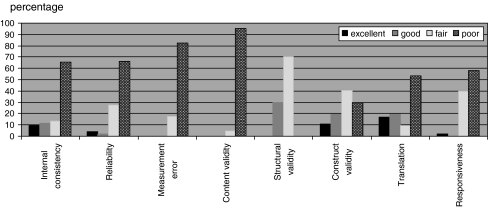
BACKGROUND: The COSMIN checklist is a standardized tool for assessing the methodological quality of studies on measurement properties. It contains 9 boxes, each dealing with one measurement property, with 5-18 items per box about design aspects and statistical methods. Our aim was to develop a scoring system for the COSMIN checklist to calculate quality scores per measurement property when using the checklist in systematic reviews of measurement properties. METHODS: The scoring system was developed based on discussions among experts and testing of the scoring system on 46 articles from a systematic review. Four response options were defined for each COSMIN item (excellent, good, fair, and poor). A quality score per measurement property is obtained by taking the lowest rating of any item in a box ("worst score counts"). RESULTS: Specific criteria for excellent, good, fair, and poor quality for each COSMIN item are described. In defining the criteria, the "worst score counts" algorithm was taken into consideration. This means that only fatal flaws were defined as poor quality. The scores of the 46 articles show how the scoring system can be used to provide an overview of the methodological quality of studies included in a systematic review of measurement properties. CONCLUSIONS: Based on experience in testing this scoring system on 46 articles, the COSMIN checklist with the proposed scoring system seems to be a useful tool for assessing the methodological quality of studies included in systematic reviews of measurement properties.
Overview
The claims and statistics of this paper haven’t been checked yet.
Free: it reads the open-access text and checks the first 5 claims that cite a source we can check. Create a free account to check every claim.
Integrity signals
Registry
Cites
Statistics
Figures
Verification
Claims the paper makes
The claims and statistics of this paper haven’t been checked yet.
Free: it reads the open-access text and checks the first 5 claims that cite a source we can check. Create a free account to check every claim.
Claims other papers make about this one
Each is checked against this paper’s own text: does it say what the citing paper says it does?
The source backs part of the claim, not all of it — or backs it for a different population, condition or comparison.
In the citing paper
“The sample size of this study met a standard for measurement properties (The COSMIN checklist; Terwee et al., 2012).”
From Reliability and validity of the Japanese version of the experiential avoidance in caregiving questionnaire (EACQ) (2023) · cites this paper as Terwee et al., 2012
Experimental — accuracy not yet measuredThe cited source says what the claim attributes to it.
In the citing paper
“The sample size of this study met a standard for measurement properties (The COSMIN checklist; Terwee et al., 2012).”
From Reliability and validity of the Japanese version of the Valued Living Questionnaire Adapted to Caregiving (2023) · cites this paper as Terwee et al., 2012
The cited source says what the claim attributes to it.
In the citing paper
“Third, since this study did not examine the responsiveness (Terwee et al., 2012) of the J-VLQAC, future research should assess this by examining whether the score of the J-VLQAC change through psychological intervention (e.g., ACT) for dementia family caregivers.”
From Reliability and validity of the Japanese version of the Valued Living Questionnaire Adapted to Caregiving (2023) · cites this paper as Terwee et al., 2012
The cited source says what the claim attributes to it.
In the citing paper
“This study examined the PAAQ-J’s reliability and validity according to COSMIN’s framework [27] (see also [28]).”
From Psychometric Properties of the Japanese Version of the Parental Acceptance and Action Questionnaire in Parents with Infants and Toddlers (2023) · cites this paper as [27]
Self-check
Percentages, sums and reported differences re-computed from the paper’s own numbers.
The self-check needs the paper’s full text.
Citations
Cites
GRADE: an emerging consensus on rating quality of evidence and strength of recommendations
Guyatt, G. H., Oxman, A. D., Vist, G. E., Kunz, R., Falck-Ytter, Y., Alonso-Coello, P., & Schünemann, H. J. (2008) · BMJ · doi:10.1136/bmj.39489.470347.ad · Cited by 23,305 · cited 2×
“This distinction is also increasingly being made in systematic reviews of randomized trials and diagnostic studies [13, 19].”
BackgroundMethodQuality criteria were proposed for measurement properties of health status questionnaires
Terwee, C. B., Bot, S. D. M., de Boer, M. R., van der Windt, D. A. W. M., Knol, D. L., Dekker, J., Bouter, L. M., & de Vet, H. C. W. (2007) · Journal of Clinical Epidemiology · doi:10.1016/j.jclinepi.2006.03.012 · Cited by 10,764 · cited 1×
“Other checklists that have been published, such as EMPRO [17], and a checklist we previously designed [18] were developed for rating the quality of an instrument rather than the methodological quality of a study.”
MethodSelf-citationApplied Multivariate Statistics for the Social Sciences
Stevens, J. P. (2012) · Routledge eBooks · doi:10.4324/9780203843130 · Cited by 10,648
Applied multivariate statistics for the social sciences
Stevens, J. P., & Stevens, J. P. (2001) · doi:10.4324/9781410604491 · Cited by 4,993
Mokkink, L. B., Terwee, C. B., Patrick, D. L., Alonso, J., Stratford, P. W., Knol, D. L., Bouter, L. M., & de Vet, H. C. W. (2010) · Quality of Life Research · doi:10.1007/s11136-010-9606-8 · Cited by 4,260 · cited 3×
“However, as we stated in the articles on the development of the COSMIN checklist [7, 8], what is adequate may depend on a number of issues.”
MethodSelf-citationMeasurement in Medicine: A Practical Guide
de Vet, H. C. W., Terwee, C. B., Mokkink, L. B., & Knol, D. L. (2011) · doi:10.1017/cbo9780511996214 · Cited by 2,321
Self-citationAssessing health status and quality-of-life instruments: Attributes and review criteria
Lohr, K. N. (2002) · Quality of Life Research · doi:10.1023/a:1015291021312 · Cited by 2,269
Mokkink, L. B., Terwee, C. B., Knol, D. L., Stratford, P. W., Alonso, J., Patrick, D. L., Bouter, L. M., & de Vet, H. C. (2010) · BMC Medical Research Methodology · doi:10.1186/1471-2288-10-22 · Cited by 1,834
Self-citation2009 updated method guidelines for systematic reviews in the Cochrane Back Review Group
Furlan, A. D., Pennick, V., Bombardier, C., & van Tulder, M. (2009) · Spine · doi:10.1097/brs.0b013e3181b1c99f · Cited by 1,663 · cited 1×
“In this systematic review, levels of evidence were used to rate the quality of the instruments, like is done in reviews of randomized clinical trials [13, 14 ].”
Method(2011) · Amsterdam UMC (VU Amsterdam) - Institutional Repository · Cited by 1,209
Self-citation
Research works printed but not linked: 1
- Higgins, J. P. T. & Green, S. (Eds.). (2009). Cochrane Handbook for Systematic Reviews of Interventions Version 5.0.2 [updated September 2009]. (Available from www.cochrane-handbook.org: Cochrane Collaboration).
Cited by
Items 201–300 of 1,005
Hall, A., Shoesmith, A., Doherty, E., McEvoy, B., Mettert, K., Lewis, C. C., Wolfenden, L., Yoong, S., Kingsland, M., Shelton, R. C., et al. (2022) · Implementation Science · doi:10.1186/s13012-022-01252-1 · Cited by 81
“High-quality systematic reviews on available measures, their psychometric and pragmatic properties, and how they have been empirically used are essential for providing evidence-based recommendations on which measures to use, identifying gaps in measurement and highlighting areas for future research [19].”
BackgroundGiannetta, N., Villa, G., Pennestrì, F., Sala, R., Mordacci, R., & Manara, D. F. (2020) · International Journal of Nursing Studies · doi:10.1016/j.ijnurstu.2020.103767 · Cited by 81
Kroman, S. L., Roos, E. M., Bennell, K. L., Hinman, R. S., & Dobson, F. (2013) · Osteoarthritis and Cartilage · doi:10.1016/j.joca.2013.10.021 · Cited by 87
Bergström, M., & Baviskar, S. (2021) · Journal of Evidence-Based Social Work · doi:10.1080/26408066.2020.1788477 · Cited by 80
Gagnier, J. J., Shen, Y., & Huang, H. (2018) · JBJS Reviews · doi:10.2106/jbjs.rvw.17.00114 · Cited by 80
Xu, C., Liu, Y., Jia, P., Li, L., Liu, T.-Z., Cheng, L.-L., Deng, K., Borhan, S., Thabane, L., & Sun, X. (2018) · Journal of Clinical Epidemiology · doi:10.1016/j.jclinepi.2018.11.007 · Cited by 85
Kameniar, K., Mackintosh, S. F., van Kessel, G., & Kumar, S. (2022) · Journal of Geriatric Physical Therapy · doi:10.1519/jpt.0000000000000337 · Cited by 83
Evaluation of skin ageing: a systematic review of clinical scales
Dobos, G., Lichterfeld, A., Blume-Peytavi, U., & Kottner, J. (2015) · British Journal of Dermatology · doi:10.1111/bjd.13509 · Cited by 80
A systematic review of health-related quality of life instruments in patients with cancer cachexia
Wheelwright, S. J., Darlington, A., Hopkinson, J. B., Fitzsimmons, D. F., White, A., & Johnson, C. D. (2013) · Supportive Care in Cancer · doi:10.1007/s00520-013-1881-9 · Cited by 92
“Papers addressing HRQOL instrument development were evaluated by SW and AW using the consensus-based standards for the selection of health status measurement instruments (COSMIN) [22].”
MethodInfluentialPowell, B. J., Mettert, K. D., Dorsey, C. N., Weiner, B. J., Stanick, C. F., Lengnick-Hall, R., Ehrhart, M. G., Aarons, G. A., Barwick, M. A., Damschroder, L. J., et al. (2021) · Implementation Research and Practice · doi:10.1177/26334895211018862 · Cited by 79
“This is more reflective of the range of measure performance than often used “top score” or “worst score counts” methods (Lewis et al., 2015; Terwee et al., 2012).”
MethodNgueleu, A.-M., Barthod, C., Best, K. L., Routhier, F., Otis, M. J.-D., & Batcho, C. S. (2022) · Journal of NeuroEngineering and Rehabilitation · doi:10.1186/s12984-022-01085-5 · Cited by 81
“First, the COSMIN grid (“consensusbased standards for the selection of health measurement instruments”) [42] was used to critically appraise the quality of the criterion validity [box H]).”
MethodA psychometric systematic review of self‐report instruments to identify anxiety in pregnancy
Evans, K., Spiby, H., & Morrell, C. J. (2015) · Journal of Advanced Nursing · doi:10.1111/jan.12649 · Cited by 74
“Brouwers et al. (2001) and Pop et al. (2011) provided a full explanation of how missing items were handled and received an ‘excellent’ overall score (Terwee et al. 2012) (Table 3).”
BackgroundMethodInfluentialGorrie, F., Goodall, K., Rush, R., & Ravenscroft, J. (2019) · PLoS ONE · doi:10.1371/journal.pone.0214290 · Cited by 83
“For factor analysis on health questionnaires, a sample size seven times the number of items in the questionnaire, with a minimum N of 100, is recommended [55], cited in [56].”
BackgroundSystematic Review of Level 1 and Level 2 Screening Tools for Autism Spectrum Disorders in Toddlers
Petrocchi, S., Levante, A., & Lecciso, F. (2020) · Brain Sciences · doi:10.3390/brainsci10030180 · Cited by 74
“According to [31], the sample size is evaluated as excellent when it is≥ 100, as good when it ranges 50-99, fair when it ranges 30-49 is fair, and poor when it is < 30.”
BackgroundMethodInfluentialWong, C. K. H., Lang, B. H. H., & Lam, C. L. K. (2016) · Journal of Clinical Epidemiology · doi:10.1016/j.jclinepi.2016.03.006 · Cited by 78
Kotecha, D., Ahmed, A., Calvert, M., Lencioni, M., Terwee, C. B., & Lane, D. A. (2016) · PLoS ONE · doi:10.1371/journal.pone.0165790 · Cited by 83
“The COSMIN taxonomy was developed after an international Delphi study [13], using a consensus of terminology across validation studies and allowing standardized objective assessment of measurement properties.”
InfluentialSelf-citationThé, B., Reininga, I. H. F., Moumni, M. E., & Eygendaal, D. E. (2013) · Journal of Shoulder and Elbow Surgery · doi:10.1016/j.jse.2013.04.013 · Cited by 78
Evaluating the Clinical COPD Questionnaire: A systematic review
Zhou, Z., Zhou, A., Zhao, Y., & Chen, P. (2017) · Respirology · doi:10.1111/resp.12970 · Cited by 77
Denteneer, L., Stassijns, G., Hertogh, W. D., Truijen, S., & Daele, U. V. (2016) · Archives of Physical Medicine and Rehabilitation · doi:10.1016/j.apmr.2016.07.020 · Cited by 83
Drake, D., Kennedy, R. A., & Wallace, E. S. (2017) · Sports Medicine - Open · doi:10.1186/s40798-017-0091-2 · Cited by 87
“The updated Consensus-based Standards for the Selection of health Measurement Instruments (COSMIN) checklist [22] was applied as a method to critique the methodological quality and rating of measurement properties of individual research articles.”
MethodStjernfeldt, P. E., Sjögren, P., Wårdh, I., & Boström, A. (2019) · Clinical and Experimental Dental Research · doi:10.1002/cre2.154 · Cited by 76
Validation of the Dutch language version of the Foot and Ankle Outcome Score
Sierevelt, I. N., Beimers, L., van Bergen, C. J. A., Haverkamp, D., Terwee, C. B., & Kerkhoffs, G. M. M. J. (2014) · Knee Surgery Sports Traumatology Arthroscopy · doi:10.1007/s00167-014-3017-2 · Cited by 79
Self-citationFatigue in Child Chronic Health Conditions: A Systematic Review of Assessment Instruments
Crichton, A. J., Knight, S., Oakley, E. A., Babl, F. E., & Anderson, V. A. (2015) · PEDIATRICS · doi:10.1542/peds.2014-2440 · Cited by 86
Qadri, T., Javed, F., Johannsen, G., & Gustafsson, A. K. (2015) · Photomedicine and Laser Surgery · doi:10.1089/pho.2015.3914 · Cited by 76
“The following criteria were used for assessing the methodological quality of the studies included in the present review 26 : Grade A (High)—”
Silva, P. F. S., Quintino, L. F., Franco, J., & Faria, C. D. C. D. M. (2014) · Brazilian Journal of Physical Therapy · doi:10.1590/s1413-35552012005000155 · Cited by 87
Fiore, J. F., Figueiredo, S. M., Balvardi, S., Lee, L., Nauche, B., Landry, T., Mayo, N. E., & Feldman, L. S. (2017) · Annals of Surgery · doi:10.1097/sla.0000000000002415 · Cited by 87
Soriano‐Vidal, F. J., Oliver‐Roig, A., Cabrero‐García, J., Congost‐Maestre, N., Dencker, A., & Richart‐Martínez, M. (2016) · BMC Pregnancy and Childbirth · doi:10.1186/s12884-016-1100-z · Cited by 86
“Although the CFA of the original structure indicated marginal fit statistics, the proposed Spanish version, in which item 18 was moved from the “perceived safety” to the “professional support” dimension, showed fit statistics in line with standard recommendations [29].”
BackgroundMethodResultInfluentialAssessment of body composition in children with cerebral palsy: a cross‐sectional study in N orway
Finbråten, A., Martins, C., Andersen, G. L., Skranes, J. S., Brannsether, B., Júlíusson, P. B., Syversen, U., Stevenson, R. D., & Vik, T. (2015) · Developmental Medicine & Child Neurology · doi:10.1111/dmcn.12752 · Cited by 74
“The goal was to include 50 children in the study, in accordance with the Consensusbased Standards for the Selection of Health Measurement Instruments checklist.(12) Among the 64 children invited, 52 (80%) agreed to participate (20 females, 32 males) and were examined by one of the authors (A-KF), and from these we obt…”
MethodAspden, T., Bradshaw, S., Playford, E. D., & Riazi, A. (2014) · Age and Ageing · doi:10.1093/ageing/afu089 · Cited by 74
Factor Analysis and Item Reduction of the Banff Patella Instability Instrument (BPII)
Lafave, M. R., Hiemstra, L. A., & Kerslake, S. (2016) · The American Journal of Sports Medicine · doi:10.1177/0363546516644605 · Cited by 75
“One of the few incomplete metrics on the COSMIN checklist is testing the structural validity of the BPII through factor analysis.(14,15,23) Completing the factor analysis and item reduction is important for a number of reasons.”
MethodBatchelor, J., Tan, W., Tour, S. K., Yong, A., Montgomery, A. A., & Thomas, K. S. (2015) · British Journal of Dermatology · doi:10.1111/bjd.14208 · Cited by 72
Clinical assessment of effusion in knee osteoarthritis—A systematic review
Maricar, N., Callaghan, M. J., Parkes, M. J., Felson, D. T., & O’Neill, T. W. (2015) · Seminars in Arthritis and Rheumatism · doi:10.1016/j.semarthrit.2015.10.004 · Cited by 72
“For publications evaluating reliability of the clinical tests for knee joint effusion, study quality was graded using the “reliability” section of COnsensus-based Standards for the selection of health Measurement INstruments (COSMIN) with close reference to a separate publication which provided detailed description of…”
MethodKupeli, N., Candy, B., Tamura-Rose, G., Schofield, G., Webber, N., Hicks, S. E., Floyd, T., Vivat, B., Sampson, E. L., Stone, P. C., et al. (2018) · Patient · doi:10.1007/s40271-018-0328-2 · Cited by 72
Legal Consciousness: A Systematic Review of its Conceptualization and Measurement Methods1
Horák, F., Lacko, D., & Klocek, A. (2020) · Anuario de Psicología Jurídica · doi:10.5093/apj2021a2 · Cited by 87
“Moreover, the systematic review is useful for the selection of an optimal specific measurement method (Terwee et al., 2012), which is one of the primary goals of this article.”
BackgroundNoben, C. Y. G., Evers, S., Nijhuis, F. J. N., & de Rijk, A. E. (2014) · BMC Public Health · doi:10.1186/1471-2458-14-115 · Cited by 77
“The methodological quality was determined per study for each measurement property separately by taking the lowest rating of the items to that measurement property in each box (worse score counts) [14].”
Systematic review of cost‐of‐illness studies in hand eczema
Politiek, K., Oosterhaven, J. A. F., Vermeulen, K. M., & Schuttelaar, M. L. A. (2016) · Contact Dermatitis · doi:10.1111/cod.12590 · Cited by 72
Development and psychometric evaluation of postgraduate nursing student academic satisfaction scale
Rahmatpour, P., Peyrovi, H., & Nia, H. S. (2020) · Nursing Open · doi:10.1002/nop2.727 · Cited by 75
Patient reported outcomes and patient empowerment in clinical genetics services
McAllister, M., & Dearing, A. (2014) · Clinical Genetics · doi:10.1111/cge.12520 · Cited by 80
“However, both are key properties of any questionnaire to be used as a PROM; without demonstrable reliability and responsiveness, a PROM will not be fit for purpose (29, 30).”
BackgroundTarara, D. T., Fogaca, L. K., Taylor, J. B., & Hegedus, E. J. (2015) · British Journal of Sports Medicine · doi:10.1136/bjsports-2015-095198 · Cited by 75
Salbach, N. M., O’Brien, K. K., Brooks, D., Irvin, E., Martino, R., Takhar, P., Chan, S., & Howe, J.-A. (2016) · Neurology Report · doi:10.1097/npt.0000000000000159 · Cited by 71
Reliability and validity of the Vitiligo Signs of Activity Score (VSAS)
van Geel, N., Passeron, T., Wolkerstorfer, A., Speeckaert, R., & Ezzedine, K. (2020) · British Journal of Dermatology · doi:10.1111/bjd.18950 · Cited by 70
García-Bernal, M.-I., Heredia‐Rizo, A. M., González-García, P., Cortés-Vega, M.-D., & Casuso-Holgado, M. J. (2021) · Scientific Reports · doi:10.1038/s41598-021-84656-1 · Cited by 75
Suica, Z., Behrendt, F., Gäumann, S., Gerth, U., Schmidt‐Trucksäss, A., Ettlin, T. M., & Schuster‐Amft, C. (2022) · BMC Medicine · doi:10.1186/s12916-022-02295-3 · Cited by 80
Hall, A. M., Kamper, S. J., Hernon, M., Hughes, K., Kelly, G. A., Lonsdale, C., Hurley, D. A., & Ostelo, R. (2014) · Archives of Physical Medicine and Rehabilitation · doi:10.1016/j.apmr.2014.07.405 · Cited by 78
Self-citationDorfman, T. L., Sumamo, E., Rempel, G. R., Scott, S. D., & Hartling, L. (2013) · International Journal of Nursing Studies · doi:10.1016/j.ijnurstu.2013.07.009 · Cited by 70
Factors Influencing the Reliability of the Glasgow Coma Scale: A Systematic Review
Reith, F. C. M., Synnot, A., den Brande, R. V., Gruen, R. L., & Maas, A. I. R. (2017) · Neurosurgery · doi:10.1093/neuros/nyw178 · Cited by 79
Chiarotto, A., Terwee, C. B., Kamper, S. J., Boers, M., & Ostelo, R. W. (2018) · Journal of Clinical Epidemiology · doi:10.1016/j.jclinepi.2018.05.006 · Cited by 69
Self-citationDetecting Delirium: A Systematic Review of Identification Instruments for Non‐ICU Settings
Helfand, B., D’Aquila, M., Tabloski, P. A., Erickson, K., Yue, J., Fong, T. G., Hshieh, T. T., Metzger, E. D., Schmitt, E. M., Boudreaux, E. D., et al. (2020) · Journal of the American Geriatrics Society · doi:10.1111/jgs.16879 · Cited by 77
“The ratings on each of the COSMIN criteria were summed and reported as a 0 to 6 score (Supplement C), using an adaptation of the COSMIN scoring procedure published previously.(19,20) For reporting on each of these categories the instruments were given one point; failure to report on these categories resulted in no poi…”
MethodReliability of physical functioning tests in patients with low back pain: a systematic review
Denteneer, L., Daele, U. V., Truijen, S., Hertogh, W. D., Meirte, J., & Stassijns, G. (2017) · The Spine Journal · doi:10.1016/j.spinee.2017.08.257 · Cited by 78
Audag, N., Goubau, C., Toussaint, M., & Reychler, G. (2019) · Therapeutic Advances in Chronic Disease · doi:10.1177/2040622318821622 · Cited by 69
Bandholm, T., Christensen, R., Thorborg, K., Treweek, S. P., & Henriksen, M. (2017) · British Journal of Sports Medicine · doi:10.1136/bjsports-2017-097527 · Cited by 72
Test–Retest Reliability of Handgrip Strength Measurement in Children and Preadolescents
Gąsior, J. S., Pawłowski, M., Jeleń, P., Rameckers, E. A. A., Williams, C. A., Makuch, R., & Werner, B. (2020) · International Journal of Environmental Research and Public Health · doi:10.3390/ijerph17218026 · Cited by 73
“participants included in these analyses, allows us to specify this study as excellent [36].”
BackgroundMethodØsterås, N., Garratt, A., Grotle, M., Natvig, B., Kjeken, I., Kvien, T. K., & Hagen, K. B. (2013) · Arthritis Care & Research · doi:10.1002/acr.21976 · Cited by 75
“In these analyses, the smallest group size was 6 subjects, but for all other contrasting groups, the number was between 33 and 309, which is regarded as fair to excellent in validity analyses (35).”
BackgroundAbma, I. L., van der Wees, P. J., Veer, V., Westert, G. P., & Rovers, M. M. (2015) · Sleep Medicine Reviews · doi:10.1016/j.smrv.2015.07.006 · Cited by 69
Systematic Review of Existential Anxiety Instruments
van Bruggen, V., Vos, J., Westerhof, G., Bohlmeijer, E., & Glas, G. (2015) · Journal of Humanistic Psychology · doi:10.1177/0022167814542048 · Cited by 54
“As recommended by Terwee et al. (2012) a 4-point scale, poor, fair, good, excellent , was used, applying the worst score counts principle.”
Heinl, D., Prinsen, C. A. C., Deckert, S., Chalmers, J. R., Drucker, A. M., Ofenloch, R. F., Humphreys, R., Sach, T., Chamlin, S. L., Schmitt, J. M., et al. (2015) · Allergy · doi:10.1111/all.12806 · Cited by 72
Carrozzino, D. (2019) · Progress in Neuro-Psychopharmacology and Biological Psychiatry · doi:10.1016/j.pnpbp.2019.109641 · Cited by 66
Validation of the Dutch version of the Simple Shoulder Test
van Kampen, D. A., van Beers, L. W. A. H., Scholtes, V. A., Terwee, C. B., & Willems, W. J. (2011) · Journal of Shoulder and Elbow Surgery · doi:10.1016/j.jse.2011.09.026 · Cited by 73
Self-citationFrancis, D. O., Patel, D. A., Sharda, R., Yancey, K. L., Sathe, N. A., Penson, D. F., Feurer, I. D., McPheeters, M. L., & Vaezi, M. F. (2016) · Otolaryngology · doi:10.1177/0194599816664330 · Cited by 75
“This is problematic since nearly all published instruments purport some degree of these attributes, most often as forms of reliability or validity.(15) The aim of the present study was to perform a comprehensive systematic review of the literature on LPR-related PRO measures and to rigorously evaluate each measure’s d…”
MethodHøjgaard, P., Klokker, L., Orbai, A., Holmsted, K., Bartels, E. M., Leung, Y. Y., Goel, N., de Wit, M. P. T., Gladman, D. D., Mease, P. J., et al. (2017) · Seminars in Arthritis and Rheumatism · doi:10.1016/j.semarthrit.2017.09.002 · Cited by 71
Self-citationTschirren, L., Bauer, S., Hanser, C., Marsico, P., Sellers, D., & van Hedel, H. J. A. (2018) · Developmental Medicine & Child Neurology · doi:10.1111/dmcn.13751 · Cited by 67
“According to the Consensus-based Standards for the Selection of Health Measurement Instruments guidelines for psychometric studies, a sample size of at least 50 participants was required to provide good methodological quality.(13)”
MethodWeiner, B. J., Mettert, K. D., Dorsey, C. N., Nolen, E. A., Stanick, C., Powell, B. J., & Lewis, C. C. (2020) · Implementation Research and Practice · doi:10.1177/2633489520933896 · Cited by 58
“negative assessment of a PAPERS property than the “worst counts” approach wherein a PAPERS property is assigned the lowest rating for that property when there are multiple ratings (Lewis et al., 2015; Terwee et al., 2012).”
BackgroundPatel, V., Orchanian‐Cheff, A., & Wu, R. C. (2021) · JMIR mhealth and uhealth · doi:10.2196/17411 · Cited by 71
“We rated the quality of each dimension as excellent, good, fair, or poor based on a priori modifications to the COSMIN validation subscale for scoring criteria that are appropriate for accuracy studies (Multimedia Appendix 2) [28].”
MethodPsychometric properties of four fear of falling rating scales in people with Parkinson’s disease
Jonasson, S. B., Nilsson, M. H., & Lexell, J. E. (2014) · BMC Geriatrics · doi:10.1186/1471-2318-14-66 · Cited by 70
“To reach a ‘good sample size’ according to recommendations for methodological quality and test-retest reliability analysis [20], we aimed at 50 to 99 participants with FOF total scores at both t1 and t2.”
Measuring medicine-related experiences from the patient perspective: a systematic review
Katusiime, B., Corlett, S. A., Reeve, J. L., & Krska, J. (2016) · Patient Related Outcome Measures · doi:10.2147/prom.s102198 · Cited by 74
Posttraumatic stress disorder and tobacco use: A systematic review and meta-analysis
Pericot‐Valverde, I., Elliott, R. J., Miller, M. E., Tidey, J. W., & Gaalema, D. E. (2018) · Addictive Behaviors · doi:10.1016/j.addbeh.2018.04.024 · Cited by 74
“, 2007) had an adequate sample size (n ≥ 100), based on the Consensus-based Standards for the Selection of Health Measurement Instruments guidelines (Terwee et al., 2012) (Feldner, Babson, & Zvolensky, 2007) enrolled adults aged ≥18, (Kelly, Jensen, & Sofuoglu, 2015) included those with current or lifetime diagnosis o…”
MethodSharawi, N., Klima, L., Shah, R., Blake, L., Carvalho, B., & Sultan, P. (2019) · Anaesthesia · doi:10.1111/anae.14807 · Cited by 68
van Lieshout, R., Reijneveld, E. A. E., Berg, S., Haerkens, G. M., Koenders, N., de Leeuw, A. J., van Oorsouw, R., Paap, D., Scheffer, E., Weterings, S., et al. (2016) · Europe PMC (PubMed Central) · Cited by 65
Turnbull, A. E., Dinglas, V. D., Friedman, L. A., Chessare, C. M., Sepúlveda, K. A., Bingham, C. O., & Needham, D. M. (2018) · Journal of Clinical Epidemiology · doi:10.1016/j.jclinepi.2018.06.007 · Cited by 63
“When psychometric evaluations of the instrument had been performed in the target population, the measure card included the results of that evaluation, as well as an assessment of any such evaluation using the COnsensus-based Standards for the selection of health Measurement Instruments (COSMIN) initiative checklist[14…”
MethodAvaliação Psicológica no Brasil e no Mundo
Bueno, J. M. H., & Peixoto, E. M. (2018) · Psicologia Ciência e Profissão · doi:10.1590/1982-3703000208878 · Cited by 83
McLean, S. M., Holden, M. A., Potia, T., Gee, M., Mallett, R., Bhanbhro, S., Parsons, H. M., & Haywood, K. L. (2016) · Rheumatology · doi:10.1093/rheumatology/kew422 · Cited by 74
“Although six studies were adequately sized for evaluative purposes (range 145 (cid:2) 249) [34], four included fewer than 100 patients [22, 40, 45, 47].”
InfluentialLimperg, P. F., Terwee, C. B., Young, N. L., Price, V. E., Gouw, S. C., Peters, M., Grootenhuis, M. A., Blanchette, V. S., & Haverman, L. (2017) · Haemophilia · doi:10.1111/hae.13197 · Cited by 72
“Each item was scored on a 4-point rating scale (‘excellent’, ‘good, ‘fair or ‘poor’) [26].”
BackgroundMethodInfluentialSelf-citationGouw, S. C., Timmer, M. A., Srivastava, A., de Kleijn, P., Hilliard, P., Peters, M., Blanchette, V. S., & Fischer, K. (2018) · Haemophilia · doi:10.1111/hae.13631 · Cited by 63
Sultan, P., Ando, K., Elkhateb, R., George, R. B., Lim, G., Carvalho, B., Chitneni, A., Kawai, R., Tulipan, T., Blake, L., et al. (2022) · JAMA Network Open · doi:10.1001/jamanetworkopen.2022.14885 · Cited by 67
Hendrikx, J., de Jonge, M. J., Fransen, J., Kievit, W., & van Riel, P. L. (2016) · RMD Open · doi:10.1136/rmdopen-2015-000202 · Cited by 65
“checklists with a four-point rating scale ranging from poor to excellent.(18) Each measurement property, out of a possible 10, was scored in a separate box containing”
BackgroundHeinl, D., Prinsen, C. A. C., Sach, T., Drucker, A. M., Ofenloch, R. F., Flohr, C., & Apfelbacher, C. (2017) · British Journal of Dermatology · doi:10.1111/bjd.14966 · Cited by 64
The measurement properties of pediatric observational pain scales: A systematic review of reviews
Andersen, R. D., Langius‐Eklöf, A., Nakstad, B., Bernklev, T., & Jylli, L. (2017) · International Journal of Nursing Studies · doi:10.1016/j.ijnurstu.2017.05.010 · Cited by 66
Haywood, K. L., Pearson, N. A., Morrison, L. J., Castrén, M. K., Lilja, G., & Perkins, G. D. (2017) · Resuscitation · doi:10.1016/j.resuscitation.2017.11.065 · Cited by 64
Fogel, Y., Stuart, N. J., Joyce, T., & Barnett, A. L. (2021) · Scandinavian Journal of Occupational Therapy · doi:10.1080/11038128.2021.2019306 · Cited by 72
“To assess the methodological quality of the assessments included in the reviewed articles, we applied the Consensus-Based Standards for the Selection of Health Measurement Instruments (COSMIN) checklist [48].”
MethodMeasurement of visual ability in children with cerebral palsy: a systematic review
Denver, B. D., Froude, E., Rosenbaum, P., Wilkes‐Gillan, S., & Imms, C. (2016) · Developmental Medicine & Child Neurology · doi:10.1111/dmcn.13139 · Cited by 63
“The visual acuity and visual perceptual measures commonly used in these validation studies do not measure the same construct as visual ability or functioning in vision-related activities, and while positive correlations could be expected, a priori hypotheses that specify both the direction and the strength of the anti…”
MethodToner, P., Boehnke, J. R., Andersen, P., & McCambridge, J. (2019) · Drug and Alcohol Dependence · doi:10.1016/j.drugalcdep.2019.01.030 · Cited by 64
Oliveira, C. C., Lee, A. L., Granger, C. L., Miller, K. J., Irving, L. B., & Denehy, L. (2013) · Archives of Physical Medicine and Rehabilitation · doi:10.1016/j.apmr.2013.04.012 · Cited by 69
Tian, L., Cao, X., & Feng, X. (2019) · PLoS ONE · doi:10.1371/journal.pone.0210242 · Cited by 63
Powell, P. A., Carlton, J., Woods, H. B., & Mazzone, P. (2020) · Health and Quality of Life Outcomes · doi:10.1186/s12955-020-01511-z · Cited by 64
ADAIR, B., SAID, C. M., RODDA, J., & MORRIS, M. E. (2012) · Developmental Medicine & Child Neurology · doi:10.1111/j.1469-8749.2012.04284.x · Cited by 58
“Since the original design, further modifications have been made to the scoring system of the COSMIN which may have improved the reliability of the tool.(29) Although the COSMIN was initially developed to evaluate questionnaires or healthrelated patient-reported outcomes, the team who developed it have also suggested t…”
MethodRainey, L., van Nispen, R. M. A., van der Zee, C., & van Rens, G. H. M. B. (2014) · Quality of Life Research · doi:10.1007/s11136-014-0743-3 · Cited by 66
“The COSMIN checklist (with a four-point scale) was used to evaluate and calculate overall methodological quality scores per study on a measurement property [25].”
MethodConijn, A. P., Jens, S. R. J., Terwee, C. B., Breek, J. C., & Koelemay, M. J. W. (2015) · European Journal of Vascular and Endovascular Surgery · doi:10.1016/j.ejvs.2014.12.002 · Cited by 59
Self-citationVargas, A. I. C., & Gabel, C. P. (2013) · Health and Quality of Life Outcomes · doi:10.1186/1477-7525-11-126 · Cited by 63
Measurement properties of mental health literacy tools measuring help-seeking: a systematic review*
Wei, Y., McGrath, P. J., Hayden, J. A., & Kutcher, S. (2017) · Journal of Mental Health · doi:10.1080/09638237.2016.1276532 · Cited by 70
“First, the COSMIN checklist (Terwee et al., 2007; Terwee et al., 2012) was originally developed as the quality criteria for the measurement properties of health status questionnaires.”
BackgroundMethodInfluentialA systematic review investigating measurement properties of physiological tests in rugby
Chiwaridzo, M., Oorschot, S., Dambi, J. M., Ferguson, G. D., Bonney, E., Mudawarima, T., Tadyanemhandu, C., & Smits-Engelsman, B. C. M. (2017) · BMC Sports Science Medicine and Rehabilitation · doi:10.1186/s13102-017-0081-1 · Cited by 67
“It also provides standardised information for evaluating the quality of each item based on design requirements and statistical methods [84, 85].”
BackgroundPike, S., Lannin, N. A., Wales, K., & Cusick, A. (2018) · Australian Occupational Therapy Journal · doi:10.1111/1440-1630.12527 · Cited by 61
Edbrooke-Childs, J. H., Hayes, J., Sharples, E., Gondek, D., Stapley, E., Sevdalis, N., Lachman, P. I., & Deighton, J. (2017) · BMJ Quality & Safety · doi:10.1136/bmjqs-2017-006513 · Cited by 60
Martin, A. R., Jentzsch, T., Wilson, J. R. F., Moghaddamjou, A., Jiang, F., Rienmüller, A., Badhiwala, J. H., Akbar, M. A., Nater, A., Oitment, C. T. A., et al. (2021) · Spine · doi:10.1097/brs.0000000000003956 · Cited by 61
A comparison of methods for measuring camouflaging in autism
Hannon, B., Mandy, W., & Hull, L. (2022) · Autism Research · doi:10.1002/aur.2850 · Cited by 59
“Note that scores on individual items of the COSMIN checklist are available upon request from the corresponding author.”
MethodInfluentialThe Medical Outcome Study Social Support Survey ( MOS‐SSS ): A psychometric systematic review
Dao‐Tran, T., Lam, L. T., Balasooriya, N. N., & Comans, T. A. (2023) · Journal of Advanced Nursing · doi:10.1111/jan.15786 · Cited by 59
Granger, C. L., McDonald, C. F., Parry, S. M., Oliveira, C. C., & Denehy, L. (2013) · BMC Cancer · doi:10.1186/1471-2407-13-135 · Cited by 62
Kleinlugtenbelt, Y. V., Nienhuis, R., Bhandari, M., Goslings, J. C., Poolman, R. W., & Scholtes, V. A. B. (2016) · Bone and Joint Research · doi:10.1302/2046-3758.54.2000462 · Cited by 63
Biomarkers and Surrogate Endpoints in Uveitis: The Impact of Quantitative Imaging
Denniston, A. K., Keane, P. A., & Srivastava, S. K. (2017) · Investigative Ophthalmology & Visual Science · doi:10.1167/iovs.17-21788 · Cited by 61
Rosário, S., Azevedo, L. F., Fonseca, J. A., Nienhaus, A., Nübling, M., & da Costa, J. T. (2017) · Journal of Occupational Medicine and Toxicology · doi:10.1186/s12995-017-0170-9 · Cited by 32
“The sample size included in this study was based not only on COSMIN recommendations (excellent sample size: ≥ 100), [44] but also on the recommendations of Comrey and Lee [50] and McCullum et al.”
MethodGrobet, C. E., Marks, M., Tecklenburg, L., & Audigé, L. (2018) · Archives of Orthopaedic and Trauma Surgery · doi:10.1007/s00402-018-2933-x · Cited by 60
“Each item was rated individually on the 4-point rating scale, which includes the following options: ‘excellent’; ‘good’; ‘fair’; and ‘poor’ quality [26].”
Metadata
- Authors
- Terwee, C. B., Mokkink, L. B., Knol, D. L., Ostelo, R. W. J. G., Bouter, L. M., & de Vet, H. C. W.
- Affiliations
- Amsterdam Public Health (NL)
- Vrije Universiteit Amsterdam (NL)
- Corresponding author
- Terwee, Caroline B.
- Venue
- Quality of Life Research
- Published
- 2011-07-06
- Volume
- 21
- Issue
- 4
- Pages
- 651-657
- ISSN
- 0962-9343 (ISSN-L)
- 1573-2649
- PMC
- PMC3323819
- OpenAlex
- W2151199180
- Semantic Scholar
- 80858ac3671354dc3bf1b226c74eb8fe0513fb26
- Cited by
- 1,978
- References
- 23
- Citations by year
- 2026: 81 · 2025: 118 · 2024: 148 · 2023: 161 · 2022: 164 · 2021: 226 · 2020: 150 · 2019: 172 · 2018: 181 · 2017: 172 · 2016: 142 · 2015: 106 · 2014: 80 · 2013: 45 · 2012: 25
- FWCI
- 12.05
- Type
- journal article
- Language
- en
- Open access
- hybrid
- doi.org
- Licence
- cc-by-nc
- creativecommons.org/licenses/by-nc/2.0 (tdm)
- Locations
- Quality of Life Research (publishedVersion, cc-by-nc)
- Europe PMC (PubMed Central) (publishedVersion, cc-by-nc)
- PubMed Central (publishedVersion, cc-by-nc)
- PubMed (publishedVersion)
- Pure Amsterdam UMC (publishedVersion, other-oa)
- VU Research Portal (publishedVersion, other-oa)
- Amsterdam UMC (VU Amsterdam) - Institutional Repository (acceptedVersion, other-oa)
- Data Archiving and Networked Services (DANS) (submittedVersion, other-oa)
- Digital Academic REpository of VU University Amsterdam (Vrije Universiteit Amsterdam) (submittedVersion)
- Topics
- Social Sciences › Decision Sciences › Statistics, Probability and Uncertainty › Meta-analysis and systematic reviews
- Social Sciences › Sociology and Political Science › Delphi Technique in Research
- Health Sciences › Nursing › Research and Theory › Health Education and Validation
- Keywords
- COSMIN checklist, measurement properties, methodological quality assessment, scoring system, quality scores, systematic reviews, patient-reported outcome measures, quality standards
- MeSH terms
- Humans, Psychometrics, Quality Control, Quality of Life, Surveys and Questionnaires, Review Literature as Topic, Reproducibility of Results, Checklist
About these checks
Registry, retraction, Cites and statistics results are computed, not judged, with one exception: a printed reference that no index lists is read once by a model before it counts as a citation error. Claims are extracted by a model and kept only when their quote appears verbatim in the text; each cited source is then checked, with a model’s help, for whether it says what the claim relies on. Those verdicts can be wrong — read the claim’s quote and the cited source before relying on one.
Statistics and arithmetic are recomputed, not judged.
Confidence bands are shown only for fields calibrated on our annotated test set. None is calibrated yet, so no band is shown.
What counts as a claim ›How we measure confidence ›How we check this ›
Are you an author, or do you see a problem with this page? Request a review
Data sources
Bibliographic data: Semantic Scholar, OpenAlex, Crossref.
Contains information from the Semantic Scholar Academic Graph Datasets, made available under the ODC Attribution License (ODC-BY 1.0).
Semantic Scholar’s data is described in: Kinney, R., et al. (2023). The Semantic Scholar Open Data Platform. arXiv:2301.10140.
