

Gamification enhances student intrinsic motivation, perceptions of autonomy and relatedness, but minimal impact on competency: a meta-analysis and systematic review
Open accessThe DOI matches its Crossref record; 123 of the 125 references it cites were found in a registry or an index, and 1 are not checked yet; 1 of the 114 sources its claims cite were checked for support.
Abstract
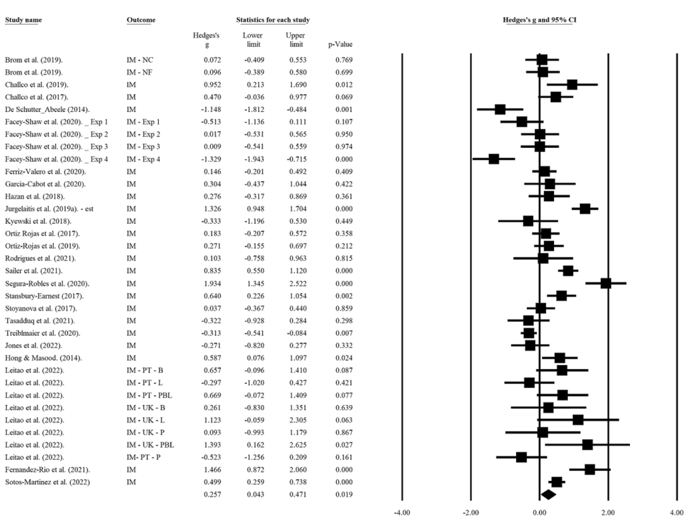
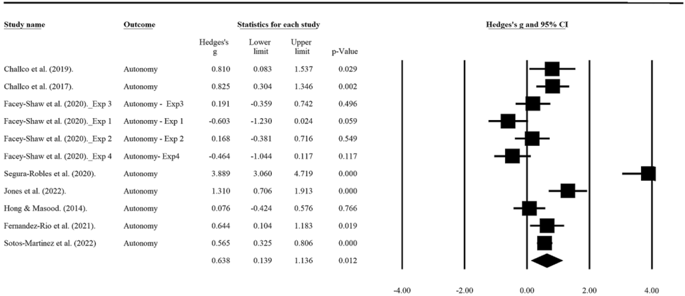
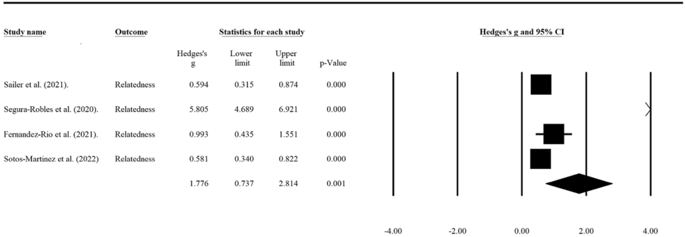
Although many studies in recent years have examined the use of gamification as a motivational strategy in education, evidence regarding its effects on intrinsic motivation is inconsistent. To make the case for or against the adoption of gamification in education, this study examines its effects on students’ intrinsic motivation and the underlying motivational factors: perceived competence, autonomy, and relatedness. In this review, we analyzed the results of studies comparing gamified learning with non-gamified learning published between 2011 and 2022. The results of our meta-analysis of 35 independent interventions (involving 2500 participants) indicated an overall significant but small effect size favoring gamified learning over learning without gamification (Hedges’g = 0.257, 95% CI [0.043, 0.471],p = .019) with no evidence of publication bias. Gamification also exerted a positive and significant effect on the students’ perceptions of autonomy (Hedges’g = 0.638, 95% CI [0.139, 1.136],p = .012) and relatedness (Hedges’g = 1.776, 95% CI [0.737, 2.814],p = .001), but minimal impact on competence (Hedges’g = 0.277, 95% CI [0.001, 0.553],p = .049). To further investigate the possible reasons for the small impact on intrinsic motivation, a systematic review of 31 studies was conducted. The findings revealed two major challenges encountered in the adoption of gamification to increase students’ intrinsic motivation: students’ lack of perceived competence and lack of perceived autonomy in gamified classes.
Verified 2026-11-25 · 1 reference not checked yet
Overview
CoChat Summary
TL;DR
This meta-analysis and systematic review compared gamified with non-gamified learning and found a small significant positive effect on intrinsic motivation, positive effects on autonomy and relatedness, but minimal impact on competence. The systematic review identified students’ lack of perceived competence and lack of perceived autonomy as major challenges in gamified classes.
Key findings
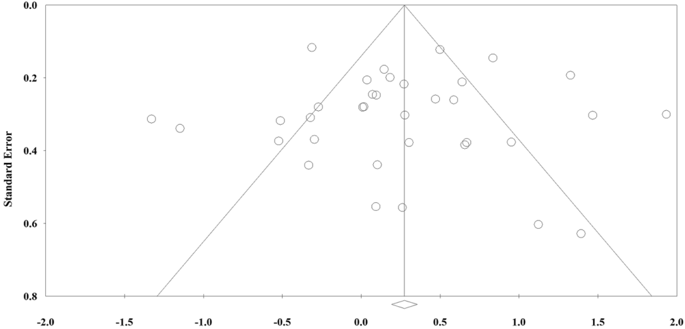
- Across 35 independent interventions involving 2,500 participants, gamification had a small significant overall effect on intrinsic motivation: Hedges’ g = 0.257, 95% CI [0.043, 0.471], p = .019; no evidence of publication bias was found (e.g., fail-safe N = 281; Egger’s regression p = .887; Begg and Mazumdar p = .820).
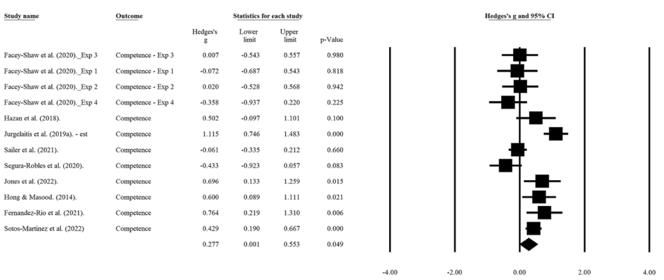
- Gamification significantly improved perceived autonomy (Hedges’ g = 0.638, 95% CI [0.139, 1.136], p = .012) and relatedness (Hedges’ g = 1.776, 95% CI [0.737, 2.814], p = .001), but had minimal impact on competence (Hedges’ g = 0.277, 95% CI [0.001, 0.553], p = .049).
- Significant moderator effects were found for reward contingency (Q = 99.486, p = .000), intervention duration (Q = 9.509, df = 4, p = .050), and instructor equivalence (Q = 12.596, df = 2, p = .002); same-instructor studies had g = 0.613 versus different-instructor studies g = −0.143, and 1–3 month interventions had g = 0.610 versus ≥1 semester g = −0.068.
- The systematic review of 31 studies found two main challenges: lack of perceived competence (e.g., discomfort among lowest-ranked participants on public absolute leaderboards, 23%; unsuitable task difficulty, 10%; unfamiliarity with gamification elements, 10%) and lack of perceived autonomy (e.g., lack of autonomy in choosing learning content and activities, 19%).
Methods
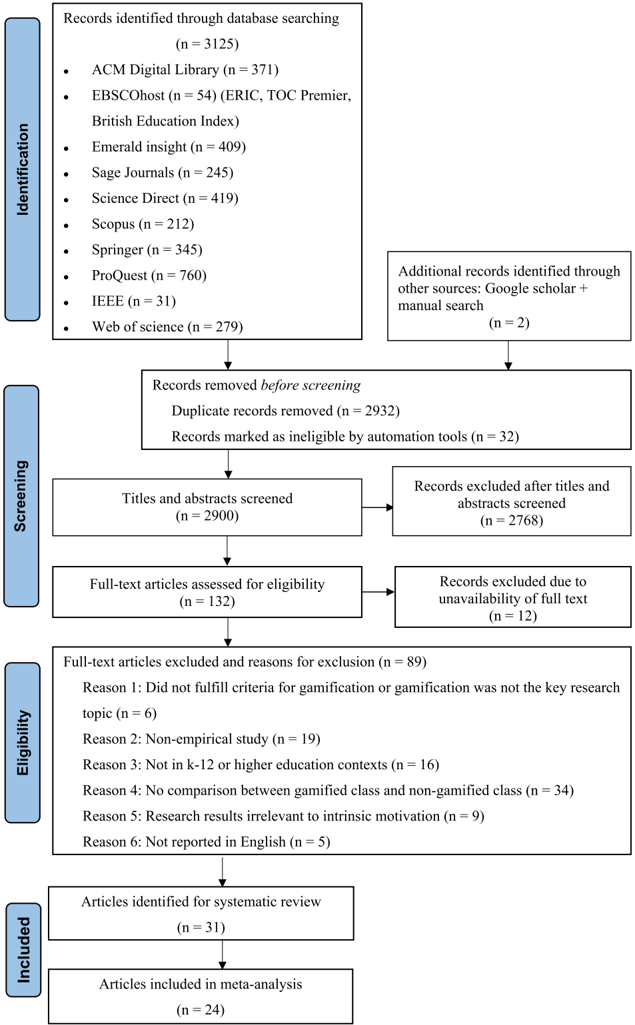
- PRISMA-guided search of 10 electronic databases for English-language studies published January 2011–October 2022 in K-12 or higher education; 3,125 records were retrieved, 132 full-text articles were eligible, 31 articles were included, and 24 provided sufficient data for meta-analysis, yielding 35 independent gamified classroom interventions and 2,500 participants.
- Meta-analysis used random effects models and Hedges’ g in Comprehensive Meta-Analysis v4; heterogeneity was assessed with Q and I², moderator analyses covered participant, course, control, game-element, reward, and reward-contingency variables, and publication bias was assessed via funnel plot, classic fail-safe N, Egger’s regression, and Begg and Mazumdar’s rank correlation.
- Systematic review used self-determination theory to code qualitative findings; the first author coded all articles using a constant-comparative approach, the second author independently coded 20%, and data-extraction inter-coder reliability was 98%.
Limitations
- Stated: many included studies had missing information or unclear reporting (e.g., insufficient statistical data); self-reports were the most common measurement approach and may reduce objectivity; moderator coding relied on information explicitly reported in original articles, with unreported variables coded as not available.
- Evident from the text: the relatedness meta-analysis was based on only 4 independent interventions, and competence and autonomy on 12 and 11 respectively; heterogeneity was substantial (I² = 83.527%), and a substantial part of heterogeneity could not be explained by the moderators investigated.
- Evident from the text: many studies did not report instructor equivalence (18 of 35 interventions in the instructor-equivalence analysis), and no included study assessed intrinsic motivation by monitoring free-choice behavior.
Model-written summary. Check it against the paper before relying on it.
Integrity signals
Registry
Cites
Statistics
Figures
Verification
Claims the paper makes
1 Valid · 0 Not valid · 74 Not checked · 75 Own results and interpretations
The cited sources support only part of this claim — read each source’s verdict below.
In the paper
“Questions that exceeded the students' expected difficulty, combined with negative feedback, also undermined their competence needs (e.g., Sailer & Sailer, 2021).”
§ Gamification enhances student intrinsic motivation, perceptions of autonomy and relatedness, but minimal impact on competency: a meta-analysis and systematic review > RQ4. What are the current challenges that gamification research must address?
What the sources say
- Partly supportedcites Sailer & Sailer, 2021 matched to “Gamification of in‐class activities in flipped classroom lectures” (2021) sourceExperimental — accuracy not yet measured
The Discussion (pp. 86-87) does say that negative feedback tends to diminish perceived competence and that this 'can be the case here as the item difficulty was higher than expected', and that negative feedback can be experienced as controlling, further diminishing competence need satisfaction — so the combination of over-difficult questions plus negative feedback and competence is the paper's own explanation. However, the paper states this only as a hedged interpretation ('can be the case here', 'we might have failed to provide optimal challenges'), while its measured result (Motivational outcomes, p. 85) showed no significant difference in competence need satisfaction between gamification and control (M = 4.03 vs 4.11, p = .67, g = -.06), contradicting Hypothesis 2.2; the underlying principle is also credited to Deci, Ryan & Williams (1996). The citing sentence therefore presents as a demonstrated undermining what this source offers as a possible explanatory mechanism. (LLM, conf=0.78)
plainstates a cause- Asserted: passes — The authors put it forward as true.
- Checkable: passes — It can be checked against evidence.
- Load-bearing: unclear — It is unclear whether the paper’s conclusions depend on it.
- Based: passes — The paper gives a reason why it holds.
- Partly supported
A result the paper reports from its own data — it cites no other source for it, so there is none to check. The quote shows it is in the paper.
In the paper
“The results of our meta-analysis of 35 independent interventions (involving 2500 participants) indicated an overall significant but small effect size favoring gamified learning over learning without gamification (Hedges' g = 0.257, 95% CI [0.043, 0.471], p = .019)”
§ Gamification enhances student intrinsic motivation, perceptions of autonomy and relatedness, but minimal impact on competency: a meta-analysis and systematic review > Abstract
hedgedstates a causen = 2,500 ·- Asserted: passes — The authors put it forward as true.
- Checkable: passes — It can be checked against evidence.
- Load-bearing: passes — The paper’s conclusions depend on it.
- Based: passes — The paper gives a reason why it holds.
A result the paper reports from its own data — it cites no other source for it, so there is none to check. The quote shows it is in the paper.
In the paper
“and relatedness (Hedges' g = 1.776, 95% CI [0.737, 2.814], p = .001)”
§ Gamification enhances student intrinsic motivation, perceptions of autonomy and relatedness, but minimal impact on competency: a meta-analysis and systematic review > Abstract
plainstates a causen = 2,500 ·- Asserted: passes — The authors put it forward as true.
- Checkable: passes — It can be checked against evidence.
- Load-bearing: passes — The paper’s conclusions depend on it.
- Based: passes — The paper gives a reason why it holds.
A result the paper reports from its own data — it cites no other source for it, so there is none to check. The quote shows it is in the paper.
In the paper
“but minimal impact on competence (Hedges' g = 0.277, 95% CI [0.001, 0.553], p = .049).”
§ Gamification enhances student intrinsic motivation, perceptions of autonomy and relatedness, but minimal impact on competency: a meta-analysis and systematic review > Abstract
plainn = 2,500 ·- Asserted: passes — The authors put it forward as true.
- Checkable: passes — It can be checked against evidence.
- Load-bearing: passes — The paper’s conclusions depend on it.
- Based: passes — The paper gives a reason why it holds.
A result the paper reports from its own data — it cites no other source for it, so there is none to check. The quote shows it is in the paper.
In the paper
“Gamification also exerted a positive and significant effect on the students' perceptions of autonomy (Hedges' g = 0.638, 95% CI [0.139, 1.136], p = .012)”
§ Gamification enhances student intrinsic motivation, perceptions of autonomy and relatedness, but minimal impact on competency: a meta-analysis and systematic review > Abstract
plainstates a causen = 2,500 ·- Asserted: passes — The authors put it forward as true.
- Checkable: passes — It can be checked against evidence.
- Load-bearing: passes — The paper’s conclusions depend on it.
- Based: passes — The paper gives a reason why it holds.
72 more claims
Create a free account to see all 150 claims and to verify the 107 references still open.
- Probably not a substantial claim. 54
- It may state two separate claims as one. 31
- The quote only partly states this claim. 3
Self-check
Percentages, sums and reported differences re-computed from the paper’s own numbers.
Each contradiction between two passages listed here was confirmed by an independent check.
Rated minor: it would not touch a result — a value no result rests on, a p-value that stays on the same side of the significance level, or a conflict that is clerical, resolved elsewhere in the paper, or outside its own findings.
In the paper
§ Gamification enhances student intrinsic motivation, perceptions of autonomy and relatedness, but minimal impact on competency: a meta-analysis and systematic review > RQ3: What is the effect of gamification on the basic psychological needs that contribute to intrinsic motivation?
“the effect size of the influence of gamification on perceived competence was marginally significant (Hedges' g = 0.277, 95% CI [0.001, 0.553], p = 0.049)”
§ Gamification enhances student intrinsic motivation, perceptions of autonomy and relatedness, but minimal impact on competency: a meta-analysis and systematic review > Effect of gamification on basic psychological needs
“the results showed that the gamification interventions did not satisfy the students' competence needs significantly better than non-gamified learning.”
Rated minor: it would not touch a result — a value no result rests on, a p-value that stays on the same side of the significance level, or a conflict that is clerical, resolved elsewhere in the paper, or outside its own findings.
In the paper
§ Gamification enhances student intrinsic motivation, perceptions of autonomy and relatedness, but minimal impact on competency: a meta-analysis and systematic review > Study selection
“(c) all selected studies were peerreviewed articles;”
§ Gamification enhances student intrinsic motivation, perceptions of autonomy and relatedness, but minimal impact on competency: a meta-analysis and systematic review > Search strategy
“we did not restrict our sources of papers to peer-reviewed journals and instead also included conference papers and dissertations.”
Citations
Cites
Preferred Reporting Items for Systematic Reviews and Meta-Analyses: The PRISMA Statement
Moher, D., Liberati, A., Tetzlaff, J., Altman, D. G., & The PRISMA Group (2009) · PLoS Medicine · doi:10.1371/journal.pmed.1000097 · Cited by 64,042 · cited 1×
“The Preferred Reporting Items for Systematic Reviews and Meta-analyses (PRISMA) statement guided the procedure for choosing relevant studies (Moher et al., 2009).”
Ryan, R. M., & Deci, E. L. (2000) · American Psychologist · doi:10.1037//0003-066x.55.1.68 · Cited by 54,599
Lincoln, Y. S., Guba, E. G., & Pilotta, J. J. (1985) · International Journal of Intercultural Relations · doi:10.1016/0147-1767(85)90062-8 · Cited by 45,787
The "what" and "why" of goal pursuits: Human needs and the self-determination of behavior
Deci, E. L., & Ryan, R. M. (2000) · Psychological Inquiry · doi:10.1207/s15327965pli1104_01 · Cited by 34,210 · cited 4×
“(2) Autonomy refers to psychological freedom and the volition to perform tasks (Deci & Ryan, 2000, p. 231; Van den Broeck et al., 2010; Vansteenkiste et al., 2010).”
InfluentialIntrinsic Motivation and Self-Determination in Human Behavior
Deci, E. L., & Ryan, R. M. (1985) · doi:10.1007/978-1-4899-2271-7 · Cited by 26,772 · cited 3×
“As Deci and Ryan (1985) argued, activities that are trivial or simple and therefore provide no challenge are not intrinsically interesting, even for somebody who perceives themselves to be extremely competent.”
The need to belong: Desire for interpersonal attachments as a fundamental human motivation.
Baumeister, R. F., & Leary, M. R. (1995) · Psychological Bulletin · doi:10.1037//0033-2909.117.3.497 · Cited by 23,245 · cited 1×
“It represents an individual’s underlying desire for integration into the social environment (Baumeister & Leary, 1995; Deci & Ryan, 2000, 2004).”
Intrinsic and Extrinsic Motivations: Classic Definitions and New Directions
Ryan, R. M., & Deci, E. L. (2000) · Contemporary Educational Psychology · doi:10.1006/ceps.1999.1020 · Cited by 18,666 · cited 8×
“…in learning activities is accompanied by positive effects such as improved mental health, enhanced creativity, and long-term learning outcomes (Ryan & Deci, 2000c), and intrinsic motivation increases the level of effort and quality of student input into a particular task (Cerasoli et al.,…”
InfluentialCochrane Handbook for Systematic Reviews of Interventions
(2019) · doi:10.1002/9781119536604 · Cited by 14,828
Shamseer, L., Moher, D., Clarke, M., Ghersi, D., Liberati, A., Petticrew, M., Shekelle, P., Stewart, L. A., & the PRISMA-P Group (2015) · BMJ · doi:10.1136/bmj.g7647 · Cited by 13,120 · cited 1×
“According to Shamseer et al. (2015), q-values of 0–40% indicate that heterogeneity is likely to be non-significant, 30–60% indicate moderate heterogeneity, 50% or more indicate large heterogeneity, and 75–100% indicate substantial heterogeneity.”
Research works printed but not linked: 1
- Huang, B., & Hew, K. F. (2021). Using gamification to design courses. Educational Technology & Society, 24(1), 44-63.
Cited by
Almuhanna, M. A. (2024) · Education and Information Technologies · doi:10.1007/s10639-024-13257-y · Cited by 149
The reality of the gamification methodology in Primary Education: A systematic review
Rodríguez, J. M. R., Menéndez, A. M., Alonso-García, S., & Maldonado, J. J. V. (2024) · International Journal of Educational Research · doi:10.1016/j.ijer.2024.102481 · Cited by 118
Smirani, L. K., & Yamani, H. A. (2024) · The Electronic Journal of e-Learning · doi:10.34190/ejel.22.9.3563 · Cited by 89
Design and Implementation of Educational Games: Theoretical and Practical Perspectives
Zemliansky, P., & Wilcox, D. (2010) · IGI Global eBooks · doi:10.4018/978-1-61520-781-7 · Cited by 74
A Meta‐Analysis of Gamification's Impact on Student Motivation in K‐12 Education
Kurnaz, M. F., & Koçtürk, N. (2025) · Psychology in the Schools · doi:10.1002/pits.70056 · Cited by 61
The Effects of Gamified Platforms on Enhancing Learners’ Ambition
Alrashedi, N. T., Alsulami, S. M. H., Flatah, A. I., Najmi, A. H., & Alhalafawy, W. S. (2024) · Journal of Ecohumanism · doi:10.62754/joe.v3i8.5004 · Cited by 50
Ratinho, E., Figueiredo, M., Estêvão, D., Faísca, L., & Martins, C. (2026) · Educational Psychology Review · doi:10.1007/s10648-025-10108-1 · Cited by 46
“The meta-analysis of eleven studies revealed a small-to-moderate positive effect on motivation ( g = 0.383), consistent with previous meta-analyses in general education contexts (Li et al., 2024; Sailer & Homner, 2020).”
InfluentialGyedu, F. O., Partey, P. A., Boafo, F. A., & Agbo, D. D. (2026) · SAGE Open · doi:10.1177/21582440261421375 · Cited by 41
Sudan, T., Hans, A., & Taggar, R. (2024) · Interactive Technology and Smart Education · doi:10.1108/itse-10-2023-0202 · Cited by 34
Han, J., Liu, G., & Xiang, S. (2025) · Humanities and Social Sciences Communications · doi:10.1057/s41599-025-05676-0 · Cited by 31
Maimaiti, G., & Hew, K. F. (2025) · The Internet and Higher Education · doi:10.1016/j.iheduc.2025.101042 · Cited by 31
Self-citationTowards gamification for spatial digital learning environments
Das, S., Nakshatram, S. V., Söbke, H., Hauge, J. B., & Springer, C. A. (2024) · Entertainment Computing · doi:10.1016/j.entcom.2024.100893 · Cited by 30
Huang, Y.-T., & Wang, T.-H. (2025) · Interactive Learning Environments · doi:10.1080/10494820.2024.2446538 · Cited by 28
Yeh, H., Chang, T., & Li, Y. (2025) · Journal of Services Marketing · doi:10.1108/jsm-08-2024-0423 · Cited by 28
Nasirun, H., Mulyono, S., Hapsari, A. W. D., Wiradinata, H. H., & Ratu, M. (2026) · Nurse Education in Practice · doi:10.1016/j.nepr.2026.104847 · Cited by 25
Gu, P., Cheng, Z., Cheng, M., Poggio, J. P., & Dong, Y. (2025) · Journal of Computer Assisted Learning · doi:10.1111/jcal.70011 · Cited by 24
Neuroscience-informed psychoeducation (NIPE): How brain awareness supports brain recovery
Rezapour, T., Berry, J., Cullum, C. M., Elahi, B., DeVille, D. C., Elbanna, I. M., Elsabbahy, M., Farokhnia, M., Haque, N., Jin, J., et al. (2026) · Progress in brain research · doi:10.1016/bs.pbr.2026.07.013 · Cited by 24
Determinantes de la aceptación de la gamificación en la educación superior: un modelo empírico
Queiro-Ameijeiras, C.-M., Seguí‐Mas, E., & Parreño, J. M. (2024) · RIED Revista Iberoamericana de Educación a Distancia · doi:10.5944/ried.28.1.41565 · Cited by 24
Effects of Game-Based Learning on Students’ Motivation in Chemistry: A Meta-analysis
Xu, J. J., Sun, X. F., Liu, Y. N., Zhang, S. Y., & Zhou, Q. W. (2025) · Journal of Chemical Education · doi:10.1021/acs.jchemed.4c01304 · Cited by 23
Malaysian Journal of Learning and Instruction
Bacus, R. C., Olvido, M. M., & Garcia, L. (2021) · Malaysian Journal of Learning and Instruction · doi:10.32890/mjli · Cited by 22
Zolfaghari, Z., Karimian, Z., Zarifsanaiey, N., & Farahmandi, A. Y. (2025) · BMC Medical Education · doi:10.1186/s12909-025-07511-1 · Cited by 22
Félix, C. C., & Santana, W. M. R. (2025) · Horizontes Revista de Investigación en Ciencias de la Educación · doi:10.33996/revistahorizontes.v9i39.1098 · Cited by 21
Min, S., Atan, N. A., & Habibi, A. (2025) · International Journal of Evaluation and Research in Education (IJERE) · doi:10.11591/ijere.v14i3.29858 · Cited by 20
Coelho, F., Rando, B., Bernardes, R. A., Pontífice-Sousa, P., Gonçalves, D. J. V., & Abreu, A. M. (2025) · Entertainment Computing · doi:10.1016/j.entcom.2025.101065 · Cited by 18
Zhang, Y., Wang, H., & Bao, C. (2025) · Computer Assisted Language Learning · doi:10.1080/09588221.2025.2573003 · Cited by 17
Game elements improve affect and motivation in a learning task
Huber, S. E., Edlinger, M., Lindstedt, A., Kiili, K. J. M., & Ninaus, M. (2024) · International Journal of Serious Games · doi:10.17083/ijsg.v11i4.769 · Cited by 17
A Self-Determination Theory Model of Gamified EFL Intrinsic Motivation
Luu, P. D., Nguyen, V. T. X., Do, L. C., & Nguyen, T. P. (2025) · EuroGlobal Journal of Linguistics and Language Education. · doi:10.69760/egjlle.2505005 · Cited by 16
Yigit, Y., Kioskli, K., Bishop, L. M., Chouliaras, N., Maglaras, L. A., & Janicke, H. (2024) · IEEE International Symposium on a World of Wireless, Mobile and Multimedia Networks (WoWMoM) · doi:10.1109/wowmom60985.2024.00016 · Cited by 15
Design and Development of Flash-Based Learning Media for Enhancing Students’ Learning Interest
Rasyid, F. R., Kesuma, T. A. R. P., & Karsiwan (2025) · Digital Learning Social Science and Life-course Studies · doi:10.70211/disolife.v1i1.259 · Cited by 14
Phạm, M., Nguyen, P. X. T., & Trinh, N. N. (2025) · Discover Education · doi:10.1007/s44217-025-00800-3 · Cited by 14
Zhang, H., Li, F., & Yan, H. (2024) · Interactive Learning Environments · doi:10.1080/10494820.2024.2412088 · Cited by 13
Journal of Information and Communication Technology
Mahamud, K. R. K., Din, A. M., Pa, N. C., Ahmad, F. B., Ishak, W. H. W., Ahmad, F. K., & Din, R. (2022) · Journal of Information and Communication Technology · doi:10.32890/jict · Cited by 13
Gamified-flipped English classes and L2 learners’ achievement and perceptions
Daliranfirouz, E., Amiryousefi, M., Geld, R., & Ansari, D. N. (2024) · Innovation in Language Learning and Teaching · doi:10.1080/17501229.2024.2374356 · Cited by 12
Gamification in Higher Education: A Literature Review
Saleem, A., & Mirza, B. (2024) · Pakistan Social Sciences Review · doi:10.35484/pssr.2024(8-i)17 · Cited by 12
Balón, K. J. C. (2025) · RECIMUNDO · doi:10.26820/recimundo/9.(2).abril.2025.660-674 · Cited by 12
Mauidloh, N. H., Anam, S., & Widyastuti, W. (2024) · IJORER International Journal of Recent Educational Research · doi:10.46245/ijorer.v5i4.650 · Cited by 11
Martinez, K. B. D., & Caragollla, L. D. C. S. (2025) · RECIMUNDO · doi:10.26820/recimundo/9.(2).abril.2025.812-825 · Cited by 11
Fostering Visitor Engagement Through Serious Game-Based Mediation in Small Local Museums
Chai-Arayalert, S., & Puttinaovarat, S. (2025) · Tourism and Hospitality · doi:10.3390/tourhosp6040218 · Cited by 10
Theoretical background of the game design element “chatbot” in serious games for medical education
Aster, A., Lotz, A., & Raupach, T. (2025) · Advances in Simulation · doi:10.1186/s41077-025-00341-7 · Cited by 10
Enhancing Student Engagement through AI-Driven Adaptive Learning and Gamification
Idika, S., & Saihi, S. (2025) · British Journal of Education · doi:10.37745/bje.2013/vol13n1257103 · Cited by 10
Rahimipour, M., Haghjoo, R., Mosalanejad, L., & Karimian, Z. (2025) · BMC Medical Education · doi:10.1186/s12909-025-07922-0 · Cited by 10
Gamified human resource management as a driver of employee engagement through intrinsic motivation
Zhang, X., Wang, J., Zhu, Y., & Ding, Z. (2026) · Frontiers in Psychology · doi:10.3389/fpsyg.2025.1746973 · Cited by 9
Gamified online business simulation: enhancing student motivation in entrepreneurship
Musyaffi, A. M., Oli, M. C., Mentari, M., & Afriadi, B. (2025) · Journal of Education and Learning (EduLearn) · doi:10.11591/edulearn.v19i4.22723 · Cited by 9
Benitez-Correa, C., Quiñonez-Beltran, A., & Morocho-Cuenca, E. (2025) · World Journal of English Language · doi:10.5430/wjel.v16n2p203 · Cited by 9
Effect Of Feedback On Students’ Learning At Primary Level: An Analysis
Munawar, N., Zafar, J. M., Rasheed, H. R., & Munawar, A. (2024) · Educational Administration Theory and Practice journal · Cited by 9
Yang, M., Guo, Y., Li, Z., Jiang, L., Gao, Y., Yang, S., & Zhou, Z. (2026) · Journal of Medical Internet Research · doi:10.2196/82769 · Cited by 8
Gamification in Ethnophysics and Its Impact on Digital Learning: A Systematic Literature Review
Riswanto, R., Alarifin, D. H., & Hidayat, A. (2025) · Jurnal Ilmiah Pendidikan Fisika Al-Biruni · doi:10.24042/jipfalbiruni.v14i1.27156 · Cited by 8
The Power of Play! A Review of Gamification Design Trends and Their Impact on Learning Outcomes
Haq, S. T. N., Prasetya, D. D., Ichwanto, M. A., Samodra, J., & Prasetya, L. A. (2025) · Edunesia Jurnal Ilmiah Pendidikan · doi:10.51276/edu.v6i3.1340 · Cited by 8
Shuhidan, S. M., Dangi, M. R. M., & Noor, R. M. (2025) · International Journal of Research and Innovation in Social Science · doi:10.47772/ijriss.2025.90300317 · Cited by 8
Ding, L., & Zhang, H. (2025) · Applied Sciences · doi:10.3390/app15169211 · Cited by 7
Accessible American Sign Language Learning in Virtual Reality via Inverse Kinematics
Immanuel, J., & Berrezueta-Guzmán, J. (2025) · Virtual Worlds · doi:10.3390/virtualworlds4040057 · Cited by 7
Effects of reward strategies in gamified learning on academic performance: A systematic review
Bai, S., Liu, Y., Hew, K. F., Sailer, M., & Xiao, Y. (2026) · Educational Research Review · doi:10.1016/j.edurev.2026.100766 · Cited by 7
Self-citationXu, W., & Dai, W.-A. (2026) · Active Learning in Higher Education · doi:10.1177/14697874261424519 · Cited by 7
Syahfitri, J., Herlina, M., & Muntahanah, M. (2026) · European Journal of Educational Research · doi:10.12973/eu-jer.15.2.563 · Cited by 7
Vinci, L. A., Passaro, A., & Stasolla, F. (2026) · Information · doi:10.3390/info17020186 · Cited by 6
Stalmach, A., D’Elia, P., Sano, S. D., & Casale, G. (2025) · Computers in the Schools · doi:10.1080/07380569.2025.2532436 · Cited by 6
Barkley, C., Nyakonda, C. N., Kuthyola, K., Ndlovu, P., Lee, D., Dallos, A., Kofi-Armah, D., Obeng, P., & Merrill, K. G. (2025) · International Journal of Environmental Research and Public Health · doi:10.3390/ijerph22081281 · Cited by 6
Herrera, M., Ordóñez, E. E. A., Benavides, M. J. C., Espinoza, F. M. G., & Vera, N. D. C. Z. (2025) · ASCE MAGAZINE · doi:10.70577/asce/503.527/2025 · Cited by 6
Oledan, A. M. B. (2025) · International Journal of Learning Teaching and Educational Research · doi:10.26803/ijlter.24.11.21 · Cited by 6
Calero, M. V. M., & Bósquez-Barcenes, V. A. (2026) · ASCE MAGAZINE · doi:10.70577/asce.v5i1.706 · Cited by 6
A Gamified Metaverse Approach to Enhancing Motivation in Global Higher Education Learners
Sukavatee, P., & Khlaisang, J. (2026) · LEARN Journal : Language Education and Acquisition Research Network · doi:10.70730/hwev2703 · Cited by 6
GAMIFICATION AS A TOOL FOR ENHANCING LEARNERS’ OUTCOME AND MOTIVATION
Tiria, R. A., & Nama, V. M. (2025) · International Journal of Multidisciplinary Research in Arts Science and Technology · doi:10.61778/ijmrast.v3i8.167 · Cited by 6
Addressing boundary conditions of cognitive and motivational effects of gamified learning
Huber, S. E., Cloude, E. B., Ober, L., Edlinger, M., Lindstedt, A., Kiili, K. J. M., & Ninaus, M. (2025) · Frontline Learning Research · doi:10.14786/flr.v13i3.1653 · Cited by 6
Syawalin, F., Kurniawan, A. T., Ramadhanti, A. F., Sari, A. P., Nhestia, K. A., & Putri, K. (2026) · SOCIAL Jurnal Inovasi Pendidikan IPS · doi:10.51878/social.v6i1.9382 · Cited by 6
Tian, F., Yan, D. “., & Umar, I. N. (2026) · Journal of Educational Computing Research · doi:10.1177/07356331251414550 · Cited by 5
Fuente-Vidal, A., Karkauskienė, E., Jerez‐Roig, J., Castro-Prat, R., Minobes‐Molina, E., Sanchez, D., Barth, N., Dallmeier, D., Forgione, D., Caserotti, P., et al. (2025) · Archives of Gerontology and Geriatrics · doi:10.1016/j.archger.2025.106076 · Cited by 5
Kusmaharti, D., Yustitia, V., Fanny, A. M., Ardhianti, M., & Kurniawan, A. (2025) · Journal of Cultural Analysis and Social Change · doi:10.64753/jcasc.v10i3.3363 · Cited by 5
ГЕЙМІФІКАЦІЯ ЯК ТРАНСФОРМАЦІЙНИЙ ІНСТРУМЕНТ ЛІТЕРАТУРНОЇ ОСВІТИ
Яременко, Н. В. (2025) · Теоретична і дидактична філологія · doi:10.31470/2309-1517-2025-40-90-110 · Cited by 5
Bridging Tradition and Technology: Gamification in Modern Islamic Boarding Schools
Attarwiyah, N. M., Wasi’ah, I. R., & Jennah, S. N. (2025) · Journal of Social Studies and Education · doi:10.61987/jsse.v3i1.668 · Cited by 5
Chong, A. P., Wong, K., Vestly, K. L. S., & Kuppusamy, S. K. (2026) · Social Sciences · doi:10.3390/socsci15030191 · Cited by 4
Karabiber, H., & Gürol, Y. D. (2026) · Acta Psychologica · doi:10.1016/j.actpsy.2026.106908 · Cited by 4
Motivations of adult postgraduate students for further advancement in Hong Kong
Luk, J. W. K., & Tian, Y. (2025) · Asian Education and Development Studies · doi:10.1108/aeds-04-2024-0077 · Cited by 4
Lo, C.-H. (2026) · BMC Psychology · doi:10.1186/s40359-026-05046-8 · Cited by 4
Albayati, H., & Singh, A. (2026) · Human Behavior and Emerging Technologies · doi:10.1155/hbe2/6015302 · Cited by 4
Navarro-Mateos, C., & López, I. J. P. (2025) · European Public & Social Innovation Review · doi:10.31637/epsir-2026-1951 · Cited by 4
Göktentürk, T., & Oluşan, İ. Ş. (2026) · Frontiers in Psychology · doi:10.3389/fpsyg.2026.1766681 · Cited by 4
Candel, E. C., Álvarez, C. D. L. P., & Chaves-Yuste, B. (2026) · Digital Education Review · doi:10.1344/der.2026.48.188-208 · Cited by 4
E-Learning as a Global Vessel Towards Inclusive and Quality Education
Renacido, J. M. D., & Biray, E. T. (2024) · Advances in educational technologies and instructional design book series · doi:10.4018/979-8-3693-8242-4.ch008 · Cited by 4
Enhancing SQL Learning: Gamified tutorials and flipped classroom synergy
Király, S., Balla, T., Kiraly, D., & Vaughan, G. (2025) · Social Sciences & Humanities Open · doi:10.1016/j.ssaho.2025.101762 · Cited by 4
English Modern Curriculum Development
Al-Awaid, S. A. A., & Hussain, N. M. A. (2025) · Forum for Linguistic Studies · doi:10.30564/fls.v7i10.10600 · Cited by 4
ENHANCING STUDENTS' FICTION ANALYSIS SKILLS THROUGH QUIZIZZ MEDIA IN A PROBLEM-BASED LEARNING MODEL
Suputra, G. K. A., Idris, I., Tahir, M., Syamsuddin, S., Gazali, G., & Nandi, R. A. N. (2025) · JURNAL EDUSCIENCE · doi:10.36987/jes.v12i3.6838 · Cited by 4
La gamificación y su influencia en el razonamiento verbal en los estudiantes en la educación básica
Durazno-Chimbo, M., Paredes, M. J. A., & Moreira-Chóez, J. S. (2025) · 593 Digital Publisher CEIT · doi:10.33386/593dp.2025.2.3044 · Cited by 4
Pratama, S. (2025) · Indonesian Journal of Education And Computer Science · doi:10.60076/indotech.v3i1.1200 · Cited by 4
Exploring ethics and trust in persuasive technologies
Rahman, P. (2025) · cIRcle (University of British Columbia) · doi:10.14288/1.0449435 · Cited by 4
Development of Gamification-based Microlearning Media for Learning Integers
Rani, S., Soepriyanto, Y., Wedi, A., & Degeng, M. D. K. (2025) · JTP - Jurnal Teknologi Pendidikan · doi:10.21009/jtp.v27i3.60542 · Cited by 4
A Study of Motivation and Fear of Learning a Language
Hanib, N. H., Yusof, N. F. M., Abdullah, S. N., & Fadhullah, W. B. (2024) · International Journal of Academic Research in Progressive Education and Development · doi:10.6007/ijarped/v13-i3/21975 · Cited by 4
Jufri, K. S., Darhamsyah, D., & Tumpu, M. (2026) · Ecological Engineering & Environmental Technology · doi:10.12912/27197050/215598 · Cited by 4
Cheng, M., Lai, X., Zeng, W., Bai, S., Duan, C., & Sun, D. (2026) · Educational Psychology Review · doi:10.1007/s10648-026-10148-1 · Cited by 4
One Size Doesn't Fit All: Age-Aware Gamification Mechanics for Multimedia Learning Environments
Kaißer, S., Kleffmann, M., & Schaaff, K. (2025) · International Symposium on Multimedia · doi:10.1109/ism66958.2025.00045 · Cited by 3
Rethinking Learning in Higher Education Through AI-Driven Gamification: A Meta-Synthesis
Saldivar, J. M. (2026) · Journal of interdisciplinary perspectives · doi:10.69569/jip.2025.816 · Cited by 3
Nie, F., Chaetnalao, A., Sun, Y., Hou, T., Yue, O., & Shi, S. (2025) · Current Issues in Tourism · doi:10.1080/13683500.2025.2609957 · Cited by 3
Utilising simulations-based gamified quizzes for environmental science in disaster-affected schools
Na, J., Zainuddin, Z., & Perera, C. J. (2025) · Technology Pedagogy and Education · doi:10.1080/1475939x.2025.2513420 · Cited by 3
Liu, J. Y. W., Wong, R. W. Y., Pinto, S. M., Wong, C. K. H., Kor, P. P. K., Wang, S., & Chan, K. (2026) · JMIR Serious Games · doi:10.2196/80033 · Cited by 3
Stover, K. K., Kruk, V., & Kuczek, J. (2025) · Anatomical Sciences Education · doi:10.1002/ase.70146 · Cited by 3
The role of technology acceptance model in evaluating educational games for higher education
Rani, M. F. C. A., Adnan, N. H., Mansor, A. Z., & Yunus, M. M. (2026) · Bulletin of Electrical Engineering and Informatics · doi:10.11591/eei.v15i2.10322 · Cited by 3
Development and Validation of a Construct 2-Based Gamified Assessment for Arabic Language Learning
Ahsanuddin, M., Ismail, Z., Thoriq, M. A., Riskiyah, F., Pradana, R. F., Pratama, A. W., & Ahsan, N. A. M. (2026) · Asia Pacific Journal of Educators and Education · doi:10.21315/apjee2025.40.3.26 · Cited by 3
Wafa, Z., & Kusumaningtyas, E. D. (2026) · English Education and Literature Journal (E-jou) · doi:10.53863/e-jou.v6i01.2061 · Cited by 3
Bazan-Perkins, B. M., Flores–Flores, A., Mandujano-Camacho, L. E., & Arispe-Oliver, A. (2025) · Institute for the Future of Education Conference (IFE) · doi:10.1109/ife63672.2025.11024278 · Cited by 3
Methodological Approaches to Gamification in Chemistry Education: A Systematic Review (2015–2025)
Holguín, W. E. P., Quisphe-Solano, R., & Yunga-Godoy, D. C. (2026) · Revista Andina de Educación · doi:10.32719/26312816.6154 · Cited by 3
Metadata
- Authors
- Li, L., Hew, K. F., & Du, J.
- Affiliations
- University of Hong Kong (HK)
- Corresponding author
- Hew, Khe Foon
- Venue
- Educational technology research and development
- Published
- 2024-01-16
- Volume
- 72
- Issue
- 2
- Pages
- 765-796
- ISSN
- 1042-1629 (ISSN-L)
- 1556-6501
- OpenAlex
- W4390904158
- Cited by
- 595
- References
- 121
- Citations by year
- 2026: 418 · 2025: 149 · 2024: 25
- FWCI
- 26.43
- Type
- journal article
- Language
- en
- Open access
- hybrid
- doi.org
- Licence
- cc-by
- creativecommons.org/licenses/by/4.0 (tdm)
- creativecommons.org/licenses/by/4.0 (vor)
- Locations
- Educational Technology Research and Development (publishedVersion, cc-by)
- The HKU Scholars Hub (University of Hong Kong) (submittedVersion)
- Funders
- Research Grants Council of Hong Kong (17616020)
- Topics
- Social Sciences › Psychology › Developmental and Educational Psychology › Educational Games and Gamification
- Social Sciences › Sociology and Political Science › Digital Games and Media
- Social Sciences › Psychology › Social Psychology › Motivation and Self-Concept in Sports
- Keywords
- gamification, intrinsic motivation, perceived autonomy, relatedness, perceived competence, self-determination theory, gamified learning, student motivation, educational technology
About these checks
Registry, retraction, Cites and statistics results are computed, not judged, with one exception: a printed reference that no index lists is read once by a model before it counts as a citation error. Claims are extracted by a model and kept only when their quote appears verbatim in the text; each cited source is then checked, with a model’s help, for whether it says what the claim relies on. Those verdicts can be wrong — read the claim’s quote and the cited source before relying on one.
The claim verdicts this report counts are experimental: their accuracy is not yet measured.
A language model drew the claims from the paper on 2026-11-23, under version 3 of the claim definition (model deepseek-v4.1-flash, prompt extract-v3).
A second model labelled each claim on 2026-11-23 (model jev-1.13-20260917, definition revision gold-guideline-v0.2).
Cited sources are checked with a language model’s help (qwen3.8-omni-flash).
Statistics and arithmetic are recomputed, not judged.
Confidence bands are shown only for fields calibrated on our annotated test set. None is calibrated yet, so no band is shown.
What counts as a claim ›How we measure confidence ›How we check this ›
Are you an author, or do you see a problem with this page? Request a review
Data sources
Bibliographic data: Semantic Scholar, OpenAlex, Crossref.
Contains information from the Semantic Scholar Academic Graph Datasets, made available under the ODC Attribution License (ODC-BY 1.0).
Semantic Scholar’s data is described in: Kinney, R., et al. (2023). The Semantic Scholar Open Data Platform. arXiv:2301.10140.
