

Gamification enhances student intrinsic motivation, perceptions of autonomy and relatedness, but minimal impact on competency: a meta-analysis and systematic review
Open accessThe DOI matches its Crossref record; 123 of the 125 references it cites were found in a registry or an index, and 1 are not checked yet; 1 of the 114 sources its claims cite were checked for support.
Abstract
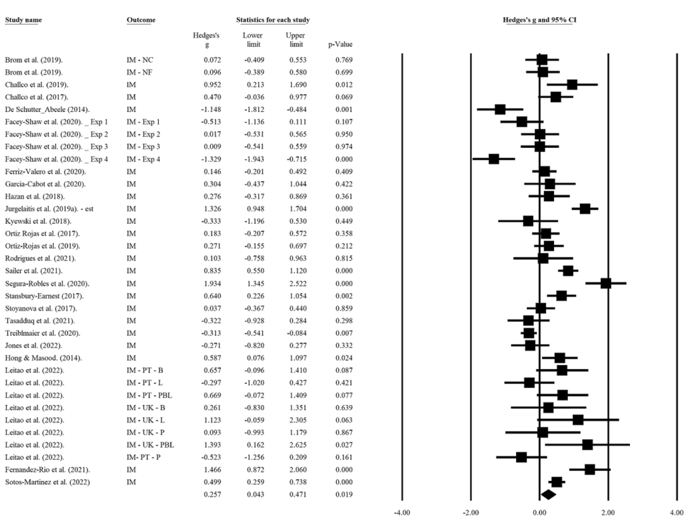
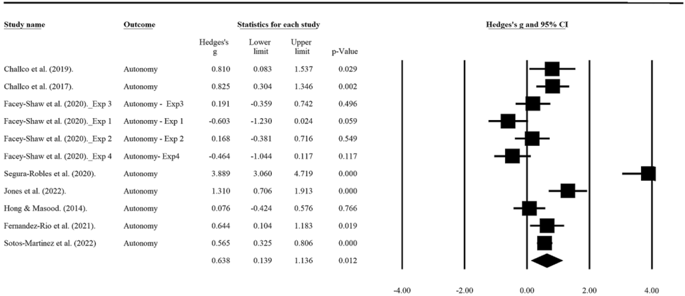
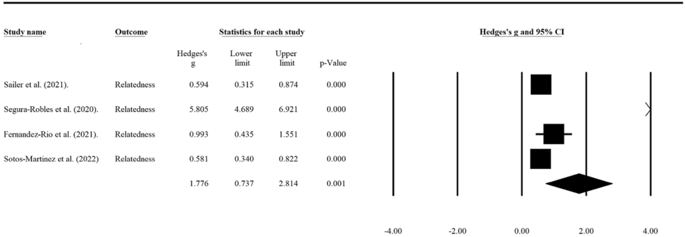
Although many studies in recent years have examined the use of gamification as a motivational strategy in education, evidence regarding its effects on intrinsic motivation is inconsistent. To make the case for or against the adoption of gamification in education, this study examines its effects on students’ intrinsic motivation and the underlying motivational factors: perceived competence, autonomy, and relatedness. In this review, we analyzed the results of studies comparing gamified learning with non-gamified learning published between 2011 and 2022. The results of our meta-analysis of 35 independent interventions (involving 2500 participants) indicated an overall significant but small effect size favoring gamified learning over learning without gamification (Hedges’g = 0.257, 95% CI [0.043, 0.471],p = .019) with no evidence of publication bias. Gamification also exerted a positive and significant effect on the students’ perceptions of autonomy (Hedges’g = 0.638, 95% CI [0.139, 1.136],p = .012) and relatedness (Hedges’g = 1.776, 95% CI [0.737, 2.814],p = .001), but minimal impact on competence (Hedges’g = 0.277, 95% CI [0.001, 0.553],p = .049). To further investigate the possible reasons for the small impact on intrinsic motivation, a systematic review of 31 studies was conducted. The findings revealed two major challenges encountered in the adoption of gamification to increase students’ intrinsic motivation: students’ lack of perceived competence and lack of perceived autonomy in gamified classes.
Verified 2026-11-25 · 1 reference not checked yet
Overview
CoChat Summary
TL;DR
This meta-analysis and systematic review compared gamified with non-gamified learning and found a small significant positive effect on intrinsic motivation, positive effects on autonomy and relatedness, but minimal impact on competence. The systematic review identified students’ lack of perceived competence and lack of perceived autonomy as major challenges in gamified classes.
Key findings
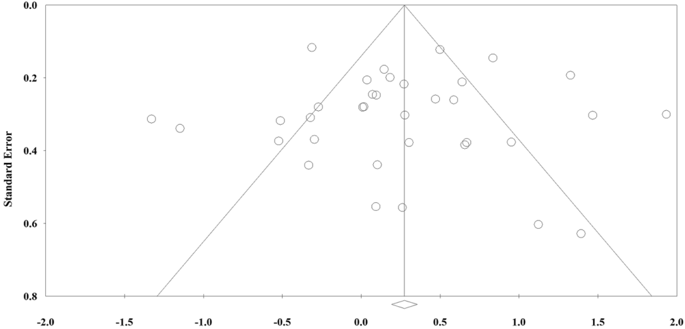
- Across 35 independent interventions involving 2,500 participants, gamification had a small significant overall effect on intrinsic motivation: Hedges’ g = 0.257, 95% CI [0.043, 0.471], p = .019; no evidence of publication bias was found (e.g., fail-safe N = 281; Egger’s regression p = .887; Begg and Mazumdar p = .820).
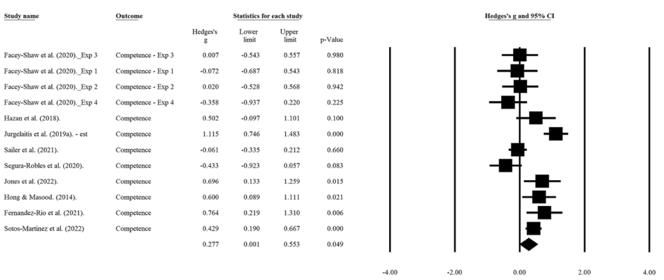
- Gamification significantly improved perceived autonomy (Hedges’ g = 0.638, 95% CI [0.139, 1.136], p = .012) and relatedness (Hedges’ g = 1.776, 95% CI [0.737, 2.814], p = .001), but had minimal impact on competence (Hedges’ g = 0.277, 95% CI [0.001, 0.553], p = .049).
- Significant moderator effects were found for reward contingency (Q = 99.486, p = .000), intervention duration (Q = 9.509, df = 4, p = .050), and instructor equivalence (Q = 12.596, df = 2, p = .002); same-instructor studies had g = 0.613 versus different-instructor studies g = −0.143, and 1–3 month interventions had g = 0.610 versus ≥1 semester g = −0.068.
- The systematic review of 31 studies found two main challenges: lack of perceived competence (e.g., discomfort among lowest-ranked participants on public absolute leaderboards, 23%; unsuitable task difficulty, 10%; unfamiliarity with gamification elements, 10%) and lack of perceived autonomy (e.g., lack of autonomy in choosing learning content and activities, 19%).
Methods
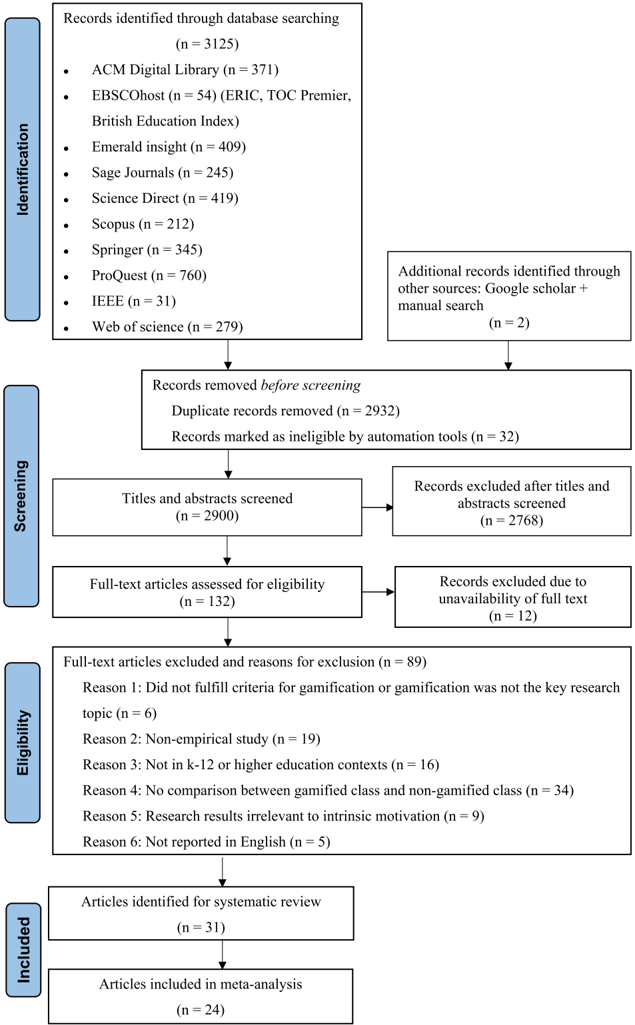
- PRISMA-guided search of 10 electronic databases for English-language studies published January 2011–October 2022 in K-12 or higher education; 3,125 records were retrieved, 132 full-text articles were eligible, 31 articles were included, and 24 provided sufficient data for meta-analysis, yielding 35 independent gamified classroom interventions and 2,500 participants.
- Meta-analysis used random effects models and Hedges’ g in Comprehensive Meta-Analysis v4; heterogeneity was assessed with Q and I², moderator analyses covered participant, course, control, game-element, reward, and reward-contingency variables, and publication bias was assessed via funnel plot, classic fail-safe N, Egger’s regression, and Begg and Mazumdar’s rank correlation.
- Systematic review used self-determination theory to code qualitative findings; the first author coded all articles using a constant-comparative approach, the second author independently coded 20%, and data-extraction inter-coder reliability was 98%.
Limitations
- Stated: many included studies had missing information or unclear reporting (e.g., insufficient statistical data); self-reports were the most common measurement approach and may reduce objectivity; moderator coding relied on information explicitly reported in original articles, with unreported variables coded as not available.
- Evident from the text: the relatedness meta-analysis was based on only 4 independent interventions, and competence and autonomy on 12 and 11 respectively; heterogeneity was substantial (I² = 83.527%), and a substantial part of heterogeneity could not be explained by the moderators investigated.
- Evident from the text: many studies did not report instructor equivalence (18 of 35 interventions in the instructor-equivalence analysis), and no included study assessed intrinsic motivation by monitoring free-choice behavior.
Model-written summary. Check it against the paper before relying on it.
Integrity signals
Registry
Cites
Statistics
Figures
Verification
Claims the paper makes
1 Valid · 0 Not valid · 74 Not checked · 75 Own results and interpretations
The cited sources support only part of this claim — read each source’s verdict below.
In the paper
“Questions that exceeded the students' expected difficulty, combined with negative feedback, also undermined their competence needs (e.g., Sailer & Sailer, 2021).”
§ Gamification enhances student intrinsic motivation, perceptions of autonomy and relatedness, but minimal impact on competency: a meta-analysis and systematic review > RQ4. What are the current challenges that gamification research must address?
What the sources say
- Partly supportedcites Sailer & Sailer, 2021 matched to “Gamification of in‐class activities in flipped classroom lectures” (2021) sourceExperimental — accuracy not yet measured
The Discussion (pp. 86-87) does say that negative feedback tends to diminish perceived competence and that this 'can be the case here as the item difficulty was higher than expected', and that negative feedback can be experienced as controlling, further diminishing competence need satisfaction — so the combination of over-difficult questions plus negative feedback and competence is the paper's own explanation. However, the paper states this only as a hedged interpretation ('can be the case here', 'we might have failed to provide optimal challenges'), while its measured result (Motivational outcomes, p. 85) showed no significant difference in competence need satisfaction between gamification and control (M = 4.03 vs 4.11, p = .67, g = -.06), contradicting Hypothesis 2.2; the underlying principle is also credited to Deci, Ryan & Williams (1996). The citing sentence therefore presents as a demonstrated undermining what this source offers as a possible explanatory mechanism. (LLM, conf=0.78)
plainstates a cause- Asserted: passes — The authors put it forward as true.
- Checkable: passes — It can be checked against evidence.
- Load-bearing: unclear — It is unclear whether the paper’s conclusions depend on it.
- Based: passes — The paper gives a reason why it holds.
- Partly supported
A result the paper reports from its own data — it cites no other source for it, so there is none to check. The quote shows it is in the paper.
In the paper
“The results of our meta-analysis of 35 independent interventions (involving 2500 participants) indicated an overall significant but small effect size favoring gamified learning over learning without gamification (Hedges' g = 0.257, 95% CI [0.043, 0.471], p = .019)”
§ Gamification enhances student intrinsic motivation, perceptions of autonomy and relatedness, but minimal impact on competency: a meta-analysis and systematic review > Abstract
hedgedstates a causen = 2,500 ·- Asserted: passes — The authors put it forward as true.
- Checkable: passes — It can be checked against evidence.
- Load-bearing: passes — The paper’s conclusions depend on it.
- Based: passes — The paper gives a reason why it holds.
A result the paper reports from its own data — it cites no other source for it, so there is none to check. The quote shows it is in the paper.
In the paper
“and relatedness (Hedges' g = 1.776, 95% CI [0.737, 2.814], p = .001)”
§ Gamification enhances student intrinsic motivation, perceptions of autonomy and relatedness, but minimal impact on competency: a meta-analysis and systematic review > Abstract
plainstates a causen = 2,500 ·- Asserted: passes — The authors put it forward as true.
- Checkable: passes — It can be checked against evidence.
- Load-bearing: passes — The paper’s conclusions depend on it.
- Based: passes — The paper gives a reason why it holds.
A result the paper reports from its own data — it cites no other source for it, so there is none to check. The quote shows it is in the paper.
In the paper
“but minimal impact on competence (Hedges' g = 0.277, 95% CI [0.001, 0.553], p = .049).”
§ Gamification enhances student intrinsic motivation, perceptions of autonomy and relatedness, but minimal impact on competency: a meta-analysis and systematic review > Abstract
plainn = 2,500 ·- Asserted: passes — The authors put it forward as true.
- Checkable: passes — It can be checked against evidence.
- Load-bearing: passes — The paper’s conclusions depend on it.
- Based: passes — The paper gives a reason why it holds.
A result the paper reports from its own data — it cites no other source for it, so there is none to check. The quote shows it is in the paper.
In the paper
“Gamification also exerted a positive and significant effect on the students' perceptions of autonomy (Hedges' g = 0.638, 95% CI [0.139, 1.136], p = .012)”
§ Gamification enhances student intrinsic motivation, perceptions of autonomy and relatedness, but minimal impact on competency: a meta-analysis and systematic review > Abstract
plainstates a causen = 2,500 ·- Asserted: passes — The authors put it forward as true.
- Checkable: passes — It can be checked against evidence.
- Load-bearing: passes — The paper’s conclusions depend on it.
- Based: passes — The paper gives a reason why it holds.
72 more claims
Create a free account to see all 150 claims and to verify the 107 references still open.
- Probably not a substantial claim. 54
- It may state two separate claims as one. 31
- The quote only partly states this claim. 3
Self-check
Percentages, sums and reported differences re-computed from the paper’s own numbers.
Each contradiction between two passages listed here was confirmed by an independent check.
Rated minor: it would not touch a result — a value no result rests on, a p-value that stays on the same side of the significance level, or a conflict that is clerical, resolved elsewhere in the paper, or outside its own findings.
In the paper
§ Gamification enhances student intrinsic motivation, perceptions of autonomy and relatedness, but minimal impact on competency: a meta-analysis and systematic review > RQ3: What is the effect of gamification on the basic psychological needs that contribute to intrinsic motivation?
“the effect size of the influence of gamification on perceived competence was marginally significant (Hedges' g = 0.277, 95% CI [0.001, 0.553], p = 0.049)”
§ Gamification enhances student intrinsic motivation, perceptions of autonomy and relatedness, but minimal impact on competency: a meta-analysis and systematic review > Effect of gamification on basic psychological needs
“the results showed that the gamification interventions did not satisfy the students' competence needs significantly better than non-gamified learning.”
Rated minor: it would not touch a result — a value no result rests on, a p-value that stays on the same side of the significance level, or a conflict that is clerical, resolved elsewhere in the paper, or outside its own findings.
In the paper
§ Gamification enhances student intrinsic motivation, perceptions of autonomy and relatedness, but minimal impact on competency: a meta-analysis and systematic review > Study selection
“(c) all selected studies were peerreviewed articles;”
§ Gamification enhances student intrinsic motivation, perceptions of autonomy and relatedness, but minimal impact on competency: a meta-analysis and systematic review > Search strategy
“we did not restrict our sources of papers to peer-reviewed journals and instead also included conference papers and dissertations.”
Citations
Cites
Preferred Reporting Items for Systematic Reviews and Meta-Analyses: The PRISMA Statement
Moher, D., Liberati, A., Tetzlaff, J., Altman, D. G., & The PRISMA Group (2009) · PLoS Medicine · doi:10.1371/journal.pmed.1000097 · Cited by 64,042 · cited 1×
“The Preferred Reporting Items for Systematic Reviews and Meta-analyses (PRISMA) statement guided the procedure for choosing relevant studies (Moher et al., 2009).”
Ryan, R. M., & Deci, E. L. (2000) · American Psychologist · doi:10.1037//0003-066x.55.1.68 · Cited by 54,599
Lincoln, Y. S., Guba, E. G., & Pilotta, J. J. (1985) · International Journal of Intercultural Relations · doi:10.1016/0147-1767(85)90062-8 · Cited by 45,787
The "what" and "why" of goal pursuits: Human needs and the self-determination of behavior
Deci, E. L., & Ryan, R. M. (2000) · Psychological Inquiry · doi:10.1207/s15327965pli1104_01 · Cited by 34,210 · cited 4×
“(2) Autonomy refers to psychological freedom and the volition to perform tasks (Deci & Ryan, 2000, p. 231; Van den Broeck et al., 2010; Vansteenkiste et al., 2010).”
InfluentialIntrinsic Motivation and Self-Determination in Human Behavior
Deci, E. L., & Ryan, R. M. (1985) · doi:10.1007/978-1-4899-2271-7 · Cited by 26,772 · cited 3×
“As Deci and Ryan (1985) argued, activities that are trivial or simple and therefore provide no challenge are not intrinsically interesting, even for somebody who perceives themselves to be extremely competent.”
The need to belong: Desire for interpersonal attachments as a fundamental human motivation.
Baumeister, R. F., & Leary, M. R. (1995) · Psychological Bulletin · doi:10.1037//0033-2909.117.3.497 · Cited by 23,245 · cited 1×
“It represents an individual’s underlying desire for integration into the social environment (Baumeister & Leary, 1995; Deci & Ryan, 2000, 2004).”
Intrinsic and Extrinsic Motivations: Classic Definitions and New Directions
Ryan, R. M., & Deci, E. L. (2000) · Contemporary Educational Psychology · doi:10.1006/ceps.1999.1020 · Cited by 18,666 · cited 8×
“…in learning activities is accompanied by positive effects such as improved mental health, enhanced creativity, and long-term learning outcomes (Ryan & Deci, 2000c), and intrinsic motivation increases the level of effort and quality of student input into a particular task (Cerasoli et al.,…”
InfluentialCochrane Handbook for Systematic Reviews of Interventions
(2019) · doi:10.1002/9781119536604 · Cited by 14,828
Shamseer, L., Moher, D., Clarke, M., Ghersi, D., Liberati, A., Petticrew, M., Shekelle, P., Stewart, L. A., & the PRISMA-P Group (2015) · BMJ · doi:10.1136/bmj.g7647 · Cited by 13,120 · cited 1×
“According to Shamseer et al. (2015), q-values of 0–40% indicate that heterogeneity is likely to be non-significant, 30–60% indicate moderate heterogeneity, 50% or more indicate large heterogeneity, and 75–100% indicate substantial heterogeneity.”
Research works printed but not linked: 1
- Huang, B., & Hew, K. F. (2021). Using gamification to design courses. Educational Technology & Society, 24(1), 44-63.
Cited by
Items 201–300 of 597
Gamification in vocational education: a comparative analysis of existing research frontiers
Omarova, М. К., & Gelişli, Y. (2025) · Bulletin of the Karaganda University Pedagogy series · doi:10.31489/2025ped1/178-186 · Cited by 1
Dagala, G. G. (2025) · International Journal of Research and Innovation in Social Science · doi:10.47772/ijriss.2025.903sedu0413 · Cited by 1
Amir, A., Zaman, S., & Tariq, M. I. (2024) · Pakistan Journal of Humanities and Social Sciences · doi:10.52131/pjhss.2024.v12i1.1985 · Cited by 1
Pedraza, C. A., Vargas, O. A. Q., Sierra, A. S. G., Robayo, H. A., Maza, J. M., & Beltran, C. E. J. (2025) · GADE Revista Científica · doi:10.63549/rg.v5i3.719 · Cited by 1
Representasi Motivasi Intrinsik dalam Meraih Mimpi Karakter Don pada Film Jumbo (2025)
Achmad, R. I. A., Achmad, R. I. A., Langit, P. B., Amaliyah, Aji, G. G., Dimisyqiyani, E., & Sinulingga, R. A. (2026) · IKRA-ITH HUMANIORA Jurnal Sosial dan Humaniora · doi:10.37817/ikraith-humaniora.v10i1.5512 · Cited by 1
Gamification in learning: turning work into play
Julin, J. (2025) · Theseus (Ammattikorkeakoulujen) · Cited by 1
Sousa, P. M. R. D. (2025) · Portuguese National Funding Agency for Science, Research and Technology (RCAAP Project by FCT) · Cited by 1
Impacto de una estrategia de gamificación en Lengua y Literatura en primer año de bachillerato
Lapo, D. A. S., Cueva, A. L. L., Castañeda, A. I. V., & Encalada, S. H. J. (2025) · Revista de Propuestas Educativas · doi:10.33996/propuestaseducativas.v7i15.3 · Cited by 1
Pamungkas, B. K., & Wakhudin (2026) · Journal of Innovation and Research in Primary Education · doi:10.56916/jirpe.v5i1.2857 · Cited by 1
Sinuraya, J. F., Barus, J. B. N. B., Tarigan, A., & Ginting, E. (2025) · SPRINTER Jurnal Ilmu Olahraga · doi:10.46838/spr.v6i3.953 · Cited by 1
Hussaini, H. M., & Saleh, S. (2026) · Jurnal Pemikir Pendidikan · doi:10.51200/jpp.v14i1.7535 · Cited by 1
Utami, A. R. (2024) · Scientica Education Journal. · doi:10.62872/sej.v1i4.549 · Cited by 1
Mardiah, S. S., & Jasrial (2026) · ISEJ Indonesian Science Education Journal · doi:10.62159/isej.v7i2.2163 · Cited by 1
Effects of team competition-based training on petanque pointing accuracy among university athletes
Nasution, M. F. A., Junaidi, J., & Widyaningsih, H. (2026) · Journal of Coaching and Sports Science · doi:10.58524/jcss.v5i2.1271 · Cited by 1
Hilmi, N., Romiyati, & Alfiyanto, A. S. (2026) · JDP (JURNAL DINAMIKA PENDIDIKAN) · doi:10.64540/csn3cz93 · Cited by 1
Gamificação e metodologias ativas no processo de ensino e aprendizagem
Souza, E. D. S. E., de Freitas, R. C., de Sousa, F. G. S., de Lima, E. V., Silva, J. S., Nascimento, G. D. S., Junior, E. I. P., & LUZ, I. C. (2026) · Revista edUCA - Revista Multidisciplinar da Faculdade Católica Paulista · doi:10.54901/educa.v9.v8-019 · Cited by 1
Jamilatun, J., Lupi, A., Ali, F., & Endra, P. (2025) · Journal of Education Technology and Inovation · doi:10.31537/jeti.v8i1.2471 · Cited by 1
The Role of Gamified Learning Media in Enhancing Students’ Motivation at State Madrasah Tsanawiyah
Novita, D. (2024) · Sufiya Journal of Islamic Studies · Cited by 1
Game-Based Review Strategies to Support Multilingual Learners in Secondary Science Classrooms
May, C. E., & Patzak, A. (2026) · Advances in computational intelligence and robotics book series · doi:10.4018/979-8-3373-7472-7.ch010
Towards a Pedagogy of Engagement in Technology-Enhanced Teaching
Admiraal, W., & Putra, I. W. H. A. (2025) · Advances in computational intelligence and robotics book series · doi:10.4018/979-8-3373-7729-2.ch001
Ming, Y., Li, L., Zhaojun, Z., WuYukun, Jing, Y., & LiYizhou (2026) · doi:10.2196/preprints.108889
Self-citationO'Higgins, D. (2026) · SSRN Electronic Journal · doi:10.2139/ssrn.6401879
Kusmiatun, A., & Ghaluh, B. M. (2026) · Interactive Learning Environments · doi:10.1080/10494820.2026.2708237
Du, Z., Li, T., Xu, M., & Xiong, C. (2026) · Frontiers in Sociology · doi:10.3389/fsoc.2026.1740629
Cuello, A. K. J., Ojeda, Á., Rogel, S. M. M., Coello, J. D. C., & Daudo, D. E. L. (2026) · ASCE MAGAZINE · doi:10.70577/asce.v5i1.708
Enhancing Child Digital Dietary Self-Monitoring via Positive Reinforcement: Proof-of-Concept Trial
León, L. G., Steeves, E. A., Reinbolt, J. A., Wyatt, T. H., & Raynor, H. A. (2025) · Nutrients · doi:10.3390/nu17213341
Gutierrez, R., Govea, J., & Valencia-Silva, E. (2026) · Education Sciences · doi:10.3390/educsci16060858
Análisis bibliométrico sobre gamificación en la educación universitaria
Chung, C. K. K., Méndez, C. C., & Arrúa, K. (2025) · Company games & business simulation academic journal. · doi:10.54988/cg.2025.1.1630
Pum, M. (2026) · Educational Technology Quarterly · doi:10.55056/etq.1304
EVALUACIÓN EDUCATIVA Y GAMIFICACIÓN: NUEVAS TENDENCIAS PARA MEDIR EL APRENDIZAJE
Gómez, L. C. R., López, F. J. P., & Mosquera, Y. P. D. (2026) · DIALÉCTICA · doi:10.56219/dialctica.v3i26.4867
Mental healing through immersive play: An umbrella review
Coelho, F., & Abreu, A. M. (2026) · Virtual Reality · doi:10.1007/s10055-026-01352-z
Radhiani, A., Abouseada, F., Wildan, & Kameliani (2026) · International Journal of Learning Reformation in Elementary Education · doi:10.56741/iistr.ijlree.001911
Metaverse Built Structures for Gamified Immersive Virtual Environments and Students' Outcomes
Palem, G., & Dasari, A. (2026) · IGI Global eBooks · doi:10.4018/979-8-2600-1771-5.ch016
Wang, X., Guo, Y., & Han, D. (2026) · Journal of Marketing Analytics · doi:10.1057/s41270-026-00496-w
The impact of a gamified adaptive learning environment on English vocabulary acquisition
Konuk, T., & Semerci, N. (2026) · The Journal of Educational Research · doi:10.1080/00220671.2026.2704538
Doddanavar, I., Agrawal, S., Rote, S., & Subramanyam, A. (2025) · IGI Global eBooks · doi:10.4018/979-8-3373-7917-3.ch008
Supentri, S., Isjoni, I., Caska, C., & Erlinda, S. (2026) · F1000Research · doi:10.12688/f1000research.180069.3
Zhang, R., Talib, O. B., Liu, S., Chen, Z., Lu, D., & Meng, Y. (2026) · Frontiers in Psychology · doi:10.3389/fpsyg.2026.1862619
Grubješić, I., Ivanjko, T., & Juričić, V. (2025) · Lecture notes in networks and systems · doi:10.1007/978-3-032-07995-4_44
Chan, G., Ataguba, G., Banire, B., Omisore, O. M., Scott, K.-A., Frempong, G., & Orji, R. (2026) · Lecture notes in networks and systems · doi:10.1007/978-3-032-25387-3_17
Improving Adult Numeracy Through Gamified Learning: A Structured Literature Review
Muchuweni, T., & Kariyana, I. (2026) · IGI Global eBooks · doi:10.4018/979-8-3373-6491-9.ch005
O'Higgins, D. (2026) · SSRN Electronic Journal · doi:10.2139/ssrn.6401881
Mahmudah, G. N., Fajrussalam, H., & Hikmatunisa, N. P. (2026) · Jurnal Penelitian Pendidikan IPA · doi:10.29303/jppipa.v12i8.15898
Impacto de la gamificación como estrategia innovadora de la educación superior: Revisión sistemática
REVILLA-SALAZAR, L. N., & RIEGA-CRUZ, C. L. (2026) · ESPACIOS · doi:10.48082/espacios-a26v47n05-e13
A consumer response to sustainability gamification: a parallel mediation model in e-banking services
Medetoğlu, B., Ata, S., & Ögel, İ. Y. (2026) · International Journal of Bank Marketing · doi:10.1108/ijbm-09-2025-0717
Zhang, C., Wu, W., & Yang, Z. (2026) · IEEE Access · doi:10.1109/access.2026.3719781
Zhou, R., Ladin, C. A., & Razali, A. B. (2026) · Frontiers in Psychology · doi:10.3389/fpsyg.2026.1940043
Psani, A., Kiriakaki, G., Kytagias, C., Psaromiligkos, Y., & Salmon, I. (2025) · South-East Europe Design Automation, Computer Engineering, Computer Networks and Social Media Conference (SEEDA-CECNSM) · doi:10.1109/seeda-cecnsm68644.2025.11329669
AI in teacher education: a systematic review of gamified motivational architectures
Barriga, D. M. P., Sánchez, A. D. V., Chiappe, A., & Chinguel, G. R. C. (2026) · Frontiers in Education · doi:10.3389/feduc.2026.1839096
Tan, M., & Sarif, S. M. (2026) · International Journal of Interactive Mobile Technologies (iJIM) · doi:10.3991/ijim.v20i14.62184
Ngoobi, N., Abdi, R. H., & Husin, N. A. (2026) · Journal of Applied Research in Higher Education · doi:10.1108/jarhe-12-2025-1180
Xu, W. M., Liu, T.-Y., & Xing, Q.-W. (2026) · Technology Pedagogy and Education · doi:10.1080/1475939x.2026.2733485
Fung, K. Y., & Sin, K. F. (2026) · International Conference on Information Technology Based Higher Education and Training (ITHET) · doi:10.1109/ithet69978.2026.11585020
Montenegro, C. F. C., Moscoso, D. R. B., Palacios, I. A. M., Palacios, G. M. M., & Zúñiga, P. I. V. (2026) · Ciencia Interdisciplinaria Internacional · doi:10.70577/cieninter.v4i3.129
Exploring Teachers’ Experiences on ICT-Integrated Gamification in Science Classes
Malifero, P. J., & Ocdenaria, J. M. (2026) · Psychology and Education A Multidisciplinary Journal · doi:10.70838/pemj.510501
Christoforakos, L., Mastrino, C., & Diefenbach, S. (2026) · i-com · doi:10.1515/icom-2026-0051
From Passive Learning to Active Engagement: Investigating Gamified Enterprise System Training
Branas, A., Hammer, A., Haddara, M., & Langseth, M. (2026) · Procedia Computer Science · doi:10.1016/j.procs.2026.03.062
Suryawati, E., Linggasari, M. N., Dianti, P. R., Erna, M., & Elviana, T. (2026) · Discover Education · doi:10.1007/s44217-026-01613-8
Raisah, P., Amalia, R., Ardiyanto, I., & Maurits, L. S. (2026) · Social Sciences & Humanities Open · doi:10.1016/j.ssaho.2026.103689
Тулученко, Г., Білоусова, Т. П., & Vygodner, I. V. (2026) · International Conference on Advanced Computer Information Technologies (ACIT) · doi:10.1109/acit69831.2026.11700178
Purnomo, K., Kelvin, & Warnars, H. L. H. S. (2026) · International Conference on Advancement in Data Science, E-learning and Information System (ICADEIS) · doi:10.1109/icadeis71120.2026.11644510
Using a Difficulty Perception Classification System to Enhance Students' Learning Outcomes
Lai, C.-H. (2026) · Applied Cognitive Psychology · doi:10.1002/acp.70270
Bastoni, R., Cowell, T. S., Murphy, A., McMahon, P., & Norberg, K. A. (2026) · ACM Conference on Learning @ Scale (L@S) · doi:10.1145/3774398.3811621
The role of gameful learning in supporting learner autonomy: a scoping review
Smith, A., Galeote, D. F., Legaki, N.-Z., & Hamari, J. (2026) · Cogent Education · doi:10.1080/2331186x.2026.2727760
Körner, S., Staller, M. S., Uhlich, T., Bonn, B., & Schué, N. (2025) · Springer eBooks · doi:10.1007/978-3-658-48447-7_3
Bai, S., Zeng, H., Zhong, Q., Yang, C., Liu, S., Cao, L., & He, M. (2026) · JMIR Serious Games · doi:10.2196/85947
Teo, W., Ee, A. Z. Q., Lim, J., & Lim, J. S. W. (2026) · Next research. · doi:10.1016/j.nexres.2026.102195
Gamificación y autorregulación del aprendizaje en educación media
de Arco, I. R. P., & Botero, J. C. R. (2026) · Revista Multidisciplinaria Voces de América y el Caribe · doi:10.69821/remuvac.v3i2.341
Osorio, J. O., Andrade, V. S., & Martínez, M. G. J. (2025) · Arandu-UTIC. · doi:10.69639/arandu.v12i3.1529
Wajabula, C. M., Degeng, I. N. S., Kuswandi, D., & Praherdhiono, H. (2026) · The Education and science journal · doi:10.17853/1994-5639-2026-4773
Rahman, Y. A., & Habibi, M. W. (2026) · IJORER International Journal of Recent Educational Research · doi:10.46245/ijorer.v7i5.1583
O’Brien, M. P., Daniels, M. H., & Ryan, A. (2026) · The International Journal of Management Education · doi:10.1016/j.ijme.2026.101545
Students’ evaluation of motivational design tradeoffs in higher educational gamification
Jedel, I. (2026) · Interactive Learning Environments · doi:10.1080/10494820.2026.2667456
Gong, X., Wang, J., Cui, Y., Wang, Z., & Wang, B. (2026) · Frontiers in Psychology · doi:10.3389/fpsyg.2026.1807531
Kim, J. Y., Williams, D. C., Kim, D.-G., Zhou, S., Wang, Z., & Yang, A. (2026) · Journal of Media Psychology Theories Methods and Applications · doi:10.1027/1864-1105/a000519
ERDEM, D. (2026) · İstanbul Gelişim Üniversitesi Sosyal Bilimler Dergisi · doi:10.17336/igusbd.1724325
DEMATEL-based gamified instructional design for music teacher education
Chen, C., Rashid, R.-A. B. A., & Xue, L. (2026) · Frontiers in Psychology · doi:10.3389/fpsyg.2026.1865021
Saxena, J. (2026) · Advances in computational intelligence and robotics book series · doi:10.4018/979-8-2600-4649-4.ch002
Devaki, V. (2026) · IGI Global eBooks · doi:10.4018/979-8-2600-1771-5.ch015
Alvarez, L., & Felder, J. (2026) · Technology Pedagogy and Education · doi:10.1080/1475939x.2026.2695865
Jia, L., & Sun, W. (2026) · The Journal of Experimental Education · doi:10.1080/00220973.2026.2664543
Babenko, S., Vasilchuk, V., Yermolenko, V., Sidachenko, V., Yushko, A., & Nalyvaiko, O. (2026) · Educological discourse · doi:10.28925/2312-5829/2026.1.11
Reimagining faculty development: Gamified online training programs
Ramezani, A., & Hajianvari, L. (2026) · Innovations in Education and Teaching International · doi:10.1080/14703297.2026.2671796
Gamification in Higher Education: A Systematic Review of Impacts, Challenges, and Applications
Meng, R., Touch, S., Pring, L., & Sam, R. (2026) · European Journal of Arts Humanities and Social Sciences · doi:10.59324/ejahss.2026.3(5).20
Azzahra, F., Desy Auliya, A., Amirullah, A., Hidayatullah, A., & Hafsi, A. R. (2026) · ULIL ALBAB Jurnal Ilmiah Multidisiplin · doi:10.56799/jim.v5i9.18074
Bahij, M. A., Xamdamovna, I. Z., Fatoni, M. H., Santoso, B., & Handayani, Y. (2026) · Journal of Contemporary Pedagogy and Learning Science · doi:10.65310/95wd4b21
Shen, L., Yan, X., Peng, P., & Clemens, N. H. (2026) · Journal of Learning Disabilities · doi:10.1177/00222194261491768
vBraille: A Gamified Approach to Support Braille Learning
Nascimento, R., Faria, G., Reis, J., Araújo, A., Barone, D. A. C., & Oliveira, W. (2026) · IEEE International Conference on Advanced Learning Technologies (ICALT) · doi:10.1109/icalt68022.2026.00030
Blockchain-driven Gamification Model to Enhance Student Participation
Kurniawan, I. V., Sanjaya, R., & Harnadi, B. (2025) · International Conference on Information Technology, Computer, and Electrical Engineering · doi:10.1109/icitacee66165.2025.11233051
Guerrero-Robles, Y. J., Ortega-Piñuela, B. C., Armijo-Garófalo, T. M., & Nuñez-Castro, G. A. (2025) · Space Scientific Journal of Multidisciplinary · doi:10.63618/omd/ssjm/v3/n4/54
Ganchozo, L. C. Z., & Ganchozo, D. L. Z. (2026) · ASCE MAGAZINE · doi:10.70577/asce.v5i1.620
Zhang, C., Chu, Z., Hor, W. T., Ho, S. W. L., Udipi, S., Green, P., Pikkarainen, M. A., He, H.-G., & Yam, M. (2025) · JMIR Serious Games · doi:10.2196/77148
Díaz, A. B. E., Cacuango, R. P. P., & Cruz, A. G. T. (2026) · Prometeo Conocimiento Científico · doi:10.55204/pcc.v6i1.e166
Fang, Y., Chenjia, G., Deng, X., & Yu, C. (2026) · International Conference on Intelligent Education and Computer Technology (IECT) · doi:10.1145/3845354.3845455
Hernandez, S. D. E. (2026) · Prometeo Conocimiento Científico · doi:10.55204/pcc.v6i2.e174
Gamificación y motivación estudiantil: desafíos y oportunidades
Palomino, G. B. B., Castillo, K. V. M., Hurtado, M. A. M., Pazmiño, L. A. T., & Ortiz, T. L. E. (2026) · Star of Sciences Multidisciplinary Journal · doi:10.63969/av47ak65
User Experience Analysis of Gamification Elements in Online Learning Platforms
Li, S. (2026) · International Conference on Educational Digitalization and Computer Science in the Guangdong-Hong Kong-Macao Greater Bay Area · doi:10.1145/3828183.3828286
السلمي, أ. س. م., فلاته, د. أ. ب. إ., & الحلفاوي, أ. د. و. س. م. (2024) · Journal of Educational and Human Sciences · doi:10.33193/jeahs.41.2024.575
Batista, T. D. C., Gomes, J. P., Ramalho, L. D. X., & Vieira, R. G. (2026) · Aurum Revista Multidisciplinar · doi:10.63330/armv2n10-010
Metadata
- Authors
- Li, L., Hew, K. F., & Du, J.
- Affiliations
- University of Hong Kong (HK)
- Corresponding author
- Hew, Khe Foon
- Venue
- Educational technology research and development
- Published
- 2024-01-16
- Volume
- 72
- Issue
- 2
- Pages
- 765-796
- ISSN
- 1042-1629 (ISSN-L)
- 1556-6501
- OpenAlex
- W4390904158
- Cited by
- 595
- References
- 121
- Citations by year
- 2026: 418 · 2025: 149 · 2024: 25
- FWCI
- 26.43
- Type
- journal article
- Language
- en
- Open access
- hybrid
- doi.org
- Licence
- cc-by
- creativecommons.org/licenses/by/4.0 (tdm)
- creativecommons.org/licenses/by/4.0 (vor)
- Locations
- Educational Technology Research and Development (publishedVersion, cc-by)
- The HKU Scholars Hub (University of Hong Kong) (submittedVersion)
- Funders
- Research Grants Council of Hong Kong (17616020)
- Topics
- Social Sciences › Psychology › Developmental and Educational Psychology › Educational Games and Gamification
- Social Sciences › Sociology and Political Science › Digital Games and Media
- Social Sciences › Psychology › Social Psychology › Motivation and Self-Concept in Sports
- Keywords
- gamification, intrinsic motivation, perceived autonomy, relatedness, perceived competence, self-determination theory, gamified learning, student motivation, educational technology
About these checks
Registry, retraction, Cites and statistics results are computed, not judged, with one exception: a printed reference that no index lists is read once by a model before it counts as a citation error. Claims are extracted by a model and kept only when their quote appears verbatim in the text; each cited source is then checked, with a model’s help, for whether it says what the claim relies on. Those verdicts can be wrong — read the claim’s quote and the cited source before relying on one.
The claim verdicts this report counts are experimental: their accuracy is not yet measured.
A language model drew the claims from the paper on 2026-11-23, under version 3 of the claim definition (model deepseek-v4.1-flash, prompt extract-v3).
A second model labelled each claim on 2026-11-23 (model jev-1.13-20260917, definition revision gold-guideline-v0.2).
Cited sources are checked with a language model’s help (qwen3.8-omni-flash).
Statistics and arithmetic are recomputed, not judged.
Confidence bands are shown only for fields calibrated on our annotated test set. None is calibrated yet, so no band is shown.
What counts as a claim ›How we measure confidence ›How we check this ›
Are you an author, or do you see a problem with this page? Request a review
Data sources
Bibliographic data: Semantic Scholar, OpenAlex, Crossref.
Contains information from the Semantic Scholar Academic Graph Datasets, made available under the ODC Attribution License (ODC-BY 1.0).
Semantic Scholar’s data is described in: Kinney, R., et al. (2023). The Semantic Scholar Open Data Platform. arXiv:2301.10140.
