

Gamification enhances student intrinsic motivation, perceptions of autonomy and relatedness, but minimal impact on competency: a meta-analysis and systematic review
Open accessThe DOI matches its Crossref record; 123 of the 125 references it cites were found in a registry or an index, and 1 are not checked yet; 1 of the 114 sources its claims cite were checked for support.
Abstract
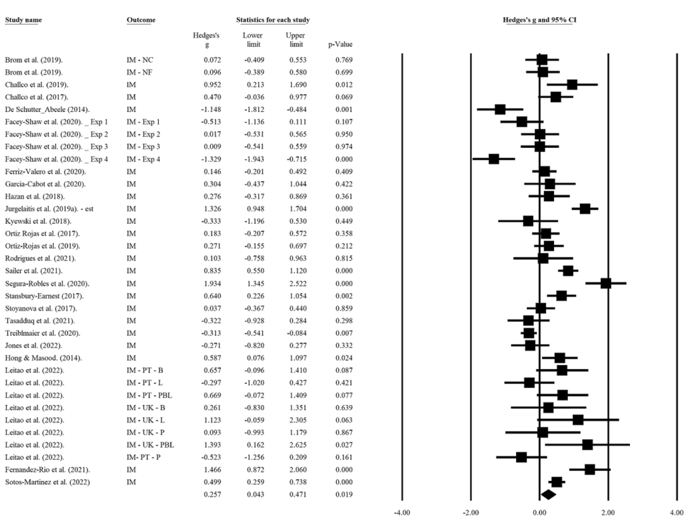
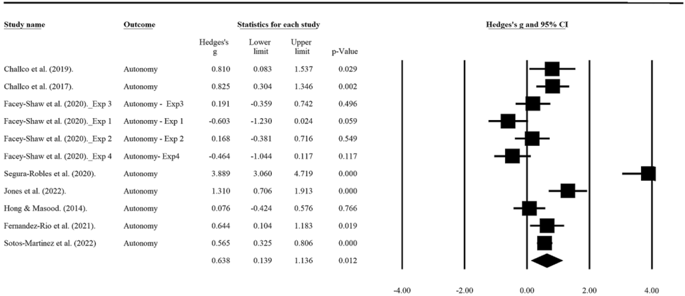
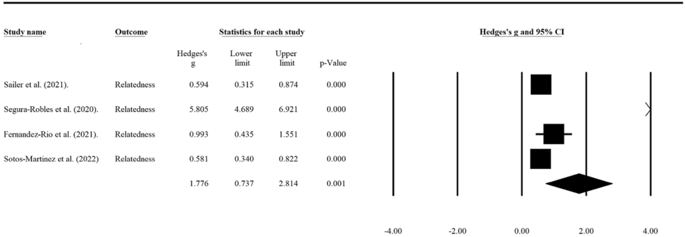
Although many studies in recent years have examined the use of gamification as a motivational strategy in education, evidence regarding its effects on intrinsic motivation is inconsistent. To make the case for or against the adoption of gamification in education, this study examines its effects on students’ intrinsic motivation and the underlying motivational factors: perceived competence, autonomy, and relatedness. In this review, we analyzed the results of studies comparing gamified learning with non-gamified learning published between 2011 and 2022. The results of our meta-analysis of 35 independent interventions (involving 2500 participants) indicated an overall significant but small effect size favoring gamified learning over learning without gamification (Hedges’g = 0.257, 95% CI [0.043, 0.471],p = .019) with no evidence of publication bias. Gamification also exerted a positive and significant effect on the students’ perceptions of autonomy (Hedges’g = 0.638, 95% CI [0.139, 1.136],p = .012) and relatedness (Hedges’g = 1.776, 95% CI [0.737, 2.814],p = .001), but minimal impact on competence (Hedges’g = 0.277, 95% CI [0.001, 0.553],p = .049). To further investigate the possible reasons for the small impact on intrinsic motivation, a systematic review of 31 studies was conducted. The findings revealed two major challenges encountered in the adoption of gamification to increase students’ intrinsic motivation: students’ lack of perceived competence and lack of perceived autonomy in gamified classes.
Verified 2026-11-25 · 1 reference not checked yet
Overview
CoChat Summary
TL;DR
This meta-analysis and systematic review compared gamified with non-gamified learning and found a small significant positive effect on intrinsic motivation, positive effects on autonomy and relatedness, but minimal impact on competence. The systematic review identified students’ lack of perceived competence and lack of perceived autonomy as major challenges in gamified classes.
Key findings
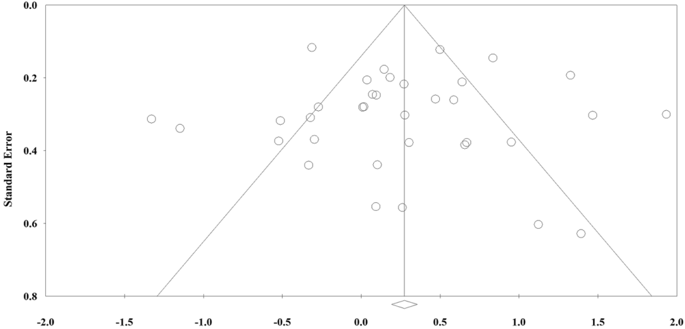
- Across 35 independent interventions involving 2,500 participants, gamification had a small significant overall effect on intrinsic motivation: Hedges’ g = 0.257, 95% CI [0.043, 0.471], p = .019; no evidence of publication bias was found (e.g., fail-safe N = 281; Egger’s regression p = .887; Begg and Mazumdar p = .820).
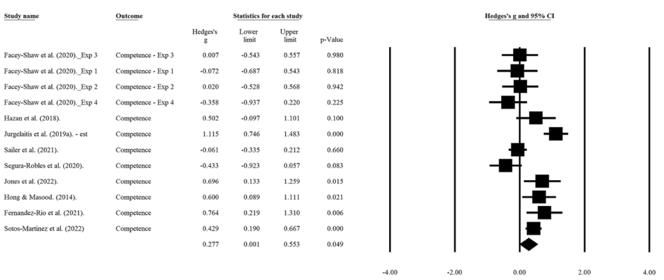
- Gamification significantly improved perceived autonomy (Hedges’ g = 0.638, 95% CI [0.139, 1.136], p = .012) and relatedness (Hedges’ g = 1.776, 95% CI [0.737, 2.814], p = .001), but had minimal impact on competence (Hedges’ g = 0.277, 95% CI [0.001, 0.553], p = .049).
- Significant moderator effects were found for reward contingency (Q = 99.486, p = .000), intervention duration (Q = 9.509, df = 4, p = .050), and instructor equivalence (Q = 12.596, df = 2, p = .002); same-instructor studies had g = 0.613 versus different-instructor studies g = −0.143, and 1–3 month interventions had g = 0.610 versus ≥1 semester g = −0.068.
- The systematic review of 31 studies found two main challenges: lack of perceived competence (e.g., discomfort among lowest-ranked participants on public absolute leaderboards, 23%; unsuitable task difficulty, 10%; unfamiliarity with gamification elements, 10%) and lack of perceived autonomy (e.g., lack of autonomy in choosing learning content and activities, 19%).
Methods
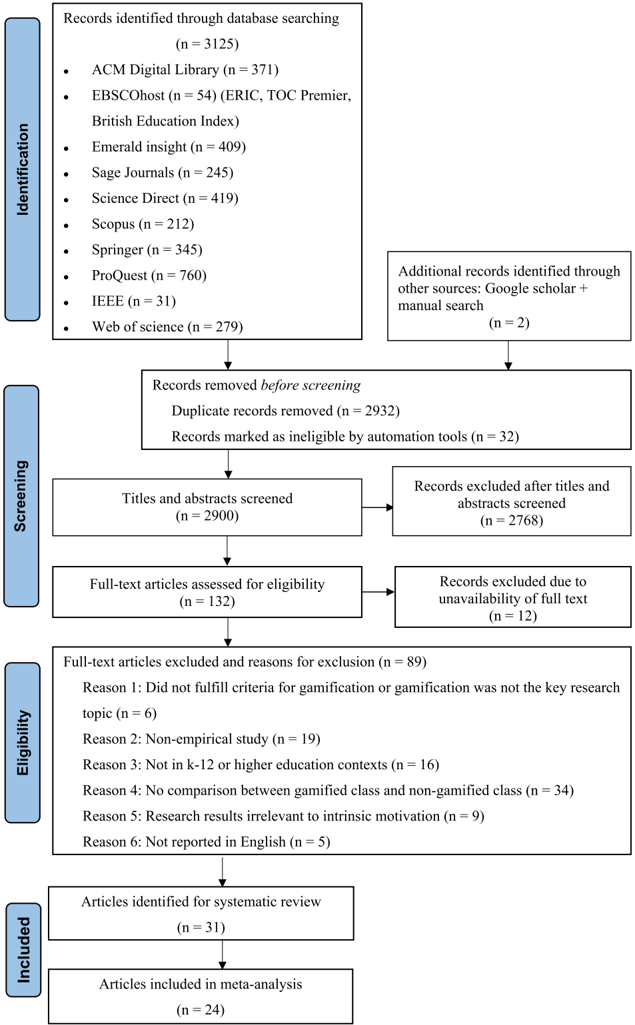
- PRISMA-guided search of 10 electronic databases for English-language studies published January 2011–October 2022 in K-12 or higher education; 3,125 records were retrieved, 132 full-text articles were eligible, 31 articles were included, and 24 provided sufficient data for meta-analysis, yielding 35 independent gamified classroom interventions and 2,500 participants.
- Meta-analysis used random effects models and Hedges’ g in Comprehensive Meta-Analysis v4; heterogeneity was assessed with Q and I², moderator analyses covered participant, course, control, game-element, reward, and reward-contingency variables, and publication bias was assessed via funnel plot, classic fail-safe N, Egger’s regression, and Begg and Mazumdar’s rank correlation.
- Systematic review used self-determination theory to code qualitative findings; the first author coded all articles using a constant-comparative approach, the second author independently coded 20%, and data-extraction inter-coder reliability was 98%.
Limitations
- Stated: many included studies had missing information or unclear reporting (e.g., insufficient statistical data); self-reports were the most common measurement approach and may reduce objectivity; moderator coding relied on information explicitly reported in original articles, with unreported variables coded as not available.
- Evident from the text: the relatedness meta-analysis was based on only 4 independent interventions, and competence and autonomy on 12 and 11 respectively; heterogeneity was substantial (I² = 83.527%), and a substantial part of heterogeneity could not be explained by the moderators investigated.
- Evident from the text: many studies did not report instructor equivalence (18 of 35 interventions in the instructor-equivalence analysis), and no included study assessed intrinsic motivation by monitoring free-choice behavior.
Model-written summary. Check it against the paper before relying on it.
Integrity signals
Registry
Cites
Statistics
Figures
Verification
Claims the paper makes
1 Valid · 0 Not valid · 74 Not checked · 75 Own results and interpretations
The cited sources support only part of this claim — read each source’s verdict below.
In the paper
“Questions that exceeded the students' expected difficulty, combined with negative feedback, also undermined their competence needs (e.g., Sailer & Sailer, 2021).”
§ Gamification enhances student intrinsic motivation, perceptions of autonomy and relatedness, but minimal impact on competency: a meta-analysis and systematic review > RQ4. What are the current challenges that gamification research must address?
What the sources say
- Partly supportedcites Sailer & Sailer, 2021 matched to “Gamification of in‐class activities in flipped classroom lectures” (2021) sourceExperimental — accuracy not yet measured
The Discussion (pp. 86-87) does say that negative feedback tends to diminish perceived competence and that this 'can be the case here as the item difficulty was higher than expected', and that negative feedback can be experienced as controlling, further diminishing competence need satisfaction — so the combination of over-difficult questions plus negative feedback and competence is the paper's own explanation. However, the paper states this only as a hedged interpretation ('can be the case here', 'we might have failed to provide optimal challenges'), while its measured result (Motivational outcomes, p. 85) showed no significant difference in competence need satisfaction between gamification and control (M = 4.03 vs 4.11, p = .67, g = -.06), contradicting Hypothesis 2.2; the underlying principle is also credited to Deci, Ryan & Williams (1996). The citing sentence therefore presents as a demonstrated undermining what this source offers as a possible explanatory mechanism. (LLM, conf=0.78)
plainstates a cause- Asserted: passes — The authors put it forward as true.
- Checkable: passes — It can be checked against evidence.
- Load-bearing: unclear — It is unclear whether the paper’s conclusions depend on it.
- Based: passes — The paper gives a reason why it holds.
- Partly supported
A result the paper reports from its own data — it cites no other source for it, so there is none to check. The quote shows it is in the paper.
In the paper
“The results of our meta-analysis of 35 independent interventions (involving 2500 participants) indicated an overall significant but small effect size favoring gamified learning over learning without gamification (Hedges' g = 0.257, 95% CI [0.043, 0.471], p = .019)”
§ Gamification enhances student intrinsic motivation, perceptions of autonomy and relatedness, but minimal impact on competency: a meta-analysis and systematic review > Abstract
hedgedstates a causen = 2,500 ·- Asserted: passes — The authors put it forward as true.
- Checkable: passes — It can be checked against evidence.
- Load-bearing: passes — The paper’s conclusions depend on it.
- Based: passes — The paper gives a reason why it holds.
A result the paper reports from its own data — it cites no other source for it, so there is none to check. The quote shows it is in the paper.
In the paper
“and relatedness (Hedges' g = 1.776, 95% CI [0.737, 2.814], p = .001)”
§ Gamification enhances student intrinsic motivation, perceptions of autonomy and relatedness, but minimal impact on competency: a meta-analysis and systematic review > Abstract
plainstates a causen = 2,500 ·- Asserted: passes — The authors put it forward as true.
- Checkable: passes — It can be checked against evidence.
- Load-bearing: passes — The paper’s conclusions depend on it.
- Based: passes — The paper gives a reason why it holds.
A result the paper reports from its own data — it cites no other source for it, so there is none to check. The quote shows it is in the paper.
In the paper
“but minimal impact on competence (Hedges' g = 0.277, 95% CI [0.001, 0.553], p = .049).”
§ Gamification enhances student intrinsic motivation, perceptions of autonomy and relatedness, but minimal impact on competency: a meta-analysis and systematic review > Abstract
plainn = 2,500 ·- Asserted: passes — The authors put it forward as true.
- Checkable: passes — It can be checked against evidence.
- Load-bearing: passes — The paper’s conclusions depend on it.
- Based: passes — The paper gives a reason why it holds.
A result the paper reports from its own data — it cites no other source for it, so there is none to check. The quote shows it is in the paper.
In the paper
“Gamification also exerted a positive and significant effect on the students' perceptions of autonomy (Hedges' g = 0.638, 95% CI [0.139, 1.136], p = .012)”
§ Gamification enhances student intrinsic motivation, perceptions of autonomy and relatedness, but minimal impact on competency: a meta-analysis and systematic review > Abstract
plainstates a causen = 2,500 ·- Asserted: passes — The authors put it forward as true.
- Checkable: passes — It can be checked against evidence.
- Load-bearing: passes — The paper’s conclusions depend on it.
- Based: passes — The paper gives a reason why it holds.
72 more claims
Create a free account to see all 150 claims and to verify the 107 references still open.
- Probably not a substantial claim. 54
- It may state two separate claims as one. 31
- The quote only partly states this claim. 3
Self-check
Percentages, sums and reported differences re-computed from the paper’s own numbers.
Each contradiction between two passages listed here was confirmed by an independent check.
Rated minor: it would not touch a result — a value no result rests on, a p-value that stays on the same side of the significance level, or a conflict that is clerical, resolved elsewhere in the paper, or outside its own findings.
In the paper
§ Gamification enhances student intrinsic motivation, perceptions of autonomy and relatedness, but minimal impact on competency: a meta-analysis and systematic review > RQ3: What is the effect of gamification on the basic psychological needs that contribute to intrinsic motivation?
“the effect size of the influence of gamification on perceived competence was marginally significant (Hedges' g = 0.277, 95% CI [0.001, 0.553], p = 0.049)”
§ Gamification enhances student intrinsic motivation, perceptions of autonomy and relatedness, but minimal impact on competency: a meta-analysis and systematic review > Effect of gamification on basic psychological needs
“the results showed that the gamification interventions did not satisfy the students' competence needs significantly better than non-gamified learning.”
Rated minor: it would not touch a result — a value no result rests on, a p-value that stays on the same side of the significance level, or a conflict that is clerical, resolved elsewhere in the paper, or outside its own findings.
In the paper
§ Gamification enhances student intrinsic motivation, perceptions of autonomy and relatedness, but minimal impact on competency: a meta-analysis and systematic review > Study selection
“(c) all selected studies were peerreviewed articles;”
§ Gamification enhances student intrinsic motivation, perceptions of autonomy and relatedness, but minimal impact on competency: a meta-analysis and systematic review > Search strategy
“we did not restrict our sources of papers to peer-reviewed journals and instead also included conference papers and dissertations.”
Citations
Cites
Preferred Reporting Items for Systematic Reviews and Meta-Analyses: The PRISMA Statement
Moher, D., Liberati, A., Tetzlaff, J., Altman, D. G., & The PRISMA Group (2009) · PLoS Medicine · doi:10.1371/journal.pmed.1000097 · Cited by 64,042 · cited 1×
“The Preferred Reporting Items for Systematic Reviews and Meta-analyses (PRISMA) statement guided the procedure for choosing relevant studies (Moher et al., 2009).”
Ryan, R. M., & Deci, E. L. (2000) · American Psychologist · doi:10.1037//0003-066x.55.1.68 · Cited by 54,599
Lincoln, Y. S., Guba, E. G., & Pilotta, J. J. (1985) · International Journal of Intercultural Relations · doi:10.1016/0147-1767(85)90062-8 · Cited by 45,787
The "what" and "why" of goal pursuits: Human needs and the self-determination of behavior
Deci, E. L., & Ryan, R. M. (2000) · Psychological Inquiry · doi:10.1207/s15327965pli1104_01 · Cited by 34,210 · cited 4×
“(2) Autonomy refers to psychological freedom and the volition to perform tasks (Deci & Ryan, 2000, p. 231; Van den Broeck et al., 2010; Vansteenkiste et al., 2010).”
InfluentialIntrinsic Motivation and Self-Determination in Human Behavior
Deci, E. L., & Ryan, R. M. (1985) · doi:10.1007/978-1-4899-2271-7 · Cited by 26,772 · cited 3×
“As Deci and Ryan (1985) argued, activities that are trivial or simple and therefore provide no challenge are not intrinsically interesting, even for somebody who perceives themselves to be extremely competent.”
The need to belong: Desire for interpersonal attachments as a fundamental human motivation.
Baumeister, R. F., & Leary, M. R. (1995) · Psychological Bulletin · doi:10.1037//0033-2909.117.3.497 · Cited by 23,245 · cited 1×
“It represents an individual’s underlying desire for integration into the social environment (Baumeister & Leary, 1995; Deci & Ryan, 2000, 2004).”
Intrinsic and Extrinsic Motivations: Classic Definitions and New Directions
Ryan, R. M., & Deci, E. L. (2000) · Contemporary Educational Psychology · doi:10.1006/ceps.1999.1020 · Cited by 18,666 · cited 8×
“…in learning activities is accompanied by positive effects such as improved mental health, enhanced creativity, and long-term learning outcomes (Ryan & Deci, 2000c), and intrinsic motivation increases the level of effort and quality of student input into a particular task (Cerasoli et al.,…”
InfluentialCochrane Handbook for Systematic Reviews of Interventions
(2019) · doi:10.1002/9781119536604 · Cited by 14,828
Shamseer, L., Moher, D., Clarke, M., Ghersi, D., Liberati, A., Petticrew, M., Shekelle, P., Stewart, L. A., & the PRISMA-P Group (2015) · BMJ · doi:10.1136/bmj.g7647 · Cited by 13,120 · cited 1×
“According to Shamseer et al. (2015), q-values of 0–40% indicate that heterogeneity is likely to be non-significant, 30–60% indicate moderate heterogeneity, 50% or more indicate large heterogeneity, and 75–100% indicate substantial heterogeneity.”
Research works printed but not linked: 1
- Huang, B., & Hew, K. F. (2021). Using gamification to design courses. Educational Technology & Society, 24(1), 44-63.
Cited by
Items 301–400 of 597
Yahya, K., & Kholil, M. A. (2026) · Journal of Education and Teaching Learning · doi:10.59211/mjpjetl.v4i2.515
Score: A web-based gamification platform to support student motivation and collaborative learning
Barros, J., Nunes, R. R., dos Reis, A. M., Cravino, J., & Pinto, T. (2026) · SoftwareX · doi:10.2139/ssrn.7268628
Level Up Learning: The Impact of Gamification as an Intervention Tool in Education
Cerna, J. R. D. (2026) · Journal on Math and Science Educational Technology · doi:10.61193/jmset.v1i2.85
Valdivieso, S. J. B., & Mera, S. M. G. (2025) · ASCE MAGAZINE · doi:10.70577/asce.v4i4.525
PRACTICE PACKAGE DESIGN IN COMPUTERASSISTED LEARNING: INTRINSIC INTEREST AND DELAYED RETENTION
Daloukas, V., Karatrantou, A., Koutromanos, G., & Panagiotakopoulos, C. T. (2026) · International Journal on Integrating Technology in Education · doi:10.5121/ijite.2026.15302
Cavalcante, R., Oliveira, C. L., Batista, A. S., Lima, G. L. F., & Faria, K. S. (2025) · Congresso sobre Tecnologias na Educação (Ctrl+e) · doi:10.5753/ctrle.2025.12630
Artificial Intelligence and Postgraduate Supervision in Higher Education
Kariyana, I., & Sinkala, W. (2026) · Open Books and Proceedings · doi:10.38140/obp4-2026
Aini, A. Z., Andrini, V. S., & Etika, E. D. (2026) · Journal of Advanced Sciences and Mathematics Education · doi:10.58524/jasme.v6i2.1358
Grade 8 students’ engagement, motivation, and challenges in using gamified learning tools
Tongzon, C. (2025) · Pantao (International Journal of the Humanities and Social Sciences) · doi:10.69651/pijhss0402236
Mishra, R. K., & Kanvaria, V. K. (2026) · International Journal of Innovative Science and Research Technology (IJISRT) · doi:10.38124/ijisrt/26feb257
Semko, O. V. (2025) · Innovate Pedagogy · doi:10.32782/ip/90.64
Neira, M. S. F., Cordova, M. J. V., Haro, E. S. G., & Fernández, R. L. (2026) · Revista Científica Multidisciplinar G-nerando · doi:10.66473/rcmg.v7i1.1221
Zahfa, P. I., Arrahman, R., Dzakwan, M. D., & Sumantri, R. M. (2026) · Studia Journal of Humanities and Education Studies · doi:10.66749/cbs5aj80
Alvear, R. L., & Salazar-Fierro, F. (2026) · EASI Ingeniería y Ciencias Aplicadas en la Industria · doi:10.53591/easi.v3i2.3105
Masaquiza, E. M. (2026) · Sercapo Journal Scientific · doi:10.67166/27bafv56
Andayani, D., Guntara, A., & Sofiyan, Y. (2026) · Repeater · doi:10.62951/repeater.v4i3.963
Dhruv, J. (2026) · International Journal of Leading Research Publication. · doi:10.70528/ijlrp.v7.i9.2376
Implementation of Gaming Strategy in Enhancing the Mathematics Performance of Learners
Ruiz, B. (2026) · International Journal of Interdisciplinary Viewpoints · doi:10.64612/ijiv.v2i8.205
Ortiz, J. D. J. A., Galicia, C. A., Benavides, E. R., & Quiróz, A. C. (2026) · doi:10.64245/eanean49
Carrillo, B. G. (2026) · Ibero Ciencias - Revista Científica y Académica · doi:10.63371/ic.v5.n3.a1626
Sahman, R. M., Wahyudin, A., & Megasari, R. (2026) · Jurnal Informatika Dan Rekayasa Perangkat Lunak/Jurnal Informatika dan Rekayasa Perangkat Lunak · doi:10.33365/jatika.v7i3.2768
Michilena, M. E. S. (2026) · Ciencia Latina Revista Científica Multidisciplinar · doi:10.37811/cl_rcm.v10i4.25932
Herlina, A., Irianto, W. S. G., & Indrasari, N. T. (2026) · Jurnal MediaTIK · doi:10.59562/mediatik.v9i3.13421
Li, R., & Goh, W. W. (2026) · Asia-Pacific Journal of Futures in Education and Society · doi:10.58946/apjfes-5.3.p9
Fardianti, R. Y., Yusliana, O., Zahra, N. A., Ananda, F., Ilmi, M. F., Widia, W., Amanda, A., Khair, M. M., Rabbani, A. A. R., Safitri, N., et al. (2026) · Jurnal Pengabdian Masyarakat Bhinneka · doi:10.58266/jpmb.v5i1.1757
Impact of Gamified Learning Platforms on Student Motivation in Grade 3
Roquero, M. R. A., Tatoy, J., Roque, J., & Naanep, N. D. (2026) · International Journal of Transformative Multidisciplinary Studies · doi:10.66074/k4c1v8b5x
Kuchimova, R. (2026) · Pedagogy and Psychology in the Modern World · doi:10.70413/zdpp-v05-i22-s60400
Pattiasina, P. J., Dewanto, I. J., Mainassy, A. K., Shabran, S., & Husnayain, M. F. (2026) · Journal of Education Review Provision · doi:10.55885/jerp.v6i2.1181
Efficiency of Digital Applications in Improving Children's Numeracy Skills: Quantitative Analysis
Prabowo, A., Hadiaty, S., & Fauzi, T. (2026) · International Journal of Ethno-Sciences and Education Research · doi:10.46336/ijeer.v6i4.1451
Pamuji, P., Sartinah, E. P., Widajati, W., Khotimah, N. K., Budiati, E. F. R., Minarsih, N. M. M., & Arianto, F. (2025) · Perinatal Journal · doi:10.57239/prn.25.033100101
Ralio, V. R. Z., Campanhola, V. L. S., Jericó, M. D. C., Scrochio, D. B., Laluce, T. D. O., & Poli, C. C. D. S. (2026) · Research Society and Development · doi:10.33448/rsd-v15i10.51924
Quilumbaquin, L. E. P., Guanotasig, P. N. H., Pepinoza, E. G. A., Lema, S. P. T., & Piedra, L. S. T. (2026) · LATAM Revista Latinoamericana de Ciencias Sociales y Humanidades · doi:10.56712/latam.v7i5.6719
Salsabila, L., & Zaini, M. (2025) · YASIN · doi:10.58578/yasin.v5i6.8063
Gamification and Flipped Classroom in SQL Education
Balla, T., & Király, S. (2025) · Central-European Journal of New Technologies in Research Education and Practice · doi:10.36427/cejntrep.7.1.12228
Hamie, R., Ali, A. A., & Abbas, A. E. (2026) · Edelweiss Applied Science and Technology · doi:10.55214/2576-8484.v10i2.12175
PENGARUH STRATEGI MENGAJAR GURU TERHADAP MOTIVASI BELAJAR SISWA PADA MATA PELAJARAN EKONOMI KELAS X
Taruna, D., Hafid, R., Damiti, F., Bumulo, F., & Dama, M. N. (2026) · LEARNING Jurnal Inovasi Penelitian Pendidikan dan Pembelajaran · doi:10.51878/learning.v6i4.15298
Nasir, N. H. B. M., Ahiaruddin, N. I. B., Dimyati, M. A. B. A., & bin Norisam, M. A. D. (2026) · Asian Pendidikan · doi:10.53797/aspen.v6i2.8.2026
Implikasi Penerapan Instructional Games Di Jenjang SD/MI : Sistematic Literature Review (SLR)
Nasar, N., & Putranto, S. (2026) · Jurnal Pendidikan dan Teknologi Indonesia · doi:10.52436/1.jpti.2190
Gamificación para incrementar la motivación escolar en Educación General Básica Elemental
Pincay-Valdiviezo, M. V., Zambrano-Zambrano, L. R., & Briones-Basurto, A. D. (2026) · PsyEduca – International Journal of Educational Psychology and Guidance · doi:10.64747/pdcf9p97
Ramadhani, N. A., Syahputra, R. E., Ridho, M., Mukhliansyah, Z., Julita, N., & Fadhillah, R. (2026) · International Journal of Education and Literature · doi:10.55606/ijel.v5i1.365
The Impact of Gamified Classroom in Higher Education
Zainol, Z. (2026) · International Journal of Research and Innovation in Social Science · doi:10.47772/ijriss.2026.10100024
The Impact of Gamification on Learning Outcomes in Sign Language Educational Games
Prasetya, C. K., Sjafri, A. S., Pratama, G. D., & Fajar, M. (2025) · International Conference on Smart Learning Courses (SCME) · doi:10.1109/scme62582.2025.11104898
Educación en movimiento: Avances, innovaciones y evaluación que transforman
Vega, L., Vico-Bosch, A., Vega, L., & Vico-Bosch, A. (2025) · Deposito de Investigacion Universidad de Sevilla (University of Seville)
Nurmiati, N., Wahyuningrum, E., Sudirman, S., & Tan, N. (2026) · International Journal of Mathematics and Sciences Education · doi:10.59965/ijmsed.v4i1.309
Salendab, F. A. (2026) · IGI Global eBooks · doi:10.4018/979-8-2600-1771-5.ch010
Menéndez, Á. A. C., Coque, C. N. A., Reyes, V. I. D., Flores, Á. M. M., & Vélez, L. L. M. (2025) · Dialnet (Universidad de la Rioja)
Uso de gamificación en el aprendizaje de Física de estudiantes universitarios
Monar, C. A. V., & Fernando, P. R. (2026) · GEDI-PRAXIS Revista de Gestión Educación y Ciencias Sociales · doi:10.66067/gec.v4i2.181
Bilal, F. (2026) · Üniversite Araştırmaları Dergisi · doi:10.32329/uad.1930429
Gamificación y su influencia en el desarrollo del razonamiento verbal en Lengua y Literatura
Nazareno, B. G. C., & Alvarado, V. F. S. (2026) · Revista Scientific · doi:10.29394/scientific.issn.2542-2987.2026.11.40.10.171-189
Nitaliya, B., & Ikhtiaranata, N. F. (2026) · Ceddi Journal of Education · doi:10.56134/cje.v5i1.206
Rico, M. J. G., & Soto, J. F. K. (2026) · Revista Latinoamericana de Calidad Educativa. · doi:10.70625/rlce/811
El desarrollo de las competencias ciudadanas en educación superior
Contreras, G. A. D. (2026) · e_Buah
ATAÇ, H., & ÇALIŞKAN, H. (2026) · Sakarya Üniversitesi Eğitim Fakültesi Dergisi · doi:10.53629/sakaefd.2027976
Chukhray, A. G., Yevdokymov, O., Mandrikova, L., Dehtiarova, T. O., & Havrylenko, O. (2025) · Communications in computer and information science · doi:10.1007/978-3-032-10477-9_11
Global Bibliometric Trends in Technology-Enabled Flexible Learning in Higher Education (1983–2025)
Moza, R., & Nayyar, V. (2026) · International Journal of Drug Delivery Technology · doi:10.25258/ijddt.16.47s.13
An analysis of the associations between boredom, effort value, and exercise behaviorPreprint
Martarelli, C., Rewitz, K., & Wolff, W. (2025) · OSF Preprints (OSF Preprints) · doi:10.31219/osf.io/a7jhs_v2
Gamification and sustainability education: exploring psycho-educational dynamics with Play It Cool
Napolitano, J., Annese, S., Ariemma, L., Barberis, N., Cuzzocrea, F., De Salvo, E., Gianelli, C., Gugliandolo, M. C., Liga, F., Ligorio, M. B., et al. (2025) · Journal of Clinical & Developmental Psychology · doi:10.13129/2612-4033/0110-4975
Educación y Humanidades en tiempos de transformación: Aportaciones desde la interdisciplinariedad
Mjehović, D. F., Martínez, J. M. A., & Baranac, S. D. (2026) · doi:10.36006/09815-1
Duong-Le, D.-T., Ly, D.-N., Duong-Thi, M.-L., Le, K.-D., & Pham, M.-P. (2026) · Communications in computer and information science · doi:10.1007/978-981-92-2597-2_20
Chen, C., & Lin, H.-Y. (2026) · Aslib Journal of Information Management · doi:10.1108/ajim-02-2026-0186
Almanca Anadili Konuşanlara Çevrimiçi Türkçe Dil Öğretiminde Etkileşim ve Motivasyon Stratejileri
ÜNAL, S. (2025) · Journal of Research in Turkic Languages · doi:10.34099/jrtl.728
Sudadio, M. P. P., Afiati, E., ., I., Tisnasari, S., Herlina, L., Karlina, L., & ., H. (2026) · Journal of Economics Finance and Management Studies · doi:10.47191/jefms/v9-i2-31
David, A., Oni, A. A., & Randle, O. (2026) · International Journal of Learning Teaching and Educational Research · doi:10.26803/ijlter.25.3.16
The Impact of Digital Technologies on Adolescents’ Learning Motivation in Latvia
Sile, K., & Vasilevska, D. (2026) · Journal of Education Culture and Society · doi:10.15503/jecs2026.1.433.451
Retroalimentación gamificada y reducción de ansiedad matemática escolar
Rengel-Herrera, M. D. R., Osejos-Santillán, M. A., Villarreal-Puga, I., Macías-Palacios, A. M., & Bonilla, L. P. G. (2026) · Código Científico Revista de Investigación · doi:10.55813/gaea/ccri/v7/n1/1527
Sucipto, Juliantine, T., Hambali, B., Purnomo, E., Gumilar, A., Annisa, S., Febriyeni, E., Muyassar, A. M., Faisal, I. R., Tumijan, W. B., et al. (2026) · Balneo and PRM Research Journal · doi:10.12680/balneo.2026.1055
Using gamification in teaching ukrainian as a foreign language to enhance student motivation
Bidenko, L. V., Boiko, O., Медвідь, Н., Moshnoriz, M., & Matsiuk, H. (2026) · Revista EDaPECI · doi:10.29276/redapeci.2026.26.225243.238-254
การพัฒนาเกมมิฟิเคชันตามแนวคิดการจัดการศึกษาที่มุ่งผลลัพธ์ เพื่อส่งเสริมการเรียนรู้ด้านสิ่งแวดล้อม
มงคลเนตร์, ศ., & มงคลเนตร์, ญ. (2026) · PULINET Journal · doi:10.66692/pulinet.13.2.2730
Anggun, P., Rusdi, R., Rahmat, R., Nari, N., & Silgado-Tuñón, D. A. (2026) · Polyhedron International Journal in Mathematics Education · doi:10.59965/pijme.v4i2.290
Gamificación y motivación para aprender en estudiantes de Bachillerato del Ecuador
Rivera, P. V. B., Morocho, M. J. C., Segarra, V. A. C., & Encarnación, C. E. V. (2026) · Polo del Conocimiento · doi:10.23857/pc.v11i10.12672
de Olmedo, M. L. H., Hermosilla, E. J. O., Cáceres, L. D. M., & Rodas, C. F. M. (2026) · Revista Sistemática · doi:10.56238/rcsv16n11-001
Gharbaoui, H. (2025) · theses.fr (ABES) · doi:10.70675/1bf250f3zb260z405bza64aza5cfe184571f
Ruffer, B. D., Faidley, E. W., Halliday, W., Travis, S. M., & Peebles, D. (2026) · International Journal of Arts Humanities & Social Science · doi:10.56734/ijahss.v7n1a3
de Souza, A. A. A., Vera, A. L. P. C., ANDRADE, A. D. S., Szabo, A., Sacchi, R., & Carbone, F. J. (2026) · doi:10.48209/978-65-5417-810-9
Ferreira, J. M., Oliveira, V. G. D. S., Lima, L. A., GERMANI, A. R. M., Montenegro, R. K. A., de Azevedo, J. K. D. M. P., da Fonseca, E. F., & Roma, J. (2026) · doi:10.48209/978-65-5417-810-b
As Tecnologias na Educação: Pesquisas, Contribuições, Transformações e Perspectivas Contemporâneas
MÜLLER, L., & Folmer, I. (2026) · doi:10.48209/978-65-5417-810-5
de Azevedo, T. C. M. B., Sousa, J. H. B., Pinheiro, J. A. D. M., & de Sousa, J. M. (2026) · doi:10.48209/978-65-5417-810-6
Pereira, I. M. D. S., dos Santos, F. D. A., Lima, L. D. S., Fontenele, J. D. C., Cavalcante, R. D. M., Nascimento, S. P., & Santos, M. A. (2026) · doi:10.48209/978-65-5417-810-1
Potencialidades da Gamificação no Processo de Ensino e Aprendizagem: Uma Análise Bibliográfica
Saggin, F. L., Cruz, D. D. S., da Silva, A. M., Licks, S. B. P., de Oliveira, R. Z., Fragoso, J. A. C., & dos Santos, S. F. (2026) · doi:10.48209/978-65-5417-810-g
Ensinar, observar e refletir com inteligência artificial
Machado, P. D. B. (2026) · doi:10.48209/978-65-5417-810-c
del Solar, C. I. Q., Rivas-Almonte, U. O., Ramírez, C. M. G., Hinostroza, M. A. B., & de la Cruz, J. R. B. (2026) · doi:10.48209/978-65-5417-810-a
de Lima, J. V. R., & Cavalcanti, J. D. H. (2026) · doi:10.48209/978-65-5417-810-7
López, W. E. M., Bernardo, A. S. S., Murrieta, E. S., & Vela, R. C. (2026) · doi:10.48209/978-65-5417-810-i
Analyzing SLA, pedagogical, and gamification approaches in digital language learning games
Thapthimhin, T. (2025) · Illinois Digital Environment for Access to Learning and Scholarship (University of Illinois at Urbana-Champaign)
Assessing the impact of using EdTech on children's learning: a scoping review of meta-analyses
Pothong, K., Sylwander, K. R., Livingstone, S., & Gemayel, S. E. (2026) · London School of Economics and Political Science Theses Online (London School of Economics and Political Science)
Manurung, A. A. (2026) · IJEMS Indonesian Journal of Education and Mathematical Science · doi:10.30596/ijems.v7i3.32139
Söderström, M. (2025) · DiVA at Umeå University (Umeå University)
Paramita, D. A., Fikriyah, F., & Rahayu, F. S. (2026) · Cokroaminoto Journal of Primary Education · doi:10.30605/cjpe.10.1.2027.9692
Designing and evaluating digital game-based learning for undergraduate education students
Plati, S. (. (2026) · e-scholar@UOIT (University of Ontario Institute of Technology)
Metadata
- Authors
- Li, L., Hew, K. F., & Du, J.
- Affiliations
- University of Hong Kong (HK)
- Corresponding author
- Hew, Khe Foon
- Venue
- Educational technology research and development
- Published
- 2024-01-16
- Volume
- 72
- Issue
- 2
- Pages
- 765-796
- ISSN
- 1042-1629 (ISSN-L)
- 1556-6501
- OpenAlex
- W4390904158
- Cited by
- 595
- References
- 121
- Citations by year
- 2026: 418 · 2025: 149 · 2024: 25
- FWCI
- 26.43
- Type
- journal article
- Language
- en
- Open access
- hybrid
- doi.org
- Licence
- cc-by
- creativecommons.org/licenses/by/4.0 (tdm)
- creativecommons.org/licenses/by/4.0 (vor)
- Locations
- Educational Technology Research and Development (publishedVersion, cc-by)
- The HKU Scholars Hub (University of Hong Kong) (submittedVersion)
- Funders
- Research Grants Council of Hong Kong (17616020)
- Topics
- Social Sciences › Psychology › Developmental and Educational Psychology › Educational Games and Gamification
- Social Sciences › Sociology and Political Science › Digital Games and Media
- Social Sciences › Psychology › Social Psychology › Motivation and Self-Concept in Sports
- Keywords
- gamification, intrinsic motivation, perceived autonomy, relatedness, perceived competence, self-determination theory, gamified learning, student motivation, educational technology
About these checks
Registry, retraction, Cites and statistics results are computed, not judged, with one exception: a printed reference that no index lists is read once by a model before it counts as a citation error. Claims are extracted by a model and kept only when their quote appears verbatim in the text; each cited source is then checked, with a model’s help, for whether it says what the claim relies on. Those verdicts can be wrong — read the claim’s quote and the cited source before relying on one.
The claim verdicts this report counts are experimental: their accuracy is not yet measured.
A language model drew the claims from the paper on 2026-11-23, under version 3 of the claim definition (model deepseek-v4.1-flash, prompt extract-v3).
A second model labelled each claim on 2026-11-23 (model jev-1.13-20260917, definition revision gold-guideline-v0.2).
Cited sources are checked with a language model’s help (qwen3.8-omni-flash).
Statistics and arithmetic are recomputed, not judged.
Confidence bands are shown only for fields calibrated on our annotated test set. None is calibrated yet, so no band is shown.
What counts as a claim ›How we measure confidence ›How we check this ›
Are you an author, or do you see a problem with this page? Request a review
Data sources
Bibliographic data: Semantic Scholar, OpenAlex, Crossref.
Contains information from the Semantic Scholar Academic Graph Datasets, made available under the ODC Attribution License (ODC-BY 1.0).
Semantic Scholar’s data is described in: Kinney, R., et al. (2023). The Semantic Scholar Open Data Platform. arXiv:2301.10140.
