

Gamification enhances student intrinsic motivation, perceptions of autonomy and relatedness, but minimal impact on competency: a meta-analysis and systematic review
Open accessThe DOI matches its Crossref record; 123 of the 125 references it cites were found in a registry or an index, and 1 are not checked yet; 1 of the 114 sources its claims cite were checked for support.
Abstract
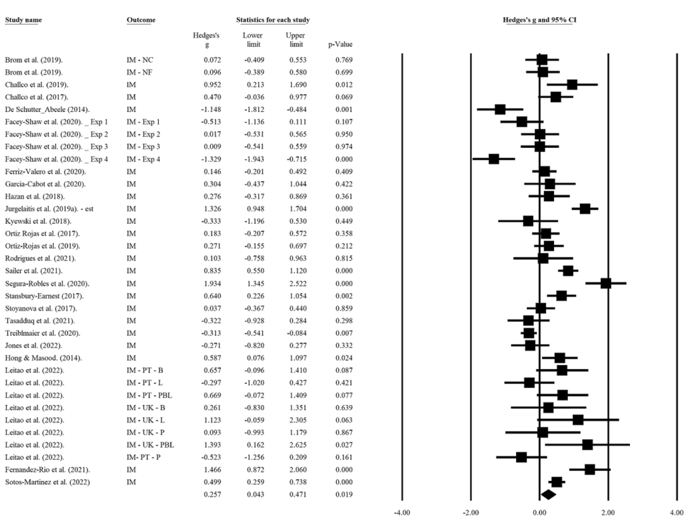
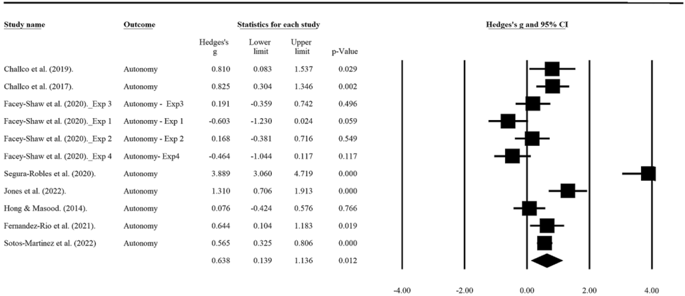
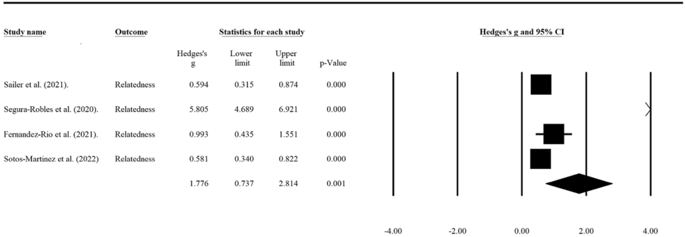
Although many studies in recent years have examined the use of gamification as a motivational strategy in education, evidence regarding its effects on intrinsic motivation is inconsistent. To make the case for or against the adoption of gamification in education, this study examines its effects on students’ intrinsic motivation and the underlying motivational factors: perceived competence, autonomy, and relatedness. In this review, we analyzed the results of studies comparing gamified learning with non-gamified learning published between 2011 and 2022. The results of our meta-analysis of 35 independent interventions (involving 2500 participants) indicated an overall significant but small effect size favoring gamified learning over learning without gamification (Hedges’g = 0.257, 95% CI [0.043, 0.471],p = .019) with no evidence of publication bias. Gamification also exerted a positive and significant effect on the students’ perceptions of autonomy (Hedges’g = 0.638, 95% CI [0.139, 1.136],p = .012) and relatedness (Hedges’g = 1.776, 95% CI [0.737, 2.814],p = .001), but minimal impact on competence (Hedges’g = 0.277, 95% CI [0.001, 0.553],p = .049). To further investigate the possible reasons for the small impact on intrinsic motivation, a systematic review of 31 studies was conducted. The findings revealed two major challenges encountered in the adoption of gamification to increase students’ intrinsic motivation: students’ lack of perceived competence and lack of perceived autonomy in gamified classes.
Verified 2026-11-25 · 1 reference not checked yet
Overview
CoChat Summary
TL;DR
This meta-analysis and systematic review compared gamified with non-gamified learning and found a small significant positive effect on intrinsic motivation, positive effects on autonomy and relatedness, but minimal impact on competence. The systematic review identified students’ lack of perceived competence and lack of perceived autonomy as major challenges in gamified classes.
Key findings
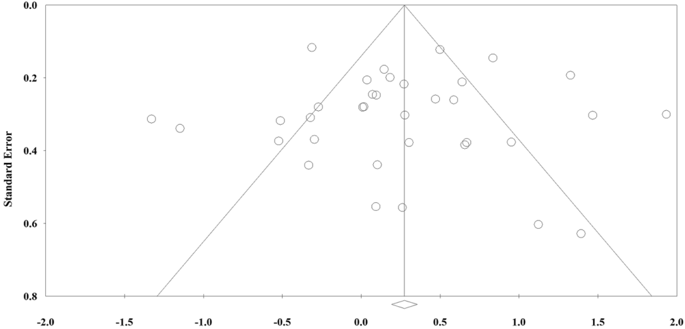
- Across 35 independent interventions involving 2,500 participants, gamification had a small significant overall effect on intrinsic motivation: Hedges’ g = 0.257, 95% CI [0.043, 0.471], p = .019; no evidence of publication bias was found (e.g., fail-safe N = 281; Egger’s regression p = .887; Begg and Mazumdar p = .820).
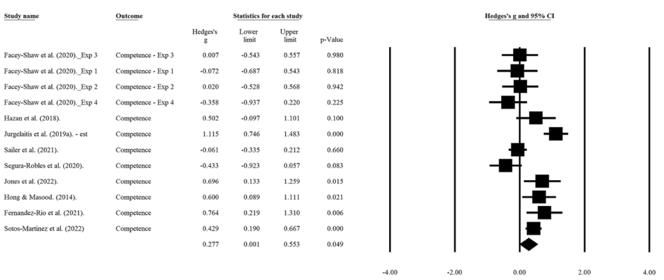
- Gamification significantly improved perceived autonomy (Hedges’ g = 0.638, 95% CI [0.139, 1.136], p = .012) and relatedness (Hedges’ g = 1.776, 95% CI [0.737, 2.814], p = .001), but had minimal impact on competence (Hedges’ g = 0.277, 95% CI [0.001, 0.553], p = .049).
- Significant moderator effects were found for reward contingency (Q = 99.486, p = .000), intervention duration (Q = 9.509, df = 4, p = .050), and instructor equivalence (Q = 12.596, df = 2, p = .002); same-instructor studies had g = 0.613 versus different-instructor studies g = −0.143, and 1–3 month interventions had g = 0.610 versus ≥1 semester g = −0.068.
- The systematic review of 31 studies found two main challenges: lack of perceived competence (e.g., discomfort among lowest-ranked participants on public absolute leaderboards, 23%; unsuitable task difficulty, 10%; unfamiliarity with gamification elements, 10%) and lack of perceived autonomy (e.g., lack of autonomy in choosing learning content and activities, 19%).
Methods
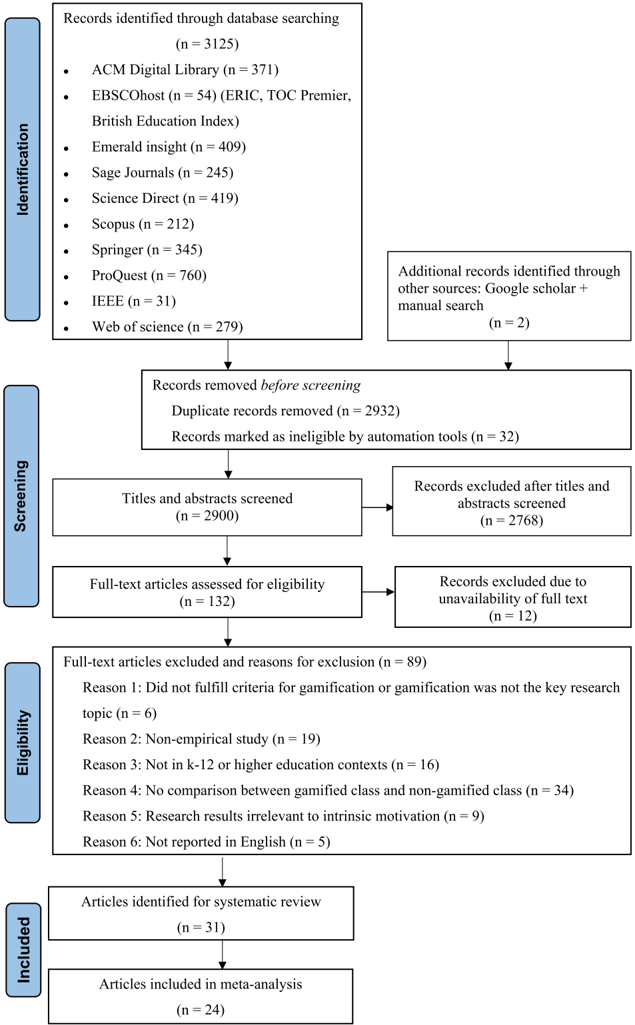
- PRISMA-guided search of 10 electronic databases for English-language studies published January 2011–October 2022 in K-12 or higher education; 3,125 records were retrieved, 132 full-text articles were eligible, 31 articles were included, and 24 provided sufficient data for meta-analysis, yielding 35 independent gamified classroom interventions and 2,500 participants.
- Meta-analysis used random effects models and Hedges’ g in Comprehensive Meta-Analysis v4; heterogeneity was assessed with Q and I², moderator analyses covered participant, course, control, game-element, reward, and reward-contingency variables, and publication bias was assessed via funnel plot, classic fail-safe N, Egger’s regression, and Begg and Mazumdar’s rank correlation.
- Systematic review used self-determination theory to code qualitative findings; the first author coded all articles using a constant-comparative approach, the second author independently coded 20%, and data-extraction inter-coder reliability was 98%.
Limitations
- Stated: many included studies had missing information or unclear reporting (e.g., insufficient statistical data); self-reports were the most common measurement approach and may reduce objectivity; moderator coding relied on information explicitly reported in original articles, with unreported variables coded as not available.
- Evident from the text: the relatedness meta-analysis was based on only 4 independent interventions, and competence and autonomy on 12 and 11 respectively; heterogeneity was substantial (I² = 83.527%), and a substantial part of heterogeneity could not be explained by the moderators investigated.
- Evident from the text: many studies did not report instructor equivalence (18 of 35 interventions in the instructor-equivalence analysis), and no included study assessed intrinsic motivation by monitoring free-choice behavior.
Model-written summary. Check it against the paper before relying on it.
Integrity signals
Registry
Cites
Statistics
Figures
Verification
Claims the paper makes
1 Valid · 0 Not valid · 74 Not checked · 75 Own results and interpretations
The cited sources support only part of this claim — read each source’s verdict below.
In the paper
“Questions that exceeded the students' expected difficulty, combined with negative feedback, also undermined their competence needs (e.g., Sailer & Sailer, 2021).”
§ Gamification enhances student intrinsic motivation, perceptions of autonomy and relatedness, but minimal impact on competency: a meta-analysis and systematic review > RQ4. What are the current challenges that gamification research must address?
What the sources say
- Partly supportedcites Sailer & Sailer, 2021 matched to “Gamification of in‐class activities in flipped classroom lectures” (2021) sourceExperimental — accuracy not yet measured
The Discussion (pp. 86-87) does say that negative feedback tends to diminish perceived competence and that this 'can be the case here as the item difficulty was higher than expected', and that negative feedback can be experienced as controlling, further diminishing competence need satisfaction — so the combination of over-difficult questions plus negative feedback and competence is the paper's own explanation. However, the paper states this only as a hedged interpretation ('can be the case here', 'we might have failed to provide optimal challenges'), while its measured result (Motivational outcomes, p. 85) showed no significant difference in competence need satisfaction between gamification and control (M = 4.03 vs 4.11, p = .67, g = -.06), contradicting Hypothesis 2.2; the underlying principle is also credited to Deci, Ryan & Williams (1996). The citing sentence therefore presents as a demonstrated undermining what this source offers as a possible explanatory mechanism. (LLM, conf=0.78)
plainstates a cause- Asserted: passes — The authors put it forward as true.
- Checkable: passes — It can be checked against evidence.
- Load-bearing: unclear — It is unclear whether the paper’s conclusions depend on it.
- Based: passes — The paper gives a reason why it holds.
- Partly supported
A result the paper reports from its own data — it cites no other source for it, so there is none to check. The quote shows it is in the paper.
In the paper
“The results of our meta-analysis of 35 independent interventions (involving 2500 participants) indicated an overall significant but small effect size favoring gamified learning over learning without gamification (Hedges' g = 0.257, 95% CI [0.043, 0.471], p = .019)”
§ Gamification enhances student intrinsic motivation, perceptions of autonomy and relatedness, but minimal impact on competency: a meta-analysis and systematic review > Abstract
hedgedstates a causen = 2,500 ·- Asserted: passes — The authors put it forward as true.
- Checkable: passes — It can be checked against evidence.
- Load-bearing: passes — The paper’s conclusions depend on it.
- Based: passes — The paper gives a reason why it holds.
A result the paper reports from its own data — it cites no other source for it, so there is none to check. The quote shows it is in the paper.
In the paper
“and relatedness (Hedges' g = 1.776, 95% CI [0.737, 2.814], p = .001)”
§ Gamification enhances student intrinsic motivation, perceptions of autonomy and relatedness, but minimal impact on competency: a meta-analysis and systematic review > Abstract
plainstates a causen = 2,500 ·- Asserted: passes — The authors put it forward as true.
- Checkable: passes — It can be checked against evidence.
- Load-bearing: passes — The paper’s conclusions depend on it.
- Based: passes — The paper gives a reason why it holds.
A result the paper reports from its own data — it cites no other source for it, so there is none to check. The quote shows it is in the paper.
In the paper
“but minimal impact on competence (Hedges' g = 0.277, 95% CI [0.001, 0.553], p = .049).”
§ Gamification enhances student intrinsic motivation, perceptions of autonomy and relatedness, but minimal impact on competency: a meta-analysis and systematic review > Abstract
plainn = 2,500 ·- Asserted: passes — The authors put it forward as true.
- Checkable: passes — It can be checked against evidence.
- Load-bearing: passes — The paper’s conclusions depend on it.
- Based: passes — The paper gives a reason why it holds.
A result the paper reports from its own data — it cites no other source for it, so there is none to check. The quote shows it is in the paper.
In the paper
“Gamification also exerted a positive and significant effect on the students' perceptions of autonomy (Hedges' g = 0.638, 95% CI [0.139, 1.136], p = .012)”
§ Gamification enhances student intrinsic motivation, perceptions of autonomy and relatedness, but minimal impact on competency: a meta-analysis and systematic review > Abstract
plainstates a causen = 2,500 ·- Asserted: passes — The authors put it forward as true.
- Checkable: passes — It can be checked against evidence.
- Load-bearing: passes — The paper’s conclusions depend on it.
- Based: passes — The paper gives a reason why it holds.
72 more claims
Create a free account to see all 150 claims and to verify the 107 references still open.
- Probably not a substantial claim. 54
- It may state two separate claims as one. 31
- The quote only partly states this claim. 3
Self-check
Percentages, sums and reported differences re-computed from the paper’s own numbers.
Each contradiction between two passages listed here was confirmed by an independent check.
Rated minor: it would not touch a result — a value no result rests on, a p-value that stays on the same side of the significance level, or a conflict that is clerical, resolved elsewhere in the paper, or outside its own findings.
In the paper
§ Gamification enhances student intrinsic motivation, perceptions of autonomy and relatedness, but minimal impact on competency: a meta-analysis and systematic review > RQ3: What is the effect of gamification on the basic psychological needs that contribute to intrinsic motivation?
“the effect size of the influence of gamification on perceived competence was marginally significant (Hedges' g = 0.277, 95% CI [0.001, 0.553], p = 0.049)”
§ Gamification enhances student intrinsic motivation, perceptions of autonomy and relatedness, but minimal impact on competency: a meta-analysis and systematic review > Effect of gamification on basic psychological needs
“the results showed that the gamification interventions did not satisfy the students' competence needs significantly better than non-gamified learning.”
Rated minor: it would not touch a result — a value no result rests on, a p-value that stays on the same side of the significance level, or a conflict that is clerical, resolved elsewhere in the paper, or outside its own findings.
In the paper
§ Gamification enhances student intrinsic motivation, perceptions of autonomy and relatedness, but minimal impact on competency: a meta-analysis and systematic review > Study selection
“(c) all selected studies were peerreviewed articles;”
§ Gamification enhances student intrinsic motivation, perceptions of autonomy and relatedness, but minimal impact on competency: a meta-analysis and systematic review > Search strategy
“we did not restrict our sources of papers to peer-reviewed journals and instead also included conference papers and dissertations.”
Citations
Cites
Preferred Reporting Items for Systematic Reviews and Meta-Analyses: The PRISMA Statement
Moher, D., Liberati, A., Tetzlaff, J., Altman, D. G., & The PRISMA Group (2009) · PLoS Medicine · doi:10.1371/journal.pmed.1000097 · Cited by 64,042 · cited 1×
“The Preferred Reporting Items for Systematic Reviews and Meta-analyses (PRISMA) statement guided the procedure for choosing relevant studies (Moher et al., 2009).”
Ryan, R. M., & Deci, E. L. (2000) · American Psychologist · doi:10.1037//0003-066x.55.1.68 · Cited by 54,599
Lincoln, Y. S., Guba, E. G., & Pilotta, J. J. (1985) · International Journal of Intercultural Relations · doi:10.1016/0147-1767(85)90062-8 · Cited by 45,787
The "what" and "why" of goal pursuits: Human needs and the self-determination of behavior
Deci, E. L., & Ryan, R. M. (2000) · Psychological Inquiry · doi:10.1207/s15327965pli1104_01 · Cited by 34,210 · cited 4×
“(2) Autonomy refers to psychological freedom and the volition to perform tasks (Deci & Ryan, 2000, p. 231; Van den Broeck et al., 2010; Vansteenkiste et al., 2010).”
InfluentialIntrinsic Motivation and Self-Determination in Human Behavior
Deci, E. L., & Ryan, R. M. (1985) · doi:10.1007/978-1-4899-2271-7 · Cited by 26,772 · cited 3×
“As Deci and Ryan (1985) argued, activities that are trivial or simple and therefore provide no challenge are not intrinsically interesting, even for somebody who perceives themselves to be extremely competent.”
The need to belong: Desire for interpersonal attachments as a fundamental human motivation.
Baumeister, R. F., & Leary, M. R. (1995) · Psychological Bulletin · doi:10.1037//0033-2909.117.3.497 · Cited by 23,245 · cited 1×
“It represents an individual’s underlying desire for integration into the social environment (Baumeister & Leary, 1995; Deci & Ryan, 2000, 2004).”
Intrinsic and Extrinsic Motivations: Classic Definitions and New Directions
Ryan, R. M., & Deci, E. L. (2000) · Contemporary Educational Psychology · doi:10.1006/ceps.1999.1020 · Cited by 18,666 · cited 8×
“…in learning activities is accompanied by positive effects such as improved mental health, enhanced creativity, and long-term learning outcomes (Ryan & Deci, 2000c), and intrinsic motivation increases the level of effort and quality of student input into a particular task (Cerasoli et al.,…”
InfluentialCochrane Handbook for Systematic Reviews of Interventions
(2019) · doi:10.1002/9781119536604 · Cited by 14,828
Shamseer, L., Moher, D., Clarke, M., Ghersi, D., Liberati, A., Petticrew, M., Shekelle, P., Stewart, L. A., & the PRISMA-P Group (2015) · BMJ · doi:10.1136/bmj.g7647 · Cited by 13,120 · cited 1×
“According to Shamseer et al. (2015), q-values of 0–40% indicate that heterogeneity is likely to be non-significant, 30–60% indicate moderate heterogeneity, 50% or more indicate large heterogeneity, and 75–100% indicate substantial heterogeneity.”
Research works printed but not linked: 1
- Huang, B., & Hew, K. F. (2021). Using gamification to design courses. Educational Technology & Society, 24(1), 44-63.
Cited by
Items 501–597 of 597
Chen, X. (2026) · SHS Web of Conferences · doi:10.1051/shsconf/202622801004
Yuyan, L., Sharif, S., & Weng, N. G. (2026) · International Journal of Research and Innovation in Social Science · doi:10.47772/ijriss.2026.10100419
Ardiansyah, A., Ahmad Syauqi, S., & Mardiana, D. (2026) · Abjadia International Journal of Education · doi:10.18860/abj.v11i1.39935
Susiaty, U. D., Darma, Y., Firdaus, M., ., H., & ., H. (2026) · Contemporary research analysis journal. · doi:10.55677/craj/01-2026-vol03i03
MENDONÇA, L. D. S., Moreira, L. E., SILVA, M. D. C. S., Moreira, M. C. H., OLIVEIRA, M. L., SILVEIRA, M. A. S., AGUILAR, N. C., CAIRES, N. O., HOTT, S. C. H., PINTO, S. S. B. P., et al. (2026) · REVISTA MULTIDISCIPLINAR INTEGRADA - REMI · doi:10.61164/1p51vr62
Efektifitas Model Gamifikasi dalam Meningkatkan Keterlibatan Motivasi Belajar STEAM di Usia Dini
Hidayah, A. N., Kuswandi, D., & Pramono, P. (2026) · Jurnal INDRIA (Jurnal Ilmiah Pendidikan Prasekolah dan Sekolah Awal) · doi:10.24269/jin.v11i1.13080
Gamificación y Motivación Académica en Estudiantes de Bachillerato
Jiménez-Abad, M. (2026) · Revista de Finanzas · doi:10.33386/rdf.2026.1-3.105
Transformasi Edukasi Keuangan melalui Metode Gamifikasi bagi Siswa SDN 11 Pemecutan Denpasar
Alam, H. S., Dewi, E. G. A., Wardhana, I. P. S. J., Buana, P. R. P., Wijaya, J. K., Maak, J. E., & Kesuma, I. K. S. (2026) · AJAD Jurnal Pengabdian kepada Masyarakat · doi:10.59431/ajad.v6i1.745
Zavyalova, E. (2026) · Theseus (Ammattikorkeakoulujen)
Rohman, R. Z., & Darnoto, D. (2026) · Mauriduna Journal of Islamic Studies · doi:10.37274/mauriduna.v7i1.25
The Impact of Gamification on Math Education: Engagement vs. Knowledge Development in Grade 6 Boys
Matadin, M. (2026) · Interdisciplinary Social Research · doi:10.64220/isr.v2i2.003
Tokarieva, A., & CHYZHYKOVA, І. (2026) · Alfred Nobel University Journal of Pedagogy and Psychology · doi:10.32342/3041-2196-2026-1-31-17
La gamificación para fortalecer el aprendizaje autónomo en estudiantes de Educación Básica
Zambrano, D. M. L., Ayala, B. E. P., Riera, D. J. O., & Zambrano, M. (2026) · Innovación Integral · doi:10.70577/s2367q19
Gamificación y creatividad en la educación parvularia: revisión sistemática
Luna, M. Y. A. (2026) · Revista Simón Rodríguez · doi:10.62319/simonrodriguez.v.6i12.183
Diseño e implementación de un «escape box» de reacciones químicas en 2.º ESO
Caballero, L. C., Barroso, M. I., & Martínez, J. P. (2026) · Dialnet (Universidad de la Rioja)
Gamification and Motivation of Secondary School Students in Physics, Osun State, NigeriaPreprint
Adedeji, A. S. (2026) · Research Square · doi:10.21203/rs.3.rs-10553389/v1
Guerrero-Suarez, R. A., Flores-Santos, R. C., Medina-León, A., & Quiroz-Valdéz, J. M. (2026) · MQRInvestigar · doi:10.56048/mqr.2026.e562
The Socio-Cultural Origins for Students’ Involvement in the Digital Educational Environment
Юрьевич, А. Р., & Николаевич, Б. Н. (2026) · Общество философия история культура · doi:10.24158/fik.2026.7.3
Rosita, F. Y., & Andita, P. (2025) · Journal of Languages and Language Teaching · doi:10.33394/jollt.v13i4.15698
Muslim, B., Faisal, M., Wati, S., Tanti, D. L., Haria, M. W., Syarif, A., & Destrinelli (2026) · Jurnal QOSIM Jurnal Pendidikan Sosial & Humaniora · doi:10.61104/jq.v4i4.9019
Simbolon, S., Simbolon, A. B., & Simbolon, Y. K. (2026) · Humanities and Social Sciences Letters · doi:10.18488/73.v14i3.5098
Gamificação na Educação Física Escolar: contribuições e limites para o engajamento dos estudantes
Pinheiro, R., da Silva, R. C., & Garuti, A. D. S. (2026) · Congresso de Educação Física de Volta Redonda · doi:10.47385/cedvr.2828.7.2026
Wibowo, A. H., Syukran, A. S., Robi'aqolbi, R., & Arrahmah, F. N. (2026) · Script Journal Journal of Linguistic and English Teaching · doi:10.24903/sj.v11i2.2432
Karmila, M., Nurhikmah, H., & Hakim, A. (2026) · Varied Knowledge Journal · doi:10.71094/vkj.v4i1.228
ゲーミフィケーションを活用した大学体育授業の実践―運動に対する動機づけと健康に対する意識の変化に着目して―
Matsuura, Y., Kanaka, S. A. T. O., FUKUCHI, S., & MIZUNO, T. (2026) · Institutional Repositories DataBase (IRDB)
Orozco, S. E. S., Aguirre, L. M. V., Oña, K. M. T., Astudillo, T. K. A., Iza, D. J. A., & Soto, V. N. L. (2026) · Revista Científica Multidisciplinaria Tsafiki · doi:10.70577/vjxkbp18
López, H. P. L., & Ramírez, I. S. (2026) · RIDE Revista Iberoamericana para la Investigación y el Desarrollo Educativo · doi:10.23913/ride.v17i33.3137
Neurotecnología y Gamificación: Nuevas estrategias para potenciar la atención y la motivación
Tacuri, J. C. T., Tigsilema, A. M. E., Aguila, B. M. M., Choez, K. A. C., & Andrade, K. E. M. (2026) · doi:10.63415/saga.2026.127
Relación entre estrategias lúdicas y el rendimiento académico en Educación Básica
Aveiga, J. L. P., Llerena, K. M. C., & Martillo, W. D. J. T. (2026) · Ciencia y Educación · doi:10.5281/zenodo.22778026
Fadillah, S. N., & Putra, M. (2026) · Jurnal Pendidikan Sains Geologi dan Geofisika (GeoScienceEd Journal) · doi:10.29303/goescienceed.v7i4.3063
Gamified Motivation Loops and Performance Gains in Secondary Learning
Uy, M. C., & Gonzales, A. P. (2026) · International Journal of Education, Research, and Innovation Perspectives · doi:10.5281/zenodo.22954687
Ulfa, K., Syaifuddin, M., & Sayuthi, M. (2026) · Information Technology Education Journal · doi:10.59562/intec.v5i3.12743
Innovated teaching with gamification to enhance students’ reading comprehension
Aguilar, M. E. J., & Lizano, M. J. V. (2026) · RICEd Revista de Investigación en Ciencias de la Educación · doi:10.53877/3pj6rf87
Yulinar, Y., Jaenudin, R., & Hasmidyani, D. (2026) · Didaktika Jurnal Kependidikan · doi:10.58230/27454312.5070
THE ROLE OF PEDAGOGICAL INNOVATIONS IN ENHANCING MOTIVATION IN THE EDUCATIONAL PROCESS
Axunovich, T. Z., & Oxunova, D. (2026) · Journal of Applied Science and Social Science
Munawar, N., Hidayah, N., Syari, W., Meivawati, E., & Hardiansyah, M. A. (2026) · JOURNAL OF ALIFBATA Journal of Basic Education (JBE) · doi:10.51700/alifbata.v6i2.2015
Gamification and Learning Motivation in Elementary Education
Taufikin (2026) · Ludi Litterarri · doi:10.62872/jw2s3r56
Muhaemin, DİANA, N., & Fitrianingsih, N. (2026) · Pendas Jurnal Ilmiah Pendidikan Dasar · doi:10.23969/jp.v11i02.52631
Ramadhani, A. Z., Shobihah, A., Sholikhah, H., Zaka, M. F., & Azizi, M. R. (2026) · Jurnal Kepemimpinan dan Pengurusan Sekolah · doi:10.34125/jkps.v11i4.3082
Yustitia, V., Ladyawati, E., Fanny, A. M., Rusminati, S. H., Cahyono, M. C., & Setiyawati, E. (2026) · Kanigara · doi:10.36456/rxjn5108
Programa educativo gamificado para fortalecer el aprendizaje de la potenciación
Obaco, J. L. N., Rubio, G. N. V., & Escudero, A. D. E. (2026) · Revista VICTEC
An Investigation of Students' Interest in Learning English Pop Songs at SMAN 4 Wajo
Ahmad, S., Sadapotto, A., Faradillah, N., Manda, I., & Hermansyah, S. (2026) · INTERACTION Jurnal Pendidikan Bahasa
Mu'minin, N., Setiyawan, A., Sibawaihi, Fauzan, N. B., Pratama, F. N., & Masuwd, M. A. (2026) · Ilmuna Jurnal Studi Pendidikan Agama Islam
МИРОВЫЕ ТЕНДЕНЦИИ И ТЕМАТИЧЕСКИЕ НАПРАВЛЕНИЯ ИССЛЕДОВАНИЙ ГЕЙМИФИКАЦИИ В ВЫСШЕМ ОБРАЗОВАНИИ
А.К., М., & Davletova, A. (2026) · Журнал серии «Педагогические науки»
Rahmasari, N. P. (2026) · UMM Institutional Repository (Universitas Muhammadiyah Malang)
Detektif Hoaks: Aplikasi Edukasi Gamifikasi Berbasis Flutter dengan Kerangka CRAAP
Rohmaniyah, Z. A., & Nerisafitra, P. (2026) · Journal of Informatics and Computer Science (JINACS)
Churuta, T., Laisema, S., & Bangthamai, E. (2026) · Journal of Intellect Education
Zafarovna, S. S. (2026) · JOURNAL OF INTERNATIONAL SCIENTIFIC RESEARCH
Saepuloh, D., Salsabila, L. M., Hurriyah Salasih, F., Lestari, H., Supriyatna, H., Dewi, Y. N., Supardi, U. S., & Dasmo, D. (2026) · IJEMS Indonesian Journal of Education and Mathematical Science · doi:10.30596/ijems.v7i3.31162
Monemnasi, Y., Tegeh, I. M., & Suartama, I. K. (2026) · ACADEMIA Jurnal Inovasi Riset Akademik · doi:10.51878/academia.v6i4.15772
Widiawati, A. D., Putri, D. A., Aksya, E. P., Miftakh, E. S., & Sulistin, I. (2026) · LIABILITIES (JURNAL PENDIDIKAN AKUNTANSI)
Silvia, I., Rezeki, S., Andrian, D., & Wahyuni, R. (2026) · AL JABAR Jurnal Pendidikan dan Pembelajaran Matematika · doi:10.46773/b32y8r47
Purba, B. E., Sinaga, J. A. B., & Simarmata, G. (2026) · EDUCTUM Journal Research · doi:10.56495/ejr.v5i2.1543
Pillasagua, G. E. E., Zuñiga, A., Olivo, V. C. C., Quiñonez, P. X. Q., Celorio, J. J. B., & Peñarrieta, A. M. Á. (2026) · Revista Científica Multidisciplinaria Tsafiki · doi:10.70577/7dp7r760
Lanangku, S. A., & Hapsari, D. P. (2026) · INTEGER Journal of Information Technology · doi:10.31284/j.integer.2026.v11i2.9349
Hanah, N., Sarinah, S., & Rahayu, P. Y. (2026) · JGK (Jurnal Guru Kita) · doi:10.24114/jgk.v10.i4.76504
La gamificación como recurso didáctico en el aprendizaje de las matemáticas
Minga, C. S. B. M. C. S. B., Guachanama, F. C. R. G. R., Minga, C. M. B. M. B., & Jiménez, N. I. A. (2026) · Revista Multidisciplinar de Estudios Generales · doi:10.70577/reg.v5i4.1116
Nurmiwati, Ihsani, B. Y., & Maryani, S. (2026) · ALINEA Jurnal Bahasa Sastra dan Pengajarannya · doi:10.58218/alinea.v6i3.3521
Siregar, O., Hanu, L., Silalahi, S. A., Herliani, R., & Putra, P. D. (2026) · Jurnal Ilmu Pendidikan dan Sosial · doi:10.58540/jipsi.v5i3.2253
Tenecora, D. J. B., Pico, D. Y. M., Bailón, J. M. B., & Carballo, E. V. (2026) · Estudios del Desarrollo Social: Cuba y América Latina
Fintarre, D. L., Permana, E. P., & Retno, R. P. (2026) · Pendas Jurnal Ilmiah Pendidikan Dasar · doi:10.23969/jp.v11i04.69726
Ma'rifah, L., & Syafi’i, I. (2026) · Manajia Journal of Education and Management
Husna, R., Hidayat, H., & Lardika, R. A. (2026) · Jurnal Pendidikan Kurikulum dan Pembelajaran · doi:10.57235/jpkp.v2i2.9164
La gamificación para mejorar la comunicación escrita de los estudiantes del subnivel superior
Cuenca, J. S. P., Castillo, K. T. C., Hernández, R. G., & González-Domínguez, N. Y. (2026) · Ciencia y Educación · doi:10.5281/zenodo.23670124
Promoting Students' Intrinsic Motivation to Learn: A Review of Different Types of Interventions
Li, P. (2026) · Lecture Notes in Education Psychology and Public Media · doi:10.54254/2753-7048/2027.38167
Инновационные методы мотивации студентов к занятиям физической культурой
Николаевич, Ш. О. (2026) · Management of Education · doi:10.25726/t4277-3667-4959-p
Ni’mah, A. A., Kholil, M., karomah, N., Hidayah, N., & Rohman, A. K. (2026) · Jurnal Ilmiah Multidisipliner
Rohman, M. S. (2026) · Jurnal Teknologi Informatika dan Komputer · doi:10.37012/jtik.v12i2.4013
Beyond Motivation and Engagement: Gamified Assessment as a Vehicle for Learner Agency
Attah, J. O., & Kruger, D. J. D. (2026) · International Journal of Learning Teaching and Educational Research · doi:10.26803/ijlter.25.10.49
Artanty, F., Muhtarom, M., & Sulianto, J. (2026) · ISEJ Indonesian Science Education Journal · doi:10.62159/isej.v8i1.3066
Annida, A., Zuhriyah, Z., Jumiatin, H., Mutmainnah, M., & Fitriyah, F. (2025) · Nusantara Indonesian Journal of Islamic Studies · doi:10.54471/4zv8v335
Harpuas, G., Nursaid, N., Ramadhan, S., & Tressyalina, T. (2026) · AL-ISHLAH Jurnal Pendidikan
Muhammad Badrut Tamam, A. M., Rafif, M. Z., & Muhajir, M. (2026) · Tadris Al- Arabiyyah Jurnal Pendidikan Bahasa Arab dan Kebahasaaraban
MANAJEMEN PEMBELAJARAN BERBASIS TEKNOLOGI DIGITAL DAN NILAI ISLAM PADA MADRASAH TSANAWIYAH
Hidayatullah, R. N., & Suherman, M. (2026) · EDUCATOR Jurnal Inovasi Tenaga Pendidik dan Kependidikan · doi:10.51878/educator.v6i4.15737
Diba, A. F., Meriyati, & Yanti, Y. (2026) · Jurnal QOSIM Jurnal Pendidikan Sosial & Humaniora · doi:10.61104/jq.v4i6.14756
Leite, J. C. S. D. S., Christ, D. C. F., & Ferreira, W. S. (2026) · Revista Ibero-Americana de Humanidades, Ciências e Educação · doi:10.51891/rease.v12i11.31459
Zendrato, O., Hulu, S. K., Bawamenewi, A., & Lase, F. (2026) · TEACHING Jurnal Inovasi Keguruan dan Ilmu Pendidikan · doi:10.51878/teaching.v6i4.15375
Carló, A. D. R. M., Rodríguez, B. E. S., Jiménez, A. B. E., & Arreaga, E. M. C. (2026) · Ciencia y Educación · doi:10.5281/zenodo.24026209
Pengaruh Pendekatan Gamifikasi terhadap Kebugaran Jasmani Siswa SD Kelas IV
Odelia, G. A., & Yunarta, A. (2026) · JURNAL PENDIDIKAN OLAHRAGA · doi:10.37630/jpo.v16i5.5190
ЖОҒАРЫ БІЛІМ БЕРУДЕГІ ГЕЙМИФИКАЦИЯ ЗЕРТТЕУЛЕРІНІҢ ӘЛЕМДІК ҮРДІСТЕРІ МЕН ТАҚЫРЫПТЫҚ БАҒЫТТАРЫ
Давлетова, А. Х., & Мырзанова, А. К. (2026) · doi:10.48371/peds.2026.82.3.012
Gamosa, A., & Jaca, C. A. (2026) · Journal of Learning and Development Studies · doi:10.32996/jlds.2026.6.10.1
Rahmawati, I., Lestari, S., & Astiti, D. P. (2026) · Jurnal QOSIM Jurnal Pendidikan Sosial & Humaniora · doi:10.61104/jq.v4i6.14971
Suriani, I., Hasibuan, L., Srg, F. R., Astari, I., Ramadhani, N., Siregar, H. S., Nasution, M., Parinduri, M. R., Harahap, A. D. A., Nasution, D. P., et al. (2026) · Didaktik Jurnal Ilmiah PGSD STKIP Subang · doi:10.36989/didaktik.v12i04.20219
Gómez, M. A. Z., & Álvarez, R. H. A. (2026) · Revista Científica Arbitrada Multidisciplinaria PENTACIENCIAS · doi:10.59169/pentaciencias.v8i4.1926
Rifki, K. A. F., Fadhliana, N. R., Rahim, M. R. R., Feniria, Rizal, M., Zaini, M., Hakim, T. R., Anisabela, Zufaramadhan, A., Adawiyah, S. R., et al. (2026) · Pengabdian kepada Masyarakat Bidang Teknologi dan Sistem Informasi (PETISI) · doi:10.30872/petisi.v4i2.6824
Gamificación en la enseñanza del inglés: perspectiva estudiantil
Fabián, C. A. G., Plasencia, C. M. D., & Avila, N. A. C. (2026) · Revista InveCom · doi:10.5281/zenodo.24270933
Psychological factors of vocational education engagement: Motivation and integration of technology
Zhu, Y., & Karabalaeva, G. T. (2026) · Bulletin of the Jusup Balasagyn Kyrgyz National University · doi:10.58649/1694-8033-2026-3(127)-44-53
Muhaemin, A., Nurkamilah, M., & Sarmidi, S. (2026) · Journal of Science Technology and Innovation · doi:10.65310/n8fjqy41
Archibong, V. B., Kumarasamy, P. M., Adane, F., Abdu, H., Olorunnado, S. E., Ibe, U., Mohammed, A., Wali, C., Ikwuka, D. C., Etukudo, E. M., et al. (2026) · Research Square · doi:10.21203/rs.3.rs-11241218/v1
Asyhari, A., Romlah, R., Wulandari, H., Jatmiko, A., Irwandani, İ., & Mustari, M. (2026) · Education Sciences · doi:10.3390/educsci16111980
Donozo, M. G., Largo, M. Y. R., Rosario, C. C. E., & Hurtado, J. M. A. (2026) · Polo del Conocimiento · doi:10.23857/pc.v11i11.12775
Muchuweni, T. (2026) · Journal of research in didactical sciences. · doi:10.51853/jorids/515
Pilot Evaluation of BijakDys: An Adaptive Gamified Learning Application for Dyslexic Learners
Miserom, F., Wook, T. S. M. T., Noor, S. F. M., & Mohtaram, S. (2026) · IEEE International Conference on Computing (ICOCO) · doi:10.1109/icoco71370.2026.11792917
Impact Of Gamification In Virtual Postgraduate Education Environments
Solano, M. R., Carrascal, B. L. V., & Cañas, C. F. R. (2026) · Pedagogical Constellation · doi:10.69821/constellations.v5i2.227
Idul, M., Dollah, S., Noni, N., Sakkir, G., Mujahidah, M., & Tjalla, M. (2026) · Indonesian TESOL Journal
Afandi, T., Khobir, A., & Muhlisin, M. (2025) · Jurnal Pendidikan Anak Usia Dini dan Kewarganegaraan
GAMIFIKASI DALAM PEMBELAJARAN NUMERASI: DARI TANTANGAN KE KESERUAN BELAJAR MATEMATIKA
Yustitia, V., Fanny, M. C. R. A. M., Kusmaharti, D., & Sa'diyah, H. (2025) · Seminar Nasional Hasil Riset dan Pengabdian
Metadata
- Authors
- Li, L., Hew, K. F., & Du, J.
- Affiliations
- University of Hong Kong (HK)
- Corresponding author
- Hew, Khe Foon
- Venue
- Educational technology research and development
- Published
- 2024-01-16
- Volume
- 72
- Issue
- 2
- Pages
- 765-796
- ISSN
- 1042-1629 (ISSN-L)
- 1556-6501
- OpenAlex
- W4390904158
- Cited by
- 595
- References
- 121
- Citations by year
- 2026: 418 · 2025: 149 · 2024: 25
- FWCI
- 26.43
- Type
- journal article
- Language
- en
- Open access
- hybrid
- doi.org
- Licence
- cc-by
- creativecommons.org/licenses/by/4.0 (tdm)
- creativecommons.org/licenses/by/4.0 (vor)
- Locations
- Educational Technology Research and Development (publishedVersion, cc-by)
- The HKU Scholars Hub (University of Hong Kong) (submittedVersion)
- Funders
- Research Grants Council of Hong Kong (17616020)
- Topics
- Social Sciences › Psychology › Developmental and Educational Psychology › Educational Games and Gamification
- Social Sciences › Sociology and Political Science › Digital Games and Media
- Social Sciences › Psychology › Social Psychology › Motivation and Self-Concept in Sports
- Keywords
- gamification, intrinsic motivation, perceived autonomy, relatedness, perceived competence, self-determination theory, gamified learning, student motivation, educational technology
About these checks
Registry, retraction, Cites and statistics results are computed, not judged, with one exception: a printed reference that no index lists is read once by a model before it counts as a citation error. Claims are extracted by a model and kept only when their quote appears verbatim in the text; each cited source is then checked, with a model’s help, for whether it says what the claim relies on. Those verdicts can be wrong — read the claim’s quote and the cited source before relying on one.
The claim verdicts this report counts are experimental: their accuracy is not yet measured.
A language model drew the claims from the paper on 2026-11-23, under version 3 of the claim definition (model deepseek-v4.1-flash, prompt extract-v3).
A second model labelled each claim on 2026-11-23 (model jev-1.13-20260917, definition revision gold-guideline-v0.2).
Cited sources are checked with a language model’s help (qwen3.8-omni-flash).
Statistics and arithmetic are recomputed, not judged.
Confidence bands are shown only for fields calibrated on our annotated test set. None is calibrated yet, so no band is shown.
What counts as a claim ›How we measure confidence ›How we check this ›
Are you an author, or do you see a problem with this page? Request a review
Data sources
Bibliographic data: Semantic Scholar, OpenAlex, Crossref.
Contains information from the Semantic Scholar Academic Graph Datasets, made available under the ODC Attribution License (ODC-BY 1.0).
Semantic Scholar’s data is described in: Kinney, R., et al. (2023). The Semantic Scholar Open Data Platform. arXiv:2301.10140.
