

Gamification enhances student intrinsic motivation, perceptions of autonomy and relatedness, but minimal impact on competency: a meta-analysis and systematic review
Open accessThe DOI matches its Crossref record; 123 of the 125 references it cites were found in a registry or an index, and 1 are not checked yet; 1 of the 114 sources its claims cite were checked for support.
Abstract
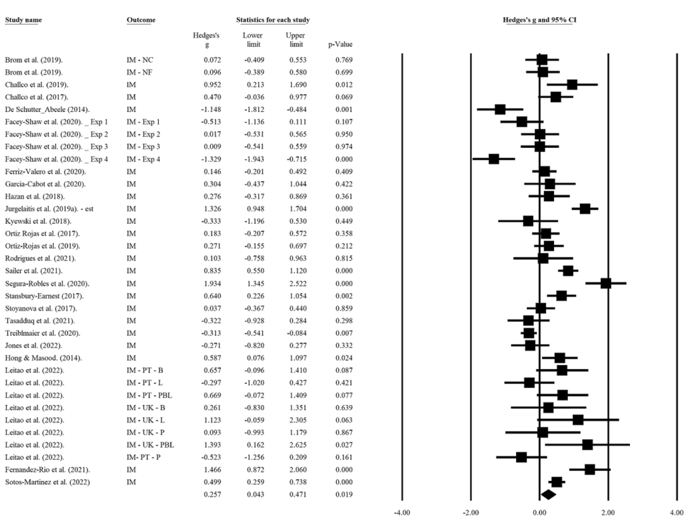
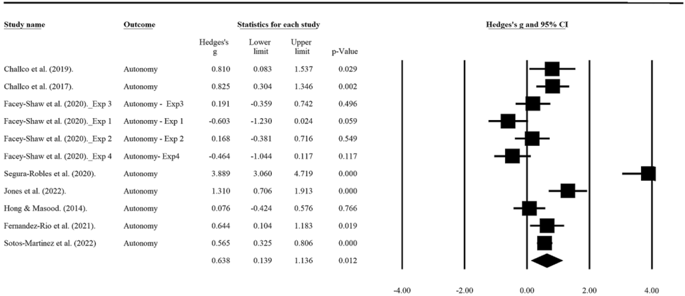
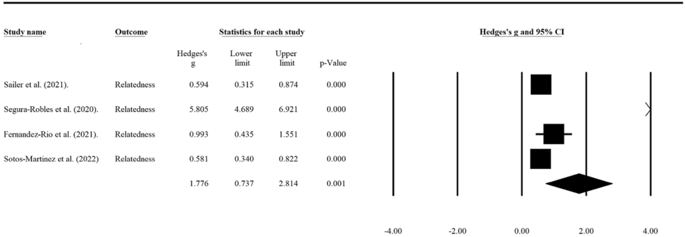
Although many studies in recent years have examined the use of gamification as a motivational strategy in education, evidence regarding its effects on intrinsic motivation is inconsistent. To make the case for or against the adoption of gamification in education, this study examines its effects on students’ intrinsic motivation and the underlying motivational factors: perceived competence, autonomy, and relatedness. In this review, we analyzed the results of studies comparing gamified learning with non-gamified learning published between 2011 and 2022. The results of our meta-analysis of 35 independent interventions (involving 2500 participants) indicated an overall significant but small effect size favoring gamified learning over learning without gamification (Hedges’g = 0.257, 95% CI [0.043, 0.471],p = .019) with no evidence of publication bias. Gamification also exerted a positive and significant effect on the students’ perceptions of autonomy (Hedges’g = 0.638, 95% CI [0.139, 1.136],p = .012) and relatedness (Hedges’g = 1.776, 95% CI [0.737, 2.814],p = .001), but minimal impact on competence (Hedges’g = 0.277, 95% CI [0.001, 0.553],p = .049). To further investigate the possible reasons for the small impact on intrinsic motivation, a systematic review of 31 studies was conducted. The findings revealed two major challenges encountered in the adoption of gamification to increase students’ intrinsic motivation: students’ lack of perceived competence and lack of perceived autonomy in gamified classes.
Verified 2026-11-25 · 1 reference not checked yet
Overview
CoChat Summary
TL;DR
This meta-analysis and systematic review compared gamified with non-gamified learning and found a small significant positive effect on intrinsic motivation, positive effects on autonomy and relatedness, but minimal impact on competence. The systematic review identified students’ lack of perceived competence and lack of perceived autonomy as major challenges in gamified classes.
Key findings
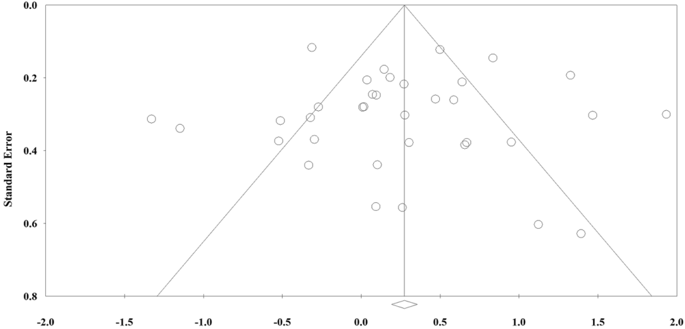
- Across 35 independent interventions involving 2,500 participants, gamification had a small significant overall effect on intrinsic motivation: Hedges’ g = 0.257, 95% CI [0.043, 0.471], p = .019; no evidence of publication bias was found (e.g., fail-safe N = 281; Egger’s regression p = .887; Begg and Mazumdar p = .820).
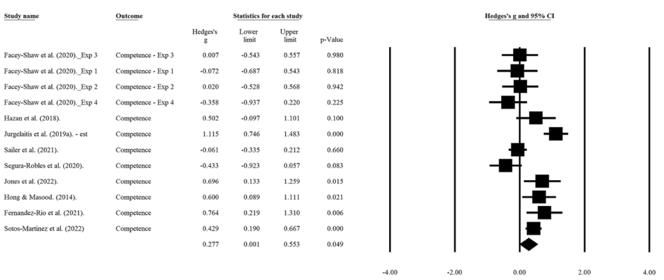
- Gamification significantly improved perceived autonomy (Hedges’ g = 0.638, 95% CI [0.139, 1.136], p = .012) and relatedness (Hedges’ g = 1.776, 95% CI [0.737, 2.814], p = .001), but had minimal impact on competence (Hedges’ g = 0.277, 95% CI [0.001, 0.553], p = .049).
- Significant moderator effects were found for reward contingency (Q = 99.486, p = .000), intervention duration (Q = 9.509, df = 4, p = .050), and instructor equivalence (Q = 12.596, df = 2, p = .002); same-instructor studies had g = 0.613 versus different-instructor studies g = −0.143, and 1–3 month interventions had g = 0.610 versus ≥1 semester g = −0.068.
- The systematic review of 31 studies found two main challenges: lack of perceived competence (e.g., discomfort among lowest-ranked participants on public absolute leaderboards, 23%; unsuitable task difficulty, 10%; unfamiliarity with gamification elements, 10%) and lack of perceived autonomy (e.g., lack of autonomy in choosing learning content and activities, 19%).
Methods
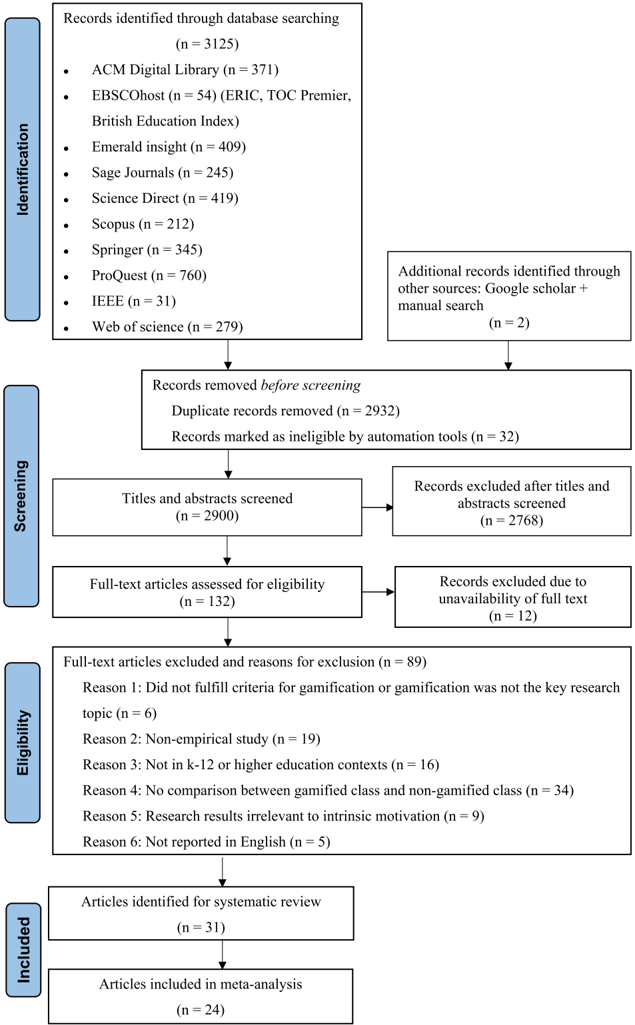
- PRISMA-guided search of 10 electronic databases for English-language studies published January 2011–October 2022 in K-12 or higher education; 3,125 records were retrieved, 132 full-text articles were eligible, 31 articles were included, and 24 provided sufficient data for meta-analysis, yielding 35 independent gamified classroom interventions and 2,500 participants.
- Meta-analysis used random effects models and Hedges’ g in Comprehensive Meta-Analysis v4; heterogeneity was assessed with Q and I², moderator analyses covered participant, course, control, game-element, reward, and reward-contingency variables, and publication bias was assessed via funnel plot, classic fail-safe N, Egger’s regression, and Begg and Mazumdar’s rank correlation.
- Systematic review used self-determination theory to code qualitative findings; the first author coded all articles using a constant-comparative approach, the second author independently coded 20%, and data-extraction inter-coder reliability was 98%.
Limitations
- Stated: many included studies had missing information or unclear reporting (e.g., insufficient statistical data); self-reports were the most common measurement approach and may reduce objectivity; moderator coding relied on information explicitly reported in original articles, with unreported variables coded as not available.
- Evident from the text: the relatedness meta-analysis was based on only 4 independent interventions, and competence and autonomy on 12 and 11 respectively; heterogeneity was substantial (I² = 83.527%), and a substantial part of heterogeneity could not be explained by the moderators investigated.
- Evident from the text: many studies did not report instructor equivalence (18 of 35 interventions in the instructor-equivalence analysis), and no included study assessed intrinsic motivation by monitoring free-choice behavior.
Model-written summary. Check it against the paper before relying on it.
Integrity signals
Registry
Cites
Statistics
Figures
Verification
Claims the paper makes
1 Valid · 0 Not valid · 74 Not checked · 75 Own results and interpretations
The cited sources support only part of this claim — read each source’s verdict below.
In the paper
“Questions that exceeded the students' expected difficulty, combined with negative feedback, also undermined their competence needs (e.g., Sailer & Sailer, 2021).”
§ Gamification enhances student intrinsic motivation, perceptions of autonomy and relatedness, but minimal impact on competency: a meta-analysis and systematic review > RQ4. What are the current challenges that gamification research must address?
What the sources say
- Partly supportedcites Sailer & Sailer, 2021 matched to “Gamification of in‐class activities in flipped classroom lectures” (2021) sourceExperimental — accuracy not yet measured
The Discussion (pp. 86-87) does say that negative feedback tends to diminish perceived competence and that this 'can be the case here as the item difficulty was higher than expected', and that negative feedback can be experienced as controlling, further diminishing competence need satisfaction — so the combination of over-difficult questions plus negative feedback and competence is the paper's own explanation. However, the paper states this only as a hedged interpretation ('can be the case here', 'we might have failed to provide optimal challenges'), while its measured result (Motivational outcomes, p. 85) showed no significant difference in competence need satisfaction between gamification and control (M = 4.03 vs 4.11, p = .67, g = -.06), contradicting Hypothesis 2.2; the underlying principle is also credited to Deci, Ryan & Williams (1996). The citing sentence therefore presents as a demonstrated undermining what this source offers as a possible explanatory mechanism. (LLM, conf=0.78)
plainstates a cause- Asserted: passes — The authors put it forward as true.
- Checkable: passes — It can be checked against evidence.
- Load-bearing: unclear — It is unclear whether the paper’s conclusions depend on it.
- Based: passes — The paper gives a reason why it holds.
- Partly supported
A result the paper reports from its own data — it cites no other source for it, so there is none to check. The quote shows it is in the paper.
In the paper
“The results of our meta-analysis of 35 independent interventions (involving 2500 participants) indicated an overall significant but small effect size favoring gamified learning over learning without gamification (Hedges' g = 0.257, 95% CI [0.043, 0.471], p = .019)”
§ Gamification enhances student intrinsic motivation, perceptions of autonomy and relatedness, but minimal impact on competency: a meta-analysis and systematic review > Abstract
hedgedstates a causen = 2,500 ·- Asserted: passes — The authors put it forward as true.
- Checkable: passes — It can be checked against evidence.
- Load-bearing: passes — The paper’s conclusions depend on it.
- Based: passes — The paper gives a reason why it holds.
A result the paper reports from its own data — it cites no other source for it, so there is none to check. The quote shows it is in the paper.
In the paper
“and relatedness (Hedges' g = 1.776, 95% CI [0.737, 2.814], p = .001)”
§ Gamification enhances student intrinsic motivation, perceptions of autonomy and relatedness, but minimal impact on competency: a meta-analysis and systematic review > Abstract
plainstates a causen = 2,500 ·- Asserted: passes — The authors put it forward as true.
- Checkable: passes — It can be checked against evidence.
- Load-bearing: passes — The paper’s conclusions depend on it.
- Based: passes — The paper gives a reason why it holds.
A result the paper reports from its own data — it cites no other source for it, so there is none to check. The quote shows it is in the paper.
In the paper
“but minimal impact on competence (Hedges' g = 0.277, 95% CI [0.001, 0.553], p = .049).”
§ Gamification enhances student intrinsic motivation, perceptions of autonomy and relatedness, but minimal impact on competency: a meta-analysis and systematic review > Abstract
plainn = 2,500 ·- Asserted: passes — The authors put it forward as true.
- Checkable: passes — It can be checked against evidence.
- Load-bearing: passes — The paper’s conclusions depend on it.
- Based: passes — The paper gives a reason why it holds.
A result the paper reports from its own data — it cites no other source for it, so there is none to check. The quote shows it is in the paper.
In the paper
“Gamification also exerted a positive and significant effect on the students' perceptions of autonomy (Hedges' g = 0.638, 95% CI [0.139, 1.136], p = .012)”
§ Gamification enhances student intrinsic motivation, perceptions of autonomy and relatedness, but minimal impact on competency: a meta-analysis and systematic review > Abstract
plainstates a causen = 2,500 ·- Asserted: passes — The authors put it forward as true.
- Checkable: passes — It can be checked against evidence.
- Load-bearing: passes — The paper’s conclusions depend on it.
- Based: passes — The paper gives a reason why it holds.
72 more claims
Create a free account to see all 150 claims and to verify the 107 references still open.
- Probably not a substantial claim. 54
- It may state two separate claims as one. 31
- The quote only partly states this claim. 3
Self-check
Percentages, sums and reported differences re-computed from the paper’s own numbers.
Each contradiction between two passages listed here was confirmed by an independent check.
Rated minor: it would not touch a result — a value no result rests on, a p-value that stays on the same side of the significance level, or a conflict that is clerical, resolved elsewhere in the paper, or outside its own findings.
In the paper
§ Gamification enhances student intrinsic motivation, perceptions of autonomy and relatedness, but minimal impact on competency: a meta-analysis and systematic review > RQ3: What is the effect of gamification on the basic psychological needs that contribute to intrinsic motivation?
“the effect size of the influence of gamification on perceived competence was marginally significant (Hedges' g = 0.277, 95% CI [0.001, 0.553], p = 0.049)”
§ Gamification enhances student intrinsic motivation, perceptions of autonomy and relatedness, but minimal impact on competency: a meta-analysis and systematic review > Effect of gamification on basic psychological needs
“the results showed that the gamification interventions did not satisfy the students' competence needs significantly better than non-gamified learning.”
Rated minor: it would not touch a result — a value no result rests on, a p-value that stays on the same side of the significance level, or a conflict that is clerical, resolved elsewhere in the paper, or outside its own findings.
In the paper
§ Gamification enhances student intrinsic motivation, perceptions of autonomy and relatedness, but minimal impact on competency: a meta-analysis and systematic review > Study selection
“(c) all selected studies were peerreviewed articles;”
§ Gamification enhances student intrinsic motivation, perceptions of autonomy and relatedness, but minimal impact on competency: a meta-analysis and systematic review > Search strategy
“we did not restrict our sources of papers to peer-reviewed journals and instead also included conference papers and dissertations.”
Citations
Cites
Preferred Reporting Items for Systematic Reviews and Meta-Analyses: The PRISMA Statement
Moher, D., Liberati, A., Tetzlaff, J., Altman, D. G., & The PRISMA Group (2009) · PLoS Medicine · doi:10.1371/journal.pmed.1000097 · Cited by 64,042 · cited 1×
“The Preferred Reporting Items for Systematic Reviews and Meta-analyses (PRISMA) statement guided the procedure for choosing relevant studies (Moher et al., 2009).”
Ryan, R. M., & Deci, E. L. (2000) · American Psychologist · doi:10.1037//0003-066x.55.1.68 · Cited by 54,599
Lincoln, Y. S., Guba, E. G., & Pilotta, J. J. (1985) · International Journal of Intercultural Relations · doi:10.1016/0147-1767(85)90062-8 · Cited by 45,787
The "what" and "why" of goal pursuits: Human needs and the self-determination of behavior
Deci, E. L., & Ryan, R. M. (2000) · Psychological Inquiry · doi:10.1207/s15327965pli1104_01 · Cited by 34,210 · cited 4×
“(2) Autonomy refers to psychological freedom and the volition to perform tasks (Deci & Ryan, 2000, p. 231; Van den Broeck et al., 2010; Vansteenkiste et al., 2010).”
InfluentialIntrinsic Motivation and Self-Determination in Human Behavior
Deci, E. L., & Ryan, R. M. (1985) · doi:10.1007/978-1-4899-2271-7 · Cited by 26,772 · cited 3×
“As Deci and Ryan (1985) argued, activities that are trivial or simple and therefore provide no challenge are not intrinsically interesting, even for somebody who perceives themselves to be extremely competent.”
The need to belong: Desire for interpersonal attachments as a fundamental human motivation.
Baumeister, R. F., & Leary, M. R. (1995) · Psychological Bulletin · doi:10.1037//0033-2909.117.3.497 · Cited by 23,245 · cited 1×
“It represents an individual’s underlying desire for integration into the social environment (Baumeister & Leary, 1995; Deci & Ryan, 2000, 2004).”
Intrinsic and Extrinsic Motivations: Classic Definitions and New Directions
Ryan, R. M., & Deci, E. L. (2000) · Contemporary Educational Psychology · doi:10.1006/ceps.1999.1020 · Cited by 18,666 · cited 8×
“…in learning activities is accompanied by positive effects such as improved mental health, enhanced creativity, and long-term learning outcomes (Ryan & Deci, 2000c), and intrinsic motivation increases the level of effort and quality of student input into a particular task (Cerasoli et al.,…”
InfluentialCochrane Handbook for Systematic Reviews of Interventions
(2019) · doi:10.1002/9781119536604 · Cited by 14,828
Shamseer, L., Moher, D., Clarke, M., Ghersi, D., Liberati, A., Petticrew, M., Shekelle, P., Stewart, L. A., & the PRISMA-P Group (2015) · BMJ · doi:10.1136/bmj.g7647 · Cited by 13,120 · cited 1×
“According to Shamseer et al. (2015), q-values of 0–40% indicate that heterogeneity is likely to be non-significant, 30–60% indicate moderate heterogeneity, 50% or more indicate large heterogeneity, and 75–100% indicate substantial heterogeneity.”
Research works printed but not linked: 1
- Huang, B., & Hew, K. F. (2021). Using gamification to design courses. Educational Technology & Society, 24(1), 44-63.
Cited by
Items 401–500 of 597
Students’ Perceptions of Role-Playing Games in Mathematics Learning: A Descriptive Study
Nurrosyadah, N., Susanti, E., & Somakim (2026) · Jurnal VARIDIKA · doi:10.23917/varidika.v38i2.13600
Sahmadan, S., & Anggreini, D. (2026) · Ludi Litterarri · doi:10.62872/3jmww341
Obadina, K. O. (2026) · ScholarWorks (Walden University)
Cahyani, N. N. A. G., Jatiyasa, I. W., & Ningsih, N. P. D. U. (2026) · GUNA WIDYA JURNAL PENDIDIKAN HINDU · doi:10.25078/gw.v13i2.6587
The Transformation of Wordwall as an Educational Tool: A Reconstruction of Effective Qurdis Learning
Palupi, N. H., & Nufus, R. M. (2026) · Journal of Educational Management Research · doi:10.61987/jemr.v5i4.2501
Marín, M. A. T., Vasco, S. L. T., García, V. I. B., Ortega, E. O. L., & Amores, M. A. G. (2026) · Innovación Integral · doi:10.70577/p0fvx963
Roca, D. D. R. H., María, P. D. Y., Pereira, K. E. V., Gualpa, R. A. U., Rhon, I. G. P., Herrera, M. C. C., Macias, M. A. P., Párraga, A. P. B., Chuquimarca, K. D. L. N. J., Carchi, M. E. C., et al. (2026) · doi:10.70577/0b0mtd42/acacfesa.editorial
Zulfianti, D. (2026) · Journal of Literacy Education · doi:10.64780/jole.v2i1.199
Sugiarti, S., & Imawati, S. (2026) · Jurnal Penelitian dan Penilaian Pendidikan · doi:10.22236/jppp.v8i1.19795
Wang, D., Duanmu, S., Yao, L., Liu, Y., & Xiao, T. (2026) · Scientific Reports · doi:10.1038/s41598-026-73716-z
Tripathi, B. (2026) · Journal of Intelligent Decision Making and Information Science · doi:10.17762/jidmis.v3.4438
Isroilova, N. N. Q. (2026) · MAKTABGACHA VA MAKTAB TA’LIMI JURNALI · doi:10.5281/zenodo.22831088
Enhancing elementary students’ reading interest through the spin the wheel digital game
Juniman, Dewi, S. L., & Syahrin, A. (2025) · Jurnal Pembangunan Pendidikan Fondasi dan Aplikasi · doi:10.21831/jppfa.v13i2.95710
Suryanti (2026) · AT-TAKLIM Jurnal Pendidikan Multidisiplin · doi:10.71282/at-taklim.v3i8.2531
THE ROLE OF GAMIFICATION AS AN ENGLISH TEACHER ASSISTANT
Prawira, B. Y., & Putriana, W. (2026) · TEACHING Jurnal Inovasi Keguruan dan Ilmu Pendidikan · doi:10.51878/teaching.v6i4.13509
Nor, R. C. M., Talip, A. H. A., & Bohari, Z. (2026) · Innovative Teaching and Learning Journal · doi:10.11113/itlj.v10.258
Еn effect addition of copper on the properties of sintered steel shh15
Halchuk, T. (2026) · Institutional repository of Lutsk National Technical University of Lutsk
Translating Gamification from Digital Technology to Analog Systems in Design Education
Mansoor, A. Z., & Putri, G. I. L. (2026) · International Journal of Multidisciplinary Research of Higher Education · doi:10.24036/ijmurhica.v9i3.533
Dzikra, N. A. F., Syuhada, N., & Adha, N. H. (2026) · Cakrawala Indonesia · doi:10.55678/jci.v11i2.2782
Alfieri, M. (2025) · ScholarWorks (Boise State University) · doi:10.18122/td.2437.boisestate
Gamification and Its Effectiveness in Learning Outcomes of Accounting Information System
Garcia, P. J. M., Gungon, D. T., Labing, A. A., Lacsi, R. D., C.Sancon, C. J., & Anas, J. A. (2026) · International Journal of Research Publications · doi:10.47119/ijrp1001951420268923
A mobile app that offers movement alternatives for an ecologically optimus route
Αλεξίου, Ά. (2025) · Dione (University of Piraeus)
Muñoz, N. V. C. (2026) · Flowers of Science Scientific Journal · doi:10.67166/g02pcb15
Tamsor, Q. H., Othman, N. Z. S., Fadzillah, N. H. H., Ghazali, M., & Xu, H. (2026) · Journal of Information and Communication Technology · doi:10.32890/jict2026.25.1.6
Nguyen, K. H., Luong, H. T., & Nguyen, T. K. A. (2026) · The International Journal of Management Education · doi:10.1016/j.ijme.2026.101574
Bashar, M. R., Hernández, A. O., Zine, Y., & Batmaz, A. U. (2026) · arXiv (Cornell University) · doi:10.48550/arxiv.2605.00389
From Concept to Classroom: Gamifying lesson design in Open and Distance Learning
Doomun, R. (2025) · Proceedings of The International Conference on Innovation in Teaching and Education · doi:10.33422/iteconference.v2i1.1313
Gerbolingo, E. (2025) · Nexus International Journal of Science and Education · doi:10.5281/zenodo.15711159
Lead Unity Developer. Cubic Games Kyiv, U., & Sulyma, Y. (2025) · The American Journal of Engineering And Technology · doi:10.37547/tajet/volume07issue06-12
Firth, R. R. (2025) · Digital Commons (Liberty University)
Klara färdiga gå! : En kvalitativ studie om upplevd motivation i spelifierade hälsoappar.
Reger, I., & Vitale, A. (2025) · Hogskolan Ihalmstad (Halmstad University)
Cuascota-Ulcuango, J. R., Vargas-Arteaga, Y. J., Dávila-Sánchez, D. F., Chicaiza-Bueno, B. A., & Naranjo-Morán, S. E. (2026) · Space Scientific Journal of Multidisciplinary · doi:10.63618/omd/ssjm/v4/n3/83
Armijos, W. M. G., & Montaño, F. R. O. (2026) · Neosapiencia Revista especializada en Ciencias de la Educación · doi:10.64018/neosapiencia.v4i2.156
Nazarejova, J., & Šoltysová, Z. (2026) · Education Sciences · doi:10.3390/educsci16111903
Zaidi, U. (2026) · Humanities and Social Science Research · doi:10.30560/hssr.v9n1p30
Carhuapoma, M. T. (2025) · LA Referencia (Red Federada de Repositorios Institucionales de Publicaciones Científicas)
The Inspired Learner: Motivation and Second Language Acquisition in Early Childhood
MZ, G. (., Samad, I. A. (., & Fitriani, S. S. (. (2026) · Neliti
Anuar, A., Hardi, N. M., Hashim, A. M., & Safieh, S. F. A. (2026) · PaperAsia · doi:10.59953/paperasia.v42i2b.925
Santos, A. N. B. D. S., Freitas, P. L. G. D., & Barreiros, M. D. O. (2026) · Revista Multidisciplinar do Nordeste Mineiro · doi:10.66104/9gh2kx02
Kalvist, K. (2026) · DSpace repository (University of Tartu)
Gamificación y Educación Física: beneficios, desafíos y principios. Revisión narrativa.
Melo, A. F. C., & Arjona, Ó. A. M. (2026) · Sportis Scientific Journal of School Sport Physical Education and Psychomotricity · doi:10.55040/vh62sz80
Sari, O. M., Sutarno, S., Syeptiani, S., Johan, H., & Defianti, A. (2026) · Didaktika Jurnal Kependidikan · doi:10.58230/27454312.4267
Ar’syilma, Ramadhani, I. J., Muthmainna, M., & Jalil, A. (2026) · ALSYS · doi:10.58578/alsys.v6i5.11889
Zambrano, R. A. R., Ronquillo, J. D. R. M., Chavarría, Y. J. M., & Tumbaco, V. V. H. (2026) · Journal of Multidisciplinary Novel Journeys & Explorations · doi:10.63688/yfwqry56
Zhang, M. (2026) · International Journal of Game-Based Learning · doi:10.4018/ijgbl.426374
Orjuela, K. A. R. (2026) · Institutional Repository of the National University Open and Distance UNAD (Universidad Nacional Abierta y a Distancia)
Kurniawati, I., & Purasani, H. N. (2026) · Jurnal Bahana Manajemen Pendidikan · doi:10.24036/jbmp.v15i1.138159
СПОСОБЫ ПОВЫШЕНИЯ УЧЕБНОЙ МОТИВАЦИИ ШКОЛЬНИКОВ В ЦИФРОВОЙ СРЕДЕ
Мифирия, С. А. (2026) · Вестник науки · doi:10.68367/33326
Indah, M., Fadhil, M. A., Anggraini, N., Putri, N. A. Z., Luthfia, P., & Arnidha, Y. (2026) · Edukasi Lingua Sastra · doi:10.47637/fjdxj445
Pacheco, M., Tayo, E., & Sisa, M. T. (2026) · Ecuacientífica · doi:10.56519/s0jetx55
Amrullah, M. F. N. (2026) · Innovative Teaching and Learning Journal · doi:10.11113/itlj.v10.318
Hugo, A.-C. (2026) · Archipel (Université du Québec à Montréal)
Cruz, A. G. T., Cacuango, R. P. P., Díaz, A. B. E., & Contento, S. C. C. (2026) · doi:10.64245/eanean59
Zulfiya, S. (2026) · Zenodo (CERN European Organization for Nuclear Research) · doi:10.67620/sai.510b0016
Student and Lecturer Needs for Interactive E-Modules in Pancasila Education
Supentri, S., Isjoni, I., Caska, C., & Erlinda, S. (2026) · F1000Research · doi:10.12688/f1000research.180069.4
Darwin, W., Alfana, Y. D., Deswina, M., Jusmardi, & Febrianti, N. (2026) · Journal Economic Business Innovation · doi:10.69725/jebi.v3i1.365
Hu, Y., & Andaya, M. (2026) · International Conference on Advances in Computing and Information Technologies (ACITY) · doi:10.5121/csit.2026.161808
Agustina, S., Munir, A., & Abdullah, M. (2026) · Journal of General Education and Humanities · doi:10.58421/gehu.v5i4.1877
Vega, A. A. B. (2026) · Polo del Conocimiento · doi:10.23857/pc.v11i8.12349
Velasco, J. E. L., Campoverde, C. E. C., & Mendoza, M. A. A. (2026) · PUERTO MADERO EDITORIAL eBooks · doi:10.55204/pmea.156
Chaves-Yuste, B. (2026) · Revista Tecnología Ciencia y Educación · doi:10.51302/tce.2026.25151
Balasekeran, K., & Karim, A. B. A. (2026) · International Journal of Advanced Research in Islamic Studies and Education
Fadzil, A. S. A., Zainoddin, A. I., Jalal, M. Z. H. A., Majid, M., & Ramli, M. F. (2026) · International Journal of Research and Innovation in Social Science · doi:10.47772/ijriss.2026.102100129
Penguatan Motivasi Belajar IPS Melalui Pemanfaatan Media Pembelajaran Gen-Smart
Dhohirrobbi, A., & Pusposari, L. F. (2026) · SAP (Susunan Artikel Pendidikan) · doi:10.30998/sap.v11i1.2273
Zulkifli, Z., Rohana, R., Achmad, W. K. S., & Syawaluddin, A. (2026) · Jurnal Didaktika Pendidikan Dasar · doi:10.67686/didaktika.v10i2.2232
Ibrahim, I., Harahap, A. M., Sirait, A. B., Sianturi, R. F., Ritonga, A. M., Alamsyah, K., & Saputra, M. Z. (2026) · Joska Jurnal Isori Kampar · doi:10.53905/joska.v3i02.21
Molecules and Missions: A Game-Based Platform for Collaborative Pharmaceutical Innovation
Jiménez-Hernández, G., & Zepeda-García, Y. (2026) · IGI Global eBooks · doi:10.4018/979-8-3373-4657-1.ch014
Cheng, Y.-J. (2026) · Library & Information Science Research · doi:10.1016/j.lisr.2026.101431
Rivera, B. J. R. (2026) · Institutional Repository of the National University Open and Distance UNAD (Universidad Nacional Abierta y a Distancia)
Zuhri, S., Hidayat, S., & Fadlullah, F. (2026) · International Journal of Economy Education and Entrepreneurship (IJE3)
Talabalarning o‘quv motivatsiyasini oshirishning innovatsion pedagogik texnologiyalari
Isanova, L. G. (n.d.) · “Qurilish va ta'lim” ilmiy jurnali
Gagosh, S. M., & Fatima, I. (2026) · Dialogue Social Science Review (DSSR)
Effective Strategies Leaders of Nonprofit Organizations Use to Engage Volunteers
Ramirez, A. K. (2026) · ScholarWorks (Walden University)
Pramatárova, M. I. M., Silva-Paredes, C., William Toapanta, P., & Enriquez, M. D. U. (2026) · Interpersona An International Journal on Personal Relationships · doi:10.54899/iij.v20i4.1708
Salsabila, N., Pratama, A. R. N., Amaliyah, A., Dimisyqiyani, E., Aji, G. G., & Sinulingga, R. A. (2026) · Eduvista Journal of Education and Innovation · doi:10.67964/2f86hm33
Waas, R. A., Nurdin, E. S., & Dahliyana, A. (2026) · JOURNAL OF EDUCATIONAL SCIENCES · doi:10.31258/jes.10.11.p.564-587
Zulu, R. F. (2026) · Open University of Cape Town (University of Cape Town)
Mahmud, D., & Mazumder, M. (2026) · US Journal of New Insights in Tech & Education · doi:10.69013/tu5452wk
Cупрун, В., Полянська, К., & Горпинюк, О. (2026) · Вісник науки та освіти · doi:10.52058/2786-6165-2026-1(43)-1178-1192
Маҳмудова, Д. (2026) · Frontiers in Education · doi:10.3389/feduc.2026.1994435
Putri, E. D. E., Nuris, D. M., & Solekah, N. M. (2026) · EDUCASIA Jurnal Pendidikan Pengajaran dan Pembelajaran · doi:10.21462/educasia.v11i3.487
Hashim, N. B., Shukri, N. D. B. M., Rof, I. K. B. M., & Borhannudin, F. A. B. (2026) · Asian Pendidikan · doi:10.53797/aspen.v6i2.10.2026
AI-Driven Personalization in Metaverse Gamified Virtual Learning Environments
Salendab, F. A. (2026) · IGI Global eBooks · doi:10.4018/979-8-2600-1771-5.ch009
Design Principles of the Gamified E-Assessment for Low Achievers in Introductory Programming
Othman, M. B., Osman, A., Ahmad, S. Z., & Dolah, N. A. (2025) · Journal of Computing Research and Innovation · doi:10.24191/jcrinn.v10i1.489
ХИМИЯНЫ ОҚЫТУ ПРОЦЕСІН ЦИФРЛАНДЫРУДА ГЕЙМИФИКАЦИЯНЫ ҚОЛДАНУ
Қарманова, Ә. С., Ахметов, Н. К., & Мадыбекова, Г. М. (2025) · BULLETIN OF THE NATIONAL ACADEMY OF SCIENCES OF THE REPUBLIC OF KAZAKHSTAN ( THE BULLETIN) · doi:10.32014/2025.2518-1467.995
Rohendi, A., Muslihin, H. Y., Riyanto, P., & Rustiawan, H. (2025) · International journal of human movement and sports sciences · doi:10.13189/saj.2025.130423
Digital Empathy: Can AI Tools Improve Employee Experience and Retention in Financial Organizations?
Jayaprakash, A. (2025) · International Journal of Integrated Research and Practice · doi:10.25215/31075037.082
Yu, H., Kuo, C., & Cheng, S. (2025) · Scandinavian Journal of Caring Sciences · doi:10.1111/scs.70137
Of course it is extrinsic motivation! Classcraft in Italian secondary school
Brambilla, A., Ghadban, R. A., & Antonacci, F. (2025) · Form re - Open Journal per la formazione in rete · doi:10.36253/form-17543
Selviani, A., Syahfitri, J., Kharisma, A., & Nasral, N. (2025) · Jurdimas (Jurnal Pengabdian Kepada Masyarakat) Royal · doi:10.33330/jurdimas.v8i4.4058
Gamificación en el área de las matemáticas para estudiantes con trastornos aprendizaje
Roca, R. A. M., & Chicaiza, R. P. M. (2025) · Simbiosis Revista de Educación y Psicología · doi:10.59993/simbiosis.v.5i12.122
Exploring New Mexico 4-H Volunteers’ Acceptance and Use of Technology: A Qualitative Approach
Hinrichs, K. D. (2025) · Digital Commons - ACU (Abilene Christian University)
UNIVERSITY STUDENTS FEELING IN GAMIFIED LEARNING OF ENGLISH LANGUAGE IN CLASSROOM.
Anugrah, P. P. (2024) · UMM Institutional Repository (Universitas Muhammadiyah Malang)
Development of an Interactive Educational Game for the Brewing Process
Kebede, K. S. (2025) · Theseus (Ammattikorkeakoulujen)
Fahlevi, M. R. (2026) · UMM Institutional Repository (Universitas Muhammadiyah Malang)
Almeida-Baroja, E. J. (2025) · Recie. Revista Caribeña de Investigación Educativa · doi:10.32541/recie.v9.784
Hareket Eğitimi Programlarında Oyunlaştırılmış Müdahalelerin Pedagojik Değeri
Ünver, D. (2025) · Özgür Yayınları eBooks · doi:10.58830/ozgur.pub1064.c4786
Karimova, G. S., Абылайхан, С. М., Kenesbekova, S., Alshynbayeva, Z., & Galym, A. (2025) · Higher Education in Kazakhstan · doi:10.59787/2413-5488-2025-52-4-19-28
Asmad, N., Yatri, A. E., & Asdar, A. (2026) · EDUCATIONAL Jurnal Inovasi Pendidikan & Pengajaran · doi:10.51878/educational.v6i1.8647
Metadata
- Authors
- Li, L., Hew, K. F., & Du, J.
- Affiliations
- University of Hong Kong (HK)
- Corresponding author
- Hew, Khe Foon
- Venue
- Educational technology research and development
- Published
- 2024-01-16
- Volume
- 72
- Issue
- 2
- Pages
- 765-796
- ISSN
- 1042-1629 (ISSN-L)
- 1556-6501
- OpenAlex
- W4390904158
- Cited by
- 595
- References
- 121
- Citations by year
- 2026: 418 · 2025: 149 · 2024: 25
- FWCI
- 26.43
- Type
- journal article
- Language
- en
- Open access
- hybrid
- doi.org
- Licence
- cc-by
- creativecommons.org/licenses/by/4.0 (tdm)
- creativecommons.org/licenses/by/4.0 (vor)
- Locations
- Educational Technology Research and Development (publishedVersion, cc-by)
- The HKU Scholars Hub (University of Hong Kong) (submittedVersion)
- Funders
- Research Grants Council of Hong Kong (17616020)
- Topics
- Social Sciences › Psychology › Developmental and Educational Psychology › Educational Games and Gamification
- Social Sciences › Sociology and Political Science › Digital Games and Media
- Social Sciences › Psychology › Social Psychology › Motivation and Self-Concept in Sports
- Keywords
- gamification, intrinsic motivation, perceived autonomy, relatedness, perceived competence, self-determination theory, gamified learning, student motivation, educational technology
About these checks
Registry, retraction, Cites and statistics results are computed, not judged, with one exception: a printed reference that no index lists is read once by a model before it counts as a citation error. Claims are extracted by a model and kept only when their quote appears verbatim in the text; each cited source is then checked, with a model’s help, for whether it says what the claim relies on. Those verdicts can be wrong — read the claim’s quote and the cited source before relying on one.
The claim verdicts this report counts are experimental: their accuracy is not yet measured.
A language model drew the claims from the paper on 2026-11-23, under version 3 of the claim definition (model deepseek-v4.1-flash, prompt extract-v3).
A second model labelled each claim on 2026-11-23 (model jev-1.13-20260917, definition revision gold-guideline-v0.2).
Cited sources are checked with a language model’s help (qwen3.8-omni-flash).
Statistics and arithmetic are recomputed, not judged.
Confidence bands are shown only for fields calibrated on our annotated test set. None is calibrated yet, so no band is shown.
What counts as a claim ›How we measure confidence ›How we check this ›
Are you an author, or do you see a problem with this page? Request a review
Data sources
Bibliographic data: Semantic Scholar, OpenAlex, Crossref.
Contains information from the Semantic Scholar Academic Graph Datasets, made available under the ODC Attribution License (ODC-BY 1.0).
Semantic Scholar’s data is described in: Kinney, R., et al. (2023). The Semantic Scholar Open Data Platform. arXiv:2301.10140.
