

Financial literacy, financial advice, and financial behavior
Open accessThe DOI matches its Crossref record; 199 of the 204 references it cites were found in a registry or an index, and 1 are not checked yet; 42 of the 189 sources its claims cite were checked for support.
Abstract
In this survey, we review the voluminous body of literature on the measurement and the determinants of financial literacy... Our survey suggests that the evidence with respect to the effectiveness of the programs is rather disappointing.
Verified 2026-11-25 · 1 reference not checked yet
Overview
CoChat Summary
TL;DR
This survey reviews the literature on measuring and explaining financial literacy and its links to financial behavior, financial education, and professional advice, supplementing the review with descriptive evidence from the German Panel on Household Finances (PHF). It finds generally low but heterogeneous financial literacy, disappointing evidence on financial education effectiveness, and inconclusive evidence on whether financial advice substitutes for financial literacy.
Key findings
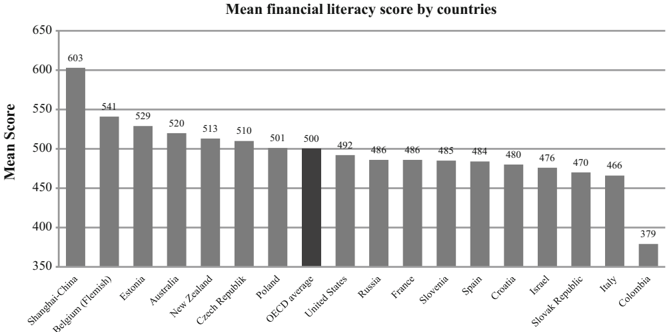
- Financial literacy is generally low and heterogeneous. In the PHF, 59% answered all Big Three questions correctly; Germany ranks among the highest worldwide (66% in the S&P FinLit Survey, 53% in SAVE, 59% in PHF), while transition economies can be as low as 4%.
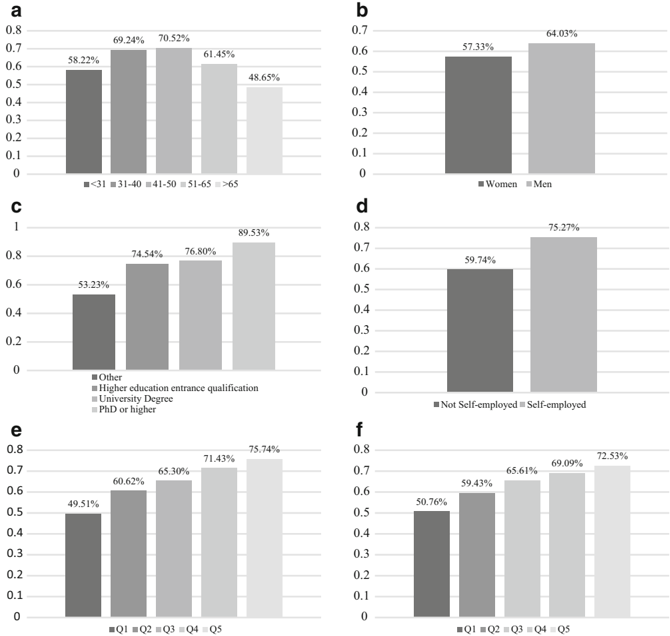
- Demographic gaps are large: in PHF, 64% of men versus 57% of women answered all Big Three correctly; highest educational attainment ~90% versus least educated 53%; highest income quintile 76% versus lowest 50%; highest wealth quintile 73% versus lowest 51%; age shows a hump shape, with >65 at 47%, <30 at 58%, and those in their forties at 70%.
- Financial education evidence is disappointing: Fernandes et al. (2014), meta-analyzing 90 studies, find financial education interventions explain no more than 0.1% of the variance in financial behavior, with effects declining over time and little impact when decisions are made 20 months or later.
- Financial advice as a substitute for literacy is inconclusive: some studies find low-literate individuals are less likely to seek advice, but once advice is obtained, low-literate individuals are most likely to follow it; overconfidence may reduce advice-seeking.
Methods
- Literature survey/review covering conceptualizations and measurement of financial literacy, determinants, financial behavior, financial education, and financial advice, including cross-country comparisons and summary tables.
- Supplemented with novel descriptive evidence from the first wave of the German PHF: face-to-face CAPI interviews between September 2010 and July 2011 with the financially knowledgeable person in 3,565 households, representative of the German population; analyses use survey weights and multiple imputation.
- Reviews studies using the Big Three, extended measures, PISA 2012, the S&P Global FinLit Survey, and discusses endogeneity and instrumental-variable approaches.
Limitations
- Stated: there is no universally accepted definition or operationalization of financial literacy; test-based measures have caveats including lack of incentives, no access to outside information, framing sensitivity, guessing, and measurement error; household survey data quality has declined; endogeneity complicates causal interpretation; evidence on financial advice and education effectiveness is mixed or inconclusive.
- Evident: as a survey, most reviewed evidence is correlational and non-experimental; the PHF component is descriptive rather than causal; the review emphasizes Germany and the U.S., with limited cross-country comparability.
Model-written summary. Check it against the paper before relying on it.
Integrity signals
Registry
Cites
Statistics
Figures
Verification
Claims the paper makes
34 Valid · 3 Not valid · 123 Not checked · 71 Own results and interpretations
Every source the paper cites for this claim was checked and supports it.
In the paper
“Hastings et al. (2013) document that respondents with higher cognitive abilities and more comfortable with numerical calculations on average exhibit higher levels of financial literacy.”
§ Financial literacy, financial advice, and financial behavior > 2.1.2 Cognitive abilities versus financial literacy
What the sources say
- Supportedcites Hastings et al. (2013) matched to “Financial Literacy, Financial Education, and Economic Outcomes” (2013) source
Section 4 (page not provided) states that individuals with higher general cognitive abilities or greater facility with numbers and numerical calculations tend to have higher financial literacy. This directly supports the citing sentence's association without implying causation. (LLM, conf=0.94)
plainstates an association- Asserted: passes — The authors put it forward as true.
- Checkable: passes — It can be checked against evidence.
- Load-bearing: unclear — It is unclear whether the paper’s conclusions depend on it.
- Based: passes — The paper gives a reason why it holds.
- Supported
The cited sources support only part of this claim — read each source’s verdict below.
In the paper
“In fact, the percentage of correct answers doubled in the latter study when the wording for the third question of the Big Three was ''buying company stock usually provides a safer return than a stock mutual fund'' as compared to phrasing the question reversely”
§ Financial literacy, financial advice, and financial behavior > 2.2.3 Caveats of test-based financial literacy measures
What the sources say
- Partly supportedcites van Rooij et al. (2011b) matched to “Financial literacy and stock market participation” (2011) sourceExperimental — accuracy not yet measured
Box 2, p. 13, says the number of correct answers doubled for the quoted wording compared with its reverse. Box 2, pp. 12–13, presents this as an advanced financial-literacy question, not as the third question of the “Big Three”; that identification is not supported by our copy. (LLM, conf=0.85)
plainstates a cause- Asserted: passes — The authors put it forward as true.
- Checkable: passes — It can be checked against evidence.
- Load-bearing: passes — The paper’s conclusions depend on it.
- Based: passes — The paper gives a reason why it holds.
- Partly supported
Every source the paper cites for this claim was checked and supports it.
In the paper
“Choi et al. (2011) investigate contributions to 401(k) plans by employees who are eligible for an employer match and find that a large fraction of these employees either do not participate at all or contribute less than the amount required to be granted the full employer match, thus foregoing matching contributions which cumulate to substantial losses over time.”
§ Financial literacy, financial advice, and financial behavior > 1 Introduction
What the sources say
- Supportedcites Choi et al. (2011) matched to “$100 Bills on the Sidewalk: Suboptimal Investment in 401(k) Plans” (2011) source
Split into 2 atoms — 2 confirmed, 0 partially supported, 0 disputed, 0 misattributed, 0 unverifiable. Expand the claim to see per-atom verdicts.
plain- Asserted: passes — The authors put it forward as true.
- Checkable: passes — It can be checked against evidence.
- Load-bearing: passes — The paper’s conclusions depend on it.
- Based: passes — The paper gives a reason why it holds.
- Supported
The cited sources support only part of this claim — read each source’s verdict below.
In the paper
“Specifically, Lusardi and Mitchell (2011a, b) and van Rooij et al. (2011b) document that the answers of survey participants differ significantly based on the wording of the test questions.”
§ Financial literacy, financial advice, and financial behavior > 2.2.3 Caveats of test-based financial literacy measures
What the sources say
- Could not verifycites Lusardi and Mitchell (2011a, b) matched to “The Outlook for Financial Literacy” (2011) sourceExperimental — accuracy not yet measured
The Financial Literacy and Financial Decision-Making section reports how many respondents answered financial-literacy questions correctly, but does not compare answers to differently worded versions of a question. The Evaluating Financial Literacy Interventions section discusses how information is framed, not the wording of test questions. Searches for question wording and differently worded questions found no passage documenting the claimed difference in answers. (LLM, conf=0.73)
- Supportedcites van Rooij et al. (2011b) matched to “Financial literacy and stock market participation” (2011) source
Box 2 (pp. 12–13) describes giving randomly selected groups differently worded versions of the same questions. It reports that wording changed responses dramatically for complex questions, although the difference for a simple question was not significant at the 5% level. (LLM, conf=0.90)
plainstates a cause- Asserted: passes — The authors put it forward as true.
- Checkable: passes — It can be checked against evidence.
- Load-bearing: unclear — It is unclear whether the paper’s conclusions depend on it.
- Based: passes — The paper gives a reason why it holds.
- Could not verify
The cited sources support only part of this claim — read each source’s verdict below.
In the paper
“Besides, study designs usually do not permit participants to tap into other sources of information in order to prepare their decisions.”
§ Financial literacy, financial advice, and financial behavior > 2.2.3 Caveats of test-based financial literacy measures
What the sources say
- Partly supportedcites Hastings et al. (2013) matched to “Financial Literacy, Financial Education, and Economic Outcomes” (2013) sourceExperimental — accuracy not yet measured
Section 3, “Measuring Financial Literacy” (page not provided), says studies had not allowed participants to consult outside sources while completing financial-literacy performance tests. This supports the point about access to information in those tests, but not the broader claim about study designs generally or participants preparing decisions. (LLM, conf=0.85)
plain- Asserted: passes — The authors put it forward as true.
- Checkable: passes — It can be checked against evidence.
- Load-bearing: passes — The paper’s conclusions depend on it.
- Based: passes — The paper gives a reason why it holds.
- Partly supported
119 more claims · 17 with their cited sources checked
Create a free account to see all 231 claims and to verify the 30 references still open.
- It may state two separate claims as one. 70
- Probably not a substantial claim. 52
Self-check
Percentages, sums and reported differences re-computed from the paper’s own numbers.
Each contradiction between two passages listed here was confirmed by an independent check.
Rated minor: it would not touch a result — a value no result rests on, a p-value that stays on the same side of the significance level, or a conflict that is clerical, resolved elsewhere in the paper, or outside its own findings.
In the paper
§ Financial literacy, financial advice, and financial behavior > 1 Introduction
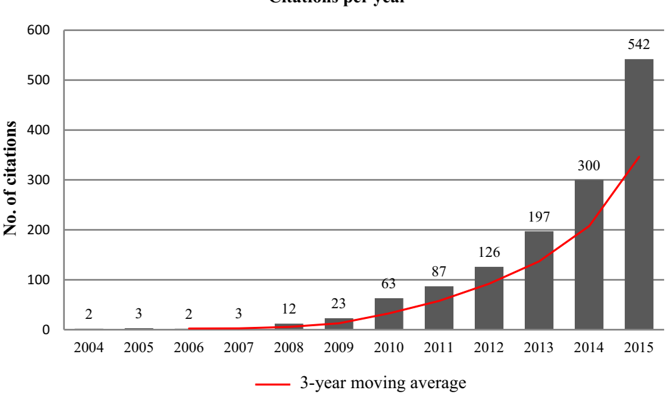
“From 2004 to 2006, the Web of Science database counts no more than two citations per year”
§ Financial literacy, financial advice, and financial behavior > 1 Introduction
“Publications per year 2 3 2 3 12 23 63 87 126 197 300 542 0 100 200 300 400 500 600 2004 2005 2006 2007 2008 2009 2010 2011 2012 2013 2014 2015No. of citations”
Citations
Cites
Kruger, J., & Dunning, D. (1999) · Journal of Personality and Social Psychology · doi:10.1037/0022-3514.77.6.1121 · Cited by 7,731 · cited 1×
“By contrast, this literature suggests that individuals who do not know much about a subject tend not to recognize their ignorance and therefore typically fail to seek better information (Kruger and Dunning 1999).”
(1996) · Institutional Research Information System University of Turin (University of Turin) · doi:10.1111/j · Cited by 5,486
The Economic Importance of Financial Literacy: Theory and Evidence
Lusardi, A., & Mitchell, O. S. (2014) · Journal of Economic Literature · doi:10.1257/jel.52.1.5 · Cited by 4,698 · cited 19×
“Although the Big Three generally do not demand advanced financial knowledge, only 34% of respondents in the original survey were able to answer all three questions correctly (Lusardi and Mitchell 2014).”
InfluentialMultiple imputation after 18+ years
Rubin, D. B. (1996) · Journal of the American Statistical Association · doi:10.1080/01621459.1996.10476908 · Cited by 4,072
Financial literacy and stock market participation
van Rooij, M., Lusardi, A., & Alessie, R. (2011) · Journal of Financial Economics · doi:10.1016/j.jfineco.2011.03.006 · Cited by 3,554 · cited 9×
“Specifically, van Rooij et al. (2011b) document that financial sophistication is positively related to stock market participation of retail investors in the Netherlands.”
BackgroundMethodInfluentialMultiple Imputation After 18+ Years
Rubin, D. B. (1996) · Journal of the American Statistical Association · doi:10.2307/2291635 · Cited by 2,686 · cited 1×
“For robustness, we re-estimate our main model using multiple imputations via Rubin’s rule (Rubin 1996).”
MethodHUSTON, S. J. (2010) · Journal of Consumer Affairs · doi:10.1111/j.1745-6606.2010.01170.x · Cited by 2,558 · cited 2×
“In another extensive review of financial literacy operationalizations, Huston (2010) surveys 71 studies using 52 different data sets and corroborates that there is no such thing as a standardized conceptualization of financial literacy.”
BackgroundSave More Tomorrow™: Using Behavioral Economics to Increase Employee Saving
Thaler, R. H., & Benartzi, S. (2004) · Journal of Political Economy · doi:10.1086/380085 · Cited by 2,483 · cited 1×
“Indeed, this approach is promoted by, e.g., Choi et al. (2004) and Thaler and Benartzi (2004) who find that opt-out regimes in 401(k) pension plans result in a large and persistent increase in pension participation rates relative to conventional opt-in arrangements. prepare a detailed transcript of…”
BackgroundEndogeneity in Empirical Corporate Finance1
Roberts, M. R., & Whited, T. M. (2013) · Handbook of the Economics of Finance · doi:10.1016/b978-0-44-453594-8.00007-0 · Cited by 2,459 · cited 1×
“Moreover, Roberts and Whited (2013) stress that truly exogenous instruments are difficult to find and, in particular, that it should be rigorous economic arguments rather than formal falsification tests that eventually decide over the instrument’s validity.”
BackgroundAngrist, J. D., & Krueger, A. B. (2001) · Journal of Economic Perspectives · doi:10.1257/jep.15.4.69 · Cited by 2,355
Research works printed but not linked: 5
- 53. Collins JM, Gorey RN, Schmeiser MD, Baker CA, Ziegler D (2009) Building indicators measures: analysis and recommendations. Anne E. Casey Foundation, Baltimore
- 56. Danes SM, Huddleston-Casas C, Boyce L (1999) Financial planning curriculum for teens: Impact evaluation. J Financ Couns Plan 10(1):26-39
- 58. Deevy M, Lucich S, Beals M (2012) Scams, schemes and swindles-a review of consumer financial fraud research. Working paper
- 94. Hilgert MA, Hogarth JM, Beverly SG (2003) Household financial management: the connection between knowdlege and behavior. Federal Reserv Bull 89(7):309-322
- 103. Investment Company Institute (2007) Why do mutual fund investors use professional financial advisors? Res Fundam 16(1):1-8
Cited by
Items 201–300 of 469
A Pilot Study Assessing Attitudes toward Finance among Italian Business Students
Bocchialini, E., & Ronchini, B. (2019) · International Journal of Business and Management · doi:10.5539/ijbm.v14n10p44 · Cited by 8
“In this case, we assumed that males, who usually score higher on overconfidence and measured financial knowledge than women (Stolper & Walter, 2017) would be more dominant in the conversation, hindering female students from freely expressing themselves.”
BackgroundEdukasi Literasi Keuangan Dan Pelatihan Komunikasi Terapeutik Di Stik Sint Carolus, Jakarta
Hermawan, F., Wijayanti, S. H., Saadah, S., et al. (2021) · JURNAL KREATIVITAS PENGABDIAN KEPADA MASYARAKAT (PKM) · doi:10.33024/jkpm.v4i4.3898 · Cited by 6
Osagwu, A. O., & Okafor, E. G. (2022) · European Journal of Business and Innovation Research · doi:10.37745/ejbir.2013/vo10.n6pp3470 · Cited by 7
Liu, C. W., Ho, L., & Chueh, T. (2019) · Journal of Computer Assisted Learning · doi:10.1111/jcal.12395 · Cited by 9
Vocational and senior high school differences in financial literacy
Khusaini, Muti’ah, M., & Ramdani, H. C. (2021) · IOP Conference Series Earth and Environmental Science · doi:10.1088/1755-1315/747/1/012018 · Cited by 6
Internal factors driving willingness to seek financial advice: The role of trust and anxiety
Westermann, S., Harrison, J. L., & Niblock, S. J. (2024) · Journal of Consumer Affairs · doi:10.1111/joca.12611 · Cited by 6
Marjerison, R. K., Dong, H., & Kim, J. M. (2025) · SAGE Open · doi:10.1177/21582440251352342 · Cited by 27
“These theories explain how risk perception and resource availability shape financial decision-making across generational lines, offering a structured lens to explore differences in risk tolerance (Lusardi & Mitchell, 2014; Stolper & Walter, 2017).”
Perceived usefulness of social media in financial decision-making: differences and similarities
Khan, K. A., Akhtar, M. A., & Tripathi, P. K. (2020) · Innovative Marketing · doi:10.21511/im.16(4).2020.13 · Cited by 10
“Some studies conclude that due to the uncertainty involved in financial decision-making, the information required is much more for taking a calculated decision (Stolper & Walter, 2017).”
BackgroundCwynar, A. (2022) · South East European Journal of Economics and Business · doi:10.2478/jeb-2022-0007 · Cited by 7
Digital Customer Protection: Mediator between Mobile Money Usage and Financial Inclusion
Budiyono, E. F. C. S., & Sukamulja, S. (2023) · Media Ekonomi dan Manajemen · doi:10.56444/mem.v38i1.3374 · Cited by 9
“Financial behavior is a behavior as individuals to carry out activities related to their finances (Grohmann, 2018; Stolper & Walter, 2017; Zakaria et al., 2012).”
BackgroundProjecting the Future Ageing Population in Post-2045: The Today’s Millenials Perspectives
Mas’ul, Z. (2023) · Jurnal Jamsostek · doi:10.61626/jamsostek.v1i1.4 · Cited by 5
“As part of financial literacy, pension funds cover all aspects of how people behave in their future, related to financial planning and financial decision making (Stolper & Walter, 2017, p. 2).”
BackgroundOladapo, I. A. (2024) · African Journal of Science Technology Innovation and Development · doi:10.1080/20421338.2023.2295625 · Cited by 7
“The TRA had be utilized in various fi elds of empirical research such as technology adoption (Otieno et al. 2016); fi nancial behaviour (Stolper and Walter 2017; Yoopetch and Chaithanapat 2021); marketing (Palm, Seubert, and Glaser 2019); blockchain-based cryptocurrency investment behaviour (Perdana,…”
Mireku, K. (2024) · Journal of Business & Finance Librarianship · doi:10.1080/08963568.2024.2352311 · Cited by 18
“However, there is evidence that many individuals are not well-equipped to make sound financial decisions (Ergün, 2018; Goyal & Kumar, 2021; Lusardi, 2012: Stolper & Walter, 2017).”
BackgroundTesting Integrative Models of the Change Behavior in the Intention to Adopt Cryptocurrency
Doblas, M. P., Becaro-Lapiz, J. M., N.A., J. P. S., Natarajan, V. K., Yoganandham, G., & Arumugasamy, G. (2024) · SAGE Open · doi:10.1177/21582440241253542 · Cited by 15
“Using financial advi-sors, Stolper and Walter (2017) demonstrated that literacy in understanding an asset works increases the propensity to demand it.”
Determinants of Positive Financial Behaviors: A Study Among University Students
Ergün, K. (2021) · Springer proceedings in business and economics · doi:10.1007/978-3-030-55277-0_29 · Cited by 6
Financial Literacy and Socialist Education: Lessons from the German Reunification
Davoli, M., & Hou, J. (2018) · German Economic Review · doi:10.1515/ger-2020-0027 · Cited by 6
Transforming Financial Sector Through Financial Literacy and Fintech Revolution
Makhija, P., Chacko, E., & Sinha, M. (2021) · Springer eBooks · doi:10.1007/978-981-16-2652-4_12 · Cited by 11
Identifying Financially Illiterate Groups: An International ComparisonPreprint
Beckker, K. D., Witte, K. D., & Campenhout, G. V. (2019) · SSRN Electronic Journal · doi:10.2139/ssrn.3360483 · Cited by 7
A Note on GameStop, Short Squeezes, and Autodidactic Herding: An Evolution in Financial Literacy?Preprint
Klein, T. (2021) · SSRN Electronic Journal · doi:10.2139/ssrn.3845722 · Cited by 5
Кузина, О. Е., Abduramanov, A. Y., & Викторовна, М. Д. (2024) · Voprosy Ekonomiki · doi:10.32609/0042-8736-2024-9-107-137 · Cited by 6
Bhatia, M., Arora, R., & Mehrotra, V. (2024) · Global Business Review · doi:10.1177/09721509241288622 · Cited by 10
Pillai, R., Kumar, P., Kumar, N., & Tabash, M. I. (2025) · Borsa Istanbul Review · doi:10.1016/j.bir.2025.09.007 · Cited by 9
Gunawan, A., Mukmin, Wahyuni, S. F., et al. (2023) · Investment Management and Financial Innovations · doi:10.21511/imfi.20(4).2023.15 · Cited by 4
“Academic pursuits, such as enrolling in secondary or tertiary educational institutions, participating in workshops, and engaging in external training initiatives, offer individuals a means to acquire financial knowledge (Stolper & Walter, 2017).”
BackgroundEnongene, G. N., Isoh, A. V. N., Mbarika, V. W. A., Fofanah, S. A., & Itoe, M. M. (2024) · Business Management and Strategy · doi:10.5296/bms.v15i1.21651 · Cited by 9
Doğaner, M. B., İbrahim, Şit, A., & Başar, B. D. (2024) · Economic Alternatives · doi:10.37075/ea.2024.1.07 · Cited by 2
Finanzielle Kompetenzen und Defizite in Deutschland – eine aktuelle Bestandsaufnahme
Bachmann, R., Rulff, C., & Schmidt, C. Μ. (2021) · List Forum für Wirtschafts- und Finanzpolitik · doi:10.1007/s41025-021-00235-2 · Cited by 11
Tyumentseva, E. Y., Shamis, V. A., & Mukhametdinova, S. K. (2023) · Science for Education Today · doi:10.15293/2658-6762.2305.06 · Cited by 5
Nazneen, A. (2024) · Journal of Infrastructure Policy and Development · doi:10.24294/jipd.v8i5.4854 · Cited by 4
“As per a survey by the World Bank, banking professionals who possess financial literacy are better able to make decisions, which in turn leads to better financial stability for themselves and the institutions they work for (Stolper and Walter, 2017).”
BackgroundFinancial Literacy, Naive Diversification, and Security SelectionPreprint
Hanson, T. A., & Kalthoff, J. (2019) · SSRN Electronic Journal · Cited by 5
Financial Literacy and Retirees' Resource Allocation Decisions in New ZealandPreprint
Noviarini, J., Coleman, A., Roberts, H., et al. (2022) · SSRN Electronic Journal · doi:10.2139/ssrn.4115332 · Cited by 4
Santiago, L. A. D., Hernández, M. G. S., Castiblanco, F., Scolaro, M. D. C. M., & Guadarrama, J. P. B. (2024) · Revista de Economía Facultad de Economía Universidad Autónoma de Yucatán · doi:10.33937/reveco.2024.407 · Cited by 5
Aristei, D., Bacci, S., Gallo, M., & Iannario, M. (2024) · Journal of the Royal Statistical Society Series A (Statistics in Society) · doi:10.1093/jrsssa/qnae133 · Cited by 3
Sharma, N., Manohar, S., Nair, A. J., & Rao, A. B. S. (2025) · Journal of Innovation and Entrepreneurship · doi:10.1186/s13731-025-00517-5 · Cited by 9
“Financially literate investors make informed and sophisticated investment decisions that balance the risk and return of their portfolios (Stolper & Walter, 2017).”
Curry, J. T. (2025) · Cogent Economics & Finance · doi:10.1080/23322039.2025.2544177 · Cited by 15
“However, the consistency of findings with external studies (Blaschke, 2022; Stolper & Walter, 2017) suggests that these gender gaps in confidence are real and impactful.”
Numeracy and Financial Wellbeing During the COVID-19 Pandemic
Wikoff, N. (2022) · Numeracy · doi:10.5038/1936-4660.15.1.1399 · Cited by 3
“These skills are arguably more relevant to day-to-day money management than are the skills and knowledge covered in traditional financial literacy scales (Stolper and Walter 2017).”
BackgroundFinancial and Digital Literacy Related to Student Entrepreneurial Intentions
Hardika, N. S., Ariana, I. M., & Masih, N. K. (2022) · Advances in Social Science, Education and Humanities Research/Advances in social science, education and humanities research · doi:10.2991/978-2-494069-83-1_23 · Cited by 3
Financial literacy during a pandemic: Does modality matter?
Filbeck, G., & Zhao, X. J. (2023) · Financial Services Review · doi:10.61190/fsr.v31i2/3.3538 · Cited by 4
Strategies for enhancing financial literacy in Indonesia
Maemunah, S. (2022) · Journal of Economics and Business Letters · doi:10.55942/jebl.v2i1.283 · Cited by 9
Trust within Investment Decisions and Advice
Ritzer-Angerer, P. (2019) · The Journal of Wealth Management · doi:10.3905/jwm.2019.1.083 · Cited by 5
“Financial education: Following Cruciani, finan cial literacy is a specif ic cognitive issue extensively addressed by f inancial literature, and, for example, recently reviewed by Stolper and Walter (2017).”
BackgroundAn empirical study on the relationship between financial literacy and emotional biases
Dureha, S., & Vaishali, J. (2022) · Cardiometry · doi:10.18137/cardiometry.2022.23.413422 · Cited by 3
Metodologías para la medición de las competencias financieras: un análisis de cuestionarios
Muñoz-Céspedes, E., Ibar-Alonso, R., & Mir, M. C. (2022) · Revista Electrónica de Comunicaciones y Trabajos de ASEPUMA · doi:10.24309/recta.2022.23.2.03 · Cited by 11
“…los conocimientos financieros, estas autoras incorporaron dos cuestiones adicionales, evaluando el entendimiento sobre los intereses hipotecarios y los precios de los bonos, estas cinco preguntas se reconocerán entonces como las Cinco Grandes ( Big Five ) (Lusardi, 2015a; Stolper & Walter, 2017) ).”
Suhardiman, S., Tamara, D., Rustam, S., & Kurniawan, B. (2023) · International Conference on Industrial Engineering and Operations Management (IEOM) · doi:10.46254/ap03.20220227 · Cited by 5
Are Z Generation young people potential investors in sustainable finance?
Ribau-Peltre, N. (2023) · Bankers Markets & Investors · doi:10.54695/bmi.172.0023 · Cited by 5
The business strategy of the utility token adoption by investors in a developing country
Chutipat, V., Sonsuphap, R., & Thetlek, R. (2023) · Corporate and Business Strategy Review · doi:10.22495/cbsrv4i3art14 · Cited by 3
“Higher levels of financial literacy, according to Stolper and Walter (2017), are connected with more saving planning, more saving behaviour, greater stock market involvement, and better decisions regarding the selection of financial goods.”
BackgroundFinancial Literacy, Financial Behaviors, and Financial Crises: The Case of Lebanon
DerMesrobian, R. M. K. (2023) · Journal of Applied Economic Sciences (JAES) · doi:10.57017/jaes.v18.1(79).05 · Cited by 4
“…in making informed financial decisions to reach healthy personal finance is impartial (Klapper et al., 2013, Bucher-Koenen and Ziegelmeyer, 2014; Stolper and Walter, 2017) as their financial behaviors play a vital role in determining not only individual financial welfare, but also national and…”
BackgroundWay of life: A future research agenda for how worldviews impact financial attitudes and behaviors
Enete, S., & McDowell, S. (2024) · Financial Planning Review · doi:10.1002/cfp2.1177 · Cited by 8
SOSIALISASI LITERASI KEUANGAN DAN INVESTASI BAGI GEN Z
Octrina, F., Rizal, N. A., Krisnawati, A., et al. (2023) · JMM (Jurnal Masyarakat Mandiri) · doi:10.31764/jmm.v7i5.16751 · Cited by 3
“…(2020) yang menyebutkan bahwa literasi keuangan harus dianggap sebagai faktor penting untuk meningkatkan kesejahteraan rumah tangga, karena menurut Stolper & Walter (2017) semakin sedikit individu yang paham keuangan, akan semakin memperbesar kemungkinan mereka membuat keputusan pembiayaan yang…”
BackgroundAttitude, behavior and financial knowledge of young university students in Mexico
Décaro-Santiago, L. A. (2023) · Journal General Economics · doi:10.35429/jge.2023.12.7.1.12 · Cited by 6
Chandra, P. K., Pangkey, L. B., & Soetanto, T. V. (2023) · International Journal of Organizational Behavior and Policy · doi:10.9744/ijobp.2.2.87-96 · Cited by 3
Is it Important for Elementary School Students to Learn the Basics of Finance?
Yunikawati, N. A., Priambodo, M. P., Puspasari, E. Y., & Istiqomah, N. (2021) · KnE Social Sciences · doi:10.18502/kss.v5i8.9346 · Cited by 8
Akhtar, M. N., Hameed, S. M. Z., & Aftab, R. (2021) · doi:10.34091/ajss.14.1.04 · Cited by 4
Edukasi Peningkatan Literasi Keuangan kepada Masyarakat Kota Ternate
Pratama, R., Hadady, H., & Bailusy, M. N. (2022) · Jurnal Abdi Masyarakat Indonesia · doi:10.54082/jamsi.523 · Cited by 3
Financial Literacy on College Students in the Context of Tuxtepec, Oax
(2023) · European Journal of Contemporary Education · doi:10.13187/ejced.2023.1.221 · Cited by 3
Autonomy and Technology Adoption
Bushong, B., Corral, C., Giné, X., Mahajan, A., & Seira, E. (2020) · National Bureau of Economic Research · doi:10.3386/w27681 · Cited by 3
Valuing Safety and Privacy in Retail Central Bank Digital Currency
Australia, R. B. O., Fairweather, Z., Fiebig, D. G., Gorajek, A., Australia, R. B. O., Guttmann, R., Australia, R. B. O., Ma, J., Mulqueeney, J., & Australia, R. B. O. (2024) · doi:10.47688/rdp2024-02 · Cited by 10
Ekasari, A., Meutia, M., Uzliawati, L., & Mulyasari, W. (2024) · Journal of Infrastructure Policy and Development · doi:10.24294/jipd.v8i8.5686 · Cited by 10
“Higher financial literacy levels among micro-entrepreneurs will individually result in better financial performance since they will make wiser financial decisions and behave better financially (Stolper, 2017; Wiagustini et al., 2023).”
BackgroundAdhana, H. N. (2024) · International Journal of Accounting Finance and Risk Management · doi:10.11648/j.ijafrm.20240902.12 · Cited by 2
Ảnh hưởng hệ sinh thái Fintech đến dự định khởi nghiệp kinh doanh số của sinh viên Việt Nam
Thu, T. N., Thu, T. Đ., Thu, H. N. T., Bảo, T. T., Ngọc, L. L. T., & Thảo, N. P. T. (2024) · Tạp chí Kinh tế và Phát triển · doi:10.33301/jed.vi.1562 · Cited by 2
“…số (Chan & cộng sự, 2017; Zaheer & cộng sự, 2019), khả năng tiếp cận Fintech (Hasan & cộng sự, 2023) và ứng dụng Fintech (Nathan & cộng sự, 2022; Stolper & Walter, 2017) hoặc nhận thức tài chính (Hasan & cộng sự, 2023) mà chưa phân tích đầy đủ mối quan hệ giữa các công nghệ đối với kinh…”
Altaf, Z., & Shah, F. (2025) · Future Business Journal · doi:10.1186/s43093-025-00601-y · Cited by 6
“However, empirical studies mostly focus on its knowledge dimension and use it interchange-ably with financial knowledge [137].”
Förster, M., Hommel, M., Aprea, C., Fürstenau, B., Happ, R., & Wuttke, E. (2025) · Springer briefs in education · doi:10.1007/978-3-031-95690-4_1 · Cited by 2
Exploring gender differences in the financial literacy decision-making
Dotras, E. R., Masllorens, J. L. I., & Mitręga-Niestrój, K. (2025) · Economics & Sociology · doi:10.14254/2071-789x.2025/18-3/5 · Cited by 3
Purnamasari, E. D., Anggraini, L. D., & Faradillah, F. (2025) · Journal of risk and financial management · doi:10.3390/jrfm18120682 · Cited by 19
“This interpretation is consistent with prior studies that emphasize the importance of education and digital competence in mediating financial outcomes (Stolper & Walter, 2017).”
Straub, L., Zeiß, C., Pehl, J., Greiner, M., Winkelmann, A., & Lechner, U. (2026) · Electronic Markets · doi:10.1007/s12525-025-00863-y · Cited by 2
“…role in financial education, particularly established financial institutions, educators, and regulatory bodies (Kaiser et al., 2022; Menberu, 2024; Stolper & Walter, 2017), are preoccupied with redefining their own roles in light of blockchain-based technological disruption (Fujiki, 2021) and…”
Financial Capabilities and Financial Well-Being: The Mediating Role of Financial Resilience
García-Santıllán, A. (2026) · Journal of risk and financial management · doi:10.3390/jrfm19020141 · Cited by 11
“This result aligns with Collins (2012), Stolper and Walter (2017), de Jong and Wagensveld (2024), and Mustafa et al. (2025), who underline the transformative potential of professional guidance.”
Raina, K., Dayal, S., & Singhal, E. (2026) · Acta Psychologica · doi:10.1016/j.actpsy.2026.106599 · Cited by 6
Mandić, A., Čiković, K. F., & Jakšić, T. (2026) · International Journal of Financial Studies · doi:10.3390/ijfs14040079 · Cited by 11
“Empirical studies show that higher financial literacy can reduce the tendency toward certain biases, such as herding or misjudging interest rates, especially in the context of complex financial products (Stolper & Walter, 2017).”
Financial Literacy and Informal Loan
Santos, D. B., Mendes‐Da‐Silva, W., & Gonzalez, L. (2018) · Springer eBooks · doi:10.1007/978-3-319-91911-9_7 · Cited by 3
Financial literacy in Italy: Empirical evidence and theoretical proposals
Stella, G. P., Filotto, U., & Cervellati, E. M. (2021) · doi:10.22495/flieetp · Cited by 4
Eriksen, K. W., Fest, S., Kvaløy, O., & Dijk, O. (2022) · Journal of Banking & Finance · doi:10.1016/j.jbankfin.2022.106571 · Cited by 2
Llona, F. M. (2022) · JPAIR Multidisciplinary Research · doi:10.7719/jpair.v50i1.437 · Cited by 2
Prazadhea, A. A., & Fitriyah, F. (2023) · Jurnal Ilmiah Manajemen Ekonomi & Akuntansi (MEA) · doi:10.31955/mea.v7i2.3066 · Cited by 23
“Additionally, Stolper and Walter, (2017) describe financial literacy as acquiring knowledge and comprehension of economic concepts and risks and the abilities, motivation, and confidence to apply this knowledge and understanding in making effective decisions across diverse financial scenarios.”
Cognition ability, financial advice seeking, and investment performance: New evidence from China
Yang, Z., Gao, J., & Yu, D. (2023) · International Review of Finance · doi:10.1111/irfi.12433 · Cited by 5
Determinants of Digital Currency Usage in Nigeria
Fepetu, O., & Adewumi, P. A. (2023) · Advances in finance, accounting, and economics book series · doi:10.4018/979-8-3693-0770-0.ch006 · Cited by 3
Wealth as a moderating effect on gender differences in portfolio holdings
Baeckström, Y., Tosun, O. K., & Riefler, R. (2024) · Global Finance Journal · doi:10.1016/j.gfj.2024.100965 · Cited by 6
Purwidianti, W., Santoso, A., Darmawan, A., Rahmawati, I. D., & Setiyani, L. (2022) · International Conference of Business, Accounting, and Economics (ICBAE) · doi:10.4108/eai.10-8-2022.2320785 · Cited by 13
“Good financial literacy will lead to optimal financial behavior [24].”
MSME FINANCIAL LITERACY TRAINING FOR SERANG RAYA UNIVERSITY ALUMNAE
Sunaryo, D. (2022) · JURNAL PENGABDIAN MASYARAKAT INDONESIA · doi:10.55606/jpmi.v1i3.597 · Cited by 2
Financial intermediation and innovation: linking international agents and local investors
Neto, M. M., Donadone, J. C., & Alves, P. V. B. F. (2022) · Gestão & Produção · doi:10.1590/1806-9649-2022v29e3622 · Cited by 3
KRİPTO PARALARA YATIRIM NİYETİNİ ETKİLEYEN BAZI FAKTÖRLERİN İNCELENMESİ
Efendioğlu, İ. H. (2022) · Giresun Üniversitesi İktisadi ve İdari Bilimler Dergisi · doi:10.46849/guiibd.1162973 · Cited by 3
“Ancak finansal bilgi seviyesi düşük olan veya yatırım danışmanlığı almayan yatırımcılar risklerle karşılaşma olasılığı daha yüksektir (Stolper ve Walter, 2017).”
Hammer, T., & Zureck, A. (2022) · Journal of Entrepreneurship and Sustainability Issues · doi:10.9770/jesi.2022.10.2(2 · Cited by 2
Analyzing the Determinants of Financial Literacy
Winanto, M. R., din, N., & Widiastuti, E. (2022) · International Research Journal of Economics and Management Studies · doi:10.56472/25835238/irjems-v2i1p104 · Cited by 2
“Having financial literacy can make it easier for someone to hold and spend the money or capital they hold (Stolper & Walter, 2017).”
Pénzügyi és öngondoskodási ismeretek a magyar középiskolák végzős osztályaiban 2021-ben
Kovács, Z., & Dunay, A. (2023) · Soproni Egyetem Kiadó eBooks · doi:10.35511/978-963-334-450-7_s4b_kovacs_dunay · Cited by 2
Literasi Keuangan, Perilaku Keuangan, Overconfidence dan Keputusan Investasi
Pradnyani, L. G. R. R., & Sujana, I. K. (2023) · E-Jurnal Akuntansi · doi:10.24843/eja.2023.v33.i05.p18 · Cited by 2
Educación financiera de universitarios: implicaciones del manejo en tarjetas de crédito
González, N. N. R., Reyes, V. C., & Ocampo, M. J. M. (2023) · Ciencia Latina Revista Científica Multidisciplinar · doi:10.37811/cl_rcm.v7i3.6509 · Cited by 4
Financial Risk, Attitude, and Skills of the Young Generation in Central India
Roy, P., Shukla, H., & Bajpai, M. (2023) · International Journal of Management and Humanities · doi:10.35940/ijmh.b1659.1010223 · Cited by 3
“The Last and Fourth part contains questions about Financial Attitude with 8 questions (Porto & Xiao, 2016 [32]; Purohit et al., 2022 [34]; Stolper & Walter, 2017 [37]).”
Wibisono, A., & Anastasia, N. (2024) · Journal of Economics Research and Policy Studies · doi:10.53088/jerps.v4i3.1259 · Cited by 9
Out-of-Pocket vs. Out-of-Profit in Financial Advisory Fees: Evidence from the LabPreprint
Mugerman, Y., Sade, O., & Winter, E. (2017) · SSRN Electronic Journal · doi:10.2139/ssrn.3061020 · Cited by 2
Mota, D., & da Silva, A. F. D. A. (2021) · SSRN Electronic Journal · doi:10.2139/ssrn.3973565 · Cited by 3
Masciandaro, D., & Guerini, C. (2023) · SSRN Electronic Journal · doi:10.2139/ssrn.4664438 · Cited by 4
Exploring Literature on Financial Socialization – A Bibliometric Analysis
Parthasarathy, S. L., & Vinayachandran, V. (2023) · TEM Journal · doi:10.18421/tem124-40 · Cited by 4
Household Finance: An Introduction to Individual Financial Behavior
Deaves, R. (2024) · doi:10.1093/9780197699898.001.0001 · Cited by 4
Ngo, T. T. A., Tran, T. N. T., Bui, T. M. X., & Le, N. Q. (2024) · Journal of Infrastructure Policy and Development · doi:10.24294/jipd.v8i7.5967 · Cited by 1
“Stolper and Walter (2017) posit that individuals with heightened FK are more likely to make informed choices regarding the use of monetary resources.”
BackgroundInfluential Financial Planners and Islamic Financial Planning: A Social Media-Based Content Analysis
Amalia, P. S., Yunanda, R. A., & Mustafa, M. Q. (2024) · Tazkia Islamic Finance and Business Review · doi:10.30993/tifbr.v18i1.329 · Cited by 2
Debt advice in Europe: a search of the good practices to fight over-indebtedness
Tanda, A., & Vandone, D. (2024) · Qualitative Research in Financial Markets · doi:10.1108/qrfm-12-2023-0301 · Cited by 1
A pénzügyi tudatosság rejtett magatartásbéli jellemzői a magyar lakosság körében
Csiszárik-Kocsír, Á., Varga, J., & Bagó, P. (2024) · Vezetéstudomány / Budapest Management Review · doi:10.14267/veztud.2024.09.06 · Cited by 1
Avoiding Financial Information: The Roles of Fate and Money Beliefs
Montford, W. J., & Timmerman, I. (2024) · Journal of Consumer Behaviour · doi:10.1002/cb.2410 · Cited by 1
Sofiyani, P., Saraswati, H., Hillalliyati, N., et al. (2024) · FINANSIA Jurnal Akuntansi dan Perbankan Syariah · doi:10.32332/finansia.v7i2.8951 · Cited by 1
Lazutina, D. V., & Faltinskaya, E. M. (2024) · Вестник Тюменского государственного университета. Социально-экономические и правовые исследования · doi:10.21684/2411-7897-2024-10-3-49-89 · Cited by 1
The need for financial education in the face of the social media and cryptocurrency phenomenon
Gómez, S. M., & de Luna, Á. B. M. (2025) · Business Management and Economics Engineering · doi:10.3846/bmee.2025.20296 · Cited by 3
Nikhil, C., Edward, S., Angeline Grace, G., & Swetha, N. B. (2025) · Cureus · doi:10.7759/cureus.85664 · Cited by 4
“Poor management of financial resources is a common problem, especially among college students [24].”
Metadata
- Authors
- Stolper, O. A., & Walter, A.
- Affiliations
- Philipps University of Marburg (DE)
- Justus-Liebig-Universität Gießen (DE)
- Corresponding author
- Walter, Andreas
- Venue
- Journal of Business Economics
- Published
- 2017-03-04
- Volume
- 87
- Issue
- 5
- Pages
- 581-643
- ISSN
- 0044-2372 (ISSN-L)
- 1861-8928
- OpenAlex
- W2593560379
- Semantic Scholar
- ea990bccbdb09e1e574090c6c126459f5d7afdba
- Cited by
- 471
- References
- 204
- Citations by year
- 2026: 46 · 2025: 49 · 2024: 93 · 2023: 68 · 2022: 75 · 2021: 55 · 2020: 45 · 2019: 26 · 2018: 9 · 2017: 5
- FWCI
- 75.22
- Type
- journal article
- Language
- en
- Open access
- hybrid
- doi.org
- Locations
- Journal of Business Economics (publishedVersion, cc-by)
- RePEc: Research Papers in Economics (submittedVersion)
- Topics
- Social Sciences › Economics, Econometrics and Finance › Finance › Financial Literacy, Pension, Retirement Analysis
- Social Sciences › Business, Management and Accounting › Accounting › Financial Literacy and Behavior
- Social Sciences › Decision Sciences › General Decision Sciences › Decision-Making and Behavioral Economics
- Keywords
- financial literacy, financial advice, financial behavior, financial education, household finance, determinants of financial literacy
About these checks
Registry, retraction, Cites and statistics results are computed, not judged, with one exception: a printed reference that no index lists is read once by a model before it counts as a citation error. Claims are extracted by a model and kept only when their quote appears verbatim in the text; each cited source is then checked, with a model’s help, for whether it says what the claim relies on. Those verdicts can be wrong — read the claim’s quote and the cited source before relying on one.
The claim verdicts this report counts are experimental: their accuracy is not yet measured.
A language model drew the claims from the paper on 2026-10-10, under version 3 of the claim definition (model deepseek-v4.1-flash, prompt extract-v3).
A second model labelled each claim on 2026-10-10 (model jev-1.13-20260917, definition revision gold-guideline-v0.2).
Cited sources are checked with a language model’s help (gpt-6-sol).
Statistics and arithmetic are recomputed, not judged.
Confidence bands are shown only for fields calibrated on our annotated test set. None is calibrated yet, so no band is shown.
What counts as a claim ›How we measure confidence ›How we check this ›
Are you an author, or do you see a problem with this page? Request a review
Data sources
Bibliographic data: Semantic Scholar, OpenAlex, Crossref.
Contains information from the Semantic Scholar Academic Graph Datasets, made available under the ODC Attribution License (ODC-BY 1.0).
Semantic Scholar’s data is described in: Kinney, R., et al. (2023). The Semantic Scholar Open Data Platform. arXiv:2301.10140.
