

Financial literacy, financial advice, and financial behavior
Open accessThe DOI matches its Crossref record; 199 of the 204 references it cites were found in a registry or an index, and 1 are not checked yet; 42 of the 189 sources its claims cite were checked for support.
Abstract
In this survey, we review the voluminous body of literature on the measurement and the determinants of financial literacy... Our survey suggests that the evidence with respect to the effectiveness of the programs is rather disappointing.
Verified 2026-11-25 · 1 reference not checked yet
Overview
CoChat Summary
TL;DR
This survey reviews the literature on measuring and explaining financial literacy and its links to financial behavior, financial education, and professional advice, supplementing the review with descriptive evidence from the German Panel on Household Finances (PHF). It finds generally low but heterogeneous financial literacy, disappointing evidence on financial education effectiveness, and inconclusive evidence on whether financial advice substitutes for financial literacy.
Key findings
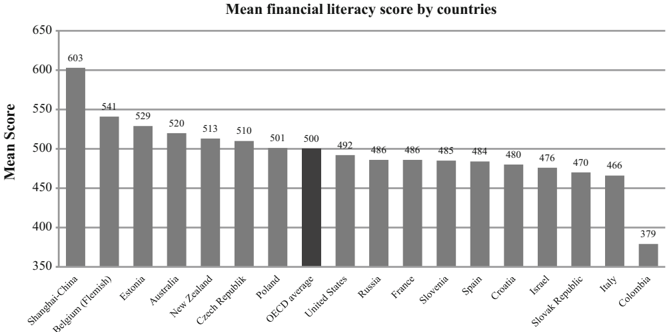
- Financial literacy is generally low and heterogeneous. In the PHF, 59% answered all Big Three questions correctly; Germany ranks among the highest worldwide (66% in the S&P FinLit Survey, 53% in SAVE, 59% in PHF), while transition economies can be as low as 4%.
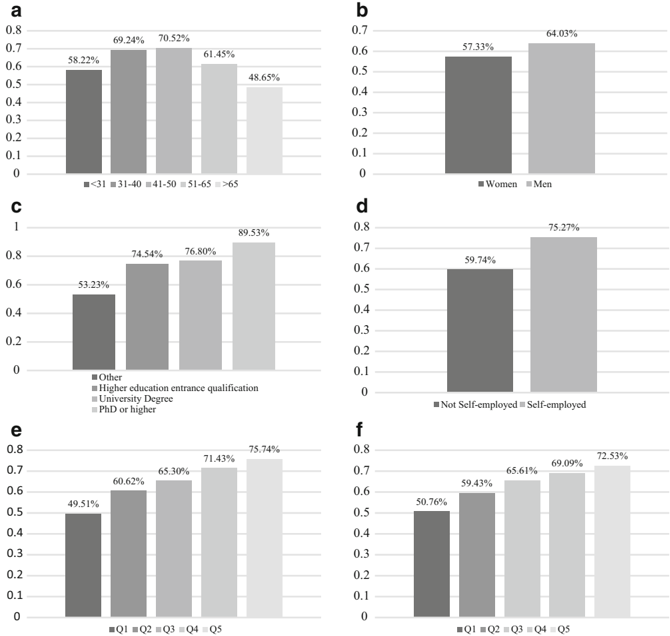
- Demographic gaps are large: in PHF, 64% of men versus 57% of women answered all Big Three correctly; highest educational attainment ~90% versus least educated 53%; highest income quintile 76% versus lowest 50%; highest wealth quintile 73% versus lowest 51%; age shows a hump shape, with >65 at 47%, <30 at 58%, and those in their forties at 70%.
- Financial education evidence is disappointing: Fernandes et al. (2014), meta-analyzing 90 studies, find financial education interventions explain no more than 0.1% of the variance in financial behavior, with effects declining over time and little impact when decisions are made 20 months or later.
- Financial advice as a substitute for literacy is inconclusive: some studies find low-literate individuals are less likely to seek advice, but once advice is obtained, low-literate individuals are most likely to follow it; overconfidence may reduce advice-seeking.
Methods
- Literature survey/review covering conceptualizations and measurement of financial literacy, determinants, financial behavior, financial education, and financial advice, including cross-country comparisons and summary tables.
- Supplemented with novel descriptive evidence from the first wave of the German PHF: face-to-face CAPI interviews between September 2010 and July 2011 with the financially knowledgeable person in 3,565 households, representative of the German population; analyses use survey weights and multiple imputation.
- Reviews studies using the Big Three, extended measures, PISA 2012, the S&P Global FinLit Survey, and discusses endogeneity and instrumental-variable approaches.
Limitations
- Stated: there is no universally accepted definition or operationalization of financial literacy; test-based measures have caveats including lack of incentives, no access to outside information, framing sensitivity, guessing, and measurement error; household survey data quality has declined; endogeneity complicates causal interpretation; evidence on financial advice and education effectiveness is mixed or inconclusive.
- Evident: as a survey, most reviewed evidence is correlational and non-experimental; the PHF component is descriptive rather than causal; the review emphasizes Germany and the U.S., with limited cross-country comparability.
Model-written summary. Check it against the paper before relying on it.
Integrity signals
Registry
Cites
Statistics
Figures
Verification
Claims the paper makes
34 Valid · 3 Not valid · 123 Not checked · 71 Own results and interpretations
Every source the paper cites for this claim was checked and supports it.
In the paper
“Hastings et al. (2013) document that respondents with higher cognitive abilities and more comfortable with numerical calculations on average exhibit higher levels of financial literacy.”
§ Financial literacy, financial advice, and financial behavior > 2.1.2 Cognitive abilities versus financial literacy
What the sources say
- Supportedcites Hastings et al. (2013) matched to “Financial Literacy, Financial Education, and Economic Outcomes” (2013) source
Section 4 (page not provided) states that individuals with higher general cognitive abilities or greater facility with numbers and numerical calculations tend to have higher financial literacy. This directly supports the citing sentence's association without implying causation. (LLM, conf=0.94)
plainstates an association- Asserted: passes — The authors put it forward as true.
- Checkable: passes — It can be checked against evidence.
- Load-bearing: unclear — It is unclear whether the paper’s conclusions depend on it.
- Based: passes — The paper gives a reason why it holds.
- Supported
The cited sources support only part of this claim — read each source’s verdict below.
In the paper
“In fact, the percentage of correct answers doubled in the latter study when the wording for the third question of the Big Three was ''buying company stock usually provides a safer return than a stock mutual fund'' as compared to phrasing the question reversely”
§ Financial literacy, financial advice, and financial behavior > 2.2.3 Caveats of test-based financial literacy measures
What the sources say
- Partly supportedcites van Rooij et al. (2011b) matched to “Financial literacy and stock market participation” (2011) sourceExperimental — accuracy not yet measured
Box 2, p. 13, says the number of correct answers doubled for the quoted wording compared with its reverse. Box 2, pp. 12–13, presents this as an advanced financial-literacy question, not as the third question of the “Big Three”; that identification is not supported by our copy. (LLM, conf=0.85)
plainstates a cause- Asserted: passes — The authors put it forward as true.
- Checkable: passes — It can be checked against evidence.
- Load-bearing: passes — The paper’s conclusions depend on it.
- Based: passes — The paper gives a reason why it holds.
- Partly supported
Every source the paper cites for this claim was checked and supports it.
In the paper
“Choi et al. (2011) investigate contributions to 401(k) plans by employees who are eligible for an employer match and find that a large fraction of these employees either do not participate at all or contribute less than the amount required to be granted the full employer match, thus foregoing matching contributions which cumulate to substantial losses over time.”
§ Financial literacy, financial advice, and financial behavior > 1 Introduction
What the sources say
- Supportedcites Choi et al. (2011) matched to “$100 Bills on the Sidewalk: Suboptimal Investment in 401(k) Plans” (2011) source
Split into 2 atoms — 2 confirmed, 0 partially supported, 0 disputed, 0 misattributed, 0 unverifiable. Expand the claim to see per-atom verdicts.
plain- Asserted: passes — The authors put it forward as true.
- Checkable: passes — It can be checked against evidence.
- Load-bearing: passes — The paper’s conclusions depend on it.
- Based: passes — The paper gives a reason why it holds.
- Supported
The cited sources support only part of this claim — read each source’s verdict below.
In the paper
“Specifically, Lusardi and Mitchell (2011a, b) and van Rooij et al. (2011b) document that the answers of survey participants differ significantly based on the wording of the test questions.”
§ Financial literacy, financial advice, and financial behavior > 2.2.3 Caveats of test-based financial literacy measures
What the sources say
- Could not verifycites Lusardi and Mitchell (2011a, b) matched to “The Outlook for Financial Literacy” (2011) sourceExperimental — accuracy not yet measured
The Financial Literacy and Financial Decision-Making section reports how many respondents answered financial-literacy questions correctly, but does not compare answers to differently worded versions of a question. The Evaluating Financial Literacy Interventions section discusses how information is framed, not the wording of test questions. Searches for question wording and differently worded questions found no passage documenting the claimed difference in answers. (LLM, conf=0.73)
- Supportedcites van Rooij et al. (2011b) matched to “Financial literacy and stock market participation” (2011) source
Box 2 (pp. 12–13) describes giving randomly selected groups differently worded versions of the same questions. It reports that wording changed responses dramatically for complex questions, although the difference for a simple question was not significant at the 5% level. (LLM, conf=0.90)
plainstates a cause- Asserted: passes — The authors put it forward as true.
- Checkable: passes — It can be checked against evidence.
- Load-bearing: unclear — It is unclear whether the paper’s conclusions depend on it.
- Based: passes — The paper gives a reason why it holds.
- Could not verify
The cited sources support only part of this claim — read each source’s verdict below.
In the paper
“Besides, study designs usually do not permit participants to tap into other sources of information in order to prepare their decisions.”
§ Financial literacy, financial advice, and financial behavior > 2.2.3 Caveats of test-based financial literacy measures
What the sources say
- Partly supportedcites Hastings et al. (2013) matched to “Financial Literacy, Financial Education, and Economic Outcomes” (2013) sourceExperimental — accuracy not yet measured
Section 3, “Measuring Financial Literacy” (page not provided), says studies had not allowed participants to consult outside sources while completing financial-literacy performance tests. This supports the point about access to information in those tests, but not the broader claim about study designs generally or participants preparing decisions. (LLM, conf=0.85)
plain- Asserted: passes — The authors put it forward as true.
- Checkable: passes — It can be checked against evidence.
- Load-bearing: passes — The paper’s conclusions depend on it.
- Based: passes — The paper gives a reason why it holds.
- Partly supported
119 more claims · 17 with their cited sources checked
Create a free account to see all 231 claims and to verify the 30 references still open.
- It may state two separate claims as one. 70
- Probably not a substantial claim. 52
Self-check
Percentages, sums and reported differences re-computed from the paper’s own numbers.
Each contradiction between two passages listed here was confirmed by an independent check.
Rated minor: it would not touch a result — a value no result rests on, a p-value that stays on the same side of the significance level, or a conflict that is clerical, resolved elsewhere in the paper, or outside its own findings.
In the paper
§ Financial literacy, financial advice, and financial behavior > 1 Introduction
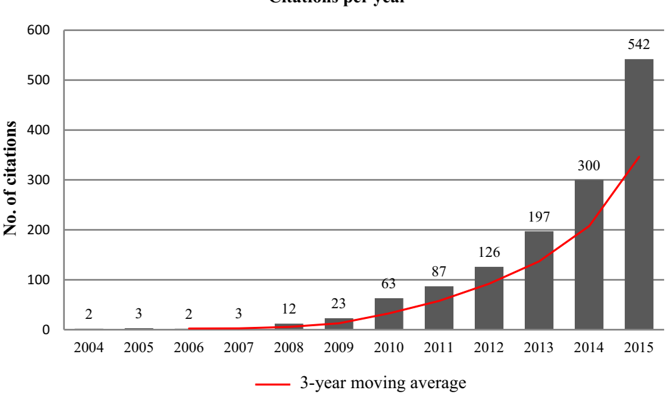
“From 2004 to 2006, the Web of Science database counts no more than two citations per year”
§ Financial literacy, financial advice, and financial behavior > 1 Introduction
“Publications per year 2 3 2 3 12 23 63 87 126 197 300 542 0 100 200 300 400 500 600 2004 2005 2006 2007 2008 2009 2010 2011 2012 2013 2014 2015No. of citations”
Citations
Cites
Kruger, J., & Dunning, D. (1999) · Journal of Personality and Social Psychology · doi:10.1037/0022-3514.77.6.1121 · Cited by 7,731 · cited 1×
“By contrast, this literature suggests that individuals who do not know much about a subject tend not to recognize their ignorance and therefore typically fail to seek better information (Kruger and Dunning 1999).”
(1996) · Institutional Research Information System University of Turin (University of Turin) · doi:10.1111/j · Cited by 5,486
The Economic Importance of Financial Literacy: Theory and Evidence
Lusardi, A., & Mitchell, O. S. (2014) · Journal of Economic Literature · doi:10.1257/jel.52.1.5 · Cited by 4,698 · cited 19×
“Although the Big Three generally do not demand advanced financial knowledge, only 34% of respondents in the original survey were able to answer all three questions correctly (Lusardi and Mitchell 2014).”
InfluentialMultiple imputation after 18+ years
Rubin, D. B. (1996) · Journal of the American Statistical Association · doi:10.1080/01621459.1996.10476908 · Cited by 4,072
Financial literacy and stock market participation
van Rooij, M., Lusardi, A., & Alessie, R. (2011) · Journal of Financial Economics · doi:10.1016/j.jfineco.2011.03.006 · Cited by 3,554 · cited 9×
“Specifically, van Rooij et al. (2011b) document that financial sophistication is positively related to stock market participation of retail investors in the Netherlands.”
BackgroundMethodInfluentialMultiple Imputation After 18+ Years
Rubin, D. B. (1996) · Journal of the American Statistical Association · doi:10.2307/2291635 · Cited by 2,686 · cited 1×
“For robustness, we re-estimate our main model using multiple imputations via Rubin’s rule (Rubin 1996).”
MethodHUSTON, S. J. (2010) · Journal of Consumer Affairs · doi:10.1111/j.1745-6606.2010.01170.x · Cited by 2,558 · cited 2×
“In another extensive review of financial literacy operationalizations, Huston (2010) surveys 71 studies using 52 different data sets and corroborates that there is no such thing as a standardized conceptualization of financial literacy.”
BackgroundSave More Tomorrow™: Using Behavioral Economics to Increase Employee Saving
Thaler, R. H., & Benartzi, S. (2004) · Journal of Political Economy · doi:10.1086/380085 · Cited by 2,483 · cited 1×
“Indeed, this approach is promoted by, e.g., Choi et al. (2004) and Thaler and Benartzi (2004) who find that opt-out regimes in 401(k) pension plans result in a large and persistent increase in pension participation rates relative to conventional opt-in arrangements. prepare a detailed transcript of…”
BackgroundEndogeneity in Empirical Corporate Finance1
Roberts, M. R., & Whited, T. M. (2013) · Handbook of the Economics of Finance · doi:10.1016/b978-0-44-453594-8.00007-0 · Cited by 2,459 · cited 1×
“Moreover, Roberts and Whited (2013) stress that truly exogenous instruments are difficult to find and, in particular, that it should be rigorous economic arguments rather than formal falsification tests that eventually decide over the instrument’s validity.”
BackgroundAngrist, J. D., & Krueger, A. B. (2001) · Journal of Economic Perspectives · doi:10.1257/jep.15.4.69 · Cited by 2,355
Research works printed but not linked: 5
- 53. Collins JM, Gorey RN, Schmeiser MD, Baker CA, Ziegler D (2009) Building indicators measures: analysis and recommendations. Anne E. Casey Foundation, Baltimore
- 56. Danes SM, Huddleston-Casas C, Boyce L (1999) Financial planning curriculum for teens: Impact evaluation. J Financ Couns Plan 10(1):26-39
- 58. Deevy M, Lucich S, Beals M (2012) Scams, schemes and swindles-a review of consumer financial fraud research. Working paper
- 94. Hilgert MA, Hogarth JM, Beverly SG (2003) Household financial management: the connection between knowdlege and behavior. Federal Reserv Bull 89(7):309-322
- 103. Investment Company Institute (2007) Why do mutual fund investors use professional financial advisors? Res Fundam 16(1):1-8
Cited by
Items 301–400 of 469
Pratiwi, A. N., & Amri, A. (2025) · JAE (JURNAL AKUNTANSI DAN EKONOMI) · doi:10.29407/jae.v10i1.24614 · Cited by 1
“Perilaku ini, seperti pengelolaan anggaran digital dan penggunaan aplikasi keuangan untuk pengambilan Keputusan yang bijak, pada akhirnya berdampak pada peningkatan kesejahteraan keuangan ( financial well-being ) mereka (Stolper & Walter, 2017).”
Does digital financial literacy increase savings in formal financial institutions?
Sultana, A. (2025) · International Journal of Research in Business and Social Science (2147-4478) · doi:10.20525/ijrbs.v14i5.4296 · Cited by 4
Kim, K. T., Han, J., & Cho, H. (2025) · International Journal of Bank Marketing · doi:10.1108/ijbm-01-2025-0033 · Cited by 2
Sandoval, J. S., Collazos-Ortiz, M. A., Sarmiento-Sabogal, J., & Cayón, E. (2025) · International Journal of Bank Marketing · doi:10.1108/ijbm-09-2024-0567 · Cited by 3
Khurana, D., & Sharma, K. (2026) · Future Business Journal · doi:10.1186/s43093-026-00744-6 · Cited by 5
“Insights from the financial advice literature indicate that individuals often rely on advice as a trigger for action, particularly when financial decisions involve substantial cognitive demands [43].”
InfluentialEffects of financial literacy on entrepreneurial intention among higher education students
Ahmed, Y. A., Ahmed, H. M. S., James, A. L., Rao, T. N., Haso, A. A., & Mulie, H. (2026) · Journal of Innovation and Entrepreneurship · doi:10.1186/s13731-026-00638-5 · Cited by 5
Exploring the drivers of energy-related financial literacy: evidence from West Bengal, India
Maji, S. K., & Chakraborty, P. (2026) · Indian Growth and Development Review · doi:10.1108/igdr-11-2024-0190 · Cited by 1
Desai, R. (2026) · Journal of Financial Services Marketing · doi:10.1057/s41264-026-00371-w · Cited by 2
“The results suggested that CBDC usage intention was not directly affected by the level of financial literacy, leading to rejection of H1; however, FNLR significantly and posi - tively affected the EFXP (β - Coefficient = 0.474, p < 0.001), supporting H2.”
InfluentialDas, S., Sur, D., & Maji, S. K. (2026) · International Journal of Rural Management · doi:10.1177/09730052261479595 · Cited by 1
Khalatur, S. M., Pavlova, H. Y., Качула, С. В., et al. (2022) · Agrosvit · doi:10.32702/2306-6792.2022.2.10 · Cited by 1
The Role of Financial Inclusion
Başdaş, Ü. (2021) · IGI Global eBooks · doi:10.4018/978-1-7998-8049-3.ch021 · Cited by 1
Matthies, A. M., & Rojahn, J. (2022) · FOM-Edition · doi:10.1007/978-3-658-35831-0_12 · Cited by 1
Peran Financial Knowledge Dan Financial Attitude Terhadap Financial Management Behavior
Izzah, F., & Riyanto, F. D. (2022) · JPEK (Jurnal Pendidikan Ekonomi dan Kewirausahaan) · doi:10.29408/jpek.v6i1.5551 · Cited by 1
Bosea, V. K., Basuah, P. K., Asare, E. T., & Barimah, R. T. (2023) · International Journal of Academic Research in Accounting Finance and Management Sciences · doi:10.6007/ijarafms/v13-i1/16303 · Cited by 2
Prasetyaningtyas, S. W., & Munandar, H. (2022) · International Seminar on Research of Information Technology and Intelligent Systems (ISRITI) · doi:10.1109/isriti56927.2022.10052822 · Cited by 1
“The relevant findings have been discussed by Stolper and Walter in 2017 [25], who contend that several studies have concluded that persons with a high level of Financial Literacy make wiser financial decisions.”
BackgroundRachapaettayakom, P., & Sopanik, S. (2023) · International Conference on Business and Industrial Research (ICBIR) · doi:10.1109/icbir57571.2023.10147741 · Cited by 1
“Some studies reveal the involvement of financial literacy in the process of applying financial literacy to make sound financial decisions [18].”
BackgroundFinancial literacy and advice perceptions among UK higher education students: an ethnicity tale?
Leone, V., & Thompson, P. (2023) · Review of Economics of the Household · doi:10.1007/s11150-023-09667-5 · Cited by 8
Emor, A., Sendouw, R. H. E., & Tarore, S. V. (2023) · Technium Social Sciences Journal · doi:10.47577/tssj.v52i1.10238 · Cited by 1
“Having financial knowledge and financial literacy will help individuals organize personal financial planning, so that individuals can maximize the time value of money and the profits obtained by individuals will be greater and will improve their standard of living (Stolper & Walter, 2017) [11].”
BackgroundFisabilillah, L. W. P., Aji, T. S., Prayudi, S. P., et al. (2024) · KnE Social Sciences · doi:10.18502/kss.v9i4.15060 · Cited by 1
“The fact that makes the urgency for financial literacy even more inevitable is that empirically it has been shown that those who are not financially literate have been highly correlated with sub-optimal financial behavior that ultimately results in long-term losses (Stolper & Walter, 2017).”
BackgroundThe role of financial literacy when informal caregivers make complex financial decisions
Cutler, H., Bilgrami, A., Gu, M., Gu, Y., & Aghdaee, M. (2024) · Applied Economics · doi:10.1080/00036846.2024.2312959 · Cited by 2
“Our study found that financial literacy is potentially a concave function across adult life, peaking in middle age, which aligns with other studies across multiple countries (Kalmi and Ruuskanen 2018; Lusardi 2019; Lusardi and Mitchell 2014; Stolper and Walter 2017).”
A Structural Equation Modelling Approach for College Students Financial Literacy
Simarmata, J. E., & Chrisinta, D. (2022) · Journal of Research in Mathematics Trends and Technology · doi:10.32734/jormtt.v4i2.15849 · Cited by 1
“Recognizing the significance of financial literacy in shaping the future financial well-being of college students, this research explores the intricate facets of their financial knowledge, behaviors, and attitudes [1], [2], [3].”
BackgroundFINANCIAL LITERACY LECTURER IN SOUTH TANGERANG : SOCIOECONOMIC DETERMINANTS AND DEMOGRAPHIC FACTORS
Arianti, B. F., Shanti, Y. K., & Maradina, J. (2020) · Jurnal Riset Akuntansi Dan Bisnis Airlangga · doi:10.20473/jraba.v5i2.46028 · Cited by 1
The Relation of Income and Spending behaviour among Women Teachers in Kodagu District of Karnataka
Shailashree, K., & Aithal, P. S. (2024) · International Journal of Case Studies in Business IT and Education · doi:10.47992/ijcsbe.2581.6942.0363 · Cited by 2
Financial Literacy Levels among Youth: The Perspectives from Undergraduate Students
Noor, N. S. M., Arifin, J., Ghazali, P. L., et al. (2024) · International Journal of Academic Research in Business and Social Sciences · doi:10.6007/ijarbss/v14-i7/22031 · Cited by 1
“Financial literacy is not merely a matter of knowledge but also involves the ability to apply this knowledge practically, influenced by individual financial attitudes (Stolper & Walter, 2017).”
BackgroundLee, Y.-H., & Wei-hua, M. (2024) · International Journal of Financial Studies · doi:10.3390/ijfs12030081 · Cited by 3
“Although there are differences between countries, people generally have relatively low levels of financial literacy, especially among younger, older, female, and less educated individuals (Lusardi and Mitchell 2007, 2014; Stolper and Walter 2017; Arrondel 2018).”
BackgroundMncwabe, M. P., & Мугова, Ш. (2024) · International Journal of Research in Business and Social Science (2147-4478) · doi:10.20525/ijrbs.v13i7.3815 · Cited by 1
“Moreover, many studies have shown differences between financial literacy and financial expertise (McDaniel et al., 2002; Stolper and Walter, 2017; Purwidianti and Tubastuvi, 2019; Purwidianti, et al ., 2022).”
Zentai, P., & Kovács, J. M. (2024) · Pénzügyi Szemle = Public Finance Quarterly · doi:10.35551/pfq_2024_4_2 · Cited by 5
Pallavi, G. P., & Dsa, K. T. (2024) · International Journal of Case Studies in Business IT and Education · doi:10.47992/ijcsbe.2581.6942.0366 · Cited by 1
Financial Literacy and Electricity Contracts
Tocock, M., MacDonald, D. H., Tinch, D., & Rose, J. M. (2025) · The Energy Journal · doi:10.1177/01956574251340291 · Cited by 2
“Self-assessed measures of financial literacy are another approach, whereby financial literacy is inferred from a respondent’s self-assessment (Stolper and Walter 2017).”
Financial literacy in Israel: The impact of sector and region on financial literacy
Ben-Simhon, M. A. (2018) · CeON Repository (Centre for Evaluation in Education and Science) · Cited by 1
Świadomość finansowa młodych dorosłych w Polsce jako wrażliwej grupy demograficznej
Lejman-Gąska, A., & Ogórek, M. (2019) · CeON Repository (Centre for Evaluation in Education and Science) · doi:10.32078/join.33.02 · Cited by 8
FACTORS AFFECTING INVESTMENT DECISIONS AMONG LISTED FIRMS IN THE NAIROBI SECURITIES EXCHANGE
Worzie, P. (2020) · International Journal of Engineering Technologies and Management Research · doi:10.29121/ijetmr.v7.i2.2020.533 · Cited by 2
Literasi Keuangan dan Keputusan untuk Berkonsultasi dengan Profesional
Purnamasari, S. (2020) · Jurnal Ekonomi Manajemen Akuntansi dan Perpajakan (Jemap) · doi:10.24167/jemap.v3i1.2551 · Cited by 3
Factors Affecting Financial Literacy and Financial Behaviour of Investors in Pakistan
Khan, M. J., Aslam, F., & Nisar-Ul-Mulk, S. (2020) · Research Journal of Social Sciences & Economics Review (RJSSER) · doi:10.36902/rjsser-vol1-iss3-2020(80-90 · Cited by 6
Sukma, D. T., Suwono, H., & Fachrunnisa, R. (2021) · AIP conference proceedings · doi:10.1063/5.0043262 · Cited by 5
Extrinsic Financial Dimensions
Purnamawati, I. G. A. (2021) · Advances in Social Science, Education and Humanities Research/Advances in social science, education and humanities research · doi:10.2991/assehr.k.210715.008 · Cited by 1
Desmintari, D., & Aryani, L. (2021) · Jurnal Bakti Masyarakat Indonesia · doi:10.24912/jbmi.v4i1.11836 · Cited by 1
Predictors of Financial Advice: An Evidence from a Developing Nation
Khan, K. A., Belás, J., & Akhtar, M. A. (2020) · Sciendo eBooks · doi:10.2478/9788395815072-045 · Cited by 1
“The study focused on investigating financial advice because the importance of financial advice is constantly increasing (Moreland, 2018; Stolper & Walter, 2017).”
BackgroundBiałowolski, P., Cwynar, A., & Węziak‐Białowolska, D. (2022) · International Journal of Finance & Economics · doi:10.1002/ijfe.2680 · Cited by 3
Welchen Einfluss hat Financial Literacy auf die Altersvorsorge?
Leinert, J. (2017) · Vierteljahrshefte zur Wirtschaftsforschung · doi:10.3790/vjh.86.4.83 · Cited by 1
“…werden, wenn erstens eine Variable der anderen zeitlich vorangeht, zweitens die Variablen kovariieren und drittens keine Erklärungsmöglichkeit durch kovariierende Drittvariablen besteht, welche die statistische Beziehung zwischen den beiden Variablen verschwinden lassen (Stier 1996: 210).”
BackgroundFinancial Literacy of the Residents of Barangay Baclaran, Balayan, BatangasPreprint
Macatangay, L. (2023) · SSRN Electronic Journal · doi:10.2139/ssrn.4477029 · Cited by 1
“In Design and Humans we Trust“? – Drivers of Trust and Advice Discounting for Robo AdvicePreprint
Breuer, C., Breuer, W., & Renerken, T. (2024) · SSRN Electronic Journal · doi:10.2139/ssrn.4792439 · Cited by 1
Financial Literacy, Portfolio Choice, and Wealth Inequality: A General Equilibrium ApproachPreprint
Kim, M. S. (2024) · SSRN Electronic Journal · doi:10.2139/ssrn.4827784 · Cited by 3
“These initiatives, commonly administered through workplace and school-based personal finance education programs, have demonstrated positive causal effects on the financial behaviors of individuals (Stolper and Walter, 2017; Kaiser et al., 2022).”
BackgroundHoda, N. (2025) · Research Square · doi:10.21203/rs.3.rs-6407164/v1 · Cited by 2
Der störrische Bankkunde. Intransparenz und Vertrauensprobleme in der Bank-Kunden-Beziehung
Neeb, P., & Knake, S. (2019) · Berliner Journal für Soziologie · doi:10.1007/s11609-019-00390-6
THE WAYS OF ACTIVIZATION OF THE INVESTMENT POTENTIAL OF PERSONAL FINANCE IN UKRAINE
Melnyk, V. (2019) · Investytsiyi praktyka ta dosvid · doi:10.32702/2306-6814.2019.24.114
The Role of Financial Inclusion
Başdaş, Ü. (2020) · Advances in finance, accounting, and economics book series · doi:10.4018/978-1-7998-2440-4.ch011
Essays on retirement wellbeing in New Zealand
Noviarini, J. (2020) · Otago University Research Archive (University of Otago)
Khan, J. S. (2020) · Pakistan Social Sciences Review · doi:10.35484/pssr.2020(4-i)56 · Cited by 1
Financial Behavior of Micro Business Women in Management and Well-Being Improvement
Purnamawati, I. G. A., Yuniarta, G. A., Sulindawati, N. L. G. E., et al. (2020) · International Conference on Tourism, Economics, Accounting, Management and Social Science (TEAMS) · doi:10.2991/aebmr.k.201212.003
“The response given to an event depends on an inner opinion about the incident [10], [11].”
BackgroundWhat factors impact financial behavior other than financial literacy?
Jones, C. M. (2020) · Muma Business Review · doi:10.28945/4656 · Cited by 1
MODELING THE DYNAMICS OF FINANCIAL AND CONSUMER BEHAVIOR OF RUSSIANS
Мухаммадиевна, Т. Л., & Chaganova, O. B. (2021) · Intellect Innovations Investments · doi:10.25198/2077-7175-2021-1-65
Financial Literacy Education: Implications for the Economic and Social Lives of Teachers in GhanaPreprint
Matey, J., Duut, J. Y., & Kombian, M. F. (2021) · SSRN Electronic Journal · doi:10.2139/ssrn.3735618
Inferring Financial Sophistication: Evidence Using Credit Card Balance Transfers and the CARD ActPreprint
Seok, Y. H., & Wang, J. J. D. (2020) · SSRN Electronic Journal · doi:10.2139/ssrn.3606693 · Cited by 1
Srovnání koncepce finanční gramotnosti ČR a vybraných států USA
Ševčík, K. (2021) · Pedagogická orientace · doi:10.5817/pedor2021-1-97
Essays on Social Interactions and Network Economics
Afodjo, N. (2022) · Carleton University's Institutional Repository (MacOdrum Library, Carleton University) · doi:10.22215/etd/2022-14827
Reis, L., Silveira, C., Carvalho, L. C., Aleixo, M. D. C., Marques, A., Filho, G. A. L., & Júnior, I. M. D. S. (2022) · Advances in finance, accounting, and economics book series · doi:10.4018/978-1-7998-9227-4.ch001
“Panengen” Indigenous Knowledge as the Financial Behavior of Cikalong Community
Azizah, N., Nidar, S. R., & Saefullah, K. (2022) · ijd-demos · doi:10.37950/ijd.v4i2.283
“(Stolper & Walter, 2017) Chen and Volpe (1998) expressed their views on financial literacy which can be interpreted as skills in managing money owned based on the life goals of an individual or family to be able to prosper sustainably.”
BackgroundMicrofinance Training on MSMEs In Klatak Tourism Village Facing the Covid-19 Pandemic
Witiastuti, R. S., Sudarma, K., Khoiruddin, M., et al. (2022) · Indonesian Journal of Devotion and Empowerment · doi:10.15294/ijde.v4i1.51416
“However, with financial literacy, it is hoped that ethics and families can enjoy their lives by allocating their finances appropriately (Stolper & Walter, 2017).”
BackgroundAssessing Financial Literacy Considering Bhartiya Model and Its Impact on Financial Decision Making
Chutani, R., & Purohit, H. (2022) · Springer proceedings in business and economics · doi:10.1007/978-981-19-4892-3_4 · Cited by 1
Syamsudin, S., Haryadi, E., & Adiyanto, Y. (2022) · JURNAL PENGABDIAN MASYARAKAT INDONESIA · doi:10.55606/jpmi.v1i3.596
Comparative Study of Financial Literacy and Socio-demographic Factors in Sibu, Sarawak
Ling, S. S. (2023) · Asian Journal of Research in Business and Management · doi:10.55057/ajrbm.2023.5.2.1 · Cited by 2
Financial literacy and quality of life amongst cancer patients in Sri Lanka
Dissanayake, D. M. R. (2023) · Asian Journal of Marketing Management · doi:10.31357/ajmm.v2i02.6469
“It finds special attention made to how financial literacy affects on quality of life amongst cancer patients depending on the level of mental pressures, economic pressures and social pressures bared by patients and their family members (Lusardi 2012; Stolper & Walter 2017).”
The rise of market‐based “choice” programs: 100 years of social sorting in social welfare services
Kline, Z. D. (2023) · Sociology Compass · doi:10.1111/soc4.13146
ความเข้าใจเกี่ยวกับการคลังและงบประมาณและการมีส่วนร่วมของประชาชนในองค์กรปกครองส่วนท้องถิ่นไทย
จันทนสกุลวงศ์, ศ., & มีชาติ, ว. (2019) · Chula Digiverse · doi:10.58837/chula.the.2019.1075
Sugiono, F., Evelyn, E., & MSEPS, P. (2022) · Jurnal Ekonomi dan Manajemen · doi:10.30650/jem.v16i2.3623
Between Income, Savings and Investment, How Do College Students Perceive Money Management?
(2023) · European Journal of Contemporary Education · doi:10.13187/ejced.2023.3.849 · Cited by 1
Effect of Financial Literacy on Financial Well-Being in Georgia
Mercan, M., Kitesashvili, D., & Aslantas, M. (2023) · Journal of Business · doi:10.31578/job.v12i2.240 · Cited by 2
Razak, N. F. A., Jaafar, A., Rusdi, N. A. A., Khalid, N. F. A., Yusof, N. S. H. C., Norshahidi, N. D., Sobri, N. M., Jalal, T. M. T., Malik, M. A. A., Nordin, N. I., et al. (2023) · Malaysian Journal of Social Sciences and Humanities (MJSSH) · doi:10.47405/mjssh.v8i9.2490
“Financial knowledge is defined as an individual's level of understanding of various financial concepts (Stolper & Walter, 2017), and it enables people to make informed financial decisions.”
BackgroundExploring Cryptocurrency Adoption: A Study of Intention among Lebanese Users
Ali, R. E., & Kaakour, S. (2023) · Advances in Social Science and Culture · doi:10.22158/assc.v6n1p1
Designing a Financial Literacy Course for Universities Using the Mind Mapping Methodology
Mukhametdinova, S. K., & Tyumentseva, E. Y. (2023) · Standards and Monitoring in Education · doi:10.12737/1998-1740-2023-11-6-26-30
Effects of Financial Literacy on Financial Inclusion: Evidence from Nepal’s Gandaki Province
Ranabhat, D., Verma, N., Sapkota, P., & Chhetri, S. D. (2023) · Lecture notes in networks and systems · doi:10.1007/978-3-031-50158-6_3 · Cited by 3
Two Sides of the same Coin: Financial Education, Education Marketing and Public CertificationPreprint
Guerini, C., & Masciandaro, D. (2024) · SSRN Electronic Journal · doi:10.2139/ssrn.4688472
Problems and Discussion Questions
Deaves, R. (2024) · Oxford University Press eBooks · doi:10.1093/9780197699898.004.0002
Deaves, R. (2024) · Oxford University Press eBooks · doi:10.1093/9780197699898.003.0013
Deaves, R. (2024) · Oxford University Press eBooks · doi:10.1093/9780197699898.003.0006
Deaves, R. (2024) · Oxford University Press eBooks · doi:10.1093/9780197699898.003.0003
Deaves, R. (2024) · Oxford University Press eBooks · doi:10.1093/9780197699898.003.0017
Deaves, R. (2024) · Oxford University Press eBooks · doi:10.1093/9780197699898.003.0016
Deaves, R. (2024) · Oxford University Press eBooks · doi:10.1093/9780197699898.004.0003
Deaves, R. (2024) · Oxford University Press eBooks · doi:10.1093/9780197699898.003.0008
Deaves, R. (2024) · Oxford University Press eBooks · doi:10.1093/9780197699898.003.0012
Deaves, R. (2024) · Oxford University Press eBooks · doi:10.1093/9780197699898.003.0015
Deaves, R. (2024) · Oxford University Press eBooks · doi:10.1093/9780197699898.003.0011
Deaves, R. (2024) · Oxford University Press eBooks · doi:10.1093/9780197699898.003.0010
Deaves, R. (2024) · Oxford University Press eBooks · doi:10.1093/9780197699898.003.0009
Deaves, R. (2024) · Oxford University Press eBooks · doi:10.1093/9780197699898.003.0007
Deaves, R. (2024) · Oxford University Press eBooks · doi:10.1093/9780197699898.003.0005
Deaves, R. (2024) · Oxford University Press eBooks · doi:10.1093/9780197699898.003.0002
Deaves, R. (2024) · Oxford University Press eBooks · doi:10.1093/9780197699898.004.0001
Deaves, R. (2024) · Oxford University Press eBooks · doi:10.1093/9780197699898.003.0014
Deaves, R. (2024) · Oxford University Press eBooks · doi:10.1093/9780197699898.003.0001
Deaves, R. (2024) · Oxford University Press eBooks · doi:10.1093/9780197699898.003.0004
Deaves, R. (2024) · Oxford University Press eBooks · doi:10.1093/9780197699898.002.0001
Deaves, R. (2024) · Oxford University Press eBooks · doi:10.1093/9780197699898.003.0020
Problems and Discussion Questions
Deaves, R. (2024) · Oxford University Press eBooks · doi:10.1093/9780197699898.003.0019
Deaves, R. (2024) · Oxford University Press eBooks · doi:10.1093/9780197699898.003.0018
Income, Financial Literacy and Financial Inclusion Increase Investment Interest in Gianyar
Kadek Wulandari Laksmi, P., Ariwangsa, I. G. N. O., Lasmi, N. W., et al. (2024) · Lecture notes in networks and systems · doi:10.1007/978-3-031-53998-5_40
Metadata
- Authors
- Stolper, O. A., & Walter, A.
- Affiliations
- Philipps University of Marburg (DE)
- Justus-Liebig-Universität Gießen (DE)
- Corresponding author
- Walter, Andreas
- Venue
- Journal of Business Economics
- Published
- 2017-03-04
- Volume
- 87
- Issue
- 5
- Pages
- 581-643
- ISSN
- 0044-2372 (ISSN-L)
- 1861-8928
- OpenAlex
- W2593560379
- Semantic Scholar
- ea990bccbdb09e1e574090c6c126459f5d7afdba
- Cited by
- 471
- References
- 204
- Citations by year
- 2026: 46 · 2025: 49 · 2024: 93 · 2023: 68 · 2022: 75 · 2021: 55 · 2020: 45 · 2019: 26 · 2018: 9 · 2017: 5
- FWCI
- 75.22
- Type
- journal article
- Language
- en
- Open access
- hybrid
- doi.org
- Locations
- Journal of Business Economics (publishedVersion, cc-by)
- RePEc: Research Papers in Economics (submittedVersion)
- Topics
- Social Sciences › Economics, Econometrics and Finance › Finance › Financial Literacy, Pension, Retirement Analysis
- Social Sciences › Business, Management and Accounting › Accounting › Financial Literacy and Behavior
- Social Sciences › Decision Sciences › General Decision Sciences › Decision-Making and Behavioral Economics
- Keywords
- financial literacy, financial advice, financial behavior, financial education, household finance, determinants of financial literacy
About these checks
Registry, retraction, Cites and statistics results are computed, not judged, with one exception: a printed reference that no index lists is read once by a model before it counts as a citation error. Claims are extracted by a model and kept only when their quote appears verbatim in the text; each cited source is then checked, with a model’s help, for whether it says what the claim relies on. Those verdicts can be wrong — read the claim’s quote and the cited source before relying on one.
The claim verdicts this report counts are experimental: their accuracy is not yet measured.
A language model drew the claims from the paper on 2026-10-10, under version 3 of the claim definition (model deepseek-v4.1-flash, prompt extract-v3).
A second model labelled each claim on 2026-10-10 (model jev-1.13-20260917, definition revision gold-guideline-v0.2).
Cited sources are checked with a language model’s help (gpt-6-sol).
Statistics and arithmetic are recomputed, not judged.
Confidence bands are shown only for fields calibrated on our annotated test set. None is calibrated yet, so no band is shown.
What counts as a claim ›How we measure confidence ›How we check this ›
Are you an author, or do you see a problem with this page? Request a review
Data sources
Bibliographic data: Semantic Scholar, OpenAlex, Crossref.
Contains information from the Semantic Scholar Academic Graph Datasets, made available under the ODC Attribution License (ODC-BY 1.0).
Semantic Scholar’s data is described in: Kinney, R., et al. (2023). The Semantic Scholar Open Data Platform. arXiv:2301.10140.
