

Financial literacy, financial advice, and financial behavior
Open accessThe DOI matches its Crossref record; 199 of the 204 references it cites were found in a registry or an index, and 2 are not checked yet; 42 of the 189 sources its claims cite were checked for support.
Abstract
In this survey, we review the voluminous body of literature on the measurement and the determinants of financial literacy... Our survey suggests that the evidence with respect to the effectiveness of the programs is rather disappointing.
Verified 2026-11-22 · 2 references not checked yet
Overview
CoChat Summary
TL;DR
This survey reviews the literature on measuring and explaining financial literacy and its links to financial behavior, financial education, and professional advice, supplementing the review with descriptive evidence from the German Panel on Household Finances (PHF). It finds generally low but heterogeneous financial literacy, disappointing evidence on financial education effectiveness, and inconclusive evidence on whether financial advice substitutes for financial literacy.
Key findings
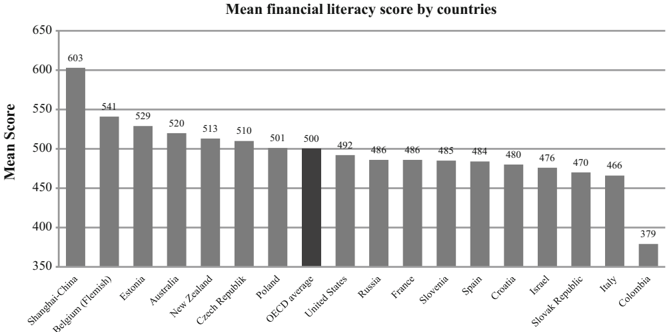
- Financial literacy is generally low and heterogeneous. In the PHF, 59% answered all Big Three questions correctly; Germany ranks among the highest worldwide (66% in the S&P FinLit Survey, 53% in SAVE, 59% in PHF), while transition economies can be as low as 4%.
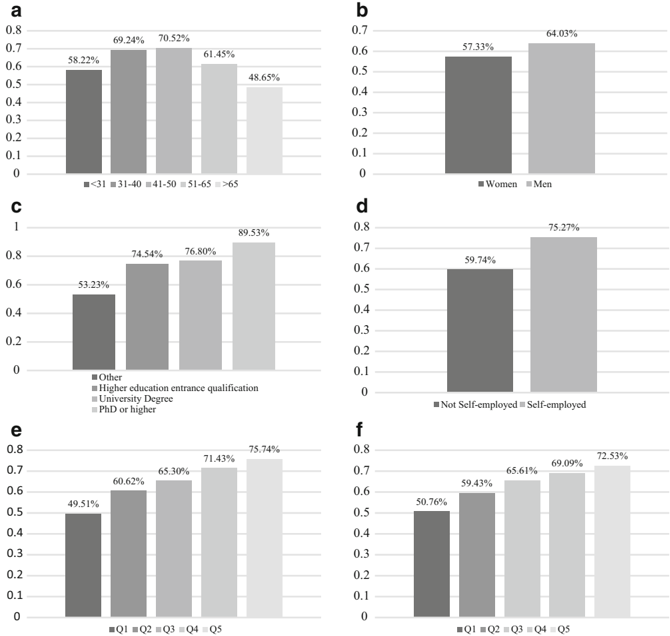
- Demographic gaps are large: in PHF, 64% of men versus 57% of women answered all Big Three correctly; highest educational attainment ~90% versus least educated 53%; highest income quintile 76% versus lowest 50%; highest wealth quintile 73% versus lowest 51%; age shows a hump shape, with >65 at 47%, <30 at 58%, and those in their forties at 70%.
- Financial education evidence is disappointing: Fernandes et al. (2014), meta-analyzing 90 studies, find financial education interventions explain no more than 0.1% of the variance in financial behavior, with effects declining over time and little impact when decisions are made 20 months or later.
- Financial advice as a substitute for literacy is inconclusive: some studies find low-literate individuals are less likely to seek advice, but once advice is obtained, low-literate individuals are most likely to follow it; overconfidence may reduce advice-seeking.
Methods
- Literature survey/review covering conceptualizations and measurement of financial literacy, determinants, financial behavior, financial education, and financial advice, including cross-country comparisons and summary tables.
- Supplemented with novel descriptive evidence from the first wave of the German PHF: face-to-face CAPI interviews between September 2010 and July 2011 with the financially knowledgeable person in 3,565 households, representative of the German population; analyses use survey weights and multiple imputation.
- Reviews studies using the Big Three, extended measures, PISA 2012, the S&P Global FinLit Survey, and discusses endogeneity and instrumental-variable approaches.
Limitations
- Stated: there is no universally accepted definition or operationalization of financial literacy; test-based measures have caveats including lack of incentives, no access to outside information, framing sensitivity, guessing, and measurement error; household survey data quality has declined; endogeneity complicates causal interpretation; evidence on financial advice and education effectiveness is mixed or inconclusive.
- Evident: as a survey, most reviewed evidence is correlational and non-experimental; the PHF component is descriptive rather than causal; the review emphasizes Germany and the U.S., with limited cross-country comparability.
Model-written summary. Check it against the paper before relying on it.
Integrity signals
Registry
Cites
Statistics
Figures
Verification
Claims the paper makes
34 Valid · 3 Not valid · 123 Not checked · 71 Own results and interpretations
Every source the paper cites for this claim was checked and supports it.
In the paper
“Hastings et al. (2013) document that respondents with higher cognitive abilities and more comfortable with numerical calculations on average exhibit higher levels of financial literacy.”
§ Financial literacy, financial advice, and financial behavior > 2.1.2 Cognitive abilities versus financial literacy
What the sources say
- Supportedcites Hastings et al. (2013) matched to “Financial Literacy, Financial Education, and Economic Outcomes” (2013) source
Section 4 (page not provided) states that individuals with higher general cognitive abilities or greater facility with numbers and numerical calculations tend to have higher financial literacy. This directly supports the citing sentence's association without implying causation. (LLM, conf=0.94)
plainstates an association- Asserted: passes — The authors put it forward as true.
- Checkable: passes — It can be checked against evidence.
- Load-bearing: unclear — It is unclear whether the paper’s conclusions depend on it.
- Based: passes — The paper gives a reason why it holds.
- Supported
The cited sources support only part of this claim — read each source’s verdict below.
In the paper
“In fact, the percentage of correct answers doubled in the latter study when the wording for the third question of the Big Three was ''buying company stock usually provides a safer return than a stock mutual fund'' as compared to phrasing the question reversely”
§ Financial literacy, financial advice, and financial behavior > 2.2.3 Caveats of test-based financial literacy measures
What the sources say
- Partly supportedcites van Rooij et al. (2011b) matched to “Financial literacy and stock market participation” (2011) sourceExperimental — accuracy not yet measured
Box 2, p. 13, says the number of correct answers doubled for the quoted wording compared with its reverse. Box 2, pp. 12–13, presents this as an advanced financial-literacy question, not as the third question of the “Big Three”; that identification is not supported by our copy. (LLM, conf=0.85)
plainstates a cause- Asserted: passes — The authors put it forward as true.
- Checkable: passes — It can be checked against evidence.
- Load-bearing: passes — The paper’s conclusions depend on it.
- Based: passes — The paper gives a reason why it holds.
- Partly supported
Every source the paper cites for this claim was checked and supports it.
In the paper
“Choi et al. (2011) investigate contributions to 401(k) plans by employees who are eligible for an employer match and find that a large fraction of these employees either do not participate at all or contribute less than the amount required to be granted the full employer match, thus foregoing matching contributions which cumulate to substantial losses over time.”
§ Financial literacy, financial advice, and financial behavior > 1 Introduction
What the sources say
- Supportedcites Choi et al. (2011) matched to “$100 Bills on the Sidewalk: Suboptimal Investment in 401(k) Plans” (2011) source
Split into 2 atoms — 2 confirmed, 0 partially supported, 0 disputed, 0 misattributed, 0 unverifiable. Expand the claim to see per-atom verdicts.
plain- Asserted: passes — The authors put it forward as true.
- Checkable: passes — It can be checked against evidence.
- Load-bearing: passes — The paper’s conclusions depend on it.
- Based: passes — The paper gives a reason why it holds.
- Supported
The cited sources support only part of this claim — read each source’s verdict below.
In the paper
“Specifically, Lusardi and Mitchell (2011a, b) and van Rooij et al. (2011b) document that the answers of survey participants differ significantly based on the wording of the test questions.”
§ Financial literacy, financial advice, and financial behavior > 2.2.3 Caveats of test-based financial literacy measures
What the sources say
- Could not verifycites Lusardi and Mitchell (2011a, b) matched to “The Outlook for Financial Literacy” (2011) sourceExperimental — accuracy not yet measured
The Financial Literacy and Financial Decision-Making section reports how many respondents answered financial-literacy questions correctly, but does not compare answers to differently worded versions of a question. The Evaluating Financial Literacy Interventions section discusses how information is framed, not the wording of test questions. Searches for question wording and differently worded questions found no passage documenting the claimed difference in answers. (LLM, conf=0.73)
- Supportedcites van Rooij et al. (2011b) matched to “Financial literacy and stock market participation” (2011) source
Box 2 (pp. 12–13) describes giving randomly selected groups differently worded versions of the same questions. It reports that wording changed responses dramatically for complex questions, although the difference for a simple question was not significant at the 5% level. (LLM, conf=0.90)
plainstates a cause- Asserted: passes — The authors put it forward as true.
- Checkable: passes — It can be checked against evidence.
- Load-bearing: unclear — It is unclear whether the paper’s conclusions depend on it.
- Based: passes — The paper gives a reason why it holds.
- Could not verify
The cited sources support only part of this claim — read each source’s verdict below.
In the paper
“Besides, study designs usually do not permit participants to tap into other sources of information in order to prepare their decisions.”
§ Financial literacy, financial advice, and financial behavior > 2.2.3 Caveats of test-based financial literacy measures
What the sources say
- Partly supportedcites Hastings et al. (2013) matched to “Financial Literacy, Financial Education, and Economic Outcomes” (2013) sourceExperimental — accuracy not yet measured
Section 3, “Measuring Financial Literacy” (page not provided), says studies had not allowed participants to consult outside sources while completing financial-literacy performance tests. This supports the point about access to information in those tests, but not the broader claim about study designs generally or participants preparing decisions. (LLM, conf=0.85)
plain- Asserted: passes — The authors put it forward as true.
- Checkable: passes — It can be checked against evidence.
- Load-bearing: passes — The paper’s conclusions depend on it.
- Based: passes — The paper gives a reason why it holds.
- Partly supported
119 more claims · 17 with their cited sources checked
Create a free account to see all 231 claims and to verify the 22 references still open.
- It may state two separate claims as one. 70
- Probably not a substantial claim. 52
Self-check
Percentages, sums and reported differences re-computed from the paper’s own numbers.
Each contradiction between two passages listed here was confirmed by an independent check.
Rated minor: it would not touch a result — a value no result rests on, a p-value that stays on the same side of the significance level, or a conflict that is clerical, resolved elsewhere in the paper, or outside its own findings.
In the paper
§ Financial literacy, financial advice, and financial behavior > 1 Introduction
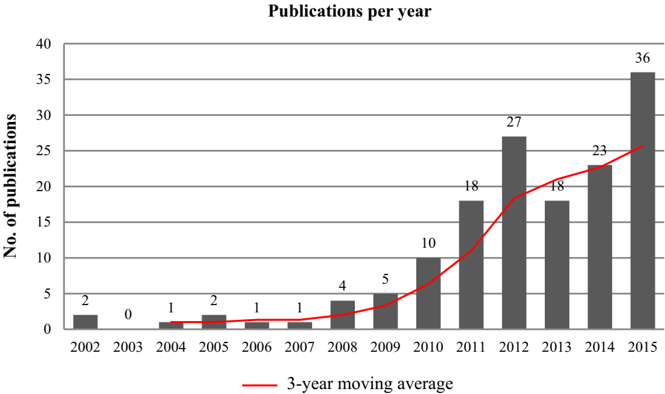
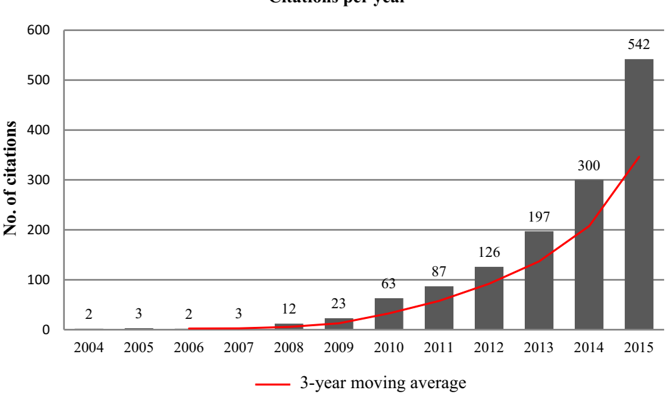
“From 2004 to 2006, the Web of Science database counts no more than two citations per year”
§ Financial literacy, financial advice, and financial behavior > 1 Introduction
“Publications per year 2 3 2 3 12 23 63 87 126 197 300 542 0 100 200 300 400 500 600 2004 2005 2006 2007 2008 2009 2010 2011 2012 2013 2014 2015No. of citations”
Citations
Cites
Kruger, J., & Dunning, D. (1999) · Journal of Personality and Social Psychology · doi:10.1037/0022-3514.77.6.1121 · Cited by 7,731 · cited 1×
“By contrast, this literature suggests that individuals who do not know much about a subject tend not to recognize their ignorance and therefore typically fail to seek better information (Kruger and Dunning 1999).”
(1996) · Institutional Research Information System University of Turin (University of Turin) · doi:10.1111/j · Cited by 5,486
The Economic Importance of Financial Literacy: Theory and Evidence
Lusardi, A., & Mitchell, O. S. (2014) · Journal of Economic Literature · doi:10.1257/jel.52.1.5 · Cited by 4,698 · cited 19×
“Although the Big Three generally do not demand advanced financial knowledge, only 34% of respondents in the original survey were able to answer all three questions correctly (Lusardi and Mitchell 2014).”
InfluentialMultiple imputation after 18+ years
Rubin, D. B. (1996) · Journal of the American Statistical Association · doi:10.1080/01621459.1996.10476908 · Cited by 4,072
Financial literacy and stock market participation
van Rooij, M., Lusardi, A., & Alessie, R. (2011) · Journal of Financial Economics · doi:10.1016/j.jfineco.2011.03.006 · Cited by 3,554 · cited 9×
“Specifically, van Rooij et al. (2011b) document that financial sophistication is positively related to stock market participation of retail investors in the Netherlands.”
BackgroundMethodInfluentialMultiple Imputation After 18+ Years
Rubin, D. B. (1996) · Journal of the American Statistical Association · doi:10.2307/2291635 · Cited by 2,686 · cited 1×
“For robustness, we re-estimate our main model using multiple imputations via Rubin’s rule (Rubin 1996).”
MethodHUSTON, S. J. (2010) · Journal of Consumer Affairs · doi:10.1111/j.1745-6606.2010.01170.x · Cited by 2,558 · cited 2×
“In another extensive review of financial literacy operationalizations, Huston (2010) surveys 71 studies using 52 different data sets and corroborates that there is no such thing as a standardized conceptualization of financial literacy.”
BackgroundSave More Tomorrow™: Using Behavioral Economics to Increase Employee Saving
Thaler, R. H., & Benartzi, S. (2004) · Journal of Political Economy · doi:10.1086/380085 · Cited by 2,483 · cited 1×
“Indeed, this approach is promoted by, e.g., Choi et al. (2004) and Thaler and Benartzi (2004) who find that opt-out regimes in 401(k) pension plans result in a large and persistent increase in pension participation rates relative to conventional opt-in arrangements. prepare a detailed transcript of…”
BackgroundEndogeneity in Empirical Corporate Finance1
Roberts, M. R., & Whited, T. M. (2013) · Handbook of the Economics of Finance · doi:10.1016/b978-0-44-453594-8.00007-0 · Cited by 2,459 · cited 1×
“Moreover, Roberts and Whited (2013) stress that truly exogenous instruments are difficult to find and, in particular, that it should be rigorous economic arguments rather than formal falsification tests that eventually decide over the instrument’s validity.”
BackgroundAngrist, J. D., & Krueger, A. B. (2001) · Journal of Economic Perspectives · doi:10.1257/jep.15.4.69 · Cited by 2,355
Financial Literacy, Financial Education, and Downstream Financial Behaviors
Fernandes, D., Lynch, J. G., & Netemeyer, R. G. (2014) · Management Science · doi:10.1287/mnsc.2013.1849 · Cited by 2,152 · cited 8×
“First, Fernandes et al. (2014) as well as Lusardi and Mitchell (2014), question the quality and motivation of teachers with respect to personal finance issues.”
BackgroundResultInfluentialBaby Boomer retirement security: The roles of planning, financial literacy, and housing wealth
Lusardi, A., & Mitchell, O. S. (2007) · Journal of Monetary Economics · doi:10.1016/j.jmoneco.2006.12.001 · Cited by 2,140 · cited 4×
“The effectiveness of the programs is usually measured by tracking self-reported financial behavior of the participants which is elicited by means of a questionnaire (e.g., Lusardi and Mitchell 2007; Bell et al. 2009; Lührmann et al. 2015).”
BackgroundMethodInfluentialFinancial literacy around the world: an overview
LUSARDI, A., & MITCHELL, O. S. (2011) · Journal of Pension Economics and Finance · doi:10.1017/s1474747211000448 · Cited by 2,000 · cited 6×
“A related strand of literature has also documented a positive relation between financial literacy and savings behavior (e.g., Lusardi and Mitchell 2011c; Chan and Stevens 2008; Behrman et al. 2012), i.e. providing additional evidence that financially literate individuals exhibit a greater tendency…”
InfluentialFinancial Literacy among the Young
LUSARDI, A., MITCHELL, O. S., & CURTO, V. (2010) · Journal of Consumer Affairs · doi:10.1111/j.1745-6606.2010.01173.x · Cited by 1,804
Financial Literacy Among the Young
Lusardi, A., Mitchell, O. S., & Curto, V. (2009) · SSRN Electronic Journal · doi:10.2139/ssrn.1476982 · Cited by 1,804 · cited 5×
“…programs to improve financial literacy, it is important to differentiate general cognitive abilities from core aspects of financial literacy.5 Lusardi et al. (2010) address this point of criticism by analyzing both a measure of financial literacy and a proxy for cognitive ability obtained…”
InfluentialHow Distance, Language, and Culture Influence Stockholdings and Trades
Grinblatt, M., & Keloharju, M. (2001) · The Journal of Finance · doi:10.1111/0022-1082.00355 · Cited by 1,667 · cited 1×
“Such outcomesbased proxies for financial literacy comprise observed risk diversification in equity portfolios (Goetzmann and Kumar 2008; Grinblatt and Keloharju 2001), prior investment experience (Goetzmann and Kumar 2008; Nicolosi et al. 2009; Seru et al. 2010), and the propensity to invest in…”
BackgroundLoss Aversion and Seller Behavior: Evidence from the Housing Market
Genesove, D., & Mayer, C. (2001) · The Quarterly Journal of Economics · doi:10.1162/003355301753265561 · Cited by 1,628 · cited 2×
“2010), and the propensity to invest in complex financial instruments (Genesove and Mayer 2001; Goetzmann and Kumar 2008).”
BackgroundPlanning and Financial Literacy: How Do Women Fare?
Lusardi, A., & Mitchell, O. S. (2008) · American Economic Review · doi:10.1257/aer.98.2.413 · Cited by 1,512 · cited 3×
“Lusardi and Mitchell (2008) in a special module of the 2004 Health and Retirement Study (HRS).6 These questions have been widely adopted in the U.S. and elsewhere and have become known as the Big Three.7 The first one of this parsimonious set of questions addresses individuals’ numeracy and their…”
Background(2017) · American Economic Review · doi:10.1257/aer · Cited by 1,511
Debt literacy, financial experiences, and overindebtedness
LUSARDI, A., & TUFANO, P. (2015) · Journal of Pension Economics and Finance · doi:10.1017/s1474747215000232 · Cited by 1,412 · cited 9×
“In addition, some studies show that a lack of financial literacy is associated with excessive debt accumulation (e.g., Stango and Zinman 2009; Lusardi and Tufano 2015).”
BackgroundMethodInfluentialFinancial Literacy Explicated: The Case for a Clearer Definition in an Increasingly Complex Economy
REMUND, D. L. (2010) · Journal of Consumer Affairs · doi:10.1111/j.1745-6606.2010.01169.x · Cited by 1,329
Equity Portfolio Diversification
Goetzmann, W. N., & Kumar, A. (2008) · Review of Finance · doi:10.1093/rof/rfn005 · Cited by 1,222 · cited 4×
“…in equity portfolios (Goetzmann and Kumar 2008; Grinblatt and Keloharju 2001), prior investment experience (Goetzmann and Kumar 2008; Nicolosi et al. 2009; Seru et al. 2010), and the propensity to invest in complex financial instruments (Genesove and Mayer 2001; Goetzmann and Kumar 2008).”
BackgroundInfluentialDown or Out: Assessing the Welfare Costs of Household Investment Mistakes
Calvet, L. E., Campbell, J. Y., & Sodini, P. (2006) · SSRN Electronic Journal · doi:10.2139/ssrn.881768 · Cited by 1,081
Financial Literacy, Financial Education, and Economic Outcomes
Hastings, J. S., Madrian, B. C., & Skimmyhorn, W. L. (2013) · Annual Review of Economics · doi:10.1146/annurev-economics-082312-125807 · Cited by 1,041 · cited 7×
“Hastings et al. (2013) document that respondents with higher cognitive abilities and more comfortable with numerical calculations on average exhibit higher levels of financial literacy.”
InfluentialDown or Out: Assessing the Welfare Costs of Household Investment Mistakes
Calvet, L. E., Campbell, J. Y., & Sodini, P. (2007) · Journal of Political Economy · doi:10.1086/524204 · Cited by 992 · cited 7×
“…link between financial literacy and portfolio diversification: highly literate investors tend to manage their risks significantly better than the group of low literate individuals (e.g., Calvet et al. 2007; Goetzmann and Kumar 2008; Guiso and Jappelli 2008; von Gaudecker 2015; Clark et al. 2015).”
InfluentialFinancial Literacy, Retirement Planning and Household Wealth
van Rooij, M. C. J., Lusardi, A., & Alessie, R. J. M. (2012) · The Economic Journal · doi:10.1111/j.1468-0297.2012.02501.x · Cited by 936 · cited 1×
“Van Rooij et al. (2012), e.g., provide evidence of a strong positive association between financial literacy and financial wealth and argue that it is financial literacy, which facilitates wealth accumulation.”
Financial literacy and retirement planning in the United States
LUSARDI, A., & MITCHELL, O. S. (2011) · Journal of Pension Economics and Finance · doi:10.1017/s147474721100045x · Cited by 911 · cited 8×
“, Moore 2003; Lusardi and Tufano 2015; Lusardi and de Bassa Scheresberg 2013; Disney and Gathergood 2013). Lusardi and Tufano (2015) show for the U.S. that individuals exhibiting low levels of financial literacy use high-cost borrowing and pay higher transaction costs and fees. Lusardi and de Bassa Scheresberg (2013)…”
InfluentialUp Close and Personal: Investor Sophistication and the Disposition Effect
Dhar, R., & Zhu, N. (2006) · Management Science · doi:10.1287/mnsc.1040.0473 · Cited by 840 · cited 4×
“Similarly, Disney et al. (2015) recently analyze the decision of indebted consumers in the U.”
BackgroundMethodInfluentialDefining and Measuring Financial Literacy
Hung, A., Parker, A. M., & Yoong, J. (2009) · SSRN Electronic Journal · doi:10.2139/ssrn.1498674 · Cited by 835 · cited 13×
“…more solid empirical grounds—the conclusions drawn in earlier studies which survey the literature on financial education (Hastings et al. 2013; Hung et al. 2009), i.e. a lack of conclusive evidence as to whether a positive impact of financial education can be observed for consumers’…”
BackgroundResultInfluentialExponential Growth Bias and Household Finance
STANGO, V., & ZINMAN, J. (2009) · The Journal of Finance · doi:10.1111/j.1540-6261.2009.01518.x · Cited by 828
The Economic Importance of Financial Literacy: Theory and Evidence
Lusardi, A., & Mitchell, O. (2013) · National Bureau of Economic Research · doi:10.3386/w18952 · Cited by 821
Education and Saving: The Long-Term Effects of High School Financial Curriculum Mandates
Bernheim, B. D., Garrett, D., & Maki, D. (1997) · National Bureau of Economic Research · doi:10.3386/w6085 · Cited by 793 · cited 1×
“…evaluates the association of financial education and testbased financial literacy (e.g., Mandell 2008; Walstad et al. 2010; Heinberg et al. 2010; Lührmann et al. 2015) as well as financial behavior (e.g., Bernheim et al. 2001; Servon and Kaestner 2008; Clark et al. 2015; Lührmann et al. 2015).”
BackgroundDo Investor Sophistication and Trading Experience Eliminate Behavioral Biases in Financial Markets?
Feng, L., & Seasholes, M. S. (2005) · Review of Finance · doi:10.1007/s10679-005-2262-0 · Cited by 790 · cited 1×
“A related strand of literature analyzes the association between financial literacy and trading behavior (e.g., Feng and Seasholes 2005; Bilias et al. 2010; Hoffmann et al. 2013; Bucher-Koenen and Ziegelmeyer 2014; Guiso and Viviano 2015) and the corresponding studies generally document a positive…”
BackgroundSelf-control, financial literacy and consumer over-indebtedness
Gathergood, J. (2012) · Journal of Economic Psychology · doi:10.1016/j.joep.2011.11.006 · Cited by 704 · cited 1×
“While some studies measure financial literacy using simple indicator variables (Jappelli 2010; Gathergood 2012), several other authors rely on more advanced techniques such as principal component analysis (e.g. Behrmann et al. 2012; Klapper et al. 2013; Lusardi et al. 2014), iterated principal…”
MethodPatterns of behavior of professionally managed and independent investors
Shapira, Z., & Venezia, I. (2001) · Journal of Banking & Finance · doi:10.1016/s0378-4266(00)00139-4 · Cited by 699 · cited 2×
“2008; Gerhardt and Hackethal 2009) and exhibit weaker disposition effects (Shapira and Venezia 2001) than portfolios of self-directed retail investors.”
BackgroundIQ and Stock Market Participation
GRINBLATT, M., KELOHARJU, M., & LINNAINMAA, J. (2011) · The Journal of Finance · doi:10.1111/j.1540-6261.2011.01701.x · Cited by 679 · cited 1×
“…and Zhu 2006; Vissing-Jorgensen 2003; Calvet et al. 2007, 2009) as well as age (Calvet et al. 2007, 2009; Georgarakos and Pasini 2011), educational attainment (Christiansen et al. 2008; Calvet et al. 2007, 2009), professional status (Calvet et al. 2009), and even IQ (Grinblatt et al. 2011, 2012).”
BackgroundInvestment in financial literacy and saving decisions
Jappelli, T., & Padula, M. (2013) · Journal of Banking & Finance · doi:10.1016/j.jbankfin.2013.03.019 · Cited by 675 · cited 1×
“While this review focuses on the empirics of financial literacy research, the body of literature on individuals’ financial knowledge and abilities also comprises important theoretical work (e.g. Delavande et al. 2008; Jappelli and Padula 2013, 2015; Lusardi et al. 2013).”
BackgroundFinancial literacy and retirement planning in the Netherlands
van Rooij, M. C. J., Lusardi, A., & Alessie, R. J. M. (2011) · Journal of Economic Psychology · doi:10.1016/j.joep.2011.02.004 · Cited by 643
Investor Competence, Trading Frequency, and Home Bias
Graham, J. R., Harvey, C. R., & Huang, H. (2009) · Management Science · doi:10.1287/mnsc.1090.1009 · Cited by 634
THE EFFECTS OF PERCEIVED AND ACTUAL FINANCIAL LITERACY ON FINANCIAL BEHAVIORS
Allgood, S., & Walstad, W. B. (2016) · Economic Inquiry · doi:10.1111/ecin.12255 · Cited by 620 · cited 2×
“In a recent study, Allgood and Walstad (2016) use a combined measure of test-based and self-assessed financial literacy and find that both financial literacy measures appear to independently correlate with financial behavior, leading them to conclude that self-assessed financial literacy may be as…”
BackgroundAssessing the Costs and Benefits of Brokers in the Mutual Fund Industry
Bergstresser, D., Chalmers, J. M. R., & Tufano, P. (2009) · Review of Financial Studies · doi:10.1093/rfs/hhp022 · Cited by 604
How Does Household Portfolio Diversification Vary with Financial Literacy and Financial Advice?
GAUDECKER, H. V. (2015) · The Journal of Finance · doi:10.1111/jofi.12231 · Cited by 596 · cited 4×
“…link between financial literacy and portfolio diversification: highly literate investors tend to manage their risks significantly better than the group of low literate individuals (e.g., Calvet et al. 2007; Goetzmann and Kumar 2008; Guiso and Jappelli 2008; von Gaudecker 2015; Clark et al. 2015).”
BackgroundInfluentialVissing-Jorgensen, A. (2003) · NBER Macroeconomics Annual · doi:10.1086/ma.18.3585252 · Cited by 596
How Ordinary Consumers Make Complex Economic Decisions: Financial Literacy and Retirement Readiness
Lusardi, A., & Mitchell, O. (2009) · doi:10.3386/w15350 · Cited by 587 · cited 4×
“Agnew and Szykman (2005), for instance, document a median correlation of 0.49 between actual and self-assessed financial literacy scores, a finding which is qualitatively corroborated in Lusardi and Mitchell (2009) and Parker et al. (2012).”
BackgroundResultInfluentialHow Financial Literacy Affects Household Wealth Accumulation
Behrman, J. R., Mitchell, O. S., Soo, C. K., & Bravo, D. (2012) · American Economic Review · doi:10.1257/aer.102.3.300 · Cited by 582 · cited 1×
“…of literature has also documented a positive relation between financial literacy and savings behavior (e.g., Lusardi and Mitchell 2011c; Chan and Stevens 2008; Behrman et al. 2012), i.e. providing additional evidence that financially literate individuals exhibit a greater tendency to plan ahead.”
BackgroundAgnew, J. R., & Szykman, L. R. (2005) · Journal of Behavioral Finance · doi:10.1207/s15427579jpfm0602_2 · Cited by 561 · cited 10×
“Agnew and Szykman (2005), for instance, document a median correlation of 0.49 between actual and self-assessed financial literacy scores, a finding which is qualitatively corroborated in Lusardi and Mitchell (2009) and Parker et al. (2012). Moreover, both types of measures have been shown to be individually associated…”
BackgroundResultInfluentialPrices or Knowledge? What Drives Demand for Financial Services in Emerging Markets?
COLE, S., SAMPSON, T., & ZIA, B. (2011) · The Journal of Finance · doi:10.1111/j.1540-6261.2011.01696.x · Cited by 545
Seru, A., Shumway, T., & Stoffman, N. (2010) · Review of Financial Studies · doi:10.1093/rfs/hhp060 · Cited by 543
Financial literacy and its consequences: Evidence from Russia during the financial crisis
Klapper, L., Lusardi, A., & Panos, G. A. (2013) · Journal of Banking & Finance · doi:10.1016/j.jbankfin.2013.07.014 · Cited by 523 · cited 1×
“…2010; Gathergood 2012), several other authors rely on more advanced techniques such as principal component analysis (e.g. Behrmann et al. 2012; Klapper et al. 2013; Lusardi et al. 2014), iterated principal factor analysis (e.g. van Rooij et al. 2011b), or cluster analysis (e.g. Lusardi and…”
MethodHow Financially Literate Are Women? An Overview and New Insights
Bucher‐Koenen, T., Lusardi, A., Alessie, R., & van Rooij, M. (2017) · Journal of Consumer Affairs · doi:10.1111/joca.12121 · Cited by 521
What Explains the Gender Gap in Financial Literacy? The Role of Household Decision Making
FONSECA, R., MULLEN, K. J., ZAMARRO, G., & ZISSIMOPOULOS, J. (2012) · Journal of Consumer Affairs · doi:10.1111/j.1745-6606.2011.01221.x · Cited by 518 · cited 2×
“A number of studies try to explain this finding arguing with traditional role models (Hsu 2011) suggesting that women only have an incentive to invest in financial literacy late in their lives (Fonseca et al. 2012), differing levels of confidence (Bucher-Koenen et al.”
Financial literacy and retirement planning in Germany
BUCHER-KOENEN, T., & LUSARDI, A. (2011) · Journal of Pension Economics and Finance · doi:10.1017/s1474747211000485 · Cited by 513 · cited 1×
“More specifically, Bucher-Koenen (2011) finds that Riester participation is disproportionately low among those German households with the lowest levels of financial literacy, although this group is eligible for the relatively highest government subsidies (see, e.g., Coppola and Gasche 2011).”
Financial Literacy and Planning: Implications for Retirement Well-being
Lusardi, A., & Mitchell, O. S. (2011) · Financial Literacy: Implications for Retirement Security and the Financial Marketplace · doi:10.1093/acprof:oso/9780199696819.003.0002 · Cited by 505
Against Financial Literacy Education
Willis, L. E. (2008) · Penn Carey Law Legal Scholarship Repository (University of Pennsylvania) · Cited by 499
Measuring the Financial Sophistication of Households
Calvet, L. E., Campbell, J. Y., & Sodini, P. (2009) · American Economic Review · doi:10.1257/aer.99.2.393 · Cited by 475
Present-Biased Preferences and Credit Card Borrowing
Meier, S., & Sprenger, C. (2009) · SSRN Electronic Journal · doi:10.2139/ssrn.1412276 · Cited by 460 · cited 1×
“Meier and Sprenger (2010) show that those who voluntarily participate in financial education programs are more future-oriented.”
BackgroundParents’ influence on children’s future orientation and saving
Webley, P., & Nyhus, E. K. (2006) · Journal of Economic Psychology · doi:10.1016/j.joep.2005.06.016 · Cited by 450 · cited 1×
“30 The effect of childhood experience on financial behavior is also analyzed in Bucciol and Veronesi (2014) and Webley and Nyhus (2006, 2013). socialization, Lachance (2014) finds that even the educational attainment of respondents’ neighbors on average impacts their financial literacy levels.”
BackgroundFinancial literacy and consumer credit portfolios
Disney, R., & Gathergood, J. (2013) · Journal of Banking & Finance · doi:10.1016/j.jbankfin.2013.01.013 · Cited by 439 · cited 2×
“Most prominently, there is solid evidence that low levels of financial literacy are associated with high-cost borrowing and suboptimal mortgage choices (e.g., Moore 2003; Lusardi and Tufano 2015; Lusardi and de Bassa Scheresberg 2013; Disney and Gathergood 2013).”
BackgroundBernheim, B. D., Garrett, D. M., & Maki, D. M. (2001) · Journal of Public Economics · doi:10.1016/s0047-2727(00)00120-1 · Cited by 433 · cited 1×
“…evaluates the association of financial education and testbased financial literacy (e.g., Mandell 2008; Walstad et al. 2010; Heinberg et al. 2010; Lührmann et al. 2015) as well as financial behavior (e.g., Bernheim et al. 2001; Servon and Kaestner 2008; Clark et al. 2015; Lührmann et al. 2015).”
IQ, trading behavior, and performance
Grinblatt, M., Keloharju, M., & Linnainmaa, J. T. (2012) · Journal of Financial Economics · doi:10.1016/j.jfineco.2011.05.016 · Cited by 428 · cited 1×
“…and Zhu 2006; Vissing-Jorgensen 2003; Calvet et al. 2007, 2009) as well as age (Calvet et al. 2007, 2009; Georgarakos and Pasini 2011), educational attainment (Christiansen et al. 2008; Calvet et al. 2007, 2009), professional status (Calvet et al. 2009), and even IQ (Grinblatt et al. 2011, 2012).”
BackgroundIndividual investor perceptions and behavior during the financial crisis
Hoffmann, A. O. I., Post, T., & Pennings, J. M. E. (2013) · Journal of Banking & Finance · doi:10.1016/j.jbankfin.2012.08.007 · Cited by 425 · cited 1×
“…strand of literature analyzes the association between financial literacy and trading behavior (e.g., Feng and Seasholes 2005; Bilias et al. 2010; Hoffmann et al. 2013; Bucher-Koenen and Ziegelmeyer 2014; Guiso and Viviano 2015) and the corresponding studies generally document a positive impact…”
BackgroundFinancial advisors: A case of babysitters?
Hackethal, A., Haliassos, M., & Jappelli, T. (2012) · Journal of Banking & Finance · doi:10.1016/j.jbankfin.2011.08.008 · Cited by 422 · cited 1×
“Hackethal et al. (2011), who study the trading behavior of advised retail clients using data from German brokerage accounts, find that they are less likely to implement the advice given to them when their financial sophistication is higher.”
BackgroundThe Financial Education Fallacy
Willis, L. E. (2011) · American Economic Review · doi:10.1257/aer.101.3.429 · Cited by 400
Inderst, R., & Ottaviani, M. (2009) · American Economic Review · doi:10.1257/aer.99.3.883 · Cited by 385 · cited 4×
“21 In a related study, Japelli (2010) conducts a cross-country assessment of economic literacy in 55 countries based on the IMD World Competitive Yearbook (WCY).”
BackgroundInfluentialIs Unbiased Financial Advice to Retail Investors Sufficient? Answers from a Large Field Study
Bhattacharya, U., Hackethal, A., Kaesler, S., Loos, B., & Meyer, S. (2012) · Review of Financial Studies · doi:10.1093/rfs/hhr127 · Cited by 383
Prices or Knowledge? What Drives Demand for Financial Services in Emerging Markets?
Cole, S. A., Sampson, T. G., & Zia, B. (2010) · London School of Economics and Political Science Research Online (London School of Economics and Political Science) · Cited by 378
Evaluating Financial Reporting Quality: The Effects of Financial Expertise vs. Financial Literacy
McDaniel, L., Martin, R. D., & Maines, L. A. (2002) · The Accounting Review · doi:10.2308/accr.2002.77.s-1.139 · Cited by 377 · cited 1×
“…context is an interesting and still largely under-researched subject: as can be inferred from Table 1, 19 out of the 20 most cited papers focus on financial decisions of households, the only exception being McDaniel et al. (2002), who discuss financial literacy in the context of audit committees.”
BackgroundIs Unbiased Financial Advice to Retail Investors Sufficient? Answers from a Large Field StudyPreprint
Bhattacharya, U., Hackethal, A., Kaesler, S., Loos, B., & Meyer, S. (2012) · SSRN Electronic Journal · doi:10.2139/ssrn.1669015 · Cited by 368
Financial literacy and pension plan participation in Italy
FORNERO, E., & MONTICONE, C. (2011) · Journal of Pension Economics and Finance · doi:10.1017/s1474747211000473 · Cited by 364 · cited 1×
“Georgarakos and Inderst (2011) sketch an analytical framework of individual behavior in the context of financial advice using a ‘‘cheap-talk’’-game in which uninformed investors must decide whether or not to trust the advice they receive whereas informed advisors can opt to ignore the advice.”
BackgroundSERVON, L. J., & KAESTNER, R. (2008) · Journal of Consumer Affairs · doi:10.1111/j.1745-6606.2008.00108.x · Cited by 363 · cited 2×
“2015) as well as financial behavior (e.g., Bernheim et al. 2001; Servon and Kaestner 2008; Clark et al. 2015; Lührmann et al. 2015).”
Background$100 Bills on the Sidewalk: Suboptimal Investment in 401(k) Plans
Choi, J. J., Laibson, D., & Madrian, B. C. (2011) · Review of Economics and Statistics · doi:10.1162/rest_a_00100 · Cited by 354 · cited 9×
“Lusardi and de Bassa Scheresberg (2013) also examine high-cost borrowing in the U.S., including payday loans, pawn shops and auto title insurance.”
InfluentialMeasuring the Financial Sophistication of Households
Calvet, L., Campbell, J., & Sodini, P. (2009) · National Bureau of Economic Research · doi:10.3386/w14699 · Cited by 353 · cited 6×
“2007, 2009), professional status (Calvet et al. 2009), and even IQ (Grinblatt et al.”
BackgroundInfluentialFinancial literacy and retirement planning: the Russian case
KLAPPER, L., & PANOS, G. A. (2011) · Journal of Pension Economics and Finance · doi:10.1017/s1474747211000503 · Cited by 351
Old Age and the Decline in Financial Literacy
Finke, M. S., Howe, J. S., & Huston, S. J. (2017) · Management Science · doi:10.1287/mnsc.2015.2293 · Cited by 347
Understanding Pensions: Cognitive Function, Numerical Ability and Retirement Saving*
Banks, J., & Oldfield, Z. (2007) · Fiscal Studies · doi:10.1111/j.1475-5890.2007.00052.x · Cited by 345 · cited 5×
“, Banks and Oldfield 2007; Grinblatt et al. 2009; Christelis et al. 2010). Thus, Hung et al. (2009) argue that, for designing effective programs to improve financial literacy, it is important to differentiate general cognitive abilities from core aspects of financial literacy.(5) Lusardi et al. (2010) address this poi…”
BackgroundInfluentialFinancial literacy and the demand for financial advice
Calcagno, R., & Monticone, C. (2015) · Journal of Banking & Finance · doi:10.1016/j.jbankfin.2014.03.013 · Cited by 345 · cited 6×
“, Calvet et al. 2007; Goetzmann and Kumar 2008; Guiso and Jappelli 2008; von Gaudecker 2015; Clark et al. 2015). 5.2.4 Investment performance The literature also documents a positive link between financial literacy and sound investment decisions. Calvet et al. (2007, 2009) show for investors in Sweden a positive corre…”
BackgroundInfluentialEconomic Literacy: An International Comparison
Jappelli, T. (2010) · The Economic Journal · doi:10.1111/j.1468-0297.2010.02397.x · Cited by 340 · cited 1×
“While some studies measure financial literacy using simple indicator variables (Jappelli 2010; Gathergood 2012), several other authors rely on more advanced techniques such as principal component analysis (e.g. Behrmann et al. 2012; Klapper et al. 2013; Lusardi et al. 2014), iterated principal…”
MethodNumeracy, Financial Literacy, and Financial Decision-Making
Lusardi, A. (2012) · doi:10.3386/w17821 · Cited by 332 · cited 1×
“Furthermore, the majority of contributions to the literature document a positive correlation between formal education and financial literacy (Lusardi and Mitchell 2011c; Christelis et al. 2010; Lusardi 2012).”
Trust, Sociability, and Stock Market Participation
Georgarakos, D., & Pasini, G. (2011) · Review of Finance · doi:10.1093/rof/rfr028 · Cited by 327 · cited 1×
“…(disposable) income and wealth (Dhar and Zhu 2006; Vissing-Jorgensen 2003; Calvet et al. 2007, 2009) as well as age (Calvet et al. 2007, 2009; Georgarakos and Pasini 2011), educational attainment (Christiansen et al. 2008; Calvet et al. 2007, 2009), professional status (Calvet et al. 2009),…”
BackgroundFinancial literacy and financial behavior: Assessing knowledge and confidence
Asaad, C. T. (2015) · Financial Services Review · doi:10.61190/fsr.v24i2.3236 · Cited by 326 · cited 1×
“Moreover, both types of measures have been shown to be individually associated with financial decisions (e.g., Hastings et al. 2013; Asaad 2015; Allgood and Walstad 2016).”
BackgroundReinforcement Learning and Savings Behavior
CHOI, J. J., LAIBSON, D., MADRIAN, B. C., & METRICK, A. (2009) · The Journal of Finance · doi:10.1111/j.1540-6261.2009.01509.x · Cited by 324 · cited 1×
“In a related laboratory study, Choi et al. (2009) show that many U.S. investors—even those with 34 In a related study, Koestner et al. (2017) identify investment experience as another potential channel to mitigate investment mistakes. high self-assessed financial literacy levels—fail to choose a…”
BackgroundNumerical ability predicts mortgage default
Gerardi, K., Goette, L., & Meier, S. (2013) · Proceedings of the National Academy of Sciences · doi:10.1073/pnas.1220568110 · Cited by 323 · cited 1×
“Finally, Gerardi et al. (2013) find that numerical abilities—a skill set which is positively associated with financial sophistication—are strongly negatively correlated with mortgage defaults.”
BackgroundHOWLETT, E., KEES, J., & KEMP, E. (2008) · Journal of Consumer Affairs · doi:10.1111/j.1745-6606.2008.00106.x · Cited by 313
The Market for Financial Advice: An Audit Study
Mullainathan, S., Noeth, M., & Schoar, A. (2012) · National Bureau of Economic Research · doi:10.3386/w17929 · Cited by 310 · cited 2×
“2012; Hung and Yoong 2010), a typical advisor’s incentive structure does in fact create a conflict of interest, leading advisors to reinforce biases of their clients instead of correcting them (Mullainathan et al. 2012) and tilt their recommendations towards costly transactions (Hoechle et al.”
BackgroundFinancial Literacy and Financial Behavior among Young Adults: Evidence and Implications
de Bassa Scheresberg, C. (2013) · Numeracy · doi:10.5038/1936-4660.6.2.5 · Cited by 292
Financial literacy and retirement planning in Japan
SEKITA, S. (2011) · Journal of Pension Economics and Finance · doi:10.1017/s1474747211000527 · Cited by 290 · cited 2×
“16 Exceptions to this behavioral trait are Japanese individuals (Sekita 2011). financial decisions, this overconfidence might be a problem, especially in situations where individuals are not aware of this bias (Lusardi and Mitchell 2014).”
BackgroundChildhood roots of financial literacy
Grohmann, A., Kouwenberg, R., & Menkhoff, L. (2015) · Journal of Economic Psychology · doi:10.1016/j.joep.2015.09.002 · Cited by 289 · cited 3×
“For example, Grohmann et al. (2015) identify three potential channels of financial socialization: family, school and work and find that two of the three channels, i.e. family and school, indeed have a positive impact on the financial literacy of the adult subjects in their study.”
BackgroundVissing-Jorgensen, A. (2003) · SSRN Electronic Journal · doi:10.2139/ssrn.417421 · Cited by 288
Financial literacy and retirement preparation in the Netherlands
ALESSIE, R., VAN ROOIJ, M., & LUSARDI, A. (2011) · Journal of Pension Economics and Finance · doi:10.1017/s1474747211000461 · Cited by 282
The Effects of Financial Education on the Financial Knowledge of High School Students
WALSTAD, W. B., REBECK, K., & MacDONALD, R. A. (2010) · Journal of Consumer Affairs · doi:10.1111/j.1745-6606.2010.01172.x · Cited by 271 · cited 3×
“One way to elicit potential changes in financial literacy levels involves measuring test-based literacy scores prior to educating subjects about the financial matters of interest and at some point in time after they have received the respective manipulation (e.g., Walstad et al. 2010).”
BackgroundTHE EFFECTS OF FINANCIAL EDUCATION IN THE WORKPLACE: EVIDENCE FROM A SURVEY OF EMPLOYERS
BAYER, P. J., BERNHEIM, B. D., & SCHOLZ, J. K. (2009) · Economic Inquiry · doi:10.1111/j.1465-7295.2008.00156.x · Cited by 269
Financial literacy and retirement planning in Sweden
ALMENBERG, J., & SÄVE-SÖDERBERGH, J. (2011) · Journal of Pension Economics and Finance · doi:10.1017/s1474747211000497 · Cited by 266
Planning and Financial Literacy: How Do Women Fare?
Lusardi, A., & Mitchell, O. (2008) · doi:10.3386/w13750 · Cited by 264
Do individual investors learn from their trading experience?
Nicolosi, G., Peng, L., & Zhu, N. (2009) · Journal of Financial Markets · doi:10.1016/j.finmar.2008.07.001 · Cited by 253 · cited 2×
“…in equity portfolios (Goetzmann and Kumar 2008; Grinblatt and Keloharju 2001), prior investment experience (Goetzmann and Kumar 2008; Nicolosi et al. 2009; Seru et al. 2010), and the propensity to invest in complex financial instruments (Genesove and Mayer 2001; Goetzmann and Kumar…”
BackgroundFinancial literacy and financial sophistication in the older population
LUSARDI, A., MITCHELL, O. S., & CURTO, V. (2014) · Journal of Pension Economics and Finance · doi:10.1017/s1474747214000031 · Cited by 250
Financial Literacy and High-Cost Borrowing in the United States
Lusardi, A., & de Bassa Scheresberg, C. (2013) · doi:10.3386/w18969 · Cited by 250
Gender differences in financial risk taking: The role of financial literacy and risk tolerance
Bannier, C. E., & Neubert, M. (2016) · Economics Letters · doi:10.1016/j.econlet.2016.05.033 · Cited by 249 · cited 11×
“Panel A lists the available surveys for Germany, Panel B contains European household surveys and Panel C (Panel D) refers to surveys conducted in the U.S. (in other countries).”
BackgroundInfluentialAre Economists More Likely to Hold Stocks?
Christiansen, C., Joensen, J. S., & Rangvid, J. (2008) · Review of Finance · doi:10.1093/rof/rfm026 · Cited by 248 · cited 2×
“…and Zhu 2006; Vissing-Jorgensen 2003; Calvet et al. 2007, 2009) as well as age (Calvet et al. 2007, 2009; Georgarakos and Pasini 2011), educational attainment (Christiansen et al. 2008; Calvet et al. 2007, 2009), professional status (Calvet et al. 2009), and even IQ (Grinblatt et al. 2011, 2012).”
BackgroundWhat You Don?t Know Can?t Help You: Pension Knowledge and Retirement Decision MakingPreprint
Stevens, A. H., & Chan, S. (2005) · RePEc: Research Papers in Economics · Cited by 232
BRUINE de BRUIN, W., VANDERKLAAUW, W., DOWNS, J. S., FISCHHOFF, B., TOPA, G., & ARMANTIER, O. (2010) · Journal of Consumer Affairs · doi:10.1111/j.1745-6606.2010.01174.x · Cited by 228
Unpacking the Causal Chain of Financial Literacy
Carpena, F., Cole, S., Shapiro, J., & Zia, B. (2011) · doi:10.1596/1813-9450-5798 · Cited by 226
Financial Literacy and the Demand for Financial Advice
Calcagno, R., & Monticone, C. (2011) · SSRN Electronic Journal · doi:10.2139/ssrn.1884813 · Cited by 223
Financial Literacy and Retirement Planning in Switzerland
Brown, M., & Graf, R. (2013) · Numeracy · doi:10.5038/1936-4660.6.2.6 · Cited by 221 · cited 1×
“…arguing with traditional role models (Hsu 2011) suggesting that women only have an incentive to invest in financial literacy late in their lives (Fonseca et al. 2012), differing levels of confidence (Bucher-Koenen et al. 2016), and diverging interests in financial matters (Brown and Graf 2013).”
BackgroundFinancial Literacy and Retirement Planning in Australia
Agnew, J., Bateman, H., & Thorp, S. (2013) · Numeracy · doi:10.5038/1936-4660.6.2.7 · Cited by 215
Kaustia, M., Alho, E., & Puttonen, V. (2008) · Financial Management · doi:10.1111/j.1755-053x.2008.00018.x · Cited by 213 · cited 3×
“However, the literature on behavioral biases has documented less severe but still significant investment mistakes conducted by, for instance, money managers (e.g., Kaustia et al. 2008).”
BackgroundMethodInfluentialFinancial literacy and retirement planning in Canada
BOISCLAIR, D., LUSARDI, A., & MICHAUD, P.-C. (2017) · Journal of Pension Economics and Finance · doi:10.1017/s1474747215000311 · Cited by 213
How Much Does Wealth Matter in the Acquisition of Financial Literacy?
MONTICONE, C. (2010) · Journal of Consumer Affairs · doi:10.1111/j.1745-6606.2010.01175.x · Cited by 210 · cited 1×
“While Monticone (2010) documents that wealth has a positive (albeit small) effect on the degree of financial knowledge, wealth has been shown to be endogenous in other contributions.”
BackgroundPreparation for Retirement, Financial Literacy and Cognitive Resources
Delavande, A., Rohwedder, S., & Willis, R. J. (2008) · SSRN Electronic Journal · doi:10.2139/ssrn.1337655 · Cited by 209 · cited 1×
“Delavande et al. 2008; Jappelli and Padula 2013, 2015; Lusardi et al. 2013). Most of the theoretical contributions develop intertemporal consumption frameworks to model individuals’ decision to invest in financial literacy as well as its effect on households’ general savings and investment decisions, i.e. endogenizing…”
Financial Illiteracy and Stock Market Participation: Evidence from the RAND American Life Panel
Yoong, J. (2011) · Financial Literacy: Implications for Retirement Security and the Financial Marketplace · doi:10.1093/acprof:oso/9780199696819.003.0005 · Cited by 199
Financial Education and Counseling—Still Holding Promise
COLLINS, J. M., & O’ROURKE, C. M. (2010) · Journal of Consumer Affairs · doi:10.1111/j.1745-6606.2010.01179.x · Cited by 197
Patterns of Behavior of Professionally Managed and Independent InvestorsPreprint
Shapira, Z., & Venezia, I. (2001) · SSRN Electronic Journal · doi:10.2139/ssrn.286784 · Cited by 196
In Our Best Interest: Women, Financial Literacy, and Credit Card Behavior
Mottola, G. (2013) · Numeracy · doi:10.5038/1936-4660.6.2.4 · Cited by 194 · cited 5×
“…than that of test-based financial literacy, providing evidence that the two concepts are distinct from each other.35 Analyzing the same dataset, Mottola (2013) also confirms that the financially literate respondents are less often found to exhibit costly credit card behaviors such as being…”
BackgroundInfluentialInvestor Sophistication and the Home Bias, Diversification, and Employer Stock PuzzlesPreprint
Kimball, M., & Shumway, T. (2010) · SSRN Electronic Journal · doi:10.2139/ssrn.1572866 · Cited by 189
Economic socialization, saving and assets in European young adults
Webley, P., & Nyhus, E. K. (2012) · Economics of Education Review · doi:10.1016/j.econedurev.2012.09.001 · Cited by 189 · cited 1×
“30 The effect of childhood experience on financial behavior is also analyzed in Bucciol and Veronesi (2014) and Webley and Nyhus (2006, 2013). socialization, Lachance (2014) finds that even the educational attainment of respondents’ neighbors on average impacts their financial literacy levels.”
BackgroundTeaching children to save: What is the best strategy for lifetime savings?
Bucciol, A., & Veronesi, M. (2014) · Journal of Economic Psychology · doi:10.1016/j.joep.2014.07.003 · Cited by 188
Financial advice: A substitute for financial literacy?
Collins, J. M. (2012) · Financial Services Review · doi:10.61190/fsr.v21i4.4682 · Cited by 188
Stock Market Literacy, Trust, and Participation
Balloch, A., Nicolae, A., & Philip, D. (2015) · Review of Finance · doi:10.1093/rof/rfu040 · Cited by 187 · cited 22×
“Panel A lists the available surveys for Germany, Panel B contains European household surveys and Panel C (Panel D) refers to surveys conducted in the U.S. (in other countries).”
BackgroundInfluentialFinancial literacy and retirement planning in New Zealand
CROSSAN, D., FESLIER, D., & HURNARD, R. (2011) · Journal of Pension Economics and Finance · doi:10.1017/s1474747211000515 · Cited by 185
Portfolio Inertia and Stock Market Fluctuations
BILIAS, Y., GEORGARAKOS, D., & HALIASSOS, M. (2010) · Journal of Money, Credit and Banking · doi:10.1111/j.1538-4616.2010.00304.x · Cited by 184
Teach Workers about the Perils of Debt
Lusardi, A., & Tufano, P. (2009) · Oxford University Research Archive (ORA) (University of Oxford) · Cited by 182
Financial Literacy and Mutual Fund Investments: Who Buys Actively Managed Funds?
Müller, S., & Weber, M. (2010) · Schmalenbach Business Review · doi:10.1007/bf03396802 · Cited by 180 · cited 1×
“Müller and Weber (2010), for instance, investigate the role of financial literacy for mutual fund selection and show that financially sophisticated German retail investors pay lower front-end loads, are less biased in their past return estimates, and are more likely to correctly assess the risk…”
BackgroundFinancial Literacy Skills for the 21st Century: Evidence from PISA
Lusardi, A. (2015) · Journal of Consumer Affairs · doi:10.1111/joca.12099 · Cited by 180 · cited 2×
“24 For a detailed description of the different proficiency levels see Lusardi (2015). classification, fails to meet the requirements necessary for basic financially literacy.”
BackgroundPISA 2012 Results: Students and Money (Volume VI): Financial Literacy Skills for the 21st Century
OECD (2014) · PISA · doi:10.1787/9789264208094-en · Cited by 180
Learning in the Credit Card Market
Agarwal, S., Driscoll, J., Gabaix, X., & Laibson, D. (2008) · National Bureau of Economic Research · doi:10.3386/w13822 · Cited by 179
Lusardi, A. (2009) · University of Chicago Press eBooks · doi:10.7208/chicago/9780226497105.001.0001 · Cited by 171
Teaching teenagers in finance: Does it work?
Lührmann, M., Serra-Garcia, M., & Winter, J. (2015) · Journal of Banking & Finance · doi:10.1016/j.jbankfin.2014.11.009 · Cited by 166 · cited 8×
“The effectiveness of the programs is usually measured by tracking self-reported financial behavior of the participants which is elicited by means of a questionnaire (e.g., Lusardi and Mitchell 2007; Bell et al. 2009; Lührmann et al. 2015).”
BackgroundMethodInfluentialDo Portfolio Distortions Reflect Superior Information or Psychological Biases?
Korniotis, G. M., & Kumar, A. (2013) · Journal of Financial and Quantitative Analysis · doi:10.1017/s0022109012000610 · Cited by 166 · cited 1×
“Following Graham et al. (2009) and Korniotis and Kumar (2013), who apply this approach to infer individuals’ perceived competence and smartness, respectively, the author proceeds in two steps to obtain a demographics-based financial literacy variable.”
MethodPlan Design and 401(k) Savings Outcomes
Choi, J., Laibson, D., & Madrian, B. (2004) · National Bureau of Economic Research · doi:10.3386/w10486 · Cited by 164
The Market for Financial Advice: An Audit StudyPreprint
Mullainathan, S., Nöth, M., & Schoar, A. (2010) · SSRN Electronic Journal · doi:10.2139/ssrn.1572334 · Cited by 158
Financial Advice and Individual Investor Portfolio Performance
Kramer, M. M. (2012) · Financial Management · doi:10.1111/j.1755-053x.2012.01185.x · Cited by 158 · cited 2×
“…are on average associated with higher costs, lower returns and inferior risk-return tradeoffs (Bergstresser et al. 2009; Hackethal et al. 2012; Kramer 2012) and conclude that advisors do not add value through their investment recommendations when judged relative to passive investment…”
BackgroundFinancial Literacy and Financial Planning in France
Arrondel, L., Debbich, M., & Savignac, F. (2013) · Numeracy · doi:10.5038/1936-4660.6.2.8 · Cited by 153
Inappropriate Confidence and Retirement Planning: Four Studies with a National Sample
Parker, A. M., de Bruin, W. B., Yoong, J., & Willis, R. (2012) · Journal of Behavioral Decision Making · doi:10.1002/bdm.745 · Cited by 152 · cited 2×
“Agnew and Szykman (2005), for instance, document a median correlation of 0.49 between actual and self-assessed financial literacy scores, a finding which is qualitatively corroborated in Lusardi and Mitchell (2009) and Parker et al. (2012).”
BackgroundResultInfluentialFinancial Literacy and Credit Card Behaviors: A Cross-Sectional Analysis by Age
Allgood, S., & Walstad, W. (2013) · Numeracy · doi:10.5038/1936-4660.6.2.3 · Cited by 149 · cited 2×
“Other recent studies document that individuals with low levels of financial literacy are significantly less likely to use their credit cards efficiently (e.g., Lusardi and Tufano 2015; Mottola 2013; Allgood and Walstad 2013).”
BackgroundHow Much Can Financial Literacy Help?
Guiso, L., & Viviano, E. (2014) · European Finance Review · doi:10.1093/rof/rfu033 · Cited by 149 · cited 1×
“…literacy and trading behavior (e.g., Feng and Seasholes 2005; Bilias et al. 2010; Hoffmann et al. 2013; Bucher-Koenen and Ziegelmeyer 2014; Guiso and Viviano 2015) and the corresponding studies generally document a positive impact of financial literacy as financially sophisticated…”
BackgroundFinancial Literacy, Public Policy, and Consumers’ Self‐Protection—More Questions, Fewer Answers
Kozup, J. C., & Hogarth, J. M. (2008) · Journal of Consumer Affairs · doi:10.1111/j.1745-6606.2008.00101.x · Cited by 149
Plan Design and 401(k) Savings Outcomes
Choi, J. J., Laibson, D., & Madrian, B. C. (2004) · National Tax Journal · doi:10.17310/ntj.2004.2.07 · Cited by 147
Financial Literacy and Household Savings in Romania
Beckmann, E. (2013) · Numeracy · doi:10.5038/1936-4660.6.2.9 · Cited by 146
Survey of Financial Literacy in Washington State: Knowledge, behavior, Attitudes, and Experiences
Moore, D. L. (2003) · Social and Economic Sciences Research Center Washington State University · doi:10.13140/2.1.4729.4722 · Cited by 142
Financial knowledge and 401(k) investment performance: a case study
CLARK, R., LUSARDI, A., & MITCHELL, O. S. (2017) · Journal of Pension Economics and Finance · doi:10.1017/s1474747215000384 · Cited by 135 · cited 9×
“…link between financial literacy and portfolio diversification: highly literate investors tend to manage their risks significantly better than the group of low literate individuals (e.g., Calvet et al. 2007; Goetzmann and Kumar 2008; Guiso and Jappelli 2008; von Gaudecker 2015; Clark et al. 2015).”
BackgroundInfluentialIt takes two to Tango: Households’ response to financial advice and the role of financial literacy
Stolper, O. A. (2017) · Journal of Banking & Finance · doi:10.1016/j.jbankfin.2017.04.014 · Cited by 134 · cited 3×
“A methodologically advanced approach to infer a demographics-based proxy of financial literacy recently applied in Stolper (2016) combines individuals’ demographic characteristics as well as directly measured levels of financial literacy by drawing on two different datasets each of which contains…”
BackgroundMethodSelf-citationAging and Financial Decision Making
Gamble, K. J., Boyle, P. A., Yu, L., & Bennett, D. A. (2015) · Management Science · doi:10.1287/mnsc.2014.2010 · Cited by 132 · cited 3×
“With respect to cognitive changes associated with aging, Gamble et al. (2015) show that a decrease in episodic memory is associated with decreasing abilities in numeracy.”
BackgroundWhat Does Financial Literacy Training Teach Us?
Carlin, B. I., & Robinson, D. T. (2012) · The Journal of Economic Education · doi:10.1080/00220485.2012.686385 · Cited by 132
Financial Education in High School
Mandell, L. (2009) · Overcoming the Saving Slump · doi:10.7208/chicago/9780226497105.003.0010 · Cited by 128
Once Burned, Twice Shy? Financial Literacy and Wealth Losses during the Financial Crisis
Bucher-Koenen, T., & Ziegelmeyer, M. (2014) · Review of Finance · doi:10.1093/rof/rft052 · Cited by 125
The Outlook for Financial Literacy
Lusardi, A., & Mitchell, O. (2011) · doi:10.3386/w17077 · Cited by 125 · cited 6×
“A related strand of literature has also documented a positive relation between financial literacy and savings behavior (e.g., Lusardi and Mitchell 2011c; Chan and Stevens 2008; Behrman et al. 2012), i.e. providing additional evidence that financially literate individuals exhibit a greater tendency…”
BackgroundInfluentialFinancial Literacy and Financial Behavior: Assessing Knowledge and Confidence
Asaad, C. T. (2015) · Financial Services Review · Cited by 124
Financial Advice and Bank Profits
Hoechle, D., Ruenzi, S., Schaub, N., & Schmid, M. (2018) · Review of Financial Studies · doi:10.1093/rfs/hhy046 · Cited by 123 · cited 2×
“2012) and tilt their recommendations towards costly transactions (Hoechle et al. 2015).”
BackgroundInvestment in financial literacy, social security, and portfolio choice
JAPPELLI, T., & PADULA, M. (2015) · Journal of Pension Economics and Finance · doi:10.1017/s1474747214000377 · Cited by 121 · cited 3×
“While this review focuses on the empirics of financial literacy research, the body of literature on individuals’ financial knowledge and abilities also comprises important theoretical work (e.g. Delavande et al. 2008; Jappelli and Padula 2013, 2015; Lusardi et al. 2013).”
BackgroundResultImputing consumption from income and wealth information
Browning, M., & Leth‐Petersen, S. (2003) · The Economic Journal · doi:10.1111/1468-0297.00135 · Cited by 119 · cited 1×
“To overcome this data limitation, the author resorts to the imputation method proposed by Browning and Leth-Petersen (2003) and designed to link datasets featuring the above-mentioned properties.”
MethodLearning in the Credit Card MarketPreprint
Agarwal, S. D., Driscoll, J. C., Gabaix, X., & Laibson, D. (2008) · SSRN Electronic Journal · doi:10.2139/ssrn.1091623 · Cited by 118
How Do Retirees Value Life Annuities? Evidence from Public Employees
Chalmers, J. M. R., & Reuter, J. (2012) · Review of Financial Studies · doi:10.1093/rfs/hhs057 · Cited by 116
Agnew, S., & Harrison, N. (2015) · Journal of Retailing and Consumer Services · doi:10.1016/j.jretconser.2015.04.006 · Cited by 113 · cited 3×
“2016; Agnew and Harrison 2015, Klapper et al. 2015): men usually score higher on measured financial literacy than women. Two channels have been found to drive this result. On the one hand, women give fewer correct answers in test questions. Lusardi and Mitchell (2014), for instance, document that in the U.S. the fract…”
BackgroundInfluentialOptimal Financial Knowledge and Wealth InequalityPreprint
Lusardi, A., Michaud, P., & Mitchell, O. S. (2014) · SSRN Electronic Journal · doi:10.2139/ssrn.2585222 · Cited by 105
Financial Illiteracy and Stock Market Participation: Evidence from the RAND American Life PanelPreprint
Yoong, J. (2010) · SSRN Electronic Journal · doi:10.2139/ssrn.1707523 · Cited by 104 · cited 3×
“In the U.S., Hung and Yoong (2010) conduct an experiment among defined-contribution plan holders in the RAND American Life Panel and show that the least sophisticated were most likely to take advice, and Chalmers and Reuter (2012), applying a demographics-based financial literacy proxy, find that…”
BackgroundHow Financial Literacy and Impatience Shape Retirement Wealth and Investment Behaviors
Hastings, J., & Mitchell, O. S. (2010) · doi:10.2139/ssrn.1710146 · Cited by 103 · cited 1×
“Indeed, the literature finds that self-assessed financial literacy and observed financial behavior do not always correlate strongly (Collins et al. 2009; Hastings and Mitchell 2011).”
Arguments for and against financial literacy education: where to go from here?
Alsemgeest, L. (2015) · International Journal of Consumer Studies · doi:10.1111/ijcs.12163 · Cited by 95 · cited 1×
“Common sense suggests that introducing financial education initiatives will increase financial literacy, and improved financial literacy, in turn, relates to better financial decision making (Alsemgeest 2015).”
BackgroundDo Seemingly Smarter Consumers Get Better Advice?Preprint
Bucher‐Koenen, T., & Koenen, J. (2015) · SSRN Electronic Journal · doi:10.2139/ssrn.2572961 · Cited by 93 · cited 5×
“Calcagno and Monticone (2015) present a stylized model of strategic interaction between advisees and better informed advisors with conflicts of interest.”
Influential(2012) · Financial Services Review · Cited by 91
Optimal Financial Knowledge and Wealth Inequality
Lusardi, A., Michaud, P.-C., & Mitchell, O. (2013) · doi:10.3386/w18669 · Cited by 89
Do financial experts make better investment decisions?
Bodnaruk, A., & Simonov, A. (2015) · Journal of Financial Intermediation · doi:10.1016/j.jfi.2014.09.001 · Cited by 87
Financial Advice and Stock Market Participation
Georgarakos, D., & Inderst, R. (2011) · SSRN Electronic Journal · doi:10.2139/ssrn.1641302 · Cited by 86
What Does Financial Literacy Training Teach Us?
Carlin, B. I., & Robinson, D. T. (2010) · National Bureau of Economic Research · doi:10.3386/w16271 · Cited by 84
Hackethal, A., Inderst, R., & Meyer, S. (2011) · SSRN Electronic Journal · doi:10.2139/ssrn.1701777 · Cited by 79 · cited 3×
“Likewise, both Chalmers and Reuter (2012) and Hackethal et al. (2012) use subsets of these demographics to proxy for financial literacy in their analyses.”
BackgroundTrust, Sociability and Stock Market ParticipationPreprint
Georgarakos, D., & Pasini, G. (2011) · SSRN Electronic Journal · doi:10.2139/ssrn.1397236 · Cited by 74
Do Individual Investors Learn from Their Mistakes?
Koestner, M., Loos, B., Meyer, S., & Hackethal, A. (2012) · Journal of Business Economics · doi:10.1007/s11573-017-0855-7 · Cited by 69 · cited 1×
“In a related laboratory study, Choi et al. (2009) show that many U.S. investors—even those with 34 In a related study, Koestner et al. (2017) identify investment experience as another potential channel to mitigate investment mistakes. high self-assessed financial literacy levels—fail to choose a…”
BackgroundFinancial Literacy and Neighborhood Effects
LACHANCE, M. (2014) · Journal of Consumer Affairs · doi:10.1111/joca.12024 · Cited by 68 · cited 7×
“(2013) and Lusardi and Mitchell (2014) review in their survey papers.”
BackgroundInfluentialWhat You Don't Know Can't Help You: Pension Knowledge and Retirement Decision-Making
Chan, S., & Stevens, A. H. (2008) · Review of Economics and Statistics · doi:10.1162/rest.90.2.253 · Cited by 68 · cited 1×
“…strand of literature has also documented a positive relation between financial literacy and savings behavior (e.g., Lusardi and Mitchell 2011c; Chan and Stevens 2008; Behrman et al. 2012), i.e. providing additional evidence that financially literate individuals exhibit a greater tendency to…”
Background(2006) · RePEc: Research Papers in Economics · Cited by 67
The relationship between financial disputes and financial literacy
Shen, C.-H., Lin, S.-J., Tang, D.-P., & Hsiao, Y.-J. (2016) · Pacific-Basin Finance Journal · doi:10.1016/j.pacfin.2015.11.002 · Cited by 66 · cited 1×
“For example, Shen et al. (2016) document for Taiwan that individuals with higher levels of financial literacy are less likely to engage in financial disputes.”
BackgroundCredit counseling: a substitute for consumer financial literacy?
DISNEY, R., GATHERGOOD, J., & WEBER, J. (2015) · Journal of Pension Economics and Finance · doi:10.1017/s1474747215000219 · Cited by 64 · cited 2×
“Disney et al. (2015) investigate the effect of financial literacy on the decision to seek credit counseling and argue that financial literacy may develop endogenously with the receipt of credit counseling.”
BackgroundFinancial Advice: Does It Make a Difference?
Finke, M. S. (2012) · Oxford University Press eBooks · doi:10.1093/acprof:oso/9780199683772.003.0011 · Cited by 59
Are Economists More Likely to Hold Stocks?Preprint
Christiansen, C., Rangvid, J., & Joensen, J. S. (2005) · SSRN Electronic Journal · doi:10.2139/ssrn.698721 · Cited by 57
Learning By TradingPreprint
Seru, A., Shumway, T., & Stoffman, N. (2006) · SSRN Electronic Journal · doi:10.2139/ssrn.891694 · Cited by 56
Does Financial Education Affect Soldiers’ Financial Behavior?Preprint
Bell, C. J., Gorin, D. R., & Hogarth, J. M. (2009) · SSRN Electronic Journal · doi:10.2139/ssrn.1445635 · Cited by 55 · cited 6×
“, Lusardi and Mitchell 2007; Bell et al. 2009; Lührmann et al. 2015). Fernandes et al. (2014) have recently conducted a meta-analysis in which they include the entire universe of published and unpublished studies on financial education interventions and standardize effect sizes reported in the original studies when ag…”
MethodResultInfluentialGerhardt, R., & Hackethal, A. (2009) · doi:10.2139/ssrn.1343607 · Cited by 52 · cited 1×
“It could be shown that professionally-managed portfolios are better diversified (Bluethgen et al. 2008; Gerhardt and Hackethal 2009) and exhibit weaker disposition effects (Shapira and Venezia 2001) than portfolios of self-directed retail investors.”
BackgroundTang, N., & Peter, P. C. (2015) · Financial Services Review · Cited by 50
The Market for Retirement Financial Advice
(2013) · Oxford University Press eBooks · doi:10.1093/acprof:oso/9780199683772.001.0001 · Cited by 47
Tang, N., & Peter, P. (2015) · Financial Services Review · doi:10.61190/fsr.v24i2.3237 · Cited by 46 · cited 1×
“Tang and Peter (2015) document that the number of U.S. states in which a personal finance course is required for high school graduation has risen from 13 in 2009 to 17 in 2013, thus highlighting the increased relevance of the topic.”
BackgroundAging and Strategic Learning: The Impact of Spousal Incentives on Financial LiteracyPreprint
Hsu, J. W. (2011) · SSRN Electronic Journal · doi:10.2139/ssrn.1824581 · Cited by 44
Financial Advice: Does it Make a Difference?
Finke, M. S. (2012) · SSRN Electronic Journal · doi:10.2139/ssrn.2051382 · Cited by 42
Financial Literacy and Savings Account Returns
Deuflhard, F., Georgarakos, D., & Inderst, R. (2013) · SSRN Electronic Journal · doi:10.2139/ssrn.2358564 · Cited by 39
Financial Literacy, Riester Pensions, and Other Private Old Age Provision in GermanyPreprint
Bucher‐Koenen, T. (2011) · SSRN Electronic Journal · doi:10.2139/ssrn.2014170 · Cited by 38 · cited 11×
“More specifically, Bucher-Koenen (2011) finds that Riester participation is disproportionately low among those German households with the lowest levels of financial literacy, although this group is eligible for the relatively highest government subsidies (see, e.”
BackgroundMethodInfluentialIt Takes Two to Tango: Households' Response to Financial Advice and the Role of Financial LiteracyPreprint
Stolper, O., & Walter, A. (2015) · SSRN Electronic Journal · doi:10.2139/ssrn.2670511 · Cited by 38
Self-citationBANKS, J., CRAWFORD, R., & TETLOW, G. (2015) · Journal of Pension Economics and Finance · doi:10.1017/s1474747215000256 · Cited by 36 · cited 3×
“Banks et al. (2015) find for the U.K. that financial literacy and numeracy are significantly positively related to individuals’ propensity to shop around for an annuity when receiving funds from their defined contribution pensions.”
BackgroundInfluentialTo be a better leader, give up authority.
Amar, A. D., Hentrich, C., & Hlupić, V. (2009) · PubMed · Cited by 33
How Does Household Portfolio Diversification Vary with Financial Sophistication and Advice?Preprint
von Gaudecker, H. (2011) · SSRN Electronic Journal · doi:10.2139/ssrn.1797565 · Cited by 32
Cognitive abilities and portfolio choice
Christelis, D., Jappelli, T., & Padula, M. (2010) · European Economic Review · doi:10.1016/j.euroecorev.2009.04.001 · Cited by 30 · cited 5×
“2 Stock market participation Another robust finding in the literature is a positive correlation between stock market participation and financial literacy (e.g., Kimball and Shumway 2006; Christelis et al. 2010; van Rooij et al. 2011b; Balloch et al. 2015; Clark et al. 2015).”
BackgroundInfluentialAging and Strategic Learning: The Impact of Spousal Incentives on Financial LiteracyPreprint
Hsu, J. W. (2011) · SSRN Electronic Journal · doi:10.2139/ssrn.1969411 · Cited by 28
High-Quality Financial Advice Wanted!
Bluethgen, R., Meyer, S., & Hackethal, A. (2008) · SSRN Electronic Journal · doi:10.2139/ssrn.1102445 · Cited by 21
The Scope of Numeracy after Five Years
Vacher, H. L., & Wallace, D. I. (2013) · Numeracy · doi:10.5038/1936-4660.6.1.1 · Cited by 20
How Financially Literate Are Women? An Overview and New InsightsPreprint
Bucher‐Koenen, T., Lusardi, A., Alessie, R. J. M., & van Rooij, M. (2015) · SSRN Electronic Journal · doi:10.2139/ssrn.2585187 · Cited by 20
Teaching Children to Save and Lifetime Savings: What is the Best Strategy?Preprint
Bucciol, A., & Veronesi, M. (2014) · SSRN Electronic Journal · doi:10.2139/ssrn.2275929 · Cited by 19 · cited 10×
“30 The effect of childhood experience on financial behavior is also analyzed in Bucciol and Veronesi (2014) and Webley and Nyhus (2006, 2013). socialization, Lachance (2014) finds that even the educational attainment of respondents’ neighbors on average impacts their financial literacy levels.”
BackgroundResultInfluential(2009) · Cited by 19
Bannier, C. E., & Neubert, M. (2016) · SSRN Electronic Journal · doi:10.2139/ssrn.2714823 · Cited by 15
Towards more sustainable debt attitudes and behaviors: the importance of basic economic skills
Goedde-Menke, M., Erner, C., & Oberste, M. (2017) · Journal of Business Economics · doi:10.1007/s11573-017-0854-8 · Cited by 15
Bannier, C., & Neubert, M. (2016) · doi:10.2139/ssrn.2723860 · Cited by 15
(2014) · Cited by 8
Financial Advice and Stock Market Participation
Georgarakos, D., & Inderst, R. (2011) · SSRN Electronic Journal · doi:10.2139/ssrn.1761486 · Cited by 6
Die Riester-Förderung – Das unbekannte Wesen (Riester Subsidy – The Unknown Entity)
Coppola, M., & Gasche, M. (2011) · SSRN Electronic Journal · doi:10.2139/ssrn.2013974 · Cited by 1 · cited 2×
“Consequently, we encourage more research in the vein of Coppola and Gasche (2011) in the future.”
(2015) · RePEc: Research Papers in Economics · Cited by 1
Research works printed but not linked: 5
- 53. Collins JM, Gorey RN, Schmeiser MD, Baker CA, Ziegler D (2009) Building indicators measures: analysis and recommendations. Anne E. Casey Foundation, Baltimore
- 56. Danes SM, Huddleston-Casas C, Boyce L (1999) Financial planning curriculum for teens: Impact evaluation. J Financ Couns Plan 10(1):26-39
- 58. Deevy M, Lucich S, Beals M (2012) Scams, schemes and swindles-a review of consumer financial fraud research. Working paper
- 94. Hilgert MA, Hogarth JM, Beverly SG (2003) Household financial management: the connection between knowdlege and behavior. Federal Reserv Bull 89(7):309-322
- 103. Investment Company Institute (2007) Why do mutual fund investors use professional financial advisors? Res Fundam 16(1):1-8
Cited by
Financial literacy: A systematic review and bibliometric analysis
Goyal, K., & Kumar, S. (2021) · International Journal of Consumer Studies · doi:10.1111/ijcs.12605 · Cited by 1,142
“Stolper and Walter (2017) examined financial literacy amongst adults across 22 single country studies, using the Big Three measure.”
Variables Influencing Cryptocurrency Use: A Technology Acceptance Model in Spain
Arias-Oliva, M., Pelegrín-Borondo, J., & Matías-Clavero, G. (2019) · Frontiers in Psychology · doi:10.3389/fpsyg.2019.00475 · Cited by 330
Kass-Hanna, J., Lyons, A. C., & Liu, F. (2022) · Emerging Markets Review · doi:10.1016/j.ememar.2021.100846 · Cited by 326
Talwar, M., Talwar, S., Kaur, P., Tripathy, N., & Dhir, A. (2021) · Journal of Retailing and Consumer Services · doi:10.1016/j.jretconser.2020.102341 · Cited by 273
“Since financial decision-making is tied to individuals’ geographic location (Stolper and Walter, 2017), the findings of our study can help regulators and firms develop a better understanding of Indian investors.”
BackgroundA methodological overview to defining and measuring “digital” financial literacy
Lyons, A. C., & Kass‐Hanna, J. (2021) · FINANCIAL PLANNING REVIEW · doi:10.1002/cfp2.1113 · Cited by 246
Metadata
- Authors
- Stolper, O. A., & Walter, A.
- Affiliations
- Philipps University of Marburg (DE)
- Justus-Liebig-Universität Gießen (DE)
- Corresponding author
- Walter, Andreas
- Venue
- Journal of Business Economics
- Published
- 2017-03-04
- Volume
- 87
- Issue
- 5
- Pages
- 581-643
- ISSN
- 0044-2372 (ISSN-L)
- 1861-8928
- OpenAlex
- W2593560379
- Cited by
- 471
- References
- 204
- Citations by year
- 2026: 46 · 2025: 49 · 2024: 93 · 2023: 68 · 2022: 75 · 2021: 55 · 2020: 45 · 2019: 26 · 2018: 9 · 2017: 5
- FWCI
- 75.22
- Type
- journal article
- Language
- en
- Open access
- hybrid
- doi.org
- Locations
- Journal of Business Economics (publishedVersion, cc-by)
- RePEc: Research Papers in Economics (submittedVersion)
- Topics
- Social Sciences › Economics, Econometrics and Finance › Finance › Financial Literacy, Pension, Retirement Analysis
- Social Sciences › Business, Management and Accounting › Accounting › Financial Literacy and Behavior
- Social Sciences › Decision Sciences › General Decision Sciences › Decision-Making and Behavioral Economics
- Keywords
- financial literacy, financial advice, financial behavior, financial education, household finance, determinants of financial literacy
About these checks
Registry, retraction, Cites and statistics results are computed, not judged, with one exception: a printed reference that no index lists is read once by a model before it counts as a citation error. Claims are extracted by a model and kept only when their quote appears verbatim in the text; each cited source is then checked, with a model’s help, for whether it says what the claim relies on. Those verdicts can be wrong — read the claim’s quote and the cited source before relying on one.
The claim verdicts this report counts are experimental: their accuracy is not yet measured.
A language model drew the claims from the paper on 2026-10-10, under version 3 of the claim definition (model deepseek-v4.1-flash, prompt extract-v3).
A second model labelled each claim on 2026-10-10 (model jev-1.13-20260917, definition revision gold-guideline-v0.2).
Cited sources are checked with a language model’s help (gpt-6-sol).
Statistics and arithmetic are recomputed, not judged.
Confidence bands are shown only for fields calibrated on our annotated test set. None is calibrated yet, so no band is shown.
What counts as a claim ›How we measure confidence ›How we check this ›
Are you an author, or do you see a problem with this page? Request a review
Data sources
Bibliographic data: Semantic Scholar, OpenAlex, Crossref.
Contains information from the Semantic Scholar Academic Graph Datasets, made available under the ODC Attribution License (ODC-BY 1.0).
Semantic Scholar’s data is described in: Kinney, R., et al. (2023). The Semantic Scholar Open Data Platform. arXiv:2301.10140.
