

Civil Society Under Attack: The Consequences for Horizontal Accountability Institutions
Open accessThe DOI matches its Crossref record; 64 of the 64 references it cites were found in a registry or an index.
Abstract
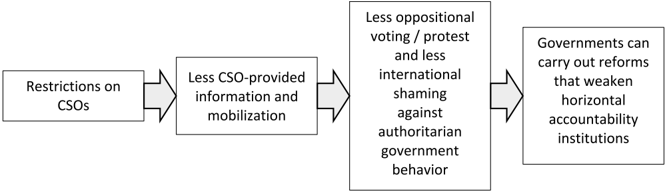
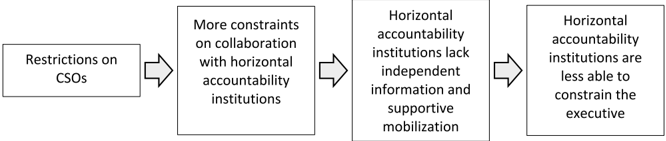
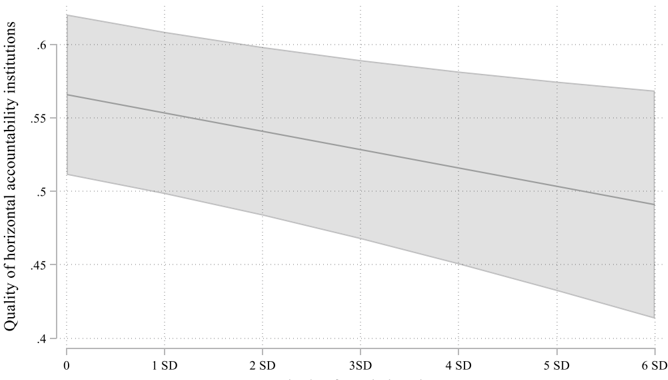
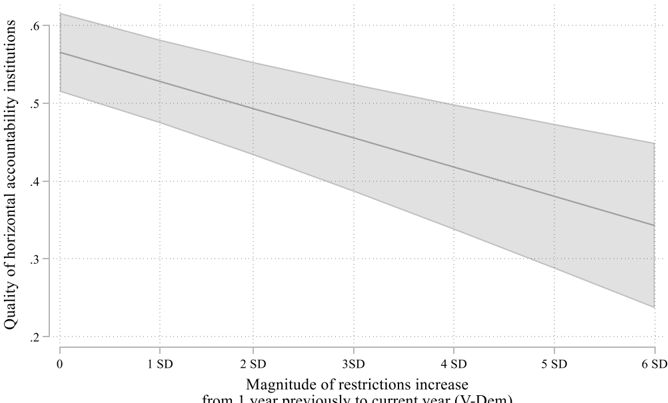
Existing research shows that the activity of independent civil society organizations (CSOs) is an important ingredient of democratization and democratic consolidation. Yet, what happens when governments impose restrictions on CSO activity? This manuscript investigates how restrictions on CSOs affect the quality of horizontal accountability institutions like parliaments and courts. CSOs monitor and mobilize against violations of democratic norms. Thus, if governments impose restrictions on CSO activity, they may face fewer barriers (i.e., less scrutiny and criticism) to dismantling horizontal checks and balances. In addition, when restrictions prevent CSOs from supporting horizontal accountability institutions (e.g., with monitoring and expertise), the latter’s ability to control and constrain governments likely declines. Our large-N cross-country analysis supports this argument, suggesting that the imposition of restrictions on CSOs diminishes the quality of horizontal accountability institutions. We examine alternative explanations (i.e., prior autocratization trends and the authoritarian nature of governments) and offer qualitative evidence from Kenya and Turkey to illustrate the expected causal pathways. Our results imply that a crackdown on CSOs serves as a warning sign of deteriorating horizontal oversight.
Overview
The claims and statistics of this paper haven’t been checked yet.
Free: it reads the open-access text and checks the first 5 claims that cite a source we can check. Create a free account to check every claim.
Integrity signals
Registry
Cites
Statistics
Figures
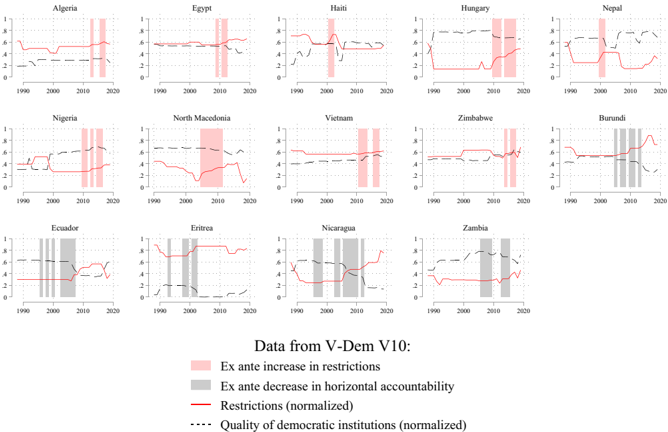
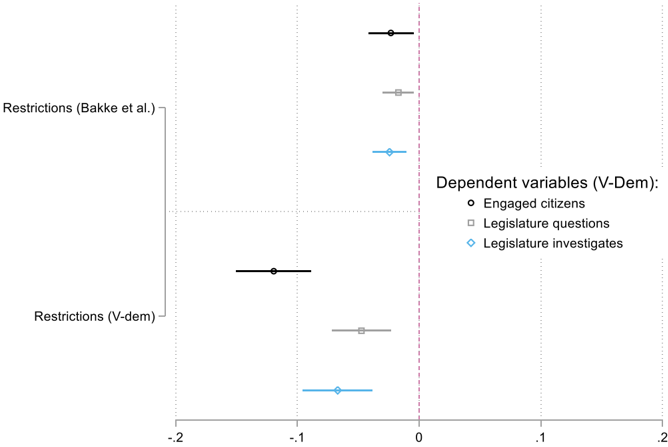
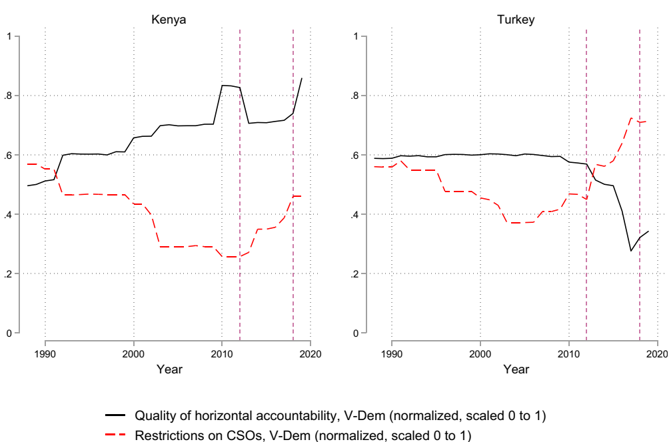
Verification
Claims the paper makes
The claims and statistics of this paper haven’t been checked yet.
Free: it reads the open-access text and checks the first 5 claims that cite a source we can check. Create a free account to check every claim.
Self-check
Percentages, sums and reported differences re-computed from the paper’s own numbers.
The self-check needs the paper’s full text.
Citations
Cites
Arellano, M., & Bond, S. (1991) · The Review of Economic Studies · doi:10.2307/2297968 · Cited by 33,272
Biases in dynamic models with fixed effects
Nickell, S. (1981) · Econometrica · doi:10.2307/1911408 · Cited by 8,735
Resource Mobilization and Social Movements: A Partial Theory
McCarthy, J. D., & Zald, M. N. (1977) · American Journal of Sociology · doi:10.1086/226464 · Cited by 7,381 · cited 1×
“…networks as well as their knowledge and material mobilization resources (such as finance and offices) to bring critical information to the attention of voters, mass publics, and international allies and mobilize these actors to punish governments’ anti-demo-cratic behavior (McCarthy and Zald 1977).”
Polyarchy: Participation and Opposition.
Ericson, J. E., & Dahl, R. A. (1972) · American Quarterly · doi:10.2307/2711442 · Cited by 7,203
Armed Conflict 1946-2001: A New Dataset
GLEDITSCH, N. P., WALLENSTEEN, P., ERIKSSON, M., SOLLENBERG, M., & STRAND, H. (2002) · Journal of Peace Research · doi:10.1177/0022343302039005007 · Cited by 3,846 · cited 2×
“We also control for anti-government protest events using data from Clark and Regan (2016) and internal armed conflict using data from UCDP-PRIO Armed Conflict Dataset (Gleditsch et al. 2002; Pettersson et al. 2019) because contention can trigger restrictions and precede attacks on democratic institutions.”
Case Selection Techniques in Case Study Research: A Menu of Qualitative and Quantitative Options
Seawright, J., & Gerring, J. (2008) · Political Research Quarterly · doi:10.1177/1065912907313077 · Cited by 3,827 · cited 1×
“Since both cases support the main observable implication of our argu-ment and are thus “typical cases” (Seawright and Gerring 2008), we can use these cases to trace the two proposed causal mechanisms (Lieberman 2005).”
Activists beyond Borders: Advocacy Networks in International Politics
Fukuyama, F., Keck, M. E., & Sikkink, K. (1998) · Foreign Affairs · doi:10.2307/20048985 · Cited by 3,700
Congressional Oversight Overlooked: Police Patrols versus Fire Alarms
McCubbins, M. D., & Schwartz, T. (1984) · American Journal of Political Science · doi:10.2307/2110792 · Cited by 2,936 · cited 1×
“Specifically, parliaments often rely on “fire-alarm oversight” to control the executive, which implies that parliamentar-ians rely on independent information provided by CSOs to punish and deter government misbehavior (McCubbins and Schwartz 1984; Scherer et al. 2008).”
Bermeo, N. (2016) · Journal of Democracy · doi:10.1353/jod.2016.0012 · Cited by 2,331
(2017) · The SHAFR Guide Online · doi:10.1163/2468-1733_shafr_sim010030025 · Cited by 2,300
Introducing ACLED: An armed conflict location and event dataset
Raleigh, C., Linke, A., Hegre, H., & Karlsen, J. (2010) · Journal of Peace Research · doi:10.1177/0022343310378914 · Cited by 1,747 · cited 2×
“…election results by stating “six people have decided they will go against the will of the peo-ple” (Burke 2017), only a few residents of Bonyamatutu village in Nyamira County, the home of Chief Justice Maraga, protested against Kenyatta’s verbal attacks on the judiciary (Raleigh et al. 2010).”
A third wave of autocratization is here: what is new about it?
Lührmann, A., & Lindberg, S. I. (2019) · Democratization · doi:10.1080/13510347.2019.1582029 · Cited by 1,528 · cited 4×
“3 Autocratization is used as synonym of democratic decline, i.e., “deterioration of qualities associated with democratic governance” (Waldner and Lust 2018, 95), that can take place within different regimes with at least somewhat democratic institutions (e.g., Lührmann and Lindberg 2019).”
InfluentialNested Analysis as a Mixed-Method Strategy for Comparative Research
LIEBERMAN, E. S. (2005) · American Political Science Review · doi:10.1017/s0003055405051762 · Cited by 1,515 · cited 1×
“Since both cases support the main observable implication of our argu-ment and are thus “typical cases” (Seawright and Gerring 2008), we can use these cases to trace the two proposed causal mechanisms (Lieberman 2005).”
Rethinking Civil Society: Toward Democratic Consolidation
Diamond, L. (1994) · Journal of Democracy · doi:10.1353/jod.1994.0041 · Cited by 1,193 · cited 1×
“Civil society organizations (CSOs) are key for democratization (O’Donnell and Schmitter 1986; Bernhard and Karakoç 2007) and democratic consolidation (Dahl 1971; Bratton 1989; Diamond 1994; Mechkova et al. 2019; Bernhard et al. 2020).”
Civil Society and the Collapse of the Weimar Republic
Berman, S. (1997) · World Politics · doi:10.1353/wp.1997.0008 · Cited by 1,108
Facing Up to the Democratic Recession
Diamond, L. (2015) · Journal of Democracy · doi:10.1353/jod.2015.0009 · Cited by 1,107 · cited 1×
“Our findings thus suggest that restrictions on CSOs are not only symptoms of authoritarian governance (e.g., Diamond 2015; Foa and Mounk 2016, 2017; Levitsky and Ziblatt 2018).”
Foa, R. S., & Mounk, Y. (2016) · Journal of Democracy · doi:10.1353/jod.2016.0049 · Cited by 1,022 · cited 1×
“Our findings thus suggest that restrictions on CSOs are not only symptoms of authoritarian governance (e.g., Diamond 2015; Foa and Mounk 2016, 2017; Levitsky and Ziblatt 2018).”
The People vs. Democracy: Why Our Freedom Is in Danger and How to Save It
Mounk, Y. (2018) · Harvard University Press eBooks · doi:10.4159/9780674984776 · Cited by 1,003 · cited 2×
“Moreover, most existing research on autocratization 3 just mentions governments’ interference with CSOs and conceptualizes it as symptomatic of authoritarian governance rather than as having independent explanatory power in the process of democratic decline (Levitsky and Ziblatt 2018; Mounk 2018).”
Unwelcome Change: Coming to Terms with Democratic Backsliding
Waldner, D., & Lust, E. (2018) · Annual Review of Political Science · doi:10.1146/annurev-polisci-050517-114628 · Cited by 889 · cited 1×
“3 Autocratization is used as synonym of democratic decline, i.e., “deterioration of qualities associated with democratic governance” (Waldner and Lust 2018, 95), that can take place within different regimes with at least somewhat democratic institutions (e.g., Lührmann and Lindberg 2019).”
Transitions from Authoritarian Rule: Comparative Perspectives
O'Donnell, G. A., Schmitter, P. C., & Whitehead, L. (2013) · Cited by 800
Foa, R. S., & Mounk, Y. (2017) · Journal of Democracy · doi:10.1353/jod.2017.0000 · Cited by 697 · cited 1×
“Our findings thus suggest that restrictions on CSOs are not only symptoms of authoritarian governance (e.g., Diamond 2015; Foa and Mounk 2016, 2017; Levitsky and Ziblatt 2018).”
The Marketing of Rebellion: Insurgents, Media, and International Activism
Bob, C. (2005) · doi:10.1017/cbo9780511756245 · Cited by 627
Svolik, M. W. (2019) · Journal of Democracy · doi:10.1353/jod.2019.0039 · Cited by 607 · cited 2×
“5 Of course, the decline in any element of democracy is likely partly endogenous to the behavior of (authoritarian-minded) incumbents (Bermeo 2016; Levitsky and Ziblatt 2018; Svolik 2019).”
Beyond the State: Civil Society and Associational Life in Africa
Bratton, M. (1989) · World Politics · doi:10.2307/2010506 · Cited by 523 · cited 1×
“Civil society organizations (CSOs) are key for democratization (O’Donnell and Schmitter 1986; Bernhard and Karakoç 2007) and democratic consolidation (Dahl 1971; Bratton 1989; Diamond 1994; Mechkova et al. 2019; Bernhard et al. 2020).”
How to Save a Constitutional Democracy
Ginsburg, T., & Huq, A. Z. (2019) · University of Chicago Press eBooks · doi:10.7208/chicago/9780226564418.001.0001 · Cited by 451
Organized violence, 1989–2018 and peace agreements
Pettersson, T., Högbladh, S., & Öberg, M. (2019) · Journal of Peace Research · doi:10.1177/0022343319856046 · Cited by 432 · cited 1×
“…control for anti-government protest events using data from Clark and Regan (2016) and internal armed conflict using data from UCDP-PRIO Armed Conflict Dataset (Gleditsch et al. 2002; Pettersson et al. 2019) because contention can trigger restrictions and precede attacks on democratic institutions.”
Social Conflict in Africa: A New Database
Salehyan, I., Hendrix, C. S., Hamner, J., Case, C., Linebarger, C., Stull, E., & Williams, J. (2012) · International Interactions · doi:10.1080/03050629.2012.697426 · Cited by 414 · cited 1×
“…neither newspaper archives nor any of the major databases of protest events—the Armed Conflict and Events Database (ACLED) and the Social Conflict in Africa Database (SCAD)—record any public protest event against this decision in the period 2013–2018 (Raleigh et al. 2010; Salehyan et al. 2012).”
How Much Democratic Backsliding?
Mechkova, V., Lührmann, A., & Lindberg, S. I. (2017) · Journal of Democracy · doi:10.1353/jod.2017.0075 · Cited by 381 · cited 2×
“Specifically, we show that inference with CSOs is one pathway to executive aggrandizement and authoritarian rule (Bern-hard et al. 2020; Lührmann et al. 2020; Lührmann and Lindberg 2019; Mechkova et al. 2017; Mechkova et al. 2019).”
Ethnopopulism and democratic backsliding in Central Europe
Anna Vachudova, M. (2020) · East European Politics · doi:10.1080/21599165.2020.1787163 · Cited by 380
What authoritarianism is … and is not:∗ a practice perspective
Glasius, M. (2018) · International Affairs · doi:10.1093/ia/iiy060 · Cited by 375 · cited 3×
“Similarly, Glasius (2018) conceptualizes restrictions as one authoritarian practice for “sabotaging accountability” by disabling access to information and voice.”
Authoritarian Reversals and Democratic Consolidation
SVOLIK, M. (2008) · American Political Science Review · doi:10.1017/s0003055408080143 · Cited by 361 · cited 2×
“Moreover, we control for economic development with GDP per capita and GDP growth, which are associated with authoritarian reversal and can also affect the CSO sector (Svolik 2008).”
Democracy's Past and Future: Authoritarianism's Last Line of Defense
Schedler, A. (2010) · Journal of Democracy · doi:10.1353/jod.0.0137 · Cited by 262 · cited 1×
“Existing research shows that while almost any regime has formally independent courts, parliaments, and other representative institutions, independent CSOs are needed for “breathing democratic life into the bones of formal representative institutions” (Schedler 2010, 78).”
Who survived? Ethiopia's regulatory crackdown on foreign-funded NGOs
Dupuy, K. E., Ron, J., & Prakash, A. (2015) · Review of International Political Economy · doi:10.1080/09692290.2014.903854 · Cited by 235
Constraining Governments: New Indices of Vertical, Horizontal, and Diagonal Accountability
LÜHRMANN, A., MARQUARDT, K. L., & MECHKOVA, V. (2020) · American Political Science Review · doi:10.1017/s0003055420000222 · Cited by 206 · cited 2×
“Our dependent variable captures the quality of horizontal accountability institutions using an index designed by Lührmann et al. (2020).”
Defunding Dissent: Restrictions on Aid to NGOs
Christensen, D., & Weinstein, J. M. (2013) · Journal of Democracy · doi:10.1353/jod.2013.0026 · Cited by 182 · cited 2×
“The literature on civil society has discussed restrictions on CSOs as a government strategy to minimize domestic and international accountability (Bakke et al. 2019; Christensen and Weinstein 2013; Glasius 2018; Glasius et al. 2020; Smidt et al. 2021).”
Turkey – from tutelary to delegative democracy
Taş, H. (2015) · Third World Quarterly · doi:10.1080/01436597.2015.1024450 · Cited by 167 · cited 1×
“Tellingly, this wave of repression was accompanied by anti-civil society statements from Erdoğan and his close supporters (Taş 2015, 780).”
NGOs, Political Protest, and Civil Society
Boulding, C. E. (2014) · Cambridge University Press eBooks · doi:10.1017/cbo9781107588561 · Cited by 165 · cited 1×
“Another reason for why CSOs preserve democracy is that CSOs create domestic networks where citizens can interact, build trust, and share information (Boulding 2014).”
Civil Society and the Legacies of Dictatorship
Bernhard, M., & Karakoç, E. (2007) · World Politics · doi:10.1353/wp.2008.0001 · Cited by 139 · cited 1×
“Civil society organizations (CSOs) are key for democratization (O’Donnell and Schmitter 1986; Bernhard and Karakoç 2007) and democratic consolidation (Dahl 1971; Bratton 1989; Diamond 1994; Mechkova et al. 2019; Bernhard et al. 2020).”
Singer, M. (2018) · Comparative Political Studies · doi:10.1177/0010414018784054 · Cited by 139 · cited 1×
“…collusion of conservative parties with populist anti-democrats (Levitsky and Ziblatt 2018), the erosion of democratic preferences in the population (Mounk 2018), or the political polarization that prevents voters from allying against authoritarian incumbents (Svo-lik 2019; cf. also Singer 2018).”
Illiberal Norm Diffusion: How Do Governments Learn to Restrict Nongovernmental Organizations?
Glasius, M., Schalk, J., & De Lange, M. (2020) · International Studies Quarterly · doi:10.1093/isq/sqaa019 · Cited by 137 · cited 2×
“The literature on civil society has discussed restrictions on CSOs as a government strategy to minimize domestic and international accountability (Bakke et al. 2019; Christensen and Weinstein 2013; Glasius 2018; Glasius et al. 2020; Smidt et al. 2021).”
Pemstein, D., Marquardt, K. L., Tzelgov, E., Wang, Y.-T., Krusell, J., & Miri, F. (2018) · doi:10.2139/ssrn.3167764 · Cited by 132
Turkey’s tamed civil society: Containment and appropriation under a competitive authoritarian regime
Yabancı, B. (2019) · Journal of Civil Society · doi:10.1080/17448689.2019.1668627 · Cited by 122 · cited 4×
“The government effectively “tamed” Turkish civil society “rendering it politicized, segregated and disabled” (Yabanci 2019, 293).”
InfluentialSmidt, H., Perera, D., Mitchell, N. J., & Bakke, K. M. (2020) · British Journal of Political Science · doi:10.1017/s0007123419000693 · Cited by 111 · cited 9×
“By contrast, bundles of restrictions on several CSOs make it more difficult to adapt and resist (Smidt et al. 2021).”
InfluentialSelf-citationSounding the Fire Alarm: The Role of Interest Groups in the Lower Federal Court Confirmation Process
Scherer, N., Bartels, B. L., & Steigerwalt, A. (2008) · The Journal of Politics · doi:10.1017/s0022381608081036 · Cited by 107 · cited 1×
“Specifically, parliaments often rely on “fire-alarm oversight” to control the executive, which implies that parliamentar-ians rely on independent information provided by CSOs to punish and deter government misbehavior (McCubbins and Schwartz 1984; Scherer et al. 2008).”
Mass Mobilization Protest Data
Clark, D. H., & Regan, P. M. (2016) · Harvard Dataverse · doi:10.7910/dvn/httwyl · Cited by 107
Parties, Civil Society, and the Deterrence of Democratic Defection
Bernhard, M., Hicken, A., Reenock, C., & Lindberg, S. I. (2020) · Studies in Comparative International Development · doi:10.1007/s12116-019-09295-0 · Cited by 105 · cited 6×
“Civil society organizations (CSOs) are key for democratization (O’Donnell and Schmitter 1986; Bernhard and Karakoç 2007) and democratic consolidation (Dahl 1971; Bratton 1989; Diamond 1994; Mechkova et al. 2019; Bernhard et al. 2020).”
InfluentialWhat do we know about civil society and regime change thirty years after 1989?
Bernhard, M. (2020) · East European Politics · doi:10.1080/21599165.2020.1787160 · Cited by 104 · cited 1×
“Recent events also facilitated autocratization, for instance, the global financial crisis in 2008 and the fear about immigration in 2015 (Bernhard 2020).”
When States Crack Down on Human Rights Defenders
Bakke, K. M., Mitchell, N. J., & Smidt, H. M. (2020) · International Studies Quarterly · doi:10.1093/isq/sqz088 · Cited by 77 · cited 5×
“First, we use a dataset by Bakke et al. (2019) that records the types of restrictions against CSO activity in a given country and year.”
InfluentialSelf-citationThe Accountability Sequence: from De-Jure to De-Facto Constraints on Governments
Mechkova, V., Lührmann, A., & Lindberg, S. I. (2019) · Studies in Comparative International Development · doi:10.1007/s12116-018-9262-5 · Cited by 46 · cited 3×
“Civil society organizations (CSOs) are key for democratization (O’Donnell and Schmitter 1986; Bernhard and Karakoç 2007) and democratic consolidation (Dahl 1971; Bratton 1989; Diamond 1994; Mechkova et al. 2019; Bernhard et al. 2020).”
NGO repression as a predictor of worsening human rights abuses
Chaudhry, S., & Heiss, A. (2022) · Journal of Human Rights · doi:10.1080/14754835.2022.2030205 · Cited by 45 · cited 2×
“Second, our findings add to the literature on the consequences of shrinking civic spaces, providing first cross-national evidence that restrictions on CSOs can harm core democratic institutions (Chaudhry and Heiss 2022; Heinzel and Koenig-Archibugi 2022; Smidt et al. 2021).”
Repression without Exception: A Study of Protest Bans during Turkey’s State of Emergency (2016-2018)
Arslanalp, M., & Erkmen, T. D. (2020) · South European Society & Politics · doi:10.1080/13608746.2020.1748353 · Cited by 38 · cited 1×
“As the case of Turkey demonstrates, repression of the right to protest was pre-emptively used in 2017 to de-mobilize civil society before an anti-democratic constitutional referendum that removed horizontal checks on executive power (Arslanalp and Deniz Erkmen 2020; ICNL 2019b).”
Populism, Nationalism, and Party Politics
Stroschein, S. (2019) · Nationalities Papers · doi:10.1017/nps.2019.91 · Cited by 34 · cited 1×
“…literature, i.e., on why regimes become gradually more autocratic, several causes have been identified: the emergence of (ethno-)populism (Stroschein 2019; Vachudova 2020), the collusion of conservative parties with populist anti-democrats (Levitsky and Ziblatt 2018), the erosion of…”
Fransen, L., Dupuy, K. E., Hinfelaar, M., & Zakaria, S. M. (2021) · Global Policy · doi:10.1111/1758-5899.12972 · Cited by 32 · cited 1×
“The Independent Agency of CSOs CSOs retain agency in dealing with restrictions on their activity (e.g., Fransen et al. 2021; Smidt et al. 2021).”
Repression, spontaneity, and collective action: the 2013 Turkish Gezi protests
Anisin, A. (2016) · Journal of Civil Society · doi:10.1080/17448689.2016.1239607 · Cited by 30 · cited 1×
“Between May and September 2013, the so-called Gezi Park protests mobilized nearly 3.5 million protestors (Anisin 2016, 411).”
InfluentialDefending Civic Space: When are Campaigns against Repressive Laws Successful?
Cheeseman, N., & Dodsworth, S. (2023) · The Journal of Development Studies · doi:10.1080/00220388.2022.2162882 · Cited by 26 · cited 2×
“Instead, nuancing our argument, CSOs banded together with horizontal oversight institutions to fend off restrictions on their activity (Berger-Kern et al. 2021; Cheeseman and Dodsworth 2023).”
Civil Society in ‘Politics’ and ‘Development’ in African Hybrid Regimes: The Kenyan Case
Mati, J. M. (2020) · VOLUNTAS International Journal of Voluntary and Nonprofit Organizations · doi:10.1007/s11266-020-00211-y · Cited by 25 · cited 1×
“Civil society confronted colonial governments in the first half of the twentieth century and forced authoritarian president Moi to hold elections and accept defeat at the beginning of the twenty-first century (Mati 2020).”
Defending Civic Space: Successful Resistance Against NGO Laws in Kenya and Kyrgyzstan
Berger‐Kern, N., Hetz, F., WAGNER, R. C., & Wolff, J. (2021) · Global Policy · doi:10.1111/1758-5899.12976 · Cited by 25
Engström, P., & Low, P. (2018) · Springer eBooks · doi:10.1007/978-3-319-89459-1_2 · Cited by 17 · cited 1×
“Similarly, constitutional courts depend on CSOs to acquire information to rule against executive power grabs (Engstrom and Low 2019).”
Heinzel, M., & Koenig‐Archibugi, M. (2022) · British Journal of Political Science · doi:10.1017/s0007123422000564 · Cited by 14 · cited 3×
“Second, our findings add to the literature on the consequences of shrinking civic spaces, providing first cross-national evidence that restrictions on CSOs can harm core democratic institutions (Chaudhry and Heiss 2022; Heinzel and Koenig-Archibugi 2022; Smidt et al. 2021).”
Mariniello, T. (2019) · German Law Journal · doi:10.1017/glj.2019.3 · Cited by 13 · cited 1×
“…without parliamentary or judicial oversight under a prolonged state of emergency, 1 3 Studies in Comparative International Development (2025) 60:81–110 inter alia, dismissing thousands of court judges and prosecutors from their functions (UN Human Rights Office 2016; Mariniello 2019; Yildiz 2019).”
Civil Society and Democracy in an Era of Inequality
Bernhard, M. H., Fernandes, T., & Branco, R. (2017) · Comparative Politics · doi:10.5129/001041517820934258 · Cited by 11 · cited 2×
“One class of unobserved reasons might be time-invariant structural difference between countries; for example, authoritarian legacies may both increase restrictions on CSOs and reduce horizontal accountability (Bernhard et al. 2017).”
The Role of Turkish Civil Society in Political Decision Making
Kuşku-Sönmez, E. (2019) · Ankara Üniversitesi SBF Dergisi · doi:10.33630/ausbf.536428 · Cited by 4 · cited 1×
“Through these platforms, CSOs generated a public debate, wrote reports, and organized conferences to convey their demands and proposals (Kuşku Sönmez 2019, 972).”
Turkey in 2012: A General Overview
Keyman, E. F., & Kancı, T. (2013) · IEMed: Mediterranean yearbook · Cited by 1
AFTER YEARS OF BROKEN PROMISES, WILL THE PBO ACT BECOME MORE THAN PAPER TIGER?
(2019) · Human Rights Documents online · doi:10.1163/2210-7975_hrd-5550-20180012 · Cited by 1
Research works printed but not linked: 35
- Amnesty International. 2013. Turkey: Gezi Park Protests: Brutal Denial of the Right to Peaceful Assem- bly in Turkey. London: Amnesty International. https:// www. amnes ty. org/ en/ docum ents/ eur44/ 022/ 2013/ en/. Accessed 30 Dec 2023.
- Anadolu Agency. 2016. Erdoğan Says 'Civil Society Groups Working Against Turkish State' Largely Destroyed. Hürriyet Daily News http:// www. hurri yetda ilyne ws. com/ erdog an-says-civil-socie ty- groups-worki ng-again st-turki sh-state-large ly-destr oyed-100789. Accessed 30 Dec 2023.
- Bernhard, Michael, Eitan Tzelgov, Dong-Joon Jung, Michael Coppedge, and Staffan I. Lindberg. 2015. The Varieties of Democracy Core Civil Society Index. In V-Dem Working Paper 13. Gothenburg: University of Gothenburg http:// www. ssrn. com/ abstr act= 26674 93. Accessed 30 Dec 2023.
- Brechenmacher, Saskia. 2017. Civil Society Under Assault. Repression and Responses in Russia, Egypt, and Ethiopia. Washington D.C.: Carnegie Endowment for International Peace.
- Bullain, Nilda, and Douglas Rutzen. 2018. All for One, One for All: Protecting Sectoral Legitimacy. In Examining Civil Society Legitimacy, ed. Thomas Carothers and Saskia Brechenmacher, 31-33.
- Burke, Jason. 2017. Kenyan Supreme Court Annuls Uhuru Kenyatta Election Victory. The Guardian https:// www. thegu ardian. com/ world/ 2017/ sep/ 01/ kenyan-supre me-court-annuls-uhuru-kenya tta-elect ion-victo ry. Accessed 30 Dec 2023.
- Carothers, Thomas, and Saskia Brechenmacher. 2018. Examining Civil Society Legitimacy. Carnegie Endowment for International Peace https:// carne gieen dowme nt. org/ 2018/ 05/ 02/ exami ning- civil-socie ty-legit imacy-pub-76211. Accessed 30 Dec 2023.
- Chilton, Adam, and Mila Versteeg. 2018. Courts' Limited Ability to Protect Constitutional Rights. The University of Chicago Law Review 85 (2) https:// chica gounb ound. uchic ago. edu/ uclrev/ vol85/ iss2/ 10. Accessed 30 Dec 2023.
- CIVICUS. 2015. Attacks on Civil Society Undermining Democracy and Development in Kenya. In Policy Action Brief. Johannesburg: CIVICUS https:// www. civic us. org/ images/ Kenya% 20Pol icy% 20Act ion% 20Bri ef. pdf. Accessed 30 Dec 2023.
- Coppedge, Michael, John Gerring, Carl Henrik Knutsen, Staffan I. Lindberg, Jan Teorell, David Alt- man, Michael Bernhard, et al. 2020. V-Dem Dataset V10. Gothenburg: University of Gothen- burg: Varieties of Democracy Institute https:// www.v-dem. net/ en/ refer ence/ versi on-9-apr- 2019/. Accessed 30 Dec 2023.
- Council of Europe. 2013. Post-Monitoring Dialogue with Turkey (Resolution 1925). Council of Europe https:// assem bly. coe. int/ nw/ xml/ XRef/ Xref-XML2H TML-en. asp? fileid= 19668 & lang= en. Accessed 30 Dec 2023.
- Dettmer, Jamie. 2017. Aid Groups Fear Mass Expulsion of Western NGOs from Turkey. VOA https:// www. voane ws. com/a/ aid-gropus-fear-mass-expul sion-of-weste rn-ngos-from-turkey/ 37607 49. html. Accessed 30 Dec 2023.
- Ebole, Roland, and Morris Odhiambo. 2017. Governance Assessment. Kenya: January 2013 -July 2016. Freedom House https:// freed omhou se. org/ sites/ defau lt/ files/ Gover nance% 20Ass essme nt% 20Ken ya% 202016. pdf. Accessed 30 Dec 2023.
- Ekim, Sinan, and Kemal Kirişci. 2017. The Turkish Constitutional Referendum, Explained. In Brookings (blog) https:// www. brook ings. edu/ blog/ order-from-chaos/ 2017/ 04/ 13/ the-turki sh-const ituti onal- refer endum-expla ined/. Accessed 30 Dec 2023.
- Eslen Özerkan, Gaye, and Ceren S. Mutlu. 2008. Turkey's EU Journey and Turkish Civil Society. Inter- national Issues & Slovak Foreign Policy Affairs 17 (1): 29-46.
- Goitom, Hanibal. 2013. Kenya: Rejection of Bill Capping NGO Foreign Funding and Giving Spy Agency Broadened Surveillance Powers. In The Law Library of Congress. Global Legal Monitor http:// www. loc. gov/ law/ forei gn-news/ artic le/ kenya-rejec tion-of-bill-cappi ng-ngo-forei gn-fundi ng-and- giving-spy-agency-broad ened-surve illan ce-powers/. Accessed 30 Dec 2023.
- ICNL. 2008. Ethics and Civil Society (Defending Civil Society). The International Journal of Not-for-Profit Law 10 (2) https://www.icnl.org/resources/research/ijnl/defending-civil-society. Accessed 30 Dec 2023.
- Dec 2023. ICNL. 2019a. Civic Freedom Monitor: Kenya. In Civic Freedom Monitor. Washington, D.C.: Inter- national Center for Not-for-Profit Law https:// www. icnl. org/ resou rces/ civic-freed om-monit or/ kenya. Accessed 30 Dec 2023.
- ICNL. 2019b. Civic Freedom Monitor: Turkey. In Civic Freedom Monitor. Washington, D.C.: Interna- tional Center for Not-for-Profit Law https:// www. icnl. org/ resou rces/ civic-freed om-monit or/ tur- key. Accessed 30 Dec 2023.
- Kenya Human Rights Commission. 2021. KHRC's Position on the BBI, Referendum and the 2022 Suc- cession. The Kenya Human Rights Commission (KHRC) https:// www. khrc. or. ke/ 2015-03-04- 10-37-01/ press-relea ses/ 738-khrc-s-posit ion-on-the-bbi-refer endum-and-the-2022-succe ssion. html. Accessed 30 Dec 2023.
- Levitsky, Steven, and Daniel Ziblatt. 2018. How Democracies Die. New York: Crown.
- Madowo, Larry. 2018. Kenya Is Sliding into a Dictatorship. In Washington Post https:// www. washi ngton post. com/ news/ global-opini ons/ wp/ 2018/ 02/ 07/ kenya-is-slidi ng-into-a-dicta torsh ip/? utm_ term=. 5a535 b4922 1f. Accessed 30 Dec 2023.
- Mellen, Ruby, and Colum Lynch. 2017. Inside Turkey's NGO Purge. In Foreign Policy (blog) https:// forei gnpol icy. com/ 2017/ 08/ 03/ inside-turke ys-ngo-purge/. Accessed 30 Dec 2023.
- New York Times. 2020. "On China's National Day, Hong Kong Police Quash Protests -The New York Times." https:// www. nytim es. com/ 2020/ 10/ 01/ world/ asia/ hong-kong-prote sts-china. html. Accessed 30 Dec 2023.
- NGOs Co-ordination Board. 2019. Annual NGO Sector Report 2018/19. Nairobi: NGOs Co-Ordination Board https:// ngobu reau. go. ke/ wp-conte nt/ uploa ds/ 2020/ 02/ ANNUAL-NGO-SECTOR-REPORT- 2018-2019. pdf. Accessed 30 Dec 2023.
- Ogemba, Paul. 2017. Court Stops MPs from Debating Petition to Remove Auditor General Edward Ouko. The Standard https:// www. stand ardme dia. co. ke/ polit ics/ artic le/ 20012 32577/ court-stops-mps-from- debat ing-petit ion-to-remove-ouko. Accessed 30 Dec 2023.
- Oloo, Adams. 2018. Kenya's 2017 Election and New Wave of Activism. In Carnegie Endowment for International Peace (blog) https:// carne gieen dowme nt. org/ 2018/ 02/ 12/ kenya-s-2017-elect ion-and- new-wave-of-activ ism-pub-75498. Accessed 30 Dec 2023.
- Pemstein, Daniel, Kyle L. Marquardt, Eitan Tzelgov, Yi-ting Wang, Juraj Medzihorsky, Joshua Kru- sell, Farhad Miri, and Johannes von Römer. 2020. The V-Dem Measurement Model: Latent Vari- able Analysis for Cross-National and Cross-Temporal Expert-Coded Data. In 21. V-Dem Working Paper. Gothenburg: University of Gothenburg. https:// doi. org/ 10. 2139/ ssrn. 31677 · DOI · Paper page
- Progressive International. 2021. The Building Bridges Initiative Has Distorted Kenya's Democracy. Pro- gressive International https:// progr essive. inter natio nal/ wire/ 2021-01-29-the-build ing-bridg es-initi ative-has-disto rted-kenyas-democ racy/ en. Accessed 30 Dec 2023.
- Puddington, Arch, Aili Piano, Jennifer Dunham, Bret Nelson, and Tyler Roylance, eds. 2013. Freedom in the World 2013: the Annual Survey of Political Rights & Civil Liberties. New York; Lanham: Freedom House; Rowman & Littlefield https:// freed omhou se. org/ sites/ defau lt/ files/ 2020-02/ Freed om_ in_ the_ World_ 2013_ compl ete_ book. pdf. Accessed 30 Dec 2023.
- Sunday Nation Team. 2015 What Jubilee's Judicial Service Commission Appointments Really Mean. https:// nation. africa/ kenya/ news/ polit ics/ what-jubil ee-s-judic ial-servi ce-commi ssion-appoi ntmen ts-really-mean-10781 68. Accessed 30 Dec 2023.
- Transparency International Kenya. 2021. Joint Civil Society Statement on the Landmark Building Bridges Initiative Judgement and Unwarranted Attacks on the Judiciary. In Transparency Inter- national Kenya (blog) https:// tiken ya. org/ joint-civil-socie ty-state ment-on-the-landm ark-build ing- bridg es-initi ative-judge ment-and-unwar ranted-attac ks-on-the-judic iary/. Accessed 30 Dec 2023.
- UN Human Rights Office. 2016. UN Experts Urge Turkey to Respect the Independence of the Judiciary and Uphold the Rule of Law. OHCHR https:// www. ohchr. org/ en/ press-relea ses/ 2016/ 07/ un-exper ts-urge-turkey-respe ct-indep enden ce-judic iary-and-uphold-rule-law. Accessed 30 Dec 2023.
- Yildiz, Ali. 2019. Did Turkey's Recent Emergency Decrees Derogate from the Absolute Rights? In Ver- fassungsblog (blog) https:// verfa ssung sblog. de/ did-turke ys-recent-emerg ency-decre es-derog ate- from-the-absol ute-rights/. Accessed 30 Dec 2023.
- Zihnioglu, Özge. 2019. The Legacy of the Gezi Protests in Turkey -After Protest: Pathways Beyond Mass Mobilization -Carnegie Europe -Carnegie Endowment for International Peace. Carnegie Europe https:// carne gieeu rope. eu/ 2019/ 10/ 24/ legacy-of-gezi-prote sts-in-turkey-pub-80142. Accessed 30 Dec 2023.
Cited by
Countering the Wave of Democratic Backsliding and the Crisis of Democracy in West Africa
Arthur, P. (2025) · Insight on Africa · doi:10.1177/09750878241312188 · Cited by 19
A red flag for public goods? The correlates of civil society restrictions
Smidt, H., Mitchell, N. J., & Bakke, K. M. (2024) · Governance · doi:10.1111/gove.12894 · Cited by 4
“For example, restrictions on CSOs likely hamper parliaments and courts to constrain the executive (Smidt et al., 2024) and likewise silence critical messages at election time, and in these ways indirectly contribute to the under‐delivery of public goods through further weakening horizontal and…”
Self-citationSteinert, C., & Smidt, H. (2025) · British Journal of Political Science · doi:10.1017/s0007123425000249 · Cited by 3
“CSOs may have potentially long-term detrimental consequences (Chaudhry 2022; Heinzel and Koenig-Archibugi 2023; Smidt et al., 2025, 2021).”
Self-citationRichter, T. O., Llanos, M., Kuehn, D., Acheampong, M., Arellano, E., & Song, E. E. (2025) · Democratization · doi:10.1080/13510347.2025.2551068 · Cited by 4
Self-citationDemocratic backsliding in Honduras and MACCIH’s effects (2016–2021)
Gomis, M. (2026) · Policy Studies · doi:10.1080/01442872.2025.2602248 · Cited by 2
“The weakening of civil society and academic autonomy further undermines horizontal accountability (Smidt, Johansson, and Richter 2025), which, if preserved, can strengthen democratic resilience (Sevaybricker, Assis, and Dyniewicz 2024).”
Metadata
- Authors
- Smidt, H., Johansson, J., & Richter, T.
- Affiliations
- University of Zurich (CH)
- Corresponding author
- Smidt, Hannah
- Venue
- Studies in Comparative International Development
- Published
- 2024-02-01
- Volume
- 60
- Issue
- 1
- Pages
- 81-110
- ISSN
- 0039-3606 (ISSN-L)
- 1936-6167
- OpenAlex
- W4391435395
- Semantic Scholar
- 8d312baf3307096d21a35b2b22eb5005f4b900a8
- Cited by
- 14
- References
- 64
- Citations by year
- 2026: 7 · 2025: 6 · 2024: 1
- FWCI
- 10.08
- Type
- journal article
- Language
- en
- Open access
- hybrid
- doi.org
- Licence
- cc-by
- creativecommons.org/licenses/by/4.0 (tdm)
- creativecommons.org/licenses/by/4.0 (vor)
- Locations
- Studies in Comparative International Development (publishedVersion, cc-by)
- Econstor (Econstor) (submittedVersion, cc-by)
- Alexandria (UniSG) (University of St.Gallen) (submittedVersion)
- Social Science Open Access Repository (GESIS – Leibniz Institute for the Social Sciences) (submittedVersion)
- Funders
- University of St.Gallen
- Topics
- Social Sciences › Sociology and Political Science › Political Conflict and Governance
- Social Sciences › Political Science and International Relations › Political Theory and Democracy
- Social Sciences › Law › Judicial and Constitutional Studies
- Keywords
- civil society organizations, horizontal accountability, checks and balances, parliament, courts, democratization, democratic consolidation, autocratization, authoritarianism, government oversight, Kenya, Turkey
About these checks
Registry, retraction, Cites and statistics results are computed, not judged, with one exception: a printed reference that no index lists is read once by a model before it counts as a citation error. Claims are extracted by a model and kept only when their quote appears verbatim in the text; each cited source is then checked, with a model’s help, for whether it says what the claim relies on. Those verdicts can be wrong — read the claim’s quote and the cited source before relying on one.
Statistics and arithmetic are recomputed, not judged.
Confidence bands are shown only for fields calibrated on our annotated test set. None is calibrated yet, so no band is shown.
What counts as a claim ›How we measure confidence ›How we check this ›
Are you an author, or do you see a problem with this page? Request a review
Data sources
Bibliographic data: Semantic Scholar, OpenAlex, Crossref.
Contains information from the Semantic Scholar Academic Graph Datasets, made available under the ODC Attribution License (ODC-BY 1.0).
Semantic Scholar’s data is described in: Kinney, R., et al. (2023). The Semantic Scholar Open Data Platform. arXiv:2301.10140.
