

Effects of Mindfulness-Based Stress Reduction Intervention on Psychological Well-being and Quality of Life: Is Increased Mindfulness Indeed the Mechanism?
Open accessThe DOI matches its Crossref record; 48 of the 49 references it cites were found in a registry or an index.
Abstract
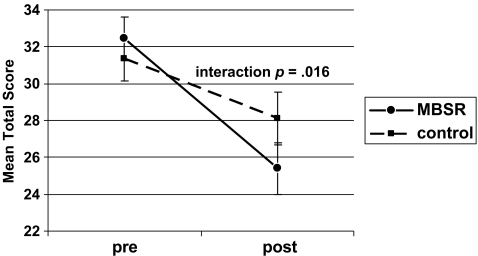
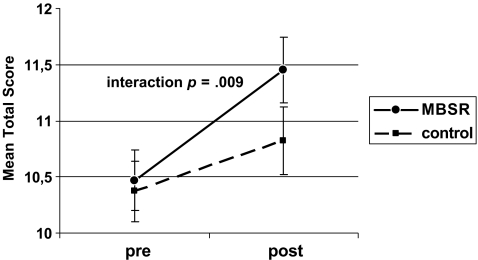
BACKGROUND: Although several studies have reported positive effects of mindfulness-based stress reduction (MBSR) intervention on psychological well-being, it is not known whether these effects are attributable to a change in mindfulness. PURPOSE: The aim of this study is to compare the effects of MBSR to a waiting-list control condition in a randomized controlled trial while examining potentially mediating effects of mindfulness. METHODS: Forty women and 20 men from the community with symptoms of distress (mean age 43.6 years, SD = 10.1) were randomized into a group receiving MBSR or a waiting-list control group. Before and after the intervention period, questionnaires were completed on psychological well-being, quality of life, and mindfulness. RESULTS: Repeated measures multiple analysis of variance (MANCOVAs) showed that, compared with the control group, the intervention resulted in significantly stronger reductions of perceived stress (p = 0.016) and vital exhaustion (p = 0.001) and stronger elevations of positive affect (p = 0.006), quality of life (p = .009), as well as mindfulness (p = 0.001). When mindfulness was included as a covariate in the MANCOVA, the group effects on perceived stress and quality of life were reduced to nonsignificance. CONCLUSION: Increased mindfulness may, at least partially, mediate the positive effects of mindfulness-based stress reduction intervention.
Overview
The claims and statistics of this paper haven’t been checked yet.
Free: it reads the open-access text and checks the first 5 claims that cite a source we can check. Create a free account to check every claim.
Integrity signals
Registry
Cites
Statistics
Figures
Verification
Claims the paper makes
The claims and statistics of this paper haven’t been checked yet.
Free: it reads the open-access text and checks the first 5 claims that cite a source we can check. Create a free account to check every claim.
Claims other papers make about this one
Each is checked against this paper’s own text: does it say what the citing paper says it does?
The source backs part of the claim, not all of it — or backs it for a different population, condition or comparison.
In the citing paper
“satisfaction with life, and quality of life (Grossman et al., 2010; Koszycki et al., 2007; Nyklíček, & Kuijpers,2008; Shapiro et al., 2005)”
From Effects of mindfulness on psychological health: A review of empirical studies (2011) · cites this paper as Nyklíček, & Kuijpers,2008
Experimental — accuracy not yet measuredThe source backs part of the claim, not all of it — or backs it for a different population, condition or comparison.
In the citing paper
“The effects of mindfulness training on mindfulness, depression and insomnia are now quite renowned8,10,21,53 and the mechanism guiding all these changes seems to be the increase in mindful attitude towards one’s own experience, in particular in terms of acceptance, nonreactivity and nonjudgment54–57.”
From Mindfulness-based online intervention increases well-being and decreases stress after Covid-19 lockdown (2022) · cites this paper as [57]
Experimental — accuracy not yet measuredThe source backs part of the claim, not all of it — or backs it for a different population, condition or comparison.
In the citing paper
“For pain, preliminary evidence suggested that mindfulness and pain catastrophizing mediated the relationship between interventions and reduced perceived stress and improved quality of life [22,25].”
From Delivering Mindfulness-Based Interventions for Insomnia, Pain, and Dysfunctional Eating Through a Text Messaging App: Three Randomized Controlled Trials Investigating the Effectiveness and Mediating Mechanisms. (2022) · cites this paper as [22]
Experimental — accuracy not yet measuredThe cited source says what the claim attributes to it.
In the citing paper
“satisfaction with life, and quality of life (Grossman et al., 2010; Koszycki et al., 2007; Nyklíček, & Kuijpers,2008; Shapiro et al., 2005)”
From Effects of mindfulness on psychological health: A review of empirical studies (2011) · cites this paper as Nyklíček, & Kuijpers,2008
The cited source says what the claim attributes to it.
In the citing paper
“It has been found to improve positive affect (Anderson et al., 2007; Bränström et al., 2010), Nyklíček, & Kuijpers, 2008)”
From Effects of mindfulness on psychological health: A review of empirical studies (2011) · cites this paper as Nyklíček, & Kuijpers, 2008
7 more claims about this paper
Create a free account to see every claim other papers make about this one.
Self-check
Percentages, sums and reported differences re-computed from the paper’s own numbers.
The self-check needs the paper’s full text.
Citations
Cites
Baron, R. M., & Kenny, D. A. (1986) · Journal of Personality and Social Psychology · doi:10.1037/0022-3514.51.6.1173 · Cited by 91,532 · cited 3×
“several outcome variables (see Tables 1 and 2), (b) the independent variable (group) had a significant effect on the potential mediators (change in mindfulness skills; see Table 3), and (c) in several cases, the potential mediator was associated with change in outcome (Table 4) [37].”
BackgroundMethodInfluentialA Global Measure of Perceived Stress
Cohen, S., Kamarck, T., & Mermelstein, R. (1983) · Journal of Health and Social Behavior · doi:10.2307/2136404 · Cited by 32,807 · cited 4×
“The PSS consists of 14 items, which are scored by using five-point Likert scales ranging from 0 (never) to 4 (very often).”
BackgroundInfluentialThe benefits of being present: Mindfulness and its role in psychological well-being
Brown, K. W., & Ryan, R. M. (2003) · Journal of Personality and Social Psychology · doi:10.1037/0022-3514.84.4.822 · Cited by 13,448 · cited 18×
“While several studies reported correlations between change in mindfulness skills and decrease in feelings of distress [20, 27], a mediation effect of mindfulness could not be obtained due to the lack of a control group.”
BackgroundMethodResultInfluentialDevelopment of the World Health Organization WHOQOL-BREF Quality of Life Assessment
THE WHOQOL GROUP (1998) · Psychological Medicine · doi:10.1017/s0033291798006667 · Cited by 7,933
Using Self-Report Assessment Methods to Explore Facets of Mindfulness
Baer, R. A., Smith, G. T., Hopkins, J., Krietemeyer, J., & Toney, L. (2006) · Assessment · doi:10.1177/1073191105283504 · Cited by 7,511 · cited 1×
“Since the recent introduction of instruments assessing various aspects of mindfulness [20, 26], the first published studies on this topic have not been able to illuminate this issue.”
Background(2008) · Medical Entomology and Zoology · Cited by 7,477
Kabat-Zinn, J. (1982) · General Hospital Psychiatry · doi:10.1016/0163-8343(82)90026-3 · Cited by 4,255 · cited 5×
“Several studies have been performed, especially in recent years, that have examined the effects of mindfulness-based stress reduction interventions, mainly in the form of the original MBSR protocol [1, 2] or derivatives thereof [3, 4].”
BackgroundResultInfluentialMindfulness-based stress reduction and health benefits
Grossman, P., Niemann, L., Schmidt, S., & Walach, H. (2004) · Journal of Psychosomatic Research · doi:10.1016/s0022-3999(03)00573-7 · Cited by 3,958
Alterations in brain and immune function produced by mindfulness meditation
Davidson, R. J., Kabat-Zinn, J., Schumacher, J., Rosenkranz, M., Muller, D., Santorelli, S. F., Urbanowski, F., Harrington, A., Bonus, K., & Sheridan, J. F. (2003) · Psychosomatic Medicine · doi:10.1097/01.psy.0000077505.67574.e3 · Cited by 2,925 · cited 1×
“Clear consistent associations have been obtained in some studies [10, 27, 45], while in most studies, no or inconsistent associations were found [9, 11, 13, 17, 23, 43, 46, 47].”
ResultAssessment of Mindfulness by Self-Report: The Kentucky Inventory of Mindfulness Skills
Baer, R. A., Smith, G. T., & Allen, K. B. (2004) · Assessment · doi:10.1177/1073191104268029 · Cited by 2,298 · cited 4×
“In addition, the pattern of intercorrelations between these scales were similar to correlations found for the original scales [ 35 ]: MAAS with Accept Without Judgment r=0.48 at baseline and r=0.62 at follow-up (both p 0.10) and r=0.32 (p= 0.014), and Accept Without Judgment with Observe r=0.07 and r=0.09 (both p>0.10…”
MethodResultInfluential
Research works printed but not linked: 1
- De Vries J, Van Heck GL. Nederlandse handleiding van de WHOQoL [Dutch manual of the WHOQoL]. Tilburg: Tilburg University; 2000.
Cited by
Items 401–500 of 533
Herbert, M. S., Fishbein, J. N., Tynan, M., Martinez, E., Lang, A. J., Casmar, P. V., Higdon, A., Backhaus, A., Golshan, S., & Afari, N. (2025) · Behaviour Research and Therapy · doi:10.1016/j.brat.2025.104854 · Cited by 2
Perceptions of Injured Athletes after Eight Weeks of Mindfulness Based Stress Reduction Program
Pappous, A. S., Mohammed, W. A., & Sharma, D. (2021) · Journal of Psychological Research · doi:10.30564/jpr.v3i2.3130 · Cited by 4
“Moreover, this is consistent with the findings from other research ([41-44]), which discovered the positive impact of MBSR on improving wellbeing and the quality of life within different clinical populations.”
ResultHopkins, S. W., Greenberg, J., Isaacs, J., & Vranceanu, A. (2022) · Journal of Integrative and Complementary Medicine · doi:10.1089/jicm.2021.0324 · Cited by 2
Thongthammarat, Y., & Yamarat, K. (2022) · Journal of Public Health and Development · doi:10.55131/jphd/2022/200312 · Cited by 3
Erfolgsfaktoren zur Umsetzung von Interventionsmaßnahmen im Setting Pflege
Wollesen, B., Otto, A.-K., Heuel, L., Fricke, M., Vogel, O., & Bischoff, L. L. (2023) · Springer eBooks · doi:10.1007/978-3-662-67020-0_18 · Cited by 2
Yoga, mindfulness and acupuncture impact on burnout: a preliminary meta-analysis
Esperança, M. B., Ferreira, A. I., & Costa, S. P. (2025) · Psychology Health & Medicine · doi:10.1080/13548506.2025.2465658 · Cited by 2
Steiner, A. J., Boulos, N., Wright, S. M., Mirocha, J., Smith, K., López, E., Gohar, S. M., & IsHak, W. W. (2017) · Journal of Psychiatric Practice · doi:10.1097/pra.0000000000000251 · Cited by 2
The Relationship between Mindfulness and Quality of Life on Pregnant Mothers
Fourianalistyawati, E. (2019) · Workshop on Multidisciplinary and Its Applications (WMA) · doi:10.4108/eai.20-1-2018.2281911 · Cited by 2
“Furthermore, mindfulness also shows an improvement in psychological stress, positive affect and overall health of pregnant women [20].”
BackgroundMethodZinzow, H. M., Shi, L., Rennert, L., Chen, L., Lopes, S. S., Zhang, L., Jones, K. O., Jindal, M., Stam, C., & Mclain, M. (2020) · Contemporary Clinical Trials · doi:10.1016/j.cct.2020.106182 · Cited by 3
Mindfulness and Distress Tolerance: A Review of the Literature
Bliesner, A. E. (2010) · CommonKnowledge Research Repository (Pacific University Oregon) · Cited by 4
Evans, K., & Vasquez, E. (2017) · Mindfulness & Compassion · doi:10.1016/j.mincom.2017.09.005 · Cited by 3
“…is direct MBSR and citizenship 169 and pre-reflexive, include the whole range of possible phenomena, from internal psychological states and processes (thoughts, feelings, images, etc.), proprioceptive information from the body, to external stimuli entering the senses’’ (Nyklíček & Kuijpers, 2008).”
BackgroundAssociation of trait mindfulness with the false recognition of emotional words in bilinguals
Yeh, L.-H., & Lu, A. Y.-C. (2019) · International Journal of Research Studies in Psychology · doi:10.5861/ijrsp.2019.4009 · Cited by 3
“The literature suggests that trait mindfulness and mindfulness-based training (MBT) are associated with the enhancement of psychological well-being (Brown & Ryan, 2003; Nyklícek & Kuijpers, 2008; Shapiro, Carlson, Astin, & Freedman, 2006).”
BackgroundYoga for Attaining the State of Mindfulness
Roy, G. (2021) · Advances in psychology, mental health, and behavioral studies (APMHBS) book series · doi:10.4018/978-1-7998-8682-2.ch017 · Cited by 2
Moskowitz, J. T., Sharma, B., Javandel, S., Moran, P. J., Paul, R. H., Gruttola, V. D., Tomov, D., Azmy, H., Sandoval, R., Hillis, M., et al. (2024) · AIDS and Behavior · doi:10.1007/s10461-024-04295-1 · Cited by 4
“We speculate that this decline could be the result of the control participants anticipating an improvement in mood as they were aware that they would be starting MBSR shortly or could be that they had a natural improvement in mood [18].”
Relationship Between the Five Facets of Mindfulness on Mood and Substance Use Relapse
Temme, L. J., & Wang, D. (2018) · Families in Society The Journal of Contemporary Social Services · doi:10.1177/1044389418784961 · Cited by 3
“Empirical evidence regarding how these concepts directly affect behaviors, exclusive of other influences, has not yet been provided (Brown & Ryan, 2004; Dakwar & Levin, 2009; Nyklicek & Kuijpers, 2008).”
BackgroundWang, Q., Zhou, X., & Ng, S. (2021) · Current Psychology · doi:10.1007/s12144-021-02042-6 · Cited by 3
Uma intervenção com meditação para pacientes internados com transtorno alimentar
Stübing, K. (2016) · Digital Library of Theses and Dissertations (Universidade de São Paulo) · doi:10.11606/d.5.2016.tde-03022016-094452 · Cited by 2
Adaptive and Maladaptive Outcomes of Perfectionism and Changes After Mindfulness Training
Short, M. M. (2015) · Knowledge Commons (Lakehead University) · Cited by 5
Mindfulness-Based Therapies for Psychological Health Conditions: A Meta-Analysis
McCarney, R. (2010) · University of Hertfordshire Research Archive (University of Hertfordshire) · Cited by 3
The neural and psychological mechanisms of yoga and mindfulness meditation
Gard, T. (2015) · Research Publications (Maastricht University) · doi:10.26481/dis.20150320tg · Cited by 2
Vasquez, J., & Bowie-Viverette, A. C. (2024) · Clinical Social Work Journal · doi:10.1007/s10615-024-00973-8 · Cited by 1
“…several pathways including through emotional regulation improvement, presence or “mindfulness,” acceptance and tolerance of challenging experiences, and flexibility to shift perspective and attention (Cohen-Katz et al., 2005; Jimenez et al., 2010; Nyklíček & Kuijpers, 2008; Teper & Inzlicht, 2013).”
Kamsickas, L., Stephens, J. E., Jackson, K., Heard‐Garris, N., Chang, V. Y., Schoeps, K., Bussolari, C. J., Vo, D. X., Moskowitz, J. T., & Duncan, L. G. (2024) · Discover Education · doi:10.1007/s44217-024-00370-w · Cited by 6
Martins, T. A. P., Ávila, L. S. G., Mota, M. D. O., Câmara, S. F., & Júnior, E. P. L. (2025) · International Journal of Innovation · doi:10.5585/2025.28023 · Cited by 1
Perczel-Forintos, D., Horváth, A., & Lisincki, A. (2025) · Orvosi Hetilap · doi:10.1556/650.2025.33409 · Cited by 1
Ruiz‐Íñiguez, R., & de la Hera, C. M. A. (2026) · Cogent Psychology · doi:10.1080/23311908.2026.2626601 · Cited by 1
Reiner, K., Tibi, L., Lipsitz, J. D., & Gurion, B. (2013) · Cited by 1
Mohamed, M., Fine, A., Fotinos, K., Welch, A., Kitchen, K., Rose, M., Hallett, D., Davis, M., Tsirgielis, C., Ambrosio, C. D., et al. (2017) · Journal of Psychology & Psychotherapy · doi:10.4172/2161-0487.1000304 · Cited by 1
“Mindfulness-based interventions aimed at reductions of psychological symptoms of distress and enhancement of quality of life, are increasingly applied and popular in various settings for both mental health care and somatic health care [16].”
BackgroundKomponenten des Stressmanagementtrainings
Rusch, S. (2019) · Springer eBooks · doi:10.1007/978-3-662-59436-0_11 · Cited by 1
Mutwiri, M. N., Muraya, M. M., & Gitonga, L. K. (2022) · Asian Journal of Probability and Statistics · doi:10.9734/ajpas/2022/v16i130390 · Cited by 1
Editors, I. (2016) · International Journal of Educational Psychology · doi:10.17583/ijep.2016.2151 · Cited by 1
Proceedings of the 2015 ISNR Conference: Keynotes, Invited, and Student Award Presentations
International Society for Neurofeedback and Research (ISNR) (2015) · NeuroRegulation · doi:10.15540/nr.2.4.179
Safa, M., Zomorodi, S., Boroujerdi, F. G., & Gholami, R. (2023) · Journal of Health Reports and Technology · doi:10.5812/jhrt-136050 · Cited by 2
Mental Hindrances and Entrepreneurial Supports towards Psychological Wellbeing among Entrepreneurs
Abdelwahed, N. A. A., & Ramish, M. S. (2024) · OBM Neurobiology · doi:10.21926/obm.neurobiol.2403245 · Cited by 2
Timm, E., Ko, Y. M., Hundhammer, T., Berlowitz, I., & Wolf, U. (2024) · Frontiers in Psychology · doi:10.3389/fpsyg.2024.1469316 · Cited by 1
A Student Initiative for Reducing Stress in Medical Students: Stress-Less-Fest
Laster, J., Geary, C., Sierpina, V. S., & Kreitzer, M. J. (2012) · EXPLORE · doi:10.1016/j.explore.2012.06.012 · Cited by 1
“ESSION 3 he objective of the third session was to eview again the signs and symptoms of tress and health benefits of lowering tress.(3,4) However this was accompanied y providing practical stress-reduction echniques, educating students about conrete approaches, and making them aware Altered Habits/Lifestyle”
BackgroundYamaji, H. (2014) · Institutional Repositories DataBase (IRDB) · Cited by 1
Mindfulness and Body Images of Female: Influence of Yoga Practice
Gim, W.-S., 양희연, & Ok-Kyeong, C. (2011) · Korean Journal of Health Psychology · doi:10.17315/kjhp.2011.16.3.001 · Cited by 1
Ruminação e habilidades de mindfulness em praticantes e não praticantes de meditação
Menezes, C. B., Crauss, F., Nascimento, L., & Andretta, I. (2017) · Psico · doi:10.15448/1980-8623.2017.4.26757 · Cited by 1
Momeni, J., Omidi, A., Raygan, F., & Akbari, H. (2018) · International journal of body, mind and culture · doi:10.22122/ijbmc.v5i2.120 · Cited by 2
“…from other published studies: The present study results were in line with the findings reported by Reibel, Greeson, Brainard, and Rosenzweig (2001), Nyklicek and Kuijpers (2008), and Witek-Janusek, Albuquerque, Chroniak, Chroniak, Durazo-Arvizu, and Mathews (2008), suggesting that MBSR has a…”
ResultAshtang Yoga: For Attaining the State of Mindfulness
Roy, G. (2021) · Journal of Indian Council of Philosophical Research · doi:10.1007/s40961-021-00257-3 · Cited by 1
Veetil, A. K. V., & Pradhan, S. (2022) · Springer proceedings in business and economics · doi:10.1007/978-981-19-4892-3_14 · Cited by 1
Mindfulness as the Key to Well-Being: A Review of Literature
Vasudevan, S., & Reddy, K. J. (2018) · International Journal of Indian Psychology · doi:10.25215/0603.040 · Cited by 1
Jones, D. L. (2013) · ScholarsArchive (Brigham Young University) · Cited by 2
Ford, A. C. (2014) · Cited by 1
Garland, S. N. (2012) · Libraries and Cultural Resources (University of Calgary) · doi:10.5072/prism/27123 · Cited by 1
Mindfulness, Facets of Big Five Personalities, and Psychological Health
Schmidt, N. J. (2013) · Aquila Digital Community (University of Southern Mississippi) · Cited by 2
Kuntz, A. B. (2016) · MacSphere (McMaster University) · doi:10.71548/19496 · Cited by 1
The relationship between mindfulness, emotion regulation, habitual thinking and eating behaviours
Fisher, N. R. (2016) · Liverpool John Moores University · doi:10.24377/ljmu.t.00004583 · Cited by 4
“Stress reduction Several randomised controlled trials of MBSR programmes have shown intervention-related decreases in perceived stress (e.g. Bränström, Kvillemo, Brandberg, & Moskowitz, 2010; Nyklíček & Kuijpers, 2008; Oman, Shapiro, Thoresen, Plante, & Flinders, 2008).”
BackgroundWilliams, C. L. (2016) · KU ScholarWorks (The University of Kansas) · Cited by 2
Raphiphatthana, B. (2018) · Open Access Victoria University of Wellington | Te Herenga Waka (Figshare) · doi:10.26686/wgtn.20388189 · Cited by 2
Dorsey, J. D. (2017) · The Research Repository @ WVU (West Virginia University) · doi:10.33915/etd.5506 · Cited by 1
Cohen, Z. P., Cosgrove, K. T., Akeman, E., Coffey, S. M., Teague, T. K., Hays-Grudo, J., Paulus, M. P., Aupperle, R. L., & Kirlić, N. (2021) · Research Square · doi:10.21203/rs.3.rs-146204/v1 · Cited by 2
Cohen, Z. P., Cosgrove, K. T., Akeman, E., Coffey, S. M., Teague, T. K., Hays-Grudo, J., Paulus, M. P., Aupperle, R. L., & Kirlić, N. (2020) · OSF Preprints (OSF Preprints) · doi:10.31219/osf.io/b5pyr · Cited by 1
Mindfulness associated with less Fear of Missing Out: Social Media Addiction as a mediatorPreprint
Aldbyani, A. (2024) · Research Square · doi:10.21203/rs.3.rs-3872015/v1 · Cited by 5
AUTOCONSCIÊNCIA EM MEDIDAS DE AUTORRELATO E EM CONTEXTOS DE RESOLUÇÃO DE PROBLEMAS
da Silveira, A. D. C. (2011) · Cited by 2
Field, J. E. (2015) · Journal of international women's studies
Reinventing the Wheel: Mindfulness Definition and Development in Buddhism and Psychology
Gilbert, B. D. (2011) · CommonKnowledge Research Repository (Pacific University Oregon)
Walsh, D. M. J. (2015) · Arrow@dit (Dublin Institute of Technology) · doi:10.13025/17845 · Cited by 1
Blotcher, E. S. (2010) · eScholarship@UMassChan · doi:10.13028/xzkm-fm74
Blom, K. C., Nolan, R. P., Irvine, M., Baker, B., Abbey, S. E., & Tobe, S. W. (2013) · Canadian Journal of Cardiology · doi:10.1016/j.cjca.2013.07.221
Nikrad, H. (2012) · CU Scholar (University of Colorado Boulder)
Exploring Emotional Memory as a Potential Mechanism Explaining the Effectiveness of Mindfulness.
Dong, B. (2015) · Brandeis Institutional Repository
Petter, M. (2014) · DalSpace (Dalhousie University)
Reich, R. R., Jacobsen, P. B., Lee, H., & Goodman, M. (2014)
A autopercepção de comportamentos relacionados à atenção plena em profissionais da saúde
de Souza, M. T. (2016) · Digital Library of Theses and Dissertations (Universidade de São Paulo) · doi:10.11606/d.5.2016.tde-09082016-153137 · Cited by 1
Mindful of the Intersession Break in Family Therapy: The Time to Think Experiment
O'Brien, C., & Yule, E. (2016) · Australian and New Zealand Journal of Family Therapy · doi:10.1002/anzf.1165
Gozal, S., Zeinali, M., Ahmadi, N., Mirzaei, S., & Azhdari, R. (2016) · AMBIENT SCIENCE · doi:10.21276/ambi.2016.03.sp1.ra04
The Effects of an MBSR Program on Psychological Health and Attachment in Adults
안희영, & 박남수 (2011) · Korea Journal of Buddhist Studies · doi:10.21482/jbs.29..201108.341
Ronzio, R. A., & Ronzio, P. A. (2012) · Cited by 2
Transitional Adjustment Intervention for International Students in U.S. Colleges
Chen, Z. (2017) · The Nebraska Educator · doi:10.13014/k29g5jr2
Mindfulness, Mindful Coping, Burnout, and Work Engagement
Bus, M. (2016) · Utrecht University Repository (Utrecht University)
Chinh, K. (2017) · Purdue e-Pubs (Purdue University System) · doi:10.7912/c20942
“Although limited, several intervention studies have reported links between 24 increased mindfulness and psychological symptom improvement in cancer patients (Bränström et al., 2010; Labelle et al., 2014; Nyklíček & Kuijpers, 2008).”
Evidências de validade da Escala de Consciência Plena no Trabalho (ECPT)
Filho, A. L. A. S., Ferreira, M. C., & Valentini, F. (2017) · Psico · doi:10.15448//1980-8623.2017.3.24034 · Cited by 1
Effect of Mindfulness-based Interventions in Cancer Care
Bränström, R. (2012) · Evidence-based anticancer complementary and alternative medicine · doi:10.1007/978-94-007-5833-9_8
The Mediating Role of Self-Compassion in the Relationship of Mindfulness with Depressive Symptoms
Sibghat-ullah, W., & Batool, I. (2018) · Peshawar Journal of Psychology and Behavioral Sciences (PJPBS) · doi:10.32879/picp.2018.4.1.55 · Cited by 5
Evaluation eines achtsamkeitsbasierten Führungskräfteprogramms
Bub, K., & Heiss, S. F. (2019) · FOM-Edition · doi:10.1007/978-3-658-25673-9_17 · Cited by 1
Reducing the Risk of Diabetes: The Role of Self-Efficacy in a Mindfulness-based Intervention
Rich, S. E. (2014) · Carolina Digital Repository (University of North Carolina at Chapel Hill) · doi:10.17615/6pza-pm45
Resonating Experiences of Self and Others enabled by a Tangible Somaesthetic DesignPreprint
Aslan, I., Seiderer, A., Dang, C. T., Rädler, S., & André, E. (2020) · arXiv (Cornell University) · doi:10.48550/arxiv.2005.02304
“, children in schools or inmates in prisons), enabling different user groups ubiquitous access to mindfulness practices and to their benefits, such as enhanced wellbeing [5] or stress reduction [6].”
Wang, E. (2019) · Cited by 1
Zhu, Y., Jiang, W., Wang, J., Jiao, Y., & Chen, S. (2020) · doi:10.21203/rs.3.rs-25922/v1
“Previous studies found that mindfulness (Ivan & Kuijpers,2008), mind/body intervention (Deckro, et al.,2002) and eurythmy therapy (Berger, et al.,2015) had effects on Page 13/16 reducing the stress perception.”
van der Donk, L. J. (2020) · University of Groningen research database (University of Groningen / Centre for Information Technology) · doi:10.33612/diss.136048320
Shireen, S. H. (2020) · TSpace (University of Toronto)
الباقی, أ. إ. م. ع. (2020) · دراسات نفسية · doi:10.21608/psj.2020.134904 · Cited by 2
Prentice, P. R. (2009) · The Research Repository @ WVU (West Virginia University) · doi:10.33915/etd.4516 · Cited by 2
“…about the future and rumination regarding the past, are associated with increased psychological stress, anxiety, and depression, whereas ‘being’ functions of the brain are associated with more positive emotional outcomes (e.g., Nolen-Hoeksema, Stice, Wade & Bohon, 2007; Nyklicek & Kuijpers, 2008).”
BackgroundMelam, G. R. (2019) · Psychology and Behavioral Science International Journal · doi:10.19080/pbsij.2019.13.555875
“Interventions can ameliorate these effects and thereby improve the character of the life of people with chronic mental illness [10,12-19].”
BackgroundWilliams, G. E. (2020) · TSpace (University of Toronto)
University-K-12 Collaboration During the Pandemic: The Case of Turkey
Atay, D. (2021) · Knowledge studies in higher education · doi:10.1007/978-3-030-82159-3_18 · Cited by 1
Bossi, F., Zaninotto, F., D’Arcangelo, S., Lattanzi, N., Malizia, A. P., & Ricciardi, E. (2021) · doi:10.2196/preprints.29949
van Dijk, I., van Ravesteijn, H. J., & Speckens, A. E. M. (2010) · Bijblijven · doi:10.1007/bf03088731 · Cited by 1
(2012) · Dunod eBooks · doi:10.3917/dunod.mirab.2012.01.0123
Lundberg, U., & Cooper, C. L. (2010) · Wiley eBooks · doi:10.1002/9781444391121.refs
van Dijk, I., van Ravesteijn, H. J., & Speckens, A. E. M. (2010) · Bijblijven · doi:10.1007/s12414-010-0002-7
Pleine conscience et acceptation
Kotsou, I., & Heeren, A. (2011) · Carrefour des psychothérapies · doi:10.3917/dbu.kotso.2011.01.0425
Mindfulness Training and Quality of Life Among Pregnant Females: A Randomized Clinical Trial
Yazdanimehr, R., Omidi, A., Akbari, H., & Sadat, Z. (2016) · Nursing and Midwifery Studies · doi:10.17795/nmsjournal32570
Pradhan, S. (2022) · Springer proceedings in business and economics · doi:10.1007/978-981-16-7818-9_19
Efektivitas Mindfulness Untuk Meningkatkan Kualitas Hidup: Studi Meta-analisis
Ayu, D. U. S., & Yudiarso, A. (2021) · Jurnal Psikologi Udayana · doi:10.24843/jpu.2021.v08.i02.p02 · Cited by 4
Septianingrum, Y. (2022) · Gaceta Médica de Caracas · doi:10.47307/gmc.2022.130.s5.43
Gracia, F., & Bintari, D. R. (2023) · Journal of Educational Health and Community Psychology · doi:10.12928/jehcp.v1i1.24980 · Cited by 1
Metadata
- Authors
- Nyklíček, I., & Kuijpers, K. F.
- Affiliations
- Tilburg University (NL)
- Corresponding author
- Nyklíček, Ivan
- Venue
- Annals of Behavioral Medicine
- Publisher
- Oxford University Press (OUP)
- Published
- 2008-06
- Volume
- 35
- Issue
- 3
- Pages
- 331-340
- ISSN
- 0742-5554 (ISSN-L)
- 0883-6612
- 1532-4796
- PMC
- PMC2517090
- OpenAlex
- W2121397829
- Cited by
- 532
- References
- 49
- Citations by year
- 2026: 11 · 2025: 18 · 2024: 20 · 2023: 23 · 2022: 21 · 2021: 30 · 2020: 39 · 2019: 33 · 2018: 33 · 2017: 38 · 2016: 41 · 2015: 44 · 2014: 33 · 2013: 37 · 2012: 45
- FWCI
- 24.08
- Type
- journal article
- Language
- en
- Open access
- bronze
- doi.org
- Locations
- Annals of Behavioral Medicine (publishedVersion)
- Europe PMC (PubMed Central) (publishedVersion, cc-by-nc)
- PubMed Central (publishedVersion, cc-by-nc)
- Research portal (Tilburg University) (publishedVersion)
- PubMed (publishedVersion)
- Data Archiving and Networked Services (DANS) (submittedVersion, other-oa)
- Topics
- Social Sciences › Psychology › Clinical Psychology › Mindfulness and Compassion Interventions
- Social Sciences › Psychology › Social Psychology › Psychological Well-being and Life Satisfaction
- Health Sciences › Health Professions › General Health Professions › Health, psychology, and well-being
- Keywords
- mindfulness-based stress reduction, mindfulness, psychological well-being, quality of life, perceived stress, vital exhaustion, positive affect, mediation, psychological distress, community-dwelling adults
- MeSH terms
- Adult, Attention, Awareness, Female, Group Processes, Humans, Male, Middle Aged, Netherlands, Quality of Life, Stress, Psychological, Treatment Outcome, Meditation
About these checks
Registry, retraction, Cites and statistics results are computed, not judged, with one exception: a printed reference that no index lists is read once by a model before it counts as a citation error. Claims are extracted by a model and kept only when their quote appears verbatim in the text; each cited source is then checked, with a model’s help, for whether it says what the claim relies on. Those verdicts can be wrong — read the claim’s quote and the cited source before relying on one.
Statistics and arithmetic are recomputed, not judged.
Confidence bands are shown only for fields calibrated on our annotated test set. None is calibrated yet, so no band is shown.
What counts as a claim ›How we measure confidence ›How we check this ›
Are you an author, or do you see a problem with this page? Request a review
Data sources
Bibliographic data: Semantic Scholar, OpenAlex, Crossref.
Contains information from the Semantic Scholar Academic Graph Datasets, made available under the ODC Attribution License (ODC-BY 1.0).
Semantic Scholar’s data is described in: Kinney, R., et al. (2023). The Semantic Scholar Open Data Platform. arXiv:2301.10140.
