

Effects of Mindfulness-Based Stress Reduction Intervention on Psychological Well-being and Quality of Life: Is Increased Mindfulness Indeed the Mechanism?
Open accessThe DOI matches its Crossref record; 48 of the 49 references it cites were found in a registry or an index.
Abstract
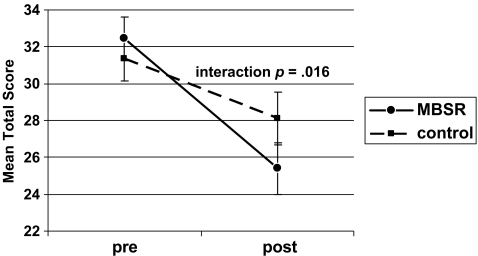
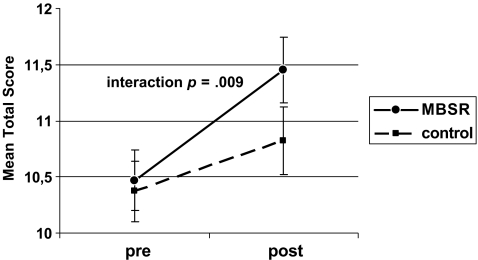
BACKGROUND: Although several studies have reported positive effects of mindfulness-based stress reduction (MBSR) intervention on psychological well-being, it is not known whether these effects are attributable to a change in mindfulness. PURPOSE: The aim of this study is to compare the effects of MBSR to a waiting-list control condition in a randomized controlled trial while examining potentially mediating effects of mindfulness. METHODS: Forty women and 20 men from the community with symptoms of distress (mean age 43.6 years, SD = 10.1) were randomized into a group receiving MBSR or a waiting-list control group. Before and after the intervention period, questionnaires were completed on psychological well-being, quality of life, and mindfulness. RESULTS: Repeated measures multiple analysis of variance (MANCOVAs) showed that, compared with the control group, the intervention resulted in significantly stronger reductions of perceived stress (p = 0.016) and vital exhaustion (p = 0.001) and stronger elevations of positive affect (p = 0.006), quality of life (p = .009), as well as mindfulness (p = 0.001). When mindfulness was included as a covariate in the MANCOVA, the group effects on perceived stress and quality of life were reduced to nonsignificance. CONCLUSION: Increased mindfulness may, at least partially, mediate the positive effects of mindfulness-based stress reduction intervention.
Overview
The claims and statistics of this paper haven’t been checked yet.
Free: it reads the open-access text and checks the first 5 claims that cite a source we can check. Create a free account to check every claim.
Integrity signals
Registry
Cites
Statistics
Figures
Verification
Claims the paper makes
The claims and statistics of this paper haven’t been checked yet.
Free: it reads the open-access text and checks the first 5 claims that cite a source we can check. Create a free account to check every claim.
Claims other papers make about this one
Each is checked against this paper’s own text: does it say what the citing paper says it does?
The source backs part of the claim, not all of it — or backs it for a different population, condition or comparison.
In the citing paper
“satisfaction with life, and quality of life (Grossman et al., 2010; Koszycki et al., 2007; Nyklíček, & Kuijpers,2008; Shapiro et al., 2005)”
From Effects of mindfulness on psychological health: A review of empirical studies (2011) · cites this paper as Nyklíček, & Kuijpers,2008
Experimental — accuracy not yet measuredThe source backs part of the claim, not all of it — or backs it for a different population, condition or comparison.
In the citing paper
“The effects of mindfulness training on mindfulness, depression and insomnia are now quite renowned8,10,21,53 and the mechanism guiding all these changes seems to be the increase in mindful attitude towards one’s own experience, in particular in terms of acceptance, nonreactivity and nonjudgment54–57.”
From Mindfulness-based online intervention increases well-being and decreases stress after Covid-19 lockdown (2022) · cites this paper as [57]
Experimental — accuracy not yet measuredThe source backs part of the claim, not all of it — or backs it for a different population, condition or comparison.
In the citing paper
“For pain, preliminary evidence suggested that mindfulness and pain catastrophizing mediated the relationship between interventions and reduced perceived stress and improved quality of life [22,25].”
From Delivering Mindfulness-Based Interventions for Insomnia, Pain, and Dysfunctional Eating Through a Text Messaging App: Three Randomized Controlled Trials Investigating the Effectiveness and Mediating Mechanisms. (2022) · cites this paper as [22]
Experimental — accuracy not yet measuredThe cited source says what the claim attributes to it.
In the citing paper
“satisfaction with life, and quality of life (Grossman et al., 2010; Koszycki et al., 2007; Nyklíček, & Kuijpers,2008; Shapiro et al., 2005)”
From Effects of mindfulness on psychological health: A review of empirical studies (2011) · cites this paper as Nyklíček, & Kuijpers,2008
The cited source says what the claim attributes to it.
In the citing paper
“It has been found to improve positive affect (Anderson et al., 2007; Bränström et al., 2010), Nyklíček, & Kuijpers, 2008)”
From Effects of mindfulness on psychological health: A review of empirical studies (2011) · cites this paper as Nyklíček, & Kuijpers, 2008
7 more claims about this paper
Create a free account to see every claim other papers make about this one.
Self-check
Percentages, sums and reported differences re-computed from the paper’s own numbers.
The self-check needs the paper’s full text.
Citations
Cites
Baron, R. M., & Kenny, D. A. (1986) · Journal of Personality and Social Psychology · doi:10.1037/0022-3514.51.6.1173 · Cited by 91,532 · cited 3×
“several outcome variables (see Tables 1 and 2), (b) the independent variable (group) had a significant effect on the potential mediators (change in mindfulness skills; see Table 3), and (c) in several cases, the potential mediator was associated with change in outcome (Table 4) [37].”
BackgroundMethodInfluentialA Global Measure of Perceived Stress
Cohen, S., Kamarck, T., & Mermelstein, R. (1983) · Journal of Health and Social Behavior · doi:10.2307/2136404 · Cited by 32,807 · cited 4×
“The PSS consists of 14 items, which are scored by using five-point Likert scales ranging from 0 (never) to 4 (very often).”
BackgroundInfluentialThe benefits of being present: Mindfulness and its role in psychological well-being
Brown, K. W., & Ryan, R. M. (2003) · Journal of Personality and Social Psychology · doi:10.1037/0022-3514.84.4.822 · Cited by 13,448 · cited 18×
“While several studies reported correlations between change in mindfulness skills and decrease in feelings of distress [20, 27], a mediation effect of mindfulness could not be obtained due to the lack of a control group.”
BackgroundMethodResultInfluentialDevelopment of the World Health Organization WHOQOL-BREF Quality of Life Assessment
THE WHOQOL GROUP (1998) · Psychological Medicine · doi:10.1017/s0033291798006667 · Cited by 7,933
Using Self-Report Assessment Methods to Explore Facets of Mindfulness
Baer, R. A., Smith, G. T., Hopkins, J., Krietemeyer, J., & Toney, L. (2006) · Assessment · doi:10.1177/1073191105283504 · Cited by 7,511 · cited 1×
“Since the recent introduction of instruments assessing various aspects of mindfulness [20, 26], the first published studies on this topic have not been able to illuminate this issue.”
Background(2008) · Medical Entomology and Zoology · Cited by 7,477
Kabat-Zinn, J. (1982) · General Hospital Psychiatry · doi:10.1016/0163-8343(82)90026-3 · Cited by 4,255 · cited 5×
“Several studies have been performed, especially in recent years, that have examined the effects of mindfulness-based stress reduction interventions, mainly in the form of the original MBSR protocol [1, 2] or derivatives thereof [3, 4].”
BackgroundResultInfluentialMindfulness-based stress reduction and health benefits
Grossman, P., Niemann, L., Schmidt, S., & Walach, H. (2004) · Journal of Psychosomatic Research · doi:10.1016/s0022-3999(03)00573-7 · Cited by 3,958
Alterations in brain and immune function produced by mindfulness meditation
Davidson, R. J., Kabat-Zinn, J., Schumacher, J., Rosenkranz, M., Muller, D., Santorelli, S. F., Urbanowski, F., Harrington, A., Bonus, K., & Sheridan, J. F. (2003) · Psychosomatic Medicine · doi:10.1097/01.psy.0000077505.67574.e3 · Cited by 2,925 · cited 1×
“Clear consistent associations have been obtained in some studies [10, 27, 45], while in most studies, no or inconsistent associations were found [9, 11, 13, 17, 23, 43, 46, 47].”
ResultAssessment of Mindfulness by Self-Report: The Kentucky Inventory of Mindfulness Skills
Baer, R. A., Smith, G. T., & Allen, K. B. (2004) · Assessment · doi:10.1177/1073191104268029 · Cited by 2,298 · cited 4×
“In addition, the pattern of intercorrelations between these scales were similar to correlations found for the original scales [ 35 ]: MAAS with Accept Without Judgment r=0.48 at baseline and r=0.62 at follow-up (both p 0.10) and r=0.32 (p= 0.014), and Accept Without Judgment with Observe r=0.07 and r=0.09 (both p>0.10…”
MethodResultInfluential
Research works printed but not linked: 1
- De Vries J, Van Heck GL. Nederlandse handleiding van de WHOQoL [Dutch manual of the WHOQoL]. Tilburg: Tilburg University; 2000.
Cited by
Items 501–533 of 533
Soe, Y. N., Swe, K. M. M., Tin, O. H., Oo, M. M., Phyu, H. P., Zin, T., & Aung, H. H. (2023) · Acta Scientific Medical Sciences · doi:10.31080/asms.2023.07.1597
Thongthammarat, Y. (2019) · Chula Digiverse · doi:10.58837/chula.the.2019.477
Mindfulness and Life Satisfaction
Christopher, M., & Gilbert, B. D. (2023) · Springer eBooks · doi:10.1007/978-3-031-17299-1_4021
Stress Management: Concept, Approaches, and AnalysisPreprint
Ganapathi, P. B., Aithal, P. S., & Kanchana, D. (2024) · SSRN Electronic Journal · doi:10.2139/ssrn.4744526
The Role of Mindfulness-Based Interventions in Treating Depression among Population Subgroups
Saiuk, N., Kołodziej, M., Kozicz, M. A., Mądry, W., Mazurkiewicz, A., Męczyńska, J., Seredyński, T., Wojciechowska, A., Marcicka, J., & Salasa, W. (2024) · Journal of Education Health and Sport · doi:10.12775/jehs.2024.66.007
Effect of Exercise on Level of Stress
Barman, A. S. (2024) · International Journal of Science and Research (IJSR) · doi:10.21275/sr24803232210
Jin, J., Xu, W., Wang, Y., Yang, X., Wang, S., Li, D., & Liu, X. (2024) · Current Psychology · doi:10.1007/s12144-024-06632-y
“Additionally, extensive research supports the hypothesis that an individual’s mindfulness level is another important factor contributing to the effectiveness of mindfulness interventions (Keng et al., 2012; Nyklíček & Kuijpers, 2008; Zhang et al., 2021).”
Mustafa, S. (2024) · SSRN Electronic Journal · doi:10.2139/ssrn.4947708 · Cited by 1
The Effects of Exercise on Stress Levels
Srivastava, S. (2025) · Journal of Educational Research and Policies · doi:10.53469/jerp.2025.07(01).01
Cao, X. (2025) · Asia Pacific Journal of Clinical Medical Research · doi:10.62177/apjcmr.v1i1.239
“Studies have shown that mindfulness training can adjust the body’s basal metabolism, regulate the autonomic nervous system, and thus improve sensory sensitivity [15] .”
Donofry, S. D., Damon, S. T., Jouppi, R. J., Davis, J. A., Conlon, R. P. K., Call, C. C., & Levine, M. D. (2025) · SSRN Electronic Journal · doi:10.2139/ssrn.5244654
Mindfulness: A Missing Integral Component of Leadership Preparation Programs
Albizu, P. J. D. L. C., & Maraia, G. (2025) · Merits · doi:10.3390/merits5020013
Ahmed, S. (2024) · International Journal of Innovative Studies in Sociology and Humanities · doi:10.20431/2456-4931.090104
Eficacia preliminar de una intervención psicológica mixta en un programa de rehabilitación cardíaca
Hermosilla, A., Pastor, M. T., Rufrancos, B. A., Cuéllar, M. L. G.-O., Nieto, M. O., & Martínez, A. P. (2025) · Clínica Contemporánea · doi:10.5093/cc2025a19 · Cited by 2
“…presente con actitud de aceptación, ha demostrado efectos positivos en la reducción del estrés, la ansiedad y la rumiación, especialmente en personas con enfermedades crónicas como las cardiovasculares (Nyklíček y Kuijpers 2008; Kabat-Zinn, 2013; Loucks et al., 2015; Moreno Monzó et al., 2024).”
Simple Pathways to Health and Wellness
McGrady, A. V., & Moss, D. (2013) · Springer eBooks · doi:10.1007/978-1-4419-1379-1_16
An Empirical Investigation of Self: Bridging the Gap betweenACT, Mindfulness and RFT
Foody, M. (2013) · Maynooth University ePrints and eTheses Archive (Maynooth University)
Mindfulness at Work and Its Relationship to Contextual Performance and Well-Being
Rauch, T. (2011) · KOPS (University of Konstanz)
Mindfulness : Relations to attention regulation, decentering, and psychological well-being
Josefsson, T. (2013) · Gothenburg University Publications Electronic Archive (Gothenburg University) · Cited by 2
Juul, L., Pallesen, K. J., Bjerggaard, M., Nielsen, C., & Fjorback, L. O. (2020) · Figshare · doi:10.6084/m9.figshare.12051492
Juul, L., Pallesen, K. J., Bjerggaard, M., Nielsen, C., & Fjorback, L. O. (2020) · Figshare · doi:10.6084/m9.figshare.12051486
Cohen, Z. P., Cosgrove, K. T., Akeman, E., Coffey, S., Teague, T. K., Hays-Grudo, J., Paulus, M. P., Aupperle, R. L., & Kirlić, N. (2021) · Figshare · doi:10.6084/m9.figshare.14429158
Ansari, S., Shaheer, S., V, & Iqbal, N. (2026) · Current Psychology · doi:10.1007/s12144-025-08661-7
“Most existing research (Bean - lands et al., 2019; Johnson et al., 2018; Nykliiček & Kuijpers, 2008 ) has focused predominantly on identifying stressors or interventions to mitigate stress but has overlooked the broader relationship of stress with emotional well-being as a multifaceted construct…”
Donofry, S. D., Dämon, S., Jouppi, R. J., Davis, J. A., Kolko, R. P., Call, C. C., & Levine, M. D. (2026) · Appetite · doi:10.1016/j.appet.2026.108545 · Cited by 2
Layous, K., Kushlev, K., Heintzelman, S. J., Wetchler, E., & Simon-Thomas, E. R. (2026) · The Journal of Positive Psychology · doi:10.1080/17439760.2026.2660669
Shalev, I., & Yaakobi, E. (2026) · Current Psychology · doi:10.1007/s12144-026-09463-1
“…2003; Kabat-Zinn, 2003 ) is known to have a beneficial impact on numerous aspects of well-being, including affect (Jislin-Goldberg et al., 2012 ; Nyklíček & Kuijpers, 2008), vitality (Brown & Ryan, 2003), and overall well-being (Baer et al., 2012 ; Brown & Ryan, 2003; Brown et al., 2007 ;…”
The consumer value of mindfulness practice as a transformative service experience
Gallarza, M. G., Tubillejas‐Andrés, B., García, H. C., & Stanton, J. (2026) · Journal of Services Marketing · doi:10.1108/jsm-03-2025-0158
Pradhan, N., Bhatta, L., Haugan, G., Rishal, P., & Infanti, J. J. (2026) · Journal of Intellectual & Developmental Disability · doi:10.3109/13668250.2026.2688672
Quinn, P., & Vargas-Nieto, J. C. (2026) · Journal of Behavioral and Cognitive Therapy · doi:10.1016/j.jbct.2026.100629
Bergen‐Cico, D., Ramon, A. E., Felleman, B. I., & Possemato, K. (2026) · Contemporary Clinical Trials · doi:10.1016/j.cct.2026.108451
Korecki, J. R., Winston, D., Ko, E., Yoo, S., Khalili, J., & Bower, J. E. (2026) · PLoS ONE · doi:10.1371/journal.pone.0357906
Ghumman, U., Shafee, C., Altarawneh, L. N., Iorini, M., Kandel, H., Anand, N., Lopez, A., Mendoza, J., Romero, E., Dang, A., et al. (2026) · Frontiers in Psychiatry · doi:10.3389/fpsyt.2026.1906750
Menezes, C. B. (2009) · Americanae (AECID Library) · Cited by 1
Metadata
- Authors
- Nyklíček, I., & Kuijpers, K. F.
- Affiliations
- Tilburg University (NL)
- Corresponding author
- Nyklíček, Ivan
- Venue
- Annals of Behavioral Medicine
- Publisher
- Oxford University Press (OUP)
- Published
- 2008-06
- Volume
- 35
- Issue
- 3
- Pages
- 331-340
- ISSN
- 0742-5554 (ISSN-L)
- 0883-6612
- 1532-4796
- PMC
- PMC2517090
- OpenAlex
- W2121397829
- Cited by
- 532
- References
- 49
- Citations by year
- 2026: 11 · 2025: 18 · 2024: 20 · 2023: 23 · 2022: 21 · 2021: 30 · 2020: 39 · 2019: 33 · 2018: 33 · 2017: 38 · 2016: 41 · 2015: 44 · 2014: 33 · 2013: 37 · 2012: 45
- FWCI
- 24.08
- Type
- journal article
- Language
- en
- Open access
- bronze
- doi.org
- Locations
- Annals of Behavioral Medicine (publishedVersion)
- Europe PMC (PubMed Central) (publishedVersion, cc-by-nc)
- PubMed Central (publishedVersion, cc-by-nc)
- Research portal (Tilburg University) (publishedVersion)
- PubMed (publishedVersion)
- Data Archiving and Networked Services (DANS) (submittedVersion, other-oa)
- Topics
- Social Sciences › Psychology › Clinical Psychology › Mindfulness and Compassion Interventions
- Social Sciences › Psychology › Social Psychology › Psychological Well-being and Life Satisfaction
- Health Sciences › Health Professions › General Health Professions › Health, psychology, and well-being
- Keywords
- mindfulness-based stress reduction, mindfulness, psychological well-being, quality of life, perceived stress, vital exhaustion, positive affect, mediation, psychological distress, community-dwelling adults
- MeSH terms
- Adult, Attention, Awareness, Female, Group Processes, Humans, Male, Middle Aged, Netherlands, Quality of Life, Stress, Psychological, Treatment Outcome, Meditation
About these checks
Registry, retraction, Cites and statistics results are computed, not judged, with one exception: a printed reference that no index lists is read once by a model before it counts as a citation error. Claims are extracted by a model and kept only when their quote appears verbatim in the text; each cited source is then checked, with a model’s help, for whether it says what the claim relies on. Those verdicts can be wrong — read the claim’s quote and the cited source before relying on one.
Statistics and arithmetic are recomputed, not judged.
Confidence bands are shown only for fields calibrated on our annotated test set. None is calibrated yet, so no band is shown.
What counts as a claim ›How we measure confidence ›How we check this ›
Are you an author, or do you see a problem with this page? Request a review
Data sources
Bibliographic data: Semantic Scholar, OpenAlex, Crossref.
Contains information from the Semantic Scholar Academic Graph Datasets, made available under the ODC Attribution License (ODC-BY 1.0).
Semantic Scholar’s data is described in: Kinney, R., et al. (2023). The Semantic Scholar Open Data Platform. arXiv:2301.10140.
