

The DOI matches its Crossref record; 65 of the 66 references it cites were found in a registry or an index.
A Step Towards Personalized Sports Nutrition: Carbohydrate Intake During Exercise
Open accessAbstract
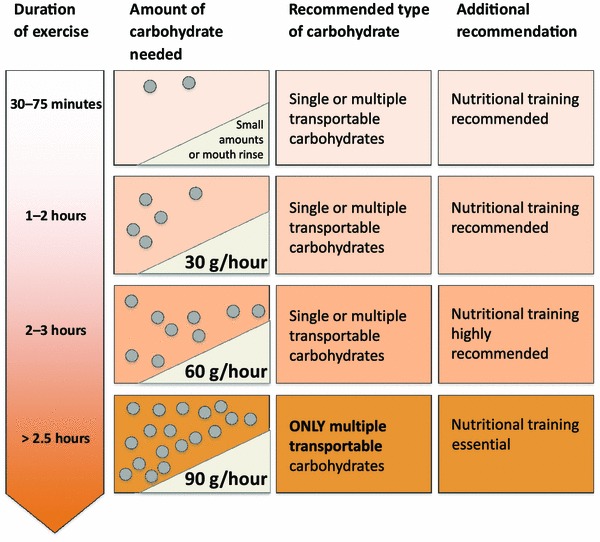
There have been significant changes in the understanding of the role of carbohydrates during endurance exercise in recent years, which allows for more specific and more personalized advice with regard to carbohydrate ingestion during exercise. The new proposed guidelines take into account the duration (and intensity) of exercise and advice is not restricted to the amount of carbohydrate; it also gives direction with respect to the type of carbohydrate. Studies have shown that during exercise lasting approximately 1 h in duration, a mouth rinse or small amounts of carbohydrate can result in a performance benefit. A single carbohydrate source can be oxidized at rates up to approximately 60 g/h and this is the recommendation for exercise that is more prolonged (2-3 h). For ultra-endurance events, the recommendation is higher at approximately 90 g/h. Carbohydrate ingested at such high ingestion rates must be a multiple transportable carbohydrates to allow high oxidation rates and prevent the accumulation of carbohydrate in the intestine. The source of the carbohydrate may be a liquid, semisolid, or solid, and the recommendations may need to be adjusted downward when the absolute exercise intensity is low and thus carbohydrate oxidation rates are also low. Carbohydrate intake advice is independent of body weight as well as training status. Therefore, although these guidelines apply to most athletes, they are highly dependent on the type and duration of activity. These new guidelines may replace the generic existing guidelines for carbohydrate intake during endurance exercise.
Overview
The claims and statistics of this paper haven’t been checked yet.
Run the check — free, no account needed. It reads the open-access text and checks the sources it cites.
Integrity signals
Registry
Cites
Statistics
Figures
Verification
Claims the paper makes
The claims and statistics of this paper haven’t been checked yet.
Run the check — free, no account needed. It reads the open-access text and checks the sources it cites.
Claims other papers make about this one
Each is checked against this paper’s own text: does it say what the citing paper says it does?
The source backs part of the claim, not all of it — or backs it for a different population, condition or comparison.
In the citing paper
“It is important to note, however, that ingestion of large amounts (>1.2 g/min) of a mixture of glucose (polymers) and fructose is likely to be only of practical relevance to highly trained athletes that are able to sustain high‐intensity exercise for a prolonged duration (i.e. > 2.5 h) (Jeukendrup, 2014).”
From Fructose co‐ingestion to increase carbohydrate availability in athletes (2019) · cites this paper as Jeukendrup, 2014
Experimental — accuracy not yet measuredThe source backs part of the claim, not all of it — or backs it for a different population, condition or comparison.
In the citing paper
“Besides greater total carbohydrate absorption and oxidation rates, glucose‐fructose mixtures also reduce the risk of gastrointestinal discomfort [68].”
From Carbohydrate Storage and Supplementation Strategies for Peak Performance in Cross-Country Skiing (2026) · cites this paper as [68]
Experimental — accuracy not yet measuredIn the citing paper
“Although the benefits of carbohydrate ingestion during exercise are generally recognized [38–41], carbohydrate supplementation during exercise may not have only positive effects.”
From Periodized Nutrition for Athletes (2017) · cites this paper as [39]
In the citing paper
“In longer events, it is clear that ingesting carbohydrates and increasing exogenous carbohydrate oxidation will result in improved endurance performance in most events [38–41, 68].”
From Periodized Nutrition for Athletes (2017) · cites this paper as [39]
In the citing paper
“Whereas it was generally accepted that exogenous CHO oxidation rates were thought to be limited at approximately 1 g/min due to saturation of intestinal glucose transporters, it is now known that exogenous CHO oxidation rates can increase to 1.8 g/min with the addition of sucrose or fructose to the CHO blend [38].”
From New strategies in sport nutrition to increase exercise performance (2016) · cites this paper as [38]
In the citing paper
“The limiting factor was subsequently found to be intestinal absorption, particularly the sodium-dependent glucose transporter, rather than gastric emptying, hepatic glucose extraction, muscle glucose uptake, or muscle glucose oxidation (Jeukendrup, 2014).”
From Contemporary Nutrition Strategies to Optimize Performance in Distance Runners and Race Walkers (2019) · cites this paper as Jeukendrup, 2014
In the citing paper
“Early investigations of CHO ingestion during exercise concluded that maximal oxidation rates plateaued at 60 g/hr, even when larger amounts were ingested (120-180 g/hr; Jeukendrup, 2014).”
From Contemporary Nutrition Strategies to Optimize Performance in Distance Runners and Race Walkers (2019) · cites this paper as Jeukendrup, 2014
Self-check
Percentages, sums and reported differences re-computed from the paper’s own numbers.
The self-check needs the paper’s full text.
Citations
Cites
ACSM Position Stand: Exercise and Fluid Replacement
Convertino, V. A., Armstrong, L. E., Coyle, E. F., Mack, G. W., Sawka, M. N., Senay, L. C., & Sherman, W. M. (1996) · Medicine & Science in Sports & Exercise · doi:10.1097/00005768-199610000-00045 · Cited by 1,977
The receptors and cells for mammalian taste
Chandrashekar, J. V., Hoon, M. A., Ryba, N. J. P., & Zuker, C. S. (2006) · Nature · doi:10.1038/nature05401 · Cited by 1,632
Exercise and Fluid Replacement
(2007) · Medicine & Science in Sports & Exercise · doi:10.1249/mss.0b013e31802ca597 · Cited by 1,497
Nutrition and Athletic Performance
(2009) · Medicine & Science in Sports & Exercise · doi:10.1249/mss.0b013e31890eb86 · Cited by 1,084 · cited 5×
“This is reflected in guidelines published by the ACSM, which recommend that athletes should take between 30 and 60 g of carbohydrate during endurance exercise (over 1 h) [30] or 0.7 g/kg per hour [6].”
BackgroundInfluentialThe effects of increasing exercise intensity on muscle fuel utilisation in humans
van Loon, L. J. C., Greenhaff, P. L., Constantin‐Teodosiu, D., Saris, W. H. M., & Wagenmakers, A. J. M. (2001) · The Journal of Physiology · doi:10.1111/j.1469-7793.2001.00295.x · Cited by 897
Carbohydrate sensing in the human mouth: effects on exercise performance and brain activity
Chambers, E. S., Bridge, M., & Jones, D. A. (2009) · The Journal of Physiology · doi:10.1113/jphysiol.2008.164285 · Cited by 625
Carbohydrate intake during exercise and performance
Jeukendrup, A. E. (2004) · Nutrition · doi:10.1016/j.nut.2004.04.017 · Cited by 490
Self-citationCarbohydrate feeding during prolonged strenuous exercise can delay fatigue
Coyle, E. F., Hagberg, J. M., Hurley, B. F., Martin, W. H., Ehsani, A. A., & Holloszy, J. O. (1983) · Journal of Applied Physiology · doi:10.1152/jappl.1983.55.1.230 · Cited by 487
Muscle Glycogen Synthesis after Exercise : an Enhancing Factor localized to the Muscle Cells in Man
BERGSTRÖM, J., & HULTMAN, E. (1966) · Nature · doi:10.1038/210309a0 · Cited by 473
The Relative Value of Fat and Carbohydrate as Sources of Muscular Energy
Krogh, A., & Lindhard, J. (1920) · Biochemical Journal · doi:10.1042/bj0140290 · Cited by 411
Cited by
Sorted by citations
Items 201–300 of 412
Carbohydrate Oral Rinsing, Cycling Performance and Individual Complex Carbohydrate Taste Sensitivity
Hartley, C., Carr, A. J., Roberts, S., Bredie, W. L. P., & Keast, R. (2024) · Nutrients · doi:10.3390/nu16030459 · Cited by 5
Bao, Z., Li, Z., Zhao, M., Wang, S., Liu, F., & Wang, H. (2025) · Critical Reviews in Food Science and Nutrition · doi:10.1080/10408398.2025.2548009 · Cited by 4
Are the Dietary–Nutritional Recommendations Met? Analysis of Intake in Endurance Competitions
Jiménez-Alfageme, R., Álvarez, J., Garbisu-Hualde, A., Romero-García, D., Giménez-Monzó, D., Sospedra, I., Ausó, E., & Sanz, J. M. M. (2024) · Nutrients · doi:10.3390/nu16020189 · Cited by 4
Maltodextrin from Sweet Cassava: A Promising Endurance Enhancer
Posridee, K., Oonsivilai, A., & Oonsivilai, R. (2024) · Foods · doi:10.3390/foods13050766 · Cited by 4
Tipton, M. (2024) · Experimental Physiology · doi:10.1113/ep092295 · Cited by 4
dos Santos, L. C., Costa, C. D. M., de Moura, R. C., Silvino, V. O., dos Santos, M. A. P., & Brandão, A. D. C. A. S. (2025) · Clinical Nutrition ESPEN · doi:10.1016/j.clnesp.2025.04.021 · Cited by 7
A Review of Honey Supplementation on Endurance Performance in Athletes
Wong, C. P. F. (2020) · Journal of Medicine and HealthCare · doi:10.47363/jmhc/2020(2)132 · Cited by 5
Dietary and ergogenic supplementation to improve elite swimming players’ performance and recovery
Wang, X., Wang, H., & Wu, H. (2023) · Science & Sports · doi:10.1016/j.scispo.2022.12.004 · Cited by 4
López-Jiménez, A., Morán-Fagúndez, L., Sánchez-Sánchez, A. M., & Fernández‐Pachón, M. (2023) · International Journal of Food Sciences and Nutrition · doi:10.1080/09637486.2023.2246699 · Cited by 4
Sleep, nutrition, and supplements: Implications for athletes
Charest, J., & Grandner, M. A. (2024) · Elsevier eBooks · doi:10.1016/b978-0-12-822969-9.00002-x · Cited by 5
Enhancing Performance in Young Athletes: A Systematic Review of Acute Supplementation Effects
Gruska, N., Sarmento, H., Martinho, D. V., Field, A., & Massart, A. G. M. (2024) · Nutrients · doi:10.3390/nu16244304 · Cited by 4
Rodrigues, D. F., Silva, A., Juzwiak, C. R., Joaquim, D. P., Rosa, J. P. P., Simim, M. A. D. M., Veríssimo, A. W., Winckler, C., Tufik, S., & de Mello, M. T. (2018) · Motriz Revista de Educação Física · doi:10.1590/s1980-657420180003e002618 · Cited by 4
Pitt, J. P., Bracken, R. M., Scott, S. N., Fontana, F. Y., Skroče, K., & McCarthy, O. M. (2022) · Journal of Sports Sciences · doi:10.1080/02640414.2022.2118944 · Cited by 4
Eckstein, M. L., Erlmann, M. P., Aberer, F., Haupt, S., Zimmermann, P., Wachsmuth, N. B., Schierbauer, J., Zimmer, R. T., Herz, D., Obermayer-Pietsch, B. M., et al. (2022) · Nutrients · doi:10.3390/nu14235128 · Cited by 4
Miguel‐Ortega, Á., Calleja-González, J., & Mielgo‐Ayuso, J. (2023) · The Journal of Physical Fitness and Sports Medicine · doi:10.7600/jpfsm.12.119 · Cited by 4
Gawrecki, A., Michalak, A., Gałczyński, S., Dachowska, I., Zozulińska‐Ziółkiewicz, D., & Szadkowska, A. (2019) · Acta Diabetologica · doi:10.1007/s00592-019-01371-0 · Cited by 4
Importance of Individualized Nutrition Plans in Athletes
Khati, A., Das, A., & Karmakar, D. (2025) · IGI Global eBooks · doi:10.4018/979-8-3693-8699-6.ch009 · Cited by 3
Vicente-Salar, N., Crespo, M., Pluim, B. M., Fernández-Fernández, J., Stroia, K. A., Ellenbecker, T. S., Rivas, D. S., Coso, J. D., Moreno-Pérez, V., Hainline, B. W., et al. (2025) · International Journal of Sport Nutrition and Exercise Metabolism · doi:10.1123/ijsnem.2025-0001 · Cited by 7
Poon, E. T., Lau, K.-W., Tsang, J. H., Zhang, X., & Wongpipit, W. (2025) · Journal of the International Society of Sports Nutrition · doi:10.1080/15502783.2025.2561670 · Cited by 3
Dean, E., Osborne, A., Subar, D. A., Hendrickse, P. W., & Gaffney, C. J. (2025) · Experimental Physiology · doi:10.1113/ep093136 · Cited by 4
Nutrition for Tactical Athletes: Insights, Applications and Research Gaps
Lye, J. C. T., & LEE, J. K. W. (2025) · Sports Medicine · doi:10.1007/s40279-025-02363-7 · Cited by 3
Consensus Document of the Spanish Nutrition Society (SEÑ) on Nutritional Strategies in Sports
Mielgo‐Ayuso, J., Macho‐González, A., Úbeda, N., Sánchez-Oliver, A. J., Martínez‐Ferrán, M., Fernández‐Lázaro, D., Aparicio‐Ugarriza, R., Roche, E., & González‐Gross, M. (2025) · Nutrients · doi:10.3390/nu17243862 · Cited by 4
Female trail running: a systematic scoping review
Espasa-Labrador, J., Sandbakk, Ø. B., Cebrián‐Ponce, Á., Irurtia, A., Carrasco‐Marginet, M., & Osborne, J. O. (2026) · Frontiers in Sports and Active Living · doi:10.3389/fspor.2025.1694925 · Cited by 4
UCI Sports Nutrition Project: Race Nutrition for Road Cycling
Jeukendrup, A. E., Redegeld, M. I., Baltazar‐Martins, G., Whitfield, J., Burke, L. A., Mujika, I., Dolan, E., & Gonzalez, J. T. (2026) · International Journal of Sport Nutrition and Exercise Metabolism · doi:10.1123/ijsnem.2025-0239 · Cited by 5
Self-citationGrivas, G. V., & Alkasasbeh, W. J. (2026) · Sports · doi:10.3390/sports14040150 · Cited by 6
Trehalose Improved 20-min Cycling Time-Trial Performance After 100-min Cycling in Amateur Cyclists
Gobbi, N., de Oliveira, L. F., da Silva, R. P., Oliveira, T. N., Möller, G. B., Murasaki, J., Ramires, M. A., Azevedo, R. D. A., Artioli, G. G., Roschel, H., et al. (2024) · International Journal of Sport Nutrition and Exercise Metabolism · doi:10.1123/ijsnem.2023-0241 · Cited by 3
Assessment of Sports-Specific Dietary Methods
Mathur, S., & Chandel, M. (2024) · Advances in medical diagnosis, treatment, and care (AMDTC) book series · doi:10.4018/979-8-3693-6317-1.ch010 · Cited by 3
Triathlon: Ergo Nutrition for Training, Competing, and Recovering
Miguel‐Ortega, Á., Rodríguez-Rodrigo, M.-A., Mielgo‐Ayuso, J., & Calleja-González, J. (2025) · Nutrients · doi:10.3390/nu17111846 · Cited by 5
King, A. J., & Hall, R. C. (2021) · British Journal Of Nutrition · doi:10.1017/s0007114521001860 · Cited by 3
Jiménez-Alfageme, R., Campodónico, M. E., Sospedra, I., Giménez-Monzó, D., García-Jaén, M., Juliá‐Sanchis, R., Ausó, E., & Sanz, J. M. M. (2023) · Nutrients · doi:10.3390/nu15081969 · Cited by 3
Type of Diet and Sports Supplements in Padel Players According to Level of Competition and Sex
Toro-Román, V., Muñoz, A., Zoido, A., Martínez, B. J. S.-Á., Pérez, F. J. G., & Muñoz, D. (2023) · Nutrients · doi:10.3390/nu15163633 · Cited by 5
Reliability of the durability concept in professional cyclists: a field-based study
Mateo‐March, M., Barranco‐Gil, D., Hernández‐Belmonte, A., Javaloyes, A., Muriel, X., Pallarés, J. G., Lucı́a, A., & Valenzuela, P. L. (2025) · International Journal of Sports Medicine · doi:10.1055/a-2555-8961 · Cited by 3
Adequacy of dietary intake in swimmers during the general preparation phase
Trindade, C. D. Z., Montenegro, K. R., Schneider, C. D., Castro, F. A. D. S., & Baroni, B. M. (2017) · Sport Sciences for Health · doi:10.1007/s11332-017-0368-3 · Cited by 4
Davitt, P. M., Sáenz, C., Hartman, T., Barone, P., & Estremera, S. (2021) · The Journal of Strength and Conditioning Research · doi:10.1519/jsc.0000000000003968 · Cited by 3
Nutritional habits of adolescent tennis players pre-, during, and post-match play
TRUAX, S., FLEMING, J., Cross, B. L., & Grosicki, G. J. (2022) · Minerva Pediatrics · doi:10.23736/s2724-5276.22.06878-1 · Cited by 3
Lee, V. Y., Rutherfurd-Markwick, K. J., & Ali, A. (2017) · Journal of Sports Sciences · doi:10.1080/02640414.2017.1306651 · Cited by 3
Carbohydrate Metabolism During Exercise
Hammond, K. M., Fell, M. J., Hearris, M. A., & Morton, J. P. (2018) · Elsevier eBooks · doi:10.1016/b978-0-12-814593-7.00011-6 · Cited by 3
Menthol mouth swilling and endurance running performance in the heat
Best, R. J. (2020) · Wintec Research Archive (Waikato Institute of Technology) · Cited by 3
Flattened cola improves high-intensity interval performance in competitive cyclists
Fowles, J. R., O'Brien, M. W., Comeau, K. G., Thurston, B., & Petrie, H. (2021) · European Journal of Applied Physiology · doi:10.1007/s00421-021-04745-x · Cited by 2
Fortis, H. O., Ravikanti, S., Barrett, J. S., Lopez, E. M., Bampouras, T. M., Haworth, J. J., Areta, J. L., & Pugh, J. N. (2025) · International Journal of Sport Nutrition and Exercise Metabolism · doi:10.1123/ijsnem.2024-0244 · Cited by 2
Influence of 8‐week endurance training on resting energy expenditure and body composition in women
Löfberg, I. E., Kuljukka, A., Salmi, V. M., Ihalainen, J. K., Kyröläinen, H., Hackney, A. C., & Taipale, R. S. (2025) · Physiological Reports · doi:10.14814/phy2.70591 · Cited by 2
What do we know about elite athlete oral health?
Needleman, I. G., Gallagher, J., & Ashley, P. F. (2026) · BDJ · doi:10.1038/s41415-025-8909-7 · Cited by 5
The 4Ps framework of nutritional strategies for optimal performance
Gleeson, M. (2026) · Performance Nutrition · doi:10.1186/s44410-026-00022-0 · Cited by 2
Sasikumar, R., Gupta, A., Selva Kumar, T., Kaviarasu, G., Haorongbam, S., Rajarathinam, R., Janghu, S., Panda, S. K., & Jaiswal, A. K. (2026) · Journal of the Science of Food and Agriculture · doi:10.1002/jsfa.70775 · Cited by 2
The effect of carbohydrate mouth rinsing on functional capacity of overweight women
Maleklou, F., & Alizadeh, Z. (2020) · Obesity Medicine · doi:10.1016/j.obmed.2020.100211 · Cited by 1
Nutrition, santé et performance du sportif d’endurance
Rousseau, A. (2022) · Cahiers de Nutrition et de Diététique · doi:10.1016/j.cnd.2021.11.004 · Cited by 2
Performance-Based Nutrition for Endurance Training
Liu, S., Hueglin, S., Scaramella, J., & Vitale, K. (2023) · Springer eBooks · doi:10.1007/978-3-031-26600-3_23 · Cited by 3
Energy Expenditure of Elite Male and Female Professional Tennis Players During Habitual Training
Ellis, D. G., Morton, J. P., Close, G. L., & Donovan, T. F. (2024) · International Journal of Sport Nutrition and Exercise Metabolism · doi:10.1123/ijsnem.2023-0197 · Cited by 2
Assessment of Nutritional Practices of Mountain Runners before and during Competitions
Walczak, J., Staśkiewicz‐Bartecka, W., Białek-Dratwa, A., Grajek, M. K., Kiciak, A., Bielaszka, A., & Kardas, M. (2024) · Nutrients · doi:10.3390/nu16162588 · Cited by 2
Peeters, W., Coussens, A., Spears, I. R., & Jeffries, O. (2024) · Frontiers in Sports and Active Living · doi:10.3389/fspor.2024.1433368 · Cited by 2
Effets de la périodisation de la prise de glucides sur les adaptations à l’entraînement
Marquet, L.-A., Hausswirth, C., & Brisswalter, J. (2015) · Science & Sports · doi:10.1016/j.scispo.2015.06.004 · Cited by 2
Brooke, N. K., & Cosío-Lima, L. (2021) · Physical Medicine and Rehabilitation Clinics of North America · doi:10.1016/j.pmr.2021.08.011 · Cited by 3
BMI and Nutritional Status in Physical Active Population Involved in Recreational Sport
Vasileva, F., Stojmanovska, D. S., Vasilev, A., & Georgiev, G. (2022) · Journal of Anthropology of Sport and Physical Education · doi:10.26773/jaspe.220103 · Cited by 3
Medical perspectives on pediatric sports medicine–Selective topics
Cabral, M. D., Patel, D. R., Greydanus, D. E., Deleon, J., Hudson, E., & Darweesh, S. (2022) · Disease-a-Month · doi:10.1016/j.disamonth.2022.101327 · Cited by 7
Sukri, N. M., Ooi, F. K., Chen, C. K., & Sirajudeen, K. N. S. (2022) · IIUM Medical Journal Malaysia · doi:10.31436/imjm.v21i3.1732 · Cited by 2
Factors Influencing the Optimal Choice of Sports Beverages
Shephard, R. J. (2019) · Elsevier eBooks · doi:10.1016/b978-0-12-815851-7.00004-8 · Cited by 2
Carbohydrate Storage and Supplementation Strategies for Peak Performance in Cross-Country Skiing
Ørtenblad, N., Holmberg, H. ‐., Nybo, L., & Gejl, K. D. (2026) · Scandinavian Journal of Medicine & Science in Sports · doi:10.1111/sms.70242 · Cited by 1
Efeito de consumo de carboidrato e de exercício físico sobre a concentração de glicogênio
Leite, C. F., & Rombaldi, A. J. (2014) · Brazilian Journal of Kinanthropometry and Human Performance · doi:10.5007/1980-0037.2015v17n1p62 · Cited by 2
Eating disorders in cross-country skiers
Grzebisz-Zatońska, N. (2018) · Nursing and Public Health · doi:10.17219/pzp/75489 · Cited by 1
The Effect of Carbonhydrate Mouth Rinse on the Endurance Performance in Football Players
Mazman, B., & Yetgin, M. K. (2024) · CBÜ Beden Eğitimi ve Spor Bilimleri Dergisi · doi:10.33459/cbubesbd.1399602 · Cited by 2
Dunn, R. A., Tinsley, G. M., Palmer, T. B., Benjamin, C. L., & Sekiguchi, Y. (2024) · Nutrients · doi:10.3390/nu16223792 · Cited by 2
Optimal Strategy for Trail Running with Nutrition and Fatigue Factors
Jaszczak, B., & Płociniczak, Ł. (2025) · SIAM Journal on Applied Mathematics · doi:10.1137/24m1629936 · Cited by 1
Zuo, Y., Poon, E. T., Zhang, X., Zhang, B., Chen, Z., & Sun, F. (2025) · Journal of Sports Sciences · doi:10.1080/02640414.2025.2497672 · Cited by 1
Viola, M., Cirrone, M., Mekala, K., & Guccione, A. (2025) · Springer eBooks · doi:10.1007/978-3-031-92079-0_8 · Cited by 1
Devrim-Lanpir, A., Eroğlu, M. N., ÖZYILDIRIM, M., & Louis, J. B. (2025) · European Journal of Sport Science · doi:10.1002/ejsc.70055 · Cited by 1
Navigating sports nutrition: athlete and coach experiences from a 16-week personalized intervention
Weerasinghe, K., Jayawardena, R., Palangasinghe, R., & Hills, A. P. (2025) · Nutrition & Metabolism · doi:10.1186/s12986-025-00941-0 · Cited by 1
Nutritional Strategies for Olympic Biathletes: A Practical Review
Gawełczyk, M., Kaszuba, M., & Petr, M. (2025) · Nutrients · doi:10.3390/nu17213385 · Cited by 1
Wang, B., Xiong, Y., Lin, N., Shi, J., Zou, B., Ma, X., Zeng, K., & Kang, C. (2025) · Frontiers in Nutrition · doi:10.3389/fnut.2025.1658950 · Cited by 1
Guppy, G., Brouner, J., & Spendiff, O. (2025) · Journal of the International Society of Sports Nutrition · doi:10.1080/15502783.2025.2598232 · Cited by 1
Bravo‐Sànchez, A., Ramírez-delaCruz, M., Sánchez-Infante, J., Abián, P., & Abián‐Vicén, J. (2026) · Applied Sciences · doi:10.3390/app16062967 · Cited by 1
Fleitas‐Paniagua, P. R., Rasica, L., Azevedo, R. D. A., Iannetta, D., Alvares, T. S., Zagatto, A. M., & Murias, J. M. (2026) · Scandinavian Journal of Medicine and Science in Sports · doi:10.1111/sms.70288 · Cited by 1
Why now? A physiological perspective on the first official sub-2-hour marathon
Grivas, G. V. (2026) · European Journal of Applied Physiology · doi:10.1007/s00421-026-06285-8 · Cited by 1
Design-Driven Gel-Based Delivery Systems for Bioactives in Sports Nutrition
Xiang, Y.-E., Yao, F., Jin, X., Li, Q., Zang, J.-W., & Wu, J. (2026) · Gels · doi:10.3390/gels12060525 · Cited by 1
Stout, J. R., Housh, T. J., & Bergstrom, H. C. (2026) · Journal of the International Society of Sports Nutrition · doi:10.1080/15502783.2026.2711031 · Cited by 2
The effect of carbohydrate ingestion on the experience of fatigue during prolonged exercise
Albert, L. (2016) · MaRBLe · doi:10.26481/marble.2015.v6.376 · Cited by 1
Repeated High-Intensity Cycling Performance Is Unaffected by Timing of Carbohydrate Ingestion
Shei, R., Paris, H. L. R., Beck, C. P., Chapman, R. F., & Mickleborough, T. D. (2017) · The Journal of Strength and Conditioning Research · doi:10.1519/jsc.0000000000002226 · Cited by 1
Exercise and the gastrointestinal system
Stachow, E. (2019) · InnovAiT Education and inspiration for general practice · doi:10.1177/1755738019855412 · Cited by 1
Effect of carbohydrate mouth rinse on resistance training performance in trained men
Valleser, C. W., & RIVERA, A. G. (2020) · Turkish Journal of Kinesiology · doi:10.31459/turkjkin.718107 · Cited by 1
Cárdenas, L. H. (2019) · Cited by 1
Bukhari, A., As’ad, S., Taslim, N. A., Thaiyeb, M., Chrissander, I. Y., & Pramudyo, F. A. (2021) · Science & Sports · doi:10.1016/j.scispo.2020.11.008 · Cited by 2
Role of Honey for Enhancing Performance in Endurance Sports
Rashid, S. A., Rashid, S. M., Amin, I., Haq, A. U., Shah, F., Rahid, A., Khan, M. S., Ali, S., & Akhter, R. (2020) · Springer eBooks · doi:10.1007/978-981-15-6799-5_20 · Cited by 1
Oeschger, R., Roos, L., Wyss, T., Buller, M. J., Veenstra, B., & Gilgen-Ammann, R. (2022) · Military Medicine · doi:10.1093/milmed/usab540 · Cited by 1
Recursos ergogênicos nutricionais no esporte: luzes e sombras sobre o seu emprego
Balko, A. B., Palavissini, C. F. C., de Souza, D. C., Lima, L. A., & de Lima, D. F. (2022) · Research Society and Development · doi:10.33448/rsd-v11i1.25056 · Cited by 1
Willems, M. E. T., Naderi, A., Sunoo, S., & Ziegenfuss, T. N. (2016) · Physical Activity and Nutrition · doi:10.20463/jenb.2016.12.20.4.3 · Cited by 1
Nolan, J. K., Benjamin, C. L., Ng, J. T. W., & Hosokawa, Y. (2018) · Springer eBooks · doi:10.1007/978-3-319-70217-9_14 · Cited by 1
O efeito da dieta vegetariana no desempenho de praticantes de endurance
Neto, A. M. S., da Rocha, M. N., Bezerra, J. A., Libânio, J. A., Sousa, P. V. D. L., & de Brito, M. M. (2022) · Research Society and Development · doi:10.33448/rsd-v11i11.29695 · Cited by 1
Carbohydrate Intake In Amateur Cyclists
Nones, D. C. D. C., Gomes, R. J. A., Fernandes, H. J., & Calazans, A. P. C. T. (2023) · Seven Editora eBooks · doi:10.56238/colleinternhealthscienv1-107 · Cited by 1
Impact of Nutrition in Fitness Development and Performance Enhancement for Athletes
Swapna, N., & Pujari, H. (2023) · International Journal of Advanced Research in Science Communication and Technology · doi:10.48175/ijarsct-13173 · Cited by 2
Tiller, N. B., Burke, L. M., Howe, S. M., Koop, J., Ohm, J. R., & Burgess, B. (2024) · International Journal of Sport Nutrition and Exercise Metabolism · doi:10.1123/ijsnem.2024-0174 · Cited by 2
Mendes, M. P., Marinho, A. H., Moura, F. A., Bádue, G. S., Ferreira, G. A., de Araújo, G. G., Lima‐Silva, A. E., & Ataide‐Silva, T. (2025) · Brazilian Journal of Medical and Biological Research · doi:10.1590/1414-431x2024e14189 · Cited by 1
Ren, C., Zhang, H., Chen, J., Feng, L., Ren, R., & Li, X. (2025) · Science & Sports · doi:10.1016/j.scispo.2024.07.004 · Cited by 1
Functional Nutritional Strategies for Peak Athletic Performance
Can, S., & Can, H. (2025) · IGI Global eBooks · doi:10.4018/979-8-3693-8699-6.ch001 · Cited by 1
Toward promoting performance nutrition behaviors among tactical athletes: a mixed methods study
Baker, B. A., Carins, J., Peterson, R., Belski, R., & Cooke, M. B. (2025) · Journal of the International Society of Sports Nutrition · doi:10.1080/15502783.2025.2492186 · Cited by 1
Ketelhut, S., Möhle, M., & Hottenrott, L. (2025) · Journal of the International Society of Sports Nutrition · doi:10.1080/15502783.2025.2516004 · Cited by 1
Ko, J.-M., So, W.-Y., & Park, S. E. (2025) · Metabolites · doi:10.3390/metabo15070455 · Cited by 1
Sporcu Beslenmesi ve Sporcularda Ağız ve Diş Sağlığı: Performansa Etkileri ve Koruyucu Önlemler
Ayhanci, N. N., Şahin, M., & Altunhan, A. (2025) · Iğdır Üniversitesi Spor Bilimleri Dergisi · doi:10.48133/igdirsbd.1710154 · Cited by 1
Zehr, R. (2019) · Scholarship@Western (Western University) · Cited by 1
Nikolić, N. (2019) · Springer eBooks · doi:10.1007/978-3-030-22357-1_16 · Cited by 1
Consideraciones nutricionales en entrenamiento en altura
Roa, M. S. (2019) · Revista de Nutrición Clínica y Metabolismo · doi:10.35454/rncm.v2n2.010 · Cited by 1
Research on Resident Personalized Sports Artificial Intelligence System
Zhu, Y. (2019) · International Conference on Smart Grid and Electrical Automation (ICSGEA) · doi:10.1109/icsgea.2019.00075 · Cited by 1
Metadata
- Authors
- Jeukendrup, A.
- Affiliations
- Gatorade Sports Science Institute (US)
- Corresponding author
- Jeukendrup, Asker
- Venue
- Sports Medicine
- Published
- 2014-05
- Volume
- 44
- Issue
- S1
- Pages
- 25-33
- ISSN
- 0112-1642 (ISSN-L)
- 1179-2035
- PMC
- PMC4008807
- OpenAlex
- W2000960085
- Cited by
- 412
- References
- 66
- Citations by year
- 2026: 46 · 2025: 51 · 2024: 35 · 2023: 45 · 2022: 29 · 2021: 30 · 2020: 41 · 2019: 37 · 2018: 34 · 2017: 20 · 2016: 20 · 2015: 18 · 2014: 5
- FWCI
- 2.08
- Type
- journal article
- Language
- en
- Open access
- hybrid
- doi.org
- Locations
- Sports Medicine (publishedVersion, cc-by)
- Europe PMC (PubMed Central) (publishedVersion, cc-by)
- PubMed Central (publishedVersion, cc-by)
- PubMed (publishedVersion)
- Funders
- PepsiCo
- Gran Sasso Science Institute
- Topics
- Health Sciences › Nursing › Nutrition and Dietetics › Muscle metabolism and nutrition
- Health Sciences › Medicine › Orthopedics and Sports Medicine › Sports Performance and Training
- Health Sciences › Medicine › Physiology (medical) › Thermoregulation and physiological responses
- Keywords
- endurance exercise, mouthwash, exercise duration, exercise intensity
- MeSH terms
- Biomechanical Phenomena, Humans, Motor Skills, Movement, Pelvis, Thorax, Upper Extremity, Lower Extremity, Athletic Performance
About these checks
Registry, retraction, Cites and statistics results are computed, not judged, with one exception: a printed reference that no index lists is read once by a model before it counts as a citation error. Claims are extracted by a model and kept only when their quote appears verbatim in the text; each cited source is then checked, with a model’s help, for whether it says what the claim relies on. Those verdicts can be wrong — read the claim’s quote and the cited source before relying on one.
Statistics and arithmetic are recomputed, not judged.
Confidence bands are shown only for fields calibrated on our annotated test set. None is calibrated yet, so no band is shown.
What counts as a claim ›How we measure confidence ›How we check this ›
Are you an author, or do you see a problem with this page? Request a review
