

The DOI matches its Crossref record; 65 of the 66 references it cites were found in a registry or an index.
A Step Towards Personalized Sports Nutrition: Carbohydrate Intake During Exercise
Open accessAbstract
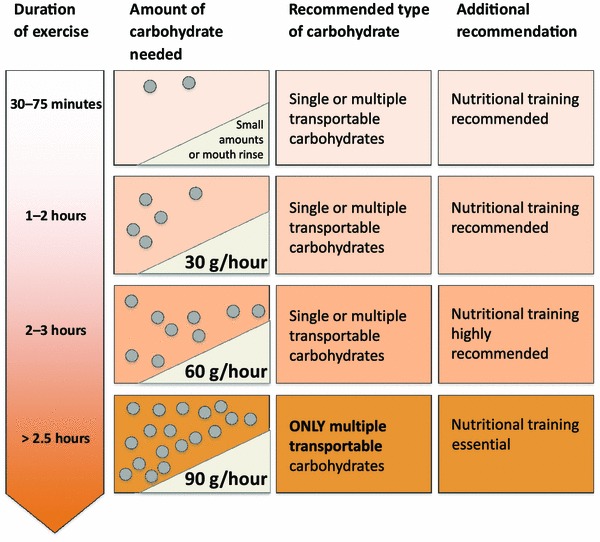
There have been significant changes in the understanding of the role of carbohydrates during endurance exercise in recent years, which allows for more specific and more personalized advice with regard to carbohydrate ingestion during exercise. The new proposed guidelines take into account the duration (and intensity) of exercise and advice is not restricted to the amount of carbohydrate; it also gives direction with respect to the type of carbohydrate. Studies have shown that during exercise lasting approximately 1 h in duration, a mouth rinse or small amounts of carbohydrate can result in a performance benefit. A single carbohydrate source can be oxidized at rates up to approximately 60 g/h and this is the recommendation for exercise that is more prolonged (2-3 h). For ultra-endurance events, the recommendation is higher at approximately 90 g/h. Carbohydrate ingested at such high ingestion rates must be a multiple transportable carbohydrates to allow high oxidation rates and prevent the accumulation of carbohydrate in the intestine. The source of the carbohydrate may be a liquid, semisolid, or solid, and the recommendations may need to be adjusted downward when the absolute exercise intensity is low and thus carbohydrate oxidation rates are also low. Carbohydrate intake advice is independent of body weight as well as training status. Therefore, although these guidelines apply to most athletes, they are highly dependent on the type and duration of activity. These new guidelines may replace the generic existing guidelines for carbohydrate intake during endurance exercise.
Overview
The claims and statistics of this paper haven’t been checked yet.
Run the check — free, no account needed. It reads the open-access text and checks the sources it cites.
Integrity signals
Registry
Cites
Statistics
Figures
Verification
Claims the paper makes
The claims and statistics of this paper haven’t been checked yet.
Run the check — free, no account needed. It reads the open-access text and checks the sources it cites.
Claims other papers make about this one
Each is checked against this paper’s own text: does it say what the citing paper says it does?
The source backs part of the claim, not all of it — or backs it for a different population, condition or comparison.
In the citing paper
“It is important to note, however, that ingestion of large amounts (>1.2 g/min) of a mixture of glucose (polymers) and fructose is likely to be only of practical relevance to highly trained athletes that are able to sustain high‐intensity exercise for a prolonged duration (i.e. > 2.5 h) (Jeukendrup, 2014).”
From Fructose co‐ingestion to increase carbohydrate availability in athletes (2019) · cites this paper as Jeukendrup, 2014
Experimental — accuracy not yet measuredThe source backs part of the claim, not all of it — or backs it for a different population, condition or comparison.
In the citing paper
“Early investigations of CHO ingestion during exercise concluded that maximal oxidation rates plateaued at 60 g/hr, even when larger amounts were ingested (120-180 g/hr; Jeukendrup, 2014).”
From Contemporary Nutrition Strategies to Optimize Performance in Distance Runners and Race Walkers (2019) · cites this paper as Jeukendrup, 2014
Experimental — accuracy not yet measuredThe source backs part of the claim, not all of it — or backs it for a different population, condition or comparison.
In the citing paper
“Besides greater total carbohydrate absorption and oxidation rates, glucose‐fructose mixtures also reduce the risk of gastrointestinal discomfort [68].”
From Carbohydrate Storage and Supplementation Strategies for Peak Performance in Cross-Country Skiing (2026) · cites this paper as [68]
Experimental — accuracy not yet measuredIn the citing paper
“Although the benefits of carbohydrate ingestion during exercise are generally recognized [38–41], carbohydrate supplementation during exercise may not have only positive effects.”
From Periodized Nutrition for Athletes (2017) · cites this paper as [39]
In the citing paper
“In longer events, it is clear that ingesting carbohydrates and increasing exogenous carbohydrate oxidation will result in improved endurance performance in most events [38–41, 68].”
From Periodized Nutrition for Athletes (2017) · cites this paper as [39]
In the citing paper
“Whereas it was generally accepted that exogenous CHO oxidation rates were thought to be limited at approximately 1 g/min due to saturation of intestinal glucose transporters, it is now known that exogenous CHO oxidation rates can increase to 1.8 g/min with the addition of sucrose or fructose to the CHO blend [38].”
From New strategies in sport nutrition to increase exercise performance (2016) · cites this paper as [38]
In the citing paper
“The limiting factor was subsequently found to be intestinal absorption, particularly the sodium-dependent glucose transporter, rather than gastric emptying, hepatic glucose extraction, muscle glucose uptake, or muscle glucose oxidation (Jeukendrup, 2014).”
From Contemporary Nutrition Strategies to Optimize Performance in Distance Runners and Race Walkers (2019) · cites this paper as Jeukendrup, 2014
Self-check
Percentages, sums and reported differences re-computed from the paper’s own numbers.
The self-check needs the paper’s full text.
Citations
Cites
ACSM Position Stand: Exercise and Fluid Replacement
Convertino, V. A., Armstrong, L. E., Coyle, E. F., Mack, G. W., Sawka, M. N., Senay, L. C., & Sherman, W. M. (1996) · Medicine & Science in Sports & Exercise · doi:10.1097/00005768-199610000-00045 · Cited by 1,977
The receptors and cells for mammalian taste
Chandrashekar, J. V., Hoon, M. A., Ryba, N. J. P., & Zuker, C. S. (2006) · Nature · doi:10.1038/nature05401 · Cited by 1,632
Exercise and Fluid Replacement
(2007) · Medicine & Science in Sports & Exercise · doi:10.1249/mss.0b013e31802ca597 · Cited by 1,497
Nutrition and Athletic Performance
(2009) · Medicine & Science in Sports & Exercise · doi:10.1249/mss.0b013e31890eb86 · Cited by 1,084 · cited 5×
“This is reflected in guidelines published by the ACSM, which recommend that athletes should take between 30 and 60 g of carbohydrate during endurance exercise (over 1 h) [30] or 0.7 g/kg per hour [6].”
BackgroundInfluentialThe effects of increasing exercise intensity on muscle fuel utilisation in humans
van Loon, L. J. C., Greenhaff, P. L., Constantin‐Teodosiu, D., Saris, W. H. M., & Wagenmakers, A. J. M. (2001) · The Journal of Physiology · doi:10.1111/j.1469-7793.2001.00295.x · Cited by 897
Carbohydrate sensing in the human mouth: effects on exercise performance and brain activity
Chambers, E. S., Bridge, M., & Jones, D. A. (2009) · The Journal of Physiology · doi:10.1113/jphysiol.2008.164285 · Cited by 625
Carbohydrate intake during exercise and performance
Jeukendrup, A. E. (2004) · Nutrition · doi:10.1016/j.nut.2004.04.017 · Cited by 490
Self-citationCarbohydrate feeding during prolonged strenuous exercise can delay fatigue
Coyle, E. F., Hagberg, J. M., Hurley, B. F., Martin, W. H., Ehsani, A. A., & Holloszy, J. O. (1983) · Journal of Applied Physiology · doi:10.1152/jappl.1983.55.1.230 · Cited by 487
Muscle Glycogen Synthesis after Exercise : an Enhancing Factor localized to the Muscle Cells in Man
BERGSTRÖM, J., & HULTMAN, E. (1966) · Nature · doi:10.1038/210309a0 · Cited by 473
The Relative Value of Fat and Carbohydrate as Sources of Muscular Energy
Krogh, A., & Lindhard, J. (1920) · Biochemical Journal · doi:10.1042/bj0140290 · Cited by 411
Cited by
Sorted by citations
Items 301–400 of 412
Fuentes-Barría, H., Aguilera-Eguía, R. A., González-Wong, C., Flores-Fernández, C., Herrera-Serna, B. Y., Pérez, D. I. V., & Urbano-Cerda, S. (2020) · Universidad y Salud · doi:10.22267/rus.202203.200 · Cited by 1
Hatta, S., Fujie, I., Togo, M., Shibata, K., Kimura, N., Takizawa, K., Kambayashi, I., & Yamaguchi, T. (2021) · 体力科學 · doi:10.7600/jspfsm.70.247 · Cited by 1
The effect of carbohydrate mouth rinse in isometric hand grip performance
Hirata, Y., Wadazumi, T., Hamada, N., Shirai, A., & Watanabe, H. (2021) · 体力科學 · doi:10.7600/jspfsm.70.269 · Cited by 1
Exercise-associated Muscle Cramps in Runners: A Review
Fattahi, A., Dehnavi, M., & Hamzeh, L. (2021) · Journal of Sport Biomechanics · doi:10.32598/biomechanics.7.2.1 · Cited by 1
Witkoś, J., & Hartman‐Petrycka, M. (2022) · Central European Journal of Sport Sciences and Medicine · doi:10.18276/cej.2022.3-03 · Cited by 1
Nutrition and athletic performance: implications of heart rate variability
Minnis, J. M. (2015) · K-State Research Exchange (Kansas State University) · Cited by 1
Use of Honey in Sports Medicine
Ooi, F. K., & Chen, C. K. (2023) · Wiley eBooks · doi:10.1002/9781119113324.ch19 · Cited by 1
STRATEGIES TO MANAGE POST- EXERCISE GLYCAEMIA IN TYPE 1 DIABETES
Campbell, M. D. (2014) · Northumbria Research Link (Northumbria University)
Almada, A. L., & Barr, D. (2015) · Springer eBooks · doi:10.1007/978-3-319-18230-8_14
Oral ketone supplementation: effect on cognitive function, physiology and exercise performance
Rodger, S. (2015) · Research Commons (University of Waikato)
Voedingsleer, vochtbalans en supplementen
Mensink, M. (2016) · Bohn Stafleu van Loghum eBooks · doi:10.1007/978-90-368-1099-9_3
The impact of adventure racing practice on anthropometry and energy balance of athletes
Sureira, T. M., Lopes, L. A., & Amâncio, O. M. S. (2017) · Sport Sciences for Health · doi:10.1007/s11332-017-0356-7
Hydration with maltodextrin vs. a regional beverage: effects on the performance of soccer players
Câmara, J. T. C., Ferreira, A. M. D. J., & Fayh, A. P. T. (2017) · Revista Brasileira de Medicina do Esporte · doi:10.1590/1517-869220172303159061
Energy Requirements and Body Composition of Professional Team-Sport Athletes
Walker, E. (2016) · Victoria University Research Repository (Victoria University)
Bagchi, D., Nair, S., & Sen, C. K. (2013) · Elsevier eBooks · doi:10.1016/b978-0-12-396454-0.00060-6
Topic 1. Carbohydrate, sports drinks and performance: strategies for Olympic sports
Jeukendrup, A. E., & Baker, L. B. (2015) · INSEP-Éditions eBooks · doi:10.4000/books.insep.1790 · Cited by 1
Self-citationResearch advances in metabolism 2017
Perakakis, N., Ghaly, W., Peradze, N., Boutari, C., Batırel, S., Douglas, V. P., & Mantzoros, C. S. (2018) · Metabolism · doi:10.1016/j.metabol.2018.01.018
Burgess, V., Bommarito, P., & António, J. (2019) · Internet Journal of Allied Health Sciences and Practice · doi:10.46743/1540-580x/2019.1763
Pugh, J. N. (2019) · Liverpool John Moores University · doi:10.24377/ljmu.t.00010815
The future of genetically based nutritional and pharmacological ergogenic aids in sport
Guest, N. S., García‐Bailo, B., Eny, K. M., Joffre, S., & El‐Sohemy, A. (2019) · Elsevier eBooks · doi:10.1016/b978-0-12-816193-7.00020-8
Voeding bij (recreatieve) sportbeoefening
van Geel, A., & Hermans, J. (2018) · Bohn Stafleu van Loghum eBooks · doi:10.1007/978-90-368-2111-7_1
Marthens, J. R. (2020) · DigitalCommons - CalPoly (California State Polytechnic University) · doi:10.15368/theses.2020.109
Peri-exercise nutrition: an innovative approach to dietary assessment in trained populations
Kozior, M. (2020) · Arrow@dit (Dublin Institute of Technology) · doi:10.34961/6072
Knechtle, B., & Nikolaidis, P. Τ. (2018) · Elsevier eBooks · doi:10.1016/b978-0-12-813922-6.00014-x
Pomportes, Hays, A., Gajdos, T., Brisswalter, J., & Davranche, K. (2021) · doi:10.31234/osf.io/wvteb
Mitchell, P. I. (2019) · White Rose eTheses Online (University of Leeds, The University of Sheffield, University of York)
Hofmann, H., & Schulz, T. (2021) · Elsevier eBooks · doi:10.1016/b978-3-437-23461-3.00025-0
Bukhari, A., As’ád, S., Taslim, N. A., Thaiyeb, M., Chrissander, I. Y., & Pramudyo, F. A. (2020) · doi:10.21203/rs.3.rs-40968/v1
Freschi, M., & Pollastri, L. (2020) · Springer eBooks · doi:10.1007/978-3-662-60752-7_60
Tomanić, M. (2016) · Medicinski podmladak · doi:10.5937/medpodm1602013t
Бадтиева, В. А., Юрьевич, Б. М., Vybornov, V. D., Rybakova, P. D., & Meshtel, A. V. (2022) · Medical alphabet · doi:10.33667/2078-5631-2022-16-84-89
Martínez‐Rodríguez, A., Nescolarde, L., Soler‐Bernad, M., & Roche, E. (2023) · American Journal of Human Biology · doi:10.1002/ajhb.23884
Novas perspetivas sobre o rácio de hidratos de carbono em indivíduos com Diabetes Tipo 2 no desporto
Novo, T. R. (2022) · Acta Portuguesa de Nutrição · doi:10.21011/apn.2022.3011
Effects of Osmolality of Rice Sports Drinks on Sports PerformancePreprint
Peepathum, P., Mitranun, W., Jirarattanarangsri, W., Surawang, S., Loakuldilok, T., Koonrungsesomboon, N., Braspaiboon, S., & Osiriphun, S. (2023) · Research Square · doi:10.21203/rs.3.rs-2819553/v1
Gobbi, N. (2023) · Digital Library of Theses and Dissertations (Universidade de São Paulo) · doi:10.11606/d.5.2023.tde-10052023-154006
Estratégias e recomendações nutricionais de carboidratos para performance esportiva
Almeida, L. R., Campbell, G. R., & Cruz, M. F. D. A. (2023) · Research Society and Development · doi:10.33448/rsd-v12i6.42253
Cahyo, F. D., Prasetyo, Y., Rismayanthi, C., & Delano, E. H. (2023) · Journal of Sports Science and Nutrition · doi:10.33545/27077012.2023.v4.i2a.179
Energy Balance and Nutrition in High Altitude
Deb, P., Bhattacharyya, P., & Pradhan, D. (2023) · Springer eBooks · doi:10.1007/978-3-031-35092-4_16
George, S. A., & Bhadran, S. (2023) · doi:10.22192/ttdls.2023.007
Value Added Products from Mushroom – Need for the Hour
Pallavi, E., & Sheeba, E. (2023) · doi:10.22192/ttdls.2023.001
Role of diet and Nutrition in Enhancing sporting performance
Vijayanand, D. S. (2023) · doi:10.22192/ttdls.2023.008
Phytochemicals and their Functional Aspects
Ramojwar, J. (2023) · doi:10.22192/ttdls.2023.005
Nano bio-pesticides in sustainable agriculture
Deepa, V. H., & Prakash, N., V (2023) · doi:10.22192/ttdls.2023.006
Deepa, V. H. (2023) · doi:10.22192/ttdls.2023.003
Application of Artificial Intelligence in Biochemistry
Inbavalli., K. (2023) · doi:10.22192/ttdls.2023.015
Ekanayake, A. K., Ekanayake, A. K., & Gupta, N. (2023) · doi:10.22192/ttdls.2023.009
Comparative Effect of Carbohydrate Overcompensation in Sprinters and MMA Fighters
Costa, G. T., & Aragão, G. F. (2020) · Journal of Sports and Games · doi:10.22259/2642-8466.0201002
Carbohydrate Ingestion in Racket Sports
DÜZ, S., & EKİN, H. (2023) · doi:10.59287/nfss.815
Effects of Honey Supplementation on Sports Performance among Recreational Runners
Wong, C. P. F., & Rahman, D. H. B. (2023) · Journal of Natural & Ayurvedic Medicine · doi:10.23880/jonam-16000426
Perspectivas nutricionales para atletas practicantes en deportes de resistencia
Sánchez, Y. D. V. (2019) · Caminos de Investigación · doi:10.59773/ci.v1i1.8
Herman, C., Heidner, G. S., Wentz, L. M., Shaver, A. A., & Murray, N. P. (2024) · Physiological Reports · doi:10.14814/phy2.15927
Safa, G., Hemmatinafar, M., Nemati, J., Imanian, B., & Suzuki, K. (2024) · Current Developments in Nutrition · doi:10.1016/j.cdnut.2024.103767
Luo, S., Zhang, J., Sun, J., Zhao, T. M., Deng, J., & Yang, H. (2024) · Advances in food and nutrition research · doi:10.1016/bs.afnr.2024.05.007
Does sex differ the relationship between macronutrients adequacy and aerobic power?
Ali, M. A., Handayani, O. W. K., Kurniawati, D. M., Dewi, L., Fibriana, F., Anggita, G. M., & Agustina, A. (2024) · The North African Journal of Food and Nutrition Research · doi:10.51745/najfnr.8.17.192-201
Endurance Sports and Its Related Nutritional Requirements
Ghosh, J., Chatterjee, S., & Shathi, M. A. (2024) · Advances in medical diagnosis, treatment, and care (AMDTC) book series · doi:10.4018/979-8-3693-6317-1.ch009 · Cited by 1
Spécificités nutritionnelles du cycliste
Maillot, J., & Bigard, X. A. (2022) · Elsevier eBooks · doi:10.1016/b978-2-294-77582-6.00005-7
Saftel, M. A., Leonte, N., Maftei, A., & Moanta, A. D. (2025) · Applied Sciences · doi:10.3390/app15031304
Individualized Nutrient Timing Assessment
Dasgupta, P., Maqsood, S., & Mohammadian, F. (2025) · Methods and protocols in food science · doi:10.1007/978-1-0716-4370-9_8
Umgang mit Nahrungsergänzung im Leistungssport
Osterkamp-Baerens, C. (2025) · Sportphysio · doi:10.1055/a-2522-4028
Kobayashi, M., Haruka, K. A. M. O., & SUZUKI, T. (2025) · Rinsho yakuri/Japanese Journal of Clinical Pharmacology and Therapeutics · doi:10.3999/jscpt.56.2_71
Balance in Dance: A Scoping ReviewPreprint
Fratnik, M. G., Jupp, I., Petsilas, P., Dunleavy, P., Banger, M. S., McGregor, A. H., & Abel, R. L. (2025) · medRxiv · doi:10.1101/2025.06.04.25328967
O impacto da suplementação de carboidratos no desempenho esportivo de atletas de corrida
Araujo, A. F. E., & Pereira, A. A. S. (2025) · Research Society and Development · doi:10.33448/rsd-v14i6.49078
Arefhosseini, S., Araminejad, M., Tutunchi, H., & Ebrahimi‐Mameghani, M. (2025) · BMC Research Notes · doi:10.1186/s13104-025-07347-4
Nutrition for Otolaryngologists
Pitman, K. T., & Martin, T. (2025) · Otolaryngologic Clinics of North America · doi:10.1016/j.otc.2025.08.001
Peeters, W. M., Baines, D., Billotto, N. K., Catterson, P., Hodges, D., Hearris, M. A., & Kasper, A. M. (2025) · Performance Nutrition · doi:10.1186/s44410-025-00015-5
The effects of carbohydrate and caffeine on self-paced intermittent exercise
Davidson, O. J. (2014) · ChesterRep (University of Chester)
Ko, J.-M., So, W.-Y., & Park, S.-E. (2025) · Science & Sports · doi:10.1016/j.scispo.2025.03.001
Kuo, M. J., Siu, F. P. L., Sze, J. W. H., Li, S. L. Y., Pun, T. K., Marqueta, P. M., Ülkar, B., & Gözübüyük, Ö. B. (2025) · Elsevier eBooks · doi:10.1016/b978-0-443-31638-8.00004-4
Body Mass Index and Optimizing Physical Activity Levels in Rehabilitation Patients
Nartea, R., & Gheorghievici, G. L. (2026) · IntechOpen eBooks · doi:10.5772/intechopen.1014055
Trinh, J., Edin, F., Andersson-Hall, U. K., & Pettersson, S. (2026) · Frontiers in Sports and Active Living · doi:10.3389/fspor.2026.1733702
Mauvieux, B., Mahon, E., Markov, A., Slamani, A., Fresneau, M., Berthou, A., Chevert, E. L., Pugh, J. N., & Edwards, B. (2026) · Nutrients · doi:10.3390/nu18071033
Tarrit, B., Moretton, C., Duclos, M., Metz, L., Chanséaume, E., Ennequin, G., Thivel, D., & RANNOU, F. (2026) · The Journal of Sports Medicine and Physical Fitness · doi:10.23736/s0022-4707.25.17488-4
Performance factors of prolonged running : a particular focus on running economy and fatigue
Pastor, F. S. (2021) · theses.fr (ABES) · doi:10.70675/5bde97d0zd2b5z4653z8a3ezfe2346031100
Li, P., Song, Q., & Xu, N. (2026) · Frontiers in Nutrition · doi:10.3389/fnut.2026.1774380
Sadek, Z., Karaki, H., Chiha, G., Yazbeck, S., Nabulsi, Z. A. A., Tzenios, N., Kibbe, F. A., Saeidi, A., Derassoyan, J., Khalil, Y. A., et al. (2026) · F1000Research · doi:10.12688/f1000research.178923.1
Dean, E., Osbrone, A., Subar, D. A., Hendrickse, P. W., & Gaffney, C. J. (2026) · Experimental Physiology · doi:10.1113/ep093858
Rahimi, V., & Jahromi, M. K. (2026) · Advances in Integrative Medicine · doi:10.1016/j.aimed.2026.100668
Jaén‐Carrillo, D., Bruce, C. D., Gobbo, C., Howe, C. A., & Lawley, J. S. (2026) · International Journal of Sports Physiology and Performance · doi:10.1123/ijspp.2025-0607 · Cited by 1
Plews, D. J., Booth, P. D., Krieger, T., & Maunder, E. (2026) · Sports Medicine · doi:10.1007/s40279-026-02462-z
Chmura, P., Nassis, G. P., Castagna, C., Mohr, M., Carling, C., Randers, M. B., Wei, X., Fahrenholtz, I. L., Oliva‐Lozano, J. M., Webb, J., et al. (2026) · Football Studies · doi:10.1016/j.footst.2026.100059
Martínez-Noguera, F. J., Alcaráz, P. E., Gomez‐Ezeiza, J., & Marín‐Pagán, C. (2026) · Frontiers in Nutrition · doi:10.3389/fnut.2026.1798548
Macrae, H. Z., Reynolds, K. M., Sellors, C., Wickham, P. E., Cable, T. G., Wallis, G. A., Goosey-Tolfrey, V. L., Funnell, M. P., Mears, S. A., & James, L. J. (2026) · Journal of Applied Physiology · doi:10.1152/japplphysiol.01192.2025
케냐 고지대 마라톤 훈련 시스템에 대한 질적 사례연구: 이텐·캅타갓의 케냐 코치·선수와 한국 엘리트 선수의 훈련 경험을 중심으로
유, 현., & 김, 종. (2026) · 한국체육학회지 · doi:10.23949/kjpe.2026.5.65.3.23
Hitting the Wall in Marathon Running: An Integrative Psychophysiological and Durability-Based Review
Grivas, G. V., Alkasasbeh, W. J., & Amawi, A. T. (2026) · Journal of Functional Morphology and Kinesiology · doi:10.3390/jfmk11030291
Potential Health Risks Associated with Sports Supplementation Use in Athletes
Cai, J., Wang, T., & Li, S. (2026) · Nutrients · doi:10.3390/nu18152490
Martínez‐Navarro, I., Mampel, J. V., López-Grueso, R., Collado‐Boira, E., & Hernando, C. (2026) · Journal of Sports Sciences · doi:10.1080/02640414.2026.2717034
Fruit Juices as a Valuable Ingredient in Isotonic Drinks
Wilczyńska, A., Rybowska, A., Newerli-Guz, J., & Palka, A. (2026) · Foods · doi:10.3390/foods15172988
Song, K.-T., Lee, H., Sung, J., Baek, J.-K., Park, S.-W., Hyun, K.-J., Jin, E.-H., Noh, K.-W., & Park, S. (2026) · Nutrients · doi:10.3390/nu18172855
Metadata
- Authors
- Jeukendrup, A.
- Affiliations
- Gatorade Sports Science Institute (US)
- Corresponding author
- Jeukendrup, Asker
- Venue
- Sports Medicine
- Published
- 2014-05
- Volume
- 44
- Issue
- S1
- Pages
- 25-33
- ISSN
- 0112-1642 (ISSN-L)
- 1179-2035
- PMC
- PMC4008807
- OpenAlex
- W2000960085
- Cited by
- 412
- References
- 66
- Citations by year
- 2026: 46 · 2025: 51 · 2024: 35 · 2023: 45 · 2022: 29 · 2021: 30 · 2020: 41 · 2019: 37 · 2018: 34 · 2017: 20 · 2016: 20 · 2015: 18 · 2014: 5
- FWCI
- 2.08
- Type
- journal article
- Language
- en
- Open access
- hybrid
- doi.org
- Locations
- Sports Medicine (publishedVersion, cc-by)
- Europe PMC (PubMed Central) (publishedVersion, cc-by)
- PubMed Central (publishedVersion, cc-by)
- PubMed (publishedVersion)
- Funders
- PepsiCo
- Gran Sasso Science Institute
- Topics
- Health Sciences › Nursing › Nutrition and Dietetics › Muscle metabolism and nutrition
- Health Sciences › Medicine › Orthopedics and Sports Medicine › Sports Performance and Training
- Health Sciences › Medicine › Physiology (medical) › Thermoregulation and physiological responses
- Keywords
- endurance exercise, mouthwash, exercise duration, exercise intensity
- MeSH terms
- Biomechanical Phenomena, Humans, Motor Skills, Movement, Pelvis, Thorax, Upper Extremity, Lower Extremity, Athletic Performance
About these checks
Registry, retraction, Cites and statistics results are computed, not judged, with one exception: a printed reference that no index lists is read once by a model before it counts as a citation error. Claims are extracted by a model and kept only when their quote appears verbatim in the text; each cited source is then checked, with a model’s help, for whether it says what the claim relies on. Those verdicts can be wrong — read the claim’s quote and the cited source before relying on one.
Statistics and arithmetic are recomputed, not judged.
Confidence bands are shown only for fields calibrated on our annotated test set. None is calibrated yet, so no band is shown.
What counts as a claim ›How we measure confidence ›How we check this ›
Are you an author, or do you see a problem with this page? Request a review
