

The DOI matches its Crossref record; 65 of the 66 references it cites were found in a registry or an index.
A Step Towards Personalized Sports Nutrition: Carbohydrate Intake During Exercise
Open accessAbstract
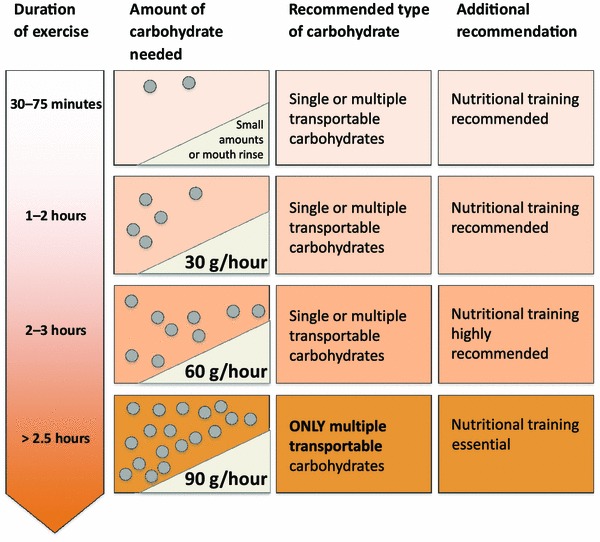
There have been significant changes in the understanding of the role of carbohydrates during endurance exercise in recent years, which allows for more specific and more personalized advice with regard to carbohydrate ingestion during exercise. The new proposed guidelines take into account the duration (and intensity) of exercise and advice is not restricted to the amount of carbohydrate; it also gives direction with respect to the type of carbohydrate. Studies have shown that during exercise lasting approximately 1 h in duration, a mouth rinse or small amounts of carbohydrate can result in a performance benefit. A single carbohydrate source can be oxidized at rates up to approximately 60 g/h and this is the recommendation for exercise that is more prolonged (2-3 h). For ultra-endurance events, the recommendation is higher at approximately 90 g/h. Carbohydrate ingested at such high ingestion rates must be a multiple transportable carbohydrates to allow high oxidation rates and prevent the accumulation of carbohydrate in the intestine. The source of the carbohydrate may be a liquid, semisolid, or solid, and the recommendations may need to be adjusted downward when the absolute exercise intensity is low and thus carbohydrate oxidation rates are also low. Carbohydrate intake advice is independent of body weight as well as training status. Therefore, although these guidelines apply to most athletes, they are highly dependent on the type and duration of activity. These new guidelines may replace the generic existing guidelines for carbohydrate intake during endurance exercise.
Overview
The claims and statistics of this paper haven’t been checked yet.
Run the check — free, no account needed. It reads the open-access text and checks the sources it cites.
Integrity signals
Registry
Cites
Statistics
Figures
Verification
Claims the paper makes
The claims and statistics of this paper haven’t been checked yet.
Run the check — free, no account needed. It reads the open-access text and checks the sources it cites.
Claims other papers make about this one
Each is checked against this paper’s own text: does it say what the citing paper says it does?
The source backs part of the claim, not all of it — or backs it for a different population, condition or comparison.
In the citing paper
“It is important to note, however, that ingestion of large amounts (>1.2 g/min) of a mixture of glucose (polymers) and fructose is likely to be only of practical relevance to highly trained athletes that are able to sustain high‐intensity exercise for a prolonged duration (i.e. > 2.5 h) (Jeukendrup, 2014).”
From Fructose co‐ingestion to increase carbohydrate availability in athletes (2019) · cites this paper as Jeukendrup, 2014
Experimental — accuracy not yet measuredThe source backs part of the claim, not all of it — or backs it for a different population, condition or comparison.
In the citing paper
“Besides greater total carbohydrate absorption and oxidation rates, glucose‐fructose mixtures also reduce the risk of gastrointestinal discomfort [68].”
From Carbohydrate Storage and Supplementation Strategies for Peak Performance in Cross-Country Skiing (2026) · cites this paper as [68]
Experimental — accuracy not yet measuredIn the citing paper
“Although the benefits of carbohydrate ingestion during exercise are generally recognized [38–41], carbohydrate supplementation during exercise may not have only positive effects.”
From Periodized Nutrition for Athletes (2017) · cites this paper as [39]
In the citing paper
“In longer events, it is clear that ingesting carbohydrates and increasing exogenous carbohydrate oxidation will result in improved endurance performance in most events [38–41, 68].”
From Periodized Nutrition for Athletes (2017) · cites this paper as [39]
In the citing paper
“Whereas it was generally accepted that exogenous CHO oxidation rates were thought to be limited at approximately 1 g/min due to saturation of intestinal glucose transporters, it is now known that exogenous CHO oxidation rates can increase to 1.8 g/min with the addition of sucrose or fructose to the CHO blend [38].”
From New strategies in sport nutrition to increase exercise performance (2016) · cites this paper as [38]
In the citing paper
“The limiting factor was subsequently found to be intestinal absorption, particularly the sodium-dependent glucose transporter, rather than gastric emptying, hepatic glucose extraction, muscle glucose uptake, or muscle glucose oxidation (Jeukendrup, 2014).”
From Contemporary Nutrition Strategies to Optimize Performance in Distance Runners and Race Walkers (2019) · cites this paper as Jeukendrup, 2014
In the citing paper
“Early investigations of CHO ingestion during exercise concluded that maximal oxidation rates plateaued at 60 g/hr, even when larger amounts were ingested (120-180 g/hr; Jeukendrup, 2014).”
From Contemporary Nutrition Strategies to Optimize Performance in Distance Runners and Race Walkers (2019) · cites this paper as Jeukendrup, 2014
Self-check
Percentages, sums and reported differences re-computed from the paper’s own numbers.
The self-check needs the paper’s full text.
Citations
Cites
ACSM Position Stand: Exercise and Fluid Replacement
Convertino, V. A., Armstrong, L. E., Coyle, E. F., Mack, G. W., Sawka, M. N., Senay, L. C., & Sherman, W. M. (1996) · Medicine & Science in Sports & Exercise · doi:10.1097/00005768-199610000-00045 · Cited by 1,977
The receptors and cells for mammalian taste
Chandrashekar, J. V., Hoon, M. A., Ryba, N. J. P., & Zuker, C. S. (2006) · Nature · doi:10.1038/nature05401 · Cited by 1,632
Exercise and Fluid Replacement
(2007) · Medicine & Science in Sports & Exercise · doi:10.1249/mss.0b013e31802ca597 · Cited by 1,497
Nutrition and Athletic Performance
(2009) · Medicine & Science in Sports & Exercise · doi:10.1249/mss.0b013e31890eb86 · Cited by 1,084 · cited 5×
“This is reflected in guidelines published by the ACSM, which recommend that athletes should take between 30 and 60 g of carbohydrate during endurance exercise (over 1 h) [30] or 0.7 g/kg per hour [6].”
BackgroundInfluentialThe effects of increasing exercise intensity on muscle fuel utilisation in humans
van Loon, L. J. C., Greenhaff, P. L., Constantin‐Teodosiu, D., Saris, W. H. M., & Wagenmakers, A. J. M. (2001) · The Journal of Physiology · doi:10.1111/j.1469-7793.2001.00295.x · Cited by 897
Carbohydrate sensing in the human mouth: effects on exercise performance and brain activity
Chambers, E. S., Bridge, M., & Jones, D. A. (2009) · The Journal of Physiology · doi:10.1113/jphysiol.2008.164285 · Cited by 625
Carbohydrate intake during exercise and performance
Jeukendrup, A. E. (2004) · Nutrition · doi:10.1016/j.nut.2004.04.017 · Cited by 490
Self-citationCarbohydrate feeding during prolonged strenuous exercise can delay fatigue
Coyle, E. F., Hagberg, J. M., Hurley, B. F., Martin, W. H., Ehsani, A. A., & Holloszy, J. O. (1983) · Journal of Applied Physiology · doi:10.1152/jappl.1983.55.1.230 · Cited by 487
Muscle Glycogen Synthesis after Exercise : an Enhancing Factor localized to the Muscle Cells in Man
BERGSTRÖM, J., & HULTMAN, E. (1966) · Nature · doi:10.1038/210309a0 · Cited by 473
The Relative Value of Fat and Carbohydrate as Sources of Muscular Energy
Krogh, A., & Lindhard, J. (1920) · Biochemical Journal · doi:10.1042/bj0140290 · Cited by 411
Cited by
Sorted by citations
Items 101–200 of 412
Hydration in the Pediatric Athlete — How to Guide Your Patients
Bergeron, M. F. (2015) · Current Sports Medicine Reports · doi:10.1249/jsr.0000000000000179 · Cited by 21
Everett, S. (2025) · Nutrients · doi:10.3390/nu17172792 · Cited by 36
Durability is improved by both low and high intensity endurance training
Matomäki, P., Heinonen, O. J., Nummela, A. T., Laukkanen, J. A., Auvinen, E.-P., Pirkola, L., & Kyröläinen, H. (2023) · Frontiers in Physiology · doi:10.3389/fphys.2023.1128111 · Cited by 19
Mattsson, S., JENDLE, J. H., & Adolfsson, P. (2019) · Frontiers in Endocrinology · doi:10.3389/fendo.2019.00571 · Cited by 19
Bradbury, K. E., Berryman, C. E., Wilson, M. A., Luippold, A. J., Kenefick, R. W., Young, A., & Pasiakos, S. M. (2020) · Journal of the International Society of Sports Nutrition · doi:10.1186/s12970-020-0335-2 · Cited by 21
Carbohydrate Mouth Rinse Improves Relative Mean Power During Multiple Sprint Performance
Simpson, G. W., PRITCHETT, R. C., O'Neal, E. K., Hoskins, G., & Pritchett, K. L. (2018) · International journal of exercise science · doi:10.70252/crpx1180 · Cited by 18
Scott, S. N., Christiansen, M. P., Fontana, F. Y., Stettler, C., Bracken, R. M., HAYES, C. A., Fisher, M., Bode, B. W., LAGROU, P. H., Southerland, P., et al. (2020) · Diabetes Care · doi:10.2337/dc19-2302 · Cited by 18
Perspective: Ketone Supplementation in Sports—Does It Work?
Valenzuela, P. L., Castillo‐García, A., Morales, J. S., & Lucía, A. (2020) · Advances in Nutrition · doi:10.1093/advances/nmaa130 · Cited by 20
Kinrade, E., & Galloway, S. D. R. (2021) · Frontiers in Physiology · doi:10.3389/fphys.2021.765888 · Cited by 18
Brauwers, B., Machado, F. V. C., Beijers, R. J. H. C. G., Spruit, M. A., & Franssen, F. M. E. (2023) · Nutrients · doi:10.3390/nu15245136 · Cited by 19
Effect of Carbohydrate Mouth Rinse on Resistance Exercise Performance
Green, M. S., Kimmel, C. S., Martin, T. D., Mouser, J. G., & Brune, M. P. (2020) · The Journal of Strength and Conditioning Research · doi:10.1519/jsc.0000000000003755 · Cited by 17
Potato ingestion is as effective as carbohydrate gels to support prolonged cycling performance
Salvador, A. F., McKenna, C. F., Alamilla, R. A., Cloud, R., Keeble, A. R., Miltko, A., Scaroni, S. E., Beals, J. W., ULANOV, A. V., Dilger, R. N., et al. (2019) · Journal of Applied Physiology · doi:10.1152/japplphysiol.00567.2019 · Cited by 19
Oliveira-Silva, I. G. R., Pinto, M. P., LEARSI, S. K., Lima‐Silva, A. E., de Araújo, G. G., & Ataide‐Silva, T. (2022) · Critical Reviews in Food Science and Nutrition · doi:10.1080/10408398.2022.2057417 · Cited by 16
Ferreira, A. M., Farias-Junior, L. F., Mota, T. A. A., Elsangedy, H. M., Marcadenti, A., Lemos, T. M. A. M., Okano, A. H., & Fayh, A. P. T. (2018) · Journal of the International Society of Sports Nutrition · doi:10.1186/s12970-018-0225-z · Cited by 15
Best, R., Crosby, S., BERGER, N. J. A., & McDonald, K. (2021) · Nutrients · doi:10.3390/nu13124309 · Cited by 16
Effectiveness of Nitrate Intake on Recovery from Exercise-Related Fatigue: A Systematic Review
Gamonales, J. M., Rojas‐Valverde, D., Muñoz-Jiménez, J., Serrano-Moreno, W., & Ibáñez, S. J. (2022) · International Journal of Environmental Research and Public Health · doi:10.3390/ijerph191912021 · Cited by 16
Are the Consumption Patterns of Sports Supplements Similar among Spanish Mountain Runners?
Jiménez-Alfageme, R., Rubio-Quintanilla, N., Romero-García, D., Sánchez-Oliver, A. J., Sospedra, I., & Sanz, J. M. M. (2023) · Nutrients · doi:10.3390/nu15020262 · Cited by 16
Changes in Pain and Nutritional Intake Modulate Ultra-Running Performance: A Case Report
Best, R., Barwick, B., Best, A., BERGER, N. J. A., Harrison, C., Wright, M., & Sparrow, J. (2018) · Sports · doi:10.3390/sports6040111 · Cited by 16
Karayigit, R., Forbes, S., Naderi, A., Candow, D., Yildirim, U., Akca, F., Aras, D., Yasli, B., Sisman, A., Mor, A., et al. (2021) · International Journal of Environmental Research and Public Health · doi:10.3390/ijerph18073463 · Cited by 15
Personalized Nutrition for the Enhancement of Elite Athletic Performance
Sutehall, S., & Pitsiladis, Y. P. (2025) · Scandinavian Journal of Medicine and Science in Sports · doi:10.1111/sms.70044 · Cited by 22
The effects of isomaltulose ingestion on gastric parameters and cycling performance in young men
Miyashita, M., Hamada, Y., Fujihira, K., Namura, S., Sakazaki, M., Miyasaka, K., & Nagai, Y. (2019) · Journal of Exercise Science & Fitness · doi:10.1016/j.jesf.2019.06.001 · Cited by 14
Personalized fluid and fuel intake for performance optimization in the heat
Cheuvront, S. N., & Kenefick, R. W. (2021) · Journal of science and medicine in sport · doi:10.1016/j.jsams.2021.01.004 · Cited by 15
Sampson, G., Morton, J. P., & Areta, J. L. (2023) · Journal of Nutritional Science · doi:10.1017/jns.2023.49 · Cited by 14
Trends and Technology Development in Life Science
Dr. Sheeba, E. (2023) · doi:10.22192/ttdls.2023 · Cited by 14
Immunotherapy: breakthrough in Cancer Treatment
Gopalakrishnan, R., & Thamaraiselvi, B. (2023) · doi:10.22192/ttdls.2023.010 · Cited by 14
Genetically Modified Organisms (GMOs): Balancing Benefits and Ethical Considerations
Deepa, V. H., & Pushp, P. (2023) · doi:10.22192/ttdls.2023.011 · Cited by 14
Penggalih, M. H. S. T., Sutanto, Y. S., Taslim, N. A., Syahputra, R. A., Hardinsyah, H., Tjandrawinata, R. R., & Nurkolis, F. (2025) · Frontiers in Nutrition · doi:10.3389/fnut.2025.1611440 · Cited by 15
Fat Oxidation Rates in Professional Soccer Players
RANDELL, R. K., CARTER, J. M., JEUKENDRUP, A. E., LIZARRAGA, M. A., YANGUAS, J. I., & ROLLO, I. (2019) · Medicine & Science in Sports & Exercise · doi:10.1249/mss.0000000000001973 · Cited by 14
Self-citationExertional heat stroke: nutritional considerations
LEE, J. K. W., Tan, B., Ogden, H. B., Chapman, S., & Sawka, M. N. (2022) · Experimental Physiology · doi:10.1113/ep090149 · Cited by 14
Baur, D., Vargas, F., Bach, C., Garvey, J., & Ormsbee, M. J. (2016) · Nutrients · doi:10.3390/nu8070392 · Cited by 15
Pomportes, L., & Brisswalter, J. (2020) · Science & Sports · doi:10.1016/j.scispo.2020.06.001 · Cited by 14
Caparello, G., Galluccio, A., Ceraudo, F., Pecorella, C., Buzzanca, F., Cuccomarino, F., Bonofiglio, D., & Avolio, E. (2023) · Applied Sciences · doi:10.3390/app13052794 · Cited by 17
Ramos‐Campo, D. J., Clemente‐Suárez, V. J., Cupeiro, R., Benítez‐Muñoz, J. A., Andreu‐Caravaca, L., & Rubio‐Arias, J. Á. (2023) · Critical Reviews in Food Science and Nutrition · doi:10.1080/10408398.2023.2233633 · Cited by 15
Paris, H. L. R., Sinai, E. C., Shei, R., Keller, A. M., & Mickleborough, T. D. (2020) · European Journal of Sport Science · doi:10.1080/17461391.2020.1842512 · Cited by 13
Beta‐alanine did not improve high‐intensity performance throughout simulated road cycling
Perim, P., Gobbi, N., Duarte, B., de Oliveira, L. F., Costa, L. A. R., Sale, C., Gualano, B., Dolan, E., & Saunders, B. (2021) · European Journal of Sport Science · doi:10.1080/17461391.2021.1940304 · Cited by 19
Agriculturist, R. N., & Raj, D. K. S. (2023) · doi:10.22192/ttdls.2023.004 · Cited by 13
Nutritional behaviour and beliefs of ski-mountaineers: a semi-quantitative and qualitative study
Praz, C., Granges, M., Burtin, C., & Kayser, B. (2015) · Journal of the International Society of Sports Nutrition · doi:10.1186/s12970-015-0108-5 · Cited by 13
Shirai, A., Wadazumi, T., Hirata, Y., Hamada, N., & Hongu, N. K. (2022) · Sports · doi:10.3390/sports10040051 · Cited by 13
Nutritional perspectives in female soccer: a scoping review
Martinho, D. V., Field, A., Naughton, R. J., Ribeiro, A. S., Rebelo, A., Gouveia, É. R., & Sarmento, H. (2024) · Journal of the International Society of Sports Nutrition · doi:10.1080/15502783.2024.2366427 · Cited by 14
Nutritional Strategies for Enhancing Performance and Training Adaptation in Weightlifters
Hwang, D.-J., & Yang, H.-J. (2024) · International Journal of Molecular Sciences · doi:10.3390/ijms26010240 · Cited by 18
The Diet Quality of Athletes as Measured by Diet Quality Indices: A Scoping Review
Dion, S., Walker, G., Lambert, K., Stefoska‐Needham, A., & Craddock, J. C. (2024) · Nutrients · doi:10.3390/nu17010089 · Cited by 13
Edwards, V. C., Myers, S., Wardle, S. L., Siddall, A. G., Powell, S. D., Needham‐Beck, S. C., Jackson, S., Greeves, J. P., & Blacker, S. D. (2022) · International Journal of Sport Nutrition and Exercise Metabolism · doi:10.1123/ijsnem.2021-0191 · Cited by 12
Barakat, C., Escalante, G., Stevenson, S. W., Bradshaw, J. T., Barsuhn, A., Tinsley, G. M., & Walters, J. (2022) · Sports · doi:10.3390/sports10070106 · Cited by 12
Pharmacokinetics of β-Alanine Using Different Dosing Strategies
Stautemas, J., Everaert, I., Lefevere, F. B. D., & Derave, W. (2018) · Frontiers in Nutrition · doi:10.3389/fnut.2018.00070 · Cited by 12
Physiological Responses and Nutritional Intake during a 7-Day Treadmill Running World Record
BERGER, N. J. A., Cooley, D., Graham, M., Harrison, C., & Best, R. (2020) · International Journal of Environmental Research and Public Health · doi:10.3390/ijerph17165962 · Cited by 12
Stocks, B., Betts, J. A., & McGawley, K. (2016) · Scandinavian Journal of Medicine & Science in Sports · doi:10.1111/sms.12544 · Cited by 11
Nutrition in CrossFit® – scientific evidence and practical perspectives: a systematic scoping review
Martinho, D. V., Rebelo, A., Clemente, F. M., Costa, R., Gouveia, É. R., Field, A., Casonatto, J., van den Hoek, D., Durkalec‐Michalski, K., Ormsbee, M. J., et al. (2025) · Journal of the International Society of Sports Nutrition · doi:10.1080/15502783.2025.2509674 · Cited by 16
Does Carbohydrate Intake During Endurance Running Improve Performance? A Critical Review
Wilson, P. B. (2016) · The Journal of Strength and Conditioning Research · doi:10.1519/jsc.0000000000001430 · Cited by 11
Glace, B. W., Kremenic, I. J., & McHugh, M. P. (2018) · Applied Physiology, Nutrition, and Metabolism · doi:10.1139/apnm-2017-0777 · Cited by 12
Peak Week Carbohydrate Manipulation Practices in Physique Athletes: A Narrative Review
Homer, K. A., Cross, M. R., & Helms, E. R. (2024) · Sports Medicine - Open · doi:10.1186/s40798-024-00674-z · Cited by 12
The challenge of regulating doping and non-doping ‘performance-enhancing strategies’ in elite sports
Goh, C. L. (2021) · The International Sports Law Journal · doi:10.1007/s40318-021-00183-1 · Cited by 11
Impact of Energy Turnover on the Regulation of Energy and Macronutrient Balance
Bosy‐Westphal, A., Hägele, F. A., & Müller, M. J. (2021) · Obesity · doi:10.1002/oby.23133 · Cited by 11
Artioli, G. G., Solis, M. Y., Tritto, A. C., & Franchini, É. (2018) · Elsevier eBooks · doi:10.1016/b978-0-12-813922-6.00009-6 · Cited by 12
Lukasiewicz, C. J., Waterman-Vandiver, K. J., Albert, E. D., Kirby, B. S., & Jacobs, R. A. (2023) · Journal of Applied Physiology · doi:10.1152/japplphysiol.00521.2023 · Cited by 14
Elghobashy, M. E., Richards, A. J., Malekzadeh, R., PATEL, D., Turner, L. V., Burr, J. F., Power, G. A., Laham, R., Riddell, M. C., & Cheng, A. J. (2024) · Medicine & Science in Sports & Exercise · doi:10.1249/mss.0000000000003440 · Cited by 12
Evidence-based sports supplements: A redox analysis
Margaritelis, N. V., Cobley, J. N., Nastos, G. G., Παπανικολάου, Κ., Bailey, S. J., Kritsiligkou, P., & Nikolaidis, M. G. (2024) · Free Radical Biology and Medicine · doi:10.1016/j.freeradbiomed.2024.08.012 · Cited by 10
Glycaemic Effects of a 156-km Ultra-trail Race in Athletes: An Observational Field Study
Parent, C., Mauvieux, B., Lespagnol, É., Hingrand, C., Vauthier, J., Noirez, P., Hurdiel, R., Martinet, Q., Delaunay, P., Besnard, S., et al. (2024) · Sports Medicine · doi:10.1007/s40279-024-02013-4 · Cited by 12
Ahmad, A., Jusoh, N. B., & Tengah, R. Y. (2018) · Physical Education of Students · doi:10.15561/20755279.2019.0201 · Cited by 13
Herrera-Olivares, A. M., Fernández-Luque, J. A., Paradas, C., Lucía, A., & Santalla, A. (2019) · Frontiers in Physiology · doi:10.3389/fphys.2019.00650 · Cited by 10
The Role of Nutrition in Maintaining the Health and Physical Condition of Sports Volunteers
Rozmiarek, M. (2024) · Nutrients · doi:10.3390/nu16193336 · Cited by 9
Wadley, A. J., Killer, S. C., Svendsen, I. S., & Gleeson, M. (2015) · European Journal of Applied Physiology · doi:10.1007/s00421-015-3162-4 · Cited by 9
Ferreira, A. M., Farias-Junior, L. F., Mota, T. A. A., Elsangedy, H. M., Marcadenti, A., Lemos, T. M. A. M., Okano, A. H., & Fayh, A. P. T. (2018) · Europe PMC (PubMed Central) · Cited by 9
Hamilton, R., McCarthy, O. M., Bain, S. C., & Bracken, R. M. (2024) · European Journal of Sport Science · doi:10.1002/ejsc.12201 · Cited by 9
Nutritional Recommendations for Athletes
Campbell, S. C., & Wisniewski, P. J. (2017) · Elsevier eBooks · doi:10.1016/b978-0-12-802928-2.00013-8 · Cited by 12
Sports Nutrition and Performance
Arcusa, R., Rentero, M. P. Z., & Hernández, J. M. (2019) · IntechOpen eBooks · doi:10.5772/intechopen.84467 · Cited by 12
Menzies, C., Wood, M., Thomas, J. E., Hengist, A., Walhin, J., Jones, R., Tsintzas, K., Gonzalez, J. T., & Betts, J. A. (2020) · International Journal of Sport Nutrition and Exercise Metabolism · doi:10.1123/ijsnem.2019-0291 · Cited by 9
Baldassarre, R., Ieno, C., Bonifazi, M., Castro, A. D., Gianfelici, A., & Piacentini, M. F. (2021) · European Journal of Sport Science · doi:10.1080/17461391.2021.1880644 · Cited by 12
Naderi, A., Samanipour, M. H., Sarshin, A., Forbes, S. C., Koozehchian, M., Franchini, É., Reale, R., Berjisian, E., de Oliveira, E. P., Miraftabi, H., et al. (2021) · Journal of the International Society of Sports Nutrition · doi:10.1186/s12970-021-00434-4 · Cited by 9
Nutrition habits in 24-hour mountain bike racers
Chlíbková, D., Knechtle, B., Rosemann, T. J., Tomášková, I., Chadim, V., & Shortall, M. (2014) · SpringerPlus · doi:10.1186/2193-1801-3-715 · Cited by 9
Finger, D., Lanferdini, F. J., Farinha, J. B., Brusco, C. M., Helal, L. C. A. S., Boeno, F. P., Cadore, E. L., & Pinto, R. S. (2018) · Applied Physiology, Nutrition, and Metabolism · doi:10.1139/apnm-2017-0835 · Cited by 10
Ishihara, K., Taniguchi, H., Akiyama, N., & Asami, Y. (2020) · Journal of Nutritional Science and Vitaminology · doi:10.3177/jnsv.66.128 · Cited by 9
Mlinaric, J., & Mohorko, N. (2025) · Journal of the International Society of Sports Nutrition · doi:10.1080/15502783.2025.2529910 · Cited by 11
Diet, Supplementation and Nutritional Habits of Climbers in High Mountain Conditions
Karpęcka-Gałka, E., Mazur-Kurach, P., Szyguła, Z., & Frączek, B. (2023) · Nutrients · doi:10.3390/nu15194219 · Cited by 12
Analysis of nutritional intake in trail runners during competition
Sanz, J. M. M., Jiménez-Alfageme, R., López, L. A., & Ayuso, J. M. (2020) · Nutrición Hospitalaria · doi:10.20960/nh.03388 · Cited by 10
Duan, R., Liu, Y., Zhang, Y., Shi, J., Xue, R., Liu, R., Miao, Y., Zhou, X., Lv, Y., Shen, H., et al. (2024) · Frontiers in Physiology · doi:10.3389/fphys.2024.1343219 · Cited by 8
Carbohydrate Ingestion on Exercise Metabolism and Physical Performance
Noakes, T. D., Prins, P., Buga, A., D'Agostino, D. P., Volek, J. S., & Koutnik, A. P. (2025) · Endocrine Reviews · doi:10.1210/endrev/bnaf038 · Cited by 11
Effects of the Timing of Carbohydrate Intake on Metabolism and Performance in Soccer Players
Noh, K.-W., Oh, J., & Park, S. (2023) · Nutrients · doi:10.3390/nu15163610 · Cited by 9
Improving Endurance Exercise Performance at High Altitude: Traditional and Nontraditional Approaches
Salgado, R. M., Ryan, B. J., Seeley, A. D., & Charkoudian, N. (2024) · Exercise and Sport Sciences Reviews · doi:10.1249/jes.0000000000000347 · Cited by 9
Vigh-Larsen, J. F., Kruse, D. Z., Moseholt, M. B., Hansen, L. G. B., Christensen, A. L., Bæk, A., Andersen, O. E., Mohr, M., & Overgaard, K. (2024) · Scandinavian Journal of Medicine and Science in Sports · doi:10.1111/sms.14731 · Cited by 7
Rossato, L. T., Fernandes, C. T. M., Vieira, P. F., de Branco, F. M. S., Nahas, P. C., Puga, G. M., & de Oliveira, E. P. (2019) · International Journal of Sports Physiology and Performance · doi:10.1123/ijspp.2018-0624 · Cited by 7
Muhamad, A. S., Puad, N. F. R. M., & Kuan, G. (2020) · Malaysian Journal of Medical Sciences · doi:10.21315/mjms2020.27.1.9 · Cited by 7
Nutritional Considerations for the Female Vegan Athlete
Schoenfeld, M. L. (2018) · Strength and conditioning journal · doi:10.1519/ssc.0000000000000405 · Cited by 7
McMahon, G. E., & Thornbury, A. (2020) · Nutrients · doi:10.3390/nu12082223 · Cited by 7
Yang, T., Shiu, Y.-J., Chen, C., Yu, S.-Y., Hsu, Y.-Y., & Chiu, C. (2024) · Nutrients · doi:10.3390/nu16081248 · Cited by 6
Scrivin, R., & Black, K. (2018) · Strength and conditioning journal · doi:10.1519/ssc.0000000000000394 · Cited by 6
Roca, E., Nescolarde, L., Brotons, D., Bayés‐Genís, A., & Roche, E. (2020) · Nutrition · doi:10.1016/j.nut.2020.110806 · Cited by 6
Effects of Isomaltulose Ingestion on Thermoregulatory Responses during Exercise in a Hot Environment
Otsuka, J., Okamoto, Y., Fujii, N., Enoki, Y., Maejima, D., Nishiyasu, T., & Amano, T. (2021) · International Journal of Environmental Research and Public Health · doi:10.3390/ijerph18115760 · Cited by 6
Health Benefits of (Poly)phenols from Cherries: A Review of Clinical Trials
Colletti, A., Cravotto, G., Meo, A. D., Pellizzato, M., Riccardi, E. L., & Marchetti, M. (2025) · Nutraceuticals · doi:10.3390/nutraceuticals5020012 · Cited by 5
Li, L., Fan, T., Luo, Z., Zhu, P., & Zhang, L. (2025) · Frontiers in Physiology · doi:10.3389/fphys.2025.1690121 · Cited by 5
Grivas, G. V. (2025) · European Journal of Applied Physiology · doi:10.1007/s00421-025-06085-6 · Cited by 6
Fan, C., Guo, R., Liu, J., Yang, J., Zhang, L., Cui, Y., & Wang, W. (2025) · Food Hydrocolloids for Health · doi:10.1016/j.fhfh.2025.100263 · Cited by 5
UCI Sports Nutrition Project: The Science of Successful Cycling Performance
Valenzuela, P. L., Leo, P. D., Mateo‐March, M., Gallo, G., Seiler, S., & Mujika, I. (2025) · International Journal of Sport Nutrition and Exercise Metabolism · doi:10.1123/ijsnem.2025-0157 · Cited by 8
Kelly, V. G., Oliver, L. S., Bowtell, J. L., & Jenkins, D. G. (2020) · International Journal of Sport Nutrition and Exercise Metabolism · doi:10.1123/ijsnem.2019-0321 · Cited by 5
Righetti, S., Medoro, A., Graziano, F., Mondazzi, L., Martegani, S., Chiappero, F., Casiraghi, E., Petroni, P., Corbi, G., Pina, R., et al. (2024) · Nutrients · doi:10.3390/nu16183078 · Cited by 7
DietScore™: Sports Nutrition-based Mobile Application for Athletes and Active Individuals
Safii, N. S., Rahman, A. H. A., Azimah, A., Izham, M., Othman, N. E., Chan, Y.-H., Pushpa, B. S., Poh, B. K., & Talib, R. A. (2017) · World Congress on Medical Physics and Biomedical Engineering, September 7 - 12, 2009, Munich, Germany · doi:10.1007/978-981-10-3737-5_1 · Cited by 5
Eating habits of young male long-distance runners
Gacek, M. K. (2017) · Medycyna Ogólna i Nauki o Zdrowiu · doi:10.5604/20834543.1235626 · Cited by 5
Energy Balance During a Self-Sufficient, Multistage Ultramarathon
Hough, P., & Earle, J. (2017) · Human performance in extreme environments · doi:10.7771/2327-2937.1103 · Cited by 5
Performance and physiological analysis of 500 km non-stop cycling: a case study
Valenzuela, P. L., Foster, C., Lucía, A., & de la Villa, P. (2018) · Research in Sports Medicine · doi:10.1080/15438627.2018.1431538 · Cited by 5
Consistency Is Key When Setting a New World Record for Running 10 Marathons in 10 Days
BERGER, N. J. A., Cooley, D., Graham, M., Harrison, C., Campbell, G., & Best, R. (2021) · International Journal of Environmental Research and Public Health · doi:10.3390/ijerph182212066 · Cited by 5
A Systematic Review of the Effects of Nutrient Intake in Handball Players on Exercise Performance
Mora-Fernández, A., López-Moro, A., Ríos, L. J. C., & Mariscal‐Arcas, M. (2022) · Applied Sciences · doi:10.3390/app122312378 · Cited by 10
Metadata
- Authors
- Jeukendrup, A.
- Affiliations
- Gatorade Sports Science Institute (US)
- Corresponding author
- Jeukendrup, Asker
- Venue
- Sports Medicine
- Published
- 2014-05
- Volume
- 44
- Issue
- S1
- Pages
- 25-33
- ISSN
- 0112-1642 (ISSN-L)
- 1179-2035
- PMC
- PMC4008807
- OpenAlex
- W2000960085
- Cited by
- 412
- References
- 66
- Citations by year
- 2026: 46 · 2025: 51 · 2024: 35 · 2023: 45 · 2022: 29 · 2021: 30 · 2020: 41 · 2019: 37 · 2018: 34 · 2017: 20 · 2016: 20 · 2015: 18 · 2014: 5
- FWCI
- 2.08
- Type
- journal article
- Language
- en
- Open access
- hybrid
- doi.org
- Locations
- Sports Medicine (publishedVersion, cc-by)
- Europe PMC (PubMed Central) (publishedVersion, cc-by)
- PubMed Central (publishedVersion, cc-by)
- PubMed (publishedVersion)
- Funders
- PepsiCo
- Gran Sasso Science Institute
- Topics
- Health Sciences › Nursing › Nutrition and Dietetics › Muscle metabolism and nutrition
- Health Sciences › Medicine › Orthopedics and Sports Medicine › Sports Performance and Training
- Health Sciences › Medicine › Physiology (medical) › Thermoregulation and physiological responses
- Keywords
- endurance exercise, mouthwash, exercise duration, exercise intensity
- MeSH terms
- Biomechanical Phenomena, Humans, Motor Skills, Movement, Pelvis, Thorax, Upper Extremity, Lower Extremity, Athletic Performance
About these checks
Registry, retraction, Cites and statistics results are computed, not judged, with one exception: a printed reference that no index lists is read once by a model before it counts as a citation error. Claims are extracted by a model and kept only when their quote appears verbatim in the text; each cited source is then checked, with a model’s help, for whether it says what the claim relies on. Those verdicts can be wrong — read the claim’s quote and the cited source before relying on one.
Statistics and arithmetic are recomputed, not judged.
Confidence bands are shown only for fields calibrated on our annotated test set. None is calibrated yet, so no band is shown.
What counts as a claim ›How we measure confidence ›How we check this ›
Are you an author, or do you see a problem with this page? Request a review
