

The DOI matches its Crossref record; 10 of the 10 references it cites were found in a registry or an index.
To behave or not (un)ethically? The meditative effect of mindfulness on statistics anxiety and academic dishonesty moderated by risk aversion
Abstract
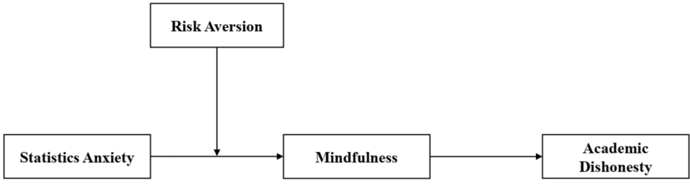
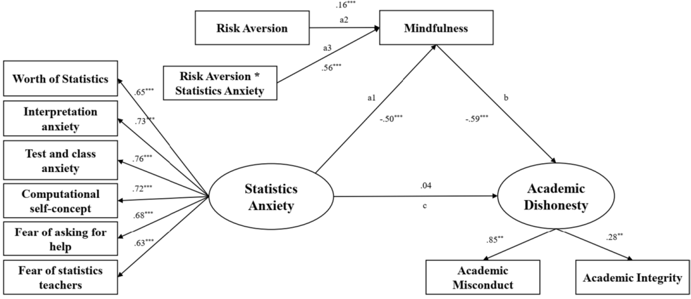
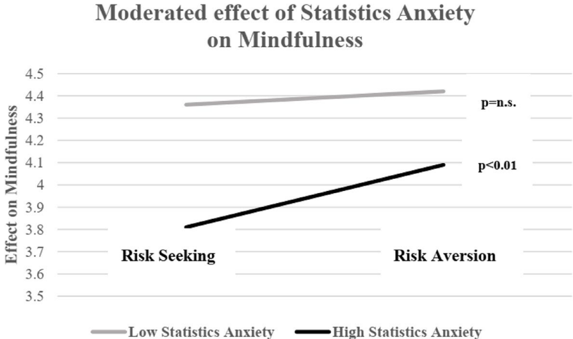
Despite the growing interest in mindfulness in higher education, the literature on its relation to decision-making under risk (i.e. academic misconduct) and statistics anxiety is scarce. The present research shall fill this gap. Based on the prospect theory, we assessed the mediating effect of mindfulness on the relationship between statistics anxiety and academic dishonesty moderated by risk aversion. Data were collected from 791 undergraduate students in six Israeli academic institutions studying for bachelor’s degrees in social sciences. Questionnaires included the following measures: risk behaviour according to the prospect theory framework, Mindful Attention Awareness Scale, Statistics Anxiety Rating Scale, Academic Misconduct Scale and sociodemographic variables. Correlations among these variables were explored. The data was analysed using Structural Equation Modelling (SEM). The results indicate that the variance in academic dishonesty is explained by students' statistics anxiety with a mediation of Mindfulness moderated by Risk Aversion. Mindfulness negatively affects Academic Dishonesty, while Risk Aversion has a significant positive effect on Mindfulness. Finally, among individuals with high statistics anxiety, Risk Averse individuals show significantly higher Mindfulness than Risk Seekers. We conclude that mindfulness-based interventions might be a constructive tool to reduce risk-taking and promote ethical decision-making among individuals who experience high levels of statistics anxiety. Furthermore, developing mindful skills may help individuals with higher anxiety levels neutralize these unwanted feelings and get along with their learning tasks. Hence, avoid academic unethical behaviours.
Overview
The claims and statistics of this paper haven’t been checked yet.
Run the check — free, no account needed. It reads the open-access text and checks the sources it cites.
Integrity signals
Registry
Cites
Statistics
Figures
Verification
Claims the paper makes
The claims and statistics of this paper haven’t been checked yet.
Run the check — free, no account needed. It reads the open-access text and checks the sources it cites.
Claims other papers make about this one
Each is checked against this paper’s own text: does it say what the citing paper says it does?
In the citing paper
“This finding is consistent with Eshet et al. (2024), who found that test anxiety does not have a direct effect on academic dishonesty”
From The Relationship between Academic Stress and Academic Integrity among University Students Moderated by Social Support (2026) · cites this paper as Eshet et al. (2024)
Self-check
Percentages, sums and reported differences re-computed from the paper’s own numbers.
The self-check needs the paper’s full text.
Citations
Cites
Prospect Theory: An Analysis of Decision under Risk
Kahneman, D., & Tversky, A. (1979) · Econometrica · doi:10.2307/1914185 · Cited by 48,524
Prospect Theory: An Analysis of Decision Under Risk
Kahneman, D., & Tversky, A. (2013) · World Scientific Handbook in Financial Economics Series · doi:10.1142/9789814417358_0006 · Cited by 3,091
Effects of mindfulness on psychological health: A review of empirical studies
Keng, S.-L., Smoski, M. J., & Robins, C. J. (2011) · Clinical Psychology Review · doi:10.1016/j.cpr.2011.04.006 · Cited by 2,687 · cited 1×
“Mindfulness elements, such as awareness and nonjudgmental acceptance of one’s moment-to-moment experience, are considered potential antidotes to common psychological distress, such as anxiety (Keng et al. 2011).”
Plagiarism in Higher Education: Tackling Tough Topics in Academic Integrity
Eaton, S. E. (2021) · doi:10.5040/9798400697142 · Cited by 199
Amanvermez, Y., Zhao, R., Cuijpers, P., de Wit, L. M., Ebert, D. D., Kessler, R. C., Bruffaerts, R., & Karyotaki, E. (2022) · Internet Interventions · doi:10.1016/j.invent.2022.100503 · Cited by 110 · cited 1×
“Higher education students face several sources of stress (Amanvermez et al. 2022), like statistics anxiety.”
Honor Codes and Academic Integrity: Three Decades of Research
Tatum, H. E. (2022) · Journal of College and Character · doi:10.1080/2194587x.2021.2017977 · Cited by 63
Personality, intelligence, and counterproductive academic behaviors: A meta-analysis
Cuadrado, D., Salgado, J. F., & Moscoso, S. (2021) · Journal of Personality and Social Psychology · doi:10.1037/pspp0000285 · Cited by 63
Hadash, Y., Ruimi, L., & Bernstein, A. (2021) · doi:10.31231/osf.io/dwzcj · Cited by 23
Hadash, Y., Ruimi, L., & Bernstein, A. (2023) · Psychological Assessment · doi:10.1037/pas0001194 · Cited by 23
Math anxiety, self-centeredness, and dispositional mindfulness.
David, A., Rubinsten, O., & Berkovich-Ohana, A. (2022) · Journal of Educational Psychology · doi:10.1037/edu0000550 · Cited by 13 · cited 1×
“Therefore, based on the current research results, we recommend implementing mindfulness training in academic institutions to reduce students’ anxieties (David et al. 2022), specifically in compulsory statistics courses.”
Research works printed but not linked: 92
- Aksen, D. E., Sleight, F. G., & Lynn, S. J. (2023). Mindfulness intervention for impulsivity as a stand-alone treatment: A qualitative review of emerging evidence. Psychology of Consciousness: Theory, Research, and Practice. https://doi.org/10.1037/cns0000367 · DOI
- Alem Y, Behrendt H, Belot M, Bíró A (2021) Mind training, stress and behaviour—A randomised experiment. PLoS ONE 16(11):e0258172. https://doi.org/10.1371/journal.pone.0258172 · DOI
- Aumeboonsuke V, Caplanova A (2021) An analysis of impact of personality traits and mindfulness on risk aversion of individual investors. Curr Psychol 42(8):1–18. https://doi.org/10.1007/s12144-021-02015-9 · DOI
- Avcu Meriç I, Sönmez MB (2022) Decision-making, interoceptive awareness and mindful attention awareness in male patients with alcohol use disorder. Cogn Neuropsychiatry 27(1):35–48. https://doi.org/10.1080/13546805.2021.2011183 · DOI
- Baltruschat S, Mas-Cuesta L, Cándido A, Maldonado A, Verdejo-Lucas C, Catena-Verdejo E, Catena A (2021) Repeat traffic offenders improve their performance in risky driving situations and have fewer accidents following a mindfulness-based intervention. Front Psychol 11:4012–4012. https://doi.org/10.3389/FPSYG.2020.567278/BIBTEX · DOI
- Birks M, Mills J, Allen S, Tee S (2020) Managing the mutations: Academic misconduct Australia, New Zealand, and the UK. Int J Educ Integr 16(6):1–15. https://doi.org/10.1007/s40979-020-00055-5 · DOI
- Blais A-R, Weber EU (2006) A domain-specific risk-taking (DOSPERT) scale for adult populations. Judgm Decis Mak 1(1):33–47. https://doi.org/10.1017/S1930297500000334 · DOI · Paper page
- Bolin AU (2004) Self-control, perceived opportunity, and attitudes as predictors of academic dishonesty. J Psychol 138(2):101–114. https://doi.org/10.3200/JRLP.138.2.101-114 · DOI · Paper page
- Brown KW, Ryan RM (2003a) The benefits of being present: Mindfulness and its role in psychological well-being. J Pers Soc Psychol 84(4):822–822. https://doi.org/10.1037/0022-3514.84.4.822 · DOI · Paper page
- Brown KW, Ryan RM (2003b) Mindful attention awareness scale. J Pers Soc Psychol · DOI · Paper page
- Browning M, Behrens TE, Jocham G, O’Reilly JX, Bishop SJ (2015) Anxious individuals have difficulty learning the causal statistics of aversive environments. Nat Neurosci 18(4):590–596. https://doi.org/10.1038/nn.3961 · DOI · Paper page
- Cruise, R. J., Cash, R. W., & Bolton, D. L. (1985). Development and validation of an instrument to measure statistical anxiety. American Statistical Association Proceedings of the Section on Statistical Education,
- Cuadrado D, Salgado JF, Moscoso S (2019) Prevalence and correlates of academic dishonesty: Towards a sustainable university. Sustainability 11(21):6062–6062. https://doi.org/10.3390/su11216062 · DOI · Paper page
- Cui S, Zhang J, Guan D, Zhao X, Si J (2019) Antecedents of statistics anxiety: An integrated account. Personality Individ Differ 144:79–87. https://doi.org/10.1016/j.paid.2019.02.036 · DOI
- Culiberg B, Mihelič KK (2020) The impact of mindfulness and perceived importance of peer reporting on students’ response to peers’ academic dishonesty. Ethics Behav 30(5):385–399. https://doi.org/10.1080/10508422.2019.1628644 · DOI
- Dark-Freudeman A, Jones C, Terry C (2022) Mindfulness, anxiety, and perceived stress in university students: Comparing a mindfulness-based intervention (MBI) against active and traditional control conditions. J Am Coll Health 70(7):2116–2125. https://doi.org/10.1080/07448481.2020.1845180 · DOI
- Dawson G (2021) Zen and the mindfulness industry. The Humanistic Psychologist 49(1):133–146. https://doi.org/10.1037/hum000017 · DOI
- De Maio C, Dixon K (2022) Promoting academic integrity in institutions of higher learning: What 30 years of research (1990–2020) in Australasia has taught us. Journal of College and Character 23(1):6–20. https://doi.org/10.1080/2194587X.2021.2017972 · DOI
- DeVaney TA (2016) Confirmatory factor analysis of the statistical anxiety rating scale with online graduate students. Psychol Rep 118(2):565–586. https://doi.org/10.1177/0033294116644093 · DOI
- Draper M, Lancaster T, Dann S, Crockett R, Glendinning I (2021) Essay mills and other contract cheating services: to buy or not to buy and the consequences of students changing their minds. Int J Educ Integr 17(1):13. https://doi.org/10.1007/s40979-021-00081-x · DOI
- Du W, Yu H, Liu X, Zhou X (2023) Mindfulness training reduces slippery slope effects in moral decision-making and moral judgment. Sci Rep 13(1):2967. https://doi.org/10.1038/s41598-023-29614-9 · DOI
- Eaton SE (2023) Postplagiarism: transdisciplinary ethics and integrity in the age of artificial intelligence and neurotechnology. Int J Educ Integr 19(1):23. https://doi.org/10.1007/s40979-023-00144-1 · DOI · Paper page
- Eidman, L., Rodriguez de Behrends, M., & Seif, G. (2022). Psychometric properties of the Mindful Attention Awareness Scale (MAAS) in Argentine university students. Ciencias Psicológicas, 16(1), 1–14. https://doi.org/10.22235/cp.v16i1.2560 · DOI
- Eltayeb, F. (2021). Mindfulness and its relation to academic procrastination among university students. Universal Journal of Educational Research, 9(5), 917–927. https://doi.org/10.13189/ujer.2021.090504 · DOI
- Ergas, O., & Hadar, L. L. (2021). Does mindfulness belong in higher education? An eight year research of students’ experiences. Pedagogy, Culture & Society, 1–19. https://doi.org/10.1080/14681366.2021.1906307 · DOI
- Eshet Y, Steinberger P, Grinautsky K (2022) Does statistics anxiety impact academic dishonesty? Academic challenges in the age of distance learning. Int J Educ Integr 18(1):1–19. https://doi.org/10.1007/s40979-022-00117-w · DOI
- Eshet Y, Dickman N, Ben Zion Y (2023) Academic integrity in the HyFlex learning environment. Heliyon 9(2):e13301. https://doi.org/10.1016/j.heliyon.2023.e13301 · DOI
- Eshet, Y., & Margaliot, A. (2022). Does creative thinking contribute to the academic integrity of education students? Frontiers in Psychology, 4709–4709. https://doi.org/10.3389/FPSYG.2022.925195 · DOI
- Eshet, Y., Steinberger, P., & Grinautsky, K. (2021). Relationship between statistics anxiety and academic dishonesty: A comparison between learning environments in social sciences. Sustainability, 13(3), 1–18–18. https://doi.org/10.3390/su13031564 · DOI
- Feruglio S, Panasiti MS, Crescentini C, Aglioti SM, Ponsi G (2022) The impact of mindfulness meditation on social and moral behavior: Does mindfulness enhance other-oriented motivation or decrease monetary reward salience? Front Integr Neurosci 16:963422. https://doi.org/10.3389/fnint.2022.963422 · DOI
- Galles J, Lenz J, Peterson GW, Sampson JP Jr (2019) Mindfulness and decision-making style: Predicting career thoughts and vocational identity. The Career Development Quarterly 67(1):77–91. https://doi.org/10.1002/cdq.12164 · DOI
- Gonçalves AP, Donate M, E. C. d., Bedendo, A., Félix Júnior, I., Gallo, G. G., & Opaleye, E. S. (2023) The effect of mindfulness on decision-making, inhibitory control, and impulsivity of substance use disorder in-treatment patients: A randomized clinical trial. PLoS ONE 18(11):e0293502–e0293502. https://doi.org/10.1371/journal.pone.0293502 · DOI
- González-Blanch C, Medrano LA, O'Sullivan S, Bell I, Nicholas J, Chambers R, ... Alvarez-Jimenez M (2022) Psychometric properties of the Mindful Attention Awareness Scale (MAAS) in a first-episode psychosis sample. Psychol Assess 34(2):188 · DOI
- Götmann, A., Bechtoldt, M. N., & Fetchenhauer, D. (2021). Breathing to the path of virtue - The effects of justice sensitivity and state mindfulness on cheating behavior in a group performance task. Personality and Individual Differences, 178(March). https://doi.org/10.1016/j.paid.2021.110851 · DOI
- Hartley CA, Phelps EA (2012) Anxiety and decision-making. Biol Psychiat 72(2):113–118. https://doi.org/10.1016/j.biopsych.2011.12.027 · DOI
- Hasty LM, Malanchini M, Shakeshaft N, Schofield K, Malanchini M, Wang Z (2021) When anxiety becomes my propeller: Mental toughness moderates the relation between academic anxiety and academic avoidance. Br J Educ Psychol 91(1):368–390. https://doi.org/10.1111/BJEP.12366 · DOI
- Hirshberg MJ, Colaianne BA, Greenberg MT, Inkelas KK, Davidson RJ, Germano D, Dunne JD, Roeser RW (2022) Can the academic and experiential study of flourishing improve flourishing in college students? A Multi-University Study Mindfulness 13(9):2243–2256. https://doi.org/10.1007/s12671-022-01952-1 · DOI · Paper page
- Hu L, t., & Bentler, P. M. (1999) Cutoff criteria for fit indexes in covariance structure analysis: Conventional criteria versus new alternatives. Struct Equ Model 6(1):1–55. https://doi.org/10.1080/10705519909540118 · DOI · Paper page
- Hughes JC, Eaton SE (2022) Academic misconduct in Higher Education: Beyond student cheating. In: Eaton SE, Hughes C (eds) Academic Integrity in Canada. Springer, pp 81–102 · DOI
- Irwin A, Sedlar N, Hamlet O (2020) Flying solo: A vignette-based examination of general aviation pilot risk perception and decision-making. Aviation Psychology and Applied Human Factors 10(2):59–69. https://doi.org/10.1027/2192-0923/a000189 · DOI
- Isbel B, Stefanidis K, Summers MJ (2020) Assessing mindfulness: Experimental support for the discriminant validity of breath counting as a measure of mindfulness but not self-report questionnaires. Psychol Assess 32(12):1184. https://doi.org/10.1037/pas0000957 · DOI
- Jankowski T, Bąk W (2019) Mindfulness as a mediator of the relationship between trait anxiety, attentional control and cognitive failures. A multimodel inference approach. Personality Individ Differ 142:62–71. https://doi.org/10.1016/J.PAID.2019.01.034 · DOI
- Karl JA, Fischer R (2022) The state of dispositional mindfulness research. Mindfulness 13(6):1357–1372. https://doi.org/10.1007/S12671-022-01853-3/TABLES/7 · DOI
- Kaufmann L, Ninaus M, Weiss EM, Gruber W, Wood G (2022). Self-Efficacy Matters: Influence of Students’ Perceived Self-Efficacy on Statistics Anxiety. https://doi.org/10.1111/nyas.14797 · DOI
- Kisamore JL, Stone TH, Jawahar IM (2007) Academic integrity: The relationship between individual and situational factors on misconduct contemplations. J Bus Ethics 75(4):381–394. https://doi.org/10.1007/s10551-006-9260-9 · DOI
- Kline, R. B. (2023). Principles and practice of structural equation modeling (Fifth edition ed.). Guilford New York, NY. https://search.ebscohost.com/login.aspx?direct=true&scope=site&db=nlebk&db=nlabk&AN=3591678
- Krou MR, Fong CJ, Hoff MA (2021) Achievement motivation and academic dishonesty: A meta-analytic investigation. Educ Psychol Rev 33:427–458. https://doi.org/10.1007/s10648-020-09557-7 · DOI
- Kurdoglu RS, Ates NY, Lerner DA (2023) Decision-making under extreme uncertainty: Eristic rather than heuristic. Int J Entrep Behav Res 29(3):763–782. https://doi.org/10.1108/IJEBR-07-2022-0587 · DOI
- Kuroda Y, Yamakawa O, Ito M (2022) Benefits of mindfulness in academic settings: Trait mindfulness has incremental validity over motivational factors in predicting academic affect, cognition, and behavior. BMC Psychology 10(1):1–14. https://doi.org/10.1186/S40359-022-00746-3/TABLES/2 · DOI
- Lau P (2021) A case study on research postgraduate students’ understanding of academic integrity at a Hong Kong University. Frontiers in Education 6:107–107. https://doi.org/10.3389/FEDUC.2021.647626/XML/NLM · DOI
- Lee SD, Kuncel NR, Gau J (2020) Personality, attitude, and demographic correlates of Academic Dishonesty: A meta-analysis. Psychol Bull 146(11):1042–1058. https://doi.org/10.1037/bul0000300 · DOI
- Lejuez CW, Richards JB, Read JP, Kahler CW, Ramsey SE, Stuart GL, Strong DR, Brown RA (2002) Evaluation of a behavioral measure of risk taking: The Balloon Analogue Risk Task (BART). J Exp Psychol Appl 8(2):75–75. https://doi.org/10.1037/1076-898X.8.2.75 · DOI · Paper page
- Lesser, L. M. (2017). Finding center: Towards increasing clarity and reducing anxiety in statistics class. Journal for the Liberal Arts and Sciences, 22(1), 42–58. https://www.oak.edu/wp-content/uploads/2021/06/jlas-v22-i1_0.pdf#page=42
- Levpušček, M. P., & Cukon, M. (2020). That old devil called ‘Statistics’: Statistics Anxiety in University Students and related factors. Center for Educational Policy Studies Journal. https://doi.org/10.26529/cepsj.826 · DOI
- Levy, J. S. (1992). An introduction to prospect theory. Political Psychology, 13(2), 171–186. https://www.jstor.org/stable/3791677 · DOI
- Luhmann CC, Ishida K, Hajcak G (2011) Intolerance of uncertainty and decisions about delayed, probabilistic rewards. Behav Ther 42(3):378–386. https://doi.org/10.1016/j.beth.2010.09.002 · DOI
- McCleskey, J., & Gruda, D. (2021). Risk-taking, resilience, and state anxiety during the COVID-19 pandemic: A coming of (old) age story. Personality and Individual Differences, 170, 110485. https://doi.org/10.1016/j.paid.2020.110485 · DOI
- Morgan, W. J., & Katz, J. (2021). Mindfulness meditation and foreign language classroom anxiety: Findings from a randomized control trial. Foreign Language Annals, 54(2), 389–409. https://doi.org/10.1111/flan.12525 · DOI
- O’Bryant M, Natesan Batley P, Onwuegbuzie AJ (2021) Validation of an adapted version of the Statistical Anxiety Scale in English and its relationship to attitudes toward statistics. SAGE Open 11:1–15. https://doi.org/10.1177/21582440211001378 · DOI
- Onwuegbuzie AJ, Da Ros D, Ryan JM (1997) The components of statistics anxiety: A phenomenological study. Focus Learn Probl Math 19(4):11–35
- Orazi DC, Chen J, Chan EY (2021) To erect temples to virtue: Effects of state mindfulness on other-focused ethical behaviors. J Bus Ethics 169(4):785–798. https://doi.org/10.1007/s10551-019-04296-4 · DOI
- Ozoliņa, R., & Bēriņa, L. H. (2021). Academic integrity in Latvia’s higher education institutions. SSE Riga Student Research Papers, 6(238), 1–55. https://www.sseriga.edu/sites/default/files/2021-05/6Paper_Ozolina_Berina.pdf
- Pan, M., Stiles, B. L., Tempelmeyer, T. C., & Wong, N. (2019). A cross-cultural exploration of academic dishonesty: Current challenges, preventive measures, and future directions. In Prevention and Detection of Academic Misconduct in Higher Education (pp. 63–82). IGI Global. · DOI
- Parsons D, Gardner P, Parry S, Smart S (2022) Mindfulness-based approaches for managing stress, anxiety and depression for Health students in Tertiary Education: A scoping review. Mindfulness 13:1–16. https://doi.org/10.1007/s12671-021-01740-3 · DOI
- Paruzel-Czachura M, Kocur D (2023) Do meditation, mindfulness, and self-compassion impact utilitarian moral judgment? Mindfulness. https://doi.org/10.1007/s12671-023-02161-0 · DOI
- Peled, Y., Eshet, Y., Barczyk, C., & Grinautski, K. (2019). Predictors of academic dishonesty among undergraduate students in online and face-to-face courses. Computers & Education, 131, 49–59. https://doi.org/10.1016/j.compedu.2018.05.012 · DOI
- Poitras Pratt, Y., & Gladue, K. (2022). Re-defining academic integrity: Embracing indigenous truths. In Academic Integrity in Canada (pp. 103–123). Springer. · DOI
- Prietzel TT (2020) The effect of emotion on risky decision making in the context of prospect theory: a comprehensive literature review. Management Review Quarterly 70(3):313–353. https://doi.org/10.1007/S11301-019-00169-2/TABLES/7 · DOI
- Reangsing C, Trakooltorwong P, Maneekunwong K, Thepsaw J, Oerther S (2023) Effects of online mindfulness-based interventions (MBIs) on anxiety symptoms in adults: a systematic review and meta-analysis. BMC Complementary Medicine and Therapies 23(1):269. https://doi.org/10.1186/s12906-023-04102-9 · DOI
- Reynolds SJ, Eliseo M, Watkins TS, Mariam M (2023) Mindful but forgetful: The negative effect of trait mindfulness on memories of immoral behavior. Bus Soc Rev. https://doi.org/10.1111/basr.12328 · DOI
- Ruggeri, K., Alí, S., Berge, M. L., Bertoldo, G., Bjørndal, L. D., Cortijos-Bernabeu, A., Davison, C., Demić, E., Esteban-Serna, C., Friedemann, M., Gibson, S. P., Jarke, H., Karakasheva, R., Khorrami, P. R., Kveder, J., Andersen, T. L., Lofthus, I. S., McGill, L., Nieto, A. E., . . . Folke, T. (2020). Replicating patterns of prospect theory for decision under risk. Nature Human Behaviour, 4(6), 622–633. https://doi.org/10.1038/s41562-020-0886-x · DOI
- Salgado, J. F., Cuadrado, D., & Moscoso, S. (2022). Counterproductive academic behaviors and academic performance: A meta-analysis and a path analysis model. Frontiers in Psychology, 0, 3029–3029. https://doi.org/10.3389/FPSYG.2022.893775 · DOI
- Sefcik L, Striepe M, Yorke J (2020) Mapping the landscape of academic integrity education programs: What approaches are effective? Assess Eval High Educ 45(1):30–43. https://doi.org/10.1080/02602938.2019.1604942 · DOI
- Shou Y, Olney, & Joel. (2022) Measuring risk tolerance across domains: Scale development and validation. J Pers Assess 104(4):484–495. https://doi.org/10.1080/00223891.2021.1966019 · DOI
- Siegrist M, Árvai J (2020) Risk Perception: Reflections on 40 Years of Research. Risk Anal 40(S1):2191–2206. https://doi.org/10.1111/risa.13599 · DOI
- Siew CSQ, McCartney MJ, Vitevitch MS (2019) Using network science to understand statistics anxiety among college students. Scholarsh Teach Learn Psychol 5(1):75–89. https://doi.org/10.1037/stl0000133 · DOI
- Smit B, Stavrulaki E (2021) The efficacy of a mindfulness-based intervention for college students under extremely stressful conditions. Mindfulness 12(12):3086–3100. https://doi.org/10.1007/s12671-021-01772-9 · DOI
- Smith R, Persich MR, Chuning AE, Cloonan S, Woods-Lubert R, Skalamera J, Berryhill SM, Weihs KL, Lane RD, Allen JJB, Dailey NS, Alkozei A, Vanuk JR, Killgore WDS (2023) Improvements in mindfulness, interoceptive and emotional awareness, emotion regulation, and interpersonal emotion management following completion of an online emotional skills training program. Emotion, No Pagination Specified-No Pagination Specified. https://doi.org/10.1037/emo0001237 · DOI
- Steinberger P (2020) Assessing the Statistical Anxiety Rating Scale as applied to prospective teachers in an Israeli Teacher-Training College. Stud Educ Eval 64:1–15. https://doi.org/10.1016/j.stueduc.2019.100829 · DOI
- Steinberger, P., Eshet, Y., & Grinautsky, K. (2021). No anxious student is left behind: Statistics anxiety, personality traits, and academic dishonesty—lessons from covid‐19. Sustainability, 13(9). https://doi.org/10.3390/su13094762 · DOI · Paper page
- Tindall IK, Fu KW, Tremayne K, Curtis GJ (2021) Can negative emotions increase students’ plagiarism and cheating? Int J Educ Integr 17(1):1–16. https://doi.org/10.1007/s40979-021-00093-7 · DOI
- Trassi AP, Leonard SJ, Rodrigues LD, Rodas JA, Santos FH (2022) Mediating factors of statistics anxiety in university students: A systematic review and meta-analysis. Ann N Y Acad Sci. https://doi.org/10.1111/nyas.14746 · DOI
- Tversky, A., & Kahneman, D. (1992). Advances in Prospect Theory: Cumulative representation of uncertainty. Journal of Risk and Uncertainty, 5, 297–323. https://www.jstor.org/stable/41755005 · DOI · Paper page
- Upton SR, Renshaw TL (2019) Immediate effects of the mindful body scan practice on risk-taking behavior. Mindfulness 10(1):78–88. https://doi.org/10.1007/S12671-018-0948-6/FIGURES/1 · DOI
- Vaughn LA, Dubovi AS-Y, Paul Niño N (2013) Processing fluency affects behavior more strongly among people higher in trait mindfulness. J Res Pers 47(6):782–788. https://doi.org/10.1016/j.jrp.2013.08.002 · DOI
- Verhaeghen P (2023) Mindfulness and academic performance meta-analyses on interventions and correlations. Mindfulness. https://doi.org/10.1007/s12671-023-02138-z · DOI
- Vinod, T. (2023). Understanding risk. In Risk and Resilience in the Era of Climate Change (pp. 35–52). Springer. https://doi.org/10.1007/978-981-19-8621-5_3 · DOI
- Widhiastuti, R., & Kanaka, S. (2021). Academic procrastination with self-control as moderator - Haifa University. Economic Education Analysis Journal, 10(2), 240–252. https://doi.org/10.15294/eeaj.v10i2.46623 · DOI
- Zahan FN, Islam MA, Kawsar LA (2020) Relationships among statistics anxiety, depression and academic Performance. International Journal of Statistical Sciences 19:35–52. https://doi.org/10.1007/978-981-16-1919-9 · DOI
- Zhang H, Shi Y, Zhou ZE, Ma H, Tang H (2020) Good people do bad things: How anxiety promotes unethical behavior through intuitive and automatic processing. Curr Psychol 39(2):720–728. https://doi.org/10.1007/s12144-018-9789-7 · DOI
- Zhang JW, Kessler E, Braasch JLG (2021a) Self-compassion mindsets can predict statistics course performance via intelligence mindsets and statistics anxiety. Learn Individ Differ 90:1–12. https://doi.org/10.1016/j.lindif.2021.102047 · DOI
- Zhang Y, Chen ZJ, Lu S, Ni S (2021b) Are mindful people more risk-averse? Effects of trait and state mindfulness on risk preference in decision-making. Int J Psychol 56(3):407–414. https://doi.org/10.1002/IJOP.12716 · DOI
Cited by
Sorted by citations
Procrastination Trap: the Hidden Link between Stress, Anxiety, Amotivation and Academic Dishonesty
Jannat, T., Reza, M. N. H., Arefin, M. S., Uddin, M. A., Chuen Khee, E. P., & Pervez, N. (2026) · Journal of Academic Ethics · doi:10.1007/s10805-026-09722-7 · Cited by 5
Sandi, F. F., Suroso, & Suhadianto (2026) · International Journal of Research and Innovation in Social Science · doi:10.47772/ijriss.2026.100801067
Metadata
- Authors
- Eshet, Y., Grinautsky, K., & Steinberger, P.
- ORCID
- Eshet, Yovav
- Venue
- International Journal for Educational Integrity
- Published
- 2024-04-18
- Volume
- 20
- Issue
- 1
- ISSN
- 1833-2595
- Cited by
- 8
- References
- 10
- Language
- en
About these checks
Registry, retraction, Cites and statistics results are computed, not judged, with one exception: a printed reference that no index lists is read once by a model before it counts as a citation error. Claims are extracted by a model and kept only when their quote appears verbatim in the text; each cited source is then checked, with a model’s help, for whether it says what the claim relies on. Those verdicts can be wrong — read the claim’s quote and the cited source before relying on one.
Statistics and arithmetic are recomputed, not judged.
Confidence bands are shown only for fields calibrated on our annotated test set. None is calibrated yet, so no band is shown.
What counts as a claim ›How we measure confidence ›How we check this ›
Are you an author, or do you see a problem with this page? Request a review
