

The DOI matches its Crossref record; 106 of the 106 references it cites were found in a registry or an index.
The role of information governance in big data analytics driven innovation
Open accessAbstract
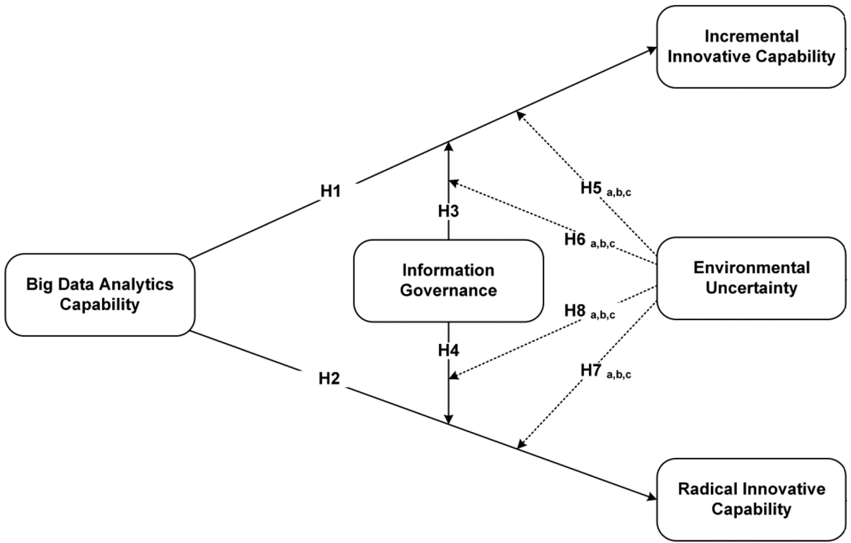
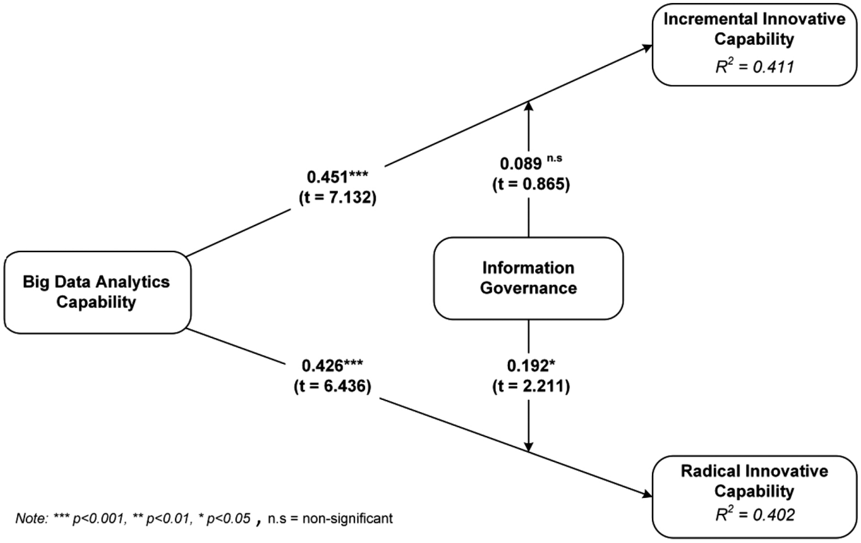
The age of big data analytics is now here, with companies increasingly investing in big data initiatives to foster innovation and outperform competition. Nevertheless, while researchers and practitioners started to examine the shifts that these technologies entail and their overall business value, it is still unclear whether and under what conditions they drive innovation. To address this gap, this study draws on the resource-based view (RBV) of the firm and information governance theory to explore the interplay between a firm’s big data analytics capabilities (BDACs) and their information governance practices in shaping innovation capabilities. We argue that a firm’s BDAC helps enhance two distinct types of innovative capabilities, incremental and radical capabilities, and that information governance positively moderates this relationship. To examine our research model, we analyzed survey data collected from 175 IT and business managers. Results from partial least squares structural equation modelling analysis reveal that BDACs have a positive and significant effect on both incremental and radical innovative capabilities. Our analysis also highlights the important role of information governance, as it positively moderates the relationship between BDAC’s and a firm’s radical innovative capability, while there is a nonsignificant moderating effect for incremental innovation capabilities. Finally, we examine the effect of environmental uncertainty conditions in our model and find that information governance and BDACs have amplified effects under conditions of high environmental dynamism.
Overview
The claims and statistics of this paper haven’t been checked yet.
Run the check — free, no account needed. It reads the open-access text and checks the sources it cites.
Integrity signals
Registry
Cites
Statistics
Figures

Verification
Claims the paper makes
The claims and statistics of this paper haven’t been checked yet.
Run the check — free, no account needed. It reads the open-access text and checks the sources it cites.
Claims other papers make about this one
Each is checked against this paper’s own text: does it say what the citing paper says it does?
In the citing paper
“There is, however, a gap in AI governance, which deals with both IT governance and data governance, and has a direct relationship with AI (Mikalef et al., 2020).”
From Toward AI Governance: Identifying Best Practices and Potential Barriers and Outcomes (2023) · cites this paper as Mikalef et al., 2020
In the citing paper
“resources represent the input of the production process, while a capability is the potential to deploy these resources to improve productivity and generate rents [21,22].”
Self-check
Percentages, sums and reported differences re-computed from the paper’s own numbers.
The self-check needs the paper’s full text.
Citations
Cites
Pls-Sem: indeed a silver bullet
Hair, J. F., Ringle, C. M., & Sarstedt, M. (2011) · Journal of Marketing Theory and Practice · doi:10.2753/mtp1069-6679190202 · Cited by 21,631
A primer on partial least squares structural equation modeling (PLS-SEM)
Leguina, A. (2015) · International Journal of Research & Method in Education · doi:10.1080/1743727x.2015.1005806 · Cited by 18,921
(2014) · DigitalCommons - Kennesaw State University (Kennesaw State University) · Cited by 12,785
(1998) · Cited by 12,725
The resource-based theory of competitive advantage: Implications for strategy formulation
Grant, R. M. (1991) · California Management Review · doi:10.2307/41166664 · Cited by 9,699
Strategic assets and organizational rent
Amit, R., & Schoemaker, P. J. H. (1993) · Strategic Management Journal · doi:10.1002/smj.4250140105 · Cited by 8,425
An assessment of the use of partial least squares structural equation modeling in marketing research
Hair, J. F., Sarstedt, M., Ringle, C. M., & Mena, J. A. (2012) · Journal of the Academy of Marketing Science · doi:10.1007/s11747-011-0261-6 · Cited by 8,088
Using pls path modeling in new technology research: updated guidelines
Henseler, J., Hubona, G., & Ray, P. A. (2016) · Industrial Management & Data Systems · doi:10.1108/imds-09-2015-0382 · Cited by 7,173
Business intelligence and analytics: from big data to big impact
Chen, H., Chiang, R. H. L., & Storey, V. C. (2012) · MIS Quarterly · doi:10.2307/41703503 · Cited by 6,250
(2011) · Cited by 5,203
Research works printed but not linked: 2
- Kiron, 2017, Lessons from becoming a data-driven organization, MIT sloan management rev., 58
- Mikalef, 2017, Big data analytics capabilities: a systematic literature review and research agenda, Inf. Syst. E-business Manag., 1
Cited by
Sorted by citations
Mikalef, P., & Gupta, M. (2021) · Information & Management · doi:10.1016/j.im.2021.103434 · Cited by 1,700
Self-citationDwivedi, Y. K., Hughes, L., Kar, A. K., Baabdullah, A. M., Grover, P., Abbas, R., Andreini, D., Abumoghli, I., Barlette, Y., Bunker, D., et al. (2022) · International Journal of Information Management · doi:10.1016/j.ijinfomgt.2021.102456 · Cited by 761
Multigroup analysis of more than two groups in PLS-SEM: A review, illustration, and recommendations
Cheah, J., Amaro, S., & Roldán, J. L. (2022) · Journal of Business Research · doi:10.1016/j.jbusres.2022.113539 · Cited by 465
Applications of big data in emerging management disciplines: A literature review using text mining
Kushwaha, A. K., Kar, A. K., & Dwivedi, Y. K. (2021) · International Journal of Information Management Data Insights · doi:10.1016/j.jjimei.2021.100017 · Cited by 255
Toward AI Governance: Identifying Best Practices and Potential Barriers and Outcomes
Papagiannidis, E., Enholm, I. M., Dremel, C., Mikalef, P., & Krogstie, J. (2023) · Information Systems Frontiers · doi:10.1007/s10796-022-10251-y · Cited by 191
Self-citationCheng, X., Su, L., Luo, X. R., Benitez, J., & Cai, S. (2021) · European Journal of Information Systems · doi:10.1080/0960085x.2020.1869508 · Cited by 186
Al‐Khatib, A. W., & Valeri, M. (2022) · European Journal of Innovation Management · doi:10.1108/ejim-04-2022-0186 · Cited by 164
Yuan, R., Luo, J., Liu, M. J., & Jiang, Y. (2021) · Journal of Business Research · doi:10.1016/j.jbusres.2021.11.012 · Cited by 157
Acciarini, C., Cappa, F., Boccardelli, P., & Oriani, R. (2023) · Technovation · doi:10.1016/j.technovation.2023.102713 · Cited by 164
Data governance & quality management—Innovation and breakthroughs across different fields
Bernardo, B. M. V., Mamede, H. S., Barroso, J. M. P., & dos Santos, V. M. P. D. (2024) · Journal of Innovation & Knowledge · doi:10.1016/j.jik.2024.100598 · Cited by 129
Tian, H., Li, Y., & Zhang, Y. (2022) · Journal of Cleaner Production · doi:10.1016/j.jclepro.2022.134261 · Cited by 135
AI applications of data sharing in agriculture 4.0: A framework for role-based data access control
Spanaki, K., Karafili, E., & Despoudi, S. (2021) · International Journal of Information Management · doi:10.1016/j.ijinfomgt.2021.102350 · Cited by 134
Al‐Khatib, A. W. (2022) · Business Process Management Journal · doi:10.1108/bpmj-05-2022-0212 · Cited by 104
Ardito, L., Cerchione, R., Mazzola, E., & Raguseo, E. (2021) · Journal of Knowledge Management · doi:10.1108/jkm-04-2021-0325 · Cited by 108
Cadden, T., Dennehy, D., Mäntymäki, M., & Treacy, R. (2021) · International Journal of Production Research · doi:10.1080/00207543.2021.1946614 · Cited by 107
A study on big data analytics and innovation: From technological and business cycle perspectives
Sivarajah, U., Kumar, S., Kumar, V., Chatterjee, S., & Li, J. (2024) · Technological Forecasting and Social Change · doi:10.1016/j.techfore.2024.123328 · Cited by 117
Zhou, X., Li, G., Wang, Q., Yangganxuan, L., & Zhou, D. (2025) · International Review of Financial Analysis · doi:10.1016/j.irfa.2025.104087 · Cited by 97
Blockchain Technology: Redefining Trust for Digital Certificates
Capece, G., Ghiron, N. L., & Pasquale, F. (2020) · Sustainability · doi:10.3390/su12218952 · Cited by 98
Oesterreich, T. D., Anton, E., Teuteberg, F., & Dwivedi, Y. K. (2022) · Journal of Business Research · doi:10.1016/j.jbusres.2022.08.028 · Cited by 111
Board engagement with digital technologies: A resource dependence framework
Oliveira, F., KAKABADSE, N. K., & Khan, N. (2021) · Journal of Business Research · doi:10.1016/j.jbusres.2021.10.010 · Cited by 90
Li, L., Zhu, W., Wei, L., & Yang, S. (2022) · Technological Forecasting and Social Change · doi:10.1016/j.techfore.2022.121830 · Cited by 90
Korherr, P., Kanbach, D. K., Kraus, S., & Mikalef, P. (2022) · Digital Business · doi:10.1016/j.digbus.2022.100045 · Cited by 104
Self-citationD’Amico, G., Arbolino, R., Ши, Л., Yiğitcanlar, T., & Ioppolo, G. (2021) · Sustainability · doi:10.3390/su13116043 · Cited by 88
Huynh, M.-T., Nippa, M., & Aichner, T. (2023) · Technological forecasting & social change · doi:10.1016/j.techfore.2023.122884 · Cited by 81
Data Matters: A Strategic Action Framework for Data Governance
Zhang, Q., Sun, X., & Zhang, M. (2022) · Information & Management · doi:10.1016/j.im.2022.103642 · Cited by 83
Alghamdi, O., & Agag, G. (2023) · Sustainability · doi:10.3390/su151914296 · Cited by 91
D’Amico, G., Arbolino, R., Ши, Л., Yiğitcanlar, T., & Ioppolo, G. (2021) · Land Use Policy · doi:10.1016/j.landusepol.2021.105819 · Cited by 78
Al‐Khatib, A. W. (2022) · EuroMed Journal of Business · doi:10.1108/emjb-10-2021-0154 · Cited by 84
Environmental governance as a driver of green innovation capacity and firm value creation
Salihi, A. A., Ibrahim, H., & Baharudin, D. M. (2023) · Innovation and Green Development · doi:10.1016/j.igd.2023.100110 · Cited by 96
Elia, G., Raguseo, E., Solazzo, G., & Pigni, F. (2022) · Information & Management · doi:10.1016/j.im.2022.103701 · Cited by 76
Korherr, P., & Kanbach, D. K. (2021) · Review of Managerial Science · doi:10.1007/s11846-021-00506-4 · Cited by 78
Al‐Khatib, A. W. (2022) · Business Process Management Journal · doi:10.1108/bpmj-08-2022-0416 · Cited by 72
Influence of motivation on teachers’ job performance
Kumari, J., & Kumar, J. (2023) · Humanities and Social Sciences Communications · doi:10.1057/s41599-023-01662-6 · Cited by 166
Cheng, W., Li, Q., Qun-qi, W., Ye, F., & Jiang, Y. (2024) · Heliyon · doi:10.1016/j.heliyon.2024.e32290 · Cited by 78
Information technology in open innovation: A resource orchestration perspective
Cui, T., Ye, H. J., & Tan, C. (2022) · Information & Management · doi:10.1016/j.im.2022.103699 · Cited by 61
Al‐Khatib, A. W., & Ramayah, T. (2023) · Business Process Management Journal · doi:10.1108/bpmj-04-2022-0179 · Cited by 67
Morimura, F., & Sakagawa, Y. (2022) · Journal of Retailing and Consumer Services · doi:10.1016/j.jretconser.2022.103193 · Cited by 58
Social media use: A review of innovation management practices
Muninger, M.-I., Mahr, D., & Hammedi, W. (2022) · Journal of Business Research · doi:10.1016/j.jbusres.2022.01.039 · Cited by 61
Kumar, V., Kumar, S., Chatterjee, S., & Mariani, M. M. (2024) · IEEE Transactions on Engineering Management · doi:10.1109/tem.2024.3423669 · Cited by 61
Park, M., & Singh, N. P. (2022) · Benchmarking An International Journal · doi:10.1108/bij-03-2022-0169 · Cited by 56
Vial, G. (2023) · Information and Organization · doi:10.1016/j.infoandorg.2023.100450 · Cited by 57
Lin, J., Wu, S., & Luo, X. R. (2024) · European Journal of Information Systems · doi:10.1080/0960085x.2024.2375262 · Cited by 61
Al-Qaralleh, R. E., & Atan, T. (2021) · Kybernetes · doi:10.1108/k-10-2020-0684 · Cited by 57
Xing, Z., Yalçın, H., & Daim, T. U. (2024) · Technovation · doi:10.1016/j.technovation.2024.103098 · Cited by 47
A longitudinal study of the actual value of big data and analytics: The role of industry environment
Zhu, S., Dong, T., & Luo, X. (. (2021) · International Journal of Information Management · doi:10.1016/j.ijinfomgt.2021.102389 · Cited by 47
Information Technology Governance for Higher Education Institutions: A Multi-Country Study
Bianchi, I. S., Sousa, R. D., & Pereira, R. (2021) · Informatics · doi:10.3390/informatics8020026 · Cited by 52
Lozada, N. E., Arias-Pérez, J., & Henao-García, E. A. (2023) · Journal of Enterprise Information Management · doi:10.1108/jeim-02-2021-0092 · Cited by 46
Almazmomi, N. K., Ilmudeen, A., & Qaffas, A. A. (2021) · Benchmarking An International Journal · doi:10.1108/bij-01-2021-0021 · Cited by 59
Zheng, L. J., Zhang, J. Z., Wang, H., & Hong, J. F. L. (2025) · Annals of Operations Research · doi:10.1007/s10479-022-04800-6 · Cited by 42
Data-driven innovation development: an empirical analysis of the antecedents using PLS-SEM and fsQCA
Hossain, M. A., Quaddus, M., Hossain, M. A., & Gopakumar, G. (2022) · Annals of Operations Research · doi:10.1007/s10479-022-04873-3 · Cited by 49
How big data alters value creation: through the lens of big data competency
Wu, X., Liang, L., & Chen, S. (2022) · Management Decision · doi:10.1108/md-09-2021-1199 · Cited by 41
Korayim, D., Chotia, V., Jain, G., Hassan, S., & Paolone, F. (2023) · Technological Forecasting and Social Change · doi:10.1016/j.techfore.2023.123040 · Cited by 45
Data governance and green technological innovation performance: A curvilinear relationship
Yin, J., & Li, C. (2022) · Journal of Cleaner Production · doi:10.1016/j.jclepro.2022.134441 · Cited by 43
Pathak, S., Krishnaswamy, V., & Sharma, M. K. (2024) · Journal of Enterprise Information Management · doi:10.1108/jeim-01-2024-0059 · Cited by 44
Sahoo, S., & Jakhar, S. K. (2023) · Business Strategy and the Environment · doi:10.1002/bse.3542 · Cited by 33
Alsedrah, I. T. (2024) · Resources Policy · doi:10.1016/j.resourpol.2024.105064 · Cited by 36
Fuller, R. M., Harding, M. K., Luna, L., & Summers, J. D. (2021) · Information & Management · doi:10.1016/j.im.2021.103584 · Cited by 33
Reddy, R. C., Bhattacharjee, B., Mishra, D., & Mandal, A. (2022) · Information Systems and e-Business Management · doi:10.1007/s10257-022-00550-x · Cited by 43
Digital Transformation in Norwegian Enterprises
Mikalef, P., & Parmiggiani, E. (2022) · Springer eBooks · doi:10.1007/978-3-031-05276-7 · Cited by 44
Self-citationThe impact of IT governance and data governance on financial and non-financial performance
Naguib, H. M., Kassem, H. M., & Naem, A. E.-H. M. A. (2024) · Future Business Journal · doi:10.1186/s43093-024-00300-0 · Cited by 32
Governance in the exploration of global and regional determinants of ICT development
Saba, C. S., Asongu, S. A., Ngepah, N. N., & Ngoungou, Y. E. (2024) · International Journal of Innovation Studies · doi:10.1016/j.ijis.2024.02.002 · Cited by 32
Can data analytics raise marketing agility?-A sense-and-respond perspective
Tarn, D. D. C., & Wang, J. (2022) · Information & Management · doi:10.1016/j.im.2022.103743 · Cited by 38
Zhang, W., Xu, H., Grebinevych, O., & Chen, M. (2025) · Journal of Environmental Management · doi:10.1016/j.jenvman.2025.125219 · Cited by 30
Mishra, R., Singh, R. K., & Gunasekaran, A. (2023) · Production Planning & Control · doi:10.1080/09537287.2023.2172622 · Cited by 33
Ciacci, A., & Penco, L. (2023) · Journal of Small Business and Enterprise Development · doi:10.1108/jsbed-10-2022-0424 · Cited by 46
Arya, V., Saraf, A., Юрьевич, Ч. Н., Papa, A., & Romano, M. (2025) · The Journal of Technology Transfer · doi:10.1007/s10961-025-10233-7 · Cited by 41
Wong, D., & Ngai, E. W. T. (2023) · International Journal of Production Economics · doi:10.1016/j.ijpe.2023.109007 · Cited by 35
Aburub, F. A. F., Hamzeh, R., Alzyoud, M. S., Alajarmeh, N. S., Al-shanableh, N., Al-Majali, R. T., Al-Hawary, S. I. S., Alshurideh, M. T., & Aldaihani, F. M. F. (2024) · Studies in computational intelligence · doi:10.1007/978-3-031-56015-6_27 · Cited by 28
Dealing With Data Challenges When Delivering Data-Intensive Software Solutions
Graetsch, U. M., Khalajzadeh, H., Shahin, M., Hoda, R., & Grundy, J. (2023) · IEEE Transactions on Software Engineering · doi:10.1109/tse.2023.3291003 · Cited by 29
Industry 4.0 technologies and international performance of SMEs: mediated-moderated perspectives
Rehman, S. U., Jabeen, F., Shahzad, K., Riaz, A., & Bhatti, A. (2024) · International Entrepreneurship and Management Journal · doi:10.1007/s11365-024-01048-3 · Cited by 30
Liang, Y., Zhang, G., Xu, F. P., & Wang, W. (2020) · Mobile Information Systems · doi:10.1155/2020/6630906 · Cited by 31
A review of strategic decision-making in marketing through big data and analytics
Nnaji, U. O., Benjamin, L. B., Eyo-Udo, N. L., & Etukudoh, E. A. (2024) · Magna Scientia Advanced Research and Reviews · doi:10.30574/msarr.2024.11.1.0077 · Cited by 25
Yoshikuni, A. C., Dwivedi, R., Filho, A. R. D. A. V., & Wamba, S. F. (2024) · Technological Forecasting and Social Change · doi:10.1016/j.techfore.2024.123851 · Cited by 28
An organizational sensemaking theorizing of how firms construct digitally enabled strategic agility
Malik, M., Andargoli, A., Tallon, P. P., & Wickramasinghe, N. S. (2025) · Information & Management · doi:10.1016/j.im.2025.104130 · Cited by 37
Chen, F.-H., Hsu, M.-F., & Hu, K.-H. (2021) · Information Technology and Management · doi:10.1007/s10799-021-00342-8 · Cited by 25
How does institutional theory illuminate the influence of the digital economy on R&D networks?
Xing, Z., Fang, D., Wang, J., & Zhang, L. (2024) · European Journal of Innovation Management · doi:10.1108/ejim-11-2023-0958 · Cited by 26
Cheng, C. C. J., & Shiu, E. (2023) · Information & Management · doi:10.1016/j.im.2023.103839 · Cited by 24
Guo, J., Lin, J., & Benitez, J. (2025) · Information & Management · doi:10.1016/j.im.2025.104179 · Cited by 27
Chen, C.-H. (2022) · Chinese Management Studies · doi:10.1108/cms-02-2022-0053 · Cited by 23
The role of use for the business value of big data analytics
Yeh, Y.-T., Eden, R., Fielt, E., & Syed, R. (2025) · Journal of strategic information systems · doi:10.1016/j.jsis.2025.101888 · Cited by 22
Xia, H., Chen, H., Zhang, Z., & Kamal, M. M. (2025) · Technological Forecasting and Social Change · doi:10.1016/j.techfore.2025.124425 · Cited by 31
Lis, D., Arbter, M., Spindler, M., & Otto, B. (2022) · IEEE Transactions on Engineering Management · doi:10.1109/tem.2022.3166109 · Cited by 25
The Interactive Effects of Capabilities and Data-Driven Culture on Sustained Competitive Advantage
Zadeh, A. V., Madhuri, J. G., Hanifah, H. M., & Ramayah, T. (2024) · IEEE Transactions on Engineering Management · doi:10.1109/tem.2024.3355775 · Cited by 24
Lu, L., Xu, J., & Wei, J. (2023) · Telematics and Informatics · doi:10.1016/j.tele.2023.102028 · Cited by 19
Building sustainable performance in the maritime industry via digital resources and innovation
Chua, C., Li, X., Tan, K. H., & Yuen, K. F. (2024) · Transport Policy · doi:10.1016/j.tranpol.2024.02.014 · Cited by 18
Fan, B.-N., & Pan, T. (2023) · Government Information Quarterly · doi:10.1016/j.giq.2023.101830 · Cited by 27
Zhang, P., & Ramayah, T. (2024) · Systems · doi:10.3390/systems13010003 · Cited by 21
Toward a Maturity Model for Big Data Analytics: A Roadmap for Complex Data Processing
Pour, M. J., Abbasi, F., & Sohrabi, B. (2022) · International Journal of Information Technology & Decision Making · doi:10.1142/s0219622022500390 · Cited by 19
Incremental Innovation: Long-Term Impetus for Design Business Creativity
Zhang, X. (2022) · Sustainability · doi:10.3390/su142214697 · Cited by 17
Bridging Big Data Analytics Capability with Sustainability Business Performance: A Literature Review
Novicka, J., & Volkova, T. (2025) · Sustainability · doi:10.3390/su17062362 · Cited by 19
Molla, C., Bhuiyan, M. R. I., Islam, M. T., & Amin, A. A. A. (2025) · Digital Finance · doi:10.1007/s42521-025-00168-x · Cited by 18
Deploying AI Governance Practices: A Revelatory Case Study
Papagiannidis, E., Enholm, I. M., Dremel, C., Mikalef, P., & Krogstie, J. (2021) · Lecture notes in computer science · doi:10.1007/978-3-030-85447-8_19 · Cited by 18
Self-citationAhmad, S. N., & Laroche, M. (2023) · Journal of Marketing Analytics · doi:10.1057/s41270-023-00218-6 · Cited by 17
Xu, Y., Sarfraz, M., Sun, J., Ivaşcu, L., & Öztürk, İ. (2024) · Business Strategy and the Environment · doi:10.1002/bse.4056 · Cited by 16
Fischer-Preßler, D., Marx, J., Bunker, D., Stieglitz, S., & Fischbach, K. (2023) · Information & Management · doi:10.1016/j.im.2023.103838 · Cited by 15
Wu, W., Gao, Y., & Liu, Y. (2024) · Journal of Manufacturing Technology Management · doi:10.1108/jmtm-12-2023-0532 · Cited by 17
THE NEXUS OF BIG DATA ANALYTICS, KNOWLEDGE SHARING, AND PRODUCT INNOVATION IN MANUFACTURING
YILDIZ, B., Çiğdem, Ş., Meidutė‐Kavaliauskienė, I., & Činčikaitė, R. (2024) · Journal of Business Economics and Management · doi:10.3846/jbem.2024.20713 · Cited by 14
Novicka, J. (2025) · Sustainability · doi:10.3390/su17083666 · Cited by 16
Data-based drivers of big data analytics utilization: moderating role of IT proactive climate
Seifian, A., Bahrami, M., Shokouhyar, S., & Shokoohyar, S. (2023) · Benchmarking An International Journal · doi:10.1108/bij-11-2021-0670 · Cited by 13
Khalil, M. L., Aziz, N. A., Ariffin, A. A. M., & Ngah, A. H. (2023) · WSEAS TRANSACTIONS ON BUSINESS AND ECONOMICS · doi:10.37394/23207.2023.20.40 · Cited by 15
Metadata
- Authors
- Mikalef, P., Boura, M., Lekakos, G., & Krogstie, J.
- Affiliations
- Norwegian University of Science and Technology (NO)
- Athens University of Economics and Business (GR)
- Corresponding author
- Mikalef, Patrick
- Venue
- Information & Management
- Publisher
- Elsevier BV
- Published
- 2020-11
- Volume
- 57
- Issue
- 7
- Pages
- 103361
- ISSN
- 0378-7206 (ISSN-L)
- OpenAlex
- W3049164745
- Cited by
- 260
- References
- 106
- Citations by year
- 2026: 30 · 2025: 51 · 2024: 63 · 2023: 44 · 2022: 44 · 2021: 26 · 2020: 2
- FWCI
- 32.94
- Type
- journal article
- Language
- en
- Open access
- hybrid
- doi.org
- Licence
- Locations
- Information & Management (publishedVersion, cc-by)
- NORA - Norwegian Open Research Archives (submittedVersion, cc-by)
- Funders
- Athens University of Economics and Business
- Topics
- Social Sciences › Business, Management and Accounting › Management Information Systems › Big Data and Business Intelligence
- Social Sciences › Business, Management and Accounting › Management Information Systems › Information Technology Governance and Strategy
- Social Sciences › Business, Management and Accounting › Strategy and Management › Innovation and Knowledge Management
- Keywords
- information governance, big data analytics capability, innovation ability, incremental innovation, radical innovation, resource-based view, environmental uncertainty, environmental dynamism, moderating effect, big data analytics
About these checks
Registry, retraction, Cites and statistics results are computed, not judged, with one exception: a printed reference that no index lists is read once by a model before it counts as a citation error. Claims are extracted by a model and kept only when their quote appears verbatim in the text; each cited source is then checked, with a model’s help, for whether it says what the claim relies on. Those verdicts can be wrong — read the claim’s quote and the cited source before relying on one.
Statistics and arithmetic are recomputed, not judged.
Confidence bands are shown only for fields calibrated on our annotated test set. None is calibrated yet, so no band is shown.
What counts as a claim ›How we measure confidence ›How we check this ›
Are you an author, or do you see a problem with this page? Request a review
