

The DOI matches its Crossref record; 106 of the 106 references it cites were found in a registry or an index.
The role of information governance in big data analytics driven innovation
Open accessAbstract
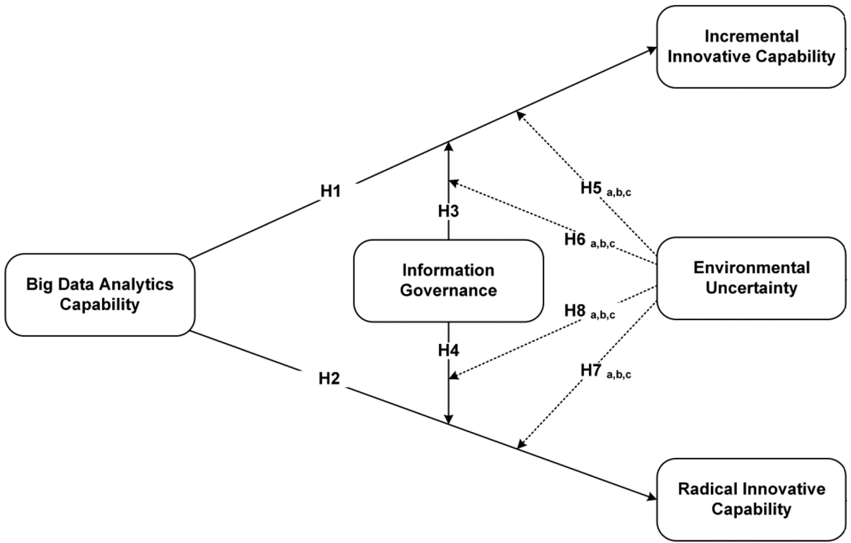
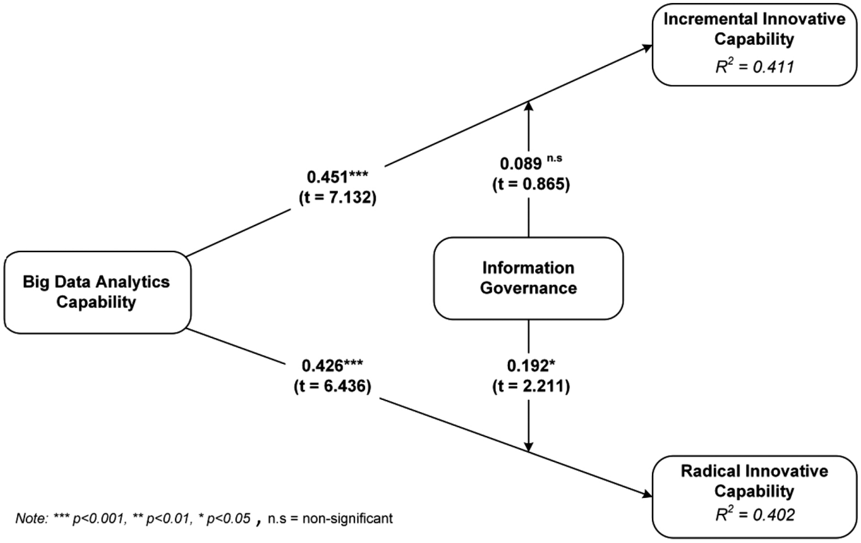
The age of big data analytics is now here, with companies increasingly investing in big data initiatives to foster innovation and outperform competition. Nevertheless, while researchers and practitioners started to examine the shifts that these technologies entail and their overall business value, it is still unclear whether and under what conditions they drive innovation. To address this gap, this study draws on the resource-based view (RBV) of the firm and information governance theory to explore the interplay between a firm’s big data analytics capabilities (BDACs) and their information governance practices in shaping innovation capabilities. We argue that a firm’s BDAC helps enhance two distinct types of innovative capabilities, incremental and radical capabilities, and that information governance positively moderates this relationship. To examine our research model, we analyzed survey data collected from 175 IT and business managers. Results from partial least squares structural equation modelling analysis reveal that BDACs have a positive and significant effect on both incremental and radical innovative capabilities. Our analysis also highlights the important role of information governance, as it positively moderates the relationship between BDAC’s and a firm’s radical innovative capability, while there is a nonsignificant moderating effect for incremental innovation capabilities. Finally, we examine the effect of environmental uncertainty conditions in our model and find that information governance and BDACs have amplified effects under conditions of high environmental dynamism.
Overview
The claims and statistics of this paper haven’t been checked yet.
Run the check — free, no account needed. It reads the open-access text and checks the sources it cites.
Integrity signals
Registry
Cites
Statistics
Figures

Verification
Claims the paper makes
The claims and statistics of this paper haven’t been checked yet.
Run the check — free, no account needed. It reads the open-access text and checks the sources it cites.
Claims other papers make about this one
Each is checked against this paper’s own text: does it say what the citing paper says it does?
In the citing paper
“There is, however, a gap in AI governance, which deals with both IT governance and data governance, and has a direct relationship with AI (Mikalef et al., 2020).”
From Toward AI Governance: Identifying Best Practices and Potential Barriers and Outcomes (2023) · cites this paper as Mikalef et al., 2020
In the citing paper
“resources represent the input of the production process, while a capability is the potential to deploy these resources to improve productivity and generate rents [21,22].”
Self-check
Percentages, sums and reported differences re-computed from the paper’s own numbers.
The self-check needs the paper’s full text.
Citations
Cites
Pls-Sem: indeed a silver bullet
Hair, J. F., Ringle, C. M., & Sarstedt, M. (2011) · Journal of Marketing Theory and Practice · doi:10.2753/mtp1069-6679190202 · Cited by 21,631
A primer on partial least squares structural equation modeling (PLS-SEM)
Leguina, A. (2015) · International Journal of Research & Method in Education · doi:10.1080/1743727x.2015.1005806 · Cited by 18,921
(2014) · DigitalCommons - Kennesaw State University (Kennesaw State University) · Cited by 12,785
(1998) · Cited by 12,725
The resource-based theory of competitive advantage: Implications for strategy formulation
Grant, R. M. (1991) · California Management Review · doi:10.2307/41166664 · Cited by 9,699
Strategic assets and organizational rent
Amit, R., & Schoemaker, P. J. H. (1993) · Strategic Management Journal · doi:10.1002/smj.4250140105 · Cited by 8,425
An assessment of the use of partial least squares structural equation modeling in marketing research
Hair, J. F., Sarstedt, M., Ringle, C. M., & Mena, J. A. (2012) · Journal of the Academy of Marketing Science · doi:10.1007/s11747-011-0261-6 · Cited by 8,088
Using pls path modeling in new technology research: updated guidelines
Henseler, J., Hubona, G., & Ray, P. A. (2016) · Industrial Management & Data Systems · doi:10.1108/imds-09-2015-0382 · Cited by 7,173
Business intelligence and analytics: from big data to big impact
Chen, H., Chiang, R. H. L., & Storey, V. C. (2012) · MIS Quarterly · doi:10.2307/41703503 · Cited by 6,250
(2011) · Cited by 5,203
Research works printed but not linked: 2
- Kiron, 2017, Lessons from becoming a data-driven organization, MIT sloan management rev., 58
- Mikalef, 2017, Big data analytics capabilities: a systematic literature review and research agenda, Inf. Syst. E-business Manag., 1
Cited by
Sorted by citations
Mikalef, P., & Gupta, M. (2021) · Information & Management · doi:10.1016/j.im.2021.103434 · Cited by 1,700
Self-citationDwivedi, Y. K., Hughes, L., Kar, A. K., Baabdullah, A. M., Grover, P., Abbas, R., Andreini, D., Abumoghli, I., Barlette, Y., Bunker, D., et al. (2022) · International Journal of Information Management · doi:10.1016/j.ijinfomgt.2021.102456 · Cited by 761
Multigroup analysis of more than two groups in PLS-SEM: A review, illustration, and recommendations
Cheah, J., Amaro, S., & Roldán, J. L. (2022) · Journal of Business Research · doi:10.1016/j.jbusres.2022.113539 · Cited by 465
Applications of big data in emerging management disciplines: A literature review using text mining
Kushwaha, A. K., Kar, A. K., & Dwivedi, Y. K. (2021) · International Journal of Information Management Data Insights · doi:10.1016/j.jjimei.2021.100017 · Cited by 255
Toward AI Governance: Identifying Best Practices and Potential Barriers and Outcomes
Papagiannidis, E., Enholm, I. M., Dremel, C., Mikalef, P., & Krogstie, J. (2023) · Information Systems Frontiers · doi:10.1007/s10796-022-10251-y · Cited by 191
Self-citation
Metadata
- Authors
- Mikalef, P., Boura, M., Lekakos, G., & Krogstie, J.
- Affiliations
- Norwegian University of Science and Technology (NO)
- Athens University of Economics and Business (GR)
- Corresponding author
- Mikalef, Patrick
- Venue
- Information & Management
- Publisher
- Elsevier BV
- Published
- 2020-11
- Volume
- 57
- Issue
- 7
- Pages
- 103361
- ISSN
- 0378-7206 (ISSN-L)
- OpenAlex
- W3049164745
- Cited by
- 260
- References
- 106
- Citations by year
- 2026: 30 · 2025: 51 · 2024: 63 · 2023: 44 · 2022: 44 · 2021: 26 · 2020: 2
- FWCI
- 32.94
- Type
- journal article
- Language
- en
- Open access
- hybrid
- doi.org
- Licence
- Locations
- Information & Management (publishedVersion, cc-by)
- NORA - Norwegian Open Research Archives (submittedVersion, cc-by)
- Funders
- Athens University of Economics and Business
- Topics
- Social Sciences › Business, Management and Accounting › Management Information Systems › Big Data and Business Intelligence
- Social Sciences › Business, Management and Accounting › Management Information Systems › Information Technology Governance and Strategy
- Social Sciences › Business, Management and Accounting › Strategy and Management › Innovation and Knowledge Management
- Keywords
- information governance, big data analytics capability, innovation ability, incremental innovation, radical innovation, resource-based view, environmental uncertainty, environmental dynamism, moderating effect, big data analytics
About these checks
Registry, retraction, Cites and statistics results are computed, not judged, with one exception: a printed reference that no index lists is read once by a model before it counts as a citation error. Claims are extracted by a model and kept only when their quote appears verbatim in the text; each cited source is then checked, with a model’s help, for whether it says what the claim relies on. Those verdicts can be wrong — read the claim’s quote and the cited source before relying on one.
Statistics and arithmetic are recomputed, not judged.
Confidence bands are shown only for fields calibrated on our annotated test set. None is calibrated yet, so no band is shown.
What counts as a claim ›How we measure confidence ›How we check this ›
Are you an author, or do you see a problem with this page? Request a review
