

The DOI matches its Crossref record; 61 of the 65 references it cites were found in a registry or an index.
Striatal dopamine D2/D3 receptor binding in pathological gambling is correlated with mood-related impulsivity
Open accessAbstract
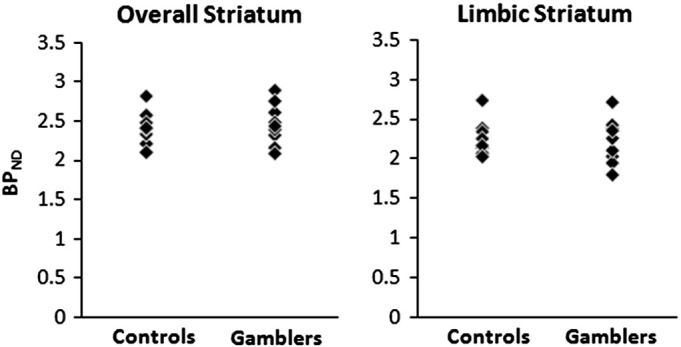
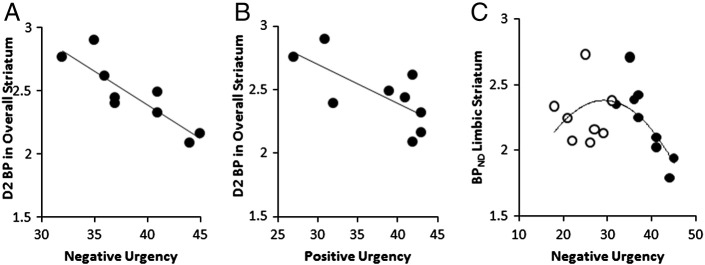
Pathological gambling (PG) is a behavioural addiction associated with elevated impulsivity and suspected dopamine dysregulation. Reduced striatal dopamine D(2)/D(3) receptor availability has been reported in drug addiction, and may constitute a premorbid vulnerability marker for addictive disorders. The aim of the present study was to assess striatal dopamine D(2)/D(3) receptor availability in PG, and its association with trait impulsivity. Males with PG (n=9) and male healthy controls (n=9) underwent [11C]-raclopride positron emission tomography imaging and completed the UPPS-P impulsivity scale. There was no significant difference between groups in striatal dopamine D(2)/D(3) receptor availability, in contrast to previous reports in drug addiction. However, mood-related impulsivity ('Urgency') was negatively correlated with [11C]-raclopride binding potentials in the PG group. The absence of a group difference in striatal dopamine binding implies a distinction between behavioural addictions and drug addictions. Nevertheless, our data indicate heterogeneity in dopamine receptor availability in disordered gambling, such that individuals with high mood-related impulsivity may show differential benefits from dopamine-based medications.
Overview
The claims and statistics of this paper haven’t been checked yet.
Run the check — free, no account needed. It reads the open-access text and checks the sources it cites.
Integrity signals
Registry
Cites
Statistics
Figures
Verification
Claims the paper makes
The claims and statistics of this paper haven’t been checked yet.
Run the check — free, no account needed. It reads the open-access text and checks the sources it cites.
Claims other papers make about this one
Each is checked against this paper’s own text: does it say what the citing paper says it does?
In the citing paper
“However, it should be noted that decreases in D2 receptor binding are not seen in pathological gamblers compared to control subjects, which also has a significant impulsive component (Boileau et al., 2013; Clark et al., 2012; Joutsa et al., 2012; Linnet et al., 2011).”
From Imaging addiction: D2 receptors and dopamine signaling in the striatum as biomarkers for impulsivity (2014) · cites this paper as Clark et al., 2012
In the citing paper
“Nonetheless, two of these studies (Boileau et al., 2013; Clark et al., 2012) did show that low D2 binding correlated with greater impulsivity within the group of gamblers.”
From Imaging addiction: D2 receptors and dopamine signaling in the striatum as biomarkers for impulsivity (2014) · cites this paper as Clark et al., 2012
Self-check
Percentages, sums and reported differences re-computed from the paper’s own numbers.
The self-check needs the paper’s full text.
Citations
Cites
(1998) · The Journal of Clinical Psychiatry · Cited by 19,139
(1998) · PubMed · Cited by 10,216
Di Chiara, G., & Imperato, A. (1988) · Proceedings of the National Academy of Sciences · doi:10.1073/pnas.85.14.5274 · Cited by 4,733
(1987) · American Journal of Psychiatry · doi:10.1176/ajp.144.9.1184 · Cited by 2,948
A pathways model of problem and pathological gambling
Blaszczynski, A., & Nower, L. (2002) · Addiction · doi:10.1046/j.1360-0443.2002.00015.x · Cited by 2,013
Consensus Nomenclature for in vivo Imaging of Reversibly Binding Radioligands
Innis, R. B., Cunningham, V. J., Delforge, J., Fujita, M., Gjedde, A., Gunn, R. N., Holden, J., Houle, S., Huang, S.-C., Ichise, M., et al. (2007) · Journal of Cerebral Blood Flow & Metabolism · doi:10.1038/sj.jcbfm.9600493 · Cited by 1,955
Wang, G.-J., Volkow, N. D., Logan, J., Pappas, N. R., Wong, C. T., Zhu, W., Netusll, N., & Fowler, J. S. (2001) · The Lancet · doi:10.1016/s0140-6736(00)03643-6 · Cited by 1,864
Inverted-U–Shaped Dopamine Actions on Human Working Memory and Cognitive Control
Cools, R., & D'Esposito, M. (2011) · Biological Psychiatry · doi:10.1016/j.biopsych.2011.03.028 · Cited by 1,673
Verdejo‐García, A., Lawrence, A. J., & Clark, L. (2008) · Neuroscience & Biobehavioral Reviews · doi:10.1016/j.neubiorev.2007.11.003 · Cited by 1,502
Self-citationCyders, M. A., Smith, G. T., Spillane, N. S., Fischer, S., Annus, A. M., & Peterson, C. (2007) · Psychological Assessment · doi:10.1037/1040-3590.19.1.107 · Cited by 1,193
Cited by
Sorted by citations
The dopamine theory of addiction: 40 years of highs and lows
Nutt, D., Lingford-Hughes, A. R., Erritzøe, D., & Stokes, P. R. A. (2015) · Nature reviews. Neuroscience · doi:10.1038/nrn3939 · Cited by 696
Self-citationPotenza, M. N., Balodis, I. M., Derevensky, J., Grant, J. E., Petry, N. M., Verdejo-Garcia, A., & Yip, S. W. (2019) · Nature Reviews Disease Primers · doi:10.1038/s41572-019-0099-7 · Cited by 437
Validation of a short French version of the UPPS-P Impulsive Behavior Scale
Billieux, J., Rochat, L., Ceschi, G., Carré, A., Offerlin-Meyer, I., Defeldre, A.-C., Khazaal, Y., Besche‐Richard, C., & der Linden, M. V. (2011) · Comprehensive Psychiatry · doi:10.1016/j.comppsych.2011.09.001 · Cited by 482
Wise, R. A., & Robble, M. A. (2020) · Annual Review of Psychology · doi:10.1146/annurev-psych-010418-103337 · Cited by 446
Integrating affect and impulsivity: The role of positive and negative urgency in substance use risk
Smith, G. T., & Cyders, M. A. (2016) · Drug and Alcohol Dependence · doi:10.1016/j.drugalcdep.2015.08.038 · Cited by 353
Metadata
- Authors
- Clark, L., Stokes, P. R., Wu, K., Michalczuk, R., Benecke, A., Watson, B. J., Egerton, A., Piccini, P., Nutt, D. J., Bowden-Jones, H., & Lingford-Hughes, A. R.
- Affiliations
- University of Cambridge (GB)
- Imperial College London (GB)
- University of Bristol (GB)
- King's College London (GB)
- Central and North West London NHS Foundation Trust (GB)
- Corresponding author
- Clark, Luke
- Venue
- NeuroImage
- Publisher
- Elsevier BV
- Published
- 2012-10
- Volume
- 63
- Issue
- 1
- Pages
- 40-46
- ISSN
- 1053-8119 (ISSN-L)
- PMC
- PMC3438449
- OpenAlex
- W2084587642
- Cited by
- 193
- References
- 65
- Citations by year
- 2026: 2 · 2025: 5 · 2024: 4 · 2023: 11 · 2022: 4 · 2021: 3 · 2020: 55 · 2019: 13 · 2018: 14 · 2017: 10 · 2016: 17 · 2015: 21 · 2014: 15 · 2013: 15 · 2012: 3
- FWCI
- 19.64
- Type
- journal article
- Language
- en
- Open access
- hybrid
- doi.org
- Licence
- Locations
- NeuroImage (publishedVersion, cc-by)
- PubMed Central (publishedVersion, cc-by)
- PubMed (publishedVersion)
- Research Portal (King's College London) (submittedVersion)
- Funders
- Wellcome Trust
- Medical Research Council (G0400575, G0802725)
- Responsible Gambling Fund
- Topics
- Social Sciences › Psychology › Clinical Psychology › Gambling Behavior and Treatments
- Life Sciences › Neuroscience › Cellular and Molecular Neuroscience › Neurotransmitter Receptor Influence on Behavior
- Life Sciences › Neuroscience › Cognitive Neuroscience › Neural and Behavioral Psychology Studies
- Keywords
- gambling addiction, dopamine D2/D3 receptors, impulsivity, urgency, [11C]raclopride PET, behavioral addiction, dopamine dysregulation
- MeSH terms
- Adult, Affect, Corpus Striatum, Female, Gambling, Humans, Impulsive Behavior, Male, Middle Aged, Statistics as Topic, Receptors, Dopamine D2, Positron-Emission Tomography, Receptors, Dopamine D3
About these checks
Registry, retraction, Cites and statistics results are computed, not judged, with one exception: a printed reference that no index lists is read once by a model before it counts as a citation error. Claims are extracted by a model and kept only when their quote appears verbatim in the text; each cited source is then checked, with a model’s help, for whether it says what the claim relies on. Those verdicts can be wrong — read the claim’s quote and the cited source before relying on one.
Statistics and arithmetic are recomputed, not judged.
Confidence bands are shown only for fields calibrated on our annotated test set. None is calibrated yet, so no band is shown.
What counts as a claim ›How we measure confidence ›How we check this ›
Are you an author, or do you see a problem with this page? Request a review
