

The DOI matches its Crossref record; 66 of the 67 references it cites were found in a registry or an index.
Real-time fMRI neurofeedback training of the amygdala activity with simultaneous EEG in veterans with combat-related PTSD
Open accessAbstract
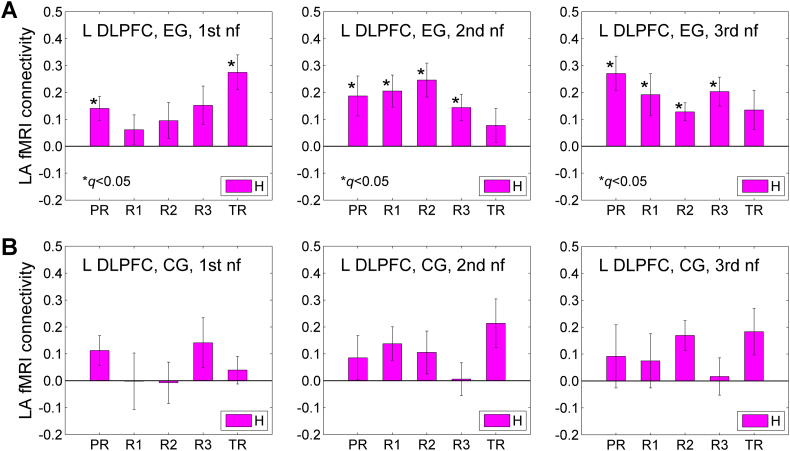
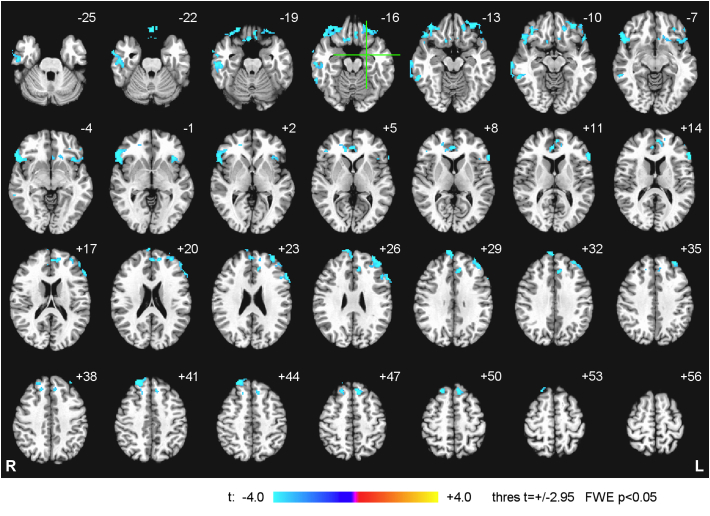
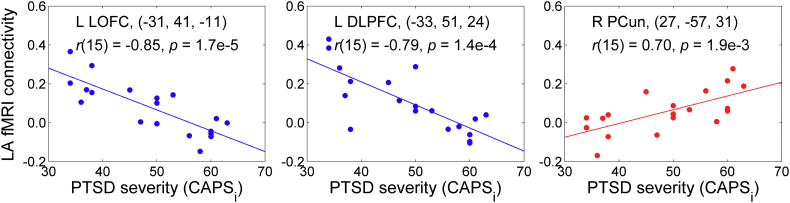
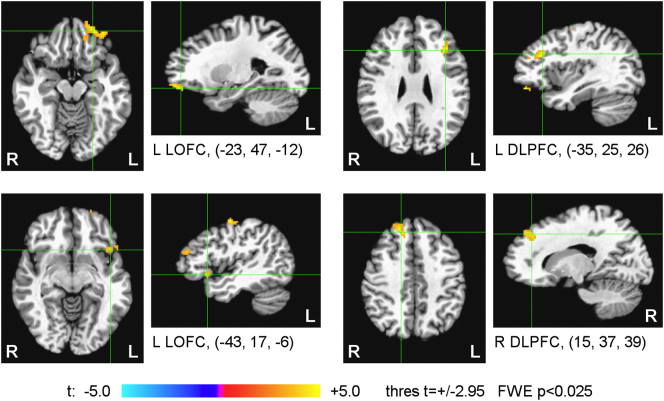
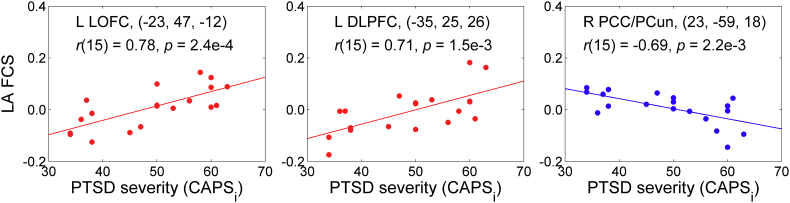
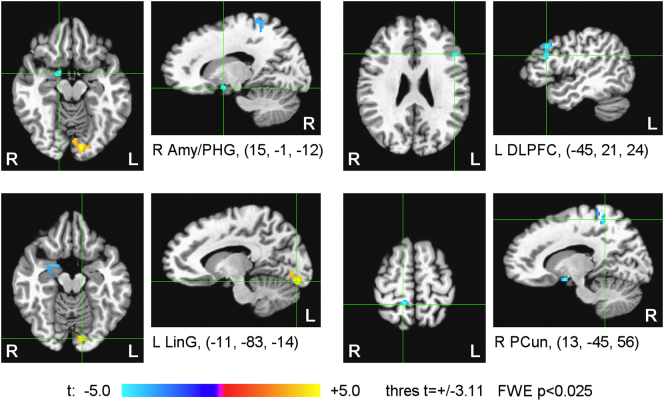
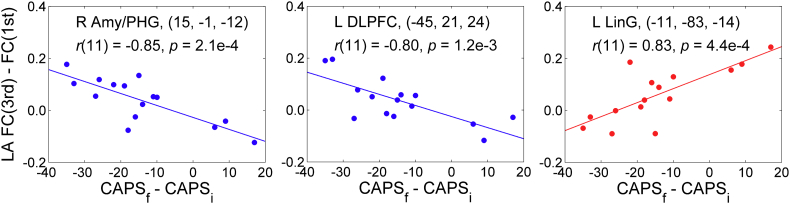
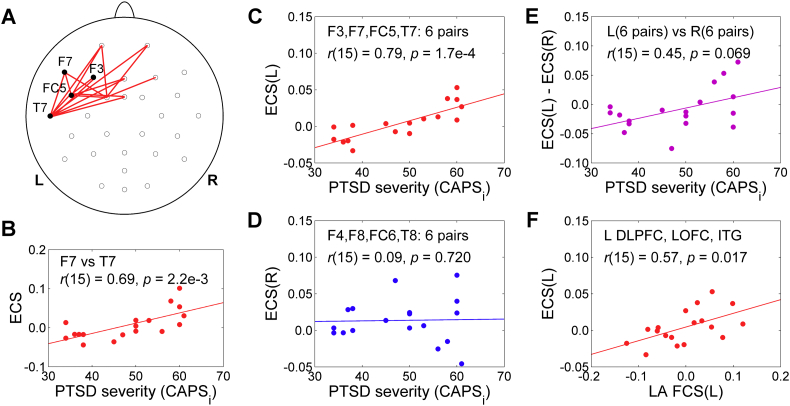
Posttraumatic stress disorder (PTSD) is a chronic and disabling neuropsychiatric disorder characterized by insufficient top-down modulation of the amygdala activity by the prefrontal cortex. Real-time fMRI neurofeedback (rtfMRI-nf) is an emerging method with potential for modifying the amygdala-prefrontal interactions. We report the first controlled emotion self-regulation study in veterans with combat-related PTSD utilizing rtfMRI-nf of the amygdala activity. PTSD patients in the experimental group (EG, n = 20) learned to upregulate blood‑oxygenation-level-dependent (BOLD) activity of the left amygdala (LA) using the rtfMRI-nf during a happy emotion induction task. PTSD patients in the control group (CG, n = 11) were provided with a sham rtfMRI-nf. The study included three rtfMRI-nf training sessions, and EEG recordings were performed simultaneously with fMRI. PTSD severity was assessed before and after the training using the Clinician-Administered PTSD Scale (CAPS). The EG participants who completed the study showed a significant reduction in total CAPS ratings, including significant reductions in avoidance and hyperarousal symptoms. They also exhibited a significant reduction in comorbid depression severity. Overall, 80% of the EG participants demonstrated clinically meaningful reductions in CAPS ratings, compared to 38% in the CG. No significant difference in the CAPS rating changes was observed between the groups. During the first rtfMRI-nf session, functional connectivity of the LA with the orbitofrontal cortex (OFC) and the dorsolateral prefrontal cortex (DLPFC) was progressively enhanced, and this enhancement significantly and positively correlated with the initial CAPS ratings. Left-lateralized enhancement in upper alpha EEG coherence also exhibited a significant positive correlation with the initial CAPS. Reduction in PTSD severity between the first and last rtfMRI-nf sessions significantly correlated with enhancement in functional connectivity between the LA and the left DLPFC. Our results demonstrate that the rtfMRI-nf of the amygdala activity has the potential to correct the amygdala-prefrontal functional connectivity deficiencies specific to PTSD.
Overview
The claims and statistics of this paper haven’t been checked yet.
Run the check — free, no account needed. It reads the open-access text and checks the sources it cites.
Integrity signals
Registry
Cites
Statistics
Figures
Verification
Claims the paper makes
The claims and statistics of this paper haven’t been checked yet.
Run the check — free, no account needed. It reads the open-access text and checks the sources it cites.
Claims other papers make about this one
Each is checked against this paper’s own text: does it say what the citing paper says it does?
The cited source doesn’t support the claim as written.
In the citing paper
“Two other studies reported clinically meaningful reduction in PTSD symptoms after amygdala down-regulation training in PTSD (Gerin et al., 2016, Zotev et al., 2018).”
From Rt-fMRI neurofeedback-guided cognitive reappraisal training modulates amygdala responsivity in posttraumatic stress disorder (2020) · cites this paper as Zotev et al., 2018
Checked by a reasoning model — may be wrong.
Experimental — accuracy not yet measured
Self-check
Percentages, sums and reported differences re-computed from the paper’s own numbers.
The self-check needs the paper’s full text.
Citations
Cites
Diagnostic and Statistical Manual of Mental Disorders
Williams, J. B. W., & First, M. B. (2013) · Oxford University Press eBooks · doi:10.1093/acrefore/9780199975839.013.104 · Cited by 109,845
The assessment and analysis of handedness: The Edinburgh inventory
Oldfield, R. C. (1971) · Neuropsychologia · doi:10.1016/0028-3932(71)90067-4 · Cited by 35,900
Hamilton, M. (1960) · Journal of Neurology, Neurosurgery & Psychiatry · doi:10.1136/jnnp.23.1.56 · Cited by 32,817
Diagnostic and Statistical Manual of Mental Disorders.
Widiger, T. A. (2000) · Oxford University Press eBooks · doi:10.1037/10518-009 · Cited by 19,766
A new depression scale designed to be sensitive to change
Montgomery, S. A., & Åsberg, M. (1979) · British Journal of Psychiatry · doi:10.1192/bjp.134.4.382 · Cited by 13,962
Co-Planar Stereotaxic Atlas of the Human Brain
Talairach, J., & Tournoux, P. (1988) · Medical Entomology and Zoology · Cited by 11,798
The assessment of anxiety states by rating
HAMILTON, M. (1959) · British Journal of Medical Psychology · doi:10.1111/j.2044-8341.1959.tb00467.x · Cited by 11,455
AFNI: Software for analysis and visualization of functional magnetic resonance neuroimages
Cox, R. W. (1996) · Computers and Biomedical Research · doi:10.1006/cbmr.1996.0014 · Cited by 10,913
An Information-Maximization Approach to Blind Separation and Blind Deconvolution
Bell, A. J., & Sejnowski, T. J. (1995) · Neural Computation · doi:10.1162/neco.1995.7.6.1129 · Cited by 8,986
Co-planar stereotaxic atlas of the human brain
Laitinen, L. (1989) · Clinical Neurology and Neurosurgery · doi:10.1016/0303-8467(89)90128-5 · Cited by 7,565
Four Factor Index of Social Status
Paschou, R. (1975) · Cited by 6,989
Bagby, R. M., Parker, J. D. A., & Taylor, G. J. (1994) · Journal of Psychosomatic Research · doi:10.1016/0022-3999(94)90005-1 · Cited by 5,293
Four Factor Index of Social Status [1975]
Hollingshead, A. B. (1975) · Cited by 5,151
Etkin, A., & Wager, T. D. (2007) · American Journal of Psychiatry · doi:10.1176/appi.ajp.2007.07030504 · Cited by 3,391 · cited 4×
“Note that parietal regions, including the precuneus and the inferior parietal lobule, are known to be hyperactive in PTSD together with the amygdala (e.g. Etkin and Wager, 2007; Lanius et al., 2006; Patel et al., 2012).”
BackgroundResultInfluentialTHREE PARIETAL CIRCUITS FOR NUMBER PROCESSING
Dehaene, S., Manuela Piazza, A., Pinel, P., & Cohen, L. (2003) · Cognitive Neuropsychology · doi:10.1080/02643290244000239 · Cited by 2,575
McNair, D. M. (1992) · Medical Entomology and Zoology · Cited by 2,527
Rethinking feelings: an fMRI study of the cognitive regulation of emotion
Ochsner, K. N., Bunge, S. A., Gross, J. J., & Gabrieli, J. D. E. (2002) · Journal of Cognitive Neuroscience · doi:10.1162/089892902760807212 · Cited by 2,520
The twenty-item Toronto Alexithymia scale—II. Convergent, discriminant, and concurrent validity
Bagby, R. M., Taylor, G. J., & Parker, J. D. A. (1994) · Journal of Psychosomatic Research · doi:10.1016/0022-3999(94)90006-x · Cited by 2,431
Fagerström, K.-O. (1978) · Addictive Behaviors · doi:10.1016/0306-4603(78)90024-2 · Cited by 2,221
The Neurocircuitry of Fear, Stress, and Anxiety Disorders
Shin, L. M., & Liberzon, I. (2010) · Neuropsychopharmacology · doi:10.1038/npp.2009.83 · Cited by 2,083 · cited 1×
“Functional neuroimaging studies of emotional processing have demonstrated prominent involvement of the above-mentioned brain systems (SN, EF/ER, CP) in neurobiology of PTSD (e.g. Etkin and Wager, 2007; Lanius et al., 2006; Patel et al., 2012; Shin and Liberzon, 2010).”
BackgroundKRINGELBACH, M. (2004) · Progress in Neurobiology · doi:10.1016/j.pneurobio.2004.03.006 · Cited by 1,977
Clinician-administered PTSD scale: A review of the first ten years of research
Weathers, F. W., Keane, T. M., & Davidson, J. R. T. (2001) · Depression and Anxiety · doi:10.1002/da.1029 · Cited by 1,903
A scale for the assessment of hedonic tone the Snaith-Hamilton pleasure scale
Snaith, R. P., Hamilton, M., Morley, S., Humayan, A., Hargreaves, D., & Trigwell, P. (1995) · British Journal of Psychiatry · doi:10.1192/bjp.167.1.99 · Cited by 1,778
Posttraumatic stress disorder: the burden to the individual and to society.
Kessler, R. C. (2000) · PubMed · Cited by 1,445
A clinician rating scale for assessing current and lifetime PTSD. The CAPS-1
Blake, D. D., Weathers, F. W., Nagy, L., Kaloupek, D. G., Klauminzer, G. W., Charney, D. S., & Keane, T. M. (1990) · Behavior Therapy · Cited by 1,123
Frontal cortex and reward-guided learning and decision-making
Rushworth, M. F. S., Noonan, M. P., Boorman, E. D., Walton, M. E., & Behrens, T. E. (2011) · Neuron · doi:10.1016/j.neuron.2011.05.014 · Cited by 1,111
Psychotherapy for Military-Related PTSD: A Review of Randomized Clinical Trials
Steenkamp, M. M., Litz, B. T., Hoge, C. W., & Marmar, C. R. (2015) · JAMA · doi:10.1001/jama.2015.8370 · Cited by 958
Sergerie, K., Chochol, C., & Armony, J. L. (2008) · Neuroscience & Biobehavioral Reviews · doi:10.1016/j.neubiorev.2007.12.002 · Cited by 917
Ghashghaei, H. T., Hilgetag, C. C., & Barbas, H. (2007) · NeuroImage · doi:10.1016/j.neuroimage.2006.09.046 · Cited by 845
Psychophysiologic assessment of posttraumatic stress disorder imagery in Vietnam combat veterans
Pitman, R. K. (1987) · Archives of General Psychiatry · doi:10.1001/archpsyc.1987.01800230050009 · Cited by 758
Estimating sample size in functional MRI (fMRI) neuroimaging studies: Statistical power analyses
Desmond, J. E., & Glover, G. H. (2002) · Journal of Neuroscience Methods · doi:10.1016/s0165-0270(02)00121-8 · Cited by 716
The Emotional Contagion Scale: A Measure of Individual Differences
Doherty, R. W. (1997) · Journal of Nonverbal Behavior · doi:10.1023/a:1024956003661 · Cited by 665
Patel, R., Spreng, R. N., Shin, L. M., & Girard, T. A. (2012) · Neuroscience & Biobehavioral Reviews · doi:10.1016/j.neubiorev.2012.06.003 · Cited by 546
Sestieri, C., Corbetta, M., Romani, G. L., & Shulman, G. L. (2011) · The Journal of Neuroscience · doi:10.1523/jneurosci.3335-10.2011 · Cited by 523
Mapping sources of correlation in resting state FMRI, with artifact detection and removal
Jo, H. J., Saad, Z. S., Simmons, W. K., Milbury, L. A., & Cox, R. W. (2010) · NeuroImage · doi:10.1016/j.neuroimage.2010.04.246 · Cited by 509
Context Processing and the Neurobiology of Post-Traumatic Stress Disorder
Liberzon, I., & Abelson, J. L. (2016) · Neuron · doi:10.1016/j.neuron.2016.09.039 · Cited by 489
Real-time fMRI neurofeedback: Progress and challenges
Sulzer, J., Haller, S., Scharnowski, F., Weiskopf, N., Birbaumer, N., Blefari, M. L., Bruehl, A. B., Cohen, L. G., deCharms, R. C., Gassert, R., et al. (2013) · NeuroImage · doi:10.1016/j.neuroimage.2013.03.033 · Cited by 453
Rush, A. J., Carmody, T., & Reimitz, P. (2000) · International Journal of Methods in Psychiatric Research · doi:10.1002/mpr.79 · Cited by 427
Decreased responsiveness to reward in depression
Henriques, J. B., & Davidson, R. J. (2000) · Cognition & Emotion · doi:10.1080/02699930050117684 · Cited by 399
A review of neuroimaging studies in PTSD: heterogeneity of response to symptom provocation
Lanius, R. A., Bluhm, R., Lanius, U., & Pain, C. (2006) · Journal of Psychiatric Research · doi:10.1016/j.jpsychires.2005.07.007 · Cited by 380
Real-time fMRI and its application to neurofeedback
Weiskopf, N. (2011) · NeuroImage · doi:10.1016/j.neuroimage.2011.10.009 · Cited by 335
Self-Regulation of Amygdala Activation Using Real-Time fMRI Neurofeedback
Zotev, V. S., Krüeger, F., Phillips, R., Alvarez, R. P., Simmons, W. K., Bellgowan, P. S. F., Drevets, W. C., & Bodurka, J. (2011) · PLoS ONE · doi:10.1371/journal.pone.0024522 · Cited by 332
Self-citationYoung, K. D., Siegle, G. J., Zotev, V., Phillips, R., Misaki, M., Yuan, H., Drevets, W. C., & Bodurka, J. (2017) · American Journal of Psychiatry · doi:10.1176/appi.ajp.2017.16060637 · Cited by 331
Self-citationThe Role of the Orbitofrontal Cortex in Anxiety Disorders
Milad, M. R., & Rauch, S. L. (2007) · Annals of the New York Academy of Sciences · doi:10.1196/annals.1401.006 · Cited by 329
An Information-Maximization Approach to Blind Separation and Blind Deconvolution
Bell, A. J., & Sejnowski, T. J. (1999) · The MIT Press eBooks · doi:10.7551/mitpress/7011.003.0009 · Cited by 303
Nicholson, A. A., Rabellino, D., Densmore, M., Frewen, P. A., Paret, C., Kluetsch, R., Schmahl, C., Théberge, J., Neufeld, R. W. J., McKinnon, M. C., et al. (2017) · Human Brain Mapping · doi:10.1002/hbm.23402 · Cited by 273
The self-regulating brain and neurofeedback: experimental science and clinical promise
Thibault, R. T., Lifshitz, M., & Raz, A. (2016) · Cortex · doi:10.1016/j.cortex.2015.10.024 · Cited by 272
α‐θ Brainwave Training and β‐Endorphin Levels in Alcoholics
Peniston, E. G., & Kulkosky, P. J. (1989) · Alcoholism Clinical and Experimental Research · doi:10.1111/j.1530-0277.1989.tb00325.x · Cited by 259
Learned regulation of brain metabolism
Birbaumer, N., Ruíz, S., & Sitaram, R. (2013) · Trends in Cognitive Sciences · doi:10.1016/j.tics.2013.04.009 · Cited by 236
Self-regulation of human brain activity using simultaneous real-time fMRI and EEG neurofeedback
Zotev, V. S., Phillips, R., Yuan, H., Misaki, M., & Bodurka, J. (2013) · NeuroImage · doi:10.1016/j.neuroimage.2013.04.126 · Cited by 225
Self-citationKrystal, J. H., Rosenheck, R. A., Cramer, J. A., Vessicchio, J. C., Jones, K. M., Vertrees, J. E., Horney, R. A., Huang, G. D., Stock, C. J., & for the Veterans Affairs Cooperative Study No. 504 Group (2011) · JAMA · doi:10.1001/jama.2011.1080 · Cited by 223
Validation of ICA-based myogenic artifact correction for scalp and source-localized EEG
McMenamin, B. W., Shackman, A. J., Maxwell, J. S., Bachhuber, D. R. W., Koppenhaver, A. M., Greischar, L. L., & Davidson, R. J. (2009) · NeuroImage · doi:10.1016/j.neuroimage.2009.10.010 · Cited by 214
Bruder, G. E., Stewart, J. W., & McGrath, P. J. (2017) · Neuroscience & Biobehavioral Reviews · doi:10.1016/j.neubiorev.2017.04.021 · Cited by 214
Behavioral activation system deficits predict the six-month course of depression
McFarland, B. R., Shankman, S. A., Tenke, C. E., Bruder, G. E., & Klein, D. N. (2006) · Journal of Affective Disorders · doi:10.1016/j.jad.2006.01.012 · Cited by 181
Zotev, V. S., Yuan, H., Misaki, M., Phillips, R., Young, K. D., Feldner, M. T., & Bodurka, J. (2016) · NeuroImage Clinical · doi:10.1016/j.nicl.2016.02.003 · Cited by 165
Self-citationZotev, V. S., Phillips, R., Young, K. D., Drevets, W. C., & Bodurka, J. (2013) · PLoS ONE · doi:10.1371/journal.pone.0079184 · Cited by 151
Self-citationVisual memory and visual perception recruit common neural substrates
Slotnick, S. D. (2004) · Behavioral and Cognitive Neuroscience Reviews · doi:10.1177/1534582304274070 · Cited by 130
Keynan, J. N., Meir-Hasson, Y., Gilam, G., Cohen, A., Jackont, G., Kinreich, S., Ikar, L., Or‐Borichev, A., Etkin, A., Gyurak, A., et al. (2016) · Biological Psychiatry · doi:10.1016/j.biopsych.2015.12.024 · Cited by 112
The Neurocircuitry of Fear, Stress, and Anxiety Disorders
Shin, L. M., & Liberzon, I. (2011) · FOCUS The Journal of Lifelong Learning in Psychiatry · doi:10.1176/foc.9.3.foc311 · Cited by 105
Hopper, J. W., Frewen, P. A., Sack, M., Lanius, R. A., & van der Kolk, B. A. (2007) · Journal of Psychopathology and Behavioral Assessment · doi:10.1007/s10862-007-9046-0 · Cited by 86
Real-time fMRI neurofeedback with War Veterans with chronic PTSD: a feasibility study
Gerin, M. I., Fichtenholtz, H., Roy, A., Walsh, C. J., Krystal, J. H., Southwick, S., & Hampson, M. (2016) · Frontiers in Psychiatry · doi:10.3389/fpsyt.2016.00111 · Cited by 84
The emotional counting Stroop: a task for assessing emotional interference during brain imaging
Whalen, P. J., Bush, G., Shin, L. M., & Rauch, S. L. (2006) · Nature Protocols · doi:10.1038/nprot.2006.45 · Cited by 59
Zotev, V. S., Misaki, M., Phillips, R., Wong, C. K., & Bodurka, J. (2017) · Human Brain Mapping · doi:10.1002/hbm.23902 · Cited by 38
Self-citationEEG-assisted retrospective motion correction for fMRI: E-REMCOR
Zotev, V. S., Yuan, H., Phillips, R., & Bodurka, J. (2012) · NeuroImage · doi:10.1016/j.neuroimage.2012.07.031 · Cited by 24
Self-citationBiswal (1997) · doi:10.1002/(sici)1099-1492(199706/08)10:4/5
Glover (2000) · doi:10.1002/1522-2594(200007)44:1
Cited by
Sorted by citations
fMRI neurofeedback in emotion regulation: A literature review
Linhartová, P., Látalová, A., Kóša, B., Kašpárek, T., Schmahl, C. G., & Paret, C. (2019) · NeuroImage · doi:10.1016/j.neuroimage.2019.03.011 · Cited by 162
Electrical fingerprint of the amygdala guides neurofeedback training for stress resilience
Keynan, J. N., Cohen, A., Jackont, G., Green, N., Goldway, N., Davidov, A., Meir-Hasson, Y., Raz, G., Intrator, N., Fruchter, E., et al. (2018) · Nature Human Behaviour · doi:10.1038/s41562-018-0484-3 · Cited by 158
Simultaneous EEG-fMRI: What Have We Learned and What Does the Future Hold?
Warbrick, T. (2022) · Sensors · doi:10.3390/s22062262 · Cited by 182
Wang, S., Zhao, Y., Zhang, L., Wang, X., Wang, X., Cheng, B., Luo, K., & Gong, Q. (2019) · Human Brain Mapping · doi:10.1002/hbm.24752 · Cited by 130
Soleimani, G., Nitsche, M. A., Bergmann, T. O., Towhidkhah, F., Violante, I. R., Lorenz, R., Kuplicki, R., Tsuchiyagaito, A., Mulyana, B. E., Mayeli, A., et al. (2023) · Translational Psychiatry · doi:10.1038/s41398-023-02565-5 · Cited by 126
Metadata
- Authors
- Zotev, V., Phillips, R., Misaki, M., Wong, C. K., Wurfel, B. E., Krueger, F., Feldner, M., & Bodurka, J.
- Affiliations
- Laureate Institute for Brain Research (US)
- Laureate Psychiatric Clinic and Hospital (US)
- University of Arkansas at Fayetteville (US)
- Corresponding author
- Bodurka, Jerzy
- Venue
- NeuroImage Clinical
- Publisher
- Elsevier BV
- Published
- 2018
- Volume
- 19
- Pages
- 106-121
- ISSN
- 2213-1582 (ISSN-L)
- PMC
- PMC6051473
- OpenAlex
- W2786003115
- Cited by
- 135
- References
- 67
- Citations by year
- 2026: 8 · 2025: 12 · 2024: 16 · 2023: 20 · 2022: 22 · 2021: 20 · 2020: 17 · 2019: 16 · 2018: 4
- FWCI
- 16.71
- Type
- journal article
- Language
- en
- Open access
- gold
- doi.org
- Licence
- Locations
- NeuroImage Clinical (publishedVersion, cc-by-nc-nd)
- Europe PMC (PubMed Central) (publishedVersion, cc-by-nc-nd)
- PubMed Central (publishedVersion, cc-by-nc-nd)
- PubMed (publishedVersion)
- arXiv (Cornell University) (submittedVersion)
- DOAJ (DOAJ: Directory of Open Access Journals) (submittedVersion)
- arXiv (Cornell University)
- Funders
- U.S. Department of Defense
- Topics
- Social Sciences › Psychology › Clinical Psychology › Posttraumatic Stress Disorder Research
- Life Sciences › Neuroscience › Cognitive Neuroscience › Neural and Behavioral Psychology Studies
- Life Sciences › Neuroscience › Neurology › Transcranial Magnetic Stimulation Studies
- Keywords
- real-time fMRI neurofeedback, amygdala activity, combat-related posttraumatic stress disorder, veterans, dorsolateral prefrontal cortex, orbitofrontal cortex, emotion regulation, comorbid depression, avoidance symptoms, hyperarousal
- MeSH terms
- Adult, Amygdala, Brain Mapping, Major Depressive Disorder, Emotions, Female, Humans, Image Processing, Computer-Assisted, Learning, Magnetic Resonance Imaging, Male, Middle Aged, Stress Disorders, Post-Traumatic, Neurofeedback
About these checks
Registry, retraction, Cites and statistics results are computed, not judged, with one exception: a printed reference that no index lists is read once by a model before it counts as a citation error. Claims are extracted by a model and kept only when their quote appears verbatim in the text; each cited source is then checked, with a model’s help, for whether it says what the claim relies on. Those verdicts can be wrong — read the claim’s quote and the cited source before relying on one.
Statistics and arithmetic are recomputed, not judged.
Confidence bands are shown only for fields calibrated on our annotated test set. None is calibrated yet, so no band is shown.
What counts as a claim ›How we measure confidence ›How we check this ›
Are you an author, or do you see a problem with this page? Request a review
