

The DOI matches its Crossref record; 152 of the 152 references it cites were found in a registry or an index.
Roles of Supplementary Motor Areas in Auditory Processing and Auditory Imagery
Open accessAbstract
Although the supplementary and pre-supplementary motor areas have been intensely investigated in relation to their motor functions, they are also consistently reported in studies of auditory processing and auditory imagery. This involvement is commonly overlooked, in contrast to lateral premotor and inferior prefrontal areas. We argue here for the engagement of supplementary motor areas across a variety of sound categories, including speech, vocalizations, and music, and we discuss how our understanding of auditory processes in these regions relate to findings and hypotheses from the motor literature. We suggest that supplementary and pre-supplementary motor areas play a role in facilitating spontaneous motor responses to sound, and in supporting a flexible engagement of sensorimotor processes to enable imagery and to guide auditory perception.
Overview
The claims and statistics of this paper haven’t been checked yet.
Run the check — free, no account needed. It reads the open-access text and checks the sources it cites.
Integrity signals
Registry
Cites
Statistics
Figures
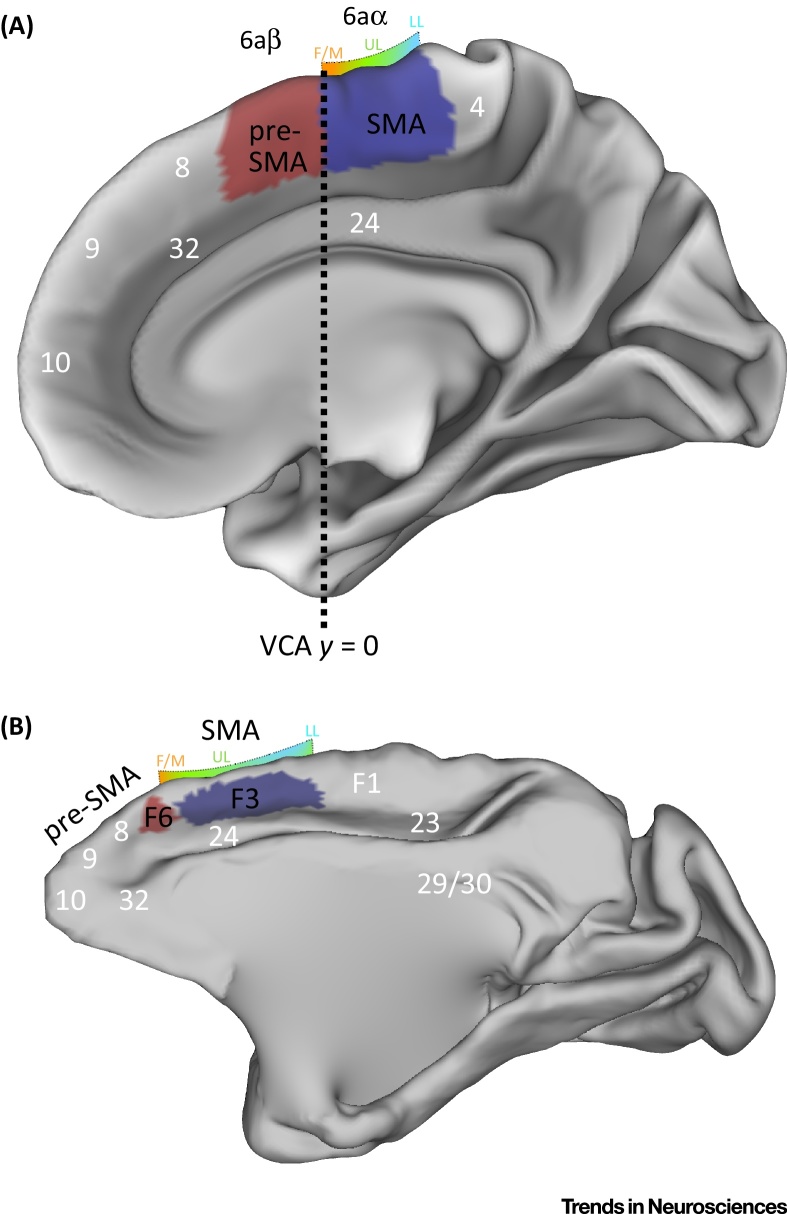
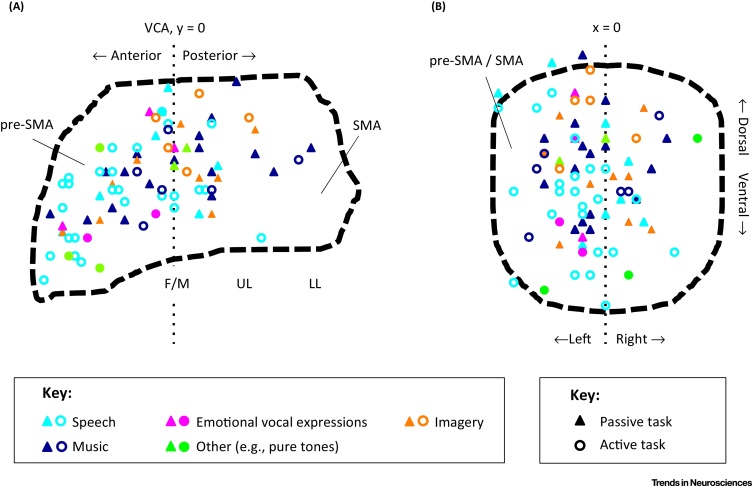
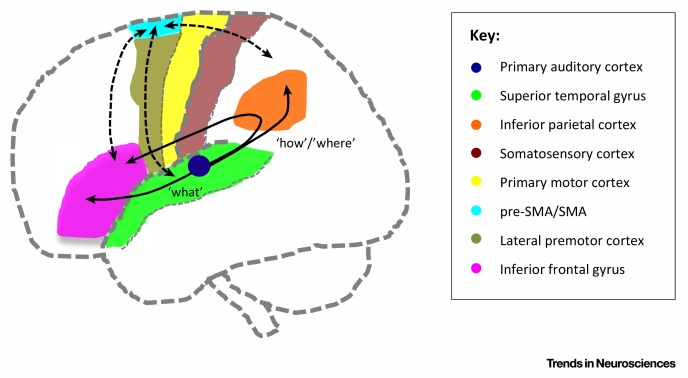
Verification
Claims the paper makes
The claims and statistics of this paper haven’t been checked yet.
Run the check — free, no account needed. It reads the open-access text and checks the sources it cites.
Claims other papers make about this one
Each is checked against this paper’s own text: does it say what the citing paper says it does?
In the citing paper
“The experience of NCVH likely also involves regions associated with the generation and monitoring of speech-motor imagery, as well as sensorimotor processes, such as the supplementary and pre-supplementary motor areas (SMA/pre-SMA; Linden et al., 2011;Lima et al., 2016).”
From Distinct processing of ambiguous speech in people with non-clinical auditory verbal hallucinations (2017) · cites this paper as Lima et al., 2016
Self-check
Percentages, sums and reported differences re-computed from the paper’s own numbers.
The self-check needs the paper’s full text.
Citations
Cites
The role of the medial frontal cortex in cognitive control
Ridderinkhof, K. R., Ullsperger, M., Crone, E. A., & Nieuwenhuis, S. (2004) · Science · doi:10.1126/science.1100301 · Cited by 2,974
Where do you know what you know? The representation of semantic knowledge in the human brain
Patterson, K., Nestor, P. J., & Rogers, T. T. (2007) · Nature Reviews Neuroscience · doi:10.1038/nrn2277 · Cited by 2,706
Functional role of the supplementary and pre-supplementary motor areas
Nachev, P., Kennard, C., & Husain, M. (2008) · Nature Reviews Neuroscience · doi:10.1038/nrn2478 · Cited by 1,928
When the brain plays music: auditory–motor interactions in music perception and production
Zatorre, R. J., Chen, J. L., & Penhune, V. B. (2007) · Nature reviews. Neuroscience · doi:10.1038/nrn2152 · Cited by 1,896
Maps and streams in the auditory cortex: nonhuman primates illuminate human speech processing
Rauschecker, J. P., & Scott, S. K. (2009) · Nature Neuroscience · doi:10.1038/nn.2331 · Cited by 1,766
Motor Areas of the Medial Wall: A Review of Their Location and Functional Activation
Picard, N., & Strick, P. L. (1996) · Cerebral Cortex · doi:10.1093/cercor/6.3.342 · Cited by 1,712
Brain Structures Differ between Musicians and Non-Musicians
Christian Gaser, B., & Gottfried Schlaug, A. (2003) · Journal of Neuroscience · doi:10.1523/jneurosci.23-27-09240.2003 · Cited by 1,626
The origin of corticospinal projections from the premotor areas in the frontal lobe
Dum, R., & Strick, P. (1991) · Journal of Neuroscience · doi:10.1523/jneurosci.11-03-00667.1991 · Cited by 1,447
Neuroplasticity Subserving Motor Skill Learning
Dayan, E., & Cohen, L. G. (2011) · Neuron · doi:10.1016/j.neuron.2011.10.008 · Cited by 1,408
The emulation theory of representation: Motor control, imagery, and perception
Grush, R. (2004) · Behavioral and Brain Sciences · doi:10.1017/s0140525x04000093 · Cited by 1,387 · cited 1×
“These ideas resonate with the ‘emulation’ framework discussed in relation to action control, and generalized to motor imagery, perception, and prediction [112,113].”
Research works printed but not linked: 1
- Vogt, 1919, Allgemeine ergebnisse unserer hirnforschung, Journal für Psychologie und Neurologie, 25, 277
Cited by
Sorted by citations
Items 101–200 of 227
Perron, M., Vuong, V., Grassi, M. W., Imran, A., & Alain, C. (2024) · Human Brain Mapping · doi:10.1002/hbm.70023 · Cited by 16
Sayal, A., Guedes, A. G., Almeida, I. A. T., Pereira, D. J., Lima, C. F., Panda, R., Paiva, R. P., Sousa, T., Castelo-Branco, M. S., Bernardino, I., et al. (2024) · IEEE Transactions on Affective Computing · doi:10.1109/taffc.2024.3507192 · Cited by 12
Greenspon, E. B., & Montanaro, V. (2022) · Attention Perception & Psychophysics · doi:10.3758/s13414-022-02613-0 · Cited by 10
Discourse management during speech perception: A functional magnetic resonance imaging (fMRI) study
Dietrich, S., Hertrich, I., Seibold, V. C., & Rolke, B. (2019) · NeuroImage · doi:10.1016/j.neuroimage.2019.116047 · Cited by 10
An investigation of the neural association between auditory imagery and perception of complex sounds
Gu, J., Zhang, H., Liu, B., Li, X., Wang, P., & Wang, B. (2019) · Brain Structure and Function · doi:10.1007/s00429-019-01948-z · Cited by 11
Xia, R., Ren, J., Li, X., Liu, J., Dai, Y., Kuang, Y., Wu, Z., & Chen, S. (2022) · Brain Sciences · doi:10.3390/brainsci13010063 · Cited by 9
Hyperacusis is associated with smaller gray matter volumes in the supplementary motor area
Makani, P., Koops, E. A., Pyott, S. J., van Dijk, P., & Thioux, M. (2023) · NeuroImage Clinical · doi:10.1016/j.nicl.2023.103425 · Cited by 9
Dynamics of Pitch Perception in the Auditory Cortex
Abrams, E. B., Marantz, A., Krementsov, I., & Gwilliams, L. (2025) · Journal of Neuroscience · doi:10.1523/jneurosci.1111-24.2025 · Cited by 9
Chung, L. K.-H., Jack, B. N., Griffiths, O., Pearson, D., Luque, D., Harris, A. W. F., Spencer, K., Pelley, M. E. L., So, S. H., & Whitford, T. J. (2023) · Cerebral Cortex · doi:10.1093/cercor/bhad389 · Cited by 12
Functional brain outcomes of L2 speech learning emerge during sensorimotor transformation
Carey, D., Miquel, M. E., Evans, B. G., Adank, P., & McGettigan, C. (2017) · NeuroImage · doi:10.1016/j.neuroimage.2017.06.053 · Cited by 9
Distinct brain areas process novel and repeating tone sequences
Green, B. M., Jääskeläinen, I. P., Sams, M. E., & Rauschecker, J. P. (2018) · Brain and Language · doi:10.1016/j.bandl.2018.09.006 · Cited by 9
Moheimanian, L., Paraskevopoulou, S. E., Adamek, M., Schalk, G., & Brunner, P. (2021) · NeuroImage · doi:10.1016/j.neuroimage.2021.118498 · Cited by 10
Are visuomotor representations cognitively penetrable? Biasing action-guiding vision
Toribio, J. (2018) · Synthese · doi:10.1007/s11229-018-1854-0 · Cited by 9
Common cortical areas involved in both auditory and visual imageries for novel stimuli
Kleider‐Offutt, H. M., Grant, A., & Turner, J. A. (2019) · Experimental Brain Research · doi:10.1007/s00221-019-05492-4 · Cited by 9
The characteristics and reproducibility of motor speech functional neuroimaging in healthy controls
Kenyon, K. H., Boonstra, F. M. C., Noffs, G., Morgan, A. T., Vogel, A. P., Kolbe, S., & van der Walt, A. (2024) · Frontiers in Human Neuroscience · doi:10.3389/fnhum.2024.1382102 · Cited by 8
Adaptive phonemic coding in the listening and speaking brain
Grabski, K., & Sato, M. (2019) · Neuropsychologia · doi:10.1016/j.neuropsychologia.2019.107267 · Cited by 7
The spatiotemporal pattern of pure tone processing: A single-trial EEG-fMRI study
Li, Q., Liu, G., Wei, D., Guo, J., Yuan, G., & Wu, S. (2017) · NeuroImage · doi:10.1016/j.neuroimage.2017.11.059 · Cited by 8
Frost, N. J., Weinborn, M., Gignac, G. E., Xia, Y., Doré, V., Rainey‐Smith, S. R., Markovic, S. J., Gordon, N. A., Sohrabi, H. R., Laws, S. M., et al. (2021) · Journal of the International Neuropsychological Society · doi:10.1017/s1355617721001132 · Cited by 7
Berro, D. H., D, J.-M. L. M., Leiber, L., Emery, É., Meneï, P., & Minassian, A. T. (2021) · BMC Neuroscience · doi:10.1186/s12868-021-00671-y · Cited by 7
Jung, C. J., Kim, J., & Park, K. (2023) · Frontiers in Human Neuroscience · doi:10.3389/fnhum.2023.1105703 · Cited by 7
Li, C., & Tsai, C. (2023) · Neuropsychologia · doi:10.1016/j.neuropsychologia.2023.108778 · Cited by 7
Carrillo, C., Chang, A., Armstrong, H., Cairney, J., McAuley, J. D., & Trainor, L. J. (2024) · Scientific Reports · doi:10.1038/s41598-024-62322-6 · Cited by 7
Hong, Y., Ryun, S., & Chung, C. K. (2024) · Frontiers in Neuroscience · doi:10.3389/fnins.2024.1428256 · Cited by 9
Dietrich, S., Hertrich, I., Müller‐Dahlhaus, F., Ackermann, H., Belardinelli, P., Desideri, D., Seibold, V. C., & Ziemann, U. (2018) · Frontiers in Neuroscience · doi:10.3389/fnins.2018.00361 · Cited by 7
rTMS treatment of visual hallucinations using a connectivity-based targeting method - A case study
Invernizzi, A., Halbertsma, H. N., van Ackooij, M., Bais, L., Boertien, J. M., Renken, R. J., Cornelissen, F. W., & van Laar, T. (2019) · Brain stimulation · doi:10.1016/j.brs.2019.09.003 · Cited by 7
Zendel, B. R. (2022) · Annals of the New York Academy of Sciences · doi:10.1111/nyas.14810 · Cited by 7
Santhosh, A., Sangilirajan, M., Nizar, N., Radhamani, R., Kumar, D. P., Bodda, S., & Diwakar, S. (2020) · Procedia Computer Science · doi:10.1016/j.procs.2020.04.197 · Cited by 7
Auditory decisions in the supplementary motor area
Morán, I., Pérez-Orive, J., Melchor, J., Figueroa, T., & Lemus, L. (2021) · Progress in Neurobiology · doi:10.1016/j.pneurobio.2021.102053 · Cited by 8
Bakola, S., Burman, K. J., Bednarek, S., Chan, J. M., Jermakow, N., Worthy, K. H., Majka, P., & Rosa, M. G. P. (2021) · Cerebral Cortex · doi:10.1093/cercor/bhab193 · Cited by 7
Functional ultrasound reveals effects of MRI acoustic noise on brain function
Hikishima, K., Tsurugizawa, T., Kasahara, K., Hayashi, R., Takagi, R., Yoshinaka, K., & Nitta, N. (2023) · NeuroImage · doi:10.1016/j.neuroimage.2023.120382 · Cited by 6
Makani, P., Thioux, M., Koops, E. A., Pyott, S. J., & van Dijk, P. (2024) · Brain Sciences · doi:10.3390/brainsci14070726 · Cited by 6
Li, C., & Tsai, C. (2022) · Brain Sciences · doi:10.3390/brainsci12020261 · Cited by 6
Lapenta, O. M., Keller, P. E., Nozaradan, S., & Varlet, M. (2022) · Scientific Reports · doi:10.1038/s41598-022-10342-5 · Cited by 7
Inhibiting orofacial mimicry affects authenticity perception in vocal emotions.
Vilaverde, R. F., Horchak, O. V., Pinheiro, A. P., Scott, S. K., Korb, S., & Lima, C. F. (2024) · Emotion · doi:10.1037/emo0001361 · Cited by 7
Ideational Praxis, Play, and Playfulness: A Cross-Sectional Study of Autistic Children
Serrada-Tejeda, S., May-Benson, T. A., Bundy, A. C., Santos-del-Riego, S., Rodríguez-Pérez, M. P., & Pérez‐de‐Heredia‐Torres, M. (2024) · American Journal of Occupational Therapy · doi:10.5014/ajot.2024.050397 · Cited by 5
High task motivation learners co‐viewing video lectures facilitates learning
Pi, Z., Chai, H., Li, L., Zhang, X., & Li, X. (2023) · Journal of Computer Assisted Learning · doi:10.1111/jcal.12901 · Cited by 7
Linklater, R. D., Judge, J., Sörqvist, P., & Marsh, J. E. (2023) · Journal of Cognitive Psychology · doi:10.1080/20445911.2023.2284404 · Cited by 6
Cai, Q., Lavan, N., Chen, S., Wang, C. Z. X., Öztürk, O. C., Chiu, R. M. Y., Gilbert, S. J., White, S. J., & Scott, S. K. (2024) · Cerebral Cortex · doi:10.1093/cercor/bhae199 · Cited by 6
Multisensory temporal processing in early deaf
Whitton, S. A., Kim, J. M., Scurry, A. N., Otto, S., Zhuang, X., Cordes, D., & Jiang, F. (2021) · Neuropsychologia · doi:10.1016/j.neuropsychologia.2021.108069 · Cited by 5
Neuroimaging of valence decisions in children and adults
Sylvester, T., Liebig, J., & Jacobs, A. M. (2021) · Developmental Cognitive Neuroscience · doi:10.1016/j.dcn.2021.100925 · Cited by 5
Cui, J., Mu, J., Liao, J., Shi, Z., Qin, K., & Li, L. (2024) · Journal of Experimental Child Psychology · doi:10.1016/j.jecp.2024.105956 · Cited by 5
Li, B., Xu, X., Wu, Y., Feng, Y., Chen, Y., Salvi, R., Xu, J., & Qi, J. (2025) · CNS Neuroscience & Therapeutics · doi:10.1111/cns.70234 · Cited by 4
Relationships and representations of brain structures, connectivity, dynamics and functions
Schmitt, O. (2025) · Progress in Neuro-Psychopharmacology and Biological Psychiatry · doi:10.1016/j.pnpbp.2025.111332 · Cited by 5
The neural basis of counting sequences
Zaleznik, E., & Park, J. (2021) · NeuroImage · doi:10.1016/j.neuroimage.2021.118146 · Cited by 4
Multi-modal imaging of the auditory-larynx motor network for voicing perception
Tamura, S., Hirose, N., Mitsudo, T., Hoaki, N., Nakamura, I., Onitsuka, T., & Hirano, Y. (2022) · NeuroImage · doi:10.1016/j.neuroimage.2022.118981 · Cited by 4
Ren, H., Li, Y., Bi, H., & Yang, Y. (2024) · International Journal of Clinical and Health Psychology · doi:10.1016/j.ijchp.2024.100519 · Cited by 5
Meng, C., & Luck, G. (2024) · Frontiers in Psychology · doi:10.3389/fpsyg.2024.1452179 · Cited by 7
Move Your Body! Low-frequency Amplitude and Syncopation Increase Groove Perception in House Music
Duncan, S.-L., & Orgs, G. (2024) · Music Perception An Interdisciplinary Journal · doi:10.1525/mp.2024.42.2.95 · Cited by 5
Subvocalization during Preparatory and Non-preparatory Auditory Imagery
Greenspon, E. B., Gentile, A. M., Pruitt, T. A., Halpern, A. R., & Pfordresher, P. Q. (2023) · Auditory Perception & Cognition · doi:10.1080/25742442.2022.2163582 · Cited by 5
The Auditory Field: The Spatial Character of Auditory Experience
Wilson, K. (2023) · Ergo an Open Access Journal of Philosophy · doi:10.3998/ergo.2909 · Cited by 4
Meykadeh, S., Khadem, A. A., Sulpizio, S., & Sommer, W. (2023) · Journal of Neurolinguistics · doi:10.1016/j.jneuroling.2023.101162 · Cited by 4
Supremacy of Auditory Versus Visual Input in Somatic Empathy and Perceived Pain Level
Agahi, S., & Wanic, R. A. (2019) · Pain Management Nursing · doi:10.1016/j.pmn.2019.06.013 · Cited by 3
Heins, N., Trempler, I., Zentgraf, K., Raab, M., & Schubotz, R. I. (2020) · Frontiers in Neuroscience · doi:10.3389/fnins.2020.573970 · Cited by 4
The Brain, Explained: A Comprehensive Theory of Brain FunctionPreprint
Rappoport, A. (2018) · Preprints.org · doi:10.20944/preprints201805.0137.v1 · Cited by 4
The Brain Dynamics of Syllable Duration and Semantic Predictability in Spanish
Ayala, M. A. M., de Vega, M., Ochoa-Gómez, J. F., & Beltrán, D. (2022) · Brain Sciences · doi:10.3390/brainsci12040458 · Cited by 3
New haptic systems for elicit emotions in audio-visual events for hearing impaired people.
Garcia-Lopez, A., Vergaz, R., Manuel, S. P. J., Tomás, O., & Victor, C. (2024) · Procedia Computer Science · doi:10.1016/j.procs.2024.05.137 · Cited by 3
Bayesian framework for robust seed‐based correlation analysis
Bell, C. S., Khairi, N. M., Ding, Z., & Wilkes, D. M. (2019) · Medical Physics · doi:10.1002/mp.13522 · Cited by 3
Добрынина, Л. А., Gadzhieva, Z. S., Dobrushina, O. R., Николаевна, М. С., Kremneva, E. I., Volik, A. V., & Кротенкова, М. В. (2024) · S S Korsakov Journal of Neurology and Psychiatry · doi:10.17116/jnevro202412403134 · Cited by 3
Cortical Tracking of Speech Is Reduced in Adults Who Stutter When Listening for Speaking
Gastaldon, S., Busan, P., Molinaro, N., & Lizarazu, M. (2024) · Journal of Speech Language and Hearing Research · doi:10.1044/2024_jslhr-24-00227 · Cited by 4
Ding, J., Yu, M., Li, L., Yang, M., Yang, P., Hua, B., & Ding, X. (2024) · Neuroscience · doi:10.1016/j.neuroscience.2024.11.046 · Cited by 3
Dobrushina, O. R., Gadzhieva, Z. S., Николаевна, М. С., Kremneva, E. I., Кротенкова, М. В., & Добрынина, Л. А. (2019) · NeuroRegulation · doi:10.15540/nr.6.1.3 · Cited by 3
EEG ANALYSIS OF REAL AND IMAGINARY ARM MOVEMENTS BY SPECTRAL COHERENCE
Özmen, N. G. (2021) · Uludağ University Journal of The Faculty of Engineering · doi:10.17482/uumfd.793775 · Cited by 3
Stripeikyte, G., Pereira, M., Rognini, G., Potheegadoo, J., Blanke, O., & Faivre, N. (2021) · Journal of Neuroscience · doi:10.1523/jneurosci.3164-20.2021 · Cited by 3
A Computational Theory for the Emergence of Grammatical Categories in Cortical Dynamics
Demattíes, D., Rizzi, S., Thiruvathukal, G. K., Perez, M. D., Wainselboim, A. J., & Zanutto, B. S. (2020) · Frontiers in Neural Circuits · doi:10.3389/fncir.2020.00012 · Cited by 3
Li, N., Ma, W., Ren, F., Li, X., Li, F., Zong, W., Wu, L., Dai, Z., Hui, S. C. N., Edden, R. A. E., et al. (2021) · bioRxiv (Cold Spring Harbor Laboratory) · doi:10.1101/2021.10.31.466279 · Cited by 3
Effects of pitch range on singing accuracy training
Pfordresher, P. Q., & Greenspon, E. B. (2024) · Musicae Scientiae · doi:10.1177/10298649241289542 · Cited by 2
Mukherjee, M., Hyde, C. E., Barhoun, P., Hamilton, K., Enticott, P. G., Lum, J. A. G., Caeyenberghs, K., Vijayakumar, N., Williams, J., Silk, T. J., et al. (2025) · Cerebral Cortex · doi:10.1093/cercor/bhaf280 · Cited by 2
The neural mechanism underlying statistical learning’s contribution to L2 grammar learning
Chen, Y., Li, L., Yang, J., Wang, M., & Wang, R. (2026) · Brain and Language · doi:10.1016/j.bandl.2026.105749 · Cited by 2
Rødland, E., Melleby, K. M., & Specht, K. (2022) · Frontiers in Behavioral Neuroscience · doi:10.3389/fnbeh.2022.806520 · Cited by 3
Rabiei, Z., & Kordy, H. M. (2025) · Neuroinformatics · doi:10.1007/s12021-025-09716-7 · Cited by 2
Ahmadi, Z. Z., DiBacco, M. L., & Pearl, P. L. (2021) · Journal of Child Neurology · doi:10.1177/08830738211001210 · Cited by 2
Subjective Lateralization within Auditory Imagery: Valence and Verbality
Hubbard, T. L., & Ruppel, S. E. (2022) · Imagination Cognition and Personality · doi:10.1177/02762366221120220 · Cited by 2
Atypical MEG inter-subject correlation during listening to continuous natural speech in dyslexiaPreprint
Thiede, A., Glerean, E., Kujala, T., & Parkkonen, L. T. (2019) · bioRxiv (Cold Spring Harbor Laboratory) · doi:10.1101/677674 · Cited by 2
Gu, J., Deng, K., Luo, X., Ma, W., & Tang, X. (2024) · Cerebral Cortex · doi:10.1093/cercor/bhae139 · Cited by 1
Carrillo, C., Dotov, D. G., & Trainor, L. J. (2025) · Human Movement Science · doi:10.1016/j.humov.2025.103387 · Cited by 1
Wang, D., Wang, X., Xu, X., Zheng, K., Jiang, D., Huang, G., Sun, L., Leng, H., Yang, Z., Zhang, G., et al. (2025) · CNS Neuroscience & Therapeutics · doi:10.1111/cns.70528 · Cited by 1
Lazzari, G., Ferreri, L., Cattaneo, L., Penhune, V. B., & Lega, C. (2025) · NeuroImage · doi:10.1016/j.neuroimage.2025.121593 · Cited by 1
Becker, A. S., Bouman, E. S. V. D. V., Beriashvili, M., Jeekel, H. J., Zeeuw, C. I. D., & Klimek, M. (2025) · Acta Psychologica · doi:10.1016/j.actpsy.2025.106090 · Cited by 1
Li, Y., Li, S., Li, Y., Pang, X., Yi, C., Jiang, L., Yao, D., Wu, W., Li, F., & Xu, P. (2026) · Communications Biology · doi:10.1038/s42003-026-09854-x · Cited by 1
Functional MRI Changes in Patients after Thyroidectomy under General Anesthesia
Yang, X., Yu, B., & Ma, L. (2022) · BioMed Research International · doi:10.1155/2022/1935125 · Cited by 1
Dykstra, A. R., & Gutschalk, A. (2024) · Physics of Life Reviews · doi:10.1016/j.plrev.2024.04.011 · Cited by 1
Variability of Spatiotemporal-Rhythmic Network During Inhibitory Control in Repetitive Subconcussion
Li, X., Fu, Z., Zhou, H., Xiang, Y., Li, Y., He, Y., Zhang, J., Li, H., Gao, L., Gao, J., et al. (2025) · IEEE Journal of Biomedical and Health Informatics · doi:10.1109/jbhi.2025.3556595 · Cited by 1
Seeking Happiness: Understanding the Mechanisms of Mixing Music and Drugs
Lam, K., & Jadavji, N. M. (2018) · doi:10.22186/jyi.34.5.31-38 · Cited by 2
rTMS treatment of visual hallucinations using a connectivity- based targeting method - A case-studyPreprint
Invernizzi, A., Halbertsma, H. N., van Ackooij, M., Bais, L., Boertien, J. M., Renken, R. J., Cornelissen, F. W., & van Laar, T. (2019) · doi:10.31234/osf.io/6qgcf · Cited by 1
Youssofzadeh, V., Roy, S., Chowdhury, A., Izadysadr, A., Parkkonen, L. T., Raghavan, M., & Prasad, G. (2022) · bioRxiv (Cold Spring Harbor Laboratory) · doi:10.1101/2022.07.16.500303 · Cited by 1
A neuropsychophilosophical investigation of musical improvisation
Phillips, K. (2026) · e-space (Manchester Metropolitan University) · doi:10.83056/mmu.32479599
Alaguna, P., & Alfredo, M. (2019)
Ogawa, T., Shimobayashi, H., Hirayama, J.-I., & Kawanabe, M. (2020) · bioRxiv (Cold Spring Harbor Laboratory) · doi:10.1101/2020.10.22.351106
Mapping the contents of consciousness during musical imageryPreprint
Regev, M., Halpern, A. R., Owen, A. M., Patel, A. D., & Zatorre, R. J. (2020) · bioRxiv (Cold Spring Harbor Laboratory) · doi:10.1101/2020.11.20.391375
Melchor, J., Morán, I., Vergara, J., Figueroa, T., Pérez-Orive, J., & Lemus, L. (2020) · bioRxiv (Cold Spring Harbor Laboratory) · doi:10.1101/2020.12.22.424045
Deficient auditory gamma-BOLD coupling in schizophrenia is related to sensory gating deficitsPreprint
Jacob, M., Sargent, K., Roach, B. J., Shamshiri, E., Mathalon, D. H., & Ford, J. M. (2021) · medRxiv · doi:10.1101/2021.08.31.21262929
Brain mechanisms of parenting in co-parenting spouses and parent-child dyads
Azhari, N. A. (2021) · DR-NTU (Nanyang Technological University) · doi:10.32657/10356/152297
Audio and visual speech emotion activates the left pre-supplementary motor areaPreprint
Rovetti, J., Copelli, F., & Russo, F. (2021) · PsyArXiv (OSF Preprints) · doi:10.31234/osf.io/zqgfu
A comprehensive study on the cognitive mechanisms and neural substrates of hallucination proneness
Johnson, J. F. (2022) · Research Publications (Maastricht University) · doi:10.26481/dis.20221101jj
Musso, M., ALTENMÜLLER, E. O., Reisert, M., Hosp, J. A., Schwarzwald, R., Blank, B., Horn, J., Glauche, V., Kaller, C. P., Weiller, C., et al. (2022) · European Journal of Neuroscience · doi:10.1111/ejn.15883
Functional network dynamics of music listening and effects of age
Belden, A. G. (2023) · doi:10.17760/d20581910
The use of mental imagery in voice pedagogy and the teaching of the head voice register
Jaber, M. D. S. (2020) · Percepta - Revista de Cognição Musical · doi:10.34018/2318-891x/8(1)35-52
Cortical tracking of speech is reduced in adults who stutter when listening for speakingPreprint
Gastaldon, S., Busan, P., Molinaro, N., & Lizarazu, M. (2024) · bioRxiv (Cold Spring Harbor Laboratory) · doi:10.1101/2024.02.23.581767
The role of different acoustic environmental stimuli on manual dexterity
Adamo, P., Fassi, A., Temporiti, F., Leo, D. D., Marino, G., Furlan, R., Barbic, F., Gatti, R., & Barajon, I. (2024) · PLoS ONE · doi:10.1371/journal.pone.0307550
Brain Function, Learning, and Role of Feedback in Complete Paralysis
Silvoni, S., Occhigrossi, C., Giorgi, M. D., Lulé, D. E., & Birbaumer, N. (2024) · Sensors · doi:10.3390/s24196366
Metadata
- Authors
- Lima, C. F., Krishnan, S., & Scott, S. K.
- Affiliations
- University College London (GB)
- University of Oxford (GB)
- Corresponding author
- Scott, Sophie K.
- Venue
- Trends in Neurosciences
- Publisher
- Elsevier BV
- Published
- 2016-08
- Volume
- 39
- Issue
- 8
- Pages
- 527-542
- ISSN
- 0166-2236 (ISSN-L)
- PMC
- PMC5441995
- OpenAlex
- W2473628615
- Cited by
- 227
- References
- 152
- Citations by year
- 2026: 17 · 2025: 20 · 2024: 29 · 2023: 21 · 2022: 21 · 2021: 38 · 2020: 25 · 2019: 31 · 2018: 17 · 2017: 8
- FWCI
- 1.97
- Type
- journal article
- Language
- en
- Open access
- hybrid
- doi.org
- Locations
- Trends in Neurosciences (publishedVersion, cc-by)
- Europe PMC (PubMed Central) (publishedVersion, cc-by)
- PubMed Central (publishedVersion, cc-by)
- PubMed (publishedVersion)
- UCL Discovery (University College London) (submittedVersion)
- Portuguese National Funding Agency for Science, Research and Technology (RCAAP Project by FCT) (submittedVersion)
- Funders
- Wellcome Trust (WT090961MA, 090961)
- Topics
- Life Sciences › Neuroscience › Cognitive Neuroscience › Neuroscience and Music Perception
- Life Sciences › Neuroscience › Cognitive Neuroscience › Neurobiology of Language and Bilingualism
- Social Sciences › Psychology › Experimental and Cognitive Psychology › Multisensory perception and integration
- Keywords
- supplementary motor area, pre-supplementary motor area, auditory processing, auditory imagery, sensorimotor integration, speech perception, vocalizations, music perception, auditory perception
- MeSH terms
- Animals, Auditory Perception, Humans, Imagination, Motor Activity, Motor Cortex
About these checks
Registry, retraction, Cites and statistics results are computed, not judged, with one exception: a printed reference that no index lists is read once by a model before it counts as a citation error. Claims are extracted by a model and kept only when their quote appears verbatim in the text; each cited source is then checked, with a model’s help, for whether it says what the claim relies on. Those verdicts can be wrong — read the claim’s quote and the cited source before relying on one.
Statistics and arithmetic are recomputed, not judged.
Confidence bands are shown only for fields calibrated on our annotated test set. None is calibrated yet, so no band is shown.
What counts as a claim ›How we measure confidence ›How we check this ›
Are you an author, or do you see a problem with this page? Request a review
