

The DOI matches its Crossref record; 154 of the 162 references it cites were found in a registry or an index; 65 of the 106 sources its claims cite were checked for support.
Artificial intelligence in diabetes management: Advancements, opportunities, and challenges
Open accessAbstract
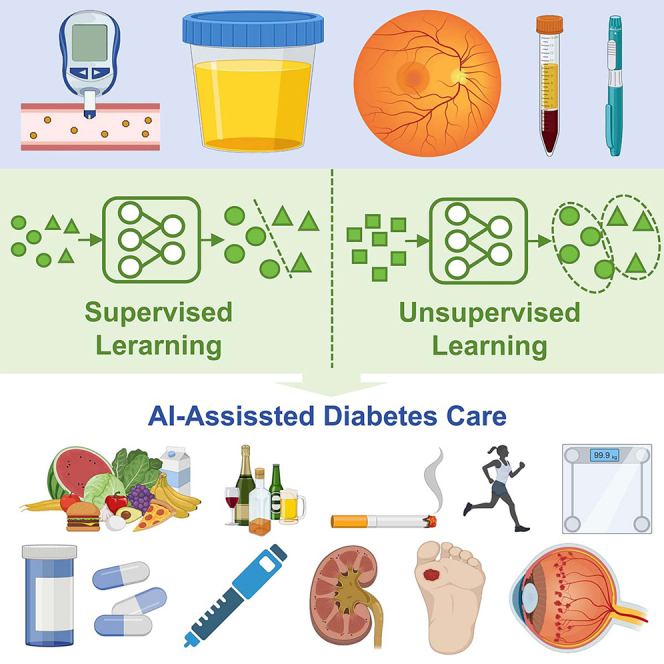
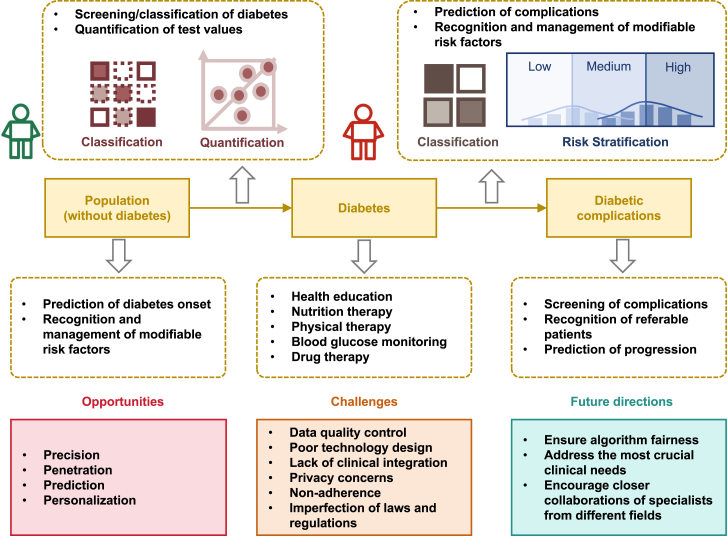
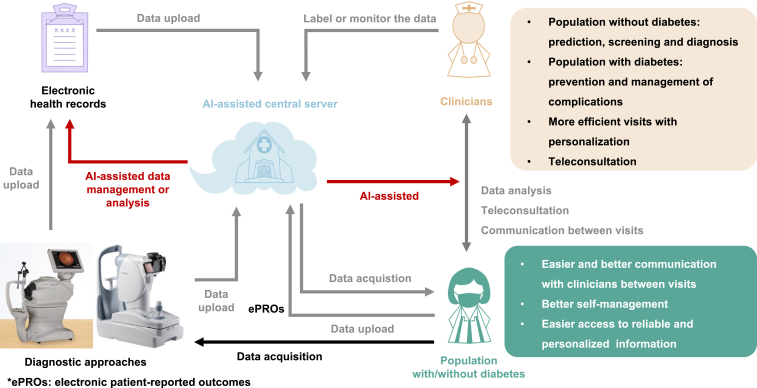
The increasing prevalence of diabetes, high avoidable morbidity and mortality due to diabetes and diabetic complications, and related substantial economic burden make diabetes a significant health challenge worldwide. A shortage of diabetes specialists, uneven distribution of medical resources, low adherence to medications, and improper self-management contribute to poor glycemic control in patients with diabetes. Recent advancements in digital health technologies, especially artificial intelligence (AI), provide a significant opportunity to achieve better efficiency in diabetes care, which may diminish the increase in diabetes-related health-care expenditures. Here, we review the recent progress in the application of AI in the management of diabetes and then discuss the opportunities and challenges of AI application in clinical practice. Furthermore, we explore the possibility of combining and expanding upon existing digital health technologies to develop an AI-assisted digital health-care ecosystem that includes the prevention and management of diabetes.
Overview
AI snapshot
Written from the paper’s full text.
TL;DR
This review summarizes how AI and machine learning are being applied across diabetes prediction, screening, classification, comprehensive management, and complication detection, and argues they could shift care toward precision, penetration, prediction, and personalization. It also outlines persistent barriers—data quality, design, clinical integration, privacy, adherence, and regulation—and proposes an AI-assisted digital health-care ecosystem.
Key findings
- AI has been applied across the diabetes care continuum: prediction of onset (e.g., ML-based logistic regression AUC 0.78 for 5-year new-onset diabetes; administrative-data model AUC 0.80; gradient-boosting model AUC 0.71 and overall accuracy 94.9%), screening/classification, management, and complication prediction/screening.
- In diabetic retinopathy screening, reported performance is high: DeepDR achieved internal-validation AUCs of 0.943, 0.955, 0.960, and 0.972 for mild, moderate, severe, and proliferative DR, with external-validation AUCs of 0.916–0.970; IDx-DR had sensitivity 87.2% and specificity 90.7%; EyeArt had 91.3% sensitivity and 91.1% specificity for referral-warranted DR.
- For glucose monitoring and dosing, a meta-analysis reported pooled sensitivity 0.80 and specificity 0.92 for predicting hypoglycemia, and pooled sensitivity 0.79 and specificity 0.80 for detecting hypoglycemia; a Ramadan-fasting model estimated normal glucose in 95.2% of readings, hyperglycemic events in 82.6%, but hypoglycemic events in only 27.9%.
- The review identifies opportunities in precision, penetration, prediction, and personalization, but lists challenges including data quality control, poor technology design, lack of clinical integration, privacy concerns, non-adherence, and imperfect laws/regulations; LLMs are promising but may produce inconsistent or misleading information.
Methods
- Narrative review of recent progress in AI applications in diabetes management, covering prediction and prevention, screening and classification, comprehensive management, diabetic complications, opportunities/challenges, and a proposed AI-assisted digital health-care ecosystem.
- Synthesizes cited studies and includes Table 1 on AI methods, inputs, and performance for diabetic complications and Table 2 on challenges and mitigating strategies.
- No primary data collection, systematic search strategy, or meta-analysis is described in the paper.
Limitations
- The paper states limitations of AI in diabetes care: data quality and bias, poor technology design, lack of clinical integration, privacy/security risks, non-adherence, and imperfect laws/regulations; it also notes ML flaws such as data bias, overfitting, resource-intensive training, and limited transfer learning, and says LLMs may risk inconsistency or misleading information.
- Evident from the text: as a narrative review, it does not report a systematic search, risk-of-bias assessment, or pooled analysis, and the cited performance metrics come from heterogeneous studies and settings, so they are not directly comparable or independently validated within the review.
Model-written summary. Check it against the paper before relying on it.
Integrity signals
Registry
Cites
Statistics
Figures
Verification
Claims the paper makes
38 Own interpretation · 28 Partly supported · 26 Supported · 23 No full text of the sources · 6 No basis given · 3 Supported so far · 1 Not supported · 1 Check pending · 1 Not checked yet · accuracy not yet measured
At least one cited source doesn’t support this claim or points to a different paper, and none confirmed it — see the verdicts below.
In the paper
“the best results yielded an accuracy of 77.32%, sensitivity of 76.89% and specificity of 77.43% for detecting the presence of DR”
§ Artificial intelligence in diabetes management: Advancements, opportunities, and challenges > Application of AI in the prediction, screening, and management of diabetic complications
What the sources say
- Disputedcites Saleh et al.109 Saleh E. Błaszczyński J. Moreno A. Valls A. Romero-Aroca P. de la Riva-Fernández S. Słowiński R. Learning ensemble classifiers for diabetic retinopathy assessment Artif. Intell. Med. 85 2018 50 63 10.1016/j.artmed.2017.09.006 28993124 sourceExperimental — accuracy not yet measured
Table 8 (Additional information; page not provided) assigns 77.32% accuracy, 76.89% sensitivity, and 77.43% specificity to DRSA, not the fuzzy random forest (FRF). It reports 80.29%, 80.67%, and 80.18%, respectively, for FRF. The Conclusions (page not provided) describe analysis of retinal photos as a later, still-in-progress stage rather than the input to these classifiers. (LLM, conf=0.92)
Checked by a reasoning model — may be wrong.
plain- Asserted: passes — The authors put it forward as true.
- Checkable: passes — It can be checked against evidence.
- Load-bearing: unclear — It is unclear whether the paper’s conclusions depend on it.
- Based: passes — The paper gives a reason why it holds.
- Disputed
The cited sources support only part of this claim — read each source’s verdict below.
In the paper
“In the prediction of diabetic complications, several studies tried to utilize risk factors (mainly from EHRs) to develop AI algorithms to predict various types of diabetes-related complications with favorable predictive performance.94,95,96,97,98,99,100”
§ Artificial intelligence in diabetes management: Advancements, opportunities, and challenges > Application of AI in the prediction, screening, and management of diabetic complications
What the sources say
- Not checked — no full text of the sourcecites [94] Lagani V. Chiarugi F. Manousos D. Verma V. Fursse J. Marias K. Tsamardinos I. Realization of a service for the long-term risk assessment of diabetes-related complications J. Diabet. Complicat. 29 2015 691 698 10.1016/j.jdiacomp.2015.03.011 25953402 source
- Partly supportedcites [95] Marini S. Trifoglio E. Barbarini N. Sambo F. Di Camillo B. Malovini A. Manfrini M. Cobelli C. Bellazzi R. A Dynamic Bayesian Network model for long-term simulation of clinical complications in type 1 diabetes J. Biomed. Inf. 57 2015 369 376 10.1016/j.jbi.2015.08.021 26325295 sourceExperimental — accuracy not yet measured
The Discussion reports that dynamic Bayesian networks modeled two type 1 diabetes complications, nephropathy and cardiovascular disease, with less than 10% error in population-state trajectories on independent test data. However, §2.1 identifies the data as coming from the DCCT and EDIC longitudinal studies, not EHRs, and the reported performance concerns cohort simulation rather than demonstrated individual-level complication prediction. Page numbers are unavailable in our copy. (LLM, conf=0.85)
- Not checked — no full text of the sourcecites [96] Armengol E. Palaudàries A. Plaza E. Individual prognosis of diabetes long-term risks: a CBR approach Methods Inf. Med. 40 2001 46 51 11310159 source
plaincorrelational- Asserted: passes — The authors put it forward as true.
- Checkable: passes — It can be checked against evidence.
- Load-bearing: passes — The paper’s conclusions depend on it.
- Based: passes — The paper gives a reason why it holds.
Every source the paper cites for this claim was checked and supports it.
In the paper
“The algorithms used in closed-loop systems primarily include model predictive control, proportional-integral-derivative, fuzzy logic, and learning algorithms.86”
§ Artificial intelligence in diabetes management: Advancements, opportunities, and challenges > Application of AI in the comprehensive management of diabetes > Drug therapy
What the sources say
- Supportedcites [86] Rigla M. García-Sáez G. Pons B. Hernando M.E. Artificial Intelligence Methodologies and Their Application to Diabetes J. Diabetes Sci. Technol. 12 2018 303 310 10.1177/1932296817710475 28539087 PMC5851211 source
The “Closed-Loop Systems Based on FL” passage names PID and MPC alongside fuzzy-logic algorithms used in closed-loop studies. The “Machine Learning” passage says learning algorithms can adapt to patient data over time in an artificial pancreas system. Together, these passages support the cited list of approaches. (LLM, conf=0.85)
plain- Asserted: passes — The authors put it forward as true.
- Checkable: passes — It can be checked against evidence.
- Load-bearing: unclear — It is unclear whether the paper’s conclusions depend on it.
- Based: passes — The paper gives a reason why it holds.
- Supported
The cited sources support only part of this claim — read each source’s verdict below.
In the paper
“Modifiable factors identified using the AI method increase the risk of developing diabetes, including high blood pressure, high blood cholesterol, tobacco smoking, insufficient physical activity, poor diet, and overweight or obesity.44,45,46”
§ Artificial intelligence in diabetes management: Advancements, opportunities, and challenges > Application of AI in the prediction and prevention of diabetes > Management of modifiable risk factors for diabetes
What the sources say
- Not checked — no full text of the sourcecites [44] Wang C. Li L. Wang L. Ping Z. Flory M.T. Wang G. Xi Y. Li W. Evaluating the risk of type 2 diabetes mellitus using artificial neural network: An effective classification approach Diabetes Res. Clin. Pract. 100 2013 111 118 10.1016/j.diabres.2013.01.023 23453177 source
- Partly supportedcites [45] Gholipour K. Asghari-Jafarabadi M. Iezadi S. Jannati A. Keshavarz S. Modelling the prevalence of diabetes mellitus risk factors based on artificial neural network and multiple regression East. Mediterr. Health J. 24 2018 770 777 10.26719/emhj.18.012 30328607 sourceExperimental — accuracy not yet measured
The Results (page unavailable) list BMI, current smoking, controlled and uncontrolled hypertension, and raised total cholesterol as predictors ranked by the artificial neural network. They do not list insufficient physical activity or poor diet as ANN-identified predictors. The paper evaluates prediction of existing type 2 diabetes, not whether each listed factor causes an increased risk of developing it. (LLM, conf=0.90)
- Partly supportedcites [46] Zhang L. Shang X. Sreedharan S. Yan X. Liu J. Keel S. Wu J. Peng W. He M. Predicting the Development of Type 2 Diabetes in a Large Australian Cohort Using Machine-Learning Techniques: Longitudinal Survey Study JMIR Med. Inform. 8 2020 e16850 10.2196/16850 PMC7420582 32720912 sourceExperimental — accuracy not yet measured
The Results (Participant Characteristics; no page number in our copy) associate later diabetes with overweight or obesity, self-reported hypertension and dyslipidemia, smoking, less physical activity, and some dietary measures. However, the machine-learning Results explicitly identify BMI as a leading predictor; they do not establish that every listed factor was identified by the models as increasing risk. The observational associations also do not establish that those factors cause diabetes. (LLM, conf=0.86)
plaindirect- Asserted: passes — The authors put it forward as true.
- Checkable: passes — It can be checked against evidence.
- Load-bearing: passes — The paper’s conclusions depend on it.
- Based: passes — The paper gives a reason why it holds.
The cited sources support only part of this claim — read each source’s verdict below.
In the paper
“Errors in CGM also increase the difficulty of predicting BG values (approximately 9% of the mean absolute relative difference for the best sensors70).”
§ Artificial intelligence in diabetes management: Advancements, opportunities, and challenges > Application of AI in the comprehensive management of diabetes > Blood glucose (BG) monitoring
What the sources say
- Partly supportedcites [70] Bailey T.S. Chang A. Christiansen M. Clinical accuracy of a continuous glucose monitoring system with an advanced algorithm J. Diabetes Sci. Technol. 9 2015 209 214 10.1177/1932296814559746 25370149 PMC4604574 sourceExperimental — accuracy not yet measured
The CGM Performance section reports a 9.0% mean absolute relative difference between this system’s readings and the YSI reference. The Discussion describes the system as more accurate than marketed alternatives. The paper does not assess whether CGM errors make future blood-glucose values harder to predict. (LLM, conf=0.88)
plaindirect- Asserted: passes — The authors put it forward as true.
- Checkable: passes — It can be checked against evidence.
- Load-bearing: unclear — It is unclear whether the paper’s conclusions depend on it.
- Based: passes — The paper gives a reason why it holds.
- Partly supported
Every source the paper cites for this claim was checked and supports it.
In the paper
“and the other study used smartphone images to estimate the likelihood of healing of diabetes-related foot ulcers (AUC = 0.73).115”
§ Artificial intelligence in diabetes management: Advancements, opportunities, and challenges > Application of AI in the prediction, screening, and management of diabetic complications
What the sources say
- Supportedcites [115] Kim R.B. Gryak J. Mishra A. Cui C. Soroushmehr S.M.R. Najarian K. Wrobel J.S. Utilization of smartphone and tablet camera photographs to predict healing of diabetes-related foot ulcers Comput. Biol. Med. 126 2020 104042 10.1016/j.compbiomed.2020.104042 PMC9058995 33059239 source
The Discussion & conclusions (page unavailable) state that all images were taken with a smartphone or tablet and that the model using all features achieved an AUROC of 0.734, consistent with the cited AUC of 0.73. That result includes clinical attributes as well as image features; the claim does not say images were the only input. (LLM, conf=0.91)
plaincorrelational- Asserted: passes — The authors put it forward as true.
- Checkable: passes — It can be checked against evidence.
- Load-bearing: unclear — It is unclear whether the paper’s conclusions depend on it.
- Based: passes — The paper gives a reason why it holds.
- Supported
The cited sources support only part of this claim — read each source’s verdict below.
In the paper
“Many people in remote or low-income settings are not well supported by conventional health care.121”
§ Artificial intelligence in diabetes management: Advancements, opportunities, and challenges > Opportunities and challenges of AI applications in the clinical practice of diabetes care > Opportunities for AI application in the clinical practice of diabetes care
What the sources say
- Partly supportedcites [121] Graham G.N. Ostrowski M. Sabina A.B. Population health-based approaches to utilizing digital technology: a strategy for equity J. Publ. Health Pol. 37 2016 154 166 10.1057/s41271-016-0012-5 27899799 sourceExperimental — accuracy not yet measured
The Abstract (page not specified in our copy) says access to care depends on where a person lives and describes disparities in the use of health services. The section on Camden describes residents relying on inefficient emergency-department care rather than preventive care. These passages support the point for underserved, low-income communities, but do not specifically establish it for remote settings. (LLM, conf=0.82)
plain- Asserted: passes — The authors put it forward as true.
- Checkable: passes — It can be checked against evidence.
- Load-bearing: passes — The paper’s conclusions depend on it.
- Based: passes — The paper gives a reason why it holds.
- Partly supported
The cited sources support only part of this claim — read each source’s verdict below.
In the paper
“The reach of AI-based DHTs, coupled with the relative reduction in cost and increased capability of mobile communications, has led to its greater penetration into traditionally difficult-to-reach communities compared with robust conventional health care.121”
§ Artificial intelligence in diabetes management: Advancements, opportunities, and challenges > Opportunities and challenges of AI applications in the clinical practice of diabetes care > Opportunities for AI application in the clinical practice of diabetes care
What the sources say
- Partly supportedcites [121] Graham G.N. Ostrowski M. Sabina A.B. Population health-based approaches to utilizing digital technology: a strategy for equity J. Publ. Health Pol. 37 2016 154 166 10.1057/s41271-016-0012-5 27899799 sourceExperimental — accuracy not yet measured
The “Digital Technology -Mobile Personal Engagement” section reports widespread smartphone ownership among low-income and underserved U.S. populations, and the Conclusion describes mobile technology’s potential to reach them. The paper does not establish that AI-based digital health tools have penetrated these communities more than conventional health care, or attribute such penetration to falling mobile-communication costs and increasing capabilities. (LLM, conf=0.86)
plaindirect- Asserted: passes — The authors put it forward as true.
- Checkable: passes — It can be checked against evidence.
- Load-bearing: passes — The paper’s conclusions depend on it.
- Based: passes — The paper gives a reason why it holds.
- Partly supported
The cited sources support only part of this claim — read each source’s verdict below.
In the paper
“The results showed that participants could complete only 43% of the tasks without assistance.”
§ Artificial intelligence in diabetes management: Advancements, opportunities, and challenges > Opportunities and challenges of AI applications in the clinical practice of diabetes care > Challenges of AI application in the clinical practice of diabetes care
What the sources say
- Partly supportedcites [130] Sarkar U. Gourley G.I. Lyles C.R. Tieu L. Clarity C. Newmark L. Singh K. Bates D.W. Usability of Commercially Available Mobile Applications for Diverse Patients J. Gen. Intern. Med. 31 2016 1417 1426 27418347 PMC5130945 sourceExperimental — accuracy not yet measured
The Results report that participants completed 79 of 185 (43%) data-retrieval tasks across 11 apps without assistance. The claim omits that restriction and implies the figure covers all tasks; the Results separately report 51% for data-entry tasks. (LLM, conf=0.88)
plainn = 26- Asserted: passes — The authors put it forward as true.
- Checkable: passes — It can be checked against evidence.
- Load-bearing: passes — The paper’s conclusions depend on it.
- Based: passes — The paper gives a reason why it holds.
- Partly supported
The cited sources support only part of this claim — read each source’s verdict below.
In the paper
“For neuropathy screening, previous studies explored the development of AI systems to identify diabetic neuropathy based on EHRs116 or corneal confocal microscopy images,117,118,119 with AUCs ranging from 0.83 to 0.95.”
§ Artificial intelligence in diabetes management: Advancements, opportunities, and challenges > Application of AI in the prediction, screening, and management of diabetic complications
What the sources say
- Supportedcites [116] Metsker O. Magoev K. Yakovlev A. Yanishevskiy S. Kopanitsa G. Kovalchuk S. Krzhizhanovskaya V.V. Identification of risk factors for patients with diabetes: diabetic polyneuropathy case study BMC Med. Inf. Decis. Making 20 2020 201 10.1186/s12911-020-01215-w PMC7444272 32831065 source
The Background states that the study developed machine-learning methods to identify diabetic polyneuropathy risk from structured electronic medical records. The Results section reports AUCs of 0.8644–0.8988, within the cited range of 0.83–0.95. Citation 116 is attached to the EHR-based work, not the corneal-image studies. (LLM, conf=0.91)
- Supportedcites [117] Williams B.M. Borroni D. Liu R. Zhao Y. Zhang J. Lim J. Ma B. Romano V. Qi H. Ferdousi M. An artificial intelligence-based deep learning algorithm for the diagnosis of diabetic neuropathy using corneal confocal microscopy: a development and validation study Diabetologia 63 2020 419 430 10.1007/s00125-019-05023-4 31720728 PMC6946763 source
The Abstract Methods describes a deep-learning algorithm trained on corneal confocal microscopy images to diagnose diabetic neuropathy. The Results, under “Clinical testing and validation based on ENA image dataset,” report an AUC of 0.826, rounded to 0.83, for classifying participants with and without neuropathy. The cited paper thus supports the image-based study and the lower end of the range reported across the cited studies. (LLM, conf=0.93)
- Partly supportedcites [118] Salahouddin T. Petropoulos I.N. Ferdousi M. Ponirakis G. Asghar O. Alam U. Kamran S. Mahfoud Z.R. Efron N. Malik R.A. Qidwai U.A. Artificial Intelligence-Based Classification of Diabetic Peripheral Neuropathy From Corneal Confocal Microscopy Images Diabetes Care 44 2021 e151 e153 10.2337/dc20-2012 34083322 PMC8323170 sourceExperimental — accuracy not yet measured
The paper’s classification results report an AI system using corneal confocal microscopy images to identify diabetic peripheral neuropathy, with AUCs of 0.86 and 0.95 for two comparisons. It also reports an AUC of 1.0 for distinguishing affected patients from controls, so 0.95 does not capture the full range of results in this source. The EHR portion of the citing sentence is attached to a different citation. (LLM, conf=0.87)
plain- Asserted: passes — The authors put it forward as true.
- Checkable: passes — It can be checked against evidence.
- Load-bearing: unclear — It is unclear whether the paper’s conclusions depend on it.
- Based: passes — The paper gives a reason why it holds.
- Supported
- Probably not a substantial claim. 31
- It may state two separate claims as one. 59
- The quote only partly states this claim. 3
The cited sources support only part of this claim — read each source’s verdict below.
In the paper
“The increasing prevalence of diabetes, high avoidable morbidity and mortality due to diabetes and diabetic complications, and related substantial economic burden make diabetes a significant health challenge worldwide.”
§ Artificial intelligence in diabetes management: Advancements, opportunities, and challenges > Abstract
What the sources say
- Partly supportedcites [4] Jia W. Diabetes care in China: Innovations and implications J. Diabetes Investig. 13 2022 1795 1797 10.1111/jdi.13908 PMC9623513 36121277 sourceExperimental — accuracy not yet measured
The opening passage links rising prevalence, avoidable morbidity and mortality, and economic burden to a major health challenge in China. The citing sentence extends that conclusion to the world, which this passage does not establish. (LLM, conf=0.89)
plaindirect- Asserted: passes — The authors put it forward as true.
- Checkable: passes — It can be checked against evidence.
- Load-bearing: fails — The paper’s conclusions may not depend on it.
- Based: passes — The paper gives a reason why it holds.
Probably not a substantial claim. The paper’s conclusions may not depend on it.
- Partly supported
The sources with a verdict support this claim; the rest weren’t checked yet, have no full text we could read, or their verdicts aren’t rated yet.
In the paper
“Despite the rapid progress of ML methods, there are several potential flaws, including data bias,27 overfitting,28 resource-intensive training,29 and limited transfer learning.30”
§ Artificial intelligence in diabetes management: Advancements, opportunities, and challenges > Introduction
What the sources say
- Not checked — no full text of the sourcecites [27] Gianfrancesco M.A. Tamang S. Yazdany J. Schmajuk G. Potential Biases in Machine Learning Algorithms Using Electronic Health Record Data JAMA Intern. Med. 178 2018 1544 1547 10.1001/jamainternmed.2018.3763 30128552 PMC6347576 source
- Not checked — no full text of the sourcecites [28] Ying X. An Overview of Overfitting and its Solutions J. Phys, Conf. Ser. 1168 2019 022022 source
- Supportedcites [29] Gómez-Carmona O. Casado-Mansilla D. López-de-Ipiña D. García-Zubia J. Optimizing computational resources for edge intelligence through model cascade strategies IEEE Internet Things J. 9 2022 7404 7417 source
Citation 29 is attached to “resource-intensive training,” not the other listed flaws. The Discussion describes training increasingly large AI and deep-learning models with massive amounts of data and scaled-up computational resources. (LLM, conf=0.88)
hedged- Asserted: passes — The authors put it forward as true.
- Checkable: passes — It can be checked against evidence.
- Load-bearing: unclear — It is unclear whether the paper’s conclusions depend on it.
- Based: passes — The paper gives a reason why it holds.
It may state two separate claims as one.
The cited sources support only part of this claim — read each source’s verdict below.
In the paper
“A targeted and reasonable diet can control blood sugar and lipids and supplement protein and other nutrients.65”
§ Artificial intelligence in diabetes management: Advancements, opportunities, and challenges > Application of AI in the comprehensive management of diabetes > Medical nutrition therapy
What the sources say
- Partly supportedcites [65] Sami W. Ansari T. Butt N.S. Ab Hamid M.R. Effect of diet on type 2 diabetes mellitus: A review Int J Health Sci-Ijh 11 2017 10.1002/dmrr.2515 PMC5426415 28539866Experimental — accuracy not yet measured
The sections “Relation between Dietary Practices and Diabetes Complications” and “Dietary Knowledge of Type 2 Diabetics” say that diet affects blood sugar and lipid levels and that nutrition therapy can help manage dyslipidemia. They do not support supplementing protein or other nutrients; the latter section instead notes that protein intake in one population exceeded recommendations. Page numbers are not available in our copy. (LLM, conf=0.87)
plaindirect- Asserted: passes — The authors put it forward as true.
- Checkable: passes — It can be checked against evidence.
- Load-bearing: fails — The paper’s conclusions may not depend on it.
- Based: passes — The paper gives a reason why it holds.
Probably not a substantial claim. The paper’s conclusions may not depend on it. It may state two separate claims as one.
- Partly supported
The cited sources support only part of this claim — read each source’s verdict below.
In the paper
“In summary, ML methods enable the development of AI applications that facilitate the discovery of previously unrecognized patterns in the data without the need to specify decision rules for each specific task or to account for complex interactions among input features. Therefore, ML has become the preferred framework for building AI utilities.34”
§ Artificial intelligence in diabetes management: Advancements, opportunities, and challenges > Introduction
What the sources say
- Partly supportedcites [34] Roberts K. Boland M.R. Pruinelli L. Dcruz J. Berry A. Georgsson M. Hazen R. Sarmiento R.F. Backonja U. Yu K.-H. Biomedical informatics advancing the national health agenda: the AMIA 2015 year-in-review in clinical and consumer informatics J. Am. Med. Inf. Assoc. 24 2017 e185 e190 10.1093/jamia/ocw103 PMC6080724 27497798 sourceExperimental — accuracy not yet measured
Split into 2 atoms — 0 confirmed, 2 partially supported, 0 disputed, 0 misattributed, 0 unverifiable. Expand the claim to see per-atom verdicts.
plaindirect- Asserted: passes — The authors put it forward as true.
- Checkable: passes — It can be checked against evidence.
- Load-bearing: unclear — It is unclear whether the paper’s conclusions depend on it.
- Based: passes — The paper gives a reason why it holds.
It may state two separate claims as one.
- Partly supported
Every source the paper cites for this claim was checked and supports it.
In the paper
“With the inputs of SMBG and non-rapid insulin, this work is worth discussing today because SMBG and non-rapid insulin formulations are still used in many parts of the world.”
§ Artificial intelligence in diabetes management: Advancements, opportunities, and challenges > Application of AI in the comprehensive management of diabetes > Drug therapy
What the sources say
- Supportedcites [82] Fong S. Zhang Y. Fiaidhi J. Mohammed O. Mohammed S. Evaluation of stream mining classifiers for real-time clinical decision support system: A case study of blood glucose prediction in diabetes therapy BioMed Res. Int. 2013 2013 274193 10.1155/2013/274193 PMC3791638 24163813 source
Section 3.1 (page not provided) describes blood-glucose measurements before and after meals and at other times as part of the study data. Section 3.2 (page not provided) identifies NPH and Ultralente insulin alongside regular insulin. The statement about why the work remains worth discussing today is the citing authors’ rationale, not a finding attributed to Fong et al. (LLM, conf=0.86)
plain- Asserted: passes — The authors put it forward as true.
- Checkable: passes — It can be checked against evidence.
- Load-bearing: passes — The paper’s conclusions depend on it.
- Based: passes — The paper gives a reason why it holds.
Probably not a substantial claim. It may state two separate claims as one.
- Supported
Every source the paper cites for this claim was checked and supports it.
In the paper
“The prediction horizon range previously explored ranged between 5 and 180 min. Short-term predictions were the most frequently explored, as most studies used prediction horizons below 60 min.71”
§ Artificial intelligence in diabetes management: Advancements, opportunities, and challenges > Application of AI in the comprehensive management of diabetes > Blood glucose (BG) monitoring
What the sources say
- Supportedcites [71] Contreras I. Vehi J. Artificial Intelligence for Diabetes Management and Decision Support: Literature Review J. Med. Internet Res. 20 2018 e10775 10.2196/10775 PMC6000484 29848472 source
The Results section under “Blood Glucose Prediction” states that prediction horizons ranged from 5 to 180 minutes and that short-term predictions were most frequent: 38 of 49 studies (76%) used horizons below 60 minutes. (LLM, conf=0.95)
plain- Asserted: passes — The authors put it forward as true.
- Checkable: passes — It can be checked against evidence.
- Load-bearing: unclear — It is unclear whether the paper’s conclusions depend on it.
- Based: passes — The paper gives a reason why it holds.
It may state two separate claims as one.
- Supported
The cited sources support only part of this claim — read each source’s verdict below.
In the paper
“A proper diet is indispensable in managing diabetic patients by maintaining normal blood sugar levels and reducing the burden of pancreatic islet β cells.64”
§ Artificial intelligence in diabetes management: Advancements, opportunities, and challenges > Application of AI in the comprehensive management of diabetes > Medical nutrition therapy
What the sources say
- Partly supportedcites [64] Kitagishi Y. Nakanishi A. Minami A. Asai Y. Yasui M. Iwaizako A. Suzuki M. Ono Y. Ogura Y. Matsuda S. Certain Diet and Lifestyle May Contribute to Islet beta-cells Protection in Type-2 Diabetes via the Modulation of Cellular PI3K/AKT Pathway Open Biochem. J. 8 2014 74 82 10.2174/1874091X01408010074 25400709 PMC4231374 sourceExperimental — accuracy not yet measured
The section “Certain Diet and Lifestyle May Contribute to Islet β-Cells Protection” (page unavailable) says oxidative damage can be reduced by controlling hyperglycemia and calorie intake, and discusses possible dietary contributions to β-cell protection. It does not establish that a proper diet is indispensable for diabetic patients, maintains normal blood sugar levels, or reduces β-cell burden by doing so. (LLM, conf=0.84)
plaindirect- Asserted: passes — The authors put it forward as true.
- Checkable: passes — It can be checked against evidence.
- Load-bearing: fails — The paper’s conclusions may not depend on it.
- Based: passes — The paper gives a reason why it holds.
Probably not a substantial claim. The paper’s conclusions may not depend on it. It may state two separate claims as one.
- Partly supported
The cited sources support only part of this claim — read each source’s verdict below.
In the paper
“Prior AI models in diabetes management offered several advantages, such as data analysis, pattern recognition, decision support, and patient education, but faced limitations in natural language understanding, personalized treatment, accuracy, and potential biases.71”
§ Artificial intelligence in diabetes management: Advancements, opportunities, and challenges > Conclusion and perspective > Recommendations for future directions
What the sources say
- Partly supportedcites [71] Contreras I. Vehi J. Artificial Intelligence for Diabetes Management and Decision Support: Literature Review J. Med. Internet Res. 20 2018 e10775 10.2196/10775 PMC6000484 29848472 sourceExperimental — accuracy not yet measured
Split into 2 atoms — 0 confirmed, 2 partially supported, 0 disputed, 0 misattributed, 0 unverifiable. Expand the claim to see per-atom verdicts.
plain- Asserted: passes — The authors put it forward as true.
- Checkable: passes — It can be checked against evidence.
- Load-bearing: passes — The paper’s conclusions depend on it.
- Based: passes — The paper gives a reason why it holds.
It may state two separate claims as one.
- Partly supported
The cited sources support only part of this claim — read each source’s verdict below.
In the paper
“User adherence is crucial to the effectiveness of DHT applications in the real world, which can be affected by convenience, user experience, and true benefits brought by this technology (for example, helping them decide when to contact their provider, being more aware of their symptoms, and feeling more connected to their provider).138,139”
§ Artificial intelligence in diabetes management: Advancements, opportunities, and challenges > Opportunities and challenges of AI applications in the clinical practice of diabetes care > Challenges of AI application in the clinical practice of diabetes care
What the sources say
- Partly supportedcites [138] Blakey J.D. Bender B.G. Dima A.L. Weinman J. Safioti G. Costello R.W. Digital technologies and adherence in respiratory diseases: the road ahead Eur. Respir. J. 52 2018 1801147 10.1183/13993003.01147-2018 PMC6364097 30409819 sourceExperimental — accuracy not yet measured
In ‘Considering the intended users of the interventions’ (page unavailable), the paper says sustained real-world use is critical to digital technologies’ success and discusses user experience, desirable features, and reasons patients disengage. It does not specifically identify convenience as a factor or substantiate the cited sentence’s examples of deciding when to contact a provider, becoming more aware of symptoms, or feeling more connected to a provider. (LLM, conf=0.83)
- Partly supportedcites [139] Rudin R.S. Fanta C.H. Qureshi N. Duffy E. Edelen M.O. Dalal A.K. Bates D.W. A Clinically Integrated mHealth App and Practice Model for Collecting Patient-Reported Outcomes between Visits for Asthma Patients: Implementation and Feasibility Appl. Clin. Inf. 10 2019 783 793 10.1055/s-0039-1697597 PMC6795530 31618782 sourceExperimental — accuracy not yet measured
The Patient Themes section (page not available) reports that patients valued the app’s simplicity, symptom awareness, and connection to their provider; the discussion (p. 789) says its core features helped patients decide when to seek care. The Clinical Relevance Statement reports questionnaire adherence, but this single-app feasibility study does not establish that adherence is crucial to the real-world effectiveness of DHT applications generally, or that the listed benefits caused adherence. (LLM, conf=0.83)
plaindirect- Asserted: passes — The authors put it forward as true.
- Checkable: passes — It can be checked against evidence.
- Load-bearing: unclear — It is unclear whether the paper’s conclusions depend on it.
- Based: passes — The paper gives a reason why it holds.
It may state two separate claims as one.
- Partly supported
Every source the paper cites for this claim was checked and supports it.
In the paper
“Federated computing approaches have further been developed, wherein dedicated parameter servers are responsible for aggregating and distributing local learning; however, a remainder of a central structure is kept.136”
§ Artificial intelligence in diabetes management: Advancements, opportunities, and challenges > Opportunities and challenges of AI applications in the clinical practice of diabetes care > Challenges of AI application in the clinical practice of diabetes care
What the sources say
- Supportedcites [136] Warnat-Herresthal S. Schultze H. Shastry K.L. Manamohan S. Mukherjee S. Garg V. Sarveswara R. Händler K. Pickkers P. Aziz N.A. Swarm Learning for decentralized and confidential clinical machine learning Nature 594 2021 265 270 10.1038/s41586-021-03583-3 34040261 PMC8189907 source
The Concept of Swarm Learning section states the citing sentence’s claim directly: federated approaches use dedicated parameter servers to aggregate and distribute local learning, retaining a central structure. The Fig. 1 caption likewise describes federated learning as having parameter settings orchestrated by a central server. (LLM, conf=0.95)
plain- Asserted: passes — The authors put it forward as true.
- Checkable: passes — It can be checked against evidence.
- Load-bearing: unclear — It is unclear whether the paper’s conclusions depend on it.
- Based: passes — The paper gives a reason why it holds.
It may state two separate claims as one.
- Supported
Every source the paper cites for this claim was checked and supports it.
In the paper
“Although participants had interest in having technology to support self-management, they reported a lack of confidence with technology, as well as frustration with design features and navigation.130”
§ Artificial intelligence in diabetes management: Advancements, opportunities, and challenges > Opportunities and challenges of AI applications in the clinical practice of diabetes care > Challenges of AI application in the clinical practice of diabetes care
What the sources say
- Supportedcites [130] Sarkar U. Gourley G.I. Lyles C.R. Tieu L. Clarity C. Newmark L. Singh K. Bates D.W. Usability of Commercially Available Mobile Applications for Diverse Patients J. Gen. Intern. Med. 31 2016 1417 1426 27418347 PMC5130945 source
The Abstract identifies all three themes: interest in technology for self-management, lack of confidence with technology, and frustration with design features and navigation. The Results section likewise reports participants’ interest alongside lack of confidence and frustration using the apps. Page numbers were not supplied in the excerpts. (LLM, conf=0.95)
plainn = 26- Asserted: passes — The authors put it forward as true.
- Checkable: passes — It can be checked against evidence.
- Load-bearing: passes — The paper’s conclusions depend on it.
- Based: passes — The paper gives a reason why it holds.
It may state two separate claims as one.
- Supported
The cited sources support only part of this claim — read each source’s verdict below.
In the paper
“These individuals often have the poorest understanding of the disease, low use of maintenance medications, and poor health outcomes.122”
§ Artificial intelligence in diabetes management: Advancements, opportunities, and challenges > Opportunities and challenges of AI applications in the clinical practice of diabetes care > Opportunities for AI application in the clinical practice of diabetes care
What the sources say
- Partly supportedcites [122] Himes B.E. Weitzman E.R. Innovations in health information technologies for chronic pulmonary diseases Respir. Res. 17 2016 38 10.1186/s12931-016-0354-3 27048618 PMC4822326 sourceExperimental — accuracy not yet measured
The Background’s health-disparities section (page not provided) identifies health literacy and medication non-adherence as factors in chronic pulmonary disease disparities. Another Background passage links poor adherence to adverse clinical outcomes. The paper does not establish that the unspecified individuals have the poorest disease understanding or specifically low use of maintenance medications. (LLM, conf=0.79)
plaincorrelational- Asserted: passes — The authors put it forward as true.
- Checkable: passes — It can be checked against evidence.
- Load-bearing: passes — The paper’s conclusions depend on it.
- Based: passes — The paper gives a reason why it holds.
It may state two separate claims as one.
- Partly supported
The cited sources support only part of this claim — read each source’s verdict below.
In the paper
“Application of AI systems in the real world may lead to many unintended outcomes, including alert fatigue,131 additional burdens for clinicians, disruption of interpersonal communications, and generation of specific threats requiring increased vigilance to recognize.132”
§ Artificial intelligence in diabetes management: Advancements, opportunities, and challenges > Opportunities and challenges of AI applications in the clinical practice of diabetes care > Challenges of AI application in the clinical practice of diabetes care
What the sources say
- Not checked — no full text of the sourcecites [131] Carspecken C.W. Sharek P.J. Longhurst C. Pageler N.M. A clinical case of electronic health record drug alert fatigue: consequences for patient outcome Pediatrics 131 2013 e1970 e1973 10.1542/peds.2012-3252 23713099 source
- Partly supportedcites [132] Ash J.S. Berg M. Coiera E. Some unintended consequences of information technology in health care: The nature of patient care information system-related errors J. Am. Med. Inf. Assoc. 11 2004 104 112 10.1197/jamia.M1471 PMC353015 14633936 sourceExperimental — accuracy not yet measured
The introduction (p. 1) says patient care information systems can add work tasks, disrupt communication routines, and create hazards requiring vigilance to detect. These points support the outcomes attached to citation 132, but the paper discusses patient care information systems rather than AI systems specifically. Alert fatigue is attached to citation 131, not this source. (LLM, conf=0.86)
hedgedconditional- Asserted: passes — The authors put it forward as true.
- Checkable: passes — It can be checked against evidence.
- Load-bearing: unclear — It is unclear whether the paper’s conclusions depend on it.
- Based: passes — The paper gives a reason why it holds.
It may state two separate claims as one.
Every source the paper cites for this claim was checked and supports it.
In the paper
“As an alternative, Warnat-Herresthal et al. introduced a decentralized ML approach named swarm learning,136 which dispenses with a dedicated server, shares the parameters via the swarm network, and builds the models independently on private data at the individual sites.”
§ Artificial intelligence in diabetes management: Advancements, opportunities, and challenges > Opportunities and challenges of AI applications in the clinical practice of diabetes care > Challenges of AI application in the clinical practice of diabetes care
What the sources say
- Supportedcites [136] Warnat-Herresthal S. Schultze H. Shastry K.L. Manamohan S. Mukherjee S. Garg V. Sarveswara R. Händler K. Pickkers P. Aziz N.A. Swarm Learning for decentralized and confidential clinical machine learning Nature 594 2021 265 270 10.1038/s41586-021-03583-3 34040261 PMC8189907 source
The Concept of Swarm Learning section states that the authors introduce SL, which dispenses with a dedicated server, shares parameters through the Swarm network, and builds models independently on private data at individual sites. The Methods section likewise describes local training and parameter sharing without a central parameter server. (LLM, conf=0.95)
plain- Asserted: passes — The authors put it forward as true.
- Checkable: passes — It can be checked against evidence.
- Load-bearing: unclear — It is unclear whether the paper’s conclusions depend on it.
- Based: passes — The paper gives a reason why it holds.
It may state two separate claims as one.
- Supported
Every source the paper cites for this claim was checked and supports it.
In the paper
“To overcome this issue, Dai et al. developed an automated, interpretable, and validated system (named DeepDR) that performs real-time image quality feedback, retinal lesion detection, and early- to late-stage DR grading with high sensitivity and specificity.103”
§ Artificial intelligence in diabetes management: Advancements, opportunities, and challenges > Conclusion and perspective > Good examples of AI applications in clinical practice
What the sources say
- Supportedcites [103] Dai L. Wu L. Li H. Cai C. Wu Q. Kong H. Liu R. Wang X. Hou X. Liu Y. A deep learning system for detecting diabetic retinopathy across the disease spectrum Nat. Commun. 12 2021 3242 10.1038/s41467-021-23458-5 34050158 PMC8163820 source
The Discussion states that the authors developed an automated, interpretable, validated DeepDR system for real-time image quality feedback, retinal lesion detection, and early- to late-stage DR grading. It also reports high sensitivity and specificity in DR grading; the Results (Performance of the DeepDR system) give corresponding figures for mild NPDR. (LLM, conf=0.94)
plain- Asserted: passes — The authors put it forward as true.
- Checkable: passes — It can be checked against evidence.
- Load-bearing: unclear — It is unclear whether the paper’s conclusions depend on it.
- Based: passes — The paper gives a reason why it holds.
It may state two separate claims as one.
- Rests on an assumption: Proper intervention at an early stage could significantly delay the progression of DR and even reverse mild non-proliferative DR to a DR-free stage.
- Supported
Every source the paper cites for this claim was checked and supports it.
In the paper
“In addition, two main barriers have been identified that may undermine clinicians’ enthusiasm to integrate AI systems into clinical workflows.133 First, experts may struggle to develop trust with these systems because of the numerous inputs and complex data integration involved, which can make it challenging or impossible to convey the specific logic behind an alert or recommendation. Second, some”
§ Artificial intelligence in diabetes management: Advancements, opportunities, and challenges > Opportunities and challenges of AI applications in the clinical practice of diabetes care > Challenges of AI application in the clinical practice of diabetes care
What the sources say
- Supportedcites [133] Henry K.E. Kornfield R. Sridharan A. Linton R.C. Groh C. Wang T. Wu A. Mutlu B. Saria S. Human-machine teaming is key to AI adoption: clinicians' experiences with a deployed machine learning system NPJ Digit. Med. 5 2022 97 10.1038/s41746-022-00597-7 35864312 PMC9304371 source
Split into 2 atoms — 2 confirmed, 0 partially supported, 0 disputed, 0 misattributed, 0 unverifiable. Expand the claim to see per-atom verdicts.
hedgedconditional- Asserted: passes — The authors put it forward as true.
- Checkable: passes — It can be checked against evidence.
- Load-bearing: unclear — It is unclear whether the paper’s conclusions depend on it.
- Based: passes — The paper gives a reason why it holds.
It may state two separate claims as one.
- Supported
Every source the paper cites for this claim was checked and supports it.
In the paper
“As described by the National Institutes of Health, precision medicine is an emerging disease treatment and prevention approach that considers individual variability in genes, environment, and lifestyle for each person.”
§ Artificial intelligence in diabetes management: Advancements, opportunities, and challenges > Opportunities and challenges of AI applications in the clinical practice of diabetes care > Opportunities for AI application in the clinical practice of diabetes care
What the sources say
- Supportedcites [120] Mesko B. The role of artificial intelligence in precision medicine Expert Review of Precision Medicine and Drug Development 2 2017 239 241 10.1080/23808993.2017.1380516 source
Section 3, “There is no precision medicine without AI” (page not specified), reproduces the definition and explicitly attributes it to the National Institutes of Health. It matches the citing sentence’s treatment-and-prevention approach and its reference to individual variability in genes, environment, and lifestyle. (LLM, conf=0.95)
plain- Asserted: passes — The authors put it forward as true.
- Checkable: passes — It can be checked against evidence.
- Load-bearing: fails — The paper’s conclusions may not depend on it.
- Based: passes — The paper gives a reason why it holds.
Probably not a substantial claim. The paper’s conclusions may not depend on it.
- Supported
The cited sources support only part of this claim — read each source’s verdict below.
In the paper
“There exist inherent disadvantages in centralized solutions, including increased data traffic and concerns about data ownership, confidentiality, privacy, and security and creating data monopolies that favor data aggregators.135”
§ Artificial intelligence in diabetes management: Advancements, opportunities, and challenges > Opportunities and challenges of AI applications in the clinical practice of diabetes care > Challenges of AI application in the clinical practice of diabetes care
What the sources say
- Partly supportedcites [135] Kaissis G.A. Makowski M.R. Rückert D. Braren R.F. Secure, privacy-preserving and federated machine learning in medical imaging Nat. Mach. Intell. 2 2020 305 311 10.1038/s42256-020-0186-1 sourceExperimental — accuracy not yet measured
The section ‘Decentralized data and federated machine learning’ says keeping data with its owner addresses governance and ownership concerns, while the discussion of patient-data protection addresses privacy and confidentiality. Our copy does not say centralized solutions create data monopolies favoring aggregators. It also describes burdensome communication as a limitation of decentralized learning, not as increased traffic caused by centralization; no page numbers are available in the indexed passages. (LLM, conf=0.87)
plaindirect- Asserted: passes — The authors put it forward as true.
- Checkable: passes — It can be checked against evidence.
- Load-bearing: passes — The paper’s conclusions depend on it.
- Based: passes — The paper gives a reason why it holds.
It may state two separate claims as one.
- Partly supported
The sources with a verdict support this claim; the rest weren’t checked yet, have no full text we could read, or their verdicts aren’t rated yet.
In the paper
“The first well-established device was IDx-DR, approved by the FDA in 2018 for its high diagnostic performance in clinical trials.104,142”
§ Artificial intelligence in diabetes management: Advancements, opportunities, and challenges > Conclusion and perspective > Good examples of AI applications in clinical practice
What the sources say
- Not checked — no full text of the sourcecites [104] Abràmoff M.D. Lou Y. Erginay A. Clarida W. Amelon R. Folk J.C. Niemeijer M. Improved Automated Detection of Diabetic Retinopathy on a Publicly Available Dataset Through Integration of Deep Learning Invest. Ophthalmol. Vis. Sci. 57 2016 5200 5206 10.1167/iovs.16-19964 27701631 source
- Supportedcites [142] Abràmoff M.D. Lavin P.T. Birch M. Shah N. Folk J.C. Pivotal trial of an autonomous AI-based diagnostic system for detection of diabetic retinopathy in primary care offices NPJ Digit. Med. 1 2018 39 10.1038/s41746-018-0040-6 31304320 PMC6550188 source
The Discussion (page not available) identifies IDx-DR as the first FDA-authorized autonomous diagnostic AI system and says the pivotal trial results led to its authorization. The Abstract reports sensitivity of 87.2% and specificity of 90.7%, exceeding the trial’s prespecified endpoints. The paper describes FDA authorization rather than using the word “approval.” (LLM, conf=0.90)
boosted- Asserted: passes — The authors put it forward as true.
- Checkable: passes — It can be checked against evidence.
- Load-bearing: unclear — It is unclear whether the paper’s conclusions depend on it.
- Based: passes — The paper gives a reason why it holds.
It may state two separate claims as one.
The cited sources support only part of this claim — read each source’s verdict below.
In the paper
“final models, tailored in accordance with the complications, provided an accuracy up to 0.838”
§ Artificial intelligence in diabetes management: Advancements, opportunities, and challenges > Application of AI in the prediction, screening, and management of diabetic complications
What the sources say
- Partly supportedcites Dagliati et al.97 Dagliati A. Marini S. Sacchi L. Cogni G. Teliti M. Tibollo V. De Cata P. Chiovato L. Bellazzi R. Machine Learning Methods to Predict Diabetes Complications J. Diabetes Sci. Technol. 12 2018 295 302 10.1177/1932296817706375 28494618 PMC5851210 sourceExperimental — accuracy not yet measured
The Abstract (page not provided) reports complication-specific final models with accuracy up to 0.838 and lists the risk factors used. The Results (page not provided) clarify that the final retained models were LR models: RF and SVM were evaluated, but the paper does not attribute that final-model accuracy to all three methods. (LLM, conf=0.88)
plaincorrelational- Asserted: passes — The authors put it forward as true.
- Checkable: passes — It can be checked against evidence.
- Load-bearing: unclear — It is unclear whether the paper’s conclusions depend on it.
- Based: passes — The paper gives a reason why it holds.
The quote only partly states this claim.
- Partly supported
The cited sources support only part of this claim — read each source’s verdict below.
In the paper
“the grading of DR as mild, moderate, severe, and proliferative achieves AUCs of 0.943, 0.955, 0.960, and 0.972, respectively (internal validation); in external validations, AUCs for grading range from 0.916 to 0.970”
§ Artificial intelligence in diabetes management: Advancements, opportunities, and challenges > Application of AI in the prediction, screening, and management of diabetic complications
What the sources say
- Partly supportedcites Dai et al.103 Dai L. Wu L. Li H. Cai C. Wu Q. Kong H. Liu R. Wang X. Hou X. Liu Y. A deep learning system for detecting diabetic retinopathy across the disease spectrum Nat. Commun. 12 2021 3242 10.1038/s41467-021-23458-5 34050158 PMC8163820 sourceExperimental — accuracy not yet measured
Split into 2 atoms — 1 confirmed, 1 partially supported, 0 disputed, 0 misattributed, 0 unverifiable. Expand the claim to see per-atom verdicts.
plain- Asserted: passes — The authors put it forward as true.
- Checkable: passes — It can be checked against evidence.
- Load-bearing: unclear — It is unclear whether the paper’s conclusions depend on it.
- Based: passes — The paper gives a reason why it holds.
It may state two separate claims as one.
- Partly supported
Every source the paper cites for this claim was checked and supports it.
In the paper
“the prediction accuracy was between 73% (myocardial infarction) and 83% (chronic ischemic heart disease), while the accuracy of traditional models was between 66% and 76%”
§ Artificial intelligence in diabetes management: Advancements, opportunities, and challenges > Application of AI in the prediction, screening, and management of diabetic complications
What the sources say
- Supportedcites Ljubic et al.99 Ljubic B. Hai A.A. Stanojevic M. Diaz W. Polimac D. Pavlovski M. Obradovic Z. Predicting complications of diabetes mellitus using advanced machine learning algorithms J. Am. Med. Inf. Assoc. 27 2020 1343 1351 10.1093/jamia/ocaa120 PMC7647294 32869093 source
Split into 2 atoms — 2 confirmed, 0 partially supported, 0 disputed, 0 misattributed, 0 unverifiable. Expand the claim to see per-atom verdicts.
plaincorrelational- Asserted: passes — The authors put it forward as true.
- Checkable: passes — It can be checked against evidence.
- Load-bearing: unclear — It is unclear whether the paper’s conclusions depend on it.
- Based: passes — The paper gives a reason why it holds.
It may state two separate claims as one.
- Supported
The cited sources support only part of this claim — read each source’s verdict below.
In the paper
“the proposed method yielded accuracy, specificity, and sensitivity of 85.27%, 83.32, and 85.24%, respectively (internal testing dataset); on a separate testing dataset, the classification accuracy, specificity, and sensitivity were 78.50%, 80.64, and 81.40%, respectively”
§ Artificial intelligence in diabetes management: Advancements, opportunities, and challenges > Application of AI in the prediction, screening, and management of diabetic complications
What the sources say
- Partly supportedcites Huang et al.112 Huang G.M. Huang K.Y. Lee T.Y. Weng J. An interpretable rule-based diagnostic classification of diabetic nephropathy among type 2 diabetes patients BMC Bioinf. 16 Suppl 1 2015 S5 10.1186/1471-2105-16-S1-S5 PMC4331704 25707942 sourceExperimental — accuracy not yet measured
Split into 2 atoms — 1 confirmed, 1 partially supported, 0 disputed, 0 misattributed, 0 unverifiable. Expand the claim to see per-atom verdicts.
plain- Asserted: passes — The authors put it forward as true.
- Checkable: passes — It can be checked against evidence.
- Load-bearing: unclear — It is unclear whether the paper’s conclusions depend on it.
- Based: passes — The paper gives a reason why it holds.
It may state two separate claims as one.
- Partly supported
Every source the paper cites for this claim was checked and supports it.
In the paper
“LLMs are built using natural language processing techniques and designed to recognize and understand the structure and meaning of human language, classify texts according to their content or purpose, and generate responses that are appropriate and coherent.146”
§ Artificial intelligence in diabetes management: Advancements, opportunities, and challenges > Conclusion and perspective > Recommendations for future directions
What the sources say
- Supportedcites [146] Ali S.R. Dobbs T.D. Hutchings H.A. Whitaker I.S. Using ChatGPT to write patient clinic letters Lancet. Digit. Health 5 2023 e179 e181 10.1016/S2589-7500(23)00048-1 36894409 source
In “Using ChatGPT to write patient clinic letters,” the paper describes NLP algorithms as recognizing and understanding language, classifying texts, and generating coherent responses. The same passage says ChatGPT uses NLP technology and describes its GPT language model, supporting the citing sentence’s paraphrase about LLMs. (LLM, conf=0.88)
plain- Asserted: passes — The authors put it forward as true.
- Checkable: passes — It can be checked against evidence.
- Load-bearing: fails — The paper’s conclusions may not depend on it.
- Based: passes — The paper gives a reason why it holds.
Probably not a substantial claim. The paper’s conclusions may not depend on it. It may state two separate claims as one.
- Supported
Every source the paper cites for this claim was checked and supports it.
In the paper
“the AUC of the system for referable DR was 0.936, sensitivity was 90.5%, and specificity was 91.6%; for vision-threatening DR, AUC was 0.958, sensitivity was 100%, and specificity was 91.1%”
§ Artificial intelligence in diabetes management: Advancements, opportunities, and challenges > Application of AI in the prediction, screening, and management of diabetic complications
What the sources say
- Supportedcites Ting et al.107 Ting D.S.W. Cheung C.Y.-L. Lim G. Tan G.S.W. Quang N.D. Gan A. Hamzah H. Garcia-Franco R. San Yeo I.Y. Lee S.Y. Development and Validation of a Deep Learning System for Diabetic Retinopathy and Related Eye Diseases Using Retinal Images From Multiethnic Populations With Diabetes JAMA 318 2017 2211 2223 10.1001/jama.2017.18152 29234807 PMC5820739 source
The Results section reports these exact AUC, sensitivity, and specificity values for the deep learning system in the primary validation dataset. The quoted figures apply to referable and vision-threatening diabetic retinopathy, respectively. (LLM, conf=0.95)
plain- Asserted: passes — The authors put it forward as true.
- Checkable: passes — It can be checked against evidence.
- Load-bearing: unclear — It is unclear whether the paper’s conclusions depend on it.
- Based: passes — The paper gives a reason why it holds.
It may state two separate claims as one.
- Supported
Every source the paper cites for this claim was checked and supports it.
In the paper
“the three-field DL system had an AUC of 0.79 in the internal validation set; assessment of the external validation set, which contained only one-field color fundus photographs, with the one-field DL system gave an AUC of 0.70”
§ Artificial intelligence in diabetes management: Advancements, opportunities, and challenges > Application of AI in the prediction, screening, and management of diabetic complications
What the sources say
- Supportedcites Bora et al.102 Bora A. Balasubramanian S. Babenko B. Virmani S. Venugopalan S. Mitani A. de Oliveira Marinho G. Cuadros J. Ruamviboonsuk P. Corrado G.S. Predicting the risk of developing diabetic retinopathy using deep learning Lancet. Digit. Health 3 2021 e10 e19 10.1016/S2589-7500(20)30250-8 33735063 source
Split into 2 atoms — 2 confirmed, 0 partially supported, 0 disputed, 0 misattributed, 0 unverifiable. Expand the claim to see per-atom verdicts.
plaincorrelational- Asserted: passes — The authors put it forward as true.
- Checkable: passes — It can be checked against evidence.
- Load-bearing: unclear — It is unclear whether the paper’s conclusions depend on it.
- Based: passes — The paper gives a reason why it holds.
It may state two separate claims as one.
- Supported
In the paper
“The emergence of digital health technologies (DHTs), especially artificial intelligence (AI), may help address these obstacles and alleviate the disease burden of diabetes in the future, because AI-based DHTs in diabetes care could help implement better prevention strategies for high-risk populations, manage diabetic patients who are unable to attend physician appointments in person, deliver real-”
§ Artificial intelligence in diabetes management: Advancements, opportunities, and challenges > Introduction
What the sources say
- Not checked — no full text of the sourcecites [8] Ashrafzadeh S. Hamdy O. Patient-Driven Diabetes Care of the Future in the Technology Era Cell Metabol. 29 2019 564 575 10.1016/j.cmet.2018.09.005 30269984 source
hedgedconditional- Asserted: passes — The authors put it forward as true.
- Checkable: passes — It can be checked against evidence.
- Load-bearing: passes — The paper’s conclusions depend on it.
- Based: passes — The paper gives a reason why it holds.
It may state two separate claims as one.
- Rests on an assumption: A shortage of diabetes specialists, uneven distribution of medical resources, low adherence to medications, and improper self-management contribute to poor glycemic control in patients with diabetes.
A claim is checked only against the cited paper’s full text, never its abstract, and none is available for its sources.
In the paper
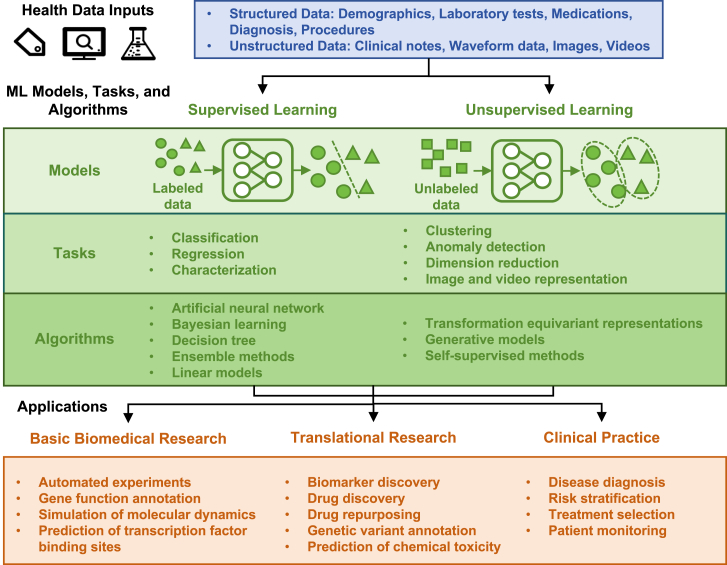
“The application of ML in diabetes care and research has been widely explored in basic biomedical research,16 translational research,14 and clinical practice17 (Figure 1).”
§ Artificial intelligence in diabetes management: Advancements, opportunities, and challenges > Introduction
What the sources say
- Not checked — no full text of the sourcecites [16] Check Hayden E. The automated lab Nature 516 2014 131 132 10.1038/516131a 25471888 source
- Not checked — no full text of the sourcecites [14] Yu K.-H. Beam A.L. Kohane I.S. Artificial intelligence in healthcare Nat. Biomed. Eng. 2 2018 719 731 10.1038/s41551-018-0305-z 31015651 source
- Not checked — no full text of the sourcecites [17] Klonoff A.N. Andy Lee W.-A. Xu N.Y. Nguyen K.T. DuBord A. Kerr D. Six Digital Health Technologies That Will Transform Diabetes J. Diabetes Sci. Technol. 17 2023 239 249 10.1177/19322968211043498 34558330 PMC9846384 source
boosted- Asserted: passes — The authors put it forward as true.
- Checkable: passes — It can be checked against evidence.
- Load-bearing: fails — The paper’s conclusions may not depend on it.
- Based: passes — The paper gives a reason why it holds.
Probably not a substantial claim. The paper’s conclusions may not depend on it.
A conclusion the paper draws from its own results — it cites no other source for it, so there is none to check. The quote shows it is in the paper.
In the paper
“Recent advancements in digital health technologies, especially artificial intelligence (AI), provide a significant opportunity to achieve better efficiency in diabetes care, which may diminish the increase in diabetes-related health-care expenditures.”
§ Artificial intelligence in diabetes management: Advancements, opportunities, and challenges > Abstract
hedgedconditional- Asserted: passes — The authors put it forward as true.
- Checkable: passes — It can be checked against evidence.
- Load-bearing: passes — The paper’s conclusions depend on it.
- Based: fails — The paper may give no reason why it holds.
Probably not a substantial claim. The paper may give no reason why it holds. It may state two separate claims as one.
- Rests on an assumption: A shortage of diabetes specialists, uneven distribution of medical resources, low adherence to medications, and improper self-management contribute to poor glycemic control in patients with diabetes.
In the paper
“However, rule-based systems are expensive to build and brittle. Furthermore, it is challenging to encode higher-order interactions between different pieces of knowledge provided by different specialists, with system effectiveness restricted by the comprehensiveness of pre-existing medical knowledge.12”
§ Artificial intelligence in diabetes management: Advancements, opportunities, and challenges > Introduction
What the sources say
- Not checked — no full text of the sourcecites [12] Samuel A.L. Some studies in machine learning using the game of checkers (Reprinted from Journal of Research and Development, vol 3, 1959 IBM J. Res. Dev. 44 2000 206 226 10.1147/rd.441.0206 source
plaindirect- Asserted: passes — The authors put it forward as true.
- Checkable: passes — It can be checked against evidence.
- Load-bearing: passes — The paper’s conclusions depend on it.
- Based: passes — The paper gives a reason why it holds.
It may state two separate claims as one.
A conclusion the paper draws from its own results — it cites no other source for it, so there is none to check. The quote shows it is in the paper.
In the paper
“AI can predict the risk of diabetes onset and classify diabetes.”
§ Artificial intelligence in diabetes management: Advancements, opportunities, and challenges > Application of AI in the screening and classification of diabetes > General classification of diabetes based on existing clinical guidelines
plaindirect- Asserted: passes — The authors put it forward as true.
- Checkable: passes — It can be checked against evidence.
- Load-bearing: passes — The paper’s conclusions depend on it.
- Based: passes — The paper gives a reason why it holds.
It may state two separate claims as one.
A conclusion the paper draws from its own results — it cites no other source for it, so there is none to check. The quote shows it is in the paper.
In the paper
“One explanation for these shortcomings is that the diagnosis of diabetes is based on the measurement of only one metabolite, glucose; however, the disease is heterogeneous in terms of clinical presentation and progression.”
§ Artificial intelligence in diabetes management: Advancements, opportunities, and challenges > Application of AI in the screening and classification of diabetes > Refined, precise classification of diabetes
hedgeddirect- Asserted: passes — The authors put it forward as true.
- Checkable: passes — It can be checked against evidence.
- Load-bearing: passes — The paper’s conclusions depend on it.
- Based: passes — The paper gives a reason why it holds.
It may state two separate claims as one.
- Rests on an assumption: Existing treatment strategies for diabetes cannot stop the progressive course of the disease and prevent the development of chronic diabetic complications.
A conclusion the paper draws from its own results — it cites no other source for it, so there is none to check. The quote shows it is in the paper.
In the paper
“Particularly, it is worth highlighting that AI algorithms could be quite useful in times when it is difficult to manage diabetes.”
§ Artificial intelligence in diabetes management: Advancements, opportunities, and challenges > Application of AI in the comprehensive management of diabetes > Blood glucose (BG) monitoring
hedgedconditional- Asserted: passes — The authors put it forward as true.
- Checkable: fails — It may be too vague to check against evidence.
- Load-bearing: fails — The paper’s conclusions may not depend on it.
- Based: passes — The paper gives a reason why it holds.
Probably not a substantial claim. It may be too vague to check against evidence. The paper’s conclusions may not depend on it.
A conclusion the paper draws from its own results — it cites no other source for it, so there is none to check. The quote shows it is in the paper.
In the paper
“These AI-based models are less invasive and highly accessible, which could effectively improve the willingness of the general population to screen and provide personalized screening plans for high-risk populations.”
§ Artificial intelligence in diabetes management: Advancements, opportunities, and challenges > Application of AI in the screening and classification of diabetes > Screening of diabetes
hedgedconditional- Asserted: passes — The authors put it forward as true.
- Checkable: passes — It can be checked against evidence.
- Load-bearing: passes — The paper’s conclusions depend on it.
- Based: fails — The paper may give no reason why it holds.
Probably not a substantial claim. The paper may give no reason why it holds. It may state two separate claims as one.
A conclusion the paper draws from its own results — it cites no other source for it, so there is none to check. The quote shows it is in the paper.
In the paper
“Health education aims to empower diabetic patients with increased knowledge and awareness of diabetes, which can further facilitate better disease self-management.”
§ Artificial intelligence in diabetes management: Advancements, opportunities, and challenges > Application of AI in the comprehensive management of diabetes > Health education
plaindirect- Asserted: passes — The authors put it forward as true.
- Checkable: fails — It may be too vague to check against evidence.
- Load-bearing: fails — The paper’s conclusions may not depend on it.
- Based: passes — The paper gives a reason why it holds.
Probably not a substantial claim. It may be too vague to check against evidence. The paper’s conclusions may not depend on it. It may state two separate claims as one.
A conclusion the paper draws from its own results — it cites no other source for it, so there is none to check. The quote shows it is in the paper.
In the paper
“A refined classification system could provide a powerful tool to individualize treatment regimens and identify individuals with an increased risk of complications at diagnosis.”
§ Artificial intelligence in diabetes management: Advancements, opportunities, and challenges > Application of AI in the screening and classification of diabetes > Refined, precise classification of diabetes
hedgedconditionaln = 8,980- Asserted: passes — The authors put it forward as true.
- Checkable: unclear — It is unclear whether it could be checked against evidence.
- Load-bearing: passes — The paper’s conclusions depend on it.
- Based: passes — The paper gives a reason why it holds.
It may state two separate claims as one.
A conclusion the paper draws from its own results — it cites no other source for it, so there is none to check. The quote shows it is in the paper.
In the paper
“Predicting near-future BG on a minute, hour, or overnight timescale enables better diabetes management and therefore remains an active research topic.”
§ Artificial intelligence in diabetes management: Advancements, opportunities, and challenges > Application of AI in the comprehensive management of diabetes > Blood glucose (BG) monitoring
plaindirect- Asserted: passes — The authors put it forward as true.
- Checkable: passes — It can be checked against evidence.
- Load-bearing: passes — The paper’s conclusions depend on it.
- Based: passes — The paper gives a reason why it holds.
It may state two separate claims as one.
In the paper
“Considering that the early stages of T2D are often asymptomatic, individuals can carry the disease for years undiagnosed.48”
§ Artificial intelligence in diabetes management: Advancements, opportunities, and challenges > Application of AI in the screening and classification of diabetes > Screening of diabetes
What the sources say
- Not checked — no full text of the sourcecites [48] American Diabetes Association 2. Classification and Diagnosis of Diabetes: Standards of Medical Care in Diabetes–2021 Diabetes Care 44 2021 S15 S33 33298413 source
plaindirect- Asserted: passes — The authors put it forward as true.
- Checkable: passes — It can be checked against evidence.
- Load-bearing: passes — The paper’s conclusions depend on it.
- Based: passes — The paper gives a reason why it holds.
It may state two separate claims as one.
A conclusion the paper draws from its own results — it cites no other source for it, so there is none to check. The quote shows it is in the paper.
In the paper
“These limitations have motivated the use of AI-based diagnostics that have high classification accuracy and leverage large datasets (including data from wearable and continuous monitoring devices) that are not easily interpreted.”
§ Artificial intelligence in diabetes management: Advancements, opportunities, and challenges > Application of AI in the screening and classification of diabetes > Screening of diabetes
plaindirect- Asserted: passes — The authors put it forward as true.
- Checkable: passes — It can be checked against evidence.
- Load-bearing: passes — The paper’s conclusions depend on it.
- Based: passes — The paper gives a reason why it holds.
It may state two separate claims as one.
- Rests on an assumption: Late-stage diagnosis can lead to health complications and lower life expectancy.
A conclusion the paper draws from its own results — it cites no other source for it, so there is none to check. The quote shows it is in the paper.
In the paper
“Unlike many other medications, insulin must be titrated, which means that the dose will change in response to real-time indicators such as current BG or based on what the patient has recently eaten. This process complicates insulin dosing and requires providers to perform complex calculations to determine the best dose.”
§ Artificial intelligence in diabetes management: Advancements, opportunities, and challenges > Application of AI in the comprehensive management of diabetes > Drug therapy
plaindirect- Asserted: passes — The authors put it forward as true.
- Checkable: passes — It can be checked against evidence.
- Load-bearing: passes — The paper’s conclusions depend on it.
- Based: passes — The paper gives a reason why it holds.
It may state two separate claims as one.
- Rests on an assumption: Errors in insulin dosing can be dangerous, as incorrect dosages can lead to serious adverse effects, such as hypoglycemia, which can cause death.
A conclusion the paper draws from its own results — it cites no other source for it, so there is none to check. The quote shows it is in the paper.
In the paper
“However, it is often poorly implemented, as clinicians lack the necessary knowledge and skills, while participants have low adherence due to design defects (e.g., prescriptions fail to take individual willingness, the appeal of exercise, and complex physical conditions into account).”
§ Artificial intelligence in diabetes management: Advancements, opportunities, and challenges > Application of AI in the comprehensive management of diabetes > Physical therapy
plaindirect- Asserted: passes — The authors put it forward as true.
- Checkable: passes — It can be checked against evidence.
- Load-bearing: passes — The paper’s conclusions depend on it.
- Based: passes — The paper gives a reason why it holds.
It may state two separate claims as one.
A conclusion the paper draws from its own results — it cites no other source for it, so there is none to check. The quote shows it is in the paper.
In the paper
“Clinicians provide therapeutic advice beyond insulin dosing guidance (particularly T2D), as diabetes is often associated with multiple comorbidities, leading to complex guidelines for personalized treatment, with gaps often present in which no recommendations are available.”
§ Artificial intelligence in diabetes management: Advancements, opportunities, and challenges > Application of AI in the comprehensive management of diabetes > Drug therapy
plaindirect- Asserted: passes — The authors put it forward as true.
- Checkable: passes — It can be checked against evidence.
- Load-bearing: passes — The paper’s conclusions depend on it.
- Based: passes — The paper gives a reason why it holds.
Probably not a substantial claim. It may state two separate claims as one.
A conclusion the paper draws from its own results — it cites no other source for it, so there is none to check. The quote shows it is in the paper.
In the paper
“Artificial neural network approaches are the most widely applied methodology, but other ML methodologies, such as random forest and support vector machine, are being adopted with increasing frequency.”
§ Artificial intelligence in diabetes management: Advancements, opportunities, and challenges > Application of AI in the comprehensive management of diabetes > Blood glucose (BG) monitoring
plaincorrelational- Asserted: passes — The authors put it forward as true.
- Checkable: passes — It can be checked against evidence.
- Load-bearing: unclear — It is unclear whether the paper’s conclusions depend on it.
- Based: unclear — It is unclear why the paper says it holds.
It may state two separate claims as one.
None of the sources cited for this claim have been checked yet.
In the paper
“Although AI can classify different types of diabetes more accurately,51,54,55 further algorithm upgrading is required to meet the clinical treatment needs.”
§ Artificial intelligence in diabetes management: Advancements, opportunities, and challenges > Application of AI in the screening and classification of diabetes > General classification of diabetes based on existing clinical guidelines
What the sources say
- Not checked — no full text of the sourcecites [51] Maniruzzaman M. Kumar N. Menhazul Abedin M. Shaykhul Islam M. Suri H.S. El-Baz A.S. Suri J.S. Comparative approaches for classification of diabetes mellitus data: Machine learning paradigm Comput. Methods Progr. Biomed. 152 2017 23 34 10.1016/j.cmpb.2017.09.004 29054258 source
- Not checked — no full text of the sourcecites [54] Barakat N.H. Bradley A.P. Barakat M.N.H. Intelligible Support Vector Machines for Diagnosis of Diabetes Mellitus Ieee T Inf Technol B 14 2010 1114 1120 10.1109/Titb.2009.2039485 20071261 source
- Not matchedcites [55] Amit kumar D. Pragati A. Classification of Diabetes Mellitus Using Machine Learning Techniques Int. J. Eng. Appl. Sci. 2 2015
Couldn’t be matched to a paper in Crossref, so it can’t be checked.
plaindirect- Asserted: passes — The authors put it forward as true.
- Checkable: passes — It can be checked against evidence.
- Load-bearing: passes — The paper’s conclusions depend on it.
- Based: passes — The paper gives a reason why it holds.
It may state two separate claims as one.
A conclusion the paper draws from its own results — it cites no other source for it, so there is none to check. The quote shows it is in the paper.
In the paper
“The ability to anticipate BG excursions could provide an early warning regarding ineffective or poor treatment.”
§ Artificial intelligence in diabetes management: Advancements, opportunities, and challenges > Application of AI in the comprehensive management of diabetes > Blood glucose (BG) monitoring
hedgedconditional- Asserted: passes — The authors put it forward as true.
- Checkable: passes — It can be checked against evidence.
- Load-bearing: passes — The paper’s conclusions depend on it.
- Based: fails — The paper may give no reason why it holds.
Probably not a substantial claim. The paper may give no reason why it holds.
- Rests on an assumption: It is usual for people with diabetes to experience BG variation throughout the day owing to carbohydrate ingestion and insulin action.
A conclusion the paper draws from its own results — it cites no other source for it, so there is none to check. The quote shows it is in the paper.
In the paper
“The prediction of diabetes onset is a part of pre-emptive medicine, accurately identifying individuals highly likely to develop diabetes at the pre-illness stage. Thus, this technology could eventually decrease the incidence of diabetes by implementing medical interventions for these people at a very early stage.”
§ Artificial intelligence in diabetes management: Advancements, opportunities, and challenges > Application of AI in the prediction and prevention of diabetes > Prediction of diabetes onset
hedgedconditional- Asserted: passes — The authors put it forward as true.
- Checkable: passes — It can be checked against evidence.
- Load-bearing: passes — The paper’s conclusions depend on it.
- Based: fails — The paper may give no reason why it holds.
Probably not a substantial claim. The paper may give no reason why it holds. It may state two separate claims as one.
A conclusion the paper draws from its own results — it cites no other source for it, so there is none to check. The quote shows it is in the paper.
In the paper
“Previous studies have focused on optimizing the insulin dose for both patients and clinicians.”
§ Artificial intelligence in diabetes management: Advancements, opportunities, and challenges > Application of AI in the comprehensive management of diabetes > Drug therapy
plain- Asserted: passes — The authors put it forward as true.
- Checkable: passes — It can be checked against evidence.
- Load-bearing: fails — The paper’s conclusions may not depend on it.
- Based: passes — The paper gives a reason why it holds.
Probably not a substantial claim. The paper’s conclusions may not depend on it.
A conclusion the paper draws from its own results — it cites no other source for it, so there is none to check. The quote shows it is in the paper.
In the paper
“This treatment model is still worth discussing today, since most patients with diabetes do not utilize automated insulin delivery systems on account of personal preferences or relatively high costs.”
§ Artificial intelligence in diabetes management: Advancements, opportunities, and challenges > Application of AI in the comprehensive management of diabetes > Drug therapy
plaindirect- Asserted: passes — The authors put it forward as true.
- Checkable: passes — It can be checked against evidence.
- Load-bearing: fails — The paper’s conclusions may not depend on it.
- Based: fails — The paper may give no reason why it holds.
Probably not a substantial claim. The paper’s conclusions may not depend on it. The paper may give no reason why it holds.
A conclusion the paper draws from its own results — it cites no other source for it, so there is none to check. The quote shows it is in the paper.
In the paper
“For clinicians, early AI-enabled decision support systems were generally designed to assist clinicians who were authoritative in the insulin dosing strategies for their patients.”
§ Artificial intelligence in diabetes management: Advancements, opportunities, and challenges > Application of AI in the comprehensive management of diabetes > Drug therapy
plain- Asserted: passes — The authors put it forward as true.
- Checkable: passes — It can be checked against evidence.
- Load-bearing: fails — The paper’s conclusions may not depend on it.
- Based: fails — The paper may give no reason why it holds.
Probably not a substantial claim. The paper’s conclusions may not depend on it. The paper may give no reason why it holds.
A conclusion the paper draws from its own results — it cites no other source for it, so there is none to check. The quote shows it is in the paper.
In the paper
“The control algorithm acts as a”
§ Artificial intelligence in diabetes management: Advancements, opportunities, and challenges > Application of AI in the comprehensive management of diabetes > Drug therapy
plaindirect- Asserted: passes — The authors put it forward as true.
- Checkable: passes — It can be checked against evidence.
- Load-bearing: passes — The paper’s conclusions depend on it.
- Based: passes — The paper gives a reason why it holds.
It may state two separate claims as one. The quote only partly states this claim.
A conclusion the paper draws from its own results — it cites no other source for it, so there is none to check. The quote shows it is in the paper.
In the paper
“AI could be employed in understanding risk factors for diabetes onset owing to human limitations and biases when dealing with large spaces of risk factors.”
§ Artificial intelligence in diabetes management: Advancements, opportunities, and challenges > Application of AI in the prediction and prevention of diabetes > Management of modifiable risk factors for diabetes
hedgedconditional- Asserted: passes — The authors put it forward as true.
- Checkable: passes — It can be checked against evidence.
- Load-bearing: passes — The paper’s conclusions depend on it.
- Based: passes — The paper gives a reason why it holds.
Probably not a substantial claim.
A conclusion the paper draws from its own results — it cites no other source for it, so there is none to check. The quote shows it is in the paper.
In the paper
“As with BG prediction, glycemic episode detection encompasses a set of tools that address the complexity of effective BG control. These tools enable us to detect the occurrence of glycemic episodes and provide us with the opportunity to respond promptly to their effects.”
§ Artificial intelligence in diabetes management: Advancements, opportunities, and challenges > Application of AI in the comprehensive management of diabetes > Blood glucose (BG) monitoring
plaindirect- Asserted: passes — The authors put it forward as true.
- Checkable: passes — It can be checked against evidence.
- Load-bearing: fails — The paper’s conclusions may not depend on it.
- Based: passes — The paper gives a reason why it holds.
Probably not a substantial claim. The paper’s conclusions may not depend on it. It may state two separate claims as one.
In the paper
“Dietary monitoring is critical in patients with diabetes, especially as self-reporting of food intake is inaccurate and often impractical59; therefore, it is necessary to develop an automated solution for dietary monitoring.”
§ Artificial intelligence in diabetes management: Advancements, opportunities, and challenges > Application of AI in the comprehensive management of diabetes > Medical nutrition therapy
What the sources say
- Not checked — no full text of the sourcecites [59] Schoeller D.A. Limitations in the assessment of dietary energy intake by self-report Metabolism 44 1995 18 22 10.1016/0026-0495(95)90204-x 7869932 source
plaindirect- Asserted: passes — The authors put it forward as true.
- Checkable: passes — It can be checked against evidence.
- Load-bearing: passes — The paper’s conclusions depend on it.
- Based: passes — The paper gives a reason why it holds.
Probably not a substantial claim. It may state two separate claims as one.
A conclusion the paper draws from its own results — it cites no other source for it, so there is none to check. The quote shows it is in the paper.
In the paper
“Treatment escalation of diabetes is another critical aspect of drug therapy strategies, which is required as a patient’s disease progresses, and multiple studies have aimed to identify optimal escalation points as an aid to clinicians.”
§ Artificial intelligence in diabetes management: Advancements, opportunities, and challenges > Application of AI in the comprehensive management of diabetes > Drug therapy
plaindirect- Asserted: passes — The authors put it forward as true.
- Checkable: passes — It can be checked against evidence.
- Load-bearing: fails — The paper’s conclusions may not depend on it.
- Based: passes — The paper gives a reason why it holds.
Probably not a substantial claim. The paper’s conclusions may not depend on it. It may state two separate claims as one.
A conclusion the paper draws from its own results — it cites no other source for it, so there is none to check. The quote shows it is in the paper.
In the paper
“In contrast to BG prediction, most of the reviewed studies on this topic focus on detecting hyperglycemia or hypoglycemia in situations where it is not possible to monitor BG effectively. Therefore, most of these studies dealt with real-time approaches rather than predictions of future events.”
§ Artificial intelligence in diabetes management: Advancements, opportunities, and challenges > Application of AI in the comprehensive management of diabetes > Blood glucose (BG) monitoring
plaincorrelational- Asserted: passes — The authors put it forward as true.
- Checkable: passes — It can be checked against evidence.
- Load-bearing: unclear — It is unclear whether the paper’s conclusions depend on it.
- Based: passes — The paper gives a reason why it holds.
It may state two separate claims as one.
In the paper
“Current diagnostic guidelines for diabetes47 are driven by invasive measurements in clinics, possibly influenced by behavioral and ethnic factors.”
§ Artificial intelligence in diabetes management: Advancements, opportunities, and challenges > Application of AI in the screening and classification of diabetes > Screening of diabetes
What the sources say
- Not checked — no full text of the sourcecites [47] American Diabetes Association 2. Classification and Diagnosis of Diabetes: Standards of Medical Care in Diabetes-2021 Diabetes Care 44 2021 S15 S33 10.2337/dc21-S002 33298413 source
hedgedconditional- Asserted: passes — The authors put it forward as true.
- Checkable: passes — It can be checked against evidence.
- Load-bearing: passes — The paper’s conclusions depend on it.
- Based: passes — The paper gives a reason why it holds.
It may state two separate claims as one.
A conclusion the paper draws from its own results — it cites no other source for it, so there is none to check. The quote shows it is in the paper.
In the paper
“A challenging aspect of measuring the agreement between human expert- and AI-generated recommendations is that, even when they disagree, both can be correct, because humans (including AI developers) often express a wide variety of priorities and risk preferences.”
§ Artificial intelligence in diabetes management: Advancements, opportunities, and challenges > Application of AI in the comprehensive management of diabetes > Drug therapy
plaindirect- Asserted: passes — The authors put it forward as true.
- Checkable: passes — It can be checked against evidence.
- Load-bearing: passes — The paper’s conclusions depend on it.
- Based: passes — The paper gives a reason why it holds.
Probably not a substantial claim.
A conclusion the paper draws from its own results — it cites no other source for it, so there is none to check. The quote shows it is in the paper.
In the paper
“In diabetes management, the prediction of the onset of diabetes and diabetic complications would eventually decrease the incidence of diabetes and diabetic complications by implementing appropriate medical interventions for those at high risk at a very early stage.”
§ Artificial intelligence in diabetes management: Advancements, opportunities, and challenges > Opportunities and challenges of AI applications in the clinical practice of diabetes care > Opportunities for AI application in the clinical practice of diabetes care
hedgeddirect- Asserted: passes — The authors put it forward as true.
- Checkable: passes — It can be checked against evidence.
- Load-bearing: passes — The paper’s conclusions depend on it.
- Based: fails — The paper may give no reason why it holds.
Probably not a substantial claim. The paper may give no reason why it holds.
A check of a cited source is scheduled, or we don’t hold its full text yet; the claim is checked once it runs.
In the paper
“The Guardian Connect System (manufactured by Medtronic) is an example of an AI system with this functionality. This system is based on CGM, has an accompanying smartphone application,144 and was certified by the FDA in 2018.”
§ Artificial intelligence in diabetes management: Advancements, opportunities, and challenges > Conclusion and perspective > Good examples of AI applications in clinical practice
What the sources say
- Not checked yetcites [144] Soupal J. Haskova A. Prazny M. Real-time CGM Is Superior to Flash Glucose Monitoring for Glucose Control in Type 1 Diabetes: The CORRIDA Randomized Controlled Trial Diabetes Care 43 2021 2744 2750 10.2337/dci20-0078 PMC7576432 32859607 source
A check is scheduled.
plain- Asserted: passes — The authors put it forward as true.
- Checkable: passes — It can be checked against evidence.
- Load-bearing: unclear — It is unclear whether the paper’s conclusions depend on it.
- Based: passes — The paper gives a reason why it holds.
It may state two separate claims as one.
- Not checked yet
The paper states this without a source or data behind it here, so there is nothing to check it against. The quote shows it is in the paper.
In the paper
“It is characterized by using AI to predict a hypoglycemic attack an hour in advance based on the CGM data and alerts the patient.”
§ Artificial intelligence in diabetes management: Advancements, opportunities, and challenges > Conclusion and perspective > Good examples of AI applications in clinical practice
plaindirect- Asserted: passes — The authors put it forward as true.
- Checkable: passes — It can be checked against evidence.
- Load-bearing: unclear — It is unclear whether the paper’s conclusions depend on it.
- Based: passes — The paper gives a reason why it holds.
It may state two separate claims as one.
A conclusion the paper draws from its own results — it cites no other source for it, so there is none to check. The quote shows it is in the paper.
In the paper
“Since retinal examinations are routinely performed for patients with diabetes and the retina is a convenient window into the homeostasis of the body, it is feasible for the integration of such algorithms into DR screening programs.”
§ Artificial intelligence in diabetes management: Advancements, opportunities, and challenges > Application of AI in the prediction, screening, and management of diabetic complications
plaindirect- Asserted: passes — The authors put it forward as true.
- Checkable: passes — It can be checked against evidence.
- Load-bearing: passes — The paper’s conclusions depend on it.
- Based: passes — The paper gives a reason why it holds.
It may state two separate claims as one.
- Rests on an assumption: Retinal examinations are routinely performed for patients with diabetes and the retina is a convenient window into body homeostasis.
The paper states this without a source or data behind it here, so there is nothing to check it against. The quote shows it is in the paper.
In the paper
“Previous studies have shown that applying AI in diabetes management involves all aspects of disease control, including prediction, prevention, screening, diagnosis, and treatment.”
§ Artificial intelligence in diabetes management: Advancements, opportunities, and challenges > Conclusion and perspective
boosted- Asserted: passes — The authors put it forward as true.
- Checkable: passes — It can be checked against evidence.
- Load-bearing: fails — The paper’s conclusions may not depend on it.
- Based: fails — The paper may give no reason why it holds.
Probably not a substantial claim. The paper’s conclusions may not depend on it. The paper may give no reason why it holds.
In the paper
“Two important mechanisms of the AI domain can be used to develop decisional systems for medical predictions: a knowledge-based system that involves logic and a system based on probabilistic reasoning.125”
§ Artificial intelligence in diabetes management: Advancements, opportunities, and challenges > Opportunities and challenges of AI applications in the clinical practice of diabetes care > Opportunities for AI application in the clinical practice of diabetes care
What the sources say
- Not checked — no full text of the sourcecites [125] Albu A. Stanciu L. Benefits of Using Artificial Intelligence in Medical Predictions 19–21 2015 IEEE 1 4 source
plain- Asserted: passes — The authors put it forward as true.
- Checkable: passes — It can be checked against evidence.
- Load-bearing: unclear — It is unclear whether the paper’s conclusions depend on it.
- Based: passes — The paper gives a reason why it holds.
It may state two separate claims as one.
In the paper
“For example, with the growing burden of DR, AI technology can increase the productivity of existing DR tele-ophthalmology screening programs and lower unit economic costs within the community.123”
§ Artificial intelligence in diabetes management: Advancements, opportunities, and challenges > Opportunities and challenges of AI applications in the clinical practice of diabetes care > Opportunities for AI application in the clinical practice of diabetes care
What the sources say
- Not checked — no full text of the sourcecites [123] Xie Y. Nguyen Q.D. Hamzah H. Lim G. Bellemo V. Gunasekeran D.V. Yip M.Y.T. Qi Lee X. Hsu W. Li Lee M. Artificial intelligence for teleophthalmology-based diabetic retinopathy screening in a national programme: an economic analysis modelling study Lancet. Digit. Health 2 2020 e240 e249 10.1016/S2589-7500(20)30060-1 33328056 source
plaindirect- Asserted: passes — The authors put it forward as true.
- Checkable: passes — It can be checked against evidence.
- Load-bearing: unclear — It is unclear whether the paper’s conclusions depend on it.
- Based: passes — The paper gives a reason why it holds.
It may state two separate claims as one.
In the paper
“With the deployment of automated AI for specific clinical tasks, the credentials needed for diagnostic, therapeutic, supportive, and paramedical tasks need to be updated, and the roles of health-care professionals will continue to evolve as various AI modules are incorporated into the standard of care.14”
§ Artificial intelligence in diabetes management: Advancements, opportunities, and challenges > Opportunities and challenges of AI applications in the clinical practice of diabetes care > Challenges of AI application in the clinical practice of diabetes care
What the sources say
- Not checked — no full text of the sourcecites [14] Yu K.-H. Beam A.L. Kohane I.S. Artificial intelligence in healthcare Nat. Biomed. Eng. 2 2018 719 731 10.1038/s41551-018-0305-z 31015651 source
plaindirect- Asserted: passes — The authors put it forward as true.
- Checkable: fails — It may be too vague to check against evidence.
- Load-bearing: fails — The paper’s conclusions may not depend on it.
- Based: passes — The paper gives a reason why it holds.
Probably not a substantial claim. It may be too vague to check against evidence. The paper’s conclusions may not depend on it. It may state two separate claims as one.
A conclusion the paper draws from its own results — it cites no other source for it, so there is none to check. The quote shows it is in the paper.
In the paper
“Integrating AI into clinical practice care could shift diabetes care toward precision, penetration, prediction, and personalization.”
§ Artificial intelligence in diabetes management: Advancements, opportunities, and challenges > Conclusion and perspective
hedgedconditional- Asserted: passes — The authors put it forward as true.
- Checkable: fails — It may be too vague to check against evidence.
- Load-bearing: passes — The paper’s conclusions depend on it.
- Based: passes — The paper gives a reason why it holds.
Probably not a substantial claim. It may be too vague to check against evidence.
The paper states this without a source or data behind it here, so there is nothing to check it against. The quote shows it is in the paper.
In the paper
“However, several obstacles remain in the research and application of AI in diabetes management, including data quality control, poor technology design, privacy concerns, lack of clinical integration, non-adherence, and the establishment of laws and regulations (Figure 2).”
§ Artificial intelligence in diabetes management: Advancements, opportunities, and challenges > Conclusion and perspective
plain- Asserted: passes — The authors put it forward as true.
- Checkable: passes — It can be checked against evidence.
- Load-bearing: passes — The paper’s conclusions depend on it.
- Based: fails — The paper may give no reason why it holds.
Probably not a substantial claim. The paper may give no reason why it holds. It may state two separate claims as one.
- Rests on an assumption: Clinical AI systems' labels and data quality directly determine model performance.
- Rests on an assumption: AI in medicine inevitably results in legal challenges regarding medical negligence attributed to complex decision-support systems.
In the paper
“the results were 100% correct in determining the kind of risk (progression or development) and the risk of stroke, 90% correct in determining amputation risk, and 72.45% correct in determining the global risk and the risk of infarct”
§ Artificial intelligence in diabetes management: Advancements, opportunities, and challenges > Application of AI in the prediction, screening, and management of diabetic complications
What the sources say
- Not checked — no full text of the sourcecites Armengol et al.96 Armengol E. Palaudàries A. Plaza E. Individual prognosis of diabetes long-term risks: a CBR approach Methods Inf. Med. 40 2001 46 51 11310159 source
plain- Asserted: passes — The authors put it forward as true.
- Checkable: passes — It can be checked against evidence.
- Load-bearing: unclear — It is unclear whether the paper’s conclusions depend on it.
- Based: passes — The paper gives a reason why it holds.
It may state two separate claims as one.
In the paper
“the results of the internal validation (T1D) reported a C index between 0.66 and 0.833, all statistically significantly different from 0.5 (p ≤ 0.0001); these results were further corroborated by the external validation (49 patients with T1D), where all models obtained similarly high and statistically significant C indexes (p < 0.05 except for the hypoglycemia and CVD model, with p = 0.0584 and 0.”
§ Artificial intelligence in diabetes management: Advancements, opportunities, and challenges > Application of AI in the prediction, screening, and management of diabetic complications
What the sources say
- Not checked — no full text of the sourcecites Lagani et al.94 Lagani V. Chiarugi F. Manousos D. Verma V. Fursse J. Marias K. Tsamardinos I. Realization of a service for the long-term risk assessment of diabetes-related complications J. Diabet. Complicat. 29 2015 691 698 10.1016/j.jdiacomp.2015.03.011 25953402 source
plaincorrelationaln = 49 ·- Asserted: passes — The authors put it forward as true.
- Checkable: passes — It can be checked against evidence.
- Load-bearing: unclear — It is unclear whether the paper’s conclusions depend on it.
- Based: passes — The paper gives a reason why it holds.
It may state two separate claims as one. The quote only partly states this claim.
In the paper
“the AI system exceeded all pre-specified superiority endpoints at sensitivity of 87.2% (>85%), specificity of 90.7% (>82.5%), and imageability rate of 96.1% for detecting the presence of more than mild DR”
§ Artificial intelligence in diabetes management: Advancements, opportunities, and challenges > Application of AI in the prediction, screening, and management of diabetic complications
What the sources say
- Not checked — no full text of the sourcecites Abramoff et al.104 Abràmoff M.D. Lou Y. Erginay A. Clarida W. Amelon R. Folk J.C. Niemeijer M. Improved Automated Detection of Diabetic Retinopathy on a Publicly Available Dataset Through Integration of Deep Learning Invest. Ophthalmol. Vis. Sci. 57 2016 5200 5206 10.1167/iovs.16-19964 27701631 source
plain- Asserted: passes — The authors put it forward as true.
- Checkable: passes — It can be checked against evidence.
- Load-bearing: unclear — It is unclear whether the paper’s conclusions depend on it.
- Based: passes — The paper gives a reason why it holds.
It may state two separate claims as one.
A conclusion the paper draws from its own results — it cites no other source for it, so there is none to check. The quote shows it is in the paper.
In the paper
“By addressing the challenges and capitalizing on the opportunities, AI could play a pivotal role in transforming diabetes care and improving the lives of millions of people worldwide.”
§ Artificial intelligence in diabetes management: Advancements, opportunities, and challenges > Conclusion and perspective > Construction of an AI-assisted digital health-care ecosystem for diabetes management
hedgedconditional- Asserted: passes — The authors put it forward as true.
- Checkable: fails — It may be too vague to check against evidence.
- Load-bearing: passes — The paper’s conclusions depend on it.
- Based: fails — The paper may give no reason why it holds.
Probably not a substantial claim. It may be too vague to check against evidence. The paper may give no reason why it holds.
A claim is checked only against the cited paper’s full text, never its abstract, and none is available for its sources.
In the paper
“Despite these risks, LLMs have the potential to revolutionize patient monitoring, treatment personalization, and patient education, leading to improved outcomes and better quality of life for patients with diabetes.149,150”
§ Artificial intelligence in diabetes management: Advancements, opportunities, and challenges > Conclusion and perspective > Recommendations for future directions
What the sources say
- Not checked — no full text of the sourcecites [149] Stokel-Walker C. Van Noorden R. What ChatGPT and generative AI mean for science Nature 614 2023 214 216 10.1038/d41586-023-00340-6 36747115 source
- Not checked — no full text of the sourcecites [150] Howard A. Hope W. Gerada A. ChatGPT and antimicrobial advice: the end of the consulting infection doctor? Lancet Infect. Dis. 23 2023 405 406 10.1016/S1473-3099(23)00113-5 36822213 source
hedgeddirect- Asserted: passes — The authors put it forward as true.
- Checkable: fails — It may be too vague to check against evidence.
- Load-bearing: passes — The paper’s conclusions depend on it.
- Based: passes — The paper gives a reason why it holds.
Probably not a substantial claim. It may be too vague to check against evidence. It may state two separate claims as one.
A conclusion the paper draws from its own results — it cites no other source for it, so there is none to check. The quote shows it is in the paper.
In the paper
“In conclusion, AI has the potential to optimize diabetes care by providing personalized, precise, and data-driven support to patients and health-care professionals.”
§ Artificial intelligence in diabetes management: Advancements, opportunities, and challenges > Conclusion and perspective > Construction of an AI-assisted digital health-care ecosystem for diabetes management
hedgedconditional- Asserted: passes — The authors put it forward as true.
- Checkable: fails — It may be too vague to check against evidence.
- Load-bearing: passes — The paper’s conclusions depend on it.
- Based: fails — The paper may give no reason why it holds.
Probably not a substantial claim. It may be too vague to check against evidence. The paper may give no reason why it holds.
In the paper
“the system could identify different stages of DR with an average accuracy of more than 85%, a sensitivity of 82%, and a specificity of 86%”
§ Artificial intelligence in diabetes management: Advancements, opportunities, and challenges > Application of AI in the prediction, screening, and management of diabetic complications
What the sources say
- Not checked — no full text of the sourcecites Acharya et al.108 Acharya U.R. Lim C.M. Ng E.Y.K. Chee C. Tamura T. Computer-based detection of diabetes retinopathy stages using digital fundus images Proc. Inst. Mech. Eng. H 223 2009 545 553 10.1243/09544119jeim486 19623908 source
hedgeddirect- Asserted: passes — The authors put it forward as true.
- Checkable: passes — It can be checked against evidence.
- Load-bearing: unclear — It is unclear whether the paper’s conclusions depend on it.
- Based: passes — The paper gives a reason why it holds.
It may state two separate claims as one.
A conclusion the paper draws from its own results — it cites no other source for it, so there is none to check. The quote shows it is in the paper.
In the paper
“Integrating AI-based DHTs will probably become increasingly feasible in the future as technology improves, and such integration will enable new models of diabetes care.”
§ Artificial intelligence in diabetes management: Advancements, opportunities, and challenges > Conclusion and perspective > Construction of an AI-assisted digital health-care ecosystem for diabetes management
hedgedconditional- Asserted: passes — The authors put it forward as true.
- Checkable: fails — It may be too vague to check against evidence.
- Load-bearing: passes — The paper’s conclusions depend on it.
- Based: fails — The paper may give no reason why it holds.
Probably not a substantial claim. It may be too vague to check against evidence. The paper may give no reason why it holds. It may state two separate claims as one.
The paper relies on this without support.
A shortage of diabetes specialists, uneven distribution of medical resources, low adherence to medications, and improper self-management contribute to poor glycemic control in patients with diabetes.
“A shortage of diabetes specialists, uneven distribution of medical resources, low adherence to medications, and improper self-management contribute to poor glycemic control in patients with diabetes.”
The paper relies on this without support.
Late-stage diagnosis can lead to health complications and lower life expectancy.
“Unfortunately, late-stage diagnosis can lead to health complications and lower life expectancy.”
The paper relies on this without support.
Existing treatment strategies for diabetes cannot stop the progressive course of the disease and prevent the development of chronic diabetic complications.
“Existing treatment strategies for diabetes cannot stop the progressive course of the disease and prevent the development of chronic diabetic complications.”
The paper relies on this without support.
It is usual for people with diabetes to experience BG variation throughout the day owing to carbohydrate ingestion and insulin action.
“It is usual for people with diabetes to experience BG variation throughout the day owing to carbohydrate ingestion and insulin action.”
The paper relies on this without support.
Errors in insulin dosing can be dangerous, as incorrect dosages can lead to serious adverse effects, such as hypoglycemia, which can cause death.
“Errors in insulin dosing can be dangerous, as incorrect dosages can lead to serious adverse effects, such as hypoglycemia, which can cause death.”
The paper relies on this without support.
Retinal examinations are routinely performed for patients with diabetes and the retina is a convenient window into body homeostasis.
“Since retinal examinations are routinely performed for patients with diabetes and the retina is a convenient window into the homeostasis of the body”
The paper relies on this without support.
Proper intervention at an early stage could significantly delay the progression of DR and even reverse mild non-proliferative DR to a DR-free stage.
“Evidence suggests that proper intervention at an early stage could significantly delay the progression of DR and even reverse mild non-proliferative DR to a DR-free stage.”
The paper relies on this without support.
Clinical AI systems' labels and data quality directly determine model performance.
“Since clinical AI systems are developed on a considerable amount of real-world health data, the corresponding labels and data quality will directly determine model performance.”
The paper relies on this without support.
AI in medicine inevitably results in legal challenges regarding medical negligence attributed to complex decision-support systems.
“AI in medicine inevitably results in legal challenges regarding medical negligence attributed to complex decision-support systems.”
The paper relies on this without support.
Several challenges exist in managing diabetes in traditional face-to-face medical practices, such as ineffective prevention systems, uneven distribution of medical resources, and improper self-management.
“Several challenges exist in managing diabetes in traditional face-to-face medical practices, such as ineffective prevention systems, uneven distribution of medical resources, and improper self-management.”
Claims other papers make about this one
Each is checked against this paper’s own text: does it say what the citing paper says it does?
The source backs part of the claim, not all of it — or backs it for a different population, condition or comparison.
In the citing paper
“However, recent advancements in AI, particularly through the development of predictive analytics, have significantly improved the ability to monitor and manage diabetes (31).”
From Generative artificial intelligence in predictive analysis of diabetes and its complications: a narrative review (2025) · cites this paper as [31]
Experimental — accuracy not yet measuredThe source backs part of the claim, not all of it — or backs it for a different population, condition or comparison.
In the citing paper
“LLMs can analyze patient data from a wide range of formats, including EHRs, clinical trial reports, genetic data, and even patient-reported outcomes (31,82).”
From Generative artificial intelligence in predictive analysis of diabetes and its complications: a narrative review (2025) · cites this paper as [31]
Experimental — accuracy not yet measuredThe source backs part of the claim, not all of it — or backs it for a different population, condition or comparison.
In the citing paper
“This capability enhances the predictive accuracy of diabetes models by combining both quantitative and qualitative data, providing a more holistic view of the patient’s health (31).”
From Generative artificial intelligence in predictive analysis of diabetes and its complications: a narrative review (2025) · cites this paper as [31]
Experimental — accuracy not yet measuredThe source backs part of the claim, not all of it — or backs it for a different population, condition or comparison.
In the citing paper
“Generative AI models have demonstrated immense potential in the early detection and management of diabetes complications (31).”
From Generative artificial intelligence in predictive analysis of diabetes and its complications: a narrative review (2025) · cites this paper as [31]
Experimental — accuracy not yet measuredThe source backs part of the claim, not all of it — or backs it for a different population, condition or comparison.
In the citing paper
“By providing real-time predictions and personalized treatment recommendations, LLMs have the potential to drastically improve patient outcomes and reduce the burden of diabetes-related complications (31).”
From Generative artificial intelligence in predictive analysis of diabetes and its complications: a narrative review (2025) · cites this paper as [31]
Experimental — accuracy not yet measured
The source backs part of the claim, not all of it — or backs it for a different population, condition or comparison.
In the citing paper
“More recently, machine learning and artificial intelligence approaches have demonstrated growing promise in diabetes risk prediction, complication detection and healthcare utilization forecasting [21–28].”
From Machine learning-driven risk prediction for post-hospitalization diabetes case management: Integrating clinical and social determinants of health (2026) · cites this paper as [23]
Experimental — accuracy not yet measuredThe cited source says what the claim attributes to it.
In the citing paper
“AI’s capacity to predict diabetes-related complications, such as CVD, is particularly valuable given the difficulty in assessing individual patient risk using traditional methods alone (31).”
From Generative artificial intelligence in predictive analysis of diabetes and its complications: a narrative review (2025) · cites this paper as [31]
Citations
Cites
LeCun, Y., Bengio, Y., & Hinton, G. (2015) · Nature · doi:10.1038/nature14539 · Cited by 84,126
Pan, S. J., & Yang, Q. (2010) · IEEE Transactions on Knowledge and Data Engineering · doi:10.1109/tkde.2009.191 · Cited by 23,387 · cited 1×
“30 In summary, ML methods enable the development of AI applications that facilitate the discovery of previously unrecognized patterns in the data without the need to specify decision rules for each specific task or to account for complex interactions among input features.”
MethodHigh-performance medicine: the convergence of human and artificial intelligence
Topol, E. J. (2019) · Nature Medicine · doi:10.1038/s41591-018-0300-7 · Cited by 10,450 · cited 1×
“134 Moreover, there are potentially fatal risks for patients if certain types of AI algorithms are hacked, such as overdosing insulin for diabetic patients in closed-loop automated insulin-de-livery systems.”
BackgroundMachine learning: Trends, perspectives, and prospects
Jordan, M. I., & Mitchell, T. M. (2015) · Science · doi:10.1126/science.aaa8415 · Cited by 9,955 · cited 1×
“15 The application of ML in diabetes care and research has been widely explored in basic biomedical research, 16 translational research, 14 and clinical practice 17 (Figure 1).”
BackgroundGulshan, V., Peng, L., Coram, M., Stumpe, M. C., Wu, D., Narayanaswamy, A., Venugopalan, S., Widner, K., Madams, T., Cuadros, J., et al. (2016) · JAMA · doi:10.1001/jama.2016.17216 · Cited by 7,697
Survey of Hallucination in Natural Language Generation
Ji, Z., Lee, N., Frieske, R., Yu, T., Su, D., Xu, Y., Ishii, E., Bang, Y. J., Madotto, A., & Fung, P. (2023) · ACM Computing Surveys · doi:10.1145/3571730 · Cited by 5,025 · cited 1×
“148 Despite these risks, LLMs have the potential to revolutionize patient monitoring, treatment personalization, and patient education, leading to improved outcomes and better quality of life for patients with diabetes.”
BackgroundDeo, R. C. (2015) · Circulation · doi:10.1161/circulationaha.115.001593 · Cited by 3,466 · cited 1×
“18 Supervised ML methods involve collecting several ‘‘training’’ cases, which contain inputs (e.g., fundus photographs) and the desired output labels (e.g., the presence or absence of diabetic retinopathy).”
MethodThe Epidemiology of Obesity: A Big Picture
Hruby, A., & Hu, F. B. (2014) · PharmacoEconomics · doi:10.1007/s40273-014-0243-x · Cited by 3,207
2. Classification and Diagnosis of Diabetes: Standards of Medical Care in Diabetes—2021
American Diabetes Association (2021) · Diabetes Care · doi:10.2337/dc21-s002 · Cited by 3,116 · cited 1×
“48 Unfortunately, late-stage diagnosis can lead to health complications and lower life expectancy.”
BackgroundPersonalized nutrition by prediction of glycemic responses
Zeevi, D., Korem, T., Zmora, N., Israeli, D., Rothschild, D., Weinberger, A., Ben-Yacov, O., Lador, D., Avnit-Sagi, T., Lotan-Pompan, M., et al. (2015) · Cell · doi:10.1016/j.cell.2015.11.001 · Cited by 2,929 · cited 1×
“67 Physical therapy A scientific, personalized, and quantitative exercise prescription that can potentially be an essential therapeutic agent for patients with diabetes is highly recommended.”
Background
Research works printed but not linked: 1
- 2021, 2. Classification and Diagnosis of Diabetes: Standards of Medical Care in Diabetes–2021, Diabetes Care, 44, S15, 10.2337/dc21-S002 · DOI · Paper page
Cited by
Sorted by citations
Items 101–200 of 289
Zero-Watermarking of Medical Images Based on Improved Lightweight Neural Network MobileNetV3
Li, Q., Zhang, W., Liu, S., et al. (2025) · Circuits Systems and Signal Processing · doi:10.1007/s00034-025-03062-4 · Cited by 4
Electrochemical glucose sensors for detection of diabetic retinopathy
Su, L., & Kiarasi, F. (2025) · Clinica Chimica Acta · doi:10.1016/j.cca.2025.120509 · Cited by 4
Khalifa, A., & Hussein, R. (2026) · Journal of Medical Systems · doi:10.1007/s10916-026-02391-4 · Cited by 5
Digital management of diabetes global research trends: a bibliometric study
Zhu, S., Bian, H., Zhan, J., Ni, L., Huo, L., & Hu, J. (2025) · Frontiers in Medicine · doi:10.3389/fmed.2025.1620307 · Cited by 7
“As a pivotal technical component in the digital management of diabetes, artificial intelligence (AI) plays a transformative role in this domain (9), characterized by multi-level technology integration and clinical value.”
Jones, J. H., & Sakai, T. (2025) · A&A Practice · doi:10.1213/xaa.0000000000002061 · Cited by 5
Towett, G., Snead, R. S., Marczika, J., Ambalavanan, R., Mbogori-Kairichi, M., & Malioukis, A. (2025) · Digital Health · doi:10.1177/20552076251406654 · Cited by 10
Martini, N. D., Dhaliwal, N. K., Alipour, E., Scahill, S., & Sajtos, L. (2026) · JMIR Formative Research · doi:10.2196/83030 · Cited by 5
“AI-enabled technologies, including continuous glucose monitors (CGMs), mobile health apps, and smart insulin pumps, provide real-time tracking, data interpretation [3,17-21], and personalized feedback for dietary choices, exercise planning, and medication decisions [22-26].”
InfluentialAshour, A., & Elkhawaga, G. (2026) · Journal of the Egyptian Public Health Association · doi:10.1186/s42506-025-00203-0 · Cited by 4
Liu, C., He, K., Xu, D., & Shi, H. (2024) · The Journal of Supercomputing · doi:10.1007/s11227-024-06470-6 · Cited by 4
Gaikwad, S. R., Bontha, M. R., Devi, S., & Dumbre, D. (2024) · Public Health Nursing · doi:10.1111/phn.13440 · Cited by 6
Karpagam, M., Sarumathi, S., Maheshwari, A., et al. (2025) · Scientific Reports · doi:10.1038/s41598-025-96541-2 · Cited by 4
“Thus, to monitor individuals with CD, an automatic medical guidance system utilizing artificial intelligence (AI) is introduced 8 .”
RetractedTrust in Medical AI: The Case of mHealth Diabetes Apps
Materne, S., Canali, S., & Chiffi, D. (2025) · Journal of Evaluation in Clinical Practice · doi:10.1111/jep.70216 · Cited by 4
“These apps provide a variety of features, including blood glucose level tracking, insulin dosages, diet monitoring, and education provision [20, 21].”
Ding, Z., Liu, Y., Liu, S., He, K., & Zhou, D. (2024) · The Visual Computer · doi:10.1007/s00371-024-03627-5 · Cited by 5
Self-citationPatient Attitude on the Application of Artificial Intelligence in Diabetes Care
Masrom, M. B., Krisnan, L., Yahya, Y., & Kaundan, M. K. (2024) · International Conference on Artificial Intelligence and Data Sciences (AiDAS) · doi:10.1109/aidas63860.2024.10730338 · Cited by 4
“In this scenario, the advent of AI, a key digital health technology, can assist in managing diabetic patients who cannot attend in-person physician appointments and enhance patient self-management [8].”
BackgroundToward artificial general intelligence in health care
Ren, H., Kwok, Q., Sun, M., Huang, X., Zhu, J., & Li, H. (2025) · The Visual Computer · doi:10.1007/s00371-025-03808-w · Cited by 5
Self-citationAhmed, A., Haider, A. J., Nafil, R. Q., et al. (2025) · The European Physical Journal B · doi:10.1140/epjb/s10051-025-00908-3 · Cited by 4
Artificial intelligence for diabetes management – a review
Maheshwari, S., Kalia, A., Tewari, J., Tewari, A., Srivastava, A., Dantu, R., Sachan, A. K., Verma, N., & Maheshwari, A. (2025) · Journal of Diabetes Metabolic Disorders & Control · doi:10.15406/jdmdc.2025.12.00292 · Cited by 3
Osonuga, A., Olawade, D. B., Gore, M., Rotifa, O. B., Egbon, E., Chinwah, V., & Boussios, S. (2025) · Annals of Translational Medicine · doi:10.21037/atm-25-62 · Cited by 4
Chen, Y., Gao, Q., Jia, H., Qian, K., & Zhu, H. (2025) · Frontiers in Psychiatry · doi:10.3389/fpsyt.2025.1667902 · Cited by 4
Bridging the digital divide: student-led literacy initiatives in diabetes management
Moyano, P. A., Raddaoui, M., Ferraz, A. D. B. C., Porfírio, G. J. M., Campos, L. A., & Baltatu, O. C. (2025) · Frontiers in Clinical Diabetes and Healthcare · doi:10.3389/fcdhc.2025.1734776 · Cited by 3
Yu, C. (2026) · Frontiers in Public Health · doi:10.3389/fpubh.2026.1756755 · Cited by 3
“…server constitutes the core of a proposed digital healthcare ecosystem for diabetes management: It receives data from EHRs and diagnostic methods, manages, and analyzes it through AI, predicts diabetes risk in non-diabetic populations, and supports complication prevention in diabetic patients (74).”
AI and Chronic Diseases From Data Integration to Clinical Implementation
Joshi, H. (2024) · Advances in healthcare information systems and administration book series · doi:10.4018/979-8-3693-6577-9.ch002 · Cited by 3
Bai, M., Yu, X., Wang, Y., Chen, J., Zhang, X., & Lyu, P. (2024) · The Visual Computer · doi:10.1007/s00371-024-03742-3 · Cited by 3
Duan, Y., Wang, P., Huang, Y. H., Hang, Y., Sun, Q. L., Shao, H., & Yang, J. (2025) · The Visual Computer · doi:10.1007/s00371-024-03759-8 · Cited by 5
Tanaka, K., Okazaki, H., Nakashima, H., Motoki, T., Kamihara, T., Sugimoto, T., Kawashima, S., Omura, T., & Tokuda, H. (2025) · Diabetes Technology and Obesity Medicine · doi:10.1089/dtom.2025.0004 · Cited by 3
Big data and cardiovascular risk—insights into obesity, diabetes, and coronary heart disease
Dörr, M. (2025) · Herz · doi:10.1007/s00059-025-05323-z · Cited by 4
Artificial intelligence in the management of hypertension: a narrative review
Zhou, J., Sun, M., Guan, Z., Shen, J., Chen, T., Zeng, D., Zhu, J., & Li, H. (2025) · The Visual Computer · doi:10.1007/s00371-025-04045-x · Cited by 3
Self-citationAlipour, M., & Alipour, A. (2025) · InfoScience Trends · doi:10.61186/ist.202502.05.04 · Cited by 3
Stephen, M. J., Akhavan, B., Chu, M. B., Batra, K., & Sagaribay, R. (2026) · JMIR Research Protocols · doi:10.2196/88197 · Cited by 2
“In a patient-reported study, hypoglycemic events were reported in 97.4% of patients with type 1 diabetes and in 95.3% of patients with type 2 diabetes over just a 4-week period [8].”
InfluentialPande, A., Kumar, A., & Anjankar, A. P. (2025) · Multidisciplinary Reviews · doi:10.31893/multirev.2025218 · Cited by 3
“For example, methods such as logistic regression and gradient-boosting decision trees have demonstrated great accuracy, with rates as high as 94.9% (Guan et al., 2023).”
InfluentialThe Future of Diabetes Management
Hassan, M. M. (2025) · Advances in healthcare information systems and administration book series · doi:10.4018/979-8-3693-7888-5.ch016 · Cited by 3
Ali, S. G., Yang, X., Masood, S., Ghazanfar, Z., Jung, Y., Chen, T., & Wang, X. (2025) · The Visual Computer · doi:10.1007/s00371-025-04024-2 · Cited by 5
Self-citationArtificial intelligence in primary ovarian insufficiency management: opportunities and challenges
Zhou, R., Wei, Y., Xiong, Y., Su, B., Xie, J., Hu, L., & Lei, X. (2025) · Journal of Assisted Reproduction and Genetics · doi:10.1007/s10815-025-03660-w · Cited by 2
Baroud, S. Y. (2025) · International Conference on Metaverse and Current Trends in Computing (ICMCTC) · doi:10.1109/icmctc62214.2025.11196336 · Cited by 2
“The landscape of AI-driven diabetes management includes various frameworks, each with distinct advantages and limitations [15, 16].”
InfluentialTseyslyer, Y. V., Malyi, V., Saifullina, M., Tsyryuk, O., Shvets, Y. V., Penchuk, Y., Kovalchuk, I., Kovalchuk, O. I., Korotkyi, O., Bulda, V., et al. (2025) · Frontiers in Endocrinology · doi:10.3389/fendo.2025.1699954 · Cited by 3
Zhang, J., Wang, Z., Wang, Q., Liu, Y., Shao, Q., Pan, Y., & Zhong, S. (2025) · Frontiers in Endocrinology · doi:10.3389/fendo.2025.1651416 · Cited by 2
Self-citationGaddam, B., Alluri, L. S. C., Amugo, I., Berta, L. T., Butler, M., Ferguson, S., Ferguson, A., Harris, E., Berthaud, V., Pratap, S., et al. (2025) · Dentistry Journal · doi:10.3390/dj13120603 · Cited by 2
“An independent ACM Digital Health study performed in China, confirmed these findings, and demonstrated that risk factor fusion (age, smoking, HbA1C) improves the robustness across the varying imaging devices [82].”
InfluentialXin, M., Yao, Y., Huang, P. C., et al. (2026) · Frontiers in Public Health · doi:10.3389/fpubh.2026.1735295 · Cited by 2
Yang, L., Du, L., Jiang, L., Zhang, Y., & Fan, Q. (2026) · British Journal of Hospital Medicine · doi:10.31083/bjhm50385 · Cited by 2
Taheri, Z., Tajdari, M., Ghadikolaei, Y. H., Eftekhari, H., Dodangeh, S., Jamshidi, P., Andarzbakhsh, K., & Rezazadeh, A. (2026) · Journal of Diabetes and Metabolic Disorders · doi:10.1007/s40200-025-01817-z · Cited by 2
Dev, V., Consedine, N. S., Boggiss, A. L., & Serlachius, A. S. (2026) · Diabetic Medicine · doi:10.1111/dme.70299 · Cited by 2
“…healthcare provision, including prompt and efficient data-driven insights, 23 prediction and early detection of issues, 6,24,25 ongoing monitoring, 6,24 reduced stigma, 19,23 prompt creation of personalised treatment plans, 23 scalability, 23 resource efficiency, 23 reduced practitioner burn-out…”
InfluentialLuo, J., Zhang, R., Xu, J., & Pan, Y. (2024) · Sustainability · doi:10.3390/su16208770 · Cited by 2
Zhao, Y.-F., Bove, A. M., Thompson, D., et al. (2024) · PubMed · doi:10.48550/arxiv.2409.15260 · Cited by 2
“These AI-powered tools can deliver information in a conversational format and analyze patient data to identify patterns and specific needs of patients in dentistry [4] or diabetes management [5].”
BackgroundSatheeskumar, R. (2025) · Journal of Clinical Research in Pediatric Endocrinology · doi:10.4274/jcrpe.galenos.2025.2024-8-13 · Cited by 2
“ML has already demonstrated significant potential in diabetes management, including predicting glucose trends, optimizing insulin delivery, and personalizing treatment strategies (16,17,18,19,20).”
Chaudhary, R. K., Ali, O., Kumar, A., Kumar, A., & Pervez, A. (2025) · Cureus · doi:10.7759/cureus.80495 · Cited by 5
“The combination of controlled intermittent fasting and calorie restriction has been proven to decrease insulin resistance and beta-cell stress levels, according to research [72].”
A visual-language foundation model for disease diagnosis and doctor–patient co-decision
Yao, Y., Jiang, Z., Guan, Z., Luxue, Y., Lee, S., Chen, X., Yang, H., & Qin, Y. (2025) · The Visual Computer · doi:10.1007/s00371-025-03857-1 · Cited by 2
Self-citationFang, P., Wu, Y., He, Y., Li, H., Guan, Z., Wang, X., Chen, T., & Shen, J. (2025) · The Visual Computer · doi:10.1007/s00371-025-03977-8 · Cited by 2
Self-citationYousif, B. A. H., Abdallah, A. B. A. A., Abdelhalim, A. A. I., Mohammedosman, M. E., Sadaka, S. I. H., & Alzobeir, S. A. A. (2025) · Cureus · doi:10.7759/cureus.89093 · Cited by 3
Can Digital Technology Revolutionize Continuous Education in Diabetes Care?
Ait-Aissa, N. (2024) · Journal of Diabetes Science and Technology · doi:10.1177/19322968241298000 · Cited by 2
Wen, S., Li, H., & Yang, Y. (2024) · Biomedical Signal Processing and Control · doi:10.1016/j.bspc.2024.107204 · Cited by 1
Self-citationAljawawdeh, H., Dughmosh, R., Almashaqbeh, D., Alazzeh, H., & Aldroubi, A. (2024) · Global Digital Health Knowledge Exchange & Empowerment Conference (gDigiHealth.KEE) · doi:10.1109/gdigihealth.kee62309.2024.10761341 · Cited by 1
“[10], [11].”
Multi-Stage Learning for Intuitive Visualization of Microcystic Macular Edema in OCT Images
Vidal, P. L., de Moura, J., Novo, J., et al. (2025) · Journal of Medical and Biological Engineering · doi:10.1007/s40846-025-00930-x · Cited by 1
“Guan et al. [26] analyzed the opportunities and challenges in AI-driven diabetes management, while Sheng et al. [27] explored the role of large language models in diabetes care, pointing to the growing integration of AI across healthcare, from diagnostics to clinical decision support.”
Kishimoto, M., Kaneko, Y., Wakui‐Kimura, A., Tachibana, Y., Sato, F., Kikuchi, T., Matsushita, Y., Hashiguchi, M., Imai, Y., Sakanaya, E., et al. (2025) · BMC Medical Education · doi:10.1186/s12909-025-06821-8 · Cited by 3
The role of AI and machine learning in optimizing insulin therapy: a comparative study
Reddy, S. (2025) · International Journal of Community Medicine and Public Health · doi:10.18203/2394-6040.ijcmph20250938 · Cited by 1
Dziekoński, K., Popiel, M., Wieczorek, I., Cybulski, P., Smala, K., Ostojewska, J., Bień, K., Szafranek, A., Wacławek, W., Kwiecień, I., et al. (2025) · Quality in Sport · doi:10.12775/qs.2025.41.60303 · Cited by 1
“AI-enabled devices and applications support remote monitoring and provide real-time feedback during exercise, enhancing management precision [34].”
Moonla, C., Chaiya, N., & Jeerapan, I. (2025) · Progress in molecular biology and translational science · doi:10.1016/bs.pmbts.2025.05.004 · Cited by 1
Ghaderi, M., Chitzan-Zadeh, K., Mokarami, M., Mokarami, M., Shokoohi, M., & Vafa, R. G. (2025) · Next research. · doi:10.1016/j.nexres.2025.100472 · Cited by 1
Explainable AI for Diabetes Risk Stratification Using Severity Index Indicators
U, R. M. V., Pushpalatha, M., & Avarebeel, S. (2025) · International Conference on Trends in Engineering Systems and Technologies (ICTEST) · doi:10.1109/ictest64710.2025.11042791 · Cited by 1
The Effect of Diabetes Mellitus on Mandibular Growth
Panayi, N. C., Tsolakis, A. I., Konstantonis, D., Tsolakis, I., Kouri, M., Kotantoula, G., & Dontas, I. A. (2025) · Turkish Journal of Orthodontics · doi:10.4274/turkjorthod.2025.2025.33 · Cited by 1
Artificial Intelligence-Driven Image and Data Analytics in Anesthesia
Madadi, F., Kohzadi, Z., Rahmatizadeh, S., Sabouri, A. S., & Dabbagh, A. (2025) · Anesthesiology Clinics · doi:10.1016/j.anclin.2025.07.001 · Cited by 1
Current trends in bariatric surgery
Неймарк, А. Е., & Lapshina, S. E. (2025) · Russian surgical journal · doi:10.18705/3034-7270-2025-1-2-103-111 · Cited by 1
Visual-action AI agents for medical diagnosis and treatment: advances and future outlook
Yao, Y., Luxue, Y., Chen, X., Shen, C., Yang, H., Lee, S., Chen, T., Ge, H., & Shen, J. (2025) · The Visual Computer · doi:10.1007/s00371-025-04153-8 · Cited by 2
Intelligent cost-effective bio-medical type-3 fuzzy model and controller
Yan, S., Zhu, L., Alattas, K. A., et al. (2025) · Biomedical Signal Processing and Control · doi:10.1016/j.bspc.2025.108846 · Cited by 1
Z Visual-language foundation models for medical and clinical diagnosis and treatments
Guan, H., Chen, X., Shen, C., Zhu, X., Xu, H., & Li, C. (2025) · The Visual Computer · doi:10.1007/s00371-025-04067-5 · Cited by 1
AI and telemedicine in management of diabetes.
Petrov, S., Donkov, D., & Orbetzova, M. (2025) · Folia Medica · doi:10.3897/folmed.67.e153728 · Cited by 2
Saputra, J. K., Sulistyo, M. H., & Putra, E. P. (2025) · International Conference on Information Management and Technology (ICIMTech) · doi:10.1109/icimtech67074.2025.11264944 · Cited by 1
“[12][13].”
The Importance of Understanding the Link Between Diabetes and Cancer
Kiruthiga, C., Das, M., Kamaladevi, A., & Kulanthaivel, L. (2026) · Springer eBooks · doi:10.1007/978-981-95-5651-9_6 · Cited by 1
Urinary microenvironment-degradable nanocapsules for traceable therapy of diabetic nephropathy
Feng, R., Yue, T., Zhao, X., et al. (2026) · Materials Today Bio · doi:10.1016/j.mtbio.2026.102833 · Cited by 1
“Common complications of diabetes mellitus, such as cardiovascular disease, diabetic nephropathy (DN), diabetic retinopathy, and neuropathy, significantly impair patients ’ quality of life while contributing to substantial morbidity and mortality [3,4].”
The Role of Artificial Intelligence in Chronic Disease Management
Manokaran, S., Muralidharan, A., Ramakrishnan, A., et al. (2026) · Signals and communication technology · doi:10.1007/978-3-032-03554-7_7 · Cited by 1
Detection of anomalies in physiological signals using artificial neural network
Jayashree, K., Bhat, G. V., Hiremath, S., & Shrishail, M. H. (2026) · Elsevier eBooks · doi:10.1016/b978-0-443-33082-7.00010-3 · Cited by 1
Wang, Y., Zhang, C., Zhao, H., Wang, C., Guo, L., Wei, P., Jin, M., Li, A., Li, Q., & Pan, H. (2026) · Frontiers in Endocrinology · doi:10.3389/fendo.2026.1693381 · Cited by 1
Karbovskaya, A. D., Marzoog, B. A., Stroeva, A., Suvorov, A., Chomakhidze, P., Gognieva, D. G., Kuznetsova, N., Syrkin, A. L., Fadeev, V. V., Ismailova, S. M., et al. (2026) · World Journal of Cardiology · doi:10.4330/wjc.v18.i3.116217 · Cited by 3
Syed, A. H., Taha, A. A., Osman, A. H., Baguda, Y. S., Aljahdali, H. M., & Yunianta, A. (2026) · Diagnostics · doi:10.3390/diagnostics16091254 · Cited by 3
A review on artificial intelligence in pharmaceutical sciences: opportunities and challenges
Kumar, V., Kumar, U., Kumar, R., Tiwari, N., & Gupta, J. K. (2026) · Drug Development and Industrial Pharmacy · doi:10.1080/03639045.2026.2670435 · Cited by 2
“Similarly, Ai has advanced early diagnosis of neurological diseases. it analyzes brain MRi scans to spot subtle indicators of conditions like Alzheimer’s well before symptoms develop [110]. this allows for prompt intervention.”
Young, C. F., & MacLeod, J. (2026) · International Journal of Obesity · doi:10.1038/s41366-026-02119-x · Cited by 1
Myopic Maculopathy Analysis Using Multi-task Learning and Pseudo Labeling
Kim, H., & Nam, H. (2024) · Lecture notes in computer science · doi:10.1007/978-3-031-54857-4_11 · Cited by 1
Zhang, L., Zhou, Q., Tang, S., & Chen, Y. (2024) · The Visual Computer · doi:10.1007/s00371-024-03667-x · Cited by 1
Lu, Y., Chang, C., Gao, S., et al. (2024) · The Visual Computer · doi:10.1007/s00371-024-03734-3 · Cited by 1
Pechprasarn, S., Srisaranon, N., & Yimluean, P. (2024) · Journal of Current Science and Technology · doi:10.59796/jcst.v15n1.2025.75 · Cited by 1
“These advancements promise to improve patient outcomes and address the evolving challenges posed by diabetes (Guan et al., 2023).”
Rempel, E., Polizzi, G., & Yates, S. J. (2025) · Frontiers in Digital Health · doi:10.3389/fdgth.2025.1520825 · Cited by 1
Advances in the Design of Novel Antidiabetic Agents Using In-silico Approaches
Jadhav, S., Yeram, P. B., Alavala, R. R., & Vora, A. (2025) · Springer eBooks · doi:10.1007/978-981-96-4154-3_21 · Cited by 1
AI-Driven Multimodal Approaches to Global Disease Management: A Review
Joshi, R., Bhatt, N., & Lathwal, A. (2024) · International Conference on Advances in Computing, Communication and Materials (ICACCM) · doi:10.1109/icaccm61117.2024.11058992 · Cited by 1
Competition and regulation in professions and occupations
OECD (2024) · OECD competition law and policy working papers. · doi:10.1787/218869f5-en · Cited by 2
Revolutionizing Diabetes Care: The Expansive Role of Generative Artificial Intelligence
Kesavadev, J., & Basanth, A. (2024) · International Journal of Diabetes and Technology · doi:10.4103/ijdt.ijdt_19_24
Borges, L. P., Barreto, M. D. S., Santos, R. S., Silva, E. E. D., Silva, D. M. R. R., Moura, P. H. M., de Jesus, P. C., de Souza, J. B., Santana, L. A. D. M., & Guimarães, A. G. (2024) · Journal of Diabetes Science and Technology · doi:10.1177/19322968241259636
Praktische Nutzung von künstlicher Intelligenz in der Diabetologie
von Sengbusch, S., & Biester, T. (2024) · Die Diabetologie · doi:10.1007/s11428-024-01231-8
Artificial Intelligence in Diabetes Mellitus Prediction: Advancements and Challenges - A Review
Awasthi, R., Mahavar, A., Shah, S., Patel, D. A., Patel, M., Shah, D. A., & Patel, A. D. (2024) · Current Bioinformatics · doi:10.2174/0115748936320525240915050640
Innovative collaborative multi-lookup table for real-time enhancement of low-light images
Li, C., Su, H., Tan, X. L., Bi, L., Zhang, X., & Ma, L. (2024) · The Visual Computer · doi:10.1007/s00371-024-03735-2
Amuti, R., Amuti, R., Kadier, A., Jiang, M., & Maihemuti, A. (2024) · doi:10.2196/preprints.69267
Customer Retention in the Hospitality Sector
Shameem, B. (2024) · Advances in hospitality, tourism and the services industry (AHTSI) book series · doi:10.4018/979-8-3693-6562-5.ch013
Amuti, R., Kadier, A., Jiang, M., Maihemuti, A., & Yang, B. (2025) · Research Square · doi:10.21203/rs.3.rs-5772338/v1
Viswanathan, A., Gopal, R. K., & Ganesh, P. S. (2025) · Clinical Breast Cancer · doi:10.1016/j.clbc.2025.01.004
Bias in AI-Driven Diabetes Prediction Models
Bhimavarapu, U. (2025) · Advances in computational intelligence and robotics book series · doi:10.4018/979-8-3693-9735-0.ch008 · Cited by 1
Crowd Profile: Research and Review on Diabetes Mellitus Health Management
Weng, L., & Lin, Z. (2024) · Journal of medicine and health science. · doi:10.62517/jmhs.202405416
Mukherjee, A., Malakar, R., Samanta, S., & Majumdar, T. (2025) · Lecture notes in computer science · doi:10.1007/978-3-031-87657-8_10
AI Tools and Applications in Managing Immunological Disorders
Kim, S.-J., Lee, S., Jin, S., & Lee, J. W. (2025) · Advances in computational intelligence and robotics book series · doi:10.4018/979-8-3693-9725-1.ch002
Conundrum and chances of diabetes management in the Western Pacific Region: A narrative review
Hwang, Y., Lee, H., & Lee, M. (2025) · Journal of Diabetes Investigation · doi:10.1111/jdi.70053
“Recent progress in digital health technologies offers a valuable opportunity to enhance the ef fi ciency of diabetes care, potentially reducing the increase in diabetes-related healthcare costs 75 .”
Oberwinster, L. (2025) · Prävention und Gesundheitsförderung · doi:10.1007/s11553-025-01226-3
Desai, H., & Katapally, T. R. (2025) · medRxiv · doi:10.1101/2025.06.01.25328752
“…health records, continuous glucose monitoring, retinal images, genomics, wearable sensors, and behavioral data (e.g., physical activity and dietary habits)—to detect complex patterns, predict future risks (such as hypoglycemia and hyperglycemia), and support personalized treatment plans (47,48).”
AdvShadow: camouflaged adversarial attacks via conditional diffusion model-generated shadows
Lang, D., Zhou, Z., Hao, H., Liu, Z., Huang, J., & Chen, D. (2025) · The Visual Computer · doi:10.1007/s00371-025-04051-z · Cited by 1
Metadata
- Authors
- Guan, Z., Li, H., Liu, R., Cai, C., Liu, Y., Li, J., Wang, X., Huang, S., Wu, L., Liu, D., Yu, S., Wang, Z., Shu, J., Hou, X., Yang, X., Jia, W., & Sheng, B.
- Affiliations
- Shanghai Jiao Tong University (CN)
- Corresponding author
- Jia, Weiping
- Sheng, Bin
- ORCID
- Venue
- Cell Reports Medicine
- Publisher
- Elsevier BV
- Published
- 2023-10
- Volume
- 4
- Issue
- 10
- Pages
- 101213
- ISSN
- 2666-3791 (ISSN-L)
- PMC
- PMC10591058
- OpenAlex
- W4387266347
- Semantic Scholar
- b109b616c987d6d1701a41ab418002adceceb45e
- Cited by
- 287
- References
- 162
- Citations by year
- 2026: 69 · 2025: 147 · 2024: 70 · 2023: 1
- FWCI
- 9.93
- Type
- journal article
- Language
- en
- Open access
- gold
- doi.org
- Licence
- Locations
- Cell Reports Medicine (publishedVersion, cc-by-nc-nd)
- PubMed (publishedVersion)
- PubMed Central (submittedVersion, cc-by-nc-nd)
- Topics
- Health Sciences › Medicine › Health Informatics › Artificial Intelligence in Healthcare and Education
- Health Sciences › Medicine › Endocrinology, Diabetes and Metabolism › Diabetes Management and Research
- Health Sciences › Health Professions › Health Information Management › Artificial Intelligence in Healthcare
- Keywords
- artificial intelligence, diabetes management, digital health technologies, glycemic control, medication adherence, diabetes self-management, diabetes prevention, health care expenditure, clinical implementation barriers
- MeSH terms
- Artificial Intelligence, Diabetes Mellitus, Humans
About these checks
Registry, retraction, Cites and statistics results are computed, not judged, with one exception: a printed reference that no index lists is read once by a model before it counts as a citation error. Claims are extracted by a model and kept only when their quote appears verbatim in the text; each cited source is then checked, with a model’s help, for whether it says what the claim relies on. Those verdicts can be wrong — read the claim’s quote and the cited source before relying on one.
A language model drew the claims from the paper on 2026-10-13, under version 3 of the claim definition (model deepseek-v4.1-flash, prompt extract-v3).
A second model labelled each claim on 2026-10-13 (model jev-1.13-20260917, definition revision gold-guideline-v0.2).
Cited sources are checked with a language model’s help (gpt-6-sol).
Statistics and arithmetic are recomputed, not judged.
Confidence bands are shown only for fields calibrated on our annotated test set. None is calibrated yet, so no band is shown.
What counts as a claim ›How we measure confidence ›How we check this ›
Are you an author, or do you see a problem with this page? Request a review
