

Persistent physical symptoms: definition, genesis, and management
Open accessThe DOI matches its Crossref record; 138 of the 138 references it cites were found in a registry or an index; 75 of the 149 sources its claims cite were checked for support.
Abstract
Persistent physical symptoms (synonymous with persistent somatic symptoms) is an umbrella term for distressing somatic complaints that last several months or more, regardless of their cause. These symptoms are associated with substantial disability and represent a major burden for patients, health-care professionals, and society. Persistent physical symptoms can follow infections, injuries, medical diseases, stressful life events, or arise de novo. As symptoms persist, their link to clearly identifiable pathophysiology often weakens, making diagnosis and treatment challenging. Multiple biological and psychosocial risk factors and mechanisms contribute to the persistence of somatic symptoms, including persistent inflammation; epigenetic profiles; immune, metabolic and microbiome dysregulation; early adverse life experiences; depression; illness-related anxiety; dysfunctional symptom expectations; symptom focusing; symptom learning; and avoidance behaviours, with many factors being common across symptoms and diagnoses. Basic care consists of addressing underlying pathophysiology and using person-centred communication techniques with validation, appropriate reassurance, and biopsychosocial explanation. If basic care is insufficient, targeted psychological and pharmacological interventions can be beneficial. A better understanding of the multifactorial persistence of somatic symptoms should lead to more specific, personalised, and mechanism-based treatment, and a reduction in the stigma patients commonly face.
Overview
CoChat Summary
TL;DR
Persistent physical symptoms are distressing somatic complaints lasting several months or more regardless of cause, common across somatic, functional, and mental disorders, and best understood through multifactorial biopsychosocial mechanisms. Management starts with diagnosis-specific treatment plus person-centred communication, with targeted psychological and pharmacological options when basic care is insufficient.
Key findings
- Persistent physical symptoms are defined as distressing somatic complaints present on most days for at least several months, regardless of cause. They account for up to 50% of all consultations in Western primary care; approximately a third cannot be attributed to a recognised disease, and prevalence is also high in chronic diseases (e.g., 70% of patients with chronic kidney disease have persistent fatigue, 63% with coronary heart disease have persistent arm, leg, or joint pain, and 31% with ulcerative colitis in remission have persistent gastrointestinal symptoms).
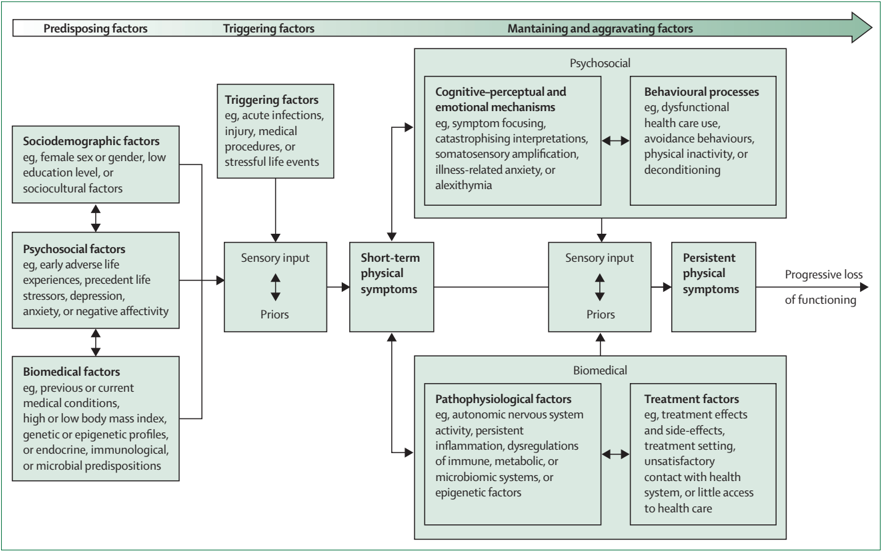
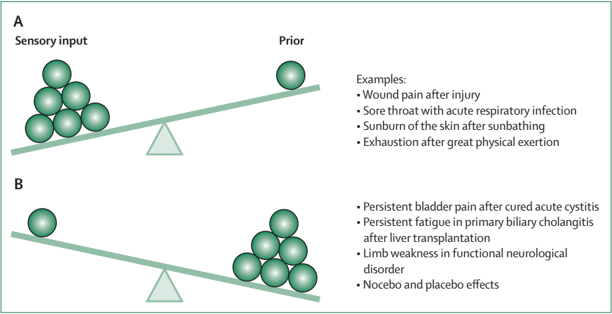
- Genesis is multifactorial and transdiagnostic. Predisposing factors include female sex or gender, lower socioeconomic status, lower education, chronic medical conditions, previous somatic symptom burden, sleep disturbance, elevated body mass index, genetic or epigenetic profiles, early adverse life experiences, depression, and anxiety. Maintaining factors include persistent inflammation; immune, metabolic, and microbiome dysregulation; symptom focusing; catastrophising; dysfunctional expectations; avoidance behaviours; and predictive coding processes in which strong priors can sustain symptoms even when ascending sensory input is diminished.
- Basic care consists of diagnosis-specific treatment of underlying pathophysiology plus person-centred communication with validation, appropriate reassurance, and a biopsychosocial explanation. If basic care is insufficient, targeted psychological and pharmacological interventions can be beneficial: a 2023 meta-analysis found psychological interventions had a small, statistically significant effect on reducing somatic symptoms; CBT trials showed small-to-moderate positive effects; short-term psychodynamic psychotherapy had medium effect sizes in a range of medical conditions and a large effect size for functional somatic symptoms; antidepressant evidence is limited, with very low-quality evidence for somatoform disorders, though some antidepressants are effective for specific symptoms and comorbid depressive or anxiety disorders.
Methods
- This is a narrative Review. The authors searched PubMed, Scopus, and PsycInfo for “persistent somatic symptom*” or “persistent physical symptom*” in titles or abstracts, from database inception to Jan 27, 2024, with no filters or language restrictions and without excluding grey literature. The search was combined with keywords related to individual Review topics, and related terms were also sought in the same databases and in reference lists of journal articles and book chapters.
- For the final reference list, articles most relevant to the Review sections were selected, prioritising systematic reviews and meta-analyses, randomised controlled trials, and prospective studies over cross-sectional studies and other publication types. Disagreements over inclusion were resolved by discussion between BL, AT, and PH.
- The Review presents a conceptual working model of risk factors and mechanisms, a predictive coding model of symptom perception, treatment principles, a case scenario, and research needs.
Limitations
- The paper states that the Review is largely based on the current state of knowledge on persistent physical symptoms, where the aetiopathogenesis is not yet fully understood. It also states that the list of exemplary risk factors and mechanisms is clearly incomplete, and not every risk factor or mechanism has been studied in all symptoms and conditions; more prospective studies are needed, including in conditions with poorly understood pathophysiology such as post-COVID-19 condition.
- Evident from the text: as a narrative Review, it does not conduct a formal systematic quality appraisal or quantitative synthesis, and treatment evidence is described as still fragmentary, with insufficient availability and effectiveness of treatment and little knowledge among treating physicians.
Model-written summary. Check it against the paper before relying on it.
Integrity signals
Registry
Cites
Statistics
Figures
Verification
Claims the paper makes
48 Valid · 5 Not valid · 24 Not checked · 23 Own results and interpretations
The cited sources support only part of this claim — read each source’s verdict below.
In the paper
“Persistent physical symptoms remain the major unmet need in the management of many chronic conditions”
What the sources say
- Partly supportedcites [16] 16 McGing JJ, Radford SJ, Francis ST, Serres S, Greenhaff PL, Moran GW. Review article: the aetiology of fatigue in inflammatory bowel disease and potential therapeutic management strategies. Aliment Pharmacol Ther 2021; 54: 368-87 . sourceExperimental — accuracy not yet measured
The Introduction (page unavailable) describes fatigue persisting during IBD remission, being rarely prioritised in consultations, and having limited treatment options. This supports an unmet need for persistent fatigue in IBD, but not the broader claim about physical symptoms across many chronic conditions or their being the major unmet need. (LLM, conf=0.85)
- Partly supportedcites [17] 17 Pope JE. Management of fatigue in rheumatoid arthritis. RMD Open 2020; 6: e001084. sourceExperimental — accuracy not yet measured
The Scope of the Problem section (page not available in our copy) describes fatigue as common in rheumatoid arthritis despite available treatments, and the Summary says more effective treatment is needed. This supports an unmet need for one persistent symptom in RA, but not the claim that persistent physical symptoms are the major unmet need across many chronic conditions. (LLM, conf=0.86)
plain- Asserted: passes — The authors put it forward as true.
- Checkable: passes — It can be checked against evidence.
- Load-bearing: passes — The paper’s conclusions depend on it.
- Based: passes — The paper gives a reason why it holds.
- Partly supported
The cited sources support only part of this claim — read each source’s verdict below.
In the paper
“the criterion of the medical unexplainability of symptoms has been abandoned because the reliability of assessing whether or not there is a pathophysiological explanation for a particular symptom is very low”
What the sources say
- Partly supportedcites [36] 36 Tack M. Medically unexplained symptoms (MUS): faults and implications. Int J Environ Res Public Health 2019; 16: 16. sourceExperimental — accuracy not yet measured
Split into 2 atoms — 0 confirmed, 2 partially supported, 0 disputed, 0 misattributed, 0 unverifiable. Expand the claim to see per-atom verdicts.
plainstates a cause- Asserted: passes — The authors put it forward as true.
- Checkable: passes — It can be checked against evidence.
- Load-bearing: passes — The paper’s conclusions depend on it.
- Based: passes — The paper gives a reason why it holds.
- Partly supported
The cited sources support only part of this claim — read each source’s verdict below.
In the paper
“Six stable clusters of interrelated symptoms are repeatedly described in clinical and general population samples”
What the sources say
- Not checked — no full text of the sourcecites [28] 28 Senger K, Heider J, Kleinstäuber M, Sehlbrede M, Witthöft M, Schröder A. Network analysis of persistent somatic symptoms in two clinical patient samples. Psychosom Med 2022; 84: 74-85. source
- Not checked — no full text of the sourcecites [29] 29 Petersen MW, Schröder A, Jørgensen T, et al. The unifying diagnostic construct of bodily distress syndrome (BDS) was confirmed in the general population. J Psychosom Res 2020; 128: 109868. source
- Partly supportedcites [30] 30 Burton C, Fink P, Henningsen P, Löwe B, Rief W. Functional somatic disorders: discussion paper for a new common classification for research and clinical use. BMC Med 2020; 18: 34. sourceExperimental — accuracy not yet measured
In “Symptoms within system clusters” (page unavailable), the paper proposes six clusters derived from clinical descriptive and epidemiological studies. It does not establish that they are stable or repeatedly found in both clinical and general-population samples. Its proposed list also says “fatigue-related” and “cardiorespiratory,” rather than “general” and “cardiopulmonary.” (LLM, conf=0.86)
plainstates an association- Asserted: passes — The authors put it forward as true.
- Checkable: passes — It can be checked against evidence.
- Load-bearing: unclear — It is unclear whether the paper’s conclusions depend on it.
- Based: passes — The paper gives a reason why it holds.
The cited sources support only part of this claim — read each source’s verdict below.
In the paper
“the diagnostic criteria for functional somatic disorders usually do not require that the symptoms cause distress”
What the sources say
- Partly supportedcites [33] 33 Lacy BE, Patel NK. Rome criteria and a diagnostic approach to irritable bowel syndrome. J Clin Med 2017; 6: 6. sourceExperimental — accuracy not yet measured
The Introduction describes the Rome IV criteria for IBS in terms of recurrent abdominal pain, bowel habits, and symptom duration, without a requirement that symptoms cause distress. The paper addresses IBS, however, not whether diagnostic criteria for functional somatic disorders usually omit a distress requirement. (LLM, conf=0.82)
plain- Asserted: passes — The authors put it forward as true.
- Checkable: passes — It can be checked against evidence.
- Load-bearing: passes — The paper’s conclusions depend on it.
- Based: passes — The paper gives a reason why it holds.
- Partly supported
The cited sources support only part of this claim — read each source’s verdict below.
In the paper
“Multiple biological, psychological, and social risk factors contribute to the persistence of somatic symptoms”
What the sources say
- Partly supportedcites [1] 1 Löwe B, Andresen V, Van den Bergh O, et al. Persistent somatic symptoms across diseases - from risk factors to modification: scientific framework and overarching protocol of the interdisciplinary SOMACROSS research unit (RU 5211). BMJ Open 2022; 12: e057596. sourceExperimental — accuracy not yet measured
The Introduction’s ‘Working hypotheses of the overall project’ states that biological, psychological and social factors contribute to symptom persistence individually or in interplay. The cited paper presents this as a hypothesis, however, and the ‘State of the art’ says the applicability of these risk factors across diseases has yet to be investigated; the claim states the contribution more definitively. (LLM, conf=0.84)
- Partly supportedcites [48] 48 Kitselaar WM, van der Vaart R, Perschl J, Numans ME, Evers AWM. Predictors of persistent somatic symptoms in the general population: a systematic review of cohort studies. Psychosom Med 2023; 85: 71-78. sourceExperimental — accuracy not yet measured
The Abstract (p. 2) identifies biological, psychological, and social-domain predictors of persistent somatic symptom onset. The review does not establish that these factors cause symptoms to persist once present; the Discussion (p. 7) treats interactions between predictors as a hypothesis, not a demonstrated finding. (LLM, conf=0.86)
- Partly supportedcites [49] 49 Knezevic NN, Candido KD, Vlaeyen JWS, Van Zundert J, Cohen SP. Low back pain. Lancet 2021; 398: 78-92. sourceExperimental — accuracy not yet measured
The risk-factor panel (page not available in our copy) lists genetic, lifestyle, and psychosocial factors associated with progression from acute to chronic low back pain. The Conclusions endorse a biopsychosocial model of chronic pain. The source supports the claim for low back pain, but does not establish it for somatic symptoms generally. (LLM, conf=0.85)
plainstates a cause- Asserted: passes — The authors put it forward as true.
- Checkable: passes — It can be checked against evidence.
- Load-bearing: passes — The paper’s conclusions depend on it.
- Based: passes — The paper gives a reason why it holds.
- Partly supported
36 more claims · 21 with their cited sources checked
Create a free account to see all 100 claims and to verify the 1 reference still open.
- It may state two separate claims as one. 38
- The quote only partly states this claim. 6
- Probably not a substantial claim. 30
Claims other papers make about this one
Each is checked against this paper’s own text: does it say what the citing paper says it does?
The source backs part of the claim, not all of it — or backs it for a different population, condition or comparison.
In the citing paper
“Health anxiety often coexists with PPS and is associated with increased healthcare utilization, poorer health, and lower recovery rates [4, 16].”
From Work Ability and Functioning Among Individuals with Persistent Indoor Environment-Related Symptoms or Chronic Fatigue: Nine-Month Follow-Up of a Web-Based Randomized Controlled Trial. (2026) · cites this paper as [4]
Experimental — accuracy not yet measuredThe source backs part of the claim, not all of it — or backs it for a different population, condition or comparison.
In the citing paper
“PPS warrant attention due to their prevalence and association with poorer health, work disability, increased healthcare use, and high societal costs [1, 4].”
From Work Ability and Functioning Among Individuals with Persistent Indoor Environment-Related Symptoms or Chronic Fatigue: Nine-Month Follow-Up of a Web-Based Randomized Controlled Trial. (2026) · cites this paper as [4]
Experimental — accuracy not yet measuredThe cited source says what the claim attributes to it.
In the citing paper
“These findings highlight the complexity of participants' life situations, where both direct and indirect issues due to symptoms affect overall functioning and well-being, with various factors possibly contributing to the symptom maintenance [4].”
Citations
Cites
Pharmacological interventions for somatoform disorders in adults
Kleinstäuber, M., Witthöft, M., Steffanowski, A., van Marwijk, H., Hiller, W., & Lambert, M. J. (2014) · Cochrane Database of Systematic Reviews · doi:10.1002/14651858.cd010628.pub2 · Cited by 11,335
Vos, T., Barber, R. M., Bell, B., Bertozzi-Villa, A., Biryukov, S., Bolliger, I., Charlson, F., Davis, A., Degenhardt, L., Dicker, D., et al. (2015) · The Lancet · doi:10.1016/s0140-6736(15)60692-4 · Cited by 6,414
Hughes, K., Bellis, M. A., Hardcastle, K. A., Sethi, D., Butchart, A., Mikton, C., Jones, L., & Dunne, M. P. (2017) · The Lancet Public Health · doi:10.1016/s2468-2667(17)30118-4 · Cited by 5,255
Central sensitization: implications for the diagnosis and treatment of pain
Woolf, C. J. (2011) · Pain · doi:10.1016/j.pain.2010.09.030 · Cited by 4,771
Treede, R.-D., Rief, W., Barke, A., Aziz, Q., Bennett, M. I., Benoliel, R., Cohen, M., Evers, S., Finnerup, N. B., First, M. B., et al. (2019) · Pain · doi:10.1097/j.pain.0000000000001384 · Cited by 3,478
Chronic pain: an update on burden, best practices, and new advances
Cohen, S. P., Vase, L., & Hooten, W. M. (2021) · The Lancet · doi:10.1016/s0140-6736(21)00393-7 · Cited by 2,614
Psychosomatic medicine in Germany: more timely than ever
Zipfel, S., Herzog, W., Kruse, J., & Henningsen, P. (2016) · Psychotherapy and Psychosomatics · doi:10.1159/000447701 · Cited by 2,323
Self-citationMeasuring the global burden of disease
Murray, C. J. L., & Lopez, A. D. (2013) · New England Journal of Medicine · doi:10.1056/nejmra1201534 · Cited by 1,818
The potential role of hypocortisolism in the pathophysiology of stress-related bodily disorders
Heim, C., Ehlert, U., & Hellhammer, D. H. (2000) · Psychoneuroendocrinology · doi:10.1016/s0306-4530(99)00035-9 · Cited by 1,688
Knezevic, N. N., Candido, K. D., Vlaeyen, J. W. S., Van Zundert, J., & Cohen, S. P. (2021) · The Lancet · doi:10.1016/s0140-6736(21)00733-9 · Cited by 1,345
Nociplastic pain: towards an understanding of prevalent pain conditions
Fitzcharles, M.-A., Cohen, S. P., Clauw, D. J., Littlejohn, G., Usui, C., & Häuser, W. (2021) · The Lancet · doi:10.1016/s0140-6736(21)00392-5 · Cited by 1,253
Functional somatic syndromes: one or many?
Wessely, S., Nimnuan, C., & Sharpe, M. (1999) · The Lancet · doi:10.1016/s0140-6736(98)08320-2 · Cited by 1,211
Barberio, B., Zamani, M., Black, C. J., Savarino, E. V., & Ford, A. C. (2021) · The Lancet Gastroenterology & Hepatology · doi:10.1016/s2468-1253(21)00014-5 · Cited by 758
Management of functional somatic syndromes
Henningsen, P., Zipfel, S., & Herzog, W. (2007) · The Lancet · doi:10.1016/s0140-6736(07)60159-7 · Cited by 741
Self-citationThe Somatic Symptom Scale–8 (SSS-8): A Brief Measure of Somatic Symptom Burden
Gierk, B., Kohlmann, S., Kroenke, K., Spangenberg, L., Zenger, M., Brähler, E., & Löwe, B. (2014) · JAMA Internal Medicine · doi:10.1001/jamainternmed.2013.12179 · Cited by 740
Self-citationThe fear-avoidance model of pain
Vlaeyen, J. W. S., Crombez, G., & Linton, S. J. (2016) · Pain · doi:10.1097/j.pain.0000000000000574 · Cited by 716
Depression, anxiety and somatization in primary care: Syndrome overlap and functional impairment
Löwe, B., Spitzer, R. L., Williams, J. B. W., Mussell, M., Schellberg, D., & Kroenke, K. (2008) · General Hospital Psychiatry · doi:10.1016/j.genhosppsych.2008.01.001 · Cited by 706
Self-citationPatients presenting with somatic complaints: epidemiology, psychiatric co‐morbidity and management
Kroenke, K. (2003) · International Journal of Methods in Psychiatric Research · doi:10.1002/mpr.140 · Cited by 624
Halpin, S. J., & Ford, A. C. (2012) · American Journal of Gastroenterology · doi:10.1038/ajg.2012.260 · Cited by 607
Unexplained post-acute infection syndromes
Choutka, J., Jansari, V., Hornig, M., & Iwasaki, A. (2022) · Nature Medicine · doi:10.1038/s41591-022-01810-6 · Cited by 604
Herzog, J. I., & Schmahl, C. (2018) · Frontiers in Psychiatry · doi:10.3389/fpsyt.2018.00420 · Cited by 583
Rome criteria and a diagnostic approach to irritable bowel syndrome
Lacy, B., & Patel, N. (2017) · Journal of Clinical Medicine · doi:10.3390/jcm6110099 · Cited by 575
Psychological Trauma and Functional Somatic Syndromes: A Systematic Review and Meta-Analysis
Afari, N., Ahumada, S. M., Wright, L. J., Mostoufi, S., Golnari, G., Reis, V., & Cuneo, J. G. (2014) · Psychosomatic Medicine · doi:10.1097/psy.0000000000000010 · Cited by 572
Symptoms and the body: taking the inferential leap
Van den Bergh, O., Witthöft, M., Petersen, S., & Brown, R. J. (2017) · Neuroscience & Biobehavioral Reviews · doi:10.1016/j.neubiorev.2017.01.015 · Cited by 543
Functional neurological disorder: new subtypes and shared mechanisms
Hallett, M., Aybek, S., Dworetzky, B. A., McWhirter, L., Staab, J. P., & Stone, J. (2022) · The Lancet Neurology · doi:10.1016/s1474-4422(21)00422-1 · Cited by 538
Ford, A. C., Lacy, B. E., Harris, L. A., Quigley, E. M. M., & Moayyedi, P. (2019) · American Journal of Gastroenterology · doi:10.1038/s41395-018-0222-5 · Cited by 467
Nijs, J., Lahousse, A., Kapreli, E., Bilika, P., Saraçoğlu, İ., Malfliet, A., Coppieters, I., De Baets, L., Leysen, L., Roose, E., et al. (2021) · Journal of Clinical Medicine · doi:10.3390/jcm10153203 · Cited by 430
Fletcher, B. R., Damery, S., Aiyegbusi, O. L., Anderson, N., Calvert, M., Cockwell, P., Ferguson, J., Horton, M., Paap, M. C. S., Sidey-Gibbons, C., et al. (2022) · PLOS Medicine · doi:10.1371/journal.pmed.1003954 · Cited by 414
The enteric nervous system relays psychological stress to intestinal inflammation
Schneider, K. M., Blank, N., Alvarez, Y., Thum, K., Lundgren, P., Litichevskiy, L., Sleeman, M., Bahnsen, K., Kim, J., Kardo, S., et al. (2023) · Cell · doi:10.1016/j.cell.2023.05.001 · Cited by 344
Treatment of Fibromyalgia Syndrome With Antidepressants: A Meta-analysis
Häuser, W., Bernardy, K., Üçeyler, N., & Sommer, C. (2009) · JAMA · doi:10.1001/jama.2008.944 · Cited by 338
Management of functional somatic syndromes and bodily distress
Henningsen, P., Zipfel, S., Sattel, H., & Creed, F. (2018) · Psychotherapy and Psychosomatics · doi:10.1159/000484413 · Cited by 335
Self-citationDe Gucht, V., & Heiser, W. (2003) · Journal of Psychosomatic Research · doi:10.1016/s0022-3999(02)00467-1 · Cited by 311
Henningsen, P., Gündel, H., Kop, W. J., Löwe, B., Martin, A., Rief, W., Rosmalen, J. G. M., Schröder, A., van der Feltz-Cornelis, C., & Van den Bergh, O. (2018) · Psychosomatic Medicine · doi:10.1097/psy.0000000000000588 · Cited by 310
Self-citationPetrie, K. J., & Rief, W. (2019) · Annual Review of Psychology · doi:10.1146/annurev-psych-010418-102907 · Cited by 309
on behalf of the EURONET-SOMA Group, Burton, C., Fink, P., Henningsen, P., Löwe, B., & Rief, W. (2020) · BMC Medicine · doi:10.1186/s12916-020-1505-4 · Cited by 292
Self-citationDevelopment and Validation of the Somatic Symptom Disorder–B Criteria Scale (SSD-12)
Toussaint, A., Murray, A. M., Voigt, K., Herzog, A., Gierk, B., Kroenke, K., Rief, W., Henningsen, P., & Löwe, B. (2016) · Psychosomatic Medicine · doi:10.1097/psy.0000000000000240 · Cited by 291
Self-citationShort-Term Psychodynamic Psychotherapy for Somatic Disorders
Abbass, A., Kisely, S., & Kroenke, K. (2009) · Psychotherapy and Psychosomatics · doi:10.1159/000228247 · Cited by 280
How to assess common somatic symptoms in large-scale studies: A systematic review of questionnaires
Zijlema, W. L., Stolk, R. P., Löwe, B., Rief, W., White, P. D., & Rosmalen, J. G. M. (2013) · Journal of Psychosomatic Research · doi:10.1016/j.jpsychores.2013.03.093 · Cited by 268
Self-citationQuality of life in adults with multiple sclerosis: A systematic review
Gil-González, I., Martín-Rodríguez, A., Conrad, R., & Pérez-San-Gregorio, M. Á. (2020) · BMJ Open · doi:10.1136/bmjopen-2020-041249 · Cited by 263
Rief, W., Shedden-Mora, M. C., Laferton, J. A. C., Auer, C., Petrie, K. J., Salzmann, S., Schedlowski, M., & Moosdorf, R. (2017) · BMC Medicine · doi:10.1186/s12916-016-0767-3 · Cited by 261
Diseases, Disorders, and Comorbidities of Interoception
Bonaz, B., Lane, R. D., Oshinsky, M. L., Kenny, P. J., Sinha, R., Mayer, E. A., & Critchley, H. D. (2021) · Trends in Neurosciences · doi:10.1016/j.tins.2020.09.009 · Cited by 260
Altered microbiome composition in individuals with fibromyalgia
Minerbi, A., Gonzalez, E., Brereton, N. J. B., Anjarkouchian, A., Dewar, K., Fitzcharles, M.-A., Chevalier, S., & Shir, Y. (2019) · Pain · doi:10.1097/j.pain.0000000000001640 · Cited by 220
Somatic symptom disorder: a scoping review on the empirical evidence of a new diagnosis
Löwe, B., Levenson, J., Depping, M., Hüsing, P., Kohlmann, S., Lehmann, M., Shedden-Mora, M., Toussaint, A., Uhlenbusch, N., & Weigel, A. (2022) · Psychological Medicine · doi:10.1017/s0033291721004177 · Cited by 217
Self-citationPlacebo effects and their determinants in gastrointestinal disorders
Elsenbruch, S., & Enck, P. (2015) · Nature Reviews Gastroenterology & Hepatology · doi:10.1038/nrgastro.2015.117 · Cited by 173
Model of understanding fatigue after stroke
Wu, S., Mead, G., Macleod, M., & Chalder, T. (2015) · Stroke · doi:10.1161/strokeaha.114.006647 · Cited by 169
Toussaint, A., Hüsing, P., Kohlmann, S., & Löwe, B. (2020) · Psychological Medicine · doi:10.1017/s003329171900014x · Cited by 153
Self-citationBoersma, K., & Linton, S. J. (2005) · Behaviour Research and Therapy · doi:10.1016/j.brat.2004.11.006 · Cited by 146
Intersectionality-based quantitative health research and sex/gender sensitivity: a scoping review
on behalf of the ADVANCE GENDER Study Group, Mena, E., & Bolte, G. (2019) · International Journal for Equity in Health · doi:10.1186/s12939-019-1098-8 · Cited by 145
Management of fatigue in rheumatoid arthritis
Pope, J. E. (2020) · RMD Open · doi:10.1136/rmdopen-2019-001084 · Cited by 137
A Practical and Evidence-Based Approach to Common Symptoms: A Narrative Review
Kroenke, K. (2014) · Annals of Internal Medicine · doi:10.7326/m14-0461 · Cited by 132
Joustra, M. L., Janssens, K. A. M., Bültmann, U., & Rosmalen, J. G. M. (2015) · Journal of Psychosomatic Research · doi:10.1016/j.jpsychores.2015.05.004 · Cited by 131
Self-citationRief, W., Burton, C., Frostholm, L., Henningsen, P., Kleinstäuber, M., Kop, W. J., Löwe, B., Martin, A., Malt, U., Rosmalen, J., et al. (2017) · Psychosomatic Medicine · doi:10.1097/psy.0000000000000502 · Cited by 129
Self-citationLöwe, B., Andresen, V., Van den Bergh, O., Huber, T. B., von dem Knesebeck, O., Lohse, A. W., Nestoriuc, Y., Schneider, G., Schneider, S. W., Schramm, C., et al. (2022) · BMJ Open · doi:10.1136/bmjopen-2021-057596 · Cited by 121
Self-citationCarbone, M., Bufton, S., Monaco, A., Griffiths, L., Jones, D. E., & Neuberger, J. M. (2013) · Journal of Hepatology · doi:10.1016/j.jhep.2013.04.017 · Cited by 115
Roenneberg, C., Sattel, H., Schaefert, R., Henningsen, P., & Hausteiner-Wiehle, C. (2019) · Deutsches Ärzteblatt international · doi:10.3238/arztebl.2019.0553 · Cited by 111
Ballering, A. V., Bonvanie, I. J., Olde Hartman, T. C., Monden, R., & Rosmalen, J. G. M. (2020) · Social Science & Medicine · doi:10.1016/j.socscimed.2020.112968 · Cited by 110
Self-citationAssociation of costs with somatic symptom severity in patients with medically unexplained symptoms
Konnopka, A., Kaufmann, C., König, H.-H., Heider, D., Wild, B., Szecsenyi, J., Herzog, W., Heinrich, S., & Schaefert, R. (2013) · Journal of Psychosomatic Research · doi:10.1016/j.jpsychores.2013.08.011 · Cited by 109
Interoception as modeling, allostasis as control
Sennesh, E., Theriault, J., Brooks, D., van de Meent, J.-W., Barrett, L. F., & Quigley, K. S. (2022) · Biological Psychology · doi:10.1016/j.biopsycho.2021.108242 · Cited by 107
Recognising and explaining functional neurological disorder
Stone, J., Burton, C., & Carson, A. (2020) · BMJ · doi:10.1136/bmj.m3745 · Cited by 104
Self-citationNestoriuc, Y., von Blanckenburg, P., Schuricht, F., Barsky, A. J., Hadji, P., Albert, U.-S., & Rief, W. (2016) · Annals of Oncology · doi:10.1093/annonc/mdw266 · Cited by 103
Nguyen, N. N., Hoang, V. T., Dao, T. L., Dudouet, P., Eldin, C., & Gautret, P. (2022) · European Journal of Clinical Microbiology & Infectious Diseases · doi:10.1007/s10096-022-04417-4 · Cited by 91
Kube, T., Rozenkrantz, L., Rief, W., & Barsky, A. (2020) · Clinical Psychology Review · doi:10.1016/j.cpr.2020.101829 · Cited by 91
Interventions for fatigue in inflammatory bowel disease
Farrell, D., Artom, M., Czuber-Dochan, W., Jelsness-Jørgensen, L. P., Norton, C., & Savage, E. (2020) · Cochrane Database of Systematic Reviews · doi:10.1002/14651858.cd012005.pub2 · Cited by 89
Suicide and suicidality in somatic symptom and related disorders: a systematic review
Torres, M. E., Löwe, B., Schmitz, S., Pienta, J. N., Van Der Feltz-Cornelis, C., & Fiedorowicz, J. G. (2021) · Journal of Psychosomatic Research · doi:10.1016/j.jpsychores.2020.110290 · Cited by 80
Self-citationBreathlessness and the brain: the role of expectation
Marlow, L. L., Faull, O. K., Finnegan, S. L., & Pattinson, K. T. S. (2019) · Current Opinion in Supportive & Palliative Care · doi:10.1097/spc.0000000000000441 · Cited by 77
Abbass, A., Lumley, M. A., Town, J., Holmes, H., Luyten, P., Cooper, A., Russell, L., Schubiner, H., De Meulemeester, C., & Kisely, S. (2021) · Journal of Psychosomatic Research · doi:10.1016/j.jpsychores.2021.110473 · Cited by 77
Khanna, A., Jopson, L., Howel, D., Bryant, A., Blamire, A., Newton, J. L., & Jones, D. E. (2019) · Hepatology · doi:10.1002/hep.30099 · Cited by 75
Petersen, M. W., Schröder, A., Jørgensen, T., Ørnbøl, E., Dantoft, T. M., Eliasen, M., Thuesen, B. H., & Fink, P. (2020) · Journal of Psychosomatic Research · doi:10.1016/j.jpsychores.2019.109868 · Cited by 71
Kohlmann, S., Gierk, B., Hümmelgen, M., Blankenberg, S., & Löwe, B. (2013) · JAMA Internal Medicine · doi:10.1001/jamainternmed.2013.6835 · Cited by 66
Self-citationKleinstäuber, M., Allwang, C., Bailer, J., Berking, M., Brünahl, C., Erkic, M., Gitzen, H., Gollwitzer, M., Gottschalk, J.-M., Heider, J., et al. (2019) · Psychotherapy and Psychosomatics · doi:10.1159/000501621 · Cited by 65
Self-citationBjurstrom, M. F., Giron, S. E., & Griffis, C. A. (2016) · Pain Practice · doi:10.1111/papr.12252 · Cited by 62
Kube, T., Glombiewski, J. A., & Rief, W. (2018) · Psychosomatic Medicine · doi:10.1097/psy.0000000000000596 · Cited by 62
Schnabel, K., Petzke, T. M., & Witthöft, M. (2022) · Clinical Psychology Review · doi:10.1016/j.cpr.2022.102196 · Cited by 61
McGing, J. J., Radford, S. J., Francis, S. T., Serres, S., Greenhaff, P. L., & Moran, G. W. (2021) · Alimentary Pharmacology & Therapeutics · doi:10.1111/apt.16465 · Cited by 60
Chalder, T., & Willis, C. (2017) · Journal of Mental Health · doi:10.1080/09638237.2017.1322187 · Cited by 59
Pavlovic, N. V., GILOTRA, N. A., LEE, C. S., NDUMELE, C., MAMMOS, D., DENNISONHIMMELFARB, C., & AbshireSaylor, M. (2022) · Journal of Cardiac Failure · doi:10.1016/j.cardfail.2021.07.005 · Cited by 58
Placebo and nocebo effects across symptoms: from pain to fatigue, dyspnea, nausea, and itch
Wolters, F., Peerdeman, K. J., & Evers, A. W. M. (2019) · Frontiers in Psychiatry · doi:10.3389/fpsyt.2019.00470 · Cited by 57
Duration of untreated illness in patients with somatoform disorders
Herzog, A., Mora, M. C. S., Jordan, P., & Löwe, B. (2018) · Journal of Psychosomatic Research · doi:10.1016/j.jpsychores.2018.01.011 · Cited by 57
Self-citationPain management strategies in rheumatoid arthritis: a narrative review
Sánchez-Flórez, J. C., Seija-Butnaru, D., Valero, E. G., Acosta, C. D. P. A., & Amaya, S. (2021) · Journal of Pain & Palliative Care Pharmacotherapy · doi:10.1080/15360288.2021.1973647 · Cited by 54
Agger, J. L., Schröder, A., Gormsen, L. K., Jensen, J. S., Jensen, T. S., & Fink, P. K. (2017) · The Lancet Psychiatry · doi:10.1016/s2215-0366(17)30126-8 · Cited by 52
Psoriatic arthritis and physical activity: a systematic review
Kessler, J., Chouk, M., Ruban, T., Prati, C., Wendling, D., & Verhoeven, F. (2021) · Clinical Rheumatology · doi:10.1007/s10067-021-05739-y · Cited by 50
Kitselaar, W. M., van der Vaart, R., Perschl, J., Numans, M. E., & Evers, A. W. M. (2023) · Psychosomatic Medicine · doi:10.1097/psy.0000000000001145 · Cited by 45
Hennemann, S., Böhme, K., Kleinstäuber, M., Baumeister, H., Küchler, A.-M., Ebert, D. D., & Witthöft, M. (2022) · Journal of Consulting and Clinical Psychology · doi:10.1037/ccp0000707 · Cited by 44
Maas genannt Bermpohl, F., Hülsmann, L., & Martin, A. (2023) · Frontiers in Psychiatry · doi:10.3389/fpsyt.2023.1160908 · Cited by 44
The development of irritable bowel syndrome: a prospective community-based cohort study
Löwe, B., Lohse, A., Andresen, V., Vettorazzi, E., Rose, M., & Broicher, W. (2016) · American Journal of Gastroenterology · doi:10.1038/ajg.2016.255 · Cited by 43
Self-citationKendler, K. S., Rosmalen, J. G. M., Ohlsson, H., Sundquist, J., & Sundquist, K. (2023) · Psychological Medicine · doi:10.1017/s0033291722000526 · Cited by 40
Self-citationMonden, R., Rosmalen, J. G. M., Wardenaar, K. J., & Creed, F. (2022) · Psychological Medicine · doi:10.1017/s0033291720001774 · Cited by 39
Self-citationBurton, C., Mooney, C., Sutton, L., White, D., Dawson, J., Neilson, A. R., Rowlands, G., Thomas, S., Horspool, M., Fryer, K., et al. (2024) · The Lancet · doi:10.1016/s0140-6736(24)00700-1 · Cited by 39
Self-citationSarter, L., Heider, J., Kirchner, L., Schenkel, S., Witthöft, M., Rief, W., & Kleinstäuber, M. (2021) · Journal of Psychosomatic Research · doi:10.1016/j.jpsychores.2021.110486 · Cited by 38
Kleinstäuber, M., Schröder, A., Daehler, S., Pallesen, K. J., Rask, C. U., Sanyer, M., Van den Bergh, O., Weinreich Petersen, M., & Rosmalen, J. G. M. (2023) · Clinical Psychology in Europe · doi:10.32872/cpe.11179 · Cited by 37
Self-citationLehmann, M., Pohontsch, N. J., Zimmermann, T., Scherer, M., & Löwe, B. (2021) · BMC Family Practice · doi:10.1186/s12875-021-01397-w · Cited by 37
Self-citationSomatisation: a joint responsibility of doctor and patient
Bensing, J. M., & Verhaak, P. (2006) · The Lancet · doi:10.1016/s0140-6736(06)68155-5 · Cited by 36
Long COVID-19, persistent somatic symptoms and social stigmatisation
Ballering, A., Olde Hartman, T., & Rosmalen, J. (2021) · Journal of Epidemiology and Community Health · doi:10.1136/jech-2021-216643 · Cited by 33
Self-citationFunctional somatic symptoms across cultures: perceptual and health care issues
Löwe, B., & Gerloff, C. (2018) · Psychosomatic Medicine · doi:10.1097/psy.0000000000000594 · Cited by 32
Self-citationAbrahamsen, C., Reme, S. E., Wangen, K. R., Lindbæk, M., & Werner, E. L. (2023) · eClinicalMedicine · doi:10.1016/j.eclinm.2023.102262 · Cited by 29
Persistent physical symptoms after COVID-19 infection and the risk of Somatic Symptom Disorder
Horn, M., Wathelet, M., Amad, A., Martignène, N., Lathiere, T., Khelfaoui, K., Rousselle, M., El Qaoubii, O., Vuotto, F., Faure, K., et al. (2023) · Journal of Psychosomatic Research · doi:10.1016/j.jpsychores.2023.111172 · Cited by 27
Conway, A. M., Nordon, I. M., Hinchliffe, R. J., THOMPSON, M. M., & Loftus, I. M. (2011) · Vascular · doi:10.1258/vasc.2011.oa0303 · Cited by 26
Psychologically informed health care
Dekker, J., Sears, S. F., Åsenlöf, P., & Berry, K. (2023) · Translational Behavioral Medicine · doi:10.1093/tbm/ibac105 · Cited by 26
Swainston, K., Thursby, S., Bell, B., Poulter, H., Dismore, L., & Copping, L. (2023) · British Journal of Health Psychology · doi:10.1111/bjhp.12613 · Cited by 25
Public stigma towards individuals with somatic symptom disorders - survey results from Germany
von dem Knesebeck, O., Lehmann, M., Löwe, B., & Makowski, A. C. (2018) · Journal of Psychosomatic Research · doi:10.1016/j.jpsychores.2018.10.014 · Cited by 25
Self-citationGay, M. C., Cassedanne, F., Barbot, F., Vaugier, I., Thomas, S., Manchon, E., Bensmail, D., Blanchere, M., & Heinzlef, O. (2024) · Journal of Neurology, Neurosurgery & Psychiatry · doi:10.1136/jnnp-2023-331537 · Cited by 22
286 The impact of adverse childhood experiences on health: a systematic review and meta-analysis
Hughes, K. E., Hardcastle, K., & Bellis, M. A. (2016) · Child Maltreatment · doi:10.1136/injuryprev-2016-042156.286 · Cited by 22
Chalder, T., Patel, M., Hotopf, M., Moss-Morris, R., Ashworth, M., Watts, K., David, A. S., McCrone, P., Husain, M., Garrood, T., et al. (2021) · Psychological Medicine · doi:10.1017/s0033291721001793 · Cited by 20
Claassen-van Dessel, N., van der Wouden, J. C., Twisk, J. W. R., Dekker, J., & van der Horst, H. E. (2018) · Journal of Psychosomatic Research · doi:10.1016/j.jpsychores.2018.02.009 · Cited by 20
O’Connell, C., Shafran, R., & Bennett, S. (2020) · Clinical Child Psychology and Psychiatry · doi:10.1177/1359104519855415 · Cited by 19
Mewes, R., Feneberg, A. C., Doerr, J. M., & Nater, U. M. (2022) · Psychosomatic Medicine · doi:10.1097/psy.0000000000001006 · Cited by 19
Scope, A., Leaviss, J., Booth, A., Sutton, A., Parry, G., Buszewicz, M., & Moss‐Morris, R. (2021) · British Journal of Health Psychology · doi:10.1111/bjhp.12521 · Cited by 18
Kustra-Mulder, A., Löwe, B., & Weigel, A. (2023) · Journal of Psychosomatic Research · doi:10.1016/j.jpsychores.2023.111485 · Cited by 18
Self-citationBarends, H., van der Wouden, J. C., Claassen - van Dessel, N., Twisk, J. W. R., van der Horst, H. E., & Dekker, J. (2022) · Journal of Psychosomatic Research · doi:10.1016/j.jpsychores.2022.110945 · Cited by 18
Cathébras, P. J. (2021) · Frontiers in Medicine · doi:10.3389/fmed.2021.585495 · Cited by 18
Fryer, K., Sanders, T., Greco, M., Mooney, C., Deary, V., & Burton, C. (2023) · Patient Education and Counseling · doi:10.1016/j.pec.2023.107870 · Cited by 17
Self-citationSymptom Classes in Decompensated Liver Disease
Hansen, L., Chang, M. F., Hiatt, S. O., Dieckmann, N. F., Mitra, A., Lyons, K. S., & Lee, C. S. (2021) · Clinical Gastroenterology and Hepatology · doi:10.1016/j.cgh.2021.11.023 · Cited by 17
Sarter, L., Heider, J., Witthöft, M., Rief, W., & Kleinstäuber, M. (2022) · General Hospital Psychiatry · doi:10.1016/j.genhosppsych.2022.03.001 · Cited by 17
Löwe, B., Nestoriuc, Y., Andresen, V., Vettorazzi, E., Zapf, A., Hübener, S., Maehder, K., Peters, L., & Lohse, A. W. (2022) · BMJ Open · doi:10.1136/bmjopen-2021-059529 · Cited by 15
Self-citationNetwork analysis of persistent somatic symptoms in two clinical patient samples
Senger, K., Heider, J., Kleinstäuber, M., Sehlbrede, M., Witthöft, M., & Schröder, A. (2022) · Psychosomatic Medicine · doi:10.1097/psy.0000000000000999 · Cited by 14
Medically unexplained symptoms (MUS): faults and implications
Tack, M. (2019) · International Journal of Environmental Research and Public Health · doi:10.3390/ijerph16071247 · Cited by 13
Senger, K., Schröder, A., Kleinstäuber, M., Rubel, J. A., Rief, W., & Heider, J. (2021) · Psychotherapy Research · doi:10.1080/10503307.2021.1916120 · Cited by 13
Weigel, A., Hüsing, P., Junge, M., & Löwe, B. (2023) · Journal of Psychosomatic Research · doi:10.1016/j.jpsychores.2023.111419 · Cited by 13
Self-citation(2020) · doi:10.1007/978-3-030-39903-0_300732 · Cited by 12
Wortman, M. S. H., Olde Hartman, T. C., van der Wouden, J. C., Dankers, S., Visser, B., Assendelft, W. J. J., & van der Horst, H. E. (2022) · BMJ Open · doi:10.1136/bmjopen-2021-057145 · Cited by 12
Bräscher, A., Brähler, E., Häuser, W., & Witthöft, M. (2023) · Assessment · doi:10.1177/10731911231219802 · Cited by 11
Self-help interventions for young people with persistent physical symptoms: a systematic review
Holsting, A. F., Rask, M. T., Frostholm, L., Rosendal, M., & Rask, C. U. (2021) · Journal of Psychosomatic Research · doi:10.1016/j.jpsychores.2021.110553 · Cited by 10
Barends, H., Dekker, J., van Dessel, N. C., Twisk, J. W. R., van der Horst, H. E., & van der Wouden, J. C. (2023) · Journal of Psychosomatic Research · doi:10.1016/j.jpsychores.2023.111343 · Cited by 10
Barberio, B., Zamani, M., Black, C. J., Savarino, E. V., & Ford, A. C. (2021) · SSRN Electronic Journal · doi:10.2139/ssrn.3746277 · Cited by 9
James, K., Patel, M., Goldsmith, K., Moss-Morris, R. E., Ashworth, M. J., Landau, S., & Chalder, T. (2022) · Behaviour Research and Therapy · doi:10.1016/j.brat.2022.104224 · Cited by 8
Public knowledge and beliefs about the irritable bowel syndrome - results from the SOMA.SOC study
Knesebeck, O. V. D., Löwe, B., Lüdecke, D., Bobardt, J. S., & Barbek, R. (2024) · BMC Public Health · doi:10.1186/s12889-024-17784-8 · Cited by 8
Self-citationJunge, M., Hüsing, P., Löwe, B., & Weigel, A. (2023) · Journal of Psychosomatic Research · doi:10.1016/j.jpsychores.2023.111347 · Cited by 6
Self-citationTreating in concert: Integrated biopsychosocial care – Not only for functional disorders
Hausteiner‐Wiehle, C., Schmidt, R., & Henningsen, P. (2023) · Journal of Psychosomatic Research · doi:10.1016/j.jpsychores.2023.111376 · Cited by 6
Self-citationToonders, S. A. J., van Westrienen, P. E., de Wit, N. J., van Dongen, J. M., Gerrits, M. M. J. G., Pisters, M. F., & Veenhof, C. (2023) · Journal of Psychosomatic Research · doi:10.1016/j.jpsychores.2023.111387 · Cited by 5
Fränkl, E., Hasenbank, N., Dumröse, K., Löwe, B., & Kohlmann, S. (2023) · Health Expectations · doi:10.1111/hex.13931 · Cited by 5
Self-citationMin, Y.-S., Kim, S.-Y., Choi, S.-K., & Ahn, Y.-S. (2023) · Healthcare · doi:10.3390/healthcare11071004 · Cited by 3
Joustra, M. L., Janssens, K. A. M., Bültmann, U., & Rosmalen, J. G. M. (2015) · Journal of Psychosomatic Research · doi:10.1016/j.jpsychores.2015.03.065 · Cited by 1
Self-citationKleinstäuber, M., Allwang, C., Bailer, J., et al. (2019) · Figshare · doi:10.6084/m9.figshare.9691664
POS1039 PSORIATIC ARTHRITIS AND PHYSICAL ACTIVITY, A SYSTEMATIC REVIEW
Kessler, J., Chouk, M., Ruban, T. N., Prati, C., Wendling, D., & Verhoeven, F. (2021) · Annals of the Rheumatic Diseases · doi:10.1136/annrheumdis-2021-eular.926
(2024) · doi:10.3310/wygw4673
Barends, H., Dessel, N. C.-V., van der Wouden, J. C., Twisk, J. W. R., van der Horst, H. E., & Dekker, J. (2022) · Journal of Psychosomatic Research · doi:10.1016/j.jpsychores.2022.110824
T-22 The effect of liver transplant on fatigue in patients with primary biliary cirrhosis
Carbone, M., Bufton, S., Monaco, A., et al. (2012) · Digestive and Liver Disease · doi:10.1016/s1590-8658(12)60059-0
Weigel, A., Hüsing, P., & Löwe, B. (2022) · Journal of Psychosomatic Research · doi:10.1016/j.jpsychores.2022.110905
Self-citation
Cited by
Psychological factors associated with Long COVID: a systematic review and meta-analysis
Engelmann, P., Reinke, M., Stein, C., Salzmann, S., Löwe, B., Toussaint, A. C., & Mora, M. C. S. (2024) · EClinicalMedicine · doi:10.1016/j.eclinm.2024.102756 · Cited by 106
Self-citationThe overlooked burden of persistent physical symptoms: a call for action in European healthcare
Toussaint, A., Weigel, A., Löwe, B., Blanch, J., Bogaerts, K., Boye, B., Burton, C., Cosci, F., Engelmann, P., Fink, P., et al. (2025) · The Lancet Regional Health - Europe · doi:10.1016/j.lanepe.2024.101140 · Cited by 44
“1,2,58,62 For instance, chronic pain may be exacerbated by stress or lack of social support, whether it arises from tissue damage or in fl ammation or not.”
InfluentialSelf-citationHybelius, J., Kosic, A., Salomonsson, S., Wachtler, C., Wallert, J., Nordin, S., & Axelsson, E. (2024) · JAMA Network Open · doi:10.1001/jamanetworkopen.2024.46603 · Cited by 55
Keter, D. L., Esteves, J. E., Loghmani, M. T., Rossettini, G., & Cook, C. E. (2025) · International journal of osteopathic medicine · doi:10.1016/j.ijosm.2025.100750 · Cited by 19
Functional neurological disorder: Practical management
Dworetzky, B. A., & Baslet, G. C. (2025) · Neurotherapeutics · doi:10.1016/j.neurot.2025.e00612 · Cited by 15
Metadata
- Authors
- Löwe, B., Toussaint, A., Rosmalen, J. G. M., Huang, W.-L., Burton, C., Weigel, A., Levenson, J. L., & Henningsen, P.
- Affiliations
- University Medical Center Hamburg-Eppendorf (DE)
- University Medical Center Groningen (NL)
- National Taiwan University (TW)
- University of Sheffield (GB)
- Virginia Commonwealth University (US)
- Technical University of Munich (DE)
- Corresponding author
- Löwe, Bernd
- ORCID
- Venue
- The Lancet
- Publisher
- Elsevier BV
- Published
- 2024-06
- Volume
- 403
- Issue
- 10444
- Pages
- 2649-2662
- ISSN
- 0099-5355 (ISSN-L)
- 0140-6736
- OpenAlex
- W4399611661
- Cited by
- 280
- References
- 136
- Citations by year
- 2026: 122 · 2025: 123 · 2024: 35
- FWCI
- 22.31
- Type
- journal article
- Language
- en
- Open access
- hybrid
- doi.org
- Licence
- cc-by
- www.elsevier.com/tdm/userlicense/1.0/ (tdm)
- www.elsevier.com/legal/tdmrep-license (tdm)
- creativecommons.org/licenses/by/4.0/ (vor)
- Locations
- The Lancet (publishedVersion, cc-by)
- PubMed (publishedVersion)
- White Rose Research Online (University of Leeds, The University of Sheffield, University of York) (acceptedVersion)
- mediaTUM – the media and publications repository of the Technical University Munich (Technical University Munich) (submittedVersion)
- University of Groningen research database (University of Groningen / Centre for Information Technology) (submittedVersion, cc-by)
- Funders
- Deutsche Forschungsgemeinschaft (RU 5211)
- Topics
- Health Sciences › Medicine › Psychiatry and Mental health › Psychosomatic Disorders and Their Treatments
- Health Sciences › Medicine › Psychiatry and Mental health › Fibromyalgia and Chronic Fatigue Syndrome Research
- Social Sciences › Arts and Humanities › History and Philosophy of Science › Medicine, History, and Philosophy
- Keywords
- persistent physical symptoms, symptom persistence, psychosomatic disorders, chronic pain, disability, chronic inflammation, epigenetics, life events, depression, health anxiety, symptom expectations, avoidance behavior, person-centred communication, biopsychosocial model, stigma, psychological intervention, pharmacotherapy
- MeSH terms
- Medically Unexplained Symptoms, Humans, Risk Factors, Somatoform Disorders
About these checks
Registry, retraction, Cites and statistics results are computed, not judged, with one exception: a printed reference that no index lists is read once by a model before it counts as a citation error. Claims are extracted by a model and kept only when their quote appears verbatim in the text; each cited source is then checked, with a model’s help, for whether it says what the claim relies on. Those verdicts can be wrong — read the claim’s quote and the cited source before relying on one.
The claim verdicts this report counts are experimental: their accuracy is not yet measured.
A language model drew the claims from the paper on 2026-09-28, under version 3 of the claim definition (prompt extract-v3).
A second model labelled each claim on 2026-09-28 (model jev-1.13-20260917, definition revision gold-guideline-v0.2).
Cited sources are checked with a language model’s help (gpt-6-sol).
Statistics and arithmetic are recomputed, not judged.
Confidence bands are shown only for fields calibrated on our annotated test set. None is calibrated yet, so no band is shown.
What counts as a claim ›How we measure confidence ›How we check this ›
Are you an author, or do you see a problem with this page? Request a review
Data sources
Bibliographic data: Semantic Scholar, OpenAlex, Crossref.
Contains information from the Semantic Scholar Academic Graph Datasets, made available under the ODC Attribution License (ODC-BY 1.0).
Semantic Scholar’s data is described in: Kinney, R., et al. (2023). The Semantic Scholar Open Data Platform. arXiv:2301.10140.
