

The economics of small business finance: The roles of private equity and debt markets in the financial growth cycle
Open accessThe DOI matches its Crossref record; 217 of the 230 references it cites were found in a registry or an index, and 1 are not checked yet; 24 of the 170 sources its claims cite were checked for support.
Abstract
This article examines the economics of financing small business in private equity and debt markets. Firms are viewed through a financial growth cycle paradigm in which different capital structures are optimal at different points in the cycle. We show the sources of small business finance, and how capital structure varies with firm size and age. The interconnectedness of small firm finance is discussed along with the impact of the macroeconomic environment. We also analyze a number of research and policy issues, review the literature, and suggest topics for future research.
Verified 2026-11-25 · 1 reference not checked yet
Overview
CoChat Summary
TL;DR
This article reviews the economics of small business finance through a financial growth cycle paradigm, emphasizing informational opacity and the roles of private equity and debt markets. It documents US small business funding sources and contracts, and analyzes vulnerability to macroeconomic shocks, credit crunches, and bank consolidation.
Key findings
- US small business finance is split roughly evenly between equity (49.63%) and debt (50.37%); the largest sources are the principal owner, commercial banks, and trade creditors, together accounting for 70.10% of total funding. Commercial banks provide 18.75%, trade credit 15.78%, principal owner equity 31.33%, angel finance 3.59%, venture capital 1.85%, and credit card debt 0.14%.
- Financial institution debt is used by 54.23% of small businesses; 86.95% name a commercial bank as their primary financial institution. Average relationship length is 6.64 years overall and 9.01 years with the primary institution; 52.03% of financial institution debt is under lines of credit, 91.94% is secured, and 51.63% is guaranteed.
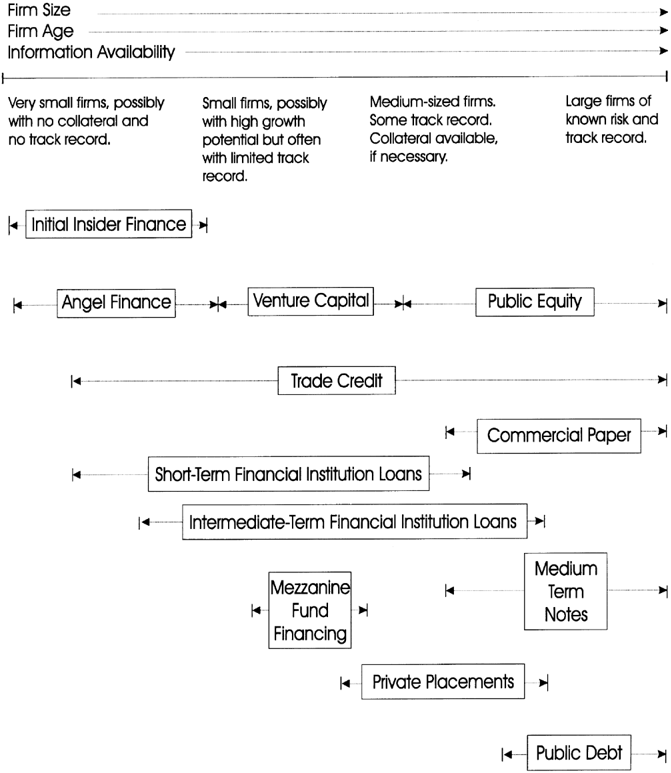
- The growth cycle paradigm predicts younger/more opaque firms rely on insider finance, trade credit, and angel finance, then venture capital and banks, and eventually public markets. However, 1993 NSSBF data show insider finance does not dominate external finance even for adolescents (upper bound 56.8% insider, roughly equal to external), and financial institution debt is important to very young firms, often based on personal guarantees or collateral.
- Macro vulnerability: the early-1990s credit crunch saw real C&I loans fall 23.2% ($596.7 billion to $458.2 billion) and estimated small business lending fall 38.5% ($143.7 billion to $88.4 billion). Banks with less than $100 million in assets held about 9% of portfolios in small business loans versus about 2% for banks over $10 billion; large banks charged about 100 basis points less and required collateral about 25% less often than small banks, other things equal.
Methods
- Design: review and synthesis organized around the financial growth cycle paradigm, covering theoretical and empirical literature on private equity and debt markets, contracts, and macroeconomic vulnerability.
- Data: primarily the 1993 National Survey of Small Business Finances (NSSBF) for US small business finance tables, plus other sources including NFIB, SCF, STBL, CALL, CRA, Venture Economics/VentureOne, and international data.
- Analysis: descriptive tabulations (Tables 1 and 2) and literature synthesis; the paper is a review rather than a new primary empirical study.
Limitations
- Paper-stated: Table 1 data are not completely accurate or consistent and should be considered rough estimates; angel finance estimates are imprecise (range $15 billion to $120 billion); 1993 data may not reflect current conditions; weighted averages mask considerable heterogeneity.
- Paper-stated: the growth cycle paradigm is not intended to fit all small businesses; firm size, age, and information availability are far from perfectly correlated, and the points at which different funding sources begin and end are not definitive.
- Evident from the text: informational opacity and the intertwining of personal and business finances make small business finance difficult to research, and data on owners’ finances are often unavailable; the paper relies heavily on existing literature and available data rather than new primary data collection.
Model-written summary. Check it against the paper before relying on it.
Integrity signals
Registry
Cites
Statistics
Figures
Verification
Claims the paper makes
22 Valid · 27 Not valid · 107 Not checked · 201 Own results and interpretations
Every source the paper cites for this claim was checked and supports it.
In the paper
“This use of personal assets to help with external ®nance also highlights another important aspect of small business ®nance ± the ®nancial intertwining of owners and their businesses (Ang, 1992).”
§ The economics of small business ®nance: The roles of private equity and debt markets in the ®nancial growth cycle > 2.3. The ®nancial growth cycle of small business
What the sources say
- Supportedcites Ang, 1992 matched to “On the Theory of Finance for Privately Held Firms” (1992) source
In “Integrating Personal and Business Accounts,” Ang says that personal guarantees or collateral make business risk inseparable from owners’ personal risk. “The Financing Decision” also identifies owners’ assets used for loan guarantees as contributions to the business. Together, these passages support the cited point that using personal assets to obtain external finance intertwines owners’ and businesses’ finances. (LLM, conf=0.94)
plainstates an association- Asserted: passes — The authors put it forward as true.
- Checkable: passes — It can be checked against evidence.
- Load-bearing: unclear — It is unclear whether the paper’s conclusions depend on it.
- Based: passes — The paper gives a reason why it holds.
- Supported
The cited sources support only part of this claim — read each source’s verdict below.
In the paper
“Costly state veri®cation (Townsend, 1979;Diamond, 1984) and adverse selection (Myers, 1984;Myers and Majluf, 1984;Nachman and Noe, 1994) arguments suggest the optimality of debt contracts after insider ®nance has been exhausted.”
§ The economics of small business ®nance: The roles of private equity and debt markets in the ®nancial growth cycle > 2.3. The ®nancial growth cycle of small business
What the sources say
- Partly supportedcites Townsend, 1979 matched to “Optimal contracts and competitive markets with costly state verification” (1979) sourceExperimental — accuracy not yet measured
Section 3 characterizes an optimal contract for a firm financing an investment project as a bond that defaults when returns fall below a threshold, supporting the costly-state-verification rationale for debt. The paper does not establish that debt becomes optimal only after insider finance has been exhausted. The adverse-selection citations in the sentence refer to other sources, not Townsend. (LLM, conf=0.85)
- Not checked — no full text of the sourcecites Diamond, 1984 matched to “Financial intermediation and delegated monitoring” (1984) source
- Not matchedcites Myers, 1984
More than one paper fits this citation.
hedgedstates a cause- Asserted: passes — The authors put it forward as true.
- Checkable: passes — It can be checked against evidence.
- Load-bearing: passes — The paper’s conclusions depend on it.
- Based: passes — The paper gives a reason why it holds.
- Partly supported
The cited sources support only part of this claim — read each source’s verdict below.
In the paper
“An agency problem arises in the relationship between the entrepreneur and the venture capitalist in which the entrepreneur may expend insucient eort, exhibit expense preference behavior, or lack sucient information or skill to make optimal production decisions.”
§ The economics of small business ®nance: The roles of private equity and debt markets in the ®nancial growth cycle > 3.2. The venture capital market
What the sources say
- Not checked — no full text of the sourcecites Cooper and Carleton, 1979 matched to “Dynamics of Borrower‐Lender Interaction: Partitioning Final Payoff in Venture Capital Finance” (1979) source
- Partly supportedcites Bergemann and Hege, 1998 matched to “Venture capital financing, moral hazard, and learning” (1998) sourceExperimental — accuracy not yet measured
Section 2.3, “Moral hazard and financing,” describes an entrepreneur who may reduce costly effort or divert investment funds to private ends, supporting the insufficient-effort and expense-preference parts of the claim. It does not identify a lack of the entrepreneur’s information or skill as a cause of poor production decisions; it instead says the entrepreneur and venture capitalists initially have the same assessment of the project. (LLM, conf=0.88)
hedgedstates a possible cause- Asserted: passes — The authors put it forward as true.
- Checkable: passes — It can be checked against evidence.
- Load-bearing: passes — The paper’s conclusions depend on it.
- Based: passes — The paper gives a reason why it holds.
Every source the paper cites for this claim was checked and supports it.
In the paper
“Since 1990, this share has about doubled to 30% (Fenn et al., 1997).”
§ The economics of small business ®nance: The roles of private equity and debt markets in the ®nancial growth cycle > 3. The role of private equity markets in small business ®nance
What the sources say
- Supportedcites Fenn et al., 1997 matched to “The Private Equity Market: An Overveiw” (1997) source
In “IPO Firms that Received Private Equity Backing,” the paper states that the share of IPOs with venture backing averaged 15% during the 1980s and doubled to 30% since 1990. This directly supports the cited claim. (LLM, conf=0.95)
plainstates an association- Asserted: passes — The authors put it forward as true.
- Checkable: passes — It can be checked against evidence.
- Load-bearing: unclear — It is unclear whether the paper’s conclusions depend on it.
- Based: passes — The paper gives a reason why it holds.
- Supported
The cited sources support only part of this claim — read each source’s verdict below.
In the paper
“During the 1980s, approximately 15% of all IPOs were backed by venture capital, well out of proportion to the fraction of all ®rms that received venture capital.”
§ The economics of small business ®nance: The roles of private equity and debt markets in the ®nancial growth cycle > 3. The role of private equity markets in small business ®nance
What the sources say
- Partly supportedcites Fenn et al., 1997 matched to “The Private Equity Market: An Overveiw” (1997) sourceExperimental — accuracy not yet measured
The section “IPO Firms that Received Private Equity Backing” states that venture-backed IPOs averaged 15% of IPOs during the 1980s. It does not give the fraction of all firms that received venture capital or make the claimed comparison with that fraction. (LLM, conf=0.84)
plainstates an association- Asserted: passes — The authors put it forward as true.
- Checkable: passes — It can be checked against evidence.
- Load-bearing: unclear — It is unclear whether the paper’s conclusions depend on it.
- Based: passes — The paper gives a reason why it holds.
- Partly supported
184 more claims · 6 with their cited sources checked
Create a free account to see all 357 claims and to verify the 12 references still open.
- Probably not a substantial claim. 94
- It may state two separate claims as one. 87
- Borderline: one of the tests for a substantial claim is unclear. 2
Claims other papers make about this one
Each is checked against this paper’s own text: does it say what the citing paper says it does?
The cited source says what the claim attributes to it.
In the citing paper
“SMEs are more dependent on external financing supplied by commercial banks (Berger and Udell 1998) because most of them are not qualified to raise money from the stock market.”
From Local Bank, Digital Financial Inclusion and SME Financing Constraints: Empirical Evidence from China (2022) · cites this paper as Berger and Udell 1998
Self-check
Percentages, sums and reported differences re-computed from the paper’s own numbers.
Rated minor: it would not touch a result — a value no result rests on, a p-value that stays on the same side of the significance level, or a conflict that is clerical, resolved elsewhere in the paper, or outside its own findings.
In the paper
“Non®nancial business/government debt provides 19.26% of small business funding (mostly trade credit)”
§ The economics of small business ®nance: The roles of private equity and debt markets in the ®nancial growth cycle > 4. The role of private debt markets in small business ®nance
Reported 19.26 · recomputed 18.01
Citations
Cites
Corporate financing and investment decisions when firms have information that investors do not have
Myers, S. C., & Majluf, N. S. (1984) · Journal of Financial Economics · doi:10.1016/0304-405x(84)90023-0 · Cited by 18,957
The Cost of Capital, Corporation Finance and the Theory of Investment
Miller, M. H. (1958) · American Economic Review · Cited by 14,574
Determinants of corporate borrowing
Myers, S. C. (1977) · Journal of Financial Economics · doi:10.1016/0304-405x(77)90015-0 · Cited by 13,169
Credit Rationing in Markets with Imperfect Information
Stiglitz, J. E., & Weiss, A. (1981) · Columbia University · doi:10.7916/d8v12ft1 · Cited by 12,769 · cited 1×
“…pledging outside collateral may help resolve adverse selection problems when the borrower has more information about the quality of the investment than the lender, and may help prevent credit rationing (Stiglitz and Weiss 1981, 1986, Bester 1985, Chan and Kanatas 1985, Besanko and Thakor 1987a,b).”
The cost of capital, corporation finance and the theory of investment
Terra, P. R. (2008) · Revista de Administração e Contabilidade da Unisinos · doi:10.4013/base.20082.07 · Cited by 8,615
Financial intermediation and delegated monitoring
Diamond, D. W. (1984) · The Review of Economic Studies · doi:10.2307/2297430 · Cited by 8,476 · cited 2×
“Costly state verification (Townsend 1979, Diamond 1984) and adverse selection (Myers 1984, Myers and Majluf 1984, Nachman and Noe 1994) arguments suggest the optimality of debt contracts after insider cFor example, there are generally accepted definitions of the stages of finance for the kind of…”
Corporate Financing and Investment Decisions When Firms Have InformationThat Investors Do Not Have
Myers, S., & Majluf, N. (1984) · doi:10.3386/w1396 · Cited by 6,745
The Benefits of Lending Relationships: Evidence from Small Business Data
PETERSEN, M. A., & RAJAN, R. G. (1994) · The Journal of Finance · doi:10.1111/j.1540-6261.1994.tb04418.x · Cited by 5,440 · cited 4×
“…whereas mortgages, equipment loans, motor vehicle loans, and other loans may more often be transactionsdriven .zs It was also found that dependence on trade credit decreased with the length of the banking relationship, supporting the value of relationship lending (Petersen and Rajan 1994, 1995).”
InfluentialInside the black box: the credit channel of monetary policy transmission
Bernanke, B. S., & Gertler, M. (1995) · Journal of Economic Perspectives · doi:10.1257/jep.9.4.27 · Cited by 4,211
Insiders and Outsiders: The Choice between Informed and Arm's‐Length Debt
RAJAN, R. G. (1992) · The Journal of Finance · doi:10.1111/j.1540-6261.1992.tb04662.x · Cited by 3,902 · cited 1×
“Some research suggests that these firms may try to reduce the control of their banks by issuing public debt, even though public debt may entail higher costs (Diamond 1991, 1993, Rajan 1992, Houston and James 1996).”
Research works printed but not linked: 11
- 66. Cook, L., 1997. Trade ®nance, bank ®nance, and capital market imperfections. Working paper. Harvard University, Cambridge, MA.
- 89. Freear, J., Sohl, J.E., Wetzel, W.E., Jr., 1994. The private investor market for venture capital. The Financier 1, 7±19.
- 112. Hancock, D., Wilcox, J.A., 1997. Bank capital, nonbank ®nance, and real estate activity. Journal of Housing Research 8, 75±105.
- 117. Hempel, G., Coleman, A., Simonson, D., 1986. Bank Management, Wiley, New York.
- 119. Ho, R., 1997. Credit-card use to ®nance small business is soaring, says survey of small ®rms. Wall Street Journal B2, Sept. 25.
- 153. Megginson, W.L., Weiss, K.A., 1991. Venture capitalist certi®cation in initial public oerings. Journal of Finance 46, 903±979.
- 162. Morsman Jr., E., 1986. Commercial loan structuring. Journal of Commercial Bank Lending 68, 2± 20.
- 187. Ravid, S.A., 1996. Debt maturity ± A survey. Financial Markets, Institutions and Instruments 5 (3), 1±68.
- 217. Wetzel Jr. W.E., 1994. Venture capital. In: Bygrave, W.D. (Ed.), Portable MBA in Entrepreneur- ship. Wiley, New York, pp. 172±194.
- 219. White, L.J., 1995. An analytical framework. In: Zahid, S.N. (Ed.), Financial Sector Development in Asia. Oxford University Press, New York, pp. 3±35.
- 222. McKean, R. (Ed.), Issues in Defense Economics. Columbia University Press, New York.
Cited by
Items 1,901–2,000 of 3,739
Microfinance Banks and its Impacts on Small and Medium Scale Enterprises in Nigeria
Khan, B. (2020) · World Scientific News · Cited by 6
Factors Driving Capital Structure of Italian SME’s
Sensini, L. (2020) · Cited by 9
Innovation, Credit Constraints, and National Banking Systems: A Comparison of Developing Nations*
Lorenz, E., & Pommet, S. (2018) · Cambridge University Press eBooks · doi:10.1017/9781108529525.008 · Cited by 7
MODELLING BANK MANAGEMENT, RURAL LENDING AND SMALL BUSINESS FINANCE IN NIGERIA
Toby, A. J. (2011) · Global Journal of Management and Business Research · Cited by 12
The Bank Lending Channel: Evidence from Australia
Deng, X., & Liu, L. (2014) · Australasian Accounting Business and Finance Journal · doi:10.14453/aabfj.v8i2.6 · Cited by 7
“This finding is consistent with research in the US (Berger & Udell 1998; Kashyap & Stein 1995).”
ResultPrivate Equity: A Portfolio Approach
Milner, F., & Vos, E. (2003) · The Journal of Alternative Investments · doi:10.3905/jai.2003.319072 · Cited by 9
Information production and lending market competition
Hyytinen, A. (2003) · Journal of Economics and Business · doi:10.1016/s0148-6195(03)00024-9 · Cited by 9
A study of cost efficiency of Indian commercial banks- An impact of mergers
Kaur, P., & Kaur, G. (2013) · AFRICAN JOURNAL OF BUSINESS MANAGEMENT · doi:10.5897/ajbm10.286 · Cited by 6
Microfinance, EU Structural Funds and Capacity Building for Managing Authorities
Pes, G. N., & Porretta, P. (2015) · Palgrave Macmillan UK eBooks · doi:10.1057/9781137536020 · Cited by 6
“This leads to the introduction of another proposition, the so-called theory of the Financial Growth Cycle (Berger and Udell, 1998), which relates the types of investors and methods of financing to the aforementioned elements, assuming the existence of a causal link between the use of different…”
BackgroundMethodAssessing and Measuring the Equity Gap and the Equity Requirements for Innovative SMEsPreprint
Gualandri, E., & Venturelli, V. (2009) · SSRN Electronic Journal · doi:10.2139/ssrn.1488684 · Cited by 6
Sharma, P., & Gounder, N. (2011) · SSRN Electronic Journal · doi:10.2139/ssrn.2185209 · Cited by 6
“For example, SMEs may be relatively more opaque, i.e. it may be more difficult to ascertain if these enterprises have the capacity (viability of projects) and/or willingness (moral hazard) to repay (Berger & Udell, 1998; Cole, et al., 2004).”
A re-examination of the role of relationships in the loan-granting processPreprint
Chakravarty, S., & Yilmazer, T. (2005) · RePEc: Research Papers in Economics · Cited by 6
Microcredit in Developed Countries: Unexpected Consequences of Loan-Size CeilingsPreprint
Cozarenco, A., & Szafarz, A. (2013) · SSRN Electronic Journal · doi:10.2139/ssrn.2269022 · Cited by 9
“25 To deal with moral hazard and adverse selection issues, financial institutions target entrepreneurial projects with already secured partial funding coming from personal money or funds provided by friends and family (Manigart and Struyf, 1997; Berger and Udell, 1998).”
BackgroundInfluentialVenture Capital Syndication in Germany: Evidence from IPO DataPreprint
Lehmann, E. E., & Boschker, K. (2003) · SSRN Electronic Journal · doi:10.2139/ssrn.361880 · Cited by 8
The Impact of the Recent Financial Crisis on Bank Loan Interest Rates and GuaranteesPreprint
Calcagnini, G., Farabullini, F., & Giombini, G. (2012) · SSRN Electronic Journal · doi:10.2139/ssrn.2008223 · Cited by 5
“According to the “sort by observed risk paradigm” observably risky borrowers are asked to pledge collateral while observably safe borrowers are not (Berger and Udell, 1990). Under asymmetric information guarantees play a role in solving different problems that may arise at loan origination (hidden information) or afte…”
InfluentialEvidence on Funding Decisions by Italian SMEs: A Self-Selection Model?Preprint
Brighi, P., & Torluccio, G. (2010) · SSRN Electronic Journal · doi:10.2139/ssrn.1629988 · Cited by 6
“19 See, amongst others, Berger and Udell, 2002 and DeYoung et al., 2004. 20 Although relationship lending is a mechanism allowing a reduction in the information asymmetries between bank and SME, this does not mean that SMEs may not also benefit from transaction lending. As Berger and Udell (2002) underline, large, non…”
Security Design in Production Economy with Flexible Information AcquisitionPreprint
Yang, M., & Zeng, Y. (2013) · SSRN Electronic Journal · doi:10.2139/ssrn.2209469 · Cited by 5
Understanding the Fair Value of Bankss LoansPreprint
Knott, S., Richardson, P., Rismanchi, K., et al. (2014) · SSRN Electronic Journal · doi:10.2139/ssrn.2545783 · Cited by 6
Underdiversification in Private Companies: Required Returns and Incentive EffectsPreprint
Mueller, E. (2004) · RePEc: Research Papers in Economics · Cited by 7
Sjöö, K. (2008) · NORA - Norwegian Open Research Archives · Cited by 6
Capital Structure in New Technology-Based Firms: Financing in the Irish Software SectorPreprint
Hogan, T., & Hutson, E. (2004) · SSRN Electronic Journal · doi:10.2139/ssrn.498283 · Cited by 6
The Role of Venture Capital in Financing Small BusinessesPreprint
Petreski, M. (2006) · SSRN Electronic Journal · Cited by 8
Bank Financing and Firm Growth: Evidence from Transition EconomiesPreprint
Ullah, B., & Wei, Z. (2016) · SSRN Electronic Journal · doi:10.2139/ssrn.2746714 · Cited by 6
Portuguese Startups: a success prediction modelPreprint
da Silva, D. S. (2016) · RePEc: Research Papers in Economics · doi:10.34626/96c6-cd81 · Cited by 16
Capital Structure and Irish Tech SMEsPreprint
Neville, C., & Lucey, B. M. (2017) · SSRN Electronic Journal · doi:10.2139/ssrn.2910979 · Cited by 7
SME Loan Securitisation 2.0: Market Assessment and Policy OptionsPreprint
Kraemer-Eis, H., Passaris, G., & Tappi, A. (2013) · RePEc: Research Papers in Economics · Cited by 6
How Did Young Firms Fare During the Great Recession? Evidence from the Kauffman Firm SurveyPreprint
Zarutskie, R. E., & Yang, T. (2015) · SSRN Electronic Journal · doi:10.2139/ssrn.2669566 · Cited by 8
“See, for example, Berger and Udell (1998) and Robb and Robinson (2014). The dynamics of the percentage of firms having a business bank loan suggest that financing conditions may have become tighter in 2009 for many firms.”
BackgroundResultBeyond the Bureau: Interoperable Payment Data for Loan Screening and Monitoring *Preprint
Rishabh, K. (2024) · SSRN Electronic Journal · doi:10.2139/ssrn.4782597 · Cited by 6
Accessing Alternative Finance in Europe: The Role of SMEs, Innovation, and Digital Platforms
Laso, J. M., Clemente, I. M., & Giner, G. R. (2025) · Journal of risk and financial management · doi:10.3390/jrfm18090496 · Cited by 13
Determinants of Access to Bank Financing in SMEs in Mexico
Rico, A. J., López, C. S. G., & Zamilpa, J. (2023) · Journal of risk and financial management · doi:10.3390/jrfm16110477 · Cited by 31
Diversity in banking and new firm formation. Insights from the Italian local credit markets
Errico, L., Rondinella, S., & Trivieri, F. (2024) · International Review of Economics & Finance · doi:10.1016/j.iref.2024.01.005 · Cited by 6
Entrepreneurial Firms and Bank Financing: Do Business Angels Play a Role?
Capizzi, V., Carta, N., Cavezzali, E., & Rigoni, U. (2024) · European Financial Management · doi:10.1111/eufm.12537 · Cited by 9
Nurhadiansjah, N., & Mansur, M. (2025) · Business Performance Review · doi:10.22495/bprv3i1p5 · Cited by 6
Re-evaluating the Supply Side of Finance Availability for Lithuanian SMEs
Railienė, G., & Ivaškevičiūtė, L. (2014) · Social Sciences · doi:10.5755/j01.ss.82.4.6605 · Cited by 5
“The use of external finance by SMEs in the middledevelopment stages has been proved as uneven comparing to the prepositions of Berger and Udell (1998), explaining it by differences in perceptions, economic conditions, cultural and ethnical aspects, and a lack of adequate growth in large companies…”
BackgroundMethodInfluentialCharacteristics and drivers of venture capital investment activity in Romania
Diaconu, M. (2012) · Economie teoretică şi aplicată · Cited by 5
Liquidity Runway and Horizon of Disappointment: Business Model of Venture Lending
Hesse, M., Lutz, E., & Talmor, E. (2016) · The Journal of Alternative Investments · doi:10.3905/jai.2016.19.2.028 · Cited by 5
“While the majority of small firms with an established business model are at least partly f inanced by traditional bank loans (Berger and Udell [1998]), entrepreneurial firms centered around an innovation do not have meaningful access to debt due to their high-risk profile, in contrast to established firms with tangibl…”
BackgroundInfluentialA Conceptual Framework of Entrepreneurial Finance
Clement, T., & Silvernagel, C. (2019) · Entrepreneurship Education and Pedagogy · doi:10.1177/2515127419846629 · Cited by 6
“…much of the published literature has dealt, primarily, with sources of finance, access to finance, the influence of public policy, risk and return issues, and information and analysis on initial public offerings (IPOs) of new ventures (Berger & Udell, 1998; Coleman, 2004; Denis, 2004; Macht, 2016).”
BackgroundInfluentialInformation asymmetries and entrepreneurial finance: evidence from theories and empirics
Han, L., Tian, L., & Mi, B. (2020) · Edward Elgar Publishing eBooks · doi:10.4337/9781786430960.00017 · Cited by 8
La oferta de microcréditos en Argentina:¿un obstáculo o una oportunidad?
Tauro, M. A., Guercio, M., & Vigier, H. P. (2020) · REVESCO Revista de Estudios Cooperativos · doi:10.5209/reve.69191 · Cited by 8
Lizano, M. M., Merino, E., & Sánchez, J. A. (2021) · Revista de Contabilidad · doi:10.6018/rcsar.349891 · Cited by 5
Influence of shareholder equity on trade credit demand: The study of non-financial firms in Pakistan
Shah, F., Liu, Y., Shah, Y. A., & Shah, F. (2021) · R-Economy · doi:10.15826/recon.2021.7.1.006 · Cited by 7
Hapsari, N. S., & Sulung, L. A. K. (2021) · Advances in Social Science, Education and Humanities Research/Advances in social science, education and humanities research · doi:10.2991/assehr.k.210531.074 · Cited by 5
The Role of Innovation in Startup Business Financing, Performance, and Survival
Konga, Y., & Kasilingam, R. (2021) · Advances in educational technologies and instructional design book series · doi:10.4018/978-1-7998-8327-2.ch020 · Cited by 9
Konga, Y., & Kasilingam, R. (2023) · Bulletin of Monetary Economics and Banking · doi:10.59091/1410-8046.2071 · Cited by 5
Measuring SMEs Risk – Evidence from Malaysia
Bai, M., & Harith, S. (2023) · SN Business & Economics · doi:10.1007/s43546-023-00496-3 · Cited by 10
“2003; Berger and Udell 1998, 2002).”
Tsuruta, D. (2023) · Economic Analysis and Policy · doi:10.1016/j.eap.2023.07.017 · Cited by 5
“Therefore, when banks offer credit to these borrowers, asymmetric information about their creditworthiness is severe for banks (Berger and Udell, 1998), which then causes problems with adverse selection and moral hazard.”
BackgroundChao, L., Pei, J., Zheng, S., & Li, B. (2023) · Environmental Science and Pollution Research · doi:10.1007/s11356-023-29966-9 · Cited by 5
“Formal finance refers to the established financial institutions, such as banks, venture capitalists, and government agencies, that provide structured funding options to businesses and individuals (Berger and Udell 1998).”
BackgroundIs the zero-leverage policy a persistent phenomenon? Evidence from Portuguese SMEs
Sardo, F., Serrasqueiro, Z., & Armada, M. J. D. R. (2024) · Research in International Business and Finance · doi:10.1016/j.ribaf.2024.102271 · Cited by 8
Credit Rationing in the Bank Credit Market: The Case of Tunisian SMEs
Fhima, F., & Bouabidi, M. (2011) · Journal of Small Business & Entrepreneurship · doi:10.1080/08276331.2011.10593555 · Cited by 8
“Both in the developing and developed world, SMEs have been found to have less access to external financing and to be more constrained in their operation and, subsequently, their growth (Berger and Udell, 1998; Galindo and Schiantarelli, 2003)2.”
BackgroundFostering business growth and commercialisation processes in small high technology firms
Pellikka, J., & Malinen, P. (2014) · International Journal of Business Environment · doi:10.1504/ijbe.2015.066018 · Cited by 5
The Relationship Between Saving and Credit from a Schumpeterian Perspective
Bertocco, G. (2009) · Journal of Economic Issues · doi:10.2753/jei0021-3624430303 · Cited by 5
How Banks Can Self-Monitor Their Lending To Comply with the Equal Credit Opportunity Act
Gilkeson, J. H., Winters, D. B., & Dwyer, P. D. (2003) · doi:10.20955/r.85.7-22 · Cited by 6
La estructura de capital en la empresa : su estudio contemporáneo.
Amaya, A. F. M. (2013) · Revista Finanzas y Política Económica · doi:10.14718/revfinanzpolitecon.v5.n2.2013.446 · Cited by 29
Factores determinantes del comportamiento financiero de las empresas familiares
Martínez, E. N. (2012) · Dialnet (Universidad de la Rioja) · Cited by 5
An examination of factors that influence entrepreneurial intention of high school students in Kenya
Kibuka, G. (2011) · Illinois Digital Environment for Access to Learning and Scholarship (University of Illinois at Urbana-Champaign) · Cited by 8
Investigating Capital Structure Determinants in Listed Cement Companies of India
Ray, S. (2013) · Financial and Quantitative Analysis · doi:10.12966/fqa.09.02.2013 · Cited by 5
Bank market power and firm creation: a multi-country analysis
Agostino, M., & Trivieri, F. (2016) · Journal of Small Business and Enterprise Development · doi:10.1108/jsbed-02-2014-0027 · Cited by 7
Determinants of Working Capital and Investment Financing Patterns of SMEs: Evidence from Turkey
ErdoÄŸan, A. Ä. (2015) · Journal of Applied Finance and Banking · Cited by 6
The effects of bank market power in short-term and long-term firm credit availability and investment
Valverde, S. C., Mansilla-Fernández, J. M., & Fernández, F. R. (2016) · Spanish Journal of Finance and Accounting / Revista Española de Financiación y Contabilidad · doi:10.1080/02102412.2016.1242239 · Cited by 8
“We obtain the expected signs for all firms but the short-term impact of bank market power is higher for SMEs (-0.5539) than for large companies (-0.4794).”
InfluentialService industries, growth dynamics and financial constraints
Donati, C. (2017) · Service Industries Journal · doi:10.1080/02642069.2017.1304927 · Cited by 5
“Larger firms, instead, are more likely to obtain finance due to greater informational transparency and the consequent reduction of information asymmetries (Berger & Udell, 1998).”
BackgroundBrighi, P., & Venturelli, V. (2017) · Springer eBooks · doi:10.1007/978-3-319-54891-3_4 · Cited by 7
Murphy, G., & Tocher, N. M. (2011) · New England journal of entrepreneurship · doi:10.1108/neje-14-01-2011-b002 · Cited by 7
“…sense,navigating the legitimacy threshold is largely a resource issue (e.g., Pfeffer and Salancik, 1978), because pre-legitimate ventures usually possess only the founder’s personal resources and what the founder has been able to raise from friends, family, and fools (Berger and Udell, 1998; 2006).”
Investment policies that support SME self-development
Das, B., Hui, X., & Sha, S. J. (2018) · Human Systems Management · doi:10.3233/hsm-17131 · Cited by 5
“Nonethe-less, bank and finance organizations are disinclined to make credit lending available to SME sector due to the possibility of risks like early stage ventures in terms of insufficient assets, low capitalization and having no proven track [1, 2, 4, 12, 32, 39].”
Behavioral agency research and theory: a review and research agenda
Massa, R. M., Partyka, R. B., & Lana, J. (2020) · Cadernos EBAPE BR · doi:10.1590/1679-395177017 · Cited by 12
Crowdfunding: An Innovative Instrument for Development Finance and Financial Inclusion
Katseli, L. T., & Boufounou, P. V. (2020) · Advances in finance, accounting, and economics book series · doi:10.4018/978-1-7998-2436-7.ch011 · Cited by 9
House Banks in Out-of-court Reorganization: Evidence from Austria
Mayr, S., Duller, C., & Stumbauer, K. (2020) · The Journal of Entrepreneurial Finance · doi:10.57229/2373-1761.1377 · Cited by 8
“SMEs are predominately funded with the help of banks in addition to equity (Berger and Udell, 1998).”
BackgroundInfluentialImpact of Employee Training and Strategic Alliances on Business Innovation and Survival
Garavito-Hernández, Y., Duarte, C. A. M., Galvis, J. F. R., et al. (2020) · Zenodo (CERN European Organization for Nuclear Research) · doi:10.5281/zenodo.3984207 · Cited by 5
Auwalin, I. (2020) · Eurasian economic review : · doi:10.1007/s40821-020-00170-w · Cited by 10
“Access to finance is often cited as one of the most important constraints faced by MSEs (Berger and Udell 1998; Schiffer and Weder 2001; Ayyagari et al. 2007; Rosengard and Prasetyantoko 2011).”
BackgroundA Commitment Mechanism to Eliminate Willful Contract Litigation
Jacobi, O., & Sher, N. (2015) · Review of Law & Economics · doi:10.1515/rle-2015-0019 · Cited by 5
Small and Medium-Sized Enterprises Financing
Yakubu, I. N., Sulemana, A.-M., & Abdallah, I. (2020) · Cited by 5
Kennickell, A. B., Kwast, M. L., & Pogach, J. (2015) · Finance and Economics Discussion Series · doi:10.17016/feds.2015.039 · Cited by 18
Why deep pockets make great borrowers: an empirical analysis of venture loans
Lehnertz, N., Plagmann, C., & Lutz, E. (2022) · Journal of Business Economics · doi:10.1007/s11573-022-01084-x · Cited by 15
“The financial growth cycle of startups usually starts with one’s own capital injections and support from family and friends, followed by participation from business angles (Berger and Udell 1998).”
BackgroundMethodGood News from Mass Media Induces More Investments in the Equity Crowdfunding Market
Felipe, I. J. D. S., Mendes‐Da‐Silva, W., Ali, I. A., & Francisco, E. D. R. (2023) · BAR - Brazilian Administration Review · doi:10.1590/1807-7692bar2023210083 · Cited by 7
The determinants of capitalising development costs in private companies: evidence from Germany
Eierle, B., & Wencki, S. (2015) · Journal of Business Economics · doi:10.1007/s11573-015-0778-0 · Cited by 5
Gómez-Guillamón, A. L. D., de Lema, D. G. P., & Garrido, T. M. (2015) · Spanish Journal of Finance and Accounting / Revista Española de Financiación y Contabilidad · doi:10.1080/02102412.2015.1006428 · Cited by 6
“…parte de fondos propios (capital riesgo), así como en el lado del pasivo mediante deuda con bancos, instituciones financieras, etc. Además, si las empresas continúan con vida y siguen creciendo, pueden tener acceso a capital público Stock Exchange y a los mercados de deuda (Berger & Udell, 1998).”
IMPACT OF ANCHORING BIAS ON CORPORATE PROFITS AND SHAREHOLDERS WEALTH
Karaa, İ. E. (2011) · DergiPark (Istanbul University) · Cited by 5
Entrepreneurial firms and financial attractiveness for securing debt capital: a Bayesian analysis
Aktekin, T., Dutta, D. K., & Sohl, J. E. (2017) · Venture Capital · doi:10.1080/13691066.2017.1336894 · Cited by 6
“Berger and Udell (1998) remark: Deviations from the Modigliani and Miller … assumption that agents can write contracts based on full information have been used to explain capital structure in corporate finance for the last 40 years, and these informational imperfections are arguably much more…”
BackgroundThe Japanese Banks in the Lasting Low-, Zero- and Negative-Interest Rate Environment
Murai, T., & Schnabl, G. (2021) · Credit and Capital Markets – Kredit und Kapital · doi:10.3790/ccm.54.1.1 · Cited by 5
Moirangthem, N. S., & Nag, B. (2021) · Asian Journal of Management Cases · doi:10.1177/0972820121998120 · Cited by 8
“Small businesses had a financial growth cycle and a startup growth cycle, in which funding sources and needs changed as they grew and matured (Berger & Udell, 1998).”
BackgroundMathur, I., & Marcelin, I. (2014) · Emerald Group Publishing Limited eBooks · doi:10.1108/s1569-375920140000096009 · Cited by 12
On SBA-Guaranteed Lending and Economic Growth
Craig, B. R., Jackson, W. E., & Thomson, J. B. (2005) · Edward Elgar Publishing eBooks · doi:10.4337/9781845428181.00014 · Cited by 5
Taxes and Corporate Borrowing: Empirical Evidence from Selected African Countries
Abor, J. Y., Bokpin, G. A., & Fiawoyife, E. (2011) · Journal of African Business · doi:10.1080/15228916.2011.588916 · Cited by 5
“If they survive the dangers of undercapitalization, they are then likely to be able to make use of other sources of debt finance (Berger & Udell, 1998 ).”
BackgroundPrantl, S., Almus, M., Egeln, J., & Engel, D. (2009) · Journal of Contextual Economics – Schmollers Jahrbuch · doi:10.3790/schm.129.1.83 · Cited by 6
The role of «perceived loss» aversion on credit screening: An experiment
Bediou, B., Comeig, I., Jaramillo-Gutiérrez, A., & Sander, D. (2013) · Spanish Journal of Finance and Accounting / Revista Española de Financiación y Contabilidad · doi:10.1080/02102412.2013.10779741 · Cited by 7
Financial Flows and Places: The Case of Montreal
Shearmur, R. (2001) · Canadian Public Policy · doi:10.2307/3552198 · Cited by 5
Acquisition of Institutional Capital by Niche Agricultural Producers
Zhang, J., & Auken, H. V. (2011) · Journal of Small Business & Entrepreneurship · doi:10.1080/08276331.2011.10593544 · Cited by 5
“…results provide support for the flows depicted in Figure 1 and confirm that a funding gap can arise from the constrained flow of information from capital providers to users about alternative financing options (Berger and Udell, 1998; Busenitz et al., 2003; Holmes and Kent, 1991; Van Auken, 2001).”
BackgroundResultInfluentialRay, E. (2010) · Library and Archives Canada (Government of Canada) · Cited by 6
Institutional Affiliation of General Partners and Private Equity Investment Choices
Huyghebaert, N. (2010) · The Journal of Private Equity · doi:10.3905/jpe.2010.13.4.025 · Cited by 5
Kenawy, E. M., Fathy, M., & Ghany, A.-E. (2012) · Cited by 5
Predicting Entrepreneurial Performance: Can Legitimacy Help?
Batchelor, J. H., & Burch, G. F. (2011) · Small Business Institute Journal · Cited by 10
Finance and R&D Investment: A Panel Study of Italian Manufacturing Firms
Succurro, M., & Costanzo, G. D. (2016) · International Journal of Economics and Finance · doi:10.5539/ijef.v8n8p95 · Cited by 4
“It is well known that debt markets provide resources at a higher cost, demand a fair amount of assets as collateral, and require complex contracts (Berger & Udell, 1998; Berger & Udell, 2002; Carpenter & Petersen, 2002a).”
BackgroundBátiz‐Lazo, B., & Noguchi, M. (2013) · Accounting History · doi:10.1177/1032373212463794 · Cited by 5
Comment on Angelini, Di Salvo and Ferri
Kashyap, A. (1998) · Journal of Banking & Finance · doi:10.1016/s0378-4266(98)00034-x · Cited by 5
Transfer of knowledge from the lab to the market: The idiosyncrasy of academic entrepreneurs
Herrero, F. V. (2008) · TDX (Tesis Doctorals en Xarxa) · Cited by 6
Banche, territorio e sviluppoPreprint
Alessandrini, P., Papi, L., & Zazzaro, A. (2002) · Moneta e credito · Cited by 11
Multiple effects of business plans on new venturesPreprint
Burke, A., Fraser, S., & Green, F. (2009) · SSRN Electronic Journal · Cited by 6
Does Social Capital Affect the Financing Decisions of Chinese Small and Medium-Sized Enterprises?Preprint
Du, J., Guariglia, A., & Newman, A. (2010) · SSRN Electronic Journal · doi:10.2139/ssrn.1619230 · Cited by 7
“Previous research highlights the use of fixed assets as a mechanism for resolving information asymmetries between lenders and borrowers and reducing financial risk for lenders (Berger and Udell, 1998).”
Family ownership and growth: the case of French SMEsPreprint
Hamelin-Schertzer, A., & Trojman, J. (2007) · RePEc: Research Papers in Economics · Cited by 6
Collaborative R&D as a Strategy to Attenuate Financing ConstraintsPreprint
Czarnitzki, D., & Hottenrott, H. (2012) · SSRN Electronic Journal · doi:10.2139/ssrn.2177881 · Cited by 9
“Thus R&D investment provides a very low inside collateral value which makes raising funds externally more costly for R&D projects than for other types of investments (Arrow, 1962; Berger and Udell, 1998; Harhoff, 1998).”
Metadata
- Authors
- N. Berger, A., & F. Udell, G.
- Venue
- Journal of Banking & Finance
- Publisher
- Elsevier BV
- Published
- 1998-08
- Volume
- 22
- Issue
- 6-8
- Pages
- 613-673
- ISSN
- 0378-4266 (ISSN-L)
- OpenAlex
- W2119780569
- Semantic Scholar
- dfc06f7f7eb83d2c0e2a1d67ecb95b520a406843
- Cited by
- 3,690
- References
- 230
- Citations by year
- 2026: 136 · 2025: 148 · 2024: 144 · 2023: 193 · 2022: 155 · 2021: 211 · 2020: 200 · 2019: 156 · 2018: 208 · 2017: 174 · 2016: 186 · 2015: 187 · 2014: 168 · 2013: 177 · 2012: 171
- FWCI
- 169.26
- Type
- journal article
- Language
- en
- Open access
- hybrid
- doi.org
- Licence
- cc-by-nc-nd
- www.elsevier.com/tdm/userlicense/1.0/ (tdm)
- www.elsevier.com/legal/tdmrep-license (tdm)
- creativecommons.org/licenses/by-nc-nd/4.0/ (vor, 125 d)
- Locations
- Journal of Banking & Finance (publishedVersion, cc-by-nc-nd)
- RePEc: Research Papers in Economics (submittedVersion)
- Funders
- York University
- Topics
- Social Sciences › Economics, Econometrics and Finance › Finance › Private Equity and Venture Capital
- Social Sciences › Economics, Econometrics and Finance › Finance › Corporate Finance and Governance
- Social Sciences › Economics, Econometrics and Finance › Finance › Banking stability, regulation, efficiency
- Keywords
- small business financing, private equity, debt markets, capital structure, firm size, firm age, macroeconomic conditions
About these checks
Registry, retraction, Cites and statistics results are computed, not judged, with one exception: a printed reference that no index lists is read once by a model before it counts as a citation error. Claims are extracted by a model and kept only when their quote appears verbatim in the text; each cited source is then checked, with a model’s help, for whether it says what the claim relies on. Those verdicts can be wrong — read the claim’s quote and the cited source before relying on one.
The claim verdicts this report counts are experimental: their accuracy is not yet measured.
A language model drew the claims from the paper on 2026-10-10, under version 3 of the claim definition (model deepseek-v4.1-flash, prompt extract-v3).
A second model labelled each claim on 2026-10-10 (model jev-1.13-20260917, definition revision gold-guideline-v0.2).
Cited sources are checked with a language model’s help (gpt-6-sol).
Statistics and arithmetic are recomputed, not judged.
Confidence bands are shown only for fields calibrated on our annotated test set. None is calibrated yet, so no band is shown.
What counts as a claim ›How we measure confidence ›How we check this ›
Are you an author, or do you see a problem with this page? Request a review
Data sources
Bibliographic data: Semantic Scholar, OpenAlex, Crossref.
Contains information from the Semantic Scholar Academic Graph Datasets, made available under the ODC Attribution License (ODC-BY 1.0).
Semantic Scholar’s data is described in: Kinney, R., et al. (2023). The Semantic Scholar Open Data Platform. arXiv:2301.10140.
