

The economics of small business finance: The roles of private equity and debt markets in the financial growth cycle
Open accessThe DOI matches its Crossref record; 217 of the 230 references it cites were found in a registry or an index, and 1 are not checked yet; 24 of the 170 sources its claims cite were checked for support.
Abstract
This article examines the economics of financing small business in private equity and debt markets. Firms are viewed through a financial growth cycle paradigm in which different capital structures are optimal at different points in the cycle. We show the sources of small business finance, and how capital structure varies with firm size and age. The interconnectedness of small firm finance is discussed along with the impact of the macroeconomic environment. We also analyze a number of research and policy issues, review the literature, and suggest topics for future research.
Verified 2026-11-25 · 1 reference not checked yet
Overview
CoChat Summary
TL;DR
This article reviews the economics of small business finance through a financial growth cycle paradigm, emphasizing informational opacity and the roles of private equity and debt markets. It documents US small business funding sources and contracts, and analyzes vulnerability to macroeconomic shocks, credit crunches, and bank consolidation.
Key findings
- US small business finance is split roughly evenly between equity (49.63%) and debt (50.37%); the largest sources are the principal owner, commercial banks, and trade creditors, together accounting for 70.10% of total funding. Commercial banks provide 18.75%, trade credit 15.78%, principal owner equity 31.33%, angel finance 3.59%, venture capital 1.85%, and credit card debt 0.14%.
- Financial institution debt is used by 54.23% of small businesses; 86.95% name a commercial bank as their primary financial institution. Average relationship length is 6.64 years overall and 9.01 years with the primary institution; 52.03% of financial institution debt is under lines of credit, 91.94% is secured, and 51.63% is guaranteed.
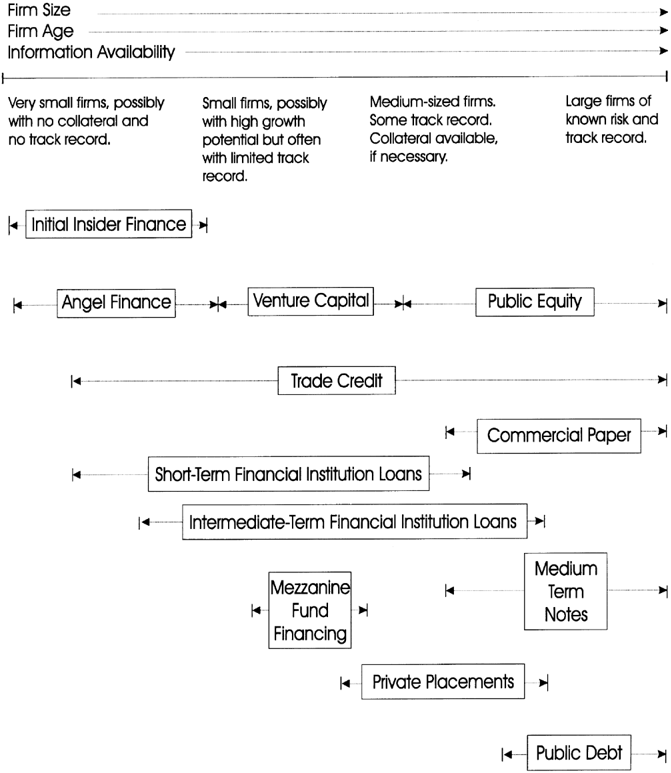
- The growth cycle paradigm predicts younger/more opaque firms rely on insider finance, trade credit, and angel finance, then venture capital and banks, and eventually public markets. However, 1993 NSSBF data show insider finance does not dominate external finance even for adolescents (upper bound 56.8% insider, roughly equal to external), and financial institution debt is important to very young firms, often based on personal guarantees or collateral.
- Macro vulnerability: the early-1990s credit crunch saw real C&I loans fall 23.2% ($596.7 billion to $458.2 billion) and estimated small business lending fall 38.5% ($143.7 billion to $88.4 billion). Banks with less than $100 million in assets held about 9% of portfolios in small business loans versus about 2% for banks over $10 billion; large banks charged about 100 basis points less and required collateral about 25% less often than small banks, other things equal.
Methods
- Design: review and synthesis organized around the financial growth cycle paradigm, covering theoretical and empirical literature on private equity and debt markets, contracts, and macroeconomic vulnerability.
- Data: primarily the 1993 National Survey of Small Business Finances (NSSBF) for US small business finance tables, plus other sources including NFIB, SCF, STBL, CALL, CRA, Venture Economics/VentureOne, and international data.
- Analysis: descriptive tabulations (Tables 1 and 2) and literature synthesis; the paper is a review rather than a new primary empirical study.
Limitations
- Paper-stated: Table 1 data are not completely accurate or consistent and should be considered rough estimates; angel finance estimates are imprecise (range $15 billion to $120 billion); 1993 data may not reflect current conditions; weighted averages mask considerable heterogeneity.
- Paper-stated: the growth cycle paradigm is not intended to fit all small businesses; firm size, age, and information availability are far from perfectly correlated, and the points at which different funding sources begin and end are not definitive.
- Evident from the text: informational opacity and the intertwining of personal and business finances make small business finance difficult to research, and data on owners’ finances are often unavailable; the paper relies heavily on existing literature and available data rather than new primary data collection.
Model-written summary. Check it against the paper before relying on it.
Integrity signals
Registry
Cites
Statistics
Figures
Verification
Claims the paper makes
22 Valid · 27 Not valid · 107 Not checked · 201 Own results and interpretations
Every source the paper cites for this claim was checked and supports it.
In the paper
“This use of personal assets to help with external ®nance also highlights another important aspect of small business ®nance ± the ®nancial intertwining of owners and their businesses (Ang, 1992).”
§ The economics of small business ®nance: The roles of private equity and debt markets in the ®nancial growth cycle > 2.3. The ®nancial growth cycle of small business
What the sources say
- Supportedcites Ang, 1992 matched to “On the Theory of Finance for Privately Held Firms” (1992) source
In “Integrating Personal and Business Accounts,” Ang says that personal guarantees or collateral make business risk inseparable from owners’ personal risk. “The Financing Decision” also identifies owners’ assets used for loan guarantees as contributions to the business. Together, these passages support the cited point that using personal assets to obtain external finance intertwines owners’ and businesses’ finances. (LLM, conf=0.94)
plainstates an association- Asserted: passes — The authors put it forward as true.
- Checkable: passes — It can be checked against evidence.
- Load-bearing: unclear — It is unclear whether the paper’s conclusions depend on it.
- Based: passes — The paper gives a reason why it holds.
- Supported
The cited sources support only part of this claim — read each source’s verdict below.
In the paper
“Costly state veri®cation (Townsend, 1979;Diamond, 1984) and adverse selection (Myers, 1984;Myers and Majluf, 1984;Nachman and Noe, 1994) arguments suggest the optimality of debt contracts after insider ®nance has been exhausted.”
§ The economics of small business ®nance: The roles of private equity and debt markets in the ®nancial growth cycle > 2.3. The ®nancial growth cycle of small business
What the sources say
- Partly supportedcites Townsend, 1979 matched to “Optimal contracts and competitive markets with costly state verification” (1979) sourceExperimental — accuracy not yet measured
Section 3 characterizes an optimal contract for a firm financing an investment project as a bond that defaults when returns fall below a threshold, supporting the costly-state-verification rationale for debt. The paper does not establish that debt becomes optimal only after insider finance has been exhausted. The adverse-selection citations in the sentence refer to other sources, not Townsend. (LLM, conf=0.85)
- Not checked — no full text of the sourcecites Diamond, 1984 matched to “Financial intermediation and delegated monitoring” (1984) source
- Not matchedcites Myers, 1984
More than one paper fits this citation.
hedgedstates a cause- Asserted: passes — The authors put it forward as true.
- Checkable: passes — It can be checked against evidence.
- Load-bearing: passes — The paper’s conclusions depend on it.
- Based: passes — The paper gives a reason why it holds.
- Partly supported
The cited sources support only part of this claim — read each source’s verdict below.
In the paper
“An agency problem arises in the relationship between the entrepreneur and the venture capitalist in which the entrepreneur may expend insucient eort, exhibit expense preference behavior, or lack sucient information or skill to make optimal production decisions.”
§ The economics of small business ®nance: The roles of private equity and debt markets in the ®nancial growth cycle > 3.2. The venture capital market
What the sources say
- Not checked — no full text of the sourcecites Cooper and Carleton, 1979 matched to “Dynamics of Borrower‐Lender Interaction: Partitioning Final Payoff in Venture Capital Finance” (1979) source
- Partly supportedcites Bergemann and Hege, 1998 matched to “Venture capital financing, moral hazard, and learning” (1998) sourceExperimental — accuracy not yet measured
Section 2.3, “Moral hazard and financing,” describes an entrepreneur who may reduce costly effort or divert investment funds to private ends, supporting the insufficient-effort and expense-preference parts of the claim. It does not identify a lack of the entrepreneur’s information or skill as a cause of poor production decisions; it instead says the entrepreneur and venture capitalists initially have the same assessment of the project. (LLM, conf=0.88)
hedgedstates a possible cause- Asserted: passes — The authors put it forward as true.
- Checkable: passes — It can be checked against evidence.
- Load-bearing: passes — The paper’s conclusions depend on it.
- Based: passes — The paper gives a reason why it holds.
Every source the paper cites for this claim was checked and supports it.
In the paper
“Since 1990, this share has about doubled to 30% (Fenn et al., 1997).”
§ The economics of small business ®nance: The roles of private equity and debt markets in the ®nancial growth cycle > 3. The role of private equity markets in small business ®nance
What the sources say
- Supportedcites Fenn et al., 1997 matched to “The Private Equity Market: An Overveiw” (1997) source
In “IPO Firms that Received Private Equity Backing,” the paper states that the share of IPOs with venture backing averaged 15% during the 1980s and doubled to 30% since 1990. This directly supports the cited claim. (LLM, conf=0.95)
plainstates an association- Asserted: passes — The authors put it forward as true.
- Checkable: passes — It can be checked against evidence.
- Load-bearing: unclear — It is unclear whether the paper’s conclusions depend on it.
- Based: passes — The paper gives a reason why it holds.
- Supported
The cited sources support only part of this claim — read each source’s verdict below.
In the paper
“During the 1980s, approximately 15% of all IPOs were backed by venture capital, well out of proportion to the fraction of all ®rms that received venture capital.”
§ The economics of small business ®nance: The roles of private equity and debt markets in the ®nancial growth cycle > 3. The role of private equity markets in small business ®nance
What the sources say
- Partly supportedcites Fenn et al., 1997 matched to “The Private Equity Market: An Overveiw” (1997) sourceExperimental — accuracy not yet measured
The section “IPO Firms that Received Private Equity Backing” states that venture-backed IPOs averaged 15% of IPOs during the 1980s. It does not give the fraction of all firms that received venture capital or make the claimed comparison with that fraction. (LLM, conf=0.84)
plainstates an association- Asserted: passes — The authors put it forward as true.
- Checkable: passes — It can be checked against evidence.
- Load-bearing: unclear — It is unclear whether the paper’s conclusions depend on it.
- Based: passes — The paper gives a reason why it holds.
- Partly supported
184 more claims · 6 with their cited sources checked
Create a free account to see all 357 claims and to verify the 12 references still open.
- Probably not a substantial claim. 94
- It may state two separate claims as one. 87
- Borderline: one of the tests for a substantial claim is unclear. 2
Claims other papers make about this one
Each is checked against this paper’s own text: does it say what the citing paper says it does?
The cited source says what the claim attributes to it.
In the citing paper
“SMEs are more dependent on external financing supplied by commercial banks (Berger and Udell 1998) because most of them are not qualified to raise money from the stock market.”
From Local Bank, Digital Financial Inclusion and SME Financing Constraints: Empirical Evidence from China (2022) · cites this paper as Berger and Udell 1998
Self-check
Percentages, sums and reported differences re-computed from the paper’s own numbers.
Rated minor: it would not touch a result — a value no result rests on, a p-value that stays on the same side of the significance level, or a conflict that is clerical, resolved elsewhere in the paper, or outside its own findings.
In the paper
“Non®nancial business/government debt provides 19.26% of small business funding (mostly trade credit)”
§ The economics of small business ®nance: The roles of private equity and debt markets in the ®nancial growth cycle > 4. The role of private debt markets in small business ®nance
Reported 19.26 · recomputed 18.01
Citations
Cites
Corporate financing and investment decisions when firms have information that investors do not have
Myers, S. C., & Majluf, N. S. (1984) · Journal of Financial Economics · doi:10.1016/0304-405x(84)90023-0 · Cited by 18,957
The Cost of Capital, Corporation Finance and the Theory of Investment
Miller, M. H. (1958) · American Economic Review · Cited by 14,574
Determinants of corporate borrowing
Myers, S. C. (1977) · Journal of Financial Economics · doi:10.1016/0304-405x(77)90015-0 · Cited by 13,169
Credit Rationing in Markets with Imperfect Information
Stiglitz, J. E., & Weiss, A. (1981) · Columbia University · doi:10.7916/d8v12ft1 · Cited by 12,769 · cited 1×
“…pledging outside collateral may help resolve adverse selection problems when the borrower has more information about the quality of the investment than the lender, and may help prevent credit rationing (Stiglitz and Weiss 1981, 1986, Bester 1985, Chan and Kanatas 1985, Besanko and Thakor 1987a,b).”
The cost of capital, corporation finance and the theory of investment
Terra, P. R. (2008) · Revista de Administração e Contabilidade da Unisinos · doi:10.4013/base.20082.07 · Cited by 8,615
Financial intermediation and delegated monitoring
Diamond, D. W. (1984) · The Review of Economic Studies · doi:10.2307/2297430 · Cited by 8,476 · cited 2×
“Costly state verification (Townsend 1979, Diamond 1984) and adverse selection (Myers 1984, Myers and Majluf 1984, Nachman and Noe 1994) arguments suggest the optimality of debt contracts after insider cFor example, there are generally accepted definitions of the stages of finance for the kind of…”
Corporate Financing and Investment Decisions When Firms Have InformationThat Investors Do Not Have
Myers, S., & Majluf, N. (1984) · doi:10.3386/w1396 · Cited by 6,745
The Benefits of Lending Relationships: Evidence from Small Business Data
PETERSEN, M. A., & RAJAN, R. G. (1994) · The Journal of Finance · doi:10.1111/j.1540-6261.1994.tb04418.x · Cited by 5,440 · cited 4×
“…whereas mortgages, equipment loans, motor vehicle loans, and other loans may more often be transactionsdriven .zs It was also found that dependence on trade credit decreased with the length of the banking relationship, supporting the value of relationship lending (Petersen and Rajan 1994, 1995).”
InfluentialInside the black box: the credit channel of monetary policy transmission
Bernanke, B. S., & Gertler, M. (1995) · Journal of Economic Perspectives · doi:10.1257/jep.9.4.27 · Cited by 4,211
Insiders and Outsiders: The Choice between Informed and Arm's‐Length Debt
RAJAN, R. G. (1992) · The Journal of Finance · doi:10.1111/j.1540-6261.1992.tb04662.x · Cited by 3,902 · cited 1×
“Some research suggests that these firms may try to reduce the control of their banks by issuing public debt, even though public debt may entail higher costs (Diamond 1991, 1993, Rajan 1992, Houston and James 1996).”
Research works printed but not linked: 11
- 66. Cook, L., 1997. Trade ®nance, bank ®nance, and capital market imperfections. Working paper. Harvard University, Cambridge, MA.
- 89. Freear, J., Sohl, J.E., Wetzel, W.E., Jr., 1994. The private investor market for venture capital. The Financier 1, 7±19.
- 112. Hancock, D., Wilcox, J.A., 1997. Bank capital, nonbank ®nance, and real estate activity. Journal of Housing Research 8, 75±105.
- 117. Hempel, G., Coleman, A., Simonson, D., 1986. Bank Management, Wiley, New York.
- 119. Ho, R., 1997. Credit-card use to ®nance small business is soaring, says survey of small ®rms. Wall Street Journal B2, Sept. 25.
- 153. Megginson, W.L., Weiss, K.A., 1991. Venture capitalist certi®cation in initial public oerings. Journal of Finance 46, 903±979.
- 162. Morsman Jr., E., 1986. Commercial loan structuring. Journal of Commercial Bank Lending 68, 2± 20.
- 187. Ravid, S.A., 1996. Debt maturity ± A survey. Financial Markets, Institutions and Instruments 5 (3), 1±68.
- 217. Wetzel Jr. W.E., 1994. Venture capital. In: Bygrave, W.D. (Ed.), Portable MBA in Entrepreneur- ship. Wiley, New York, pp. 172±194.
- 219. White, L.J., 1995. An analytical framework. In: Zahid, S.N. (Ed.), Financial Sector Development in Asia. Oxford University Press, New York, pp. 3±35.
- 222. McKean, R. (Ed.), Issues in Defense Economics. Columbia University Press, New York.
Cited by
Items 1,801–1,900 of 3,739
Adamek, J. (2006) · Cited by 12
Fostering the 'New Economy': the role of financial intermediationPreprint
Houben, A., & Kakes, J. (2001) · RePEc: Research Papers in Economics · Cited by 7
Leitner, S. M., & Stehrer, R. (2012) · RePEc: Research Papers in Economics · Cited by 7
Collateral and Local Lending: Testing the Lender-Based Theory
Bellucci, A., Borisov, A., Giombini, G., & Zazzaro, A. (2015) · Institutional Repositories DataBase (IRDB) · Cited by 8
The Number of Bank Relationships of Smes: A Disaggregated Analysis for the Swiss Loan MarketPreprint
Neuberger, D., & Schacht, C. (2005) · SSRN Electronic Journal · doi:10.2139/ssrn.812845 · Cited by 7
Evaluation and Microenterprise ProgramsPreprint
Schreiner, M. J. (2001) · RePEc: Research Papers in Economics · Cited by 7
Dong, X. L., Worthington, A. C., & Higgs, H. (2011) · SSRN Electronic Journal · doi:10.2139/ssrn.1913979 · Cited by 7
“Start-up and early-stage SMEs may then resort to external equity, particularly private investors and business angels (Berger and Udell, 1998).”
Conditions de financement de la PME et relations bancaires
Vigneron, L. (2008) · HAL · Cited by 21
The Legal Enforcement of Credit Contracts and the Level of InvestmentPreprint
Fabbri, D. (2001) · RePEc: Research Papers in Economics · Cited by 11
On the Determinants of Smes Cash Holding: Evidence from SpainPreprint
García‐Teruel, P. J., & Solano, P. M. (2005) · SSRN Electronic Journal · doi:10.2139/ssrn.695163 · Cited by 7
Relational Networks and Family Firm Capital Structure in Thailand : Theory and Practice
Chuairuang, S. (2013) · DiVA at Umeå University (Umeå University) · Cited by 8
Bank Consolidation and Small Business Lending within Local MarketsPreprint
Samolyk, K. A., & Richardson, C. A. (2006) · SSRN Electronic Journal · doi:10.2139/ssrn.886681 · Cited by 7
Short Term Debt in Spanish SmesPreprint
García‐Teruel, P. J., & Solano, P. M. (2004) · SSRN Electronic Journal · doi:10.2139/ssrn.534503 · Cited by 7
The impact of banks' expanded securities powers on small‐business lending
Ely, D. P., & Robinson, K. J. (2003) · Review of Financial Economics · doi:10.1016/j.rfe.2003.07.001 · Cited by 10
The Optimal Rating Philosophy for the Rating of SMEsPreprint
Rikkers, F., & Thibeault, A. E. (2007) · SSRN Electronic Journal · doi:10.2139/ssrn.966322 · Cited by 7
“As a result, small firms often cannot credibly convey their quality (Berger and Udell, 1998).”
Cross-Selling Lending and Underwriting: Scope Economies and IncentivesPreprint
Laux, C., & Walz, U. (2007) · SSRN Electronic Journal · doi:10.2139/ssrn.965247 · Cited by 7
Bank Lending Technologies and SME Credit Rationing in Europe in the 2009 CrisisPreprint
Ferri, G., Murro, P., & Rotondi, Z. (2014) · SSRN Electronic Journal · doi:10.2139/ssrn.2469699 · Cited by 7
“5 Berger and Udell (2006) consider six different transaction-based lending technologies: (i) financial statement lending,”
Small and Medium-Sized Enterprises’ (Smes’) Access to Credit in Ghana: Determinants and Challenges
Fuseini, G. (2015) · Cited by 7
Brown, R., Mawson, S., Rowe, A., & Mason, C. M. (2015) · Stirling Online Research Repository (University of Stirling) · Cited by 25
SMALL AND MEDIUM ENTERPRISE FINANCING AND CREDIT RATIONING THE ROLE OF BANKS IN SOUTH AFRICA
Mutezo, A. T. (2023) · Unisa Institutional Repository (University of South Africa) · doi:10.13140/rg.2.2.26792.96005 · Cited by 11
Putting Technology to Good Use for Society: the Role of Corporate, Competition and Tax LawPreprint
Armour, J. H., Enriques, L., Ezrachi, A., & Vella, J. (2018) · SSRN Electronic Journal · doi:10.2139/ssrn.3287696 · Cited by 7
Bank Financing for Small and Medium-sized Enterprises (SMEs) in Libya
Abdulsaleh, A. M. (2016) · Griffith Research Online · doi:10.25904/1912/2451 · Cited by 12
Bank Loan Markups and Adverse SelectionPreprint
Beyhaghi, M., Fracassi, C., & Weitzner, G. (2020) · SSRN Electronic Journal · doi:10.2139/ssrn.3733932 · Cited by 7
De-Segmenting Research in Entrepreneurial FinancePreprint
Cumming, D. J., & Vismara, S. (2016) · SSRN Electronic Journal · doi:10.2139/ssrn.2740453 · Cited by 8
Grilli, L., & Murtinu, S. (2013) · SSRN Electronic Journal · doi:10.2139/ssrn.1892024 · Cited by 7
Debt Financing and Firm Growth: European Evidence on StartupsPreprint
Andrieu, G., Rocca, M. L., Rocca, T. L., & Staglianò, R. (2021) · SSRN Electronic Journal · doi:10.2139/ssrn.3919521 · Cited by 9
Beg, Borrow, and Deal? Entrepreneurs’ Choice of Financing and New Firm InnovationPreprint
Smith, S. W. (2011) · SSRN Electronic Journal · doi:10.2139/ssrn.1787759 · Cited by 16
Kennickell, A. B., Kwast, M. L., & Pogach, J. (2015) · SSRN Electronic Journal · doi:10.2139/ssrn.2620748 · Cited by 8
Purchase Order Financing: Credit, Commitment, and Supply Chain ConsequencesPreprint
Reindorp, M. J., Tanrısever, F., & Lange, A. (2015) · SSRN Electronic Journal · doi:10.2139/ssrn.2616812 · Cited by 7
Hahn, E. D., & Massini, S. (2024) · Journal of International Management · doi:10.1016/j.intman.2024.101172 · Cited by 10
Tsuruta, D. (2024) · Pacific-Basin Finance Journal · doi:10.1016/j.pacfin.2024.102500 · Cited by 7
Toward Sustainable Development: Gender Diversity in Leadership, Green Innovation, and ESG Disclosure
Alodat, A. Y., & Dong, S. (2025) · Business Strategy and the Environment · doi:10.1002/bse.70181 · Cited by 7
Climate risk exposure and bank risk-taking behavior: new evidence from China
Zhang, Y., & Hui, M. (2025) · Humanities and Social Sciences Communications · doi:10.1057/s41599-025-06232-6 · Cited by 11
“At the market structure level, we contribute to the long-standing debate on bank competition and stability (Berger and Udell, 1998) by empirically examining how regional competition mediates climate risk impacts.”
Nguyen, H. H., Nguyen, D. H., Nguyen, T. H. M., & Chen, X. H. (2025) · Energy Policy · doi:10.1016/j.enpol.2025.115048 · Cited by 11
Bank Capital Ratios and the Structure of Nonfinancial Industries
Lee, S. J., & Stebunovs, V. (2012) · Finance and Economics Discussion Series · doi:10.17016/feds.2012.53 · Cited by 8
Sharma, A., Lee, S., & Lin, M. S. (2023) · Cornell Hospitality Quarterly · doi:10.1177/19389655231178264 · Cited by 8
Innovation, asymmetric information and the capital structure of new firms
Taglialatela, J., & Mina, A. (2023) · Economics of Innovation and New Technology · doi:10.1080/10438599.2023.2265821 · Cited by 14
“…any collateral and expose their funds to substantial risks, thus facing a high level of information asymmetries, which command an additional ‘ lemon premium ’ compared to debt fi nanciers (Berger and Udell 1998; Carpenter and Petersen 2002a; Vanacker and Manigart 2010; Vaznyte and Andries 2019).”
Yi-tian, H., & Qin, C. (2024) · Computational Economics · doi:10.1007/s10614-024-10667-5 · Cited by 6
“…large enterprises, SMEs often face funding shortages due to factors such as a lack of sufficient collateral, low transparency of financial information, and higher lending costs from FIs (see Berger & Udell, 1998; Bin, 2017; Devereux & Schiantarelli, 1990; Liu et al., 2019; Stiglitz & Weiss, 1981).”
Ponce, H. G. (2024) · Business Strategy and the Environment · doi:10.1002/bse.3924 · Cited by 6
Adverse Selection in Corporate Loan Markets
Beyhaghi, M., Fracassi, C., & Weitzner, G. (2020) · The Journal of Finance · doi:10.1111/jofi.70011 · Cited by 22
MICROCREDIT AND BUSINESS PERFORMANCE IN NIGERIA: THE CASE OF MFI FINANCE ENTERPRISES
Babajide Abiola, A., & Joseph, T. (2011) · Covenant University Repository (Covenant University) · Cited by 7
Aspectos conceptuales y empíricos de la financiación de nuevas empresas en Colombia
Zuluaga, B. B., & Mejía, A. G. (2011) · Cuadernos de Administración · doi:10.25100/cdea.v26i43.426 · Cited by 17
A Question of Loyalty: Bank-Firm Relationships in Taiwan
Wang, C.-Y., Cheng, H., & Chang, Y.-H. (2012) · Emerging Markets Finance and Trade · doi:10.2753/ree1540-496x4805s312 · Cited by 6
“A close relationship may prompt a bank to extend loans with little or no collateral (Berger and Udell 1995; Degryse and Van Cayseele 2000), provide liquidity insurance in the event of financial distress (Elsas and Krahnen 1998), and smooth credit conditions over the business cycle (Petersen and…”
BackgroundThe relevance of agency conflicts in small and medium enterprises
Yahya, F., Ali, S. A., & Ghazali, Z. (2016) · International Journal of ADVANCED AND APPLIED SCIENCES · doi:10.21833/ijaas.2016.07.007 · Cited by 6
“Therefore, despite of moving toward financial institutions, usually early stage firms or start-up entrepreneurs find business angels or private investors as the resort to external equity (Berger and Udell, 1998).”
BackgroundHeger, D., & Hussinger, K. (2016) · Industry and Innovation · doi:10.1080/13662716.2016.1264066 · Cited by 9
“…start-ups with a relatively small collateral value (Holmstrom and Tirole 1997; Ueda 2004), high growth (De Bettignies 2008; Ueda 2004), high risk (Berger and Udell 1998; Ueda 2004) and potentially high profitability (Ueda 2004) have a higher probability to receive venture capital than funds from…”
BackgroundExploring Blockchain Technology for Capital Markets: A Case of Angel Fund
Chang, S. E., & He, S. Y. (2018) · IEEE International Conference on Internet of Things (iThings) and IEEE Green Computing and Communications (GreenCom) and IEEE Cyber, Physical and Social Computing (CPSCom) and IEEE Smart Data (SmartData) · doi:10.1109/cybermatics_2018.2018.00321 · Cited by 11
“Small firms in developed and developing countries have experienced difficulty in obtaining external funding [1].”
BackgroundАндрос, С., Melnyk, L. V., Butenko, N. V., et al. (2019) · Marketing and Management of Innovations · doi:10.21272/mmi.2019.4-11 · Cited by 6
“In order to reduce credit losses, we consider it expedient to periodically classify industries by level of credit risk (Berger and Udell, 1998).”
BackgroundFormal Finance Usage and Innovative SMEs: Evidence from ASEAN Countries
Arif, M., Hasan, M., Joyo, A. S., Gan, C. E. C., & Abidin, S. (2020) · Journal of risk and financial management · doi:10.3390/jrfm13100222 · Cited by 9
Knowledge-Intensive Entrepreneurship and Future Research Directions
Malerba, F., & McKelvey, M. (2018) · Cambridge University Press eBooks · doi:10.1017/9781108529525.016 · Cited by 8
(Un)Expected Housing Price Changes: Identifying the Drivers of Small Business Finance
Kapinos, P. S., Gurley‐Calvez, T., & Kapinos, K. A. (2016) · Journal of Economics and Business · doi:10.1016/j.jeconbus.2016.02.002 · Cited by 12
Cloud Computing Inhibitors Among Small and Medium Enterprises
Mujinga, M. (2020) · International Conference on Intelligent Sustainable Systems (ICISS) · doi:10.1109/iciss49785.2020.9315905 · Cited by 9
“Financial deficiencies prevent SMEs from growing to the expected levels [34] to fulfil their role.”
BackgroundTalaulikar, H. S., Desai, P. H., & Borde, N. (2021) · Managerial Finance · doi:10.1108/mf-06-2021-0294 · Cited by 7
Entrepreneurs signaling: promoting equity crowdfunding in Lebanon
Hajj, M. C. E., Chidiac, M., & Awdeh, A. (2022) · Journal of economic and administrative sciences. · doi:10.1108/jeas-12-2021-0249 · Cited by 6
Baños‐Caballero, S., & García‐Teruel, P. J. (2022) · Applied Economics · doi:10.1080/00036846.2022.2086685 · Cited by 9
“This definition is in line with that proposed by Berger and Udell (1998), who distinguish four groups of companies: infants (0 to 2 years), adolescents (3 to 4 years), middle-aged (5 to 24 years) and old (more than 25 years).”
ResultBank Market Structure and SMMEs’ Access to Finance: A South African Perspective
Ngonisa, P., Mgxekwa, B., Ndlovu, N., Ngonyama, N., & Mlambo, C. (2023) · Economies · doi:10.3390/economies11010030 · Cited by 11
Gender bias in access to trade credit: Firm-level evidence from emerging markets
Reddy, K., & Gopalan, S. (2023) · Global Finance Journal · doi:10.1016/j.gfj.2023.100835 · Cited by 8
Financial resilience of British SMEs during the financial crisis of 2008
Nguyet, T. L. A. (2023) · Tạp chí Nghiên cứu Tài chính - Marketing · doi:10.52932/jfm.vi3.375 · Cited by 6
“The important role of trade credit on SMEs is confirmed in the US (Berger & Udell, 1998), Asia (Arzeni & Akamatsu, 2014), and the UK (National Audit Office, 2013).”
BackgroundTying the knot – linking bootstrapping and working capital management in established enterprises
Fitzsimons, M., Hogan, T., & Hayden, M. T. (2023) · Journal of Applied Accounting Research · doi:10.1108/jaar-03-2023-0078 · Cited by 20
Chong, B., & Im, H. J. (2023) · Journal of Business Finance & Accounting · doi:10.1111/jbfa.12763 · Cited by 6
Bigus, J., & Weicker, M. (2023) · Journal of Banking & Finance · doi:10.1016/j.jbankfin.2023.107050 · Cited by 11
Board structure and net working capital: evidence from FTSE all share index companies
Sargon, B. (2024) · Applied Economics · doi:10.1080/00036846.2023.2301222 · Cited by 8
Abuhommous, A. A. (2024) · International Journal of Finance & Economics · doi:10.1002/ijfe.2977 · Cited by 9
Financiación de nuevas empresas: comparación de las fuentes de financiación en Colombia y Chile
Zuluaga, B. B., & Godoy, J. A. R. (2013) · Cuadernos de Administración · doi:10.11144/javeriana.cao26-46.fnec · Cited by 6
Entrepreneurship and the carbon market: opportunities and challenges for South African entrepreneurs
Nkusi, I. J., Habtezghi, S., & Dolles, H. (2013) · AI & Society · doi:10.1007/s00146-013-0458-y · Cited by 6
“The importance of venture capital has grown over the years as successful businesses which were formerly small entrepreneurs grew from such investments (Berger and Udell 1998).”
BackgroundLA FORMA LEGAL Y EL ACCESO AL FINANCIAMIENTO DE LAS PYMES INDUSTRIALES
Guercio, M., Vigier, H. P., & Briozzo, A. (2014) · DYNA MANAGEMENT · doi:10.6036/mn6946 · Cited by 6
“com Por su parte, el enfoque del ciclo de crecimiento financiero afirma que la estructura financiera de la empresa se va modificando con su dimensión y con su edad ([3]).”
BackgroundL’internationalisation des PME affecte-t-elle l’accès au financement bancaire ?
Benkraiem, R., & Miloudi, A. (2014) · Management international · doi:10.7202/1024194ar · Cited by 19
Milanesi, G. S. (2014) · Journal of Economics Finance and Administrative Science · doi:10.1016/j.jefas.2014.03.004 · Cited by 6
CHINESE SMEs' USES OF FINANCIAL STATEMENTS IN DECISION MAKING
Auken, H. V., & Yang, K. (2014) · Journal of Developmental Entrepreneurship · doi:10.1142/s1084946714500277 · Cited by 17
A note on a semiparametric approach to estimating financing constraints in firms
Bhaumik, S. K., Kumbhakar, S. C., & Sun, K. (2014) · European Journal of Finance · doi:10.1080/1351847x.2014.906068 · Cited by 6
“…is consistent with the view taken in the wider corporate finance literature in which age and size are believed to be correlated with the extent of information asymmetry between firms and their creditors and investors that acts as a friction in the credit and capital markets (Berger and Udell 1998).”
BackgroundResultPederzoli, C., Torricelli, C., & Castellani, S. (2010) · Economic Notes · doi:10.1111/j.1468-0300.2010.00218.x · Cited by 6
Entrepreneurs' Gender and Financial Constraints: Evidence from International Data Discussion Papers
Muravyev, A., Schäfer, D., & Talavera, O. (2007) · Cited by 15
Ocholah, R. M. A., Okelo, S., Ojwang, C., et al. (2013) · Greener Journal of Social Sciences · doi:10.15580/gjss.2013.5.022613502 · Cited by 6
“A thorough understanding of how SMEs grow is an important issue because, according to Berger and Udell (1998) and Radovic (2007), small and medium-sized enterprises provide the engine for economic growth for many countries.”
BackgroundEquity Crowdfunding: Beyond Financial Innovation
Nasrabadi, A. G. (2015) · FGF studies in small business and entrepreneurship · doi:10.1007/978-3-319-18017-5_14 · Cited by 6
Mörec, B., & Rašković, M. M. (2011) · Economic Research-Ekonomska Istraživanja · doi:10.1080/1331677x.2011.11517484 · Cited by 12
“…crisis the supply-of-funds side conditions worsen, leading to decreased bank lending (Brunnermeier & Pedersen, 2005), emergence of a “credit crunch” (Berger & Udell, 1998; Peek & Rosengren, 1995; Berger & Udell, 2006; Blalock, Gertler & Levine, 2008), and fueled by higher levels of perceived…”
BackgroundInfluentialVillar, L. B., Briozzo, A., Pesce, G., & Fernández, A. (2016) · Revista Desarrollo y Sociedad · doi:10.13043/dys.76.5 · Cited by 22
Contribution de la cotation en Bourse à l’entrepreneuriat international
Fadil, N. (2016) · Revue de l’Entrepreneuriat · doi:10.3917/entre.151.0081 · Cited by 11
Rehman, M. A. (2016) · Journals & Books Hosting (International Knowledge Sharing Platform) · Cited by 7
Private Equity in Family Firms: Drivers of the Willingness to Cede Control
Henn, M., & Lutz, E. (2017) · The Journal of Entrepreneurial Finance · doi:10.57229/2373-1761.1293 · Cited by 8
“Most often, not only financing but also external strategic support is needed to prevent the company from failing (Berger & Udell, 1998).”
BackgroundThe rise of crowd equity funding: where to now?
Nehme, M. (2017) · International Journal of Law in Context · doi:10.1017/s1744552317000167 · Cited by 6
The Role of Islamic Banks in Enhancing SMEs' Access to Financing via Musharakah Financing
Rahman, N. H. A. (2017) · Journal of Islamic Finance · doi:10.12816/0042732 · Cited by 6
Does the choice in valuation method matter in the judicial appraisal of private firms?
Saastamoinen, J., & Savolainen, H. (2019) · Journal of Business Finance & Accounting · doi:10.1111/jbfa.12364 · Cited by 10
“The quality of data provided to stockholders may not be verifiable because financial statements are often unaudited (Berger & Udell, 1998).”
BackgroundJachi, M., & Muchongwe, N. (2019) · Public Policy and Administration Research · doi:10.7176/ppar/9-12-03 · Cited by 7
“Results also confirm conclusions by some scholars who advocated against fiscal incentives, pointing to the rampant nature of information opacity (Berger & Udell, 1988) associated with the regime and its preferential treatment nature (Fletcher, 2002), which results in equity violations which are…”
BackgroundResultAn Experiential Pattern-Matching Teaching Method: Unpacking the Process of Becoming
Pokidko, D., Saade, F. P., & Shir, N. (2020) · Entrepreneurship Education and Pedagogy · doi:10.1177/2515127420914658 · Cited by 12
“Most new startup ventures are informationally opaque since they lack the track record and data needed to decide whether the business prospects are economically viable or even feasible (Berger & Udell, 1998; Mason & Stark, 2004).”
BackgroundEfectos de la estructura de capital en la innovación
Vargas, H. C., & Cortés-Palacios, H. A. (2020) · Investigación Administrativa · doi:10.35426/iav49n126.02 · Cited by 6
Bankruptcy of ECF-funded firms: Evidence from France
Bouaiss, K., Girard, C., & Zopounidis, C. (2020) · Finance · doi:10.3917/fina.413.0093 · Cited by 6
Venture Capital-Backed Firms, Unavoidable Value-Destroying Trade Sales, and Fair Value Protections
Nigro, C. A., & Stahl, J. R. (2021) · European Business Organization Law Review · doi:10.1007/s40804-020-00196-7 · Cited by 13
Does firm life cycle have impacts on managerial promotion tournament incentives?
Chowdhury, H., & Shams, S. M. M. (2020) · Australian Journal of Management · doi:10.1177/0312896220974417 · Cited by 6
“…attributes and innovation (Koberg et al., 1996), acquisition likelihood (Owen and Yawson, 2010), capital structure (Anthony and Ramesh, 1992; Berger and Udell, 1998), risk-taking (Habib and Hasan, 2017), financial distress (Koh et al., 2015) and a firm’s strategy for growth and productivity…”
BackgroundEstimating the relationship between collateral and interest rate: A comparison of methods
Bellucci, A., Borisov, A., Giombini, G., et al. (2021) · Finance research letters · doi:10.1016/j.frl.2021.101962 · Cited by 6
“In addition, sole proprietorships are informationally less transparent and are expected to face differential collateral requirements (Berger and Udell, 1998).”
BackgroundDoes social capital alleviate financing constraints? A study of China’s creative economy
Chu, S., Oldford, E., & Gao, C. (2022) · Asia-Pacific Journal of Accounting & Economics · doi:10.1080/16081625.2022.2067882 · Cited by 7
“…or medium sized firms (Pan, Meng, and Zhao 2016), and research has shown that smaller firms have more difficulty accessing capital (Jayartre and Strahan 1996; Berger & Udell, 1998), a difficulty that is exacerbated when the firm’s revenue is associated with innovation (Angilella and Mazzù 2015).”
Audretsch, D. B., Keilbach, M., & Lehmann, E. E. (2006) · Oxford University Press eBooks · doi:10.1093/acprof:oso/9780195183511.003.0009 · Cited by 6
Saifurrahman, A., & Kassim, S. (2022) · Islamic Economic Studies · doi:10.1108/ies-04-2022-0023 · Cited by 34
Financial Development and Energy Environmental Performance: Evidence from China’s Regional Economies
Chen, Y., Tan, X.-Y., & Cao, S. (2023) · Environmental science and pollution research international · doi:10.1007/s11356-023-27575-0 · Cited by 6
Balling, M., & Gnan, E. (2009) · Chapters in SUERF Studies · Cited by 10
Are Business Incubators Helping? The Role of BIs in Facilitating Tenants’ Development
Ratinho, T., Harms, R., & Groen, A. J. (2010) · Maryland Shared Open Access Repository (USMAI Consortium) · doi:10.13016/m2wh2df6b · Cited by 10
Walker, D. S., & Tobias, A. M. (2006) · Strategic Change · doi:10.1002/jsc.751 · Cited by 6
Contracting debt and the quality of financial reporting in private firms
Paiva, I. (2018) · Contaduría y Administración · doi:10.22201/fca.24488410e.2018.1663 · Cited by 7
“Most private businesses maintain a relationship with their commercial bank as it will facilitate their access and needed to financing (Berger & Udell, 1998; Berger et al., 2011).”
BackgroundInnovation and Entrepreneurship: Perspectives From Orthopedic Surgery
Campbell, K. J., Louie, P. K., Khorsand, D. A., et al. (2018) · Orthopedics · doi:10.3928/01477447-20180409-08 · Cited by 6
Federal Home Loan Bank Advances and Small Business Lending
Davidson, T. R., & Simpson, W. G. (2016) · The journal of entrepreneurial finance · doi:10.57229/2373-1761.1255 · Cited by 6
“2 Berger and Udell (1998) provide a description of the relationship of small businesses to the economy and”
InfluentialEuropean SME Financing: An Empirical Taxonomy
Masiak, C., Moritz, A., & Lang, F. (2019) · FGF studies in small business and entrepreneurship · doi:10.1007/978-3-030-17612-9_1 · Cited by 6
Metadata
- Authors
- N. Berger, A., & F. Udell, G.
- Venue
- Journal of Banking & Finance
- Publisher
- Elsevier BV
- Published
- 1998-08
- Volume
- 22
- Issue
- 6-8
- Pages
- 613-673
- ISSN
- 0378-4266 (ISSN-L)
- OpenAlex
- W2119780569
- Semantic Scholar
- dfc06f7f7eb83d2c0e2a1d67ecb95b520a406843
- Cited by
- 3,690
- References
- 230
- Citations by year
- 2026: 136 · 2025: 148 · 2024: 144 · 2023: 193 · 2022: 155 · 2021: 211 · 2020: 200 · 2019: 156 · 2018: 208 · 2017: 174 · 2016: 186 · 2015: 187 · 2014: 168 · 2013: 177 · 2012: 171
- FWCI
- 169.26
- Type
- journal article
- Language
- en
- Open access
- hybrid
- doi.org
- Licence
- cc-by-nc-nd
- www.elsevier.com/tdm/userlicense/1.0/ (tdm)
- www.elsevier.com/legal/tdmrep-license (tdm)
- creativecommons.org/licenses/by-nc-nd/4.0/ (vor, 125 d)
- Locations
- Journal of Banking & Finance (publishedVersion, cc-by-nc-nd)
- RePEc: Research Papers in Economics (submittedVersion)
- Funders
- York University
- Topics
- Social Sciences › Economics, Econometrics and Finance › Finance › Private Equity and Venture Capital
- Social Sciences › Economics, Econometrics and Finance › Finance › Corporate Finance and Governance
- Social Sciences › Economics, Econometrics and Finance › Finance › Banking stability, regulation, efficiency
- Keywords
- small business financing, private equity, debt markets, capital structure, firm size, firm age, macroeconomic conditions
About these checks
Registry, retraction, Cites and statistics results are computed, not judged, with one exception: a printed reference that no index lists is read once by a model before it counts as a citation error. Claims are extracted by a model and kept only when their quote appears verbatim in the text; each cited source is then checked, with a model’s help, for whether it says what the claim relies on. Those verdicts can be wrong — read the claim’s quote and the cited source before relying on one.
The claim verdicts this report counts are experimental: their accuracy is not yet measured.
A language model drew the claims from the paper on 2026-10-10, under version 3 of the claim definition (model deepseek-v4.1-flash, prompt extract-v3).
A second model labelled each claim on 2026-10-10 (model jev-1.13-20260917, definition revision gold-guideline-v0.2).
Cited sources are checked with a language model’s help (gpt-6-sol).
Statistics and arithmetic are recomputed, not judged.
Confidence bands are shown only for fields calibrated on our annotated test set. None is calibrated yet, so no band is shown.
What counts as a claim ›How we measure confidence ›How we check this ›
Are you an author, or do you see a problem with this page? Request a review
Data sources
Bibliographic data: Semantic Scholar, OpenAlex, Crossref.
Contains information from the Semantic Scholar Academic Graph Datasets, made available under the ODC Attribution License (ODC-BY 1.0).
Semantic Scholar’s data is described in: Kinney, R., et al. (2023). The Semantic Scholar Open Data Platform. arXiv:2301.10140.
