

The economics of small business finance: The roles of private equity and debt markets in the financial growth cycle
Open accessThe DOI matches its Crossref record; 217 of the 230 references it cites were found in a registry or an index, and 1 are not checked yet; 24 of the 170 sources its claims cite were checked for support.
Abstract
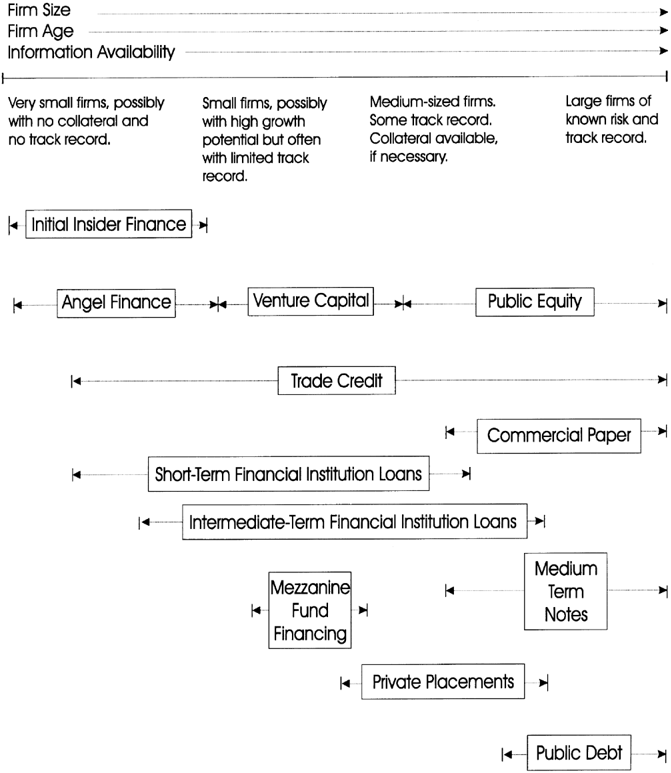
This article examines the economics of financing small business in private equity and debt markets. Firms are viewed through a financial growth cycle paradigm in which different capital structures are optimal at different points in the cycle. We show the sources of small business finance, and how capital structure varies with firm size and age. The interconnectedness of small firm finance is discussed along with the impact of the macroeconomic environment. We also analyze a number of research and policy issues, review the literature, and suggest topics for future research.
Verified 2026-11-25 · 1 reference not checked yet
Overview
CoChat Summary
TL;DR
This article reviews the economics of small business finance through a financial growth cycle paradigm, emphasizing informational opacity and the roles of private equity and debt markets. It documents US small business funding sources and contracts, and analyzes vulnerability to macroeconomic shocks, credit crunches, and bank consolidation.
Key findings
- US small business finance is split roughly evenly between equity (49.63%) and debt (50.37%); the largest sources are the principal owner, commercial banks, and trade creditors, together accounting for 70.10% of total funding. Commercial banks provide 18.75%, trade credit 15.78%, principal owner equity 31.33%, angel finance 3.59%, venture capital 1.85%, and credit card debt 0.14%.
- Financial institution debt is used by 54.23% of small businesses; 86.95% name a commercial bank as their primary financial institution. Average relationship length is 6.64 years overall and 9.01 years with the primary institution; 52.03% of financial institution debt is under lines of credit, 91.94% is secured, and 51.63% is guaranteed.
- The growth cycle paradigm predicts younger/more opaque firms rely on insider finance, trade credit, and angel finance, then venture capital and banks, and eventually public markets. However, 1993 NSSBF data show insider finance does not dominate external finance even for adolescents (upper bound 56.8% insider, roughly equal to external), and financial institution debt is important to very young firms, often based on personal guarantees or collateral.
- Macro vulnerability: the early-1990s credit crunch saw real C&I loans fall 23.2% ($596.7 billion to $458.2 billion) and estimated small business lending fall 38.5% ($143.7 billion to $88.4 billion). Banks with less than $100 million in assets held about 9% of portfolios in small business loans versus about 2% for banks over $10 billion; large banks charged about 100 basis points less and required collateral about 25% less often than small banks, other things equal.
Methods
- Design: review and synthesis organized around the financial growth cycle paradigm, covering theoretical and empirical literature on private equity and debt markets, contracts, and macroeconomic vulnerability.
- Data: primarily the 1993 National Survey of Small Business Finances (NSSBF) for US small business finance tables, plus other sources including NFIB, SCF, STBL, CALL, CRA, Venture Economics/VentureOne, and international data.
- Analysis: descriptive tabulations (Tables 1 and 2) and literature synthesis; the paper is a review rather than a new primary empirical study.
Limitations
- Paper-stated: Table 1 data are not completely accurate or consistent and should be considered rough estimates; angel finance estimates are imprecise (range $15 billion to $120 billion); 1993 data may not reflect current conditions; weighted averages mask considerable heterogeneity.
- Paper-stated: the growth cycle paradigm is not intended to fit all small businesses; firm size, age, and information availability are far from perfectly correlated, and the points at which different funding sources begin and end are not definitive.
- Evident from the text: informational opacity and the intertwining of personal and business finances make small business finance difficult to research, and data on owners’ finances are often unavailable; the paper relies heavily on existing literature and available data rather than new primary data collection.
Model-written summary. Check it against the paper before relying on it.
Integrity signals
Registry
Cites
Statistics
Figures
Verification
Claims the paper makes
22 Valid · 27 Not valid · 107 Not checked · 201 Own results and interpretations
Every source the paper cites for this claim was checked and supports it.
In the paper
“This use of personal assets to help with external ®nance also highlights another important aspect of small business ®nance ± the ®nancial intertwining of owners and their businesses (Ang, 1992).”
§ The economics of small business ®nance: The roles of private equity and debt markets in the ®nancial growth cycle > 2.3. The ®nancial growth cycle of small business
What the sources say
- Supportedcites Ang, 1992 matched to “On the Theory of Finance for Privately Held Firms” (1992) source
In “Integrating Personal and Business Accounts,” Ang says that personal guarantees or collateral make business risk inseparable from owners’ personal risk. “The Financing Decision” also identifies owners’ assets used for loan guarantees as contributions to the business. Together, these passages support the cited point that using personal assets to obtain external finance intertwines owners’ and businesses’ finances. (LLM, conf=0.94)
plainstates an association- Asserted: passes — The authors put it forward as true.
- Checkable: passes — It can be checked against evidence.
- Load-bearing: unclear — It is unclear whether the paper’s conclusions depend on it.
- Based: passes — The paper gives a reason why it holds.
- Supported
The cited sources support only part of this claim — read each source’s verdict below.
In the paper
“Costly state veri®cation (Townsend, 1979;Diamond, 1984) and adverse selection (Myers, 1984;Myers and Majluf, 1984;Nachman and Noe, 1994) arguments suggest the optimality of debt contracts after insider ®nance has been exhausted.”
§ The economics of small business ®nance: The roles of private equity and debt markets in the ®nancial growth cycle > 2.3. The ®nancial growth cycle of small business
What the sources say
- Partly supportedcites Townsend, 1979 matched to “Optimal contracts and competitive markets with costly state verification” (1979) sourceExperimental — accuracy not yet measured
Section 3 characterizes an optimal contract for a firm financing an investment project as a bond that defaults when returns fall below a threshold, supporting the costly-state-verification rationale for debt. The paper does not establish that debt becomes optimal only after insider finance has been exhausted. The adverse-selection citations in the sentence refer to other sources, not Townsend. (LLM, conf=0.85)
- Not checked — no full text of the sourcecites Diamond, 1984 matched to “Financial intermediation and delegated monitoring” (1984) source
- Not matchedcites Myers, 1984
More than one paper fits this citation.
hedgedstates a cause- Asserted: passes — The authors put it forward as true.
- Checkable: passes — It can be checked against evidence.
- Load-bearing: passes — The paper’s conclusions depend on it.
- Based: passes — The paper gives a reason why it holds.
- Partly supported
The cited sources support only part of this claim — read each source’s verdict below.
In the paper
“An agency problem arises in the relationship between the entrepreneur and the venture capitalist in which the entrepreneur may expend insucient eort, exhibit expense preference behavior, or lack sucient information or skill to make optimal production decisions.”
§ The economics of small business ®nance: The roles of private equity and debt markets in the ®nancial growth cycle > 3.2. The venture capital market
What the sources say
- Not checked — no full text of the sourcecites Cooper and Carleton, 1979 matched to “Dynamics of Borrower‐Lender Interaction: Partitioning Final Payoff in Venture Capital Finance” (1979) source
- Partly supportedcites Bergemann and Hege, 1998 matched to “Venture capital financing, moral hazard, and learning” (1998) sourceExperimental — accuracy not yet measured
Section 2.3, “Moral hazard and financing,” describes an entrepreneur who may reduce costly effort or divert investment funds to private ends, supporting the insufficient-effort and expense-preference parts of the claim. It does not identify a lack of the entrepreneur’s information or skill as a cause of poor production decisions; it instead says the entrepreneur and venture capitalists initially have the same assessment of the project. (LLM, conf=0.88)
hedgedstates a possible cause- Asserted: passes — The authors put it forward as true.
- Checkable: passes — It can be checked against evidence.
- Load-bearing: passes — The paper’s conclusions depend on it.
- Based: passes — The paper gives a reason why it holds.
Every source the paper cites for this claim was checked and supports it.
In the paper
“Since 1990, this share has about doubled to 30% (Fenn et al., 1997).”
§ The economics of small business ®nance: The roles of private equity and debt markets in the ®nancial growth cycle > 3. The role of private equity markets in small business ®nance
What the sources say
- Supportedcites Fenn et al., 1997 matched to “The Private Equity Market: An Overveiw” (1997) source
In “IPO Firms that Received Private Equity Backing,” the paper states that the share of IPOs with venture backing averaged 15% during the 1980s and doubled to 30% since 1990. This directly supports the cited claim. (LLM, conf=0.95)
plainstates an association- Asserted: passes — The authors put it forward as true.
- Checkable: passes — It can be checked against evidence.
- Load-bearing: unclear — It is unclear whether the paper’s conclusions depend on it.
- Based: passes — The paper gives a reason why it holds.
- Supported
The cited sources support only part of this claim — read each source’s verdict below.
In the paper
“During the 1980s, approximately 15% of all IPOs were backed by venture capital, well out of proportion to the fraction of all ®rms that received venture capital.”
§ The economics of small business ®nance: The roles of private equity and debt markets in the ®nancial growth cycle > 3. The role of private equity markets in small business ®nance
What the sources say
- Partly supportedcites Fenn et al., 1997 matched to “The Private Equity Market: An Overveiw” (1997) sourceExperimental — accuracy not yet measured
The section “IPO Firms that Received Private Equity Backing” states that venture-backed IPOs averaged 15% of IPOs during the 1980s. It does not give the fraction of all firms that received venture capital or make the claimed comparison with that fraction. (LLM, conf=0.84)
plainstates an association- Asserted: passes — The authors put it forward as true.
- Checkable: passes — It can be checked against evidence.
- Load-bearing: unclear — It is unclear whether the paper’s conclusions depend on it.
- Based: passes — The paper gives a reason why it holds.
- Partly supported
184 more claims · 6 with their cited sources checked
Create a free account to see all 357 claims and to verify the 12 references still open.
- Probably not a substantial claim. 94
- It may state two separate claims as one. 87
- Borderline: one of the tests for a substantial claim is unclear. 2
Claims other papers make about this one
Each is checked against this paper’s own text: does it say what the citing paper says it does?
The cited source says what the claim attributes to it.
In the citing paper
“SMEs are more dependent on external financing supplied by commercial banks (Berger and Udell 1998) because most of them are not qualified to raise money from the stock market.”
From Local Bank, Digital Financial Inclusion and SME Financing Constraints: Empirical Evidence from China (2022) · cites this paper as Berger and Udell 1998
Self-check
Percentages, sums and reported differences re-computed from the paper’s own numbers.
Rated minor: it would not touch a result — a value no result rests on, a p-value that stays on the same side of the significance level, or a conflict that is clerical, resolved elsewhere in the paper, or outside its own findings.
In the paper
“Non®nancial business/government debt provides 19.26% of small business funding (mostly trade credit)”
§ The economics of small business ®nance: The roles of private equity and debt markets in the ®nancial growth cycle > 4. The role of private debt markets in small business ®nance
Reported 19.26 · recomputed 18.01
Citations
Cites
Corporate financing and investment decisions when firms have information that investors do not have
Myers, S. C., & Majluf, N. S. (1984) · Journal of Financial Economics · doi:10.1016/0304-405x(84)90023-0 · Cited by 18,957
The Cost of Capital, Corporation Finance and the Theory of Investment
Miller, M. H. (1958) · American Economic Review · Cited by 14,574
Determinants of corporate borrowing
Myers, S. C. (1977) · Journal of Financial Economics · doi:10.1016/0304-405x(77)90015-0 · Cited by 13,169
Credit Rationing in Markets with Imperfect Information
Stiglitz, J. E., & Weiss, A. (1981) · Columbia University · doi:10.7916/d8v12ft1 · Cited by 12,769 · cited 1×
“…pledging outside collateral may help resolve adverse selection problems when the borrower has more information about the quality of the investment than the lender, and may help prevent credit rationing (Stiglitz and Weiss 1981, 1986, Bester 1985, Chan and Kanatas 1985, Besanko and Thakor 1987a,b).”
The cost of capital, corporation finance and the theory of investment
Terra, P. R. (2008) · Revista de Administração e Contabilidade da Unisinos · doi:10.4013/base.20082.07 · Cited by 8,615
Financial intermediation and delegated monitoring
Diamond, D. W. (1984) · The Review of Economic Studies · doi:10.2307/2297430 · Cited by 8,476 · cited 2×
“Costly state verification (Townsend 1979, Diamond 1984) and adverse selection (Myers 1984, Myers and Majluf 1984, Nachman and Noe 1994) arguments suggest the optimality of debt contracts after insider cFor example, there are generally accepted definitions of the stages of finance for the kind of…”
Corporate Financing and Investment Decisions When Firms Have InformationThat Investors Do Not Have
Myers, S., & Majluf, N. (1984) · doi:10.3386/w1396 · Cited by 6,745
The Benefits of Lending Relationships: Evidence from Small Business Data
PETERSEN, M. A., & RAJAN, R. G. (1994) · The Journal of Finance · doi:10.1111/j.1540-6261.1994.tb04418.x · Cited by 5,440 · cited 4×
“…whereas mortgages, equipment loans, motor vehicle loans, and other loans may more often be transactionsdriven .zs It was also found that dependence on trade credit decreased with the length of the banking relationship, supporting the value of relationship lending (Petersen and Rajan 1994, 1995).”
InfluentialInside the black box: the credit channel of monetary policy transmission
Bernanke, B. S., & Gertler, M. (1995) · Journal of Economic Perspectives · doi:10.1257/jep.9.4.27 · Cited by 4,211
Insiders and Outsiders: The Choice between Informed and Arm's‐Length Debt
RAJAN, R. G. (1992) · The Journal of Finance · doi:10.1111/j.1540-6261.1992.tb04662.x · Cited by 3,902 · cited 1×
“Some research suggests that these firms may try to reduce the control of their banks by issuing public debt, even though public debt may entail higher costs (Diamond 1991, 1993, Rajan 1992, Houston and James 1996).”
Research works printed but not linked: 11
- 66. Cook, L., 1997. Trade ®nance, bank ®nance, and capital market imperfections. Working paper. Harvard University, Cambridge, MA.
- 89. Freear, J., Sohl, J.E., Wetzel, W.E., Jr., 1994. The private investor market for venture capital. The Financier 1, 7±19.
- 112. Hancock, D., Wilcox, J.A., 1997. Bank capital, nonbank ®nance, and real estate activity. Journal of Housing Research 8, 75±105.
- 117. Hempel, G., Coleman, A., Simonson, D., 1986. Bank Management, Wiley, New York.
- 119. Ho, R., 1997. Credit-card use to ®nance small business is soaring, says survey of small ®rms. Wall Street Journal B2, Sept. 25.
- 153. Megginson, W.L., Weiss, K.A., 1991. Venture capitalist certi®cation in initial public oerings. Journal of Finance 46, 903±979.
- 162. Morsman Jr., E., 1986. Commercial loan structuring. Journal of Commercial Bank Lending 68, 2± 20.
- 187. Ravid, S.A., 1996. Debt maturity ± A survey. Financial Markets, Institutions and Instruments 5 (3), 1±68.
- 217. Wetzel Jr. W.E., 1994. Venture capital. In: Bygrave, W.D. (Ed.), Portable MBA in Entrepreneur- ship. Wiley, New York, pp. 172±194.
- 219. White, L.J., 1995. An analytical framework. In: Zahid, S.N. (Ed.), Financial Sector Development in Asia. Oxford University Press, New York, pp. 3±35.
- 222. McKean, R. (Ed.), Issues in Defense Economics. Columbia University Press, New York.
Cited by
Items 3,601–3,700 of 3,739
Tiemo, T. H., & Psychogios, A. G. (2026) · Business, management and economics · doi:10.5772/intechopen.1014127
Momanyi, C. (2026) · SN Social Sciences · doi:10.1007/s43545-026-01331-w
Zhou, Q., Zheng, N., Li, N., Yu, H., & Qu, Y. (2026) · Journal of Small Business Management · doi:10.1080/00472778.2026.2623029
Mengstie, B., & Yesuf, Y. M. (2026) · Journal of global entrepreneurship research · doi:10.1007/s40497-026-00505-3 · Cited by 2
“Finally, finance pertains specifically to the availability and accessibility of external capital, such as credit and equity, which are essential for providing liquidity to fuel operations and growth (Beck et al., 2006 ; Berger & Udell, 1998).”
ОЦЕНКА ДОСТУПНОСТИ ГОСУДАРСТВЕННОЙ ПОДДЕРЖКИ МАЛОГО И СРЕДНЕГО ПРЕДПРИНИМАТЕЛЬСТВА В КАЗАХСТАНЕ
С.К., К., Султанова, А. А., Исаева, А. М., et al. (2025) · Вестник Казахского университета экономики финансов и международной торговли · doi:10.52260/2304-7216.2025.4(61).36
Does headquarters location matter for corporate cash holding?
Wang, Y. Y., & Yi, L. (2026) · Review of Quantitative Finance and Accounting · doi:10.1007/s11156-026-01498-6
ESG performance and trade credit in European firms: the moderating role of institutional factors
Palacín-Sánchez, M.-J., Canto-Cuevas, F.-J., di Pietro, F., & Korzeb, Z. (2026) · Managerial Finance · doi:10.1108/mf-10-2025-0818 · Cited by 2
Firm‐Level Financing Strategies and Environmental Risk: Global Evidence
Chowdhury, A., Lee, L., & Shubita, M. (2026) · European Financial Management · doi:10.1111/eufm.70055
Muscio, A., Testa, G., & Vallanti, G. (2026) · SSRN Electronic Journal · doi:10.2139/ssrn.6390924
Financial Strategies and Practices of Start-Up Companies at Different Stages of Development
Zhou, Z. (2026) · International Journal of Finance and Investment · doi:10.54097/pk13jt75
“Previous literature has examined the impact of financing constraints on corporate investment (Fazzari et al. (1988)) and the relationship between corporate life cycle and financing structure (Berger and Udell (1998)).”
Jahangır, R., & Bulut, M. (2026) · Journal of Islamic accounting and business research · doi:10.1108/jiabr-10-2024-0403
Ryoo, S., & Oh, C. (2026) · Journal of Climate Change Research · doi:10.15531/ksccr.2026.17.1.061
When Algorithms Push Firms to Cheat: AI, Blockchain, and Financing in China
Fu, M. (2026) · Applied Artificial Intelligence Research · doi:10.65455/d2tq5y61
“The financial growth cycle model also shows how young firms have to depend on informal sources before they can be credentialed on the basis of reputation or assets [7] .”
Mahato, C., & Mahata, G. C. (2026) · Operations Research Forum · doi:10.1007/s43069-026-00605-6
On the optimal equity ratio: Pinning the anchor
Loehr, D. (2026) · International Review of Economics & Finance · doi:10.1016/j.iref.2026.105155
The oak and the reed: Working capital management and the role of business group affiliation
Lefebvre, V., & Hamelin, A. (2021) · Finance · doi:10.3917/e.fina.432.0159 · Cited by 3
Financement des Petites et Moyennes Entreprises en Tunisie
Fhima, F. (2010) · theses.fr (ABES) · doi:10.70675/e1e6e0ddz8371z42b2z87f5z131ae17a8bc2
Capizzi, V., Croce, A., & Tenca, F. (2026) · SSRN Electronic Journal · doi:10.2139/ssrn.6497864
Русняк, М. (2026) · Економіка та суспільство · doi:10.32782/2524-0072/2026-84-54
La consolidation en microfinance : le cas africain
Kendo, C. (2014) · theses.fr (ABES) · doi:10.70675/935a31d0z97f3z44fazb05fza12114d69c12 · Cited by 3
Ali, R. E.-C. (2014) · theses.fr (ABES) · doi:10.70675/e032c83az6ae0z4f04z8dc5z2d79f25a90e1 · Cited by 4
The Impact of Tariffs and Trade Policy Uncertainty on SME Supply Chains
LeMay, S. A., & McMahon, D. (2026) · Journal of Small Business Strategy · doi:10.53703/001c.157795 · Cited by 3
Emerging approaches for financing innovation
Pendeven, B. L. (2018) · theses.fr (ABES) · doi:10.70675/11866129zbf33z4c9azbedazfef5381e4d9b · Cited by 1
Mialocq, D. (2017) · theses.fr (ABES) · doi:10.70675/84c800e9z5437z4b12z89d5zb5514f65108f · Cited by 4
Essays on the performance of initial public offerings
Toumi, N. (2018) · theses.fr (ABES) · doi:10.70675/37711f2dz716ez4586z9ba7z849682f5b8ed
L’impact de l’appartenance d’une entreprise à un groupe sur sa performance financière
Kara, C. G. (2018) · theses.fr (ABES) · doi:10.70675/f876150fz99f8z4b32za3eaz803e4d88e15a
The Revenue Illusion: Payment Settlement Data as an Early Warning System for Small Business FailurePreprint
Swid, L. (2026) · SSRN Electronic Journal · doi:10.2139/ssrn.6432699
La problématique du financement des petites et moyennes entreprises au Sénégal
Diop, S. (2019) · theses.fr (ABES) · doi:10.70675/7fcbf24bze509z4388zb307ze456c10c4740 · Cited by 4
Three essays on corporate disclosure by small and medium entities
Ghio, A. (2018) · theses.fr (ABES) · doi:10.70675/5fcad4dczb897z4fa8za907z723af3c6de30
Lefebvre, V. (2020) · theses.fr (ABES) · doi:10.70675/2733218bzca39z40fezb7cez2635aaeca830 · Cited by 1
Gandégnon, M. C. F. (2020) · theses.fr (ABES) · doi:10.70675/a742fde9z6382z442fz984az81764fc1cf63 · Cited by 3
La gouvernance, les valeurs et les comportements des banques européennes
Elkaoukabi, S. (2021) · theses.fr (ABES) · doi:10.70675/01f3df4ezb929z480dz9a05za49df5c5565b · Cited by 1
Monetary Policy and SME ExpectationsPreprint
Anastasiou, D., Bragoudakis, Z. G., Kallandranis, C., et al. (2026) · SSRN Electronic Journal · doi:10.2139/ssrn.6531532
Le financement de l’immatériel des PME Françaises : Conditions, imperfections de marché et impacts
Descos, C. (2021) · theses.fr (ABES) · doi:10.70675/930458d3zdf19z46f1zb348z554bdeb32ede
“It can’t rain all the time.” The effects of heavy rains on European firms financing
Giaretta, E., & Zen, F. (2026) · Review of Accounting and Finance · doi:10.1108/raf-05-2025-0184
Entrepreneurial confidence, financial decisions and firms performance
Morales, A. B. (2021) · theses.fr (ABES) · doi:10.70675/c67713faz99dfz40e2za7fcz6ec0df21c069 · Cited by 2
Trois essais sur l'entrepreneuriat à Mayotte
Ibrahima, N. (2021) · theses.fr (ABES) · doi:10.70675/68ac2364z5898z4087z91ffz9460bc1db61b
Peer-to-Peer lending and the access to finance of SMEs
Lawniczak, A.-S. (2021) · theses.fr (ABES) · doi:10.70675/3ecd13d7z2f03z4978z93a3z7501417b5edb
Jimenez, P. E. A. (2023) · theses.fr (ABES) · doi:10.70675/4398bfc5z9a65z475dzb952z992e5626d34f · Cited by 3
Bank-firm relationships, competition and asymmetric information
Taillet, N. (2022) · theses.fr (ABES) · doi:10.70675/25b6a038z3c40z4c70z91a9z9eb39f0d54f3
Financial literacy and the entrepreneurial process : the role of formal education
Thévenet, G. (2024) · theses.fr (ABES) · doi:10.70675/aee53e3bzbce9z417az92adz837684b84a39
L’impact de l’information sur la confiance en crowdfunding : Cas Libanais
helou, W. E. (2024) · theses.fr (ABES) · doi:10.70675/13b103afze406z49fbza220z0c6865a66405
Cavagna, N. (2023) · theses.fr (ABES) · doi:10.70675/fcfd63bbza4b4z407az89fbz91362535d3c4
Sengar, P., Tiwary, D., & Bose, A. (2026) · Journal of Economic Studies · doi:10.1108/jes-09-2025-0679 · Cited by 1
Dipierro, S., & Valdinoci, E. (2026) · Quantitative Finance and Economics · doi:10.3934/qfe.2026010
Bank Entry, New Loans, and MisallocationPreprint
Chakraborty, P., & Mitra, N. (2026) · SSRN Electronic Journal · doi:10.2139/ssrn.6589328
Bueno, I. S. (2012) · theses.fr (ABES) · doi:10.70675/875c61bbze49fz4d85z97bdz5af79e11de3f · Cited by 1
Mawuena, Y., & Fongang, G. M. T. (2026) · European Journal of Development Research · doi:10.1057/s41287-026-00747-7
“…and external factors (legal and regulatory framework, access to finance) for the growth and development of SMEs (Lumpkin and Dess 1996; Berger and Udell 1998; St-Jean et al. 2008), other authors have shown that internal factors such as entrepreneurial characteristics and technological…”
Moral Hazard and Management of Debt Collateral in SME Financing: A Focus on Lease Contracts
Alfani, F. (2026) · Journal of risk and financial management · doi:10.3390/jrfm19050301
Swid, L. (2026) · SSRN Electronic Journal · doi:10.2139/ssrn.6622419
Kazarian, P., & Lhuillery, S. (2026) · Journal of Small Business Management · doi:10.1080/00472778.2026.2665713
Insurance as a stabilizer: SME credit access during the COVID-19 crisis
Lanciano, E., Previati, D., & Ricci, O. (2026) · The Geneva Papers on Risk and Insurance Issues and Practice · doi:10.1057/s41288-026-00383-6
Driving change? A systematic exploration of private equity and innovation
Molnár, E. M., Németh, Á., & Tupá, M. (2026) · European Journal of Innovation Management · doi:10.1108/ejim-10-2025-1424
A spatial analysis of financial development and green economic efficiency
Fang, L., & Li, Z. (2026) · Spatial Economic Analysis · doi:10.1080/17421772.2026.2660736 · Cited by 1
Dividend policy, corporate philanthropy and firm life cycle
Uyar, A., Wasiuzzaman, S., Kuzey, C., & Karaman, A. S. (2026) · International Review of Financial Analysis · doi:10.1016/j.irfa.2026.105214 · Cited by 1
Variable and fixed rate debt: Gambling on the future state of the economy after Covid-19
Cowling, M., Wong, K. P., & Yang, H. (2026) · Small Business Economics · doi:10.1007/s11187-026-01230-7
Ndunge, A., Mathuva, D., & Njiraini, N. (2026) · Journal of Entrepreneurship in Emerging Economies · doi:10.1108/jeee-12-2024-0579
Ilcsik, B. O., & Kárpáti, D. B. (2026) · Acta Academiae Beregsasiensis Economics · doi:10.58423/2786-6742/2026-13-345-357
Digital but not borderless: Geographic persistence in Brazilian equity crowdfunding
Nascimento, L. D. S., Francisco, E. D. R., Correia, J. P., et al. (2026) · Journal of Business Venturing Insights · doi:10.1016/j.jbvi.2026.e00622
When finance meets entrepreneurial behaviour: explaining young firms’ survival and growth
Bonnet, J., & Pape, N. L. (2026) · Applied Economics · doi:10.1080/00036846.2026.2683054
贾, 海., Anon, A., Tao, B., et al. (2026) · SSRN Electronic Journal · doi:10.2139/ssrn.6891539
Factoring and performance: evidence from Portuguese firms
Silva, F., Mota, J. A. P. S., & Madaleno, M. (2026) · Managerial Finance · doi:10.1108/mf-09-2025-0668
To be innovative is not enough: the signaling value of user entrepreneurship in start-up financing
Yu, C., & Kato, M. (2026) · Economics of Innovation and New Technology · doi:10.1080/10438599.2026.2678935 · Cited by 2
When the last branch closes: the impact of bank desertification on local firm growth
Algeri, C., Brighi, P., Girardone, C., et al. (2026) · Applied Economics Letters · doi:10.1080/13504851.2026.2684789
Hien, P. T. T., Bup, N. T., & Oanh, S. T. T. (2026) · Tạp chí Công nghiệp Kinh tế và Quản lý · doi:10.62831/nckh.2026.134.v1
Financial Inclusion and Small Business Innovation: Evidence from China's Specialized Bank BranchesPreprint
Liu, S., Jia, Y., & Li, H. (2026) · SSRN Electronic Journal · doi:10.2139/ssrn.6944975
Panosso, O., Klann, R. C., & Rodrigues, M. M. (2026) · Revista Contabilidade & Finanças · doi:10.1590/1808-057x20252185.en
Effectiveness of government entrepreneurial support on start-ups: a supply chain economy perspective
Acebo, E., Dávila, J. Á. M., Rodriguez, L., & González, L. B. (2026) · Management Research The Journal of the Iberoamerican Academy of Management · doi:10.1108/mrjiam-10-2025-1832
ENTREPRENEURIAL FINANCE: A BIBLIOMETRIC ANALYSIS ON INTERNATIONAL SCIENTIFIC PUBLICATIONS
Ardoğan, A. R. (2026) · Beykoz Akademi Dergisi · doi:10.14514/beykozad.1650668
Suárez, M. A. C., Juliao-Rossi, J. L., de‐Miguel‐Molina, B., & Díaz, C. A. R. (2026) · Borsa Istanbul Review · doi:10.1016/j.bir.2026.100860 · Cited by 1
SME Investment in Hungary: Financing Conditions, Development Needs, and Structural Misalignment
Hortoványi, L. (2026) · Pénzügyi Szemle = Public Finance Quarterly · doi:10.35551/pfq_2026_2_2
Corporate governance, sustainability reporting, and performance: Insights from an emerging economy
Al-Dahiyat, M. A., Sadaqa, R., & Alabdullatif, S. A. (2026) · Corporate Governance and Sustainability Review · doi:10.22495/cgsrv10i3sip5
The Efficiency of Public Guarantee System in a Post-Transition Country: A Case of Croatia
Broz, T., Becker, G., & Ridzak, T. (2026) · Economies · doi:10.3390/economies14070243
Do Credit Constraints Affect MSME Investment? Micro-Level Empirical Evidence from India
Behara, N., Chaudhuri, S. R., & Dutta, R. P. (2026) · The Journal of Theoretical Accounting Research · doi:10.1922/ns7pn489
Mehra, S., & Komera, S. (2026) · Journal of Emerging Market Finance · doi:10.1177/09726527261462338
“Their reliance on external funding provides them with incentives to utilize REM activities to signal stability (Berger & Udell, 1998).”
Private equity investments in early-stage financing during COVID-19
Gemson, J., & Orcutt, M. (2026) · Przedsiębiorczość Międzynarodowa · doi:10.15678/ier.2026.1202.02
“Such companies usually lack stable cash flows (Berger & Udell, 1998), have few tangible assets to warrant as collateral and could face the threat of operating losses for many years (Gompers, 1999) making them very risky.”
From crowds to boards: the impact of equity crowdfunding on board size
Marien, N., Paeleman, I., Deloof, M., et al. (2026) · Small Business Economics · doi:10.1007/s11187-026-01253-0
Jarboui, A., & Bouzouitina, A. (2026) · Society and Business Review · doi:10.1108/sbr-07-2025-0267
Does Berger and Udell (1998) financial life-cycle theory hold for loan interest rates?
Cowling, M., Bhaird, C. M. A., O’Reilly, S., & Yang, H. (2026) · Small Business Economics · doi:10.1007/s11187-026-01260-1
Ngoc, M. N., Thành, C. N., & Van, N. N. (2026) · International Journal of Financial Studies · doi:10.3390/ijfs14070194 · Cited by 1
Picking winners: Do VC investors back hot industries or strong startups?
Haritha, V. H., Prasanna, K., & Patel, V. D. (2026) · Journal of Behavioral and Experimental Finance · doi:10.1016/j.jbef.2026.101226
Mathieson, D., & Schinasi, G. (2001) · International Monetary Fund eBooks · doi:10.5089/9781589060562.083.ch001
CHAPTER V FINANCIAL SECTOR CONSOLIDATION IN EMERGING MARKETS
Mathieson, D., & Schinasi, G. (2001) · International Monetary Fund eBooks · doi:10.5089/9781589060562.083.ch005
Mathieson, D., & Schinasi, G. (2001) · International Monetary Fund eBooks · doi:10.5089/9781589060562.083.ch999
CHAPTER III EMERGING MARKET FINANCING
Mathieson, D., & Schinasi, G. (2001) · International Monetary Fund eBooks · doi:10.5089/9781589060562.083.ch003
CHAPTER II DEVELOPMENTS AND TRENDS IN MATURE CAPITAL MARKETS
Mathieson, D., & Schinasi, G. (2001) · International Monetary Fund eBooks · doi:10.5089/9781589060562.083.ch002
Mathieson, D., & Schinasi, G. (2001) · International Monetary Fund eBooks · doi:10.5089/9781589060562.083.ch000
Ncube, O., & Marozva, G. (2026) · International Journal of Financial Studies · doi:10.3390/ijfs14080196
Kim, H. (2026) · Research Square · doi:10.21203/rs.3.rs-10434455/v1
A global analysis of female innovative entrepreneurship and the role of financial development
Alvarez‐Vargas, C., Capelleras, J., Greene, F. J., & Martin‐Sanchez, V. (2026) · Technovation · doi:10.1016/j.technovation.2026.103659
Debt Heterogeneity and Leverage Measurement: The Role of Operating LeasesPreprint
Hill, P. (2026) · SSRN Electronic Journal · doi:10.2139/ssrn.7194032
The Cyclicality of Guaranteed Financing and Investment EfficiencyPreprint
Dong, L., Xu, W., Yang, J., et al. (2026) · SSRN Electronic Journal · doi:10.2139/ssrn.7199116
Structured prompt-guided zero-shot cross-modal reasoning for SME financial risk identification
Chen, P., & Wang, Z. (2026) · Discover Computing · doi:10.1007/s10791-026-10433-1
“…and large financial institutions, SMEs usually have shorter operating histories, weaker disclosure incentives, less standardized accounting records, and stronger dependence on soft information such as transaction relationships, platform traffic, supplier stability, and local market reputation [18].”
Tightening the Reins: Macroprudential Policy and Early-Stage EntrepreneurshipPreprint
Li, X., ge, C., Wang, H., Fu, Y., & Vigne, S. A. (2026) · SSRN Electronic Journal · doi:10.2139/ssrn.7230767
Sarto, N. D., & Audretsch, D. B. (2026) · SSRN Electronic Journal · doi:10.2139/ssrn.7230770
Ashaal, A., Mokdad, G. E., Bazih, J. H., & Bakri, A. (2026) · Journal of East-West Business · doi:10.1080/10669868.2026.2712895
Putra, Y. D. (2026) · Universitas Pasundan institutional repositories & scientific journals (Universitas Pasundan)
KICHIK BIZNES RAQOBATDOSHligini OSHIRISHDA MOLIYAVIY RESURSLARDAN SAMARALI FOYDALANISH
Shavkatov, A. (2026) · Innovatsion iqtisodiyot · doi:10.70769/3030-315x.ii.6.6.2026.18
Metadata
- Authors
- N. Berger, A., & F. Udell, G.
- Venue
- Journal of Banking & Finance
- Publisher
- Elsevier BV
- Published
- 1998-08
- Volume
- 22
- Issue
- 6-8
- Pages
- 613-673
- ISSN
- 0378-4266 (ISSN-L)
- OpenAlex
- W2119780569
- Semantic Scholar
- dfc06f7f7eb83d2c0e2a1d67ecb95b520a406843
- Cited by
- 3,690
- References
- 230
- Citations by year
- 2026: 136 · 2025: 148 · 2024: 144 · 2023: 193 · 2022: 155 · 2021: 211 · 2020: 200 · 2019: 156 · 2018: 208 · 2017: 174 · 2016: 186 · 2015: 187 · 2014: 168 · 2013: 177 · 2012: 171
- FWCI
- 169.26
- Type
- journal article
- Language
- en
- Open access
- hybrid
- doi.org
- Licence
- cc-by-nc-nd
- www.elsevier.com/tdm/userlicense/1.0/ (tdm)
- www.elsevier.com/legal/tdmrep-license (tdm)
- creativecommons.org/licenses/by-nc-nd/4.0/ (vor, 125 d)
- Locations
- Journal of Banking & Finance (publishedVersion, cc-by-nc-nd)
- RePEc: Research Papers in Economics (submittedVersion)
- Funders
- York University
- Topics
- Social Sciences › Economics, Econometrics and Finance › Finance › Private Equity and Venture Capital
- Social Sciences › Economics, Econometrics and Finance › Finance › Corporate Finance and Governance
- Social Sciences › Economics, Econometrics and Finance › Finance › Banking stability, regulation, efficiency
- Keywords
- small business financing, private equity, debt markets, capital structure, firm size, firm age, macroeconomic conditions
About these checks
Registry, retraction, Cites and statistics results are computed, not judged, with one exception: a printed reference that no index lists is read once by a model before it counts as a citation error. Claims are extracted by a model and kept only when their quote appears verbatim in the text; each cited source is then checked, with a model’s help, for whether it says what the claim relies on. Those verdicts can be wrong — read the claim’s quote and the cited source before relying on one.
The claim verdicts this report counts are experimental: their accuracy is not yet measured.
A language model drew the claims from the paper on 2026-10-10, under version 3 of the claim definition (model deepseek-v4.1-flash, prompt extract-v3).
A second model labelled each claim on 2026-10-10 (model jev-1.13-20260917, definition revision gold-guideline-v0.2).
Cited sources are checked with a language model’s help (gpt-6-sol).
Statistics and arithmetic are recomputed, not judged.
Confidence bands are shown only for fields calibrated on our annotated test set. None is calibrated yet, so no band is shown.
What counts as a claim ›How we measure confidence ›How we check this ›
Are you an author, or do you see a problem with this page? Request a review
Data sources
Bibliographic data: Semantic Scholar, OpenAlex, Crossref.
Contains information from the Semantic Scholar Academic Graph Datasets, made available under the ODC Attribution License (ODC-BY 1.0).
Semantic Scholar’s data is described in: Kinney, R., et al. (2023). The Semantic Scholar Open Data Platform. arXiv:2301.10140.
