

The economics of small business finance: The roles of private equity and debt markets in the financial growth cycle
Open accessThe DOI matches its Crossref record; 217 of the 230 references it cites were found in a registry or an index, and 1 are not checked yet; 24 of the 170 sources its claims cite were checked for support.
Abstract
This article examines the economics of financing small business in private equity and debt markets. Firms are viewed through a financial growth cycle paradigm in which different capital structures are optimal at different points in the cycle. We show the sources of small business finance, and how capital structure varies with firm size and age. The interconnectedness of small firm finance is discussed along with the impact of the macroeconomic environment. We also analyze a number of research and policy issues, review the literature, and suggest topics for future research.
Verified 2026-11-25 · 1 reference not checked yet
Overview
CoChat Summary
TL;DR
This article reviews the economics of small business finance through a financial growth cycle paradigm, emphasizing informational opacity and the roles of private equity and debt markets. It documents US small business funding sources and contracts, and analyzes vulnerability to macroeconomic shocks, credit crunches, and bank consolidation.
Key findings
- US small business finance is split roughly evenly between equity (49.63%) and debt (50.37%); the largest sources are the principal owner, commercial banks, and trade creditors, together accounting for 70.10% of total funding. Commercial banks provide 18.75%, trade credit 15.78%, principal owner equity 31.33%, angel finance 3.59%, venture capital 1.85%, and credit card debt 0.14%.
- Financial institution debt is used by 54.23% of small businesses; 86.95% name a commercial bank as their primary financial institution. Average relationship length is 6.64 years overall and 9.01 years with the primary institution; 52.03% of financial institution debt is under lines of credit, 91.94% is secured, and 51.63% is guaranteed.
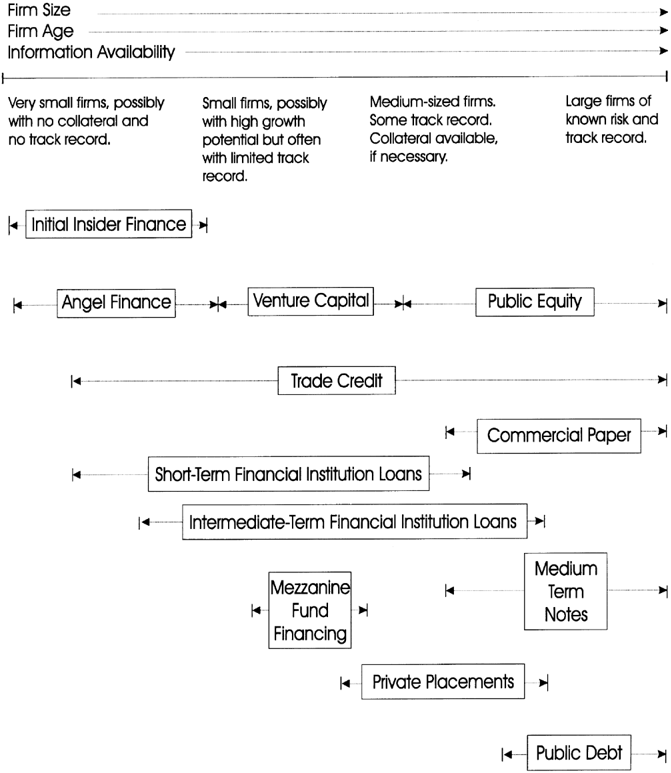
- The growth cycle paradigm predicts younger/more opaque firms rely on insider finance, trade credit, and angel finance, then venture capital and banks, and eventually public markets. However, 1993 NSSBF data show insider finance does not dominate external finance even for adolescents (upper bound 56.8% insider, roughly equal to external), and financial institution debt is important to very young firms, often based on personal guarantees or collateral.
- Macro vulnerability: the early-1990s credit crunch saw real C&I loans fall 23.2% ($596.7 billion to $458.2 billion) and estimated small business lending fall 38.5% ($143.7 billion to $88.4 billion). Banks with less than $100 million in assets held about 9% of portfolios in small business loans versus about 2% for banks over $10 billion; large banks charged about 100 basis points less and required collateral about 25% less often than small banks, other things equal.
Methods
- Design: review and synthesis organized around the financial growth cycle paradigm, covering theoretical and empirical literature on private equity and debt markets, contracts, and macroeconomic vulnerability.
- Data: primarily the 1993 National Survey of Small Business Finances (NSSBF) for US small business finance tables, plus other sources including NFIB, SCF, STBL, CALL, CRA, Venture Economics/VentureOne, and international data.
- Analysis: descriptive tabulations (Tables 1 and 2) and literature synthesis; the paper is a review rather than a new primary empirical study.
Limitations
- Paper-stated: Table 1 data are not completely accurate or consistent and should be considered rough estimates; angel finance estimates are imprecise (range $15 billion to $120 billion); 1993 data may not reflect current conditions; weighted averages mask considerable heterogeneity.
- Paper-stated: the growth cycle paradigm is not intended to fit all small businesses; firm size, age, and information availability are far from perfectly correlated, and the points at which different funding sources begin and end are not definitive.
- Evident from the text: informational opacity and the intertwining of personal and business finances make small business finance difficult to research, and data on owners’ finances are often unavailable; the paper relies heavily on existing literature and available data rather than new primary data collection.
Model-written summary. Check it against the paper before relying on it.
Integrity signals
Registry
Cites
Statistics
Figures
Verification
Claims the paper makes
22 Valid · 27 Not valid · 107 Not checked · 201 Own results and interpretations
Every source the paper cites for this claim was checked and supports it.
In the paper
“This use of personal assets to help with external ®nance also highlights another important aspect of small business ®nance ± the ®nancial intertwining of owners and their businesses (Ang, 1992).”
§ The economics of small business ®nance: The roles of private equity and debt markets in the ®nancial growth cycle > 2.3. The ®nancial growth cycle of small business
What the sources say
- Supportedcites Ang, 1992 matched to “On the Theory of Finance for Privately Held Firms” (1992) source
In “Integrating Personal and Business Accounts,” Ang says that personal guarantees or collateral make business risk inseparable from owners’ personal risk. “The Financing Decision” also identifies owners’ assets used for loan guarantees as contributions to the business. Together, these passages support the cited point that using personal assets to obtain external finance intertwines owners’ and businesses’ finances. (LLM, conf=0.94)
plainstates an association- Asserted: passes — The authors put it forward as true.
- Checkable: passes — It can be checked against evidence.
- Load-bearing: unclear — It is unclear whether the paper’s conclusions depend on it.
- Based: passes — The paper gives a reason why it holds.
- Supported
The cited sources support only part of this claim — read each source’s verdict below.
In the paper
“Costly state veri®cation (Townsend, 1979;Diamond, 1984) and adverse selection (Myers, 1984;Myers and Majluf, 1984;Nachman and Noe, 1994) arguments suggest the optimality of debt contracts after insider ®nance has been exhausted.”
§ The economics of small business ®nance: The roles of private equity and debt markets in the ®nancial growth cycle > 2.3. The ®nancial growth cycle of small business
What the sources say
- Partly supportedcites Townsend, 1979 matched to “Optimal contracts and competitive markets with costly state verification” (1979) sourceExperimental — accuracy not yet measured
Section 3 characterizes an optimal contract for a firm financing an investment project as a bond that defaults when returns fall below a threshold, supporting the costly-state-verification rationale for debt. The paper does not establish that debt becomes optimal only after insider finance has been exhausted. The adverse-selection citations in the sentence refer to other sources, not Townsend. (LLM, conf=0.85)
- Not checked — no full text of the sourcecites Diamond, 1984 matched to “Financial intermediation and delegated monitoring” (1984) source
- Not matchedcites Myers, 1984
More than one paper fits this citation.
hedgedstates a cause- Asserted: passes — The authors put it forward as true.
- Checkable: passes — It can be checked against evidence.
- Load-bearing: passes — The paper’s conclusions depend on it.
- Based: passes — The paper gives a reason why it holds.
- Partly supported
The cited sources support only part of this claim — read each source’s verdict below.
In the paper
“An agency problem arises in the relationship between the entrepreneur and the venture capitalist in which the entrepreneur may expend insucient eort, exhibit expense preference behavior, or lack sucient information or skill to make optimal production decisions.”
§ The economics of small business ®nance: The roles of private equity and debt markets in the ®nancial growth cycle > 3.2. The venture capital market
What the sources say
- Not checked — no full text of the sourcecites Cooper and Carleton, 1979 matched to “Dynamics of Borrower‐Lender Interaction: Partitioning Final Payoff in Venture Capital Finance” (1979) source
- Partly supportedcites Bergemann and Hege, 1998 matched to “Venture capital financing, moral hazard, and learning” (1998) sourceExperimental — accuracy not yet measured
Section 2.3, “Moral hazard and financing,” describes an entrepreneur who may reduce costly effort or divert investment funds to private ends, supporting the insufficient-effort and expense-preference parts of the claim. It does not identify a lack of the entrepreneur’s information or skill as a cause of poor production decisions; it instead says the entrepreneur and venture capitalists initially have the same assessment of the project. (LLM, conf=0.88)
hedgedstates a possible cause- Asserted: passes — The authors put it forward as true.
- Checkable: passes — It can be checked against evidence.
- Load-bearing: passes — The paper’s conclusions depend on it.
- Based: passes — The paper gives a reason why it holds.
Every source the paper cites for this claim was checked and supports it.
In the paper
“Since 1990, this share has about doubled to 30% (Fenn et al., 1997).”
§ The economics of small business ®nance: The roles of private equity and debt markets in the ®nancial growth cycle > 3. The role of private equity markets in small business ®nance
What the sources say
- Supportedcites Fenn et al., 1997 matched to “The Private Equity Market: An Overveiw” (1997) source
In “IPO Firms that Received Private Equity Backing,” the paper states that the share of IPOs with venture backing averaged 15% during the 1980s and doubled to 30% since 1990. This directly supports the cited claim. (LLM, conf=0.95)
plainstates an association- Asserted: passes — The authors put it forward as true.
- Checkable: passes — It can be checked against evidence.
- Load-bearing: unclear — It is unclear whether the paper’s conclusions depend on it.
- Based: passes — The paper gives a reason why it holds.
- Supported
The cited sources support only part of this claim — read each source’s verdict below.
In the paper
“During the 1980s, approximately 15% of all IPOs were backed by venture capital, well out of proportion to the fraction of all ®rms that received venture capital.”
§ The economics of small business ®nance: The roles of private equity and debt markets in the ®nancial growth cycle > 3. The role of private equity markets in small business ®nance
What the sources say
- Partly supportedcites Fenn et al., 1997 matched to “The Private Equity Market: An Overveiw” (1997) sourceExperimental — accuracy not yet measured
The section “IPO Firms that Received Private Equity Backing” states that venture-backed IPOs averaged 15% of IPOs during the 1980s. It does not give the fraction of all firms that received venture capital or make the claimed comparison with that fraction. (LLM, conf=0.84)
plainstates an association- Asserted: passes — The authors put it forward as true.
- Checkable: passes — It can be checked against evidence.
- Load-bearing: unclear — It is unclear whether the paper’s conclusions depend on it.
- Based: passes — The paper gives a reason why it holds.
- Partly supported
184 more claims · 6 with their cited sources checked
Create a free account to see all 357 claims and to verify the 12 references still open.
- Probably not a substantial claim. 94
- It may state two separate claims as one. 87
- Borderline: one of the tests for a substantial claim is unclear. 2
Claims other papers make about this one
Each is checked against this paper’s own text: does it say what the citing paper says it does?
The cited source says what the claim attributes to it.
In the citing paper
“SMEs are more dependent on external financing supplied by commercial banks (Berger and Udell 1998) because most of them are not qualified to raise money from the stock market.”
From Local Bank, Digital Financial Inclusion and SME Financing Constraints: Empirical Evidence from China (2022) · cites this paper as Berger and Udell 1998
Self-check
Percentages, sums and reported differences re-computed from the paper’s own numbers.
Rated minor: it would not touch a result — a value no result rests on, a p-value that stays on the same side of the significance level, or a conflict that is clerical, resolved elsewhere in the paper, or outside its own findings.
In the paper
“Non®nancial business/government debt provides 19.26% of small business funding (mostly trade credit)”
§ The economics of small business ®nance: The roles of private equity and debt markets in the ®nancial growth cycle > 4. The role of private debt markets in small business ®nance
Reported 19.26 · recomputed 18.01
Citations
Cites
Corporate financing and investment decisions when firms have information that investors do not have
Myers, S. C., & Majluf, N. S. (1984) · Journal of Financial Economics · doi:10.1016/0304-405x(84)90023-0 · Cited by 18,957
The Cost of Capital, Corporation Finance and the Theory of Investment
Miller, M. H. (1958) · American Economic Review · Cited by 14,574
Determinants of corporate borrowing
Myers, S. C. (1977) · Journal of Financial Economics · doi:10.1016/0304-405x(77)90015-0 · Cited by 13,169
Credit Rationing in Markets with Imperfect Information
Stiglitz, J. E., & Weiss, A. (1981) · Columbia University · doi:10.7916/d8v12ft1 · Cited by 12,769 · cited 1×
“…pledging outside collateral may help resolve adverse selection problems when the borrower has more information about the quality of the investment than the lender, and may help prevent credit rationing (Stiglitz and Weiss 1981, 1986, Bester 1985, Chan and Kanatas 1985, Besanko and Thakor 1987a,b).”
The cost of capital, corporation finance and the theory of investment
Terra, P. R. (2008) · Revista de Administração e Contabilidade da Unisinos · doi:10.4013/base.20082.07 · Cited by 8,615
Financial intermediation and delegated monitoring
Diamond, D. W. (1984) · The Review of Economic Studies · doi:10.2307/2297430 · Cited by 8,476 · cited 2×
“Costly state verification (Townsend 1979, Diamond 1984) and adverse selection (Myers 1984, Myers and Majluf 1984, Nachman and Noe 1994) arguments suggest the optimality of debt contracts after insider cFor example, there are generally accepted definitions of the stages of finance for the kind of…”
Corporate Financing and Investment Decisions When Firms Have InformationThat Investors Do Not Have
Myers, S., & Majluf, N. (1984) · doi:10.3386/w1396 · Cited by 6,745
The Benefits of Lending Relationships: Evidence from Small Business Data
PETERSEN, M. A., & RAJAN, R. G. (1994) · The Journal of Finance · doi:10.1111/j.1540-6261.1994.tb04418.x · Cited by 5,440 · cited 4×
“…whereas mortgages, equipment loans, motor vehicle loans, and other loans may more often be transactionsdriven .zs It was also found that dependence on trade credit decreased with the length of the banking relationship, supporting the value of relationship lending (Petersen and Rajan 1994, 1995).”
InfluentialInside the black box: the credit channel of monetary policy transmission
Bernanke, B. S., & Gertler, M. (1995) · Journal of Economic Perspectives · doi:10.1257/jep.9.4.27 · Cited by 4,211
Insiders and Outsiders: The Choice between Informed and Arm's‐Length Debt
RAJAN, R. G. (1992) · The Journal of Finance · doi:10.1111/j.1540-6261.1992.tb04662.x · Cited by 3,902 · cited 1×
“Some research suggests that these firms may try to reduce the control of their banks by issuing public debt, even though public debt may entail higher costs (Diamond 1991, 1993, Rajan 1992, Houston and James 1996).”
Research works printed but not linked: 11
- 66. Cook, L., 1997. Trade ®nance, bank ®nance, and capital market imperfections. Working paper. Harvard University, Cambridge, MA.
- 89. Freear, J., Sohl, J.E., Wetzel, W.E., Jr., 1994. The private investor market for venture capital. The Financier 1, 7±19.
- 112. Hancock, D., Wilcox, J.A., 1997. Bank capital, nonbank ®nance, and real estate activity. Journal of Housing Research 8, 75±105.
- 117. Hempel, G., Coleman, A., Simonson, D., 1986. Bank Management, Wiley, New York.
- 119. Ho, R., 1997. Credit-card use to ®nance small business is soaring, says survey of small ®rms. Wall Street Journal B2, Sept. 25.
- 153. Megginson, W.L., Weiss, K.A., 1991. Venture capitalist certi®cation in initial public oerings. Journal of Finance 46, 903±979.
- 162. Morsman Jr., E., 1986. Commercial loan structuring. Journal of Commercial Bank Lending 68, 2± 20.
- 187. Ravid, S.A., 1996. Debt maturity ± A survey. Financial Markets, Institutions and Instruments 5 (3), 1±68.
- 217. Wetzel Jr. W.E., 1994. Venture capital. In: Bygrave, W.D. (Ed.), Portable MBA in Entrepreneur- ship. Wiley, New York, pp. 172±194.
- 219. White, L.J., 1995. An analytical framework. In: Zahid, S.N. (Ed.), Financial Sector Development in Asia. Oxford University Press, New York, pp. 3±35.
- 222. McKean, R. (Ed.), Issues in Defense Economics. Columbia University Press, New York.
Cited by
Items 3,501–3,600 of 3,739
Regional heterogeneity impact on capital structure: The case of the textile industry in Portugal
Lisboa, I. M. C., & Santos, N. (2025) · RPER · doi:10.59072/rper.vi70.686
Vega-Pascual, M., di Pietro, F., Palacín-Sánchez, M.-J., et al. (2025) · Revista de estudios empresariales · doi:10.17561/ree.n1.2025.9154
Delivering Net Zero and Beyond: Addressing the Financing Challenges for UK Green SME Transition
Owen, R., & Burnett, A. (2025) · Emerald Group Publishing Limited eBooks · doi:10.1108/978-1-83608-574-420251017
Ask and You Shall Receive? Financial Literacy of Micro-Entrepreneurs and Access to CreditPreprint
Calcagno, R., Russo, P. F., Galotto, L., & Quas, A. (2025) · SSRN Electronic Journal · doi:10.2139/ssrn.5116462
SMEs Financing: Current State of Play and a Glimpse into the Future
Daskalakis, N. (2024) · Springer eBooks · doi:10.1007/978-3-031-74554-6_14
Tobias, T. T., Egessa, R., & Bulla, D. M. (2024) · Journal of Accounting and Finance in Emerging Economies · doi:10.26710/jafee.v10i4.3206 · Cited by 1
Fraser, S. (2025) · Palgrave studies in entrepreneurship and society. · doi:10.1007/978-3-031-72190-8_16
Modeling of the integrated system of state support for agricultural enterprises
Zakharova, K. A., Kiselitsa, E. P., & Ivanova, N. V. (2025) · MIR (Modernization Innovation Research) · doi:10.18184/2079-4665.2025.16.1.116-133
Institutional ownership and firm performance by life-cycle stage
Glambosky, M., Jory, S. R., Mishra, T., & Ngo, T. (2025) · Financial markets and portfolio management · doi:10.1007/s11408-025-00471-y · Cited by 1
“As the firm ages and becomes larger the firm characteristics and ambitions change (Berger & Udell 1998; Capizzi 2004; Caselli & Negri 2018).”
White, W. M., Moolupuri, A., & Pak, R. (2025) · Urology · doi:10.1016/j.urology.2025.03.049
Local banking market structure and employment dynamics: evidence from US counties
Ghosh, A., & Contreras, S. A. (2025) · Annals of Finance · doi:10.1007/s10436-025-00461-0
“Access to credit is especially relevant for small firms (Petersen and Rajan 1994; Berger and Udell 1998; Beck et al. 2008; Robb and Robinson 2014).”
Theory and Practice of Capital Structure: Evidence from Hundsun Technologies
Sun, X. (2025) · Advances in Economics Management and Political Sciences · doi:10.54254/2754-1169/2025.22142
Capital Structure in New Ventures
Söderblom, A., & Samuelsson, M. J. (2025) · Springer eBooks · doi:10.1007/978-3-031-81653-6_127
The role of venture capital and bank credit in new ventures creation
Adnan, M., & Khan, M. Z. (2025) · Journal of International Entrepreneurship · doi:10.1007/s10843-025-00386-9 · Cited by 2
“Countries with poor banking system discourage entrepreneurs to get access to debt financing (Berger and Udell 1998); therefore, they seek for VC investment.”
Regulatory-Driven Crowd Out on Small Business LendingPreprint
Lin, C., Qin, S., & Tai, M. (2025) · SSRN Electronic Journal · doi:10.2139/ssrn.5241411
Influence du genre sur l’ouverture et la pluralité de la structure de propriété de PME françaises1
Fonrouge, C., & Hamelin, A. (2025) · Revue internationale P M E Économie et gestion de la petite et moyenne entreprise · doi:10.7202/1117702ar
Capital Structure of Start-Up Firms and Small Firms
Miglo, A. (2025) · Springer eBooks · doi:10.1007/978-3-031-85459-0_9 · Cited by 1
Downstream Guarantees, Credit Supply and Internal Capital MarketsPreprint
Yin, M., & xiao, X. (2025) · SSRN Electronic Journal · doi:10.2139/ssrn.5252543
Adaptation or Persistence? Capital Structure Choices of Italian Firms Over Time
Rocca, M. L., Fasano, F., & Monteforte, D. (2025) · CORPORATE GOVERNANCE AND RESEARCH & DEVELOPMENT STUDIES · doi:10.3280/cgrds1-2025oa19061
Bridging Innovation and Finance: Evolving Ecosystems for Entrepreneurial Success
Shamansurova, Z. (2025) · Journal of Economics Finance and Management Studies · doi:10.47191/jefms/v8-i5-66
The non-bank lending channel: an important substitute for SME bank debt
McGeown, E., Power, B., & Shinnick, E. (2025) · International Journal of Entrepreneurial Behaviour & Research · doi:10.1108/ijebr-09-2024-1033
Dr.K.Nandeeswaraiah, D. K. N. (2025) · INTERNATIONAL JOURNAL OF RESEARCH AND ANALYTICAL REVIEWS · doi:10.56975/ijrar.v12i2.315253
Gender Disparities in Entrepreneurial Finance: The Overlooked Demand Side
Li, J. (2025) · OpenArchive@CBS (Copenhagen Business School) · doi:10.22439/phd.20.2025
Information Transparency of Firm Financing
Noël, A., & Hongfei, S. (2025) · Journal of money credit and banking · doi:10.1111/jmcb.13259
TURKIYE’DE KOBI KREDILERI VE CIRO PERFORMANSI- ARDL YAKLASIMIYLA BIR INCELEME
Ganıyev, S., & Gürkan, S. (2025) · Uluslararası Bankacılık Ekonomi ve Yönetim Araştırmaları Dergisi · doi:10.52736/ubeyad.1694668
Robust SME investment and financing under market frictions
Wang, L., Wang, Y., Zhang, H., et al. (2025) · Quantitative Finance · doi:10.1080/14697688.2025.2519842
Debt specialization and diversification: International evidence
Duffee, G. R., & Hördahl, P. (2025) · Journal of International Money and Finance · doi:10.1016/j.jimonfin.2025.103389
Dark Trading and Stock-based CEO Pay
Rzayev, K., Savaşer, T., & Ciamarra, E. Ş. (2025) · Journal of Corporate Finance · doi:10.1016/j.jcorpfin.2025.102848
Effects of Venture Debt on Early-and Late-Stage Funding in Tech EcosystemsPreprint
Dekker, D. J., Christopoulos, D., & Galeano-Duque, V. (2025) · SSRN Electronic Journal · doi:10.2139/ssrn.5337552
Financing Small- and Medium-Sized Enterprises in Times of COVID-19 in Hong Kong
Wan, W. Y., Li, L. C., & Mo, P. L. L. (2025) · Chinese Economy · doi:10.1080/10971475.2025.2527492
“More generally, SMEs often have challenges in accessing bank loans without collateral or other forms of credit support (Berger & Udell, 1998; Cassar, 2004), and may be subject to more oner-ous credit lines as compared to large firms (Chodorow-Reich et al., 2022).”
Analysing Diversity in Entrepreneurial Finance across Entrepreneurial Ecosystems
Brown, R., & Rocha, A. (2025) · Oxford University Press eBooks · doi:10.1093/oxfordhb/9780198866190.013.0019 · Cited by 1
Examining the Economic Impact of Micro and Small Enterprises on Oman National Development
Awashreh, R. A. (2025) · Advances in computational intelligence and robotics book series · doi:10.4018/979-8-3693-9611-7.ch011
The dilemma of growth: High growth expectation and borrower discouragement
Chu, V. T., & Pham, T. H. L. (2025) · Borsa Istanbul Review · doi:10.1016/j.bir.2025.07.011
Who gets funded? Firm characteristics and venture capital decisions in Greece's startup ecosystemPreprint
Mitsi, C., & Dimitras, A. I. (2025) · SSRN Electronic Journal · doi:10.2139/ssrn.5346972
CEO IQ and earnings quality in private firms
Myllymäki, E., Ikäheimo, S., & Mao, Y. (2025) · Accounting and Business Research · doi:10.1080/00014788.2025.2521109
Impact of Venture Capital on Startup Success and Economic Growth in Nepal
Bhandari, I. B. (2025) · Nepalese Journal of Finance. · doi:10.3126/njf.v12i1.82673
Financial and Governance Aspects of Firms as Drivers of Captive Insurance UsagePreprint
McCahery, J. A., & Pudschedl, P. C. (2025) · SSRN Electronic Journal · doi:10.2139/ssrn.5384538
Hernández‐Cánovas, G., Mol-Gómez-Vázquez, A., & Solano, P. M. (2025) · Applied Economics · doi:10.1080/00036846.2025.2548037
“…less informative financial statements, shorter track records, and less public visibility than larger companies, resulting in significant informational asymmetries (Rahman, Rahman, and Belas 2017) and more difficulties accessing bank debt (Berger and Udell 1998; Berger, Klapper, and Udell 2001).”
InfluentialGestión del riesgo crediticio en pequeñas y medianas empresas de la provincia de Tungurahua
Molina, P. B. O., & Barral, O. P. (2025) · Prohominum · doi:10.47606/acven/ph0367
A Note on the Employment Dynamics of Credit-Constrained Small- and Medium-sized Enterprises
Vlassas, I., & Kallandranis, C. (2025) · Palgrave Macmillan studies in banking and financial institutions · doi:10.1007/978-3-031-96066-6_3
Guiñares, R. C. (2025) · Research Square · doi:10.21203/rs.3.rs-7430169/v1
Droughts don’t just dry up water — they drain livelihoods and weaken local economies
Özsoy, S. M., & Yönder, E. (2025) · doi:10.64628/aam.nwek57r5d
The Impact of Patent Collateralisation on Entrepreneurship: A Difference-in-Difference ApproachPreprint
Hong Kong Institute for Monetary and Financial Research (2025) · SSRN Electronic Journal · doi:10.2139/ssrn.5408728
Achleitner, A., & Braun, R. (2025) · Springer eBooks · doi:10.1007/978-3-658-05263-8_8-2
Effects of Venture Debt on Early- and Late-Stage Funding in Tech EcosystemsPreprint
Dekker, D. J., Galeano-Duque, V., & Christopoulos, D. (2025) · SSRN Electronic Journal · doi:10.2139/ssrn.5436583
Yadav, S., & Sharma, S. (2024) · ShodhKosh Journal of Visual and Performing Arts · doi:10.29121/shodhkosh.v5.i6.2024.6338
“The accessibility of money has been featured as the main consideration in the turn of events, development, and achievement of SMEs [Berger & Udell (1998), Cassar, (2004)].”
Getting money in the country: Is there a liability of rurality facing SMEs?
Cowling, M., Brown, R., Liu, W., & Yang, H. (2025) · Journal of Rural Studies · doi:10.1016/j.jrurstud.2025.103886 · Cited by 1
“In terms of the former issue, informational asymmetries, low (or no) collateral, a lack of lending track record all combine to frustrate SMEs when accessing finance from banks (Berger and Udell, 1998).”
InfluentialWang, H., & Ye, L. (2025) · Applied Economics · doi:10.1080/00036846.2025.2561274
Capital Structure and Performance under Severe Financial Frictions: Evidence from Rural StartupsPreprint
Fernández, B. C., Fuertes, Y., & Serrano, A. (2025) · SSRN Electronic Journal · doi:10.2139/ssrn.5551422
MECHANISMS FOR FINANCING ENTREPRENEURIAL ACTIVITIES AND PROSPECTS FOR THEIR IMPROVEMENT
Rahmatov, A. (2025) · Review of Law Sciences · doi:10.51788/tsul.rols.2025.9.3./mthn1308
Solanki, R. (2025) · SSRN Electronic Journal · doi:10.2139/ssrn.5615616
Ramos, R. S., dos Santos, J. F., & Confessor, K. L. A. (2025) · Revista de Gestão · doi:10.1108/rege-03-2025-0053
On the Optimal Equity Ratio: Pinning the Anchor and Lower BoundPreprint
Loehr, D. (2025) · SSRN Electronic Journal · doi:10.2139/ssrn.5692168
Bakhytzhanov, T. B., Baitenova, L. M., & Intykbayeva, S. (2025) · Central Asian Economic Review · doi:10.52821/2789-4401-2025-4-191-204
The Effect of Hosting a Super Bowl on Local Debt Capital Markets
Hayduk, T. (2022) · International Journal of Sport Finance · doi:10.32731/ijsf.172.052022.03
“This is because debt capital is the primary source of funds for new and small businesses in North America (Berger & Udell, 1998).”
InfluentialGreen Finance and Its Unintended Effects on Corporate Financialization: Evidence from China
Qi, S., Zhou, J., Li, X., Li, K., & Zhou, C. (2025) · Sustainability · doi:10.3390/su172210110
Dynamic Reinforcement Learning Strategies for Venture Capital Fund PortfoliosPreprint
Deng, G., Fiaschetti, M., & Mazzarisi, P. (2025) · SSRN Electronic Journal · doi:10.2139/ssrn.5748295
Trade credit, earthquakes, and firm resilience: Lessons from three earthquakes in the 21st century
Ramirez, A. (2025) · Modern Finance · doi:10.61351/mf.v3i4.443 · Cited by 1
Huynh, T. (2025) · SSRN Electronic Journal · doi:10.2139/ssrn.5773951
On the Optimal Equity Ratio: Pinning the AnchorPreprint
Loehr, D. (2025) · SSRN Electronic Journal · doi:10.2139/ssrn.5778506
Boiling banks - how heat harms bank performance
Vollmar, S., & Wening, F. (2025) · Journal of Sustainable Finance & Investment · doi:10.1080/20430795.2025.2589771 · Cited by 1
Moro, A. (2025) · Research Square · doi:10.21203/rs.3.rs-8048146/v1
Zero-leverage determinants: A study for Portuguese SMEs
Barbosa, C., Sardo, F., & Pacheco, L. (2025) · Quantitative Finance and Economics · doi:10.3934/qfe.2025031
Cash Flow and Catastrophe: Launching a Post-Crisis Business With Nothing but Grit
Bryan, H. (2025) · Small Business Institute Journal · doi:10.53703/001c.147813
Korsgaard, M. A., & Sapienza, H. J. (2002) · Emerald Group Publishing Limited eBooks · doi:10.1108/978-1-60752-859-320251003 · Cited by 8
Fernando, M. T., Achsani, N. A., & Anggraeni, L. (2025) · International Journal of Research and Review · doi:10.52403/ijrr.20251206
Erschließung des Risikokapitalmarktes für junge Wachstumsunternehmen
Gerke, W., & Burrak, A. (2001) · Gabler Verlag eBooks · doi:10.1007/978-3-322-89933-0_18
Haraldsdottir, H., & Thorén, M. (2015) · Gothenburg University Publications Electronic Archive (Gothenburg University)
Post-IPO Operating Performance of Venture and Non Venture-Backed Companies in Malaysia
Suci, A. S. (2012) · UUM Electronic Theses and Dissertation [eTheses] (Northern University of Malaysia)
The Impact of a Stock Listing on Investment PolicyPreprint
Schoubben, F., & Hulle, C. V. (2007) · SSRN Electronic Journal · doi:10.2139/ssrn.965424
“Simultaneously, following Berger and Udell (1998) , we could argue that, as owners”
BackgroundLe prospettive dei confidi meridionali
Sabetta, A. (2009) · Cineca Institutional Research Information System (Tor Vergata University) · doi:10.58015/sabetta-arianna_phd2009-01-04
Strand, K., & Saugen, M. H. V. (2013) · NORA - Norwegian Open Research Archives
Baños‐Caballero, S., García‐Teruel, P. J., & Solano, P. M. (2009) · Documentos de Trabajo FUNCAS · Cited by 1
Vigneron, L., & Daïri, M. (2013) · Munich Personal RePEc Archive (Ludwig Maximilian University of Munich)
Building a Better Community?: The Role of Banks and Voluntary Associations
Teckchandani, A. (2010) · eScholarship (California Digital Library)
Overcoming Capital Constraints and Challanges of Fast Growth as an IT SME
Helmersson, A. (2010) · Jönköping University Publications (Jönköping University)
Bank, M. (2002) · Springer eBooks · doi:10.1007/978-3-540-24826-2_10
Customer-Equity Valuation in Software Markets
Kemper, A. (2010) · Contributions to management science · doi:10.1007/978-3-7908-2367-7_6
Ruiz, G. R. S., & Bustamante, A. A. (2016) · INFM-OAR (INFN Catania) · doi:10.5281/zenodo.164524
Zhao, Z., Li, X., & Ma, J. (2025) · SSRN Electronic Journal · doi:10.2139/ssrn.5573995
Accounting in the shadow of elections: how political uncertainty shapes managerial decisions
Yousef, H., Gad, M. A., & Altantawy, M. (2025) · International Journal of Disclosure and Governance · doi:10.1057/s41310-025-00329-9
“These firms also tend to be more depen - dent on external financing and local banking relationships (Berger and Udell 1998), potentially increasing their sensitivity to political uncertainty, such as those induced by gubernatorial elections.”
Achleitner, A., & Braun, R. (2025) · Springer eBooks · doi:10.1007/978-3-658-48710-2_8
Bank branch proximity and deposit rate dynamics
Sharma, P. (2025) · SN Business & Economics · doi:10.1007/s43546-025-01033-0
“● Small banks interacting with other small banks : Investigating whether smaller institutions exhibit different strategic behaviors, possibly due to resource con - straints or niche market targeting (Berger and Udell 1998).”
Restricted Credit Growth, Loan Cuts, and Employment Growth in the Great RecessionPreprint
Augsburg, A. S., Groes, F., & le Maire, D. (2025) · SSRN Electronic Journal · doi:10.2139/ssrn.5960741
Credit Lines as Committed Liquidity in Corporate TakeoversPreprint
Vu, T. Q. (2025) · SSRN Electronic Journal · doi:10.2139/ssrn.5960074
Capizzi, V., Croce, A., & Tenca, F. (2025) · SSRN Electronic Journal · doi:10.2139/ssrn.5974872
How Financing and Equity Contribute to Business Growth: An Empirical Study in Kosovo
Kllokoqi, A., & Mazllami, J. (2025) · Springer proceedings in business and economics · doi:10.1007/978-3-032-04218-7_8
The Role of Corporate Finance in Enhancing Entrepreneurial Innovation and Performance
Mollay, M. H., Sharma, D., Anawade, P. A., et al. (2026) · Lecture notes in networks and systems · doi:10.1007/978-981-96-9191-3_5
Bu, D., Keloharju, M., Liao, Y., & Ongena, S. R. G. (2026) · Journal of Financial and Quantitative Analysis · doi:10.1017/s0022109025102561 · Cited by 4
Marín, Ó. D. L. R., Gil, I. P., Torres-Pruñonosa, J., & Gómez-Martínez, R. (2026) · International Journal of Financial Studies · doi:10.3390/ijfs14010017
“Although prior research recognizes that SMEs are prone to overconfidence, information asymmetries, and liquidity mismanagement (Berger & Udell, 1998; Carpenter & Petersen, 2002; Demir et al., 2022), the literature has largely approached liquidity as a restrictive constraint rather than as a…”
DO INDUSTRIAL ROBOTS AFFECT THE PRODUCTIVITY OF INCUMBENT FIRMS OR NEW ENTRANTS?
Chen, S., & Tang, H. (2026) · The Singapore Economic Review · doi:10.1142/s0217590826500025 · Cited by 1
Öztekin, Ö., & Çolak, G. (2026) · SSRN Electronic Journal · doi:10.2139/ssrn.6118452
Pajarinen, M. (2025) · Springer eBooks · doi:10.1007/978-3-031-76422-6_253
Valery, M. G., & Kombem, T. (2026) · International Journal of Finance and Banking Research · doi:10.11648/j.ijfbr.20261201.11
Particularities of managing insolvency costs in the context of increasing company value
Vekshina, A. (2026) · Finance and Credit · doi:10.24891/vmliif
Do initial public offerings reduce the cost of debt? Evidence from China
Lv, J. R., Ye, C., Tang, F., et al. (2026) · Asia Pacific Journal of Innovation and Entrepreneurship · doi:10.1108/apjie-10-2024-0211
SME LOANS AND REVENUE PERFORMANCE IN TÜRKİYE: AN ARDL APPROACH
Ganıyev, S., & Gürkan, S. (2025) · DergiPark (Istanbul University)
Resilience: Future Trends and Challenges in Small and Medium Enterprises
Mohit, M., Chaudhry, R., Kumar, R., Malik, N., & Chaudhary, K. (2025) · Emerald Group Publishing Limited eBooks · doi:10.1108/s2040-724620250000022026
Utami, Y., Lestari, S., & Jati, D. P. (2026) · SN Business & Economics · doi:10.1007/s43546-026-01076-x · Cited by 6
“…comparability, and verifiability advantages typically absent in privately held SMEs that often exhibit information opacity and unaudited reporting (Berger and Udell 1998); listed firms are subject to Indonesian Financial Accounting Stan - dards (PSAK) compliant audited statements and mandatory…”
Metadata
- Authors
- N. Berger, A., & F. Udell, G.
- Venue
- Journal of Banking & Finance
- Publisher
- Elsevier BV
- Published
- 1998-08
- Volume
- 22
- Issue
- 6-8
- Pages
- 613-673
- ISSN
- 0378-4266 (ISSN-L)
- OpenAlex
- W2119780569
- Semantic Scholar
- dfc06f7f7eb83d2c0e2a1d67ecb95b520a406843
- Cited by
- 3,690
- References
- 230
- Citations by year
- 2026: 136 · 2025: 148 · 2024: 144 · 2023: 193 · 2022: 155 · 2021: 211 · 2020: 200 · 2019: 156 · 2018: 208 · 2017: 174 · 2016: 186 · 2015: 187 · 2014: 168 · 2013: 177 · 2012: 171
- FWCI
- 169.26
- Type
- journal article
- Language
- en
- Open access
- hybrid
- doi.org
- Licence
- cc-by-nc-nd
- www.elsevier.com/tdm/userlicense/1.0/ (tdm)
- www.elsevier.com/legal/tdmrep-license (tdm)
- creativecommons.org/licenses/by-nc-nd/4.0/ (vor, 125 d)
- Locations
- Journal of Banking & Finance (publishedVersion, cc-by-nc-nd)
- RePEc: Research Papers in Economics (submittedVersion)
- Funders
- York University
- Topics
- Social Sciences › Economics, Econometrics and Finance › Finance › Private Equity and Venture Capital
- Social Sciences › Economics, Econometrics and Finance › Finance › Corporate Finance and Governance
- Social Sciences › Economics, Econometrics and Finance › Finance › Banking stability, regulation, efficiency
- Keywords
- small business financing, private equity, debt markets, capital structure, firm size, firm age, macroeconomic conditions
About these checks
Registry, retraction, Cites and statistics results are computed, not judged, with one exception: a printed reference that no index lists is read once by a model before it counts as a citation error. Claims are extracted by a model and kept only when their quote appears verbatim in the text; each cited source is then checked, with a model’s help, for whether it says what the claim relies on. Those verdicts can be wrong — read the claim’s quote and the cited source before relying on one.
The claim verdicts this report counts are experimental: their accuracy is not yet measured.
A language model drew the claims from the paper on 2026-10-10, under version 3 of the claim definition (model deepseek-v4.1-flash, prompt extract-v3).
A second model labelled each claim on 2026-10-10 (model jev-1.13-20260917, definition revision gold-guideline-v0.2).
Cited sources are checked with a language model’s help (gpt-6-sol).
Statistics and arithmetic are recomputed, not judged.
Confidence bands are shown only for fields calibrated on our annotated test set. None is calibrated yet, so no band is shown.
What counts as a claim ›How we measure confidence ›How we check this ›
Are you an author, or do you see a problem with this page? Request a review
Data sources
Bibliographic data: Semantic Scholar, OpenAlex, Crossref.
Contains information from the Semantic Scholar Academic Graph Datasets, made available under the ODC Attribution License (ODC-BY 1.0).
Semantic Scholar’s data is described in: Kinney, R., et al. (2023). The Semantic Scholar Open Data Platform. arXiv:2301.10140.
