

Effect of the 13-valent pneumococcal conjugate vaccine on invasive pneumococcal disease in England and Wales 4 years after its introduction: an observational cohort study
Open accessThe DOI matches its Crossref record; 24 of the 24 references it cites were found in a registry or an index.
Abstract
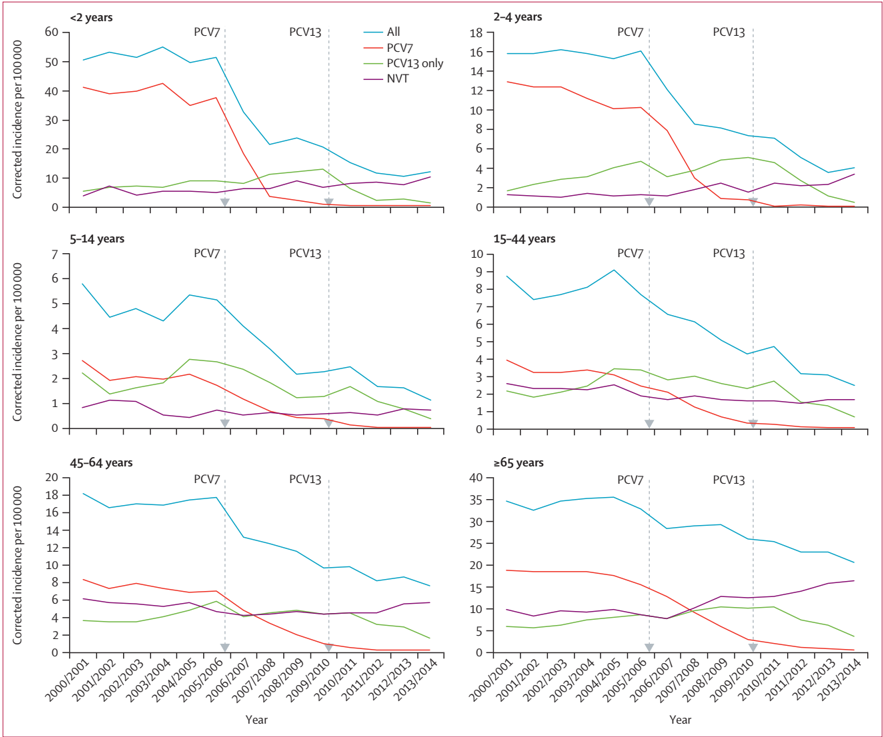
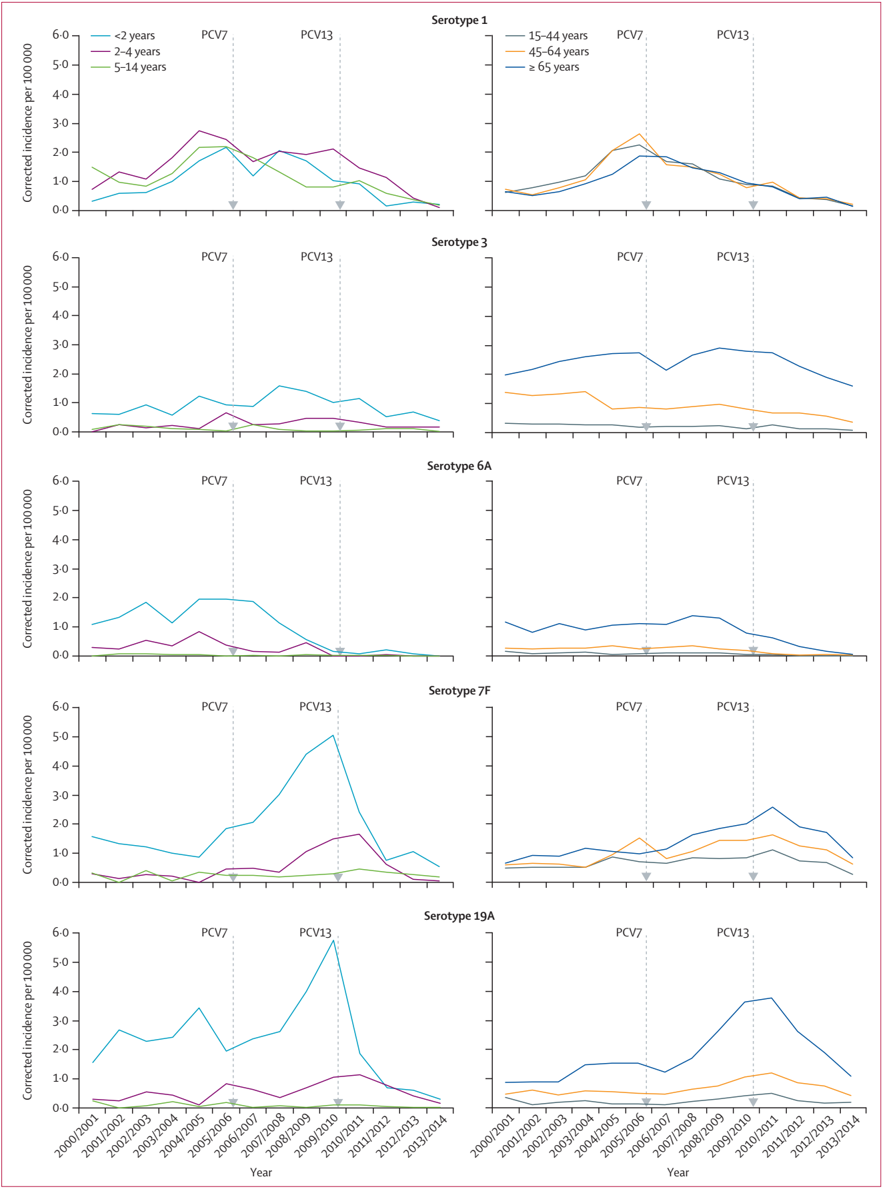
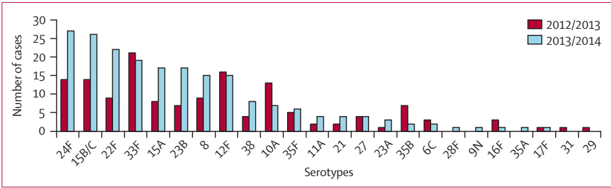
BACKGROUND: The 13-valent pneumococcal conjugate vaccine (PCV13) protects against key serotypes that increased after routine immunisation with the seven-valent vaccine (PCV7), but its potential for herd protection and serotype replacement is uncertain. The aim of this study was to analyse the effect of the 13-valent pneumococcal conjugate vaccine on invasive pneumococcal disease in England and Wales 4 years after its introduction. METHODS: We used a national dataset of electronically reported and serotyped invasive pneumococcal disease cases in England and Wales to estimate incidence rate ratios (IRRs) for vaccine and non-vaccine type invasive pneumococcal disease between July, 2013, and June, 2014, versus the pre-PCV13 and pre-PCV7 baseline. Incidence rates were corrected for missing serotype data and changes in surveillance sensitivity over time. An over-dispersed Poisson model was used to estimate IRRs and confidence intervals. FINDINGS: Incidence of invasive pneumococcal disease in the epidemiological year 2013/14 decreased by 32% compared with the pre-PCV13 baseline (incidence 10·14 per 100,000 in 2008-10 vs 6·85 per 100,000 in 2013/14; IRR 0·68, 95% CI 0·64-0·72). This was due to an 86% reduction of the serotypes covered by PCV7 (1·46 vs 0·20 per 100,000; IRR 0·14, 0·10-0·18) and a 69% reduction of the additional six serotypes covered by PCV13 (4·48 vs 1·40 per 100,000; IRR 0·31, 0·28-0·35). When compared with the pre-PCV7 baseline, there was a 56% overall reduction in invasive pneumococcal disease (15·63 vs 6·85 per 100,000; IRR 0·44, 95% CI 0·43-0·47). Compared with the pre-PCV13 baseline, the incidence of non-PCV13 serotypes increased (incidence all ages 4·19 vs 5·25 per 100,000; IRR 1·25, 95% CI 1·17-1·35) due to increases across a broad range of serotypes in children younger than 5 years and in people aged 45 years or more. In children younger than 5 years, incidence of non-PCV13 serotypes in 2013/14 was higher than in 2012/13 (age <2 years: 12·03 vs 10·83 per 100,000; age 2-4 years: 4·08 vs 3·63 per 100,000). INTERPRETATION: 8 years of PCV use in England and Wales has reduced the overall incidence of invasive pneumococcal disease by more than 50%. The herd protection induced by PCV7 is continuing, and similar indirect protection is occurring from the additional serotypes covered by PCV13. There is, however, evidence of increasing invasive pneumococcal disease due to non-PCV13 serotypes, particularly in children younger than 5 years in 2014. If this increase continues, the maximum benefit of the PCV13 programme in children might already have been achieved. FUNDING: Public Health England funds national surveillance of invasive pneumococcal disease.
Overview
The claims and statistics of this paper haven’t been checked yet.
Free: it reads the open-access text and checks the first 5 claims that cite a source we can check. Create a free account to check every claim.
Integrity signals
Registry
Cites
Statistics
Figures
Verification
Claims the paper makes
The claims and statistics of this paper haven’t been checked yet.
Free: it reads the open-access text and checks the first 5 claims that cite a source we can check. Create a free account to check every claim.
Claims other papers make about this one
Each is checked against this paper’s own text: does it say what the citing paper says it does?
The source backs part of the claim, not all of it — or backs it for a different population, condition or comparison.
In the citing paper
“A 56% reduction in invasive pneumococcal disease (IPD) among adults has been reported since the introduction of the PCV7 into the routine infant schedule and its replacement by PCV13 in April 2010.8”
From Community-acquired acute bacterial meningitis in adults: a clinical update (2019) · cites this paper as [8]
Experimental — accuracy not yet measured
Self-check
Percentages, sums and reported differences re-computed from the paper’s own numbers.
The self-check needs the paper’s full text.
Citations
Cites
O'Brien, K. L., Wolfson, L. J., Watt, J. P., Henkle, E., Deloria-Knoll, M., McCall, N., Lee, E., Mulholland, K., Levine, O. S., & Cherian, T. (2009) · The Lancet · doi:10.1016/s0140-6736(09)61204-6 · Cited by 2,398
Serotype replacement in disease after pneumococcal vaccination
Weinberger, D. M., Malley, R., & Lipsitch, M. (2011) · The Lancet · doi:10.1016/s0140-6736(10)62225-8 · Cited by 1,020
Moore, M. R., Link-Gelles, R., Schaffner, W., Lynfield, R., Lexau, C., Bennett, N. M., Petit, S., Zansky, S. M., Harrison, L. H., Reingold, A., et al. (2015) · The Lancet Infectious Diseases · doi:10.1016/s1473-3099(14)71081-3 · Cited by 733
Miller, E., Andrews, N. J., Waight, P. A., Slack, M. P., & George, R. C. (2011) · The Lancet Infectious Diseases · doi:10.1016/s1473-3099(11)70090-1 · Cited by 643
Self-citationAndrews, N. J., Waight, P. A., Burbidge, P., Pearce, E., Roalfe, L., Zancolli, M., Slack, M., Ladhani, S. N., Miller, E., & Goldblatt, D. (2014) · The Lancet Infectious Diseases · doi:10.1016/s1473-3099(14)70822-9 · Cited by 545
Self-citationFeikin, D. R., Kagucia, E. W., Loo, J. D., Link-Gelles, R., Puhan, M. A., Cherian, T., Levine, O. S., Whitney, C. G., O’Brien, K. L., Moore, M. R., et al. (2013) · PLoS Medicine · doi:10.1371/journal.pmed.1001517 · Cited by 470
Flasche, S., Van Hoek, A. J., Sheasby, E., Waight, P., Andrews, N., Sheppard, C., George, R., & Miller, E. (2011) · PLoS Medicine · doi:10.1371/journal.pmed.1001017 · Cited by 277
Self-citationvan Hoek, A. J., Andrews, N., Waight, P. A., Stowe, J., Gates, P., George, R., & Miller, E. (2012) · Journal of Infection · doi:10.1016/j.jinf.2012.02.017 · Cited by 253
Self-citationAndrews, N. J., Waight, P. A., George, R. C., Slack, M. P. E., & Miller, E. (2012) · Vaccine · doi:10.1016/j.vaccine.2012.09.019 · Cited by 239
Self-citationCooper, D., Yu, X., Sidhu, M., Nahm, M. H., Fernsten, P., & Jansen, K. U. (2011) · Vaccine · doi:10.1016/j.vaccine.2011.06.056 · Cited by 223
Research works printed but not linked: 3
- Roca A, Bojang A, Bottomley C, et al. Eff ect of replacing PCV-7 with PCV-13 in the expanded program of immunization on nasopharyngeal carriage of pneumococci in the Gambia. Pneumonia 2014; 3: 20.
- Nunes MC, Jones S, von Gottberg A, et al. Acquisition of Streptococcus pneumoniae in South African children vaccinated with 7-valent pneumococcal conjugate vaccine (PCV7). Pneumonia 2014; 3: 44.
- Moore M, Link-Gelles R, Guevara R, et al. Case-control study of eff ectiveness of 13-valent pneumococcal conjugate vaccine (PCV13) against Invasive Pneumococcal Disease (IPD) in the US: preliminary estimates. International Symposium on Pneumococci and Pneumococcal Diseases; Hyderabad, India; March 9-13, 2014. Poster 032.
Cited by
Items 101–200 of 590
Recombinant expression ofStreptococcus pneumoniaecapsular polysaccharides inEscherichia coli
Kay, E. J., Yates, L. E., Terra, V. S., Cuccui, J., & Wren, B. W. (2016) · Open Biology · doi:10.1098/rsob.150243 · Cited by 53
“However, an increase in non-vaccine serotypes has been observed, especially in those under 5 and over 45 years, with serotypes 12F, 8, 15A and 24F increasing significantly in the UK, after introduction of PCV13 [53].”
Slotved, H., Dalby, T., Harboe, Z. B., Valentiner‐Branth, P., de Casadevante, V. F., Espenhain, L., Fuursted, K., & Konradsen, H. B. (2016) · Heliyon · doi:10.1016/j.heliyon.2016.e00198 · Cited by 53
“PCV vaccination programmes for children have in general led to that themajority of the PCV serotypes have become rare in both children and adults due to a combination of immunity and herd protection [2, 3, 18].”
BackgroundInfluentialUsuf, E. A., Bottomley, C., Bojang, E., Jagne, I., Bojang, A., Gladstone, R. A., Kampmann, B., Hill, P. C., & Roca, A. (2018) · Clinical Infectious Diseases · doi:10.1093/cid/ciy726 · Cited by 52
“Several carriage and IPD studies have shown that PCV13 has no direct or indirect effect on serotype 3 [37, 38].”
BackgroundLu, C., Chiang, C., Chiu, C., Wang, E.-T., Chen, Y.-Y., Yao, S.-M., Chang, L., Huang, L., Lin, T., & Chou, J.-H. (2019) · Clinical Infectious Diseases · doi:10.1093/cid/ciy1127 · Cited by 53
Saxena, S. K., Atchison, C. J., Cecil, E. V., Sharland, M., Koshy, E. R., & Bottle, A. (2015) · Journal of Infection · doi:10.1016/j.jinf.2015.06.011 · Cited by 52
Jayasinghe, S. H., Chiu, C., Quinn, H., Menzies, R., Gilmour, R. E., & McIntyre, P. B. (2018) · Clinical Infectious Diseases · doi:10.1093/cid/ciy129 · Cited by 56
Childhood Deaths Attributable to Invasive Pneumococcal Disease in England and Wales, 2006–2014
Oligbu, G., Collins, S., Sheppard, C. L., Fry, N. K., Slack, M., Borrow, R., & Ladhani, S. N. (2017) · Clinical Infectious Diseases · doi:10.1093/cid/cix310 · Cited by 50
“interrupting transmission to older children and adults [4].”
BackgroundInfluentialSelf-citationPeterson, J. T., Stacey, H. L., MacNair, J. E., Li, J., Hartzel, J. S., Sterling, T. M., Benner, P., Tamms, G. M., & Musey, L. K. (2018) · Human Vaccines & Immunotherapeutics · doi:10.1080/21645515.2018.1532250 · Cited by 51
Fenoll, A., Granizo, J.-J., Giménez, M.-J., Yuste, J., & Aguilar, L. (2015) · Vaccine · doi:10.1016/j.vaccine.2015.08.009 · Cited by 50
Lévy, C., Varon, E., Ouldali, N., Béchet, S., Bonacorsi, S., & Cohen, R. (2019) · Clinical Infectious Diseases · doi:10.1093/cid/ciz221 · Cited by 50
Nakahashi-Ouchida, R., Uchida, Y., Yuki, Y., Katakai, Y., Yamanoue, T., Ogawa, H., Munesue, Y., Nakano, N., Hanari, K., Miyazaki, T., et al. (2021) · Vaccine · doi:10.1016/j.vaccine.2021.04.069 · Cited by 58
Su, W., Lo, H.-Y., Chang, C., Chang, L., Chiu, C., Lee, P., Lu, C., Hsieh, Y., Lai, M.-S., & Lin, T. (2016) · The Pediatric Infectious Disease Journal · doi:10.1097/inf.0000000000001054 · Cited by 52
“A possible explanation might be that non-PCV7/PCV10-covered serotypes, such as 19A, emerged gradually and that protection against IPD may decline with the changing epidemiology of nonvaccine serotypes, which influence the VE estimate.(23,24) The relationship between serotype-specific IgG concentrations after PCV primi…”
BackgroundBen‐Shimol, S., Givon‐Lavi, N., Grisaru‐Soen, G., Megged, O., Greenberg, D., & Dagan, R. (2017) · Vaccine · doi:10.1016/j.vaccine.2017.05.059 · Cited by 48
van Deursen, A. M. M., van Houten, M. A., Webber, C., Patton, M., Scott, D. A., Patterson, S., Sidhu, M. S., Drews, W., Gruber, W. C., Emini, E. A., et al. (2017) · Clinical Infectious Diseases · doi:10.1093/cid/cix419 · Cited by 57
“Although there is no consensus for a clinically meaningful empirically predefined level of protection in adults, clinical data support functional antibody and OPA as the basis for protection [34].”
Lai, X., Wahl, B., Yu, W., Xu, T., Zhang, H., Garcia, C., Qin, Y., Guo, Y., Yin, Z., Knoll, M. D., et al. (2022) · The Lancet Regional Health - Western Pacific · doi:10.1016/j.lanwpc.2022.100430 · Cited by 54
Status of research and development of pediatric vaccines for Streptococcus pneumoniae
Alderson, M. R. (2016) · Vaccine · doi:10.1016/j.vaccine.2016.03.107 · Cited by 50
“Despite a clear overall benefit of PCVs, increasing neumococcal disease caused by non-vaccine serotypes, through erotype emergence or replacement, in high-income countries has een documented and may limit the overall benefit of PCVs [8].”
BackgroundTiley, K. S., Ratcliffe, H., Voysey, M., Jefferies, K., Sinclair, G., Carr, M., Colin-Jones, R., Smith, D. R., Bowman, J., Hart, T. C., et al. (2022) · The Journal of Infectious Diseases · doi:10.1093/infdis/jiac376 · Cited by 48
“reduction in PCV7 IPD cases and nasopharyngeal carriage was observed in the immunized cohort [7, 8], and a fall in PCV7 IPD in older age groups was observed due to reduced circulation of these serotypes [7].”
BackgroundLupinacci, R. J., Rupp, R. E., Wittawatmongkol, O., Jones, J. D., Quinones, J., Ulukol, B., Dagan, R., Richmond, P., Stek, J. E., Romero, L., et al. (2023) · Vaccine · doi:10.1016/j.vaccine.2022.12.054 · Cited by 48
Spread of Meropenem-ResistantStreptococcus pneumoniaeSerotype 15A-ST63 Clone in Japan, 2012–2014
Nakano, S., Fujisawa, T., Ito, Y., Chang, B., Matsumura, Y., Yamamoto, M., Nagao, M., Suga, S., Ohnishi, M., & Ichiyama, S. (2018) · Emerging infectious diseases · doi:10.3201/eid2402.171268 · Cited by 53
“MEM-NS-non15A (32) SSMK (29), SAMK (3) SRN (32) KTG (32) SVVK (32) SSNA (32) KTG (32) SAMK (32) HSSN (32) VKSG (32)”
InfluentialDelgleize, E., Leeuwenkamp, O. R., Theodorou, E., & de Velde, N. V. (2016) · BMJ Open · doi:10.1136/bmjopen-2015-010776 · Cited by 49
“Invasive pneumococcal diseases Overall efficacy against meningitis and bacteraemia was computed for both vaccines based on the serotype-specific efficacy estimates from Whitney et al(13) and the local serotype distribution derived from Waight et al (see online supplementary table S5a in file 1).(51) 52 The efficacy us…”
BackgroundMethodInfluentialCorcoran, M., Vickers, I., Mereckiene, J., Murchan, S., Cotter, S. M., Fitzgerald, M. G., McElligott, M., Cafferkey, M., O’Flanagan, D., Cunney, R., et al. (2017) · Epidemiology and Infection · doi:10.1017/s0950268817001194 · Cited by 49
“Both countries introduced PCV13 in 2010, without a catch-up campaign [6, 19].”
BackgroundResultInfluentialOligbu, G., Collins, S., Andrews, N. J., Sheppard, C. L., Fry, N. K., Slack, M., Borrow, R., & Ladhani, S. N. (2017) · Clinical Infectious Diseases · doi:10.1093/cid/cix418 · Cited by 49
“If PCV13-type IPD cases do start appearing in older children because of waning immunity, for example, these would be identified through the ongoing national IPD surveillance.”
MethodInfluentialSelf-citationStreptococcus mitis Expressing Pneumococcal Serotype 1 Capsule
Lessa, F. C., Milucky, J., Rouphael, N., Bennett, N. M., Talbot, H. K., Harrison, L. H., Farley, M. M., Walston, J. D., Pimenta, F. C., Gertz, R. E., et al. (2018) · Scientific Reports · doi:10.1038/s41598-018-35921-3 · Cited by 47
van Deursen, A. M. M., van Houten, M. A., Webber, C., Patton, M., Scott, D. A., Patterson, S., Jiang, Q. L., Gruber, W. C., Schmöele-Thoma, B., Grobbee, D. E., et al. (2018) · Clinical Infectious Diseases · doi:10.1093/cid/ciy009 · Cited by 47
“This is in particular true for older adults, who seem most susceptible to disease regardless of serotype [12, 13, 15].”
Richter, L., Schmid, D., Kanitz, E. E., Zwazl, I., Pöllabauer, E., Jasińska, J., Burgmann, H., Kundi, M., & Wiedermann, U. (2019) · PLoS ONE · doi:10.1371/journal.pone.0210081 · Cited by 47
Azzari, C., Serranti, D., Nieddu, F., Moriondo, M., Casini, A., Lodi, L., Benedictis, F. M. D., Vitis, E. D., Cavone, F., Cortimiglia, M., et al. (2019) · Vaccine · doi:10.1016/j.vaccine.2019.04.012 · Cited by 47
“IPD showed that PCV13 effectiveness against serotype 3 is lower than other serotypes, such as 7F or 19A [9,10,21].”
BackgroundCillóniz, C., Amaro, R., & Torres, A. (2016) · Current Opinion in Infectious Diseases · doi:10.1097/qco.0000000000000246 · Cited by 53
Remschmidt, C., Harder, T., Wichmann, O., Bogdan, C., & Falkenhorst, G. (2016) · BMC Infectious Diseases · doi:10.1186/s12879-016-2040-y · Cited by 49
Ermlich, S. J., Andrews, C. P., Folkerth, S., Rupp, R. E., Greenberg, D., McFetridge, R. D., Hartzel, J. S., Marchese, R. D., Stek, J. E., Abeygunawardana, C., et al. (2018) · Vaccine · doi:10.1016/j.vaccine.2018.03.012 · Cited by 52
Herbert, J. A., Kay, E. J., Faustini, S. E., Richter, A., Abouelhadid, S., Cuccui, J., Wren, B. W., & Mitchell, T. J. (2018) · Vaccine · doi:10.1016/j.vaccine.2018.05.036 · Cited by 48
“by the additional 6 serotypes dropped by 75% [4].”
The global challenge of new classes of antibacterial agents: an industry perspective
FERNANDES, P. B. (2015) · Current Opinion in Pharmacology · doi:10.1016/j.coph.2015.06.003 · Cited by 54
Wasserman, M., Perdrizet, J. E., Grant, L. R., Hayford, K. T., Singh, S., Saharia, P., Horn, E. K., & Farkouh, R. (2021) · Infectious Diseases and Therapy · doi:10.1007/s40121-021-00544-1 · Cited by 42
Declining mortality from adult pneumococcal infections linked to children's vaccination
Grau, I., Ardanuy, C., Cubero, M., Benítez, M. Á., Liñares, J., & Pallarés, R. (2016) · Journal of Infection · doi:10.1016/j.jinf.2016.01.011 · Cited by 42
Principi, N., Cara, G. D., Bizzarri, I., Isidori, C., Borgia, P., Mignini, C., Saponara, M., Argentiero, A., & Esposito, S. (2018) · Current Infectious Disease Reports · doi:10.1007/s11908-018-0607-z · Cited by 42
Gessner, B. D., Jiang, Q. L., van Werkhoven, C. H., Sings, H. L., Webber, C., Scott, D. A., Gruber, W. C., Grobbee, D. E., Bonten, M. J. M., & Jódar, L. (2019) · Vaccine · doi:10.1016/j.vaccine.2019.05.065 · Cited by 41
Dagan, R. (2019) · Expert Review of Vaccines · doi:10.1080/14760584.2019.1627207 · Cited by 46
“The overall disease caused by these three serotypes is sizeable, especially in countries using PCV10, but much of the IPD in all ages is still caused mainly by NVTs that increase after PCV introduction [126,131].”
BackgroundForstner, C., Kolditz, M., Kesselmeier, M., Ewig, S., Rohde, G. G. U., Barten-Neiner, G., Rupp, J., Witzenrath, M., Welte, T., & Pletz, M. W. (2019) · Vaccine · doi:10.1016/j.vaccine.2019.11.026 · Cited by 42
LeBlanc, J. J., ElSherif, M. S., Ye, L., MacKinnon‐Cameron, D., Ambrose, A., Hatchette, T. F., Lang, A. L. S., Gillis, H. D., Martín, I., Demczuk, W., et al. (2019) · Vaccine · doi:10.1016/j.vaccine.2019.05.003 · Cited by 45
Jackson, J., Sonneveld, N., Rashid, H., Karpish, L., Wallace, S., Whop, L. J., Patel, C., Brotherton, J. M. L., Wang, H., Hendry, A., et al. (2023) · Communicable Diseases Intelligence · doi:10.33321/cdi.2023.47.32 · Cited by 47
Kambiré, D., Soeters, H. M., Ouedraogo-Traoré, R., Médah, I., Sangaré, L., Yaméogo, I., Sawadogo, G., Ouédraogo, A., Ouangraoua, S., McGee, L., et al. (2017) · Journal of Infection · doi:10.1016/j.jinf.2017.12.002 · Cited by 38
“≥30 years 92 (14) 56 (12) 50 (12) 198 (13) 74 (15) 73 (13) 147 (14) 345 (13)”
Kawai, K., Adil, E. A., Barrett, D. L., Manganella, J. L., & Kenna, M. A. (2018) · The Journal of Pediatrics · doi:10.1016/j.jpeds.2018.05.047 · Cited by 39
Dominance of vaccine serotypes in pediatric invasive pneumococcal infections in Portugal (2012–2015)
Silva‐Costa, C., Brito, M. J., Aguiar, S. I., Lopes, J. P., Ramirez, M., Melo‐Cristino, J., Portuguese Group for the Study of Streptococcal Infections, Vaz, T., Gião, M., Ferreira, R., et al. (2019) · Scientific Reports · doi:10.1038/s41598-018-36799-x · Cited by 41
Invasive Pneumococcal and Meningococcal Disease
Fitzgerald, D. B., & WATERER, G. W. (2019) · Infectious Disease Clinics of North America · doi:10.1016/j.idc.2019.08.007 · Cited by 52
Azarian, T., Grant, L. R., Arnold, B., Hammitt, L. L., Reid, R., Santosham, M., Weatherholtz, R., Goklish, N. A., Thompson, C. M., Bentley, S. D., et al. (2018) · PLoS Pathogens · doi:10.1371/journal.ppat.1006966 · Cited by 44
Molecular characterization and epidemiology of Streptococcus pneumoniae serotype 24F in Denmark
Kavalari, I. D., Fuursted, K., Krogfelt, K. A., & Slotved, H. (2019) · Scientific Reports · doi:10.1038/s41598-019-41983-8 · Cited by 40
Wagenvoort, G. H. J., Sanders, E. A. M., Vlaminckx, B. J. M., Elberse, K. E. M., de Melker, H. E., ENDE, A. V. D., & Knol, M. J. (2016) · Vaccine · doi:10.1016/j.vaccine.2015.12.066 · Cited by 37
Sando, E., Suzuki, M., Furumoto, A., Asoh, N., Yaegashi, M., Aoshima, M., Ishida, M., Hamaguchi, S., Otsuka, Y., & Morimoto, K. (2019) · Vaccine · doi:10.1016/j.vaccine.2019.04.009 · Cited by 35
Soeters, H. M., Kambiré, D., Sawadogo, G., Ouedraogo-Traoré, R., Bicaba, B. W., Médah, I., Sangaré, L., Ouédraogo, A., Ouangraoua, S., Yaméogo, I., et al. (2019) · The Journal of Infectious Diseases · doi:10.1093/infdis/jiz301 · Cited by 37
“The introduction of PCV resulted in substantial decreases in invasive pneumococcal disease (IPD) and pneumonia among children globally, with dramatic decreases observed among young children targeted for vaccination [15-21].”
BackgroundPneumococcal Conjugate Vaccine Breakthrough Infections: 2001–2016
Adebanjo, T., Pondo, T., Yankey, D., Hill, H. A., Gierke, R., Apostol, M. M., Barnes, M., Petit, S., Farley, M. M., Harrison, L. H., et al. (2020) · PEDIATRICS · doi:10.1542/peds.2019-0836 · Cited by 40
Teixeira, R., Kossyvaki, V., Gálvez, P., & Méndez, C. (2023) · Microorganisms · doi:10.3390/microorganisms11061376 · Cited by 43
Cost-effectiveness of pneumococcal vaccination strategies for the elderly in Korea
Heo, J. Y., Seo, Y. B., Choi, W. S., Lee, J., Noh, J. Y., Jeong, H. W., Kim, W. J., Kim, M. J., Lee, H., & Song, J. Y. (2017) · PLoS ONE · doi:10.1371/journal.pone.0177342 · Cited by 39
Demczuk, W., Martín, I., Desai, S. N., Griffith, A., Caron-Poulin, L., Lefebvre, B., McGeer, A., Tyrrell, G. J., Zhanel, G. G., Gubbay, J. B., et al. (2018) · Vaccine · doi:10.1016/j.vaccine.2018.06.018 · Cited by 39
Plainvert, C., Varon, E., Viriot, D., Kempf, M., Plainvert, C., Alauzet, C., Auger, G., Batah, J., Brieu, N., Cattoir, V., et al. (2022) · Infectious Diseases Now · doi:10.1016/j.idnow.2022.11.001 · Cited by 35
Shinjoh, M., Yamaguchi, Y., & Iwata, S. (2017) · Journal of Infection and Chemotherapy · doi:10.1016/j.jiac.2017.02.014 · Cited by 37
Makwana, A., Sheppard, C. L., Borrow, R., Fry, N. K., Andrews, N. J., & Ladhani, S. N. (2018) · The Pediatric Infectious Disease Journal · doi:10.1097/inf.0000000000001845 · Cited by 35
Self-citationFuture immunisation strategies to prevent Streptococcus pneumoniae infections in children and adults
Ramos, B., Vadlamudi, N. K., Han, C., & Sadarangani, M. (2025) · The Lancet Infectious Diseases · doi:10.1016/s1473-3099(24)00740-0 · Cited by 41
Picazo, J. J., Ruíz-Contreras, J., Casado‐Flores, J., Negreira, S., Baquero, F., Hernández‐Sampelayo, T., Otheo, E., Méndez, C., & On behalf of Heracles Study Group (2017) · PLoS ONE · doi:10.1371/journal.pone.0172222 · Cited by 36
Corrêa, R. D. A., José, B. P. D. S., Malta, D. C., Passos, V. M. D. A., França, E. B., Teixeira, R. A., & Camargos, P. A. M. (2017) · Revista Brasileira de Epidemiologia · doi:10.1590/1980-5497201700050014 · Cited by 71
Prato, R., Fortunato, F., Cappelli, M. G., Chironna, M., & Martinelli, D. (2018) · BMJ Open · doi:10.1136/bmjopen-2017-019034 · Cited by 33
Sheppard, C. L., Groves, N., Andrews, N., Litt, D. J., Fry, N. K., Southern, J., & Miller, E. (2019) · Genes · doi:10.3390/genes10090687 · Cited by 32
“This supports the suggestion that isolates within GPSC 3 have had a major role in serotype replacement in England and Wales.”
BackgroundInfluentialSelf-citationChan, K. F., Fung, T., Ip, M., & Ho, P. (2021) · BMJ Open · doi:10.1136/bmjopen-2021-055575 · Cited by 33
Valente, C., Hinds, J., Gould, K. A., Pinto, F. R., de LENCASTRE, H., & Sá‐Leão, R. (2016) · Vaccine · doi:10.1016/j.vaccine.2016.06.017 · Cited by 43
Guevara, M., Barricarte, A., Torroba, L., Herranz, M., Gil-Setas, A., Gil, F., Bernaola, E., Ezpeleta, C., Castilla, J., & Working Group for Surveillance of the Pneumococcal Invasive Disease in Navarra (2016) · Eurosurveillance · doi:10.2807/1560-7917.es.2016.21.14.30186 · Cited by 35
Sings, H. L. (2017) · Vaccine · doi:10.1016/j.vaccine.2017.05.075 · Cited by 39
“A follow-up study using the same national dataset in England and Wales assessed the effect of the PCV13 program on the serotype-specific incidence of IPD in older unvaccinated age groups during the first 4 years of the infant vaccination program [91].”
MethodEvolución de la enfermedad neumocócica invasora y sus serotipos en la Comunidad de Madrid
Zamalloa, P. L., Sanz, J. C., Gavín, M. O., Ordoñez, M. D. B., Marisquerena, E. I., de Miguel, Á. G., Chávez, A. C. F., & Comas, L. G. (2017) · Enfermedades Infecciosas y Microbiología Clínica · doi:10.1016/j.eimc.2017.10.026 · Cited by 32
“> 59 años Total 669 (17,97) 433 (16,47) 709 (17,09) 0,92NS 0,95NS Serotipados 611 (16,41) 366 (13,92) 625 (15,06) 0,85 0,89 VCN7a 77 (2,07) 21 (0,80) 52 (1,25) 0,39 0,61 VCN13 adicionalb 273 (7,33) 124 (4,72) 143 (3,45) 0,64 0,47 No VCNc 261 (7,01) 221 (8,40) 430 (10,36) 1,20 1,48”
Wilson, M. R., Wasserman, M., Jadavi, T., Postma, M. J., Breton, M.-C., Peloquin, F., Earnshaw, S., McDade, C. L., Sings, H. L., & Farkouh, R. (2018) · Infectious Diseases and Therapy · doi:10.1007/s40121-018-0206-1 · Cited by 33
Horácio, A. N., Silva‐Costa, C., Diamantino-Miranda, J., Lopes, J. P., Ramirez, M., Melo‐Cristino, J., & Portuguese Group for the Study of Streptococcal Infections (2016) · PLoS ONE · doi:10.1371/journal.pone.0153602 · Cited by 34
“However, the benefits of vaccination were also partly overcome by increases in incidence of non-vaccine serotypes [5,7,34,35].”
BackgroundKim, Y. K., LaFon, D. C., & Nahm, M. H. (2016) · Infection and Chemotherapy · doi:10.3947/ic.2016.48.4.257 · Cited by 33
“Surveillance data from Calgary, Alberta suggested near-total elimination of VT-IPD significantly in children less than 2 years of age [47-52].”
BackgroundInfluentialMoreira, M., Castro, O., Palmieri, M., Efklidou, S., Castagna, S., & Hoet, B. (2016) · Human Vaccines & Immunotherapeutics · doi:10.1080/21645515.2016.1263409 · Cited by 32
“47) when compared with the pre-PCV7 baseline.(61) In Canada (Quebec), VE against vaccine-type IPD in children having received at least 1 dose was 97% (95% CI: 84-99) for PHiD-CV and 86% (95% CI 62-95) for PCV13, while VE against overall IPD was 72% (95% CI: 46-85) for PHiD-CV and 66% (95% CI: 29-83) for PCV13.”
ResultEconomic burden of pneumococcal infections in children under 5 years of age
Ceyhan, M., Özsürekçi, Y., Aykaç, K., Hacıbedel, B., & Ozbilgili, E. (2017) · Human Vaccines & Immunotherapeutics · doi:10.1080/21645515.2017.1371378 · Cited by 32
“In the UK, IPD due to PCV13-only serotypes decreased by 89% after the PCV13 National Immunization Program in children below 2 years of age as compared with the pre-PCV13 periods.(16) In Southern Israel, sequential implementation of PCV7 and PCV13 was associated with decreases in otitis media caused by PCV7 serotypes p…”
ResultNon-Invasive Pneumococcal Pneumonia Due to Vaccine Serotypes: A Systematic Review and Meta-Analysis
Lansbury, L., Lim, B. S. H., McKeever, T. M., Lawrence, H., & Lim, W. S. (2021) · EClinicalMedicine · doi:10.1016/j.eclinm.2022.101271 · Cited by 36
Wagenvoort, G. H. J., Knol, M. J., de Melker, H. E., Vlaminckx, B. J. M., ENDE, A. V. D., Rozenbaum, M. H., & Sanders, E. A. M. (2015) · Vaccine · doi:10.1016/j.vaccine.2015.11.048 · Cited by 36
Pneumococcal colonization in older adults
Esposito, S., Mari, D., Bergamaschini, L. C., Orenti, A., Terranova, L., Ruggiero, L., Ierardi, V., Gambino, M., Croce, F., & Principi, N. (2016) · Immunity & Ageing · doi:10.1186/s12979-016-0057-0 · Cited by 38
“However, considering that the most common non-PCV13 serotypes that were carried by older people were among the most common cause of IPD as evidenced by recent epidemiological studies conducted in Europe after the introduction of PCV13 [32], continued monitoring is needed to evaluate their importance in the older popul…”
BackgroundThomas, R. E. (2021) · Geriatrics · doi:10.3390/geriatrics6010013 · Cited by 31
Esposito, S., Principi, N., & ESCMID Vaccine Study Group (EVASG) (2015) · Future Microbiology · doi:10.2217/fmb.15.81 · Cited by 31
Blommaert, A., Bilcke, J., Willem, L., Verhaegen, J., Goossens, H., & Beutels, P. (2016) · Vaccine · doi:10.1016/j.vaccine.2016.03.003 · Cited by 42
Turner, P., Turner, C. L., Suy, K., Soeng, S., Ly, S., Miliya, T., Goldblatt, D., & Day, N. (2015) · Emerging infectious diseases · doi:10.3201/eid2111.150914 · Cited by 30
Community-Acquired Pneumonia in Sub-Saharan Africa
Rylance, J., & Aston, S. (2016) · Seminars in Respiratory and Critical Care Medicine · doi:10.1055/s-0036-1592126 · Cited by 33
Efficacy and Safety of the Pneumococcal Conjugate-13 Valent Vaccine in Adults
Marra, F., & Vadlamudi, N. K. (2018) · Aging and Disease · doi:10.14336/ad.2018.0512 · Cited by 31
“With studies reporting >90% decline in pneumococcal disease due to vaccine serotypes in older children and adults [62], as well as a 56% reduction in the incidence of vaccine-type community acquired pneumonia [63,64].”
BackgroundVaccines to Prevent Pneumococcal Community-Acquired Pneumonia
van Werkhoven, C. H., & Huijts, S. M. (2018) · Clinics in Chest Medicine · doi:10.1016/j.ccm.2018.07.007 · Cited by 30
Morales, M., Sanz-Orrio, G. L., Ercibengoa, M., Esteva, C., Sánchez-Encinales, V., Alonso, M. M., Muñoz‐Almagro, C., & Marimón, J. M. (2018) · PLoS ONE · doi:10.1371/journal.pone.0209048 · Cited by 32
Corcoran, M., Mereckiene, J., Cotter, S. M., Murchan, S., Lo, S. W., McGee, L., Breiman, R. F., Cunney, R., Humphreys, H., Bentley, S. D., et al. (2021) · Vaccine · doi:10.1016/j.vaccine.2021.06.017 · Cited by 29
Zintgraff, J. C., Gagetti, P. S., Napoli, D., Eluchans, N. S., Irazú, L., Moscoloni, M. L., Regueira, M., Lara, C. S., & Corso, A. C. (2021) · Vaccine · doi:10.1016/j.vaccine.2021.12.008 · Cited by 29
Martinón‐Torres, F., Wysocki, J., Szenborn, L., Martínez, A. C., Põder, A., Dagan, R., Richmond, P., Gilbert, C., Trudel, M.-C., Flores, S. A., et al. (2023) · Vaccine · doi:10.1016/j.vaccine.2023.04.036 · Cited by 30
Miyazaki, H., Shibuya, R., Midorikawa, N., Chang, B., Ohnishi, M., & Matsumoto, T. (2017) · Journal of Infection and Chemotherapy · doi:10.1016/j.jiac.2016.12.016 · Cited by 32
Chapman, T. J., Olarte, L., Dbaibo, G. S., Houston, A. M., Tamms, G. M., Lupinacci, R. J., Feemster, K. A., Buchwald, U. K., & Banniettis, N. (2023) · Expert Review of Vaccines · doi:10.1080/14760584.2023.2294153 · Cited by 29
“…studies from the post-PCV10 and PCV13 era have shown that PCVs not only significantly reduce the overall incidence of IPD by reducing IPD caused by serotypes contained in the vaccine [2,22–29] but also have a beneficial impact on reducing pneumococcal-related pneumonia [30–35] and AOM [5,23,36–40].”
Menéndez, R., España, P. P., Pérez‐Trallero, E., Uranga, A., Méndez, R., Cillóniz, C., Marimón, J. M., Cifuentes, I., Méndez, C., & Torres, A. (2017) · Vaccine · doi:10.1016/j.vaccine.2017.08.007 · Cited by 29
“Among 65 cases identified, 2 isolates not serotyped. c Confirmed pneumococcal CAP (by UAD or Binax Now) for which blood and/or pleural fluid culture result were negative. trend of pneumococci serotypes in Spain indicated that the percentage of PCV13 isolates among IPD cases showed an increasing trend until 2001, reach…”
BackgroundResultInfluentialCleary, D. W., & Clarke, S. C. (2017) · Emerging Topics in Life Sciences · doi:10.1042/etls20170041 · Cited by 33
Fine, P., Mulholland, K., Scott, J. A. G., & Edmunds, W. J. (2017) · Elsevier eBooks · doi:10.1016/b978-0-323-35761-6.00077-8 · Cited by 34
Serotype evolution in Western Europe: perspectives on invasive pneumococcal diseases (IPD)
Htar, M. T. T., Martínez, J. M., Theilacker, C., Schmitt, H., & Swerdlow, D. L. (2019) · Expert Review of Vaccines · doi:10.1080/14760584.2019.1688149 · Cited by 29
Hyams, C. J., Challen, R., Hettle, D., Amin‐Chowdhury, Z., Grimes, C., Ruffino, G., Conway, R., Heath, R., North, P., Malin, A., et al. (2023) · Emerging infectious diseases · doi:10.3201/eid2910.230519 · Cited by 29
“We found that most residual PCV serotype disease is caused by PCV13–7 serotypes, especially serotypes 3 and 19A, observations that are consistent with other reports ( 5 , 7 , 12 , 22 ).”
BackgroundResultInfluentialSelf-citationGladstone, R. A., Devine, V. T., Jones, J., Cleary, D. W., Jefferies, J. M., Bentley, S. D., Faust, S. N., & Clarke, S. C. (2017) · Microbial Genomics · doi:10.1099/mgen.0.000119 · Cited by 28
“Subsequent increases in 15B/C IPD cases were observed in the UK and USA [6, 39].”
BackgroundInfluentialImpact of 13-valent pneumococcal conjugate vaccine on pneumococcal meningitis in children
Ruíz-Contreras, J., Picazo, J. J., Casado‐Flores, J., Baquero‐Artigao, F., Hernández‐Sampelayo, T., Otheo, E., Méndez, C., del Amo, M., & Balseiro, C. (2017) · Vaccine · doi:10.1016/j.vaccine.2017.06.070 · Cited by 32
“This could be due to the near-elimination of PM caused by serotype 19A, as the incidence of IPD caused by this serotype is remarkably higher in children aged less than 2 years as compared to older patients [30,31,38].”
ResultSv, S., Rennert, W. P., Lobzin, Y. V., Briko, N. I., Kozlov, R. S., Namazova-Baranova, L. S., Tsvetkova, I. A., Андреевич, А. В., Nikitina, E. V., Ardysheva, A. T., et al. (2019) · Diagnostic Microbiology and Infectious Disease · doi:10.1016/j.diagmicrobio.2019.114914 · Cited by 28
Critical care management of infectious meningitis and encephalitis
Meyfroidt, G., Kurtz, P., & Sonneville, R. (2020) · Intensive Care Medicine · doi:10.1007/s00134-019-05901-w · Cited by 31
Serotype 1 pneumococcus: epidemiology, genomics, and disease mechanisms
Chaguza, C., Yang, M., Jacques, L. C., Bentley, S. D., & Kadioglu, A. (2021) · Trends in Microbiology · doi:10.1016/j.tim.2021.11.007 · Cited by 27
“While the ST306 clone was first on PCV effectiveness in low disease burden settings [103], recent data describe a 95% reduction in disease incidence in settings presenting high S1 disease burden, six years following the introduction of PCV10 or PCV13 [104-106] .”
BackgroundPrevention of Community-Acquired Pneumonia with Available Pneumococcal Vaccines
Principi, N., & Esposito, S. (2016) · International Journal of Molecular Sciences · doi:10.3390/ijms18010030 · Cited by 34
“On the other hand, while introduction of PCV13 has worldwide led to a significant reduction of the 19A pneumococcal infections [38] and carriage [39], this was not always seen after PCV10 use [33].”
BackgroundAsner, S. A., Agyeman, P., Gradoux, E., Posfay-Barbe, K. M., Heininger, U., Giannoni, É., Crisinel, P. A., Stocker, M., Bernhard‐Stirnemann, S., Niederer-Loher, A., et al. (2018) · Clinical Infectious Diseases · doi:10.1093/cid/ciy1139 · Cited by 28
Shi, W., Li, J., Fang, D., Qian, S., Liu, G., Xu, B., Zhou, L., Xu, W., Meng, Q., Wang, Q., et al. (2018) · Expert Review of Vaccines · doi:10.1080/14760584.2019.1557523 · Cited by 27
“ness of PCV13 for preventing IPD was well-established in children [5,29,30], it would be beneficial for Chinese children to receive the vaccination of PCV13.”
BackgroundCamacho‐Moreno, G., Yunda, L. I., Leal, A. L., Moreno, V. M., Patiño, J., Gutiérrez-Tobar, I. F., Beltrán, S., Alvarez-Olmos, M. I., Mariño, C., Barrero, R., et al. (2020) · Human Vaccines & Immunotherapeutics · doi:10.1080/21645515.2019.1710411 · Cited by 32
“Studies carried out in other countries that have implemented PCV13 immunization in the routine infants programs, have shown a decrease in the prevalence and incidence of Spn 19A.(3,27-34) Moore et al reports a decrease in the prevalence of Spn19A in children under 5 years old, in the USA, from 52,8% to 11,11% after th…”
Background
Metadata
- Authors
- Waight, P. A., Andrews, N. J., Ladhani, S. N., Sheppard, C. L., Slack, M. P. E., & Miller, E.
- Affiliations
- Public Health England (GB)
- Griffith University (AU)
- Corresponding author
- Waight, Pauline A
- Venue
- The Lancet Infectious Diseases
- Publisher
- Elsevier BV
- Published
- 2015-05
- Volume
- 15
- Issue
- 5
- Pages
- 535-543
- ISSN
- 1473-3099 (ISSN-L)
- PMC
- PMC7130081
- OpenAlex
- W2025200855
- Cited by
- 589
- References
- 24
- Citations by year
- 2026: 17 · 2025: 28 · 2024: 32 · 2023: 35 · 2022: 40 · 2021: 51 · 2020: 46 · 2019: 69 · 2018: 86 · 2017: 90 · 2016: 61 · 2015: 30
- FWCI
- 69.83
- Type
- journal article
- Language
- en
- Open access
- hybrid
- doi.org
- Licence
- cc-by
- www.elsevier.com/tdm/userlicense/1.0/ (tdm)
- www.elsevier.com/legal/tdmrep-license (tdm)
- creativecommons.org/licenses/by/4.0/ (vor)
- Locations
- The Lancet Infectious Diseases (publishedVersion, cc-by)
- PubMed Central (publishedVersion)
- PubMed (publishedVersion)
- Griffith Research Online (submittedVersion, cc-by-nc-nd)
- Funders
- Public Health England
- Topics
- Health Sciences › Medicine › Epidemiology › Pneumonia and Respiratory Infections
- Life Sciences › Immunology and Microbiology › Microbiology › Bacterial Infections and Vaccines
- Life Sciences › Immunology and Microbiology › Microbiology › Microbial infections and disease research
- Keywords
- 13-valent pneumococcal conjugate vaccine, PCV13, invasive pneumococcal disease, Streptococcus pneumoniae, serotype replacement, herd protection, PCV7, vaccine impact, England and Wales, incidence rate ratio, overdispersion
- MeSH terms
- Adolescent, Adult, Aged, Child, Child, Preschool, England, Female, Humans, Infant, Infant, Newborn, Male, Middle Aged, Pneumococcal Infections, Streptococcus pneumoniae, Wales, Incidence, Poisson Distribution, Vaccines, Conjugate, Pneumococcal Vaccines, Mass Vaccination, Epidemiological Monitoring, Serogroup
About these checks
Registry, retraction, Cites and statistics results are computed, not judged, with one exception: a printed reference that no index lists is read once by a model before it counts as a citation error. Claims are extracted by a model and kept only when their quote appears verbatim in the text; each cited source is then checked, with a model’s help, for whether it says what the claim relies on. Those verdicts can be wrong — read the claim’s quote and the cited source before relying on one.
Statistics and arithmetic are recomputed, not judged.
Confidence bands are shown only for fields calibrated on our annotated test set. None is calibrated yet, so no band is shown.
What counts as a claim ›How we measure confidence ›How we check this ›
Are you an author, or do you see a problem with this page? Request a review
Data sources
Bibliographic data: Semantic Scholar, OpenAlex, Crossref.
Contains information from the Semantic Scholar Academic Graph Datasets, made available under the ODC Attribution License (ODC-BY 1.0).
Semantic Scholar’s data is described in: Kinney, R., et al. (2023). The Semantic Scholar Open Data Platform. arXiv:2301.10140.
