

Effect of the 13-valent pneumococcal conjugate vaccine on invasive pneumococcal disease in England and Wales 4 years after its introduction: an observational cohort study
Open accessThe DOI matches its Crossref record; 24 of the 24 references it cites were found in a registry or an index.
Abstract
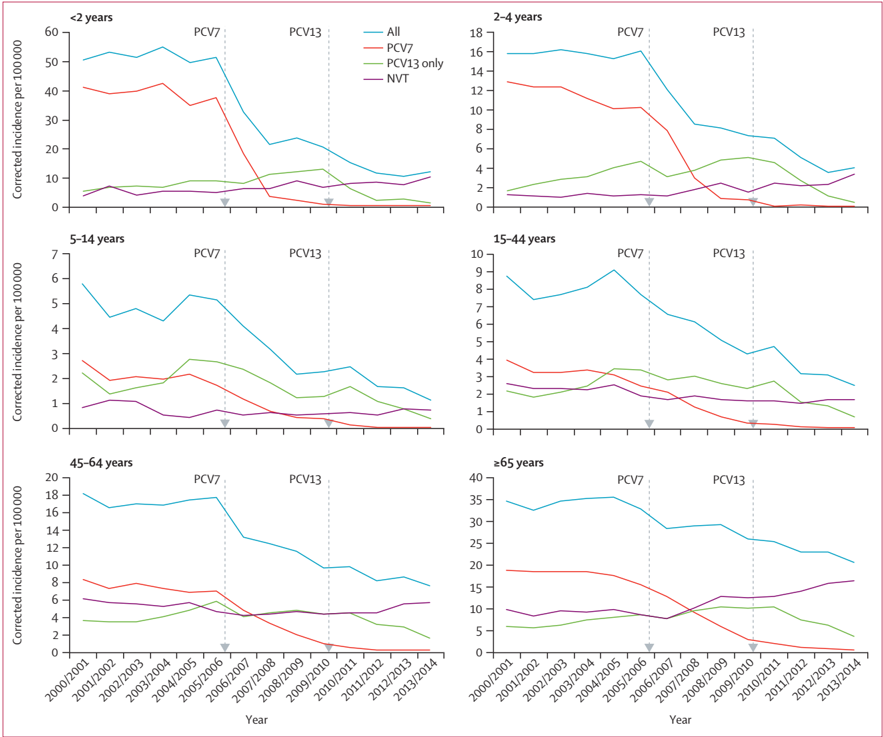
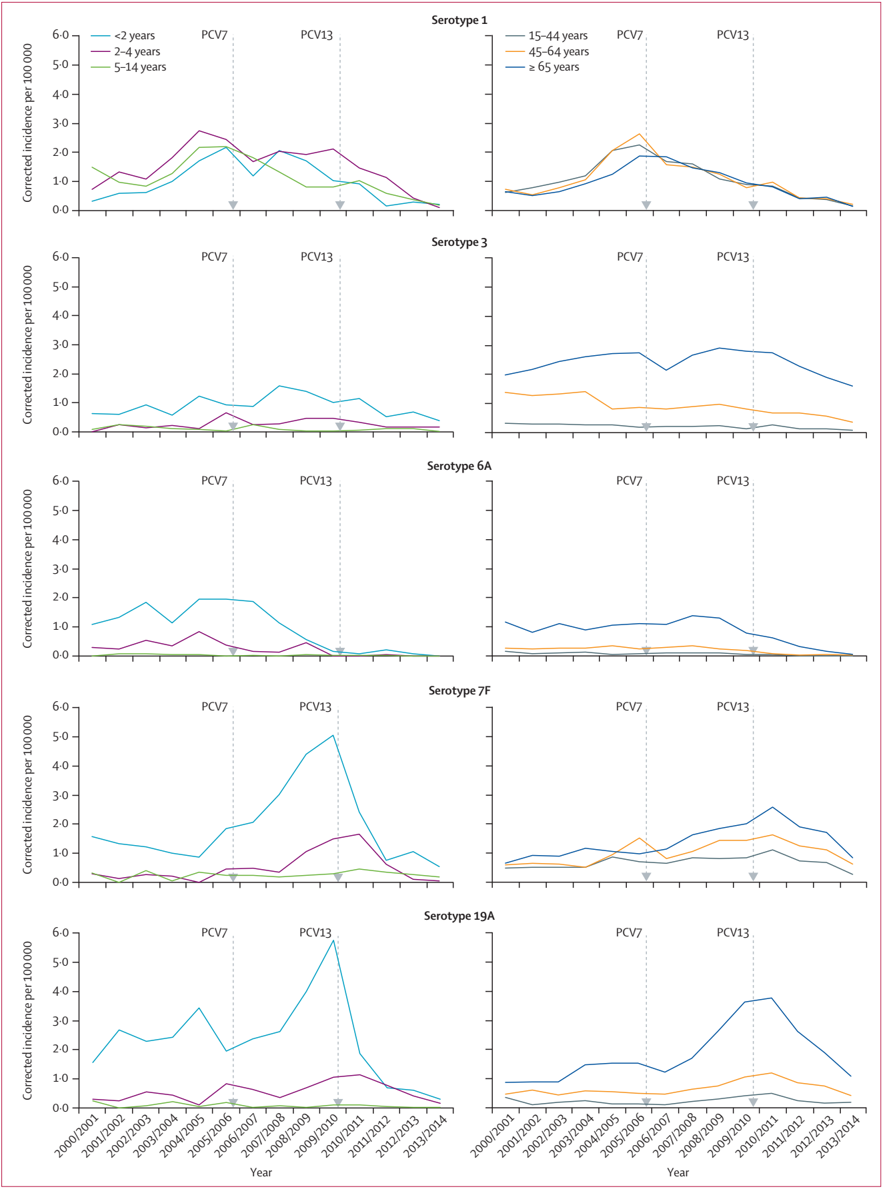
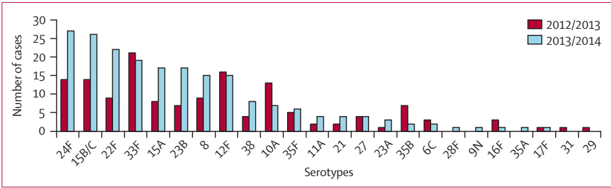
BACKGROUND: The 13-valent pneumococcal conjugate vaccine (PCV13) protects against key serotypes that increased after routine immunisation with the seven-valent vaccine (PCV7), but its potential for herd protection and serotype replacement is uncertain. The aim of this study was to analyse the effect of the 13-valent pneumococcal conjugate vaccine on invasive pneumococcal disease in England and Wales 4 years after its introduction. METHODS: We used a national dataset of electronically reported and serotyped invasive pneumococcal disease cases in England and Wales to estimate incidence rate ratios (IRRs) for vaccine and non-vaccine type invasive pneumococcal disease between July, 2013, and June, 2014, versus the pre-PCV13 and pre-PCV7 baseline. Incidence rates were corrected for missing serotype data and changes in surveillance sensitivity over time. An over-dispersed Poisson model was used to estimate IRRs and confidence intervals. FINDINGS: Incidence of invasive pneumococcal disease in the epidemiological year 2013/14 decreased by 32% compared with the pre-PCV13 baseline (incidence 10·14 per 100,000 in 2008-10 vs 6·85 per 100,000 in 2013/14; IRR 0·68, 95% CI 0·64-0·72). This was due to an 86% reduction of the serotypes covered by PCV7 (1·46 vs 0·20 per 100,000; IRR 0·14, 0·10-0·18) and a 69% reduction of the additional six serotypes covered by PCV13 (4·48 vs 1·40 per 100,000; IRR 0·31, 0·28-0·35). When compared with the pre-PCV7 baseline, there was a 56% overall reduction in invasive pneumococcal disease (15·63 vs 6·85 per 100,000; IRR 0·44, 95% CI 0·43-0·47). Compared with the pre-PCV13 baseline, the incidence of non-PCV13 serotypes increased (incidence all ages 4·19 vs 5·25 per 100,000; IRR 1·25, 95% CI 1·17-1·35) due to increases across a broad range of serotypes in children younger than 5 years and in people aged 45 years or more. In children younger than 5 years, incidence of non-PCV13 serotypes in 2013/14 was higher than in 2012/13 (age <2 years: 12·03 vs 10·83 per 100,000; age 2-4 years: 4·08 vs 3·63 per 100,000). INTERPRETATION: 8 years of PCV use in England and Wales has reduced the overall incidence of invasive pneumococcal disease by more than 50%. The herd protection induced by PCV7 is continuing, and similar indirect protection is occurring from the additional serotypes covered by PCV13. There is, however, evidence of increasing invasive pneumococcal disease due to non-PCV13 serotypes, particularly in children younger than 5 years in 2014. If this increase continues, the maximum benefit of the PCV13 programme in children might already have been achieved. FUNDING: Public Health England funds national surveillance of invasive pneumococcal disease.
Overview
The claims and statistics of this paper haven’t been checked yet.
Free: it reads the open-access text and checks the first 5 claims that cite a source we can check. Create a free account to check every claim.
Integrity signals
Registry
Cites
Statistics
Figures
Verification
Claims the paper makes
The claims and statistics of this paper haven’t been checked yet.
Free: it reads the open-access text and checks the first 5 claims that cite a source we can check. Create a free account to check every claim.
Claims other papers make about this one
Each is checked against this paper’s own text: does it say what the citing paper says it does?
The source backs part of the claim, not all of it — or backs it for a different population, condition or comparison.
In the citing paper
“A 56% reduction in invasive pneumococcal disease (IPD) among adults has been reported since the introduction of the PCV7 into the routine infant schedule and its replacement by PCV13 in April 2010.8”
From Community-acquired acute bacterial meningitis in adults: a clinical update (2019) · cites this paper as [8]
Experimental — accuracy not yet measured
Self-check
Percentages, sums and reported differences re-computed from the paper’s own numbers.
The self-check needs the paper’s full text.
Citations
Cites
O'Brien, K. L., Wolfson, L. J., Watt, J. P., Henkle, E., Deloria-Knoll, M., McCall, N., Lee, E., Mulholland, K., Levine, O. S., & Cherian, T. (2009) · The Lancet · doi:10.1016/s0140-6736(09)61204-6 · Cited by 2,398
Serotype replacement in disease after pneumococcal vaccination
Weinberger, D. M., Malley, R., & Lipsitch, M. (2011) · The Lancet · doi:10.1016/s0140-6736(10)62225-8 · Cited by 1,020
Moore, M. R., Link-Gelles, R., Schaffner, W., Lynfield, R., Lexau, C., Bennett, N. M., Petit, S., Zansky, S. M., Harrison, L. H., Reingold, A., et al. (2015) · The Lancet Infectious Diseases · doi:10.1016/s1473-3099(14)71081-3 · Cited by 733
Miller, E., Andrews, N. J., Waight, P. A., Slack, M. P., & George, R. C. (2011) · The Lancet Infectious Diseases · doi:10.1016/s1473-3099(11)70090-1 · Cited by 643
Self-citationAndrews, N. J., Waight, P. A., Burbidge, P., Pearce, E., Roalfe, L., Zancolli, M., Slack, M., Ladhani, S. N., Miller, E., & Goldblatt, D. (2014) · The Lancet Infectious Diseases · doi:10.1016/s1473-3099(14)70822-9 · Cited by 545
Self-citationFeikin, D. R., Kagucia, E. W., Loo, J. D., Link-Gelles, R., Puhan, M. A., Cherian, T., Levine, O. S., Whitney, C. G., O’Brien, K. L., Moore, M. R., et al. (2013) · PLoS Medicine · doi:10.1371/journal.pmed.1001517 · Cited by 470
Flasche, S., Van Hoek, A. J., Sheasby, E., Waight, P., Andrews, N., Sheppard, C., George, R., & Miller, E. (2011) · PLoS Medicine · doi:10.1371/journal.pmed.1001017 · Cited by 277
Self-citationvan Hoek, A. J., Andrews, N., Waight, P. A., Stowe, J., Gates, P., George, R., & Miller, E. (2012) · Journal of Infection · doi:10.1016/j.jinf.2012.02.017 · Cited by 253
Self-citationAndrews, N. J., Waight, P. A., George, R. C., Slack, M. P. E., & Miller, E. (2012) · Vaccine · doi:10.1016/j.vaccine.2012.09.019 · Cited by 239
Self-citationCooper, D., Yu, X., Sidhu, M., Nahm, M. H., Fernsten, P., & Jansen, K. U. (2011) · Vaccine · doi:10.1016/j.vaccine.2011.06.056 · Cited by 223
Research works printed but not linked: 3
- Roca A, Bojang A, Bottomley C, et al. Eff ect of replacing PCV-7 with PCV-13 in the expanded program of immunization on nasopharyngeal carriage of pneumococci in the Gambia. Pneumonia 2014; 3: 20.
- Nunes MC, Jones S, von Gottberg A, et al. Acquisition of Streptococcus pneumoniae in South African children vaccinated with 7-valent pneumococcal conjugate vaccine (PCV7). Pneumonia 2014; 3: 44.
- Moore M, Link-Gelles R, Guevara R, et al. Case-control study of eff ectiveness of 13-valent pneumococcal conjugate vaccine (PCV13) against Invasive Pneumococcal Disease (IPD) in the US: preliminary estimates. International Symposium on Pneumococci and Pneumococcal Diseases; Hyderabad, India; March 9-13, 2014. Poster 032.
Cited by
Items 201–300 of 590
Wasserman, M., Sings, H. L., Jones, D., Pugh, S. J., Moffatt, M., & Farkouh, R. (2017) · Expert Review of Vaccines · doi:10.1080/14760584.2018.1409116 · Cited by 26
Nakano, S., Fujisawa, T., Ito, Y., Chang, B., Matsumura, Y., Yamamoto, M., Suga, S., Ohnishi, M., & Nagao, M. (2019) · Antimicrobial Agents and Chemotherapy · doi:10.1128/aac.02579-18 · Cited by 25
“MEM-IR or -R CTX-S 13:JP1:43 (40) CTX-IR 13:JP1:43 (8), 13:JP1:JP2 (2) CTX-R 13:JP1:JP3 (12), 13:JP1:147 (1), 13:JP1:JP6 (1)”
BackgroundInfluentialDaningrat, W. O. D., Amalia, H., Ayu, I. M., Satzke, C., & Safari, D. (2021) · Journal of Microbiology Immunology and Infection · doi:10.1016/j.jmii.2021.08.002 · Cited by 37
Tamura, K., Chang, B., Shimbashi, R., Watanabe, H., Tanabe, Y., Kuronuma, K., Oshima, K., Maruyama, T., Fujita, J., Abe, S., et al. (2022) · Vaccine · doi:10.1016/j.vaccine.2022.04.062 · Cited by 29
Surveillance of impact of PCV-10 vaccine on pneumococcal meningitis in Mozambique, 2013 – 2015
Nhantumbo, A. A., Weldegebriel, G. G., Katsande, R., de Gouveia, L., Comé, C. E., Cuco, A. Z., Cantarelli, V. V., Dias, C. A. G., Caierão, J., Mathiu, J. M., et al. (2017) · PLoS ONE · doi:10.1371/journal.pone.0177746 · Cited by 26
Oligbu, G., Collins, S., Sheppard, C. L., Fry, N. K., Dick, M. C., Streetly, A., & Ladhani, S. N. (2017) · Archives of Disease in Childhood · doi:10.1136/archdischild-2017-313611 · Cited by 26
Self-citationKent, A., Makwana, A., Sheppard, C. L., Collins, S., Fry, N. K., Heath, P. T., Ramsay, M. E., & Ladhani, S. N. (2018) · Clinical Infectious Diseases · doi:10.1093/cid/ciy842 · Cited by 31
Self-citationLadhani, S. N., Fernandes, S., Garg, M. K., Borrow, R., de Lusignan, S., & Bolton‐Maggs, P. H. B. (2024) · British Journal of Haematology · doi:10.1111/bjh.19361 · Cited by 34
“58,60 More recently, the COVID-19 pandemic, along-side large-scale lockdowns and restrictions, was associated with large declines in respiratory viral and bacterial infection, including pneumococcal disease, across all age groups since March 2020.”
BackgroundSelf-citationGlobal distribution and characteristics of pneumococcal serotypes in adults
Maeda, H., & Morimoto, K. (2025) · Human Vaccines & Immunotherapeutics · doi:10.1080/21645515.2025.2469424 · Cited by 32
“…PCV13 serotypes across all age groups within four years post-introduction, which was due to the reduction of serotypes 1, 3, 6A, 7F, and 19A. 54 However, the national surveillance of IPD showed that in 2016 ‒ 2017, the incidence of IPD cases involving adults aged ≥15 years increased due to…”
Increased Invasive Pneumococcal Disease, North East England, UK
Houseman, C., Hughes, G. J., Chapman, K. E., Wilson, D., & Gorton, R. (2016) · Emerging infectious diseases · doi:10.3201/eid2301.160897 · Cited by 25
“92) 2014/2015 230 11 (5) 100 (43) 119 (52) 8.”
Su, H., Liu, Q., Bian, X., Wang, S., Curtiss, R., & Kong, Q. (2020) · Proceedings of the National Academy of Sciences · doi:10.1073/pnas.2013350118 · Cited by 24
Invasive Pneumococcal Disease in Adults in Portugal: The Importance of Serotypes 8 and 3 (2015–2018)
Silva‐Costa, C., Gomes‐Silva, J., Teodoro, I. M. M., Ramirez, M., Melo‐Cristino, J., & on behalf of the Portuguese Group for the Study of Streptococcal Infections (2021) · Microorganisms · doi:10.3390/microorganisms9051016 · Cited by 29
Deb, A., Podmore, B., Barnett, R., Beier, D., Galetzka, W., Qizilbash, N., Häckl, D., Mihm, S., Johnson, K. D., & Weiss, T. W. (2022) · Epidemiology and Infection · doi:10.1017/s0950268822001182 · Cited by 26
“Studies since the introduction of the PCV13 in other countries, for example in the UK [43] or US [44], have shown a decline in IPD over time in adults aged over 65, attributing it to herdprotection after the introduction of the PCV13 vaccine in children.”
BackgroundCampling, J., Vyse, A., Liu, H., Wright, H., Slack, M., Reinert, R.-R., Drayson, M. T., Richter, A. G., Singh, D., Barlow, G. D., et al. (2023) · Expert Review of Vaccines · doi:10.1080/14760584.2023.2256394 · Cited by 29
“In addition to directly protecting children, the sequential introduction of PCV7 and PCV13 into the infant immunization program has induced valuable indirect protection for older age groups and consequently reduced the incidence of vaccine-type (VT)-PD across the full age range [25].”
BackgroundSelf-citationTheory and strategy for Pneumococcal vaccines in the elderly
Namkoong, H., Ishii, M., Funatsu, Y., Kimizuka, Y., Yagi, K., Asami, T., Asakura, T., Suzuki, S., Kamo, T., Fujiwara, H., et al. (2015) · Human Vaccines & Immunotherapeutics · doi:10.1080/21645515.2015.1075678 · Cited by 29
Community-acquired pneumonia in adults: Highlighting missed opportunities for vaccination
Blasi, F., Akova, M., Bonanni, P., Dartois, N., Sauty, E., Webber, C., & Torres, A. (2016) · European Journal of Internal Medicine · doi:10.1016/j.ejim.2016.09.024 · Cited by 26
Marchisio, P., Esposito, S., Picca, M., Baggi, E., Terranova, L., Orenti, A., Biganzoli, E. M., & Principi, N. (2016) · The Pediatric Infectious Disease Journal · doi:10.1097/inf.0000000000001485 · Cited by 24
Sanz-Orrio, G. L., García-García, S., Lanaspa, M., Ciruela, P., Esteva, C., de Sevilla, M. F., Díaz‐Conradi, A., Martí, C., Motjé, M., Galles, C., et al. (2020) · PLoS ONE · doi:10.1371/journal.pone.0228612 · Cited by 25
Ladhani, S. N., Andrews, N. J., & Ramsay, M. E. (2020) · The Lancet Infectious Diseases · doi:10.1016/s1473-3099(20)30492-8 · Cited by 24
Self-citationWilson, M. R., Lucas, A., Mendes, D., Vyse, A., Mikudina, B., Czudek, C., Ellsbury, G., & Perdrizet, J. E. (2023) · Vaccines · doi:10.3390/vaccines11071168 · Cited by 27
“After the 2+1 schedule was implemented, there was a substantial reduction in disease incidence caused by PCV-covered serotypes [5,6].”
BackgroundPneumococcal Meningitis in Adults after Introduction of PCV7 and PCV13, Israel, July 2009–June 20151
Regev‐Yochay, G., Reisenberg, K., Katzir, M., Weil‐Weiner, Y., Rahav, G., Strahilevitz, J., Istomin, V., Tsyba, E., Peretz, A., Khakshoor, S., et al. (2018) · Emerging infectious diseases · doi:10.3201/eid2407.170721 · Cited by 26
Epidemiology of Cryptococcus gattii, British Columbia, Canada, 1999–2007
Galanis, E. (2010) · Emerging infectious diseases · doi:10.3201/eid1601.090900 · Cited by 34
Divergent Memory B Cell Responses in a Mixed Infant Pneumococcal Conjugate Vaccine Schedule
Trück, J., Mitchell, R. M., Jawad, S., Clutterbuck, E., Snape, M. D., Kelly, D. F., Voysey, M., & Pollard, A. J. (2016) · The Pediatric Infectious Disease Journal · doi:10.1097/inf.0000000000001497 · Cited by 23
“Compared with other serotypes, immunogenicity for serotype 3 is attenuated and a serotype 3–containing vaccine has previously failed to show protective efficacy against serotype 3 otitis media,(9) although postimplementation surveillance suggests that immunization with PCV-13 does have some efficacy against serotype 3…”
BackgroundSilva‐Costa, C., Gomes‐Silva, J., Prados, L., Ramirez, M., Melo‐Cristino, J., on behalf of the Portuguese Group for the Study of Streptococcal Infections, & the Portuguese Study Group of Invasive Pneumococcal Disease of the Pediatric Infectious Disease Society (2021) · Microorganisms · doi:10.3390/microorganisms9071428 · Cited by 24
“The increase in NVTs in pIPD seen here, although reported to be more pronounced in the adult population [5,33], was also documented in children in many other countries [7,10,24,25,34].”
ResultMasala, G. L., Lipsitch, M., Bottomley, C., & Flasche, S. (2017) · Journal of The Royal Society Interface · doi:10.1098/rsif.2017.0620 · Cited by 22
“PCV7 4 (18), 6B (2), 9 V (6), 14 (5), 18C (11), 19F (1), 23F (3)”
Wasserman, M., Lucas, A., Jones, D., Wilson, M. R., Hilton, B., Vyse, A., Madhava, H., Brogan, A. J., Slack, M., & Farkouh, R. (2018) · Epidemiology and Infection · doi:10.1017/s095026881800198x · Cited by 22
“Specifically, we estimated these unknown input parameters such that the model approximated historical IPD surveillance data as closely as possible [7, 8].”
BackgroundMethodInfluentialSelf-citationIndirect protection in adults ≥18 years of age from pediatric pneumococcal vaccination: a review
Flem, E., Mouawad, C., PALMU, A. A. I., Platt, H. L., Johnson, K. D., McIntosh, E. D. G., Abadi, J., Buchwald, U. K., & Feemster, K. A. (2024) · Expert Review of Vaccines · doi:10.1080/14760584.2024.2416229 · Cited by 23
“Most studies reported PCV coverage of >80% among children at timepoints when a reduction in VT IPD incidence in adults was detected [28,34,37,38,43,45–49, 55, 59, 65– 71].”
Meder, K. N., Jayasinghe, S., Beard, F., Dey, A., Kirk, M., Cook, H., Strachan, J., Sintchenko, V., Smith, H., Giele, C., et al. (2020) · Clinical Infectious Diseases · doi:10.1093/cid/ciz731 · Cited by 20
Castiglia, P., Pradelli, L., Castagna, S., Freguglia, V., Palù, G., & Esposito, S. (2017) · Human Vaccines & Immunotherapeutics · doi:10.1080/21645515.2017.1343773 · Cited by 22
“The effect of PCV-13 and PHiD-CV in PCV-7pre-exposed populations is less (56%).(17) Current incidence in Italy reflects about 10 y of universal vaccination: the assumption is that these represent a 50% remaining incidence vs.”
BackgroundDomínguez, Á., Soldevila, N., Toledo, D., Godoy, P., Torner, N., Force, L., Castilla, J., Mayoral, J. M., Tamames, S., Martín, V., et al. (2016) · PubMed · doi:10.1080/21645515.2016.1149661 · Cited by 23
Trück, J., Jawad, S., Goldblatt, D., Roalfe, L., Snape, M. D., Voysey, M., & Pollard, A. J. (2016) · The Pediatric Infectious Disease Journal · doi:10.1097/inf.0000000000001180 · Cited by 21
Time for a third-generation pneumococcal conjugate vaccine
Klugman, K. P., & Rodgers, G. L. (2020) · The Lancet Infectious Diseases · doi:10.1016/s1473-3099(20)30513-2 · Cited by 21
Pneumococcal vaccination coverage and willingness in mainland China
Shao, W., Chen, X., Zheng, C., Wang, G., Zhang, B., & Zhang, W. (2022) · Tropical Medicine & International Health · doi:10.1111/tmi.13809 · Cited by 21
Peptide linker increased the stability of pneumococcal fusion protein vaccine candidate
Zane, L., Kraschowetz, S., Trentini, M. M., Alves, V. D. S., Araújo, S. C., Goulart, C., Leite, L. C. C., & Gonçalves, V. M. (2023) · Frontiers in Bioengineering and Biotechnology · doi:10.3389/fbioe.2023.1108300 · Cited by 23
Pneumococcal 23B Molecular Subtype Identified Using Whole Genome Sequencing
Kapatai, G., Sheppard, C. L., Troxler, L. J., Litt, D. J., Furrer, J., Hilty, M., & Fry, N. K. (2017) · Genome Biology and Evolution · doi:10.1093/gbe/evx092 · Cited by 21
Self-citationDemczuk, W., Martín, I., Hoang, L., Caeseele, P. G. V., Lefebvre, B., Horsman, G. B., Haldane, D. J. M., Gubbay, J. B., Ratnam, S., German, G. J., et al. (2017) · PLoS ONE · doi:10.1371/journal.pone.0178040 · Cited by 22
Pneumococcal vaccine impacts on the population genomics of non-typeable Haemophilus influenzae
Cleary, D. W., Devine, V. T., Morris, D. E., Osman, K. L., Gladstone, R. A., Bentley, S. D., Faust, S. N., & Clarke, S. C. (2018) · Microbial Genomics · doi:10.1099/mgen.0.000209 · Cited by 29
“The use of PCVs has radically reduced the burden of invasive pneumococcal disease (IPD) both in the UK [55] and globally [56–62].”
Martinón‐Torres, F., Bosch, F. X., Rappuoli, R., Ladhani, S. N., Redondo, E., Vesikari, T., García‐Sastre, A., Calle, I. R., Rial, J. G., Salas, A., et al. (2019) · Human Vaccines & Immunotherapeutics · doi:10.1080/21645515.2019.1609823 · Cited by 21
“cine (PCV7) in the infant immunization schedule in 2010, and was highly effective during the four first years of the program.(18) Despite an increase in invasive disease caused by non-vaccine serotypes, Dr.”
BackgroundSelf-citationPublic health impact of pneumococcal conjugate vaccination: a review of measurement challenges
Horn, E. K., Wasserman, M., Hall-Murray, C. K., Sings, H. L., Chapman, R., & Farkouh, R. (2021) · Expert Review of Vaccines · doi:10.1080/14760584.2021.1971521 · Cited by 20
Kobras, C. M., Monteith, W., Somerville, S., Delaney, J. M., Khan, I. K., Brimble, C., Corrigan, R. M., Sheppard, S. K., & Fenton, A. K. (2023) · Proceedings of the National Academy of Sciences · doi:10.1073/pnas.2308029120 · Cited by 26
“This approach has successfully reduced the targeted S. pneumoniae capsule types thereby reducing antibiotic resistance in the short and medium term (40).”
Pneumococcal conjugate vaccine use in adults
Istúriz, R., Schmöele-Thoma, B., Scott, D. A., Jódar, L., Webber, C., Sings, H. L., & Paradiso, P. R. (2015) · Expert Review of Vaccines · doi:10.1586/14760584.2016.1132171 · Cited by 21
“New Zealand,[36] Brazil,[37] Canada (Quebec),[38] the United States,[39] England and Wales,[40] Norway,[41] and Chile.”
BackgroundAgudelo, C. I., DeAntonio, R., & Castañeda, E. (2018) · Vaccine · doi:10.1016/j.vaccine.2018.06.068 · Cited by 22
Dennison, S. H., Ask, L. S., ERIKSSON, M., Granath, A., Hertting, O., Bennet, R., Lindstrand, A., Masaba, P. J., Dimitriou, P. A., & Stjärne, P. (2019) · International Journal of Pediatric Otorhinolaryngology · doi:10.1016/j.ijporl.2019.02.034 · Cited by 20
Nakano, S., Fujisawa, T., Ito, Y., Chang, B., Matsumura, Y., Yamamoto, M., Suga, S., Ohnishi, M., & Nagao, M. (2019) · Antimicrobial Agents and Chemotherapy · doi:10.1128/aac.00711-19 · Cited by 20
Pneumococcal-related Hemolytic Uremic Syndrome in the United Kingdom
Makwana, A., Sheppard, C. L., Fry, N. K., & Ladhani, S. N. (2019) · The Pediatric Infectious Disease Journal · doi:10.1097/inf.0000000000002368 · Cited by 20
Self-citationSevilla, J. P., Stawasz, A., Burnes, D., Agarwal, A., Hacıbedel, B., Helvacioglu, K., Sato, R., & Bloom, D. E. (2020) · Human Vaccines & Immunotherapeutics · doi:10.1080/21645515.2019.1708668 · Cited by 23
“We assume that herd effects from Turkey’s national pediatric PCV13 vaccination program will reduce steady state PCV13type incidence rates among adults by the same 88% reduction observed in seven-valent pneumococcal conjugate vaccine (PCV7) type incidence rates in Denmark and in the United Kingdom after the introductio…”
BackgroundMonali, R., Vita, E. D., Mariottini, F., Privitera, G. P., Lopalco, P. L., & Tavoschi, L. (2020) · Epidemiology and Infection · doi:10.1017/s0950268820001077 · Cited by 20
Invasive pneumococcal disease due to 22F and 33F in England: A tail of two serotypes
Amin‐Chowdhury, Z., Groves, N., Sheppard, C. L., Litt, D. J., Fry, N. K., Andrews, N. J., & Ladhani, S. N. (2021) · Vaccine · doi:10.1016/j.vaccine.2021.02.026 · Cited by 20
Self-citationBili, A., Dobson, S., Quinones, J., Phongsamart, W., Oberdorfer, P., Kosalaraksa, P., Dagan, R., Richmond, P., Wilck, M. B., Vallejos, W., et al. (2022) · Vaccine · doi:10.1016/j.vaccine.2022.10.072 · Cited by 20
Ning, X., Li, L., Liu, J., Wang, F., Tan, K., Li, W., Zhou, K., Jing, S., Lin, A., Bi, J., et al. (2024) · Emerging Microbes & Infections · doi:10.1080/22221751.2024.2332670 · Cited by 22
“…differences in their capsular polysaccharides, limited serogroups account for most paediatric IPDs worldwide, with serogroups 1, 3, 6, 8, 14, 19, and 23 being the most common ones [8–10], meanwhile, serotype shifts have been observed in countries and regions where PCVs are widely used [11–13].”
BackgroundHammitt, L. L., Quinn, D., Janczewska, E., Pasquel, F. J., Tytus, R. H., Reddy, K. R., Abarca, K., V, Мансуровна, Х. И., Dagan, R., McCauley, J., et al. (2021) · Open Forum Infectious Diseases · doi:10.1093/ofid/ofab605 · Cited by 19
Maeda, H., Dhoubhadel, B. G., Sando, E., Suzuki, M., Furumoto, A., Asoh, N., Yaegashi, M., Aoshima, M., Ishida, M., Hamaguchi, S., et al. (2022) · Vaccine · doi:10.1016/j.vaccine.2022.07.041 · Cited by 18
Invasive Pneumococcal Disease in High-risk Children: A 10-Year Retrospective Study
van Warmerdam, J., Campigotto, A. J., Bitnun, A., Macdougall, G., Kirby-Allen, M. A., Papsin, B. C., McGeer, A., Allen, U., & Morris, S. K. (2022) · The Pediatric Infectious Disease Journal · doi:10.1097/inf.0000000000003748 · Cited by 41
Cost-effectiveness of 13-valent pneumococcal conjugate vaccination in Mongolia
Sundaram, N., Chen, C., Yoong, J., Luvsan, M.-E., Fox, K., Sarankhuu, A., Vincente, S. F. L., & Jit, M. (2017) · Vaccine · doi:10.1016/j.vaccine.2016.12.070 · Cited by 19
“Indirect effects were extrapolated from IPD incidence following PCV13 introduction in the United Kingdom (UK) between 2010/11 and 2013/14 [38].”
Methodvan Deursen, A. M. M., Klooster, T. M. S.-V., Man, W. H., van de Kassteele, J., van Gageldonk‐Lafeber, A. B., Bruijning-Verhagen, P. C. J. L., de Melker, H. E., Sanders, E. A. M., & Knol, M. J. (2017) · Vaccine · doi:10.1016/j.vaccine.2017.10.090 · Cited by 19
van de Garde, M. D. B., van Westen, E., Poelen, M. C. M., Rots, N. Y., & van Els, C. A. C. M. (2019) · Infection and Immunity · doi:10.1128/iai.00098-19 · Cited by 22
Vila-Córcoles, Á., Gondar, O. O., Satué-Gracia, E. M., de Diego‐Cabanes, C., Vila-Rovira, Á., Gómez-Bertomeu, F., Raga, X., & Aragón, M. (2019) · Vaccine · doi:10.1016/j.vaccine.2019.11.012 · Cited by 20
Men, W., Dong, Q., Shi, W., & Yao, K. (2019) · Brazilian Journal of Microbiology · doi:10.1007/s42770-019-00198-9 · Cited by 19
Corcoran, M., Mereckiene, J., Cotter, S. M., Murchan, S., Cunney, R., & Humphreys, H. (2019) · The Pediatric Infectious Disease Journal · doi:10.1097/inf.0000000000002549 · Cited by 19
Cripps, A. W., Folaranmi, T. A., Johnson, K. D., Musey, L. K., Niederman, M. S., & Buchwald, U. K. (2021) · Expert Review of Vaccines · doi:10.1080/14760584.2021.1889374 · Cited by 20
Goldblatt, D., Tan, C. Y., Burbidge, P., McElhiney, S. P., McLaughlin, L., Tucker, R. P., Rauh, M., Sidhu, M. K., & Giardina, P. C. (2015) · Clinical and Vaccine Immunology · doi:10.1128/cvi.00437-15 · Cited by 19
“A project is under way to bridge the IgG assignments for 89SF to the new reference standard, 007sp, for the remaining four serotypes that are less prevalent in young pediatric populations but are also included in the 23-valent polysaccharide vaccine Pneumovax II (13, 14).”
MethodAdult pneumococcal vaccination: advances, impact, and unmet needs
José, R. J. P., & Brown, J. (2017) · Current Opinion in Pulmonary Medicine · doi:10.1097/mcp.0000000000000369 · Cited by 20
Pneumococcal Conjugate Vaccine impact assessment in Bangladesh
Baqui, A. H., McCollum, E. D., Saha, S. K., Roy, A. K., Chowdhury, N. H., Harrison, M., Hanif, A. A. M., Simmons, N., Mahmud, A., Begum, N., et al. (2018) · Gates Open Research · doi:10.12688/gatesopenres.12805.1 · Cited by 18
Fenoll, A., Ardanuy, C., Liñares, J., Cercenado, E., Marco, F., Fleites, A. M., Rodríguez–Mayo, M., López-Hontangas, J. L., Palop, B., Aller, A.-I., et al. (2018) · Vaccine · doi:10.1016/j.vaccine.2018.10.098 · Cited by 19
Intra-Species Interactions in Streptococcus pneumoniae Biofilms
Valente, C., Cruz, A. R., Henriques, A. O., & Sá‐Leão, R. (2022) · Frontiers in Cellular and Infection Microbiology · doi:10.3389/fcimb.2021.803286 · Cited by 18
“Given the large array of metabolic profiles identified among pneumococcal strains (Watkins et al., 2015), it seems possible that our strains have different nutritional requirements; this possibility, however, was not addressed in the present study.”
BackgroundImpact of PCV10 on pediatric pneumococcal disease burden in Brazil: time for new recommendations?
Jarovsky, D., & Berezin, E. N. (2022) · Jornal de Pediatria · doi:10.1016/j.jped.2022.11.003 · Cited by 18
Pneumococcal Disease: Global Disease Prevention Strategies with a Focus on the Challenges in Iraq
Al-Jumaili, A., Dawood, H. N., Ikram, D., & AlJabban, A. (2023) · International Journal of General Medicine · doi:10.2147/ijgm.s409476 · Cited by 21
“85 per 100,000 in 2013–14 (more than 50% decline in incidence rate since PCV introduction).(79) However, IPD cases due to non-PCV13 serotypes increased in children <5 years and adults ≥45 years.”
BackgroundJanesch, P., Rouha, H., Badarau, A., Stulik, L., Mirkina, I. I., Caccamo, M., Havlicek, K., Maierhofer, B., Weber, S., Groß, K., et al. (2018) · Virulence · doi:10.1080/21505594.2018.1520545 · Cited by 19
“nia, have been reported in the elderly [3,4].”
BackgroundSohn, S., Hong, K., & Chun, B. C. (2020) · International Journal of Infectious Diseases · doi:10.1016/j.ijid.2020.01.034 · Cited by 19
Segal, N., Greenberg, D., Dagan, R., & Ben‐Shimol, S. (2016) · Vaccine · doi:10.1016/j.vaccine.2016.07.004 · Cited by 17
“Some potential reasons for these findings are different baseline pneumococcal disease rates [3], differences on the population level (e.”
BackgroundWu, X., Zhao, S., Jiang, Y., Xiang, X., Ge, L., Chen, Q., Wang, Y., Vidal, J. E., & Yu, Y. (2022) · Emerging Microbes & Infections · doi:10.1080/22221751.2022.2040921 · Cited by 17
Wilck, M. B., Cornely, O. A., Cordonnier, C., Vélez, J. D., Ljungman, P. T., Maertens, J. A., Selleslag, D., Mullane, K. M., Nabhan, S. K., Chen, Q., et al. (2023) · Clinical Infectious Diseases · doi:10.1093/cid/ciad349 · Cited by 22
“…of Merck & Co, Inc., Rahway, NJ, USA [MSD]) is a 15-valent PCV approved in adults and children, containing all 13 serotypes in PCV13 (Prevnar 13; Wyeth LLC, marketed by Pfizer, New York, NY, USA) and epidemiologically important serotypes 22F and 33F [18–21] for expanded serotype coverage.”
BackgroundCho, E. Y., Choi, E. H., Kang, J. H., Kim, K., Kim, D. S., Kim, Y., Ahn, Y. M., Eun, B. W., Oh, S. H., Cha, S. H., et al. (2016) · Journal of Korean Medical Science · doi:10.3346/jkms.2016.31.7.1082 · Cited by 17
“Although the annual incidence of IPD caused by PCV13 types has decreased, there remains concern about the emergence of IPD due to non-PCV13 serotypes (12).”
BackgroundNieddu, F., Moriondo, M., Vitis, E. D., Ricci, S., Indolfi, G., Resti, M., Vocale, C., Landini, M. P., Sartor, A., & Azzari, C. (2017) · Vaccine · doi:10.1016/j.vaccine.2017.01.064 · Cited by 18
“Although several studies, both in United States and in Europe, [17,21,30,31] demonstrated an overall herd effect of PCV13 introduction in adults and elderly, in our study, as previously outlined, a limited change in percentage, with the exception of 7F, occurred among PCV13 serotypes between the pre-and post-PCV13 era…”
ResultCho, Y.-C., Chiu, N., Lu, C., Huang, D. T., Huang, C., Chang, L., Huang, L., & Chi, H. (2017) · The Pediatric Infectious Disease Journal · doi:10.1097/inf.0000000000001664 · Cited by 17
Eletu, S. D., Sheppard, C. L., Thomas, E., Smith, K., Daniel, P., Litt, D. J., Lim, W. S., & Fry, N. K. (2017) · Clinical and Vaccine Immunology · doi:10.1128/cvi.00262-17 · Cited by 19
Self-citationFjeldhøj, S., Laursen, R. P., Larnkjær, A., Mølgaard, C., Fuursted, K., Krogfelt, K. A., & Slotved, H. (2018) · Scientific Reports · doi:10.1038/s41598-018-33583-9 · Cited by 17
Redin, A., Ciruela, P., de Sevilla, M. F., Gómez-Bertomeu, F., González‐Peris, S., Benítez, M. Á., Trujillo, G., Díaz, Á., Jou, E., Izquierdo, C., et al. (2021) · Microbiology Spectrum · doi:10.1128/spectrum.01150-21 · Cited by 19
“disease are 24F and 15A, as observed in other studies (44, 45).”
ResultBuchwald, U. K., Andrews, C. P., Ervin, J. E., Peterson, J. T., Tamms, G. M., Krupa, D. A., Ajiboye, P., Roalfe, L., Krick, A. L., Sterling, T. M., et al. (2021) · Human Vaccines & Immunotherapeutics · doi:10.1080/21645515.2021.1888621 · Cited by 18
Lagousi, T., Papadatou, I., Strempas, P., Chatzikalil, E., & Spoulou, V. I. (2021) · Vaccines · doi:10.3390/vaccines9121390 · Cited by 16
“Early PCV7 studies had demonstrated 96% vaccine effectiveness against IPD among healthy children [75], while the effectiveness of different PCV13 schedules against IPD across high-income countries varies between 78% [76] and 89% [77].”
BackgroundSong, S. H., Lee, H., Lee, H. J., Song, E. S., Ahn, J. G., Park, S. E., Lee, T.-J., Cho, H., Lee, J., Kim, Y., et al. (2023) · Journal of Korean Medical Science · doi:10.3346/jkms.2023.38.e127 · Cited by 16
Principi, N., & Esposito, S. (2015) · Expert Review of Vaccines · doi:10.1586/14760584.2015.1075884 · Cited by 17
“A great extent of IPD is presently associated with serotypes not included in either vaccine [26,27].”
BackgroundFlasche, S., Givon‐Lavi, N., & Dagan, R. (2016) · American Journal of Epidemiology · doi:10.1093/aje/kww012 · Cited by 16
Holubar, M. K., Stavroulakis, M. C., Maldonado, Y., Ioannidis, J. P. A., & Contopoulos‐Ioannidis, D. G. (2017) · PLoS ONE · doi:10.1371/journal.pone.0172414 · Cited by 18
Novel and preclinical treatment strategies in pneumococcal meningitis
Bewersdorf, J. P., Grandgirard, D., Koedel, U., & Leib, S. L. (2017) · Current Opinion in Infectious Diseases · doi:10.1097/qco.0000000000000416 · Cited by 19
Jensen, V. V. S., Furberg, A.-S., Slotved, H., Александровна, Б. Т., Haldorsen, B. C., Caugant, D. A., Sundsfjord, A., Valentiner‐Branth, P., & Simonsen, G. S. (2020) · BMC Infectious Diseases · doi:10.1186/s12879-020-04998-5 · Cited by 16
“This serotype was previously associated with MDR and was isolated from most IPD cases in the post-PCV era in several post-industrial countries [51] [52] [53] .”
BackgroundWolf, A., Mitsi, E., Jones, S., Jochems, S. P., Roalfe, L., Thindwa, D., Meiring, J., Msefula, J., Bonomali, F., Jere, T. M., et al. (2022) · Vaccine · doi:10.1016/j.vaccine.2022.09.069 · Cited by 15
Köhler, J. R., Hube, B., Puccia, R., Casadevall, A., & Perfect, J. R. (2017) · ASM Press eBooks · doi:10.1128/9781555819583.ch39 · Cited by 44
Hasanuzzaman, M., Saha, S., Malaker, R., Rahman, H., Sajib, M. S. I., Das, R. C., Islam, M., Hamer, D. H., Darmstadt, G. L., & Saha, S. K. (2021) · The Journal of Infectious Diseases · doi:10.1093/infdis/jiab073 · Cited by 15
Prato, R., Fortunato, F., & Martinelli, D. (2015) · Current Medical Research and Opinion · doi:10.1185/03007995.2015.1131150 · Cited by 16
Dagan, R., Juergens, C., Trammel, J., Patterson, S., Greenberg, D., Givon‐Lavi, N., Porat, N., Gruber, W. C., & Scott, D. A. (2017) · Vaccine · doi:10.1016/j.vaccine.2016.12.052 · Cited by 15
Horácio, A. N., Silva‐Costa, C., Lopes, E., Ramirez, M., Melo‐Cristino, J., & on behalf of the Portuguese Group for the Study of Streptococcal Infections (2018) · PLoS ONE · doi:10.1371/journal.pone.0206912 · Cited by 18
Seir, R. A., Azmi, K., Hamdan, A., Namouz, H., Jaar, F., Jaber, H., Rubin, C., Doron, D., Rahav, G., Abdeen, Z., et al. (2018) · PLoS ONE · doi:10.1371/journal.pone.0206927 · Cited by 17
The Potential Beneficial Effects of Vaccination on Antigenically Evolving Pathogens
Wen, F. T., Malani, A., & Cobey, S. E. (2021) · The American Naturalist · doi:10.1086/717410 · Cited by 14
Sheppard, C. L., Kapatai, G., Broughton, K., Schaefer, U., Hannah, M. J., Litt, D. J., & Fry, N. K. (2017) · PeerJ · doi:10.7717/peerj.3571 · Cited by 15
“pneumoniae, and the introduction of conjugate vaccines to the most common capsular types has led to a dramatic reduction in circulating vaccine serotypes and an increase in non-vaccine serotype disease (Waight et al., 2015).”
BackgroundSelf-citationMaraki, S., Mavromanolaki, V. E., Stafylaki, D., Hamilos, G., & Samonis, G. (2018) · Infection and Chemotherapy · doi:10.3947/ic.2018.50.4.328 · Cited by 15
“In several countries the most frequently emerging serotypes implicated in adult IPDs since the post-PCV13 period were 22F and 8 [16, 23, 29, 30].”
BackgroundWidespread Foodborne Cyclosporiasis Outbreaks Present Major Challenges
Colley, D. G. (1996) · Emerging infectious diseases · doi:10.3201/eid0204.960413 · Cited by 16
Non-vaccine Pneumococcal Serotypes Among Children with Invasive Pneumococcal Disease
John, J., Varghese, R., Daniel, J. L. K., Neeravi, A., & Veeraraghavan, B. (2018) · Indian Pediatrics · doi:10.1007/s13312-018-1398-x · Cited by 14
Pugh, S. J., Fletcher, M. A., Charos, A., Imekraz, L., Wasserman, M., & Farkouh, R. (2018) · Infectious Diseases and Therapy · doi:10.1007/s40121-018-0226-x · Cited by 15
Metadata
- Authors
- Waight, P. A., Andrews, N. J., Ladhani, S. N., Sheppard, C. L., Slack, M. P. E., & Miller, E.
- Affiliations
- Public Health England (GB)
- Griffith University (AU)
- Corresponding author
- Waight, Pauline A
- Venue
- The Lancet Infectious Diseases
- Publisher
- Elsevier BV
- Published
- 2015-05
- Volume
- 15
- Issue
- 5
- Pages
- 535-543
- ISSN
- 1473-3099 (ISSN-L)
- PMC
- PMC7130081
- OpenAlex
- W2025200855
- Semantic Scholar
- 5c963d5f23c27d4c8d23abdc0b6e3a220537801c
- Cited by
- 589
- References
- 24
- Citations by year
- 2026: 17 · 2025: 28 · 2024: 32 · 2023: 35 · 2022: 40 · 2021: 51 · 2020: 46 · 2019: 69 · 2018: 86 · 2017: 90 · 2016: 61 · 2015: 30
- FWCI
- 69.83
- Type
- journal article
- Language
- en
- Open access
- hybrid
- doi.org
- Licence
- cc-by
- www.elsevier.com/tdm/userlicense/1.0/ (tdm)
- www.elsevier.com/legal/tdmrep-license (tdm)
- creativecommons.org/licenses/by/4.0/ (vor)
- Locations
- The Lancet Infectious Diseases (publishedVersion, cc-by)
- PubMed Central (publishedVersion)
- PubMed (publishedVersion)
- Griffith Research Online (submittedVersion, cc-by-nc-nd)
- Funders
- Public Health England
- Topics
- Health Sciences › Medicine › Epidemiology › Pneumonia and Respiratory Infections
- Life Sciences › Immunology and Microbiology › Microbiology › Bacterial Infections and Vaccines
- Life Sciences › Immunology and Microbiology › Microbiology › Microbial infections and disease research
- Keywords
- 13-valent pneumococcal conjugate vaccine, PCV13, invasive pneumococcal disease, Streptococcus pneumoniae, serotype replacement, herd protection, PCV7, vaccine impact, England and Wales, incidence rate ratio, overdispersion
- MeSH terms
- Adolescent, Adult, Aged, Child, Child, Preschool, England, Female, Humans, Infant, Infant, Newborn, Male, Middle Aged, Pneumococcal Infections, Streptococcus pneumoniae, Wales, Incidence, Poisson Distribution, Vaccines, Conjugate, Pneumococcal Vaccines, Mass Vaccination, Epidemiological Monitoring, Serogroup
About these checks
Registry, retraction, Cites and statistics results are computed, not judged, with one exception: a printed reference that no index lists is read once by a model before it counts as a citation error. Claims are extracted by a model and kept only when their quote appears verbatim in the text; each cited source is then checked, with a model’s help, for whether it says what the claim relies on. Those verdicts can be wrong — read the claim’s quote and the cited source before relying on one.
Statistics and arithmetic are recomputed, not judged.
Confidence bands are shown only for fields calibrated on our annotated test set. None is calibrated yet, so no band is shown.
What counts as a claim ›How we measure confidence ›How we check this ›
Are you an author, or do you see a problem with this page? Request a review
Data sources
Bibliographic data: Semantic Scholar, OpenAlex, Crossref.
Contains information from the Semantic Scholar Academic Graph Datasets, made available under the ODC Attribution License (ODC-BY 1.0).
Semantic Scholar’s data is described in: Kinney, R., et al. (2023). The Semantic Scholar Open Data Platform. arXiv:2301.10140.
