

Effect of the 13-valent pneumococcal conjugate vaccine on invasive pneumococcal disease in England and Wales 4 years after its introduction: an observational cohort study
Open accessThe DOI matches its Crossref record; 24 of the 24 references it cites were found in a registry or an index.
Abstract
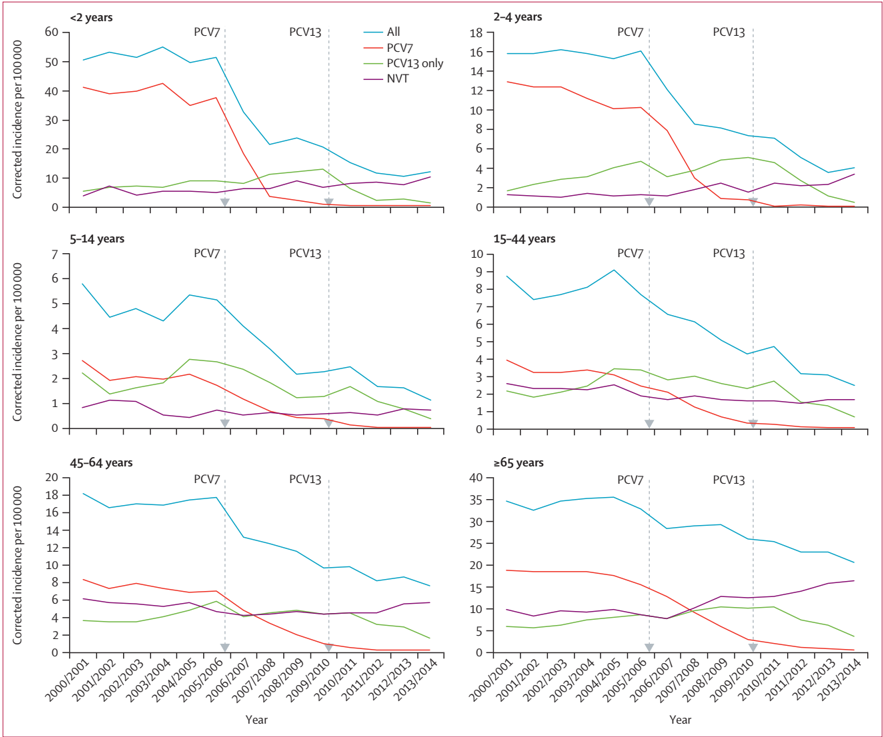
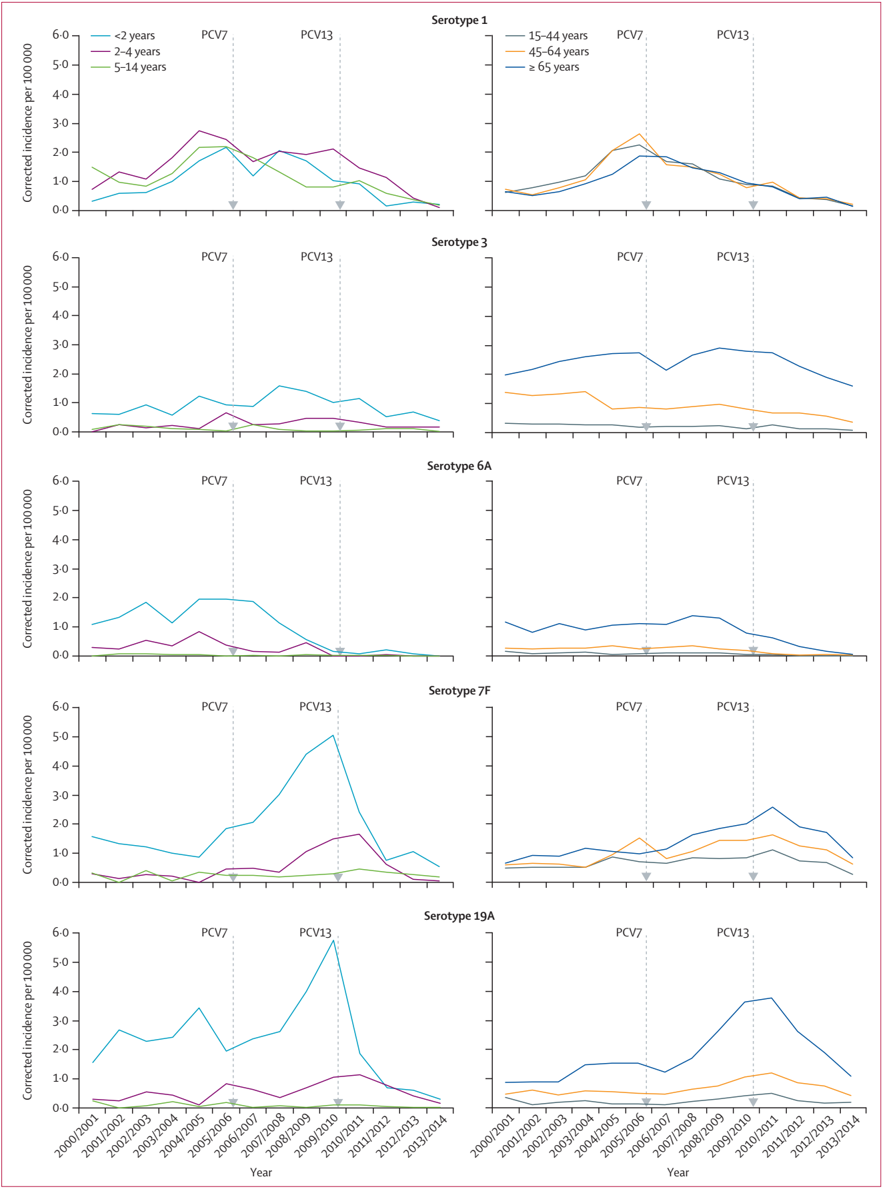
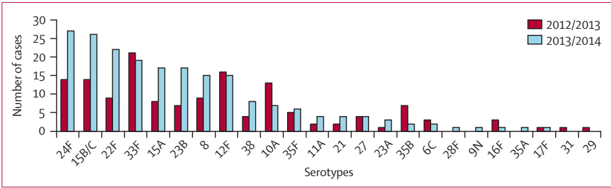
BACKGROUND: The 13-valent pneumococcal conjugate vaccine (PCV13) protects against key serotypes that increased after routine immunisation with the seven-valent vaccine (PCV7), but its potential for herd protection and serotype replacement is uncertain. The aim of this study was to analyse the effect of the 13-valent pneumococcal conjugate vaccine on invasive pneumococcal disease in England and Wales 4 years after its introduction. METHODS: We used a national dataset of electronically reported and serotyped invasive pneumococcal disease cases in England and Wales to estimate incidence rate ratios (IRRs) for vaccine and non-vaccine type invasive pneumococcal disease between July, 2013, and June, 2014, versus the pre-PCV13 and pre-PCV7 baseline. Incidence rates were corrected for missing serotype data and changes in surveillance sensitivity over time. An over-dispersed Poisson model was used to estimate IRRs and confidence intervals. FINDINGS: Incidence of invasive pneumococcal disease in the epidemiological year 2013/14 decreased by 32% compared with the pre-PCV13 baseline (incidence 10·14 per 100,000 in 2008-10 vs 6·85 per 100,000 in 2013/14; IRR 0·68, 95% CI 0·64-0·72). This was due to an 86% reduction of the serotypes covered by PCV7 (1·46 vs 0·20 per 100,000; IRR 0·14, 0·10-0·18) and a 69% reduction of the additional six serotypes covered by PCV13 (4·48 vs 1·40 per 100,000; IRR 0·31, 0·28-0·35). When compared with the pre-PCV7 baseline, there was a 56% overall reduction in invasive pneumococcal disease (15·63 vs 6·85 per 100,000; IRR 0·44, 95% CI 0·43-0·47). Compared with the pre-PCV13 baseline, the incidence of non-PCV13 serotypes increased (incidence all ages 4·19 vs 5·25 per 100,000; IRR 1·25, 95% CI 1·17-1·35) due to increases across a broad range of serotypes in children younger than 5 years and in people aged 45 years or more. In children younger than 5 years, incidence of non-PCV13 serotypes in 2013/14 was higher than in 2012/13 (age <2 years: 12·03 vs 10·83 per 100,000; age 2-4 years: 4·08 vs 3·63 per 100,000). INTERPRETATION: 8 years of PCV use in England and Wales has reduced the overall incidence of invasive pneumococcal disease by more than 50%. The herd protection induced by PCV7 is continuing, and similar indirect protection is occurring from the additional serotypes covered by PCV13. There is, however, evidence of increasing invasive pneumococcal disease due to non-PCV13 serotypes, particularly in children younger than 5 years in 2014. If this increase continues, the maximum benefit of the PCV13 programme in children might already have been achieved. FUNDING: Public Health England funds national surveillance of invasive pneumococcal disease.
Overview
The claims and statistics of this paper haven’t been checked yet.
Free: it reads the open-access text and checks the first 5 claims that cite a source we can check. Create a free account to check every claim.
Integrity signals
Registry
Cites
Statistics
Figures
Verification
Claims the paper makes
The claims and statistics of this paper haven’t been checked yet.
Free: it reads the open-access text and checks the first 5 claims that cite a source we can check. Create a free account to check every claim.
Claims other papers make about this one
Each is checked against this paper’s own text: does it say what the citing paper says it does?
The source backs part of the claim, not all of it — or backs it for a different population, condition or comparison.
In the citing paper
“A 56% reduction in invasive pneumococcal disease (IPD) among adults has been reported since the introduction of the PCV7 into the routine infant schedule and its replacement by PCV13 in April 2010.8”
From Community-acquired acute bacterial meningitis in adults: a clinical update (2019) · cites this paper as [8]
Experimental — accuracy not yet measured
Self-check
Percentages, sums and reported differences re-computed from the paper’s own numbers.
The self-check needs the paper’s full text.
Citations
Cites
O'Brien, K. L., Wolfson, L. J., Watt, J. P., Henkle, E., Deloria-Knoll, M., McCall, N., Lee, E., Mulholland, K., Levine, O. S., & Cherian, T. (2009) · The Lancet · doi:10.1016/s0140-6736(09)61204-6 · Cited by 2,398
Serotype replacement in disease after pneumococcal vaccination
Weinberger, D. M., Malley, R., & Lipsitch, M. (2011) · The Lancet · doi:10.1016/s0140-6736(10)62225-8 · Cited by 1,020
Moore, M. R., Link-Gelles, R., Schaffner, W., Lynfield, R., Lexau, C., Bennett, N. M., Petit, S., Zansky, S. M., Harrison, L. H., Reingold, A., et al. (2015) · The Lancet Infectious Diseases · doi:10.1016/s1473-3099(14)71081-3 · Cited by 733
Miller, E., Andrews, N. J., Waight, P. A., Slack, M. P., & George, R. C. (2011) · The Lancet Infectious Diseases · doi:10.1016/s1473-3099(11)70090-1 · Cited by 643
Self-citationAndrews, N. J., Waight, P. A., Burbidge, P., Pearce, E., Roalfe, L., Zancolli, M., Slack, M., Ladhani, S. N., Miller, E., & Goldblatt, D. (2014) · The Lancet Infectious Diseases · doi:10.1016/s1473-3099(14)70822-9 · Cited by 545
Self-citationFeikin, D. R., Kagucia, E. W., Loo, J. D., Link-Gelles, R., Puhan, M. A., Cherian, T., Levine, O. S., Whitney, C. G., O’Brien, K. L., Moore, M. R., et al. (2013) · PLoS Medicine · doi:10.1371/journal.pmed.1001517 · Cited by 470
Flasche, S., Van Hoek, A. J., Sheasby, E., Waight, P., Andrews, N., Sheppard, C., George, R., & Miller, E. (2011) · PLoS Medicine · doi:10.1371/journal.pmed.1001017 · Cited by 277
Self-citationvan Hoek, A. J., Andrews, N., Waight, P. A., Stowe, J., Gates, P., George, R., & Miller, E. (2012) · Journal of Infection · doi:10.1016/j.jinf.2012.02.017 · Cited by 253
Self-citationAndrews, N. J., Waight, P. A., George, R. C., Slack, M. P. E., & Miller, E. (2012) · Vaccine · doi:10.1016/j.vaccine.2012.09.019 · Cited by 239
Self-citationCooper, D., Yu, X., Sidhu, M., Nahm, M. H., Fernsten, P., & Jansen, K. U. (2011) · Vaccine · doi:10.1016/j.vaccine.2011.06.056 · Cited by 223
Research works printed but not linked: 3
- Roca A, Bojang A, Bottomley C, et al. Eff ect of replacing PCV-7 with PCV-13 in the expanded program of immunization on nasopharyngeal carriage of pneumococci in the Gambia. Pneumonia 2014; 3: 20.
- Nunes MC, Jones S, von Gottberg A, et al. Acquisition of Streptococcus pneumoniae in South African children vaccinated with 7-valent pneumococcal conjugate vaccine (PCV7). Pneumonia 2014; 3: 44.
- Moore M, Link-Gelles R, Guevara R, et al. Case-control study of eff ectiveness of 13-valent pneumococcal conjugate vaccine (PCV13) against Invasive Pneumococcal Disease (IPD) in the US: preliminary estimates. International Symposium on Pneumococci and Pneumococcal Diseases; Hyderabad, India; March 9-13, 2014. Poster 032.
Cited by
Items 301–400 of 590
Zhang, Y., Zheng, W., Ning, H., Liu, J., Li, F., & Ju, X. (2022) · Frontiers in Pediatrics · doi:10.3389/fped.2022.922143 · Cited by 14
van Werkhoven, C. H., & Bonten, M. J. M. (2015) · Future Microbiology · doi:10.2217/fmb.15.80 · Cited by 15
Yin, J. K., Jayasinghe, S. H., Charles, P. G. P., King, C. L., Chiu, C. K., Menzies, R., & McIntyre, P. B. (2017) · The Medical Journal of Australia · doi:10.5694/mja16.01102 · Cited by 14
Namazova-Baranova, L. S., Fedoseenko, М. V., Vishneva, Е. A., Selimzianova, L. R., & Chemakina, D. S. (2018) · Педиатрическая фармакология · doi:10.15690/pf.v15i1.1844 · Cited by 14
Janesch, P., Stulik, L., Rouha, H., Varga, C., Steinhäuser, J., Zerbs, M., & Nagy, E. (2018) · Cytokine · doi:10.1016/j.cyto.2018.09.012 · Cited by 15
Hernstadt, H., Cheung, A. W., Hurem, D., Vasilunas, N., Phuong, L. K., Quinn, P., Agrawal, R., Daley, A. J., Cole, T. S., & Gwee, A. (2019) · The Pediatric Infectious Disease Journal · doi:10.1097/inf.0000000000002489 · Cited by 14
Takano, C., Kuramochi, Y., Seki, M., Kim, D. W., Omagari, D., Sasano, M., Chang, B., Ohnishi, M., Kim, E. J., Fuwa, K., et al. (2019) · Scientific Reports · doi:10.1038/s41598-019-56225-0 · Cited by 17
Owusu‐Edusei, K., Deb, A., & Johnson, K. D. (2022) · Infectious Diseases and Therapy · doi:10.1007/s40121-022-00588-x · Cited by 14
“Several other studies have highlighted the persistence of some vaccine serotypes in adults after the introduction of PCVs, especially serotype 3 [11, 32, 33].”
BackgroundEconomic evaluations of 13-valent pneumococcal conjugate vaccine: a systematic review
Du, Y., Wang, Y., Zhang, T., Li, J., Song, H., Wang, Y., Xu, Y., Cui, J., Yang, M., Wang, Z., et al. (2023) · Expert Review of Vaccines · doi:10.1080/14760584.2023.2173176 · Cited by 14
“In recent years, a number of studies have reported that the incidence of PDs, especially the invasive PDs in vaccinated populations decreased significantly with the use of the PCV13 [9–12].”
BackgroundWateska, A. R., Nowalk, M. P., Lin, C. J., Harrison, L. H., Schaffner, W., Zimmerman, R. K., & Smith, K. J. (2019) · Vaccine · doi:10.1016/j.vaccine.2019.01.002 · Cited by 16
Chamberland, M. E., Epstein, J. S., Dodd, R. Y., Persing, D. H., Will, R. G., DeMaria, A., Emmanuel, J., Pierce, B., & KHABBAZ, R. F. (1998) · Emerging infectious diseases · doi:10.3201/eid0403.980317 · Cited by 15
Shiri, T., McCarthy, N. D., & Petrou, S. (2019) · BMC Infectious Diseases · doi:10.1186/s12879-019-4119-8 · Cited by 16
“Vaccination coverage for the primary series and booster dose has risen from 80 and 83% in the first year of vaccine introduction to 90 and 94% in 2015/16, respectively [11, 12, 14].”
BackgroundLodi, L., Ricci, S., Nieddu, F., Moriondo, M., Lippi, F., Canessa, C., Mangone, G., Cortimiglia, M., Casini, A., Lucenteforte, E., et al. (2019) · Vaccines · doi:10.3390/vaccines7040128 · Cited by 13
“Currently, there is open debate regarding the effectiveness of PCV13 against ser3 pneumococcus, with some post-licensure studies showing non-significant [2], non-evaluable [3], or extremely reduced [4] effectiveness, while others [12–14] report significant protection.”
BackgroundAhn, J. G., Kim, H. W., Choi, H. J., Lee, J. H., & Kim, K. (2015) · Vaccine · doi:10.1016/j.vaccine.2015.08.002 · Cited by 13
Tostes, R., Rodrigues, T. C., da Silva, J. B., Schanoski, A. S., Oliveira, M. L. S., & Miyaji, E. N. (2017) · PLoS ONE · doi:10.1371/journal.pone.0170157 · Cited by 19
Choi, M.-J., Kang, S.-O., Oh, J.-J., Park, S., Kim, M. J., & Cheong, H. J. (2018) · Human Vaccines & Immunotherapeutics · doi:10.1080/21645515.2018.1456602 · Cited by 15
“pneumococcal vaccine after pediatric PCV13 use, has also been reported.(36) Cost-effectiveness analyses between PPSV23 and PCV13 have been conducted in many countries, but not in Korea.”
BackgroundPneumococcal Conjugate Vaccine and Pneumococcal Common Protein Vaccines
Klugman, K. P., Dagan, R., Malley, R., & Whitney, C. G. (2017) · Elsevier eBooks · doi:10.1016/b978-0-323-35761-6.00045-6 · Cited by 16
Community-acquired acute bacterial meningitis in adults: a clinical update
Ellis, J., Luintel, A., Chandna, A., & Heyderman, R. S. (2019) · British Medical Bulletin · doi:10.1093/bmb/ldz023 · Cited by 12
Trends of Pediatric Bloodstream Infections in Stockholm, Sweden: A 20-year Retrospective Study
Luthander, J., Bennet, R., Giske, C. G., Eriksson, M., & Nilsson, A. (2020) · The Pediatric Infectious Disease Journal · doi:10.1097/inf.0000000000002850 · Cited by 12
“Similar increase in invasive pneumococcal disease caused by nonvaccine serotypes has been observed in children younger than 5 years in the United Kingdom.22,23 Second, our observed increase of EOS GBS during the latter part of the study may partly be explained by low compliance with IAP guidelines.”
Incidence of pneumococcal disease from 2003 to 2019 in children ≤17 years in England
Mohanty, S., Podmore, B., Moral, A. C., Matthews, I. R., Sarpong, E., Lacetera, A., & Qizilbash, N. (2023) · Pneumonia · doi:10.1186/s41479-022-00103-3 · Cited by 15
“Ladhani SN, Collins S, Djennad A, Sheppard CL, Borrow R, Fry NK, et al. Rapid increase in non-vaccine serotypes causing invasive pneumococcal disease in England and Wales, 2000-17: a prospective national observational cohort study.”
BackgroundResultInfluentialEffect of Childhood Pneumococcal Conjugate Vaccination on Invasive Disease Serotypes in Serbia
Opavski, N., Jovićević, M., Kabić, J., Kekić, D., & Gajić, I. (2024) · Vaccines · doi:10.3390/vaccines12080940 · Cited by 12
“However, a decrease in vaccine type (VT) carriage is frequently linked with a rise in non-vaccine type (NVT) carriage but also illnesses attributable to NVT [5].”
BackgroundInvasive Pneumococcal Disease in People With Human Immunodeficiency Virus in England, 1999–2017
Kirwan, P., Amin‐Chowdhury, Z., Croxford, S., Sheppard, C. L., Fry, N. K., Delpech, V., & Ladhani, S. N. (2020) · Clinical Infectious Diseases · doi:10.1093/cid/ciaa522 · Cited by 12
Self-citationVadlamudi, N. K., Patrick, D. M., Hoang, L., Sadarangani, M., & Marra, F. (2020) · PLoS ONE · doi:10.1371/journal.pone.0239848 · Cited by 12
“In this study, like other global studies, we found significant increases in the non-PCV13 serotypes IPD in most age groups during both vaccine eras [13, 21, 22].”
ResultInfluentialButić, I., Gužvinec, M., Jelić, M., Groš, I., Lucić, S., Bošnjak, M., & Andrašević, A. T. (2022) · Croatian Medical Journal · doi:10.3325/cmj.2022.63.156 · Cited by 16
“…was followed by a significant decrease in IPD caused by serotypes included in the vaccine and a partial replacement of these serotypes by non-vaccine serotypes (6,38-40 Currently, the prevalence of non-vaccine serotypes 8, 9N, 15A, and 23B is increasing in Australia, USA, France, and Norway (6,41).”
Makwana, A., Ladhani, S. N., Kapatai, G., Campion, E., Fry, N. K., & Sheppard, C. L. (2018) · Emerging infectious diseases · doi:10.3201/eid2410.180114 · Cited by 14
“In September 2006, the childhood immunization program in the United Kingdom introduced PCV7, a pneumococcal conjugate vaccine against the 7 most common serotypes causing invasive pneumococcal disease (IPD) in children; a 13-valent PCV replaced it in April 2010 (1).”
BackgroundResultSelf-citationNogué, M. R., Arraiz, I. G., Martín, G. A., Valle, M. M. F., & Peligros, A. G. (2019) · PubMed · Cited by 12
Sigurdsson, S., Eyþórsson, E. S., Erlendsdóttir, H., Hrafnkelsson, B., Kristinsson, K. G., & Haraldsson, Á. (2020) · Vaccine · doi:10.1016/j.vaccine.2020.01.094 · Cited by 16
D'Aeth, J. C., Bertran, M., Abdullahi, F., Eletu, S. D., Hani, E., Fry, N. K., Ladhani, S. N., & Litt, D. J. (2025) · The Lancet Microbe · doi:10.1016/j.lanmic.2025.101102 · Cited by 15
Self-citationBate, J. M., Borrow, R., Chisholm, J., Clarke, S. C., Dixon, E. L., Faust, S. N., Galanopoulou, A., Goldblatt, D., Heath, P. T., Maishman, T., et al. (2019) · Clinical Infectious Diseases · doi:10.1093/cid/ciz965 · Cited by 13
Chan, J., Gidding, H. F., Blyth, C. C., Fathima, P., Jayasinghe, S. H., McIntyre, P. B., Moore, H. C., Mulholland, K., Nguyen, C. D., Andrews, R. M., et al. (2021) · PLoS Medicine · doi:10.1371/journal.pmed.1003733 · Cited by 12
“This may be explained by previous research indicating lower vaccine effectiveness against the additional serotypes in PCV13 [35,36].”
ResultLai, X., Garcia, C., Wu, D., Knoll, M. D., Zhang, H., Xu, T., Jing, R., Yin, Z., Wahl, B., & Fang, H. (2022) · The Lancet Regional Health - Western Pacific · doi:10.1016/j.lanwpc.2022.100666 · Cited by 11
Bacterial Respiratory Infections Complicating Human Immunodeficiency Virus
Anderson, R., & Feldman, C. H. (2016) · Seminars in Respiratory and Critical Care Medicine · doi:10.1055/s-0036-1572558 · Cited by 13
Alvarado, S., Cavada, G., Villena, R., Wilhelm, J. P., O, I. B., Lara, C., Salinas, X., Azpilcueta, N., & Valenzuela, M. T. (2018) · Revista Panamericana de Salud Pública · doi:10.26633/rpsp.2018.155 · Cited by 11
“Enfermedad neumocócica invasora 1,37 (26) 2,12 (41) 1,13 (22) 1,12 (22) 1,02 (20) 0,82 (16) 1,33 (26)”
Xie, J., Zhang, Y., Caro-Aguilar, I., Indrawati, L., Smith, W. J., Giovarelli, C., Winters, M. A., MacNair, J. E., He, J., Abeygunawardana, C., et al. (2019) · The Pediatric Infectious Disease Journal · doi:10.1097/inf.0000000000002522 · Cited by 11
“Widespread use of pneumococcal conjugate vaccines (PCVs) has been shown to be effective in reducing vaccine-type invasive pneumococcal disease (IPD) in both pediatrics and adults.4,5 However, there is evidence of increasing IPD due to pneumococcal ST not included in PCVs.6,7 To broaden protection against disease cause…”
BackgroundInfluentialThe Epidemiology and Biostatistics of Pneumococcus
Oligbu, G., Fry, N. K., & Ladhani, S. N. (2019) · Methods in molecular biology · doi:10.1007/978-1-4939-9199-0_18 · Cited by 13
Self-citationEffect of a Reduced PCV10 Dose Schedule on Pneumococcal Carriage in Vietnam
Yoshida, L., Toizumi, M., Nguyen, H. A. T., Quilty, B. J., Le, L. T., Hoàng, L. H., Iwasaki, C., Takegata, M., Kitamura, N., Nation, M. L., et al. (2024) · New England Journal of Medicine · doi:10.1056/nejmoa2400007 · Cited by 9
Pneumococcal vaccines for prevention of adult pneumonia
Morimoto, K., & Masuda, S. (2024) · Respiratory Investigation · doi:10.1016/j.resinv.2024.12.007 · Cited by 11
Hernández, M. S., Aguiar-Santana, I. A., Artiles, F., & Gil, E. C. (2017) · Enfermedades Infecciosas y Microbiología Clínica · doi:10.1016/j.eimc.2017.10.022 · Cited by 10
Luna, C. M., Pulido, L., Niederman, M. S., Casey, A., Burgos, D., Agüero, S. L., Grosso, A., Membriani, E., Entrocassi, A. C., Fermepin, M. R., et al. (2018) · Pneumonia · doi:10.1186/s41479-018-0053-6 · Cited by 11
Quinn, C. T., Wiedmann, R. T., Jarovsky, D., López‐Medina, E., Rodriguez, H. M., Papa, M., Boggio, G., Shou, Q., Dagan, R., Richmond, P., et al. (2023) · Blood Advances · doi:10.1182/bloodadvances.2022008037 · Cited by 14
Valdarchi, C., Dorrucci, M., Mancini, F., Farchi, F., de Araujo, F. P., Corongiu, M., Ciervo, A., Rezza, G., Pantosti, A., & Camilli, R. (2019) · Vaccine · doi:10.1016/j.vaccine.2019.06.052 · Cited by 11
Haggie, S., Selvadurai, H. C., Gunasekera, H., & Fitzgerald, D. A. (2020) · Paediatric Respiratory Reviews · doi:10.1016/j.prrv.2020.10.004 · Cited by 14
Nakano, S., Fujisawa, T., Ito, Y., Chang, B., Matsumura, Y., Yamamoto, M., Suga, S., Ohnishi, M., & Nagao, M. (2020) · Emerging infectious diseases · doi:10.3201/eid2611.200087 · Cited by 11
Ghia, C. J., Horn, E. K., Rambhad, G. S., Perdrizet, J. E., Chitale, R., & Wasserman, M. (2021) · Infectious Diseases and Therapy · doi:10.1007/s40121-021-00498-4 · Cited by 12
Kaplan, A. G., Arsenault, P., Aw, B., Brown, V., Fox, G. A., Grossman, R., Jadavji, T., Laferrière, C. A., Levitz, S., Loeb, M. B., et al. (2019) · Canadian Family Physician · doi:10.46747/cfp.6509625 · Cited by 12
Safety and tolerability of pneumococcal vaccines in children
Esposito, S., & Principi, N. (2016) · Expert Opinion on Drug Safety · doi:10.1517/14740338.2016.1160056 · Cited by 11
Παπασταματίου, Θ., Routsias, J. G., Koutsoni, O. S., Dotsika, E., Tsakris, A., & Spoulou, V. I. (2017) · Infection and Immunity · doi:10.1128/iai.00673-17 · Cited by 12
Kaur, R., & Pichichero, M. E. (2020) · Vaccine · doi:10.1016/j.vaccine.2020.04.063 · Cited by 12
Boccalini, S., Varone, O., Chellini, M., Pieri, L., Sala, A., Berardi, C., Bonanni, P., & Bechini, A. (2016) · Human Vaccines & Immunotherapeutics · doi:10.1080/21645515.2017.1264796 · Cited by 10
“Similarly to our findings, other studies, performed in Wales and England, demonstrated that few years after PCV13 implementation a reduction of 32% of VT IPD was observed, but this decrease did not generate a high impact on the general pneumococcal disease incidence (VT and NVT) due to an increase of NVT diseases.(20,…”
ResultForecasting Trends in Invasive Pneumococcal Disease among Elderly Adults in Quebec
Zhou, Z., Deceuninck, G., Lefebvre, B., & Wals, P. D. (2017) · Canadian Journal of Infectious Diseases and Medical Microbiology · doi:10.1155/2017/4347206 · Cited by 9
Camacho‐Moreno, G., Duarte, C., García, D., Calderón, V., Maldonado, L. Y., Castellar, L. P., Moreno, J., Palacios, J., Gallego, Á., Castillo, O., et al. (2021) · Biomédica · doi:10.7705/biomedica.5658 · Cited by 9
“Significant reductions of 19A have been observed in the United States after 5 years of PCV13 use (43), findings also reported in the United Kingdom (47), Canada (48), Denmark (49), Israel (50), and France (51).”
BackgroundImproving Pneumococcal Vaccination Rates in High-risk Children in Specialty Clinics
Harris, J. G., Harris, L. A., Olarte, L., Elson, E. C., Moran, R., Blowey, D. L., & Feghaly, R. E. E. (2022) · PEDIATRICS · doi:10.1542/peds.2020-031724 · Cited by 11
Homaira, N., Strachan, R. E., Quinn, H., Beggs, S. A., Bhuiyan, M. U., Bowen, A. C., Fawcett, L. K., Gilbert, G. L., Lambert, S. B., Macartney, K. K., et al. (2022) · Vaccine · doi:10.1016/j.vaccine.2022.11.006 · Cited by 8
Global transcriptional responses of pneumococcus to human blood components and cerebrospinal fluid
Pettersen, J. S., Høg, F. F., Nielsen, F. D., Møller‐Jensen, J., & Jørgensen, M. G. (2022) · Frontiers in Microbiology · doi:10.3389/fmicb.2022.1060583 · Cited by 9
“Fortunately, in recent years, the overall rate of invasive pneumococcal diseases (IPD) has declined in many countries due to the introduction of the pneumococcal conjugate vaccines (PCV7; PCV13; Harboe et al., 2014; Waight et al., 2015).”
BackgroundHammitt, L. L., Quinn, D., Janczewska, E., Pasquel, F. J., Tytus, R. H., Reddy, K. R., Abarca, K., V, Хаертынова, И. М., Dagan, R., Dawson, R. S., et al. (2023) · Human Vaccines & Immunotherapeutics · doi:10.1080/21645515.2023.2177066 · Cited by 9
Changing Epidemiology of Pneumococcal Disease in the Era of Conjugate Vaccines
Whitney, C. G. (2016) · Current Epidemiology Reports · doi:10.1007/s40471-016-0077-5 · Cited by 10
Miernyk, K. M., BULKOW, L. R., Case, S. L., Zulz, T., Bruce, M. G., Harker‐Jones, M., Hurlburt, D. A., Hennessy, T. W., & Rudolph, K. M. (2016) · Diagnostic Microbiology and Infectious Disease · doi:10.1016/j.diagmicrobio.2016.07.004 · Cited by 9
“…22F isolates were also almost entirely CC433 and, although they did not report genotyping data, other groups have reported significant increases in serotypes 12F or 22F after PCV13 use (Ben-Shimol et al., 2014; Waight et al., 2015; Metcalf et al., 2016; Demczuk et al., 2013; Levy et al., 2014).”
InfluentialAlbrich, W. C., Pride, M. W., Madhi, S. A., Callahan, J., Adrian, P. V., French, R., van Niekerk, N., Sebastian, S., Souza, V., Telles, J.-N., et al. (2016) · Journal of Clinical Microbiology · doi:10.1128/jcm.01573-16 · Cited by 10
“Nevertheless, pneumococcal diagnoses in patients with CAP seem to be declining, which may be related to a true decline due to secular changes, successful pediatric vaccination programs (14–16), and declining emphasis on microbiological diagnostics (4).”
Cost-effectiveness of the 13-valent Pneumococcal Conjugate Vaccine in Children in Portugal
Gouveia, M. R. D. A., Fiorentino, F., Jesus, G., da Costa, J. F. S., & Borges, M. (2017) · The Pediatric Infectious Disease Journal · doi:10.1097/inf.0000000000001587 · Cited by 12
“(22) In particular, the elasticity of adults’ PD incidence reduction due to children ́s vaccination took into account the countries differences in vaccine coverage.”
BackgroundEletu, S. D., Sheppard, C. L., Rose, S., Smith, K., Andrews, N. J., Lim, W. S., Litt, D. J., & Fry, N. K. (2020) · Access Microbiology · doi:10.1099/acmi.0.000094 · Cited by 9
Self-citationHiggins, R. A., Temple, B., Dai, V. T. T., Phan, T. V., Toàn, N. T., Spry, L., Toh, Z. Q., Nation, M. L., Ortika, B. D., Uyen, D. Y., et al. (2021) · The Lancet Regional Health - Western Pacific · doi:10.1016/j.lanwpc.2021.100273 · Cited by 11
“[2-4] PCVs reduce pneumococcal disease by eliciting serotype-specific antibody responses and by reducing VT nasopharyngeal carriage, which leads to reduced pneumococcal transmission and herd protection in the broader population.”
Chen, Y.-C., Chen, H.-H., Janapatla, R. P., Dudek, A., Hsu, M., Chen, C., & Chiu, C. (2020) · Pediatrics & Neonatology · doi:10.1016/j.pedneo.2020.02.005 · Cited by 9
Trends of invasive pneumococcal disease and its serotypes in the Autonomous Community of Madrid
Zamalloa, P. L., Sanz, J. C., Gavín, M. O., Ordoñez, M. D. B., Marisquerena, E. I., de Miguel, Á. G., Chávez, A. C. F., & Comas, L. G. (2018) · Enfermedades infecciosas y microbiologia clinica (English ed ) · doi:10.1016/j.eimce.2018.07.007 · Cited by 9
Progress in mucosal immunization for protection against pneumococcal pneumonia
Gonçalves, V. M., Kaneko, K., Solórzano, C., MacLoughlin, R. J., Saleem, I. Y., & Miyaji, E. N. (2019) · Expert Review of Vaccines · doi:10.1080/14760584.2019.1643719 · Cited by 11
Impact of 10-Valent Pneumococcal Conjugate Vaccine on Bacterial Meningitis in Madagascar
Andriatahirintsoa, E. J., Raboba, J. L., Rahajamanana, V. L., Rakotozanany, A., Nimpa, M. M., Masembe, Y. V., Weldegebriel, G. G., de Gouveia, L., Mwenda, J. M., & Robinson, A. L. (2019) · Clinical Infectious Diseases · doi:10.1093/cid/ciz504 · Cited by 9
Hammitt, L. L., Etyang, A. O., Morpeth, S. C., Ojal, J., Mutuku, A., Mturi, N., Moïsi, J. C., Adetifa, I., Karani, A., Akech, D. O., et al. (2018) · bioRxiv (Cold Spring Harbor Laboratory) · doi:10.1101/369876 · Cited by 9
“12 been small compared to the decline in VT-IPD.(18,19) The only exception to this is a recent increase in total IPD incidence among persons 5-64 and ≥65 years of age in North East England that was observed seven years following introduction of PCV13 in the routine vaccination program in the United Kingdom.”
BackgroundOchoa, T. J., del Águila, O., Reyes, I., Chaparro, E., Castillo, M. E., Campos, F., Sáenz, A., Hernandez, R., Luna-Muschi, A., Tokumori, F. C., et al. (2023) · Journal of Infection and Public Health · doi:10.1016/j.jiph.2023.10.047 · Cited by 8
Abdullahi, F., Bertran, M., D'Aeth, J. C., Eletu, S. D., Chan, Y.-W., Andrews, N. J., Litt, D. J., Ramsay, M. E., & Ladhani, S. N. (2024) · The Lancet Child & Adolescent Health · doi:10.1016/s2352-4642(24)00193-7 · Cited by 10
Self-citationAlbrich, W. C., Just, N., Kahlert, C. R., Casanova, C., Baty, F., & Hilty, M. (2025) · Emerging Microbes & Infections · doi:10.1080/22221751.2025.2488189 · Cited by 8
“Vaccination programmes had an impact on the serotype distribution and, as a consequence, non-vaccine serotypes have been increasing since then [4–6 ,10].”
Limited impact of pneumococcal vaccines on invasive pneumococcal disease in Nunavik (Quebec)
Meur, J. L., Lefebvre, B., Proulx, J., & Wals, P. D. (2018) · Canadian Journal of Public Health · doi:10.17269/s41997-018-0138-2 · Cited by 8
Ruiz, J. P. R., Xavier, B. B., Stöhr, W., Heirstraeten, L. V., Lammens, C., Finn, A. H. R., Goossens, H., Bielicki, J. A., Sharland, M., Malhotra‐Kumar, S., et al. (2024) · BMC Microbiology · doi:10.1186/s12866-024-03300-w · Cited by 8
“This might be explained by the disease status of the children, as PCV13 serotypes are known to have a higher disease-causing potential, evidenced by the decrease in IPD after PCV introduction [35].”
Background13-valent pneumococcal conjugate vaccine in Africa
Cohen, R., & Lévy, C. (2017) · The Lancet Global Health · doi:10.1016/s2214-109x(17)30044-x · Cited by 8
Pírez, C., Mota, M. I., Giachetto, G., Varela, M. S., Galazka, J., Gutiérrez, S., Varela, A., Picón, T., & Algorta, G. (2017) · The Pediatric Infectious Disease Journal · doi:10.1097/inf.0000000000001671 · Cited by 11
Daniel, P., Rodrigo, C., Bewick, T. A., Sheppard, C. L., Greenwood, S., McKeever, T. M., Trotter, C. L., & Lim, W. S. (2018) · Vaccine · doi:10.1016/j.vaccine.2018.02.005 · Cited by 8
Self-citationThe changing epidemiology of pneumococcal diseases
Hultén, K. G. (2018) · The Lancet Infectious Diseases · doi:10.1016/s1473-3099(18)30399-2 · Cited by 8
Kaplan, A. G., Arsenault, P., Aw, B., Brown, V., Fox, G. A., Grossman, R., Jadavji, T., Laferrière, C. A., Levitz, S., Loeb, M. B., et al. (2019) · PubMed Central · Cited by 8
Early clinical predictors for the prognosis of invasive pneumococcal disease
Wu, S., Guo, X., Xu, Z., Han, M., Huang, L., Tao, Y., Li, Y., Li, Y., Zhang, T., & Bai, Z. (2020) · BMC Infectious Diseases · doi:10.1186/s12879-020-05382-z · Cited by 10
“The widespread vaccination of PCV13 in many countries has effectively reduced the incidence and mortality of IPD [31, 32].”
BackgroundHyams, C. J., Amin-Chowdhury, Z., Fry, N. K., North, P., Finn, A. H. R., Judge, A., Ladhani, S. N., & Williams, O. M. (2021) · Emerging Microbes & Infections · doi:10.1080/22221751.2021.1945955 · Cited by 11
“In April 2010, this vaccine was replaced with 13-valent PCV (PCV13) [12].”
BackgroundSelf-citationAsai, N., & Mikamo, H. (2021) · Microorganisms · doi:10.3390/microorganisms9112342 · Cited by 9
Hyams, C. J., Lahuerta, M., Theilacker, C., King, J., Adegbite, D., McGuinness, S., Grimes, C., Campling, J., Southern, J., Pride, M. W., et al. (2024) · Vaccine · doi:10.1016/j.vaccine.2024.02.007 · Cited by 8
Slotved, H. (2016) · Human Vaccines & Immunotherapeutics · doi:10.1080/21645515.2016.1197451 · Cited by 8
“program for children, the majority of PCV serotypes became rare in both children and adults due to a combination of immunity and herd protection.(4,7,15,18) In a study by Slotved et al.”
BackgroundInfluentialHink, R. K., Adam, H. J., Golden, A., Baxter, M. R., Martín, I., Nichol, K. A., Demczuk, W., Mulvey, M. R., Karlowsky, J. A., & Zhanel, G. G. (2020) · Diagnostic Microbiology and Infectious Disease · doi:10.1016/j.diagmicrobio.2020.115282 · Cited by 8
The Results of a Three-Year Pneumococcal Vaccination of Children in Russia
Briko, N. I., Korshunov, V. A., Namazova-Baranova, L. S., Lobzin, J. V., Aa, B., Kostenko, N. A., Fedoseenko, М. V., Kajtukova, E. V., Vishneva, Е. A., Ткаченко, Н. Е., et al. (2018) · Педиатрическая фармакология · doi:10.15690/pf.v15i4.1943 · Cited by 8
Osei, I., Mendy, E., van Zandvoort, K., Sarwar, G., Nuredin, I. M., Bruce, J., Barjo, O., Molfa, M., Salaudeen, R. A., Greenwood, B. M., et al. (2025) · Vaccine · doi:10.1016/j.vaccine.2025.127181 · Cited by 7
Ordóñez, J., & Ordóñez, A. (2023) · Expert Review of Vaccines · doi:10.1080/14760584.2023.2184090 · Cited by 7
Sharew, B., Moges, F., Yismaw, G., Mihret, A., Lobie, T. A., Abebe, W., Fentaw, S., Frye, S. A., Vestrheim, D. F., Tessema, B., et al. (2024) · Scientific Reports · doi:10.1038/s41598-024-72762-9 · Cited by 7
“However, serotype shifts, characterized by increased detection of serotypes not covered by PCVs, have been found in locations where these vaccinations were introduced 12–15 .”
BackgroundGhia, C. J., Wasserman, M., Fletcher, M. A., Farkouh, R., & Rambhad, G. S. (2018) · Value in Health Regional Issues · doi:10.1016/j.vhri.2018.03.003 · Cited by 8
Jullien, S., Sharma, R., Mynak, M. L., Henares, D., Muñoz‐Almagro, C., & Bassat, Q. (2020) · BMC Infectious Diseases · doi:10.1186/s12879-020-05674-4 · Cited by 9
Estimating the risk of recurrent invasive pneumococcal disease in Australia, 1991–2016
Malo, J., Ware, R. S., & Lambert, S. B. (2021) · Vaccine · doi:10.1016/j.vaccine.2021.08.095 · Cited by 7
Vyse, A., Campling, J., Czudek, C., Ellsbury, G., Mendes, D., Reinert, R.-R., & Slack, M. (2021) · Expert Review of Vaccines · doi:10.1080/14760584.2021.1984888 · Cited by 7
Self-citationWang, W., Liang, Q., Zhu, J., Zhang, J., Chen, J., Xie, S., Hu, Y., & Li, G. (2022) · Human Vaccines & Immunotherapeutics · doi:10.1080/21645515.2021.2019498 · Cited by 7
“After introduction of PCV-13, there was significant decrease of IPD due to vaccine-related serotype.(8,9) In China, Beijing Minhai Biotechnology Co.”
BackgroundTakeshita, K., Takeuchi, N., Ohkusu, M., Hishiki, H., Shiko, Y., Kawasaki, Y., Chang, B., & Ishiwada, N. (2022) · Epidemiology and Infection · doi:10.1017/s0950268822000395 · Cited by 7
Leal, A. L., Camacho‐Moreno, G., Montañez, A., Varón-Vega, F. A., Álvarez-Rodríguez, J. C., Valderrama, S., Ariza, B. E., Pancha, O., Santana, A. Y., Flórez, N. S., et al. (2022) · IJID Regions · doi:10.1016/j.ijregi.2022.04.007 · Cited by 8
Vaccination and modern management of chronic obstructive pulmonary disease – a narrative review
Joean, O., & Welte, T. (2022) · Expert Review of Respiratory Medicine · doi:10.1080/17476348.2022.2092099 · Cited by 8
“decrease in colonization with the vaccine serotypes of Streptococcus pneumoniae [75].”
BackgroundPrevention of pneumococcal diseases: the challenge remains
Dhoubhadel, B. G., & Morimoto, K. (2022) · The Lancet Global Health · doi:10.1016/s2214-109x(22)00374-6 · Cited by 7
España, P. P., Uranga, A., Ruiz, L. A., Quintana, J. M., Bilbao, A., Arámburu, A., Fernández, L. S., Ayarza, R., Martinez, A., & Zalacaín, R. (2019) · Vaccine · doi:10.1016/j.vaccine.2019.05.052 · Cited by 7
Microbial epidemiology and carriage studies for the evaluation of vaccines
Coughtrie, A. L., Jefferies, J. M., Cleary, D. W., Doncaster, C. P., Faust, S. N., Kraaijeveld, A. R., Moore, M. V., Mullee, M., Roderick, P. J., Webb, J. S., et al. (2019) · Journal of Medical Microbiology · doi:10.1099/jmm.0.001046 · Cited by 7
Dabaja‐Younis, H., Geller, D., Geffen, Y., Almog, R., & Kassis, I. (2021) · European Journal of Clinical Microbiology & Infectious Diseases · doi:10.1007/s10096-021-04167-9 · Cited by 7
Doherty, K., Bonnett, L. J., Agbla, S. C., Beveridge, N. E. R., Decraene, V., Fleming, K. M., Hungerford, D., & French, N. (2024) · Vaccine · doi:10.1016/j.vaccine.2024.05.050 · Cited by 6
Allen, M., Reynolds, R., Mushtaq, S., Nsonwu, O., Hope, R., Horner, C., Longshaw, C. M., Parcell, B. J., & Livermore, D. M. (2025) · Journal of Antimicrobial Chemotherapy · doi:10.1093/jac/dkaf248 · Cited by 6
Metadata
- Authors
- Waight, P. A., Andrews, N. J., Ladhani, S. N., Sheppard, C. L., Slack, M. P. E., & Miller, E.
- Affiliations
- Public Health England (GB)
- Griffith University (AU)
- Corresponding author
- Waight, Pauline A
- Venue
- The Lancet Infectious Diseases
- Publisher
- Elsevier BV
- Published
- 2015-05
- Volume
- 15
- Issue
- 5
- Pages
- 535-543
- ISSN
- 1473-3099 (ISSN-L)
- PMC
- PMC7130081
- OpenAlex
- W2025200855
- Semantic Scholar
- 5c963d5f23c27d4c8d23abdc0b6e3a220537801c
- Cited by
- 589
- References
- 24
- Citations by year
- 2026: 17 · 2025: 28 · 2024: 32 · 2023: 35 · 2022: 40 · 2021: 51 · 2020: 46 · 2019: 69 · 2018: 86 · 2017: 90 · 2016: 61 · 2015: 30
- FWCI
- 69.83
- Type
- journal article
- Language
- en
- Open access
- hybrid
- doi.org
- Licence
- cc-by
- www.elsevier.com/tdm/userlicense/1.0/ (tdm)
- www.elsevier.com/legal/tdmrep-license (tdm)
- creativecommons.org/licenses/by/4.0/ (vor)
- Locations
- The Lancet Infectious Diseases (publishedVersion, cc-by)
- PubMed Central (publishedVersion)
- PubMed (publishedVersion)
- Griffith Research Online (submittedVersion, cc-by-nc-nd)
- Funders
- Public Health England
- Topics
- Health Sciences › Medicine › Epidemiology › Pneumonia and Respiratory Infections
- Life Sciences › Immunology and Microbiology › Microbiology › Bacterial Infections and Vaccines
- Life Sciences › Immunology and Microbiology › Microbiology › Microbial infections and disease research
- Keywords
- 13-valent pneumococcal conjugate vaccine, PCV13, invasive pneumococcal disease, Streptococcus pneumoniae, serotype replacement, herd protection, PCV7, vaccine impact, England and Wales, incidence rate ratio, overdispersion
- MeSH terms
- Adolescent, Adult, Aged, Child, Child, Preschool, England, Female, Humans, Infant, Infant, Newborn, Male, Middle Aged, Pneumococcal Infections, Streptococcus pneumoniae, Wales, Incidence, Poisson Distribution, Vaccines, Conjugate, Pneumococcal Vaccines, Mass Vaccination, Epidemiological Monitoring, Serogroup
About these checks
Registry, retraction, Cites and statistics results are computed, not judged, with one exception: a printed reference that no index lists is read once by a model before it counts as a citation error. Claims are extracted by a model and kept only when their quote appears verbatim in the text; each cited source is then checked, with a model’s help, for whether it says what the claim relies on. Those verdicts can be wrong — read the claim’s quote and the cited source before relying on one.
Statistics and arithmetic are recomputed, not judged.
Confidence bands are shown only for fields calibrated on our annotated test set. None is calibrated yet, so no band is shown.
What counts as a claim ›How we measure confidence ›How we check this ›
Are you an author, or do you see a problem with this page? Request a review
Data sources
Bibliographic data: Semantic Scholar, OpenAlex, Crossref.
Contains information from the Semantic Scholar Academic Graph Datasets, made available under the ODC Attribution License (ODC-BY 1.0).
Semantic Scholar’s data is described in: Kinney, R., et al. (2023). The Semantic Scholar Open Data Platform. arXiv:2301.10140.
