

Effect of the 13-valent pneumococcal conjugate vaccine on invasive pneumococcal disease in England and Wales 4 years after its introduction: an observational cohort study
Open accessThe DOI matches its Crossref record; 24 of the 24 references it cites were found in a registry or an index.
Abstract
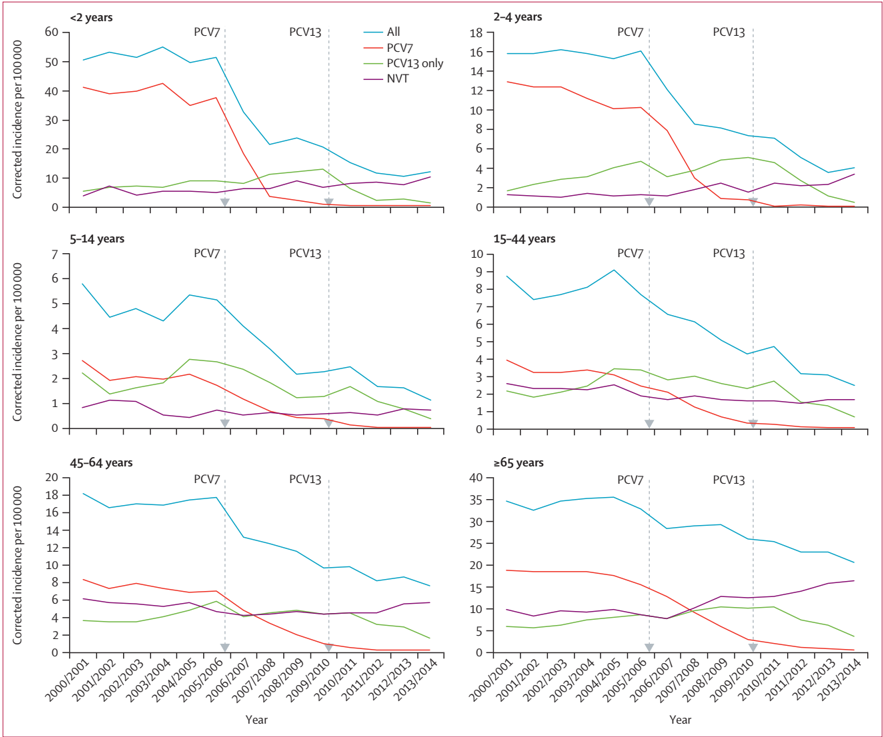
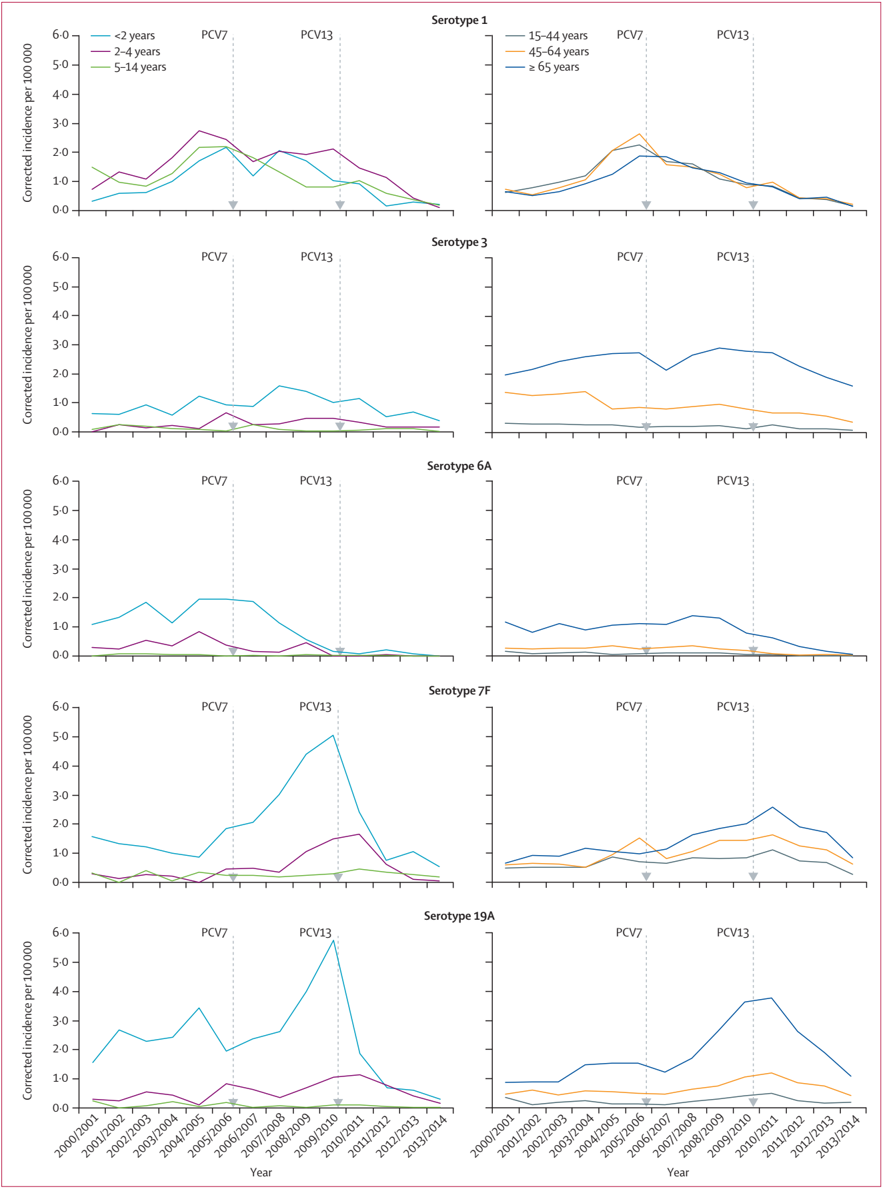
BACKGROUND: The 13-valent pneumococcal conjugate vaccine (PCV13) protects against key serotypes that increased after routine immunisation with the seven-valent vaccine (PCV7), but its potential for herd protection and serotype replacement is uncertain. The aim of this study was to analyse the effect of the 13-valent pneumococcal conjugate vaccine on invasive pneumococcal disease in England and Wales 4 years after its introduction. METHODS: We used a national dataset of electronically reported and serotyped invasive pneumococcal disease cases in England and Wales to estimate incidence rate ratios (IRRs) for vaccine and non-vaccine type invasive pneumococcal disease between July, 2013, and June, 2014, versus the pre-PCV13 and pre-PCV7 baseline. Incidence rates were corrected for missing serotype data and changes in surveillance sensitivity over time. An over-dispersed Poisson model was used to estimate IRRs and confidence intervals. FINDINGS: Incidence of invasive pneumococcal disease in the epidemiological year 2013/14 decreased by 32% compared with the pre-PCV13 baseline (incidence 10·14 per 100,000 in 2008-10 vs 6·85 per 100,000 in 2013/14; IRR 0·68, 95% CI 0·64-0·72). This was due to an 86% reduction of the serotypes covered by PCV7 (1·46 vs 0·20 per 100,000; IRR 0·14, 0·10-0·18) and a 69% reduction of the additional six serotypes covered by PCV13 (4·48 vs 1·40 per 100,000; IRR 0·31, 0·28-0·35). When compared with the pre-PCV7 baseline, there was a 56% overall reduction in invasive pneumococcal disease (15·63 vs 6·85 per 100,000; IRR 0·44, 95% CI 0·43-0·47). Compared with the pre-PCV13 baseline, the incidence of non-PCV13 serotypes increased (incidence all ages 4·19 vs 5·25 per 100,000; IRR 1·25, 95% CI 1·17-1·35) due to increases across a broad range of serotypes in children younger than 5 years and in people aged 45 years or more. In children younger than 5 years, incidence of non-PCV13 serotypes in 2013/14 was higher than in 2012/13 (age <2 years: 12·03 vs 10·83 per 100,000; age 2-4 years: 4·08 vs 3·63 per 100,000). INTERPRETATION: 8 years of PCV use in England and Wales has reduced the overall incidence of invasive pneumococcal disease by more than 50%. The herd protection induced by PCV7 is continuing, and similar indirect protection is occurring from the additional serotypes covered by PCV13. There is, however, evidence of increasing invasive pneumococcal disease due to non-PCV13 serotypes, particularly in children younger than 5 years in 2014. If this increase continues, the maximum benefit of the PCV13 programme in children might already have been achieved. FUNDING: Public Health England funds national surveillance of invasive pneumococcal disease.
Overview
The claims and statistics of this paper haven’t been checked yet.
Free: it reads the open-access text and checks the first 5 claims that cite a source we can check. Create a free account to check every claim.
Integrity signals
Registry
Cites
Statistics
Figures
Verification
Claims the paper makes
The claims and statistics of this paper haven’t been checked yet.
Free: it reads the open-access text and checks the first 5 claims that cite a source we can check. Create a free account to check every claim.
Claims other papers make about this one
Each is checked against this paper’s own text: does it say what the citing paper says it does?
The source backs part of the claim, not all of it — or backs it for a different population, condition or comparison.
In the citing paper
“A 56% reduction in invasive pneumococcal disease (IPD) among adults has been reported since the introduction of the PCV7 into the routine infant schedule and its replacement by PCV13 in April 2010.8”
From Community-acquired acute bacterial meningitis in adults: a clinical update (2019) · cites this paper as [8]
Experimental — accuracy not yet measured
Self-check
Percentages, sums and reported differences re-computed from the paper’s own numbers.
The self-check needs the paper’s full text.
Citations
Cites
O'Brien, K. L., Wolfson, L. J., Watt, J. P., Henkle, E., Deloria-Knoll, M., McCall, N., Lee, E., Mulholland, K., Levine, O. S., & Cherian, T. (2009) · The Lancet · doi:10.1016/s0140-6736(09)61204-6 · Cited by 2,398
Serotype replacement in disease after pneumococcal vaccination
Weinberger, D. M., Malley, R., & Lipsitch, M. (2011) · The Lancet · doi:10.1016/s0140-6736(10)62225-8 · Cited by 1,020
Moore, M. R., Link-Gelles, R., Schaffner, W., Lynfield, R., Lexau, C., Bennett, N. M., Petit, S., Zansky, S. M., Harrison, L. H., Reingold, A., et al. (2015) · The Lancet Infectious Diseases · doi:10.1016/s1473-3099(14)71081-3 · Cited by 733
Miller, E., Andrews, N. J., Waight, P. A., Slack, M. P., & George, R. C. (2011) · The Lancet Infectious Diseases · doi:10.1016/s1473-3099(11)70090-1 · Cited by 643
Self-citationAndrews, N. J., Waight, P. A., Burbidge, P., Pearce, E., Roalfe, L., Zancolli, M., Slack, M., Ladhani, S. N., Miller, E., & Goldblatt, D. (2014) · The Lancet Infectious Diseases · doi:10.1016/s1473-3099(14)70822-9 · Cited by 545
Self-citationFeikin, D. R., Kagucia, E. W., Loo, J. D., Link-Gelles, R., Puhan, M. A., Cherian, T., Levine, O. S., Whitney, C. G., O’Brien, K. L., Moore, M. R., et al. (2013) · PLoS Medicine · doi:10.1371/journal.pmed.1001517 · Cited by 470
Flasche, S., Van Hoek, A. J., Sheasby, E., Waight, P., Andrews, N., Sheppard, C., George, R., & Miller, E. (2011) · PLoS Medicine · doi:10.1371/journal.pmed.1001017 · Cited by 277
Self-citationvan Hoek, A. J., Andrews, N., Waight, P. A., Stowe, J., Gates, P., George, R., & Miller, E. (2012) · Journal of Infection · doi:10.1016/j.jinf.2012.02.017 · Cited by 253
Self-citationAndrews, N. J., Waight, P. A., George, R. C., Slack, M. P. E., & Miller, E. (2012) · Vaccine · doi:10.1016/j.vaccine.2012.09.019 · Cited by 239
Self-citationCooper, D., Yu, X., Sidhu, M., Nahm, M. H., Fernsten, P., & Jansen, K. U. (2011) · Vaccine · doi:10.1016/j.vaccine.2011.06.056 · Cited by 223
Research works printed but not linked: 3
- Roca A, Bojang A, Bottomley C, et al. Eff ect of replacing PCV-7 with PCV-13 in the expanded program of immunization on nasopharyngeal carriage of pneumococci in the Gambia. Pneumonia 2014; 3: 20.
- Nunes MC, Jones S, von Gottberg A, et al. Acquisition of Streptococcus pneumoniae in South African children vaccinated with 7-valent pneumococcal conjugate vaccine (PCV7). Pneumonia 2014; 3: 44.
- Moore M, Link-Gelles R, Guevara R, et al. Case-control study of eff ectiveness of 13-valent pneumococcal conjugate vaccine (PCV13) against Invasive Pneumococcal Disease (IPD) in the US: preliminary estimates. International Symposium on Pneumococci and Pneumococcal Diseases; Hyderabad, India; March 9-13, 2014. Poster 032.
Cited by
Wahl, B., O'Brien, K. L., Greenbaum, A., Majumder, A., Liu, L., Chu, Y., Lukšić, I., Nair, H., McAllister, D. A., Campbell, H., et al. (2018) · The Lancet Global Health · doi:10.1016/s2214-109x(18)30247-x · Cited by 1,118
Ladhani, S. N., Collins, S., Djennad, A., Sheppard, C. L., Borrow, R., Fry, N. K., Andrews, N. J., Miller, E., & Ramsay, M. E. (2018) · The Lancet Infectious Diseases · doi:10.1016/s1473-3099(18)30052-5 · Cited by 559
Self-citationBalsells, E., Guillot, L., Nair, H., & Kyaw, M. H. (2017) · PLOS ONE · doi:10.1371/journal.pone.0177113 · Cited by 393
Köhler, J. R., Hube, B., Puccia, R., Casadevall, A., & Perfect, J. R. (2017) · Microbiology Spectrum · doi:10.1128/microbiolspec.funk-0014-2016 · Cited by 297
Acute bacterial meningitis in adults
McGill, F., Heyderman, R. S., Panagiotou, S., Tunkel, A. R., & Solomon, T. (2016) · The Lancet · doi:10.1016/s0140-6736(16)30654-7 · Cited by 274
Falkenhorst, G., Remschmidt, C., Harder, T., Hummers-Pradier, E., Wichmann, O., & Bogdan, C. (2017) · PLOS ONE · doi:10.1371/journal.pone.0169368 · Cited by 250
Shiri, T., Datta, S., Madan, J., Tsertsvadze, A., Royle, P., Keeling, M. J., McCarthy, N. D., & Petrou, S. (2017) · The Lancet Global Health · doi:10.1016/s2214-109x(16)30306-0 · Cited by 222
Moore, M. R., Link-Gelles, R., Schaffner, W., Lynfield, R., Holtzman, C., Harrison, L. H., Zansky, S. M., Rosen, J. B., Reingold, A., Scherzinger, K., et al. (2016) · The Lancet Respiratory Medicine · doi:10.1016/s2213-2600(16)00052-7 · Cited by 194
Mackenzie, G. A., Hill, P. C., Jeffries, D. J., Hossain, I., Uchendu, U., Ameh, D., Ndiaye, M., Adeyemi, O., Pathirana, J., Olatunji, Y., et al. (2016) · The Lancet Infectious Diseases · doi:10.1016/s1473-3099(16)00054-2 · Cited by 179
Kapatai, G., Sheppard, C. L., Al-Shahib, A., Litt, D. J., Underwood, A. P., Harrison, T. G., & Fry, N. K. (2016) · PeerJ · doi:10.7717/peerj.2477 · Cited by 168
“In the UK, the initial reduction of invasive pneumococcal disease (IPD) and carriage, due to the introduction of PCV7 and PCV13 polysaccharide-conjugate vaccines, was followed by increases in non-vaccine type IPD (Miller et al., 2011; Waight et al., 2015).”
BackgroundInfluentialSelf-citationPneumococcal serotype evolution in Western Europe
Tin Tin Htar, M., Christopoulou, D., & Schmitt, H.-J. (2015) · BMC Infectious Diseases · doi:10.1186/s12879-015-1147-x · Cited by 167
“Serotype 3 has become one of the most prevalent serotypes in adults, with some reduction only in the UK and France.”
BackgroundInfluentialHanquet, G., Krizova, P., Valentiner-Branth, P., Ladhani, S. N., Nuorti, J. P., Lepoutre, A., Mereckiene, J., Knol, M., Winje, B. A., Ciruela, P., et al. (2019) · Thorax · doi:10.1136/thoraxjnl-2018-211767 · Cited by 164
Self-citationVaccines for the elderly: current use and future challenges
Weinberger, B. (2018) · Immunity & Ageing · doi:10.1186/s12979-017-0107-2 · Cited by 160
Effects of PCV7 and PCV13 on invasive pneumococcal disease and carriage in Stockholm, Sweden
Galanis, I., Lindstrand, A., Darenberg, J., Browall, S., Nannapaneni, P., Sjöström, K., Morfeldt, E., Nauclér, P., Blennow, M., Örtqvist, Å., et al. (2016) · European Respiratory Journal · doi:10.1183/13993003.01451-2015 · Cited by 156
Hammitt, L. L., Etyang, A. O., Morpeth, S. C., Ojal, J., Mutuku, A., Mturi, N., Moïsi, J. C., Adetifa, I., Karani, A., Akech, D., et al. (2019) · The Lancet · doi:10.1016/s0140-6736(18)33005-8 · Cited by 159
Life-Threatening Infectious Complications in Sickle Cell Disease: A Concise Narrative Review
Ochocinski, D., Dalal, M., Black, L. V., Carr, S. B., Lew, J., Sullivan, K., & Kissoon, N. “. (2020) · Frontiers in Pediatrics · doi:10.3389/fped.2020.00038 · Cited by 189
Nauclér, P., Galanis, I., Morfeldt, E., Darenberg, J., Örtqvist, Å., & Henriques‐Normark, B. (2017) · Clinical Infectious Diseases · doi:10.1093/cid/cix685 · Cited by 167
“In comparison, a reduction in IPD caused by serotype 3 was observed in all age groups after PCV13 introduction in England and Wales, but not in the United States [13, 14].”
BackgroundResultInfluentialMaking sense of differences in pneumococcal serotype replacement
Lewnard, J. A., & Hanage, W. P. (2019) · The Lancet Infectious Diseases · doi:10.1016/s1473-3099(18)30660-1 · Cited by 147
França, E. B., Passos, V. M. D. A., Malta, D. C., Duncan, B. B., Ribeiro, A. L. P., Guimarães, M. D. C., de Abreu, D. M. X., Vasconcelos, A. M. N., Carneiro, M., Teixeira, R. A., et al. (2017) · Population Health Metrics · doi:10.1186/s12963-017-0156-y · Cited by 154
“Moreover, the universal availability of influenza vaccines since 1999 and the further introduction of polysaccharide pneumococcal vaccines for children (and in recent years for adults), and a herd protection effect from universal vaccination in children could also have led to a morbidity and mortality reduction in adu…”
BackgroundLobitz, S., Telfer, P. T., Cela, E., Allaf, B., Angastiniotis, M., Johansson, C. B., Badens, C., Bento, C., Bouva, M. J., Canatan, D., et al. (2018) · British Journal of Haematology · doi:10.1111/bjh.15600 · Cited by 167
“However, strains not included in the vaccine remain a problem, which may worsen in the future (Payne et al, 2013; Tin Tin Htar et al, 2015; Waight et al, 2015; Camilli et al, 2017; Latasa Zamalloa et al, 2017; Oligbu et al, 2018).”
BackgroundDjennad, A., Ramsay, M. E., Pebody, R. G., Fry, N. K., Sheppard, C. L., Ladhani, S. N., & Andrews, N. J. (2018) · EClinicalMedicine · doi:10.1016/j.eclinm.2018.12.007 · Cited by 147
“In April 2010, PCV7 was replaced with a 13-valent PCV (PCV13) without a catch-up,which led to further declines in both PCV13-type and overall IPD across all age groups although, again, with a small increase in replacement disease due to non-PCV13 serotypes [4].”
MethodInfluentialSelf-citationBurden of pneumococcal community-acquired pneumonia in adults across Europe: A literature review
Torres, A., Cillóniz, C., Blasi, F., Chalmers, J. D., GAILLAT, J., Dartois, N., Schmitt, H.-J., & Welte, T. (2018) · Respiratory Medicine · doi:10.1016/j.rmed.2018.02.007 · Cited by 172
Invasive Pneumococcal Disease Among Immunocompromised Persons: Implications for Vaccination Programs
Shigayeva, A., Rudnick, W., Green, K., Chen, D. K., Demczuk, W., Gold, W. L., Johnstone, J., Kitai, I., Krajden, S., Lovinsky, R., et al. (2015) · Clinical Infectious Diseases · doi:10.1093/cid/civ803 · Cited by 148
Fever in Children: Pearls and Pitfalls
Barbi, E., Marzuillo, P., Neri, E., Naviglio, S., & KRAUSS, B. S. (2017) · Children · doi:10.3390/children4090081 · Cited by 180
“This may change after the introduction of the 13-valent vaccine [73,76]; however, there is already evidence of increasing invasive pneumococcal diseases due to serotypes not included in the 13-valent vaccine [72].”
BackgroundGoldblatt, D., Southern, J., Andrews, N. J., Burbidge, P., Partington, J., Roalfe, L., Pinto, M. V., Thalasselis, V., Plested, E. L., Richardson, H., et al. (2017) · The Lancet Infectious Diseases · doi:10.1016/s1473-3099(17)30654-0 · Cited by 138
Self-citationSwarthout, T. D., Fronterrè, C., Lourenço, J., Obolski, U., Gori, A., Bar‐Zeev, N., Everett, D., Kamng’ona, A. W., Mwalukomo, T. S., Mataya, A. A., et al. (2020) · Nature Communications · doi:10.1038/s41467-020-15786-9 · Cited by 133
Hausdorff, W. P., & Hanage, W. P. (2016) · Human Vaccines & Immunotherapeutics · doi:10.1080/21645515.2015.1118593 · Cited by 137
“35).(24) Data on the numbers of cases of IPD due to different classes of serotypes in different age groups are made available by Public Health England and show an increasing trajectory of NVT disease across multiple age groups.”
BackgroundTsaban, G., & Ben‐Shimol, S. (2017) · Vaccine · doi:10.1016/j.vaccine.2017.04.032 · Cited by 127
Bertran, M., D'Aeth, J. C., Abdullahi, F., Eletu, S. D., Andrews, N. J., Ramsay, M. E., Litt, D. J., & Ladhani, S. N. (2024) · The Lancet Infectious Diseases · doi:10.1016/s1473-3099(23)00706-5 · Cited by 127
Self-citationUbukata, K., Takata, M., Morozumi, M., Chiba, N., Wajima, T., Hanada, S., Shouji, M., Sakuma, M., Iwata, S., & the Invasive Pneumococcal Diseases Surveillance Study Group (2018) · Emerging infectious diseases · doi:10.3201/eid2411.180326 · Cited by 128
Sings, H. L., Wals, P. D., Gessner, B. D., Istúriz, R., Laferrière, C. A., McLaughlin, J. M., Pelton, S. I., Schmitt, H., Suaya, J. A., & Jódar, L. (2018) · Clinical Infectious Diseases · doi:10.1093/cid/ciy920 · Cited by 128
“In the United Kingdom, based on national surveillance conducted by Public Health England, the number of cases of serotype 3 IPD also declined among children aged <5 years in the years immediately following PCV13 introduction, with a reported incidence rate reduction of 68% (95% CI, 6%–89%) comparing 2013–2014 to 2008…”
BackgroundStreptococcus pneumoniae serotype 19A: worldwide epidemiology
Istúriz, R., Sings, H. L., Hilton, B., Arguedas, A. G., Reinert, R.-R., & Jódar, L. (2017) · Expert Review of Vaccines · doi:10.1080/14760584.2017.1362339 · Cited by 131
“The USA, UK, and Canada continue to vaccinate adults ≥65 years of age with PPV23, which contains serotype 19A.”
BackgroundMethodInfluentialLi, L., Ma, J., Yu, Z., Li, M., Zhang, W., & Sun, H. (2022) · Microbiological Research · doi:10.1016/j.micres.2022.127221 · Cited by 163
Effect and cost-effectiveness of pneumococcal conjugate vaccination: a global modelling analysis
Chen, C., Cervero‐Liceras, F., Flasche, S., Sidharta, S., Yoong, J., Sundaram, N., & Jit, M. (2018) · The Lancet Global Health · doi:10.1016/s2214-109x(18)30422-4 · Cited by 133
Savulescu, C., Křížová, P., Lepoutre, A., Mereckiene, J., Vestrheim, D. F., Ciruela, P., Ordobás, M., Guevara, M., McDonald, E., Morfeldt, E., et al. (2017) · The Lancet Respiratory Medicine · doi:10.1016/s2213-2600(17)30110-8 · Cited by 129
Pneumococcal serotype trends, surveillance and risk factors in UK adult pneumonia, 2013–18
Pick, H., Daniel, P., Rodrigo, C., Bewick, T. A., Ashton, D., Lawrence, H., Baskaran, V., Edwards-Pritchard, R. C., Sheppard, C. L., Eletu, S. D., et al. (2019) · Thorax · doi:10.1136/thoraxjnl-2019-213725 · Cited by 115
Self-citationSouthern, J., Andrews, N. J., Sandu, P., Sheppard, C. L., Waight, P. A., Fry, N. K., van Hoek, A. J., & Miller, E. (2018) · PLoS ONE · doi:10.1371/journal.pone.0195799 · Cited by 121
Self-citationStacey, H. L., Rosen, J., Peterson, J. T., Williams‐Diaz, A., Gakhar, V., Sterling, T. M., Acosta, C. J., Nolan, K. M., Li, J., Pedley, A., et al. (2019) · Human Vaccines & Immunotherapeutics · doi:10.1080/21645515.2018.1532249 · Cited by 110
Hereditary tyrosinemia type I--an overview.
Kvittingen, E. A. (1986) · PubMed · Cited by 109
Composition and immunological significance of the upper respiratory tract microbiota
Schenck, L. P., Surette, M. G., & Bowdish, D. M. E. (2016) · FEBS Letters · doi:10.1002/1873-3468.12455 · Cited by 122
“Nasal swabs have also been used to measure the efficacy of vaccination and to understand the interplay between age and environmental risk factors in carriage and disease risk [41, 42].”
Nakano, S., Fujisawa, T., Ito, Y., Chang, B., Suga, S., Noguchi, T., Yamamoto, M., Matsumura, Y., Nagao, M., Takakura, S., et al. (2015) · Vaccine · doi:10.1016/j.vaccine.2015.11.015 · Cited by 101
Izurieta, P., Bahety, P., Adegbola, R. A., Clarke, C., & Hoet, B. (2017) · Expert Review of Vaccines · doi:10.1080/14760584.2018.1413354 · Cited by 109
Epidemiology of lower respiratory tract infections in adults
Feldman, C. H., & Shaddock, E. J. (2018) · Expert Review of Respiratory Medicine · doi:10.1080/17476348.2019.1555040 · Cited by 110
“In England and Wales, serotype replacement infections have increased in both children and adults [120,121].”
BackgroundPlatt, H. L., Cardona, J. F., Haranaka, M., Schwartz, H. I., Pérez, S. N., Dowell, A., Chang, C., Dagan, R., Tamms, G. M., Sterling, T. M., et al. (2021) · Vaccine · doi:10.1016/j.vaccine.2021.08.049 · Cited by 97
Thorrington, D., Andrews, N. J., Stowe, J., Miller, E., & van Hoek, A. J. (2018) · BMC Medicine · doi:10.1186/s12916-018-1004-z · Cited by 96
“We did not compare the IRR of laboratory-reported IPD to the control conditions from HES because the IPD data from laboratories are not subject to the same secular trends as the HES data and were already corrected for trends in ascertainment of laboratoryconfirmed pneumococcal bacteraemias [7, 8].”
BackgroundMethodResultInfluentialSelf-citationJayasinghe, S. H., Menzies, R., Chiu, C., Toms, C., Blyth, C. C., Krause, V., & McIntyre, P. B. (2016) · Clinical Infectious Diseases · doi:10.1093/cid/ciw720 · Cited by 92
“In contrast to Australia, the UK and United States reported reductions in 7F IPD post-PCV13 that were similar to 19A IPD, both in children and adults [18, 19].”
ResultInfluentialDomínguez, Á., Ciruela, P., Hernández, S., García‐García, J. J., Soldevila, N., Izquierdo, C., Llop, F. A. M., Díaz, Á., de Sevilla, M. F., González‐Peris, S., et al. (2017) · PLoS ONE · doi:10.1371/journal.pone.0183191 · Cited by 94
Ys, K., Chung, D. R., Song, J., Baek, J. Y., Thamlikitkul, V., Wang, H., Carlos, C., Ahmad, N., Arushothy, R., Tan, S. H., et al. (2019) · Vaccine · doi:10.1016/j.vaccine.2019.09.065 · Cited by 95
Ganaie, F., Maruhn, K., Li, C., Porambo, R. J., Elverdal, P. L., Abeygunwardana, C., van der Linden, M., Duus, J. Ø., Sheppard, C. L., & Nahm, M. H. (2021) · Journal of Clinical Microbiology · doi:10.1128/jcm.00540-21 · Cited by 88
“In the wake of conjugate vaccine use, it is possible that the 24C serotype is more prevalent and is as widely distributed as 24F or 24B. Consistent with this possibility, additional 24C isolates have been identified among clinical isolates in the United Kingdom, Germany, Italy, and Belgium (see Table S2 in the supplem…”
InfluentialSelf-citationA systematic review of the burden of vaccine preventable pneumococcal disease in UK adults
Chalmers, J. D., Campling, J., Dicker, A., Woodhead, M. A., & Madhava, H. (2016) · BMC Pulmonary Medicine · doi:10.1186/s12890-016-0242-0 · Cited by 86
“The corresponding figures from Waight et al. for England and Wales were 44.1 and 20.3 % [21].”
BackgroundInfluential2018 recommendations for the management of community acquired pneumonia
Corrêa, R. D. A., Costa, A. N., Lundgren, F. L. C., Michelin, L., de Figueiredo, M. R. F., Holanda, M. A., Gomes, M., Teixeira, P. J. Z., Martins, R. L. D. M., Silva, R., et al. (2018) · Jornal Brasileiro de Pneumologia · doi:10.1590/s1806-37562018000000130 · Cited by 119
“(1) Despite the vast diversity of respiratory microbiota, the widespread dissemination of potentially pathogenic agents, the phenomenon of globalization, and the occurrence of viral epidemics, Streptococcus pneumoniae remains the most prevalent pathogen among the etiologic agents of CAP.”
BackgroundInfluentialGrant, L. R., Slack, M., Theilacker, C., Vojicic, J., Dion, S., Reinert, R.-R., Jódar, L., & Gessner, B. D. (2022) · Clinical Infectious Diseases · doi:10.1093/cid/ciac475 · Cited by 81
“These data are corroborated with evidence of significant declines in serotype 19A IPD in countries that introduced PCV13 into the pediatric NIP [11, 22].”
ResultSelf-citationJanoir, C., Lepoutre, A., Gutmann, L., & Varon, E. (2016) · Open Forum Infectious Diseases · doi:10.1093/ofid/ofw020 · Cited by 81
“In the United States, serotypes 35B and 15A are ranking now at the third and the seventh position, respectively, but their rates of resistance are considerably lower [8]; in the United Kingdom, serotypes 24F and 15A are also increasing [17].”
Impact of pneumococcal conjugate vaccines for children in high- and non–high-income countries
Cohen, R., Cohen, J. F., Chalumeau, M., & Lévy, C. (2017) · Expert Review of Vaccines · doi:10.1080/14760584.2017.1320221 · Cited by 84
Ahmed, S. S., Pondo, T., Xing, W., McGee, L., Farley, M., Schaffner, W., Thomas, A., Reingold, A., Harrison, L. H., Lynfield, R., et al. (2020) · Clinical Infectious Diseases · doi:10.1093/cid/ciz739 · Cited by 79
Varon, E., Cohen, R., Béchet, S., Doit, C., & Lévy, C. (2015) · Vaccine · doi:10.1016/j.vaccine.2015.10.015 · Cited by 78
Kandasamy, R., Voysey, M., Collins, S., Berbers, G. A. M., Robinson, H., Noel, I., Hughes, H., Ndimah, S., Gould, K. A., Fry, N. K., et al. (2019) · The Journal of Infectious Diseases · doi:10.1093/infdis/jiz178 · Cited by 77
Self-citationResurgence of pneumococcal meningitis in Europe and Northern America
Koelman, D. L. H., Brouwer, M. C., & van de Beek, D. (2019) · Clinical Microbiology and Infection · doi:10.1016/j.cmi.2019.04.032 · Cited by 90
Horácio, A. N., Silva‐Costa, C., Lopes, J. P., Ramirez, M., Melo‐Cristino, J., & Portuguese Group for the Study of Streptococcal Infections (2016) · Frontiers in Microbiology · doi:10.3389/fmicb.2016.01616 · Cited by 80
Pneumonia in the developing world: C haracteristic features and approach to management
Aston, S. (2017) · Respirology · doi:10.1111/resp.13112 · Cited by 131
Pneumococcal whole-cell and protein-based vaccines: changing the paradigm
Pichichero, M. E. (2017) · Expert Review of Vaccines · doi:10.1080/14760584.2017.1393335 · Cited by 82
The rise and fall of pneumococcal serotypes carried in the PCV era
Devine, V. T., Cleary, D. W., Jefferies, J. M., Anderson, R., Morris, D. E., Tuck, A. C., Gladstone, R. A., O'Doherty, G., Kuruparan, P., Bentley, S. D., et al. (2017) · Vaccine · doi:10.1016/j.vaccine.2017.01.035 · Cited by 74
“IPD incidence as reported by Public Health England has also shown that there has been a decrease in IPD due to PCV13 VTs across all age groups, and an increase in IPD in all age groups due to PCV13 NVTs (2006/07 to 2012/13 data) [17,24].”
BackgroundMethodResultInfluentialCommunity-acquired pneumonia in the United Kingdom: a call to action
Chalmers, J. D., Campling, J., Ellsbury, G., Hawkey, P. M., Madhava, H., & Slack, M. (2017) · Pneumonia · doi:10.1186/s41479-017-0039-9 · Cited by 71
“[1] and analyzed for cost effectiveness by Van Hoek et al.”
BackgroundSelf-citationAndrews, N. J., Kent, A., Amin‐Chowdhury, Z., Sheppard, C. L., Fry, N. K., Ramsay, M. E., & Ladhani, S. N. (2019) · Vaccine · doi:10.1016/j.vaccine.2019.06.071 · Cited by 78
Self-citationBar‐Zeev, N., Swarthout, T. D., Everett, D., Alaerts, M., Msefula, J., Brown, C., Bilima, S., Mallewa, J., King, C., von Gottberg, A., et al. (2021) · The Lancet Global Health · doi:10.1016/s2214-109x(21)00165-0 · Cited by 81
Pneumococcal Vaccination in High-Risk Individuals: Are We Doing It Right?
Papadatou, I., & Spoulou, V. I. (2016) · Clinical and Vaccine Immunology · doi:10.1128/cvi.00721-15 · Cited by 66
“Data reported from the United Kingdom since the introduction of PCV13 show that some of the emerging serotypes causing IPD in children over 5 years of age and in adults of all ages, such as serotypes 15A and 24F, are not included in PPV23 (21).”
BackgroundVadlamudi, N. K., Chen, A. M., & Marra, F. (2018) · Clinical Infectious Diseases · doi:10.1093/cid/ciy872 · Cited by 67
Rutherford, A. I., Subesinghe, S., Bharucha, T., Ibrahim, F., Kleymann, A., & Galloway, J. B. (2016) · Lara D. Veeken · doi:10.1093/rheumatology/kew323 · Cited by 64
Cámara, J., Marimón, J. M., Cercenado, E., Larrosa, N., Quesada, M. D., Fontanals, D., Cubero, M., Pérez‐Trallero, E., Fenoll, A., Liñares, J., et al. (2017) · PLoS ONE · doi:10.1371/journal.pone.0175224 · Cited by 69
“Moreover, several works that were unable to detect a reduction of 6C isolates after the PCV13 introduction have been published [24, 25, 42].”
BackgroundDube, F. S., Ramjith, J., Gardner‐Lubbe, S., Nduru, P. M., Robberts, F. J. L., Wolter, N., Zar, H. J., & Nicol, M. P. (2018) · Scientific Reports · doi:10.1038/s41598-018-30345-5 · Cited by 64
Reglinski, M., Ercoli, G., Plumptre, C., Kay, E. J., Petersen, F. C., Paton, J. C., Wren, B. W., & Brown, J. (2018) · npj Vaccines · doi:10.1038/s41541-018-0090-4 · Cited by 67
Cunningham, A. L., McIntyre, P. B., Subbarao, K., Booy, R., & Levin, M. J. (2021) · BMJ · doi:10.1136/bmj.n188 · Cited by 75
Epidemiology, virulence factors and management of the pneumococcus
Feldman, C. H., & Anderson, R. (2016) · F1000Research · doi:10.12688/f1000research.9283.1 · Cited by 72
“Subsequently, PCV7 use in children was largely replaced by PCV13, the latter also covering for serotype 19A, and while a similar reduction in vaccine-type IPD was also documented, as with PCV7, serotype replacement disease is once again being documented 28,29 .”
BackgroundInfluentialRinta‐Kokko, H., PALMU, A. A. I., Auranen, K. J., Nuorti, J. P., Toropainen, M., Siira, L., Virtanen, M. J., Nohynek, H., & Jokinen, J. (2018) · Vaccine · doi:10.1016/j.vaccine.2018.03.001 · Cited by 60
Oligbu, G., Collins, S., Djennad, A., Sheppard, C. L., Fry, N. K., Andrews, N. J., Borrow, R., Ramsay, M. E., & Ladhani, S. N. (2019) · Emerging infectious diseases · doi:10.3201/eid2509.180747 · Cited by 69
“Here, we describe the epidemiology of pneumococcal meningitis in England and Wales over a 16-year period encompassing the introduction of PCV7 and PCV13 into the national immunization program.”
BackgroundMethodResultInfluentialSelf-citationLoop-mediated isothermal amplification methods for diagnosis of bacterial meningitis
Seki, M., Kilgore, P. E., Kim, E. J., Ohnishi, M., Hayakawa, S., & Kim, D. W. (2018) · Frontiers in Pediatrics · doi:10.3389/fped.2018.00057 · Cited by 60
Grant, L. R., Hammitt, L. L., O’Brien, S. E., Jacobs, M. R., Donaldson, C., Weatherholtz, R., Reid, R., Santosham, M., & O’Brien, K. L. (2016) · The Pediatric Infectious Disease Journal · doi:10.1097/inf.0000000000001207 · Cited by 62
Pelton, S. I., Bornheimer, R., Doroff, R., Shea, K. M., Sato, R., & Weycker, D. A. (2018) · Clinical Infectious Diseases · doi:10.1093/cid/ciy800 · Cited by 65
“Similarly in the United Kingdom, initial declines in overall IPD rates observed in adults aged ≥65 years since PCV13 introduction in children [22] have been reversed with no net change in overall IPD rates due to increased incidence of nonvaccine serotypes [21].”
BackgroundPneumococcal Vaccines: Host Interactions, Population Dynamics, and Design Principles
Croucher, N. J., Løchen, A., & Bentley, S. D. (2018) · Annual Review of Microbiology · doi:10.1146/annurev-micro-090817-062338 · Cited by 66
Rupp, R. G., Hurley, D. C., Grayson, S., Li, J., Nolan, K. M., McFetridge, R. D., Hartzel, J., Abeygunawardana, C., Winters, M. A., Pujar, H., et al. (2019) · Human Vaccines & Immunotherapeutics · doi:10.1080/21645515.2019.1568159 · Cited by 59
Invasive Pneumococcal Disease in Children’s Hospitals: 2014–2017
Kaplan, S. L., Barson, W. J., Lin, P. L., Romero, J. R., Bradley, J. S., Tan, T. Q., Pannaraj, P. S., Givner, L. B., & Hultén, K. G. (2019) · PEDIATRICS · doi:10.1542/peds.2019-0567 · Cited by 59
Agudelo, C. I., Castañeda-Orjuela, C. A., Brandileone, M. C. D. C., Echániz-Avilés, G., Almeida, S. C. G., Carnalla-Barajas, M. N., Regueira, M., Fossati, S., Alarcón, P., Araya, P., et al. (2020) · The Lancet Infectious Diseases · doi:10.1016/s1473-3099(20)30489-8 · Cited by 58
Sheppard, C. L., Fry, N. K., Mushtaq, S., Woodford, N., Reynolds, R., Janes, R., Pike, R., Hill, R., Kimuli, M., Staves, P., et al. (2016) · Eurosurveillance · doi:10.2807/1560-7917.es.2016.21.50.30423 · Cited by 59
Self-citationUbukata, K., Morozumi, M., Sakuma, M., Takata, M., Mokuno, E., Tajima, T., & Iwata, S. (2018) · The Pediatric Infectious Disease Journal · doi:10.1097/inf.0000000000001956 · Cited by 60
IL-17 can be protective or deleterious in murine pneumococcal pneumonia
Ritchie, N. D., Ritchie, R., Bayes, H. K., Mitchell, T. J., & Evans, T. J. (2018) · PLoS Pathogens · doi:10.1371/journal.ppat.1007099 · Cited by 60
Platt, H. L., Greenberg, D., Tapiéro, B., Clifford, R. A., Klein, N. P., Hurley, D. C., Shekar, T., Li, J., Hurtado, K., Su, S., et al. (2020) · The Pediatric Infectious Disease Journal · doi:10.1097/inf.0000000000002765 · Cited by 59
Factors Underlying Racial Disparities in Sepsis Management
DiMeglio, M., Dubensky, J., Schadt, S., Potdar, R. R., & Laudański, K. (2018) · Healthcare · doi:10.3390/healthcare6040133 · Cited by 65
“Pneumococcal vaccination (PCV-13 and PPSV-23) effectively reduces the incidence of pneumonia and sepsis [15,51,52].”
BackgroundRegev‐Yochay, G., Katzir, M., Strahilevitz, J., Rahav, G., Finn, T., Miron, D., Maor, ., Chazan, B., Schindler, Y., & Dagan, R. (2017) · Vaccine · doi:10.1016/j.vaccine.2017.03.031 · Cited by 56
Mackenzie, G. A., Hill, P. C., Jeffries, D. J., Ndiaye, M., Sahito, S. M., Hossain, I. M., Uchendu, U., Ameh, D., Adeyemi, O., Pathirana, J. C., et al. (2021) · The Lancet Infectious Diseases · doi:10.1016/s1473-3099(20)30880-x · Cited by 56
Weinberger, R., von Kries, R., van der Linden, M., Rieck, T., Siedler, A., & Falkenhorst, G. (2017) · Vaccine · doi:10.1016/j.vaccine.2017.11.085 · Cited by 56
“Increases in the rates of non-PCV13 IPD have also been reported in other countries [4,5,14,15].”
BackgroundResultNakano, S., Fujisawa, T., Ito, Y., Chang, B., Matsumura, Y., Yamamoto, M., Suga, S., Ohnishi, M., & Nagao, M. (2019) · Vaccine · doi:10.1016/j.vaccine.2019.12.022 · Cited by 56
Mendes, D., Averin, A., Atwood, M., Sato, R., Vyse, A., Campling, J., Weycker, D. A., Slack, M., Ellsbury, G., & Mugwagwa, T. (2022) · Expert Review of Pharmacoeconomics & Outcomes Research · doi:10.1080/14737167.2022.2134120 · Cited by 59
“children and indirect protection of older children and adults [3,30].”
BackgroundSelf-citationAlari, A., Chaussade, H., de Cellès, M. D., Fouler, L. L., Varon, E., Opatowski, L., Guillemot, D., & Watier, L. (2016) · BMC Medicine · doi:10.1186/s12916-016-0755-7 · Cited by 63
“Post PCV13 serotype replacement was highly variable across countries: in England and Wales an important increase of IPD due to non-PCV13-serotypes was observed (especially in children under 5 years old) [31]; in contrast, in other countries, such as Denmark, Spain,”
ResultChoi, Y. H., Andrews, N. J., & Miller, E. (2019) · PLoS Medicine · doi:10.1371/journal.pmed.1002845 · Cited by 55
Self-citationvan Hoek, A. J., & Miller, E. (2016) · PLoS ONE · doi:10.1371/journal.pone.0149540 · Cited by 57
“We corrected for changes in surveillance sensitivity over time by increasing the incidence of IPD before 2009/10 as previously described [9].”
BackgroundMethodSelf-citationDu, Q., Shi, W., Yu, D., & Yao, K. (2021) · Human Vaccines & Immunotherapeutics · doi:10.1080/21645515.2021.1985353 · Cited by 68
the Adult IPD Study Group, Fukusumi, M., Chang, B., Tanabe, Y., Oshima, K., Maruyama, T., Watanabe, H., Kuronuma, K., Kasahara, K., Takeda, H., et al. (2017) · BMC Infectious Diseases · doi:10.1186/s12879-016-2113-y · Cited by 55
“Although a 44% reduction of IPD incidence caused by serotype 3 was reported in the UK among individuals who were aged 65 years or older after the introduction of PCV13 for children, a herd immunity effect against serotype 3 is unclear worldwide [15, 16].”
BackgroundCamilli, R., D’Ambrosio, F., Grosso, M. D., de Araujo, F. P., Caporali, M. G., Manso, M. D., Gherardi, G., D’Ancona, F. “., & Pantosti, A. (2017) · Vaccine · doi:10.1016/j.vaccine.2017.07.010 · Cited by 57
“In line with several other studies [2,8,15,16], our analyses confirmed that both PCV7 and PCV13 vaccination were effective in reducing IPD incidence in children.”
ResultCiruela, P., Izquierdo, C., Broner, S., Muñoz‐Almagro, C., Hernández, S., Ardanuy, C., Pallarés, R., Domı́nguez, Á., Jané, M., Esteva, C., et al. (2018) · Vaccine · doi:10.1016/j.vaccine.2018.05.026 · Cited by 54
Slotved, H., Dalby, T., & Hoffmann, S. (2016) · Vaccine · doi:10.1016/j.vaccine.2015.12.056 · Cited by 53
Metadata
- Authors
- Waight, P. A., Andrews, N. J., Ladhani, S. N., Sheppard, C. L., Slack, M. P. E., & Miller, E.
- Affiliations
- Public Health England (GB)
- Griffith University (AU)
- Corresponding author
- Waight, Pauline A
- Venue
- The Lancet Infectious Diseases
- Publisher
- Elsevier BV
- Published
- 2015-05
- Volume
- 15
- Issue
- 5
- Pages
- 535-543
- ISSN
- 1473-3099 (ISSN-L)
- PMC
- PMC7130081
- OpenAlex
- W2025200855
- Semantic Scholar
- 5c963d5f23c27d4c8d23abdc0b6e3a220537801c
- Cited by
- 589
- References
- 24
- Citations by year
- 2026: 17 · 2025: 28 · 2024: 32 · 2023: 35 · 2022: 40 · 2021: 51 · 2020: 46 · 2019: 69 · 2018: 86 · 2017: 90 · 2016: 61 · 2015: 30
- FWCI
- 69.83
- Type
- journal article
- Language
- en
- Open access
- hybrid
- doi.org
- Licence
- cc-by
- www.elsevier.com/tdm/userlicense/1.0/ (tdm)
- www.elsevier.com/legal/tdmrep-license (tdm)
- creativecommons.org/licenses/by/4.0/ (vor)
- Locations
- The Lancet Infectious Diseases (publishedVersion, cc-by)
- PubMed Central (publishedVersion)
- PubMed (publishedVersion)
- Griffith Research Online (submittedVersion, cc-by-nc-nd)
- Funders
- Public Health England
- Topics
- Health Sciences › Medicine › Epidemiology › Pneumonia and Respiratory Infections
- Life Sciences › Immunology and Microbiology › Microbiology › Bacterial Infections and Vaccines
- Life Sciences › Immunology and Microbiology › Microbiology › Microbial infections and disease research
- Keywords
- 13-valent pneumococcal conjugate vaccine, PCV13, invasive pneumococcal disease, Streptococcus pneumoniae, serotype replacement, herd protection, PCV7, vaccine impact, England and Wales, incidence rate ratio, overdispersion
- MeSH terms
- Adolescent, Adult, Aged, Child, Child, Preschool, England, Female, Humans, Infant, Infant, Newborn, Male, Middle Aged, Pneumococcal Infections, Streptococcus pneumoniae, Wales, Incidence, Poisson Distribution, Vaccines, Conjugate, Pneumococcal Vaccines, Mass Vaccination, Epidemiological Monitoring, Serogroup
About these checks
Registry, retraction, Cites and statistics results are computed, not judged, with one exception: a printed reference that no index lists is read once by a model before it counts as a citation error. Claims are extracted by a model and kept only when their quote appears verbatim in the text; each cited source is then checked, with a model’s help, for whether it says what the claim relies on. Those verdicts can be wrong — read the claim’s quote and the cited source before relying on one.
Statistics and arithmetic are recomputed, not judged.
Confidence bands are shown only for fields calibrated on our annotated test set. None is calibrated yet, so no band is shown.
What counts as a claim ›How we measure confidence ›How we check this ›
Are you an author, or do you see a problem with this page? Request a review
Data sources
Bibliographic data: Semantic Scholar, OpenAlex, Crossref.
Contains information from the Semantic Scholar Academic Graph Datasets, made available under the ODC Attribution License (ODC-BY 1.0).
Semantic Scholar’s data is described in: Kinney, R., et al. (2023). The Semantic Scholar Open Data Platform. arXiv:2301.10140.
