

Trends and mortality effects of vitamin A deficiency in children in 138 low-income and middle-income countries between 1991 and 2013: a pooled analysis of population-based surveys
Open accessThe DOI matches its Crossref record; 43 of the 45 references it cites were found in a registry or an index.
Abstract
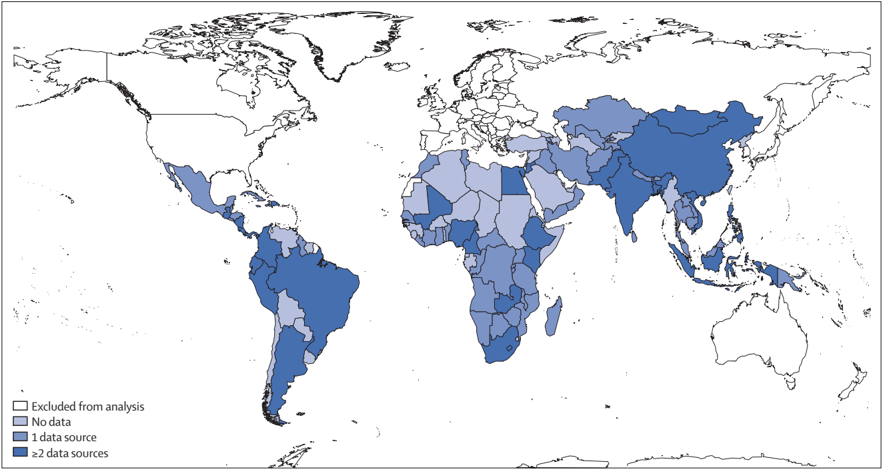
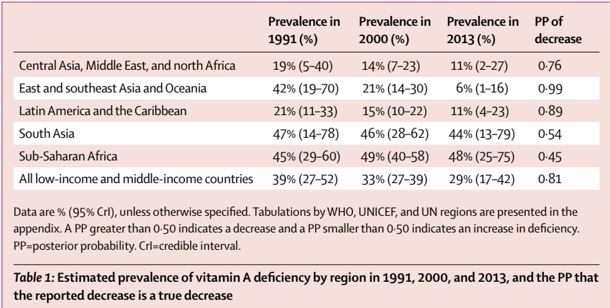
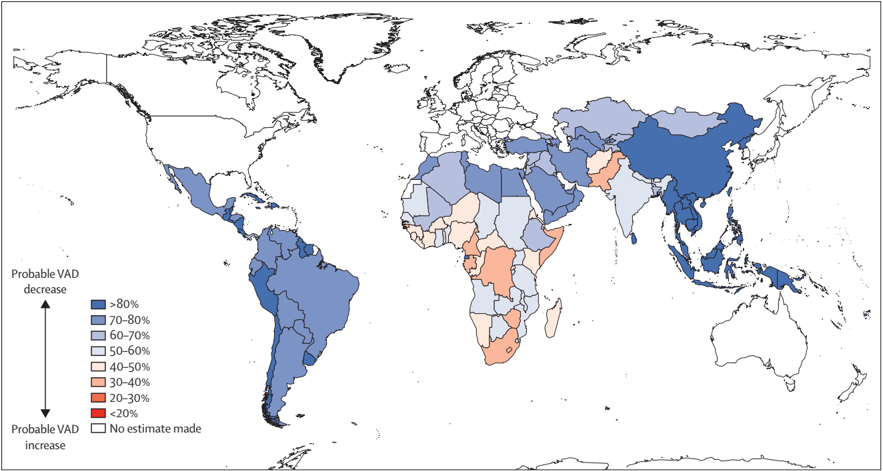
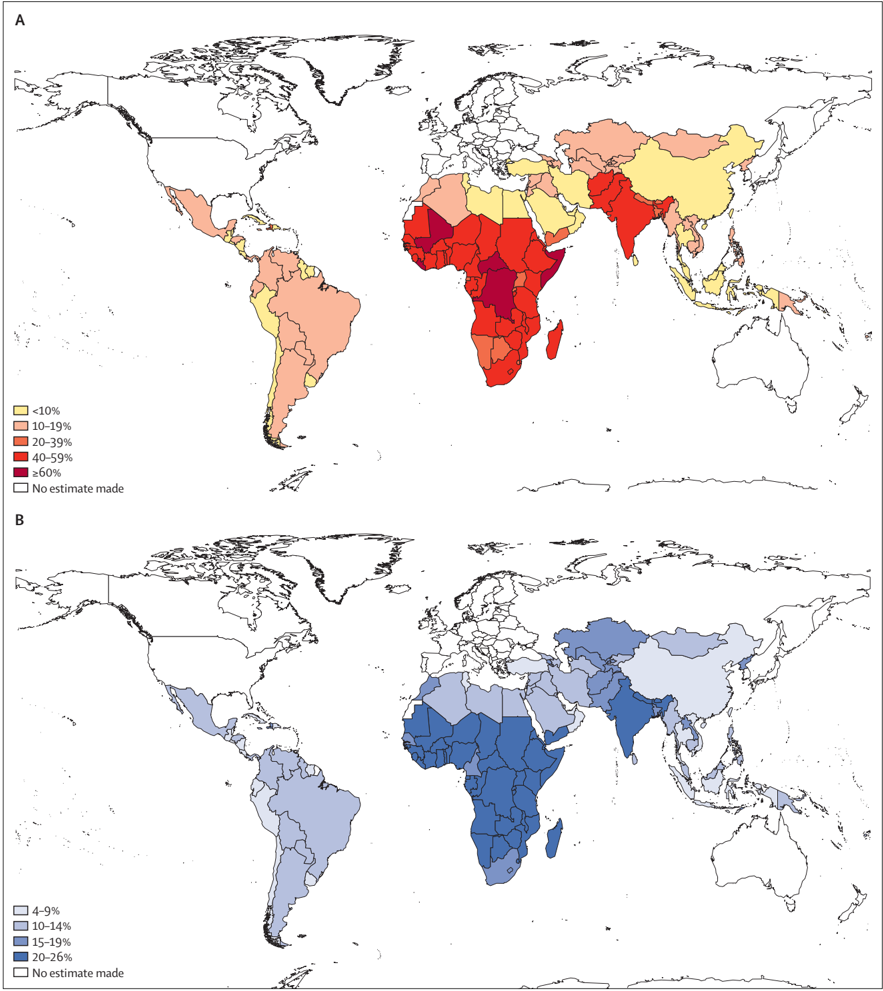
BACKGROUND: Vitamin A deficiency is a risk factor for blindness and for mortality from measles and diarrhoea in children aged 6-59 months. We aimed to estimate trends in the prevalence of vitamin A deficiency between 1991 and 2013 and its mortality burden in low-income and middle-income countries. METHODS: We collated 134 population-representative data sources from 83 countries with measured serum retinol concentration data. We used a Bayesian hierarchical model to estimate the prevalence of vitamin A deficiency, defined as a serum retinol concentration lower than 0·70 μmol/L. We estimated the relative risks (RRs) for the effects of vitamin A deficiency on mortality from measles and diarrhoea by pooling effect sizes from randomised trials of vitamin A supplementation. We used information about prevalences of deficiency, RRs, and number of cause-specific child deaths to estimate deaths attributable to vitamin A deficiency. All analyses included a systematic quantification of uncertainty. FINDINGS: In 1991, 39% (95% credible interval 27-52) of children aged 6-59 months in low-income and middle-income countries were vitamin A deficient. In 2013, the prevalence of deficiency was 29% (17-42; posterior probability [PP] of being a true decline=0·81). Vitamin A deficiency significantly declined in east and southeast Asia and Oceania from 42% (19-70) to 6% (1-16; PP>0·99); a decline in Latin America and the Caribbean from 21% (11-33) to 11% (4-23; PP=0·89) also occurred. In 2013, the prevalence of deficiency was highest in sub-Saharan Africa (48%; 25-75) and south Asia (44%; 13-79). 94 500 (54 200-146 800) deaths from diarrhoea and 11 200 (4300-20 500) deaths from measles were attributable to vitamin A deficiency in 2013, which accounted for 1·7% (1·0-2·6) of all deaths in children younger than 5 years in low-income and middle-income countries. More than 95% of these deaths occurred in sub-Saharan Africa and south Asia. INTERPRETATION: Vitamin A deficiency remains prevalent in south Asia and sub-Saharan Africa. Deaths attributable to this deficiency have decreased over time worldwide, and have been almost eliminated in regions other than south Asia and sub-Saharan Africa. This new evidence for both prevalence and absolute burden of vitamin A deficiency should be used to reconsider, and possibly revise, the list of priority countries for high-dose vitamin A supplementation such that a country's priority status takes into account both the prevalence of deficiency and the expected mortality benefits of supplementation. FUNDIN: Bill & Melinda Gates Foundation, Grand Challenges Canada, UK Medical Research Council.
Overview
The claims and statistics of this paper haven’t been checked yet.
Free: it reads the open-access text and checks the first 5 claims that cite a source we can check. Create a free account to check every claim.
Integrity signals
Registry
Cites
Statistics
Figures
Verification
Claims the paper makes
The claims and statistics of this paper haven’t been checked yet.
Free: it reads the open-access text and checks the first 5 claims that cite a source we can check. Create a free account to check every claim.
Claims other papers make about this one
Each is checked against this paper’s own text: does it say what the citing paper says it does?
The source backs part of the claim, not all of it — or backs it for a different population, condition or comparison.
In the citing paper
“This is of special importance in infants and children, where this intervention reduces the rate of child morbidity and mortality.”
From Vitamin A Update: Forms, Sources, Kinetics, Detection, Function, Deficiency, Therapeutic Use and Toxicity (2021) · cites this paper as [336]
Experimental — accuracy not yet measuredThe source backs part of the claim, not all of it — or backs it for a different population, condition or comparison.
In the citing paper
“it is calculated that approximately one-third of the world’s infant population suffers from hypovitaminosis A”
From Vitamin A Update: Forms, Sources, Kinetics, Detection, Function, Deficiency, Therapeutic Use and Toxicity (2021) · cites this paper as [336]
Experimental — accuracy not yet measuredThe check wasn’t confident either way, so it gives no verdict — never disputed.
In the citing paper
“in developing countries, around 15% of all pregnant women suffer from this deficiency”
From Vitamin A Update: Forms, Sources, Kinetics, Detection, Function, Deficiency, Therapeutic Use and Toxicity (2021) · cites this paper as [336]
Experimental — accuracy not yet measured
Self-check
Percentages, sums and reported differences re-computed from the paper’s own numbers.
The self-check needs the paper’s full text.
Citations
Cites
Lim, S. S., Vos, T., Flaxman, A. D., Danaei, G., Shibuya, K., Adair-Rohani, H., AlMazroa, M. A., Amann, M., Anderson, H. R., Andrews, K. G., et al. (2012) · The Lancet · doi:10.1016/s0140-6736(12)61766-8 · Cited by 11,805
Self-citationMaternal and child undernutrition and overweight in low-income and middle-income countries
Black, R. E., Victora, C. G., Walker, S. P., Bhutta, Z. A., Christian, P., de Onis, M., Ezzati, M., Grantham-McGregor, S., Katz, J., Martorell, R., et al. (2013) · The Lancet · doi:10.1016/s0140-6736(13)60937-x · Cited by 8,475
Self-citationMaternal and child undernutrition: global and regional exposures and health consequences
Black, R. E., Allen, L. H., Bhutta, Z. A., Caulfield, L. E., de Onis, M., Ezzati, M., Mathers, C., & Rivera, J. (2008) · The Lancet · doi:10.1016/s0140-6736(07)61690-0 · Cited by 6,443
Self-citationFinucane, M. M., Stevens, G. A., Cowan, M. J., Danaei, G., Lin, J. K., Paciorek, C. J., Singh, G. M., Gutierrez, H. R., Lu, Y., Bahalim, A. N., et al. (2011) · The Lancet · doi:10.1016/s0140-6736(10)62037-5 · Cited by 4,050
Self-citationSelected major risk factors and global and regional burden of disease
Ezzati, M., Lopez, A. D., Rodgers, A., Vander Hoorn, S., & Murray, C. J. (2002) · The Lancet · doi:10.1016/s0140-6736(02)11403-6 · Cited by 3,594
Self-citationDanaei, G., Finucane, M. M., Lu, Y., Singh, G. M., Cowan, M. J., Paciorek, C. J., Lin, J. K., Farzadfar, F., Khang, Y.-H., Stevens, G. A., et al. (2011) · The Lancet · doi:10.1016/s0140-6736(11)60679-x · Cited by 3,568
Self-citationLiu, L., Oza, S., Hogan, D., Perin, J., Rudan, I., Lawn, J. E., Cousens, S., Mathers, C., & Black, R. E. (2015) · The Lancet · doi:10.1016/s0140-6736(14)61698-6 · Cited by 3,167
Self-citationGlobal burden of childhood pneumonia and diarrhoea
Walker, C. L. F., Rudan, I., Liu, L., Nair, H., Theodoratou, E., Bhutta, Z. A., O'Brien, K. L., Campbell, H., & Black, R. E. (2013) · The Lancet · doi:10.1016/s0140-6736(13)60222-6 · Cited by 2,356
Self-citationStevens, G. A., Finucane, M. M., De-Regil, L. M., Paciorek, C. J., Flaxman, S. R., Branca, F., Peña-Rosas, J. P., Bhutta, Z. A., & Ezzati, M. (2013) · The Lancet Global Health · doi:10.1016/s2214-109x(13)70001-9 · Cited by 1,932
Self-citationDanaei, G., Finucane, M. M., Lin, J. K., Singh, G. M., Paciorek, C. J., Cowan, M. J., Farzadfar, F., Stevens, G. A., Lim, S. S., Riley, L. M., et al. (2011) · The Lancet · doi:10.1016/s0140-6736(10)62036-3 · Cited by 1,239
Self-citation
Research works printed but not linked: 2
- 15. Rice AL, West KP, Black RE. Vitamin A defi ciency. In: Ezzati M, Lopez AD, Rodgers A, Murray CJL, eds. Comparative Quantifi cation of Health Risks. Geneva: World Health Organization; 2006: 211-56.
- 48. West KP Jr, Klemm RDW, Sommer A. Vitamin A saves lives. Sound science, sound policy. World Nutr 2010; 1: 211-29.
Cited by
Items 401–500 of 623
Chaudhary‐Webb, M., Schleicher, R. L., Erhardt, J. G., Pendergrast, E. C., & Pfeiffer, C. M. (2019) · The Journal of Applied Laboratory Medicine · doi:10.1373/jalm.2018.027508 · Cited by 3
“Given the uncertainties with measuring RBP as a surrogate indicator for vitamin A status, a direct measure of retinol in serum is preferred (4, 5, 18), particularly if used in conjunction with other biomarkers as recommended by the World Health Organization (4, 19).”
MethodImdad, A., Ranjit, D., Surin, G. S., Lawler, S., Smith, A. A., & Bhutta, Z. A. (2019) · Campbell Systematic Reviews · doi:10.1002/cl2.1021 · Cited by 3
“Vitamin A deficiency (VAD) is most prevalent in South Asia and Africa (Stevens et al., 2015).”
InfluentialSelf-citationFaye, M. H., Diémé, M.-M. A., Dossou, N. I., Badiane, A., Diouf, A., Ndome, N. M. N., & Tanumihardjo, S. A. (2021) · PLoS ONE · doi:10.1371/journal.pone.0246246 · Cited by 3
“7 μmol/L [4] and an analysis of existing VAD statistics in West Africa indicates a public health problem in children under five years [5–11].”
MethodSemba, R. D. (2022) · Springer eBooks · doi:10.1007/978-3-030-42634-7_304 · Cited by 5
Ezzati, M., Bennett, J. E., Black, R. E., Bhutta, Z. A., & Fawzi, W. W. (2015) · The Lancet Global Health · doi:10.1016/s2214-109x(15)00248-x · Cited by 3
Self-citationAbtahi, M., Pouraram, H., Djazayery, A., & Siassi, F. (2022) · Iranian Journal of Pediatrics · doi:10.5812/ijp-114851 · Cited by 2
“However, it is much more common in pregnant women (10 20%) (4).”
BackgroundSosa‐Pedreschi, A., Fontes, F., C, J. R. D. L., Roa, R., & Mendoza, R. M. (2024) · The Lancet Regional Health - Americas · doi:10.1016/j.lana.2024.100932 · Cited by 5
Cruet-Burgos, C. M., Banda, L., Faye, J. M., Diatta, C., Zapata, D., Morris, G. P., & Rhodes, D. (2026) · Theoretical and Applied Genetics · doi:10.1007/s00122-026-05245-2 · Cited by 2
“Vitamin A deficiency is a major global public health issue, particularly in low-income countries where starchy staple crops such as cereals and tubers are the main source of calories (World Health Organization 2009; Bailey et al. 2015; Stevens et al. 2015; Wirth et al. 2017; Song et al. 2023).”
Burden, trends, and projections of nutritional deficiencies in China from 1990 to 2030
Chen, B., Yang, H., Zheng, W., Zheng, H., Lin, H., Yu, J., Xu, Y., Guo, Z., & Zhan, Z. (2025) · Frontiers in Nutrition · doi:10.3389/fnut.2025.1643869 · Cited by 2
Kumar, A., Ahluwalia, K., Edathil, A. P., Sankar, R., Arlappa, N., Nair, S., Duggal, M., & Joe, W. (2025) · PLoS ONE · doi:10.1371/journal.pone.0331790 · Cited by 2
Hu, Q., Lyu, J., Li, J., Lin, X., Li, S., Bu, Y., & Zhao, Q. (2025) · Frontiers in Nutrition · doi:10.3389/fnut.2025.1673576 · Cited by 2
Ndovie, P., Geresomo, N. C., Nkhata, S. G., Fungo, R., Nyau, V., & Munthali, J. (2026) · Journal of Nutritional Science · doi:10.1017/jns.2025.10073 · Cited by 3
“(40,41) A recent study in sub-Saharan Africa emphasised that diversified diets, including legumes and animal-source foods, are essential to reduce stunting and wasting among young children.”
Pro‐Vitamin A Biofortified Cavendish Banana: Trait Stability in the Field
Tindamanyire, J. M., Watkins, J. L., Mortimer, C. L., Mlalazi, B., Daniells, J., Harding, R. M., Dale, J. L., & Paul, J. (2026) · Plant Biotechnology Journal · doi:10.1111/pbi.70516 · Cited by 2
“%) continued to exhibit disproportionately high rates (Stevens et al. 2015).”
Bashir, T., Rashid, R., Malik, A. R., Sundouri, A. S., Bhat, K. M., Mir, M., Rehman, M. U., Masood, M., & Tehleelah (2026) · Frontiers in Plant Science · doi:10.3389/fpls.2026.1853898 · Cited by 3
Bioavailability of Palm Oil Carotenoids Consumed from Different Foods
Dongmo, F. F. D., Ndomou, M., Ngono, A. R. N., Mawamba, A. D., Schweigert�, F. J., & Gouado, I. (2017) · Journal of Food Research · doi:10.5539/jfr.v6n3p48 · Cited by 2
“Vitamin A deficiency (VAD) is a major nutritional concern in poor societies, especially in lower income countries were it mainly affects preschool children and pregnant women (WHO, 2009; Gretchen et al., 2015).”
BackgroundRaut, M. K. (2018) · International Journal of Community Medicine and Public Health · doi:10.18203/2394-6040.ijcmph20180775 · Cited by 2
Advances in carotenoid increments in storage parts of African staple crops
Nuwamanya, E., & Atwijukire, E. (2019) · Journal of Plant Breeding and Crop Science · doi:10.5897/jpbcs2018.0776 · Cited by 2
Medical reversals in low‐ and middle‐income countries
Haslam, A., Prasad, V. K., & Livingston, C. J. (2019) · The International Journal of Health Planning and Management · doi:10.1002/hpm.2937 · Cited by 2
A Nonhealing Epithelial Defect in a Patient Experiencing Alcohol Use Disorder
Chen, A., Ahmad, M. T., & Akpek, E. K. (2020) · JAMA Ophthalmology · doi:10.1001/jamaophthalmol.2020.4651 · Cited by 2
Small and Mighty: Micronutrients at the Intersection of Neonatal Immunity and Infection
Sherlock, L. G., & Krebs, N. F. (2023) · NeoReviews · doi:10.1542/neo.24-3-e158 · Cited by 2
Bellere, A. D., Esteban, A. J., & Raseetha, S. (2023) · Food Research · doi:10.26656/fr.2017.7(s4).15 · Cited by 2
“In southeast Asia and Sub - Saharan Africa, insufficient dietary zinc and vitamin A deficiency are very common (Stevens et al., 2015).”
BackgroundEffectiveness of vitamin A supplementation among children under 5 years old in Kazakhstan
Beisbekova, A., Ospanova, F., Kainarbayeva, M., Ushanskaya, E., Bykybayeva, S., Berdygaliev, A. B., Raushanova, A., & Linkov, F. Y. (2024) · Potravinarstvo Slovak Journal of Food Sciences · doi:10.5219/1946 · Cited by 3
“This targeted approach ensures that resources are optimally utilized and interventions are culturally sensitive [44] .”
BackgroundMicrobial vitamins in nutrition and healthcare
Shaida, B., Singh, V., Alavudeen, S. S., Ahmad, M. F., & Akhtar, M. S. (2024) · Elsevier eBooks · doi:10.1016/b978-0-443-15528-4.00009-x · Cited by 2
Mechanistic perspective on the actions of vitamin a in autism spectrum disorder etiology
Carrazana‐Escalona, R., Espinoza, F., & Ávila, A. (2024) · Neuroscience · doi:10.1016/j.neuroscience.2024.07.012 · Cited by 2
Seng, K. B. H., Tan, P. Y., Lim, C. C., Loganathan, R., Lim, Y. A. L., Teng, K., Selvaduray, K. R., Johari, S. N. M., & Ramli, N. M. (2024) · Nutrition Research · doi:10.1016/j.nutres.2024.07.003 · Cited by 3
Chowdhury, S. S. A., Kundu, S., Jahan, I., Dey, R., Sharif, A. B., & Hossain, A. (2024) · BMJ Nutrition Prevention & Health · doi:10.1136/bmjnph-2024-000944 · Cited by 2
Kieran, C., Doledec, D., Klemm, R. D. W., Waithera, E. N., & Vosti, S. A. (2025) · Annals of the New York Academy of Sciences · doi:10.1111/nyas.15280 · Cited by 2
Beressa, G. (2025) · Scientific Reports · doi:10.1038/s41598-025-07992-6 · Cited by 2
Solving the Problem of Nutritional Deficiencies in Children
Li, J., & Wang, S. (2025) · Springer eBooks · doi:10.1007/978-981-96-8512-7_6 · Cited by 5
Hodges, J. K., Tan, L., Green, M. H., & Ross, A. C. (2017) · Current Developments in Nutrition · doi:10.3945/cdn.116.000265 · Cited by 2
“Despite a modest reduction in the prevalence of vitamin A (VA; retinol) deficiency in lowincome countries, it is still very common in South Asia and sub-Saharan Africa, where it affects 44–48% of children (1).”
BackgroundSelected laboratory-based biomarkers for assessing vitamin A deficiency in at-risk individuals
Gannon, B. M., Colt, S., Rogers, L. M., Garcia‐Casal, M. N., Martinez, R. X., Lopez-Perez, L., Ghezzi‐Kopel, K., & Mehta, S. (2020) · Cochrane Database of Systematic Reviews · doi:10.1002/14651858.cd013742 · Cited by 2
Self-citationBabalola, D., Menkir, A., Ilesanmi, O. J., Offornedo, Q., & Gedil, M. A. (2020) · Journal of Cereal Science · doi:10.1016/j.jcs.2020.103149 · Cited by 2
Kamira, M., Simbare, A., Sivirihauma, C., Mpoki, S., Nabuuma, D., & Ekesa, B. (2021) · African Journal of Agricultural Research · doi:10.5897/ajar2021.15658 · Cited by 1
(2019) · Archivos Argentinos de Pediatria · doi:10.5546/aap.2019.19 · Cited by 2
“La mediana de ingesta de vitamina A fue 236,7 μg/día (105,6-436,9); al estratificar la ingesta según tercilos, los valores menores de 148,8 μg/día (primer tercilo) fueron considerados como bajo consumo de vitamina A.”
Gastrointestinal and Nutritional Disorders
Scherbakova, I., Chen, R. W. S., Marcus, D. M., & Rustgi, A. K. (2022) · Springer eBooks · doi:10.1007/978-3-030-42634-7_303 · Cited by 2
The status of Uganda’s food-based Vitamin A deficiency mitigation strategies
Lee, H.-H. (2022) · African Journal of Food Agriculture Nutrition and Development · doi:10.18697/ajfand.108.21735 · Cited by 2
Ibeanu, V. N., Ani, P. N., Eme, B. N., & Anoshirike, C. (2022) · Pakistan Journal of Nutrition · doi:10.3923/pjn.2021.119.126 · Cited by 2
Urio, E. M., Tanumihardjo, S. A., Fweja, L. W. T., & Ndossi, G. D. (2022) · Journal of Nutrition · doi:10.1093/jn/nxac227 · Cited by 2
Zinc and Provitamin A Biofortified Maize Genotypes Exhibited Potent to Reduce Hidden—Hunger in Nepal
Dhakal, K. H., Pun, A. B., Pokhrel, K. R., Baral, B. R., Beshir, A., Shrestha, H. K., & Vista, S. P. (2022) · Plants · doi:10.3390/plants11212898 · Cited by 2
Hidden Hunger or Knowledge Hunger? an Interventional Study in a Public School of Rawalpindi
Mashhadi, S. F., Khan, N., Maryam, Z., Aamir, M., Sahi, S. S., & Amin, M. (2022) · Pakistan Armed Forces Medical Journal · doi:10.51253/pafmj.v72isuppl-4.9680 · Cited by 2
Mehta, S., Gannon, B. M., Jones, C. E., Hackl, L., Udipi, S. A., Thakker, V., Thorat, A., Bonam, W., Haas, J. D., & Finkelstein, J. L. (2020) · doi:10.17504/protocols.io.bq32myqe · Cited by 2
Gebretsadik, S., Yemane, B., & Adasho, Z. A. (2023) · Research Square · doi:10.21203/rs.3.rs-3167315/v1 · Cited by 2
Carotenoids in Gac Fruit Aril – Structure and Bioaccessibility
Erşan, S., & Müller-Maatsch, J. (2022) · CABI eBooks · doi:10.1079/9781789247329.0003 · Cited by 1
Sarohan, A. R., Edipsoy, S., Özkurt, Z., Özlü, C., Demir, A. N., & Çen, O. (2023) · Advances in experimental medicine and biology · doi:10.1007/5584_2023_774 · Cited by 2
Sy, M., Ibondou, R. K., Bah, F., Foko, R. F., Diop, N., Vénus, M., Séga, A., Diop, C., Fall, M., & Faye, O. (2023) · Advances in Reproductive Sciences · doi:10.4236/arsci.2024.121001 · Cited by 1
Screening of drought tolerant carrot genotypes and understanding drought tolerance in carrots
Rashid, M. H. A., Senalik, D. A., Lalor, E., Rolling, W. R., & Simon, P. W. (2024) · Acta Horticulturae · doi:10.17660/actahortic.2024.1393.33 · Cited by 1
Fan, X., Lai, X., Miao, J., Chen, Q.-X., Chen, J., & Liu, H. (2024) · Food Science & Nutrition · doi:10.1002/fsn3.4552 · Cited by 1
Prevalence of ocular manifestations of vitamin A deficiency in children: A systematic review
Castro-Pachón, S., Perilla-Soto, S., Ruiz-Sarmiento, K., Niño-García, J. A., Sánchez-Rosso, M. J., Ordóñez-Caro, M. C., Camacho-Páez, D. S., & Lozada, D. G. (2024) · Archivos de la Sociedad Española de Oftalmología (English Edition) · doi:10.1016/j.oftale.2024.12.011 · Cited by 4
Biofortification of Food Grains in Relation to Food Security
Noorka, I. R., Qureshi, M. T., Khan, Z. I., Siddique, K. H. M., & Heslop-Harrison, J. S. (2025) · Wiley eBooks · doi:10.1002/9781394273270.ch01 · Cited by 1
KELAPARAN TERSEMBUNYI PADA ANAK DENGAN BERAT BADAN KURANG DI PEDESAAN PESISIR
Darubekti, N., & Hanum, S. H. (2023) · Jurnal Muara Ilmu Sosial Humaniora dan Seni · doi:10.24912/jmishumsen.v7i1.13285.2023 · Cited by 1
“Sekitar sepertiga anak usia 6–59 bulan (anak 5 tahun) di negara berpenghasilan rendah dan menengah menderita Kekurangan Vitamin A (KVA) (Stevens et al., 2015) dan 18% anak 5 tahun mengalami anemia defisiensi Fe (Stevens et al., 2013).”
Way Forward for Biomanufacturing and Biotechnology in Europe
Halbes‐Létinois, U., Crump, S., Zerrer, B., Hans, M., Meunier, P.-A., & Wyss, M. (2025) · CHIMIA International Journal for Chemistry · doi:10.2533/chimia.2025.344 · Cited by 2
Girsha, H., Ketema, K., Moroda, M., Yazew, T., & Kuyu, C. G. (2025) · Discover Food · doi:10.1007/s44187-025-00550-z · Cited by 1
Egbende, L., Mapatano, M. A., Luthuli, S., Akilimali, P. Z., & Engebretsen, I. M. S. (2025) · Journal of Nutrition and Metabolism · doi:10.1155/jnme/3033218 · Cited by 1
“In the Democratic Republic of the Congo (DRC), VAD may also be a public health problem [3–5].”
Zeitler, L., Randell, H., & Powell, B. (2025) · People and Nature · doi:10.1002/pan3.70145 · Cited by 2
“(Semba & Bloem, 2002 ; Stevens et al., 2015).”
Perinatal vitamin A excess impacts vitamin A and lipid metabolism in rat offspring
Berthomé, A., Antoine, T., Meiller, L., Govers, R., Guichard, P., Sabran, C., Gonzalez, T., Nowicki, M., Bordat, C., Borel, P., et al. (2025) · Scientific Reports · doi:10.1038/s41598-025-18896-w · Cited by 1
Solar Drying of Mangoes: Opportunities for Combating Vitamin A Deficiency in Sub-Saharan Africa
Salvador, P. V., & Galindo, F. G. (2025) · Foods · doi:10.3390/foods14223979 · Cited by 1
“In 2013 alone, VAD was associated with approximately 94,500 diarrhea-related deaths and 11,200 measles-related deaths in children under five, with the vast majority occurring in sub-Saharan Africa and South Asia [2,4].”
Kere, N., Compaoré, E. W. R., Ouédraogo, O., Inoussa, K. Y., Bambara, E., Tirogo, S., KOUAME, J. S. R., Savadogo, B., & Dicko, M. H. (2026) · BMC Nutrition · doi:10.1186/s40795-026-01254-y · Cited by 1
“Indeed, vitamin A deficiency is a risk factor for blindness and mortality from measles and diarrhea in children aged between 6 and 59 months [1].”
Cuna, W. R., Passera, R., & Rodríguez, C. (2026) · Microorganisms · doi:10.3390/microorganisms14020511 · Cited by 2
“[36].”
Hassan, M. S., Said, A. I., Nadarajah, S., Korse, A. H., & Dahir, H. M. (2026) · Health Science Reports · doi:10.1002/hsr2.71927 · Cited by 1
Wang, F., Sun, Q., Sun, G., Lu, J., Shi, Z., Zhang, Z., Guo, M., Li, Q. H., Wang, S., An, L., et al. (2026) · Biology of Reproduction · doi:10.1093/biolre/ioag033 · Cited by 1
Rohner, F., Rakotovao, J.-M., El-Mallah, C., Andrianarison, R., Randrenarizo, N., Wegmüller, R., Rakotovao, R., Ravaoarisoa, L., Joyeux, M., Wirth, J. P., et al. (2026) · Journal of Nutrition · doi:10.1016/j.tjnut.2026.101610 · Cited by 2
Dirnena-Fusini, I., Stafne, S. N., Gustafsson, M. K., Mosti, M. P., Sujan, M. A. J., Syversen, U., & Stunes, A. K. (2026) · Frontiers in Nutrition · doi:10.3389/fnut.2026.1835994 · Cited by 1
“VAD in children increases the risk of death from infections in early life, and if VAD continues throughout childhood, it weakens the immune system, lowers survival, and increases long-term vulnerability to infectious diseases, limiting healthy development into later childhood (4).”
Zhang, Z., Liu, L., Li, X., & Wu, Y. (2026) · HORMONES · doi:10.1007/s42000-025-00752-1 · Cited by 1
“The specific criteria were as follows: Subclinical vitamin A deficiency was defined as serum retinol concentration 0.70 µmol/L [14 ].”
InfluentialBottone, M., Jonas, J., Steinmetz, J. D., Braithwaite, T., Casson, R., Ehrlich, J., Taylor, H. R., Friedman, D. S., Congdon, N. G., Kempen, J., et al. (2026) · Ophthalmic and Physiological Optics · doi:10.1007/s44402-026-00208-y · Cited by 1
“Population-level associations between risk factors and vision loss have been considered in speci fi c countries, across high-income and low-income countries [11, 12] and for speci fi c severities of VI [13], yet few studies have addressed global, regional and cross-country factors.”
Self-citationHigh dose vitamin A capsules – Rusty bullets?
Fisker, A. B., & Greiner, T. H. (2017) · World Nutrition · doi:10.26596/wn.20178152-61 · Cited by 1
Muzhingi, T., Yeum, K., Siwela, A. H., Bermúdez, O. I., & Tang, G. (2017) · International Journal for Vitamin and Nutrition Research · doi:10.1024/0300-9831/a000437 · Cited by 1
Nogueira, T. B. D. B., de Oliveira, T. A., Medina, T. D. S., Nascimento, F. R., do Nascimento, T. P., & Ferreira, M. S. L. (2019) · Cited by 1
Carotenoids Biofortification of Sweet Potatoes
Benkeblia, N., Pinto, E. C. B., & Vasconcelos, M. W. (2020) · Wiley eBooks · doi:10.1002/9781119511144.ch5 · Cited by 2
Holistic Approach to The Environment and GMOs – The Case of Golden Rice
Kelam, I. (2019) · Global Bioethics Enquiry Journal · doi:10.38020/gbe.7.3.2019.118-127 · Cited by 1
“On the other hand, golden rice proponents, deny Vandana Shiva's allegations, pointing out that the new generation of golden rice contains a much higher concentration of beta-carotene, and, according to calculations, the daily consumption of one bowl of golden rice per person would significantly reduce vitamin A defici…”
BackgroundSuplementação de vitamina A em crianças de duas cidades do Maranhão
Barbosa, A. K. D. S., Rocha, J. M. D. H., Barreto, I. C., & Cardoso, K. M. (2020) · Research Society and Development · doi:10.33448/rsd-v9i9.7589 · Cited by 1
Collese, T. S., Norde, M. M., Ferreira, M. V. N., Kim, H., Marchioni, D. M. L., Carvalho, H. B., & Giovannucci, E. L. (2020) · Nutrition Reviews · doi:10.1093/nutrit/nuaa133 · Cited by 1
Towards an Integrated Mathematical Model of Nutrient Metabolism: Linking β-Carotene and Vitamin A
Gannon, B. M. (2020) · Journal of Nutrition · doi:10.1093/jn/nxaa422 · Cited by 1
Liu, R., Ye, R., Wang, Q., Pappas, L., Dill, S., Rozelle, S., & Zhou, H. (2022) · BMC Public Health · doi:10.1186/s12889-022-13726-4 · Cited by 1
“In addition, an estimated 29% of children in LMICs have vitamin A deficiencies [14], and more than 50% of children in LMICs suffer from zinc deficiencies [15].”
The Tomato Juhwang Mutant Accumulates a High Level of β-Carotene and has a Long Shelf-Life
Kim, S.-Y., Kim, S.-M., Chun, J.-I., Jung, J.-W., Kim, J. K., An, J., Chung, D., & Kang, J. (2022) · Journal of Plant Biology · doi:10.1007/s12374-022-09372-3 · Cited by 1
“For example, β-carotene is the precursor of vitamin A, the deficiency of which causes blindness and death in children (Stevens et al. 2015; Johra et al. 2020).”
BackgroundMaldonado, Y., & Shetty, A. K. (2022) · Elsevier eBooks · doi:10.1016/b978-0-323-75608-2.00227-5 · Cited by 1
Kaslon, L., Conner, N. W., Matkin, G. S., Balschweid, M. A., & Hibberd, C. (2023) · Journal of Human Sciences and Extension · doi:10.55533/2325-5226.1445 · Cited by 1
Key Nutrients for Biofortification: Iron, Zinc and Vitamin A
Khan, S., Tiwari, S., Sharma, K., Chaturvedi, S., & Bauer, P. (2024) · Springer eBooks · doi:10.1007/978-981-97-3438-2_3 · Cited by 1
Multifaceted determinants of micronutrient status in early childhood in Iran
Nikooyeh, B., Ghodsi, D., Yari, Z., Rasekhi, H., Amini, M., Rabiei, S., Ebrahimof, S., Abdollahi, Z., Minaie, M., Motlagh, M. E., et al. (2024) · European Journal of Nutrition · doi:10.1007/s00394-024-03545-1 · Cited by 1
“Although severe VAD has been controlled efficiently in many countries [16], it is still a public health problem in many low-and middle-income countries and one of the main causes of vision loss globally [ 14 , 17].”
Kundu, S., Adnani, Q. E. S., Rahman, M. A., Chowdhury, S. S. A., Dey, R., Sharif, A. B., & Ahmed, F. (2025) · BMJ Nutrition Prevention & Health · doi:10.1136/bmjnph-2024-001118 · Cited by 1
Govender, K. (2016) · DUT Open Scholar (Durban University of Technology) · doi:10.51415/10321/1625 · Cited by 2
da Silva, L. L. S. (2018) · Digital Library of Theses and Dissertations (Universidade de São Paulo) · doi:10.11606/t.6.2018.tde-04012018-142026 · Cited by 2
Efficacy of biofortified (yellow) cassava on serum retinol in pre-school Nigerian children
Afolami, I. (2021) · doi:10.18174/551311 · Cited by 3
Vitamin A: Physiology, dietary sources and requirements
Ross, A. C. (2022) · Elsevier eBooks · doi:10.1016/b978-0-12-821848-8.00082-2 · Cited by 1
Vitamin A: Deficiency and interventions
Palmer, A., & West, K. P. (2022) · Elsevier eBooks · doi:10.1016/b978-0-12-821848-8.00127-x · Cited by 1
Four Essays on Health and Nutrition of Indian Women and Children
Kumar, R. (2022) · eDiss (Georg-August-Universität Göttingen) · doi:10.53846/goediss-9427 · Cited by 1
Batni, S. R. (2016) · DigitalGeorgetown (Georgetown University Library)
Food Demand and Food Security in El SalvadorPreprint
Sandoval, L., & Carpio, C. E. (2016) · RePEc: Research Papers in Economics · doi:10.22004/ag.econ.230074
Should we give vitamins to children?
Zakharova, I. N., Pshenichnikova, I. I., Мумладзе, Э. Б., & Иосифовна, С. В. (2016) · Meditsinskiy sovet = Medical Council · doi:10.21518/2079-701x-2016-1-22-29
Oliveira, C. S. D. M. (2018) · Digital Library of Theses and Dissertations (Universidade de São Paulo) · doi:10.11606/t.6.2018.tde-04012018-145346
NÚMERO ESPECIAL DE ATENÇÃO PRIMÁRIA À SAÚDE NO BRASIL: A 40 ANOS DE ALMA ATA
VV.AA., V. A. (2018) · Revista Panamericana de Salud Pública · doi:10.26633/rpsp.2018.210 · Cited by 1
Undernutrition of Children Under 5 and Women of Reproductive Age in Egypt
Akuoku, J. K. (2019) · World Bank, Washington, DC eBooks · doi:10.1596/978-1-4648-1467-9_ch1
Boț, M., Sighencea, M. G., Borislavschi, A., Zvanca, M. E., Petca, R., Plopan, A. M., Tecuci, A., & Petca, A. T. (2019) · Ginecologia ro · doi:10.26416/gine.26.4.2019.2703
Mendonça, W. D. O., de Araújo, L. D. C. N., Duarte, D. B., Kelly, I. M., & de Souza, M. K. T. (2020) · Revista interdisciplinar em saúde · doi:10.35621/23587490.v7.n1.p1678-1695
CME-Dermatologie 22: Masern – Epidemiologie und Klinik
Hari, L., & Lautenschlager, S. (2020) · Praxis · doi:10.1024/1661-8157/a003587
Vitamin status in pregnancy and newborns
Keats, E. C., Salam, R. A., Charbonneau, K. D., & Bhutta, Z. A. (2020) · Elsevier eBooks · doi:10.1016/b978-0-12-813862-5.00005-0
Self-citationCongenital Heart Disease: causes and risk factors
Siddiqui, M. F., Farooq, S., Khan, A. K., & Kausar, H. (2021) · Pakistan BioMedical Journal · doi:10.52229/pbmj.v4i1.58
Fukumoto, Y. (2021) · European Journal of Preventive Cardiology · doi:10.1093/eurjpc/zwab009
Zeba, A. N., Bationo, J. F., Sombié, O. O., & Diendéré, J. (2021) · Journal of Nutrition and Food Security · doi:10.18502/jnfs.v6i3.6831
Metadata
- Authors
- Stevens, G. A., Bennett, J. E., Hennocq, Q., Lu, Y., De-Regil, L. M., Rogers, L., Danaei, G., Li, G., White, R. A., Flaxman, S. R., Oehrle, S.-P., Finucane, M. M., Guerrero, R., Bhutta, Z. A., Then-Paulino, A., Fawzi, W., Black, R. E., & Ezzati, M.
- Affiliations
- World Health Organization (CH)
- MRC Centre for Environment and Health (GB)
- Harvard University (US)
- Norwegian Institute of Public Health (NO)
- Carnegie Mellon University (US)
- Mathematica Policy Research (US)
- Universidad Icesi (CO)
- Aga Khan University (PK)
- Universidad Autónoma de Santo Domingo (DO)
- Johns Hopkins University (US)
- Corresponding author
- Ezzati, Majid
- ORCID
- Venue
- The Lancet Global Health
- Publisher
- Elsevier BV
- Published
- 2015-09
- Volume
- 3
- Issue
- 9
- Pages
- e528-e536
- ISSN
- 2214-109X (ISSN-L)
- OpenAlex
- W2161245837
- Semantic Scholar
- 2479c3ef57898adfd02f8768d770d15657648143
- Cited by
- 572
- References
- 45
- Citations by year
- 2026: 38 · 2025: 46 · 2024: 54 · 2023: 63 · 2022: 85 · 2021: 71 · 2020: 66 · 2019: 46 · 2018: 36 · 2017: 38 · 2016: 25 · 2015: 4
- FWCI
- 33.06
- Type
- journal article
- Language
- en
- Open access
- gold
- doi.org
- Licence
- cc-by-nc-nd
- www.elsevier.com/tdm/userlicense/1.0/ (tdm)
- creativecommons.org/licenses/by-nc-nd/3.0/ (vor)
- Locations
- The Lancet Global Health (publishedVersion, cc-by-nc-nd)
- LA Referencia (Red Federada de Repositorios Institucionales de Publicaciones Científicas) (publishedVersion)
- PubMed (publishedVersion)
- Northumbria Research Link (Northumbria University) (acceptedVersion)
- Biblioteca Digital - Universidad Icesi (submittedVersion, cc-by-nc-nd)
- Digital Access to Scholarship at Harvard (DASH) (Harvard University) (submittedVersion, cc-by)
- DOAJ (DOAJ: Directory of Open Access Journals) (submittedVersion, cc-by-sa)
- NORA - Norwegian Open Research Archives (submittedVersion, other-oa)
- Spiral (Imperial College London) (submittedVersion, other-oa)
- Funders
- World Health Organization
- Wellcome Trust (100693)
- Medical Research Council (MR/K005901/1)
- Topics
- Health Sciences › Nursing › Nutrition and Dietetics › Child Nutrition and Water Access
- Health Sciences › Medicine › Pediatrics, Perinatology and Child Health › Global Maternal and Child Health
- Health Sciences › Medicine › Endocrinology, Diabetes and Metabolism › Vitamin D Research Studies
- Keywords
- vitamin A deficiency, children under five, prevalence trends, mortality burden, measles mortality, diarrhea mortality, serum retinol, vitamin A supplementation, childhood blindness, low- and middle-income countries, attributable mortality, sub-Saharan Africa, South Asia, Latin America and the Caribbean, East and Southeast Asia, Oceania, Bayesian hierarchical model, population survey, micronutrient deficiency
- MeSH terms
- Bayes Theorem, Child, Child, Preschool, Developing Countries, Female, Humans, Infant, Vitamin A Deficiency, Prevalence, Child Mortality
About these checks
Registry, retraction, Cites and statistics results are computed, not judged, with one exception: a printed reference that no index lists is read once by a model before it counts as a citation error. Claims are extracted by a model and kept only when their quote appears verbatim in the text; each cited source is then checked, with a model’s help, for whether it says what the claim relies on. Those verdicts can be wrong — read the claim’s quote and the cited source before relying on one.
Statistics and arithmetic are recomputed, not judged.
Confidence bands are shown only for fields calibrated on our annotated test set. None is calibrated yet, so no band is shown.
What counts as a claim ›How we measure confidence ›How we check this ›
Are you an author, or do you see a problem with this page? Request a review
Data sources
Bibliographic data: Semantic Scholar, OpenAlex, Crossref.
Contains information from the Semantic Scholar Academic Graph Datasets, made available under the ODC Attribution License (ODC-BY 1.0).
Semantic Scholar’s data is described in: Kinney, R., et al. (2023). The Semantic Scholar Open Data Platform. arXiv:2301.10140.
