

Trends and mortality effects of vitamin A deficiency in children in 138 low-income and middle-income countries between 1991 and 2013: a pooled analysis of population-based surveys
Open accessThe DOI matches its Crossref record; 43 of the 45 references it cites were found in a registry or an index.
Abstract
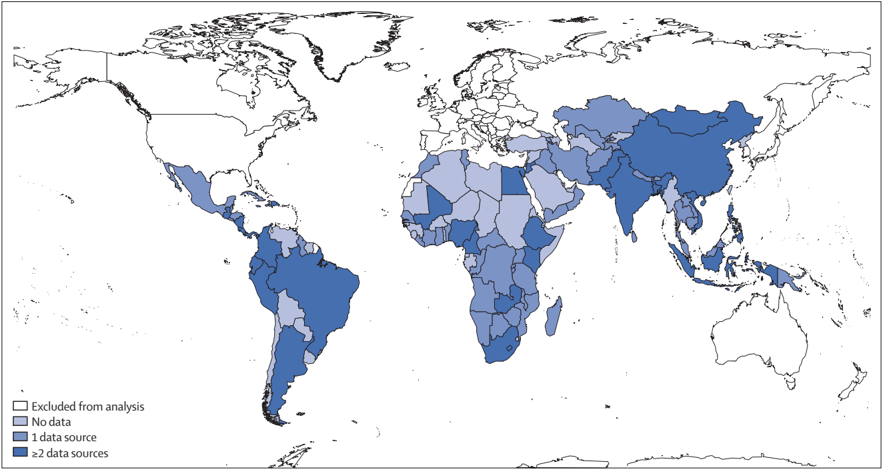
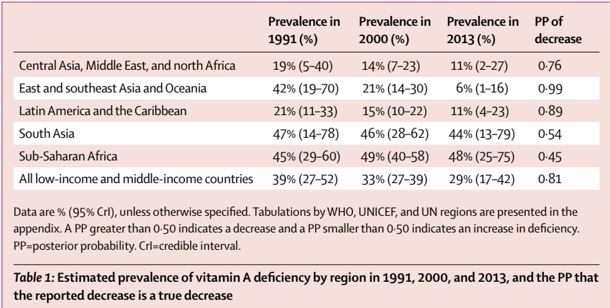
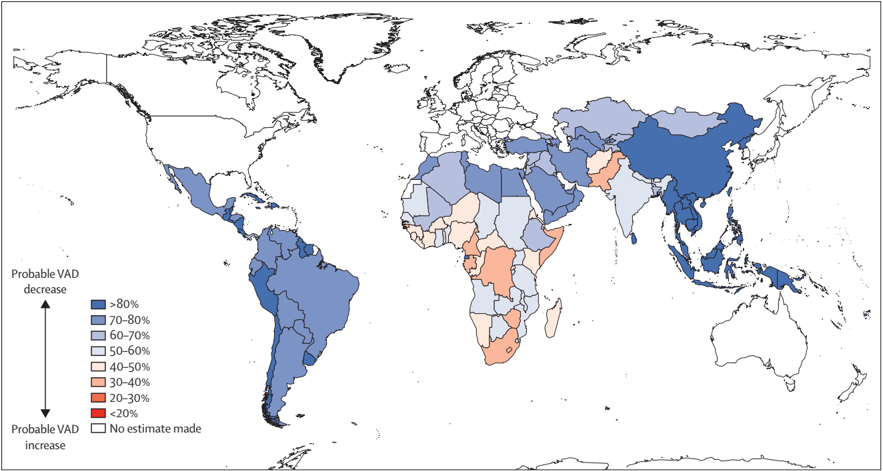
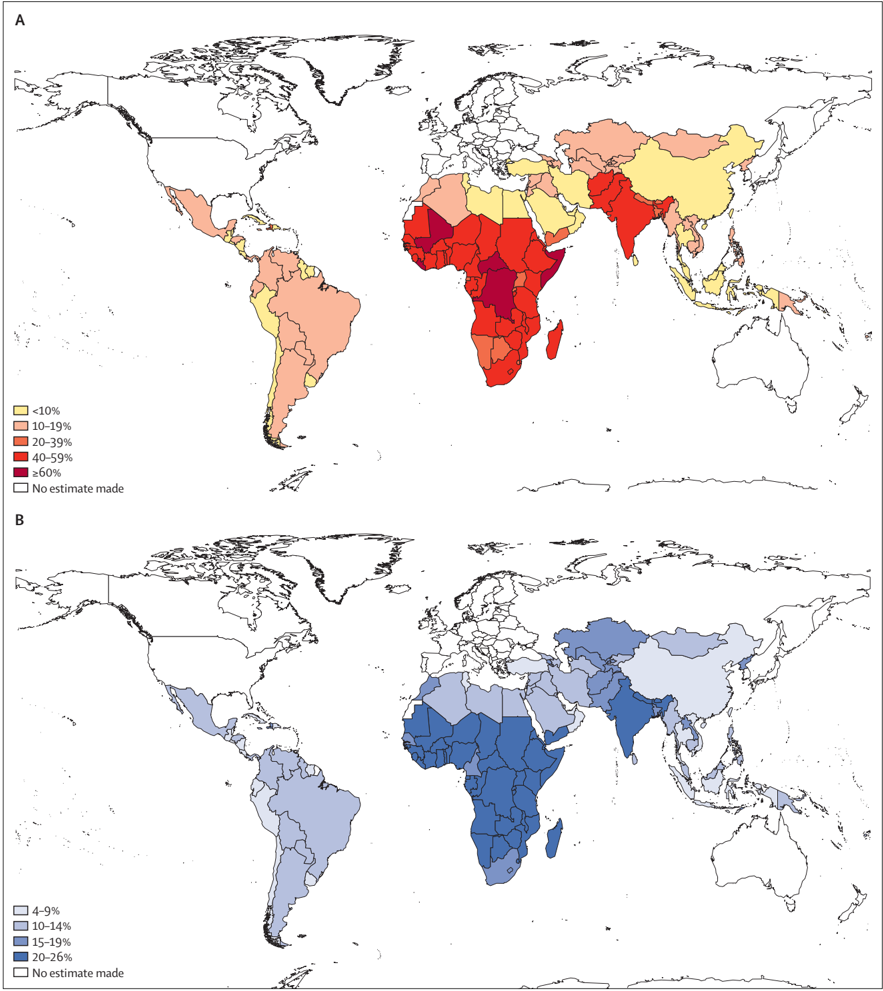
BACKGROUND: Vitamin A deficiency is a risk factor for blindness and for mortality from measles and diarrhoea in children aged 6-59 months. We aimed to estimate trends in the prevalence of vitamin A deficiency between 1991 and 2013 and its mortality burden in low-income and middle-income countries. METHODS: We collated 134 population-representative data sources from 83 countries with measured serum retinol concentration data. We used a Bayesian hierarchical model to estimate the prevalence of vitamin A deficiency, defined as a serum retinol concentration lower than 0·70 μmol/L. We estimated the relative risks (RRs) for the effects of vitamin A deficiency on mortality from measles and diarrhoea by pooling effect sizes from randomised trials of vitamin A supplementation. We used information about prevalences of deficiency, RRs, and number of cause-specific child deaths to estimate deaths attributable to vitamin A deficiency. All analyses included a systematic quantification of uncertainty. FINDINGS: In 1991, 39% (95% credible interval 27-52) of children aged 6-59 months in low-income and middle-income countries were vitamin A deficient. In 2013, the prevalence of deficiency was 29% (17-42; posterior probability [PP] of being a true decline=0·81). Vitamin A deficiency significantly declined in east and southeast Asia and Oceania from 42% (19-70) to 6% (1-16; PP>0·99); a decline in Latin America and the Caribbean from 21% (11-33) to 11% (4-23; PP=0·89) also occurred. In 2013, the prevalence of deficiency was highest in sub-Saharan Africa (48%; 25-75) and south Asia (44%; 13-79). 94 500 (54 200-146 800) deaths from diarrhoea and 11 200 (4300-20 500) deaths from measles were attributable to vitamin A deficiency in 2013, which accounted for 1·7% (1·0-2·6) of all deaths in children younger than 5 years in low-income and middle-income countries. More than 95% of these deaths occurred in sub-Saharan Africa and south Asia. INTERPRETATION: Vitamin A deficiency remains prevalent in south Asia and sub-Saharan Africa. Deaths attributable to this deficiency have decreased over time worldwide, and have been almost eliminated in regions other than south Asia and sub-Saharan Africa. This new evidence for both prevalence and absolute burden of vitamin A deficiency should be used to reconsider, and possibly revise, the list of priority countries for high-dose vitamin A supplementation such that a country's priority status takes into account both the prevalence of deficiency and the expected mortality benefits of supplementation. FUNDIN: Bill & Melinda Gates Foundation, Grand Challenges Canada, UK Medical Research Council.
Overview
The claims and statistics of this paper haven’t been checked yet.
Free: it reads the open-access text and checks the first 5 claims that cite a source we can check. Create a free account to check every claim.
Integrity signals
Registry
Cites
Statistics
Figures
Verification
Claims the paper makes
The claims and statistics of this paper haven’t been checked yet.
Free: it reads the open-access text and checks the first 5 claims that cite a source we can check. Create a free account to check every claim.
Claims other papers make about this one
Each is checked against this paper’s own text: does it say what the citing paper says it does?
The source backs part of the claim, not all of it — or backs it for a different population, condition or comparison.
In the citing paper
“This is of special importance in infants and children, where this intervention reduces the rate of child morbidity and mortality.”
From Vitamin A Update: Forms, Sources, Kinetics, Detection, Function, Deficiency, Therapeutic Use and Toxicity (2021) · cites this paper as [336]
Experimental — accuracy not yet measuredThe source backs part of the claim, not all of it — or backs it for a different population, condition or comparison.
In the citing paper
“it is calculated that approximately one-third of the world’s infant population suffers from hypovitaminosis A”
From Vitamin A Update: Forms, Sources, Kinetics, Detection, Function, Deficiency, Therapeutic Use and Toxicity (2021) · cites this paper as [336]
Experimental — accuracy not yet measuredThe check wasn’t confident either way, so it gives no verdict — never disputed.
In the citing paper
“in developing countries, around 15% of all pregnant women suffer from this deficiency”
From Vitamin A Update: Forms, Sources, Kinetics, Detection, Function, Deficiency, Therapeutic Use and Toxicity (2021) · cites this paper as [336]
Experimental — accuracy not yet measured
Self-check
Percentages, sums and reported differences re-computed from the paper’s own numbers.
The self-check needs the paper’s full text.
Citations
Cites
Lim, S. S., Vos, T., Flaxman, A. D., Danaei, G., Shibuya, K., Adair-Rohani, H., AlMazroa, M. A., Amann, M., Anderson, H. R., Andrews, K. G., et al. (2012) · The Lancet · doi:10.1016/s0140-6736(12)61766-8 · Cited by 11,805
Self-citationMaternal and child undernutrition and overweight in low-income and middle-income countries
Black, R. E., Victora, C. G., Walker, S. P., Bhutta, Z. A., Christian, P., de Onis, M., Ezzati, M., Grantham-McGregor, S., Katz, J., Martorell, R., et al. (2013) · The Lancet · doi:10.1016/s0140-6736(13)60937-x · Cited by 8,475
Self-citationMaternal and child undernutrition: global and regional exposures and health consequences
Black, R. E., Allen, L. H., Bhutta, Z. A., Caulfield, L. E., de Onis, M., Ezzati, M., Mathers, C., & Rivera, J. (2008) · The Lancet · doi:10.1016/s0140-6736(07)61690-0 · Cited by 6,443
Self-citationFinucane, M. M., Stevens, G. A., Cowan, M. J., Danaei, G., Lin, J. K., Paciorek, C. J., Singh, G. M., Gutierrez, H. R., Lu, Y., Bahalim, A. N., et al. (2011) · The Lancet · doi:10.1016/s0140-6736(10)62037-5 · Cited by 4,050
Self-citationSelected major risk factors and global and regional burden of disease
Ezzati, M., Lopez, A. D., Rodgers, A., Vander Hoorn, S., & Murray, C. J. (2002) · The Lancet · doi:10.1016/s0140-6736(02)11403-6 · Cited by 3,594
Self-citationDanaei, G., Finucane, M. M., Lu, Y., Singh, G. M., Cowan, M. J., Paciorek, C. J., Lin, J. K., Farzadfar, F., Khang, Y.-H., Stevens, G. A., et al. (2011) · The Lancet · doi:10.1016/s0140-6736(11)60679-x · Cited by 3,568
Self-citationLiu, L., Oza, S., Hogan, D., Perin, J., Rudan, I., Lawn, J. E., Cousens, S., Mathers, C., & Black, R. E. (2015) · The Lancet · doi:10.1016/s0140-6736(14)61698-6 · Cited by 3,167
Self-citationGlobal burden of childhood pneumonia and diarrhoea
Walker, C. L. F., Rudan, I., Liu, L., Nair, H., Theodoratou, E., Bhutta, Z. A., O'Brien, K. L., Campbell, H., & Black, R. E. (2013) · The Lancet · doi:10.1016/s0140-6736(13)60222-6 · Cited by 2,356
Self-citationStevens, G. A., Finucane, M. M., De-Regil, L. M., Paciorek, C. J., Flaxman, S. R., Branca, F., Peña-Rosas, J. P., Bhutta, Z. A., & Ezzati, M. (2013) · The Lancet Global Health · doi:10.1016/s2214-109x(13)70001-9 · Cited by 1,932
Self-citationDanaei, G., Finucane, M. M., Lin, J. K., Singh, G. M., Paciorek, C. J., Cowan, M. J., Farzadfar, F., Stevens, G. A., Lim, S. S., Riley, L. M., et al. (2011) · The Lancet · doi:10.1016/s0140-6736(10)62036-3 · Cited by 1,239
Self-citation
Research works printed but not linked: 2
- 15. Rice AL, West KP, Black RE. Vitamin A defi ciency. In: Ezzati M, Lopez AD, Rodgers A, Murray CJL, eds. Comparative Quantifi cation of Health Risks. Geneva: World Health Organization; 2006: 211-56.
- 48. West KP Jr, Klemm RDW, Sommer A. Vitamin A saves lives. Sound science, sound policy. World Nutr 2010; 1: 211-29.
Cited by
Zhou, B., Lu, Y., Hajifathalian, K., Bentham, J., Di Cesare, M., Danaei, G., Bixby, H., Cowan, M., Ali, M., Taddei, C., et al. (2016) · The Lancet · doi:10.1016/s0140-6736(16)00618-8 · Cited by 4,311
Self-citationVictora, C. G., Christian, P., Vidaletti, L. P., Gatica-Domínguez, G., Menon, P., & Black, R. E. (2021) · The Lancet · doi:10.1016/s0140-6736(21)00394-9 · Cited by 883
Self-citationSafiri, S., Kolahi, A.-A., Noori, M., Nejadghaderi, S. A., Karamzad, N., Bragazzi, N. L., Sullman, M. J. M., Abdollahi, M., Collins, G. S., Kaufman, J. S., et al. (2021) · Journal of Hematology & Oncology · doi:10.1186/s13045-021-01202-2 · Cited by 583
Effective interventions to address maternal and child malnutrition: an update of the evidence
Keats, E. C., Das, J. K., Salam, R. A., Lassi, Z. S., Imdad, A., Black, R. E., & Bhutta, Z. A. (2021) · The Lancet Child & Adolescent Health · doi:10.1016/s2352-4642(20)30274-1 · Cited by 525
“Unfortunately, relatively few programmes have evaluated medium to long term outcomes for women, 20 a major limitation of most inter ventions among women of reproductive age.”
Self-citationMoss, W. J. (2017) · The Lancet · doi:10.1016/s0140-6736(17)31463-0 · Cited by 530
Imdad, A., Mayo-Wilson, E., Herzer, K., & Bhutta, Z. A. (2017) · Cochrane Database of Systematic Reviews · doi:10.1002/14651858.cd008524.pub3 · Cited by 513
Self-citationCarazo, A., Macáková, K., Matoušová, K., Krčmová, L. K., Protti, M., & Mladěnka, P. (2021) · Nutrients · doi:10.3390/nu13051703 · Cited by 461
Epidemiology of blindness in children
Solebo, A. L., Teoh, L., & Rahi, J. (2017) · Archives of Disease in Childhood · doi:10.1136/archdischild-2016-310532 · Cited by 383
Global estimation of dietary micronutrient inadequacies: a modelling analysis
Passarelli, S., Free, C. M., Shepon, A., Beal, T., Batis, C., & Golden, C. D. (2024) · The Lancet Global Health · doi:10.1016/s2214-109x(24)00276-6 · Cited by 314
Tam, E., Keats, E. C., Rind, F., Das, J. K., & Bhutta, Z. A. (2020) · Nutrients · doi:10.3390/nu12020289 · Cited by 267
“Worldwide, an estimated 43% of children under-five have anemia [2], 29% of children under-five in LMICs are deficient in vitamin A [3], 30% of school-aged children have insufficient iodine intake [4], and 17% of the population are deficient in zinc [5], despite a considerable degree of uncertainty in these estimates.”
BackgroundSelf-citationProspects and challenges of fish for food security in Africa
Chan, C. Y., Tran, N., Pethiyagoda, S., Crissman, C. C., Sulser, T. B., & Phillips, M. J. (2019) · Global Food Security · doi:10.1016/j.gfs.2018.12.002 · Cited by 240
Harika, R., Faber, M., Samuel, F., Kimiywe, J., Mulugeta, A., & Eilander, A. (2017) · Nutrients · doi:10.3390/nu9101096 · Cited by 236
“Globally anaemia and VAD prevalence in women are decreasing; however, regions of Africa (and Southeast Asia) still have alarming rates of anaemia in WRA, including PW, and the prevalence of VAD is also reported to be high in PW [14,15].”
BackgroundKeats, E. C., Neufeld, L. M., Garrett, G. S., Mbuya, M. N. N., & Bhutta, Z. A. (2019) · The American Journal of Clinical Nutrition · doi:10.1093/ajcn/nqz023 · Cited by 233
Self-citationVitamin A Supplementation Programs and Country-Level Evidence of Vitamin A Deficiency
Wirth, J., Petry, N., Tanumihardjo, S., Rogers, L., McLean, E., Greig, A., Garrett, G., Klemm, R., & Rohner, F. (2017) · Nutrients · doi:10.3390/nu9030190 · Cited by 232
“, who examined global trends in VAD from 1993 to 2013 [2] and reported a 10% reduction in the global VAD prevalence (from 39% in 1993 to 29% in 2013), noted that the majority of data on VA status are outdated, and the available data make it difficult to accurately estimate the global prevalence of VAD.”
BackgroundSelf-citationCost and affordability of nutritious diets at retail prices: Evidence from 177 countries
Bai, Y., Alemu, R., Block, S. A., Headey, D., & Masters, W. A. (2021) · Food Policy · doi:10.1016/j.foodpol.2020.101983 · Cited by 221
“Data on vitamin A deficiency (VAD) prevalence is from Stevens et al. (2015) which estimated VAD among children based on serum retinol concentrations using a Bayesian hierarchical model.”
Childhood diarrhoeal diseases in developing countries
Ugboko, H. U., Nwinyi, O. C., Oranusi, S. U., & Oyewale, J. O. (2020) · Heliyon · doi:10.1016/j.heliyon.2020.e03690 · Cited by 217
The Rise and Fall of Protein Malnutrition in Global Health
Semba, R. D. (2016) · Annals of Nutrition and Metabolism · doi:10.1159/000449175 · Cited by 219
Paul, J., Khanna, H., Kleidon, J., Hoang, P., Geijskes, J., Daniells, J., Zaplin, E., Rosenberg, Y., James, A., Mlalazi, B., et al. (2017) · Plant Biotechnology Journal · doi:10.1111/pbi.12650 · Cited by 205
“Plant Biotechnology Journal published by Society for Experimental Biology and The Association of Applied Biologists and John Wiley & Sons Ltd., 15, 520–532 29% in 2013 in low- and middle-income countries (Stevens et al., 2015).”
BackgroundInfluentialHwalla, N., Al Dhaheri, A., Radwan, H., Alfawaz, H., Fouda, M., Al‐Daghri, N., Zaghloul, S., & Blumberg, J. (2017) · Nutrients · doi:10.3390/nu9030229 · Cited by 182
Han, X., Ding, S., Lu, J., & Li, Y. (2022) · eClinicalMedicine · doi:10.1016/j.eclinm.2022.101299 · Cited by 170
Lee, S., & Kelleher, S. L. (2016) · American Journal of Physiology-Endocrinology and Metabolism · doi:10.1152/ajpendo.00495.2015 · Cited by 188
Hidden hunger in South Asia: a review of recent trends and persistent challenges
Harding, K. L., Aguayo, V. M., & Webb, P. (2017) · Public Health Nutrition · doi:10.1017/s1368980017003202 · Cited by 181
“Disaggregated by country, modelled data indicate that Sri Lanka and the Maldives have achieved substantial reductions in VAD among children since 1991 and Bangladesh has made some progress (Fig.”
BackgroundInfluentialA review of the contribution of cowpea leaves to food and nutrition security in East Africa
Owade, J. O., Abong, G. O., OKOTH, M. W., & Mwang’ombe, A. W. (2019) · Food Science & Nutrition · doi:10.1002/fsn3.1337 · Cited by 129
“The burden of malnutrition in SSA is pronounced especially among the under five-year-old children and pregnant mothers (Stevens et al., 2015).”
BackgroundGlobal Update and Trends of Hidden Hunger, 1995-2011: The Hidden Hunger Index
Ruel‐Bergeron, J. C., Stevens, G. A., Sugimoto, J. D., Roos, F. F., Ezzati, M., Black, R. E., & Kraemer, K. (2015) · PLoS ONE · doi:10.1371/journal.pone.0143497 · Cited by 142
“Maintaining the same methodology used in the first HHI paper [3], the analysis presented here aims to complement and extend the information on hidden hunger provided earlier, using newly available data on vitamin A status [8] and iron deficiency anemia [9].”
MethodSelf-citationImdad, A., Mayo-Wilson, E., Haykal, M. R., Regan, A., Sidhu, J., Smith, A., & Bhutta, Z. A. (2022) · Cochrane Database of Systematic Reviews · doi:10.1002/14651858.cd008524.pub4 · Cited by 128
Self-citationGlobal Burden of Vitamin A Deficiency in 204 Countries and Territories from 1990–2019
Zhao, T., Liu, S.-W., Zhang, R., Zhao, Z.-P., Yu, H., Pu, L.-Y., Wang, L., & Han, L.-Y. (2022) · Nutrients · doi:10.3390/nu14050950 · Cited by 97
“The prevalence of VAD in low-income regions is high although the global mortality rate due to VAD has fallen sharply [21].”
BackgroundLow, J. W., & Thiele, G. (2019) · Agricultural Systems · doi:10.1016/j.agsy.2019.102770 · Cited by 114
“The development and scaling of OFSP during the past 25 years is a case study of a disruptive innovation1 (Bower and Christensen, 1995) to address a pressing need – the high levels of vitamin A deficiency among children under five years of age, with a prevalence rate still around 48% in 2013 (Stevens et al., 2015).”
BackgroundAmimo, J. O., Michael, H., Chepngeno, J., Raev, S. A., Saif, L. J., & Vlasova, A. N. (2022) · Nutrients · doi:10.3390/nu14235038 · Cited by 119
“The World Health Organization (WHO) has listed VAD as one of the leading micronutrient deficiencies affecting children and women mostly in developing countries [17].”
BackgroundGoredema-Matongera, N., Ndhlela, T., Magorokosho, C., Kamutando, C. N., van Biljon, A., & Labuschagne, M. T. (2021) · Nutrients · doi:10.3390/nu13031039 · Cited by 109
“Vitamin A deficiency prevalence in Africa is estimated at approximately 48%, indicating a linear increase from the 40% reported in 1991 [33].”
BackgroundPollinator Deficits, Food Consumption, and Consequences for Human Health: A Modeling Study
Smith, M. R., Mueller, N. D., Springmann, M., Sulser, T. B., Garibaldi, L. A., Gerber, J., Wiebe, K., & Myers, S. S. (2022) · Environmental Health Perspectives · doi:10.1289/ehp10947 · Cited by 116
“Although falling globally, there are still substantial global burdens of disease from these de fi ciencies, 8 and pollinator-dependent crops are responsible for a large share of these nutrients in the global diet.”
Global food nutrients analysis reveals alarming gaps and daunting challenges
Wang, X., Dou, Z., Feng, S., Zhang, Y., Ma, L., Zou, C., Bai, Z., Lakshmanan, P., Shi, X., Liu, D., et al. (2023) · Nature Food · doi:10.1038/s43016-023-00851-5 · Cited by 110
Impact of Vitamin A and Carotenoids on the Risk of Tuberculosis Progression
Aibana, O., Franke, M. F., Huang, C.-C., Galea, J. T., Calderon, R., Zhang, Z., Becerra, M. C., Smith, E. R., Ronnenberg, A. G., Contreras, C., et al. (2017) · Clinical Infectious Diseases · doi:10.1093/cid/cix476 · Cited by 98
Siwela, M., Pillay, K., Govender, L., Lottering, S., Mudau, F. N., Modi, A. T., & Mabhaudhi, T. (2020) · Foods · doi:10.3390/foods9060815 · Cited by 120
“Vitamin A deficiency (VAD) is the main cause of preventable night blindness, childhood morbidity and mortality [4].”
BackgroundHidden Hunger in the Age of Abundance: The Nutritional Pitfalls of Modern Staple Crops
Yılmaz, H., & YILMAZ, A. (2025) · Food Science & Nutrition · doi:10.1002/fsn3.4610 · Cited by 114
Harika, R. K., Faber, M., Samuel, F. O., Mulugeta, A., Kimiywe, J. O., & Eilander, A. (2017) · Food and Nutrition Bulletin · doi:10.1177/0379572117715818 · Cited by 120
“The prevalence for VAD in children aged <5 years in the 4 countries are lower than the 48% (95% CI 25%-75%) prevalence estimated by the WHO from studies published 1991 to 2013 in sub-Saharan African <5 years children.(7) The higher estimates from WHO could be due to inclusion of African countries with a higher prevale…”
Song, P., Adeloye, D., Li, S., Zhao, D., Ye, X., Pan, Q., Qiu, Y., Zhang, R., & Rudan, I. (2023) · Journal of Global Health · doi:10.7189/jogh.13.04084 · Cited by 94
“Despite widespread implementation, including supplementation, fortification and diversified diets, in approximately 100 countries globally, hundreds of millions of preschool children are still affected, mostly residing in sub-Saharan Africa and South-East Asia Region (SEAR) [1].”
BackgroundInfluentialDe-Regil, L. M., Jefferds, M. E. D., & Peña-Rosas, J. P. (2017) · Cochrane Database of Systematic Reviews · doi:10.1002/14651858.cd009666.pub2 · Cited by 92
Self-citationThe Burden of Malnutrition and Fatal COVID-19: A Global Burden of Disease Analysis
Mertens, E., & Peñalvo, J. L. (2021) · Frontiers in Nutrition · doi:10.3389/fnut.2020.619850 · Cited by 101
“Child growth failure, including child underweight, child wasting, and child stunting, is a common indicator of malnutrition among children under 5 years old (22), whereas iron deficiency is the most widespread micronutrient deficiency worldwide affecting all layers of the population (23), followed by vitamin A deficie…”
BackgroundMultidimensional characterization of global food supply from 1961 to 2013
Bentham, J., Singh, G. M., Danaei, G., Green, R., Lin, J. K., Stevens, G. A., Farzadfar, F., Bennett, J. E., Di Cesare, M., Dangour, A. D., et al. (2020) · Nature Food · doi:10.1038/s43016-019-0012-2 · Cited by 91
Self-citationKoç, E., & Karayiğit, B. (2021) · Journal of soil science and plant nutrition · doi:10.1007/s42729-021-00663-1 · Cited by 103
Larson, L. M., Namaste, S. M. L., Williams, A. M., Engle‐Stone, R., Addo, O. Y., Suchdev, P. S., Wirth, J. P., Temple, V. J., Serdula, M. K., & Northrop, C. A. (2017) · American Journal of Clinical Nutrition · doi:10.3945/ajcn.116.142166 · Cited by 89
“Thus, the adjusted prevalence estimates presented here cannot be compared with previous estimates that do not account for inflammation (38).”
ResultSustaining planetary health through systems thinking: Public health's critical role
Iyer, H. S., DeVille, N. V., Stoddard, O. P., Cole, J., Myers, S. S., Li, H., Elliott, E. G., Jimenez, M. P., James, P., & Golden, C. D. W. (2021) · SSM - Population Health · doi:10.1016/j.ssmph.2021.100844 · Cited by 98
“…& Black, 2004; Wessells and Brown, 2012), vitamin A (Global Prevalence of Vitamin A Deficiency in Populations at Risk 1995–2005: WHO Global Database on Vitamin A Deficiency, 2009; Stevens et al., 2015), and protein (de Onís, Monteiro, Akré, & Glugston, 1993; Medek, Schwartz, & Myers, 2017).”
BackgroundRetinoid metabolism: new insights
Gudas, L. J. (2022) · Journal of Molecular Endocrinology · doi:10.1530/jme-22-0082 · Cited by 93
Patterns in child stunting by age: A cross‐sectional study of 94 low‐ and middle‐income countries
Karlsson, O., Kim, R., Moloney, G. M., Hasman, A., & Subramanian, S. V. (2023) · Maternal and Child Nutrition · doi:10.1111/mcn.13537 · Cited by 91
“Further, at age 6 – 59 months, regular supplementation of high ‐ dose vitamin A can improve immune function and reduce diarrhoea incidence (Stevens et al., 2015; UNICEF, 2021b).”
Fortification of rice with vitamins and minerals for addressing micronutrient malnutrition
Peña‐Rosas, J. P., Mithra, P., Unnikrishnan, B., Kumar, N., De‐Regil, L. M., Nair, N. S., Garcia‐Casal, M. N., & Solon, J. A. (2019) · Cochrane Database of Systematic Reviews · doi:10.1002/14651858.cd009902.pub2 · Cited by 92
Self-citationGut Commensals Expand Vitamin A Metabolic Capacity of the Mammalian Host
Bonakdar, M., Czuba, L. C., Han, G., Zhong, G. G., Luong, H. T., Isoherranen, N., & Vaishnava, S. (2022) · Cell Host & Microbe · doi:10.1016/j.chom.2022.06.011 · Cited by 83
Sustainable Food Security and Nutritional Challenges
Hussain, M. A., Li, L., Kalu, K. A., Wu, X., & Naumovski, N. (2025) · Sustainability · doi:10.3390/su17030874 · Cited by 84
Medeiros, P. H. Q. S., Pinto, D. V., de Almeida, J. Z., Rêgo, J. M. D. C., Rodrigues, F. A. P., Lima, A. Â. M., Bolick, D. T., Guerrant, R. L., & Oriá, R. B. (2018) · Nutrients · doi:10.3390/nu10091128 · Cited by 85
“Mortality related to vitamin A deficiency in these settings has also declined throughout the past decades [74].”
BackgroundInfluentialThe Biological Role of Vitamins in Athletes’ Muscle, Heart and Microbiota
Brancaccio, M., Mennitti, C., Cesaro, A., Fimiani, F., Vano, M., Gargiulo, B., Caiazza, M., Amodio, F., Coto, I., D’Alicandro, G., et al. (2022) · International Journal of Environmental Research and Public Health · doi:10.3390/ijerph19031249 · Cited by 64
Fortification of staple foods with vitamin A for vitamin A deficiency.
Hombali, A., Solon, J., Venkatesh, B., Nair, N. S., & Peña-Rosas, J. P. (2019) · Cochrane Database of Systematic Reviews · doi:10.1002/14651858.cd010068.pub2 · Cited by 58
Light quality-induced changes of carotenoid composition in pak choi Brassica rapa ssp. chinensis
Frede, K., Schreiner, M., & Baldermann, S. (2019) · Journal of Photochemistry and Photobiology B Biology · doi:10.1016/j.jphotobiol.2019.02.001 · Cited by 69
Palmer, A., Healy, K., Barffour, M. A., Siamusantu, W., Chileshe, J., Schulze, K. J., West, K. P., & Labrique, A. B. (2016) · Journal of Nutrition · doi:10.3945/jn.116.239202 · Cited by 67
Rapid diagnostic testing platform for iron and vitamin A deficiency
Lu, Z.-D., O'Dell, D., Srinivasan, B., Rey, E. G., Wang, R.-S., Vemulapati, S., Mehta, S., & Erickson, D. (2017) · Proceedings of the National Academy of Sciences of the United States of America · doi:10.1073/pnas.1711464114 · Cited by 61
“VAD causes night blindness, mostly among children and pregnant women, affecting about 29% of the population in low- and mid-income countries (2).”
BackgroundSuccessful delivery of nutrition programs and the sustainable development goals
de Romaña, D. L., Greig, A., Thompson, A., & Arabi, M. (2021) · Current Opinion in Biotechnology · doi:10.1016/j.copbio.2021.03.004 · Cited by 79
Mohammadi, Y., Parsaeian, M., Mehdipour, P., Khosravi, A., Larijani, B. A., Sheidaei, A., Mansouri, A., Kasaeian, A., Yazdani, K., Moradi‐Lakeh, M., et al. (2017) · The Lancet Global Health · doi:10.1016/s2214-109x(17)30105-5 · Cited by 72
Yazdani, M., Tavakoli, O., Khoobi, M., Wu, Y. S. S., Faramarzi, M. A., Gholibegloo, E., & Farkhondeh, S. (2021) · Journal of Inclusion Phenomena and Macrocyclic Chemistry · doi:10.1007/s10847-021-01100-7 · Cited by 65
“The global prevalence of vitamin A deficiency has decreased owing to vitamin A supplementation and food fortification programs, but there continues to be a need to fortify food and beverages based on the dietary constraints of diverse populations [1, 2].”
White, J. M., Beal, T., Arsenault, J. E., Okronipa, H., Hinnouho, G., Chimanya, K., Matji, J., & Garg, A. (2021) · Nutrition Reviews · doi:10.1093/nutrit/nuaa142 · Cited by 67
“achieved in sub-Saharan Africa: VAD prevalence was 45% in 1991 and is 48% today.(3) An estimated 69% and”
BackgroundHealth Considerations for Immigrant and Refugee Children
Kroening, A. L. H., & Dawson-Hahn, E. E. (2019) · Advances in Pediatrics · doi:10.1016/j.yapd.2019.04.003 · Cited by 70
Imdad, A., Ahmed, Z., & Bhutta, Z. A. (2016) · Cochrane Database of Systematic Reviews · doi:10.1002/14651858.cd007480.pub3 · Cited by 58
Self-citationSrivastava, S., & Kumar, S. (2021) · BMC Public Health · doi:10.1186/s12889-021-10601-6 · Cited by 57
“Further, VAD was positively associated with stunting and wasting among children [15].”
BackgroundFate of β-Carotene within Loaded Delivery Systems in Food: State of Knowledge
Maurya, V. K., Shakya, A., Aggarwal, M., Muthukaliannan, G. K., Bohn, T., & Pareek, S. (2021) · Antioxidants · doi:10.3390/antiox10030426 · Cited by 59
“Though its multifunctionality in humans is yet to be fully understood, several epidemiologic studies have demonstrated its relationship to a decreased incidence of chronic diseases such as blindness [27], xerophthalmia [28], cancer [29], cardiovascular diseases [30], diabetes [31] and premature death [32] and found to…”
BackgroundAghaji, A. E., Duke, R. E., & Aghaji, U. C. W. (2019) · BMC Public Health · doi:10.1186/s12889-019-6413-1 · Cited by 62
“A recent review indicated that although only 1.7% of the under-five mortality in low- and middle-income countries was attributed to VAD, 95% of these deaths occurred in sub-Saharan Africa and south Asia where 2% of deaths (same in both regions) were attributed to VAD [2].”
BackgroundInfluentialGMOs in Africa: Status, adoption and public acceptance
Gbadegesin, L. A., Ayeni, E. A., Tettey, C. K., Uyanga, V. A., Aluko, O. O., Ahiakpa, J. K., Okoye, C. O., Mbadianya, J. I., Adekoya, M. A., Aminu, R. O., et al. (2022) · Food Control · doi:10.1016/j.foodcont.2022.109193 · Cited by 68
Dubock, A. C. (2017) · Agriculture & Food Security · doi:10.1186/s40066-017-0135-3 · Cited by 63
“Yet vitamin A deficiency remains a very significant public health problem [23, 34], principally associated with poverty, and one that is preventable at low cost [21].”
BackgroundBrown, K. H., Moore, S. E., Hess, S. Y., McDonald, C. M., Jones, K. S., Meadows, S., Manger, M. S., Coates, J., Alayón, S., & Osendarp, S. J. M. (2021) · American Journal of Clinical Nutrition · doi:10.1093/ajcn/nqab173 · Cited by 60
“(3) reported that only 83 countries produced relevant information for vitamin A”
BackgroundSangija, F., Martin, H., & Matemu, A. O. (2021) · Comprehensive Reviews in Food Science and Food Safety · doi:10.1111/1541-4337.12756 · Cited by 62
“However, AIVs arewasted (Global Panel, 2018; Stevens et al., 2015) despite the favorable climatic conditions and high production; they account for 50% of postharvest losses (PHL) of all food produced in SSA (Global Panel, 2018; Weinberger & Msuya, 2004).”
BackgroundAllow Golden Rice to save lives
Wu, F., Wesseler, J., Zilberman, D., Russell, R. M., Chen, C., & Dubock, A. C. (2021) · Proceedings of the National Academy of Sciences · doi:10.1073/pnas.2120901118 · Cited by 63
Biofortification’s contribution to mitigating micronutrient deficiencies
Li, J., Martin, C. R., & Fernie, A. R. (2024) · Nature Food · doi:10.1038/s43016-023-00905-8 · Cited by 60
“Biofortification through breeding activities of HarvestPlus has been effectively, perhaps pragmatically, restricted to increasing provitamin A/β-carotene, iron and zinc, specifically in staple crops for LMICs in Africa, Asia, Central America and South America 3,12 .”
InfluentialStrebel, P. M., Papania, M. J., Gastañaduy, P. A., & Goodson, J. L. (2017) · Elsevier eBooks · doi:10.1016/b978-0-323-35761-6.00037-7 · Cited by 65
Global patterns in vision loss burden due to vitamin A deficiency from 1990 to 2017
Xu, Y., Shan, Y., Lin, X., Qi, M., Lou, L., Wang, Y., & Ye, J. (2021) · Public Health Nutrition · doi:10.1017/s1368980021001324 · Cited by 57
“In our research, the vision loss burden due to VAD was concentrated in countries with lower socio-economic status, such as Sub-Saharan Africa, South Asia, North Africa and Middle East.”
InfluentialInfectious eye disease in the 21st century—an overview
Clare, G., Kempen, J. H., & Pavesio, C. E. (2024) · Eye · doi:10.1038/s41433-024-02966-w · Cited by 60
“While vitamin A deficiency worldwide has been decreasing worldwide [61], the impact of food poverty due to conflict and global warming may be significant this century.”
BackgroundSong, P., Wang, J., Wei, W., Chang, X., Wang, M., & An, L. (2017) · Nutrients · doi:10.3390/nu9121285 · Cited by 56
“However, this finding is not entirely consistent with the global declining trend of VAD prevalence during the past two decades [15].”
BackgroundResultInfluentialObesity rise plateaus in developed nations and accelerates in developing nations
Zhou, B., Phelps, N. H., Galeazzi, A., O'Driscoll, O. N., Bennett, J. E., Jain, L., Brisis, Y. D. D., Barradas‐Pires, A., Deo, F., Stevens, G. A., et al. (2026) · Nature · doi:10.1038/s41586-026-10383-0 · Cited by 68
“The statistical methods for analysis of pooled data, including its implementation and computation, are described in detail in a statistical paper 79 and related substantive papers 1,9,10,56,71,80,81 .”
Self-citationDiab, L., & Krebs, N. F. (2018) · Pediatrics in Review · doi:10.1542/pir.2016-0068 · Cited by 59
Cruet-Burgos, C. M., Cox, S., Ioerger, B. P., Perumal, R., Hu, Z., Herald, T. J., Bean, S. R., & Rhodes, D. (2020) · The Plant Genome · doi:10.1002/tpg2.20013 · Cited by 52
A Review on Prevention Interventions to Decrease Diarrheal Diseases’ Burden in Children
Webb, C. M., & Cabada, M. M. (2018) · Current Tropical Medicine Reports · doi:10.1007/s40475-018-0134-x · Cited by 56
High-yield paper-based quantitative blood separation system
Lu, Z., Rey, E. G., Vemulapati, S., Srinivasan, B., Mehta, S., & Erickson, D. (2018) · Lab on a Chip · doi:10.1039/c8lc00717a · Cited by 52
Global Burden of Nutritional Deficiencies among Children under 5 Years of Age from 2010 to 2019
Yue, T., Zhang, Q., Li, G., & Qin, H. (2022) · Nutrients · doi:10.3390/nu14132685 · Cited by 49
“Vitamin A deficiency is an important cause of night blindness, exophthalmia and infectious diseases [17,18].”
BackgroundSelf-citationThe economics of malnutrition: Dietary transition and food system transformation
Masters, W. A., Finaret, A. B., & Block, S. (2022) · Handbook of agricultural economics · doi:10.1016/bs.hesagr.2022.03.006 · Cited by 70
Emmanuel, O. C., & Babalola, O. O. (2021) · International Journal of Agricultural Sustainability · doi:10.1080/14735903.2021.1940729 · Cited by 48
Engle‐Stone, R., Vosti, S. A., Luo, H., Kagin, J., Tarini, A., Adams, K. P., French, C. D., & Brown, K. H. (2019) · Annals of the New York Academy of Sciences · doi:10.1111/nyas.14128 · Cited by 49
“Advantages of this approach include: (1) leveraging available data for decision making, (2) offering a transparent framework for considering programbenefits and risks, (3) explicit consideration of program costs, and (4) flexibility to propose subnational strategies for addressing MN deficiencies.”
BackgroundMethodInfluentialZielinska-Pukos, M. A., & Hamułka, J. (2019) · International Journal of Environmental Research and Public Health · doi:10.3390/ijerph16214181 · Cited by 50
“Vitamin A deficiency, common in low- and middle-income countries, is related to increased mortality and morbidity [106].”
BackgroundMrimi, E. C., Palmeirim, M. S., Minja, E. G., Long, K. Z., & Keiser, J. (2022) · PLoS neglected tropical diseases · doi:10.1371/journal.pntd.0010261 · Cited by 60
“A higher dosage of oral-vitamin A supplementation (� 30 mg) to infants in areas with a high prevalence of deficiency, as recommended by the World Health Organization (WHO), has resulted in a 10% reduction in prevalence of vitamin A deficiency [11,12].”
BackgroundOlaosebikan, O., Abdulrazaq, B., Owoade, D., Ogunade, A., Aina, O., Ilona, P., Muheebwa, A., Teeken, B., Iluebbey, P., Kulakow, P., et al. (2018) · Physiological and Molecular Plant Pathology · doi:10.1016/j.pmpp.2018.11.007 · Cited by 49
“In Nigeria, the world's largest producer and consumer of cassava products, hidden hunger in form of Vitamin A Deficiency (VAD) affects 30% of children under the age of 5 years and 20% of pregnant women [2–4] resulting in reduced immunity, impaired vision, and, in some cases, blindness and even death [5,6].”
BackgroundIsmail, L. C., Dhaheri, A. S. A., Ibrahim, S., Ali, H. I., Chokor, F. A. Z., O’Neill, L. M., Mohamad, M. N., Kassis, A. N., Ayesh, W. H., Kharroubi, S. A., et al. (2022) · BMC Public Health · doi:10.1186/s12889-022-12616-z · Cited by 53
“Farrag NS, Cheskin LJ, Farag MK: A systematic review of childhood obesity in the Middle East and North Africa (MENA) region: Prevalence and risk factors meta-analysis.”
BackgroundInfluentialInfluence of Proteins on the Absorption of Lipophilic Vitamins, Carotenoids and Curcumin – A Review
Iddir, M., Vahid, F., Merten, D., Larondelle, Y., & Bohn, T. (2022) · Molecular Nutrition & Food Research · doi:10.1002/mnfr.202200076 · Cited by 45
Berde, A. S., Bester, P., & Kruger, I. M. (2019) · Public Health Nutrition · doi:10.1017/s1368980018004056 · Cited by 42
“Furthermore, in the regions of South Asia and SSA, vitamin A deficiency accounted for about 2% of child deaths((4)).”
BackgroundThe Pathogenesis of Cytomegalovirus and Other Viruses Associated with Hearing Loss: Recent Updates
Shi, X., Liu, X., & Sun, Y. (2023) · Viruses · doi:10.3390/v15061385 · Cited by 49
Socioeconomic factors associated with anemia among children aged 6-59 months in Namibia
Shimanda, P. P., Amukugo, H. J., & Norström, F. (2020) · Journal of Public Health in Africa · doi:10.4081/jphia.2020.1131 · Cited by 46
Prevalence of Dry Eye Disease in Africa: A Systematic Review and Meta‐analysis
Akowuah, P. K., & Kobia‐Acquah, E. (2020) · Optometry and Vision Science · doi:10.1097/opx.0000000000001610 · Cited by 47
Serum antioxidant vitamins and respiratory morbidity and mortality: a pooled analysis
Salo, P. M., Mendy, A., Wilkerson, J., Molsberry, S. A., Feinstein, L., London, S. J., Fessler, M. B., Thorne, P. S., & Zeldin, D. C. (2022) · Respiratory Research · doi:10.1186/s12931-022-02059-w · Cited by 42
Vitamin A in Nutritional Anemia
Gernand, A. D., Xu, X., & West, K. P. (2022) · Nutrition and health · doi:10.1007/978-3-031-14521-6_12 · Cited by 41
Harding, K. L., Aguayo, V. M., Masters, W. A., & Webb, P. (2018) · BMC Public Health · doi:10.1186/s12889-018-5312-1 · Cited by 48
“(2015) compiled data on VAD for 6– 59 month old children based on serum retinol concentrations from different population-representative sources that were then used to model prevalence estimates for every year between 1991 to 2013 for 138 low and middle income countries, using a Bayesian hierarchical model [38].”
MethodGannon, B. M., Valentine, A. R., Davis, C. R., Howe, J. A., & Tanumihardjo, S. A. (2018) · Journal of Nutrition · doi:10.1093/jn/nxy095 · Cited by 40
“9 in this study) and a constant for dose catabolism [e−kt where k = ln(2)/half-life in days (140 d), and t = time in d].”
BackgroundIntegrating primary eye care into global child health policies
Malik, A. N., Mafwiri, M., & Gilbert, C. E. (2017) · Archives of Disease in Childhood · doi:10.1136/archdischild-2017-313536 · Cited by 40
Ma, L., Xu, H., Zhang, Z., Li, L., Lin, Z., & Qin, H. (2023) · Preventive Medicine Reports · doi:10.1016/j.pmedr.2023.102396 · Cited by 44
Sivakumar, D., Phan, A. D. T., Slabbert, M. M., Sultanbawa, Y. F., & Remize, F. (2020) · Frontiers in Nutrition · doi:10.3389/fnut.2020.576532 · Cited by 44
Vitamin A Deficiency Due to Selective Eating as a Cause of Blindness in a High-Income Setting
Martini, S., Rizzello, A., Corsini, I., Romanin, B., Fiorentino, M., Grandi, S., & Bergamaschi, R. (2018) · PEDIATRICS · doi:10.1542/peds.2016-2628 · Cited by 37
Jeyam, A., Gibb, F. W., McKnight, J. A., Kennon, B., O’Reilly, J. E., Caparrotta, T. M., Höhn, A., McGurnaghan, S. J., Blackbourn, L. A. K., Hatam, S., et al. (2021) · Diabetologia · doi:10.1007/s00125-021-05413-7 · Cited by 40
Food Insecurity and Malnutrition of Africa: A Combined Attempt Can Reduce Them
Mohajan, H. K. (2022) · Journal of Economic Development Environment and People · doi:10.26458/jedep.v1i1.716 · Cited by 60
“The prevalence of vitamin A deficiency in young children and iron deficiency of women in SSA are the highest [Stevens et al., 2015].”
Background
Metadata
- Authors
- Stevens, G. A., Bennett, J. E., Hennocq, Q., Lu, Y., De-Regil, L. M., Rogers, L., Danaei, G., Li, G., White, R. A., Flaxman, S. R., Oehrle, S.-P., Finucane, M. M., Guerrero, R., Bhutta, Z. A., Then-Paulino, A., Fawzi, W., Black, R. E., & Ezzati, M.
- Affiliations
- World Health Organization (CH)
- MRC Centre for Environment and Health (GB)
- Harvard University (US)
- Norwegian Institute of Public Health (NO)
- Carnegie Mellon University (US)
- Mathematica Policy Research (US)
- Universidad Icesi (CO)
- Aga Khan University (PK)
- Universidad Autónoma de Santo Domingo (DO)
- Johns Hopkins University (US)
- Corresponding author
- Ezzati, Majid
- ORCID
- Venue
- The Lancet Global Health
- Publisher
- Elsevier BV
- Published
- 2015-09
- Volume
- 3
- Issue
- 9
- Pages
- e528-e536
- ISSN
- 2214-109X (ISSN-L)
- OpenAlex
- W2161245837
- Semantic Scholar
- 2479c3ef57898adfd02f8768d770d15657648143
- Cited by
- 572
- References
- 45
- Citations by year
- 2026: 38 · 2025: 46 · 2024: 54 · 2023: 63 · 2022: 85 · 2021: 71 · 2020: 66 · 2019: 46 · 2018: 36 · 2017: 38 · 2016: 25 · 2015: 4
- FWCI
- 33.06
- Type
- journal article
- Language
- en
- Open access
- gold
- doi.org
- Licence
- cc-by-nc-nd
- www.elsevier.com/tdm/userlicense/1.0/ (tdm)
- creativecommons.org/licenses/by-nc-nd/3.0/ (vor)
- Locations
- The Lancet Global Health (publishedVersion, cc-by-nc-nd)
- LA Referencia (Red Federada de Repositorios Institucionales de Publicaciones Científicas) (publishedVersion)
- PubMed (publishedVersion)
- Northumbria Research Link (Northumbria University) (acceptedVersion)
- Biblioteca Digital - Universidad Icesi (submittedVersion, cc-by-nc-nd)
- Digital Access to Scholarship at Harvard (DASH) (Harvard University) (submittedVersion, cc-by)
- DOAJ (DOAJ: Directory of Open Access Journals) (submittedVersion, cc-by-sa)
- NORA - Norwegian Open Research Archives (submittedVersion, other-oa)
- Spiral (Imperial College London) (submittedVersion, other-oa)
- Funders
- World Health Organization
- Wellcome Trust (100693)
- Medical Research Council (MR/K005901/1)
- Topics
- Health Sciences › Nursing › Nutrition and Dietetics › Child Nutrition and Water Access
- Health Sciences › Medicine › Pediatrics, Perinatology and Child Health › Global Maternal and Child Health
- Health Sciences › Medicine › Endocrinology, Diabetes and Metabolism › Vitamin D Research Studies
- Keywords
- vitamin A deficiency, children under five, prevalence trends, mortality burden, measles mortality, diarrhea mortality, serum retinol, vitamin A supplementation, childhood blindness, low- and middle-income countries, attributable mortality, sub-Saharan Africa, South Asia, Latin America and the Caribbean, East and Southeast Asia, Oceania, Bayesian hierarchical model, population survey, micronutrient deficiency
- MeSH terms
- Bayes Theorem, Child, Child, Preschool, Developing Countries, Female, Humans, Infant, Vitamin A Deficiency, Prevalence, Child Mortality
About these checks
Registry, retraction, Cites and statistics results are computed, not judged, with one exception: a printed reference that no index lists is read once by a model before it counts as a citation error. Claims are extracted by a model and kept only when their quote appears verbatim in the text; each cited source is then checked, with a model’s help, for whether it says what the claim relies on. Those verdicts can be wrong — read the claim’s quote and the cited source before relying on one.
Statistics and arithmetic are recomputed, not judged.
Confidence bands are shown only for fields calibrated on our annotated test set. None is calibrated yet, so no band is shown.
What counts as a claim ›How we measure confidence ›How we check this ›
Are you an author, or do you see a problem with this page? Request a review
Data sources
Bibliographic data: Semantic Scholar, OpenAlex, Crossref.
Contains information from the Semantic Scholar Academic Graph Datasets, made available under the ODC Attribution License (ODC-BY 1.0).
Semantic Scholar’s data is described in: Kinney, R., et al. (2023). The Semantic Scholar Open Data Platform. arXiv:2301.10140.
