

The Lancet Psychiatry Commission on youth mental health
Open accessThe DOI matches its Crossref record; 428 of the 442 references it cites were found in a registry or an index; 267 of the 518 sources its claims cite were checked for support.
Overview
CoChat Summary
TL;DR
This Lancet Psychiatry Commission argues that youth mental health is in a global crisis, with rising prevalence, early onset, and major care gaps, and calls for integrated, developmentally appropriate care, prevention, economic investment, and political reform. It synthesizes evidence across epidemiology, developmental science, models of care, economics, and politics to propose a blueprint for ages 12–25.
Key findings
- Mental illnesses have a peak age of onset of 15 years, with 63–75% of onsets by age 25; a meta-analysis of 192 epidemiological studies (708,561 individuals) found cumulative onset proportions of 34·6% by age 14, 48·4% by 18, and 62·5% by 25. Mental ill health accounts for at least 45% of the overall burden of disease in those aged 10–24 years.
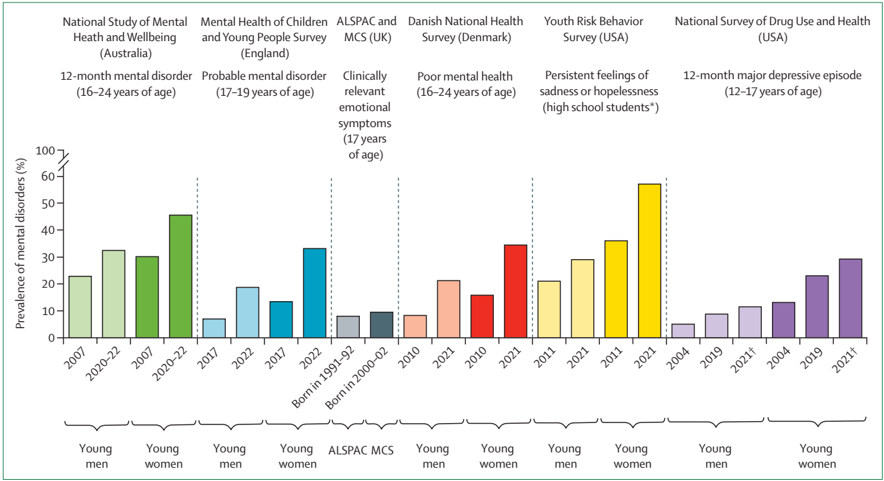
- In Australia’s national study (2020–22), diagnostic-level mental disorders in people aged 16–24 years rose 50% since 2007, reaching annual prevalence of 39% (nearly 50% in young women); 12-month prevalence rates were 32% for anxiety, 14% for affective, and 7·8% for substance use disorders, versus 15%, 6%, and 13% in 2007.
- Care gaps are severe: only 2% of global health budgets go to mental health; in the MILESTONE cohort of 763 young people, only 19·6% transitioned to adult services and 26·8% remained in child services after age 18; a 2022 UK survey found 58% deteriorated while waiting for care and 24% attempted suicide while waiting; 42% dropped out by the third therapy session, up to 80% with complex conditions relapsed, and one-third to two-thirds receiving interventions had no symptom reduction.
- Economic evidence supports investment: global cost of all mental disorders was estimated at US$2·5–8·5 trillion in 2010 and projected to double by 2030; every Australian dollar invested in school or university depression/anxiety prevention returns about AU$1·1–3·1; early intervention in psychosis showed 35% health-care savings per point of PANSS improvement in Hong Kong; lay-delivered therapy cost US$4 per student in India and US$13 per DALY averted in Uganda.
Methods
- This Commission is a synthesis of evidence across five key topics, using systematic reviews and meta-analyses where available and appropriate, plus publications deemed relevant to capture the current state of knowledge.
- An initial consultation meeting was held in July, 2019, bringing together experts across clinical psychology, psychiatry, neuroscience, epidemiology, social science, economics, and service reform, as well as young people from low-income, middle-income, and high-income countries.
- The Commission was developed by section Commissioners, youth Commissioners, and co-authors; it is not described as a systematic review with a formal search strategy, inclusion criteria, or risk-of-bias assessment.
Limitations
- The paper states that much of the data and practical reform has been limited to high-resource and middle-resource settings, that youth mental health reform in low-resource settings is only beginning, and that systematic monitoring of youth mental health trends in low-resource and middle-resource settings is relatively insufficient.
- The paper states that economic evidence generalisability is a challenge, that budget-effect questions are underexplored, and that evidence on social media and mental health is still emerging, with longitudinal and well controlled experimental studies scarce.
- Evident from the text: the Commission is a narrative synthesis rather than a systematic review, and many authors declare competing interests, including leadership, advisory, or financial ties to headspace, Orygen, digital mental health platforms, and other youth mental health services and programmes discussed.
Model-written summary. Check it against the paper before relying on it.
Integrity signals
Registry
Cites
Statistics
Figures
Verification
Claims the paper makes
166 Valid · 23 Not valid · 108 Not checked · 79 Own results and interpretations
Some cited sources support this claim and some don’t — read each source’s verdict below.
In the paper
“Other evidence for specific interventions targeting disorders that occur mainly in young people (such as depressive or eating disorders) have also been found to be highly cost-effective. 430-432”
What the sources say
- Not checked — no full text of the sourcecites [430] Le, 2017, The modeled cost-effectiveness of family-based and adolescent-focused treatment for anorexia nervosa, Int J Eat Disord source
- Partly supportedcites [431] Turner, 2017, Cost-effectiveness of a preferred intensity exercise programme for young people with depression compared with treatment as usual: an economic evaluation alongside a clinical trial in the UK, BMJ Open sourceExperimental — accuracy not yet measured
The Conclusion says preferred-intensity exercise could be cost-effective for adolescents with depression when measured by improvement in CDI-2 scores. But the Results > Outcomes and Discussion report substantial uncertainty and no evidence of a QALY improvement, so this study does not establish that the intervention is highly cost-effective. The paper addresses depression, not eating disorders. (LLM, conf=0.88)
- Disputedcites [432] Tie, 2019, Cost-effectiveness analysis of telephone cognitive-behaviour therapy for adolescents with obsessive-compulsive disorder, BJPsych Open sourceExperimental — accuracy not yet measured
The Discussion (Policy implications; page unavailable) says this study found no evidence that telephone CBT was cost-effective compared with face-to-face CBT for young people with OCD, particularly when measured by QALYs. It does not report a highly cost-effective intervention for depression or an eating disorder. (LLM, conf=0.86)
Checked by a reasoning model — may be wrong.
plainstates a cause- Asserted: passes — The authors put it forward as true.
- Checkable: passes — It can be checked against evidence.
- Load-bearing: unclear — It is unclear whether the paper’s conclusions depend on it.
- Based: passes — The paper gives a reason why it holds.
At least one cited source doesn’t support this claim or points to a different paper, and none confirmed it — see the verdicts below.
In the paper
“A trial of a similar programme in Kenya reported statistically significantly lower rates of depression in young men compared with young women. 439”
What the sources say
- Disputedcites [439] Kilburn, 2016, Effects of a large-scale unconditional cash transfer program on mental health outcomes of young people in Kenya, J Adolesc Health sourceExperimental — accuracy not yet measured
The Results (Sample characteristics) report depressive symptoms in 33% of participants, with no difference between young men and young women. The statistically significant finding was instead a lower prevalence among young men in the intervention group than among young men in the control group; it was not a significant comparison of men with women. (LLM, conf=0.87)
Checked by a reasoning model — may be wrong.
plainstates a cause- Asserted: passes — The authors put it forward as true.
- Checkable: passes — It can be checked against evidence.
- Load-bearing: unclear — It is unclear whether the paper’s conclusions depend on it.
- Based: passes — The paper gives a reason why it holds.
- Disputed
Every source the paper cites for this claim was checked and supports it.
In the paper
“The neglect of youth mental health can be partly ascribed to the stigma-based neglect of mental health worldwide.”
What the sources say
- Supportedcites [53] Thornicroft, 2022, The Lancet Commission on ending stigma and discrimination in mental health, Lancet source
In the section headed “Person in Botswana” (page not provided), the Commission reports worldwide evidence of stigma affecting young people with mental health conditions and describes families dismissing adolescents’ problems or creating barriers to seeking help. The “Personal impacts” section (page not provided) says stigma reduces help-seeking and health-service use, especially among young people with mental health conditions. Together, these passages support the claim’s qualified attribution of youth mental-health neglect partly to stigma. (LLM, conf=0.87)
plainstates a possible cause- Asserted: passes — The authors put it forward as true.
- Checkable: passes — It can be checked against evidence.
- Load-bearing: unclear — It is unclear whether the paper’s conclusions depend on it.
- Based: passes — The paper gives a reason why it holds.
- Supported
Every source the paper cites for this claim was checked and supports it.
In the paper
“In low-resource and middle-resource settings, availability and access to mental health services for young people are grossly inadequate.”
What the sources say
- Supportedcites [49] Zhou, 2020, Child and adolescent mental health policy in low- and middle-income countries: challenges and lessons for policy development and implementation, Front Psychiatry source
The Results section, under “The Shortage of CAMH Resources,” says mental health services and other resources are insufficient in low- and middle-income countries, with resources for children and adolescents scarcer than those for adults. It also reports that families commonly pay for these services out of pocket, supporting the claim about limited access. (LLM, conf=0.93)
plain- Asserted: passes — The authors put it forward as true.
- Checkable: passes — It can be checked against evidence.
- Load-bearing: passes — The paper’s conclusions depend on it.
- Based: passes — The paper gives a reason why it holds.
- Supported
The cited sources support only part of this claim — read each source’s verdict below.
In the paper
“Indigenous young people in many countries (eg, Australia, Canada, the USA, and India) have substantially higher rates of suicide than the general population.”
What the sources say
- Partly supportedcites [43] Troya, 2022, Suicide rates amongst individuals from ethnic minority backgrounds: a systematic review and meta-analysis, EClinicalMedicine sourceExperimental — accuracy not yet measured
The Discussion reports substantially higher suicide risk for Indigenous populations overall (RR 2.8), supporting the general comparison. The Results table includes youth studies in Australia, Canada, and the USA, but lists the India study as covering all ages; the cited passages do not establish elevated rates specifically among Indigenous young people across all four named countries. (LLM, conf=0.87)
plainstates an association- Asserted: passes — The authors put it forward as true.
- Checkable: passes — It can be checked against evidence.
- Load-bearing: unclear — It is unclear whether the paper’s conclusions depend on it.
- Based: passes — The paper gives a reason why it holds.
- Partly supported
160 more claims · 83 with their cited sources checked
Create a free account to see all 376 claims and to verify the 14 references still open.
- It may state two separate claims as one. 146
- Probably not a substantial claim. 88
- The quote only partly states this claim. 1
Claims other papers make about this one
Each is checked against this paper’s own text: does it say what the citing paper says it does?
The source backs part of the claim, not all of it — or backs it for a different population, condition or comparison.
In the citing paper
“The trend of rising mental health issues is not limited to Australia; it is reflected worldwide across various countries (McGorry et al., 2024).”
From Will restricting the age of access to social media reduce mental illness in Australian youth? (2025) · cites this paper as McGorry et al., 2024
Experimental — accuracy not yet measured
Self-check
Percentages, sums and reported differences re-computed from the paper’s own numbers.
Rated minor: it would not touch a result — a value no result rests on, a p-value that stays on the same side of the significance level, or a conflict that is clerical, resolved elsewhere in the paper, or outside its own findings.
In the paper
“the percentage of adolescents who reported being almost constantly online doubled over the previous 7 years (46% in 2022 vs 24% in 2017).”
Reported 7 · recomputed 5
Citations
Cites
The Ecology of Human Development: Experiments by Nature and Design
Bronfenbrenner, U. (1979) · Harvard University Press eBooks · doi:10.4159/9780674028845 · Cited by 26,084
Kessler, R. C., Berglund, P., Demler, O., Jin, R., Merikangas, K. R., & Walters, E. E. (2005) · Archives of General Psychiatry · doi:10.1001/archpsyc.62.6.593 · Cited by 20,391
Emerging adulthood: A theory of development from the late teens through the twenties.
Arnett, J. J. (2000) · American Psychologist · doi:10.1037/0003-066x.55.5.469 · Cited by 16,843
Digital Natives, Digital Immigrants Part 1
Prensky, M. (2001) · On the Horizon · doi:10.1108/10748120110424816 · Cited by 11,104
Positive Psychology Progress: Empirical Validation of Interventions.
Seligman, M. E. P., Steen, T. A., Park, N., & Peterson, C. (2005) · American Psychologist · doi:10.1037/0003-066x.60.5.410 · Cited by 5,947
Santomauro, D. F., Mantilla Herrera, A. M., Shadid, J., Zheng, P., Ashbaugh, C., Pigott, D. M., Abbafati, C., Adolph, C., Amlag, J. O., Aravkin, A. Y., et al. (2021) · The Lancet · doi:10.1016/s0140-6736(21)02143-7 · Cited by 5,444
Age at onset of mental disorders worldwide: Large-scale meta-analysis of 192 epidemiological studies
Solmi, M., Radua, J., Olivola, M., Croce, E., Soardo, L., Salazar de Pablo, G., Il Shin, J., Kirkbride, J. B., Jones, P., Kim, J. H., et al. (2022) · Molecular Psychiatry · doi:10.1038/s41380-021-01161-7 · Cited by 3,835
Self-citationOur future: a Lancet commission on adolescent health and wellbeing
Patton, G. C., Sawyer, S. M., Santelli, J. S., Ross, D. A., Afifi, R., Allen, N. B., Arora, M., Azzopardi, P., Baldwin, W., Bonell, C., et al. (2016) · The Lancet · doi:10.1016/s0140-6736(16)00579-1 · Cited by 3,785
The Lancet Commission on global mental health and sustainable development
Patel, V., Saxena, S., Lund, C., Thornicroft, G., Baingana, F., Bolton, P., Chisholm, D., Collins, P. Y., Cooper, J. L., Eaton, J., et al. (2018) · The Lancet · doi:10.1016/s0140-6736(18)31612-x · Cited by 3,692
Sawyer, S. M., Azzopardi, P. S., Wickremarathne, D., & Patton, G. C. (2018) · The Lancet Child & Adolescent Health · doi:10.1016/s2352-4642(18)30022-1 · Cited by 3,666
Research works printed but not linked: 2
- 5 Rutter M, Smith DJ, eds. Psychosocial disorders in young people: time trends and their causes. Chichester, West Sussex: John Wiley & Sons Ltd, 1995.
- Tan, 2019, Mental health of trans and gender diverse people in Aotearoa/New Zealand: a review of the social determinants of inequities, N Z J Psychol, 48, 64
Cited by
The youth mental health crisis: analysis and solutions
McGorry, P., Gunasiri, H., Mei, C., Rice, S., & Gao, C. X. (2025) · Frontiers in Psychiatry · doi:10.3389/fpsyt.2024.1517533 · Cited by 175
“The fi ndings of this review indicate a substantial rise in youth mental health issues including anxiety, psychological distress, self-harm, suicide, and depressive symptoms, contributing to a global youth mental health crisis as highlighted by a recent Lancet Commission on youth mental health (14).”
InfluentialSelf-citationDigital interventions in mental health: An overview and future perspectives
Löchner, J., Carlbring, P., Schuller, B. W., Torous, J. B., & Sander, L. (2025) · Internet Interventions · doi:10.1016/j.invent.2025.100824 · Cited by 208
A call to action: the second Lancet Commission on adolescent health and wellbeing
Baird, S., Choonara, S., Azzopardi, P. S., Banati, P., Bessant, J., Biermann, O., Capon, A. G., Claeson, M., Collins, P. Y., Wet, N. D., et al. (2025) · The Lancet · doi:10.1016/s0140-6736(25)00503-3 · Cited by 245
Madrid‐Cagigal, A., Kealy, C., Potts, C., Mulvenna, M. D., Byrne, M., Barry, M. M., & Donohoe, G. (2025) · Early Intervention in Psychiatry · doi:10.1111/eip.70017 · Cited by 78
Social connection as a key target for youth mental health
Birrell, L., Werner‐Seidler, A., Davidson, L., Andrews, J. L., & Slade, T. N. (2025) · Mental Health & Prevention · doi:10.1016/j.mhp.2025.200395 · Cited by 73
Social Media and Youth Mental Health: Scoping Review of Platform and Policy Recommendations
Chhabra, J., Pilkington, V., Benakovic, R., Wilson, M. J., Sala, L. L., & Seidler, Z. E. (2025) · Journal of Medical Internet Research · doi:10.2196/72061 · Cited by 65
“Following established consensus, we define “young people” as individuals aged 12 to 25 years [5].”
Henriksen, K., Huang, Z., Bartley, J. D., Kenttä, G., Purcell, R., Wagstaff, C. R. D., Si, G., Ge, Y., & Schinke, R. J. (2024) · International Journal of Sport and Exercise Psychology · doi:10.1080/1612197x.2024.2437923 · Cited by 52
Evaluating Generative AI Psychotherapy Chatbots Used by Youth: Cross-Sectional Study
Sobowale, K., Humphrey, D. K., & Zhao, S. Y. (2025) · JMIR Mental Health · doi:10.2196/79838 · Cited by 52
“Most mental illness onset occurs during the formative years of youth between the ages of 12 and 25 years [9].”
Polyvіanaia, M., Yachnik, Y., Fegert, J. M., Sitarski, E., Степанова, Н. Р., & Пінчук, І. (2025) · BMC Psychiatry · doi:10.1186/s12888-025-06654-1 · Cited by 94
“Young people in the transition to adulthood are especially vulnerable to worsening mental health and psychosocial disorders [1].”
Kaman, A., Erhart, M., Devine, J., Napp, A.-K., Reiß, F., Behn, S., & Ravens‐Sieberer, U. (2025) · Bundesgesundheitsblatt - Gesundheitsforschung - Gesundheitsschutz · doi:10.1007/s00103-025-04045-1 · Cited by 54
An Approach to Providing Timely Mental Health Services to Diverse Youth Populations
Iyer, S. N., Boksa, P., Joober, R., Shah, J. L., Fuhrer, R., Andersson, N., Lal, S., D’Andrea, G., Morrison, N., Noel, V. A., et al. (2025) · JAMA Psychiatry · doi:10.1001/jamapsychiatry.2024.4880 · Cited by 39
Self-citationComputational whole-body-exposome models for global precision brain health
Ibáñez, A. M., Duran-Aniotz, C. A., Migeot, J., Báez, S., Fittipaldi, S., Coronel‐Oliveros, C., Eyre, H. A., Udeh‐Momoh, C. T., Zetterberg, H., Alladi, S., et al. (2025) · Nature Communications · doi:10.1038/s41467-025-67448-3 · Cited by 33
“A new generation of methods is actively tackling this challenge 8 , including the NIH Gateway Exposome Coordinating Center, and the predictive exposome databases 9 are bringing multiple innovations.”
Centring youth mental health discourse on low-income and middle-income countries
Rose‐Clarke, K., Bitta, M. A., Evans-Lacko, S. E., Jokinen, T., Jordans, M. J. D., Nyongesa, M. K., Nadkarni, A., Patalay, P., Pradhan, I., Rahman, A., et al. (2024) · The Lancet Psychiatry · doi:10.1016/s2215-0366(24)00211-6 · Cited by 27
Kambeitz, J. P., & Meyer‐Lindenberg, A. (2025) · npj Digital Medicine · doi:10.1038/s41746-024-01422-z · Cited by 26
“As a speci fi c example, simulations could explore whether adverse events are particularly detrimental during vulnerable developmental periods 51 – 53 , providing insights into the timing of interventions.”
Factors that affect the resilience of young adults to depression: a systematic review
Theron, L. C., Stekel, D. J., Höltge, J., Fawole, O. I., Levine, D. T., Mai-Bornu, Z. L., Maksudi, K., Olaniyan, O. A., Wright, C. Y., & Ungar, M. T. (2025) · The Lancet Psychiatry · doi:10.1016/s2215-0366(25)00044-6 · Cited by 25
Bohman, H., Låftman, S. B., Alaie, I., Ssegonja, R., & Jonsson, U. (2024) · European Child & Adolescent Psychiatry · doi:10.1007/s00787-024-02596-3 · Cited by 27
“Global societal trends (e.g., environmental, social, economic, political, or technological change) in combination with declining mental health among youth over the last two decades make the generalisability of our findings uncertain [42].”
Hickie, I. B., Rosenberg, S. P., Carpenter, J. S., Crouse, J. J., Hamilton, B. A., Hermens, D. F., Guastella, A. J., Leweke, F. M., Capon, W., Scott, E. M., et al. (2025) · Australian & New Zealand Journal of Psychiatry · doi:10.1177/00048674241297542 · Cited by 23
Self-citationZhang, X., Mori, Y., Abio, A., Kafami, Z., Gilbert, S., Grimland, M., Bezborodovs, N., Yunus, W. M. A. W. M., Silwal, S., Westerlund, M., et al. (2025) · BMJ Global Health · doi:10.1136/bmjgh-2025-019267 · Cited by 32
Mental health of children and young people in the WHO Europe region
Tarasenko, A., Josy, G., Minnis, H., Hall, J., Danese, A., Lau, J. Y. F., Cortese, S., Stringaris, A. K., Redlich, C., & Ougrin, D. (2025) · The Lancet Regional Health - Europe · doi:10.1016/j.lanepe.2025.101459 · Cited by 46
“…with poor mental health by addressing risk factors, enhancing protective factors, and intervening early to mitigate the progression of disorders 1,59,60 and they could provide a starting point for addressing many current problems Europe’s healthcare systems provide an opportunity to develop,…”
Self-citationTransdiagnostic-focused apps for depression and anxiety: a meta-analysis
Linardon, J., Anderson, C., Messer, M., Liu, C., & Torous, J. B. (2025) · npj Digital Medicine · doi:10.1038/s41746-025-01860-3 · Cited by 25
“Depressionandanxietydisordersareleadingcausesofdisabilityworldwide, resultinginsubstantialeconomic,societal,andpsychologicalburdens 1,2 .”
Will restricting the age of access to social media reduce mental illness in Australian youth?
Blake, J. A., Sourander, A., Kato, A., & Scott, J. G. (2025) · Australian & New Zealand Journal of Psychiatry · doi:10.1177/00048674241308692 · Cited by 27
Rodney-Wolf, K., & Schmitz, J. (2025) · Frontiers in Public Health · doi:10.3389/fpubh.2025.1480630 · Cited by 21
“…the deterioration of child and adolescent mental health in the last decade, in particular due to the COVID-19 pandemic (19), the Lancet Psychiatry Commission on Youth Mental Health has called for systemic reforms to address the global gaps in mental health care for children and adolescents (114).”
Social Media and Subjective Well-Being: The Moderating Role of Personality Traits
Alphenaar, L. E. V., Shiner, R. L., Arana, C. C., & Prinzie, P. (2025) · Journal of Happiness Studies · doi:10.1007/s10902-025-00898-0 · Cited by 28
“…et al., 2019 ), and life satisfaction (Valenzuela et al., 2009 ), whereas others highlight negative outcomes, such as mental health difficulties (McGorry et al., 2024 ; Rasmussen et al., 2020 ; Vuorre et al., 2021 ) and lower subjective well-being (Brooks, 2015 ; Marttila et al., 2021 ; Wirtz…”
Haskell, E., Sigmarsdottir, B., Þórisdóttir, I. E., Valborgarson, A., Aparicio, E. B., Kiviruusu, O. H., Suvisaari, J., Chang, Z., Ystrøm, E., Butwicka, A., et al. (2025) · The Lancet Regional Health - Europe · doi:10.1016/j.lanepe.2025.101301 · Cited by 32
Suresh, K., & Dar, A. A. (2025) · Asian Journal of Psychiatry · doi:10.1016/j.ajp.2025.104447 · Cited by 29
Juul, L., Frydenberg, M., Bonde, E. H., Beck, M. S., Gøtzsche, K., Nielsen, H. B., & Fjorback, L. O. (2025) · Social Science & Medicine · doi:10.1016/j.socscimed.2025.118117 · Cited by 19
Wu, J., Zhao, X., Shao, Y., Zang, W., Jun, H., & Yu, W. (2025) · Child and Adolescent Psychiatry and Mental Health · doi:10.1186/s13034-025-00903-7 · Cited by 26
“In recent years, the escalating prevalence of mental health issues among adolescents has garnered significant attention, emerging as a pressing global public health concern [1, 2].”
Wade, T. D., Pennesi, J., & Pellizzer, M. L. (2025) · Australian & New Zealand Journal of Psychiatry · doi:10.1177/00048674241312803 · Cited by 25
“The Lancet Psychiatry Commission on youth mental health (McGorry et al., 2024) suggests a variety of influences could be responsible for this trend, including the rise of neoliberalism, the smart-phone and unregulated social media, and greater pressure to achieve aca-demically.”
Brinsley, J., Schmidt, M., Curtis, R., Simpson, C. E. M., Edwards, J. K., Eglitis, E., Gosse, G., Broad, M., Jardine, B., Taddeo, E., et al. (2025) · Scientific Reports · doi:10.1038/s41598-025-01053-8 · Cited by 25
Mental health in Central and Eastern Europe: a comprehensive analysis
Winkler, P., Guerrero, Z., Kågström, A., Petrášová, M., Pashoja, A. C., Qirjako, G., Hristakeva, V., Germanov, D., Kuzman, M. R., Kuharić, D. B., et al. (2025) · The Lancet Regional Health - Europe · doi:10.1016/j.lanepe.2025.101464 · Cited by 22
Fegert, J. M., Gottschalk, G., Schneider, R. A., Sitarski, E., Sounderajah, V., & Graham, G. N. (2025) · Child and Adolescent Psychiatry and Mental Health · doi:10.1186/s13034-025-00932-2 · Cited by 18
“The Lancet Psychiatry Commission on youth mental health [5] describes a global youth mental health crisis that started to develop long before the COVID-19 pandemic.”
An Argument for More High‐Quality Research Focused on Mental Health in the Post‐Secondary Context
Byrom, N., Pointon‐Haas, J., Upsher, R. J., Iorfino, F., McKenna, S., McCann, E., Priestley, M. J., Slack, H. R., & Cleverley, K. (2025) · Early Intervention in Psychiatry · doi:10.1111/eip.70002 · Cited by 15
Advancing youth co-design of ethical guidelines for AI-powered digital mental health tools
Figueroa, C. A., Ramos, G., Psihogios, A. M., Ekuban, E., Bansie, P., de Haas, M., Karnik, N. S., Ajilore, O., Anderson, E. E., & Stiles‐Shields, C. (2025) · Nature Mental Health · doi:10.1038/s44220-025-00467-7 · Cited by 23
“Youth engagement is key to reforming youth mental health services and health policy 76 and has a strong link with outcomes, especially for marginalized youth 77 .”
de Graaff, A. M., Habashneh, R., Fanatseh, S., Keyan, D., Akhtar, A., Abualhaija, A., Faroun, M., Aqel, I. S., Dardas, L. A., Servili, C., et al. (2024) · JMIR Mental Health · doi:10.2196/63515 · Cited by 29
“The majority of young people live in low-and middle-income countries (LMIC) where services, especially for young people, are often scarce due to a lack of government policy on mental health, funding, and trained mental health professionals [2].”
Cross, S. P. M., Mangelsdorf, S. N., Valentine, L., O’Sullivan, S., McEnery, C., Scott, I., Gilbertson, T., Louis, S., Myer, J., Liu, P., et al. (2025) · Internet Interventions · doi:10.1016/j.invent.2025.100849 · Cited by 18
Self-citationEditorial: Adolescent mental health in a rapidly changing world
Stevens, G. W. J. M. (2024) · Journal of Child Psychology and Psychiatry · doi:10.1111/jcpp.14065 · Cited by 15
Gender differences in mental health among late adolescents: A cross-lagged panel network analysis
Zhu, K., & Xue, S. (2025) · Journal of Affective Disorders · doi:10.1016/j.jad.2025.119595 · Cited by 16
Marshall, N. J., Loades, M. E., Jacobs, C., Biddle, L., & Lambert, J. D. (2025) · Current Treatment Options in Psychiatry · doi:10.1007/s40501-025-00348-x · Cited by 11
Cosma, A. P., Black, M., Vuckovic, S., Pavic, I., Fonseca, H., & Lazzerini, M. (2025) · Public Health in Practice · doi:10.1016/j.puhip.2025.100655 · Cited by 10
Mental Health Antecedents and Correlates of 2 Distinct Developmental Pathways to Suicidal Ideation
Geoffroy, M., MacNeil, S., Paquin, V., Inja, A., Girard, A., Chartrand, E., Ryan, N. C., Notredame, C.-É., Colman, I., Orri, M., et al. (2025) · JAMA Psychiatry · doi:10.1001/jamapsychiatry.2025.1273 · Cited by 14
Meadley, A., Rickwood, D., & Ishikawa, A. (2024) · Youth · doi:10.3390/youth4040109 · Cited by 15
“Mental health problems are a growing concern for young people worldwide [1].”
Self-citationShin, M., Carpenter, J. S., Park, S. H., Janiszewski, C. M. S., Tonini, E., McKenna, S., Hindmarsh, G., Iorfino, F., Nichles, A., Zmicerevska, N., et al. (2025) · Journal of Biological Rhythms · doi:10.1177/07487304251328501 · Cited by 15
Self-citationDykxhoorn, J. L., Solmi, F., Walters, K. R., Gnani, S., Lazzarino, A. I., Kidger, J., Kirkbride, J. B., & Osborn, D. (2025) · BMJ Mental Health · doi:10.1136/bmjment-2024-301457 · Cited by 12
Gorban, C., Chong, M. K., Poulsen, A., Turner, A., LaMonica, H. M., McKenna, S., Scott, E. M., Hickie, I. B., & Iorfino, F. (2025) · JMIR Mental Health · doi:10.2196/70154 · Cited by 14
“Youth mental health has emerged as a global crisis [1], with mental disorders affecting more than 1 in 10 individuals aged between 5 and 24 years and accounting for the highest disease burden in this age group [2].”
Self-citationThe social determinants of adolescent anxiety and depression in peri-urban South Africa
Rossouw, L., Watt, K., Davidson, L. L., & Desmond, C. (2024) · PLOS mental health. · doi:10.1371/journal.pmen.0000173 · Cited by 12
“Most mental health disorders begin at 15 years of age and two-thirds to three-quarters are manifest before the age of 25 [2].”
InfluentialCrises impact youth mental health
Lawrance, E. L. (2024) · Nature Climate Change · doi:10.1038/s41558-024-02144-6 · Cited by 10
Fusar‐Poli, P., Pillinger, T., McCutcheon, R. A., Rangaswamy, T., Asmal, L., Singh, S. P., Oliver, D., Stefanelli, R., Crossley, N. A., Gadelha, A., et al. (2026) · World Psychiatry · doi:10.1002/wps.70066 · Cited by 20
“Given the large number of young people and the increasing prioritization of youth mental health in these settings 102,119 , embedding CHR-P approaches within comprehensive youth services 120 could enhance early intervention without significantly straining mental health systems.”
Self-citationFrei, E., Frei, O., Jaholkowski, P. P., Parker, N., Parekh, P., Shadrin, A. A., Hagen, E., Bakken, N. R., Birkenæs, V., Ask, H., et al. (2025) · Psychiatry Research · doi:10.1016/j.psychres.2025.116761 · Cited by 8
Neuroimaging insights into adolescent depression risk and development
MacSweeney, N., Toenders, Y. J., & Tamnes, C. K. (2025) · Nature Mental Health · doi:10.1038/s44220-025-00453-z · Cited by 14
Steffen, M. W., Murray, A. J., Mohammed, I., van Loggerenberg, F., Heritage, P., & Lau, J. Y. F. (2025) · European Child & Adolescent Psychiatry · doi:10.1007/s00787-025-02734-5 · Cited by 8
Healy, C., Lång, U., O’Hare, K., Metsälä, J., O’Connor, K., Lockhart, E., Byrne, N., Veijola, J. M., Kajantie, E., Ramsay, H., et al. (2025) · Psychological Medicine · doi:10.1017/s0033291724003568 · Cited by 11
Nguyen, A., Grummitt, L. R., Barrett, E. L., Bailey, S., Gardner, L. A., Champion, K. E., Halladay, J. E., Maratos, F. A., Hunter, E., Rowlinson, K., et al. (2025) · Mental Health & Prevention · doi:10.1016/j.mhp.2025.200430 · Cited by 29
Rubin-Kahana, D. S., Nevo, G. A., & Boileau, I. (2025) · Journal of Psychiatry and Neuroscience · doi:10.1503/jpn.250115 · Cited by 12
Chaudhary, V., Walia, G. K., Devi, N. K., Shekhawat, L. S., & Saraswathy, K. N. (2025) · Child Abuse & Neglect · doi:10.1016/j.chiabu.2025.107255 · Cited by 11
Crosland, P., Ho, N., Nguyen, K., Tran, K., Hosseini, S. H., Vacher, C., Skinner, A., van Rosmalen, J., Rosenberg, S. P., Iorfino, F., et al. (2025) · Nature Mental Health · doi:10.1038/s44220-025-00459-7 · Cited by 9
“Despite this evidence, social determinants of mental health are rarely addressed within child and youth health policies and services planning 41 , and the social determinants of mental health are either not improving or getting worse over time 11,32 .”
InfluentialSelf-citationTolstrup, J. S., Larsen, S. R., Kelleher, I., Cannon, M. D., Larsen, C. V. L., & Nordentoft, M. (2025) · The Lancet Regional Health - Europe · doi:10.1016/j.lanepe.2025.101435 · Cited by 11
Self-citationTagliaferri, S. D., Han, L. K. M., Khetan, M., Nguyen, J., Markulev, C., Rice, S., Cotton, S., Berk, M., Byrne, E. M., Rickwood, D., et al. (2025) · Journal of the American Academy of Child & Adolescent Psychiatry · doi:10.1016/j.jaac.2025.03.019 · Cited by 15
Self-citationOoms, L., van Stam, W., Sevdalis, V., Overbye, M., Algurén, B., Heck, S., & Hoye, A. V. (2025) · BMC Public Health · doi:10.1186/s12889-025-25916-x · Cited by 16
“In this regard, research shows that the Covid-19 pandemic, and related social isolation and fears, exacerbated mental health problems among children and adolescents [1, 3, 7–10].”
Cruz, G. V., Liberacka-Dwojak, M., Wiłkość-Dębczyńska, M., Terzioğlu, M. A., Farchione, T. J., Lecomte, T., Ingram, S., Khan, R., & Khazaal, Y. (2025) · JMIR Mental Health · doi:10.2196/78334 · Cited by 17
“This focus on young adults is particularly important given their high involvement in smartphone and social media use [9, 35], as well as the developmental phase they are navigating [36,37], where identity formation, social connectedness, and self-regulation are especially salient.”
Chua, Y. W., Schlüter, D. K., Pearce, A., Sharp, H. M., & Taylor-Robinson, D. C. (2025) · Social Science & Medicine · doi:10.1016/j.socscimed.2025.118159 · Cited by 11
Johnson, C., Radünz, M., Linardon, J., Fuller‐Tyszkiewicz, M., Williamson, P., & Wade, T. D. (2025) · Psychological Medicine · doi:10.1017/s0033291725000066 · Cited by 16
“It is clearly a priority for future research, given the escalation of mental health problems in this group, and the subsequent personal and societal costs (McGorry et al., 2024).”
Gonsalves, P. P., Mittal, D., Aluria, S., Khan, A., Razdan, E., Kashyap, P., Rahate, N., D’Silva, M., Iyengar, S., Gonsalves, F., et al. (2024) · Cambridge Prisms Global Mental Health · doi:10.1017/gmh.2024.148 · Cited by 8
Self-citationDigital Tools to Support Post‐Secondary Student Mental Health and Wellbeing
LaMonica, H. M., Hickie, I. B., Capon, W., Ahia, M., Ewing, L., Lee, W., Iorfino, F., Song, Y. J. C., McKenna, S., & Cleverley, K. (2025) · Early Intervention in Psychiatry · doi:10.1111/eip.70094 · Cited by 7
Self-citationAspeqvist, E., Korhonen, L., Dahlström, Ö., Andersson, H., Baetens, I., Plener, P. L., & Zetterqvist, M. (2025) · Journal of Youth and Adolescence · doi:10.1007/s10964-025-02251-3 · Cited by 8
“Raising awareness and promoting mental health in schools are essential components of future youth mental healthcare (McGorry et al., 2024).”
Yi, Y., Jiang, J., & Jin, Y. (2025) · Scientific Reports · doi:10.1038/s41598-025-95700-9 · Cited by 6
Kent, L., Havrilova, M., Dick, S., & Carbone, S. R. (2025) · Mental Health & Prevention · doi:10.1016/j.mhp.2025.200403 · Cited by 10
Jantzer, V., Neumayer, F., Lerch, S., & Kaess, M. (2025) · Trials · doi:10.1186/s13063-025-08821-x · Cited by 14
“Simultaneously, the Lancet Psychiatry Commission on youth mental health concludes that we are in the midst of a mental health crisis in children and adolescents [11].”
Singh, R., Leung, S., Sawrikar, V., McHugh, C. M., Hu, N., Ardill‐Young, O., Lingam, R., Eapen, V., Hodgins, M., & Curtis, J. (2025) · Health Expectations · doi:10.1111/hex.70223 · Cited by 7
“To address this, there has been a rise in youth mental health services and programmes tailored to the 12 – 25 ‐ year ‐ old age group [3, 4].”
Lenze, L., Benzing, V., Schmid, J., Minder, B., Henn, R.-E., & Frahsa, A. (2025) · International Journal of Behavioral Nutrition and Physical Activity · doi:10.1186/s12966-025-01834-4 · Cited by 10
“Fostering PMH also acts as a protective factor for mental illnesses [9], and is highly important amid the current mental health burden [10], especially in young people [11], with at least one in five adolescents facing mental health problems [12, 13].”
Nakanishi, M., Yamaguchi, S., Sakai, M., Yoshii, H., Yamasaki, S., Nishida, A., & Tabuchi, T. (2025) · BMC Public Health · doi:10.1186/s12889-025-21514-z · Cited by 9
Causal AI Recommendation System for Digital Mental Health: Bayesian Decision-Theoretic Analysis
Varidel, M., An, V., Hickie, I. B., Cripps, S., Marchant, R., Scott, J. L., Crouse, J. J., Poulsen, A., O’Dea, B., McKenna, S., et al. (2025) · Journal of Medical Internet Research · doi:10.2196/71305 · Cited by 13
“Furthermore, mental ill-health and well-being are influenced by cultural, socioeconomic, or population-level factors [5,6].”
Self-citationBlomgren, J., & Perhoniemi, R. (2025) · BMJ Open · doi:10.1136/bmjopen-2024-098001 · Cited by 15
Brunborg, G. S., Nilsen, S. A., Skogen, J. C., & Bang, L. (2025) · Social Science & Medicine · doi:10.1016/j.socscimed.2025.118528 · Cited by 5
Hung, Y.-A., Choi, M., Liao, Y.-A., Bowden, M. R., Ong, S. H., Hwang, T., Kakimoto, M., Ni, M. Y., Nishio, A., Garcia-Quiroga, J., et al. (2025) · The Lancet Regional Health - Western Pacific · doi:10.1016/j.lanwpc.2025.101678 · Cited by 16
“19 The evaluation of CAMH policies and services remains limited, highlighting the need for evidence-based development, ongoing monitoring, and economic evaluation to optimize impact and resource allocation, 61 as emphasized in Australia’s National Children’s Mental Health and Wellbeing Strategy.”
Bridging the empathy perception gap fosters social connection
Pei, R., Grayson, S., Appel, R. E., Soh, S. J., Garcia, S. B., Bouwer, A., Huang, G., Jackson, M. O., Harari, G. M., & Zaki, J. (2025) · Nature Human Behaviour · doi:10.1038/s41562-025-02307-1 · Cited by 11
Shafran, R., Bond, L., Carlbring, P., Cohen, Z. D., Creed, T. A., Davey, E., Egan, S. J., Freeman, D. H., Hollon, S. D., Jacobson, N. C., et al. (2025) · Behaviour Research and Therapy · doi:10.1016/j.brat.2025.104945 · Cited by 13
Dodgson, G., Singh, A., Barclay, N., Birkett, L., Boyle, C. A., Brandon, T., Dudley, R. E. J., Einbeck, J., Gibbs, C., Hamilton, J., et al. (2025) · Psychiatry Research · doi:10.1016/j.psychres.2025.116564 · Cited by 4
Cao, X. (2025) · Frontiers in Psychology · doi:10.3389/fpsyg.2025.1632111 · Cited by 7
“Adolescence is not only a period of high prevalence of mental health problems, but also a critical time for developing lifelong social and emotional skills (McGorry et al., 2024).”
Wu, W., Zou, H., Cao, F., Chen, F., & Zhang, W. (2025) · Psychiatric Quarterly · doi:10.1007/s11126-025-10193-z · Cited by 8
Landi, G., Pakenham, K. I., Bao, Z., Cattivelli, R., Crocetti, E., Tossani, E., & Grandi, S. (2025) · Clinical Psychology Review · doi:10.1016/j.cpr.2025.102569 · Cited by 9
Addressing the Adolescent Mental Health-Care Gap in the United States
Hill, E. K., Bond, L., Weisz, J. R., & Patel, V. (2025) · Journal of Adolescent Health · doi:10.1016/j.jadohealth.2025.08.007 · Cited by 9
Klonteig, S., Roalsø, E. S., Kraft, B., Moberget, T., Hilland, E., Mirtaheri, P., & Jonassen, R. (2025) · Journal of Behavior Therapy and Experimental Psychiatry · doi:10.1016/j.jbtep.2025.102036 · Cited by 7
Finlay, S., Adegboye, O. A., McDERMOTT, B. M., Rudd, D., & Sarnyai, Z. (2024) · Psychoneuroendocrinology · doi:10.1016/j.psyneuen.2024.107276 · Cited by 6
Montagne, A., Rousseau, C., & Gómez-Carrillo, A. (2025) · The Lancet Regional Health - Americas · doi:10.1016/j.lana.2025.101310 · Cited by 7
“1 Encountering these changes primarily through digital platforms often fuels helplessness, anxiety, and disconnection; schools can serve as a counter-balance.”
InfluentialKaman, A., Erhart, M., Devine, J., Napp, A.-K., Reiß, F., Behn, S., & Ravens‐Sieberer, U. (2024) · SSRN Electronic Journal · doi:10.2139/ssrn.5033413 · Cited by 12
Study protocol: an effectiveness, cost-effectiveness, and process evaluation of headspace Denmark
Bjørkedal, S. T. B., Christensen, T. N., Poulsen, R. M., Ranning, A., Thorup, A. A. E., Nordentoft, M., Bojesen, A. B., Hastrup, L. H., Ustrup, M., & Eplov, L. F. (2025) · Frontiers in Public Health · doi:10.3389/fpubh.2025.1491756 · Cited by 6
Witt, K., Teo, S. M., Ziou, M., Rajaram, G., Baker, D. G., Browne, V., Schmaal, L., McGorry, P. D., & Gao, C. X. (2025) · Australian & New Zealand Journal of Psychiatry · doi:10.1177/00048674251393162 · Cited by 11
“This was echoed in the recent Lancet Commission on Youth Mental Health (McGorry et al., 2024).”
Self-citationTransdiagnostic emotional profiles in at-risk Spanish adolescents: A latent profile analysis
Pérez‐Esteban, A., Díez-Gómez, A., Lucas‐Molina, B., Pérez‐Albéniz, A., & Fonseca‐Pedrero, E. (2026) · Journal of Affective Disorders · doi:10.1016/j.jad.2026.121315 · Cited by 5
Pickett, W., King, N., Elgar, F. J., & Michaelson, V. E. (2025) · SSM - Population Health · doi:10.1016/j.ssmph.2025.101776 · Cited by 8
“Recent declines in adolescent mental health and wellbeing (Freeman et al., 2011; McGorry et al., 2024) have been partially attributed to socio-economic circumstances and to growing economic inequality (Marmot, 2004; Cabieses et al., 2016; Elgar et al., 2024).”
Wu, K., Zecchinato, F., Guan, C., & Hongyi, S. (2025) · European Child & Adolescent Psychiatry · doi:10.1007/s00787-025-02887-3 · Cited by 10
“Through exploring potential gender differences, findings would contribute to early identifica - tion of mental health difficulties, and to developing more targeted interventions to mitigate the onset and persistence of symptoms among at-risk individuals [ 44, 45].”
Nguyen, P., Diaz, S. A., Friedrich, S., Krause, K., Schneider, S., & Rus‐Calafell, M. (2025) · Early Intervention in Psychiatry · doi:10.1111/eip.70084 · Cited by 4
Mumbauer, A. E., Stein, D. J., & Wolvaardt, G. G. (2024) · International Review of Psychiatry · doi:10.1080/09540261.2024.2429648 · Cited by 7
“…was predominantly youth, defined as being aged 12–25 years, in alignment with the target age range emerging for the field of youth mental health (McGorry et al., 2024; Uhlhaas et al., 2023); evaluate mental health services, programmes, interventions or models of care in the community or primary…”
InfluentialDesigning for all youth: a scoping review of equity and participation in mental health apps
Figueroa, C. A., Pérez‐Flores, N. J., Guan, K., Zhang, R., Orchard, N. A., Kuebler, W., Williams, G. C., & Stiles‐Shields, C. (2026) · npj Digital Public Health · doi:10.1038/s44482-026-00012-y · Cited by 6
Understanding students' emotion regulation strategy selection using network analysis approach
Ha, C., Ng, Z. J., & Cipriano, C. (2024) · Personality and Individual Differences · doi:10.1016/j.paid.2024.112913 · Cited by 6
Alarm bells or echoes of hope? A new perspective on the global youth mental health crisis
van Dam, L., van Os, J., Stams, G. J. J. M., & Ormel, H. (2025) · Psychological Medicine · doi:10.1017/s0033291725102249 · Cited by 7
Mohajerin, B., & Howard, R. (2025) · Personality and Mental Health · doi:10.1002/pmh.70004 · Cited by 7
Hanania, J. W., Shepherd, R. F., Wiener, L. S., Sharp, K. M. H., Similuk, M. N., Denburg, A., & Wakefield, C. E. (2025) · Pediatric Blood & Cancer · doi:10.1002/pbc.32065 · Cited by 4
“Psychology, as a mental health profession, is well-positioned to make valuable contributionstotheburgeoninginterdisciplinaryfieldofgenomic oncology, especially in light of the intersection with rising mental health needs in young people worldwide [19].”
Gholami, M., Wing, D., Bedmutha, M. S., Godino, J., Ibarra, A., Fergerson, B. D., May, N., Longhurst, C., Weibel, N., Duffy, A. C., et al. (2025) · JMIR Research Protocols · doi:10.2196/68368 · Cited by 7
“Addressing the mental health and well-being crisis on university campuses requires a multifaceted approach [14].”
Dallison, S., Munir, S., Chubb, E., Padley, H. J., Fung, H. M., Desrochers, D. M., & Loades, M. E. (2025) · BMC Medical Research Methodology · doi:10.1186/s12874-025-02636-9 · Cited by 7
“This is a particular priority in the context of the global worsening of young people’s mental health [1] and the unmet need for support [2].”
Waddington, J. L., Nkire, N., Kinsella, A., Russell, V., & Clarke, M. (2025) · Psychiatry Research Communications · doi:10.1016/j.psycom.2025.100232 · Cited by 5
Metadata
- Authors
- McGorry, P. D., Mei, C., Dalal, N., Alvarez-Jimenez, M., Blakemore, S.-J., Browne, V., Dooley, B., Hickie, I. B., Jones, P. B., McDaid, D., Mihalopoulos, C., Wood, S. J., El Azzouzi, F. A., Fazio, J., Gow, E., Hanjabam, S., Hayes, A., Morris, A., Pang, E., Paramasivam, K., Quagliato Nogueira, I., Tan, J., Adelsheim, S., Broome, M. R., Cannon, M., Chanen, A. M., Chen, E. Y. H., Danese, A., Davis, M., Ford, T., Gonsalves, P. P., Hamilton, M. P., Henderson, J., John, A., Kay-Lambkin, F., Le, L. K.-D., Kieling, C., Mac Dhonnagáin, N., Malla, A., Nieman, D. H., Rickwood, D., Robinson, J., Shah, J. L., Singh, S., Soosay, I., Tee, K., Twenge, J., Valmaggia, L., van Amelsvoort, T., Verma, S., Wilson, J., Yung, A., Iyer, S. N., & Killackey, E.
- Affiliations
- The University of Melbourne (AU)
- University of Cambridge (GB)
- University College Dublin (IE)
- The University of Sydney (AU)
- London School of Economics and Political Science (GB)
- Monash University (AU)
- Orygen (AU)
- Jack.org (CA)
- Stanford Medicine (US)
- Birmingham Women’s and Children’s NHS Foundation Trust (GB)
- Royal College of Surgeons in Ireland (IE)
- Nanyang Technological University (SG)
- King's College London (GB)
- University of Massachusetts Chan Medical School (US)
- University of Sussex (GB)
- Swansea University (GB)
- Universidade Federal do Rio Grande do Sul (BR)
- Douglas Mental Health University Institute (CA)
- Amsterdam UMC Location University of Amsterdam (NL)
- University of Canberra (AU)
- University of Warwick (GB)
- University of Auckland (NZ)
- Providence Health Care (CA)
- San Diego State University (US)
- Institute of Mental Health (SG)
- Norfolk and Suffolk NHS Foundation Trust (GB)
- Deakin University (AU)
- Corresponding author
- McGorry, Patrick D
- ORCID
- McGorry, Patrick D
- Mei, Cristina
- Dalal, Naeem
- Blakemore, Sarah-Jayne
- Browne, Vivienne
- Dooley, Barbara
- Hickie, Ian B
- Jones, Peter B
- McDaid, David
- Mihalopoulos, Cathrine
- Wood, Stephen J
- Hayes, Alan
- Morris, Amelia
- Adelsheim, Steven
- Broome, Matthew R
- Cannon, Mary
- Chanen, Andrew M
- Chen, Eric Y H
- Danese, Andrea
- Davis, Maryann
- Ford, Tamsin
- Gonsalves, Pattie P
- Hamilton, Matthew P
- John, Ann
- Kieling, Christian
- Malla, Ashok
- Nieman, Dorien H
- Rickwood, Debra
- Robinson, Jo
- Shah, Jai L
- Singh, Swaran
- Soosay, Ian
- Tee, Karen
- Twenge, Jean
- Valmaggia, Lucia
- Verma, Swapna
- Wilson, Jon
- Yung, Alison
- Iyer, Srividya N
- Venue
- The Lancet Psychiatry
- Publisher
- Elsevier BV
- Published
- 2024-09
- Volume
- 11
- Issue
- 9
- Pages
- 731-774
- ISSN
- 2215-0366 (ISSN-L)
- OpenAlex
- W4401528161
- Semantic Scholar
- 6de45b54b5cf97c2171787221d6026e0fff9d5e5
- Cited by
- 663
- References
- 442
- Citations by year
- 2026: 323 · 2025: 306 · 2024: 34
- FWCI
- 58.97
- Type
- journal article
- Language
- en
- Open access
- Licence
- cc-by-nc-nd
- www.elsevier.com/tdm/userlicense/1.0/ (tdm)
- www.elsevier.com/legal/tdmrep-license (tdm)
- doi.org/10.15223/policy-017 (stm-asf)
- doi.org/10.15223/policy-037 (stm-asf)
- doi.org/10.15223/policy-012 (stm-asf)
- doi.org/10.15223/policy-029 (stm-asf)
- doi.org/10.15223/policy-004 (stm-asf)
- Locations
- The Lancet Psychiatry (publishedVersion)
- PubMed (publishedVersion)
- Research Publications (Maastricht University) (publishedVersion, cc-by-nc-nd)
- Pure Amsterdam UMC (publishedVersion, other-oa)
- University of Birmingham Research Portal (University of Birmingham) (publishedVersion, cc-by-nc-nd)
- London School of Economics and Political Science Research Online (London School of Economics and Political Science) (submittedVersion, cc-by)
- Research Portal (King's College London) (submittedVersion, cc-by)
- London School of Economics and Political Science Theses Online (London School of Economics and Political Science) (submittedVersion, cc-by)
- Figshare (submittedVersion, cc-by)
- Funders
- National Institutes of Health
- Arts and Humanities Research Council
- Wolfson Foundation
- Jacobs Foundation
- Canada Research Chairs
- Margaret and Wallace McCain Centre for Child, Youth and Family Mental Health
- Conselho Nacional de Desenvolvimento Científico e Tecnológico
- Health Research Board (2008460)
- National Health Research Institutes
- Medical Research Council
- Fonds de Recherche du Québec - Santé
- National Institute of Mental Health
- Cooperative Research Centres, Australian Government Department of Industry
- Economic and Social Research Council
- Mackay Regional Council
- Wellcome Trust (WT107496/Z/15/Z)
- Grand Challenges Canada
- University of Cambridge (2016346, 1171910, 1061043, 1136259)
- National Health and Medical Research Council (1155508)
- Topics
- Social Sciences › Psychology › Clinical Psychology › COVID-19 and Mental Health
- Health Sciences › Medicine › Psychiatry and Mental health › Mental Health Treatment and Access
- Social Sciences › Psychology › Clinical Psychology › Child and Adolescent Psychosocial and Emotional Development
- Keywords
- youth mental health, emerging adults, mental illness, COVID-19 pandemic, pandemic containment measures, megatrends, social determinants of mental health, mental health policy
- MeSH terms
- Adolescent, Mental Disorders, Child, Humans, Mental Health, Mental Health Services, Psychiatry
About these checks
Registry, retraction, Cites and statistics results are computed, not judged, with one exception: a printed reference that no index lists is read once by a model before it counts as a citation error. Claims are extracted by a model and kept only when their quote appears verbatim in the text; each cited source is then checked, with a model’s help, for whether it says what the claim relies on. Those verdicts can be wrong — read the claim’s quote and the cited source before relying on one.
The claim verdicts this report counts are experimental: their accuracy is not yet measured.
A language model drew the claims from the paper on 2026-10-12, under version 3 of the claim definition (model deepseek-v4.1-flash, prompt extract-v3).
A second model labelled each claim on 2026-10-12 (model jev-1.13-20260917, definition revision gold-guideline-v0.2).
Cited sources are checked with a language model’s help (gpt-6-sol).
Statistics and arithmetic are recomputed, not judged.
Confidence bands are shown only for fields calibrated on our annotated test set. None is calibrated yet, so no band is shown.
What counts as a claim ›How we measure confidence ›How we check this ›
Are you an author, or do you see a problem with this page? Request a review
Data sources
Bibliographic data: Semantic Scholar, OpenAlex, Crossref.
Contains information from the Semantic Scholar Academic Graph Datasets, made available under the ODC Attribution License (ODC-BY 1.0).
Semantic Scholar’s data is described in: Kinney, R., et al. (2023). The Semantic Scholar Open Data Platform. arXiv:2301.10140.
