

The Lancet Psychiatry Commission on youth mental health
Open accessThe DOI matches its Crossref record; 428 of the 442 references it cites were found in a registry or an index; 267 of the 518 sources its claims cite were checked for support.
Overview
CoChat Summary
TL;DR
This Lancet Psychiatry Commission argues that youth mental health is in a global crisis, with rising prevalence, early onset, and major care gaps, and calls for integrated, developmentally appropriate care, prevention, economic investment, and political reform. It synthesizes evidence across epidemiology, developmental science, models of care, economics, and politics to propose a blueprint for ages 12–25.
Key findings
- Mental illnesses have a peak age of onset of 15 years, with 63–75% of onsets by age 25; a meta-analysis of 192 epidemiological studies (708,561 individuals) found cumulative onset proportions of 34·6% by age 14, 48·4% by 18, and 62·5% by 25. Mental ill health accounts for at least 45% of the overall burden of disease in those aged 10–24 years.
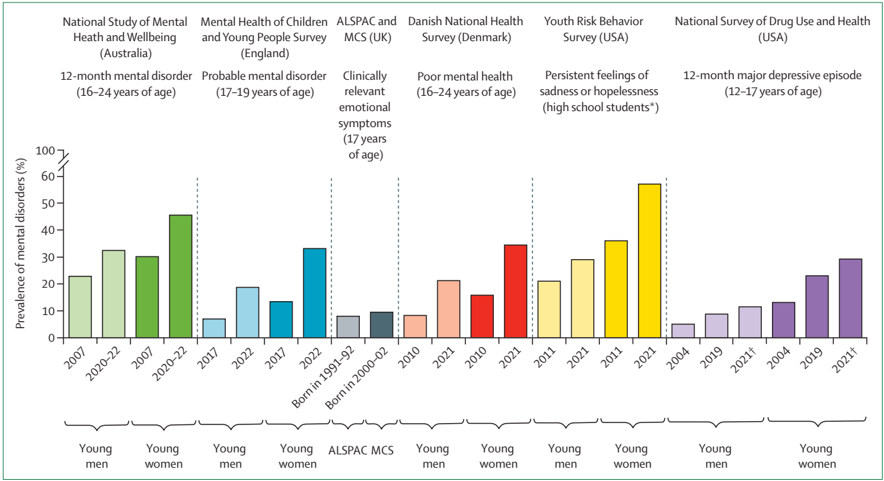
- In Australia’s national study (2020–22), diagnostic-level mental disorders in people aged 16–24 years rose 50% since 2007, reaching annual prevalence of 39% (nearly 50% in young women); 12-month prevalence rates were 32% for anxiety, 14% for affective, and 7·8% for substance use disorders, versus 15%, 6%, and 13% in 2007.
- Care gaps are severe: only 2% of global health budgets go to mental health; in the MILESTONE cohort of 763 young people, only 19·6% transitioned to adult services and 26·8% remained in child services after age 18; a 2022 UK survey found 58% deteriorated while waiting for care and 24% attempted suicide while waiting; 42% dropped out by the third therapy session, up to 80% with complex conditions relapsed, and one-third to two-thirds receiving interventions had no symptom reduction.
- Economic evidence supports investment: global cost of all mental disorders was estimated at US$2·5–8·5 trillion in 2010 and projected to double by 2030; every Australian dollar invested in school or university depression/anxiety prevention returns about AU$1·1–3·1; early intervention in psychosis showed 35% health-care savings per point of PANSS improvement in Hong Kong; lay-delivered therapy cost US$4 per student in India and US$13 per DALY averted in Uganda.
Methods
- This Commission is a synthesis of evidence across five key topics, using systematic reviews and meta-analyses where available and appropriate, plus publications deemed relevant to capture the current state of knowledge.
- An initial consultation meeting was held in July, 2019, bringing together experts across clinical psychology, psychiatry, neuroscience, epidemiology, social science, economics, and service reform, as well as young people from low-income, middle-income, and high-income countries.
- The Commission was developed by section Commissioners, youth Commissioners, and co-authors; it is not described as a systematic review with a formal search strategy, inclusion criteria, or risk-of-bias assessment.
Limitations
- The paper states that much of the data and practical reform has been limited to high-resource and middle-resource settings, that youth mental health reform in low-resource settings is only beginning, and that systematic monitoring of youth mental health trends in low-resource and middle-resource settings is relatively insufficient.
- The paper states that economic evidence generalisability is a challenge, that budget-effect questions are underexplored, and that evidence on social media and mental health is still emerging, with longitudinal and well controlled experimental studies scarce.
- Evident from the text: the Commission is a narrative synthesis rather than a systematic review, and many authors declare competing interests, including leadership, advisory, or financial ties to headspace, Orygen, digital mental health platforms, and other youth mental health services and programmes discussed.
Model-written summary. Check it against the paper before relying on it.
Integrity signals
Registry
Cites
Statistics
Figures
Verification
Claims the paper makes
166 Valid · 23 Not valid · 108 Not checked · 79 Own results and interpretations
Some cited sources support this claim and some don’t — read each source’s verdict below.
In the paper
“Other evidence for specific interventions targeting disorders that occur mainly in young people (such as depressive or eating disorders) have also been found to be highly cost-effective. 430-432”
What the sources say
- Not checked — no full text of the sourcecites [430] Le, 2017, The modeled cost-effectiveness of family-based and adolescent-focused treatment for anorexia nervosa, Int J Eat Disord source
- Partly supportedcites [431] Turner, 2017, Cost-effectiveness of a preferred intensity exercise programme for young people with depression compared with treatment as usual: an economic evaluation alongside a clinical trial in the UK, BMJ Open sourceExperimental — accuracy not yet measured
The Conclusion says preferred-intensity exercise could be cost-effective for adolescents with depression when measured by improvement in CDI-2 scores. But the Results > Outcomes and Discussion report substantial uncertainty and no evidence of a QALY improvement, so this study does not establish that the intervention is highly cost-effective. The paper addresses depression, not eating disorders. (LLM, conf=0.88)
- Disputedcites [432] Tie, 2019, Cost-effectiveness analysis of telephone cognitive-behaviour therapy for adolescents with obsessive-compulsive disorder, BJPsych Open sourceExperimental — accuracy not yet measured
The Discussion (Policy implications; page unavailable) says this study found no evidence that telephone CBT was cost-effective compared with face-to-face CBT for young people with OCD, particularly when measured by QALYs. It does not report a highly cost-effective intervention for depression or an eating disorder. (LLM, conf=0.86)
Checked by a reasoning model — may be wrong.
plainstates a cause- Asserted: passes — The authors put it forward as true.
- Checkable: passes — It can be checked against evidence.
- Load-bearing: unclear — It is unclear whether the paper’s conclusions depend on it.
- Based: passes — The paper gives a reason why it holds.
At least one cited source doesn’t support this claim or points to a different paper, and none confirmed it — see the verdicts below.
In the paper
“A trial of a similar programme in Kenya reported statistically significantly lower rates of depression in young men compared with young women. 439”
What the sources say
- Disputedcites [439] Kilburn, 2016, Effects of a large-scale unconditional cash transfer program on mental health outcomes of young people in Kenya, J Adolesc Health sourceExperimental — accuracy not yet measured
The Results (Sample characteristics) report depressive symptoms in 33% of participants, with no difference between young men and young women. The statistically significant finding was instead a lower prevalence among young men in the intervention group than among young men in the control group; it was not a significant comparison of men with women. (LLM, conf=0.87)
Checked by a reasoning model — may be wrong.
plainstates a cause- Asserted: passes — The authors put it forward as true.
- Checkable: passes — It can be checked against evidence.
- Load-bearing: unclear — It is unclear whether the paper’s conclusions depend on it.
- Based: passes — The paper gives a reason why it holds.
- Disputed
Every source the paper cites for this claim was checked and supports it.
In the paper
“The neglect of youth mental health can be partly ascribed to the stigma-based neglect of mental health worldwide.”
What the sources say
- Supportedcites [53] Thornicroft, 2022, The Lancet Commission on ending stigma and discrimination in mental health, Lancet source
In the section headed “Person in Botswana” (page not provided), the Commission reports worldwide evidence of stigma affecting young people with mental health conditions and describes families dismissing adolescents’ problems or creating barriers to seeking help. The “Personal impacts” section (page not provided) says stigma reduces help-seeking and health-service use, especially among young people with mental health conditions. Together, these passages support the claim’s qualified attribution of youth mental-health neglect partly to stigma. (LLM, conf=0.87)
plainstates a possible cause- Asserted: passes — The authors put it forward as true.
- Checkable: passes — It can be checked against evidence.
- Load-bearing: unclear — It is unclear whether the paper’s conclusions depend on it.
- Based: passes — The paper gives a reason why it holds.
- Supported
Every source the paper cites for this claim was checked and supports it.
In the paper
“In low-resource and middle-resource settings, availability and access to mental health services for young people are grossly inadequate.”
What the sources say
- Supportedcites [49] Zhou, 2020, Child and adolescent mental health policy in low- and middle-income countries: challenges and lessons for policy development and implementation, Front Psychiatry source
The Results section, under “The Shortage of CAMH Resources,” says mental health services and other resources are insufficient in low- and middle-income countries, with resources for children and adolescents scarcer than those for adults. It also reports that families commonly pay for these services out of pocket, supporting the claim about limited access. (LLM, conf=0.93)
plain- Asserted: passes — The authors put it forward as true.
- Checkable: passes — It can be checked against evidence.
- Load-bearing: passes — The paper’s conclusions depend on it.
- Based: passes — The paper gives a reason why it holds.
- Supported
The cited sources support only part of this claim — read each source’s verdict below.
In the paper
“Indigenous young people in many countries (eg, Australia, Canada, the USA, and India) have substantially higher rates of suicide than the general population.”
What the sources say
- Partly supportedcites [43] Troya, 2022, Suicide rates amongst individuals from ethnic minority backgrounds: a systematic review and meta-analysis, EClinicalMedicine sourceExperimental — accuracy not yet measured
The Discussion reports substantially higher suicide risk for Indigenous populations overall (RR 2.8), supporting the general comparison. The Results table includes youth studies in Australia, Canada, and the USA, but lists the India study as covering all ages; the cited passages do not establish elevated rates specifically among Indigenous young people across all four named countries. (LLM, conf=0.87)
plainstates an association- Asserted: passes — The authors put it forward as true.
- Checkable: passes — It can be checked against evidence.
- Load-bearing: unclear — It is unclear whether the paper’s conclusions depend on it.
- Based: passes — The paper gives a reason why it holds.
- Partly supported
160 more claims · 83 with their cited sources checked
Create a free account to see all 376 claims and to verify the 14 references still open.
- It may state two separate claims as one. 146
- Probably not a substantial claim. 88
- The quote only partly states this claim. 1
Claims other papers make about this one
Each is checked against this paper’s own text: does it say what the citing paper says it does?
The source backs part of the claim, not all of it — or backs it for a different population, condition or comparison.
In the citing paper
“The trend of rising mental health issues is not limited to Australia; it is reflected worldwide across various countries (McGorry et al., 2024).”
From Will restricting the age of access to social media reduce mental illness in Australian youth? (2025) · cites this paper as McGorry et al., 2024
Experimental — accuracy not yet measured
Self-check
Percentages, sums and reported differences re-computed from the paper’s own numbers.
Rated minor: it would not touch a result — a value no result rests on, a p-value that stays on the same side of the significance level, or a conflict that is clerical, resolved elsewhere in the paper, or outside its own findings.
In the paper
“the percentage of adolescents who reported being almost constantly online doubled over the previous 7 years (46% in 2022 vs 24% in 2017).”
Reported 7 · recomputed 5
Citations
Cites
The Ecology of Human Development: Experiments by Nature and Design
Bronfenbrenner, U. (1979) · Harvard University Press eBooks · doi:10.4159/9780674028845 · Cited by 26,084
Kessler, R. C., Berglund, P., Demler, O., Jin, R., Merikangas, K. R., & Walters, E. E. (2005) · Archives of General Psychiatry · doi:10.1001/archpsyc.62.6.593 · Cited by 20,391
Emerging adulthood: A theory of development from the late teens through the twenties.
Arnett, J. J. (2000) · American Psychologist · doi:10.1037/0003-066x.55.5.469 · Cited by 16,843
Digital Natives, Digital Immigrants Part 1
Prensky, M. (2001) · On the Horizon · doi:10.1108/10748120110424816 · Cited by 11,104
Positive Psychology Progress: Empirical Validation of Interventions.
Seligman, M. E. P., Steen, T. A., Park, N., & Peterson, C. (2005) · American Psychologist · doi:10.1037/0003-066x.60.5.410 · Cited by 5,947
Santomauro, D. F., Mantilla Herrera, A. M., Shadid, J., Zheng, P., Ashbaugh, C., Pigott, D. M., Abbafati, C., Adolph, C., Amlag, J. O., Aravkin, A. Y., et al. (2021) · The Lancet · doi:10.1016/s0140-6736(21)02143-7 · Cited by 5,444
Age at onset of mental disorders worldwide: Large-scale meta-analysis of 192 epidemiological studies
Solmi, M., Radua, J., Olivola, M., Croce, E., Soardo, L., Salazar de Pablo, G., Il Shin, J., Kirkbride, J. B., Jones, P., Kim, J. H., et al. (2022) · Molecular Psychiatry · doi:10.1038/s41380-021-01161-7 · Cited by 3,835
Self-citationOur future: a Lancet commission on adolescent health and wellbeing
Patton, G. C., Sawyer, S. M., Santelli, J. S., Ross, D. A., Afifi, R., Allen, N. B., Arora, M., Azzopardi, P., Baldwin, W., Bonell, C., et al. (2016) · The Lancet · doi:10.1016/s0140-6736(16)00579-1 · Cited by 3,785
The Lancet Commission on global mental health and sustainable development
Patel, V., Saxena, S., Lund, C., Thornicroft, G., Baingana, F., Bolton, P., Chisholm, D., Collins, P. Y., Cooper, J. L., Eaton, J., et al. (2018) · The Lancet · doi:10.1016/s0140-6736(18)31612-x · Cited by 3,692
Sawyer, S. M., Azzopardi, P. S., Wickremarathne, D., & Patton, G. C. (2018) · The Lancet Child & Adolescent Health · doi:10.1016/s2352-4642(18)30022-1 · Cited by 3,666
Research works printed but not linked: 2
- 5 Rutter M, Smith DJ, eds. Psychosocial disorders in young people: time trends and their causes. Chichester, West Sussex: John Wiley & Sons Ltd, 1995.
- Tan, 2019, Mental health of trans and gender diverse people in Aotearoa/New Zealand: a review of the social determinants of inequities, N Z J Psychol, 48, 64
Cited by
Items 501–600 of 634
Dooley, N., Aghedo, B., Harrington, S. M., Johnson, A., Kirby, J., Owens, N., Solan, I., Staunton, G.-M., McEvoy, D., Cannon, M., et al. (2026) · Social Psychiatry and Psychiatric Epidemiology · doi:10.1007/s00127-025-03026-8
“Compared to the adolescents of the 2000 s and 2010 s, adolescents of the 2020 s tend to report more symptoms of depression and anxiety, and have a higher probability of being diagnosed with a mental illness [1].”
Self-citationSamal, S., Prathyush, S., Gagrai, S., Das, N., Lamay, N., Banra, S., Purty, S., Purty, M., Mundri, B., Bodra, D., et al. (2026) · PLOS mental health. · doi:10.1371/journal.pmen.0000492
Self-citationLoneliness and associated factors among medical students in France: A nationwide study
Haddad, S., Doudeau, N., Vilain, F., Sadat, K., Morvan, Y., & Frajerman, A. (2026) · Public Health · doi:10.1016/j.puhe.2026.106496
Wong, R. C. P., & Bates, G. W. (2026) · Mindfulness · doi:10.1007/s12671-026-02909-4 · Cited by 1
“Mental ill health that emerges during youth undermines the development of important milestones impacting future outcomes across personal, social, academic, and occupational domains (McGorry et al., 2024).”
Worrell, C., Pérez, C., Alford, S., Pollard, R., Sforzini, L., Sommeling, C., Hotham, J., Rodney, A., Sadiq, Z., Shah, H., et al. (2026) · Journal of Child Psychology and Psychiatry · doi:10.1111/jcpp.70215 · Cited by 1
Self-citationCorriveau, H., Goguen, C., Ahmadi, S., Mau, K., & Plourde, V. (2026) · Research Square · doi:10.21203/rs.3.rs-10814266/v1
Jakobsen, J. S., Johansen, K. S., Thylstrup, B., & Mårtensson, S. (2026) · Nordic Journal of Psychiatry · doi:10.1080/08039488.2026.2680604
“Accumulated evidence, pooling studies of trends in psychiatric diagnoses and broader wellbeing questionnaires, shows that mental health is deteriorating among adolescents and young adults worldwide [1].”
A Painting Psychoanalysis Method Based on Image Caption and Knowledge Graph Reasoning
Lyu, M., Qi, X., Yu, H., Pan, T., Zhao, X., & Liu, W. (2025) · Chinese Control Conference (CCC) · doi:10.23919/ccc64809.2025.11178550 · Cited by 1
“The recent study[1] shows a global trend of deteriorating mental health among young people.”
Hunt, E., Nolan, C., Eichler, J. R., & Keptner, K. M. (2026) · American Journal of Occupational Therapy · doi:10.1177/19437676261464052
“Around the world, the mental health of young people is declining (McGorry et al., 2024), constituting a signi fi cant and alarming global public health crisis (McGorry et al., 2025).”
Paquin, V., Lavallee, Z., Huot‐Lavoie, M., Ku, B. S., Díaz-Caneja, C. M., & Gülöksüz, S. (2026) · Journal of Behavioral Addictions · doi:10.1556/2006.2025.00094 · Cited by 3
“During adolescence, the peer, school and family environments are important determinants of mental health (McGorry et al., 2024).”
An ecological meta-analysis of coach education for sport-based youth development
Li, L., Tereschenko, I., & McCleery, J. (2026) · International Journal of Sports Science & Coaching · doi:10.1177/17479541261461871
“37,129,130 These opportunities are increasingly vital in a rapidly evolving society shaped by technological change and population health challenges 131,132 and align with human-centered goals to build healthy, resilient communities.”
Trevillion, K., Appleton, R., Spaducci, G., Maynard, E., Allman, F., Griffiths, J., Clarke, C., Lewis, H. K., Begum, S., Bhutta, A., et al. (2026) · Administration and Policy in Mental Health and Mental Health Services Research · doi:10.1007/s10488-026-01517-7 · Cited by 1
Maulik, P. K., Yatirajula, S. K., Kallakuri, S., Paslawar, S., Ghosh, A., Rastogi, A., Mukherjee, A., Khan, R., Sagar, R., Lempp, H. K., et al. (2025) · SSRN Electronic Journal · doi:10.2139/ssrn.5359728
Die Krise der psychischen Gesundheit
Strittmatter, E., & Möhler, E. (2026) · Zeitschrift für Kinder- und Jugendpsychiatrie und Psychotherapie · doi:10.1024/1422-4917/a001076
Martínez-Pastor, E., Moraleda-Esteban, R., & Dryjańska, L. (2026) · International Journal of Adolescence and Youth · doi:10.1080/02673843.2025.2608761 · Cited by 3
Embodying Hope: Growing Well-Being from the Ecological Soil/Soul of Our Suffering
Denichaud, D. (2025) · Springer international handbooks of education · doi:10.1007/978-981-97-8101-0_7-1
Nizza, I. E., Bryan, G., Phillips, K., Pomfret, I., James, R. M., Roberts, H. M., Cornaglia, F., Vázquez‐Vázquez, A., Hudson, L. D., Mathews, G., et al. (2026) · SSM - Qualitative Research in Health · doi:10.1016/j.ssmqr.2026.100760
Ahn, J. S., Litalien, D., Bradshaw, E. L., Ferber, K. A., Dupéré, V., Mbanga, R., & Audet, L. (2026) · Applied Developmental Science · doi:10.1080/10888691.2026.2630177 · Cited by 1
Effectiveness of a Mobile-Based Self-Regulation Training on Youths’ Affect
Aleva, A., Karreman, A., Janssen, L. H. C., Vroegindeweij, A., van Aken, M. A. G., Hessels, C. J., & Laceulle, O. M. (2026) · Healthcare · doi:10.3390/healthcare14010133 · Cited by 2
“Youth mental health has been declining for over two decades [1].”
Hart, V. R. ‘., Koet, L. B. M., Schouten, B. W. V., Velek, P., Bindels, P., & Gerger, H. (2025) · Social Psychiatry and Psychiatric Epidemiology · doi:10.1007/s00127-025-02956-7 · Cited by 1
Task sharing: transfer of knowledge from thrive NYC to the Scottish context
Cameron, J., & Tosatti, E. (2025) · Journal of Public Mental Health · doi:10.1108/jpmh-03-2025-0037
Flourishing as an educational aim: the case for school health education
Reiss, M. J. (2025) · Journal of Philosophy of Education · doi:10.1093/jopedu/qhaf029
Allison, S. C. (2025) · Australasian Psychiatry · doi:10.1177/10398562251325709
Urban Mental Health: Förderung der psychischen Gesundheit von jungen Menschen in der Stadt
Popp, L., Voigt, B., Julich, A., König, H.-H., Brettschneider, C., Kulisch, L. K., Sterner, P., Falkai, P., & Schneider, S. (2025) · Kindheit und Entwicklung · doi:10.1026/0942-5403/a000471 · Cited by 3
THE IMPACT OF EXTREME WAR CONDITIONS ON THE PSYCHOLOGICAL WELL-BEING OF UNIVERSITY STUDENTS
Dudnyk, Y. (2025) · Problems of Psychology in the 21st Century · doi:10.33225/ppc/25.19.46
Knudsen, A. K., Skogen, J. C., Sivertsen, B., Gustavson, K., Stene‐Larsen, K., Krokstad, S., Ferrari, A. J., Kessler, R. C., & Reneflot, A. (2026) · Social Psychiatry and Psychiatric Epidemiology · doi:10.1007/s00127-025-03030-y
Hanewinkel, R., & Hansen, J. (2026) · Substance Use & Misuse · doi:10.1080/10826084.2026.2617436
Barbic, S. P., Warren, C., Marchand, K., Beggs, T., Tsou, S., Smit, B., Lockhart, L., Turuba, R., Mathias, S., & Ben‐David, S. (2025) · Child Psychiatry & Human Development · doi:10.1007/s10578-025-01926-z
Orih, D., Cheer, K., Morgan, R., Udah, H., & Tsey, K. (2025) · Frontiers in Education · doi:10.3389/feduc.2025.1562779 · Cited by 2
Torrecilla, P., Lavín, V., Arias-Magnasco, A., Lin, B. D., Menne‐Lothmann, C., Decoster, J., van Winkel, R., Collip, D., Delespaul, P., Hert, M. D., et al. (2026) · European Psychiatry · doi:10.1192/j.eurpsy.2026.10176 · Cited by 1
“This population is central to the emerging youth mental health crisis, driven by profound societal shifts (e.g., intergenerational inequality, financial instability, climate change, impact of unregulated social media) [42].”
Dutschke, C. M., & Brailovskaia, J. (2026) · Journal of Social Media Research · doi:10.29329/jsomer.93 · Cited by 3
Moffett, B., Bitta, M. A., Williams, D., Doenz, J., Erskine, H. E., Mabia, C., Nkuna, T., Gomes, S., van Heerden, A. C., Marlow, M., et al. (2026) · JMIR Research Protocols · doi:10.2196/98369
“To address these challenges, there has been growing interest in task-shared and stepped-care models of mental health service delivery, alongside the use of digital mental health interventions [4].”
Triantafyllou, K., Koumoula, A., Konialis, E., Papoulias, P., Moustaka, D., Karagiorga, V. E., Schäfer, J., Simioni, A., Marchionatti, L. E., Schuster, K., et al. (2026) · medRxiv · doi:10.64898/2026.04.30.26352158
Pagani, L. S., Kazandjian, N., Geoffrion, S., & Barnett, T. A. (2025) · INQUIRY The Journal of Health Care Organization Provision and Financing · doi:10.1177/00469580251399302 · Cited by 2
“6,22 Noteworthy is that the peak prevalences of both psychiatric illness 23 and loneliness 20 are between ages 18 and 25.”
Larrain, B., van Kessel, R., Mosler, K., Penazzi, G., Corazza, O., Achab, S., Stein, D. J., Ekhtari, H., Bowden‐Jones, H., Ioannidis, K., et al. (2026) · Comprehensive Psychiatry · doi:10.1016/j.comppsych.2026.152674 · Cited by 1
“The multifaceted disruptive impact of PUI is a growing phenomenon, leading to poor mental health [11], as well as having broader societal implications involving social disruptions, healthcare challenges, and economic burdens [12].”
Hinchy, S., Pilkington, E., Tobin, H. M., Ravichandran, N., Cullen, W., O’Donoghue, B., Smyth, B., & Beug, A. (2026) · PLoS ONE · doi:10.1371/journal.pone.0349885
“…young adults may reflect a cohort who are more likely to seek mental health care when in crisis or be reflective of a “Youth mental health crisis”, in which young people experience heightened levels of psychological distress while simultaneously “ageing out” of child and adolescent services [15].”
Odyssée: protocol for a prospective cohort on psychiatric transition at age 17 in Nice, France
Dumas, L.-É., Marchini, S., Fontas, É., Ribeyron, J., Metelkina-Fernandez, V., Benoît, M., Fernandez, A., & Askenazy-Gittard, F. (2026) · BMJ Open · doi:10.1136/bmjopen-2026-120667
Bennett, M., O’Dwyer, C., Murthy, V. E., Dalgleish, T., & Nearchou, F. (2025) · Journal of Research on Adolescence · doi:10.1111/jora.70061 · Cited by 5
“The 2024 Lancet Psychiatry Commission on Youth Mental Health, for instance, recognizes the need for early-stage solutions like interventions that prevent and mitigate mental ill health (McGorry et al., 2024).”
Social Media Perceptions in Transition-Aged Youth: A Qualitative Study
Niles, L. L., BARTLETT, R. L., Delaney, K. R., Bail, J., & Wedgeworth, M. L. (2026) · Journal of Psychosocial Nursing and Mental Health Services · doi:10.3928/02793695-20260312-02
Cirasola, A., & Fonagy, P. (2025) · Journal of Infant Child and Adolescent Psychotherapy · doi:10.1080/15289168.2025.2473326 · Cited by 1
Wainwright, C., Harris, N., O’Leary, R., Riley, T., & Sofija, E. (2026) · Community Mental Health Journal · doi:10.1007/s10597-026-01710-w
Thanaskanda, S., Whitehead, R. E., Hopkins, L., MacMillan, I. C., & Kehoe, M. (2026) · Adolescents · doi:10.3390/adolescents6020032
“There are relatively few naturalistic descriptions of the demographic and social characteristics of young people attending Australian community mental health services [11].”
Tani, Y., Isumi, A., & Fujiwara, T. (2026) · BMC Psychology · doi:10.1186/s40359-026-04658-4
“Adolescent mental health problems are the greatest cause of loss of human potential and productivity throughout life [6–8].”
The effect of municipality-level social media use on youth mental healthPreprint
Tveit, O. B., & Biele, G. (2025) · Research Square · doi:10.21203/rs.3.rs-6647544/v1
Sakurai, T., Birnbaum, M., Chua, Y. H. V., et al. (2025) · SSRN Electronic Journal · doi:10.2139/ssrn.5173711
Kealy, C., Madrid‐Cagigal, A., O’Neill, S. M., Donohoe, G. J., Mulvenna, M. D., & Barry, M. M. (2026) · International Journal of Behavioral Development · doi:10.1177/01650254261441509 · Cited by 2
Wang, C. J., Raucher‐Chéné, D., & Lavigne, K. M. (2025) · Journal of Psychiatric Research · doi:10.1016/j.jpsychires.2025.12.017 · Cited by 2
Vallely, M., Nolan, A., & Smyth, E. (2025) · Child Indicators Research · doi:10.1007/s12187-025-10311-0 · Cited by 1
“Recent research highlights that mental illnesses have a peak onset age of 15, with two-thirds to three-quarters of onsets occurring by age 25 years (McGorry et al., 2024).”
InfluentialYouth prevention in a changing society
Overbeek, G. J. (2026) · European Journal of Developmental Psychology · doi:10.1080/17405629.2026.2681816
Zou, H., Tuerxun, R., Bi, K., Liu, J., & Zhang, W. (2026) · Journal of Affective Disorders · doi:10.1016/j.jad.2026.121919
Ogilvie, J., Crissman, B., Hurren, E., Thompson, C., Kuluk, A., Allard, T. J., Broidy, L. M., Dennison, S. M., Kisely, S. R., & Stewart, A. (2026) · Frontiers in Psychiatry · doi:10.3389/fpsyt.2026.1635802
McKay, S., Lamblin, M., Bellairs-Walsh, I., Veresova, M., Kenny, B., Bailey, E., Byrne, S. J., Yuen, H. P., Pirkis, J., Mihalopoulos, C., et al. (2026) · BMC Pediatrics · doi:10.1186/s12887-026-06838-y · Cited by 3
“There is growing public and policy consensus that schools can provide an effective platform for suicide prevention and intervention efforts [13].”
Self-citationAndersen, N. K., Fagerlund, B., Jepsen, J. R. M., Hjorthøj, C. R., Lemvigh, C. K., Rydkjær, J., Melau, M., Vernal, D. L., & Pagsberg, A. K. (2026) · Schizophrenia Research · doi:10.1016/j.schres.2026.03.017
McKimmy, C., Gallop, R., & Dimidjian, S. (2026) · Journal of American College Health · doi:10.1080/07448481.2026.2681092
Service Use and Engagement in Youth Mental Healthcare: National Trends in Jigsaw (2017–2022)
Moore, J., Ryan, N., & O’Brien, S. (2026) · Early Intervention in Psychiatry · doi:10.1111/eip.70171
Lafond-Brina, G., & Bonnefond, A. (2025) · medRxiv · doi:10.1101/2025.03.10.25323681 · Cited by 1
“Youth mental health, as recently emphasized by The Lancet Psychiatry Commission, must be recognized as a public health priority (McGorry et al., 2024).”
InfluentialDoes Online Peer Counselling Help in Reducing Suicidal Ideation? Outcome-Evaluation of [U25] Germany
Hildebrand, A., Weiss, M., Fernando, A., & Stemmler, M. (2025) · Archives of Suicide Research · doi:10.1080/13811118.2025.2544766 · Cited by 1
“Many mental illnesses occur between the ages of 15 and 25 (McGorry et al., 2024).”
Structural vulnerabilities? Trends in preventable deaths of despair in the Netherlands, 2013-2023
Marco, M. H. D., Vrinzen, S., Berkelmans, G., Schweren, L., Mérelle, S. Y. M., & Liem, M. C. A. (2026) · Public Health · doi:10.1016/j.puhe.2026.106447
Verstegen, N. A., Kooiman, B., Robberegt, S. J., Vuuregge, A. H., Bockting, C., Nauta, M. H., & Stikkelbroek, Y. A. J. (2026) · Journal of Affective Disorders · doi:10.1016/j.jad.2026.121706
Krisenfest aufwachsen in Zeiten von Klimawandel, Krieg und Pandemie
Asbrand, J., & Christiansen, H. (2024) · Kindheit und Entwicklung · doi:10.1026/0942-5403/a000467
Engelskirchen, L., Asbrand, J., & Tuschen‐Caffier, B. (2025) · Cognitive Therapy and Research · doi:10.1007/s10608-025-10643-9 · Cited by 1
Evidence based consensus statements for digital tools to address youth mental health literacy
Moss, S. J., Siddiqui, S., Chacon, C. Z., Sriskandarajah, C., Stelfox, M., Gaunce, B., Harley, M., Smith, S., Ahmed, S. B., Birnie, K. A., et al. (2025) · Scientific Reports · doi:10.1038/s41598-025-12947-y · Cited by 3
Haywood, S., Paraskeva, N., & Schneider, J. (2026) · Body Image · doi:10.1016/j.bodyim.2026.102109 · Cited by 1
Klanšček, H. J., Mikolič, P., Blanco-Calvo, C., Roškar, S., Selak, Š., & Vinko, M. (2026) · Frontiers in Public Health · doi:10.3389/fpubh.2026.1834645
Thompson, A., Bouliotis, G., Yap, M. B. H., Birchwood, M. J., Cardamone-Breen, M. C., Valliere, N. D., Khan, K., Melvin, G. A., Michelet, F., Olivier, P. L., et al. (2026) · Journal of Affective Disorders · doi:10.1016/j.jad.2026.122272
Marchini, S., Reis, J., Ben-Shaool, E., Zaina, G., Kornreich, C., Nicolis, H., Leys, C., Slama, H., & Delvenne, V. (2026) · Comprehensive Psychiatry · doi:10.1016/j.comppsych.2026.152745
Shukla, M., Zonp, Z., Jenuwine, E., Ahmed, S. W., Sunny, M. N. M., Brand, B., & Albdour, M. M. (2026) · Journal of Pediatric Health Care · doi:10.1016/j.pedhc.2026.08.008
Fairweather, S. J., Kwong, A. S. F., Deniz, E., Hammerton, G., Khandaker, G. M., & Jones, H. J. (2026) · medRxiv · doi:10.64898/2026.06.24.26356453
Grummitt, L. R., Bailey, S., Rowlinson, K., Ivison, I., Birrell, L., Nguyen, A., Gardner, L. A., Champion, K. E., Chapman, C., Newton, N. C., et al. (2026) · Journal of Applied Developmental Psychology · doi:10.1016/j.appdev.2026.102009
Evaluation of an innovative youth mental health service model – bridging the service gap
Mildred, H., Coulton, T., Allison, L., Harris, N., Jenkins, P., Innes, S. I., & Brann, P. (2026) · Australasian Psychiatry · doi:10.1177/10398562261458931
Smith, G. M. G., Long, A., Wragg, M., & Kent, L. (2026) · Mental Health & Prevention · doi:10.1016/j.mhp.2026.200520
Suokas, K., Gutvilig, M., Komulainen, K., Alho, J., McGrath, J. J., Pirkola, S. P., Lumme, S., Elovainio, M. J., & Hakulinen, C. A. (2026) · medRxiv · doi:10.64898/2026.09.02.26362001
Formal and informal mental health support in young adults with recurrently depressed parents
Jones, R., Weavers, B., Lomax, T., Meilak, E., Eyre, O., Powell, V., Mars, B., & Rice, F. (2024) · BJPsych Open · doi:10.1192/bjo.2025.10819 · Cited by 1
“11 Studies to date have also focused primarily on formal health service use in this population.”
Auswege aus der Angst: Wie soziale Gruppen Menschen in Krisenzeiten aktivieren
Jonas, E., Stollberg, J., & Klackl, J. (2026) · Psychologische Rundschau · doi:10.1026/0033-3042/a000756
Pagani, L. S. (2025) · Euro-Mediterranean Journal for Environmental Integration · doi:10.1007/s41207-025-00996-8 · Cited by 1
“This contact causally generates pro‑environmen‑ tal dispositions and stewardship behaviors (Barragan‑Jason”
Investing early in youth mental health: from promise to population evidence
Geoffroy, M., & Côté, S. M. (2026) · The Lancet Psychiatry · doi:10.1016/s2215-0366(26)00199-9
Pathways to suicidal ideation for young people engaged in mental health care
Varidel, M., Hickie, I., An, V., Cripps, S., Marchant, R., Robinson, J., Sala, L. L., Capon, W., Turner, A., Tashevski, A., et al. (2025) · medRxiv · doi:10.1101/2025.02.11.25322101 · Cited by 1
Self-citationThe Vital Role of Research in Transforming Mental Health in Aotearoa New Zealand
Lozano, C. D. S., & Soosay, I. (2026) · Journal of the Royal Society of New Zealand · doi:10.1002/snz2.70009
Self-citationThe long shadow of academic pressure
Fairchild, G. F., McGuire, R., & Becker, K. (2026) · The Lancet Child & Adolescent Health · doi:10.1016/s2352-4642(26)00010-6
Flynn, M. (2024) · Biological Psychiatry · doi:10.1016/j.biopsych.2024.09.003
Winstone, L., Parsonage, J. T. I., Muir, C., Randhawa, A., Cross, L., MacArthur, G., Asiedu-Addo, E., & Garavini, E. (2026) · Journal of Adolescence · doi:10.1002/jad.70231 · Cited by 2
Slater, H., Klem, N.-R., Lord, S. M., Birnie, K. A., Noel, M. E., Nufi, E. P., O’Sullivan, P., Schütze, R., Tagliaferri, S. D., Stinson, J., et al. (2026) · Journal of Pain · doi:10.1016/j.jpain.2026.106414
Li, N., 杨小丽, Zhang, S., Liang, Y., Wang, Y., Chen, S., & Teng, M. (2026) · Comprehensive Psychiatry · doi:10.1016/j.comppsych.2026.152735
Lal, S. (2025) · Irish Journal of Psychological Medicine · doi:10.1017/ipm.2025.10121
Setia, S., Pavarini, G., Koshkouei, M., & Murta, S. G. (2026) · Journal of Medical Internet Research · doi:10.2196/79106
“In low-and middle-income countries (LMICs), sociocultural factors, including religion, cultural values, economic inequality, and political instability, disproportionately impact mental health outcomes [2,6,7].”
Improving the quality of child and youth mental health care through an implementation science lens
Dumke, L., Hall, J., Jung, J., Sibilio, R., Beinerte, K., Belikova, R., Mavreas, V. G., Stylianidis, S., Muscat, N. A., Lazëri, L., et al. (2026) · Frontiers in Health Services · doi:10.3389/frhs.2026.1731708 · Cited by 1
Fonseca‐Pedrero, E., Pérez‐Esteban, A., Díez-Gómez, A., Pérez‐Albéniz, A., Al‐Halabí, S., Lucas‐Molina, B., & Debbané, M. (2026) · Psychological Medicine · doi:10.1017/s0033291726105443 · Cited by 1
“…as well as their subthreshold presentations, are associated with considerable distress and substantial impairments in personal, academic, family, health, and social functioning (Arrondo et al., 2022; GBD 2019 Mental Disorders Collaborators, 2022; McGinty et al., 2024; McGorry et al., 2024).”
Problèmes de santé mentale – définition, prévalence et enjeux
Ariu, A., Franzoni, A., & Messerli‐Bürgy, N. (2025) · Revue suisse de pédagogie spécialisée · doi:10.57161/r2025-02-01
“Par ailleurs, de nombreuses études menées au cours des deux dernières décennies indiquent une dégradation continue de la santé mentale des jeunes avec une tendance alarmante qui laisse présager une dété-rioration persistante dans les années à venir (McGorry et al., 2024).”
Societal Implications of Youth Mental Health Challenges
Chatterjee, S., Dindarian, A., & Rengaraju, U. (2025) · Apress eBooks · doi:10.1007/979-8-8688-1186-9_2
Poulsen, A., Hickie, I. B., Chong, M. K., LaMonica, H. M., Turner, A., Varidel, M., & Iorfino, F. (2025) · Research Square · doi:10.21203/rs.3.rs-7062632/v1
Self-citationThe sensory environment may be a neglected social determinant of mental health
Hoare, E. (2026) · Mental Health & Prevention · doi:10.1016/j.mhp.2026.200564
Lama, R., Matergia, M., Giri, P., Mukhia, D., Aragon-Menzel, I., Rai, R., & Cherewick, M. (2026) · SSM - Mental Health · doi:10.1016/j.ssmmh.2026.100689 · Cited by 1
Trauma and suicidality in adolescents with substance use disorders
Vasileva, M., Kuitunen‐Paul, S., Roessner, V., Shvedovskii, E., Clemens, V., Fegert, J. M., & Golub, Y. (2026) · Child and Adolescent Psychiatry and Mental Health · doi:10.1186/s13034-026-01165-7
“Suicidal ideation and suicidal behavior as well as substance use all peak in adolescence [1, 2].”
Dress, Adversity, and Mental Illness: Is There Space for Fashion in Psychotherapy?
Çili, S. (2026) · Springer eBooks · doi:10.1007/978-3-032-12271-1_9
Furneaux-Bate, A., Birrell, L., Berle, D., Newton, N. C., Chapman, C., Slade, T. N., Mewton, L. R., Smout, S., & Teesson, M. (2025) · Mental Health & Prevention · doi:10.1016/j.mhp.2025.200445
McEvoy, D., Sweeney, C., Ryan, L., Wilson, C., Healy, C., Mongan, D., Sheaf, G., Higgins, A., Gallant, A., Doyle, L., et al. (2026) · Journal of Psychiatric Research · doi:10.1016/j.jpsychires.2026.02.027
Self-citationEklund, K. R., O’Neill, S. M., Barnett, K., Hendrix, C., Vengurlekar, I. N., Guetschow, K. W., & Stern, N. (2026) · School Mental Health · doi:10.1007/s12310-026-09905-y
Qi, W., Li, X., Luo, J., Tang, Y., Li, Q., Guo, M., Bi, T., & Kou, H. (2026) · Psychiatry Research · doi:10.1016/j.psychres.2026.117397
Poulsen, A., Hickie, I. B., Gorban, C., de Haan, Z., Small, D. R., Hutcheon, A., Capon, W., Iorfino, F., & LaMonica, H. M. (2026) · doi:10.2196/preprints.105593
Self-citationWatson, D., Hogg, T. L., Balogun, A., Joshi, L., Mugo, D., Musarurwa, P., Olude, A., Warner, A., Wray, B., & Lawrance, E. L. (2026) · Research Square · doi:10.21203/rs.3.rs-9979005/v1
Metadata
- Authors
- McGorry, P. D., Mei, C., Dalal, N., Alvarez-Jimenez, M., Blakemore, S.-J., Browne, V., Dooley, B., Hickie, I. B., Jones, P. B., McDaid, D., Mihalopoulos, C., Wood, S. J., El Azzouzi, F. A., Fazio, J., Gow, E., Hanjabam, S., Hayes, A., Morris, A., Pang, E., Paramasivam, K., Quagliato Nogueira, I., Tan, J., Adelsheim, S., Broome, M. R., Cannon, M., Chanen, A. M., Chen, E. Y. H., Danese, A., Davis, M., Ford, T., Gonsalves, P. P., Hamilton, M. P., Henderson, J., John, A., Kay-Lambkin, F., Le, L. K.-D., Kieling, C., Mac Dhonnagáin, N., Malla, A., Nieman, D. H., Rickwood, D., Robinson, J., Shah, J. L., Singh, S., Soosay, I., Tee, K., Twenge, J., Valmaggia, L., van Amelsvoort, T., Verma, S., Wilson, J., Yung, A., Iyer, S. N., & Killackey, E.
- Affiliations
- The University of Melbourne (AU)
- University of Cambridge (GB)
- University College Dublin (IE)
- The University of Sydney (AU)
- London School of Economics and Political Science (GB)
- Monash University (AU)
- Orygen (AU)
- Jack.org (CA)
- Stanford Medicine (US)
- Birmingham Women’s and Children’s NHS Foundation Trust (GB)
- Royal College of Surgeons in Ireland (IE)
- Nanyang Technological University (SG)
- King's College London (GB)
- University of Massachusetts Chan Medical School (US)
- University of Sussex (GB)
- Swansea University (GB)
- Universidade Federal do Rio Grande do Sul (BR)
- Douglas Mental Health University Institute (CA)
- Amsterdam UMC Location University of Amsterdam (NL)
- University of Canberra (AU)
- University of Warwick (GB)
- University of Auckland (NZ)
- Providence Health Care (CA)
- San Diego State University (US)
- Institute of Mental Health (SG)
- Norfolk and Suffolk NHS Foundation Trust (GB)
- Deakin University (AU)
- Corresponding author
- McGorry, Patrick D
- ORCID
- McGorry, Patrick D
- Mei, Cristina
- Dalal, Naeem
- Blakemore, Sarah-Jayne
- Browne, Vivienne
- Dooley, Barbara
- Hickie, Ian B
- Jones, Peter B
- McDaid, David
- Mihalopoulos, Cathrine
- Wood, Stephen J
- Hayes, Alan
- Morris, Amelia
- Adelsheim, Steven
- Broome, Matthew R
- Cannon, Mary
- Chanen, Andrew M
- Chen, Eric Y H
- Danese, Andrea
- Davis, Maryann
- Ford, Tamsin
- Gonsalves, Pattie P
- Hamilton, Matthew P
- John, Ann
- Kieling, Christian
- Malla, Ashok
- Nieman, Dorien H
- Rickwood, Debra
- Robinson, Jo
- Shah, Jai L
- Singh, Swaran
- Soosay, Ian
- Tee, Karen
- Twenge, Jean
- Valmaggia, Lucia
- Verma, Swapna
- Wilson, Jon
- Yung, Alison
- Iyer, Srividya N
- Venue
- The Lancet Psychiatry
- Publisher
- Elsevier BV
- Published
- 2024-09
- Volume
- 11
- Issue
- 9
- Pages
- 731-774
- ISSN
- 2215-0366 (ISSN-L)
- OpenAlex
- W4401528161
- Semantic Scholar
- 6de45b54b5cf97c2171787221d6026e0fff9d5e5
- Cited by
- 663
- References
- 442
- Citations by year
- 2026: 323 · 2025: 306 · 2024: 34
- FWCI
- 58.97
- Type
- journal article
- Language
- en
- Open access
- Licence
- cc-by-nc-nd
- www.elsevier.com/tdm/userlicense/1.0/ (tdm)
- www.elsevier.com/legal/tdmrep-license (tdm)
- doi.org/10.15223/policy-017 (stm-asf)
- doi.org/10.15223/policy-037 (stm-asf)
- doi.org/10.15223/policy-012 (stm-asf)
- doi.org/10.15223/policy-029 (stm-asf)
- doi.org/10.15223/policy-004 (stm-asf)
- Locations
- The Lancet Psychiatry (publishedVersion)
- PubMed (publishedVersion)
- Research Publications (Maastricht University) (publishedVersion, cc-by-nc-nd)
- Pure Amsterdam UMC (publishedVersion, other-oa)
- University of Birmingham Research Portal (University of Birmingham) (publishedVersion, cc-by-nc-nd)
- London School of Economics and Political Science Research Online (London School of Economics and Political Science) (submittedVersion, cc-by)
- Research Portal (King's College London) (submittedVersion, cc-by)
- London School of Economics and Political Science Theses Online (London School of Economics and Political Science) (submittedVersion, cc-by)
- Figshare (submittedVersion, cc-by)
- Funders
- National Institutes of Health
- Arts and Humanities Research Council
- Wolfson Foundation
- Jacobs Foundation
- Canada Research Chairs
- Margaret and Wallace McCain Centre for Child, Youth and Family Mental Health
- Conselho Nacional de Desenvolvimento Científico e Tecnológico
- Health Research Board (2008460)
- National Health Research Institutes
- Medical Research Council
- Fonds de Recherche du Québec - Santé
- National Institute of Mental Health
- Cooperative Research Centres, Australian Government Department of Industry
- Economic and Social Research Council
- Mackay Regional Council
- Wellcome Trust (WT107496/Z/15/Z)
- Grand Challenges Canada
- University of Cambridge (2016346, 1171910, 1061043, 1136259)
- National Health and Medical Research Council (1155508)
- Topics
- Social Sciences › Psychology › Clinical Psychology › COVID-19 and Mental Health
- Health Sciences › Medicine › Psychiatry and Mental health › Mental Health Treatment and Access
- Social Sciences › Psychology › Clinical Psychology › Child and Adolescent Psychosocial and Emotional Development
- Keywords
- youth mental health, emerging adults, mental illness, COVID-19 pandemic, pandemic containment measures, megatrends, social determinants of mental health, mental health policy
- MeSH terms
- Adolescent, Mental Disorders, Child, Humans, Mental Health, Mental Health Services, Psychiatry
About these checks
Registry, retraction, Cites and statistics results are computed, not judged, with one exception: a printed reference that no index lists is read once by a model before it counts as a citation error. Claims are extracted by a model and kept only when their quote appears verbatim in the text; each cited source is then checked, with a model’s help, for whether it says what the claim relies on. Those verdicts can be wrong — read the claim’s quote and the cited source before relying on one.
The claim verdicts this report counts are experimental: their accuracy is not yet measured.
A language model drew the claims from the paper on 2026-10-12, under version 3 of the claim definition (model deepseek-v4.1-flash, prompt extract-v3).
A second model labelled each claim on 2026-10-12 (model jev-1.13-20260917, definition revision gold-guideline-v0.2).
Cited sources are checked with a language model’s help (gpt-6-sol).
Statistics and arithmetic are recomputed, not judged.
Confidence bands are shown only for fields calibrated on our annotated test set. None is calibrated yet, so no band is shown.
What counts as a claim ›How we measure confidence ›How we check this ›
Are you an author, or do you see a problem with this page? Request a review
Data sources
Bibliographic data: Semantic Scholar, OpenAlex, Crossref.
Contains information from the Semantic Scholar Academic Graph Datasets, made available under the ODC Attribution License (ODC-BY 1.0).
Semantic Scholar’s data is described in: Kinney, R., et al. (2023). The Semantic Scholar Open Data Platform. arXiv:2301.10140.
