

The Lancet Psychiatry Commission on youth mental health
Open accessThe DOI matches its Crossref record; 428 of the 442 references it cites were found in a registry or an index; 267 of the 518 sources its claims cite were checked for support.
Overview
CoChat Summary
TL;DR
This Lancet Psychiatry Commission argues that youth mental health is in a global crisis, with rising prevalence, early onset, and major care gaps, and calls for integrated, developmentally appropriate care, prevention, economic investment, and political reform. It synthesizes evidence across epidemiology, developmental science, models of care, economics, and politics to propose a blueprint for ages 12–25.
Key findings
- Mental illnesses have a peak age of onset of 15 years, with 63–75% of onsets by age 25; a meta-analysis of 192 epidemiological studies (708,561 individuals) found cumulative onset proportions of 34·6% by age 14, 48·4% by 18, and 62·5% by 25. Mental ill health accounts for at least 45% of the overall burden of disease in those aged 10–24 years.
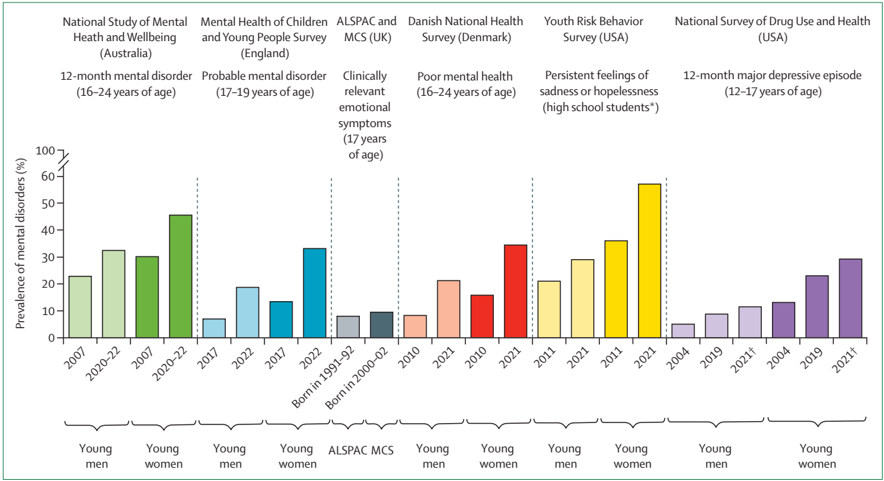
- In Australia’s national study (2020–22), diagnostic-level mental disorders in people aged 16–24 years rose 50% since 2007, reaching annual prevalence of 39% (nearly 50% in young women); 12-month prevalence rates were 32% for anxiety, 14% for affective, and 7·8% for substance use disorders, versus 15%, 6%, and 13% in 2007.
- Care gaps are severe: only 2% of global health budgets go to mental health; in the MILESTONE cohort of 763 young people, only 19·6% transitioned to adult services and 26·8% remained in child services after age 18; a 2022 UK survey found 58% deteriorated while waiting for care and 24% attempted suicide while waiting; 42% dropped out by the third therapy session, up to 80% with complex conditions relapsed, and one-third to two-thirds receiving interventions had no symptom reduction.
- Economic evidence supports investment: global cost of all mental disorders was estimated at US$2·5–8·5 trillion in 2010 and projected to double by 2030; every Australian dollar invested in school or university depression/anxiety prevention returns about AU$1·1–3·1; early intervention in psychosis showed 35% health-care savings per point of PANSS improvement in Hong Kong; lay-delivered therapy cost US$4 per student in India and US$13 per DALY averted in Uganda.
Methods
- This Commission is a synthesis of evidence across five key topics, using systematic reviews and meta-analyses where available and appropriate, plus publications deemed relevant to capture the current state of knowledge.
- An initial consultation meeting was held in July, 2019, bringing together experts across clinical psychology, psychiatry, neuroscience, epidemiology, social science, economics, and service reform, as well as young people from low-income, middle-income, and high-income countries.
- The Commission was developed by section Commissioners, youth Commissioners, and co-authors; it is not described as a systematic review with a formal search strategy, inclusion criteria, or risk-of-bias assessment.
Limitations
- The paper states that much of the data and practical reform has been limited to high-resource and middle-resource settings, that youth mental health reform in low-resource settings is only beginning, and that systematic monitoring of youth mental health trends in low-resource and middle-resource settings is relatively insufficient.
- The paper states that economic evidence generalisability is a challenge, that budget-effect questions are underexplored, and that evidence on social media and mental health is still emerging, with longitudinal and well controlled experimental studies scarce.
- Evident from the text: the Commission is a narrative synthesis rather than a systematic review, and many authors declare competing interests, including leadership, advisory, or financial ties to headspace, Orygen, digital mental health platforms, and other youth mental health services and programmes discussed.
Model-written summary. Check it against the paper before relying on it.
Integrity signals
Registry
Cites
Statistics
Figures
Verification
Claims the paper makes
166 Valid · 23 Not valid · 108 Not checked · 79 Own results and interpretations
Some cited sources support this claim and some don’t — read each source’s verdict below.
In the paper
“Other evidence for specific interventions targeting disorders that occur mainly in young people (such as depressive or eating disorders) have also been found to be highly cost-effective. 430-432”
What the sources say
- Not checked — no full text of the sourcecites [430] Le, 2017, The modeled cost-effectiveness of family-based and adolescent-focused treatment for anorexia nervosa, Int J Eat Disord source
- Partly supportedcites [431] Turner, 2017, Cost-effectiveness of a preferred intensity exercise programme for young people with depression compared with treatment as usual: an economic evaluation alongside a clinical trial in the UK, BMJ Open sourceExperimental — accuracy not yet measured
The Conclusion says preferred-intensity exercise could be cost-effective for adolescents with depression when measured by improvement in CDI-2 scores. But the Results > Outcomes and Discussion report substantial uncertainty and no evidence of a QALY improvement, so this study does not establish that the intervention is highly cost-effective. The paper addresses depression, not eating disorders. (LLM, conf=0.88)
- Disputedcites [432] Tie, 2019, Cost-effectiveness analysis of telephone cognitive-behaviour therapy for adolescents with obsessive-compulsive disorder, BJPsych Open sourceExperimental — accuracy not yet measured
The Discussion (Policy implications; page unavailable) says this study found no evidence that telephone CBT was cost-effective compared with face-to-face CBT for young people with OCD, particularly when measured by QALYs. It does not report a highly cost-effective intervention for depression or an eating disorder. (LLM, conf=0.86)
Checked by a reasoning model — may be wrong.
plainstates a cause- Asserted: passes — The authors put it forward as true.
- Checkable: passes — It can be checked against evidence.
- Load-bearing: unclear — It is unclear whether the paper’s conclusions depend on it.
- Based: passes — The paper gives a reason why it holds.
At least one cited source doesn’t support this claim or points to a different paper, and none confirmed it — see the verdicts below.
In the paper
“A trial of a similar programme in Kenya reported statistically significantly lower rates of depression in young men compared with young women. 439”
What the sources say
- Disputedcites [439] Kilburn, 2016, Effects of a large-scale unconditional cash transfer program on mental health outcomes of young people in Kenya, J Adolesc Health sourceExperimental — accuracy not yet measured
The Results (Sample characteristics) report depressive symptoms in 33% of participants, with no difference between young men and young women. The statistically significant finding was instead a lower prevalence among young men in the intervention group than among young men in the control group; it was not a significant comparison of men with women. (LLM, conf=0.87)
Checked by a reasoning model — may be wrong.
plainstates a cause- Asserted: passes — The authors put it forward as true.
- Checkable: passes — It can be checked against evidence.
- Load-bearing: unclear — It is unclear whether the paper’s conclusions depend on it.
- Based: passes — The paper gives a reason why it holds.
- Disputed
Every source the paper cites for this claim was checked and supports it.
In the paper
“The neglect of youth mental health can be partly ascribed to the stigma-based neglect of mental health worldwide.”
What the sources say
- Supportedcites [53] Thornicroft, 2022, The Lancet Commission on ending stigma and discrimination in mental health, Lancet source
In the section headed “Person in Botswana” (page not provided), the Commission reports worldwide evidence of stigma affecting young people with mental health conditions and describes families dismissing adolescents’ problems or creating barriers to seeking help. The “Personal impacts” section (page not provided) says stigma reduces help-seeking and health-service use, especially among young people with mental health conditions. Together, these passages support the claim’s qualified attribution of youth mental-health neglect partly to stigma. (LLM, conf=0.87)
plainstates a possible cause- Asserted: passes — The authors put it forward as true.
- Checkable: passes — It can be checked against evidence.
- Load-bearing: unclear — It is unclear whether the paper’s conclusions depend on it.
- Based: passes — The paper gives a reason why it holds.
- Supported
Every source the paper cites for this claim was checked and supports it.
In the paper
“In low-resource and middle-resource settings, availability and access to mental health services for young people are grossly inadequate.”
What the sources say
- Supportedcites [49] Zhou, 2020, Child and adolescent mental health policy in low- and middle-income countries: challenges and lessons for policy development and implementation, Front Psychiatry source
The Results section, under “The Shortage of CAMH Resources,” says mental health services and other resources are insufficient in low- and middle-income countries, with resources for children and adolescents scarcer than those for adults. It also reports that families commonly pay for these services out of pocket, supporting the claim about limited access. (LLM, conf=0.93)
plain- Asserted: passes — The authors put it forward as true.
- Checkable: passes — It can be checked against evidence.
- Load-bearing: passes — The paper’s conclusions depend on it.
- Based: passes — The paper gives a reason why it holds.
- Supported
The cited sources support only part of this claim — read each source’s verdict below.
In the paper
“Indigenous young people in many countries (eg, Australia, Canada, the USA, and India) have substantially higher rates of suicide than the general population.”
What the sources say
- Partly supportedcites [43] Troya, 2022, Suicide rates amongst individuals from ethnic minority backgrounds: a systematic review and meta-analysis, EClinicalMedicine sourceExperimental — accuracy not yet measured
The Discussion reports substantially higher suicide risk for Indigenous populations overall (RR 2.8), supporting the general comparison. The Results table includes youth studies in Australia, Canada, and the USA, but lists the India study as covering all ages; the cited passages do not establish elevated rates specifically among Indigenous young people across all four named countries. (LLM, conf=0.87)
plainstates an association- Asserted: passes — The authors put it forward as true.
- Checkable: passes — It can be checked against evidence.
- Load-bearing: unclear — It is unclear whether the paper’s conclusions depend on it.
- Based: passes — The paper gives a reason why it holds.
- Partly supported
160 more claims · 83 with their cited sources checked
Create a free account to see all 376 claims and to verify the 14 references still open.
- It may state two separate claims as one. 146
- Probably not a substantial claim. 88
- The quote only partly states this claim. 1
Claims other papers make about this one
Each is checked against this paper’s own text: does it say what the citing paper says it does?
The source backs part of the claim, not all of it — or backs it for a different population, condition or comparison.
In the citing paper
“The trend of rising mental health issues is not limited to Australia; it is reflected worldwide across various countries (McGorry et al., 2024).”
From Will restricting the age of access to social media reduce mental illness in Australian youth? (2025) · cites this paper as McGorry et al., 2024
Experimental — accuracy not yet measured
Self-check
Percentages, sums and reported differences re-computed from the paper’s own numbers.
Rated minor: it would not touch a result — a value no result rests on, a p-value that stays on the same side of the significance level, or a conflict that is clerical, resolved elsewhere in the paper, or outside its own findings.
In the paper
“the percentage of adolescents who reported being almost constantly online doubled over the previous 7 years (46% in 2022 vs 24% in 2017).”
Reported 7 · recomputed 5
Citations
Cites
The Ecology of Human Development: Experiments by Nature and Design
Bronfenbrenner, U. (1979) · Harvard University Press eBooks · doi:10.4159/9780674028845 · Cited by 26,084
Kessler, R. C., Berglund, P., Demler, O., Jin, R., Merikangas, K. R., & Walters, E. E. (2005) · Archives of General Psychiatry · doi:10.1001/archpsyc.62.6.593 · Cited by 20,391
Emerging adulthood: A theory of development from the late teens through the twenties.
Arnett, J. J. (2000) · American Psychologist · doi:10.1037/0003-066x.55.5.469 · Cited by 16,843
Digital Natives, Digital Immigrants Part 1
Prensky, M. (2001) · On the Horizon · doi:10.1108/10748120110424816 · Cited by 11,104
Positive Psychology Progress: Empirical Validation of Interventions.
Seligman, M. E. P., Steen, T. A., Park, N., & Peterson, C. (2005) · American Psychologist · doi:10.1037/0003-066x.60.5.410 · Cited by 5,947
Santomauro, D. F., Mantilla Herrera, A. M., Shadid, J., Zheng, P., Ashbaugh, C., Pigott, D. M., Abbafati, C., Adolph, C., Amlag, J. O., Aravkin, A. Y., et al. (2021) · The Lancet · doi:10.1016/s0140-6736(21)02143-7 · Cited by 5,444
Age at onset of mental disorders worldwide: Large-scale meta-analysis of 192 epidemiological studies
Solmi, M., Radua, J., Olivola, M., Croce, E., Soardo, L., Salazar de Pablo, G., Il Shin, J., Kirkbride, J. B., Jones, P., Kim, J. H., et al. (2022) · Molecular Psychiatry · doi:10.1038/s41380-021-01161-7 · Cited by 3,835
Self-citationOur future: a Lancet commission on adolescent health and wellbeing
Patton, G. C., Sawyer, S. M., Santelli, J. S., Ross, D. A., Afifi, R., Allen, N. B., Arora, M., Azzopardi, P., Baldwin, W., Bonell, C., et al. (2016) · The Lancet · doi:10.1016/s0140-6736(16)00579-1 · Cited by 3,785
The Lancet Commission on global mental health and sustainable development
Patel, V., Saxena, S., Lund, C., Thornicroft, G., Baingana, F., Bolton, P., Chisholm, D., Collins, P. Y., Cooper, J. L., Eaton, J., et al. (2018) · The Lancet · doi:10.1016/s0140-6736(18)31612-x · Cited by 3,692
Sawyer, S. M., Azzopardi, P. S., Wickremarathne, D., & Patton, G. C. (2018) · The Lancet Child & Adolescent Health · doi:10.1016/s2352-4642(18)30022-1 · Cited by 3,666
Research works printed but not linked: 2
- 5 Rutter M, Smith DJ, eds. Psychosocial disorders in young people: time trends and their causes. Chichester, West Sussex: John Wiley & Sons Ltd, 1995.
- Tan, 2019, Mental health of trans and gender diverse people in Aotearoa/New Zealand: a review of the social determinants of inequities, N Z J Psychol, 48, 64
Cited by
Items 401–500 of 634
Theurel, A., Shankland, R., Martinie, M., Cros, L., Fournier, A., Krifa, I., Witt, A., Millot, I., & Bègue, L. (2026) · Journal of Medical Internet Research · doi:10.2196/preprints.96985
Cini, K. I., Dumuid, D., Abbsar, I., Li, L., Priambodo, D. A., Bhoomadevi, A., Abdullah, M. A., Abdullah, Aboagye, R. G., Acharya, S., et al. (2026) · The Lancet Child & Adolescent Health · doi:10.1016/s2352-4642(26)00163-x · Cited by 2
Waller, R., Slater, H., Briggs, A. M., Lord, S. M., & Smith, A. J. (2025) · Journal of Pain · doi:10.1016/j.jpain.2025.105482
Psychische Gesundheit von Jugendlichen auf der ganzen Welt
(2025) · PPmP - Psychotherapie · Psychosomatik · Medizinische Psychologie · doi:10.1055/a-2436-4218
Early Career Teacher Preparedness to Respond to Student Mental Health
Spray, E., Smith, A., Shaw, E. L., & Burke, R. (2025) · Education Sciences · doi:10.3390/educsci15111505 · Cited by 3
James, R., & Hitcham, L. (2026) · Palgrave Studies in Cyberpsychology. · doi:10.1007/978-3-031-96188-5_4
Shah, J. L., Thanh, N. X., Surood, S., Poudel, S., Urichuk, L., D'andrea, G., Latimer, E. A., Andersson, N., Boksa, P., Joober, R., et al. (2026) · The Lancet Psychiatry · doi:10.1016/s2215-0366(26)00165-3 · Cited by 3
Self-citationSydney, Z., Ullah, S., Allison, S. C., Kisely, S. R., Looi, J. C., & Bastiampillai, T. J. (2025) · BJPsych Open · doi:10.1192/bjo.2025.10863 · Cited by 1
Noyes, B. K., Booij, L., Riek, H. C., Coe, B. C., Brien, D. C., Khalid‐Khan, S., & Munoz, D. P. (2026) · Frontiers in Psychiatry · doi:10.3389/fpsyt.2026.1850946 · Cited by 2
“Despite it being well known that early identi fi cation and treatment of mental health concerns is protective against worsening progression (4, 5), the majority of adolescents requiring care for psychiatric conditions such as depression go unrecognized or untreated (6).”
Wendel, F., Walbaum, M., Finger, C., Brettschneider, C., Jung‐Sievers, C., Knapp, M. R. J., Rehfuess, E. A., & Asaria, M. (2026) · BMJ Public Health · doi:10.1136/bmjph-2025-004776
Accurate prevalence estimates needed for youth common mental disorders – Authors' reply
Robson, E., & Sawyer, S. M. (2025) · The Lancet Psychiatry · doi:10.1016/s2215-0366(25)00090-2
Longitudinal Associations Between Anxiety and Depression in Transition From Childhood to Adolescence
Keskin, G., Plamondon, A., Tough, S., & Madigan, S. L. (2026) · Depression and Anxiety · doi:10.1155/da/5659455
Bedirian, J., Cowan, T., Noel, V. A., Lal, S., Joober, R., Shah, J. L., Abdel‐Baki, A., Fuhrer, R., Boksa, P., Andersson, N., et al. (2026) · Psychiatric Services · doi:10.1176/appi.ps.20250441
Self-citationWahlberg, K., Selvik, K. L. I., Braaten, T., Kvaløy, K., Vie, G. Å., Bjerkeset, O. A., & Pape, K. (2025) · BMJ Mental Health · doi:10.1136/bmjment-2024-301508
Chiang, L., Wallwork, M.-A., & Terzis, L. D. (2024) · doi:10.30688/janzssa.2024-2-03 · Cited by 1
“Peer supports for mental health have been recognised as a crucial step in emerging adults’ mental health services (McGorry et al., 2024).”
BackgroundBridging gaps in youth mental health care: YOUTHreach—a comprehensive European strategy
van Amelsvoort, T., Boonstra, A., Lekadir, K., Pujadas, E. R., Broome, M. R., Griffiths, S. L., Donohoe, G. J., Popma, A., de Girolamo, G., Díaz‐Caneja, C. M., et al. (2026) · European Child & Adolescent Psychiatry · doi:10.1007/s00787-026-03033-3 · Cited by 1
Self-citationNew Ways of Negotiating Mental Health: Perspectives from Chinese New Zealand Youth
Tasker, K., & Gibson, K. (2026) · Journal of Immigrant & Refugee Studies · doi:10.1080/15562948.2026.2725968
Knight, R., Clegg, H., Dalmaijer, E. S., Dunning, D. L., Franckel, G., Lenaert, B., Sakol, A., Sandhu, T., Vainre, M., Watson, P., et al. (2025) · SSRN Electronic Journal · doi:10.2139/ssrn.5379889
Self-citationGarau, C., Ledesma‐Corvi, S., Jiménez-Marín, Y., García‐Cabrerizo, R., & García-Fuster, M. J. (2026) · Translational Psychiatry · doi:10.1038/s41398-026-03909-7
“…alarming rise in youth mental health issues (reviewed by [1]), such as increased rates of depressive symptoms, anxiety, psychological distress, self-harm, suicide, etc., leading to a global youth mental health crisis (as highlighted by The Lancet Psychiatry Commission on youth mental health; [2]).”
ALHO, J. S., Gutvilig, M., Niemi, R., Cachón-Alonso, L., Komulainen, K., Böckerman, P., Webb, R. T., Elovainio, M. J., & Hakulinen, C. A. (2025) · European Child & Adolescent Psychiatry · doi:10.1007/s00787-025-02723-8 · Cited by 2
Schmidt‐Persson, J., Gejl, A. K., Philipsen, K. B., Johansen, M. S., Mathiesen, J., Taylor, R., Flensborg‐Madsen, T., Kristensen, P. L., & Grøntved, A. (2026) · BMC Psychology · doi:10.1186/s40359-026-04827-5
Siegel, P. F. (2026) · Behavioral and Brain Sciences · doi:10.1017/s0140525x25103257
Psychosomatic complaints and school failure: A prospective Swedish national cohort studyPreprint
Wahlström, J., Östberg, V., & Låftman, S. B. (2026) · Research Square · doi:10.21203/rs.3.rs-7999037/v1
Zecchinato, F., Kreppner, J., & Lawrence, P. J. (2025) · Development and Psychopathology · doi:10.1017/s0954579425000343 · Cited by 1
Challenges in addressing youth mental health
Baum, F. E., Raven, M. K., Jureidini, J. N., Fisher, M., & van den Berg, M. (2024) · The Lancet Psychiatry · doi:10.1016/s2215-0366(24)00327-4
deJonge, M. L., Nesbitt, A. E., Darnell, S. C., Hamza, C. A., & Sabiston, C. M. (2026) · JMIR Mental Health · doi:10.2196/92076 · Cited by 1
“…reflects the capacity to realize one’s potential, cope with stressors, and participate in society, whereas mental ill health refers to subclinical experiences of distress and impaired functioning, and mental illness captures more severe, persistent, and clinically diagnosable conditions [15,16].”
InfluentialUniversity student mental health research: look back to move forward
Duffy, A. C., Borschmann, R., O’Brien, A. A., Robinson, L. J., Sawyer, S. M., Selby, E. A., Watkins, E. R., & Kaufman, K. R. (2026) · BJPsych Open · doi:10.1192/bjo.2026.12024
Christiansen, H., Kumsta, R., Brettschneider, C., et al. (2025) · Kindheit und Entwicklung · doi:10.1026/0942-5403/a000475
Pérez‐Esteban, A., Ciulin, B. A., Lijián, J., Falcó, R., & Díez-Gómez, A. (2026) · Revista Brasileira de Educação do Campo · doi:10.70860/ufnt.rbec.e20689
Palmer, C., Patterson, P., & Tuomainen, H. (2026) · Journal of Adolescent Health · doi:10.1016/j.jadohealth.2026.06.002
Digital mental health apps for young people in Europe: A systematic cross-country analysis
Madrid‐Cagigal, A., Akyol, C. Ç., Angın, N. C., Ferreira, J. M. A., Gabor-Siatkowska, K., Männikkö, N., Meyniel, A., Özdemir, N. Ö., Stojadinović, M., Varga, V., et al. (2026) · PLOS Digital Health · doi:10.1371/journal.pdig.0001622
Is my Therapy Likely to Improve my Mental Health?
Woodard, G. S., Waye, C., & Jensen‐Doss, A. (2025) · Frontiers for Young Minds · doi:10.3389/frym.2025.1559160
Does youth-friendly mental health care improve therapeutic engagement and psychosocial outcomes?
Allison, S. C., Bastiampillai, T. J., Kisely, S. R., & Looi, J. C. (2025) · Australasian Psychiatry · doi:10.1177/10398562251351445 · Cited by 1
Riccioni, A., Siracusano, M., Davico, C., et al. (2025) · European Child & Adolescent Psychiatry · doi:10.1007/s00787-025-02721-w
“Professor Dennis Ougrin The rising prevalence of mental health disorders among children and adolescents [1] highlights the urgent need for specialized and evidence-based training in child and adoles - cent (neuro)psychiatry [2–3].”
Self-citationPredictors of readmission in child and adolescent psychiatry
Padilla, F. M., Lingamchetty, T. N., Waxmonsky, J. G., & Baweja, R. (2026) · World Journal of Psychiatry · doi:10.5498/wjp.v16.i3.113468
Guan, X., Ding, Q., & Li, Y. (2026) · PLoS ONE · doi:10.1371/journal.pone.0356293
Moeineslam, M., Steinsbekk, S., Wichstrøm, L., & Skalická, V. (2026) · European Child & Adolescent Psychiatry · doi:10.1007/s00787-026-03160-x
Music-Based Program for Emotion Regulation in Hong Kong: A Randomized Controlled Trial
Cao, Y., Shi, Y., Kwan, G. S. Y., Shek, D. T. L., Shum, D., Tanksale, R., & Dingle, G. A. (2026) · Research on Social Work Practice · doi:10.1177/10497315261487123
Epidemiology of suicide among Austrian children and adolescents: 2015–2024
Jaeger, M., Till, B., Dervic, K., Plener, P. L., Laido, Z., & Niederkrotenthaler, T. (2026) · Wiener klinische Wochenschrift · doi:10.1007/s00508-026-02787-9
Barkauskienė, R. (2026) · European Journal of Developmental Psychology · doi:10.1080/17405629.2026.2726801
Hoppstock, P., Foerster, E., Schauer, N., Berger, M., Fiebig, N., Mossaheb, N., Baumgartner, J. S., & Friedrich, F. (2026) · Neuropsychiatrie · doi:10.1007/s40211-026-00595-1
Contextualising adolescent emotional development in Africa: toward culturally grounded interventions
Ngwenya, N. B., Wambua, G. N., Seeley, J., Seedat, S., & Stein, A. L. (2026) · The Lancet Regional Health - Africa · doi:10.1016/j.lanafr.2026.100093
Tang, K., Wells, R., Thompson, C., Hill, E., Pellicano, E., & MYERS, B. J. (2026) · Journal of Autism and Developmental Disorders · doi:10.1007/s10803-026-07504-z
Lui, I. D., Law, T. W. S., Chung, C. L., Wong, S. S. Y., So, W. W. Y., Lee, J., & Yip, P. S. F. (2026) · BMC Pediatrics · doi:10.1186/s12887-025-06461-3 · Cited by 1
“Recent societal changes such as increased social exclusion and lone-liness continue to undermine adolescents’ wellbeing, and their effects are further compounded by persistent global stigma against young people’s mental health issues, preventing those in need from seeking help [3].”
Anand-Vembar, S., Keogh, B., Higgins, A., Sheaf, G., Kartalova‐O’Doherty, Y., Longe, O., Staines, L., McEvoy, D., Gallant, A. J., Wilson, C., et al. (2026) · HRB Open Research · doi:10.12688/hrbopenres.14287.2 · Cited by 1
Self-citationMachisa, M., Mahlangu, P., Sikweyiya, Y. M., Jewkes, R. K., Dartnall, E., Duma, S. E., Khuzwayo, N., Pillay, M., Maoto, M., & Brooke‐Sumner, C. (2026) · PLOS mental health. · doi:10.1371/journal.pmen.0000566 · Cited by 1
“…distress in this group is also associated with increased risks of social withdrawal, loneliness, and in severe cases, suicidal behavior [4–6, Within educational settings, understanding the dynamics of psychological distress is essential because these are primary environments where…”
Martineau, A., MacNeil, S., Iyer, S. N., London-Nadeau, K., Anzarouth, L., Chartrand, E., Colman, I., Orri, M., Chadi, N., Ouellet‐Morin, I., et al. (2026) · Canadian Journal of Public Health · doi:10.17269/s41997-026-01235-5 · Cited by 2
Self-citationTjora, T., Jensen, K., Dieset, I., Fjukstad, K. K., Holman, P. A., Tesli, M., & Joa, I. (2026) · JMIR Research Protocols · doi:10.2196/82696
“This transdiagnostic model [32,36-38] recognizes the fluid nature of mental disorders and distinguishes between early clinical stages (with low rates of progression to more severe disorders) and later stages (with higher rates of persistence and impairment).”
Schmier, J., Plener, P. L., & Klinger, D. (2026) · European Child & Adolescent Psychiatry · doi:10.1007/s00787-026-03119-y
Kambeitz, J. P. (2026) · Research Square · doi:10.21203/rs.3.rs-9291631/v1
Köhler, H. E., Bauch, J., Rodney-Wolf, K., Greiner-Döchert, F., Heitz, K., Saalbach, H., Baumann, E., Tucholski, N., & Schmitz, J. (2026) · Frontiers in Public Health · doi:10.3389/fpubh.2026.1760608 · Cited by 1
“Increasing prevalence rates have led the Lancet Psychiatry Commission to characterize the state of youth mental health as a global crisis, stressing the need for early intervention to prevent long term adverse outcomes for both individuals and societies (14).”
Parkinson, A., Mullan, B. A., & Finlay‐jones, A. L. (2025) · CoDesign · doi:10.1080/15710882.2025.2582678
Pupi, V., Mangialavori, S., & Fave, A. D. (2026) · Journal of Happiness Studies · doi:10.1007/s10902-026-01038-y
“This interpretation is further consistent with the generational concerns related to increasing inequality, job uncertainty, and climate change, which are increasingly shaping young people’s relationship with society (Bynner & Heinz, 2021; Achdut, 2023; McGorry et al., 2024 ).”
From Silos to Synergy: Insights From Health Professionals on Integrating Youth Mental Health Care
Sawrikar, V., Leung, S., Hodgins, M., McHugh, C. M., Ardill‐Young, O., Eapen, V., Lingam, R., & Curtis, J. (2026) · Early Intervention in Psychiatry · doi:10.1111/eip.70213
Bürgin, D., Haag, C., Büeler, L. A., Bechtiger, L., Janousch, C., Feldmann, E., Ribeaud, D., Eisner, M., von Wyl, V., & Shanahan, L. (2026) · Journal of Child Psychology and Psychiatry · doi:10.1111/jcpp.70169
Brunner, M. S., Sele, S., Koenig, J., Mürner-Lavanchy, I. M., Bjureberg, J., Kaess, M., & Cavelti, M. (2026) · Journal of Affective Disorders · doi:10.1016/j.jad.2026.122411
Ruf, N., Sopp, M. R., Lass‐Hennemann, J., Schäfer, S. K., Braun, M. N., Equit, M., & Michael, T. (2025) · Kindheit und Entwicklung · doi:10.1026/0942-5403/a000483
Systematic scoping review of school-based psychological first aid programs
Fugmann, J., Schecklmann, M., Eisl, J., Kreuzer, P. M., Kandsperger, S., Brunner, R. M., & Langguth, B. (2026) · Acta Psychologica · doi:10.1016/j.actpsy.2026.107738
Jackson, J. E., Morton, J. P. I., Kirkman, A., Harrington, T., Aledeh, M., & Kotera, Y. (2026) · Mental Health & Prevention · doi:10.1016/j.mhp.2026.200492 · Cited by 3
Kaeser, J. M., Wegmueller, G., Lerch, S., Michel, C., Burkhardt, E., Reichl, C., Berger, T., Kaess, M., & Cavelti, M. (2026) · Schizophrenia Research · doi:10.1016/j.schres.2026.07.006
Trani, J., Zhu, Y., Bechara, S., Yin, S., Bakhshi, P., Kaplan, I., Singh, R. K., Modaber, M. A., Rawab, H., Yoo, M. G., et al. (2026) · Journal of Child Psychology and Psychiatry · doi:10.1111/jcpp.70125 · Cited by 2
“This burden is particularly acute within low-and middle-income countries (LMICs), with their predominantly younger child and youth populations that are at higher risk of poor mental health outcomes (McGorry et al., 2024).”
A pedagogy of connection: building young peoples’ resilience through social prescribing
Laredo, E., & Hill, D. (2026) · International Journal of Social Pedagogy · doi:10.14324/111.444.ijsp.2026.v15.x.011
Bordia, V., Woon, L. S., Kisely, S. R., Bastiampillai, T. J., Allison, S. C., & Looi, J. C. (2026) · Australasian Psychiatry · doi:10.1177/10398562261435925
NEET and not depressed: The social, spatial and personal roots of African youth resilience
Theron, L., Mai-Bornu, Z. L., & Jakavula, J. (2026) · Wellbeing Space and Society · doi:10.1016/j.wss.2026.100477
Boonstra, A., Daemen, M., Osstyn, S. L., Handels, R. L. H., Drost, R. M. W. A., Postma, M. R., der Meulen, I. H.-V., Volbragt, N., Nieman, D. H., Delespaul, P., et al. (2026) · Psychological Medicine · doi:10.1017/s003329172610395x · Cited by 1
“…al., 2021), also among youth who experienced childhood adversity (Schweer-Collins & Lanier, 2021; Soneson et al., 2024), where digital and blended interventions are well placed to address this issue, improve accessibility, and drive service innovation (McGorry et al., 2022; McGorry et al., 2024).”
Self-citationStorm, I. M. S., Smedemark, R. A. M. U., Holen, M., Hybholt, L., Austin, S. F., Leamy, M. C., & Berring, L. L. (2026) · Issues in Mental Health Nursing · doi:10.1080/01612840.2025.2598796
“Within the context of an increasing global youth mental health crisis (McGorry et al., 2024) a deeper understanding of how to support young adults’ mental health during life-disruptive mental distress is called for, particularly since the dynamics of recovery in youth remain sparsely explored…”
Lyster, S., Bjerkeset, O. A., Bjørngaard, J. H., Nilsen, S. M., & Asheim, A. (2025) · Research Square · doi:10.21203/rs.3.rs-8133858/v1
Schools at the centre: embedding adolescent mental health within the education ecosystem
Fazel, M. S., & Rose‐Clarke, K. (2026) · The Lancet Psychiatry · doi:10.1016/s2215-0366(26)00130-6 · Cited by 1
Zhou, H., O'Donnell, A. W., Rickard, N. S., O’Connor, M., & Reynolds, K. J. (2026) · Journal of Adolescent Health · doi:10.1016/j.jadohealth.2026.06.015
Veliaminova, L., Megersa, S. W., Abebe, F., Gerbig, P., Dehning, S., Girma, E., & Jobst, A. (2026) · PLOS Global Public Health · doi:10.1371/journal.pgph.0007153
“Mental health disorders have a peak onset around age 15 years old, and by age 25, 63–75% of mental disorders will have already emerged [1].”
Thompson, A. D., Bouliotis, G., Yap, M. B. H., Birchwood, M. J., Cardamone-Breen, M. C., Valliere, N. D., Khan, K., Melvin, G. A., Michelet, F., Olivier, P. L., et al. (2025) · doi:10.2196/preprints.77421
Hampel, P., Schumacher, C., & Duhnke, A. (2026) · Praxis der Kinderpsychologie und Kinderpsychiatrie · doi:10.13109/prkk.2026.75.2.109
Jacobsen, L. M., Haugan, G., Patten, S. B., Braaten, T., Sivertsen, B., & Bjerkeset, O. A. (2026) · BMC Psychiatry · doi:10.1186/s12888-026-08229-0
Field, M., Mulligan, C., D’souza, N. A., & Mazurka, R. (2025) · Learning Health Systems · doi:10.1002/lrh2.70021 · Cited by 1
Transitionspsychiatrie und das reflektierte Rollenverständnis von Pflegenden
Köllner, H. P., & Hagenauer, C. (2025) · PPH · doi:10.1055/a-2633-7516
Loftness, B. C., Cohen, J. G., Kairamkonda, D. D., Cherian, J., Mascia, G., Halvorson-Phelan, J., Bradshaw, C., Hidalgo, J. E., Berman, I., Brown, A. J., et al. (2026) · medRxiv · doi:10.64898/2026.08.07.26359979
Jozaghi, E. (2026) · Psychiatry International · doi:10.3390/psychiatryint7040187
“Youth may be particularly vulnerable as they navigate identity formation, educational pathways, and future expectations amid heightened job market uncertainty [18,19,24].”
InfluentialAdolescent Mental Health: The Troubling Picture
Bhuyan, D., & Bhuyan, T. (2025) · Academic Bulletin of Mental Health · doi:10.25259/abmh_11_2025
Youth Mental Health in Philippine Higher Education: Extending the LMIC Analysis
Dantic, D. E. (2026) · International Journal of Social Psychiatry · doi:10.1177/00207640261459267
Masanneck, L., Repple, J., Meuth, S. G., Holtmann, M., Föcker, M., & Pawlitzki, M. (2025) · Zeitschrift für Kinder- und Jugendpsychiatrie und Psychotherapie · doi:10.1024/1422-4917/a001037 · Cited by 1
The effect of municipality-level social media use on youth mental health
Tveit, O. B., & Biele, G. (2025) · BMC Public Health · doi:10.1186/s12889-025-24727-4 · Cited by 2
“The prevalence of internalizing problems (i.e., depression and anxiety) among youths has increased in recent decades, particularly among females [1, 2].”
Ustrup, M., Bjørkedal, S. T. B., Christensen, T. N., Bojesen, A. B., Ranning, A., Thorup, A. A. E., Heine, K., Nordentoft, M., & Eplov, L. F. (2026) · European Psychiatry · doi:10.1192/j.eurpsy.2026.12254 · Cited by 1
“…need for more intensive interventions by the healthcare and social sectors, there is a need for preventive and mental health-promoting initiatives [1, 4]. headspace is a preventive and mental health-promoting service for young people, with locally adapted models in 15 countries [5]. headspace…”
InfluentialTherapeutic social media guidelines for young adults: A Delphi study
Dodemaide, P., Merolli, M., & Joubert, L. (2025) · The British Journal of Social Work · doi:10.1093/bjsw/bcaf050
French, N. J., Freichel, R., Kahveci, S., Werntz, A. J., Howell, J. L., Lindgren, K. P., O’Shea, B. A., Boker, S. M., & Teachman, B. A. (2025) · Clinical Psychological Science · doi:10.1177/21677026251359621 · Cited by 1
Coronapandemie: soziale und gesundheitliche Folgen für Kinder und Jugendliche
Weyersberg, A., & Böhm-González, S. (2025) · Pädiatrie up2date · doi:10.1055/a-1546-6306
Viswanathan, P., & Sikand, M. (2026) · Mental Health and Social Inclusion · doi:10.1108/mhsi-12-2025-0317
Carney, R., Imran, S., Law, H., Lovell, K., Ravindrarajah, R., Fenton, C., Green, N., Macafee, G., Erunkulu, O., & Parker, S. (2026) · Frontiers in Child and Adolescent Psychiatry · doi:10.3389/frcha.2026.1731769
“This preventable mortality gap has been called an international “human rights scandal”, prompting action from the World Health Organization, National Health Service England, the Lancet Commission Group and CORE25PLUS5 which includes children and young people (3 – 8).”
Ionescu, A., Byansi, W., Sheibani, F., Pabla, I., McDonogh, A., Frasco, E., & Burgess, R. A. (2026) · PLOS mental health. · doi:10.1371/journal.pmen.0000625 · Cited by 1
“The dominance of child-and youth-focused social interventions for mental health in our settings, reflects a strong recognition of the importance of early interventions for mental health, and a clear response to the growing burden of mental health conditions among young populations [116–118].”
Personal health impacts of adventurous outdoor learning
Priest, S., Ritchie, S., & Down, M. J. A. (2026) · Journal of Outdoor and Environmental Education · doi:10.1007/s42322-026-00268-1
Turner, A., Hickie, I. B., Maguire, S., Tonini, E., LaMonica, H. M., Varidel, M., Nichles, A., Zmicerevska, N., Scott, J. L., Pantelis, C., et al. (2026) · European Child & Adolescent Psychiatry · doi:10.1007/s00787-026-02978-9
“Youth mental health has been labelled a global crisis [1].”
Self-citationTeaching Through Grief: An Autoethnography and Recommendations
Mallinson, D. J. (2026) · Journal of Public Affairs Education · doi:10.1177/15236803261440393
Feng, L., Xie, X., Zhuo, F., Yang, Y., & Kong, L. (2026) · Archives of Psychiatric Nursing · doi:10.1016/j.apnu.2026.152212
Nkire, N., Kinsella, A., Russell, V., Clarke, M., & Waddington, J. L. (2026) · Early Intervention in Psychiatry · doi:10.1111/eip.70204
Early‐life internalizing behavioral trajectories and childhood‐onset asthma: An epigenetic link
Yoon, J., Lee, S., Kim, J., Lee, S.-Y., Oh, H. Y., 정성수, Paek, E. Y., Lee, D. K., Choi, E. J., Song, K.-B., et al. (2026) · Pediatric Allergy and Immunology · doi:10.1111/pai.70436 · Cited by 1
Sjöblom, K., Bellander, M., Nilbrink, J., Zetterqvist, M., Sampaio, F., Hedman‐Lagerlöf, E., Hellner, C., Gross, J. J., Hesser, H., & Bjureberg, J. (2026) · BMJ Open · doi:10.1136/bmjopen-2026-116511
Ben-Shaool, E., Bennis, C., Richelle, L., Vinker, S., Wojtecka, A., Konieczna, A., Balwicki, Ł., Jevtić, M., Brkić–Jovanović, N., Behr, K., et al. (2026) · Neuropsychiatrie de l Enfance et de l Adolescence · doi:10.1016/j.neurenf.2026.01.007
Crouse, J. J., Shin, M., Hockey, S. J., Jeon, E., Bradshaw, N., Nichles, A., Zmicerevska, N., Chong, M. K., You, H., Wray, N. R., et al. (2026) · BMJ Open · doi:10.1136/bmjopen-2025-114817 · Cited by 2
“19 Trials testing safe, affordable and potentially scalable treatments are needed, particularly for young people, 2 who have been the focus of fewer trials compared with middle-aged and older populations.”
Self-citation
Metadata
- Authors
- McGorry, P. D., Mei, C., Dalal, N., Alvarez-Jimenez, M., Blakemore, S.-J., Browne, V., Dooley, B., Hickie, I. B., Jones, P. B., McDaid, D., Mihalopoulos, C., Wood, S. J., El Azzouzi, F. A., Fazio, J., Gow, E., Hanjabam, S., Hayes, A., Morris, A., Pang, E., Paramasivam, K., Quagliato Nogueira, I., Tan, J., Adelsheim, S., Broome, M. R., Cannon, M., Chanen, A. M., Chen, E. Y. H., Danese, A., Davis, M., Ford, T., Gonsalves, P. P., Hamilton, M. P., Henderson, J., John, A., Kay-Lambkin, F., Le, L. K.-D., Kieling, C., Mac Dhonnagáin, N., Malla, A., Nieman, D. H., Rickwood, D., Robinson, J., Shah, J. L., Singh, S., Soosay, I., Tee, K., Twenge, J., Valmaggia, L., van Amelsvoort, T., Verma, S., Wilson, J., Yung, A., Iyer, S. N., & Killackey, E.
- Affiliations
- The University of Melbourne (AU)
- University of Cambridge (GB)
- University College Dublin (IE)
- The University of Sydney (AU)
- London School of Economics and Political Science (GB)
- Monash University (AU)
- Orygen (AU)
- Jack.org (CA)
- Stanford Medicine (US)
- Birmingham Women’s and Children’s NHS Foundation Trust (GB)
- Royal College of Surgeons in Ireland (IE)
- Nanyang Technological University (SG)
- King's College London (GB)
- University of Massachusetts Chan Medical School (US)
- University of Sussex (GB)
- Swansea University (GB)
- Universidade Federal do Rio Grande do Sul (BR)
- Douglas Mental Health University Institute (CA)
- Amsterdam UMC Location University of Amsterdam (NL)
- University of Canberra (AU)
- University of Warwick (GB)
- University of Auckland (NZ)
- Providence Health Care (CA)
- San Diego State University (US)
- Institute of Mental Health (SG)
- Norfolk and Suffolk NHS Foundation Trust (GB)
- Deakin University (AU)
- Corresponding author
- McGorry, Patrick D
- ORCID
- McGorry, Patrick D
- Mei, Cristina
- Dalal, Naeem
- Blakemore, Sarah-Jayne
- Browne, Vivienne
- Dooley, Barbara
- Hickie, Ian B
- Jones, Peter B
- McDaid, David
- Mihalopoulos, Cathrine
- Wood, Stephen J
- Hayes, Alan
- Morris, Amelia
- Adelsheim, Steven
- Broome, Matthew R
- Cannon, Mary
- Chanen, Andrew M
- Chen, Eric Y H
- Danese, Andrea
- Davis, Maryann
- Ford, Tamsin
- Gonsalves, Pattie P
- Hamilton, Matthew P
- John, Ann
- Kieling, Christian
- Malla, Ashok
- Nieman, Dorien H
- Rickwood, Debra
- Robinson, Jo
- Shah, Jai L
- Singh, Swaran
- Soosay, Ian
- Tee, Karen
- Twenge, Jean
- Valmaggia, Lucia
- Verma, Swapna
- Wilson, Jon
- Yung, Alison
- Iyer, Srividya N
- Venue
- The Lancet Psychiatry
- Publisher
- Elsevier BV
- Published
- 2024-09
- Volume
- 11
- Issue
- 9
- Pages
- 731-774
- ISSN
- 2215-0366 (ISSN-L)
- OpenAlex
- W4401528161
- Semantic Scholar
- 6de45b54b5cf97c2171787221d6026e0fff9d5e5
- Cited by
- 663
- References
- 442
- Citations by year
- 2026: 323 · 2025: 306 · 2024: 34
- FWCI
- 58.97
- Type
- journal article
- Language
- en
- Open access
- Licence
- cc-by-nc-nd
- www.elsevier.com/tdm/userlicense/1.0/ (tdm)
- www.elsevier.com/legal/tdmrep-license (tdm)
- doi.org/10.15223/policy-017 (stm-asf)
- doi.org/10.15223/policy-037 (stm-asf)
- doi.org/10.15223/policy-012 (stm-asf)
- doi.org/10.15223/policy-029 (stm-asf)
- doi.org/10.15223/policy-004 (stm-asf)
- Locations
- The Lancet Psychiatry (publishedVersion)
- PubMed (publishedVersion)
- Research Publications (Maastricht University) (publishedVersion, cc-by-nc-nd)
- Pure Amsterdam UMC (publishedVersion, other-oa)
- University of Birmingham Research Portal (University of Birmingham) (publishedVersion, cc-by-nc-nd)
- London School of Economics and Political Science Research Online (London School of Economics and Political Science) (submittedVersion, cc-by)
- Research Portal (King's College London) (submittedVersion, cc-by)
- London School of Economics and Political Science Theses Online (London School of Economics and Political Science) (submittedVersion, cc-by)
- Figshare (submittedVersion, cc-by)
- Funders
- National Institutes of Health
- Arts and Humanities Research Council
- Wolfson Foundation
- Jacobs Foundation
- Canada Research Chairs
- Margaret and Wallace McCain Centre for Child, Youth and Family Mental Health
- Conselho Nacional de Desenvolvimento Científico e Tecnológico
- Health Research Board (2008460)
- National Health Research Institutes
- Medical Research Council
- Fonds de Recherche du Québec - Santé
- National Institute of Mental Health
- Cooperative Research Centres, Australian Government Department of Industry
- Economic and Social Research Council
- Mackay Regional Council
- Wellcome Trust (WT107496/Z/15/Z)
- Grand Challenges Canada
- University of Cambridge (2016346, 1171910, 1061043, 1136259)
- National Health and Medical Research Council (1155508)
- Topics
- Social Sciences › Psychology › Clinical Psychology › COVID-19 and Mental Health
- Health Sciences › Medicine › Psychiatry and Mental health › Mental Health Treatment and Access
- Social Sciences › Psychology › Clinical Psychology › Child and Adolescent Psychosocial and Emotional Development
- Keywords
- youth mental health, emerging adults, mental illness, COVID-19 pandemic, pandemic containment measures, megatrends, social determinants of mental health, mental health policy
- MeSH terms
- Adolescent, Mental Disorders, Child, Humans, Mental Health, Mental Health Services, Psychiatry
About these checks
Registry, retraction, Cites and statistics results are computed, not judged, with one exception: a printed reference that no index lists is read once by a model before it counts as a citation error. Claims are extracted by a model and kept only when their quote appears verbatim in the text; each cited source is then checked, with a model’s help, for whether it says what the claim relies on. Those verdicts can be wrong — read the claim’s quote and the cited source before relying on one.
The claim verdicts this report counts are experimental: their accuracy is not yet measured.
A language model drew the claims from the paper on 2026-10-12, under version 3 of the claim definition (model deepseek-v4.1-flash, prompt extract-v3).
A second model labelled each claim on 2026-10-12 (model jev-1.13-20260917, definition revision gold-guideline-v0.2).
Cited sources are checked with a language model’s help (gpt-6-sol).
Statistics and arithmetic are recomputed, not judged.
Confidence bands are shown only for fields calibrated on our annotated test set. None is calibrated yet, so no band is shown.
What counts as a claim ›How we measure confidence ›How we check this ›
Are you an author, or do you see a problem with this page? Request a review
Data sources
Bibliographic data: Semantic Scholar, OpenAlex, Crossref.
Contains information from the Semantic Scholar Academic Graph Datasets, made available under the ODC Attribution License (ODC-BY 1.0).
Semantic Scholar’s data is described in: Kinney, R., et al. (2023). The Semantic Scholar Open Data Platform. arXiv:2301.10140.
