

The Lancet Psychiatry Commission on youth mental health
Open accessThe DOI matches its Crossref record; 428 of the 442 references it cites were found in a registry or an index; 267 of the 518 sources its claims cite were checked for support.
Overview
CoChat Summary
TL;DR
This Lancet Psychiatry Commission argues that youth mental health is in a global crisis, with rising prevalence, early onset, and major care gaps, and calls for integrated, developmentally appropriate care, prevention, economic investment, and political reform. It synthesizes evidence across epidemiology, developmental science, models of care, economics, and politics to propose a blueprint for ages 12–25.
Key findings
- Mental illnesses have a peak age of onset of 15 years, with 63–75% of onsets by age 25; a meta-analysis of 192 epidemiological studies (708,561 individuals) found cumulative onset proportions of 34·6% by age 14, 48·4% by 18, and 62·5% by 25. Mental ill health accounts for at least 45% of the overall burden of disease in those aged 10–24 years.
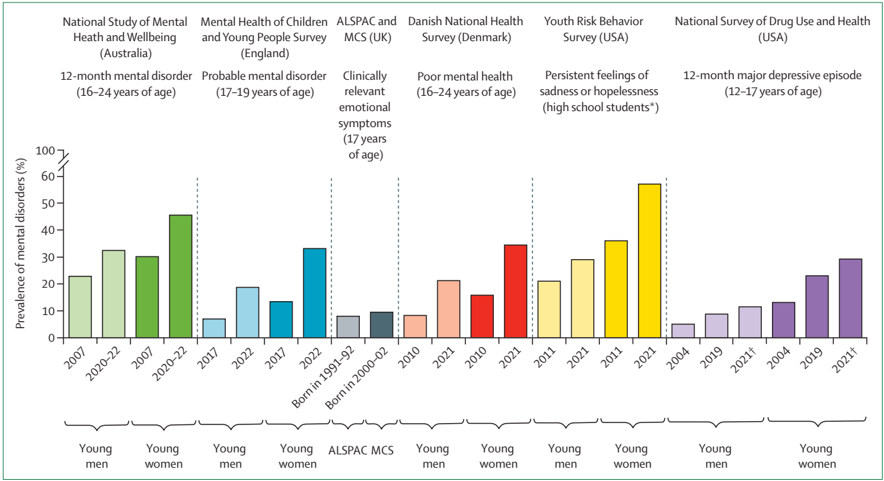
- In Australia’s national study (2020–22), diagnostic-level mental disorders in people aged 16–24 years rose 50% since 2007, reaching annual prevalence of 39% (nearly 50% in young women); 12-month prevalence rates were 32% for anxiety, 14% for affective, and 7·8% for substance use disorders, versus 15%, 6%, and 13% in 2007.
- Care gaps are severe: only 2% of global health budgets go to mental health; in the MILESTONE cohort of 763 young people, only 19·6% transitioned to adult services and 26·8% remained in child services after age 18; a 2022 UK survey found 58% deteriorated while waiting for care and 24% attempted suicide while waiting; 42% dropped out by the third therapy session, up to 80% with complex conditions relapsed, and one-third to two-thirds receiving interventions had no symptom reduction.
- Economic evidence supports investment: global cost of all mental disorders was estimated at US$2·5–8·5 trillion in 2010 and projected to double by 2030; every Australian dollar invested in school or university depression/anxiety prevention returns about AU$1·1–3·1; early intervention in psychosis showed 35% health-care savings per point of PANSS improvement in Hong Kong; lay-delivered therapy cost US$4 per student in India and US$13 per DALY averted in Uganda.
Methods
- This Commission is a synthesis of evidence across five key topics, using systematic reviews and meta-analyses where available and appropriate, plus publications deemed relevant to capture the current state of knowledge.
- An initial consultation meeting was held in July, 2019, bringing together experts across clinical psychology, psychiatry, neuroscience, epidemiology, social science, economics, and service reform, as well as young people from low-income, middle-income, and high-income countries.
- The Commission was developed by section Commissioners, youth Commissioners, and co-authors; it is not described as a systematic review with a formal search strategy, inclusion criteria, or risk-of-bias assessment.
Limitations
- The paper states that much of the data and practical reform has been limited to high-resource and middle-resource settings, that youth mental health reform in low-resource settings is only beginning, and that systematic monitoring of youth mental health trends in low-resource and middle-resource settings is relatively insufficient.
- The paper states that economic evidence generalisability is a challenge, that budget-effect questions are underexplored, and that evidence on social media and mental health is still emerging, with longitudinal and well controlled experimental studies scarce.
- Evident from the text: the Commission is a narrative synthesis rather than a systematic review, and many authors declare competing interests, including leadership, advisory, or financial ties to headspace, Orygen, digital mental health platforms, and other youth mental health services and programmes discussed.
Model-written summary. Check it against the paper before relying on it.
Integrity signals
Registry
Cites
Statistics
Figures
Verification
Claims the paper makes
166 Valid · 23 Not valid · 108 Not checked · 79 Own results and interpretations
Some cited sources support this claim and some don’t — read each source’s verdict below.
In the paper
“Other evidence for specific interventions targeting disorders that occur mainly in young people (such as depressive or eating disorders) have also been found to be highly cost-effective. 430-432”
What the sources say
- Not checked — no full text of the sourcecites [430] Le, 2017, The modeled cost-effectiveness of family-based and adolescent-focused treatment for anorexia nervosa, Int J Eat Disord source
- Partly supportedcites [431] Turner, 2017, Cost-effectiveness of a preferred intensity exercise programme for young people with depression compared with treatment as usual: an economic evaluation alongside a clinical trial in the UK, BMJ Open sourceExperimental — accuracy not yet measured
The Conclusion says preferred-intensity exercise could be cost-effective for adolescents with depression when measured by improvement in CDI-2 scores. But the Results > Outcomes and Discussion report substantial uncertainty and no evidence of a QALY improvement, so this study does not establish that the intervention is highly cost-effective. The paper addresses depression, not eating disorders. (LLM, conf=0.88)
- Disputedcites [432] Tie, 2019, Cost-effectiveness analysis of telephone cognitive-behaviour therapy for adolescents with obsessive-compulsive disorder, BJPsych Open sourceExperimental — accuracy not yet measured
The Discussion (Policy implications; page unavailable) says this study found no evidence that telephone CBT was cost-effective compared with face-to-face CBT for young people with OCD, particularly when measured by QALYs. It does not report a highly cost-effective intervention for depression or an eating disorder. (LLM, conf=0.86)
Checked by a reasoning model — may be wrong.
plainstates a cause- Asserted: passes — The authors put it forward as true.
- Checkable: passes — It can be checked against evidence.
- Load-bearing: unclear — It is unclear whether the paper’s conclusions depend on it.
- Based: passes — The paper gives a reason why it holds.
At least one cited source doesn’t support this claim or points to a different paper, and none confirmed it — see the verdicts below.
In the paper
“A trial of a similar programme in Kenya reported statistically significantly lower rates of depression in young men compared with young women. 439”
What the sources say
- Disputedcites [439] Kilburn, 2016, Effects of a large-scale unconditional cash transfer program on mental health outcomes of young people in Kenya, J Adolesc Health sourceExperimental — accuracy not yet measured
The Results (Sample characteristics) report depressive symptoms in 33% of participants, with no difference between young men and young women. The statistically significant finding was instead a lower prevalence among young men in the intervention group than among young men in the control group; it was not a significant comparison of men with women. (LLM, conf=0.87)
Checked by a reasoning model — may be wrong.
plainstates a cause- Asserted: passes — The authors put it forward as true.
- Checkable: passes — It can be checked against evidence.
- Load-bearing: unclear — It is unclear whether the paper’s conclusions depend on it.
- Based: passes — The paper gives a reason why it holds.
- Disputed
Every source the paper cites for this claim was checked and supports it.
In the paper
“The neglect of youth mental health can be partly ascribed to the stigma-based neglect of mental health worldwide.”
What the sources say
- Supportedcites [53] Thornicroft, 2022, The Lancet Commission on ending stigma and discrimination in mental health, Lancet source
In the section headed “Person in Botswana” (page not provided), the Commission reports worldwide evidence of stigma affecting young people with mental health conditions and describes families dismissing adolescents’ problems or creating barriers to seeking help. The “Personal impacts” section (page not provided) says stigma reduces help-seeking and health-service use, especially among young people with mental health conditions. Together, these passages support the claim’s qualified attribution of youth mental-health neglect partly to stigma. (LLM, conf=0.87)
plainstates a possible cause- Asserted: passes — The authors put it forward as true.
- Checkable: passes — It can be checked against evidence.
- Load-bearing: unclear — It is unclear whether the paper’s conclusions depend on it.
- Based: passes — The paper gives a reason why it holds.
- Supported
Every source the paper cites for this claim was checked and supports it.
In the paper
“In low-resource and middle-resource settings, availability and access to mental health services for young people are grossly inadequate.”
What the sources say
- Supportedcites [49] Zhou, 2020, Child and adolescent mental health policy in low- and middle-income countries: challenges and lessons for policy development and implementation, Front Psychiatry source
The Results section, under “The Shortage of CAMH Resources,” says mental health services and other resources are insufficient in low- and middle-income countries, with resources for children and adolescents scarcer than those for adults. It also reports that families commonly pay for these services out of pocket, supporting the claim about limited access. (LLM, conf=0.93)
plain- Asserted: passes — The authors put it forward as true.
- Checkable: passes — It can be checked against evidence.
- Load-bearing: passes — The paper’s conclusions depend on it.
- Based: passes — The paper gives a reason why it holds.
- Supported
The cited sources support only part of this claim — read each source’s verdict below.
In the paper
“Indigenous young people in many countries (eg, Australia, Canada, the USA, and India) have substantially higher rates of suicide than the general population.”
What the sources say
- Partly supportedcites [43] Troya, 2022, Suicide rates amongst individuals from ethnic minority backgrounds: a systematic review and meta-analysis, EClinicalMedicine sourceExperimental — accuracy not yet measured
The Discussion reports substantially higher suicide risk for Indigenous populations overall (RR 2.8), supporting the general comparison. The Results table includes youth studies in Australia, Canada, and the USA, but lists the India study as covering all ages; the cited passages do not establish elevated rates specifically among Indigenous young people across all four named countries. (LLM, conf=0.87)
plainstates an association- Asserted: passes — The authors put it forward as true.
- Checkable: passes — It can be checked against evidence.
- Load-bearing: unclear — It is unclear whether the paper’s conclusions depend on it.
- Based: passes — The paper gives a reason why it holds.
- Partly supported
160 more claims · 83 with their cited sources checked
Create a free account to see all 376 claims and to verify the 14 references still open.
- It may state two separate claims as one. 146
- Probably not a substantial claim. 88
- The quote only partly states this claim. 1
Claims other papers make about this one
Each is checked against this paper’s own text: does it say what the citing paper says it does?
The source backs part of the claim, not all of it — or backs it for a different population, condition or comparison.
In the citing paper
“The trend of rising mental health issues is not limited to Australia; it is reflected worldwide across various countries (McGorry et al., 2024).”
From Will restricting the age of access to social media reduce mental illness in Australian youth? (2025) · cites this paper as McGorry et al., 2024
Experimental — accuracy not yet measured
Self-check
Percentages, sums and reported differences re-computed from the paper’s own numbers.
Rated minor: it would not touch a result — a value no result rests on, a p-value that stays on the same side of the significance level, or a conflict that is clerical, resolved elsewhere in the paper, or outside its own findings.
In the paper
“the percentage of adolescents who reported being almost constantly online doubled over the previous 7 years (46% in 2022 vs 24% in 2017).”
Reported 7 · recomputed 5
Citations
Cites
The Ecology of Human Development: Experiments by Nature and Design
Bronfenbrenner, U. (1979) · Harvard University Press eBooks · doi:10.4159/9780674028845 · Cited by 26,084
Kessler, R. C., Berglund, P., Demler, O., Jin, R., Merikangas, K. R., & Walters, E. E. (2005) · Archives of General Psychiatry · doi:10.1001/archpsyc.62.6.593 · Cited by 20,391
Emerging adulthood: A theory of development from the late teens through the twenties.
Arnett, J. J. (2000) · American Psychologist · doi:10.1037/0003-066x.55.5.469 · Cited by 16,843
Digital Natives, Digital Immigrants Part 1
Prensky, M. (2001) · On the Horizon · doi:10.1108/10748120110424816 · Cited by 11,104
Positive Psychology Progress: Empirical Validation of Interventions.
Seligman, M. E. P., Steen, T. A., Park, N., & Peterson, C. (2005) · American Psychologist · doi:10.1037/0003-066x.60.5.410 · Cited by 5,947
Santomauro, D. F., Mantilla Herrera, A. M., Shadid, J., Zheng, P., Ashbaugh, C., Pigott, D. M., Abbafati, C., Adolph, C., Amlag, J. O., Aravkin, A. Y., et al. (2021) · The Lancet · doi:10.1016/s0140-6736(21)02143-7 · Cited by 5,444
Age at onset of mental disorders worldwide: Large-scale meta-analysis of 192 epidemiological studies
Solmi, M., Radua, J., Olivola, M., Croce, E., Soardo, L., Salazar de Pablo, G., Il Shin, J., Kirkbride, J. B., Jones, P., Kim, J. H., et al. (2022) · Molecular Psychiatry · doi:10.1038/s41380-021-01161-7 · Cited by 3,835
Self-citationOur future: a Lancet commission on adolescent health and wellbeing
Patton, G. C., Sawyer, S. M., Santelli, J. S., Ross, D. A., Afifi, R., Allen, N. B., Arora, M., Azzopardi, P., Baldwin, W., Bonell, C., et al. (2016) · The Lancet · doi:10.1016/s0140-6736(16)00579-1 · Cited by 3,785
The Lancet Commission on global mental health and sustainable development
Patel, V., Saxena, S., Lund, C., Thornicroft, G., Baingana, F., Bolton, P., Chisholm, D., Collins, P. Y., Cooper, J. L., Eaton, J., et al. (2018) · The Lancet · doi:10.1016/s0140-6736(18)31612-x · Cited by 3,692
Sawyer, S. M., Azzopardi, P. S., Wickremarathne, D., & Patton, G. C. (2018) · The Lancet Child & Adolescent Health · doi:10.1016/s2352-4642(18)30022-1 · Cited by 3,666
Research works printed but not linked: 2
- 5 Rutter M, Smith DJ, eds. Psychosocial disorders in young people: time trends and their causes. Chichester, West Sussex: John Wiley & Sons Ltd, 1995.
- Tan, 2019, Mental health of trans and gender diverse people in Aotearoa/New Zealand: a review of the social determinants of inequities, N Z J Psychol, 48, 64
Cited by
Items 201–300 of 634
Reconceptualizing cognitive-behavioral processes in youth anxiety in the digital age
Skjerdingstad, N., & Leigh, E. (2026) · Nature Mental Health · doi:10.1038/s44220-026-00633-5 · Cited by 3
“This digital shift coincides with rising concerns about youth mental health 6,7 as the rates of anxiety and depression have increased in recent years 8,9 .”
Perhoniemi, R., & Blomgren, J. (2025) · BMC Public Health · doi:10.1186/s12889-025-22431-x · Cited by 10
“Higher education students have a high risk for depression and other mental disorders [6, 37], and the disruptions caused by covid-19 further increased the prevalence of depressive and anxiety symptoms among this group [38] and the young in general [39] in many countries.”
Dhonnagáin, N. M., O’Reilly, A., O'Brien, G., & Dooley, B. A. (2025) · Early Intervention in Psychiatry · doi:10.1111/eip.70000 · Cited by 2
Self-citationThe impact of mental health lived experience advocacy on youth education and employment engagement
Wainwright, C., Harris, N., O’Leary, R., Riley, T., & Sofija, E. (2025) · Discover Mental Health · doi:10.1007/s44192-025-00339-7 · Cited by 5
“This shift calls for a multi-faceted approach that incorporates storytelling, mental health championing, and the development of tangible solutions [43].”
Analysis of Factors Affecting Healthy Reproductive Behavior in Adolescents in the Digital Era
Ula, Z., Rahagia, R., & Suprapto (2025) · Journal of Health Sciences and Medical Development · doi:10.56741/hesmed.v4i03.1322 · Cited by 8
“While traditional school-based education and community programs have been valuable in promoting awareness, the rise of the digital era has transformed the context in which adolescents access and process reproductive health information [7] [8].”
Bailie, J., Aitken, Z., Mantilla, S., Shields, M., Dimov, S., Bright, T. M., Sully, A., Folpp, N., Ekanayake, K., & Llewellyn, G. M. (2026) · BMC Public Health · doi:10.1186/s12889-026-28583-8
“An individual’s position on this continuum can shift at any time due to a complex interplay of individual, social, and structural influences [3, 6, 8–10].”
Perspectives of Carers on the Physical Health of Young People with Early Psychosis
Hui, T. T., Garvey, L., & Olasoji, M. (2025) · Issues in Mental Health Nursing · doi:10.1080/01612840.2025.2558055 · Cited by 1
“Young people with mental illness are more susceptible to poor physical health (McGorry et al., 2024).”
InfluentialTalking at cross purposes? Exploring (mis)alignment between research and practice
Day, E., Steinka‐Fry, K. T., Schweer‐Collins, M. L., Grant, S., Trevino, S. D., & Tanner‐Smith, E. E. (2025) · Educational Research · doi:10.1080/00131881.2025.2529256 · Cited by 3
We’re all mental health nurses now
Clarke, S. P. (2025) · Nursing Outlook · doi:10.1016/j.outlook.2025.102560 · Cited by 1
Juul, L., Frydenberg, M., Bonde, E. H., Beck, M. S., Gøtzsche, K., Bruggisser, S., & Fjorback, L. O. (2025) · npj Mental Health Research · doi:10.1038/s44184-025-00150-w · Cited by 2
Backer, H. D., Martens, N., Bakker, J. M., den Broeck, K. V., van Amelsvoort, T., & Glazemakers, I. (2026) · European Child & Adolescent Psychiatry · doi:10.1007/s00787-026-03118-z · Cited by 1
Building a two-state learning healthcare system for persons with first episode psychosis
Marsteller, J. A., Goldberg, R. W., Boumaiz, Y., Jumper, M. B. E., Taylor, J., Saravana, A., Buchanan, R. W., Chengappa, K. N. R., Conroy, C. G., Dickerson, F., et al. (2025) · Schizophrenia Research · doi:10.1016/j.schres.2025.02.004 · Cited by 1
Suen, Y. N., Chan, K. T., Wan, Y. S., So, M. M., Lee, E. H. M., Wong, S. M. Y., Chan, S. K. W., Hui, C. L. M., Wong, M. T. H., & Chen, E. Y. H. (2025) · BMJ Public Health · doi:10.1136/bmjph-2025-002692 · Cited by 1
Self-citationAdolescents' trajectories of mental health in the MYRIAD trial
Holst, C. G., Skripkauskaitė, S., Andrews, J. L., Montero‐Marín, J., Hinze, V., Dalgleish, T., Kuyken, W., MYRIAD team, & Foulkes, L. (2025) · JCPP Advances · doi:10.1002/jcv2.70046 · Cited by 2
“We use the descriptors ‘high’, ‘moderate’ and ‘low’ to describe and visualise trajectories, however this should be interpreted with caution given that raw scores were used for the RCADS rather than t - scores; these labels do not necessarily equate quantitatively to clinical severity.”
Dim light sensitivity and delayed sleep timing in young people with emerging mental disordersPreprint
Tonini, E., Hickie, I. B., Shin, M., Carpenter, J. S., Nichles, A., Zmicerevska, N., Jeon, E., Hindmarsh, G., Phung, E., Janiszewski, C., et al. (2026) · medRxiv · doi:10.64898/2026.03.02.26347467 · Cited by 1
Self-citationPolitical economy of adolescent mental health and well-being globally
Biermann, O., Shawar, Y. R., Shiffman, J., Brown, S. L., Bain, M., Shire, I., Baird, S., Collins, P. Y., Requejo, J. H., Mensa‐Kwao, A., et al. (2026) · Health Research Policy and Systems · doi:10.1186/s12961-026-01477-2 · Cited by 1
“A variety of documents also employed the public health narrative emphasizing the importance of early interventions [12, 29, 32, 33].”
Mindfulness training impacts brain network dynamics linked to stress response in young adolescents
Gaviria, J., Celen, Z., Smith, M. M., Peek, L., Brosset, S., Vuilleumier, P., Van De Ville, D., Merglen, A., Klauser, P., & Piguet, C. (2024) · doi:10.1101/2024.10.16.616959 · Cited by 1
Crombach, C. M. W., Janssen, S., Daemen, M., Klaassen, R. M. C., van Amelsvoort, T., & Leijdesdorff, S. M. J. (2025) · Child Psychiatry & Human Development · doi:10.1007/s10578-025-01861-z · Cited by 3
Shepherd, R. F., Rising, C. J., Moser, R. P., Huelsnitz, C. O., Boyd, P., Wilsnack, C., Sleight, A. G., Klein, W. M. P., Werner‐Lin, A., Hutson, S. P., et al. (2025) · European Journal of Human Genetics · doi:10.1038/s41431-025-01984-w · Cited by 2
“…areas for future research, particularly in developing long-term supportive care interventions tailored to YAs ’ concerns about LFS. Effectively managing the psychosocial challenges of LFS requires interdisciplinary care teams, including mental health providers, genetic counselors, and physicians.”
Mürner-Lavanchy, I. M., Sele, S., Simmons, J. G., Lubman, D. I., Whittle, S., Allen, N. B., & Kaess, M. (2025) · Journal of Behavioral Addictions · doi:10.1556/2006.2025.00068 · Cited by 4
“Understanding this spectrum is essential for the identi fi cation of early risk factors, particularly during adolescence – a critical developmental period marked by signi fi cant changes and challenges (Crone, Van Duijvenvoorde, & Peper, 2016; McGorry et al., 2024).”
Paquin, V., Lavallee, Z., Huot‐Lavoie, M., Ku, B. S., Díaz‐Caneja, C. M., & Gülöksüz, S. (2025) · medRxiv · doi:10.1101/2025.03.24.25324546 · Cited by 1
Skvarc, D., Patafio, B., Hyder, S., Harries, T., Curtis, A., Benstead, M., & Mayshak, R. (2025) · Behavioral Sciences · doi:10.3390/bs15121736 · Cited by 3
Global trends in youth suicide
Padmanathan, P., Chang, S., Rajapakse, T. N., & Knipe, D. W. (2026) · BMJ · doi:10.1136/bmj.s4 · Cited by 3
MacNeil, S., Sicotte, R., Davisse‐Paturet, C., Chartrand, E., Alexander, E., Lecousy, M., Girard, A., Orri, M., Chadi, N., Ouellet‐Morin, I., et al. (2026) · The Canadian Journal of Psychiatry · doi:10.1177/07067437261442420 · Cited by 1
Self-citationSolmi, M., Correll, C. U., Boldrini, T., Addington, J., Barbezat, E., Bassetto, S. A., Bechdolf, A., Devoe, D. J. A., Firth, J., Fusar‐Poli, P., et al. (2026) · The World Journal of Biological Psychiatry · doi:10.1080/15622975.2026.2651738 · Cited by 1
Self-citationLima, R. A., Baumeister, H., Pryss, R., Küchler, A., Kraft, R., Berghoff, N., Nagel, L., Reichert, M., Idrees, A. R., Stach, M., et al. (2026) · BMJ Open · doi:10.1136/bmjopen-2025-108674 · Cited by 2
“5 8 Among the various approaches, universal social and emotional learning (SEL) interventions have the strongest evidence of enhancing young people’s social and emotional skills while also reducing symptoms of depression and anxiety in the short term.”
Kusier, A. O., Dalsgaard, C., Hoffmann, S. H., Thygesen, L. C., & Folker, A. P. (2026) · JMIR Human Factors · doi:10.2196/91017 · Cited by 1
“Girls turning to the digital letter box for advice far more often than boys may reflect a higher prevalence of distress among Danish girls, as documented in national health surveys [5], but it may also indicate that boys are less inclined to seek help.”
InfluentialLoades, M. E. (2025) · Clinical Child Psychology and Psychiatry · doi:10.1177/13591045251346290 · Cited by 3
“…it also de fi nes young people as up to age 24, aligned with others who have argued for a broader de fi nition of adolescence that is more inclusive (age 10 – 24) and captures the biopsychosocial development that occurs between childhood and adulthood (McGorry et al., 2024; Sawyer et al., 2018).”
Fegert, J. M., Boege, I., Calderoni, D., Purper‐Ouakil, D., Sitarski, E., & Vitiello, B. (2025) · European Child & Adolescent Psychiatry · doi:10.1007/s00787-025-02902-7 · Cited by 1
Gerin, M. I., Viding, E. M., Armbruster‐Genc, D., Roiser, J. P., & McCrory, E. J. P. (2025) · European Child & Adolescent Psychiatry · doi:10.1007/s00787-025-02838-y · Cited by 1
“The prevention and promotion of mental health is increas - ingly recognised not only as an ethical imperative but also as an economic one [8].”
Göksal, R., Salcuni, S., Marino, G., Paduanello, M., & de Rénoche, G. (2025) · Research in Psychotherapy Psychopathology Process and Outcome · doi:10.4081/ripppo.2025.831 · Cited by 3
Anand-Vembar, S., Keogh, B., Higgins, A., Sheaf, G., Kartalova‐O’Doherty, Y., Longe, O., Staines, L., McEvoy, D., Gallant, A. J., Wilson, C., et al. (2025) · HRB Open Research · doi:10.12688/hrbopenres.14287.1 · Cited by 2
“Beyond institutional mandates, PPI is also a moral and ethical imperative, helping to redress decades of epistemic injustice by valuing the knowledge of those with direct experience of health challenges (Downs, 2025; McGorry et al. , 2024; Rose & Kalathil, 2019).”
Self-citationCalia, C., Grant, L., Guerra, C., & Reid, C. L. (2025) · Reflective Practice · doi:10.1080/14623943.2025.2586133 · Cited by 1
Hugh‐Jones, S., Farahar, C., Allder, L., Foster, A., Williams, E., Bhui, K. S., & Shaughnessy, N. (2026) · medRxiv · doi:10.64898/2026.07.30.26359340 · Cited by 1
Witt, K., Teo, S. M., Ziou, M., Rajaram, G., Baker, D. G., Browne, V., Schmaal, L., McGorry, P. D., & Gao, C. X. (2025) · SSRN Electronic Journal · doi:10.2139/ssrn.5262921 · Cited by 1
Self-citationStrøm, I. B., Lexén, A., Bonnert, M., & Jonsson, U. (2025) · Clinical Child Psychology and Psychiatry · doi:10.1177/13591045251329151 · Cited by 2
“Similar trends have been observed in countries worldwide, indicating a global youth mental health crisis (McGorry et al., 2024).”
Luyten, P., Speybrouck, D., Martin, P., Claes, S. J., Midgley, N., Eeren, H. V., Busschbach, J. J. V., & Tang, E. (2026) · JMIR Research Protocols · doi:10.2196/80511 · Cited by 3
“Population-based studies suggest a lifetime prevalence of approximately 15% for unipolar depression and up to 25% in women [1,2], with some evidence suggesting increases in prevalence in recent decades [3], particularly in young people [4-6].”
Larsen, S. R., Hansen, E. R., Bültmann, U., & Tolstrup, J. S. (2026) · The Lancet Regional Health - Europe · doi:10.1016/j.lanepe.2026.101660 · Cited by 2
“11 While the consequences of clinical mental disorders for school disengagement and NEET status are well documented, the impact of suboptimal mental well-being remain less well understood.”
Young people’s experiences of compassion-focused group therapy: A reflexive thematic analysis
Parkrud, H. H., Anderberg, M., Vestin, M., & Dennhag, I. (2026) · Psychotherapy Research · doi:10.1080/10503307.2026.2625272 · Cited by 2
Stubbing, J., Gibson, K. L., Bardsley, A., & Gluckman, P. (2025) · BMC Public Health · doi:10.1186/s12889-025-22618-2 · Cited by 4
“Perhaps even more concerningly, a recent decline in youth mental health and well-being has been documented across countries where data is available (e.g., [3, 4–8]) and was documented before the COVID-19 pandemic, which has negatively impacted youth wellbeing (e.g., [9, 10]).”
Dupéré, V., Caron‐Diotte, M., Beauregard, N., Courdi, C., Ahn, J. S., Olivier, É., Tardif‐Grenier, K., & Litalien, D. (2025) · Frontiers in Public Health · doi:10.3389/fpubh.2025.1601463 · Cited by 6
Haag, C., Bürgin, D., Büeler, L. A., Janousch, C., Bechtiger, L., Ribeaud, D., Eisner, M., Shanahan, L., & von Wyl, V. (2026) · Journal of Affective Disorders · doi:10.1016/j.jad.2026.121221 · Cited by 4
Wong, S. M., Chen, E., Suen, Y., van Os, J., Jones, P., Mcgorry, P., Lam, T.-H., Morgan, C., Mcdaid, D., Sham, P., et al. (2025) · Psychological Medicine · doi:10.1017/s0033291725102468 · Cited by 1
“With the onset of most adult depressive disorders occurring before the age of 25 years (Solmi et al., 2022), early prevention and intervention initiatives targeting this age group have been called for (McGorry et al., 2024).”
Self-citationDo smartphones and social media really harm teens’ mental health?
Pearson, H. (2025) · Nature · doi:10.1038/d41586-025-00933-3 · Cited by 4
Tu, X., Wu, B., Ding, X., Huo, Q., & Chen, M. (2026) · Behavioral Sciences · doi:10.3390/bs16010119 · Cited by 2
Challenges in addressing youth mental health
Buckley, R., & Liddon, M. (2024) · The Lancet Psychiatry · doi:10.1016/s2215-0366(24)00321-3 · Cited by 1
Hall, J., Atmore, K. H., Belikova, R., Boyd-Skinner, C., Corrigan, L., Giannaki, A., Guerreiro, A. I. F., Kalpaxi, P., Kelly, C. N. M., Kotsis, K. Τ., et al. (2025) · Frontiers in Health Services · doi:10.3389/frhs.2025.1644419 · Cited by 1
“Despite all countries in the Region being classified as either high or middle income (15), most, if not all, have reported having inadequate resources for child and youth mental health care with multiple calls for more investment in this area (16).”
AI Mental Health Support and the Case for Distributed Networked Regulation
Paterson, J. (2026) · Cambridge University Press eBooks · doi:10.1017/9781009860796 · Cited by 1
Mental Health as a Polysemic Construct? Revisiting the Debate about University Students’ Unmet Needs
Gonçalves‐Pereira, M. (2024) · Portuguese Journal of Public Health · doi:10.1159/000542629 · Cited by 1
“Quoting the 2024 Lancet Psychiatry Commission on Youth Mental Health, “ arguably, young people communicate the warning signs of our modern world and are indicating that our society and world are in serious trouble ” [24].”
Gender and age-specific aspects of mental health in children and adolescents
Slobodskaya, H. R., Kornienko, O. S., Safronova, M. V., Ryabichenko, T. I., Варшал, А. В., Petrenko, E. N., & Козлова, Е. А. (2026) · S S Korsakov Journal of Neurology and Psychiatry · doi:10.17116/jnevro2026126021109 · Cited by 1
Ball, A., Rowe, A., Zieschank, K. L., & March, S. (2026) · Internet Interventions · doi:10.1016/j.invent.2026.100938 · Cited by 1
Hunt, E. (2025) · Journal of Occupational Science · doi:10.1080/14427591.2025.2592124 · Cited by 1
“…as a means of responding gently yet powerfully to the unprecedented but understandable fear and distress that so many young people are reporting (McGorry et al., 2024), while teachings on joy and gratitude empower students to identify, celebrate, and perhaps reclaim the big or small experiences…”
Hosseini, S. H., Ho, N., Huntley, S., Piper, S., Crosland, P., Skinner, A., Vacher, C., Tran, K., Nguyen, K., Song, Y. J. C., et al. (2025) · Journal of Medical Internet Research · doi:10.2196/71256 · Cited by 7
“The projected impacts of integrated approaches combining digital and specialized services are consistent with the recent Lancet Psychiatry Commission on YMH [56], which advocates for multimodal service models across diverse health care systems.”
InfluentialSelf-citationShah, J. L., Thành, N. X., Surood, S., Gusnowski, A., Poudel, S., Urichuk, L., D’Andrea, G., Iyer, S. N., MALLA, A. K., Latimer, E. A., et al. (2026) · The Canadian Journal of Psychiatry · doi:10.1177/07067437251412570 · Cited by 2
Self-citationVijayabanu, C., & Gayathri, R. (2026) · Springer eBooks · doi:10.1007/978-3-030-68127-2_851-1 · Cited by 1
Huth, D., Brand, S., & Lindenberg, K. (2026) · Journal of Behavioral Addictions · doi:10.1556/2006.2025.00551 · Cited by 1
“PUI has been linked to the deterioration of mental health among adolescents and young adults (McGorry et al., 2024).”
Hoffmann, S. H., Kusier, A. O., Mairey, I. P., Folker, A. P., & Thygesen, L. C. (2025) · JMIR Research Protocols · doi:10.2196/73736 · Cited by 1
“If effective, this highly scalable service may contribute to combating the trend of rising mental health issues among young people and address key challenges in primary care by delivering timely, coordinated, and effective services to young individuals, potentially at a low cost [52].”
Orchard, N. A., Duister, S., Zhang, R., Guan, K., Vegt, N., de Reuver, M., & Figueroa, C. A. (2026) · ACM Transactions on Computing for Healthcare · doi:10.1145/3810945 · Cited by 2
Transdiagnostic stage-based monitoring of public mental health
Buchweitz, C., Viduani, A. C., Herrman, H., Kohrt, B. A., McGorry, P. D., Salum, G. A., Sartor, C., Saxena, S., & Kieling, C. (2026) · Nature Reviews Psychology · doi:10.1038/s44159-025-00527-w · Cited by 5
“the positive long-term transgenerational impact of establishing youth mental health prevention and services as a priority has undeniable value 102,142 .”
InfluentialSelf-citationShoari, N., Lewis, K. M., Blackburn, R. M., et al. (2025) · medRxiv · doi:10.1101/2025.11.03.25339389 · Cited by 1
Reiß, F., Volk, C., Behn, S., Kaman, A., Klos, L., Burchartz, A., Hinz, T., Hanssen‐Doose, A., Wöll, A., Niessner, C., et al. (2025) · Zeitschrift für Kinder- und Jugendpsychiatrie und Psychotherapie · doi:10.1024/1422-4917/a001045 · Cited by 2
CAIRS: A causal artificial intelligence recommendation system for digital mental healthPreprint
Varidel, M., An, V., Hickie, I. B., Cripps, S., Marchant, R., Scott, J. L., Crouse, J. J., Poulsen, A., O’Dea, B., & Iorfino, F. (2024) · medRxiv · doi:10.1101/2024.11.11.24317126 · Cited by 1
Self-citationIntergenerational Injustice and Youth Mental Health: A Call to Action
Jordan, G., Akhtar, F., Ahsan, N., Egharevba, E., Kimber, R., Saffy, N., & Horvath, E. (2024) · Early Intervention in Psychiatry · doi:10.1111/eip.13619 · Cited by 1
Villodas, M. L., Acevedo, N., Wheeler, M., Hamati, F., & Kapur, I. (2026) · Journal of Policy Practice and Research · doi:10.1007/s42972-026-00155-5 · Cited by 1
Verbesserung der psychischen Gesundheit im Kindes- und Jugendalter
der YMH-INF, K., Christiansen, H., Dort, M., van der Meer, A. S., Strelow, A. E., Oschwald, A., Pranjic, C., Nagler, T., Hasselhorn, M., Blask, K., et al. (2025) · Kindheit und Entwicklung · doi:10.1026/0942-5403/a000476 · Cited by 1
Brooks, M. J., MacLean, S. A., Eschliman, E. L., Poku, O. B., Molebatsi, K., Ahmed, C. V., Morakanyane, P., Entaile, P., Monyane-Pheko, M. M. B., Morapedi, K., et al. (2026) · Journal of Adolescent Health · doi:10.1016/j.jadohealth.2025.12.260 · Cited by 2
“Future studies will include a more framework-based assessment of implementation and process based on guidelines that have been recently developed [38,39].”
McKenna, S., Chong, M. K., Poulsen, A., Turner, A., Gorban, C., Crouse, J. J., Capon, W., Varidel, M., Aji, M., Scott, E. M., et al. (2025) · JMIR Human Factors · doi:10.2196/71678 · Cited by 1
“In response to the extreme scale and complexity of these problems, urgent calls have been made to radically transform youth mental health services so that they are able to provide more efficient and personalized treatments [5,6].”
Self-citationNavarrete, J., Brandolin, F., Lappalainen, P., García‐Rubio, C., Ferreira, C., Luciano, J. V., Lappalainen, R. I., & Kiuru, N. H. (2026) · Journal of Contextual Behavioral Science · doi:10.1016/j.jcbs.2026.101015 · Cited by 1
Integrated Youth Mental Health Services – Neue Hoffnung für junge Menschen mit psychischen Krisen
Bechdolf, A., Correll, C. U., & Uhlhaas, P. J. (2025) · Psychiatrische Praxis · doi:10.1055/a-2657-9858 · Cited by 1
“15 bis 28 Jahren zu implementieren [6].”
The Young Adult Sleep model: an evolving causal loop diagram of mental health dynamics
Uleman, J. F., Al‐Shama, R., Zucco, A. G., Echterhoff, J., Luijten, M., Verhagen, M., Vyrastekova, J., Treur, J. L., Wootton, R. E., Jones, S., et al. (2026) · BMC Medicine · doi:10.1186/s12916-026-04738-7 · Cited by 1
“The decline in mental health among young adults over the past two decades has become a significant public health concern [1].”
Macauley, J., Bower, M., Teesson, M., Webster, E., & Chapman, C. (2025) · Australian & New Zealand Journal of Psychiatry · doi:10.1177/00048674251385365 · Cited by 3
“The mental health and wellbeing of young people in western, high-income nations is deteriorating (Bor et al., 2014; McGorry et al., 2024).”
Stalled Improvements? Youth Opioid Misuse 2015–2022
Siegal, N., Simon, K. I., Freedman, S. M., Aalsma, M. C., & Wing, C. (2025) · Journal of Adolescent Health · doi:10.1016/j.jadohealth.2025.05.008 · Cited by 1
Downey, P. M., Collins, J. C., El‐Den, S., McMillan, S. S., Hamilton, B. A., Fowler, D., Janiszewski, C., Fathabadi, S., & O’Reilly, C. L. (2026) · Exploratory Research in Clinical and Social Pharmacy · doi:10.1016/j.rcsop.2026.100723 · Cited by 1
Rethinking suicide prevention in schools starts with implementation
Robinson, J., McKay, S., & Vargas, B. (2025) · Nature Mental Health · doi:10.1038/s44220-025-00484-6 · Cited by 1
Self-citationScreen use and the mental health of children and young people
Madelaire, L. F., Jeppesen, P., Hansen, A. S., Mainz, J., Bikic, A., Nordentoft, M., & Krantz, M. F. (2024) · Ugeskrift for Læger · doi:10.61409/v05240342 · Cited by 1
Bechdolf, A., Correll, C. U., Hellenschmidt, T., Holzner, L., von Hardenberg, L., Jäckel, D., Kambeitz, J. P., Koutsouleris, N., Kusserow, N., Leopold, K., et al. (2025) · Der Nervenarzt · doi:10.1007/s00115-025-01895-7 · Cited by 1
Is young people’s mental health worse than in the past?
Groenman, A. P., Copp, T., McCaffery, K. J., Jansen, J., & Jønsson, A. B. R. (2026) · BMJ · doi:10.1136/bmj.s410 · Cited by 1
Zhang, Z., Li, C., Qiu, T. H., Su, Y., Feng, Y., Chu, Y., Wang, Y., Wu, Y. C., Gu, Y., & Zhang, H. (2024) · SSRN Electronic Journal · doi:10.2139/ssrn.5073196 · Cited by 1
Ollers-Adrover, M. À., de la Torre‐Luque, A., González-Bennasar, N., Penadés, R. L., Morillas-Romero, A., Llabrés, J., & Balle, M. (2026) · International Journal of Clinical and Health Psychology · doi:10.1016/j.ijchp.2026.100702 · Cited by 1
“From a prevention perspective, and in line with transdiagnostic models of psychopathology and recent calls for earlier, developmentally informed approaches to youth mental health (McGorry et al., 2024), the present findings underscore the importance of identifying modifiable intermediary processes.”
Zecchinato, F., Kreppner, J., Bullard, P., Kumar, M., Painter, S., & Lawrence, P. J. (2025) · Mental Health & Prevention · doi:10.1016/j.mhp.2025.200439 · Cited by 1
Monteux, S., Stirling, F. J., Stoll, M., et al. (2025) · International Journal of Mental Health Nursing · doi:10.1111/inm.70062 · Cited by 1
Rodwin, A. H., Layman, D. M., Finnerty, M. T., Patel, S. Y., Jeong, J., Chen, Q., & Munson, M. R. (2025) · Journal of Adolescent Health · doi:10.1016/j.jadohealth.2025.01.010 · Cited by 2
Bjørkedal, S. T. B., Fabricius, M., Poulsen, R. M., Folker, A. P., & Eplov, L. F. (2026) · Scientific Reports · doi:10.1038/s41598-026-58021-z · Cited by 1
“Although these models vary, common features include accessible entry points, youth participation, community-based approaches, and holistic, prevention-oriented care 4,15,19 .”
Kruckow, S., Hansen, E. R., Ewing, S. W. F., Thomsen, K. R., Peden, A. E., Bramming, M., Kjeld, S. G., & Tolstrup, J. S. (2025) · European Journal of Public Health · doi:10.1093/eurpub/ckaf192 · Cited by 1
Differences in social media use between adolescents with and without mental health conditions
(2025) · Nature Human Behaviour · doi:10.1038/s41562-025-02133-5 · Cited by 1
Chanen, A. M., Andrewes, H. E., Nicol, K., Jackson, H. J., Cotton, S., Gleeson, J., Davey, C. G., McCutcheon, L., Perera, S., Rayner, V., et al. (2025) · European Child & Adolescent Psychiatry · doi:10.1007/s00787-025-02742-5 · Cited by 1
Self-citationSo, M. M., Wong, S. M. Y., Hui, C. L. M., Suen, Y. N., Chan, S. K. W., Lee, E. H. M., & Chen, E. Y. H. (2025) · Journal of Loss and Trauma · doi:10.1080/15325024.2025.2493954 · Cited by 2
“In view of the importance of youth mental health globally (McGorry et al., 2024), we aimed to investigate whether high mindful attention could moderate the relationship between prospective exposure to SLEs and symptoms of depression, anxiety, and PTSD at 1-year follow-up in a community-based cohort…”
Self-citationKwong, A. S. F., Moody, S. C., Taylor, A., Lockhart, C. L., Ogden, R., Leal, R., McMillan, A., Harvey, J., Brierley, E., Matthews, S., et al. (2026) · BMJ Open · doi:10.1136/bmjopen-2026-122195 · Cited by 1
Wang, L., Lu, H., Jiang, Y., Zhu, D., Sun, P., Sun, H., Wang, L., Jiang, W., Wu, Y., & Xiao, Z. (2025) · International Journal of Social Psychiatry · doi:10.1177/00207640241311031 · Cited by 1
Youth supporting youth online: A content analysis of peer counselling at the online chat of @ease
Boonstra, A., Simons, E. M. C., Klaassen, R. M. C., Mil, N. H. G., Boonstra, N., de Winter, R. F. P., van Amelsvoort, T., & Leijdesdorff, S. M. J. (2026) · Internet Interventions · doi:10.1016/j.invent.2026.100940 · Cited by 3
Liu, S., Wang, Y., & Huang, L. Q. (2026) · Journal of Clinical Medicine · doi:10.3390/jcm15135309 · Cited by 1
“Adolescent mental health is a vital global public health issue with heavy socioeconomic burdens [18,19].”
Dippel, N., Christiansen, H., Zemp, M., Pranjic, C., Baumann, A. W., Otto, K., Hirsch, O., Fabsits, S., Reiners, J., & Asbrand, J. (2026) · Psychological Test Adaptation and Development · doi:10.1027/2698-1866/a000141 · Cited by 3
Burton, Z. A., & Hudson, L. D. (2025) · Anaesthesia · doi:10.1111/anae.16729 · Cited by 1
“The recent Lancet Psychiatry commission on youth mental health reported a signi fi cant global decline, with the peak age of onset of mental ill-health occurring at just 15 years [5].”
Bellagarda, C. A., Padmanabhan, V., Dondzilo, L., Reynolds, A., & Wijeratne, L. T. (2026) · Australian & New Zealand Journal of Psychiatry · doi:10.1177/00048674251406460 · Cited by 1
Krok, D. (2026) · Brain Sciences · doi:10.3390/brainsci16030253 · Cited by 1
O’Brien, A., dos Santos, J. G. B., Humphrey, N., & Panayiotou, M. (2026) · PLoS ONE · doi:10.1371/journal.pone.0349949 · Cited by 1
“Amidst rising mental health problems among young people [1], there is robust evidence that school-based social-emotional learning (SEL) programmes can improve children’s social-emotional, behavioural, mental health and academic outcomes in the short and long-term [2–4].”
Macauley, J., Bower, M., Webster, E., Harris, M., Teesson, M., & Chapman, C. (2025) · Australian & New Zealand Journal of Psychiatry · doi:10.1177/00048674251389790 · Cited by 1
“For example, mental health care needs appear to be rising, as evidenced by the increasing prevalence of mental health conditions in this age group (McGorry et al., 2024; Slade et al., 2024).”
Youth mental health crisis: A translational view of the COVID-19 pandemic
Halldorsdottir, T. (2025) · Neurobiology of Stress · doi:10.1016/j.ynstr.2025.100738 · Cited by 6
Rantavuori, P., & Sannino, A. (2025) · Teachers College Record The Voice of Scholarship in Education · doi:10.1177/01614681251408929 · Cited by 1
“Similar worrisome trends are apparent on a global scale (see Bundick et al., 2014; McGorry et al., 2024; McPherson et al., 2023).”
Metadata
- Authors
- McGorry, P. D., Mei, C., Dalal, N., Alvarez-Jimenez, M., Blakemore, S.-J., Browne, V., Dooley, B., Hickie, I. B., Jones, P. B., McDaid, D., Mihalopoulos, C., Wood, S. J., El Azzouzi, F. A., Fazio, J., Gow, E., Hanjabam, S., Hayes, A., Morris, A., Pang, E., Paramasivam, K., Quagliato Nogueira, I., Tan, J., Adelsheim, S., Broome, M. R., Cannon, M., Chanen, A. M., Chen, E. Y. H., Danese, A., Davis, M., Ford, T., Gonsalves, P. P., Hamilton, M. P., Henderson, J., John, A., Kay-Lambkin, F., Le, L. K.-D., Kieling, C., Mac Dhonnagáin, N., Malla, A., Nieman, D. H., Rickwood, D., Robinson, J., Shah, J. L., Singh, S., Soosay, I., Tee, K., Twenge, J., Valmaggia, L., van Amelsvoort, T., Verma, S., Wilson, J., Yung, A., Iyer, S. N., & Killackey, E.
- Affiliations
- The University of Melbourne (AU)
- University of Cambridge (GB)
- University College Dublin (IE)
- The University of Sydney (AU)
- London School of Economics and Political Science (GB)
- Monash University (AU)
- Orygen (AU)
- Jack.org (CA)
- Stanford Medicine (US)
- Birmingham Women’s and Children’s NHS Foundation Trust (GB)
- Royal College of Surgeons in Ireland (IE)
- Nanyang Technological University (SG)
- King's College London (GB)
- University of Massachusetts Chan Medical School (US)
- University of Sussex (GB)
- Swansea University (GB)
- Universidade Federal do Rio Grande do Sul (BR)
- Douglas Mental Health University Institute (CA)
- Amsterdam UMC Location University of Amsterdam (NL)
- University of Canberra (AU)
- University of Warwick (GB)
- University of Auckland (NZ)
- Providence Health Care (CA)
- San Diego State University (US)
- Institute of Mental Health (SG)
- Norfolk and Suffolk NHS Foundation Trust (GB)
- Deakin University (AU)
- Corresponding author
- McGorry, Patrick D
- ORCID
- McGorry, Patrick D
- Mei, Cristina
- Dalal, Naeem
- Blakemore, Sarah-Jayne
- Browne, Vivienne
- Dooley, Barbara
- Hickie, Ian B
- Jones, Peter B
- McDaid, David
- Mihalopoulos, Cathrine
- Wood, Stephen J
- Hayes, Alan
- Morris, Amelia
- Adelsheim, Steven
- Broome, Matthew R
- Cannon, Mary
- Chanen, Andrew M
- Chen, Eric Y H
- Danese, Andrea
- Davis, Maryann
- Ford, Tamsin
- Gonsalves, Pattie P
- Hamilton, Matthew P
- John, Ann
- Kieling, Christian
- Malla, Ashok
- Nieman, Dorien H
- Rickwood, Debra
- Robinson, Jo
- Shah, Jai L
- Singh, Swaran
- Soosay, Ian
- Tee, Karen
- Twenge, Jean
- Valmaggia, Lucia
- Verma, Swapna
- Wilson, Jon
- Yung, Alison
- Iyer, Srividya N
- Venue
- The Lancet Psychiatry
- Publisher
- Elsevier BV
- Published
- 2024-09
- Volume
- 11
- Issue
- 9
- Pages
- 731-774
- ISSN
- 2215-0366 (ISSN-L)
- OpenAlex
- W4401528161
- Semantic Scholar
- 6de45b54b5cf97c2171787221d6026e0fff9d5e5
- Cited by
- 663
- References
- 442
- Citations by year
- 2026: 323 · 2025: 306 · 2024: 34
- FWCI
- 58.97
- Type
- journal article
- Language
- en
- Open access
- Licence
- cc-by-nc-nd
- www.elsevier.com/tdm/userlicense/1.0/ (tdm)
- www.elsevier.com/legal/tdmrep-license (tdm)
- doi.org/10.15223/policy-017 (stm-asf)
- doi.org/10.15223/policy-037 (stm-asf)
- doi.org/10.15223/policy-012 (stm-asf)
- doi.org/10.15223/policy-029 (stm-asf)
- doi.org/10.15223/policy-004 (stm-asf)
- Locations
- The Lancet Psychiatry (publishedVersion)
- PubMed (publishedVersion)
- Research Publications (Maastricht University) (publishedVersion, cc-by-nc-nd)
- Pure Amsterdam UMC (publishedVersion, other-oa)
- University of Birmingham Research Portal (University of Birmingham) (publishedVersion, cc-by-nc-nd)
- London School of Economics and Political Science Research Online (London School of Economics and Political Science) (submittedVersion, cc-by)
- Research Portal (King's College London) (submittedVersion, cc-by)
- London School of Economics and Political Science Theses Online (London School of Economics and Political Science) (submittedVersion, cc-by)
- Figshare (submittedVersion, cc-by)
- Funders
- National Institutes of Health
- Arts and Humanities Research Council
- Wolfson Foundation
- Jacobs Foundation
- Canada Research Chairs
- Margaret and Wallace McCain Centre for Child, Youth and Family Mental Health
- Conselho Nacional de Desenvolvimento Científico e Tecnológico
- Health Research Board (2008460)
- National Health Research Institutes
- Medical Research Council
- Fonds de Recherche du Québec - Santé
- National Institute of Mental Health
- Cooperative Research Centres, Australian Government Department of Industry
- Economic and Social Research Council
- Mackay Regional Council
- Wellcome Trust (WT107496/Z/15/Z)
- Grand Challenges Canada
- University of Cambridge (2016346, 1171910, 1061043, 1136259)
- National Health and Medical Research Council (1155508)
- Topics
- Social Sciences › Psychology › Clinical Psychology › COVID-19 and Mental Health
- Health Sciences › Medicine › Psychiatry and Mental health › Mental Health Treatment and Access
- Social Sciences › Psychology › Clinical Psychology › Child and Adolescent Psychosocial and Emotional Development
- Keywords
- youth mental health, emerging adults, mental illness, COVID-19 pandemic, pandemic containment measures, megatrends, social determinants of mental health, mental health policy
- MeSH terms
- Adolescent, Mental Disorders, Child, Humans, Mental Health, Mental Health Services, Psychiatry
About these checks
Registry, retraction, Cites and statistics results are computed, not judged, with one exception: a printed reference that no index lists is read once by a model before it counts as a citation error. Claims are extracted by a model and kept only when their quote appears verbatim in the text; each cited source is then checked, with a model’s help, for whether it says what the claim relies on. Those verdicts can be wrong — read the claim’s quote and the cited source before relying on one.
The claim verdicts this report counts are experimental: their accuracy is not yet measured.
A language model drew the claims from the paper on 2026-10-12, under version 3 of the claim definition (model deepseek-v4.1-flash, prompt extract-v3).
A second model labelled each claim on 2026-10-12 (model jev-1.13-20260917, definition revision gold-guideline-v0.2).
Cited sources are checked with a language model’s help (gpt-6-sol).
Statistics and arithmetic are recomputed, not judged.
Confidence bands are shown only for fields calibrated on our annotated test set. None is calibrated yet, so no band is shown.
What counts as a claim ›How we measure confidence ›How we check this ›
Are you an author, or do you see a problem with this page? Request a review
Data sources
Bibliographic data: Semantic Scholar, OpenAlex, Crossref.
Contains information from the Semantic Scholar Academic Graph Datasets, made available under the ODC Attribution License (ODC-BY 1.0).
Semantic Scholar’s data is described in: Kinney, R., et al. (2023). The Semantic Scholar Open Data Platform. arXiv:2301.10140.
