

The Lancet Psychiatry Commission on youth mental health
Open accessThe DOI matches its Crossref record; 428 of the 442 references it cites were found in a registry or an index; 267 of the 518 sources its claims cite were checked for support.
Overview
CoChat Summary
TL;DR
This Lancet Psychiatry Commission argues that youth mental health is in a global crisis, with rising prevalence, early onset, and major care gaps, and calls for integrated, developmentally appropriate care, prevention, economic investment, and political reform. It synthesizes evidence across epidemiology, developmental science, models of care, economics, and politics to propose a blueprint for ages 12–25.
Key findings
- Mental illnesses have a peak age of onset of 15 years, with 63–75% of onsets by age 25; a meta-analysis of 192 epidemiological studies (708,561 individuals) found cumulative onset proportions of 34·6% by age 14, 48·4% by 18, and 62·5% by 25. Mental ill health accounts for at least 45% of the overall burden of disease in those aged 10–24 years.
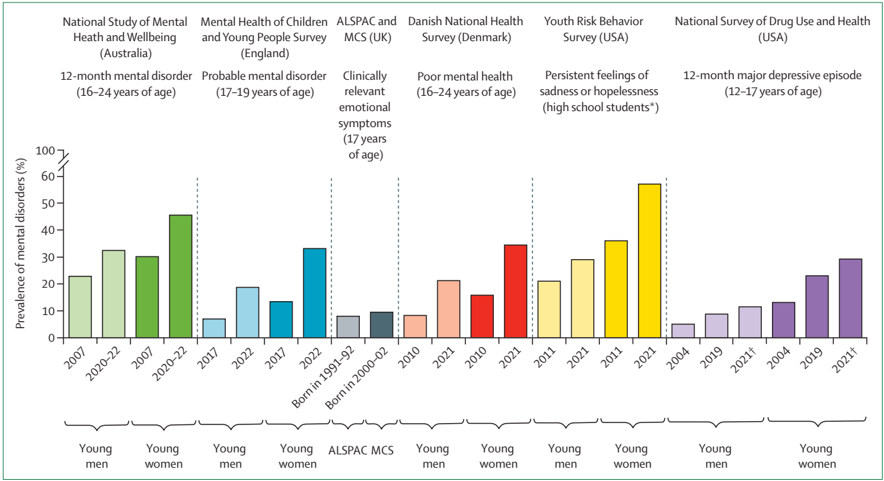
- In Australia’s national study (2020–22), diagnostic-level mental disorders in people aged 16–24 years rose 50% since 2007, reaching annual prevalence of 39% (nearly 50% in young women); 12-month prevalence rates were 32% for anxiety, 14% for affective, and 7·8% for substance use disorders, versus 15%, 6%, and 13% in 2007.
- Care gaps are severe: only 2% of global health budgets go to mental health; in the MILESTONE cohort of 763 young people, only 19·6% transitioned to adult services and 26·8% remained in child services after age 18; a 2022 UK survey found 58% deteriorated while waiting for care and 24% attempted suicide while waiting; 42% dropped out by the third therapy session, up to 80% with complex conditions relapsed, and one-third to two-thirds receiving interventions had no symptom reduction.
- Economic evidence supports investment: global cost of all mental disorders was estimated at US$2·5–8·5 trillion in 2010 and projected to double by 2030; every Australian dollar invested in school or university depression/anxiety prevention returns about AU$1·1–3·1; early intervention in psychosis showed 35% health-care savings per point of PANSS improvement in Hong Kong; lay-delivered therapy cost US$4 per student in India and US$13 per DALY averted in Uganda.
Methods
- This Commission is a synthesis of evidence across five key topics, using systematic reviews and meta-analyses where available and appropriate, plus publications deemed relevant to capture the current state of knowledge.
- An initial consultation meeting was held in July, 2019, bringing together experts across clinical psychology, psychiatry, neuroscience, epidemiology, social science, economics, and service reform, as well as young people from low-income, middle-income, and high-income countries.
- The Commission was developed by section Commissioners, youth Commissioners, and co-authors; it is not described as a systematic review with a formal search strategy, inclusion criteria, or risk-of-bias assessment.
Limitations
- The paper states that much of the data and practical reform has been limited to high-resource and middle-resource settings, that youth mental health reform in low-resource settings is only beginning, and that systematic monitoring of youth mental health trends in low-resource and middle-resource settings is relatively insufficient.
- The paper states that economic evidence generalisability is a challenge, that budget-effect questions are underexplored, and that evidence on social media and mental health is still emerging, with longitudinal and well controlled experimental studies scarce.
- Evident from the text: the Commission is a narrative synthesis rather than a systematic review, and many authors declare competing interests, including leadership, advisory, or financial ties to headspace, Orygen, digital mental health platforms, and other youth mental health services and programmes discussed.
Model-written summary. Check it against the paper before relying on it.
Integrity signals
Registry
Cites
Statistics
Figures
Verification
Claims the paper makes
166 Valid · 23 Not valid · 108 Not checked · 79 Own results and interpretations
Some cited sources support this claim and some don’t — read each source’s verdict below.
In the paper
“Other evidence for specific interventions targeting disorders that occur mainly in young people (such as depressive or eating disorders) have also been found to be highly cost-effective. 430-432”
What the sources say
- Not checked — no full text of the sourcecites [430] Le, 2017, The modeled cost-effectiveness of family-based and adolescent-focused treatment for anorexia nervosa, Int J Eat Disord source
- Partly supportedcites [431] Turner, 2017, Cost-effectiveness of a preferred intensity exercise programme for young people with depression compared with treatment as usual: an economic evaluation alongside a clinical trial in the UK, BMJ Open sourceExperimental — accuracy not yet measured
The Conclusion says preferred-intensity exercise could be cost-effective for adolescents with depression when measured by improvement in CDI-2 scores. But the Results > Outcomes and Discussion report substantial uncertainty and no evidence of a QALY improvement, so this study does not establish that the intervention is highly cost-effective. The paper addresses depression, not eating disorders. (LLM, conf=0.88)
- Disputedcites [432] Tie, 2019, Cost-effectiveness analysis of telephone cognitive-behaviour therapy for adolescents with obsessive-compulsive disorder, BJPsych Open sourceExperimental — accuracy not yet measured
The Discussion (Policy implications; page unavailable) says this study found no evidence that telephone CBT was cost-effective compared with face-to-face CBT for young people with OCD, particularly when measured by QALYs. It does not report a highly cost-effective intervention for depression or an eating disorder. (LLM, conf=0.86)
Checked by a reasoning model — may be wrong.
plainstates a cause- Asserted: passes — The authors put it forward as true.
- Checkable: passes — It can be checked against evidence.
- Load-bearing: unclear — It is unclear whether the paper’s conclusions depend on it.
- Based: passes — The paper gives a reason why it holds.
At least one cited source doesn’t support this claim or points to a different paper, and none confirmed it — see the verdicts below.
In the paper
“A trial of a similar programme in Kenya reported statistically significantly lower rates of depression in young men compared with young women. 439”
What the sources say
- Disputedcites [439] Kilburn, 2016, Effects of a large-scale unconditional cash transfer program on mental health outcomes of young people in Kenya, J Adolesc Health sourceExperimental — accuracy not yet measured
The Results (Sample characteristics) report depressive symptoms in 33% of participants, with no difference between young men and young women. The statistically significant finding was instead a lower prevalence among young men in the intervention group than among young men in the control group; it was not a significant comparison of men with women. (LLM, conf=0.87)
Checked by a reasoning model — may be wrong.
plainstates a cause- Asserted: passes — The authors put it forward as true.
- Checkable: passes — It can be checked against evidence.
- Load-bearing: unclear — It is unclear whether the paper’s conclusions depend on it.
- Based: passes — The paper gives a reason why it holds.
- Disputed
Every source the paper cites for this claim was checked and supports it.
In the paper
“The neglect of youth mental health can be partly ascribed to the stigma-based neglect of mental health worldwide.”
What the sources say
- Supportedcites [53] Thornicroft, 2022, The Lancet Commission on ending stigma and discrimination in mental health, Lancet source
In the section headed “Person in Botswana” (page not provided), the Commission reports worldwide evidence of stigma affecting young people with mental health conditions and describes families dismissing adolescents’ problems or creating barriers to seeking help. The “Personal impacts” section (page not provided) says stigma reduces help-seeking and health-service use, especially among young people with mental health conditions. Together, these passages support the claim’s qualified attribution of youth mental-health neglect partly to stigma. (LLM, conf=0.87)
plainstates a possible cause- Asserted: passes — The authors put it forward as true.
- Checkable: passes — It can be checked against evidence.
- Load-bearing: unclear — It is unclear whether the paper’s conclusions depend on it.
- Based: passes — The paper gives a reason why it holds.
- Supported
Every source the paper cites for this claim was checked and supports it.
In the paper
“In low-resource and middle-resource settings, availability and access to mental health services for young people are grossly inadequate.”
What the sources say
- Supportedcites [49] Zhou, 2020, Child and adolescent mental health policy in low- and middle-income countries: challenges and lessons for policy development and implementation, Front Psychiatry source
The Results section, under “The Shortage of CAMH Resources,” says mental health services and other resources are insufficient in low- and middle-income countries, with resources for children and adolescents scarcer than those for adults. It also reports that families commonly pay for these services out of pocket, supporting the claim about limited access. (LLM, conf=0.93)
plain- Asserted: passes — The authors put it forward as true.
- Checkable: passes — It can be checked against evidence.
- Load-bearing: passes — The paper’s conclusions depend on it.
- Based: passes — The paper gives a reason why it holds.
- Supported
The cited sources support only part of this claim — read each source’s verdict below.
In the paper
“Indigenous young people in many countries (eg, Australia, Canada, the USA, and India) have substantially higher rates of suicide than the general population.”
What the sources say
- Partly supportedcites [43] Troya, 2022, Suicide rates amongst individuals from ethnic minority backgrounds: a systematic review and meta-analysis, EClinicalMedicine sourceExperimental — accuracy not yet measured
The Discussion reports substantially higher suicide risk for Indigenous populations overall (RR 2.8), supporting the general comparison. The Results table includes youth studies in Australia, Canada, and the USA, but lists the India study as covering all ages; the cited passages do not establish elevated rates specifically among Indigenous young people across all four named countries. (LLM, conf=0.87)
plainstates an association- Asserted: passes — The authors put it forward as true.
- Checkable: passes — It can be checked against evidence.
- Load-bearing: unclear — It is unclear whether the paper’s conclusions depend on it.
- Based: passes — The paper gives a reason why it holds.
- Partly supported
160 more claims · 83 with their cited sources checked
Create a free account to see all 376 claims and to verify the 14 references still open.
- It may state two separate claims as one. 146
- Probably not a substantial claim. 88
- The quote only partly states this claim. 1
Claims other papers make about this one
Each is checked against this paper’s own text: does it say what the citing paper says it does?
The source backs part of the claim, not all of it — or backs it for a different population, condition or comparison.
In the citing paper
“The trend of rising mental health issues is not limited to Australia; it is reflected worldwide across various countries (McGorry et al., 2024).”
From Will restricting the age of access to social media reduce mental illness in Australian youth? (2025) · cites this paper as McGorry et al., 2024
Experimental — accuracy not yet measured
Self-check
Percentages, sums and reported differences re-computed from the paper’s own numbers.
Rated minor: it would not touch a result — a value no result rests on, a p-value that stays on the same side of the significance level, or a conflict that is clerical, resolved elsewhere in the paper, or outside its own findings.
In the paper
“the percentage of adolescents who reported being almost constantly online doubled over the previous 7 years (46% in 2022 vs 24% in 2017).”
Reported 7 · recomputed 5
Citations
Cites
The Ecology of Human Development: Experiments by Nature and Design
Bronfenbrenner, U. (1979) · Harvard University Press eBooks · doi:10.4159/9780674028845 · Cited by 26,084
Kessler, R. C., Berglund, P., Demler, O., Jin, R., Merikangas, K. R., & Walters, E. E. (2005) · Archives of General Psychiatry · doi:10.1001/archpsyc.62.6.593 · Cited by 20,391
Emerging adulthood: A theory of development from the late teens through the twenties.
Arnett, J. J. (2000) · American Psychologist · doi:10.1037/0003-066x.55.5.469 · Cited by 16,843
Digital Natives, Digital Immigrants Part 1
Prensky, M. (2001) · On the Horizon · doi:10.1108/10748120110424816 · Cited by 11,104
Positive Psychology Progress: Empirical Validation of Interventions.
Seligman, M. E. P., Steen, T. A., Park, N., & Peterson, C. (2005) · American Psychologist · doi:10.1037/0003-066x.60.5.410 · Cited by 5,947
Santomauro, D. F., Mantilla Herrera, A. M., Shadid, J., Zheng, P., Ashbaugh, C., Pigott, D. M., Abbafati, C., Adolph, C., Amlag, J. O., Aravkin, A. Y., et al. (2021) · The Lancet · doi:10.1016/s0140-6736(21)02143-7 · Cited by 5,444
Age at onset of mental disorders worldwide: Large-scale meta-analysis of 192 epidemiological studies
Solmi, M., Radua, J., Olivola, M., Croce, E., Soardo, L., Salazar de Pablo, G., Il Shin, J., Kirkbride, J. B., Jones, P., Kim, J. H., et al. (2022) · Molecular Psychiatry · doi:10.1038/s41380-021-01161-7 · Cited by 3,835
Self-citationOur future: a Lancet commission on adolescent health and wellbeing
Patton, G. C., Sawyer, S. M., Santelli, J. S., Ross, D. A., Afifi, R., Allen, N. B., Arora, M., Azzopardi, P., Baldwin, W., Bonell, C., et al. (2016) · The Lancet · doi:10.1016/s0140-6736(16)00579-1 · Cited by 3,785
The Lancet Commission on global mental health and sustainable development
Patel, V., Saxena, S., Lund, C., Thornicroft, G., Baingana, F., Bolton, P., Chisholm, D., Collins, P. Y., Cooper, J. L., Eaton, J., et al. (2018) · The Lancet · doi:10.1016/s0140-6736(18)31612-x · Cited by 3,692
Sawyer, S. M., Azzopardi, P. S., Wickremarathne, D., & Patton, G. C. (2018) · The Lancet Child & Adolescent Health · doi:10.1016/s2352-4642(18)30022-1 · Cited by 3,666
Research works printed but not linked: 2
- 5 Rutter M, Smith DJ, eds. Psychosocial disorders in young people: time trends and their causes. Chichester, West Sussex: John Wiley & Sons Ltd, 1995.
- Tan, 2019, Mental health of trans and gender diverse people in Aotearoa/New Zealand: a review of the social determinants of inequities, N Z J Psychol, 48, 64
Cited by
Items 101–200 of 634
Clinical Staging for Psychiatry and Psychology
Dwyer, D., Ye, R. R., Nelson, B., & McGorry, P. D. (2025) · Annual Review of Clinical Psychology · doi:10.1146/annurev-clinpsy-081423-025310 · Cited by 13
Self-citationInvisible and overlooked: young people’s perceptions of managing green spaces for mental wellbeing
Whitten, M. (2025) · Cities & Health · doi:10.1080/23748834.2025.2458394 · Cited by 9
Manohar, N., Fujimoto, H., Harvey, S. B., Mackinnon, A. J., & Baldwin, P. A. (2025) · Australian & New Zealand Journal of Psychiatry · doi:10.1177/00048674251371368 · Cited by 4
Mental health(ism) education and the neoliberal imaginary
Powell, D. (2025) · Sport Education and Society · doi:10.1080/13573322.2025.2540067 · Cited by 6
Duffy, A. C., King, N., Rivera, D., Pankow, K., Cunningham, S., Tetzlaff, E., Kyone, K., Dephoure, E., Lyon, A. G., Robinson, L. J., et al. (2026) · BJPsych Open · doi:10.1192/bjo.2025.10960 · Cited by 6
Sawrikar, V., Buchan, K., & Gillespie‐Smith, K. (2025) · Health Policy and Technology · doi:10.1016/j.hlpt.2025.101028 · Cited by 4
Cotton, S., Menssink, J. M., Rickwood, D., Filia, K., Watson, A., Hasty, M. K., Herrman, H., Parker, A. G., Hetrick, S. E., Hickie, I. B., et al. (2025) · Journal of Affective Disorders · doi:10.1016/j.jad.2025.120188 · Cited by 6
Self-citationChild and adolescent psychiatry: challenges, solutions, opportunities, and future directions
Cortese, S., Arango, C., Aymerich, C., Catalan, A., Chetouani, M., Cohen, D., Coghill, D., Gabellone, A., Iniesta, R., Kadan, A., et al. (2026) · World Psychiatry · doi:10.1002/wps.70044 · Cited by 4
Social Determinants of Health, the developing brain, and risk and resilience for psychopathology
Lean, R. E., Constantino-Pettit, A. M., Gorham, L. S., Herzberg, M. P., Anaya, B., Rogers, C. E., & Luby, J. L. (2025) · Neuropsychopharmacology · doi:10.1038/s41386-025-02169-1 · Cited by 8
“Designing preventive interventions that address adverse SDoH during heightened periods of neural plasticity is vital to alleviate the youth mental health crisis [56, 202].”
Nkire, N., Kingston, T., Kinsella, A., Russell, V., & Waddington, J. L. (2025) · Schizophrenia Research · doi:10.1016/j.schres.2025.08.016 · Cited by 5
Landi, G., Grangel, A. B., Pakenham, K. I., Gallagher, S. M., Grandi, S., & Tossani, E. (2025) · Child Indicators Research · doi:10.1007/s12187-025-10237-7 · Cited by 4
“Given evidence showing a decline in the mental health of emerging adults over the past two decades (McGorry et al., 2024), identifying groups of young people at high risk of mental health problems and expanding our knowledge of potent risk factors that foster psychosocial vulnerability in these…”
Dumke, L., Nagraj, S., Yusuf, S., Abukmail, H., Cinar, E. N., Razai, M. S., Whyatt, G., Hall, J., Breda, J., Giannaki, A., et al. (2025) · European Child & Adolescent Psychiatry · doi:10.1007/s00787-025-02833-3 · Cited by 7
“Children and adolescents face a high burden of mental ill health [1].”
Kranhold, A.-L., Neuhoff, L., Bunz, M., Derhardt, R., Schreiber, F., Popp, L., Kulisch, L. K., Schneider, S., Christiansen, H., In‐Albon, T., et al. (2025) · Kindheit und Entwicklung · doi:10.1026/0942-5403/a000474 · Cited by 7
Heinze, H., Daseking, M., Gawrilow, C., Gunzenhauser, C., Karbach, J., Ulitzka, B., & Koerner, J. K. A. (2025) · Applied Neuropsychology Child · doi:10.1080/21622965.2025.2519862 · Cited by 8
Promoting Youth Mental Health in Spiritual Tourism Through Service Design
Dong, H., Zhang, J., & Tang, T. (2025) · Sustainability · doi:10.3390/su17020498 · Cited by 6
Li, S., Junus, A., & YIP, P. S. F. (2024) · SSM - Mental Health · doi:10.1016/j.ssmmh.2024.100357 · Cited by 5
Robinson, J., Sala, L. L., & Harrison, V. (2025) · Crisis · doi:10.1027/0227-5910/a001014 · Cited by 10
Self-citationLindenberg, K., Huth, D., Ebner, C., Schultze, M., & Brand, S. (2026) · SUCHT - Zeitschrift für Wissenschaft und Praxis / Journal of Addiction Research and Practice · doi:10.1024/0939-5911/a000973 · Cited by 4
Dastamooz, S., Wong, S. H., Yang, Y., Arbour‐Nicitopoulos, K. P., Ho, R., Yam, J. C. S., Tham, C. C. Y., Liu, C., & Sit, C. H. P. (2025) · Journal of Affective Disorders · doi:10.1016/j.jad.2025.120285 · Cited by 10
Agudelo‐Hernández, F., Plata‐Casas, L. I., & López, J. E. M. (2025) · International Journal of Public Health · doi:10.3389/ijph.2025.1607782 · Cited by 6
“Another factor that adds to the concept of polycrisis [12] is food insecurity, which is associated with malnutrition and de fi ciencies of micronutrients essential for neurological function and mental health [17].”
Online Therapy for Children: Yay or Nay? Clinicians’ Insights from the COVID-19 Era
Hagyari-Donaldson, P., & Scott, N. (2024) · Child & Youth Care Forum · doi:10.1007/s10566-024-09835-3 · Cited by 4
“…trends still indicate long wait times for services, whilst children’s mental health continues to be on a steady decline—the consequences of which are felt on both individual and societal levels (e.g. Abrams, 2023; Children’s Commissioner, 2024; Eichstedt et al., 2024; McGorry et al., 2024).”
Oosterwijk, V. A., Gao, C. X., Menssink, J. M., Nguyen, J., Filia, K., Watson, A., Herrman, H., Hetrick, S. E., Parker, A. G., Hickie, I. B., et al. (2025) · Psychological Medicine · doi:10.1017/s0033291725101104 · Cited by 4
Self-citationBeyond the debate: toward pragmatic evaluation of Australia's social media age restrictions
Stevens, M. W. R., Radünz, M., Király, O., Griffiths, M. D., Delfabbro, P., Demetrovics, Z., Czakó, A., & King, D. L. (2026) · The Lancet Regional Health - Western Pacific · doi:10.1016/j.lanwpc.2026.101818 · Cited by 5
“19 These observations have intensified public health concerns about protecting underage users from harmful content.”
Birrell, L., Grummitt, L. R., Christensen, H. M., & Teesson, M. (2025) · Research Directions Depression · doi:10.1017/dep.2025.1 · Cited by 6
Sciola, A., Acland, E. L., Philippe, F. L., Loose, T., Orri, M., Vergunst, F., Ouellet‐Morin, I., Ryan, N. C., Girard, A., Talwar, V., et al. (2025) · Journal of Adolescence · doi:10.1002/jad.70029 · Cited by 6
Potterton, R., Brown, G. L., & Schmidt, U. H. (2025) · Journal of Eating Disorders · doi:10.1186/s40337-025-01260-8 · Cited by 8
Borgogno, M., Davico, C., Vitiello, B., Martinuzzi, A., Ricci, F., Amianto, F., & Marcotulli, D. (2026) · Child and Adolescent Psychiatry and Mental Health · doi:10.1186/s13034-026-01051-2 · Cited by 6
“However, this relationship may be more complex and should be interpreted within the broader context of the general rise in psychopathology among children and adolescents described in high income countries and the huge societal changes we are living through [9].”
Engelskirchen, L., Asbrand, J., & Tuschen‐Caffier, B. (2025) · Scientific Reports · doi:10.1038/s41598-025-09565-z · Cited by 8
Wong, S. M. Y., Suen, Y. N., Hui, C. L. M., Lee, E. H. M., Chan, S. K. W., & Chen, E. Y. H. (2025) · Journal of Affective Disorders · doi:10.1016/j.jad.2025.120909 · Cited by 4
Self-citationNeumayer, F., Jantzer, V., Killer, A., Lerch, S., & Kaess, M. (2025) · Child and Adolescent Psychiatry and Mental Health · doi:10.1186/s13034-025-01008-x · Cited by 6
“Thus, bullying in any form constitutes a global health concern for youths which is particularly important considering that mental and physical well-being are internationally recognized public health priorities [12, 13].”
Haidt, J., & Rausch, Z. M. (2026) · SSRN Electronic Journal · doi:10.2139/ssrn.6069268 · Cited by 9
Self-Regulation Competence as a Superpower: An Integrated Framework for K-12
Trautwein, U., Eberhart, J., Dignath, C., Bonner, C. V., & Roberts, B. W. (2026) · Educational Psychology Review · doi:10.1007/s10648-026-10190-z · Cited by 6
“…sciences (e.g., OECD, 2023) as well as increasing mental health issues among children and adolescents that range from decreased levels of well-being to psychological disorders such as ADHD, depression, and anxiety (see The Lancet Psychiatry Commissions on youth mental health; McGorry et al., 2024).”
Taxiarchi, V. P., Anderson, J., Abel, K. M., Ford, T. J., Newlove‐Delgado, T., McManus, S., Bai, Y., & Pierce, M. (2025) · The British Journal of Psychiatry · doi:10.1192/bjp.2025.124 · Cited by 7
“4,17 Additionally, much of the research has relied on brief, single-informant screening instruments with poor psychometric properties, limiting their sensitivity and specificity for diagnosing mental disorders.”
Self-citationFehring, D. J., Gaillard, A., Mazzoli, E., Rossell, S. L., Dempsey, P. C., Wheeler, M. J., Owen, N. G., Dunstan, D. W., & Hallgren, M. Å. (2025) · Scientific Reports · doi:10.1038/s41598-025-09360-w · Cited by 7
Gan, Y., Zhao, Z., & Mao, Z. (2025) · Journal of Health Psychology · doi:10.1177/13591053251345583 · Cited by 3
“Increasing evidence suggests that the mental health of emerging young people in many countries has been steadily declining over the past two decades (McGorry et al., 2024).”
Bäckström, M. K., Girdler, S. J., Jonsson, U., Håkansson, C., & Lexén, A. (2025) · PLoS ONE · doi:10.1371/journal.pone.0327617 · Cited by 5
“The unsuccessful prevention of mental ill-health and promotion of mental well-being among young adults warrants novel theories in order to understand and address the current mental health crisis [1,45].”
InfluentialMeaningful youth engagement for a positive mental health ecosystem
Murali, H., Fofo, C. A., Funani, A., Bobbili, S. J., O’Leary, M., Bitanihirwe, B. K. Y., Kousoulis, A. A., & Kline, S. (2024) · The Lancet Psychiatry · doi:10.1016/s2215-0366(24)00212-8 · Cited by 4
Cavelti, M., Kaeser, J. M., Sele, S., Berger, T., Kaess, M., Kindler, J., & Michel, C. (2025) · Psychological Medicine · doi:10.1017/s0033291725000364 · Cited by 3
Praharaj, S. K., Zhang, X., Jain, P., Kamath, A., Vishwanath, R., Abio, A., Soans, S., Sesha, S., Lahiri, V., Buskutty, A., et al. (2026) · Child and Adolescent Psychiatry and Mental Health · doi:10.1186/s13034-026-01041-4 · Cited by 6
“The COVID-19 pandemic worsened adolescent mental health globally, increasing suicidality and self-harm [17, 18].”
Bäckström, M. K., Girdler, S. J., Milbourn, B. T., & Lexén, A. (2025) · JMIR Formative Research · doi:10.2196/71563 · Cited by 4
“Young adults report increasing experiences of inadequacy, isolation, and self-doubt among themselves and their peers [3,9].”
InfluentialWu, S. L., Mah, P. N., Yap, C. C., Fam, J. Y., & Tan, S. A. (2025) · The Journal of Genetic Psychology · doi:10.1080/00221325.2025.2497457 · Cited by 7
“The increasing living costs, in addition to the high youth unemployment rate, increase their possibilities of developing mental health issues (McGorry et al., 2024).”
Scognamiglio, P., Martiadis, V., Diaspro, G., Viacava, L., Longobardi, A., Rea, R., Iniziato, V., Saviano, P., & Pia, S. L. (2026) · Frontiers in Psychiatry · doi:10.3389/fpsyt.2026.1831668 · Cited by 7
“…a progressive deterioration in the mental health of emerging adults over the past two decades, driven by converging “ megatrends ” such as widening socioeconomic inequalities, employment precarity, climate anxiety, and the pervasive in fl uence of poorly regulated digital environments (2, 3).”
Meyer, J., Engström, S., Löthberg, M., Berggren, S., Ramirez, A., Girdler, S. J., Hirvikoski, T., Bölte, S., & Jonsson, U. (2025) · BMC Psychiatry · doi:10.1186/s12888-025-07046-1 · Cited by 4
“Recent years have seen a reported increase in mental health problems among young adults in Sweden and globally [2, 5].”
InfluentialLiu, C.-H., Chen, Y.-L., Ai, W., Ni, H., & Lai, M. (2026) · Child and Adolescent Psychiatry and Mental Health · doi:10.1186/s13034-026-01044-1 · Cited by 4
“An important developmental window through which to address these research gaps is adolescence, a critical period for social coping skills development [39, 40] and also for mental health challenges to arise due to increasing social pressures [41].”
Systematic review and meta-analysis of child and adolescent mental health in South AfricaPreprint
Bantjes, J. R., Jenkins, D., Brooke‐Sumner, C., Marchionatti, L. E., Mpisane, N., Mosalisa, M., Chideya, Y., Pengelly, T. C., Stein, D. J., Seedat, S., et al. (2025) · medRxiv · doi:10.1101/2025.09.09.25335400 · Cited by 6
Homman, L. E., Augustine, L., & Granlund, M. (2025) · BMC Public Health · doi:10.1186/s12889-025-23388-7 · Cited by 7
“They are often partly a consequence of life events [16].”
Weinrabe, A., Malik, A., Cochrane, T., Khan, M., Murphy, D., & Smith, J. (2025) · Frontiers in Education · doi:10.3389/feduc.2025.1647419 · Cited by 4
O’Hare, K., Chitsabesan, P., Ford, T. J., Gallagher, L., John, A. M., McNicholas, F., Minnis, H., Thapar, A., & Kelleher, I. (2025) · The British Journal of Psychiatry · doi:10.1192/bjp.2025.10480 · Cited by 5
“…have harmful effects on the health of the entire population, the current mental health crisis seems to be disproportionately affecting adolescents, 11 suggesting there are also likely to be unique, developmentally specific drivers of the rise in presentations for mental ill-health in this age…”
Self-citationYouth benefit finding and caregiving in a parental illness context: a latent profile analysis
Landi, G., Pakenham, K. I., Pilato, J., Dorard, G., Untas, A., Cattivelli, R., Grandi, S., & Tossani, E. (2025) · Frontiers in Psychology · doi:10.3389/fpsyg.2025.1601162 · Cited by 4
The Clinician’s Role in Youth Peer Support Services for Mental Health
Haft, S. L., & Martínez, W. (2025) · Journal of Health Service Psychology · doi:10.1007/s42843-025-00130-w · Cited by 3
“Rates of mental health concerns in youth have soared over the past decade, reaching the level of a global crisis (McGorry et al., 2024).”
Challenges in addressing youth mental health
Allison, S. C., Looi, J. C., & Bastiampillai, T. J. (2024) · The Lancet Psychiatry · doi:10.1016/s2215-0366(24)00320-1 · Cited by 2
Cooper, C., Sala, L. L., Patlamazoglou, L., Patrick, P., Sabo, A., Rajaram, G., & Robinson, J. (2026) · Computers in Human Behavior Reports · doi:10.1016/j.chbr.2026.101067 · Cited by 6
Self-citationStrengthening Mental Health Services for Children and Youth in Canada
Mitchell, R. H. B., & Ameis, S. H. (2025) · The Canadian Journal of Psychiatry · doi:10.1177/07067437251346090 · Cited by 4
“A recent Lancet Psychiatry commission on youth mental health 45 warns that we have entered a “ dangerous phase ” of the youth mental health crisis, citing sweeping societal changes – environmental, political, and beyond – as contributors to the current crisis, which could have detrimental global…”
Liu, Y., Gang, X., Gao, Y., & Wang, G. (2025) · Endocrine · doi:10.1007/s12020-025-04237-4 · Cited by 2
“In 2011, the World Economic Forum underscored the fact that mental illnesses constitute the most burdensome non-communicable diseases in economic terms, leading to considerable losses in the global gross domestic product (GDP) [5].”
van der Spek, N., Junus, A., van Ballengooijen, W., Wiers, R. W. H. J., & Bockting, C. (2025) · Journal of Affective Disorders · doi:10.1016/j.jad.2025.119844 · Cited by 3
Strittmatter, E., Helsper, N., Joas, J., Cooklin, A. I., Möhler, E., & Spierling, K. H. (2025) · European Child & Adolescent Psychiatry · doi:10.1007/s00787-025-02853-z · Cited by 3
“Particularly in times of financial restraints, personnel shortages and increased difficulties in adolescents’ men - tal health [45 ] different and more economic approaches to therapy need to be considered.”
Bruce, E., Halladay, J. E., Pathiranawasam, S., & Munn, C. (2025) · Mental Health & Prevention · doi:10.1016/j.mhp.2025.200433 · Cited by 4
Behn, S., Napp, A.-K., Reiß, F., Kaman, A., Barkmann, C., Erhart, M., & Ravens‐Sieberer, U. (2026) · Frontiers in Sports and Active Living · doi:10.3389/fspor.2026.1776510 · Cited by 3
Providing digital mental health support and guidance across Colombia: An observational study
LaMonica, H. M., Niño, P. N. B., Gómez–Restrepo, C., Uribe-Restrepo, J. M., Llamas, T. C., Escobar-Altare, A., Naranjo-Bedoya, I. A., Morales-Zuluaga, L. T., Pavlich‐Mariscal, J. A., Pomares, A., et al. (2025) · Digital Health · doi:10.1177/20552076251330766 · Cited by 4
Self-citationAddictive-like Dimensions of Problematic Use of Social Media
Yuste, R., Baler, R., & Volkow, N. D. (2025) · Journal of Addiction Medicine · doi:10.1097/adm.0000000000001525 · Cited by 4
O’Hare, K., Lång, U., Kieseppä, V., Ramsay, H., Lindgren, M., Kyrölä, A., Gyllenberg, D., & Kelleher, I. (2026) · European Child & Adolescent Psychiatry · doi:10.1007/s00787-026-03008-4 · Cited by 3
“These findings have led experts to recognise a youth mental health crisis as a major public health concern [32].”
Fostering Eudaimonia: Design to Support Virtues and Practical Wisdom
Dhiman, H., O’Donnell, N., Nemoto, Y., Ruiz, G. A. R., Plewe, D. A., Wemmer, E., & Röcker, C. (2025) · Designing Interactive Systems Conference · doi:10.1145/3715668.3734163 · Cited by 2
Privacy-Conscious Internet Behavior for Depression Detection With Cross-Scale Adaptive Transformer
Yang, M., Bai, Y., Zheng, W., & Hu, B. (2025) · IEEE Journal of Biomedical and Health Informatics · doi:10.1109/jbhi.2025.3572118 · Cited by 3
“quality of life, academic underperformance, reduced productivity, and deteriorated social relationships among young individuals [2].”
Li, H., Zhang, X., Bu, L., Zhang, Y., Wang, X., Ye, H., Liu, W., Wang, D., & Fan, F. (2025) · Early Intervention in Psychiatry · doi:10.1111/eip.70090 · Cited by 5
Capon, W., Hickie, I. B., Varidel, M., Crouse, J. J., Rosenberg, S. P., Dimitropoulos, G., LaMonica, H. M., Scott, E. M., & Iorfino, F. (2025) · International Journal of Mental Health Systems · doi:10.1186/s13033-025-00676-8 · Cited by 2
“There were significant differences in SNI (F(3, df) = 8.72, p 0.001, λ = 0.5), Clinical (F(3, df) = 9.45, p 0.001, λ = 0.9), Psychosocial (F(3, df) = 15.42, p 0.001, λ = 0.4), and Comorbidity (χ² [3] = 12.94, p 0.005) scores across the four groups (Fig.”
InfluentialSelf-citationPelizza, L., Catalano, F., Leuci, E., Quattrone, E., Palmisano, D., Pupo, S., Paulillo, G., Pellegrini, C., Pellegrini, P., & Menchetti, M. (2025) · Research on Child and Adolescent Psychopathology · doi:10.1007/s10802-025-01368-0 · Cited by 2
Saville, C. W. N. (2025) · Journal of Epidemiology & Community Health · doi:10.1136/jech-2025-225076 · Cited by 2
Paternoster, J., Wooldridge, A., Carr, L., Cross, J. H., Goselink, R. J. M., & Reilly, C. J. (2025) · Seizure · doi:10.1016/j.seizure.2025.08.025 · Cited by 2
Tsomokos, D. I., McLaughlin, K. A., Whittle, S., Dhamala, E., Mehta, M. A., & Rakesh, D. (2025) · Biological Psychiatry Cognitive Neuroscience and Neuroimaging · doi:10.1016/j.bpsc.2025.12.010 · Cited by 5
Jørgensen, M. S., Schousboe, A., Pappaianni, E., Steinstad, L., Eisemann, C., Klitgård, M., & Micali, N. (2025) · BMJ Open · doi:10.1136/bmjopen-2025-105185 · Cited by 2
Winsper, C., Tuomainen, H., Jilka, S., Goutham, S., Morroni, D., Akpan, U. U., Giacco, D., Gill, P. S., Iyer, S. N., Lohumi, I., et al. (2026) · Clinical Psychology Review · doi:10.1016/j.cpr.2026.102727 · Cited by 3
Self-citationCollet, O. A., Orri, M., Galéra, C., Thombs, B. D., Geoffroy, M., Trudeau-Ferrin, O., Buch, D., Vitaro, F., Boivin, M., Tremblay, R. E., et al. (2025) · European Child & Adolescent Psychiatry · doi:10.1007/s00787-025-02854-y · Cited by 5
Tang, K., Thompson, C., Hill, E., Pellicano, E., Wan, P., & MYERS, B. J. (2025) · Child Care Health and Development · doi:10.1111/cch.70201 · Cited by 2
Adapting Psychiatric Approaches to the Needs of Vulnerable Populations: A Qualitative Analysis
Besson, P., Gagné, L., Bertulies‐Esposito, B., & Hudon, A. (2025) · European Journal of Investigation in Health Psychology and Education · doi:10.3390/ejihpe15030030 · Cited by 3
Family dynamics on mental health: a network analysis
Jiang, Z., Tetkovic, I., Neufeld, S., Ford, T. J., & Chen, B. (2025) · npj Mental Health Research · doi:10.1038/s44184-025-00168-0 · Cited by 3
“Mental health is a signi fi cant public health issue, with one in two people worldwide experiencing a mental health disorder in their lifetime 1,2 .”
Self-citationCampisi, S. C., Perquier, F., Wasan, Y., Soofi, S. B., Korczak, D. J., Monga, S., Szatmári, P., & Bhutta, Z. A. (2025) · Cambridge Prisms Global Mental Health · doi:10.1017/gmh.2025.10006 · Cited by 5
Croci, M. S., Brañas, M. J. A. A., Finch, E. F., Ren, B., Uh, S., Dalmaijer, E. S., Caye, A., Salum, G. A., Rohde, L. A., Miguel, E. C., et al. (2026) · Translational Psychiatry · doi:10.1038/s41398-026-03832-x · Cited by 4
Nano, J. P., Catterall, W. A., Chang, M. L., & Ghaly, M. H. (2025) · Journal of Affective Disorders Reports · doi:10.1016/j.jadr.2025.100918 · Cited by 5
van Pelt, D., Mérelle, S. Y. M., Jenniskens, K., Creemers, D. H. M., Spijker, J., van Vuuren, L., van Nassau, F., Popma, A., & Rasing, S. P. A. (2025) · BMC Public Health · doi:10.1186/s12889-025-24219-5 · Cited by 4
“Furthermore, the mental health of young adults has deteriorated in the past two decades, reported as a rising prevalence of adolescents with anxiety, depression, and suicide problems [3].”
Lange, M., Birgel, V., Damerow, S., Lemcke, J., Allen, J., Butschalowsky, H., Christen, S., & Cohrdes, C. (2025) · BMC Medical Research Methodology · doi:10.1186/s12874-025-02613-2 · Cited by 6
Ma, R., Romano, E., Aldisi, D. A., Al‐Daghri, N. M., Sabico, S., Baca, A., Sánchez, G. F. L., Smith, L., Zou, L., López‐Gil, J. F., et al. (2025) · Journal of Physical Activity and Health · doi:10.1123/jpah.2024-0788 · Cited by 4
O’Byrne, K. T., Buglio, G. L., Girardi, P., Boldrini, T., Gee, D. L., Hancock, A., McGorry, P. D., Nelson, B., Stratford, J., Thompson, A., et al. (2026) · Asian Journal of Psychiatry · doi:10.1016/j.ajp.2026.104886 · Cited by 2
Self-citationPathways of intergenerational transmission of depression: The role of the Fast Track intervention
Gorla, L., Rothenberg, W. A., Godwin, J. W., & Copeland, W. (2025) · Development and Psychopathology · doi:10.1017/s0954579425100588 · Cited by 5
Rasmussen, I. S., Wilson, P., Overbeck, G., Ekstrøm, C. T., Olsen, E. M., & Strandberg‐Larsen, K. (2026) · Epidemiology and Psychiatric Sciences · doi:10.1017/s2045796026100596 · Cited by 3
Dickson, S. L., Tracey, I., Cirulli, F., Kas, M. J., Konradsson‐Geuken, Å., Rostasy, K. M., Kestens, E., Arango, C., Mohr, P., Balázs, J., et al. (2025) · European Journal of Neuroscience · doi:10.1111/ejn.16680 · Cited by 2
Waddington, J. L. (2025) · Schizophrenia · doi:10.1038/s41537-025-00704-z · Cited by 3
“As our fi eld embraces early intervention as a model of health care provision for psychotic illness, it continues to seek both prodromal features that reliably predict risk for subsequent psychosis and yet earlier models of care to delay, diminish or even prevent the expression of such risk 1 .”
Ten priorities that are shaping the future of mental health prevention
Colizzi, M. (2025) · Discover Mental Health · doi:10.1007/s44192-025-00290-7 · Cited by 6
“These include the increased availability of unhealthy products, social media and technological changes, academic and labor market challenges, declining family stability, environmental degradation, armed conflict, and mass migration, trends that were further exacerbated by the COVID-19 pandemic [49].”
Sawrikar, V., Hodgins, M., Leung, S., Ardill‐Young, O., Curtis, J., & Lingam, R. (2025) · BMJ Open Quality · doi:10.1136/bmjoq-2024-003280 · Cited by 3
Swipe to diagnose: College students, social media, and the stigma of self-diagnosis
Madsen, A., & Raikhel, E. (2025) · SSM - Mental Health · doi:10.1016/j.ssmmh.2025.100572 · Cited by 7
A path for transforming esports into a health and performance domain
Bennett, K. J. M., Jackman, P. C., Eime, R., & Poulus, D. (2025) · Psychology of sport and exercise · doi:10.1016/j.psychsport.2025.102973 · Cited by 2
Sexual Orientation and Exposure to Close Others’ Self-Injurious Thoughts and Behaviors
Clark, K. A., Cleare, S., Brausch, A. M., Wetherall, K., Bränström, R., Hatzenbuehler, M. L., Pachankis, J. E., & O’Connor, R. C. (2025) · JAMA Network Open · doi:10.1001/jamanetworkopen.2025.31182 · Cited by 3
Sakurai, T., Birnbaum, M., Chua, Y. H. V., Isa, T., & Sawa, A. (2025) · Schizophrenia Research · doi:10.1016/j.schres.2025.07.007 · Cited by 4
Opportunities for advancing knowledge and enhancing care in youth mental health
Korczak, D. J., & Madigan, S. L. (2024) · The Lancet Psychiatry · doi:10.1016/s2215-0366(24)00210-4 · Cited by 2
van Dam, L. (2026) · Child and Adolescent Mental Health · doi:10.1111/camh.70086 · Cited by 2
“This bias is currently re fl ected in youth mental health debates (McGorry et al., 2024).”
Radünz, M., Quinney, B. A., Galanis, C. R., King, D. L., & Wade, T. D. (2025) · International Journal of Mental Health and Addiction · doi:10.1007/s11469-025-01597-w · Cited by 5
Bai, Y., Rayner, A., Abel, K. M., Cartwright‐Hatton, S., Wan, M. W., & Pierce, M. (2025) · BMJ Open · doi:10.1136/bmjopen-2025-104829 · Cited by 4
Smith, A. C., Ahuvia, I. L., Zapata, J. P., Cohen, K. A., Graham, A. K., & Schleider, J. L. (2025) · Behaviour Research and Therapy · doi:10.1016/j.brat.2025.104809 · Cited by 6
Pathways to suicidal ideation for young people engaged in mental health care
Varidel, M., Hickie, I. B., An, V., Cripps, S., Marchant, R., Robinson, J., Sala, L. L., Capon, W., Turner, A., Tashevski, A., et al. (2025) · Comprehensive Psychiatry · doi:10.1016/j.comppsych.2025.152611 · Cited by 3
Self-citationMurray, L., Breheny, M., Cumming, R., Doig, T., Erueti, B., Mooney, M., Severinsen, C. A., & Shanly, J. (2025) · Environmental Communication · doi:10.1080/17524032.2025.2510374 · Cited by 6
“Climate change has recently been identified as one underlying mega-trend affecting the deteriorating mental health of young people over the past two decades, as has socioeconomic injustice, especially between high and low-and middle-income countries (McGorry et al., 2024).”
InfluentialLemmer, D., Moessner, M., Arnaud, N., Baumeister, H., Mutter, A., Klemm, S.-L., König, E., Plener, P. L., Rummel‐Kluge, C., Thomasius, R., et al. (2025) · Scientific Reports · doi:10.1038/s41598-025-11315-0 · Cited by 4
Metadata
- Authors
- McGorry, P. D., Mei, C., Dalal, N., Alvarez-Jimenez, M., Blakemore, S.-J., Browne, V., Dooley, B., Hickie, I. B., Jones, P. B., McDaid, D., Mihalopoulos, C., Wood, S. J., El Azzouzi, F. A., Fazio, J., Gow, E., Hanjabam, S., Hayes, A., Morris, A., Pang, E., Paramasivam, K., Quagliato Nogueira, I., Tan, J., Adelsheim, S., Broome, M. R., Cannon, M., Chanen, A. M., Chen, E. Y. H., Danese, A., Davis, M., Ford, T., Gonsalves, P. P., Hamilton, M. P., Henderson, J., John, A., Kay-Lambkin, F., Le, L. K.-D., Kieling, C., Mac Dhonnagáin, N., Malla, A., Nieman, D. H., Rickwood, D., Robinson, J., Shah, J. L., Singh, S., Soosay, I., Tee, K., Twenge, J., Valmaggia, L., van Amelsvoort, T., Verma, S., Wilson, J., Yung, A., Iyer, S. N., & Killackey, E.
- Affiliations
- The University of Melbourne (AU)
- University of Cambridge (GB)
- University College Dublin (IE)
- The University of Sydney (AU)
- London School of Economics and Political Science (GB)
- Monash University (AU)
- Orygen (AU)
- Jack.org (CA)
- Stanford Medicine (US)
- Birmingham Women’s and Children’s NHS Foundation Trust (GB)
- Royal College of Surgeons in Ireland (IE)
- Nanyang Technological University (SG)
- King's College London (GB)
- University of Massachusetts Chan Medical School (US)
- University of Sussex (GB)
- Swansea University (GB)
- Universidade Federal do Rio Grande do Sul (BR)
- Douglas Mental Health University Institute (CA)
- Amsterdam UMC Location University of Amsterdam (NL)
- University of Canberra (AU)
- University of Warwick (GB)
- University of Auckland (NZ)
- Providence Health Care (CA)
- San Diego State University (US)
- Institute of Mental Health (SG)
- Norfolk and Suffolk NHS Foundation Trust (GB)
- Deakin University (AU)
- Corresponding author
- McGorry, Patrick D
- ORCID
- McGorry, Patrick D
- Mei, Cristina
- Dalal, Naeem
- Blakemore, Sarah-Jayne
- Browne, Vivienne
- Dooley, Barbara
- Hickie, Ian B
- Jones, Peter B
- McDaid, David
- Mihalopoulos, Cathrine
- Wood, Stephen J
- Hayes, Alan
- Morris, Amelia
- Adelsheim, Steven
- Broome, Matthew R
- Cannon, Mary
- Chanen, Andrew M
- Chen, Eric Y H
- Danese, Andrea
- Davis, Maryann
- Ford, Tamsin
- Gonsalves, Pattie P
- Hamilton, Matthew P
- John, Ann
- Kieling, Christian
- Malla, Ashok
- Nieman, Dorien H
- Rickwood, Debra
- Robinson, Jo
- Shah, Jai L
- Singh, Swaran
- Soosay, Ian
- Tee, Karen
- Twenge, Jean
- Valmaggia, Lucia
- Verma, Swapna
- Wilson, Jon
- Yung, Alison
- Iyer, Srividya N
- Venue
- The Lancet Psychiatry
- Publisher
- Elsevier BV
- Published
- 2024-09
- Volume
- 11
- Issue
- 9
- Pages
- 731-774
- ISSN
- 2215-0366 (ISSN-L)
- OpenAlex
- W4401528161
- Semantic Scholar
- 6de45b54b5cf97c2171787221d6026e0fff9d5e5
- Cited by
- 663
- References
- 442
- Citations by year
- 2026: 323 · 2025: 306 · 2024: 34
- FWCI
- 58.97
- Type
- journal article
- Language
- en
- Open access
- Licence
- cc-by-nc-nd
- www.elsevier.com/tdm/userlicense/1.0/ (tdm)
- www.elsevier.com/legal/tdmrep-license (tdm)
- doi.org/10.15223/policy-017 (stm-asf)
- doi.org/10.15223/policy-037 (stm-asf)
- doi.org/10.15223/policy-012 (stm-asf)
- doi.org/10.15223/policy-029 (stm-asf)
- doi.org/10.15223/policy-004 (stm-asf)
- Locations
- The Lancet Psychiatry (publishedVersion)
- PubMed (publishedVersion)
- Research Publications (Maastricht University) (publishedVersion, cc-by-nc-nd)
- Pure Amsterdam UMC (publishedVersion, other-oa)
- University of Birmingham Research Portal (University of Birmingham) (publishedVersion, cc-by-nc-nd)
- London School of Economics and Political Science Research Online (London School of Economics and Political Science) (submittedVersion, cc-by)
- Research Portal (King's College London) (submittedVersion, cc-by)
- London School of Economics and Political Science Theses Online (London School of Economics and Political Science) (submittedVersion, cc-by)
- Figshare (submittedVersion, cc-by)
- Funders
- National Institutes of Health
- Arts and Humanities Research Council
- Wolfson Foundation
- Jacobs Foundation
- Canada Research Chairs
- Margaret and Wallace McCain Centre for Child, Youth and Family Mental Health
- Conselho Nacional de Desenvolvimento Científico e Tecnológico
- Health Research Board (2008460)
- National Health Research Institutes
- Medical Research Council
- Fonds de Recherche du Québec - Santé
- National Institute of Mental Health
- Cooperative Research Centres, Australian Government Department of Industry
- Economic and Social Research Council
- Mackay Regional Council
- Wellcome Trust (WT107496/Z/15/Z)
- Grand Challenges Canada
- University of Cambridge (2016346, 1171910, 1061043, 1136259)
- National Health and Medical Research Council (1155508)
- Topics
- Social Sciences › Psychology › Clinical Psychology › COVID-19 and Mental Health
- Health Sciences › Medicine › Psychiatry and Mental health › Mental Health Treatment and Access
- Social Sciences › Psychology › Clinical Psychology › Child and Adolescent Psychosocial and Emotional Development
- Keywords
- youth mental health, emerging adults, mental illness, COVID-19 pandemic, pandemic containment measures, megatrends, social determinants of mental health, mental health policy
- MeSH terms
- Adolescent, Mental Disorders, Child, Humans, Mental Health, Mental Health Services, Psychiatry
About these checks
Registry, retraction, Cites and statistics results are computed, not judged, with one exception: a printed reference that no index lists is read once by a model before it counts as a citation error. Claims are extracted by a model and kept only when their quote appears verbatim in the text; each cited source is then checked, with a model’s help, for whether it says what the claim relies on. Those verdicts can be wrong — read the claim’s quote and the cited source before relying on one.
The claim verdicts this report counts are experimental: their accuracy is not yet measured.
A language model drew the claims from the paper on 2026-10-12, under version 3 of the claim definition (model deepseek-v4.1-flash, prompt extract-v3).
A second model labelled each claim on 2026-10-12 (model jev-1.13-20260917, definition revision gold-guideline-v0.2).
Cited sources are checked with a language model’s help (gpt-6-sol).
Statistics and arithmetic are recomputed, not judged.
Confidence bands are shown only for fields calibrated on our annotated test set. None is calibrated yet, so no band is shown.
What counts as a claim ›How we measure confidence ›How we check this ›
Are you an author, or do you see a problem with this page? Request a review
Data sources
Bibliographic data: Semantic Scholar, OpenAlex, Crossref.
Contains information from the Semantic Scholar Academic Graph Datasets, made available under the ODC Attribution License (ODC-BY 1.0).
Semantic Scholar’s data is described in: Kinney, R., et al. (2023). The Semantic Scholar Open Data Platform. arXiv:2301.10140.
