

The effect of multiple adverse childhood experiences on health: a systematic review and meta-analysis.
Open accessThe DOI matches its Crossref record; 66 of the 70 references it cites were found in a registry or an index; 23 of the 40 sources its claims cite were checked for support.
Abstract
BACKGROUND: A growing body of research identifies the harmful effects that adverse childhood experiences (ACEs; occurring during childhood or adolescence; eg, child maltreatment or exposure to domestic violence) have on health throughout life. Studies have quantified such effects for individual ACEs. However, ACEs frequently co-occur and no synthesis of findings from studies measuring the effect of multiple ACE types has been done. METHODS: In this systematic review and meta-analysis, we searched five electronic databases for cross-sectional, case-control, or cohort studies published up to May 6, 2016, reporting risks of health outcomes, consisting of substance use, sexual health, mental health, weight and physical exercise, violence, and physical health status and conditions, associated with multiple ACEs. We selected articles that presented risk estimates for individuals with at least four ACEs compared with those with none for outcomes with sufficient data for meta-analysis (at least four populations). Included studies also focused on adults aged at least 18 years with a sample size of at least 100. We excluded studies based on high-risk or clinical populations. We extracted data from published reports. We calculated pooled odds ratios (ORs) using a random-effects model. FINDINGS: of >75%) between estimates for almost half of the outcomes. INTERPRETATION: To have multiple ACEs is a major risk factor for many health conditions. The outcomes most strongly associated with multiple ACEs represent ACE risks for the next generation (eg, violence, mental illness, and substance use). To sustain improvements in public health requires a shift in focus to include prevention of ACEs, resilience building, and ACE-informed service provision. The Sustainable Development Goals provide a global platform to reduce ACEs and their life-course effect on health. FUNDING: Public Health Wales.
Overview
CoChat Summary
TL;DR
This systematic review and meta-analysis of 37 studies and 253,719 participants found that adults with at least four adverse childhood experiences (ACEs) had increased odds of all 23 health outcomes compared with those with no ACEs. The strongest associations were for problematic drug use and interpersonal and self-directed violence, while physical inactivity, overweight or obesity, and diabetes showed weaker associations.
Key findings
- Across 37 included studies providing risk estimates for 23 outcomes, 57% of 252,467 participants reported at least one ACE and 13% of 244,979 reported at least four.
- Pooled odds ratios (ORs) were weak or modest for physical inactivity (1·25, 95% CI 1·03–1·52), overweight or obesity (1·39, 1·13–1·71), and diabetes (1·52, 1·23–1·89); moderate for smoking (2·82, 2·38–3·34), heavy alcohol use (2·20, 1·74–2·78), poor self-rated health (2·24, 1·97–2·54), cancer (2·31, 1·82–2·95), cardiovascular disease (2·07, 1·66–2·59), and respiratory disease (3·05, 2·47–3·77).
- Stronger associations included multiple sexual partners (3·64, 3·02–4·40), anxiety (3·70, 2·62–5·22), early sexual initiation (3·72, 2·88–4·80), teenage pregnancy (4·20, 2·98–5·92), low life satisfaction (4·36, 3·72–5·10), depression (4·40, 3·54–5·46), illicit drug use (5·62, 4·46–7·07), problematic alcohol use (5·84, 3·99–8·56), and sexually transmitted infections (5·92, 3·21–10·92).
- The strongest pooled ORs were for violence victimisation (7·51, 5·60–10·08), violence perpetration (8·10, 5·87–11·18), problematic drug use (10·22, 7·62–13·71), and suicide attempt (30·14, 14·73–61·67); considerable heterogeneity (I² >75%) was identified for almost half of outcomes.
Methods
- Systematic review and meta-analysis searching five electronic databases for cross-sectional, case-control, or cohort studies published up to May 6, 2016, reporting health outcomes associated with multiple ACEs; included studies focused predominantly on adults aged at least 18 years, had sample sizes of at least 100, used a cumulative measure of at least four ACEs spanning direct and indirect types, and reported risk estimates for at least four ACEs versus none.
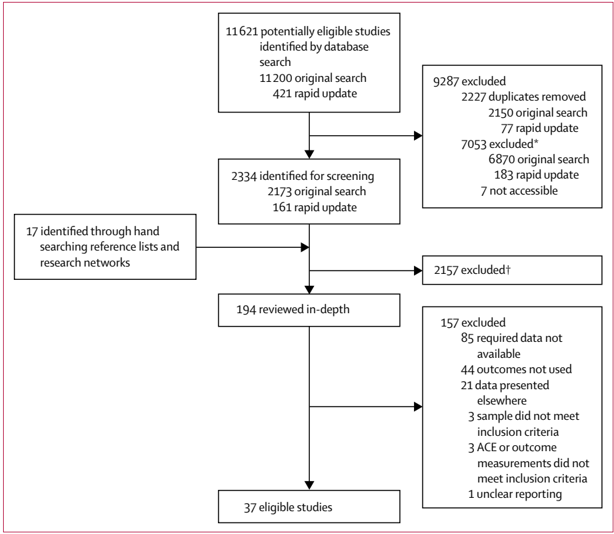
- From 11,621 references, 37 studies were included, providing risk estimates for 23 outcomes and 253,719 participants; most studies were from high-income countries, with nine samples from middle-income countries and none from low-income countries; 26 articles used cross-sectional data and 11 used cohort data, and all used retrospective, self-reported ACEs.
- Pooled ORs with 95% CIs were calculated using a random-effects model in StatsDirect; heterogeneity was assessed with I², publication bias with Begg-Mazumdar and Egger tests and funnel plots where at least ten samples were available, and sensitivity analyses and meta-regression were done in Stata.
Limitations
- The paper states that all included studies used retrospective ACE reports, which could be affected by recall or reporting bias; the number and types of ACEs varied, and summing ACEs does not account for different combinations or for variation in age at or length of exposure; confounding factors varied and some studies included no adjustments; genetic and environmental risks were largely unmeasured.
- The paper states that focusing on community settings likely excluded those with the most complex health problems (eg, homeless populations) and those who had already had ACE-related premature mortality; outcome measurement varied, rarer outcomes were less well covered by population surveys, and the study could only measure associations rather than establish causality.
- Evident from the text: most included samples came from high-income countries, with nine middle-income samples and none from low-income countries; heterogeneity was high for many outcomes; and visual funnel-plot assessment suggested possible missing small studies for smoking and early sexual initiation, although statistical tests for smoking were nonsignificant.
Model-written summary. Check it against the paper before relying on it.
Integrity signals
Registry
Cites
Statistics
Figures
Verification
Claims the paper makes
18 Valid · 0 Not valid · 4 Not checked · 126 Own results and interpretations
The sources with a verdict support this claim; the rest weren’t checked yet, have no full text we could read, or their verdicts aren’t rated yet.
In the paper
“However, five of the seven samples comprised students aged 18-25; 13 pooling of the remaining two samples 8,18 resulted in an OR of 12·53 (6·71-23·37; appendix).”
What the sources say
- Not checked — no full text of the sourcecites [8] 8 Ramiro LS, Madrid BJ, Brown DW. Adverse childhood experiences (ACE) and health-risk behaviors among adults in a developing country setting. Child Abuse Negl 2010; 34: 842-55. source
- Supportedcites [18] 18 Dube SR, Felitti VJ, Dong M, Giles WH, Anda RF. The impact of adverse childhood experiences on health problems: evidence from four birth cohorts dating back to 1900. Prev Med 2003; 37: 268-77 . source
The citation follows “the remaining two samples,” identifying studies used in the citing authors’ pooling rather than attributing the pooled estimate to either study. The cited paper’s Abstract describes a study of 17,337 adult HMO members that examined suicide attempts; its Methods identify the population as adult Kaiser Health Plan members. The OR of 12.53 is presented as the citing authors’ pooled result, not a result attributed to this source. (LLM, conf=0.85)
plainstates an associationn = 2- Asserted: passes — The authors put it forward as true.
- Checkable: passes — It can be checked against evidence.
- Load-bearing: unclear — It is unclear whether the paper’s conclusions depend on it.
- Based: passes — The paper gives a reason why it holds.
Every source the paper cites for this claim was checked and supports it.
In the paper
“However, five of the seven samples comprised students aged 18-25; 13 pooling of the remaining two samples 8,18 resulted in an OR of 12·53 (6·71-23·37; appendix).”
What the sources say
- Supportedcites [13] 13 Bellis MA, Hughes K, Leckenby N, et al. Adverse childhood experiences and associations with health-harming behaviours in young adults: surveys in eight eastern European countries. Bull World Health Organ 2014; 92: 641-55. source
The Attempted suicide section says respondents in seven of the eight countries were asked about suicide attempts. The Methods describe classroom surveys of students and state that the multi-study analyses were limited to respondents aged 18–25, supporting this paper's inclusion among the student samples described in the citing sentence. (LLM, conf=0.90)
plainn = 5- Asserted: passes — The authors put it forward as true.
- Checkable: passes — It can be checked against evidence.
- Load-bearing: unclear — It is unclear whether the paper’s conclusions depend on it.
- Based: passes — The paper gives a reason why it holds.
- Supported
The sources with a verdict support this claim; the rest weren’t checked yet, have no full text we could read, or their verdicts aren’t rated yet.
In the paper
“Supported by international work to standardise measurement of ACEs and their effects on health, these findings have since been replicated in studies from low-income and middle-income 7,8 and high-income 2,9 countries.”
What the sources say
- Not checked — no full text of the sourcecites [7] 7 Almuneef M, Qayad M, Aleissa M, Albuhairan F. Adverse childhood experiences, chronic diseases, and risky health behaviors in Saudi Arabian adults: a pilot study. Child Abuse Negl 2014; 38: 1787-93. source
- Not checked — no full text of the sourcecites [8] 8 Ramiro LS, Madrid BJ, Brown DW. Adverse childhood experiences (ACE) and health-risk behaviors among adults in a developing country setting. Child Abuse Negl 2010; 34: 842-55. source
- Supportedcites [2] 2 Bellis MA, Hughes K, Leckenby N, Hardcastle KA, Perkins C, Lowey H. Measuring mortality and the burden of adult disease associated with adverse childhood experiences in England: a national survey. J Public Health 2015; 37: 445-54. source
The citation to this paper supports the high-income-country part of the sentence: its English national survey found a strong association between ACEs and adult morbidity and premature mortality. The low- and middle-income-country studies are attributed to other citations. The decisive passage is in “What this study adds”; no page number is supplied in our copy. (LLM, conf=0.90)
- Supportedcites [9] 9 Bellis MA, Hughes K, Leckenby N, Perkins C, Lowey H. National household survey of adverse childhood experiences and their relationship with resilience to health-harming behaviors in England. BMC Med 2014; 12: 72. source
Citation 9 is attached to the high-income-country portion of the sentence. The Methods describe a national household survey in England, and the Results report that adverse childhood experiences were associated with multiple health-harming behaviors after adjustment for deprivation and other demographics. The indexed copy does not provide page numbers. (LLM, conf=0.91)
plainstates an association- Asserted: passes — The authors put it forward as true.
- Checkable: passes — It can be checked against evidence.
- Load-bearing: unclear — It is unclear whether the paper’s conclusions depend on it.
- Based: passes — The paper gives a reason why it holds.
The cited sources support only part of this claim — read each source’s verdict below.
In the paper
“For teenage pregnancy, four studies 9,33-35 had measured unintended teenage pregnancy and these studies reported higher estimates than did those measuring any teenage pregnancy 8,14,21 (appendix).”
What the sources say
- Supportedcites [9] 9 Bellis MA, Hughes K, Leckenby N, Perkins C, Lowey H. National household survey of adverse childhood experiences and their relationship with resilience to health-harming behaviors in England. BMC Med 2014; 12: 72. source
The paper is one of the studies identified in the citing sentence as measuring unintended teenage pregnancy. Its Results report an adjusted odds ratio of 5.86 for that outcome among respondents with four or more ACEs versus none. The comparison with studies measuring any teenage pregnancy is the citing authors’ cross-study synthesis, not a comparison attributed to this individual paper. (LLM, conf=0.88)
- Not checked — no full text of the sourcecites [33] 33 Bellis MA, Lowey H, Leckenby N, Hughes K, Harrison D. Adverse childhood experiences: retrospective study to determine their impact on adult health behaviours and health outcomes in a UK population. J Public Health 2014; 36: 81-91. source
- Partly supportedcites [34] 34 Bellis MA, Ashton K, Hughes K, Ford K, Bishop J, Paranjothy S. Adverse childhood experiences and their impact on health-harming behaviours in the Welsh adult population. Cardiff: Public Health Wales, 2015. sourceExperimental — accuracy not yet measured
The section ‘ACEs and their association with unintended teenage pregnancy’ reports an estimate for unintended teenage pregnancy, so this paper supports its identification as a study measuring that outcome. It does not compare its estimate with studies measuring any teenage pregnancy or establish that four studies reported higher estimates. (LLM, conf=0.83)
- Not matchedcites [35] 35 Ford K, Butler N, Hughes K, Quigg Z, Bellis MA. Adverse childhood experiences (ACEs) in Hertfordshire, Luton and Northamptonshire. Liverpool: Liverpool John Moores University, 2016.
Its entry has no title and year that we can search by.
- Not checked — no full text of the sourcecites [8] 8 Ramiro LS, Madrid BJ, Brown DW. Adverse childhood experiences (ACE) and health-risk behaviors among adults in a developing country setting. Child Abuse Negl 2010; 34: 842-55. source
- Not checked yetcites [14] 14 Anda RF, Chapman DP, Felitti VJ, et al. Adverse childhood experiences and risk of paternity in teen pregnancy. Obstet Gynecol 2002; 100: 37-45. source
Checked before — its earlier verdict is held back until a new check runs.
- Not checked — no full text of the sourcecites [21] 21 Hillis SD, Anda RF, Dube SR, Felitti VJ, Marchbanks PA, Marks JS. The association between adverse childhood experiences and adolescent pregnancy, long-term psychosocial consequences, and fetal death. Pediatrics 2004; 113: 320-27 . source
plainstates an association- Asserted: passes — The authors put it forward as true.
- Checkable: passes — It can be checked against evidence.
- Load-bearing: unclear — It is unclear whether the paper’s conclusions depend on it.
- Based: passes — The paper gives a reason why it holds.
- Supported
Every source the paper cites for this claim was checked and supports it.
In the paper
“However, our criteria also meant that studies were excluded because of alternative data analysis methods (eg, analysis of the World Mental Health Surveys 51 ).”
What the sources say
- Supportedcites [51] 51 Kessler RC, McLaughlin KA, Green JG, et al. Childhood adversities and adult psychopathology in the WHO World Mental Health Surveys. Br J Psychiatry 2010; 97: 378-85. source
The Analysis methods section identifies this paper as an analysis of the World Mental Health Surveys and describes its discrete-time survival analysis using person-years. The statement that the citing review excluded it under its own criteria is the citing authors’ decision, not a claim the source needs to make. (LLM, conf=0.88)
plainstates a cause- Asserted: passes — The authors put it forward as true.
- Checkable: passes — It can be checked against evidence.
- Load-bearing: unclear — It is unclear whether the paper’s conclusions depend on it.
- Based: passes — The paper gives a reason why it holds.
- Supported
53 more claims · 2 with their cited sources checked
Create a free account to see all 148 claims and to verify the 1 reference still open.
- It may state two separate claims as one. 44
- Probably not a substantial claim. 27
- The quote only partly states this claim. 31
Claims other papers make about this one
Each is checked against this paper’s own text: does it say what the citing paper says it does?
The source backs part of the claim, not all of it — or backs it for a different population, condition or comparison.
In the citing paper
“Early adverse life experiences, negative affectivity, neuroticism, depression, and anxiety have been identified as psycho logical predisposing conditions for persistent physical symptoms”
From Persistent physical symptoms: definition, genesis, and management (2024) · cites this paper as [64]
Experimental — accuracy not yet measuredThe source backs part of the claim, not all of it — or backs it for a different population, condition or comparison.
In the citing paper
“The impact of childhood abuse, neglect, and violence exposure on adult physical and emotional health and behaviors is significant and well documented”
From Intergenerational effects of childhood maltreatment: A systematic review of the parenting practices of adult survivors of childhood abuse, neglect, and violence. (2020) · cites this paper as Hughes et al., 2017
Experimental — accuracy not yet measuredThe source backs part of the claim, not all of it — or backs it for a different population, condition or comparison.
In the citing paper
“Early institutional rearing is associated with adverse biological and health outcomes in later life, including accelerated cellular aging as measured by telomere length.”
From Telomere trajectories from early adolescence to adulthood following early institutionalization: Protective effects of foster care in the Bucharest Early Intervention Project (2026) · cites this paper as Hughes et al., 2017
Experimental — accuracy not yet measuredThe source backs part of the claim, not all of it — or backs it for a different population, condition or comparison.
In the citing paper
“Individuals exposed to early life adversity are at increased risk of developing a broad spectrum of age-related illnesses at a young age, resulting in shorter health span, referring to the period of life free from chronic disease (Chandan et al., 2020; Hughes et al., 2017).”
From Telomere trajectories from early adolescence to adulthood following early institutionalization: Protective effects of foster care in the Bucharest Early Intervention Project (2026) · cites this paper as Hughes et al., 2017
Experimental — accuracy not yet measuredThe source backs part of the claim, not all of it — or backs it for a different population, condition or comparison.
In the citing paper
“This aligns with findings that ACEs are linked not only with SUD onset, but also with broader emotional and interpersonal dysregulation [4, 6].”
From The link of adverse childhood experiences and attachment to maladaptive personality traits in adults diagnosed with substance use disorder (2025) · cites this paper as [4]
Experimental — accuracy not yet measured
7 more claims about this paper
Create a free account to see every claim other papers make about this one.
Self-check
Percentages, sums and reported differences re-computed from the paper’s own numbers.
Each contradiction between two passages listed here was confirmed by an independent check.
Rated minor: it would not touch a result — a value no result rests on, a p-value that stays on the same side of the significance level, or a conflict that is clerical, resolved elsewhere in the paper, or outside its own findings.
In the paper
§ Summary
“respiratory disease (ORs of two to three)”
§ Discussion
“| Respiratory disease | 3·05 (2·47-3·77)”
Citations
Cites
Felitti, V. J., Anda, R. F., Nordenberg, D., Williamson, D. F., Spitz, A. M., Edwards, V., Koss, M. P., & Marks, J. S. (1998) · American Journal of Preventive Medicine · doi:10.1016/s0749-3797(98)00017-8 · Cited by 18,943
Global status report on noncommunicable diseases 2010.
Alwan, A. (2011) · Cited by 8,494
Forouzanfar, M. H., Afshin, A., Alexander, L. T., Anderson, H. R., Bhutta, Z. A., Biryukov, S., Brauer, M., Burnett, R., Cercy, K., Charlson, F. J., et al. (2016) · The Lancet · doi:10.1016/s0140-6736(16)31679-8 · Cited by 7,698
Wang, H., Naghavi, M., Allen, C., Barber, R. M., Bhutta, Z. A., Carter, A., Casey, D. C., Charlson, F. J., Chen, A. Z., Coates, M. M., et al. (2016) · The Lancet · doi:10.1016/s0140-6736(16)31012-1 · Cited by 6,596
Anda, R. F., Felitti, V. J., Bremner, J. D., Walker, J. D., Whitfield, C., Perry, B. D., Dube, S. R., & Giles, W. H. (2006) · European archives of psychiatry and clinical neuroscience · doi:10.1007/s00406-005-0624-4 · Cited by 4,292
Norman, R. E., Byambaa, M., De, R., Butchart, A., Scott, J., & Vos, T. (2012) · PLoS Medicine · doi:10.1371/journal.pmed.1001349 · Cited by 3,387
Self-citationValidity of adult retrospective reports of adverse childhood experiences: review of the evidence
Hardt, J., & Rutter, M. (2004) · Journal of Child Psychology and Psychiatry · doi:10.1111/j.1469-7610.2004.00218.x · Cited by 2,827
Childhood adversities and adult psychopathology in the WHO World Mental Health Surveys
Kessler, R. C., McLaughlin, K. A., Green, J. G., Gruber, M. J., Sampson, N. A., Zaslavsky, A. M., Aguilar-Gaxiola, S., Alhamzawi, A. O., Alonso, J., Angermeyer, M., et al. (2010) · British Journal of Psychiatry · doi:10.1192/bjp.bp.110.080499 · Cited by 2,640
Impact of child sexual abuse: A review of the research.
Browne, A., & Finkelhor, D. (1986) · Psychological Bulletin · doi:10.1037/0033-2909.99.1.66 · Cited by 2,590
Adverse childhood experiences, allostasis, allostatic load and age-related disease
Danese, A., & McEwen, B. S. (2012) · Physiology & Behavior · doi:10.1016/j.physbeh.2011.08.019 · Cited by 2,140
Cited by
Items 301–400 of 5,221
Adverse childhood experiences predict opioid relapse during treatment among rural adults
Derefinko, K. J., García, F. I. S., Talley, K. M., Bursac, Z., Johnson, K., Murphy, J. G., McDevitt‐Murphy, M. E., Andrasik, F., & Sumrok, D. D. (2019) · Addictive Behaviors · doi:10.1016/j.addbeh.2019.05.008 · Cited by 66
“Adverse childhood experiences (ACE) are a major public health concern (Hughes et al., 2017).”
BackgroundDeschênes, S. S., Kivimaki, M., & Schmitz, N. (2021) · Journal of the American Heart Association · doi:10.1161/jaha.120.019013 · Cited by 59
Poor Individual Risk Classification From Adverse Childhood Experiences Screening
Meehan, A. J., Baldwin, J. R., Lewis, S. J., MacLeod, J. G., & Danese, A. (2021) · American Journal of Preventive Medicine · doi:10.1016/j.amepre.2021.08.008 · Cited by 76
“, parental incarceration, mental illness, substance use), are consistently associated with elevated risk for physical and mental health conditions.(1,2) Given the global ubiquity of violence against children and broader family adversity, various regional, national, and international health bodies have advocated for ro…”
BackgroundMoye, J. A., Kaiser, A. P., Cook, J. M., & Pietrzak, R. H. (2021) · American Journal of Geriatric Psychiatry · doi:10.1016/j.jagp.2021.10.011 · Cited by 65
Chamberlain, C., Gray, P., Bennet, D., Elliott, A., Jackomos, M., Krakouer, J., Marriott, R., O'Dea, B., Andrews, J., Andrews, S., et al. (2022) · Australian Journal of Social Issues · doi:10.1002/ajs4.200 · Cited by 75
Ierardi, E., Bottini, M., & Crugnola, C. R. (2022) · BMC Psychology · doi:10.1186/s40359-022-00742-7 · Cited by 78
“Based on the literature, there is a consistent presence of adverse experiences in the history of the subject with a cut-off greater than or equal to 4 [48].”
BackgroundGrummitt, L. R., Barrett, E. L., Kelly, E. V., & Newton, N. C. (2022) · Substance Abuse and Rehabilitation · doi:10.2147/sar.s341818 · Cited by 68
“As shown, meta-analytic estimates demonstrate an increased pooled risk associated with just one ACE for harmful alcohol use, illicit drug use, and smoking.(22,25,26,34) The strength of this association increases for those experiencing more than one ACE,(22,25,26,34) which sadly represents the majority of children who…”
BackgroundMethodKovács-Tóth, B., Oláh, B., Szabó, I. K., & Fekete, Z. (2023) · Frontiers in Psychology · doi:10.3389/fpsyg.2023.1161620 · Cited by 82
“org (abuse, neglect, household dysfunction) contribute to the development of various mental and somatic disorders that span into or develop in adulthood (Felitti et al., 1998; Hughes et al., 2017; Bellis et al., 2019).”
BackgroundResultLiang, Y. Y., Zhou, M., He, Y., Zhang, W., Wu, Q., Luo, T., Zhang, J., Jia, F., Qi, L., Ai, S., et al. (2024) · Nature Human Behaviour · doi:10.1038/s41562-024-01970-0 · Cited by 66
The evolving neurobiology of early-life stress
Birnie, M. T., & Baram, T. Z. (2025) · Neuron · doi:10.1016/j.neuron.2025.02.016 · Cited by 82
“4,5 10 In 2019, the annual economic burden of early-life stress was estimated as $748 billion 11 and the estimate for 2023, following the COVID-19 pandemic, has been (cid:1) $14 trillion.”
Screening for childhood adversity among adult primary care patients
Kalmakis, K. A., Shafer, M. B., Chandler, G. E., Aponte, E. V., & Roberts, S. J. (2018) · Journal of the American Association of Nurse Practitioners · doi:10.1097/jxx.0000000000000033 · Cited by 63
Clemens, V., Berthold, O., Witt, A., Sachser, C., Brähler, E., Plener, P. L., Strauss, B. M., & Fegert, J. M. (2019) · European Psychiatry · doi:10.1016/j.eurpsy.2019.01.018 · Cited by 67
“Even though there are heterogeneous approaches what to include when ACEs are assessed, they are usually distinguished between ACEs related to household dysfunction and child maltreatment [1].”
BackgroundDoi, S. K., Fujiwara, T., & Isumi, A. (2020) · Development and Psychopathology · doi:10.1017/s0954579420000334 · Cited by 74
Guinn, A. S., Ports, K. A., Ford, D. C., Breiding, M., & Merrick, M. T. (2019) · Injury Prevention · doi:10.1136/injuryprev-2018-042927 · Cited by 57
Wells, A. E., Hunnikin, L. M., Ash, D. P., & van Goozen, S. H. M. (2020) · European Child & Adolescent Psychiatry · doi:10.1007/s00787-020-01652-y · Cited by 72
Marqués-Feixa, L., Palma‐Gudiel, H., Romero, S., Moya-Higueras, J., Rapado‐Castro, M., Castro-Quintas, Á., Zorrilla, E. P., Muñoz, M. J., Ramírez, M., Mayoral, M., et al. (2021) · Psychological Medicine · doi:10.1017/s003329172100249x · Cited by 73
“Experiences of childhood maltreatment (CM) are one of the main contributors to mental illness (Brown, Harris, & Craig, 2019; Hughes et al., 2017).”
Foster Families: A Systematic Review of Intention and Retention Factors
Gouveia, L., Magalhães, E., & Pinto, V. S. (2021) · Journal of Child and Family Studies · doi:10.1007/s10826-021-02051-w · Cited by 79
“Research has highlighted the negative impact of adverse childhood experiences on adulthood (Hughes et al., 2017),”
BackgroundLawrence, D. M., Hunt, A., Mathews, B., Haslam, D. M., Malacova, E., Dunne, M. P., Erskine, H. E., Higgins, D. J., Finkelhor, D., Pacella, R., et al. (2023) · The Medical Journal of Australia · doi:10.5694/mja2.51877 · Cited by 94
Self-citationHanson, L. L. M., Pentti, J., Nordentoft, M., Xu, T., Rugulies, R., Madsen, I. E. H., Conway, P. M., Westerlund, H., Vahtera, J., Ervasti, J. M., et al. (2023) · The Lancet Public Health · doi:10.1016/s2468-2667(23)00096-8 · Cited by 79
Amene, E. W., Annor, F., Gilbert, L. K., McOwen, J., Augusto, Â. D. R., Manuel, P., Nobah, M. T. V. N., & Massetti, G. M. (2023) · Child Abuse & Neglect · doi:10.1016/j.chiabu.2023.106353 · Cited by 76
“For example, some research on ACEs in sub-Saharan Africa has employed convenience samples from urban areas or clinical settings, which may reflect significant bias in prevalence and even in associations with health conditions (Hughes et al., 2017; Kessler et al., 2010; Massetti et al., 2020).”
BackgroundLiu, M., Mejía-Lancheros, C., Lachaud, J., Nisenbaum, R. A., Stergiopoulos, V., & Hwang, S. W. (2020) · American Journal of Preventive Medicine · doi:10.1016/j.amepre.2019.12.017 · Cited by 65
The biopsychosociotechnical model: a systems-based framework for human-centered health improvement
Card, A. J. (2022) · Health Systems · doi:10.1080/20476965.2022.2029584 · Cited by 89
“…determinants of health, helping pave the way for fields of inquiry such as the impact of adverse childhood experiences (ACEs) on health (Boullier & Blair, 2018; Burke et al., 2011; Dube et al., 2002; Felitti, 2009; Felitti et al., 1998; Hughes et al., 2017; Oh et al., 2018; Schilling et al., 2007).”
BackgroundYohros, A. (2022) · Trauma Violence & Abuse · doi:10.1177/15248380211073846 · Cited by 76
“Second, the literature on ACEs draws from a life course perspective, including long-term effects on health (Felitti et al., 1998; Hughes et al., 2017).”
BackgroundJackson, D. B., Jones, M. S., Semenza, D. C., & Testa, A. M. (2023) · International Journal of Environmental Research and Public Health · doi:10.3390/ijerph20043202 · Cited by 79
“Research has shown that ACEs are harmful for an array of short- and long-term outcomes [3,9], including engagement in crime and delinquency [11–15].”
BackgroundMethodAbate, B. B., Sendekie, A. K., Faris, A. M., Abebe, G. K., Azmeraw, M., Alamaw, A. W., Zemariam, A. B., Kitaw, T. A., Kassaw, A., Wodaynew, T., et al. (2024) · Neuropsychobiology · doi:10.1159/000542392 · Cited by 75
“…[35, 36, 38, 42, 46, 47]; child abuse history [38]; physical inactivity, overweight or obesity, diabetes, smoking status, alcohol use, self-rated health, cancer, heart disease, respiratory disease, drug use [39]; comorbid psychiatric disorders, parity, and complications during pregnancy [42, 47].”
InfluentialChild Sexual Abuse and Pregnancy: A Systematic Review of the Literature
Brunton, R., & Dryer, R. (2020) · Child Abuse & Neglect · doi:10.1016/j.chiabu.2020.104802 · Cited by 69
Thoma, M. V., Bernays, F., Eising, C. M., Maercker, A., & Rohner, S. L. (2021) · Child Abuse & Neglect · doi:10.1016/j.chiabu.2020.104925 · Cited by 75
“, 2012), as well as physical health outcomes (e.g., Draper et al., 2008; Hughes et al., 2017; Wegman & Stetler, 2009).”
BackgroundSchneider, M., VanOrmer, J., & Zlomke, K. (2019) · Journal of Developmental & Behavioral Pediatrics · doi:10.1097/dbp.0000000000000703 · Cited by 55
“Furthermore, ACEs have an additive effect such that exposure to more ACEs increases the risk for adverse outcomes, such as mental health diagnoses, substance abuse, diabetes, obesity, heart disease, and cancer.(4) Youth with neurodevelopmental diagnoses have been identified as particularly at risk for ACEs.”
BackgroundThe Potential of Early Intervention for Preventing and Reducing ACE-Related Trauma
Asmussen, K., McBride, T., & Waddell, S. (2019) · Social Policy and Society · doi:10.1017/s1474746419000071 · Cited by 63
“In particular, studies show that the presence of four or more ACE categories during childhood substantially increases the likelihood of a variety of negative adult outcomes (Hughes et al., 2017).”
BackgroundBending the Curve in Cardiovascular Disease Mortality: Bethesda + 40 and Beyond
Goff, D. C., Khan, S. S., Lloyd‐Jones, D. M., Arnett, D. K., Carnethon, M. R., Labarthe, D. R., Loop, M. S., Luepker, R. V., McConnell, M. V., Mensah, G. A., et al. (2021) · Circulation · doi:10.1161/circulationaha.120.046501 · Cited by 67
Macpherson, J. M., Gray, S. R., Ip, P., McCallum, M., Hanlon, P., Welsh, P. I., Chan, K. L., Mair, F. S., Celis-Morales, C. A., Minnis, H., et al. (2021) · The Lancet Regional Health - Europe · doi:10.1016/j.lanepe.2021.100224 · Cited by 61
“7) [5], similarly in another meta-analysis on child maltreatment (ORs 2.”
BackgroundMcGovern, R., Bogowicz, P., Meader, N., Kaner, E., Alderson, H., Craig, D., Geijer‐Simpson, E., Jackson, K., Muir, C., Salonen, D., et al. (2023) · Addiction · doi:10.1111/add.16127 · Cited by 75
Sebalo, I., Königová, M. P., Vňuková, M., Anders, M., & Ptáček, R. (2023) · Substance Abuse Research and Treatment · doi:10.1177/11782218231193914 · Cited by 94
“11,22 In line with the diathesis-stress framework, 18 Baranger et al 145 showed that exposure to ACEs was associated with risky alcohol use among individuals sensitive to stressors due to carrying the minor C allele at rs3027172.”
MethodOstacoli, L., Carletto, S., Cavallo, M., Baldomir, P., Lorenzo, G. D., Fernández, I., Hase, M., Justo-Alonso, A., Lehnung, M., Migliaretti, G., et al. (2018) · Frontiers in Psychology · doi:10.3389/fpsyg.2018.00074 · Cited by 70
Montgomery, E., Just‐Østergaard, E., & Jervelund, S. S. (2018) · International Journal of Public Health · doi:10.1007/s00038-018-1185-4 · Cited by 95
“For instance, exposure to child abuse is associated with higher risk of violence, mental illness and substance abuse in the next generation (Hughes et al. 2017).”
BackgroundLoxton, D. J., Forder, P., Cavenagh, D., Townsend, N., Holliday, E. G., Chojenta, C., & Melka, A. S. (2020) · Child Abuse & Neglect · doi:10.1016/j.chiabu.2020.104771 · Cited by 60
Blosnich, J. R., Garfin, D. R., Maguen, S., Vogt, D. S., Dichter, M. E., Hoffmire, C. A., Bernhard, P. A., & Schneiderman, A. (2021) · American Psychologist · doi:10.1037/amp0000755 · Cited by 70
“…adverse childhood experiences (ACEs) are robustly tied to physical and mental health problems over the lifespan in the United States (US) (Anda & Brown, 2010) and globally (Hughes et al., 2017), including risk of suicidal ideation and suicide attempt (Choi et al., 2017; Dube et al., 2001).”
BackgroundGajos, J. M., Miller, C. R., Leban, L., & Cropsey, K. L. (2022) · Journal of Affective Disorders · doi:10.1016/j.jad.2022.07.047 · Cited by 82
Predictors of PTSD and Psychological Distress Symptoms of Ukraine Civilians During war
Eshel, Y., Kimhi, S., Marciano, H., & Adini, B. B. (2023) · Disaster Medicine and Public Health Preparedness · doi:10.1017/dmp.2023.69 · Cited by 73
“19 The prevalence of psychological distress roughly ranges between 5% and 27% in the general population.”
Peng, J., Liu, Y., Wang, X., Yi, Z., Xu, L., & Zhang, F. (2025) · Scientific Reports · doi:10.1038/s41598-025-85943-x · Cited by 68
Adverse Childhood Experiences (ACEs) and Headaches Among Children: A Cross‐Sectional Analysis
Mansuri, F., Nash, M. C., Bakour, C., & Kip, K. E. (2020) · Headache The Journal of Head and Face Pain · doi:10.1111/head.13773 · Cited by 59
Hanlon, P., McCallum, M., Jani, B., McQueenie, R., Lee, D., & Mair, F. S. (2020) · Journal of Comorbidity · doi:10.1177/2235042x10944344 · Cited by 67
Boisgontier, M. P., Orsholits, D., von Arx, M., Sieber, S., Miller, M. W., Courvoisier, D. S., Iversen, M. D., Cullati, S., & Cheval, B. (2020) · Journal of Physical Activity and Health · doi:10.1123/jpah.2019-0133 · Cited by 55
“= β0 þ β1 Agej þ β2 Waveij þ β3ðAgej ×WaveijÞ þ β4 Squared waveij þ β5ðAgej × Squared waveijÞ þ β6 Genderj þ β7 Countryj þ β8 Birth cohortj þ β9 Attritionj þ β10 Childhood socioeconomic circumstancesj þ β11 Childhood health problemsj þ β12 Adverse childhood experiencej þ u0j þ u1j Waveij þ εij, (1)”
Butler, N., Quigg, Z., & Bellis, M. A. (2020) · BMC Medicine · doi:10.1186/s12916-020-01788-3 · Cited by 77
Self-citationPopulation-Based Estimates of Associations Between Child Maltreatment Types: A Meta-Analysis
Matsumoto, M. Y., Piersiak, H. A., Letterie, M. C., & Humphreys, K. L. (2021) · Trauma Violence & Abuse · doi:10.1177/15248380211030502 · Cited by 67
“…pose a serious public health issue; beyond immediate physical harm, they may increase the long-term risk for poorer physical health, substance abuse, interpersonal violence, suicidality, and psychiatric disorders (Cohen et al., 2001; Gilbert et al., 2009; Hughes et al., 2017; Mathews et al., 2020).”
BackgroundMultimorbidity among People Experiencing Homelessness—Insights from Primary Care Data
Vallesi, S., Tuson, M., Davies, A., & Wood, L. J. (2021) · International Journal of Environmental Research and Public Health · doi:10.3390/ijerph18126498 · Cited by 59
“As shown in a 2017 systematic review of the impact of adverse childhood experiences (ACES) on health, ACES are strongly linked to higher risks of harmful health behaviours, including smoking, excessive drinking and drug use [36].”
BackgroundAssini‐Meytin, L. C., Fix, R. L., Green, K. M., Nair, R., & Letourneau, E. J. (2021) · Journal of Child & Adolescent Trauma · doi:10.1007/s40653-021-00424-3 · Cited by 59
“The association between ACEs and sexual risk-taking is similarly strong (Hughes et al., 2017).”
BackgroundResultInfluentialAsif, N. Q., Breen, C. L., & Wells, R. (2023) · Child Abuse & Neglect · doi:10.1016/j.chiabu.2023.106145 · Cited by 77
Determinants of obesity in Latin America
Ferreira, S. R. G., Macotela, Y., Velloso, L. A., & Mori, M. A. (2024) · Nature Metabolism · doi:10.1038/s42255-024-00977-1 · Cited by 86
“A meta-analysis including 37 studies involving more than 200,000 individuals from high-and middle-income countries showed that there was a weak or modest association between having experienced four or more ACEs and overweight and obesity 179 .”
Albus, C., Waller, C. F., Fritzsche, K., Gunold, H., Haass, M., Hamann, B., Kindermann, I., Köllner, V., Leithäuser, B., Marx, N., et al. (2018) · Der Kardiologe · doi:10.1007/s12181-018-0271-4 · Cited by 74
Gartland, D., Giallo, R., Woolhouse, H., Mensah, F. K., & Brown, S. (2019) · EClinicalMedicine · doi:10.1016/j.eclinm.2019.08.008 · Cited by 66
“ther studies use the number of Adverse Childhood Experiences ACES) which include childhood abuse, with greater number of exeriences associated with poorer outcomes [3,6,24].”
BackgroundInfluentialRiedl, D., Lampe, A., Exenberger, S., Nolte, T., Trawöger, I., & Beck, T. N. (2020) · General Hospital Psychiatry · doi:10.1016/j.genhosppsych.2020.03.005 · Cited by 62
Kuzminskaite, E., Vinkers, C. H., Elzinga, B. M., Wardenaar, K. J., Giltay, E. J., & Penninx, B. W. J. H. (2020) · Psychoneuroendocrinology · doi:10.1016/j.psyneuen.2020.104835 · Cited by 53
Kalia, V., Knauft, K. M., & Hayatbini, N. (2020) · PLoS ONE · doi:10.1371/journal.pone.0243881 · Cited by 62
Watt, T. T., Kim, S., Ceballos, N. A., & Norton, C. L. (2020) · Journal of American College Health · doi:10.1080/07448481.2020.1791882 · Cited by 64
“However, one of the most common techniques for operationalizing adverse childhood experiences is to identify those having an ACE score of 4 or higher.(39) This level of trauma has consistently been associated with significant and substantive increases in the risk of adverse physical and mental health outcomes.”
BackgroundBiological correlates of early life stressful events in major depressive disorder
Silva, R. C., Maffioletti, E., Gennarelli, M., Baune, B. T., & Minelli, A. (2021) · Psychoneuroendocrinology · doi:10.1016/j.psyneuen.2020.105103 · Cited by 52
Iob, E., Baldwin, J. R., Plomin, R. J., & Steptoe, A. (2021) · Translational Psychiatry · doi:10.1038/s41398-021-01538-w · Cited by 66
“For instance, individuals exposed to multiple ACEs have a threefold increased risk of depression [8, 9].”
BackgroundSayyah, M. D., Merrick, J., Larson, M. D., & Narayan, A. J. (2022) · Children and Youth Services Review · doi:10.1016/j.childyouth.2022.106455 · Cited by 68
Modeling environment through a general exposome factor in two independent adolescent cohorts
Moore, T. M., Visoki, E., Argabright, S. T., DiDomenico, G. E., Sotelo, I., Wortzel, J. D., Naeem, A., Gur, R. C., Gur, R. E., Warrier, V., et al. (2022) · Exposome · doi:10.1093/exposome/osac010 · Cited by 68
“First, when selecting environmental variables to include in analysis, we generally tried to take an inclusive approach informed by literature on environmental effects on development.(2,63) We included some variables that have substantial genetic components (eg, parent psychopathology) and others that may be confounded…”
MethodVervoort-Schel, J., Mercera, G., Wissink, I. B., Mink, E., van der Helm, P. G., Lindauer, R., & Moonen, X. (2018) · International Journal of Environmental Research and Public Health · doi:10.3390/ijerph15102136 · Cited by 67
“), but also in many low-, middle- and high income countries all over the world [6,7,48].”
BackgroundStigma as a dominant discourse in fetal alcohol spectrum disorder
Choate, P. W., & Badry, D. (2018) · Advances in Dual Diagnosis · doi:10.1108/add-05-2018-0005 · Cited by 64
Whitaker, R. C., Herman, A. N., Dearth‐Wesley, T., Smith, H. G., Burnim, S. B., Myers, E. L., Saunders, A. M., & Kainz, K. (2019) · JAMA Network Open · doi:10.1001/jamanetworkopen.2019.3193 · Cited by 64
Adverse Childhood Experiences Among Gynecology Patients With Chronic Pelvic Pain
Krantz, T. E., Andrews, N. L., Petersen, T. R., Dunivan, G. C., Montoya, M., Swanson, N., Wenzl, C. K., Zambrano, J. R., & Komesu, Y. M. (2019) · Obstetrics and Gynecology · doi:10.1097/aog.0000000000003533 · Cited by 59
Self-esteem and other risk factors for depressive symptoms among adolescents in United Arab Emirates
Shah, S. M. A., Dhaheri, F. A. A., Albanna, A., Jaberi, N. A., Eissaee, S. A., Alshehhi, N. A., Shamisi, S. A. A., Hamez, M. M. A., Abdelrazeq, S. Y., Grivna, M., et al. (2020) · PLoS ONE · doi:10.1371/journal.pone.0227483 · Cited by 66
“Exposure to Adverse Childhood Experiences (ACE) such as abuse or neglect, household violence or parental divorce in early childhood increases the risk of mortality and different forms of morbidity including autoimmune, liver, coronary and pulmonary diseases [73].”
BackgroundChandan, J. S., Gokhale, K. M., Bradbury‐Jones, C., Nirantharakumar, K., Bandyopadhyay, S., & Taylor, J. S. (2020) · BMJ Open · doi:10.1136/bmjopen-2020-036949 · Cited by 55
Morgan, C., Gayer-Anderson, C. E., Beards, S., Hubbard, K., Mondelli, V., Forti, M. D., Murray, R. M., Pariante, C. M., Dazzan, P., Craig, T., et al. (2020) · The British Journal of Psychiatry · doi:10.1192/bjp.2020.133 · Cited by 64
Grummitt, L., Kelly, E., Barrett, E., Keyes, K., & Newton, N. (2021) · PLOS ONE · doi:10.1371/journal.pone.0252815 · Cited by 51
“For children exposed to four or more different types of ACEs, the odds for problematic drinking are six times higher and ten times higher for problematic drug use than those with no ACE exposure [7].”
BackgroundSynergistic adversities and behavioral problems in traumatized children and adolescents
Putnam, F. W., Amaya-Jackson, L., Putnam, K. T., & Briggs, E. C. (2020) · Child Abuse & Neglect · doi:10.1016/j.chiabu.2020.104492 · Cited by 51
Henry, B. F. (2019) · Child Abuse & Neglect · doi:10.1016/j.chiabu.2019.104251 · Cited by 82
“Child abuse and other adverse experiences have been repeatedly shown to impact mental health/substance use disorders and contribute to the development of social problems, such as crime and incarceration (Felitti et al., 1998; Hughes et al., 2017; Jung, Herrenkohl, Klika, Lee, & Brown, 2015; Roos et al., 2016).”
BackgroundMethodQuidé, Y., Tozzi, L., Corcoran, M., Cannon, D. M., & Dauvermann, M. R. (2020) · Neuropsychiatric Disease and Treatment · doi:10.2147/ndt.s285540 · Cited by 68
Boehm, J. K. (2021) · Social and Personality Psychology Compass · doi:10.1111/spc3.12599 · Cited by 66
“This parallels interest in adverse childhood experiences (Appleton, Holdsworth, et al., 2017; Bellis et al., 2019; Hughes et al., 2017) but asks not whether traumatic life experiences are detrimental to health, but rather whether protective factors such as well‐being can promote health.”
BackgroundEpigenomic and enhancer dysregulation in uterine leiomyomas
Mlodawska, O. W., Saini, P., Parker, J. B., Wei, J., Bulun, S. E., Simon, M. A., & Chakravarti, D. (2022) · Human Reproduction Update · doi:10.1093/humupd/dmac008 · Cited by 60
Child protection training for professionals to improve reporting of child abuse and neglect
Walsh, K., Eggins, E., Hine, L., Mathews, B., Kenny, M. C., Howard, S., Ayling, N. J., Dallaston, E., Pink, E., & Vagenas, D. (2022) · Cochrane Database of Systematic Reviews · doi:10.1002/14651858.cd011775.pub2 · Cited by 105
Stodden, D. F., Pesce, C., Zarrett, N. R., Tomporowski, P. D., Ben‐Soussan, T. D., Brian, A., Abrams, T. C., & Weist, M. D. (2023) · Clinical Child and Family Psychology Review · doi:10.1007/s10567-023-00428-5 · Cited by 82
Oberg, G., Carroll, A., & MacMahon, S. J. (2023) · Frontiers in Education · doi:10.3389/feduc.2023.1128618 · Cited by 104
Karabatsiakis, A., & Schönfeldt‐Lecuona, C. (2020) · Translational Psychiatry · doi:10.1038/s41398-020-00901-7 · Cited by 62
Association of Childhood Violence Exposure With Adolescent Neural Network Density
Goetschius, L. G., Hein, T. C., McLanahan, S., Brooks-Gunn, J., McLoyd, V. C., Dotterer, H. L., Lopez‐Duran, N. L., Mitchell, C. M., Hyde, L. W., Monk, C. S., et al. (2020) · JAMA Network Open · doi:10.1001/jamanetworkopen.2020.17850 · Cited by 66
Mitochondria and early-life adversity
Zitkovsky, E. K., Daniels, T. E., & Tyrka, A. R. (2021) · Mitochondrion · doi:10.1016/j.mito.2021.01.005 · Cited by 59
Association of Childhood Adversities With Suicide Ideation and Attempts in Puerto Rican Young Adults
Polanco-Roman, L. A., Álvarez, K., Corbeil, T., Scorza, P., Wall, M. M., Gould, M. S., Alegria, M. M., Bird, H., CANINO, G. J., & Duarte, C. S. (2021) · JAMA Psychiatry · doi:10.1001/jamapsychiatry.2021.0480 · Cited by 55
Adaptation of Lipid Profiling in Depression Disease and Treatment: A Critical Review
Pinto, B., Conde, T., Domingues, I., & Domingues, M. R. (2022) · International Journal of Molecular Sciences · doi:10.3390/ijms23042032 · Cited by 51
“Adverse childhood experiences, for example, have been linked to an increased risk of mental and physiological disorders later in life [43].”
BackgroundEpigenomic mediation after adverse childhood experiences: a systematic review and meta-analysis
Neves, I., Dinis‐Oliveira, R. J., & Magalhães, T. (2019) · Forensic Sciences Research · doi:10.1080/20961790.2019.1641954 · Cited by 60
“A recent meta-analysis showed that individuals with at least four ACEs had an increased risk of all negative health outcomes, with strong associations for sexual risk-taking, mental ill health, problematic ethanol abuse, problematic drug use and violence, both interpersonal and self-directed [2].”
MethodAdverse childhood experiences and depression among women in rural Pakistan
LeMasters, K. H., Bates, L. M., Chung, E. O., Gallis, J. A., Hagaman, A. K., Scherer, E. M., Sikander, S., Staley, B. S., Zalla, L. C., Zivich, P. N., et al. (2021) · BMC Public Health · doi:10.1186/s12889-021-10409-4 · Cited by 67
Ghandour, R. M., Hirai, A. H., Moore, K. A., Robinson, L. R., Kaminski, J. W., Murphy, K., Lu, M. C., & Kogan, M. D. (2021) · Academic Pediatrics · doi:10.1016/j.acap.2021.02.019 · Cited by 58
Articulating the Trauma‐Informed Theory of Individual Health Behavior
Marks, C., Pearson, J., Zúñiga, M. L., Martin, N. K., Werb, D., & Smith, L. R. (2021) · Stress and Health · doi:10.1002/smi.3068 · Cited by 62
The validity of the residuals approach to measuring resilience to adverse childhood experiences
Cahill, S., Hager, R., & Chandola, T. (2022) · Child and Adolescent Psychiatry and Mental Health · doi:10.1186/s13034-022-00449-y · Cited by 64
Musillo, C., Berry, A., & Cirulli, F. (2022) · Neuroscience & Biobehavioral Reviews · doi:10.1016/j.neubiorev.2022.104624 · Cited by 58
“Research performed over many decades has now provided evidence that early exposure to conditions such as physical or sexual abuse, maltreatment, neglect or separation experienced during childhood or adolescence, results in a variety of negative health outcomes (Cirulli et al., 2009; Heim and Nemeroff, 1999; Hughes et…”
Broekhof, R., Nordahl, H. M., Bjørnelv, S., & Selvik, S. G. (2022) · Social Psychiatry and Psychiatric Epidemiology · doi:10.1007/s00127-022-02277-z · Cited by 90
“Thirdly, the early literature shows a dose–response relationship between an increase in the number of ACEs and poorer adult mental health [3, 15, 21, 24].”
BackgroundAdverse Childhood Experiences and Chronic Diseases: Identifying a Cut-Point for ACE Scores
Alhowaymel, F. M., Kalmakis, K. A., Chiodo, L. M., Kent, N. M., & Almuneef, M. A. (2023) · International Journal of Environmental Research and Public Health · doi:10.3390/ijerph20021651 · Cited by 59
“Although many studies have used a cut-point of 4 ACEs [21], researchers have used various ACE score cut-points from 2 ACEs [22] to 3 ACEs [23] to 5 ACEs [24], as well as multiple cut-points within the same study [25] to indicate adversity sufficient to affect health.”
MethodPeng, C., Cheng, J., Rong, F., Wang, Y., & Yu, Y. (2023) · Frontiers in Psychology · doi:10.3389/fpsyg.2023.1130683 · Cited by 60
“Individuals who experience maltreatment during childhood and adolescence are more likely to develop various mental and psychological problems (Hughes et al., 2017), such as depression (Dunn et al.”
BackgroundLacey, R. E., Bartley, M., Kelly‐Irving, M., Bevilacqua, L., Iob, E., Kelly, Y. J., & Howe, L. D. (2020) · Psychoneuroendocrinology · doi:10.1016/j.psyneuen.2020.104914 · Cited by 61
“The research thus far has largely shown that people experiencing ACEs are at higher risk of numerous adverse child and adult health outcomes e.g.(Hughes et al., 2017), on average.”
BackgroundSalter, M., & Hall, H. (2020) · Trauma Violence & Abuse · doi:10.1177/1524838020979667 · Cited by 72
“…found that individuals reporting four or more ACEs were seven times more likely to have been violently victimized, eight times more likely to have perpetrated violence, 10 times more likely to have problematic drug use, and 30 times more likely to have attempted suicide (Hughes et al., 2017).”
BackgroundWatt, T. T., Ceballos, N. A., Kim, S., Pan, X., & Sharma, S. (2019) · Journal of Child & Adolescent Trauma · doi:10.1007/s40653-019-00270-4 · Cited by 64
Rojo‐Wissar, D. M., Sosnowski, D. W., Ingram, M. M., Jackson, C. L., Maher, B. S., Alfano, C. A., Meltzer, L. J., & Spira, A. P. (2021) · Sleep Medicine · doi:10.1016/j.sleep.2021.10.019 · Cited by 61
Assessment and Treatment of Adolescents With Chronic Medical Conditions
Russo, K. (2022) · Journal of Health Service Psychology · doi:10.1007/s42843-022-00059-4 · Cited by 70
The impact of traumatic childhood experiences on interoception: disregarding one’s own body
Schmitz, M., Back, S. N., Seitz, K. I., Harbrecht, N. K., Streckert, L., Schulz, A., Herpertz, S. C., & Bertsch, K. (2023) · Borderline Personality Disorder and Emotion Dysregulation · doi:10.1186/s40479-023-00212-5 · Cited by 65
Davis, R. S., Meiser‐Stedman, R., Afzal, N., Devaney, J., Halligan, S. L., Lofthouse, K., Smith, P. A., Stallard, P. N., Ye, S., & Hiller, R. M. (2023) · Journal of the American Academy of Child & Adolescent Psychiatry · doi:10.1016/j.jaac.2023.02.013 · Cited by 94
Yang, W., Jin, S., Duan, W., Yu, H., Ping, L., Shen, Z., Cheng, Y., Xu, X., & Zhou, C. (2023) · Psychological Medicine · doi:10.1017/s0033291723000661 · Cited by 62
“…& Fassbinder, 2022), schizophrenia (Cancel, Dallel, Zine, El-Hage, & Fakra, 2019; D ’ Andrea et al., 2022; Sideli et al., 2020), substance abuse (Hughes et al., 2017), eating disorders (Cascino et al., 2022; Luo et al., 2020), as well as functional somatic and visceral pain syndromes (Chandan…”
Gewirtz‐Meydan, A., & Godbout, N. (2023) · Child Abuse & Neglect · doi:10.1016/j.chiabu.2023.106195 · Cited by 87
“Childhood sexual abuse is an endemic public health and social problem with long-lasting negative effects and elevated associated annual costs (Barth et al., 2013; Hughes et al., 2017; Peterson et al., 2018).”
Current evidence and opportunities in child and adolescent public mental health: a research review
Fazel, M. S., & Soneson, E. (2023) · Journal of Child Psychology and Psychiatry · doi:10.1111/jcpp.13889 · Cited by 66
Marquez, J., Francis-Hew, L., & Humphrey, N. (2023) · Child and Adolescent Psychiatry and Mental Health · doi:10.1186/s13034-023-00687-8 · Cited by 82
“…and experiences which are often neglected in research on child and adolescent adversity exposure (e.g., fewer than 10% of studies in Hughes et al. meta-analysis [54] of adverse childhood experiences on health outcomes included bullying, and no studies included experiences of discrimination).”
Background
Metadata
- Authors
- Hughes, K., Bellis, M. A., Hardcastle, K. A., Sethi, D., Butchart, A., Mikton, C., Jones, L., & Dunne, M. P.
- Affiliations
- Bangor University (GB)
- Public Health Wales (GB)
- World Health Organization Regional Office for Europe (DK)
- World Health Organization (CH)
- University of the West of England (GB)
- Liverpool John Moores University (GB)
- Queensland University of Technology (AU)
- Corresponding author
- Bellis, Mark A
- Venue
- The Lancet Public Health
- Publisher
- Elsevier BV
- Published
- 2017-08
- Volume
- 2
- Issue
- 8
- Pages
- e356-e366
- ISSN
- 2468-2667 (ISSN-L)
- OpenAlex
- W2740726397
- Semantic Scholar
- cdd633b48c3e902b5a7a012711d868cf5745c677
- Cited by
- 5,255
- References
- 70
- Citations by year
- 2026: 750 · 2025: 849 · 2024: 817 · 2023: 711 · 2022: 698 · 2021: 626 · 2020: 464 · 2019: 232 · 2018: 97 · 2017: 7
- FWCI
- 33.48
- Type
- journal article
- Language
- en
- Open access
- gold
- doi.org
- Licence
- cc-by-nc-nd
- www.elsevier.com/tdm/userlicense/1.0/ (tdm)
- creativecommons.org/licenses/by-nc-nd/4.0/ (vor)
- Locations
- The Lancet Public Health (publishedVersion, cc-by-nc-nd)
- PubMed (publishedVersion)
- Liverpool John Moores University (acceptedVersion)
- QUT ePrints (Queensland University of Technology) (submittedVersion, cc-by-nc-nd)
- UWE Research Repository (UWE Bristol) (submittedVersion, cc-by-nc-nd)
- DOAJ (DOAJ: Directory of Open Access Journals) (submittedVersion, cc-by-sa)
- Funders
- World Health Organization
- Public Health Wales
- Topics
- Social Sciences › Psychology › Clinical Psychology › Child Abuse and Trauma
- Social Sciences › Sociology and Political Science › Child Welfare and Adoption
- Social Sciences › Health › Intimate Partner and Family Violence
- Keywords
- adverse childhood experiences, child abuse, domestic violence exposure, substance use, sexual health, mental health, violence, physical health, physical activity, weight, resilience
- MeSH terms
- Health Status, Humans, Life Change Events
About these checks
Registry, retraction, Cites and statistics results are computed, not judged, with one exception: a printed reference that no index lists is read once by a model before it counts as a citation error. Claims are extracted by a model and kept only when their quote appears verbatim in the text; each cited source is then checked, with a model’s help, for whether it says what the claim relies on. Those verdicts can be wrong — read the claim’s quote and the cited source before relying on one.
The claim verdicts this report counts are experimental: their accuracy is not yet measured.
A language model drew the claims from the paper on 2026-09-28, under version 3 of the claim definition (prompt extract-v3).
A second model labelled each claim on 2026-09-28 (model jev-1.13-20260917, definition revision gold-guideline-v0.2).
Cited sources are checked with a language model’s help (gpt-6-sol).
Statistics and arithmetic are recomputed, not judged.
Confidence bands are shown only for fields calibrated on our annotated test set. None is calibrated yet, so no band is shown.
What counts as a claim ›How we measure confidence ›How we check this ›
Are you an author, or do you see a problem with this page? Request a review
Data sources
Bibliographic data: Semantic Scholar, OpenAlex, Crossref.
Contains information from the Semantic Scholar Academic Graph Datasets, made available under the ODC Attribution License (ODC-BY 1.0).
Semantic Scholar’s data is described in: Kinney, R., et al. (2023). The Semantic Scholar Open Data Platform. arXiv:2301.10140.
