

The effect of multiple adverse childhood experiences on health: a systematic review and meta-analysis.
Open accessThe DOI matches its Crossref record; 66 of the 70 references it cites were found in a registry or an index; 23 of the 40 sources its claims cite were checked for support.
Abstract
BACKGROUND: A growing body of research identifies the harmful effects that adverse childhood experiences (ACEs; occurring during childhood or adolescence; eg, child maltreatment or exposure to domestic violence) have on health throughout life. Studies have quantified such effects for individual ACEs. However, ACEs frequently co-occur and no synthesis of findings from studies measuring the effect of multiple ACE types has been done. METHODS: In this systematic review and meta-analysis, we searched five electronic databases for cross-sectional, case-control, or cohort studies published up to May 6, 2016, reporting risks of health outcomes, consisting of substance use, sexual health, mental health, weight and physical exercise, violence, and physical health status and conditions, associated with multiple ACEs. We selected articles that presented risk estimates for individuals with at least four ACEs compared with those with none for outcomes with sufficient data for meta-analysis (at least four populations). Included studies also focused on adults aged at least 18 years with a sample size of at least 100. We excluded studies based on high-risk or clinical populations. We extracted data from published reports. We calculated pooled odds ratios (ORs) using a random-effects model. FINDINGS: of >75%) between estimates for almost half of the outcomes. INTERPRETATION: To have multiple ACEs is a major risk factor for many health conditions. The outcomes most strongly associated with multiple ACEs represent ACE risks for the next generation (eg, violence, mental illness, and substance use). To sustain improvements in public health requires a shift in focus to include prevention of ACEs, resilience building, and ACE-informed service provision. The Sustainable Development Goals provide a global platform to reduce ACEs and their life-course effect on health. FUNDING: Public Health Wales.
Overview
CoChat Summary
TL;DR
This systematic review and meta-analysis of 37 studies and 253,719 participants found that adults with at least four adverse childhood experiences (ACEs) had increased odds of all 23 health outcomes compared with those with no ACEs. The strongest associations were for problematic drug use and interpersonal and self-directed violence, while physical inactivity, overweight or obesity, and diabetes showed weaker associations.
Key findings
- Across 37 included studies providing risk estimates for 23 outcomes, 57% of 252,467 participants reported at least one ACE and 13% of 244,979 reported at least four.
- Pooled odds ratios (ORs) were weak or modest for physical inactivity (1·25, 95% CI 1·03–1·52), overweight or obesity (1·39, 1·13–1·71), and diabetes (1·52, 1·23–1·89); moderate for smoking (2·82, 2·38–3·34), heavy alcohol use (2·20, 1·74–2·78), poor self-rated health (2·24, 1·97–2·54), cancer (2·31, 1·82–2·95), cardiovascular disease (2·07, 1·66–2·59), and respiratory disease (3·05, 2·47–3·77).
- Stronger associations included multiple sexual partners (3·64, 3·02–4·40), anxiety (3·70, 2·62–5·22), early sexual initiation (3·72, 2·88–4·80), teenage pregnancy (4·20, 2·98–5·92), low life satisfaction (4·36, 3·72–5·10), depression (4·40, 3·54–5·46), illicit drug use (5·62, 4·46–7·07), problematic alcohol use (5·84, 3·99–8·56), and sexually transmitted infections (5·92, 3·21–10·92).
- The strongest pooled ORs were for violence victimisation (7·51, 5·60–10·08), violence perpetration (8·10, 5·87–11·18), problematic drug use (10·22, 7·62–13·71), and suicide attempt (30·14, 14·73–61·67); considerable heterogeneity (I² >75%) was identified for almost half of outcomes.
Methods
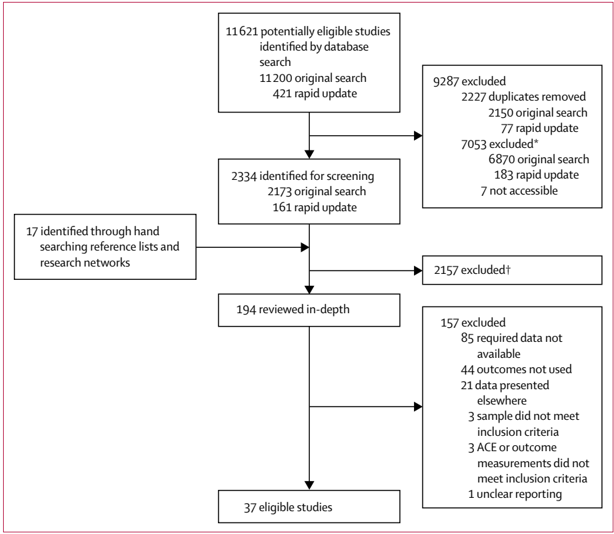
- Systematic review and meta-analysis searching five electronic databases for cross-sectional, case-control, or cohort studies published up to May 6, 2016, reporting health outcomes associated with multiple ACEs; included studies focused predominantly on adults aged at least 18 years, had sample sizes of at least 100, used a cumulative measure of at least four ACEs spanning direct and indirect types, and reported risk estimates for at least four ACEs versus none.
- From 11,621 references, 37 studies were included, providing risk estimates for 23 outcomes and 253,719 participants; most studies were from high-income countries, with nine samples from middle-income countries and none from low-income countries; 26 articles used cross-sectional data and 11 used cohort data, and all used retrospective, self-reported ACEs.
- Pooled ORs with 95% CIs were calculated using a random-effects model in StatsDirect; heterogeneity was assessed with I², publication bias with Begg-Mazumdar and Egger tests and funnel plots where at least ten samples were available, and sensitivity analyses and meta-regression were done in Stata.
Limitations
- The paper states that all included studies used retrospective ACE reports, which could be affected by recall or reporting bias; the number and types of ACEs varied, and summing ACEs does not account for different combinations or for variation in age at or length of exposure; confounding factors varied and some studies included no adjustments; genetic and environmental risks were largely unmeasured.
- The paper states that focusing on community settings likely excluded those with the most complex health problems (eg, homeless populations) and those who had already had ACE-related premature mortality; outcome measurement varied, rarer outcomes were less well covered by population surveys, and the study could only measure associations rather than establish causality.
- Evident from the text: most included samples came from high-income countries, with nine middle-income samples and none from low-income countries; heterogeneity was high for many outcomes; and visual funnel-plot assessment suggested possible missing small studies for smoking and early sexual initiation, although statistical tests for smoking were nonsignificant.
Model-written summary. Check it against the paper before relying on it.
Integrity signals
Registry
Cites
Statistics
Figures
Verification
Claims the paper makes
18 Valid · 0 Not valid · 4 Not checked · 126 Own results and interpretations
The sources with a verdict support this claim; the rest weren’t checked yet, have no full text we could read, or their verdicts aren’t rated yet.
In the paper
“However, five of the seven samples comprised students aged 18-25; 13 pooling of the remaining two samples 8,18 resulted in an OR of 12·53 (6·71-23·37; appendix).”
What the sources say
- Not checked — no full text of the sourcecites [8] 8 Ramiro LS, Madrid BJ, Brown DW. Adverse childhood experiences (ACE) and health-risk behaviors among adults in a developing country setting. Child Abuse Negl 2010; 34: 842-55. source
- Supportedcites [18] 18 Dube SR, Felitti VJ, Dong M, Giles WH, Anda RF. The impact of adverse childhood experiences on health problems: evidence from four birth cohorts dating back to 1900. Prev Med 2003; 37: 268-77 . source
The citation follows “the remaining two samples,” identifying studies used in the citing authors’ pooling rather than attributing the pooled estimate to either study. The cited paper’s Abstract describes a study of 17,337 adult HMO members that examined suicide attempts; its Methods identify the population as adult Kaiser Health Plan members. The OR of 12.53 is presented as the citing authors’ pooled result, not a result attributed to this source. (LLM, conf=0.85)
plainstates an associationn = 2- Asserted: passes — The authors put it forward as true.
- Checkable: passes — It can be checked against evidence.
- Load-bearing: unclear — It is unclear whether the paper’s conclusions depend on it.
- Based: passes — The paper gives a reason why it holds.
Every source the paper cites for this claim was checked and supports it.
In the paper
“However, five of the seven samples comprised students aged 18-25; 13 pooling of the remaining two samples 8,18 resulted in an OR of 12·53 (6·71-23·37; appendix).”
What the sources say
- Supportedcites [13] 13 Bellis MA, Hughes K, Leckenby N, et al. Adverse childhood experiences and associations with health-harming behaviours in young adults: surveys in eight eastern European countries. Bull World Health Organ 2014; 92: 641-55. source
The Attempted suicide section says respondents in seven of the eight countries were asked about suicide attempts. The Methods describe classroom surveys of students and state that the multi-study analyses were limited to respondents aged 18–25, supporting this paper's inclusion among the student samples described in the citing sentence. (LLM, conf=0.90)
plainn = 5- Asserted: passes — The authors put it forward as true.
- Checkable: passes — It can be checked against evidence.
- Load-bearing: unclear — It is unclear whether the paper’s conclusions depend on it.
- Based: passes — The paper gives a reason why it holds.
- Supported
The sources with a verdict support this claim; the rest weren’t checked yet, have no full text we could read, or their verdicts aren’t rated yet.
In the paper
“Supported by international work to standardise measurement of ACEs and their effects on health, these findings have since been replicated in studies from low-income and middle-income 7,8 and high-income 2,9 countries.”
What the sources say
- Not checked — no full text of the sourcecites [7] 7 Almuneef M, Qayad M, Aleissa M, Albuhairan F. Adverse childhood experiences, chronic diseases, and risky health behaviors in Saudi Arabian adults: a pilot study. Child Abuse Negl 2014; 38: 1787-93. source
- Not checked — no full text of the sourcecites [8] 8 Ramiro LS, Madrid BJ, Brown DW. Adverse childhood experiences (ACE) and health-risk behaviors among adults in a developing country setting. Child Abuse Negl 2010; 34: 842-55. source
- Supportedcites [2] 2 Bellis MA, Hughes K, Leckenby N, Hardcastle KA, Perkins C, Lowey H. Measuring mortality and the burden of adult disease associated with adverse childhood experiences in England: a national survey. J Public Health 2015; 37: 445-54. source
The citation to this paper supports the high-income-country part of the sentence: its English national survey found a strong association between ACEs and adult morbidity and premature mortality. The low- and middle-income-country studies are attributed to other citations. The decisive passage is in “What this study adds”; no page number is supplied in our copy. (LLM, conf=0.90)
- Supportedcites [9] 9 Bellis MA, Hughes K, Leckenby N, Perkins C, Lowey H. National household survey of adverse childhood experiences and their relationship with resilience to health-harming behaviors in England. BMC Med 2014; 12: 72. source
Citation 9 is attached to the high-income-country portion of the sentence. The Methods describe a national household survey in England, and the Results report that adverse childhood experiences were associated with multiple health-harming behaviors after adjustment for deprivation and other demographics. The indexed copy does not provide page numbers. (LLM, conf=0.91)
plainstates an association- Asserted: passes — The authors put it forward as true.
- Checkable: passes — It can be checked against evidence.
- Load-bearing: unclear — It is unclear whether the paper’s conclusions depend on it.
- Based: passes — The paper gives a reason why it holds.
The cited sources support only part of this claim — read each source’s verdict below.
In the paper
“For teenage pregnancy, four studies 9,33-35 had measured unintended teenage pregnancy and these studies reported higher estimates than did those measuring any teenage pregnancy 8,14,21 (appendix).”
What the sources say
- Supportedcites [9] 9 Bellis MA, Hughes K, Leckenby N, Perkins C, Lowey H. National household survey of adverse childhood experiences and their relationship with resilience to health-harming behaviors in England. BMC Med 2014; 12: 72. source
The paper is one of the studies identified in the citing sentence as measuring unintended teenage pregnancy. Its Results report an adjusted odds ratio of 5.86 for that outcome among respondents with four or more ACEs versus none. The comparison with studies measuring any teenage pregnancy is the citing authors’ cross-study synthesis, not a comparison attributed to this individual paper. (LLM, conf=0.88)
- Not checked — no full text of the sourcecites [33] 33 Bellis MA, Lowey H, Leckenby N, Hughes K, Harrison D. Adverse childhood experiences: retrospective study to determine their impact on adult health behaviours and health outcomes in a UK population. J Public Health 2014; 36: 81-91. source
- Partly supportedcites [34] 34 Bellis MA, Ashton K, Hughes K, Ford K, Bishop J, Paranjothy S. Adverse childhood experiences and their impact on health-harming behaviours in the Welsh adult population. Cardiff: Public Health Wales, 2015. sourceExperimental — accuracy not yet measured
The section ‘ACEs and their association with unintended teenage pregnancy’ reports an estimate for unintended teenage pregnancy, so this paper supports its identification as a study measuring that outcome. It does not compare its estimate with studies measuring any teenage pregnancy or establish that four studies reported higher estimates. (LLM, conf=0.83)
- Not matchedcites [35] 35 Ford K, Butler N, Hughes K, Quigg Z, Bellis MA. Adverse childhood experiences (ACEs) in Hertfordshire, Luton and Northamptonshire. Liverpool: Liverpool John Moores University, 2016.
Its entry has no title and year that we can search by.
- Not checked — no full text of the sourcecites [8] 8 Ramiro LS, Madrid BJ, Brown DW. Adverse childhood experiences (ACE) and health-risk behaviors among adults in a developing country setting. Child Abuse Negl 2010; 34: 842-55. source
- Not checked yetcites [14] 14 Anda RF, Chapman DP, Felitti VJ, et al. Adverse childhood experiences and risk of paternity in teen pregnancy. Obstet Gynecol 2002; 100: 37-45. source
Checked before — its earlier verdict is held back until a new check runs.
- Not checked — no full text of the sourcecites [21] 21 Hillis SD, Anda RF, Dube SR, Felitti VJ, Marchbanks PA, Marks JS. The association between adverse childhood experiences and adolescent pregnancy, long-term psychosocial consequences, and fetal death. Pediatrics 2004; 113: 320-27 . source
plainstates an association- Asserted: passes — The authors put it forward as true.
- Checkable: passes — It can be checked against evidence.
- Load-bearing: unclear — It is unclear whether the paper’s conclusions depend on it.
- Based: passes — The paper gives a reason why it holds.
- Supported
Every source the paper cites for this claim was checked and supports it.
In the paper
“However, our criteria also meant that studies were excluded because of alternative data analysis methods (eg, analysis of the World Mental Health Surveys 51 ).”
What the sources say
- Supportedcites [51] 51 Kessler RC, McLaughlin KA, Green JG, et al. Childhood adversities and adult psychopathology in the WHO World Mental Health Surveys. Br J Psychiatry 2010; 97: 378-85. source
The Analysis methods section identifies this paper as an analysis of the World Mental Health Surveys and describes its discrete-time survival analysis using person-years. The statement that the citing review excluded it under its own criteria is the citing authors’ decision, not a claim the source needs to make. (LLM, conf=0.88)
plainstates a cause- Asserted: passes — The authors put it forward as true.
- Checkable: passes — It can be checked against evidence.
- Load-bearing: unclear — It is unclear whether the paper’s conclusions depend on it.
- Based: passes — The paper gives a reason why it holds.
- Supported
53 more claims · 2 with their cited sources checked
Create a free account to see all 148 claims and to verify the 1 reference still open.
- It may state two separate claims as one. 44
- Probably not a substantial claim. 27
- The quote only partly states this claim. 31
Claims other papers make about this one
Each is checked against this paper’s own text: does it say what the citing paper says it does?
The source backs part of the claim, not all of it — or backs it for a different population, condition or comparison.
In the citing paper
“Early adverse life experiences, negative affectivity, neuroticism, depression, and anxiety have been identified as psycho logical predisposing conditions for persistent physical symptoms”
From Persistent physical symptoms: definition, genesis, and management (2024) · cites this paper as [64]
Experimental — accuracy not yet measuredThe source backs part of the claim, not all of it — or backs it for a different population, condition or comparison.
In the citing paper
“The impact of childhood abuse, neglect, and violence exposure on adult physical and emotional health and behaviors is significant and well documented”
From Intergenerational effects of childhood maltreatment: A systematic review of the parenting practices of adult survivors of childhood abuse, neglect, and violence. (2020) · cites this paper as Hughes et al., 2017
Experimental — accuracy not yet measuredThe source backs part of the claim, not all of it — or backs it for a different population, condition or comparison.
In the citing paper
“Early institutional rearing is associated with adverse biological and health outcomes in later life, including accelerated cellular aging as measured by telomere length.”
From Telomere trajectories from early adolescence to adulthood following early institutionalization: Protective effects of foster care in the Bucharest Early Intervention Project (2026) · cites this paper as Hughes et al., 2017
Experimental — accuracy not yet measuredThe source backs part of the claim, not all of it — or backs it for a different population, condition or comparison.
In the citing paper
“Individuals exposed to early life adversity are at increased risk of developing a broad spectrum of age-related illnesses at a young age, resulting in shorter health span, referring to the period of life free from chronic disease (Chandan et al., 2020; Hughes et al., 2017).”
From Telomere trajectories from early adolescence to adulthood following early institutionalization: Protective effects of foster care in the Bucharest Early Intervention Project (2026) · cites this paper as Hughes et al., 2017
Experimental — accuracy not yet measuredThe source backs part of the claim, not all of it — or backs it for a different population, condition or comparison.
In the citing paper
“This aligns with findings that ACEs are linked not only with SUD onset, but also with broader emotional and interpersonal dysregulation [4, 6].”
From The link of adverse childhood experiences and attachment to maladaptive personality traits in adults diagnosed with substance use disorder (2025) · cites this paper as [4]
Experimental — accuracy not yet measured
7 more claims about this paper
Create a free account to see every claim other papers make about this one.
Self-check
Percentages, sums and reported differences re-computed from the paper’s own numbers.
Each contradiction between two passages listed here was confirmed by an independent check.
Rated minor: it would not touch a result — a value no result rests on, a p-value that stays on the same side of the significance level, or a conflict that is clerical, resolved elsewhere in the paper, or outside its own findings.
In the paper
§ Summary
“respiratory disease (ORs of two to three)”
§ Discussion
“| Respiratory disease | 3·05 (2·47-3·77)”
Citations
Cites
Felitti, V. J., Anda, R. F., Nordenberg, D., Williamson, D. F., Spitz, A. M., Edwards, V., Koss, M. P., & Marks, J. S. (1998) · American Journal of Preventive Medicine · doi:10.1016/s0749-3797(98)00017-8 · Cited by 18,943
Global status report on noncommunicable diseases 2010.
Alwan, A. (2011) · Cited by 8,494
Forouzanfar, M. H., Afshin, A., Alexander, L. T., Anderson, H. R., Bhutta, Z. A., Biryukov, S., Brauer, M., Burnett, R., Cercy, K., Charlson, F. J., et al. (2016) · The Lancet · doi:10.1016/s0140-6736(16)31679-8 · Cited by 7,698
Wang, H., Naghavi, M., Allen, C., Barber, R. M., Bhutta, Z. A., Carter, A., Casey, D. C., Charlson, F. J., Chen, A. Z., Coates, M. M., et al. (2016) · The Lancet · doi:10.1016/s0140-6736(16)31012-1 · Cited by 6,596
Anda, R. F., Felitti, V. J., Bremner, J. D., Walker, J. D., Whitfield, C., Perry, B. D., Dube, S. R., & Giles, W. H. (2006) · European archives of psychiatry and clinical neuroscience · doi:10.1007/s00406-005-0624-4 · Cited by 4,292
Norman, R. E., Byambaa, M., De, R., Butchart, A., Scott, J., & Vos, T. (2012) · PLoS Medicine · doi:10.1371/journal.pmed.1001349 · Cited by 3,387
Self-citationValidity of adult retrospective reports of adverse childhood experiences: review of the evidence
Hardt, J., & Rutter, M. (2004) · Journal of Child Psychology and Psychiatry · doi:10.1111/j.1469-7610.2004.00218.x · Cited by 2,827
Childhood adversities and adult psychopathology in the WHO World Mental Health Surveys
Kessler, R. C., McLaughlin, K. A., Green, J. G., Gruber, M. J., Sampson, N. A., Zaslavsky, A. M., Aguilar-Gaxiola, S., Alhamzawi, A. O., Alonso, J., Angermeyer, M., et al. (2010) · British Journal of Psychiatry · doi:10.1192/bjp.bp.110.080499 · Cited by 2,640
Impact of child sexual abuse: A review of the research.
Browne, A., & Finkelhor, D. (1986) · Psychological Bulletin · doi:10.1037/0033-2909.99.1.66 · Cited by 2,590
Adverse childhood experiences, allostasis, allostatic load and age-related disease
Danese, A., & McEwen, B. S. (2012) · Physiology & Behavior · doi:10.1016/j.physbeh.2011.08.019 · Cited by 2,140
Cited by
Items 201–300 of 5,221
Meinck, F., Boyes, M. E., Cluver, L. D., Ward, C. L., Schmidt, P. S., Stone, S. D., & Dunne, M. P. (2018) · Child Abuse & Neglect · doi:10.1016/j.chiabu.2018.05.022 · Cited by 99
“Were based on a recent systematic review of health outcomes associated with multiple Adverse Childhood Experiences (Hughes et al., 2017).”
BackgroundSelf-citationSeker, S., Boonmann, C., Gerger, H., Jäggi, L., d’Huart, D., Schmeck, K., & Schmid, M. (2022) · European Child & Adolescent Psychiatry · doi:10.1007/s00787-021-01828-0 · Cited by 82
Wang, D., Choi, J., & Shin, J. (2020) · Journal of Youth and Adolescence · doi:10.1007/s10964-020-01305-y · Cited by 98
Cagney, J., Spencer, C. N., Flor, L. S., Herbert, M. E., Khalil, M., O’Connell, E. M., Mullany, E. C., Bustreo, F., Chandan, J. S., Metheny, N., et al. (2025) · The Lancet · doi:10.1016/s0140-6736(25)00311-3 · Cited by 142
“1,2 Existing studies on the health effects of SVAC have made its long-term somatic (eg, asthma and STIs) and psychiatric (eg, major depression and anxiety) effects increasingly clear, 3,4 and others have documented SVAC’s association with stress-response behaviours such as alcohol and substance use.”
Whittle, H. J., Sheira, L. A., Wolfe, W. R., Frongillo, E. A., Palar, K., Merenstein, D. J., Wilson, T. E., Adedimeji, A., Weber, K. M., Adimora, A. A., et al. (2019) · Journal of Nutrition · doi:10.1093/jn/nxz093 · Cited by 95
“For example, adverse childhood experiences predict a range of social and health issues in adulthood [what has been termed “toxic stress” (58)], including adult and household food insecurity (59, 60) and poor mental health (61).”
BackgroundHughes, K., Ford, K., Kadel, R., Sharp, C. A., & Bellis, M. A. (2020) · BMJ Open · doi:10.1136/bmjopen-2019-036374 · Cited by 82
Self-citationKushalnagar, P., Ryan, C., Paludneviciene, R., Spellun, A. H., & Gulati, S. (2020) · American Journal of Preventive Medicine · doi:10.1016/j.amepre.2020.04.016 · Cited by 94
Overlooked and unaddressed: A narrative review of mental health consequences of child marriages
Burgess, R. A., Jeffery, M., Odero, S. A., Rose‐Clarke, K., & Devakumar, D. (2022) · PLOS Global Public Health · doi:10.1371/journal.pgph.0000131 · Cited by 116
Panagou, C., & MacBeth, A. M. (2022) · Clinical Psychology & Psychotherapy · doi:10.1002/cpp.2732 · Cited by 111
“…review supports existing evidence for the link between early adversity and various forms of common psychopathology (e.g., Green et al., 2010; Hughes et al., 2017; Riedl et al., 2020) indicating that child adversity constitutes a transdiagnostic risk factor in the development and maintenance…”
BackgroundChandan, J. S., Thomas, T., Gokhale, K. M., Bandyopadhyay, S., Taylor, J., & Nirantharakumar, K. (2019) · The Lancet Psychiatry · doi:10.1016/s2215-0366(19)30369-4 · Cited by 80
Wesarg, C., van den Akker, A. L., Oei, N. Y. L., Hoeve, M., & Wiers, R. W. H. J. (2020) · European Journal of Developmental Psychology · doi:10.1080/17405629.2020.1748594 · Cited by 115
“On the other hand, it encompasses conditions which more indirectly impact the child, like growing up in poverty (see Hughes et al., 2017).”
BackgroundSpecial Report: The Biology of Inequalities in Health: The Lifepath Consortium
Vineis, P., Avendano-Pabon, M., Barros, H., Bartley, M., Carmeli, C., Carra, L., Chadeau-Hyam, M., Costa, G., Delpierre, C., D'Errico, A., et al. (2020) · Frontiers in Public Health · doi:10.3389/fpubh.2020.00118 · Cited by 80
“A related literature has been accumulating on the specific ACEs that are important and their likely consequences for later socioeconomic status (105, 106), health behaviors, and health outcomes (107, 108).”
Klopack, E. T., Crimmins, E. M., Cole, S. W., Seeman, T. E., & Carroll, J. (2022) · SSM - Population Health · doi:10.1016/j.ssmph.2022.101071 · Cited by 101
“…attainment (Font & Maguire-Jack, 2016; Liu et al., 2013; Yang et al., 2017) and research suggesting the effect of ACEs on depressive symptoms is mediated by these socioeconomic and lifestyle factors (Hughes et al., 2017; Jones et al., 2018; Merrick et al., 2017; Wickrama et al., 2014).”
BackgroundWolff, K. T., Cuevas, C., Intravia, J., Baglivio, M. T., & Epps, N. (2018) · Journal of Youth and Adolescence · doi:10.1007/s10964-018-0887-5 · Cited by 118
Leban, L. (2021) · Crime & Delinquency · doi:10.1177/0011128721989059 · Cited by 89
“Adverse Childhood Experiences (ACEs) are a set of traumatic events that can have harmful effects throughout the life course (Baglivio et al., 2014; Hughes et al., 2017).”
BackgroundYu, J., Patel, R. A., Haynie, D. L., Vidal‐Ribas, P., Govender, T., Sundaram, R., & Gilman, S. E. (2022) · The Lancet Regional Health - Americas · doi:10.1016/j.lana.2022.100349 · Cited by 100
Ross, N., Gilbert, R. W., Torres, S., Dugas, K., Jefferies, P., McDonald, S., Savage, S. L., & Ungar, M. T. (2020) · Child Abuse & Neglect · doi:10.1016/j.chiabu.2020.104440 · Cited by 96
Chanlongbutra, A., Singh, G. K., & Mueller, C. D. (2018) · Journal of Environmental and Public Health · doi:10.1155/2018/7151297 · Cited by 91
Adverse Childhood Experiences Increase Risk for Prescription Opioid Misuse
Merrick, M. T., Ford, D. C., Haegerich, T. M., & Simon, T. R. (2020) · The Journal of Primary Prevention · doi:10.1007/s10935-020-00578-0 · Cited by 90
“A recent international meta-analysis found that across 37 retrospective studies, 57% of participants reported at least one ACE and 13% reported at least four (Hughes et al., 2017).”
Child Maltreatment During the COVID-19 Pandemic
Rapp, A., Fall, G., Radomsky, A. C., & Santarossa, S. (2021) · Pediatric Clinics of North America · doi:10.1016/j.pcl.2021.05.006 · Cited by 76
Adverse childhood experiences: A scoping review of measures and methods
Karatekin, C., Mason, S. M., Riegelman, A., Bakker, C., Hunt, S., Gresham, B. L., Corcoran, F., & Barnes, A. J. (2022) · Children and Youth Services Review · doi:10.1016/j.childyouth.2022.106425 · Cited by 110
Childhood maltreatment and sleep in children and adolescents: A systematic review and meta-analysis
Schønning, V., Sivertsen, B., Hysing, M., Dovran, A., & Askeland, K. G. (2022) · Sleep Medicine Reviews · doi:10.1016/j.smrv.2022.101617 · Cited by 93
Kuzminskaite, E., Vinkers, C. H., Milaneschi, Y., Giltay, E. J., & Penninx, B. W. J. H. (2022) · Journal of Affective Disorders · doi:10.1016/j.jad.2022.06.057 · Cited by 106
Emsley, E., Smith, J., Martin, D., & Lewis, N. V. (2022) · BMC Health Services Research · doi:10.1186/s12913-022-08461-w · Cited by 131
“In a systematic review and meta-analysis of 37 observational studies of health behaviours and adult disease, patients with four or more ACEs were at higher risk of a range of poorer health outcomes including cardiovascular disease and mental ill health, versus those with no ACEs history [12].”
BackgroundA genetically informed Registered Report on adverse childhood experiences and mental health
Baldwin, J. R., Sallis, H., Schoeler, T., Taylor, M. J., Kwong, A. S. F., Tielbeek, J. J., Barkhuizen, W., Warrier, V., Howe, L. D., Danese, A., et al. (2022) · Nature Human Behaviour · doi:10.1038/s41562-022-01482-9 · Cited by 92
“• Hypothesis 1c will be supported if (1) the Wald test is significant; (2) pairwise comparisons show that parental mental illness, parental substance abuse and parental criminality are associated with higher polygenic risk than other ACEs; and (3) the CIs for these differences are not within the equivalence bounds.”
BackgroundMethodResultInfluentialAssociation of Adverse Childhood Experiences With Accelerated Epigenetic Aging in Midlife
Kim, K., Yaffe, K. S., Rehkopf, D. H., Zheng, Y., Nannini, D. R., Perak, A. M., Nagata, J. M., Miller, G. E., Zhang, K., Lloyd‐Jones, D. M., et al. (2023) · JAMA Network Open · doi:10.1001/jamanetworkopen.2023.17987 · Cited by 91
Saunders, K. R. K., McGuinness, E., Barnett, P., Foye, U., Sears, J., Carlisle, S., Allman, F., Tzouvara, V., Schlief, M., Juan, N. V. S., et al. (2023) · BMC Psychiatry · doi:10.1186/s12888-023-05016-z · Cited by 120
“reflecting upon the use of restraint and personal communication styles (through reporting and analysing every restraint incident over a period of time); (3) using approaches to help patients and staff ascertain needs and challenges with regards to aggression on the ward; (4) employing partnership working strategies to…”
BackgroundMethodInfluentialAdverse childhood experiences and poor birth outcomes in a diverse, low-income sample
Mersky, J. P., & Lee, C. P. (2019) · BMC Pregnancy and Childbirth · doi:10.1186/s12884-019-2560-8 · Cited by 81
Social trauma and its association with posttraumatic stress disorder and social anxiety disorder
Bjornsson, A. S., Hardarson, J., Valdimarsdottir, A. G., Guðmundsdóttir, K., Tryggvadóttir, A., Þórarinsdóttir, K., Wessman, I. D., Sigurjónsdóttir, Ó., Davíðsdóttir, S. D., & Thorisdottir, A. S. (2020) · Journal of Anxiety Disorders · doi:10.1016/j.janxdis.2020.102228 · Cited by 98
“, Kowalski, Guimetti, Schroeder, & Lattanner, 2014; McCabe, Miller, Laugesen, Antony, & Young, 2010) and the literature on adverse childhood experiences (ACE; Hughes et al., 2017; Petruccelli, Davis, & Berman, 2019).”
Child Maltreatment and Mortality in Young Adults
Segal, L., Armfield, J. M., Gnanamanickam, E. S., Preen, D. B., Brown, D. S., Doidge, J., & Nguyen, H. (2021) · PEDIATRICS · doi:10.1542/peds.2020-023416 · Cited by 77
Attachment, Mentalizing and Trauma: Then (1992) and Now (2022)
Fonagy, P., Campbell, C., & Luyten, P. (2023) · Brain Sciences · doi:10.3390/brainsci13030459 · Cited by 117
Racine, N. M., Deneault, A., Thiemann, R. F., Turgeon, J., Zhu, J., Cooke, J. E., & Madigan, S. L. (2023) · Child Abuse & Neglect · doi:10.1016/j.chiabu.2023.106479 · Cited by 111
Wiehn, J., Hornberg, C., & Fischer, F. (2018) · BMC Public Health · doi:10.1186/s12889-018-5926-3 · Cited by 72
Hu, Z. Y., Kaminga, A. C., Yang, J., Liu, J., & Xu, H. (2021) · Child Abuse & Neglect · doi:10.1016/j.chiabu.2021.105088 · Cited by 86
Mersky, J. P., Janczewski, C. E., & Nitkowski, J. (2018) · Social Science & Medicine · doi:10.1016/j.socscimed.2018.03.043 · Cited by 82
Testa, A. M., & Jackson, D. B. (2020) · Journal of Adolescent Health · doi:10.1016/j.jadohealth.2020.02.002 · Cited by 85
Adverse childhood experiences and psychological well-being in a rural sample of Chinese young adults
Zhang, L., Mersky, J. P., & Topitzes, J. (2020) · Child Abuse & Neglect · doi:10.1016/j.chiabu.2020.104658 · Cited by 82
Psychedelics as a novel approach to treating autoimmune conditions
Thompson, C., & Szabo, A. (2020) · Immunology Letters · doi:10.1016/j.imlet.2020.10.001 · Cited by 71
Smoking and Neuropsychiatric Disease—Associations and Underlying Mechanisms
Hahad, O., Daiber, A., Michal, M., Kuntić, M., Lieb, K., Beutel, M. E., & Münzel, T. F. (2021) · International Journal of Molecular Sciences · doi:10.3390/ijms22147272 · Cited by 82
Métais, C., Burel, N., Gillham, J. E., Tarquinio, C., & Martin‐Krumm, C. (2022) · Europe’s Journal of Psychology · doi:10.5964/ejop.2251 · Cited by 123
“Third, the acknowledgement of both chronic and acute adversity adds to consideration the possibility for a co-occur rence of either both kinds of adversity or multiple adversities (Hughes et al., 2017).”
BackgroundCamacho, S., & Henderson, S. C. (2022) · International Journal of Environmental Research and Public Health · doi:10.3390/ijerph191710670 · Cited by 89
“…violence, homelessness, foster care, bullying, and racism); this research has: (1) advanced dialogue around the diversity of ACEs; (2) examined the relationship between ACEs and child demographics; and (3) demonstrated which populations of children are more likely to experience ACEs [2,7,8].”
Bunting, L., McCartan, C. J., Davidson, G., Grant, A., Mulholland, C. C., Schubotz, D., Hamill, R., McBride, O., Murphy, J., Nolan, E., et al. (2023) · Child Abuse & Neglect · doi:10.1016/j.chiabu.2023.106159 · Cited by 87
“A meta-analysis of ACE related health outcomes in adulthood (Hughes et al., 2017) found that those with four or more ACEs were over three times more likely to report current mental illness, six times more likely to report lifetime mental illness, and nine times more likely to report having ever…”
BackgroundMethodMok, P. L. H., Antonsen, S., Pedersen, C. B., Carr, M., Kapur, N., Nazroo, J. Y., & Webb, R. T. (2018) · The Lancet Public Health · doi:10.1016/s2468-2667(18)30164-6 · Cited by 81
Schär, S., Mürner-Lavanchy, I., Schmidt, S. J., Koenig, J., & Kaess, M. (2022) · Frontiers in Neuroendocrinology · doi:10.1016/j.yfrne.2022.100987 · Cited by 71
Deschênes, S. S., Graham, E. A., Kivimäki, M., & Schmitz, N. (2018) · Diabetes Care · doi:10.2337/dc18-0932 · Cited by 79
Inequalities in the Distribution of Childhood Adversity From Birth to 11 Years
O'Connor, M., Slopen, N., Becares, L., Burgner, D., Williams, D. R., & Priest, N. (2020) · Academic Pediatrics · doi:10.1016/j.acap.2019.12.004 · Cited by 67
Downing, N. R., Akinlotan, M. A., & Thornhill, C. W. (2021) · Child Abuse & Neglect · doi:10.1016/j.chiabu.2021.105181 · Cited by 94
Adverse childhood experiences or adverse childhood socioeconomic conditions?
Taylor-Robinson, D. C., Straatmann, V. S., & Whitehead, M. M. (2018) · The Lancet Public Health · doi:10.1016/s2468-2667(18)30094-x · Cited by 70
Riedl, D., Beck, T., Exenberger, S., Daniels, J., Dejaco, D., Unterberger, I., & Lampe, A. (2019) · Journal of Psychosomatic Research · doi:10.1016/j.jpsychores.2018.11.019 · Cited by 69
Lee, D. Y., Yu, E., & Kim, N. H. (2020) · European Journal of Psychotraumatology · doi:10.1080/20008198.2019.1704563 · Cited by 91
“A large body of research has indicated that adverse childhood experiences are associated with multiple physical and mental health problems, with maladjustment, and with unhealthy lifestyles in adulthood (Felitti et al., 1998; Hughes et al., 2017).”
BackgroundInvestigating Pleiotropy Between Depression and Autoimmune Diseases Using the UK Biobank
Glanville, K. P., Coleman, J. R. I., O’Reilly, P. F., Galloway, J. B., & Lewis, C. M. (2021) · Biological Psychiatry Global Open Science · doi:10.1016/j.bpsgos.2021.03.002 · Cited by 85
Association Between Adverse Childhood Experiences and Adverse Pregnancy Outcomes
Miller, E. S., Fleming, O., Ekpe, E. E., Grobman, W. A., & Heard‐Garris, N. (2021) · Obstetrics and Gynecology · doi:10.1097/aog.0000000000004570 · Cited by 78
Adverse childhood experiences: prevalence and associated factors among South African young adults
Manyema, M., & Richter, L. (2019) · Heliyon · doi:10.1016/j.heliyon.2019.e03003 · Cited by 89
Thai, T. T., Cao, P. L. T., Kim, L. X., Tran, D. P., Bui, M. B., & Bui, H. H. T. (2020) · Asian Journal of Psychiatry · doi:10.1016/j.ajp.2020.102134 · Cited by 74
Straatmann, V. S., Lai, E. T. C., Law, C., Whitehead, M. M., Strandberg‐Larsen, K., & Taylor-Robinson, D. C. (2020) · Journal of Epidemiology & Community Health · doi:10.1136/jech-2020-213817 · Cited by 85
“6 While we know that both adverse SECs and ACEs are harmful to health, 3 12 13 from a causal pathway perspective, ACEs may be conceptualised as being mediators on the causal pathway from disad-vantaged SECs to adverse outcomes.”
Pollok, T. M., Kaiser, A., Kraaijenvanger, E. J., Monninger, M., Brandeis, D., Banaschewski, T., Eickhoff, S. B., & Holz, N. E. (2022) · Neuroscience & Biobehavioral Reviews · doi:10.1016/j.neubiorev.2022.104589 · Cited by 86
Cortisol and cardiometabolic disease: a target for advancing health equity
Ortiz, R., Kluwe, B., Lazarus, S. A., Teruel, M. N., & Joseph, J. J. (2022) · Trends in Endocrinology and Metabolism · doi:10.1016/j.tem.2022.08.002 · Cited by 85
Iob, E., Lacey, R. E., & Steptoe, A. (2020) · Brain Behavior and Immunity · doi:10.1016/j.bbi.2020.07.045 · Cited by 75
“ACEs are extremely common across several countries (Bellis et al., 2014; Merrick et al., 2018), and are major psychosocial risk factors for depression, as well as for other mental and physical disorders (Hughes, 2017; Bellis, 2019).”
BackgroundThe association of child maltreatment and systemic inflammation in adulthood: A systematic review
Kerr, D. M., McDonald, J. J., & Minnis, H. (2021) · PLoS ONE · doi:10.1371/journal.pone.0243685 · Cited by 75
Individuals with adverse childhood experiences explore less and underweight reward feedback
Lloyd, A., McKay, R. T., & Furl, N. (2022) · Proceedings of the National Academy of Sciences · doi:10.1073/pnas.2109373119 · Cited by 68
Kelifa, M. O., Yang, Y., Herbert, C., Wang, B., & Wang, P. (2020) · Journal of Happiness Studies · doi:10.1007/s10902-020-00308-7 · Cited by 88
Gehred, M. Z., Knodt, A. R., Ambler, A., Bourassa, K. J., Danese, A., Elliott, M. L., Hogan, S., Ireland, D., Poulton, R., Ramrakha, S., et al. (2021) · Biological Psychiatry · doi:10.1016/j.biopsych.2021.02.971 · Cited by 65
“These health-harming behaviors have been demonstrated to have physiological effects (3), which may, in turn, broadly impact brain structure.”
Rod, N. H., Bengtsson, J., Elsenburg, L. K., Taylor-Robinson, D. C., & Rieckmann, A. (2021) · The Lancet Public Health · doi:10.1016/s2468-2667(21)00158-4 · Cited by 70
Mamun, A. A., Biswas, T., Scott, J. G., Sly, P. D., McIntyre, D. H., Thorpe, K. J., Boyle, F. M., Nitert, M. D., Doi, S. A. R., Mitchell, M. D., et al. (2023) · BMJ Open · doi:10.1136/bmjopen-2022-063826 · Cited by 83
Kip, A., Schoppe, L., Arntz, A., & Morina, N. (2023) · Journal of Anxiety Disorders · doi:10.1016/j.janxdis.2023.102772 · Cited by 66
Naviaux, R. K. (2018) · Mitochondrion · doi:10.1016/j.mito.2018.08.001 · Cited by 80
Meldrum, R. C., Young, B. C., Soor, S., Hay, C., Copp, J. E., Trace, M., Smith‐Darden, J. P., & Kernsmith, P. D. (2019) · Criminal Justice and Behavior · doi:10.1177/0093854819879741 · Cited by 73
“Since the original ACEs study (Felitti et al., 1998), a growing body of research links ACEs with chronic disease, mental illness, risky behaviors, and poor socioeconomic outcomes (e.g., Hughes et al., 2017; Metzler, Merrick, klevens, Ports, & Ford, 2017).”
BackgroundBhushan, D., Kotz, K. J., McCall, J., Wirtz, S., Gilgoff, R., Dube, S. R., Powers, C., Olson-Morgan, J., Galeste, M., Patterson, K., et al. (2020) · doi:10.48019/peam8812 · Cited by 121
Zugman, A., Alliende, L. M., Medel, V., Bethlehem, R. A. I., Seidlitz, J., Ringlein, G., Arango, C., Arnatkevičiūtė, A., Asmal, L., Bellgrove, M., et al. (2023) · Proceedings of the National Academy of Sciences · doi:10.1073/pnas.2218782120 · Cited by 65
“Our study could not examine further which of these mechanisms were involved, since many types of adverse experiences coexist across societies (36).”
BackgroundLuo, J., Beam, C. R., & Gatz, M. (2023) · Prevention Science · doi:10.1007/s11121-022-01385-1 · Cited by 65
Promoting Evidence-Based, Trauma-Informed Social Work Practice
Mersky, J. P., Topitzes, J., & Britz, L. (2019) · Journal of Social Work Education · doi:10.1080/10437797.2019.1627261 · Cited by 109
“The ACE literature is a good source of supporting data, as increased exposure to ACEs is known to correspond with an elevated risk of physical, mental, and behavioral health problems (Green et al., 2010; Hughes et al., 2017).”
BackgroundKuhar, M., & Kocjan, G. Z. (2021) · European Journal of Psychotraumatology · doi:10.1080/20008198.2021.1924953 · Cited by 76
“…conditions, healthrisk behaviours, and self-rated health, with existing studies either focusing on selected outcomes from a particular category or including examples from all categories (e.g. Clemens et al., 2018; Felitti et al., 1998; Hughes et al., 2017; Petruccelli, Davis., & Berman, 2019).”
BackgroundMethodResultInfluentialBrewerton, T. D. (2022) · Journal of Eating Disorders · doi:10.1186/s40337-022-00696-6 · Cited by 80
Oláh, B., Fekete, Z., Kuritárné Szabó, I., & Kovács-Tóth, B. (2023) · Frontiers in Public Health · doi:10.3389/fpubh.2023.1258798 · Cited by 65
Adverse Childhood Experiences and Autism: A Meta-Analysis
Hartley, G., Sirois, F. M., Purrington, J., & Rabey, Y. (2023) · Trauma Violence & Abuse · doi:10.1177/15248380231213314 · Cited by 89
“There is considerable evidence of the long-term negative impact of ACEs on physical and mental health outcomes (Hughes et al., 2017).”
BackgroundCeccarelli, C., Prina, E., Muneghina, O., Jordans, M. J. D., Barker, E. D., Miller, K. E., Singh, R. K., Acartürk, C., Sorsdhal, K., Cuijpers, P. J., et al. (2022) · Epidemiology and Psychiatric Sciences · doi:10.1017/s2045796022000580 · Cited by 70
Adverse childhood experiences in mothers with chronic pain and intergenerational impact on children
Dennis, C. H., Clohessy, D. S., Stone, A. L., Darnall, B. D., & Wilson, A. C. (2019) · The Journal of Pain · doi:10.1016/j.jpain.2019.04.004 · Cited by 64
Nishimi, K. M., Choi, K. W., Cerutti, J., Powers, A. D., Bradley, B., & Dunn, E. C. (2020) · Psychological Medicine · doi:10.1017/s0033291720001191 · Cited by 73
“However, retrospective reports of adversity tend to be under- not over-reported (Hardt & Rutter, 2004) and consistently identify groups of individuals at high risk for adult outcomes (Hughes et al., 2017).”
BackgroundVila‐Badia, R., Butjosa, A., Cacho, N. D., Serra‐Arumí, C., Esteban‐Sanjusto, M., Ochoa, S., & Usall, J. (2021) · Schizophrenia Research · doi:10.1016/j.schres.2020.11.047 · Cited by 72
Mental Health in Lifestyle Medicine: A Call to Action
Merlo, G., & VELA, A. M. (2021) · American Journal of Lifestyle Medicine · doi:10.1177/15598276211013313 · Cited by 83
“There is a preponderance of mental disorders in certain populations— for example, increased risk of negative mental and behavioral health outcomes (ie, greater rates of symptoms and disorder) among groups who experienced more adverse childhood events.(3) Individuals and groups of lower socioeconomic status are also di…”
BackgroundMay, T., Younan, R., & Pilkington, P. D. (2022) · Clinical Psychology & Psychotherapy · doi:10.1002/cpp.2712 · Cited by 89
“This is consistent with a large body of research linking adverse childhood experiences to poor health outcomes including poor mental health (Hughes et al., 2017).”
Adverse childhood experiences and resilience among adult women: A population-based study
Daníelsdóttir, H. B., Aspelund, T., Thordardottir, E. B., Fall, K., Fang, F., Tómasson, G., Rúnarsdóttir, H., Yang, Q., Choi, K. W., Kennedy, B., et al. (2022) · eLife · doi:10.7554/elife.71770 · Cited by 86
Su, Y., Meng, X., Yang, G., & D’Arcy, C. (2022) · BMC Psychiatry · doi:10.1186/s12888-022-04001-2 · Cited by 81
“Discussion Our prevalence estimates of childhood maltreatment are comparable to a recent meta-analysis of 37 studies with a total of 253,719 participants [54].”
ResultHatch, V., Swerbenski, H. G., & Gray, S. A. O. (2020) · American Journal of Orthopsychiatry · doi:10.1037/ort0000451 · Cited by 81
“Although continuity of childhood household dysfunction, abuse, and maltreatment across generations is well established, less is known about the intergenerational impact of mothers’ accumulation of ACEs; this is despite awareness of the high prevalence rates of ACEs and the dose-response association between ACE exposur…”
BackgroundValidity of an expanded assessment of adverse childhood experiences: A replication study
Choi, C., Mersky, J. P., Janczewski, C. E., Lee, C. P., Davies, W. H., & Lang, A. C. (2020) · Children and Youth Services Review · doi:10.1016/j.childyouth.2020.105216 · Cited by 81
Xu, Z., Zhang, D., Ding, H., Zheng, X., Lee, R. C.-M., Yang, Z., Mo, P. K. H., Lee, E. K. P., & Wong, S. Y. S. (2022) · European Journal of Psychotraumatology · doi:10.1080/20008198.2022.2065429 · Cited by 71
“The selection of mental health indicators was based on a previous meta-analysis on ACEs (Hughes et al., 2017), using both well-examined instruments and self-constructed questions.”
BackgroundMethodInfluentialChildhood adversity and mental health comorbidity in men and women with opioid use disorders
Evans, E., Goff, S. L., Upchurch, D. M., & Grella, C. E. (2019) · Addictive Behaviors · doi:10.1016/j.addbeh.2019.106149 · Cited by 71
Ford, K., Bellis, M. A., Hughes, K. E., Barton, E. R., & Newbury, A. (2020) · Health & Justice · doi:10.1186/s40352-020-00115-5 · Cited by 86
Self-citationFolk, J. B., Kemp, K. A., Yurasek, A., Barr‐Walker, J., & Tolou‐Shams, M. (2021) · American Psychologist · doi:10.1037/amp0000769 · Cited by 69
“…caregiver mental illness, caregiver divorce/separation, caregiver incarceration, domestic violence) comprise the framework for characterizing and quantifying effects of childhood adversity across different settings and populations (Felitti et al., 1998; Hughes et al., 2017; Oral et al., 2016).”
BackgroundInfluentialKappel, R., Livingston, M. D., Patel, S. N., Villaveces, A., & Massetti, G. M. (2021) · Child Abuse & Neglect · doi:10.1016/j.chiabu.2021.104993 · Cited by 75
Prevention of mental disorders requires action on adverse childhood experiences
Jorm, A. F., & Mulder, R. T. (2018) · Australian & New Zealand Journal of Psychiatry · doi:10.1177/0004867418761581 · Cited by 62
Adversity in childhood and depression in pregnancy
Wajid, A., van Zanten, S. V., Mughal, M. K., Biringer, A. B., Austin, M., Vermeyden, L., & Kingston, D. E. (2019) · Archives of Women s Mental Health · doi:10.1007/s00737-019-00966-4 · Cited by 69
Meinck, F., Neelakantan, L., Steele, B., Jochim, J., Davies, L. M., Boyes, M., Barlow, J., & Dunne, M. (2023) · Trauma, Violence, & Abuse · doi:10.1177/15248380221082152 · Cited by 61
“…or any of the following prespecified outcomes that are associated with VAC and related adversity with odds ratios > 3.5 in a recent meta-analysis (Hughes et al., 2017): depression, anxiety, suicidal ideation, self-harm, problem behavior in the form of delinquency, criminal activity or violence…”
BackgroundInfluentialSelf-citationWang, Y.-R., Sun, J., Lin, P., Zhang, H.-H., Mu, G.-X., & Cao, F. (2019) · Child Abuse & Neglect · doi:10.1016/j.chiabu.2019.104183 · Cited by 80
Lippard, E., & Nemeroff, C. B. (2023) · American Journal of Psychiatry · doi:10.1176/appi.ajp.19010020 · Cited by 79
ADHD and risk for subsequent adverse childhood experiences: understanding the cycle of adversity
Lugo‐Candelas, C., Corbeil, T., Wall, M., Posner, J., Bird, H., Canino, G., Fisher, P. W., Suglia, S. F., & Duarte, C. S. (2021) · Journal of Child Psychology and Psychiatry · doi:10.1111/jcpp.13352 · Cited by 60
“The detrimental long-term consequences of ACEs on physical and mental health are well documented (Hughes et al., 2017) with a substantial body of literature linking ACEs to increased likelihood of developing attention deficit/hyperactivity disorder (ADHD).”
BackgroundInfluentialRussell, A. E., Heron, J., Gunnell, D., Ford, T., Hemani, G., Joinson, C., Moran, P., Relton, C., Suderman, M., & Mars, B. (2019) · Journal of Child Psychology and Psychiatry · doi:10.1111/jcpp.13100 · Cited by 61
“Introduction Exposure to adverse childhood experiences (ACEs) is a well-established risk factor for self-harm (Bj€ orkenstam, Kosidou, & Bj€ orkenstam, 2016; Brown et al., 2018; Cha et al., 2018; Dube et al., 2001; Hughes et al., 2017; Liu, Scopelliti, Pittman, & Zamora, 2018); however, the psychological and biologica…”
BackgroundArmfield, J. M., Gnanamanickam, E. S., Johnston, D. W., Preen, D. B., Brown, D. S., Nguyen, H., & Segal, L. (2021) · The Lancet Public Health · doi:10.1016/s2468-2667(21)00024-4 · Cited by 72
Yu, H., Liu, X., Yang, H., Chen, R., & He, Q. (2022) · Sleep Medicine · doi:10.1016/j.sleep.2022.06.006 · Cited by 69
Associations between adverse childhood experiences and substance use: A meta-analysis
Zhu, J., Racine, N. M., Devereux, C., Hodgins, D. C., & Madigan, S. L. (2023) · Child Abuse & Neglect · doi:10.1016/j.chiabu.2023.106431 · Cited by 92
Metadata
- Authors
- Hughes, K., Bellis, M. A., Hardcastle, K. A., Sethi, D., Butchart, A., Mikton, C., Jones, L., & Dunne, M. P.
- Affiliations
- Bangor University (GB)
- Public Health Wales (GB)
- World Health Organization Regional Office for Europe (DK)
- World Health Organization (CH)
- University of the West of England (GB)
- Liverpool John Moores University (GB)
- Queensland University of Technology (AU)
- Corresponding author
- Bellis, Mark A
- Venue
- The Lancet Public Health
- Publisher
- Elsevier BV
- Published
- 2017-08
- Volume
- 2
- Issue
- 8
- Pages
- e356-e366
- ISSN
- 2468-2667 (ISSN-L)
- OpenAlex
- W2740726397
- Semantic Scholar
- cdd633b48c3e902b5a7a012711d868cf5745c677
- Cited by
- 5,255
- References
- 70
- Citations by year
- 2026: 750 · 2025: 849 · 2024: 817 · 2023: 711 · 2022: 698 · 2021: 626 · 2020: 464 · 2019: 232 · 2018: 97 · 2017: 7
- FWCI
- 33.48
- Type
- journal article
- Language
- en
- Open access
- gold
- doi.org
- Licence
- cc-by-nc-nd
- www.elsevier.com/tdm/userlicense/1.0/ (tdm)
- creativecommons.org/licenses/by-nc-nd/4.0/ (vor)
- Locations
- The Lancet Public Health (publishedVersion, cc-by-nc-nd)
- PubMed (publishedVersion)
- Liverpool John Moores University (acceptedVersion)
- QUT ePrints (Queensland University of Technology) (submittedVersion, cc-by-nc-nd)
- UWE Research Repository (UWE Bristol) (submittedVersion, cc-by-nc-nd)
- DOAJ (DOAJ: Directory of Open Access Journals) (submittedVersion, cc-by-sa)
- Funders
- World Health Organization
- Public Health Wales
- Topics
- Social Sciences › Psychology › Clinical Psychology › Child Abuse and Trauma
- Social Sciences › Sociology and Political Science › Child Welfare and Adoption
- Social Sciences › Health › Intimate Partner and Family Violence
- Keywords
- adverse childhood experiences, child abuse, domestic violence exposure, substance use, sexual health, mental health, violence, physical health, physical activity, weight, resilience
- MeSH terms
- Health Status, Humans, Life Change Events
About these checks
Registry, retraction, Cites and statistics results are computed, not judged, with one exception: a printed reference that no index lists is read once by a model before it counts as a citation error. Claims are extracted by a model and kept only when their quote appears verbatim in the text; each cited source is then checked, with a model’s help, for whether it says what the claim relies on. Those verdicts can be wrong — read the claim’s quote and the cited source before relying on one.
The claim verdicts this report counts are experimental: their accuracy is not yet measured.
A language model drew the claims from the paper on 2026-09-28, under version 3 of the claim definition (prompt extract-v3).
A second model labelled each claim on 2026-09-28 (model jev-1.13-20260917, definition revision gold-guideline-v0.2).
Cited sources are checked with a language model’s help (gpt-6-sol).
Statistics and arithmetic are recomputed, not judged.
Confidence bands are shown only for fields calibrated on our annotated test set. None is calibrated yet, so no band is shown.
What counts as a claim ›How we measure confidence ›How we check this ›
Are you an author, or do you see a problem with this page? Request a review
Data sources
Bibliographic data: Semantic Scholar, OpenAlex, Crossref.
Contains information from the Semantic Scholar Academic Graph Datasets, made available under the ODC Attribution License (ODC-BY 1.0).
Semantic Scholar’s data is described in: Kinney, R., et al. (2023). The Semantic Scholar Open Data Platform. arXiv:2301.10140.
