

The effect of multiple adverse childhood experiences on health: a systematic review and meta-analysis.
Open accessThe DOI matches its Crossref record; 66 of the 70 references it cites were found in a registry or an index; 23 of the 40 sources its claims cite were checked for support.
Abstract
BACKGROUND: A growing body of research identifies the harmful effects that adverse childhood experiences (ACEs; occurring during childhood or adolescence; eg, child maltreatment or exposure to domestic violence) have on health throughout life. Studies have quantified such effects for individual ACEs. However, ACEs frequently co-occur and no synthesis of findings from studies measuring the effect of multiple ACE types has been done. METHODS: In this systematic review and meta-analysis, we searched five electronic databases for cross-sectional, case-control, or cohort studies published up to May 6, 2016, reporting risks of health outcomes, consisting of substance use, sexual health, mental health, weight and physical exercise, violence, and physical health status and conditions, associated with multiple ACEs. We selected articles that presented risk estimates for individuals with at least four ACEs compared with those with none for outcomes with sufficient data for meta-analysis (at least four populations). Included studies also focused on adults aged at least 18 years with a sample size of at least 100. We excluded studies based on high-risk or clinical populations. We extracted data from published reports. We calculated pooled odds ratios (ORs) using a random-effects model. FINDINGS: of >75%) between estimates for almost half of the outcomes. INTERPRETATION: To have multiple ACEs is a major risk factor for many health conditions. The outcomes most strongly associated with multiple ACEs represent ACE risks for the next generation (eg, violence, mental illness, and substance use). To sustain improvements in public health requires a shift in focus to include prevention of ACEs, resilience building, and ACE-informed service provision. The Sustainable Development Goals provide a global platform to reduce ACEs and their life-course effect on health. FUNDING: Public Health Wales.
Overview
CoChat Summary
TL;DR
This systematic review and meta-analysis of 37 studies and 253,719 participants found that adults with at least four adverse childhood experiences (ACEs) had increased odds of all 23 health outcomes compared with those with no ACEs. The strongest associations were for problematic drug use and interpersonal and self-directed violence, while physical inactivity, overweight or obesity, and diabetes showed weaker associations.
Key findings
- Across 37 included studies providing risk estimates for 23 outcomes, 57% of 252,467 participants reported at least one ACE and 13% of 244,979 reported at least four.
- Pooled odds ratios (ORs) were weak or modest for physical inactivity (1·25, 95% CI 1·03–1·52), overweight or obesity (1·39, 1·13–1·71), and diabetes (1·52, 1·23–1·89); moderate for smoking (2·82, 2·38–3·34), heavy alcohol use (2·20, 1·74–2·78), poor self-rated health (2·24, 1·97–2·54), cancer (2·31, 1·82–2·95), cardiovascular disease (2·07, 1·66–2·59), and respiratory disease (3·05, 2·47–3·77).
- Stronger associations included multiple sexual partners (3·64, 3·02–4·40), anxiety (3·70, 2·62–5·22), early sexual initiation (3·72, 2·88–4·80), teenage pregnancy (4·20, 2·98–5·92), low life satisfaction (4·36, 3·72–5·10), depression (4·40, 3·54–5·46), illicit drug use (5·62, 4·46–7·07), problematic alcohol use (5·84, 3·99–8·56), and sexually transmitted infections (5·92, 3·21–10·92).
- The strongest pooled ORs were for violence victimisation (7·51, 5·60–10·08), violence perpetration (8·10, 5·87–11·18), problematic drug use (10·22, 7·62–13·71), and suicide attempt (30·14, 14·73–61·67); considerable heterogeneity (I² >75%) was identified for almost half of outcomes.
Methods
- Systematic review and meta-analysis searching five electronic databases for cross-sectional, case-control, or cohort studies published up to May 6, 2016, reporting health outcomes associated with multiple ACEs; included studies focused predominantly on adults aged at least 18 years, had sample sizes of at least 100, used a cumulative measure of at least four ACEs spanning direct and indirect types, and reported risk estimates for at least four ACEs versus none.
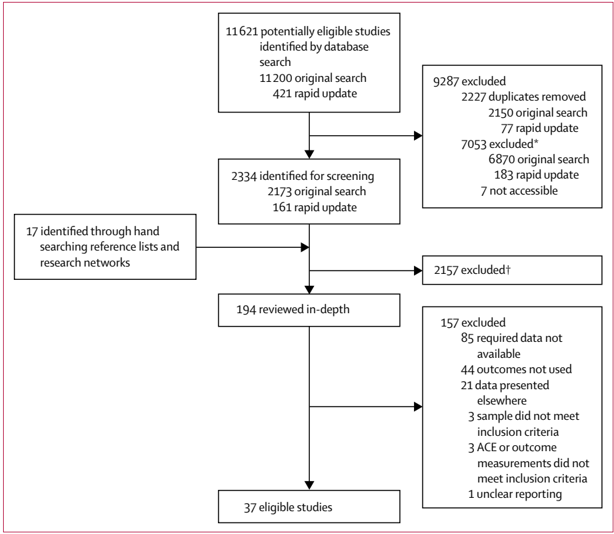
- From 11,621 references, 37 studies were included, providing risk estimates for 23 outcomes and 253,719 participants; most studies were from high-income countries, with nine samples from middle-income countries and none from low-income countries; 26 articles used cross-sectional data and 11 used cohort data, and all used retrospective, self-reported ACEs.
- Pooled ORs with 95% CIs were calculated using a random-effects model in StatsDirect; heterogeneity was assessed with I², publication bias with Begg-Mazumdar and Egger tests and funnel plots where at least ten samples were available, and sensitivity analyses and meta-regression were done in Stata.
Limitations
- The paper states that all included studies used retrospective ACE reports, which could be affected by recall or reporting bias; the number and types of ACEs varied, and summing ACEs does not account for different combinations or for variation in age at or length of exposure; confounding factors varied and some studies included no adjustments; genetic and environmental risks were largely unmeasured.
- The paper states that focusing on community settings likely excluded those with the most complex health problems (eg, homeless populations) and those who had already had ACE-related premature mortality; outcome measurement varied, rarer outcomes were less well covered by population surveys, and the study could only measure associations rather than establish causality.
- Evident from the text: most included samples came from high-income countries, with nine middle-income samples and none from low-income countries; heterogeneity was high for many outcomes; and visual funnel-plot assessment suggested possible missing small studies for smoking and early sexual initiation, although statistical tests for smoking were nonsignificant.
Model-written summary. Check it against the paper before relying on it.
Integrity signals
Registry
Cites
Statistics
Figures
Verification
Claims the paper makes
18 Valid · 0 Not valid · 4 Not checked · 126 Own results and interpretations
The sources with a verdict support this claim; the rest weren’t checked yet, have no full text we could read, or their verdicts aren’t rated yet.
In the paper
“However, five of the seven samples comprised students aged 18-25; 13 pooling of the remaining two samples 8,18 resulted in an OR of 12·53 (6·71-23·37; appendix).”
What the sources say
- Not checked — no full text of the sourcecites [8] 8 Ramiro LS, Madrid BJ, Brown DW. Adverse childhood experiences (ACE) and health-risk behaviors among adults in a developing country setting. Child Abuse Negl 2010; 34: 842-55. source
- Supportedcites [18] 18 Dube SR, Felitti VJ, Dong M, Giles WH, Anda RF. The impact of adverse childhood experiences on health problems: evidence from four birth cohorts dating back to 1900. Prev Med 2003; 37: 268-77 . source
The citation follows “the remaining two samples,” identifying studies used in the citing authors’ pooling rather than attributing the pooled estimate to either study. The cited paper’s Abstract describes a study of 17,337 adult HMO members that examined suicide attempts; its Methods identify the population as adult Kaiser Health Plan members. The OR of 12.53 is presented as the citing authors’ pooled result, not a result attributed to this source. (LLM, conf=0.85)
plainstates an associationn = 2- Asserted: passes — The authors put it forward as true.
- Checkable: passes — It can be checked against evidence.
- Load-bearing: unclear — It is unclear whether the paper’s conclusions depend on it.
- Based: passes — The paper gives a reason why it holds.
Every source the paper cites for this claim was checked and supports it.
In the paper
“However, five of the seven samples comprised students aged 18-25; 13 pooling of the remaining two samples 8,18 resulted in an OR of 12·53 (6·71-23·37; appendix).”
What the sources say
- Supportedcites [13] 13 Bellis MA, Hughes K, Leckenby N, et al. Adverse childhood experiences and associations with health-harming behaviours in young adults: surveys in eight eastern European countries. Bull World Health Organ 2014; 92: 641-55. source
The Attempted suicide section says respondents in seven of the eight countries were asked about suicide attempts. The Methods describe classroom surveys of students and state that the multi-study analyses were limited to respondents aged 18–25, supporting this paper's inclusion among the student samples described in the citing sentence. (LLM, conf=0.90)
plainn = 5- Asserted: passes — The authors put it forward as true.
- Checkable: passes — It can be checked against evidence.
- Load-bearing: unclear — It is unclear whether the paper’s conclusions depend on it.
- Based: passes — The paper gives a reason why it holds.
- Supported
The sources with a verdict support this claim; the rest weren’t checked yet, have no full text we could read, or their verdicts aren’t rated yet.
In the paper
“Supported by international work to standardise measurement of ACEs and their effects on health, these findings have since been replicated in studies from low-income and middle-income 7,8 and high-income 2,9 countries.”
What the sources say
- Not checked — no full text of the sourcecites [7] 7 Almuneef M, Qayad M, Aleissa M, Albuhairan F. Adverse childhood experiences, chronic diseases, and risky health behaviors in Saudi Arabian adults: a pilot study. Child Abuse Negl 2014; 38: 1787-93. source
- Not checked — no full text of the sourcecites [8] 8 Ramiro LS, Madrid BJ, Brown DW. Adverse childhood experiences (ACE) and health-risk behaviors among adults in a developing country setting. Child Abuse Negl 2010; 34: 842-55. source
- Supportedcites [2] 2 Bellis MA, Hughes K, Leckenby N, Hardcastle KA, Perkins C, Lowey H. Measuring mortality and the burden of adult disease associated with adverse childhood experiences in England: a national survey. J Public Health 2015; 37: 445-54. source
The citation to this paper supports the high-income-country part of the sentence: its English national survey found a strong association between ACEs and adult morbidity and premature mortality. The low- and middle-income-country studies are attributed to other citations. The decisive passage is in “What this study adds”; no page number is supplied in our copy. (LLM, conf=0.90)
- Supportedcites [9] 9 Bellis MA, Hughes K, Leckenby N, Perkins C, Lowey H. National household survey of adverse childhood experiences and their relationship with resilience to health-harming behaviors in England. BMC Med 2014; 12: 72. source
Citation 9 is attached to the high-income-country portion of the sentence. The Methods describe a national household survey in England, and the Results report that adverse childhood experiences were associated with multiple health-harming behaviors after adjustment for deprivation and other demographics. The indexed copy does not provide page numbers. (LLM, conf=0.91)
plainstates an association- Asserted: passes — The authors put it forward as true.
- Checkable: passes — It can be checked against evidence.
- Load-bearing: unclear — It is unclear whether the paper’s conclusions depend on it.
- Based: passes — The paper gives a reason why it holds.
The cited sources support only part of this claim — read each source’s verdict below.
In the paper
“For teenage pregnancy, four studies 9,33-35 had measured unintended teenage pregnancy and these studies reported higher estimates than did those measuring any teenage pregnancy 8,14,21 (appendix).”
What the sources say
- Supportedcites [9] 9 Bellis MA, Hughes K, Leckenby N, Perkins C, Lowey H. National household survey of adverse childhood experiences and their relationship with resilience to health-harming behaviors in England. BMC Med 2014; 12: 72. source
The paper is one of the studies identified in the citing sentence as measuring unintended teenage pregnancy. Its Results report an adjusted odds ratio of 5.86 for that outcome among respondents with four or more ACEs versus none. The comparison with studies measuring any teenage pregnancy is the citing authors’ cross-study synthesis, not a comparison attributed to this individual paper. (LLM, conf=0.88)
- Not checked — no full text of the sourcecites [33] 33 Bellis MA, Lowey H, Leckenby N, Hughes K, Harrison D. Adverse childhood experiences: retrospective study to determine their impact on adult health behaviours and health outcomes in a UK population. J Public Health 2014; 36: 81-91. source
- Partly supportedcites [34] 34 Bellis MA, Ashton K, Hughes K, Ford K, Bishop J, Paranjothy S. Adverse childhood experiences and their impact on health-harming behaviours in the Welsh adult population. Cardiff: Public Health Wales, 2015. sourceExperimental — accuracy not yet measured
The section ‘ACEs and their association with unintended teenage pregnancy’ reports an estimate for unintended teenage pregnancy, so this paper supports its identification as a study measuring that outcome. It does not compare its estimate with studies measuring any teenage pregnancy or establish that four studies reported higher estimates. (LLM, conf=0.83)
- Not matchedcites [35] 35 Ford K, Butler N, Hughes K, Quigg Z, Bellis MA. Adverse childhood experiences (ACEs) in Hertfordshire, Luton and Northamptonshire. Liverpool: Liverpool John Moores University, 2016.
Its entry has no title and year that we can search by.
- Not checked — no full text of the sourcecites [8] 8 Ramiro LS, Madrid BJ, Brown DW. Adverse childhood experiences (ACE) and health-risk behaviors among adults in a developing country setting. Child Abuse Negl 2010; 34: 842-55. source
- Not checked yetcites [14] 14 Anda RF, Chapman DP, Felitti VJ, et al. Adverse childhood experiences and risk of paternity in teen pregnancy. Obstet Gynecol 2002; 100: 37-45. source
Checked before — its earlier verdict is held back until a new check runs.
- Not checked — no full text of the sourcecites [21] 21 Hillis SD, Anda RF, Dube SR, Felitti VJ, Marchbanks PA, Marks JS. The association between adverse childhood experiences and adolescent pregnancy, long-term psychosocial consequences, and fetal death. Pediatrics 2004; 113: 320-27 . source
plainstates an association- Asserted: passes — The authors put it forward as true.
- Checkable: passes — It can be checked against evidence.
- Load-bearing: unclear — It is unclear whether the paper’s conclusions depend on it.
- Based: passes — The paper gives a reason why it holds.
- Supported
Every source the paper cites for this claim was checked and supports it.
In the paper
“However, our criteria also meant that studies were excluded because of alternative data analysis methods (eg, analysis of the World Mental Health Surveys 51 ).”
What the sources say
- Supportedcites [51] 51 Kessler RC, McLaughlin KA, Green JG, et al. Childhood adversities and adult psychopathology in the WHO World Mental Health Surveys. Br J Psychiatry 2010; 97: 378-85. source
The Analysis methods section identifies this paper as an analysis of the World Mental Health Surveys and describes its discrete-time survival analysis using person-years. The statement that the citing review excluded it under its own criteria is the citing authors’ decision, not a claim the source needs to make. (LLM, conf=0.88)
plainstates a cause- Asserted: passes — The authors put it forward as true.
- Checkable: passes — It can be checked against evidence.
- Load-bearing: unclear — It is unclear whether the paper’s conclusions depend on it.
- Based: passes — The paper gives a reason why it holds.
- Supported
53 more claims · 2 with their cited sources checked
Create a free account to see all 148 claims and to verify the 1 reference still open.
- It may state two separate claims as one. 44
- Probably not a substantial claim. 27
- The quote only partly states this claim. 31
Claims other papers make about this one
Each is checked against this paper’s own text: does it say what the citing paper says it does?
The source backs part of the claim, not all of it — or backs it for a different population, condition or comparison.
In the citing paper
“Early adverse life experiences, negative affectivity, neuroticism, depression, and anxiety have been identified as psycho logical predisposing conditions for persistent physical symptoms”
From Persistent physical symptoms: definition, genesis, and management (2024) · cites this paper as [64]
Experimental — accuracy not yet measuredThe source backs part of the claim, not all of it — or backs it for a different population, condition or comparison.
In the citing paper
“The impact of childhood abuse, neglect, and violence exposure on adult physical and emotional health and behaviors is significant and well documented”
From Intergenerational effects of childhood maltreatment: A systematic review of the parenting practices of adult survivors of childhood abuse, neglect, and violence. (2020) · cites this paper as Hughes et al., 2017
Experimental — accuracy not yet measuredThe source backs part of the claim, not all of it — or backs it for a different population, condition or comparison.
In the citing paper
“Early institutional rearing is associated with adverse biological and health outcomes in later life, including accelerated cellular aging as measured by telomere length.”
From Telomere trajectories from early adolescence to adulthood following early institutionalization: Protective effects of foster care in the Bucharest Early Intervention Project (2026) · cites this paper as Hughes et al., 2017
Experimental — accuracy not yet measuredThe source backs part of the claim, not all of it — or backs it for a different population, condition or comparison.
In the citing paper
“Individuals exposed to early life adversity are at increased risk of developing a broad spectrum of age-related illnesses at a young age, resulting in shorter health span, referring to the period of life free from chronic disease (Chandan et al., 2020; Hughes et al., 2017).”
From Telomere trajectories from early adolescence to adulthood following early institutionalization: Protective effects of foster care in the Bucharest Early Intervention Project (2026) · cites this paper as Hughes et al., 2017
Experimental — accuracy not yet measuredThe source backs part of the claim, not all of it — or backs it for a different population, condition or comparison.
In the citing paper
“This aligns with findings that ACEs are linked not only with SUD onset, but also with broader emotional and interpersonal dysregulation [4, 6].”
From The link of adverse childhood experiences and attachment to maladaptive personality traits in adults diagnosed with substance use disorder (2025) · cites this paper as [4]
Experimental — accuracy not yet measured
7 more claims about this paper
Create a free account to see every claim other papers make about this one.
Self-check
Percentages, sums and reported differences re-computed from the paper’s own numbers.
Each contradiction between two passages listed here was confirmed by an independent check.
Rated minor: it would not touch a result — a value no result rests on, a p-value that stays on the same side of the significance level, or a conflict that is clerical, resolved elsewhere in the paper, or outside its own findings.
In the paper
§ Summary
“respiratory disease (ORs of two to three)”
§ Discussion
“| Respiratory disease | 3·05 (2·47-3·77)”
Citations
Cites
Felitti, V. J., Anda, R. F., Nordenberg, D., Williamson, D. F., Spitz, A. M., Edwards, V., Koss, M. P., & Marks, J. S. (1998) · American Journal of Preventive Medicine · doi:10.1016/s0749-3797(98)00017-8 · Cited by 18,943
Global status report on noncommunicable diseases 2010.
Alwan, A. (2011) · Cited by 8,494
Forouzanfar, M. H., Afshin, A., Alexander, L. T., Anderson, H. R., Bhutta, Z. A., Biryukov, S., Brauer, M., Burnett, R., Cercy, K., Charlson, F. J., et al. (2016) · The Lancet · doi:10.1016/s0140-6736(16)31679-8 · Cited by 7,698
Wang, H., Naghavi, M., Allen, C., Barber, R. M., Bhutta, Z. A., Carter, A., Casey, D. C., Charlson, F. J., Chen, A. Z., Coates, M. M., et al. (2016) · The Lancet · doi:10.1016/s0140-6736(16)31012-1 · Cited by 6,596
Anda, R. F., Felitti, V. J., Bremner, J. D., Walker, J. D., Whitfield, C., Perry, B. D., Dube, S. R., & Giles, W. H. (2006) · European archives of psychiatry and clinical neuroscience · doi:10.1007/s00406-005-0624-4 · Cited by 4,292
Norman, R. E., Byambaa, M., De, R., Butchart, A., Scott, J., & Vos, T. (2012) · PLoS Medicine · doi:10.1371/journal.pmed.1001349 · Cited by 3,387
Self-citationValidity of adult retrospective reports of adverse childhood experiences: review of the evidence
Hardt, J., & Rutter, M. (2004) · Journal of Child Psychology and Psychiatry · doi:10.1111/j.1469-7610.2004.00218.x · Cited by 2,827
Childhood adversities and adult psychopathology in the WHO World Mental Health Surveys
Kessler, R. C., McLaughlin, K. A., Green, J. G., Gruber, M. J., Sampson, N. A., Zaslavsky, A. M., Aguilar-Gaxiola, S., Alhamzawi, A. O., Alonso, J., Angermeyer, M., et al. (2010) · British Journal of Psychiatry · doi:10.1192/bjp.bp.110.080499 · Cited by 2,640
Impact of child sexual abuse: A review of the research.
Browne, A., & Finkelhor, D. (1986) · Psychological Bulletin · doi:10.1037/0033-2909.99.1.66 · Cited by 2,590
Adverse childhood experiences, allostasis, allostatic load and age-related disease
Danese, A., & McEwen, B. S. (2012) · Physiology & Behavior · doi:10.1016/j.physbeh.2011.08.019 · Cited by 2,140
Cited by
Items 101–200 of 5,221
The social ecology of childhood and early life adversity
Lopez, M., Ruiz, M. O., Rovnaghi, C. R., Tam, G. K.-Y., Hiscox, J., Gotlib, I. H., Barr, D. A., Carrión, V. G., & Anand, K. J. S. (2021) · Pediatric Research · doi:10.1038/s41390-020-01264-x · Cited by 216
The Impact of Everyday Stressors on the Immune System and Health
Seiler, A., Fagundes, C. P., & Christian, L. M. (2019) · Springer eBooks · doi:10.1007/978-3-030-16996-1_6 · Cited by 227
Hakamata, Y., Suzuki, Y., Kobashikawa, H., & Hori, H. (2022) · Frontiers in Neuroendocrinology · doi:10.1016/j.yfrne.2022.100994 · Cited by 167
“Influential epidemiological studies have demonstrated that ACEs confer a risk of developing a variety of psychiatric disorders, including major depressive disorder (MDD), post-traumatic stress disorder (PTSD), obsessive–compulsive disorder, and anxiety disorders (Hughes et al., 2017; Scott et al., 2010).”
InfluentialLorenc, T., Lester, S. E., Sutcliffe, K., Stansfield, C., & Thomas, J. (2020) · BMC Public Health · doi:10.1186/s12889-020-08789-0 · Cited by 187
Adverse Childhood Experiences and Justice System Contact: A Systematic Review
Graf, G. H.-J., Chihuri, S. T., Blow, M., & Li, G. (2021) · PEDIATRICS · doi:10.1542/peds.2020-021030 · Cited by 180
Blum, R. W., Li, M., & Naranjo-Rivera, G. (2019) · Journal of Adolescent Health · doi:10.1016/j.jadohealth.2019.01.020 · Cited by 157
“and Europe, demonstrate substantial associations between ACEs and poor health and life outcomes [2].”
BackgroundCrandall, A., Broadbent, E., Stanfill, M., Magnusson, B. M., Novilla, M. L. B., Hanson, C. L., & Barnes, M. (2020) · Child Abuse & Neglect · doi:10.1016/j.chiabu.2020.104644 · Cited by 164
Fang (2022) · doi:10.1016/s2352-4642(22)00033-5 · Cited by 136
Review of Tools for Measuring Exposure to Adversity in Children and Adolescents
Oh, D. L., Jerman, P., Purewal, S. K., Koita, K., Briner, S., Bucci, M., & Harris, N. B. (2018) · Journal of Pediatric Health Care · doi:10.1016/j.pedhc.2018.04.021 · Cited by 151
Looking behind the bars: emerging health issues for people in prison
Stürup-Toft, S., O'Moore, E., & Plugge, E. (2018) · British Medical Bulletin · doi:10.1093/bmb/ldx052 · Cited by 189
“Adverse childhood experiences (ACEs) which are associated with a range of negative outcomes in adulthood, including physical and mental health disorders and aggressive behaviour, have also been shown to be directly associated with adult offending behaviour(20) as well as being associated with poor health outcomes.(21)…”
BackgroundScreening for Adverse Childhood Experiences in Children: A Systematic Review
Loveday, S., Hall, T., Constable, L. N., Paton, K., Sanci, L. A., Goldfeld, S. R., & Hiscock, H. (2022) · PEDIATRICS · doi:10.1542/peds.2021-051884 · Cited by 169
Olvera Alvarez, H. A., Kubzansky, L. D., Campen, M. J., & Slavich, G. M. (2018) · Neuroscience & Biobehavioral Reviews · doi:10.1016/j.neubiorev.2018.06.002 · Cited by 133
“In this context, the terms early life stress or early adversity, have referred to different types of stressors, including violence, poverty, maltreatment, abuse, and neglect, as well as parental substance abuse or mental illness (Carroll et al., 2011; Dube et al., 2001; Hughes et al., 2017; Infurna et al., 2016; Lacey…”
The Prevalence and Consequences of Adverse Childhood Experiences in the German Population
Witt, A., Sachser, C., Plener, P. L., Brähler, E., & Fegert, J. M. (2019) · Deutsches Ärzteblatt international · doi:10.3238/arztebl.2019.0635 · Cited by 131
“The results of the meta-analysis by Hughes and colleagues (3) also underline the point raised by Dr.”
ResultThe disparate impact of COVID-19 on the mental health of female and male caregivers
Wade, M., Prime, H., Johnson, D., May, S. S., Jenkins, J. M., & Browne, D. T. (2021) · Social Science & Medicine · doi:10.1016/j.socscimed.2021.113801 · Cited by 149
Adverse Childhood Experiences and Trauma-Informed Care
Goddard, A. (2021) · Journal of Pediatric Health Care · doi:10.1016/j.pedhc.2020.09.001 · Cited by 132
Dempster, K. S., O’Leary, D. D., MacNeil, A. J., Hodges, G. J., & Wade, T. J. (2020) · Brain Behavior and Immunity · doi:10.1016/j.bbi.2020.12.018 · Cited by 151
Tan, M., & Mao, P. (2023) · Child Abuse & Neglect · doi:10.1016/j.chiabu.2023.106091 · Cited by 149
Burden of Mental Disorders and Suicide Attributable to Childhood Maltreatment
Grummitt, L. R., Baldwin, J. R., Lafoa’i, J., Keyes, K. M., & Barrett, E. L. (2024) · JAMA Psychiatry · doi:10.1001/jamapsychiatry.2024.0804 · Cited by 239
Adverse childhood experiences and chronic pain among children and adolescents in the United States
Groenewald, C. B., Murray, C. B., & Palermo, T. M. (2020) · PAIN Reports · doi:10.1097/pr9.0000000000000839 · Cited by 139
“exposure to multiple ACEs further increases the risk for mental health disease and substance abuse.(12) Nelson et al.”
BackgroundGuo, J., Fu, M., Liu, D., Zhang, B., Wang, X., & van IJzendoorn, M. H. (2020) · Child Abuse & Neglect · doi:10.1016/j.chiabu.2020.104667 · Cited by 122
Liu, M., Luong, L., Lachaud, J., Edalati, H., Reeves, A., & Hwang, S. W. (2021) · The Lancet Public Health · doi:10.1016/s2468-2667(21)00189-4 · Cited by 174
Kim, Y., Lee, H., & Park, A. (2021) · Social Psychiatry and Psychiatric Epidemiology · doi:10.1007/s00127-021-02129-2 · Cited by 155
Forster, M., Grigsby, T. J., Gower, A. L., Mehus, C. J., & McMorris, B. J. (2020) · Journal of Youth and Adolescence · doi:10.1007/s10964-020-01235-9 · Cited by 158
Wood, L. C. N. (2018) · BMJ Paediatrics Open · doi:10.1136/bmjpo-2018-000338 · Cited by 139
“41 Given our understanding of the background levels of complex, intergenerational adverse circumstances faced by Central American families seeking asylum in the USA, there is considerable concern about the levels of child traumatisation and mental health needs prior to US entry.”
BackgroundTrauma-informed Teacher Wellbeing: Teacher Reflections within Trauma-informed Positive Education
Brunzell, T., Waters, L. E., & Stokes, H. (2021) · The Australian journal of teacher education · doi:10.14221/ajte.2021v46n5.6 · Cited by 132
McDonald, S. W., Madigan, S., Racine, N., Benzies, K., Tomfohr, L., & Tough, S. (2019) · Preventive Medicine · doi:10.1016/j.ypmed.2018.11.013 · Cited by 118
Herrenkohl, T. I., Fedina, L., Roberto, K. A., Raquet, K. L., Hu, R. X., Rousson, A. N., & Mason, W. A. (2022) · Trauma, Violence, & Abuse · doi:10.1177/1524838020939119 · Cited by 119
“These studies estimate that around 6 in 10 individuals are exposed to at least one type of ACE in their lifetimes (Brown et al., 2015; M. Dong et al., 2004; Felitti et al., 1998; Gilbert et al., 2014; Hughes et al., 2017; Merrick et al., 2019).”
BackgroundRidout, K. K., Khan, M. B., & Ridout, S. J. (2018) · BioEssays · doi:10.1002/bies.201800077 · Cited by 137
Young‐Wolff, K. C., Alabaster, A. L., McCaw, B. R., Stoller, N., Watson, C. R., Sterling, S., Ridout, K. K., & FLANAGAN, T. A. (2019) · Journal of Women s Health · doi:10.1089/jwh.2018.7108 · Cited by 129
“Studies suggest that exposure to one or more ACEs increases health risk, suggesting this stratification is clinically relevant.(64,65) We also ran stratified analyses by resilience with 0–1 ACEs versus 2+ ACEs and the pattern of results was similar (not shown).”
BackgroundXiao, Z., Murat Baldwin, M., Wong, S. C., Obsuth, I., Meinck, F., & Murray, A. L. (2023) · Trauma, Violence, & Abuse · doi:10.1177/15248380221122816 · Cited by 118
“In line with research on other forms of maltreatment, psychological maltreatment has been shown to negatively affect children’s social, cognitive, emotional, and/or physical development (Hibbard et al., 2012), with difficulties continuing into adulthood (Hughes et al., 2017; Grummit et al., 2021).”
BackgroundDumornay, N. M., Lebois, L. A. M., Ressler, K. J., & Harnett, N. G. (2023) · American Journal of Psychiatry · doi:10.1176/appi.ajp.21090961 · Cited by 137
Baglivio, M. T., & Wolff, K. T. (2020) · Youth Violence and Juvenile Justice · doi:10.1177/1541204020972487 · Cited by 140
“…students, finding each additional ACE exposure increased the odds of both self-directed violence and violence perpetration by 35%–144% (see also Hughes et al., 2017, meta-analysis demonstrating ACE effects on health issues among the strongest for problematic drug use and interpersonal and…”
BackgroundThe interplay between substance use and intimate partner violence perpetration: A meta-ethnography
Gilchrist, G., Dennis, F., Radcliffe, P., Henderson, J., Howard, L. M., & Gadd, D. (2018) · International Journal of Drug Policy · doi:10.1016/j.drugpo.2018.12.009 · Cited by 149
“Murphy, O’Farrell, Fals-Stewart, & Feehan, 2001), and shared risk factors that studies have found make substance use and IPV perpetration more likely such as adverse childhood experiences, personality disorders, psychosis and depression (Trull et al., 2018; Choi, DiNitto, Marti, & Choi, 2017; Hughes et al., 2017; Smit…”
BackgroundTrauma Informed Child Welfare Systems—A Rapid Evidence Review
Bunting, L., Montgomery, L., Mooney, S., MacDonald, M., Coulter, S., Hayes, D., & Davidson, G. (2019) · International Journal of Environmental Research and Public Health · doi:10.3390/ijerph16132365 · Cited by 170
McNally, P., Taggart, L., & Shevlin, M. E. (2021) · Journal of Applied Research in Intellectual Disabilities · doi:10.1111/jar.12872 · Cited by 142
“Furthermore, Norman et al. (2012) and Hughes et al. (2017) conducted systematic reviews and meta- analyses of the literature that have established a causal link of childhood abuse experiences to poor physical health and poor mental health outcomes.”
BackgroundCorcoran, M., & McNulty, M. (2017) · Child Abuse & Neglect · doi:10.1016/j.chiabu.2017.11.012 · Cited by 160
“Further research confirmed an association between ACE and poorer physical health in adulthood (Hughes et al., 2017).”
BackgroundGatt, J. M., Alexander, R., Emond, A. M., Foster, K., Hadfield, K., Mason‐Jones, A. J., Reid, S., Theron, L. C., Ungar, M. T., Wouldes, T. A., et al. (2020) · Frontiers in Psychiatry · doi:10.3389/fpsyt.2019.00997 · Cited by 163
Victora, C. G., Hartwig, F. P., Vidaletti, L. P., Martorell, R., Osmond, C., Richter, L. M., Stein, A. D., Barros, A. J. D., Adair, L. S., Barros, F. C., et al. (2022) · The Lancet · doi:10.1016/s0140-6736(21)02716-1 · Cited by 117
Haahr-Pedersen, I., Ershadi, A. E., Hyland, P., Hansen, M., Perera, C., Sheaf, G., Bramsen, R. H., Spitz, P., & Vallières, F. (2020) · Child Abuse & Neglect · doi:10.1016/j.chiabu.2020.104589 · Cited by 112
“Altogether, the results of the present review lend further support to the well-established link between multiple traumatic or victimizing exposures and adverse mental health outcomes (Grasso et al., 2013; Hughes et al., 2017; Liming & Grube, 2018).”
BackgroundResultThakur, N., Hessler, D., Koita, K., Ye, M., Benson, M., Gilgoff, R., Bucci, M., Long, D., & Harris, N. B. (2020) · Child Abuse & Neglect · doi:10.1016/j.chiabu.2020.104685 · Cited by 132
Morris, A. S., Hays-Grudo, J., Zapata, M. I., Treat, A. E., & Kerr, K. L. (2021) · Adversity and Resilience Science · doi:10.1007/s42844-021-00036-8 · Cited by 156
Gugushvili, A., Zhao, Y., & Bukodi, E. (2018) · Social Science & Medicine · doi:10.1016/j.socscimed.2018.12.027 · Cited by 120
“It is well known that, in addition to individuals’ own socio-economic status, their social origins are also related to the risk of developing depressive symptoms in adult life (Adler et al., 1994; Bjelland et al., 2008; Edwards et al., 2003; Hughes et al., 2017; Ross and Willigen, 1997; Schilling et al., 2007).”
BackgroundThe Importance of Parenting in Influencing the Lives of Children
Sanders, M. R., & Turner, K. (2018) · Springer eBooks · doi:10.1007/978-3-319-94598-9_1 · Cited by 191
The evidence base for routine enquiry into adverse childhood experiences: A scoping review
Ford, K., Hughes, K. E., Hardcastle, K., Lemma, L. C. G. D., Davies, A. R., Edwards, S., & Bellis, M. A. (2019) · Child Abuse & Neglect · doi:10.1016/j.chiabu.2019.03.007 · Cited by 131
“A strategy was developed iteratively using search terms utilized in systematic reviews on ACEs (Hughes et al., 2017) and an examination of key words used within prominent ACE literature (for search strategy see Supplementary Material, Table S1).”
BackgroundMethodSelf-citationPhysical, psychological and social impact of school violence on children
Ferrara, P., Franceschini, G., Villani, A., & Corsello, G. (2019) · The Italian Journal of Pediatrics/Italian journal of pediatrics · doi:10.1186/s13052-019-0669-z · Cited by 173
Health and development from preconception to 20 years of age and human capital
Black, R. E., Liu, L., Hartwig, F. P., Villavicencio, F., Rodriguez-Martinez, A., Vidaletti, L. P., Perin, J., Black, M. M., Blencowe, H., You, D., et al. (2022) · The Lancet · doi:10.1016/s0140-6736(21)02533-2 · Cited by 111
Brindle, R. C., Pearson, A., & Ginty, A. T. (2022) · Neuroscience & Biobehavioral Reviews · doi:10.1016/j.neubiorev.2022.104530 · Cited by 128
Pace, C. S., Muzi, S., Rogier, G., Meinero, L. L., & Marcenaro, S. (2022) · Child Abuse & Neglect · doi:10.1016/j.chiabu.2022.105640 · Cited by 145
Zhang, L., Mersky, J. P., Gruber, A. M., & Kim, J. (2022) · Trauma Violence & Abuse · doi:10.1177/15248380221126186 · Cited by 126
“Instead, replicating a recent systematic review that examined the health effects of ACEs (Hughes et al., 2017) and also considering the fact that many studies have confirmed that exposure to four or more ACEs is associated with an array of consequences (e.g., Felitti et al., 1998; Hunt et al.,…”
BackgroundFriedman, J. E. (2018) · Diabetes · doi:10.2337/dbi17-0011 · Cited by 120
“This is especially necessary in Asia, Africa, and the Middle East, where childhood obesity, young-onset type 2 diabetes, and chronic diseases are rampant (4).”
BackgroundThe Impact of Early Life Stress on Anxiety Symptoms in Late Adulthood
Lähdepuro, A., Savolainen, K., Lahti‐Pulkkinen, M., Eriksson, J. G., Lahti, J. M. T., Tuovinen, S., Kajantie, E., Pesonen, A., Heinonen, K., & Räikkönen, K. (2019) · Scientific Reports · doi:10.1038/s41598-019-40698-0 · Cited by 138
Vibrant and Healthy Kids: Aligning Science, Practice, and Policy to Advance Health Equity
Perrin, J. M., Lu, M. C., Geller, A. B., & DeVoe, J. E. (2019) · Academic Pediatrics · doi:10.1016/j.acap.2019.11.019 · Cited by 126
Watters, E. R., Aloe, A. M., & Wojciak, A. S. (2021) · Trauma Violence & Abuse · doi:10.1177/15248380211029397 · Cited by 136
“childhood trauma, resilience, depression, multivariate meta-analysis Childhood trauma is a prevalent problem that has detrimental effects on the overall mental and physical health of individuals throughout development (Anda et al., 2006; Hughes et al., 2017; Norman et al., 2012).”
BackgroundResultThe geroscience agenda: Toxic stress, hormetic stress, and the rate of aging
Epel, E. S. (2020) · Ageing Research Reviews · doi:10.1016/j.arr.2020.101167 · Cited by 123
The Impact of Different Types of Abuse on Depression
Radell, M. L., Hamza, E. A., Daghustani, W. H., Perveen, A., & Moustafa, A. A. (2021) · Depression Research and Treatment · doi:10.1155/2021/6654503 · Cited by 156
“, [24, 141, 142]) as well as found a doseresponse effect where multiple types of childhood adversity increase the risk for negative health outcomes [28].”
BackgroundMcLoughlin, E., Fletcher, D., Slavich, G. M., Arnold, R., & Moore, L. J. (2020) · Psychology of sport and exercise · doi:10.1016/j.psychsport.2020.101823 · Cited by 147
Qu, G., Ma, S., Liu, H., Han, T., Zhang, H., Ding, X., Sun, L., Qin, Q., Chen, M., & Sun, Y. (2022) · Child Abuse & Neglect · doi:10.1016/j.chiabu.2022.105511 · Cited by 123
Positive Childhood Experiences and Adult Health Outcomes
Huang, C. X., Halfon, N., Sastry, N., Chung, P. J., & Schickedanz, A. B. (2023) · PEDIATRICS · doi:10.1542/peds.2022-060951 · Cited by 138
Hughes, K., Bellis, M. A., Sethi, D., Andrew, R., Yon, Y., Wood, S., Ford, K., Baban, A., Boderscova, L., Kachaeva, M., et al. (2019) · European Journal of Public Health · doi:10.1093/eurpub/ckz037 · Cited by 99
Self-citationHoutepen, L. C., Heron, J. E., Suderman, M. J., Tilling, K. M., & Howe, L. D. (2018) · Wellcome Open Research · doi:10.12688/wellcomeopenres.14716.1 · Cited by 116
“Although other software packages can be used to derive the ACE measures, together with the data we will provide the R code we used to (1) dichotomise the variables, (2) derive the ACE measures for a specific time period and (3) implement multiple imputation.”
MethodRisk of Cardiometabolic Disease and All‐Cause Mortality in Female Survivors of Domestic Abuse
Chandan, J. S., Thomas, T., Bradbury‐Jones, C., Taylor, J., Bandyopadhyay, S., & Nirantharakumar, K. (2020) · Journal of the American Heart Association · doi:10.1161/jaha.119.014580 · Cited by 97
Adverse childhood experiences and intimate partner violence: A meta-analysis
Zhu, J., Exner‐Cortens, D., Dobson, K. S., Wells, L., Noel, M. E., & Madigan, S. L. (2023) · Development and Psychopathology · doi:10.1017/s0954579423000196 · Cited by 131
Madigan, S. L., Thiemann, R. F., Deneault, A., Fearon, P. R. M., Racine, N. M., Park, J., Lunney, C. A., Dimitropoulos, G., Jenkins, S., Williamson, T. S., et al. (2024) · Archives of Pediatrics and Adolescent Medicine · doi:10.1001/jamapediatrics.2024.4385 · Cited by 153
Compton, W. M., Jones, C. M., Baldwin, G. T., Harding, F. M., Blanco, C., & Wargo, E. M. (2019) · American Journal of Public Health · doi:10.2105/ajph.2019.305020 · Cited by 111
Resilience of Emerging Adults After Adverse Childhood Experiences: A Qualitative Systematic Review
Leung, D. Y. L., Chan, A. C. Y., & Ho, G. W. K. (2020) · Trauma Violence & Abuse · doi:10.1177/1524838020933865 · Cited by 135
Jackson, D. B., Chilton, M. M., Johnson, K. R., & Vaughn, M. G. (2019) · American Journal of Preventive Medicine · doi:10.1016/j.amepre.2019.06.004 · Cited by 111
“00 Adverse childhood experiences (ACEs), which typically encompass various forms of family dysfunction, child abuse, and child neglect,(1) have recently captured the attention of policymakers, practitioners, and scholars.(2,3) Research suggests that ACEs are quite common, with recent estimates indicating that by adult…”
BackgroundDisease burden of adverse childhood experiences across 14 states
Waehrer, G. M., Miller, T. R., Marques, S. S., Oh, D. L., & Harris, N. B. (2020) · PLoS ONE · doi:10.1371/journal.pone.0226134 · Cited by 109
“A recent meta-analysis reported that exposure to 4+ ACEs was weakly associated with physical inactivity, obesity and diabetes (odds ratios (OR) less than 2), moderately associated with smoking, heavy alcohol use, heart disease, respiratory disease, cancer (OR between 2 and 3), strongly associated with sexual risk-taki…”
BackgroundChildren Present a Window of Opportunity for Promoting Health
Fernández‐Jiménez, R., Al‐Kazaz, M., Jaslow, R., Carvajal, I., & Fuster, V. (2018) · Journal of the American College of Cardiology · doi:10.1016/j.jacc.2018.10.031 · Cited by 115
Clements-Nolle, K. D., & Waddington, R. (2018) · Journal of Adolescent Health · doi:10.1016/j.jadohealth.2018.09.025 · Cited by 117
Feltz-Cornelis, C. M. V. D., Potters, E. C., van Dam, A., Koorndijk, R. P. M., Elfeddali, I., & van der Sluijs, J. F. V. E. (2018) · Journal of Affective Disorders · doi:10.1016/j.jad.2018.12.096 · Cited by 117
Anthony, R., Paine, A. L., & Shelton, K. H. (2019) · International Journal of Environmental Research and Public Health · doi:10.3390/ijerph16122212 · Cited by 139
Kampling, H., Kruse, J., Lampe, A., Nolte, T., Hettich, N., Brähler, E., Sachser, C., Fegert, J. M., Gingelmaier, S., Fonagy, P., et al. (2022) · Frontiers in Psychiatry · doi:10.3389/fpsyt.2022.919191 · Cited by 116
Bussières, A., Hancock, M. J., Elklit, A., Ferreira, M. L., Ferreira, P. H., Stone, L. S., Wideman, T. H., Boruff, J. T., Zoubi, F. A., Chaudhry, F., et al. (2023) · European Journal of Psychotraumatology · doi:10.1080/20008066.2023.2284025 · Cited by 116
Depletion: The Human Costs of Caring
Rai, S. (2024) · doi:10.1093/oso/9780197535547.001.0001 · Cited by 172
Cerna-Turoff, I., Fang, Z., Meierkord, A., Wu, Z., Yanguela, J., Bangirana, C. A., & Meinck, F. (2021) · Trauma, Violence, & Abuse · doi:10.1177/1524838020985532 · Cited by 92
Subramaniam, M., Abdin, E., Seow, E., Vaingankar, J. A., Shafie, S., Shahwan, S., Lim, M., Fung, D. S. S., James, L., Verma, S. K., et al. (2020) · Child Abuse & Neglect · doi:10.1016/j.chiabu.2020.104447 · Cited by 101
Parenteau, A. M., Boyer, C. J., Campos, L., Carranza, A. F., Deer, L. K., Hartman, D. T., Bidwell, J. T., & Hostinar, C. E. (2022) · Development and Psychopathology · doi:10.1017/s0954579422000499 · Cited by 113
“…there is strong evidence that childhood adversity can have serious negative long-term consequences for mental and physical health, which are costly for society and individuals alike (Edwards et al., 2003; Gilbert et al., 2015; Herzog & Schmahl, 2018; Hughes et al., 2017; Thompson et al., 2019).”
BackgroundHo, G. W. K., Bressington, D. T., Karatzias, T., Chien, W. T., Înoue, S., Yang, P., Chan, A. C. Y., & Hyland, P. (2019) · Social Psychiatry and Psychiatric Epidemiology · doi:10.1007/s00127-019-01768-w · Cited by 99
Satinsky, E. N., Kakuhikire, B., Baguma, C., Rasmussen, J. D., Ashaba, S., Cooper‐Vince, C. E., Perkins, J. M., Kiconco, A., Namara, E. B., Bangsberg, D. R., et al. (2021) · PLoS Medicine · doi:10.1371/journal.pmed.1003642 · Cited by 103
Zhang, X., & Monnat, S. M. (2021) · SSM - Population Health · doi:10.1016/j.ssmph.2021.100997 · Cited by 112
“Childhood adversity is a well-established risk factor for mental health problems throughout the life course, including adolescence (Kalmakis & Chandler, 2015; Hughes et al., 2017; Norman et al., 2012 for systematic reviews).”
BackgroundSwedo, E. A., Pampati, S., Anderson, K. N., Thorne, E., McKinnon, I. I., Brener, N. D., Stinson, J., Mpofu, J. J., & Niolon, P. H. (2024) · MMWR Supplements · doi:10.15585/mmwr.su7304a5 · Cited by 89
Adverse Childhood Events and Health Biomarkers: A Systematic Review
Soares, S., Rocha, V., Kelly‐Irving, M., Stringhini, S., & Fraga, S. J. D. S. (2021) · Frontiers in Public Health · doi:10.3389/fpubh.2021.649825 · Cited by 111
Goldstein, E., Topitzes, J., Miller‐Cribbs, J., & Brown, R. (2020) · Pediatric Research · doi:10.1038/s41390-020-01188-6 · Cited by 105
“Cumulative ACEs are predictive of cascading life course problems such as academic failure, problems with socioemotional maladjustment, and poor health outcomes.(1,9) Evidence continues to mount that cumulative ACEs exposures, rather than individual ACE experiences, yield the most negative impacts on overall well-being.”
BackgroundFujiwara, T. (2022) · Psychiatry and Clinical Neurosciences · doi:10.1111/pcn.13464 · Cited by 113
Leibbrand, C., Hill, H., Rowhani-Rahbar, A., & Rivara, F. (2020) · SSM - Population Health · doi:10.1016/j.ssmph.2020.100689 · Cited by 87
“A large body of literature has shown the long-term effects of adverse childhood experiences (ACEs) on health and wellbeing across the life course (Hughes et al., 2017).”
BackgroundScreening for Adverse Childhood Experiences (ACEs) in Primary Care
Campbell, T. L. (2020) · JAMA · doi:10.1001/jama.2020.4365 · Cited by 94
Anderson, A. S., Siciliano, R. E., Henry, L. M., Watson, K. H., Gruhn, M. A., Kuhn, T. M., Ebert, J. S., Vreeland, A., Ciriegio, A. E., Guthrie, C. S., et al. (2022) · Child Abuse & Neglect · doi:10.1016/j.chiabu.2022.105493 · Cited by 118
Rogers, C. J., Pakdaman, S., Forster, M., Sussman, S. Y., Grigsby, T. J., Victoria, J., & Unger, J. B. (2022) · Drug and Alcohol Dependence · doi:10.1016/j.drugalcdep.2022.109407 · Cited by 101
Pfaltz, M. C., Halligan, S. L., Haim-Nachum, S., Sopp, M. R., Åhs, F., Bachem, R., Bartoli, E., Belete, H., Belete, T., Berzengi, A., et al. (2022) · Psychotherapy and Psychosomatics · doi:10.1159/000523667 · Cited by 82
Tidmarsh, L. V., Harrison, R. N., Ravindran, D., Matthews, S. L., & Finlay, K. A. (2022) · Frontiers in Pain Research · doi:10.3389/fpain.2022.923866 · Cited by 119
“The pervasive detrimental physical, social and psychological outcomes from chronic pain also commonly present in people who have experienced greater childhood adversity (14, 15).”
BackgroundAdverse Childhood Experiences: Prevalence and Association With Adolescent Health in Malawi
Kidman, R. C., Piccolo, L. D. R., & Kohler, H. (2019) · American Journal of Preventive Medicine · doi:10.1016/j.amepre.2019.08.028 · Cited by 93
Iob, E., Lacey, R. E., & Steptoe, A. (2019) · Brain Behavior and Immunity · doi:10.1016/j.bbi.2019.12.019 · Cited by 99
“Different meta-analyses and systematic reviews have provided robust evidence for the link between ACEs and several mental and physical health conditions such as cardiovascular disease, diabetes, depression, and anxiety disorders (Hughes et al., 2017; Kalmakis and Chandler, 2015; Norman et al., 2012).”
BackgroundMolloy, C. S., Beatson, R. M., Harrop, C., Perini, N., & Goldfeld, S. R. (2020) · Journal of Advanced Nursing · doi:10.1111/jan.14576 · Cited by 103
Adolescent dating violence prevention programmes: a global systematic review of evaluation studies
Reyes, H. L. M., Graham, L. M., Chen, M. S., Baron, D., Gibbs, A., Groves, A. K., Kajula, L. J., Bowler, S. L., & Maman, S. (2020) · The Lancet Child & Adolescent Health · doi:10.1016/s2352-4642(20)30276-5 · Cited by 102
The impact of adverse childhood experiences on multimorbidity: a systematic review and meta-analysis
Senaratne, D. N. S., Thakkar, B., Smith, B. H., Hales, T. G., Marryat, L., & Colvin, L. (2024) · BMC Medicine · doi:10.1186/s12916-024-03505-w · Cited by 122
The prevalence of childhood trauma in psychiatric outpatients
Devi, F., Shahwan, S., Teh, W. L., Sambasivam, R., Zhang, Y. J., Lau, Y. W., Ong, S. H., Fung, D. S. S., Gupta, B., Chong, S. A., et al. (2019) · Annals of General Psychiatry · doi:10.1186/s12991-019-0239-1 · Cited by 110
Gardner, R., Feely, A., Layte, R., Williams, J. M., & McGavock, J. (2019) · Pediatric Research · doi:10.1038/s41390-019-0414-8 · Cited by 96
Warrier, V., & Baron‐Cohen, S. (2019) · Molecular Psychiatry · doi:10.1038/s41380-019-0550-x · Cited by 98
Choi, J., Teshome, T. Z., & Smith, J. P. (2020) · Journal of Affective Disorders · doi:10.1016/j.jad.2020.10.041 · Cited by 101
Early life adversity as a risk factor for cognitive impairment and Alzheimer’s disease
Huang, Z., Jordan, J. D., & Zhang, Q. (2023) · Translational Neurodegeneration · doi:10.1186/s40035-023-00355-z · Cited by 101
Metadata
- Authors
- Hughes, K., Bellis, M. A., Hardcastle, K. A., Sethi, D., Butchart, A., Mikton, C., Jones, L., & Dunne, M. P.
- Affiliations
- Bangor University (GB)
- Public Health Wales (GB)
- World Health Organization Regional Office for Europe (DK)
- World Health Organization (CH)
- University of the West of England (GB)
- Liverpool John Moores University (GB)
- Queensland University of Technology (AU)
- Corresponding author
- Bellis, Mark A
- Venue
- The Lancet Public Health
- Publisher
- Elsevier BV
- Published
- 2017-08
- Volume
- 2
- Issue
- 8
- Pages
- e356-e366
- ISSN
- 2468-2667 (ISSN-L)
- OpenAlex
- W2740726397
- Semantic Scholar
- cdd633b48c3e902b5a7a012711d868cf5745c677
- Cited by
- 5,255
- References
- 70
- Citations by year
- 2026: 750 · 2025: 849 · 2024: 817 · 2023: 711 · 2022: 698 · 2021: 626 · 2020: 464 · 2019: 232 · 2018: 97 · 2017: 7
- FWCI
- 33.48
- Type
- journal article
- Language
- en
- Open access
- gold
- doi.org
- Licence
- cc-by-nc-nd
- www.elsevier.com/tdm/userlicense/1.0/ (tdm)
- creativecommons.org/licenses/by-nc-nd/4.0/ (vor)
- Locations
- The Lancet Public Health (publishedVersion, cc-by-nc-nd)
- PubMed (publishedVersion)
- Liverpool John Moores University (acceptedVersion)
- QUT ePrints (Queensland University of Technology) (submittedVersion, cc-by-nc-nd)
- UWE Research Repository (UWE Bristol) (submittedVersion, cc-by-nc-nd)
- DOAJ (DOAJ: Directory of Open Access Journals) (submittedVersion, cc-by-sa)
- Funders
- World Health Organization
- Public Health Wales
- Topics
- Social Sciences › Psychology › Clinical Psychology › Child Abuse and Trauma
- Social Sciences › Sociology and Political Science › Child Welfare and Adoption
- Social Sciences › Health › Intimate Partner and Family Violence
- Keywords
- adverse childhood experiences, child abuse, domestic violence exposure, substance use, sexual health, mental health, violence, physical health, physical activity, weight, resilience
- MeSH terms
- Health Status, Humans, Life Change Events
About these checks
Registry, retraction, Cites and statistics results are computed, not judged, with one exception: a printed reference that no index lists is read once by a model before it counts as a citation error. Claims are extracted by a model and kept only when their quote appears verbatim in the text; each cited source is then checked, with a model’s help, for whether it says what the claim relies on. Those verdicts can be wrong — read the claim’s quote and the cited source before relying on one.
The claim verdicts this report counts are experimental: their accuracy is not yet measured.
A language model drew the claims from the paper on 2026-09-28, under version 3 of the claim definition (prompt extract-v3).
A second model labelled each claim on 2026-09-28 (model jev-1.13-20260917, definition revision gold-guideline-v0.2).
Cited sources are checked with a language model’s help (gpt-6-sol).
Statistics and arithmetic are recomputed, not judged.
Confidence bands are shown only for fields calibrated on our annotated test set. None is calibrated yet, so no band is shown.
What counts as a claim ›How we measure confidence ›How we check this ›
Are you an author, or do you see a problem with this page? Request a review
Data sources
Bibliographic data: Semantic Scholar, OpenAlex, Crossref.
Contains information from the Semantic Scholar Academic Graph Datasets, made available under the ODC Attribution License (ODC-BY 1.0).
Semantic Scholar’s data is described in: Kinney, R., et al. (2023). The Semantic Scholar Open Data Platform. arXiv:2301.10140.
