

Dietary carbohydrate intake and mortality: a prospective cohort study and meta-analysis
Open accessThe DOI matches its Crossref record; 33 of the 33 references it cites were found in a registry or an index.
Abstract
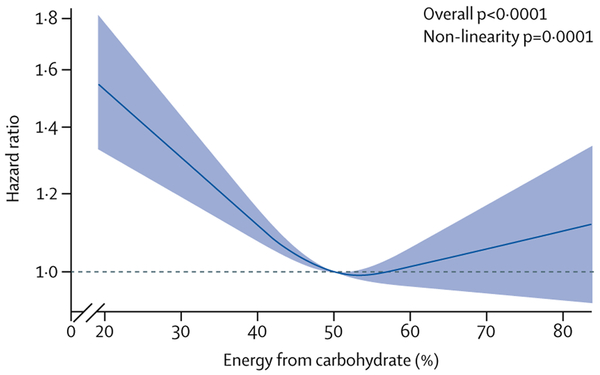
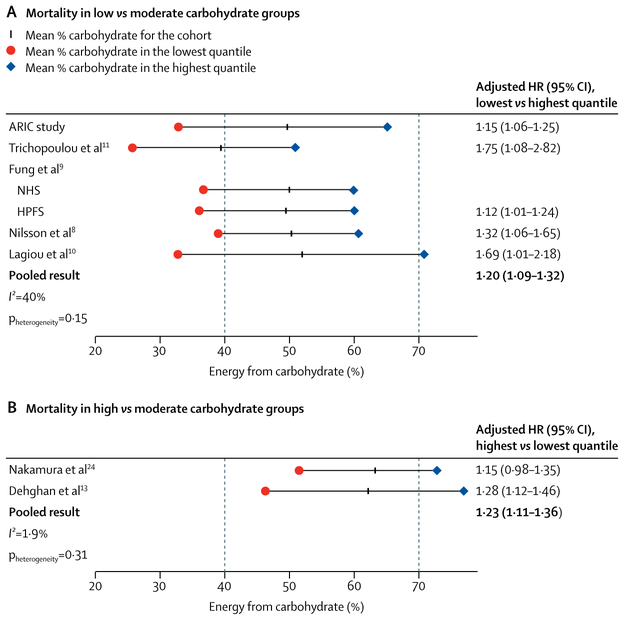
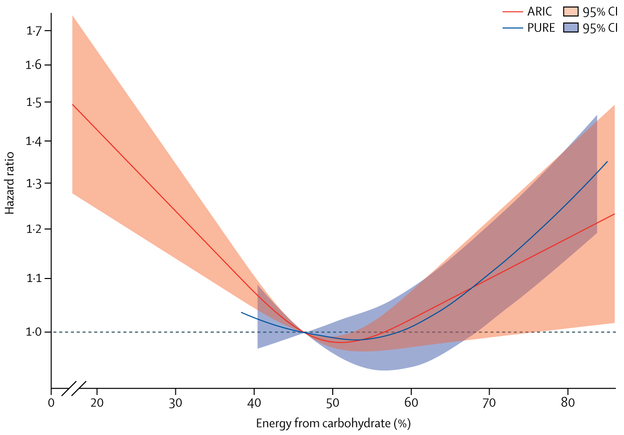
BACKGROUND: Low carbohydrate diets, which restrict carbohydrate in favour of increased protein or fat intake, or both, are a popular weight-loss strategy. However, the long-term effect of carbohydrate restriction on mortality is controversial and could depend on whether dietary carbohydrate is replaced by plant-based or animal-based fat and protein. We aimed to investigate the association between carbohydrate intake and mortality. METHODS: We studied 15 428 adults aged 45-64 years, in four US communities, who completed a dietary questionnaire at enrolment in the Atherosclerosis Risk in Communities (ARIC) study (between 1987 and 1989), and who did not report extreme caloric intake (<600 kcal or >4200 kcal per day for men and <500 kcal or >3600 kcal per day for women). The primary outcome was all-cause mortality. We investigated the association between the percentage of energy from carbohydrate intake and all-cause mortality, accounting for possible non-linear relationships in this cohort. We further examined this association, combining ARIC data with data for carbohydrate intake reported from seven multinational prospective studies in a meta-analysis. Finally, we assessed whether the substitution of animal or plant sources of fat and protein for carbohydrate affected mortality. FINDINGS: During a median follow-up of 25 years there were 6283 deaths in the ARIC cohort, and there were 40 181 deaths across all cohort studies. In the ARIC cohort, after multivariable adjustment, there was a U-shaped association between the percentage of energy consumed from carbohydrate (mean 48·9%, SD 9·4) and mortality: a percentage of 50-55% energy from carbohydrate was associated with the lowest risk of mortality. In the meta-analysis of all cohorts (432 179 participants), both low carbohydrate consumption (<40%) and high carbohydrate consumption (>70%) conferred greater mortality risk than did moderate intake, which was consistent with a U-shaped association (pooled hazard ratio 1·20, 95% CI 1·09-1·32 for low carbohydrate consumption; 1·23, 1·11-1·36 for high carbohydrate consumption). However, results varied by the source of macronutrients: mortality increased when carbohydrates were exchanged for animal-derived fat or protein (1·18, 1·08-1·29) and mortality decreased when the substitutions were plant-based (0·82, 0·78-0·87). INTERPRETATION: Both high and low percentages of carbohydrate diets were associated with increased mortality, with minimal risk observed at 50-55% carbohydrate intake. Low carbohydrate dietary patterns favouring animal-derived protein and fat sources, from sources such as lamb, beef, pork, and chicken, were associated with higher mortality, whereas those that favoured plant-derived protein and fat intake, from sources such as vegetables, nuts, peanut butter, and whole-grain breads, were associated with lower mortality, suggesting that the source of food notably modifies the association between carbohydrate intake and mortality. FUNDING: National Institutes of Health.
Overview
The claims and statistics of this paper haven’t been checked yet.
Free: it reads the open-access text and checks the first 5 claims that cite a source we can check. Create a free account to check every claim.
Integrity signals
Registry
Cites
Statistics
Figures
Verification
Claims the paper makes
The claims and statistics of this paper haven’t been checked yet.
Free: it reads the open-access text and checks the first 5 claims that cite a source we can check. Create a free account to check every claim.
Claims other papers make about this one
Each is checked against this paper’s own text: does it say what the citing paper says it does?
The cited source says what the claim attributes to it.
In the citing paper
“Considering this and a recent systematic review of cohort studies suggesting that long term LCDs are associated with increased mortality,73 clinicians might consider short term LCDs for management of type 2 diabetes, while actively monitoring and adjusting diabetes medication as needed.”
The cited source says what the claim attributes to it.
In the citing paper
“Large cohort studies suggest higher mortality at lower carbohydrate levels, but this association disappears when plant-based protein is substituted for animal-based sources of protein”
From Lifestyle Medicine for Obesity in the Era of Highly Effective Anti-Obesity Treatment (2025) · cites this paper as [188]
The check wasn’t confident either way, so it gives no verdict — never disputed.
In the citing paper
“Dietary carbohydrate has a 'neutral' effect on LDL-C, although excessive consumption is represented by untoward effects on plasma TGs and HDL-C levels [164].”
From 2019 ESC/EAS guidelines for the management of dyslipidaemias: lipid modification to reduce cardiovascular risk (2019) · cites this paper as [164]
Experimental — accuracy not yet measuredIn the citing paper
“low intakes of fats and oils increase the risk of inadequate intakes of vitamin E and of essential fatty acids, and may contribute to a reduction of HDL-C [164].”
From 2019 ESC/EAS guidelines for the management of dyslipidaemias: lipid modification to reduce cardiovascular risk (2019) · cites this paper as [164]
Self-check
Percentages, sums and reported differences re-computed from the paper’s own numbers.
The self-check needs the paper’s full text.
Citations
Cites
von Elm, E., Altman, D. G., Egger, M., Pocock, S. J., Gøtzsche, P. C., Vandenbroucke, J. P., & Initiative, F. T. S. (2007) · PLoS Medicine · doi:10.1371/journal.pmed.0040296 · Cited by 23,020
von Elm, E., Altman, D. G., Egger, M., Pocock, S. J., Gøtzsche, P. C., & Vandenbroucke, J. P. (2007) · The Lancet · doi:10.1016/s0140-6736(07)61602-x · Cited by 21,320
(2014) · Medical Entomology and Zoology · Cited by 17,633
CONSORT 2010 Statement: updated guidelines for reporting parallel group randomised trials
the CONSORT Group, Schulz, K. F., Altman, D. G., & Moher, D. (2010) · BMC Medicine · doi:10.1186/1741-7015-8-18 · Cited by 13,371
Harrell, F. E. (2001) · Springer Series in Statistics · doi:10.1007/978-1-4757-3462-1 · Cited by 9,195
Reproducibility and validity of a semiquantitative food frequency questionnaire
WILLETT, W. C., SAMPSON, L., STAMPFER, M. J., ROSNER, B., BAIN, C., WITSCHI, J., HENNEKENS, C. H., & SPEIZER, F. E. (1985) · American Journal of Epidemiology · doi:10.1093/oxfordjournals.aje.a114086 · Cited by 4,274
Self-citationA short questionnaire for the measurement of habitual physical activity in epidemiological studies
Baecke, J., Burema, J., & Frijters, J. (1982) · The American Journal of Clinical Nutrition · doi:10.1093/ajcn/36.5.936 · Cited by 3,945
CONSORT 2010 statement: updated guidelines for reporting parallel group randomized trials
Schulz, K. F., Altman, D. G., Moher, D., & for the CONSORT Group* (2010) · Annals of Internal Medicine · doi:10.7326/0003-4819-152-11-201006010-00232 · Cited by 3,824
(1989) · PubMed · Cited by 3,139
THE ATHEROSCLEROSIS RISK IN COMMUNIT (ARIC) STUDY: DESIGN AND OBJECTIVES
THE ARIC INVESTIGATORS (1989) · American Journal of Epidemiology · doi:10.1093/oxfordjournals.aje.a115184 · Cited by 2,924
Cited by
Items 101–200 of 775
Optimum nutritional strategies for cardiovascular disease prevention and rehabilitation (BACPR)
Butler, T., Kerley, C. P., Altieri, N., Alvarez, J., Green, J., Hinchliffe, J., Stanford, D., & Paterson, K. (2020) · Heart · doi:10.1136/heartjnl-2019-315499 · Cited by 92
“15 16 Higher fibre intake is inversely associated with cardiovascular and all-cause mortality post-MI.”
BackgroundA ketogenic diet substantially reshapes the human metabolome
Effinger, D., Hirschberger, S., Yoncheva, P., Schmid, A., Heine, T., Newels, P., Schütz, B., Meng, C., Gigl, M., Kleigrewe, K., et al. (2023) · Clinical Nutrition · doi:10.1016/j.clnu.2023.04.027 · Cited by 64
Di Rosa, C., Lattanzi, G., Taylor, S. F., Manfrini, S., & Khazrai, Y. M. (2020) · Obesity Research & Clinical Practice · doi:10.1016/j.orcp.2020.08.009 · Cited by 54
Diabetes Risk Reduction Diet and Survival after Breast Cancer Diagnosis
Wang, T., Farvid, M. S., Kang, J. H., Holmes, M. D., ROSNER, B. A., Tamimi, R. M., Willett, W. C., & Eliassen, A. H. (2021) · Cancer Research · doi:10.1158/0008-5472.can-21-0256 · Cited by 56
Self-citationRomán, L., Campanella, O. H., & Martínez, M. M. (2019) · Carbohydrate Polymers · doi:10.1016/j.carbpol.2019.03.076 · Cited by 56
Coconuts and Health: Different Chain Lengths of Saturated Fats Require Different Consideration
Hewlings, S. J. (2020) · Journal of Cardiovascular Development and Disease · doi:10.3390/jcdd7040059 · Cited by 76
“[44] Prospective Cohort and Meta-Analysis Association between carbohydrate intake and mortality.”
BackgroundResultGrand Transitions: How the Modern World Was Made
Smil, V. (2021) · doi:10.1093/oso/9780190060664.001.0001 · Cited by 87
Risks and Benefits of Different Dietary Patterns in CKD
Joshi, S., Kalantar‐Zadeh, K., Chauveau, P., & Carrero, J. J. (2023) · American Journal of Kidney Diseases · doi:10.1053/j.ajkd.2022.08.013 · Cited by 58
Low carbohydrate dietary approaches for people with type 2 diabetes-a narrative review
Wheatley, S. D., Deakin, T. A., Arjomandkhah, N. C., Hollinrake, P. B., & Reeves, T. E. (2021) · Frontiers in Nutrition · doi:10.3389/fnut.2021.687658 · Cited by 50
Dietary Carbohydrate Intake and New-Onset Hypertension: A Nationwide Cohort Study in China
Li, Q., Liu, C., Zhang, S., Li, R., Zhang, Y., He, P., Zhang, Z., Liu, M., Zhou, C., Ye, Z., et al. (2021) · Hypertension · doi:10.1161/hypertensionaha.120.16751 · Cited by 61
Hata, S., Okamura, T., Kobayashi, A., Bamba, R., Miyoshi, T., Nakajima, H., Kitagawa, N., Hashimoto, Y., Majima, S., Senmaru, T., et al. (2022) · Nutrients · doi:10.3390/nu14173531 · Cited by 53
“Additionally, in another meta-analysis of over 400,000 individuals, both high (>70%) and low (<40%) carbohydrate intake was associated with an increased risk of mortality than moderate carbohydrate (50–55%) intake [8].”
BackgroundOh, R., Gilani, B., & Uppaluri, K. R. (2019) · StatPearls · Cited by 62
Low-Carbohydrate Diet Scores and Mortality Among Adults With Incident Type 2 Diabetes
Hu, Y., Liu, G., Yu, E., Wang, B., Wittenbecher, C., Manson, J. E., Rimm, E. B., Liang, L., Rexrode, K. M., Willett, W. C., et al. (2023) · Diabetes Care · doi:10.2337/dc22-2310 · Cited by 48
Self-citationDietary carbohydrate intake and new-onset diabetes: A nationwide cohort study in China
Zhou, C., Zhang, Z., Liu, M., Zhang, Y., Li, H., He, P., Li, Q., Liu, C., & Qin, X. (2021) · Metabolism · doi:10.1016/j.metabol.2021.154865 · Cited by 52
JCS 2023 Guideline on the Primary Prevention of Coronary Artery Disease
Fujiyoshi, A., Kohsaka, S., Hata, J., Hara, M., Kai, H., Masuda, D., Miyamatsu, N., Nishio, Y., Ogura, M., Sata, M., et al. (2024) · Circulation Journal · doi:10.1253/circj.cj-23-0285 · Cited by 61
Dietary plant-to-animal protein ratio and risk of cardiovascular disease in 3 prospective cohorts
Glenn, A. J., Wang, F., Tessier, A., Manson, J. E., Rimm, E. B., Mukamal, K. J., Sun, Q., Willett, W. C., Rexrode, K. M., Jenkins, D. J. A., et al. (2024) · American Journal of Clinical Nutrition · doi:10.1016/j.ajcnut.2024.09.006 · Cited by 58
Self-citationImpact of Dietary Fiber on Inflammation in Humans
Kabisch, S., Hajir, J., Sukhobaevskaia, V., Weickert, M. O., & Pfeiffer, A. F. H. (2025) · International Journal of Molecular Sciences · doi:10.3390/ijms26052000 · Cited by 65
“Observational studies show an increased mortality associated with both low-carbohydrate and carbohydrate-rich diets with a variable optimum for carbohydrate proportion [36–38].”
Dietary Management of Type 2 Diabetes in the MENA Region: A Review of the Evidence
Hwalla, N. C., Jaafar, Z. A., & Sawaya, S. (2021) · Nutrients · doi:10.3390/nu13041060 · Cited by 58
Ma, Y., Zheng, Z., Zhuang, L., HuiTing, W., Li, A., Chen, L., & Liu, L. (2024) · Nutrients · doi:10.3390/nu16010152 · Cited by 56
Savarese, G., Schiattarella, G. G., Lindberg, F., Anker, M. S., Bayés‐Genís, A., Bäck, M., Braunschweig, F., Bucciarelli‐Ducci, C., Butler, J., Cannata, A. N., et al. (2025) · European Journal of Heart Failure · doi:10.1002/ejhf.3676 · Cited by 59
Coconut oil intake and its effects on the cardiometabolic profile – A structured literature review
Santos, H. O., Howell, S. L., Earnest, C. P., & Teixeira, F. J. (2019) · Progress in Cardiovascular Diseases · doi:10.1016/j.pcad.2019.11.001 · Cited by 91
Nutrients, Physical Activity, and Mitochondrial Dysfunction in the Setting of Metabolic Syndrome
Lemos, G., Torrinhas, R. S., & Waitzberg, D. L. (2023) · Nutrients · doi:10.3390/nu15051217 · Cited by 63
Low‐Carbohydrate Diets and Risk of Incident Atrial Fibrillation: A Prospective Cohort Study
Zhang, S., Zhuang, X., Lin, X., Zhong, X., Zhou, H., Sun, X., Xiong, Z., Huang, Y., Fan, Y., Guo, Y., et al. (2019) · Journal of the American Heart Association · doi:10.1161/jaha.119.011955 · Cited by 52
“Low-carbohydrate diets, which restrict carbohydrate intake, in favor of increased protein or fat intake, have gained substantial popularity because of their ability to induce short-term weight loss.(4,5) Nevertheless, the long-term effect of carbohydrate restriction is still controversial, especially in the influence…”
BackgroundResultGenetic background, epigenetic factors and dietary interventions which influence human longevity
Costa, D., Scognamiglio, M., Fiorito, C., Benincasa, G., & Napoli, C. (2019) · Biogerontology · doi:10.1007/s10522-019-09824-3 · Cited by 56
Non-Systematic Review of Diet and Nutritional Risk Factors of Cardiovascular Disease in Obesity
Rychter, A. M., Ratajczak, A. E., Zawada, A. E., Dobrowolska, A., & Krela‐Kaźmierczak, I. (2020) · Nutrients · doi:10.3390/nu12030814 · Cited by 54
“Dietary cholesterol - <300 mg/day (especially when plasma cholesterol levels are elevated) - notice there is an individual variation of how dietary cholesterol may influence serum cholesterol [19,151]”
Backgroundde Medeiros, G. C. B. S., Mesquita, G. X. B., Lima, S. C. V. C., Silva, D. F. O., de Azevedo, K. P. M., Pimenta, I. D. S. F., Gonçalves, A. K., Lyra, C. D. O., Martínez, D. G., & Piuvezam, G. (2022) · Critical Reviews in Food Science and Nutrition · doi:10.1080/10408398.2022.2058461 · Cited by 54
“…sources of protein and fat (vegetables, nuts, peanut butter and wholegrain breads), were associated with lower all-cause mortality, whereas dietary patterns with animal-derived sources of protein and fat (lamb, pork and chicken) were associated with higher mortality (Seidelmann et al. 2018).”
BackgroundNew insights into starch, lipid, and protein interactions — Colon microbiota fermentation
Wang, Y., Han, T., Liu, T., Sun, L., Dou, B., Xin, J., & Zhang, N. (2024) · Carbohydrate Polymers · doi:10.1016/j.carbpol.2024.122113 · Cited by 52
Global associations between macronutrient supply and age-specific mortality
Senior, A. M., Nakagawa, S., Raubenheimer, D., & Simpson, S. J. (2020) · Proceedings of the National Academy of Sciences · doi:10.1073/pnas.2015058117 · Cited by 43
Hosseini, F. S., Jayedi, A., Khan, T. A., & Shab‐Bidar, S. (2022) · Scientific Reports · doi:10.1038/s41598-022-06212-9 · Cited by 60
Dietary patterns to promote cardiometabolic health
Pagidipati, N. J., Taub, P. R., Ostfeld, R. J., & Kirkpatrick, C. F. (2024) · Nature Reviews Cardiology · doi:10.1038/s41569-024-01061-7 · Cited by 51
“The results of this meta-analysis indicated that replacing carbohydrates with animal-based proteins or fats was associated with an increased risk of death, whereas replacing carbohydrates with plant-based proteins or fats was associated with a decreased risk of death 60 .”
InfluentialVitamin B12 sources in non-animal foods: a systematic review
de Brito, B. M., Campos, V. D. M., Neves, F. D. J., Ramos, L. R., & Tomita, L. Y. (2022) · Critical Reviews in Food Science and Nutrition · doi:10.1080/10408398.2022.2053057 · Cited by 54
Low‐carbohydrate ketogenic diets in body weight control: A recurrent plaguing issue of fad diets?
Schütz, Y., Montani, J., & Dulloo, A. G. (2021) · Obesity Reviews · doi:10.1111/obr.13195 · Cited by 54
“Although bone mineral density has been shown to be preserved after 2 years on a low-CHO diet in F IGURE 3 An intake of carbohydrates (as a percentage of total energy intake) that is too high or too low leads to a reduction in projected longevity compared with an intake of 50%–55% (drawn from data of Seidelmann et al.2…”
BackgroundResultInfluentialBao, Y., Xu, Y., Li, Z., & Wu, Q. F. (2023) · Scientific Reports · doi:10.1038/s41598-023-32776-1 · Cited by 45
Dietary Composition and Cardiovascular Risk: A Mediator or a Bystander?
Korakas, E., Dimitriadis, G., Raptis, A. E., & Lambadiari, V. (2018) · Nutrients · doi:10.3390/nu10121912 · Cited by 56
“Higher mortality was observed when carbohydrates were substituted by animal-derived protein and fat, while lower mortality was achieved when protein and fat were derived from plant sources and whole grains [54].”
BackgroundLipoprotein(a): Current Evidence for a Physiologic Role and the Effects of Nutraceutical Strategies
Santos, H. O., KONES, R. J., Rumana, U., Earnest, C. P., Izidoro, L. F. M., & Macedo, R. C. O. (2019) · Clinical Therapeutics · doi:10.1016/j.clinthera.2019.06.002 · Cited by 43
Eating, diet, and nutrition for the treatment of non-alcoholic fatty liver disease
Semmler, G., Datz, C., & Trauner, M. (2022) · Clinical and Molecular Hepatology · doi:10.3350/cmh.2022.0364 · Cited by 46
Wali, J. A., Raubenheimer, D., Senior, A. M., Couteur, D. G. L., & Simpson, S. J. (2020) · Cardiovascular Research · doi:10.1093/cvr/cvaa136 · Cited by 45
Low-Carbohydrate Diet Score and Coronary Artery Calcium Progression: Results From the CARDIA Study
Gao, J., Hao, Q.-Y., Zhang, H., Li, X.-Z., Yuan, Z., Guo, Y., Wang, J., Zhang, S.-L., & Liu, P. (2020) · Arteriosclerosis Thrombosis and Vascular Biology · doi:10.1161/atvbaha.120.314838 · Cited by 45
The Ketogenic Diet: Breath Acetone Sensing Technology
Alkedeh, O., & Priefer, R. (2021) · Biosensors · doi:10.3390/bios11010026 · Cited by 47
Hamdy, O., Tasabehji, M. W., Elseaidy, T., Tomah, S., Ashrafzadeh, S., & Mottalib, A. (2018) · Current Diabetes Reports · doi:10.1007/s11892-018-1103-4 · Cited by 39
Dietary Patterns and All-Cause Mortality: A Systematic Review
Boushey, C. J., Ard, J. D., Bazzano, L., Heymsfield, S. B., Mayer‐Davis, E. J., Sabaté, J., Snetselaar, L., Horn, L. V., Schneeman, B. O., English, L., et al. (2020) · doi:10.52570/nesr.dgac2020.sr0108 · Cited by 57
Thakur, B. K., Malaisé, Y., Choudhury, S. R., Neustaeter, A., Turpin, W., Streutker, C., Copeland, J. K., Wong, E. O. Y., Navarre, W. W., Guttman, D. S., et al. (2025) · Nature Microbiology · doi:10.1038/s41564-025-01938-4 · Cited by 50
“In addition, lowering dietary carbohydrate associated with reduced fibre intake is associated with increased mortality 9 and cancer 10 .”
Reconstructing Neanderthal diet: The case for carbohydrates
Hardy, K., Bocherens, H., Brand-Miller, J. C., & Copeland, L. (2021) · Journal of Human Evolution · doi:10.1016/j.jhevol.2021.103105 · Cited by 41
Nurkolis, F., Harbuwono, D. S., Taslim, N. A., Soegondo, S., Suastika, K., Sparringa, R. A., Mustika, A., Syam, A. F., Santini, A., Holly, J. M. P., et al. (2025) · Discover Food · doi:10.1007/s44187-025-00422-6 · Cited by 51
“While randomized controlled trials (RCTs) suggest a potential advantage of low-carb diets in promoting diabetes remission [64], findings from observational studies raise concerns regarding an increased risk of disease associated with long-term adherence to such diets [194].”
Kang, S., Kang, S. M., Choi, J. H., Ko, S., Koo, B. K., Kwon, H.-S., Kim, M. K., Kim, S. Y., Kim, S., Kim, Y., et al. (2025) · Diabetes & Metabolism Journal · doi:10.4093/dmj.2025.0469 · Cited by 85
Habitual animal fat consumption in shaping gut microbiota and microbial metabolites
Wan, Y., Tong, W., Zhou, R., Li, J., Yuan, J., Wang, F., & Li, D. (2019) · Food & Function · doi:10.1039/c9fo01490j · Cited by 40
Maula, A., Kai, J., Woolley, A. K., Weng, S. F., Dhalwani, N. N., Griffiths, F. E., Khunti, K., & Kendrick, D. (2019) · Diabetic Medicine · doi:10.1111/dme.14193 · Cited by 45
Low-carbohydrate diets: Effects on metabolism and exercise – A comprehensive literature review
Macedo, R. C. O., Santos, H. O., Tinsley, G. M., & Reischak-Oliveira, Á. (2020) · Clinical Nutrition ESPEN · doi:10.1016/j.clnesp.2020.07.022 · Cited by 42
Biomarker-Calibrated Macronutrient Intake and Chronic Disease Risk among Postmenopausal Women
Prentice, R. L., Pettinger, M. B., Neuhouser, M. L., Raftery, D., Zheng, C., Gowda, G. A. N., Huang, Y., Tinker, L. F., Howard, B. V., Manson, J. E., et al. (2021) · Journal of Nutrition · doi:10.1093/jn/nxab091 · Cited by 40
“A recent cohort study and meta-analysis (12) reported a U-shaped association between carbohydrate density and all-cause mortality, with lowest mortality risk when 50– 55% of energy was from carbohydrate.”
The immune‐supportive diet in allergy management: A narrative review and proposal
Vlieg‐Boerstra, B., Groetch, M., Vassilopoulou, Ε., Meyer, R. W., Laitinen, K., Swain, A., Durban, R., Aalst, O. B., Bottse, R., Grimshaw, K. E. C., et al. (2023) · Allergy · doi:10.1111/all.15687 · Cited by 46
Practical Guidance for Food Consumption to Prevent Cardiovascular Disease
Nestel, P. J., Beilin, L. J., Clifton, P. M., Watts, G. F., & Mori, T. A. (2020) · Heart Lung and Circulation · doi:10.1016/j.hlc.2020.08.022 · Cited by 43
Lei, L., Huang, J., Zhang, L., Hong, Y., Hui, S., & Yang, J. (2022) · Frontiers in Nutrition · doi:10.3389/fnut.2022.935234 · Cited by 35
The Impact of Migration on the Gut Metagenome of South Asian Canadians
Copeland, J. K., Chao, G. Y. C., Vanderhout, S. M., Acton, E., Wang, P. W., Benchimol, E. I., El‐Sohemy, A., Croitoru, K., Gommerman, J. L., Guttman, D. S., et al. (2021) · Gut Microbes · doi:10.1080/19490976.2021.1902705 · Cited by 39
“In the United States, low and high carbohydrate consumption were both associated with increased mortality rates, while moderate carbohydrate consumption resulted in the lowest risk of metabolic disease development, especially when plant-derived proteins were most often consumed.(24) For SA immigrants, an increase in t…”
BackgroundSikorski, C., Yang, S., Stennett, R., Miller, V., Teo, K. K., Anand, S. S., Paré, G., Yusuf, S., Dehghan, M., & Mente, A. (2022) · Nutrition · doi:10.1016/j.nut.2022.111941 · Cited by 41
Nutrition and dietary restrictions in cancer prevention
Mishra, A. K., Giuliani, G., & Longo, V. D. (2023) · Biochimica et Biophysica Acta (BBA) - Reviews on Cancer · doi:10.1016/j.bbcan.2023.189063 · Cited by 43
Webster, C. C., Murphy, T., Larmuth, K., Noakes, T. D., & Smith, J. A. H. (2019) · Diabetes Metabolic Syndrome and Obesity · doi:10.2147/dmso.s227090 · Cited by 41
Garonzi, C., Forsander, G., & Maffeis, C. (2021) · Nutrients · doi:10.3390/nu13082625 · Cited by 43
Zhou, C., Wu, Q., Ye, Z., Liu, M., Zhang, Z., Zhang, Y., Li, H., He, P., Li, Q., Liu, C., et al. (2022) · Hypertension · doi:10.1161/hypertensionaha.121.18222 · Cited by 35
Ying, H., Gao, L., Liao, N., Xu, X., Yu, W., & Hong, W. (2022) · BMC Cancer · doi:10.1186/s12885-022-10265-4 · Cited by 35
“However, it is the most commonly used method for collecting dietary intake data, and it is carried out by trained interviewers [28, 29].”
MethodHealth Effects of Whole Grains: A Bibliometric Analysis
Wei, X., Yang, W., Wang, J., Zhang, Y., Wang, Y., Long, Y., Tan, B., & Wan, X. (2022) · Foods · doi:10.3390/foods11244094 · Cited by 40
Kronsteiner-Gicevic, S., Tello, M., Lincoln, L. E., Kondo, J. K., Naidoo, U., Fung, T. T., Willett, W. C., & Thorndike, A. N. (2023) · Journal of the Academy of Nutrition and Dietetics · doi:10.1016/j.jand.2023.05.023 · Cited by 32
Self-citationAnimal and vegetable protein intake and malnutrition in older adults: a multicohort study
Carballo‐Casla, A., Sotos‐Prieto, M., García‐Esquinas, E., Struijk, E. A., Caballero, F. F., Calderón‐Larrañaga, A., López‐García, E., Rodríguez‐Artalejo, F., & Ortolá, R. (2024) · The journal of nutrition health & aging · doi:10.1016/j.jnha.2023.100002 · Cited by 37
“However, the main driver of these associations seems to be animal protein, while plant protein intake has been linked with lower risk of death [10,12].”
Zhao, D., Huang, Y., Wang, B., Chen, H., Pan, W., Yang, M., Xia, Z., Zhang, R., & Yuan, C. (2023) · Nutrients · doi:10.3390/nu15030704 · Cited by 36
Johansson, I., Esberg, A., Nilsson, L. M., Jansson, J., Wennberg, P., & Winkvist, A. (2019) · Nutrients · doi:10.3390/nu11020284 · Cited by 37
“This type of pattern was recently confirmed to be associated with an increased mortality risk [36].”
BackgroundCarbohydrates deteriorate fatty liver by activating the inflammatory response
Gao, Y., Hua, R., Hu, K., & Wang, Z. (2021) · Nutrition Research Reviews · doi:10.1017/s0954422421000202 · Cited by 37
“(95) 22 63 (5) 10/12 31 (3) 23 (11) 28 (13) N.”
BackgroundInfluentialPrenatal Omega-3 and Omega-6 Polyunsaturated Fatty Acids and Childhood Atopic Dermatitis
Gardner, K. G., Gebretsadik, T. S., Hartman, T. J., Rosa, M. J., Tylavsky, F. A., Adgent, M. A., Moore, P. E., Koçak, M., Bush, N. R., Davis, R. L., et al. (2019) · The Journal of Allergy and Clinical Immunology In Practice · doi:10.1016/j.jaip.2019.09.031 · Cited by 35
The Merits and the Pitfalls of Low Carbohydrate Diet: A Concise Review
Mooradian, A. D. (2020) · The journal of nutrition health & aging · doi:10.1007/s12603-020-1417-1 · Cited by 37
A Narrative Review of Dietary Approaches for Kidney Transplant Patients
Cyrino, L. G., Galpern, J., Moore, L., Borgi, L., & Riella, L. V. (2021) · Kidney International Reports · doi:10.1016/j.ekir.2021.04.009 · Cited by 36
“Side effects of KD also exist, such as nonalcoholic fatty liver disease, insulin resistance,(73) and even increased mortality.(74) This diet demonstrates to be useful for the rapid induction of short-term weight loss.”
BackgroundHe, P., Li, H., Liu, M., Zhang, Z., Zhang, Y., Zhou, C., Li, Q., Liu, C., & Qin, X. (2021) · The Journal of Clinical Endocrinology & Metabolism · doi:10.1210/clinem/dgab636 · Cited by 30
Choi, J. H., Cho, Y. J., Kim, H., Ko, S., Chon, S., Kang, J., Kim, E. M., Kim, H. J., Kim, H. J., Song, K., et al. (2022) · Diabetes & Metabolism Journal · doi:10.4093/dmj.2022.0038 · Cited by 34
“Carbohydrates make up more than half of an individual’s calorie intake, and restricting them can be critical in reducing total calories and body weight [10].”
BackgroundMultidimensional associations between nutrient intake and healthy ageing in humans
Senior, A. M., Legault, V., Lavoie, F. B., Presse, N., Gaudreau, P., Turcot, V., Raubenheimer, D., Couteur, D. G. L., Simpson, S. J., & Cohen, A. A. (2022) · BMC Biology · doi:10.1186/s12915-022-01395-z · Cited by 35
“Epidemiological and meta-analytic study of the effects of carbohydrates on all-cause mortality in humans has found identical patterns [40], possibly moderated by carbohydrate quality.”
BackgroundRole of dietary carbohydrates on risk of lung cancer
Tao, J., Jatoi, A., Crawford, J., Lam, W., Ho, J., Wang, X., & Pang, H. (2021) · Lung Cancer · doi:10.1016/j.lungcan.2021.03.009 · Cited by 33
Ma, X., Dong, Z., Liu, J., Ma, L., Sun, X., Gao, R., Pan, L., Zhang, J., Dilan, A., An, J., et al. (2021) · Cardiovascular Drugs and Therapy · doi:10.1007/s10557-021-07267-y · Cited by 37
Jiménez‐Cortegana, C., Iglesias, P., Ribalta, J., Vilariño‐García, T., Montánez, L., Arrieta, F., Aguilar‐Diosdado, M., Durán, S., Obaya, J. C., Becerra, A., et al. (2021) · Nutrients · doi:10.3390/nu13114150 · Cited by 39
“In the general population, it was demonstrated that both high and low percentages of carbohydrate diets were associated with increased mortality, with the lowest risk reported at 50–55% energy from carbohydrate [100].”
BackgroundKetogenic diets composed of long-chain and medium-chain fatty acids induce cardiac fibrosis in mice
Sternberg, F., Sternberg, C., Dunkel, A., Beikbaghban, T., Gregor, A., Szarzynski, A., Somoza, V., Walter, I., Duszka, K., Kofler, B., et al. (2023) · Molecular Metabolism · doi:10.1016/j.molmet.2023.101711 · Cited by 34
Lifestyle Medicine for Obesity in the Era of Highly Effective Anti-Obesity Treatment
Sannidhi, D., Abeles, R., Andrew, W., Bonnet, J. P., Vitale, K., Niranjan, V., Gulati, M., Pauly, K., Moran, R., Alexander, L., et al. (2025) · Nutrients · doi:10.3390/nu17142382 · Cited by 29
“Large cohort studies suggest higher mortality at lower carbohydrate levels, but this association disappears when plant-based protein is substituted for animal-based sources of protein [188,189].”
Bai, A., Si, M., Xue, P., Qu, Y., & Jiang, Y. (2024) · BMC Medical Informatics and Decision Making · doi:10.1186/s12911-023-02397-9 · Cited by 38
Elderly vulnerability to temperature-related mortality risks in China
Yao, X., Qu, Y., Mishra, A., MANN, M. E., Zhang, L., Bai, C., Li, M., Lin, J., Wei, J., Yu, Q., et al. (2025) · Science Advances · doi:10.1126/sciadv.ado5499 · Cited by 34
Xie, Y., Wang, C., Zhao, D., Zhou, C., & Li, C. (2020) · Molecular Nutrition & Food Research · doi:10.1002/mnfr.202000291 · Cited by 31
Zhou, C., Liu, C., Zhang, Z., Liu, M., Zhang, Y., Li, H., He, P., Li, Q., & Qin, X. (2022) · BMC Medicine · doi:10.1186/s12916-021-02199-8 · Cited by 32
Dietary and Lifestyle Strategies for Obesity
Barber, T. M., Kabisch, S., Pfeiffer, A. F. H., & Weickert, M. O. (2024) · Nutrients · doi:10.3390/nu16162714 · Cited by 42
“…the only published cohort study to date that investigated the impact of long-term LCD adoption on cardiovascular disease outcomes showed an increase in mortality, with increased serum levels of low-density lipoprotein (LDL) cholesterol (low atherogenic, large particle LDL-cholesterol) [98].”
BackgroundChuruangsuk, C., Lean, M. E. J., & Combet, E. (2020) · Proceedings of The Nutrition Society · doi:10.1017/s0029665120000105 · Cited by 37
“Compared to moderate carbohydrate intake (about 50% energy), low carbohydrate intake (<40% energy) was associated with a 20% increased risk of all-cause mortality (pooled hazard ratio 1⋅2; 95% CI 1⋅09, 1⋅32; P<0⋅0001), and high carbohydrate intake (>70% energy) was also associated with a 23% increased risk of all-caus…”
BackgroundInfluentialComerford, K. B., Papanikolaou, Y., Jones, J. M., Rodriguez, J. C., Slavin, J. L., Angadi, S. S., & Drewnowski, A. (2021) · Nutrients · doi:10.3390/nu13082667 · Cited by 32
“low in carbohydrate content give varying results with respect to body weight, disease risk, and mortality [2–4], suggesting that it is CF type and quality that count most for health and longevity [7].”
ResultBa, D. M., Gao, X., Al‐Shaar, L., Muscat, J. E., Chinchilli, V. M., Ssentongo, P., Zhang, X., Liu, G., Beelman, R. B., & Richie, J. P. (2021) · Nutrition Journal · doi:10.1186/s12937-021-00738-w · Cited by 29
“Carbohydrates and fiber were included as covariates because they are related to all-cause mortality [46, 47].”
BackgroundKord‐Varkaneh, H., Poursoleiman, F., Masri, M. K. A., Alras, K. A., Shayah, Y., Masmoum, M. D., Alangari, F. A., Alras, A., Rinaldi, G., Day, A. S., et al. (2022) · Frontiers in Nutrition · doi:10.3389/fnut.2022.987921 · Cited by 33
Dietary vitamin E intake and new-onset hypertension
Zhang, Y., Yang, S., Wu, Q., Ye, Z., Zhou, C., Liu, M., Zhang, Z., He, P., Zhang, Y., Li, H., et al. (2023) · Hypertension Research · doi:10.1038/s41440-022-01163-0 · Cited by 32
“>3600 or <500 kcal/d) were also excluded [15, 16].”
BackgroundStorz, M. A., & Ronco, A. L. (2023) · British Journal of Nutrition · doi:10.1017/s0007114522001908 · Cited by 27
Association of a Low-Carbohydrate High-Fat Diet With Plasma Lipid Levels and Cardiovascular Risk
Iatan, I., Huang, K., Vikulova, D. N., Ranjan, S., & Brunham, L. R. (2024) · JACC Advances · doi:10.1016/j.jacadv.2024.100924 · Cited by 33
Dietary Antioxidants and Natural Compounds in Preventing Thrombosis and Cardiovascular Disease
Giurranna, E., Nencini, F., Bettiol, A., Borghi, S., Argento, F. R., Emmi, G., Silvestri, E., Taddei, N., Fiorillo, C., & Becatti, M. (2024) · International Journal of Molecular Sciences · doi:10.3390/ijms252111457 · Cited by 31
Macronutrient Quality and All-Cause Mortality in the SUN Cohort
Santiago, S., Zazpe, I., Fernandez-Lazaro, C. I., Víctor de la, O., Bes‐Rastrollo, M., & Martínez‐González, M. Á. (2021) · Nutrients · doi:10.3390/nu13030972 · Cited by 34
“Regarding energy from carbohydrates, both high and low percentages, have been associated with increased mortality, observing the lowest risk of mortality between 50–55% of calories from carbohydrate intake [11].”
BackgroundKetogenic diet for weight loss.
Ting, R., Dugré, N., Allan, G. M., & Lindblad, A. J. (2018) · Europe PMC (PubMed Central) · Cited by 39
The effect of diet and exercise on tobacco carcinogen-induced lung cancer
Elisia, I., Cho, B., Hay, M., Li, M. Y., Hofs, E., Lam, V., Dyer, R., Lum, J. J., & Krystal, G. (2019) · Carcinogenesis · doi:10.1093/carcin/bgz060 · Cited by 29
Dietary fat and fatty foods in the prevention of non-communicable diseases: A review of the evidence
Schwingshackl, L., Heseker, H., Kiesswetter, E., & Koletzko, B. V. (2022) · Trends in Food Science & Technology · doi:10.1016/j.tifs.2022.08.002 · Cited by 32
Qin, P., Huang, C., Jiang, B., Wang, X., Yang, Y., Ma, J., Chen, S., Hu, D., & Bo, Y. (2022) · Clinical Nutrition · doi:10.1016/j.clnu.2022.12.010 · Cited by 29
Carbohydrates in nutrition: friend or foe?
Großkopf, A., & Simm, A. (2020) · Zeitschrift für Gerontologie und Geriatrie · doi:10.1007/s00391-020-01726-1 · Cited by 33
Sadeghi, A., Sadeghian, M., Nasiri, M., Rahmani, J., Khodadost, M., Pirouzi, A., Maleki, V., & Sadeghi, O. (2019) · Clinical Nutrition · doi:10.1016/j.clnu.2019.08.001 · Cited by 26
Iizuka, K. (2021) · International Journal of Molecular Sciences · doi:10.3390/ijms222112058 · Cited by 39
“High- and low-carbohydrate diets were associated with reversal when the energy from carbohydrates was replaced with plant-derived protein or fat [21].”
BackgroundAssociations of lower-carbohydrate and lower-fat diets with mortality among people with prediabetes
Li, L., Shan, Z., Wan, Z., Li, R., Geng, T., Lu, Q., Zhu, K., Qiu, Z., Zhang, X., Liu, Y., et al. (2022) · American Journal of Clinical Nutrition · doi:10.1093/ajcn/nqac058 · Cited by 28
Schwingshackl, L., Heseker, H., Kiesswetter, E., & Koletzko, B. V. (2022) · Trends in Food Science & Technology · doi:10.1016/j.tifs.2022.10.011 · Cited by 26
Exercise and nutrition in type 1 diabetes: Insights from the FinnDiane cohort
Barlovič, D. P., Harjutsalo, V., & Groop, P. (2022) · Frontiers in Endocrinology · doi:10.3389/fendo.2022.1064185 · Cited by 34
Metadata
- Authors
- Seidelmann, S. B., Claggett, B., Cheng, S., Henglin, M., Shah, A., Steffen, L. M., Folsom, A. R., Rimm, E. B., Willett, W. C., & Solomon, S. D.
- Affiliations
- Brigham and Women's Hospital (US)
- University of Minnesota (US)
- Corresponding author
- Solomon, Scott D
- ORCID
- Venue
- The Lancet Public Health
- Publisher
- Elsevier BV
- Published
- 2018-09
- Volume
- 3
- Issue
- 9
- Pages
- e419-e428
- ISSN
- 2468-2667 (ISSN-L)
- PMC
- PMC6339822
- OpenAlex
- W2885382674
- Semantic Scholar
- ee38d52ac78aab923b1f4de7d8d9e79b60dd20df
- Cited by
- 776
- References
- 33
- Citations by year
- 2026: 44 · 2025: 87 · 2024: 100 · 2023: 103 · 2022: 122 · 2021: 121 · 2020: 96 · 2019: 73 · 2018: 29
- FWCI
- 76.04
- Type
- journal article
- Language
- en
- Open access
- gold
- doi.org
- Licence
- cc-by-nc-nd
- www.elsevier.com/tdm/userlicense/1.0/ (tdm)
- creativecommons.org/licenses/by-nc-nd/4.0/ (vor)
- Locations
- The Lancet Public Health (publishedVersion, cc-by-nc-nd)
- PubMed (publishedVersion)
- Europe PMC (PubMed Central) (acceptedVersion, cc-by)
- PubMed Central (acceptedVersion, cc-by)
- DOAJ (DOAJ: Directory of Open Access Journals) (submittedVersion, cc-by-sa)
- Funders
- National Heart, Lung, and Blood Institute contracts (HHSN268201100005C, HHSN268201100006C, HHSN268201100007C, HHSN268201100008C, HHSN26820110000 9C, HHSN268201100010C, HHSN268201100011C, HHSN26820 1100012C)
- NIH (R01-HL134168, R01-HL131532)
- Topics
- Health Sciences › Medicine › Public Health, Environmental and Occupational Health › Nutritional Studies and Diet
- Health Sciences › Medicine › Physiology (medical) › Diet and metabolism studies
- Health Sciences › Medicine › Endocrinology, Diabetes and Metabolism › Diet, Metabolism, and Disease
- Keywords
- carbohydrate intake, all-cause mortality, low-carbohydrate diet, U-shaped relationship, macronutrient substitution, vegetable fats, plant proteins, animal protein, Atherosclerosis Risk in Communities Study, weight loss diet, nonlinear dose-response relationship, long-term mortality risk
- MeSH terms
- Diet Surveys, Dietary Carbohydrates, Female, Humans, Male, Middle Aged, Mortality, Prospective Studies, United States
About these checks
Registry, retraction, Cites and statistics results are computed, not judged, with one exception: a printed reference that no index lists is read once by a model before it counts as a citation error. Claims are extracted by a model and kept only when their quote appears verbatim in the text; each cited source is then checked, with a model’s help, for whether it says what the claim relies on. Those verdicts can be wrong — read the claim’s quote and the cited source before relying on one.
Statistics and arithmetic are recomputed, not judged.
Confidence bands are shown only for fields calibrated on our annotated test set. None is calibrated yet, so no band is shown.
What counts as a claim ›How we measure confidence ›How we check this ›
Are you an author, or do you see a problem with this page? Request a review
Data sources
Bibliographic data: Semantic Scholar, OpenAlex, Crossref.
Contains information from the Semantic Scholar Academic Graph Datasets, made available under the ODC Attribution License (ODC-BY 1.0).
Semantic Scholar’s data is described in: Kinney, R., et al. (2023). The Semantic Scholar Open Data Platform. arXiv:2301.10140.
