

Dietary carbohydrate intake and mortality: a prospective cohort study and meta-analysis
Open accessThe DOI matches its Crossref record; 33 of the 33 references it cites were found in a registry or an index.
Abstract
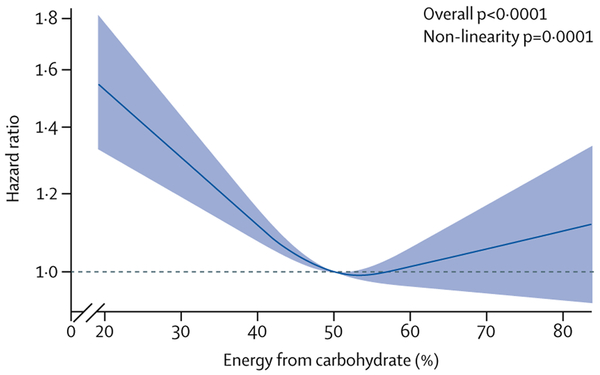
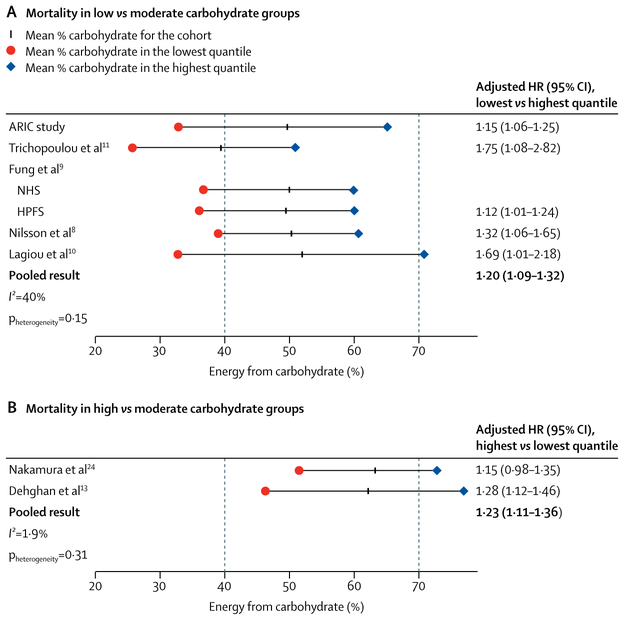
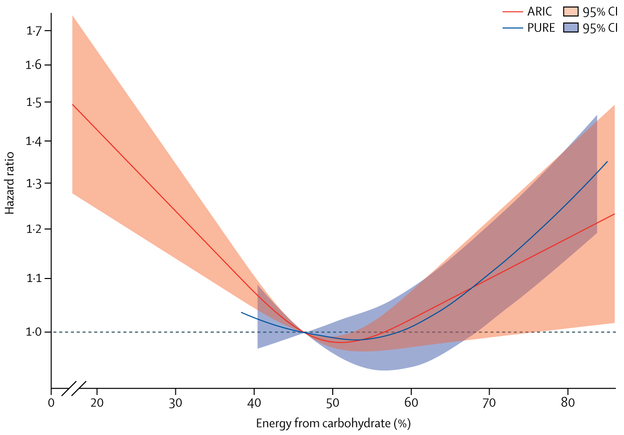
BACKGROUND: Low carbohydrate diets, which restrict carbohydrate in favour of increased protein or fat intake, or both, are a popular weight-loss strategy. However, the long-term effect of carbohydrate restriction on mortality is controversial and could depend on whether dietary carbohydrate is replaced by plant-based or animal-based fat and protein. We aimed to investigate the association between carbohydrate intake and mortality. METHODS: We studied 15 428 adults aged 45-64 years, in four US communities, who completed a dietary questionnaire at enrolment in the Atherosclerosis Risk in Communities (ARIC) study (between 1987 and 1989), and who did not report extreme caloric intake (<600 kcal or >4200 kcal per day for men and <500 kcal or >3600 kcal per day for women). The primary outcome was all-cause mortality. We investigated the association between the percentage of energy from carbohydrate intake and all-cause mortality, accounting for possible non-linear relationships in this cohort. We further examined this association, combining ARIC data with data for carbohydrate intake reported from seven multinational prospective studies in a meta-analysis. Finally, we assessed whether the substitution of animal or plant sources of fat and protein for carbohydrate affected mortality. FINDINGS: During a median follow-up of 25 years there were 6283 deaths in the ARIC cohort, and there were 40 181 deaths across all cohort studies. In the ARIC cohort, after multivariable adjustment, there was a U-shaped association between the percentage of energy consumed from carbohydrate (mean 48·9%, SD 9·4) and mortality: a percentage of 50-55% energy from carbohydrate was associated with the lowest risk of mortality. In the meta-analysis of all cohorts (432 179 participants), both low carbohydrate consumption (<40%) and high carbohydrate consumption (>70%) conferred greater mortality risk than did moderate intake, which was consistent with a U-shaped association (pooled hazard ratio 1·20, 95% CI 1·09-1·32 for low carbohydrate consumption; 1·23, 1·11-1·36 for high carbohydrate consumption). However, results varied by the source of macronutrients: mortality increased when carbohydrates were exchanged for animal-derived fat or protein (1·18, 1·08-1·29) and mortality decreased when the substitutions were plant-based (0·82, 0·78-0·87). INTERPRETATION: Both high and low percentages of carbohydrate diets were associated with increased mortality, with minimal risk observed at 50-55% carbohydrate intake. Low carbohydrate dietary patterns favouring animal-derived protein and fat sources, from sources such as lamb, beef, pork, and chicken, were associated with higher mortality, whereas those that favoured plant-derived protein and fat intake, from sources such as vegetables, nuts, peanut butter, and whole-grain breads, were associated with lower mortality, suggesting that the source of food notably modifies the association between carbohydrate intake and mortality. FUNDING: National Institutes of Health.
Overview
The claims and statistics of this paper haven’t been checked yet.
Free: it reads the open-access text and checks the first 5 claims that cite a source we can check. Create a free account to check every claim.
Integrity signals
Registry
Cites
Statistics
Figures
Verification
Claims the paper makes
The claims and statistics of this paper haven’t been checked yet.
Free: it reads the open-access text and checks the first 5 claims that cite a source we can check. Create a free account to check every claim.
Claims other papers make about this one
Each is checked against this paper’s own text: does it say what the citing paper says it does?
The cited source says what the claim attributes to it.
In the citing paper
“Considering this and a recent systematic review of cohort studies suggesting that long term LCDs are associated with increased mortality,73 clinicians might consider short term LCDs for management of type 2 diabetes, while actively monitoring and adjusting diabetes medication as needed.”
The cited source says what the claim attributes to it.
In the citing paper
“Large cohort studies suggest higher mortality at lower carbohydrate levels, but this association disappears when plant-based protein is substituted for animal-based sources of protein”
From Lifestyle Medicine for Obesity in the Era of Highly Effective Anti-Obesity Treatment (2025) · cites this paper as [188]
The check wasn’t confident either way, so it gives no verdict — never disputed.
In the citing paper
“Dietary carbohydrate has a 'neutral' effect on LDL-C, although excessive consumption is represented by untoward effects on plasma TGs and HDL-C levels [164].”
From 2019 ESC/EAS guidelines for the management of dyslipidaemias: lipid modification to reduce cardiovascular risk (2019) · cites this paper as [164]
Experimental — accuracy not yet measuredIn the citing paper
“low intakes of fats and oils increase the risk of inadequate intakes of vitamin E and of essential fatty acids, and may contribute to a reduction of HDL-C [164].”
From 2019 ESC/EAS guidelines for the management of dyslipidaemias: lipid modification to reduce cardiovascular risk (2019) · cites this paper as [164]
Self-check
Percentages, sums and reported differences re-computed from the paper’s own numbers.
The self-check needs the paper’s full text.
Citations
Cites
von Elm, E., Altman, D. G., Egger, M., Pocock, S. J., Gøtzsche, P. C., Vandenbroucke, J. P., & Initiative, F. T. S. (2007) · PLoS Medicine · doi:10.1371/journal.pmed.0040296 · Cited by 23,020
von Elm, E., Altman, D. G., Egger, M., Pocock, S. J., Gøtzsche, P. C., & Vandenbroucke, J. P. (2007) · The Lancet · doi:10.1016/s0140-6736(07)61602-x · Cited by 21,320
(2014) · Medical Entomology and Zoology · Cited by 17,633
CONSORT 2010 Statement: updated guidelines for reporting parallel group randomised trials
the CONSORT Group, Schulz, K. F., Altman, D. G., & Moher, D. (2010) · BMC Medicine · doi:10.1186/1741-7015-8-18 · Cited by 13,371
Harrell, F. E. (2001) · Springer Series in Statistics · doi:10.1007/978-1-4757-3462-1 · Cited by 9,195
Reproducibility and validity of a semiquantitative food frequency questionnaire
WILLETT, W. C., SAMPSON, L., STAMPFER, M. J., ROSNER, B., BAIN, C., WITSCHI, J., HENNEKENS, C. H., & SPEIZER, F. E. (1985) · American Journal of Epidemiology · doi:10.1093/oxfordjournals.aje.a114086 · Cited by 4,274
Self-citationA short questionnaire for the measurement of habitual physical activity in epidemiological studies
Baecke, J., Burema, J., & Frijters, J. (1982) · The American Journal of Clinical Nutrition · doi:10.1093/ajcn/36.5.936 · Cited by 3,945
CONSORT 2010 statement: updated guidelines for reporting parallel group randomized trials
Schulz, K. F., Altman, D. G., Moher, D., & for the CONSORT Group* (2010) · Annals of Internal Medicine · doi:10.7326/0003-4819-152-11-201006010-00232 · Cited by 3,824
(1989) · PubMed · Cited by 3,139
THE ATHEROSCLEROSIS RISK IN COMMUNIT (ARIC) STUDY: DESIGN AND OBJECTIVES
THE ARIC INVESTIGATORS (1989) · American Journal of Epidemiology · doi:10.1093/oxfordjournals.aje.a115184 · Cited by 2,924
Cited by
Items 401–500 of 775
Crisafulli, O., Quintiero, V., Grattarola, L., Bottoni, G., Giovanetti, G., Negro, M., Lavaselli, E., & D’Antona, G. (2024) · European Journal of Applied Physiology · doi:10.1007/s00421-024-05684-z · Cited by 6
“…impacts as it is known that, in the long term, a high CHO consumption, especially if combined with a low level of physical activity, can lead to the development of several metabolic disorders (Mul et al. 2015; Giugliano et al. 2018), as well as to a higher mortality risk (Seidelmann et al. 2018).”
Acetyltransferase in cardiovascular disease and aging
Keller, M. A., & Nakamura, M. (2024) · The Journal of Cardiovascular Aging · doi:10.20517/jca.2024.21 · Cited by 9
Suarez, C., Cheang, S. E., Larke, J. A., Jiang, J., Weng, C.-Y., Stacy, A., Couture, G., Chen, Y., Bacalzo, N. P., Smilowitz, J. T., et al. (2025) · Food Chemistry · doi:10.1016/j.foodchem.2025.142977 · Cited by 5
Sheng, T., Lai, M., Wu, Y., Zhu, H., Ha, C., Xiao, S., Yu, Z., & Zhou, Y. (2025) · International Journal of Biological Macromolecules · doi:10.1016/j.ijbiomac.2025.142287 · Cited by 8
Prävention nicht übertragbarer chronischer Erkrankungen durch „gesunde“ Ernährung
Bosy‐Westphal, A., & Müller, M. J. (2021) · DMW - Deutsche Medizinische Wochenschrift · doi:10.1055/a-1248-5539 · Cited by 9
Food for Thought or Feeding a Dogma? Diet and Coronary Artery Disease: a Clinician’s Perspective
Sekhar, A., Kuttan, A., Borges, J. C., & Rajachandran, M. S. (2021) · Current Cardiology Reports · doi:10.1007/s11886-021-01557-5 · Cited by 6
Carbohydrates as Nutritional Components for Health and Longevity
Okburan, G., & Gezer, C. (2021) · Healthy ageing and longevity · doi:10.1007/978-3-030-83017-5_2 · Cited by 8
Schwingshackl, L., Bröckelmann, N., Beyerbach, J., Werner, S. S., Zähringer, J., Schwarzer, G., & Meerpohl, J. J. (2022) · Advances in Nutrition · doi:10.1093/advances/nmac042 · Cited by 6
Kwon, Y., Lee, H. S., Park, G. E., Kim, H.-M., Lee, J. J., Kim, W. J., & Lee, J. (2022) · Frontiers in Nutrition · doi:10.3389/fnut.2022.850109 · Cited by 8
Empfehlungen zur Ernährung von Personen mit Diabetes mellitus Typ 2
Skurk, T., Bosy‐Westphal, A., Grünerbel, A., Kabisch, S., Keuthage, W., Kronsbein, P., Müssig, K., Pfeiffer, A. F. H., Simon, M., Tombek, A., et al. (2022) · Die Diabetologie · doi:10.1007/s11428-022-00908-2 · Cited by 6
Jiang, Y., Shen, Q., Tang, H., Liu, Y., Ju, Y., Liu, T., Cui, L., Li, J., & Wang, X. (2022) · Healthcare · doi:10.3390/healthcare10112245 · Cited by 8
“[15] summarized that the association between carbohydrate intake and all-cause and cardiovascular mortality was nonlinear, among which both high and low carbohydrate-to-energy proportion (CEP) diets were associated with increased mortality.”
BackgroundHunt, L. C., Dashti, H. S., Chan, Q. M., Gibson, R., & Vetter, C. (2020) · Nutrients · doi:10.3390/nu12041170 · Cited by 7
“[46] have suggested a U-shaped relationship for carbohydrate intake with minimal risk for all-cause mortality observed when carbohydrate intake constituted 50–55% of energy intake.”
BackgroundLiu, J. (2020) · Alcohol · doi:10.1016/j.alcohol.2020.07.003 · Cited by 6
Hafez, D., Lopez, K. S., Saslow, L. R., & Richardson, C. R. (2021) · Frontiers in Nutrition · doi:10.3389/fnut.2021.682137 · Cited by 7
KETOGENIC DIET FOR WEIGHT LOSS AND ITS IMPLICATION ON HEALTH: A LITERATURE STUDY
Diana, R., & Atmaka, D. R. (2020) · Media Gizi Indonesia · doi:10.20473/mgi.v15i3.184-193 · Cited by 10
“The risk of death will increase if carbohydrates are replaced with animal foods (goats, cows, chickens, pigs), and decreases if replaced with plant foods (vegetables, beans, whole cereals) (Seidelmann et al., 2018).”
BackgroundWHO-Leitlinie zur Kohlenhydratzufuhr für Erwachsene und Kinder
Sommer, I., Nußbaumer-Streit, B., & Gartlehner, G. (2024) · Das Gesundheitswesen · doi:10.1055/a-2364-2388 · Cited by 6
Wang, T., Zhu, S., Lang, J., Shang, N., & Liao, W. (2025) · Food Reviews International · doi:10.1080/87559129.2025.2509292 · Cited by 5
Dietary guidelines across different countries & comparisons to dietary guidelines for Indians, 2024
Shah, R. M., Sachdeva, G., & Chaudhari, U. K. (2025) · The Indian Journal of Medical Research · doi:10.25259/ijmr_1674_2024 · Cited by 6
“%) carbohydrate diets were associated with an increased risk of all-cause mortality 31 .”
Low-carbohydrate diet: forget restriction, replace with balance!
Banach, M., Mikhailidis, D. P., & Mazidi, M. (2019) · European Heart Journal · doi:10.1093/eurheartj/ehz927 · Cited by 5
Tamura, M., Saito, Y., Saito, T., Kobayashi, H., Mikami, A., & Sasahara, Y. (2023) · Food Hydrocolloids for Health · doi:10.1016/j.fhfh.2023.100150 · Cited by 7
Park, Y. H., Lee, H. S., Yang, J., Lim, L. R., Kwon, Y., & Lee, J. (2024) · Clinical Nutrition · doi:10.1016/j.clnu.2024.03.024 · Cited by 5
Ernährung, Stoffwechsel, Gehirn und mentale Gesundheit
Linsmayer, D., Eckert, G. P., Reiff, J., & Braus, D. F. (2024) · Der Nervenarzt · doi:10.1007/s00115-024-01678-6 · Cited by 7
Association between carbohydrate to protein or fat ratio and mortality: A prospective cohort study
Son, G.-H., Lee, H. S., Kwon, Y., & Lee, J. (2024) · Clinical Nutrition ESPEN · doi:10.1016/j.clnesp.2024.08.008 · Cited by 6
Yang, H., Jiang, Y., Luo, Y., Qin, K., Yang, C. Q., Liang, D., Xie, Y., Cui, X., Ju, W., Tang, P., et al. (2025) · Archives of Gerontology and Geriatrics · doi:10.1016/j.archger.2025.105805 · Cited by 5
Storz, M. A., & Ronco, Á. L. (2022) · American Journal of Lifestyle Medicine · doi:10.1177/15598276221133297 · Cited by 5
A Review of Low-Density Lipoprotein-Lowering Diets in the Age of Anti-Sense Technology
Nestel, P. J., & Mori, T. A. (2023) · Nutrients · doi:10.3390/nu15051249 · Cited by 6
“A major long-term prospective study has shown optimal carbohydrate consumption to be 50–55% energy [60].”
BackgroundManeesing, T.-U., Dawangpa, A., Chaivanit, P., Songsakul, S., Prasertsri, P., Noronha, N. Y., Watanabe, L. M., Nonino, C. B., Pratumvinit, B., & Sae‐Lee, C. (2023) · Frontiers in Nutrition · doi:10.3389/fnut.2023.1216753 · Cited by 9
Dietary Recommendations for Persons with Type 2 Diabetes Mellitus
Skurk, T., Bosy‐Westphal, A., Grünerbel, A., Kabisch, S., Keuthage, W., Kronsbein, P., Müssig, K., Nussbaumer, H., Pfeiffer, A. F. H., Simon, M., et al. (2024) · Experimental and Clinical Endocrinology & Diabetes · doi:10.1055/a-2166-6772 · Cited by 5
Onofrei, L. M., Puiu, M., Chiriță-Emandi, A., & Șerban, C. L. (2024) · Frontiers in Public Health · doi:10.3389/fpubh.2024.1368069 · Cited by 7
“The ARIC cohort showed a U-shaped all-cause mortality, with the lowest risk of mortality in diets with 50–55% energy from carbohydrates (37).”
BackgroundMethodGan, X., Yang, S., Zhou, C., He, P., Ye, Z., Liu, M., Zhang, Y., Huang, Y., Xiang, H., Zhang, Y., et al. (2024) · Molecular Nutrition & Food Research · doi:10.1002/mnfr.202400373 · Cited by 7
A paradigm shift for the prevention and treatment of individual and global obesity
Slyper, A. H. (2018) · Diabetes Metabolic Syndrome and Obesity · doi:10.2147/dmso.s183777 · Cited by 6
“However, increasing animal protein and fat at the expense of carbohydrate in low- or moderate-carbohydrate diets increases mortality and will not be discussed further in this article.(30) Most of the satiety effect of carbohydrate comes from its content of dietary fiber, and gut bacteria have a role in this satiety ef…”
BackgroundDiet modelling in the development of a healthy diet for the Ghanaian population
Azupogo, F., Agbemafle, I., Owusu, R., Wijesinha‐Bettoni, R., Addy, P., Ministry of Food and Agriculture, & Aryeetey, R. (2023) · African Journal of Food Agriculture Nutrition and Development · doi:10.18697/ajfand.116.22930 · Cited by 8
Dustin, D., Kowalski, C., Salesses, M., McDowell, A., Kris‐Etherton, P. M., Belury, M. A., Johnson, L. K., & Conrad, Z. (2023) · Journal of the Academy of Nutrition and Dietetics · doi:10.1016/j.jand.2023.02.011 · Cited by 8
Lee, C. J., Kim, M.-J., & An, S. J. (2019) · Daehan imsang geon-gang jeungjin hakoeji/Daehan imsang geon'gang jeungjin haghoeji · doi:10.15384/kjhp.2019.19.4.171 · Cited by 4
A Metabolomic Analysis of the Sex-Dependent Hispanic Paradox
Patterson, J. S., Shi, X., Bresette, W., Eghlimi, R., Atlas, S., Farr, K. J., Vega‐López, S., & Gu, H. (2021) · Metabolites · doi:10.3390/metabo11080552 · Cited by 5
“It is also important to note that the metabolic profiles of men and women have been found to be significantly different in numerous trials, particularly those examining the relationship with BMI [34,36].”
BackgroundRetrospective Evaluation of an Online Diabetes Health Coaching Program: A Pilot Study
Sarver, J., Khambatta, C., Barbaro, R., Chavan, B. B., & Drozek, D. S. (2019) · American Journal of Lifestyle Medicine · doi:10.1177/1559827619879106 · Cited by 6
“In addition, a growing body of large-scale epidemiological research shows that diets low in carbohydrate energy not only increase chronic disease risk but also increase the risk of all-cause mortality.(44-52) The first studies to report the effect of increased dietary fat on insulin resistance were published as far ba…”
BackgroundConnell, J., Toma, R., Ho, C. H.-C., Shen, N., Moura, P., Le, T., Cai, Y., Tanton, D., Banavar, G. S., & Vuyisich, M. (2021) · Research Square · doi:10.21203/rs.3.rs-504357/v1 · Cited by 8
Meng, J., Sun, Y., Wu, P., Dong, Z., Qin, Y., Wang, L., Xiao, J., Hou, C., Ying, X., Gao, J., et al. (2025) · Foods · doi:10.3390/foods14223864 · Cited by 5
“Epidemiological evidence suggests that both insufficient and excessive carbohydrate intake are linked to increased mortality, with the lowest risk observed when carbohydrates contribute 50–55% of daily energy intake [1].”
PROSPECTS OF MEDICAL TECHNOLOGIES OF ARTIFICIAL INTELLIGENCE
Ryazanova, S. V., Komkov, A. A., & Mazaev, V. P. (2022) · Научное обозрение Медицинские науки (Scientific Review Medical Sciences) · doi:10.17513/srms.1279 · Cited by 7
Mita, T., Osonoi, Y., Someya, Y., Osonoi, T., Saito, M., Nakayama, S., Ishida, H., Ishii, R., Gosho, M., & Watada, H. (2025) · The Journal of Clinical Endocrinology & Metabolism · doi:10.1210/clinem/dgaf179 · Cited by 4
Linking Nutrients to Multiple Sclerosis Pathogenesis: Biological Evidence and Clinical Implications
Rosso, R., Maglione, A., Bronzini, M., Virgilio, E., Clerico, M., & Rolla, S. (2025) · Nutrients · doi:10.3390/nu17213414 · Cited by 6
“Such dietary patterns are associated with a higher intake of fiber and micronutrients and a lower risk of mortality [81].”
Chen, Y., Sun, B., Wang, C., Zhang, K., Lu, W., & Huang, G. (2023) · Journal of Translational Medicine · doi:10.1186/s12967-023-03927-9 · Cited by 3
“It suggested that there was a U-shaped relationship between carbohydrate intake and mortality with both low and high carbohydrate consumptions accompanied with an increased mortality risk but intermediate carbohydrate consumption accompanied with a decreased mortality risk [45].”
BackgroundDietary modification for prevention and control of high blood pressure
Tse, Y.-H., Tuet, C.-Y., Lau, K. K., & Tse, H. (2023) · Postgraduate Medical Journal · doi:10.1093/postmj/qgad021 · Cited by 7
Ye, C., Kong, L., Wang, Y., Dou, C., Xu, M., Zheng, J., Zheng, R., Xu, Y., Li, M., Zhao, Z., et al. (2023) · Nutrients · doi:10.3390/nu15224817 · Cited by 4
“Our findings provide novel evidence for causal risk factors and pathological pathways of hypertension and encourage an integrated and precise approach to promote dietary behavior, psychological well-being, and weight control to tackle the rapid epidemic and heavy burden of hypertension.”
BackgroundBrown, R. B., & Bigelow, P. (2024) · Medicines · doi:10.3390/medicines11020005 · Cited by 6
“Of concern, low-carbohydrate diets with animal-based protein and fat are generally associated with higher mortality [105].”
BackgroundHuang, J., Rong, R., Feei, Z., & Chen, Y. (2024) · Nutrients · doi:10.3390/nu16152567 · Cited by 4
“Despite the intensive efforts to elaborate the health effects of various dietary patterns with differing levels of macronutrients, mostly represented by CER and FER, inconsistent and even controversial conclusions were drawn [19,22–24].”
BackgroundResultInfluentialBMI Mediates the Association between Macronutrient Subtypes and Phenotypic Age Acceleration
He, K., Xu, T., Song, X., Fang, J., Jiang, K., Hu, C., He, X., Tao, Y., & Jin, L. (2024) · Nutrients · doi:10.3390/nu16203436 · Cited by 6
“Several studies on the effectiveness of macronutrient subtypes in relation to age-related diseases support our preliminary conclusions [55,60,61].”
ResultPetrovic, A., Jovičić, S. Ž., Dodevska, M. S., Djordjevic, B. I., Milinković, N., & Ivanović, N. (2024) · Nutrients · doi:10.3390/nu16203453 · Cited by 4
“While the dropout rate (65 out of 100 participants completed this study) was comparable to similar studies with intensive monitoring, we believe that the inclusion of structured support mechanisms—such as regular counseling sessions and continuous self-monitoring—helped to reduce the higher dropout…”
ResultZhang, Y., Gan, X., Xiang, H., Zhang, Y., Yang, S., Ye, Z., Yu, Y., Wu, Y., Mai, J., Jiang, J., et al. (2025) · Molecular Nutrition & Food Research · doi:10.1002/mnfr.202400761 · Cited by 4
Xu, Y., Yan, Z., Li, K., Liu, L., & Xu, L. (2025) · Frontiers in Public Health · doi:10.3389/fpubh.2024.1393119 · Cited by 6
Chen, H., Chen, G.-Q., Li, L., Zhang, W., Wang, Y.-J., Li, K., & Lian, Y. (2025) · Ecotoxicology and Environmental Safety · doi:10.1016/j.ecoenv.2025.117958 · Cited by 6
Khodarahmi, M., Tabrizi, F. P. F., & Askari, G. (2025) · BMC Nutrition · doi:10.1186/s40795-025-01062-w · Cited by 7
Chagas, C. L., Pinho, C. P. S., da Silva, N. F., Rodrigues, I. G., Arcoverde, G. M. P. F., Cabral, P. C., & de Arruda, I. K. G. (2025) · Nutrition · doi:10.1016/j.nut.2025.112874 · Cited by 5
Jin, Z., Zhou, T., Ye, K., Jiang, W., Liu, Z., Luo, L., Wang, Y., & Shen, Z. (2025) · Molecular Nutrition & Food Research · doi:10.1002/mnfr.70151 · Cited by 5
“The measurements included further adjusting for anxiety or depression, excluding participants with abnormal total energy intake (men: < 600 kcal or > 4200 kcal; women: < 500 kcal or > 3600 kcal) [27], and excluding those who were diagnosed with UC or CD within 1 year after baseline.”
Diretriz de Síndrome Coronariana Crônica – 2025
César, L. A. M., Gowdak, L. H. W., Pavanello, R., Ferreira, J. F. M., Mioto, B. M., Poppi, N. T., Mendonça, C. J. L., Beck, A. L. D. S., de Brito, A. S. X., Abizaid, A., et al. (2025) · Arquivos Brasileiros de Cardiologia · doi:10.36660/abc.20250619 · Cited by 33
Carbohydrates: Not All that Bad?
Lin, S., Zhang, C., & Lin, S. (2018) · Cell Metabolism · doi:10.1016/j.cmet.2018.10.004 · Cited by 4
Shu, X., Yu, D., Shu, X.-O., Munro, H. M., Zheng, W., & Blot, W. J. (2020) · Cancer Causes & Control · doi:10.1007/s10552-020-01344-7 · Cited by 6
Dietary Sugars: Not as Sour as They Are Made Out to Be
Bier, D. M. (2020) · Nestlé Nutrition Institute Workshop series · doi:10.1159/000511524 · Cited by 4
Gender-specific association between carbohydrate consumption and blood pressure in Chinese adults
Liu, R., Mi, B., Zhao, Y., Li, Q., Dang, S., & Yan, H. (2021) · BMJ Nutrition Prevention & Health · doi:10.1136/bmjnph-2020-000165 · Cited by 6
“13 It meant that the health effects of carbohydrates intake might depend on their sources for a given population.”
Borsi, E., Șerban, C. L., Potre, C., Potre, O., Putnoky, S., Samfireag, M., Tudor, R., Ioniță, I., & Ioniţă, H. (2021) · International Journal of Environmental Research and Public Health · doi:10.3390/ijerph18105444 · Cited by 5
Dietary protein and prognosis of hepatocellular carcinoma: a prospective cohort study
Yishake, D., He, T., Liu, Z., Chen, S. X., Luo, Y., Liu, X., Huang, R.-Z., Lan, Q.-Y., Fang, A., & Zhu, H. (2021) · Food & Function · doi:10.1039/d1fo02013g · Cited by 5
Alimentation glucidolipidique et maladies cardio-vasculaires
Bard, J. (2021) · Actualités Pharmaceutiques · doi:10.1016/j.actpha.2021.08.007 · Cited by 6
Kokts‐Porietis, R. L., Morielli, A. R., McNeil, J., Courneya, K. S., Cook, L. S., & Friedenreich, C. M. (2022) · Cancer Epidemiology Biomarkers & Prevention · doi:10.1158/1055-9965.epi-22-0906 · Cited by 4
Gan, X., Zhou, C., He, P., Ye, Z., Liu, M., Yang, S., Zhang, Y., Zhang, Y., Huang, Y., Xiang, H., et al. (2023) · Preventive Medicine · doi:10.1016/j.ypmed.2023.107738 · Cited by 4
Rocha, C., Koury, O. H., Scheede‐Bergdahl, C., & Bergdahl, A. (2018) · Journal of Physiology and Biochemistry · doi:10.1007/s13105-018-0653-x · Cited by 4
Nutrient supplementation no substitute for healthy diets
Hu, F. B. (2018) · Nature Reviews Cardiology · doi:10.1038/s41569-018-0143-4 · Cited by 4
Nutritional Regulation of Aging and Longevity
Moskalev, A. (2021) · Healthy ageing and longevity · doi:10.1007/978-3-030-83017-5_21 · Cited by 5
Subramaniam, A., Park, B.-J., Raphael, D., Landstrom, M., & Hayes, K. C. (2022) · Nutrients · doi:10.3390/nu14153064 · Cited by 4
Wang, A., Han, T.-L., Chen, Z., Zhou, X., Yu, X., Qi, H., Baker, P. N., & Zhang, H. (2019) · Experimental Cell Research · doi:10.1016/j.yexcr.2019.05.001 · Cited by 5
Ernährung und Ernährungsverhalten – ein wichtiges Feld der Prävention und Gesundheitsförderung
Lührmann, P. M., & Carlsohn, A. (2021) · Springer Reference Pflege, Therapie, Gesundheit · doi:10.1007/978-3-662-62426-5_77 · Cited by 5
Zhang, Z., Ding, L., Liang, Y., Hu, Y., & Zhu, Y. (2025) · Frontiers in Nutrition · doi:10.3389/fnut.2025.1468513 · Cited by 5
Zhou, J., Zhang, Y., Xuan, C., Yang, L., Kang, X., Li, J., Wang, L., Xiao, H., Zhang, Z., & Liu, D. (2025) · Journal of Agricultural and Food Chemistry · doi:10.1021/acs.jafc.5c06215 · Cited by 3
Storz, M. A., & Ronco, Á. L. (2025) · Current Developments in Nutrition · doi:10.1016/j.cdnut.2025.107557 · Cited by 3
“Using cross-sectional data, it was deemed unfeasible to account for the potential effects of specific food sources (e.g., plant-based compared with animal-based) that are used to replace carbohydrate intake in carbohydrate-restrictive diets [25].”
Sheng, T., Zhu, H., Wu, Y., Wang, T., Cao, Z., & Zhou, Y. (2025) · Journal of Agricultural and Food Chemistry · doi:10.1021/acs.jafc.5c09064 · Cited by 3
Carnivore Diet: A Scoping Review of the Current Evidence, Potential Benefits and Risks
Lietz, A., Dapprich, J., & Fischer, T. (2026) · Nutrients · doi:10.3390/nu18020348 · Cited by 6
“%) and very high carbohydrate intakes [120].”
DiMattia, Z. S., & Petersen, K. S. (2026) · Journal of the American Heart Association · doi:10.1161/jaha.125.048903 · Cited by 4
“31–34 However, carbohydrate intake in these cohorts is substantially higher than that of KDs, limiting direct applicability to KD exposure.”
Dror, Y., Rimon, E., & Vaida, R. (2020) · Springer eBooks · doi:10.1007/978-3-030-39823-1_1 · Cited by 3
Exploring organic consumer preferences for dried pasta
Mandolesi, S., Dudinskaya, E. C., Naspetti, S., Solfanelli, F., & Zanoli, R. (2024) · ECONOMIA AGRO-ALIMENTARE · doi:10.3280/ecag2023oa15159 · Cited by 3
The Ketogenic Diet: The Ke(y) - to Success? A Review of Weight Loss, Lipids, and Cardiovascular Risk
Boal, A., & Kanonidou, C. (2024) · Journal of Cardiology and Cardiovascular Medicine · doi:10.29328/journal.jccm.1001178 · Cited by 4
Liu, K., He, H., Liu, M., Hu, Y., Lu, L. W., Liu, B., & Chen, J. (2025) · Food & Function · doi:10.1039/d4fo05125d · Cited by 3
Khodarahmi, M., Seyedhosseini-Ghaheh, H., & Askari, G. (2025) · Food Science & Nutrition · doi:10.1002/fsn3.70566 · Cited by 3
“In other words, LCDs comprised of plant-based proteins and fats are more likely to attenuate health consequences risk than animal-based ones (Seidelmann et al. 2018).”
Seifi, N., Talkhi, N., Khorasanchi, Z., Soflaei, S. S., Sobhani, S. R., Abdollahi, Z., Shahri, A. M. M., Mohammadi‐Bajgiran, M., Ferns, G. A., Esmaily, H., et al. (2025) · Journal of Health Population and Nutrition · doi:10.1186/s41043-025-01022-x · Cited by 3
“A prospective cohort study and meta-analysis revealed that both lower and higher intakes of carbohydrates are associated with an increased risk of mortality, and the minimal risk was observed at carbohydrate levels of 50–55% [30].”
High-Quality Carbohydrates: A Concept in Search of a Definition
Kanter, M. M. (2019) · Nutrition Today · doi:10.1097/nt.0000000000000377 · Cited by 3
Dietary management of cardiovascular risk including type 2 diabetes
Nestel, P. J., SULLIVAN, D. R., & Mori, T. A. (2020) · Current Opinion in Endocrinology Diabetes and Obesity · doi:10.1097/med.0000000000000589 · Cited by 3
Regional Differences in Metabolic Risk in the Elderly in Korea
Kim, J., & Bae, Y. (2022) · International Journal of Environmental Research and Public Health · doi:10.3390/ijerph191811675 · Cited by 6
“Several studies demonstrated that a percentage of energy from carbohydrates that was too high or too low was associated with increased mortality [50,51].”
BackgroundAssociation between energy intake patterns and outcome in US heart failure patients
Fang, Z., Wang, Z., Cao, X., Wang, Z., Yu, C., Ju, W., & Li, D. (2022) · Frontiers in Cardiovascular Medicine · doi:10.3389/fcvm.2022.1019797 · Cited by 4
Akrimi, S., & Brinkmann, C. K. (2022) · International Journal of Environmental Research and Public Health · doi:10.3390/ijerph192316251 · Cited by 5
Hamade, H., Moriyasu, A., & Kushida, O. (2023) · Nutrients · doi:10.3390/nu15041029 · Cited by 6
“While a large cohort study has shown that diets in which carbohydrates constitute 50–55% energy have the lowest risk of mortality [30], those who did not cook and lived with their families tended to have a slightly lower average carbohydrate to energy ratio of 50.”
Role of cereals in nutrition and health
Jones, J. M. (2023) · Elsevier eBooks · doi:10.1016/b978-0-323-95295-8.00028-9 · Cited by 4
Efficacy of low carbohydrate ketogenic diet in weight management: A narrative review
Zaman, S., & Ahammed, T. (2024) · Obesity Medicine · doi:10.1016/j.obmed.2024.100550 · Cited by 4
Proposed Mechanisms and Associations of COVID-19 with Cardiometabolic Risk Factors
Reddy, K. R., Faridi, K. F., Aggarwal, M., Tirumalai, A. A., Singh, T. K., Tejtel, S. K. S., Williams, K. A., Sr., Litwin, S. E., Dastmalchi, L. N., White, B. A., et al. (2024) · American Journal of Lifestyle Medicine · doi:10.1177/15598276241269532 · Cited by 3
Factors Affecting Cancer Mortality in Young Adults: Findings from a Prospective Cohort Study
Le, N. T., Pham, Y. T., Le, L. T., Dao, H. V., Koriyama, C., Ha, T., Lichtveld, M. Y., Kuchipudi, S. V., Huynh, N. Y. N., Nguyen, D. D., et al. (2024) · Cancers · doi:10.3390/cancers16223853 · Cited by 3
“…risk of mortality in the Atherosclerosis Risk in Communities (ARIC) study and several other cohort studies in the meta-analysis, including the Nurses’ Health Study and Health Professionals Follow-up Study as well as the European Prospective Investigation into Cancer and Nutrition Study (EPIC) [47].”
Zhang, T. Y., Zhang, R., Song, T., Chen, F., & Wei, Y. (2024) · Frontiers in Nutrition · doi:10.3389/fnut.2024.1470833 · Cited by 3
White, R. R., & Hall, M. B. (2024) · Proceedings of the National Academy of Sciences · doi:10.1073/pnas.2319011121 · Cited by 3
Highlights from European Society of Cardiology Congress: a focus on nutrition
Цыганкова, Д. П. (2021) · Complex Issues of Cardiovascular Diseases · doi:10.17802/2306-1278-2021-10-1-83-88 · Cited by 3
How low should one go in reducing carbohydrate?
Kirkpatrick, C. F., Agarwala, A., & Maki, K. C. (2022) · Journal of clinical lipidology · doi:10.1016/j.jacl.2022.10.007 · Cited by 3
Epidemiologie, Prävention und Therapie der Adipositas
Lautenbach, A., & Aberle, J. (2019) · Der Diabetologe · doi:10.1007/s11428-019-0486-4 · Cited by 3
Consumer behavior of bread and its influence on "Supply Chain Management" an innovative approach
de Oliveira, P. S. G., Araújo, J., Kaperaviczus, A. F., da Silva, L. F., & Banderó, F. A. (2020) · Brazilian Journal of Operations & Production Management · doi:10.14488/bjopm.2020.045 · Cited by 3
“The change in bread consumer habits is mainly due to a greater awareness of the population and also due to studies that demonstrated that protein and fat derived from plants, including wholegrain bread, were associated with a lower mortality rate, suggesting that food source significantly modifies the association betw…”
BackgroundType 2 Myocardial Infarction Related to Very Low Carbohydrate Ketogenic Diet
Taha, A., Ahmed, S., Ahmed, R., & Ahmed Mohammed, M. (2022) · Journal of Investigative Medicine High Impact Case Reports · doi:10.1177/23247096221074879 · Cited by 4
Low Carb Diet – To Love or to Hate?
Sima, A. C. (2018) · Romanian Journal of Diabetes Nutrition and Metabolic Diseases · doi:10.2478/rjdnmd-2018-0026 · Cited by 3
Metadata
- Authors
- Seidelmann, S. B., Claggett, B., Cheng, S., Henglin, M., Shah, A., Steffen, L. M., Folsom, A. R., Rimm, E. B., Willett, W. C., & Solomon, S. D.
- Affiliations
- Brigham and Women's Hospital (US)
- University of Minnesota (US)
- Corresponding author
- Solomon, Scott D
- ORCID
- Venue
- The Lancet Public Health
- Publisher
- Elsevier BV
- Published
- 2018-09
- Volume
- 3
- Issue
- 9
- Pages
- e419-e428
- ISSN
- 2468-2667 (ISSN-L)
- PMC
- PMC6339822
- OpenAlex
- W2885382674
- Semantic Scholar
- ee38d52ac78aab923b1f4de7d8d9e79b60dd20df
- Cited by
- 776
- References
- 33
- Citations by year
- 2026: 44 · 2025: 87 · 2024: 100 · 2023: 103 · 2022: 122 · 2021: 121 · 2020: 96 · 2019: 73 · 2018: 29
- FWCI
- 76.04
- Type
- journal article
- Language
- en
- Open access
- gold
- doi.org
- Licence
- cc-by-nc-nd
- www.elsevier.com/tdm/userlicense/1.0/ (tdm)
- creativecommons.org/licenses/by-nc-nd/4.0/ (vor)
- Locations
- The Lancet Public Health (publishedVersion, cc-by-nc-nd)
- PubMed (publishedVersion)
- Europe PMC (PubMed Central) (acceptedVersion, cc-by)
- PubMed Central (acceptedVersion, cc-by)
- DOAJ (DOAJ: Directory of Open Access Journals) (submittedVersion, cc-by-sa)
- Funders
- National Heart, Lung, and Blood Institute contracts (HHSN268201100005C, HHSN268201100006C, HHSN268201100007C, HHSN268201100008C, HHSN26820110000 9C, HHSN268201100010C, HHSN268201100011C, HHSN26820 1100012C)
- NIH (R01-HL134168, R01-HL131532)
- Topics
- Health Sciences › Medicine › Public Health, Environmental and Occupational Health › Nutritional Studies and Diet
- Health Sciences › Medicine › Physiology (medical) › Diet and metabolism studies
- Health Sciences › Medicine › Endocrinology, Diabetes and Metabolism › Diet, Metabolism, and Disease
- Keywords
- carbohydrate intake, all-cause mortality, low-carbohydrate diet, U-shaped relationship, macronutrient substitution, vegetable fats, plant proteins, animal protein, Atherosclerosis Risk in Communities Study, weight loss diet, nonlinear dose-response relationship, long-term mortality risk
- MeSH terms
- Diet Surveys, Dietary Carbohydrates, Female, Humans, Male, Middle Aged, Mortality, Prospective Studies, United States
About these checks
Registry, retraction, Cites and statistics results are computed, not judged, with one exception: a printed reference that no index lists is read once by a model before it counts as a citation error. Claims are extracted by a model and kept only when their quote appears verbatim in the text; each cited source is then checked, with a model’s help, for whether it says what the claim relies on. Those verdicts can be wrong — read the claim’s quote and the cited source before relying on one.
Statistics and arithmetic are recomputed, not judged.
Confidence bands are shown only for fields calibrated on our annotated test set. None is calibrated yet, so no band is shown.
What counts as a claim ›How we measure confidence ›How we check this ›
Are you an author, or do you see a problem with this page? Request a review
Data sources
Bibliographic data: Semantic Scholar, OpenAlex, Crossref.
Contains information from the Semantic Scholar Academic Graph Datasets, made available under the ODC Attribution License (ODC-BY 1.0).
Semantic Scholar’s data is described in: Kinney, R., et al. (2023). The Semantic Scholar Open Data Platform. arXiv:2301.10140.
