

Dietary carbohydrate intake and mortality: a prospective cohort study and meta-analysis
Open accessThe DOI matches its Crossref record; 33 of the 33 references it cites were found in a registry or an index.
Abstract
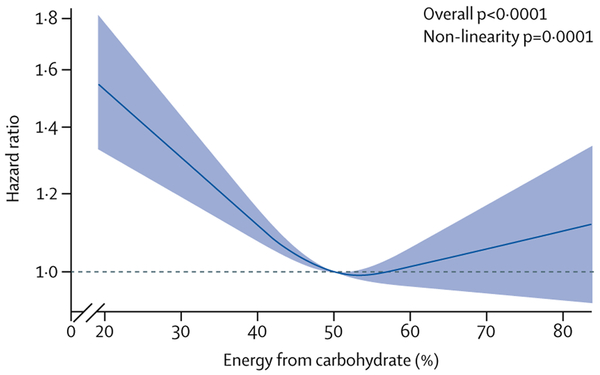
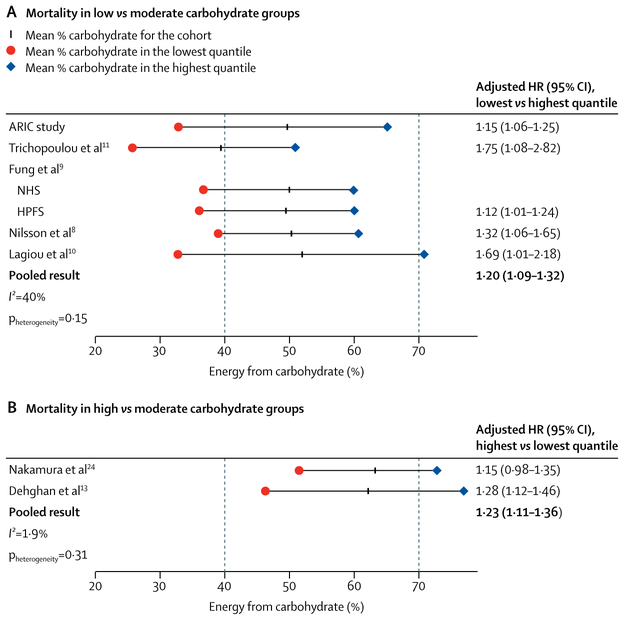
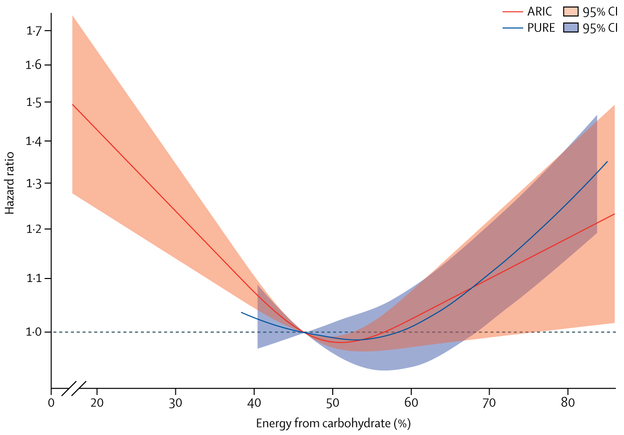
BACKGROUND: Low carbohydrate diets, which restrict carbohydrate in favour of increased protein or fat intake, or both, are a popular weight-loss strategy. However, the long-term effect of carbohydrate restriction on mortality is controversial and could depend on whether dietary carbohydrate is replaced by plant-based or animal-based fat and protein. We aimed to investigate the association between carbohydrate intake and mortality. METHODS: We studied 15 428 adults aged 45-64 years, in four US communities, who completed a dietary questionnaire at enrolment in the Atherosclerosis Risk in Communities (ARIC) study (between 1987 and 1989), and who did not report extreme caloric intake (<600 kcal or >4200 kcal per day for men and <500 kcal or >3600 kcal per day for women). The primary outcome was all-cause mortality. We investigated the association between the percentage of energy from carbohydrate intake and all-cause mortality, accounting for possible non-linear relationships in this cohort. We further examined this association, combining ARIC data with data for carbohydrate intake reported from seven multinational prospective studies in a meta-analysis. Finally, we assessed whether the substitution of animal or plant sources of fat and protein for carbohydrate affected mortality. FINDINGS: During a median follow-up of 25 years there were 6283 deaths in the ARIC cohort, and there were 40 181 deaths across all cohort studies. In the ARIC cohort, after multivariable adjustment, there was a U-shaped association between the percentage of energy consumed from carbohydrate (mean 48·9%, SD 9·4) and mortality: a percentage of 50-55% energy from carbohydrate was associated with the lowest risk of mortality. In the meta-analysis of all cohorts (432 179 participants), both low carbohydrate consumption (<40%) and high carbohydrate consumption (>70%) conferred greater mortality risk than did moderate intake, which was consistent with a U-shaped association (pooled hazard ratio 1·20, 95% CI 1·09-1·32 for low carbohydrate consumption; 1·23, 1·11-1·36 for high carbohydrate consumption). However, results varied by the source of macronutrients: mortality increased when carbohydrates were exchanged for animal-derived fat or protein (1·18, 1·08-1·29) and mortality decreased when the substitutions were plant-based (0·82, 0·78-0·87). INTERPRETATION: Both high and low percentages of carbohydrate diets were associated with increased mortality, with minimal risk observed at 50-55% carbohydrate intake. Low carbohydrate dietary patterns favouring animal-derived protein and fat sources, from sources such as lamb, beef, pork, and chicken, were associated with higher mortality, whereas those that favoured plant-derived protein and fat intake, from sources such as vegetables, nuts, peanut butter, and whole-grain breads, were associated with lower mortality, suggesting that the source of food notably modifies the association between carbohydrate intake and mortality. FUNDING: National Institutes of Health.
Overview
The claims and statistics of this paper haven’t been checked yet.
Free: it reads the open-access text and checks the first 5 claims that cite a source we can check. Create a free account to check every claim.
Integrity signals
Registry
Cites
Statistics
Figures
Verification
Claims the paper makes
The claims and statistics of this paper haven’t been checked yet.
Free: it reads the open-access text and checks the first 5 claims that cite a source we can check. Create a free account to check every claim.
Claims other papers make about this one
Each is checked against this paper’s own text: does it say what the citing paper says it does?
The cited source says what the claim attributes to it.
In the citing paper
“Considering this and a recent systematic review of cohort studies suggesting that long term LCDs are associated with increased mortality,73 clinicians might consider short term LCDs for management of type 2 diabetes, while actively monitoring and adjusting diabetes medication as needed.”
The cited source says what the claim attributes to it.
In the citing paper
“Large cohort studies suggest higher mortality at lower carbohydrate levels, but this association disappears when plant-based protein is substituted for animal-based sources of protein”
From Lifestyle Medicine for Obesity in the Era of Highly Effective Anti-Obesity Treatment (2025) · cites this paper as [188]
The check wasn’t confident either way, so it gives no verdict — never disputed.
In the citing paper
“Dietary carbohydrate has a 'neutral' effect on LDL-C, although excessive consumption is represented by untoward effects on plasma TGs and HDL-C levels [164].”
From 2019 ESC/EAS guidelines for the management of dyslipidaemias: lipid modification to reduce cardiovascular risk (2019) · cites this paper as [164]
Experimental — accuracy not yet measuredIn the citing paper
“low intakes of fats and oils increase the risk of inadequate intakes of vitamin E and of essential fatty acids, and may contribute to a reduction of HDL-C [164].”
From 2019 ESC/EAS guidelines for the management of dyslipidaemias: lipid modification to reduce cardiovascular risk (2019) · cites this paper as [164]
Self-check
Percentages, sums and reported differences re-computed from the paper’s own numbers.
The self-check needs the paper’s full text.
Citations
Cites
von Elm, E., Altman, D. G., Egger, M., Pocock, S. J., Gøtzsche, P. C., Vandenbroucke, J. P., & Initiative, F. T. S. (2007) · PLoS Medicine · doi:10.1371/journal.pmed.0040296 · Cited by 23,020
von Elm, E., Altman, D. G., Egger, M., Pocock, S. J., Gøtzsche, P. C., & Vandenbroucke, J. P. (2007) · The Lancet · doi:10.1016/s0140-6736(07)61602-x · Cited by 21,320
(2014) · Medical Entomology and Zoology · Cited by 17,633
CONSORT 2010 Statement: updated guidelines for reporting parallel group randomised trials
the CONSORT Group, Schulz, K. F., Altman, D. G., & Moher, D. (2010) · BMC Medicine · doi:10.1186/1741-7015-8-18 · Cited by 13,371
Harrell, F. E. (2001) · Springer Series in Statistics · doi:10.1007/978-1-4757-3462-1 · Cited by 9,195
Reproducibility and validity of a semiquantitative food frequency questionnaire
WILLETT, W. C., SAMPSON, L., STAMPFER, M. J., ROSNER, B., BAIN, C., WITSCHI, J., HENNEKENS, C. H., & SPEIZER, F. E. (1985) · American Journal of Epidemiology · doi:10.1093/oxfordjournals.aje.a114086 · Cited by 4,274
Self-citationA short questionnaire for the measurement of habitual physical activity in epidemiological studies
Baecke, J., Burema, J., & Frijters, J. (1982) · The American Journal of Clinical Nutrition · doi:10.1093/ajcn/36.5.936 · Cited by 3,945
CONSORT 2010 statement: updated guidelines for reporting parallel group randomized trials
Schulz, K. F., Altman, D. G., Moher, D., & for the CONSORT Group* (2010) · Annals of Internal Medicine · doi:10.7326/0003-4819-152-11-201006010-00232 · Cited by 3,824
(1989) · PubMed · Cited by 3,139
THE ATHEROSCLEROSIS RISK IN COMMUNIT (ARIC) STUDY: DESIGN AND OBJECTIVES
THE ARIC INVESTIGATORS (1989) · American Journal of Epidemiology · doi:10.1093/oxfordjournals.aje.a115184 · Cited by 2,924
Cited by
Items 201–300 of 775
Diet and Glycemic Index in Children with Type 1 Diabetes
Quarta, A., Guarino, M., Tripodi, R., Giannini, C., Chiarelli, F., & Blasetti, A. (2023) · Nutrients · doi:10.3390/nu15163507 · Cited by 39
Holden, R. M., Mustafa, R. A., Alexander, R. T., Battistella, M., Bevilacqua, M. U., Knoll, G. A., Mac‐Way, F., Reslerova, M., Wald, R., Acott, P. D., et al. (2020) · Canadian Journal of Kidney Health and Disease · doi:10.1177/2054358120944271 · Cited by 28
Dietary starch is weight reducing when distally digested in the small intestine
Lim, J., Ferruzzi, M. G., & Hamaker, B. R. (2021) · Carbohydrate Polymers · doi:10.1016/j.carbpol.2021.118599 · Cited by 24
Prentice, R. L., Pettinger, M. B., Zheng, C., Neuhouser, M. L., Raftery, D., Gowda, G. A. N., Huang, Y., Tinker, L. F., Howard, B. V., Manson, J. E., et al. (2022) · Journal of Nutrition · doi:10.1093/jn/nxac004 · Cited by 26
Kelly, O. J., Gilman, J. C., & Ilich, J. Z. (2019) · Nutrients · doi:10.3390/nu11020282 · Cited by 26
“[13], with the lowest risk at 50–55% is noteworthy, considering the expected differences in dietary CHO quality in the study population.”
BackgroundMethodInfluentialGoldenshluger, A., Constantini, K., Goldstein, N., Shelef, I., Schwarzfuchs, D., Zelicha, H., Meir, A. Y., Tsaban, G., Chassidim, Y., & Gepner, Y. (2021) · Nutrients · doi:10.3390/nu13072230 · Cited by 29
“Some evidence suggests that the health benefits of the Mediterranean diet are mediated by a limitation in carbohydrate intake [18], especially when it is replaced by unsaturated fats and specifically by polyunsaturated fats [18,19].”
BackgroundLow-Carbohydrate Diets in Korea: Why Does It Matter, and What Is Next?
Ha, K., & Song, Y. (2021) · Journal of Obesity & Metabolic Syndrome · doi:10.7570/jomes21051 · Cited by 26
“Seidelmann et al.25 reported that increased consumption of animal-based proteins and fats as replacements for carbohydrates was significantly associated with an increased risk of mortality, while consuming plant-based proteins and fats instead was significantly associated with a decreased risk of morality.”
BackgroundInfluentialMartínez, J. B. G., Alvarado, K. A., & Denkenberger, D. (2021) · Chemical Engineering Research and Design · doi:10.1016/j.cherd.2021.10.017 · Cited by 26
Papanikolaou, Y., & Fulgoni, V. L. I. (2021) · Nutrients · doi:10.3390/nu14010059 · Cited by 23
Clinical Evidence of Low-Carbohydrate Diets against Obesity and Diabetes Mellitus
Pavlidou, E., Papadopoulou, S. Κ., Fasoulas, A., Mantzorou, M., & Giaginis, C. (2023) · Metabolites · doi:10.3390/metabo13020240 · Cited by 33
Metabolically Healthy Obesity: Are Interventions Useful?
Mathis, B. J., Tanaka, K., & Hiramatsu, Y. (2023) · Current Obesity Reports · doi:10.1007/s13679-023-00494-4 · Cited by 28
Ohlsson, B. (2019) · Experimental and Therapeutic Medicine · doi:10.3892/etm.2019.7303 · Cited by 39
“%) increases mortality compared to medium carbohydrate content usually present in Nordic diet (26,49,52).”
Elevated Coronary Artery Calcium scores are associated with tooth loss
Donders, M.-C., IJzerman, L., Soffner, M., Hof, A. W. J. V. ’., Loos, B. G., & de Lange, J. (2020) · PLoS ONE · doi:10.1371/journal.pone.0243232 · Cited by 22
Koemel, N. A., Senior, A. M., Celermajer, D. S., Grech, A. L., Gill, T. P., Simpson, S. J., Raubenheimer, D., & Skilton, M. R. (2023) · Nutrients · doi:10.3390/nu15020345 · Cited by 26
“These findings align with a recent multinational meta-analysis of seven cohorts, which revealed a nonlinear U-shaped association for absolute carbohydrate intake with all-cause mortality [9].”
BackgroundResultJian, Y., Cheng, L., Hong, Y., Li, Z., Li, C., Ban, X., Zhu, L., & Gu, Z. (2023) · Nutrients · doi:10.3390/nu15245080 · Cited by 27
“…worth noting that reducing carbohydrate intake is not an ideal way to reduce glycemic fluctuation or GL. Studies have shown that a reasonable intake of carbohydrates (45% to 60% of daily energy intake) is crucial to ensuring a balanced intake of macronutrients and maintaining metabolic health [24].”
BackgroundPros & cons of some popular extreme weight-loss diets
Shilpa, J., & Mohan, V. (2018) · The Indian Journal of Medical Research · doi:10.4103/ijmr.ijmr_1793_18 · Cited by 34
Gress, T., Mansoor, K., Rayyan, Y. M., Khthir, R. A., Tayyem, R., Tzamaloukas, A. H., Abraham, N. G., Shapiro, J. I., & Khitan, Z. J. (2020) · Journal of Clinical Hypertension · doi:10.1111/jch.13985 · Cited by 22
Pattnaik, S., Dash, B., Bhuyan, S. S., Katara, J. L., Parameswaran, C., Verma, R., Ramesh, N., & Samantaray, S. (2020) · Plants · doi:10.3390/plants9101306 · Cited by 22
“) is the world’s most important food crop, cultivated in Southeast Asian region which fulfils the demand of the almost half of the population in the world [1].”
BackgroundGhorbani, Z., Kazemi, A., Shoaibinobarian, N., Taylor, K. S. M., & Noormohammadi, M. (2023) · Ageing Research Reviews · doi:10.1016/j.arr.2023.101997 · Cited by 23
The Crucial Role of the Interstitial Cells of Cajal in Neurointestinal Diseases
Choi, E. L., Taheri, N., Tan, E., Matsumoto, K., & Hayashi, Y. (2023) · Biomolecules · doi:10.3390/biom13091358 · Cited by 26
“Notably, studies have established a correlation between reduced food intake and increased overall mortality rates in both elderly individuals and aged mice [14,15].”
BackgroundChuruangsuk, C., Lean, M. E. J., & Combet, E. (2019) · European Journal of Nutrition · doi:10.1007/s00394-019-02122-1 · Cited by 26
Ha, K., Nam, K., & Song, Y. (2020) · Nutrition Journal · doi:10.1186/s12937-020-00603-2 · Cited by 23
Zhuang, P., Wang, F., Yao, J., Liu, X., Yin, L., Ao, Y., Ye, H., Wan, X., Zhang, Y., & Jiao, J. (2024) · BMC Medicine · doi:10.1186/s12916-024-03683-7 · Cited by 23
“…within 2 years from the baseline, those with missing data on covariates, individuals with extreme energy intake (< 600 kcal or > 4200 kcal per day for men and < 500 kcal or > 3600 kcal per day for women [26]), those with type 1 diabetes, or individuals who completed only one 24-h dietary recall.”
BackgroundFernandez-Lazaro, C. I., Zazpe, I., Santiago, S., Toledo, E., Barbería-Latasa, M., & Martínez‐González, M. Á. (2020) · Clinical Nutrition · doi:10.1016/j.clnu.2020.10.029 · Cited by 24
Das, A., Cumming, R. G., Naganathan, V., Blyth, F., Couteur, D. G. L., Handelsman, D. J., Waite, L. M., Ribeiro, R. V., Simpson, S. J., & Hirani, V. (2021) · Journal of Human Nutrition and Dietetics · doi:10.1111/jhn.12965 · Cited by 23
Non-alcoholic Fatty Liver Disease in Children
Muzurović, E. M., Pοlyzos, S. A., Mikhailidis, D. P., Borozan, S., Novosel, D., Cmiljanić, O., Kadić, N., & Mantzoros, C. S. (2022) · Current Vascular Pharmacology · doi:10.2174/1570161121666221118155136 · Cited by 25
Inverse J-Shaped Relationship of Dietary Carbohydrate Intake with Serum Klotho in NHANES 2007–2016
Xiang, L., Wu, M., Wang, Y., Liu, S., Lin, Q., Luo, G., & Xiao, L. (2023) · Nutrients · doi:10.3390/nu15183956 · Cited by 20
“[18] revealed a compelling U-shaped association between the energy percentage of carbohydrates and mortality, with low and high carbohydrate levels linked to increased mortality rates.”
BackgroundResultAraki, E., Tanaka, A., Inagaki, N., Ito, H., Ueki, K., Murohara, T., Imai, K., Sata, M., Sugiyama, T., Ishii, H., et al. (2020) · Circulation Journal · doi:10.1253/circj.cj-20-0865 · Cited by 26
Soh, S. M., Chung, S., & Yoon, J. (2020) · Nutrients · doi:10.3390/nu12020429 · Cited by 21
“Recently, some studies have reported that high and low energy intake from carbohydrate is associated with the high mortality [32,33].”
BackgroundNeves, G. S., Lunardi, M. D. S., Lin, K., Rieger, D. K., Ribeiro, L. C., & Moreira, J. D. (2020) · Nutrition Reviews · doi:10.1093/nutrit/nuaa112 · Cited by 24
Liu, Y., Wu, Q., Lv, J.-L., Jiang, Y., Sun, H. J., Xia, Y., Chang, Q., & Zhao, Y. (2021) · Frontiers in Nutrition · doi:10.3389/fnut.2021.670411 · Cited by 24
Sharma, R. (2021) · PharmaNutrition · doi:10.1016/j.phanu.2021.100281 · Cited by 23
Choi, J. H., Cho, Y. J., Kim, H., Ko, S., Chon, S., Kang, J., Kim, K. K., Kim, H. J., Kim, H. J., Song, K., et al. (2022) · Clinical Hypertension · doi:10.1186/s40885-022-00207-4 · Cited by 24
“Carbohydrates make up more than half of an individual’s calorie intake, and restricting them can be critical in reducing total calories and body weight [10].”
BackgroundReformulation of Pastry Products to Improve Effects on Health
Estruch, R., Vendrell, E., Ruiz-León, A. M., Casas, R. M., Castro‐Barquero, S., & Alvarez, X. (2020) · Nutrients · doi:10.3390/nu12061709 · Cited by 33
“However, it should be underlined that the increase in mortality observed with low carbohydrate intake was reversed when energy from carbohydrates was replaced by plant-derived proteins or healthy fats [44].”
BackgroundMohammadifard, N., Mansourian, M., Firouzi, S., Taheri, M., & Haghighatdoost, F. (2021) · Critical Reviews in Food Science and Nutrition · doi:10.1080/10408398.2021.1900057 · Cited by 21
Aged mice exhibit widespread metabolic changes but preserved major fluxes
Jankowski, C. S. R., Samarah, L. Z., MacArthur, M. R., Mitchell, S. J., Weilandt, D. R., Hunter, C. J., Zeng, X., McReynolds, M. R., & Rabinowitz, J. D. (2025) · Cell Metabolism · doi:10.1016/j.cmet.2025.09.009 · Cited by 19
Garcêz, L. S., de Avelar, C. R., Fonseca, N. S. D. S., Costa, P. R. D. F., Lyra, A. C., Cunha, C. D. M., de Jesús, R. P., & de Oliveira, L. P. M. (2021) · Nutrition Reviews · doi:10.1093/nutrit/nuaa146 · Cited by 21
Lim, C. G. Y., Tai, E. S., & van Dam, R. M. (2021) · American Journal of Clinical Nutrition · doi:10.1093/ajcn/nqab403 · Cited by 22
Roles of glucose‐dependent insulinotropic polypeptide in diet‐induced obesity
Seino, Y., & Yamazaki, Y. (2022) · Journal of Diabetes Investigation · doi:10.1111/jdi.13816 · Cited by 22
Features of a Balanced Healthy Diet with Cardiovascular and Other Benefits
Manolis, A. S., Manolis, T. A., Melita, H., & Manolis, A. S. (2023) · Current Vascular Pharmacology · doi:10.2174/1570161121666230327135916 · Cited by 24
Liu, C., Meng, Q., Zu, C., Wei, Y., Su, X., Zhang, Y., He, P., Zhou, C., Liu, M., Ye, Z., et al. (2023) · Clinical Nutrition · doi:10.1016/j.clnu.2023.06.021 · Cited by 18
Low carbohydrate versus balanced carbohydrate diets for reducing weight and cardiovascular risk
Naude, C. E., Schoonees, A., Nguyen, K. A., Senekal, M., Young, T., Garner, P., Chaplin, M., & Volmink, J. A. (2019) · Cochrane Database of Systematic Reviews · doi:10.1002/14651858.cd013334 · Cited by 18
Chen, H., Li, H., Cao, Y., Qi, H., Ma, Y., Bai, X., Zhao, Y., Wu, L., Liu, C., Wei, J., et al. (2022) · Frontiers in Nutrition · doi:10.3389/fnut.2022.853565 · Cited by 22
Lee, H. A., & An, H. (2020) · Scientific Reports · doi:10.1038/s41598-020-57931-w · Cited by 21
Oh, S., Wood, A. C., Hwang, S.-S., & Allison, M. (2022) · JAMA Network Open · doi:10.1001/jamanetworkopen.2022.37552 · Cited by 20
“Characteristic Mean (SD) Q1 Q2 Q3 Q4 Q5 LCD score, median (IQR) 5 (3-7) 11 (10-12) 16 (15-17) 20 (19-21) 25 (24-27) No.”
Al‐Rashed, F., Sindhu, S. T. A. K., Madhoun, A. S. A., Bahman, F., AlSaeed, H., Akhter, N., Malik, M. Z., Alzaïd, F., Al‐Mulla, F., & Ahmad, R. (2023) · Frontiers in Public Health · doi:10.3389/fpubh.2023.1115333 · Cited by 20
Meng, Q., Liu, C., Zu, C., Wei, Y., Su, X., Gan, X., Zhang, Y., He, P., Zhou, C., Liu, M., et al. (2023) · American Journal of Geriatric Psychiatry · doi:10.1016/j.jagp.2023.05.001 · Cited by 20
Connell, J., Toma, R., Ho, C. H.-C., Shen, N., Moura, P., Le, T., Patridge, E. V., Antoine, G., Keiser, H., Julian, C., et al. (2023) · American Journal of Lifestyle Medicine · doi:10.1177/15598276231216393 · Cited by 21
Tokgözoğlu, L. S., Hekimsoy, V., Costabile, G., Calabrese, I., & Riccardi, G. (2020) · Handbook of experimental pharmacology · doi:10.1007/164_2020_353 · Cited by 26
Ichikawa, T., Okada, H., Hironaka, J., Nakajima, H., Okamura, T., Majima, S., Senmaru, T., Ushigome, E., Nakanishi, N., Hamaguchi, M., et al. (2024) · Journal of Diabetes Investigation · doi:10.1111/jdi.14271 · Cited by 23
Yamauchi, T., Kamiya, H., Utsunomiya, K., Watada, H., Kawanami, D., Sato, J., Kitada, M., Koya, D., Harada, N., Shide, K., et al. (2020) · Diabetology International · doi:10.1007/s13340-020-00437-7 · Cited by 23
“Though the efficacy of a low-carbohydrate diet on vascular complications and the long-term prognosis are both unclear, a study on the amount of glucides and mortality published in the West in 2018 [30], including a cohort of 15,428 subjects in the United States, indicated there is a U curve correlation between energy…”
BackgroundLangsetmo, L., Harrison, S. L., Jonnalagadda, S. S., Pereira, S. L., Shikany, J. M., Farsijani, S., Lane, N. E., Cauley, J. A., Stone, K. L., & Cawthon, P. M. (2020) · The journal of nutrition health & aging · doi:10.1007/s12603-020-1422-4 · Cited by 20
“Our findings are contrary to many of the findings in non-geriatric populations (13, 14, 22), in which high protein intake was associated with increased, not decreased risk of mortality.”
BackgroundResultWu, Q. F., Xu, Y., Bao, Y., Alvarez, J., & Gonzales, M. L. (2020) · Journal of Clinical Medicine · doi:10.3390/jcm9082584 · Cited by 20
the directors of the JCS, J., Araki, E., Tanaka, A., Inagaki, N., Ito, H., Ueki, K., Murohara, T., Imai, K., Sata, M., Sugiyama, T., et al. (2020) · Diabetology International · doi:10.1007/s13340-020-00471-5 · Cited by 17
Pasta’s History and Role in Healthful Diets
Webb, D. (2019) · Nutrition Today · doi:10.1097/nt.0000000000000364 · Cited by 19
Ketogenic Diet in Heart Failure
Kodur, N., Yurista, S. R., Province, V. M., Rueth, E., Nguyen, C. T., & Tang, W. H. W. (2023) · JACC Heart Failure · doi:10.1016/j.jchf.2023.05.009 · Cited by 20
Carbohydrates: Separating fact from fiction
Blaak, E. E., Riccardi, G., & Cho, L. (2021) · Atherosclerosis · doi:10.1016/j.atherosclerosis.2021.03.025 · Cited by 23
(2020) · doi:10.1136/bmj.n262 · Cited by 16
Herrera, M., & Byerley, L. O. (2025) · Nutrients · doi:10.3390/nu17142373 · Cited by 15
“However, when energy from carbs was replaced with plant-derived protein or fat, this association was reversed [117].”
Wan, Z., Shan, Z., Geng, T., Lu, Q., Li, L., Yin, J., Liu, L., Pan, A., & Liu, G. (2022) · The Journal of Clinical Endocrinology & Metabolism · doi:10.1210/clinem/dgac235 · Cited by 199
Nilsson, M. I., Crozier, M., Carlo, A. D., Xhuti, D., Manta, K., Roik, L. J., Bujak, A. L., Nederveen, J. P., Tarnopolsky, M. G., Hettinga, B. P., et al. (2022) · Molecular Genetics and Metabolism · doi:10.1016/j.ymgme.2022.06.001 · Cited by 18
He, P., Li, H., Liu, M., Zhang, Z., Zhang, Y., Zhou, C., Ye, Z., Wu, Q., Liang, M., Jiang, J., et al. (2022) · Frontiers of Medicine · doi:10.1007/s11684-022-0932-3 · Cited by 15
Zhang, M., Xu, S., Zuo, Z., Xu, H., Xu, Q., Li, T., Zhang, X., & Wang, L. (2024) · International Journal of Biological Macromolecules · doi:10.1016/j.ijbiomac.2024.135206 · Cited by 15
Reversal of diabetic tractional retinal detachment attributed to keto diet
Chandrasekaran, P. R., & Rani, P. K. (2020) · BMJ Case Reports · doi:10.1136/bcr-2020-235873 · Cited by 16
Higher Animal Protein Intake During the Second Trimester of Pregnancy Is Associated With Risk of GDM
Yong, H. Y., Shariff, Z. M., Yusof, B. N. M., Rejali, Z., Tee, Y. Y. S., BINDELS, J. G., & van der Beek, E. M. (2021) · Frontiers in Nutrition · doi:10.3389/fnut.2021.718792 · Cited by 19
Shon, J., Han, Y., & Park, Y. J. (2022) · Nutrients · doi:10.3390/nu14030478 · Cited by 15
“Interestingly, in a large prospective cohort study with a 25-year follow-up, midlife participants who had low (<40%) or high (>70%) energy from carbohydrate consumption were associated with increased mortality [84].”
BackgroundZhong, G., Hu, T., Yang, P., Peng, Y., Wu, J., Sun, W., Cheng, L., & Wang, C. (2021) · Aging · doi:10.18632/aging.203302 · Cited by 17
Krasowska, U., Adamska-Patruno, E., Bauer, W., Fiedorczuk, J., Czajkowski, P., Moroz, M., Drygalski, K., Ustymowicz, A., Tomkiewicz, E., Górska, M., et al. (2023) · Scientific Reports · doi:10.1038/s41598-023-33842-4 · Cited by 16
Yuan, L., Jiang, Q., Zhai, Y., Zhao, Z., Liu, Y., Hu, F., Qian, Y. H., & Jin-hai, S. (2023) · Current Developments in Nutrition · doi:10.1016/j.cdnut.2023.102065 · Cited by 17
Lifestyle and Lipoprotein(a) Levels: Does a Specific Counseling Make Sense?
Fogacci, F., Micoli, V. D., Sabouret, P. F., Giovannini, M., & Cicero, A. F. G. (2024) · Journal of Clinical Medicine · doi:10.3390/jcm13030751 · Cited by 19
“Dietary patterns abundant in animal-derived proteins and fats might be linked to increased risks of CV disease and related mortality when compared to diets rich in plant-derived protein [27–29].”
BackgroundNegro, M., Cerullo, G., Parimbelli, M., Ravazzani, A., Feletti, F., Berardinelli, A. L., Cena, H., & D’Antona, G. (2021) · Frontiers in Physiology · doi:10.3389/fphys.2021.704290 · Cited by 17
“CPTII muscle deficiency is not easily recognized and patients may have to wait for decades just to get a proper diagnosis, generally based on referred symptoms (Sigauke et al., 2003).”
BackgroundPrimary prevention of cardiovascular disease: focus on improving behavioral risk factors
Чулков, В. С., Сергеевна, Г. Е., Сергеевич, Ч. В., Pankova, E. D., Lenets, E. A., & Tkachenko, P. E. (2021) · Russian Journal of Cardiology · doi:10.15829/1560-4071-2021-4278 · Cited by 22
Zhao, L., Li, H., Liu, D., Fang, J., Wang, J., Tan, Y., & Xiang, Y. (2022) · European Journal of Clinical Nutrition · doi:10.1038/s41430-022-01083-9 · Cited by 195
“INTRODUCTION Associations between the quality and quantity of carbohydrate intake and risk of mortality have ignited a heated debate in scientists as well as the public in recent years [1, 2].”
BackgroundSun, C., Zhang, W., Jiang, C., Jin, Y., Deng, X., Woo, J., Cheng, K. K., Lam, T., Thomas, G. N., & Xu, L. (2022) · Nutrients · doi:10.3390/nu14071406 · Cited by 14
“In a recent meta-analysis of predominantly Western populations (six of seven studies), high carbohydrate intake was associated with a higher risk of all-cause mortality and cardiovascular disease (CVD) [5].”
BackgroundU-Shaped Relation of Dietary Thiamine Intake and New-Onset Hypertension
Zhang, Y., Zhang, Y., Yang, S., Ye, Z., Wu, Q., Liu, M., Zhou, C., He, P., Jiang, J., Liang, M., et al. (2022) · Nutrients · doi:10.3390/nu14163251 · Cited by 14
“Furthermore, participants having hypertension or having no dietary thiamine data or having implausible energy intake data (female: >3600 or <500 kcal/day; male: >4200 or <600 kcal/day) [15] were also excluded.”
BackgroundGan, X., He, P., Zhou, C., Zu, C., Meng, Q., Liu, M., Zhang, Y., Yang, S., Zhang, Y., Ye, Z., et al. (2022) · British Journal Of Nutrition · doi:10.1017/s0007114522002732 · Cited by 14
Effectiveness of Changes in Diet Composition on Reducing the Incidence of Cardiovascular Disease
Calabrese, I., & Riccardi, G. (2019) · Current Cardiology Reports · doi:10.1007/s11886-019-1176-y · Cited by 16
Najjar, R. S. (2023) · Journal of Cardiovascular Development and Disease · doi:10.3390/jcdd10070282 · Cited by 26
Astina, J., & Sapwarobol, S. (2020) · Journal of Nutritional Science · doi:10.1017/jns.2020.22 · Cited by 13
“Previous studies have shown that the quality and quantity of carbohydrate have been linked to non-communicable diseases, such as diabetes and obesity((2,3)).”
BackgroundDietary recommendations for persons with type 2 diabetes mellitus
Skurk, T., Bosy‐Westphal, A., Grünerbel, A., Kabisch, S., Keuthage, W., Kleinridders, A., Kronsbein, P., Müssig, K., Nussbaumer, H., Pfeiffer, A. F. H., et al. (2022) · Experimental and Clinical Endocrinology & Diabetes · doi:10.1055/a-1624-5095 · Cited by 13
Wang, X. J., Zhang, W. S., Jiang, C. Q., Zhu, F., Jin, Y. L., Cheng, K. K., Lam, T. H., & Xu, L. (2021) · Nutrition · doi:10.1016/j.nut.2022.111844 · Cited by 16
Clinician's Guide to the Updated ABCs of Cardiovascular Disease Prevention: A Review Part 2
Arps, K. E., Pallazola, V. A., Cardoso, R. N., Meyer, J., Jones, R., Latina, J. M., Gluckman, T. J., Stone, N. J., Blumenthal, R. S., & McEvoy, J. W. (2019) · The American Journal of Medicine · doi:10.1016/j.amjmed.2019.01.031 · Cited by 14
Abbasi, M. S. P., Shojaei, N., & Farhangi, M. A. (2022) · Physiological Reports · doi:10.14814/phy2.15375 · Cited by 14
“…on the role of dietary indices or dietary patterns as an alternative approach to single nutrient evaluation in investigating the diet- disease relationships (Lagiou et al., 2007; Mirmiran et al., 2010; Sangsefidi, SalehiAbarghouei, et al., 2021; Sjogren et al., 2010; Trichopoulou et al., 2007).”
BackgroundMethodTorna, E., Smith, E. B., Lamothe, M., Langkamp‐Henken, B., & Andrade, J. (2021) · Nutrition Research · doi:10.1016/j.nutres.2021.04.001 · Cited by 13
Refined grain intake and cardiovascular disease: Meta-analyses of prospective cohort studies
Gaesser, G. A. (2022) · Trends in Cardiovascular Medicine · doi:10.1016/j.tcm.2022.08.002 · Cited by 15
Hong, W., Ying, H., Wang, X., Liu, L., Shen, X., & Shan, Y. (2023) · Nutrition · doi:10.1016/j.nut.2023.112035 · Cited by 12
Abebe, Z., Wassie, M. M., Nguyen, D. P., Reynolds, A. C., & Melaku, Y. A. (2024) · European Journal of Nutrition · doi:10.1007/s00394-024-03513-9 · Cited by 18
“The chosen response variables included fibre density (g/d) [ 62], folate density (g/d) [12], proportion of energy derived from carbohydrates [63], unsaturated fatty acids [33], and saturated fatty acids [61].”
Kundu, S., Hossain, K. S., Moni, A., Zahan, M. S., Rahman, M. M., & Uddin, M. J. (2022) · Molecular Biology Reports · doi:10.1007/s11033-022-07460-8 · Cited by 14
Diet Composition, Anthropometrics, and Mortality Risk
Krakauer, N. Y., & Krakauer, J. C. (2022) · International Journal of Environmental Research and Public Health · doi:10.3390/ijerph191912885 · Cited by 13
“[26] found that even after adjustment for covariates, low carbohydrate intake was associated with higher mortality in ARIC, primarily when accompanied by high intake of animal protein and fat.”
BackgroundMethodNguyen, H. D. (2022) · Menopause The Journal of The North American Menopause Society · doi:10.1097/gme.0000000000002064 · Cited by 14
Ye, Z., Wu, Q., Yang, S., Zhang, Y., Zhou, C., Liu, M., Zhang, Z., He, P., Zhang, Y., Li, R., et al. (2023) · BMC Medicine · doi:10.1186/s12916-023-02752-7 · Cited by 15
“In addition, participants who had hypertension (defined as having systolic blood pressure [SBP] ≥ 140 mm Hg and/or diastolic blood pressure [DBP] ≥ 90 mm Hg, previously diagnosed by physicians, or currently receiving antihypertensive therapy) and self-reported physician-diagnosed cardiovascular diseases at baseline, m…”
BackgroundSubramaniam, A., Landstrom, M., & Hayes, K. C. (2019) · Nutrients · doi:10.3390/nu11071538 · Cited by 12
“However, a recent meta-analysis involving more than 430,000 subjects and 25 years of follow-up to assess the impact of CHO intake on all-cause mortality, including complications from diabetes, revealed that macronutrient sources of protein and fat, especially from animal products, have a major detrimental effect on ch…”
BackgroundDietary Macronutrient Intakes and Mortality among Patients with Type 2 Diabetes
Lin, C., Liu, C.-S., Li, C., Lin, C.-H., Lin, W., Wang, M.-C., Yang, S.-Y., & Li, T. (2020) · Nutrients · doi:10.3390/nu12061665 · Cited by 12
“Our study demonstrated that people with 43–52% carbohydrate intakes were associated with 17–22% decrease in all-cause and expanded CVD mortality, which was consistent with the findings of a previous meta-analysis [28].”
ResultStepaniak, U., Polak, M., Stefler, D., Kozela, M., Bobák, M., Niubo, A. S., Ayuso‐Mateos, J. L., Haro, J. M., & Pająk, A. (2022) · Nutrients · doi:10.3390/nu14122454 · Cited by 11
Feng, S., Liu, R., Thompson, C., Colwell, B., Chung, S., Barry, A., & Wang, H. (2025) · The American Journal of Clinical Nutrition · doi:10.1016/j.ajcnut.2025.09.012 · Cited by 12
“Further complicating the evidence base is a proposed U-shaped relationship between carbohydrate intake and mortality, suggesting that both very low and very high carbohydrate consumption may elevate health risks [22].”
Cheng, L., Chen, Y., Luo, Z., Wang, Q., Zou, F., & Lin, Y. (2025) · Nutrients · doi:10.3390/nu17142270 · Cited by 15
“Exclusion criteria included having major chronic diseases (e.g., cancer, diabetes, stroke) or reporting implausible daily energy intakes (i.e., >3600 kcal or <500 kcal for women; >4200 kcal or <600 kcal for men) [18].”
Dietary inflammatory index and renal cancer risk: a prospective study
Wu, J., Yu, C., Shivappa, N., Hébert, J. R., & Xu, X. (2023) · Food & Function · doi:10.1039/d3fo02158k · Cited by 11
Obesity-Related Glomerulopathy: Epidemiology, Pathogenesis, and Current Treatments
Yang, X., Bayliss, G. P., & Zhuang, S. (2024) · Integrative Medicine in Nephrology and Andrology · doi:10.1097/imna-d-24-00011 · Cited by 12
“[51] In fact, studies have shown that increasing dietary fiber intake can improve kidney function [52] and reducing animal fat intake can decrease mortality risk.”
Linoleic acid, mitochondria, gut microbiome, and metabolic health: a mechanistic review
Mercola, J. M. (2025) · Advances in Redox Research · doi:10.1016/j.arres.2025.100128 · Cited by 12
Dietary Carbohydrate Intake, Carbohydrate Quality, and Healthy Aging in Women
Korat, A. V. A., Duscova, E., Shea, M. K., Jacques, P. F., Sebastiani, P., Wang, M., Mahdavi, S. M., Eliassen, A. H., Willett, W. C., & Sun, Q. (2025) · JAMA Network Open · doi:10.1001/jamanetworkopen.2025.11056 · Cited by 14
Self-citation
Metadata
- Authors
- Seidelmann, S. B., Claggett, B., Cheng, S., Henglin, M., Shah, A., Steffen, L. M., Folsom, A. R., Rimm, E. B., Willett, W. C., & Solomon, S. D.
- Affiliations
- Brigham and Women's Hospital (US)
- University of Minnesota (US)
- Corresponding author
- Solomon, Scott D
- ORCID
- Venue
- The Lancet Public Health
- Publisher
- Elsevier BV
- Published
- 2018-09
- Volume
- 3
- Issue
- 9
- Pages
- e419-e428
- ISSN
- 2468-2667 (ISSN-L)
- PMC
- PMC6339822
- OpenAlex
- W2885382674
- Semantic Scholar
- ee38d52ac78aab923b1f4de7d8d9e79b60dd20df
- Cited by
- 776
- References
- 33
- Citations by year
- 2026: 44 · 2025: 87 · 2024: 100 · 2023: 103 · 2022: 122 · 2021: 121 · 2020: 96 · 2019: 73 · 2018: 29
- FWCI
- 76.04
- Type
- journal article
- Language
- en
- Open access
- gold
- doi.org
- Licence
- cc-by-nc-nd
- www.elsevier.com/tdm/userlicense/1.0/ (tdm)
- creativecommons.org/licenses/by-nc-nd/4.0/ (vor)
- Locations
- The Lancet Public Health (publishedVersion, cc-by-nc-nd)
- PubMed (publishedVersion)
- Europe PMC (PubMed Central) (acceptedVersion, cc-by)
- PubMed Central (acceptedVersion, cc-by)
- DOAJ (DOAJ: Directory of Open Access Journals) (submittedVersion, cc-by-sa)
- Funders
- National Heart, Lung, and Blood Institute contracts (HHSN268201100005C, HHSN268201100006C, HHSN268201100007C, HHSN268201100008C, HHSN26820110000 9C, HHSN268201100010C, HHSN268201100011C, HHSN26820 1100012C)
- NIH (R01-HL134168, R01-HL131532)
- Topics
- Health Sciences › Medicine › Public Health, Environmental and Occupational Health › Nutritional Studies and Diet
- Health Sciences › Medicine › Physiology (medical) › Diet and metabolism studies
- Health Sciences › Medicine › Endocrinology, Diabetes and Metabolism › Diet, Metabolism, and Disease
- Keywords
- carbohydrate intake, all-cause mortality, low-carbohydrate diet, U-shaped relationship, macronutrient substitution, vegetable fats, plant proteins, animal protein, Atherosclerosis Risk in Communities Study, weight loss diet, nonlinear dose-response relationship, long-term mortality risk
- MeSH terms
- Diet Surveys, Dietary Carbohydrates, Female, Humans, Male, Middle Aged, Mortality, Prospective Studies, United States
About these checks
Registry, retraction, Cites and statistics results are computed, not judged, with one exception: a printed reference that no index lists is read once by a model before it counts as a citation error. Claims are extracted by a model and kept only when their quote appears verbatim in the text; each cited source is then checked, with a model’s help, for whether it says what the claim relies on. Those verdicts can be wrong — read the claim’s quote and the cited source before relying on one.
Statistics and arithmetic are recomputed, not judged.
Confidence bands are shown only for fields calibrated on our annotated test set. None is calibrated yet, so no band is shown.
What counts as a claim ›How we measure confidence ›How we check this ›
Are you an author, or do you see a problem with this page? Request a review
Data sources
Bibliographic data: Semantic Scholar, OpenAlex, Crossref.
Contains information from the Semantic Scholar Academic Graph Datasets, made available under the ODC Attribution License (ODC-BY 1.0).
Semantic Scholar’s data is described in: Kinney, R., et al. (2023). The Semantic Scholar Open Data Platform. arXiv:2301.10140.
