

Dietary carbohydrate intake and mortality: a prospective cohort study and meta-analysis
Open accessThe DOI matches its Crossref record; 33 of the 33 references it cites were found in a registry or an index.
Abstract
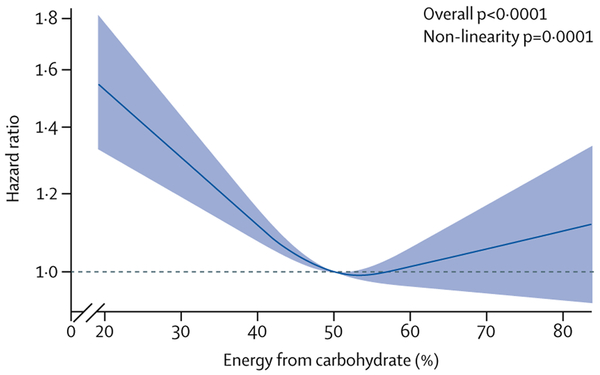
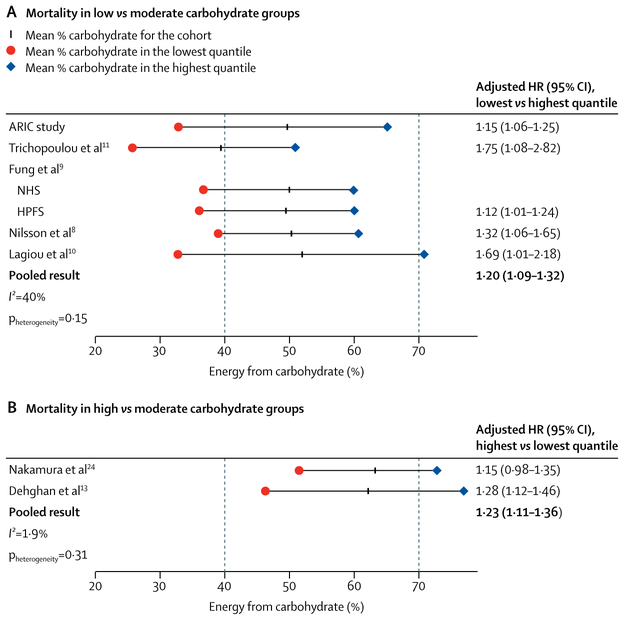
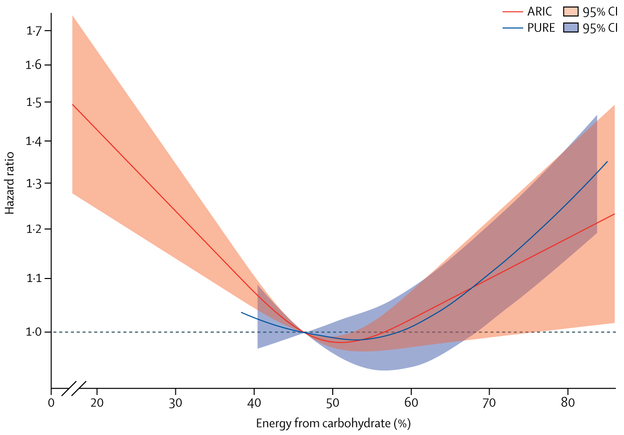
BACKGROUND: Low carbohydrate diets, which restrict carbohydrate in favour of increased protein or fat intake, or both, are a popular weight-loss strategy. However, the long-term effect of carbohydrate restriction on mortality is controversial and could depend on whether dietary carbohydrate is replaced by plant-based or animal-based fat and protein. We aimed to investigate the association between carbohydrate intake and mortality. METHODS: We studied 15 428 adults aged 45-64 years, in four US communities, who completed a dietary questionnaire at enrolment in the Atherosclerosis Risk in Communities (ARIC) study (between 1987 and 1989), and who did not report extreme caloric intake (<600 kcal or >4200 kcal per day for men and <500 kcal or >3600 kcal per day for women). The primary outcome was all-cause mortality. We investigated the association between the percentage of energy from carbohydrate intake and all-cause mortality, accounting for possible non-linear relationships in this cohort. We further examined this association, combining ARIC data with data for carbohydrate intake reported from seven multinational prospective studies in a meta-analysis. Finally, we assessed whether the substitution of animal or plant sources of fat and protein for carbohydrate affected mortality. FINDINGS: During a median follow-up of 25 years there were 6283 deaths in the ARIC cohort, and there were 40 181 deaths across all cohort studies. In the ARIC cohort, after multivariable adjustment, there was a U-shaped association between the percentage of energy consumed from carbohydrate (mean 48·9%, SD 9·4) and mortality: a percentage of 50-55% energy from carbohydrate was associated with the lowest risk of mortality. In the meta-analysis of all cohorts (432 179 participants), both low carbohydrate consumption (<40%) and high carbohydrate consumption (>70%) conferred greater mortality risk than did moderate intake, which was consistent with a U-shaped association (pooled hazard ratio 1·20, 95% CI 1·09-1·32 for low carbohydrate consumption; 1·23, 1·11-1·36 for high carbohydrate consumption). However, results varied by the source of macronutrients: mortality increased when carbohydrates were exchanged for animal-derived fat or protein (1·18, 1·08-1·29) and mortality decreased when the substitutions were plant-based (0·82, 0·78-0·87). INTERPRETATION: Both high and low percentages of carbohydrate diets were associated with increased mortality, with minimal risk observed at 50-55% carbohydrate intake. Low carbohydrate dietary patterns favouring animal-derived protein and fat sources, from sources such as lamb, beef, pork, and chicken, were associated with higher mortality, whereas those that favoured plant-derived protein and fat intake, from sources such as vegetables, nuts, peanut butter, and whole-grain breads, were associated with lower mortality, suggesting that the source of food notably modifies the association between carbohydrate intake and mortality. FUNDING: National Institutes of Health.
Overview
The claims and statistics of this paper haven’t been checked yet.
Free: it reads the open-access text and checks the first 5 claims that cite a source we can check. Create a free account to check every claim.
Integrity signals
Registry
Cites
Statistics
Figures
Verification
Claims the paper makes
The claims and statistics of this paper haven’t been checked yet.
Free: it reads the open-access text and checks the first 5 claims that cite a source we can check. Create a free account to check every claim.
Claims other papers make about this one
Each is checked against this paper’s own text: does it say what the citing paper says it does?
The cited source says what the claim attributes to it.
In the citing paper
“Considering this and a recent systematic review of cohort studies suggesting that long term LCDs are associated with increased mortality,73 clinicians might consider short term LCDs for management of type 2 diabetes, while actively monitoring and adjusting diabetes medication as needed.”
The cited source says what the claim attributes to it.
In the citing paper
“Large cohort studies suggest higher mortality at lower carbohydrate levels, but this association disappears when plant-based protein is substituted for animal-based sources of protein”
From Lifestyle Medicine for Obesity in the Era of Highly Effective Anti-Obesity Treatment (2025) · cites this paper as [188]
The check wasn’t confident either way, so it gives no verdict — never disputed.
In the citing paper
“Dietary carbohydrate has a 'neutral' effect on LDL-C, although excessive consumption is represented by untoward effects on plasma TGs and HDL-C levels [164].”
From 2019 ESC/EAS guidelines for the management of dyslipidaemias: lipid modification to reduce cardiovascular risk (2019) · cites this paper as [164]
Experimental — accuracy not yet measuredIn the citing paper
“low intakes of fats and oils increase the risk of inadequate intakes of vitamin E and of essential fatty acids, and may contribute to a reduction of HDL-C [164].”
From 2019 ESC/EAS guidelines for the management of dyslipidaemias: lipid modification to reduce cardiovascular risk (2019) · cites this paper as [164]
Self-check
Percentages, sums and reported differences re-computed from the paper’s own numbers.
The self-check needs the paper’s full text.
Citations
Cites
von Elm, E., Altman, D. G., Egger, M., Pocock, S. J., Gøtzsche, P. C., Vandenbroucke, J. P., & Initiative, F. T. S. (2007) · PLoS Medicine · doi:10.1371/journal.pmed.0040296 · Cited by 23,020
von Elm, E., Altman, D. G., Egger, M., Pocock, S. J., Gøtzsche, P. C., & Vandenbroucke, J. P. (2007) · The Lancet · doi:10.1016/s0140-6736(07)61602-x · Cited by 21,320
(2014) · Medical Entomology and Zoology · Cited by 17,633
CONSORT 2010 Statement: updated guidelines for reporting parallel group randomised trials
the CONSORT Group, Schulz, K. F., Altman, D. G., & Moher, D. (2010) · BMC Medicine · doi:10.1186/1741-7015-8-18 · Cited by 13,371
Harrell, F. E. (2001) · Springer Series in Statistics · doi:10.1007/978-1-4757-3462-1 · Cited by 9,195
Reproducibility and validity of a semiquantitative food frequency questionnaire
WILLETT, W. C., SAMPSON, L., STAMPFER, M. J., ROSNER, B., BAIN, C., WITSCHI, J., HENNEKENS, C. H., & SPEIZER, F. E. (1985) · American Journal of Epidemiology · doi:10.1093/oxfordjournals.aje.a114086 · Cited by 4,274
Self-citationA short questionnaire for the measurement of habitual physical activity in epidemiological studies
Baecke, J., Burema, J., & Frijters, J. (1982) · The American Journal of Clinical Nutrition · doi:10.1093/ajcn/36.5.936 · Cited by 3,945
CONSORT 2010 statement: updated guidelines for reporting parallel group randomized trials
Schulz, K. F., Altman, D. G., Moher, D., & for the CONSORT Group* (2010) · Annals of Internal Medicine · doi:10.7326/0003-4819-152-11-201006010-00232 · Cited by 3,824
(1989) · PubMed · Cited by 3,139
THE ATHEROSCLEROSIS RISK IN COMMUNIT (ARIC) STUDY: DESIGN AND OBJECTIVES
THE ARIC INVESTIGATORS (1989) · American Journal of Epidemiology · doi:10.1093/oxfordjournals.aje.a115184 · Cited by 2,924
Cited by
Items 501–600 of 775
Dietary carbohydrate intake and mortality: reflections and reactions
Stanton, A. A. (2018) · The Lancet Public Health · doi:10.1016/s2468-2667(18)30205-6 · Cited by 3
The right nutrition for the nutrition related diseases
Vettor, R. (2020) · Reviews in Endocrine and Metabolic Disorders · doi:10.1007/s11154-020-09582-5 · Cited by 3
Yang, N., Lee, Y., Kim, M. K., & Kim, K. (2022) · Research Square · doi:10.21203/rs.3.rs-1164783/v1 · Cited by 3
Wu, Q., Ye, Z., Zhou, C., Liu, M., Zhang, Y., Zhang, Z., He, P., Li, R., Li, H., Yang, S., et al. (2023) · American Heart Journal · doi:10.1016/j.ahj.2023.01.013 · Cited by 2
Lin, J., Wang, T., & Lin, W. T. (2024) · Nutrients · doi:10.3390/nu16132124 · Cited by 4
“…include the General Principles for Nutrition Labeling of Prepackaged Foods in China, the Guidelines for Nutrition Claims and Nutrient Functional Claims of Foods in China [33], the United Kingdom’s Traffic Nutrition Labels from the UK Food Standard Agency, and the study of Seidelmann et al. [34].”
BackgroundAlonge, O., Homsi, M. R., Rizvi, M. S., Malykh, R., Geffert, K., Kasymova, N., Tilenbaeva, N., Isakova, L., Kushubakova, M., Mavlyanova, D., et al. (2024) · Global Health Science and Practice · doi:10.9745/ghsp-d-23-00442 · Cited by 4
“For example, both are based on nutritional standards consistent with available evidence (Korea, United States, and 5 continents) 54,55 and entail the provision of free healthy meals to school children and sale restriction of competitive foods in schools.”
BackgroundWhy traditional diets are more relevant than ever today
Morris, K., & Puoane, T. R. (2024) · South African Journal of Clinical Nutrition · doi:10.1080/16070658.2024.2400441 · Cited by 2
“2,3,5 However, for those who have shown improvement, results tend to flatten out after one year and after this initial period there may be a worsening of various indicators of health in the long term.”
Recommendations For Nutritional Correction in The Treatment of Atherosclerosis
Mustafin, R. N., & Galieva, E. A. (2025) · The Russian Archives of Internal Medicine · doi:10.20514/2226-6704-2025-15-1-5-16 · Cited by 3
Hayashi, K., Nakamura, M., Tsujiguchi, H., Hara, A., Suzuki, K., Miyagi, S., Takazawa, C., Zhao, J., Camara, J., Marama, T., et al. (2025) · Nutrients · doi:10.3390/nu17050755 · Cited by 2
Aloraini, G. F., McKeown, N. M., Rogers, G. T., Das, S. K., Lichtenstein, A. H., & Jacques, P. F. (2025) · Current Developments in Nutrition · doi:10.1016/j.cdnut.2025.107479 · Cited by 3
Lou, Y., Wang, H., Wang, L., Huang, S., Xie, Y., Song, F., Lu, Z., Wang, F., Jiang, Q., & Cao, S. (2025) · Nutrients · doi:10.3390/nu17162683 · Cited by 3
“Research on macronutrient combinations is not only limited in quantity but also often constrained by poor participant adherence and unreliable evidence due to specific demographic characteristics of participants and wide variations in study durations [8,9].”
Choi, S. K., Moon, Y., & Jung, H. (2025) · Digital Health · doi:10.1177/20552076251361381 · Cited by 5
“…low-carbohydrate diet may lead to adverse health outcomes — such as increased low-density lipoprotein cholesterol, symptoms of ketosis, impaired glucose metabolism, psychological discomfort, and even higher mortality 39 – 41 — ChatGPT did not recommend restricting such diets to a short duration.”
Huang, H., & Chuang, H. W. (2025) · SeGAH ... IEEE ... International Conference on Serious Games and Applications for Health/IEEE International Conference on Serious Games and Applications for Health · doi:10.1109/segah65397.2025.11168425 · Cited by 2
Sulaj, A., Nguyen, P., Poschet, G., Kliemank, E., Fleming, T., Henke, L., Neibig, W., Kopf, S., Hell, R., Longo, V. D., et al. (2025) · Molecular Metabolism · doi:10.1016/j.molmet.2025.102257 · Cited by 2
“Low-carbohydrate diets have been associated with higher mortality, potentially due to elevated animal protein intake [25], whereas low-protein diets have been associated with higher mortality in individuals over 65 years, likely due to sar-copenia [27].”
Bae, S., & Park, H. (2025) · Nutrients · doi:10.3390/nu17203282 · Cited by 3
“However, large prospective cohort studies and meta-analyses have identified an association between very low carbohydrate intake and increased long-term mortality [36].”
Cho, H. J., Shin, W., Song, Y., Lee, J., Kang, D., & Lee, J. E. (2025) · Clinical Nutrition · doi:10.1016/j.clnu.2025.106549 · Cited by 2
Rajaguru, V., Kim, J., Chapagain, D. D., Kim, T. H., Lee, S. G., & Han, W. M. (2026) · Nutrients · doi:10.3390/nu18010178 · Cited by 4
“Similarly, the Atherosclerosis Risk in Communities (ARIC) study found U-shaped associations, where both very low and very high carbohydrate intake increased mortality risk due to differential substitutions [27,28].”
Alonso-Díaz, J., Gómez‐Sánchez, M., Echeverría, D. A., González‐Sánchez, S., Rodríguez‐Sánchez, E., García‐Ortiz, L., Gomez-Sanchez, L., Gómez-Marcos, M. Á., & EVA Investigators Group (2026) · Nutrients · doi:10.3390/nu18091314 · Cited by 3
“Total carbohydrate intake does not distinguish between refined carbohydrates and high-quality carbohydrate sources rich in fiber and low glycemic load [54–56].”
Maida, C. D., Scaglione, S., Norrito, R. L., Daidone, M., Pacinella, G., Marchese, A., Vutano, F., Cassataro, G., Dell’Ajra, L., Ferrantelli, S., et al. (2026) · Nutrients · doi:10.3390/nu18101592 · Cited by 2
“In particular, diets rich in complex carbohydrates appear to exert more favourable metabolic effects than those high in simple sugars, which are associated with hyperglycaemia, insulin resistance, and increased lipogenesis [60].”
Influences of ratio of macro-nutrients intake to human and animals: an overview
Song, G., Wang, Y., Chen, X., Pang, S., Miao, H., Li, A., & Wang, W. (2019) · Food and Agricultural Immunology · doi:10.1080/09540105.2018.1561832 · Cited by 2
“There are two results from the Lancet below, (Dehghan et al., 2017; Seidelmann et al., 2018).”
BackgroundResultInfluentialSong, S., Lee, Y. J., & Song, Y. (2020) · Daehan imsang geon-gang jeungjin hakoeji/Daehan imsang geon'gang jeungjin haghoeji · doi:10.15384/kjhp.2020.20.4.182 · Cited by 2
Yashin, A. I., Wu, D., Arbeev, K. G., Yashkin, A. P., Akushevich, I. V., Bagley, O., Duan, M., & Ukraintseva, S. V. (2021) · Journal of Translational Genetics and Genomics · doi:10.20517/jtgg.2021.26 · Cited by 3
“Further research showed that separate components of the diet, including carbohydrates[10,11], lipids[12], proteins[13–16], vitamins[17], minerals[18], fiber[19], and water, can influence aging and lifespan through different albeit often interacting genetic regulatory mechanisms.”
BackgroundLee, H. A., & Park, H. (2022) · Nutrients · doi:10.3390/nu14030654 · Cited by 6
“Regarding the effect of carbohydrate intake on health risk, associations with hypo-HDL cholesterolemia [5], mortality [6], and type 2 diabetes [7,8] have been reported.”
BackgroundSmil, V. (2021) · Oxford University Press eBooks · doi:10.1093/oso/9780190060664.003.0001 · Cited by 3
Liu, W., Sun, M., Yin, D., Zhang, G., Wang, Z., & Cui, X. (2023) · Chemistry & Biodiversity · doi:10.1002/cbdv.202300986 · Cited by 2
Hosseinpour‐Niazi, S., Bakhshi, B., Mirmiran, P., Gaeini, Z., Hadaegh, F., & Azizi, F. (2023) · Nutrition & Metabolism · doi:10.1186/s12986-023-00761-0 · Cited by 4
“The Atherosclerosis Risk in Communities (ARIC) and the Prospective Urban Rural Epidemiology (PURE) studies, two large prospective cohorts, have indicated a U-shaped effect of energy from carbohydrates intake and mortality, suggesting that both low and high carbohydrate intake was associated with an increased risk of m…”
BackgroundShah, P., Sawhney, A., Anamika, F., Kanagala, S. G., Parikh, K., Mendpara, V. A., Garg, N., & Jain, R. (2023) · Cardiovascular & Hematological Agents in Medicinal Chemistry · doi:10.2174/0118715257267341231031120105 · Cited by 2
Livzan, M. A., Lyalyukova, E. A., Друк, И. В., Safronova, S. S., Аскерович, Х. А., Martirosian, K. A., Petrosian, V. Y., & Galakhov, Y. S. (2024) · Экспериментальная и клиническая гастроэнтерология · doi:10.31146/1682-8658-ecg-218-10-5-47 · Cited by 4
Matsuo, T., Higaki, S., Inai, R., Mochizuki, S., Yoshihara, A., & Akimitsu, K. (2024) · Journal of Nutrition and Health · doi:10.4163/jnh.2024.57.2.185 · Cited by 2
Diabetes Risk Reduction Diet (DRRD) and Breast Cancer Risk: A Review
Hasani, M., Ghasemi, H., & Khodabakhshi, A. (2024) · Nutrition and Cancer · doi:10.1080/01635581.2024.2355686 · Cited by 3
“Our study is in line with previous research indicating that a nutritious diet is linked to a lower likelihood of insulin resistance and hyperinsulinemia and a decrease in mortality (51–57).”
Kim, S., & Park, C. Y. (2024) · Nutrition Research and Practice · doi:10.4162/nrp.2024.18.4.554 · Cited by 5
“Therefore, greater mixed grains, fruits, vegetables, protein, and dairy intake may decrease the risk of mortality in rural areas [63].”
BackgroundFad diets for non-dialysis chronic kidney disease patients: Can “the miracle diet” be a threat?
Brum, I. D. S. D. C., Cardozo, L., Alvarenga, L., Kemp, J. A., Baptista, B. G., Britto, I. K., Borges, N. A., Renouf, D., Wong, M., Fouque, D. P., et al. (2024) · Nutrition · doi:10.1016/j.nut.2024.112668 · Cited by 2
Macronutrients, Micronutrients, Trace Elements, Magnesium and Stroke
Aljumayi, H., Khalil, N. A., & Almatrafi, M. M. (2024) · Nutritional neurosciences · doi:10.1007/978-981-97-6818-9_11 · Cited by 3
Yin, L., Yu, L., Wang, Y., Li, X., Zhang, F., Zhan, Q., An, Q., Tian, K., Liu, T., & Wang, Z. (2025) · Scientific Reports · doi:10.1038/s41598-025-88101-5 · Cited by 2
“In the study of Seidelmann et al., there was a U-shaped association between carbohydrate intake and all-cause mortality; a high intake of carbohydrate was associated with a significantly increased risk of all-cause mortality 40 .”
Lotti, S., Dinu, M., Napoletano, A., Pagliai, G., Asensi, M. T., Giangrandi, I., Cesari, F., Becatti, M., Amedei, A., Fiorillo, C., et al. (2025) · Trials · doi:10.1186/s13063-025-08859-x · Cited by 2
“Additionally, this study comes at a time when low-carbohydrate diets have gained widespread popularity, often based on the misconception that all carbohydrates are harmful [24, 25].”
Wendin, K., Olsson, V., Karkehabadi, S., Knický, M., Korzeniowska, M., Kabašinskienė, A., Miknienė, Z., Getya, A., Matvieiev, М., Hryshchenko, N. P., et al. (2025) · Future Foods · doi:10.1016/j.fufo.2025.100731 · Cited by 4
Consumo alimentar de indivíduos com ortorexia e sua relação com nível de atividade física
Santos, S. K. D., D’avila, H. F., & Alves, F. D. (2020) · DEMETRA Alimentação Nutrição & Saúde · doi:10.12957/demetra.2020.44043 · Cited by 2
Empfehlungen zur Ernährung von Personen mit Typ-2-Diabetes mellitus
Skurk, T., Bosy‐Westphal, A., Grünerbel, A., Kabisch, S., Keuthage, W., Kronsbein, P., Müssig, K., Nussbaumer, H., Pfeiffer, A. F. H., Simon, M., et al. (2022) · Diabetologie und Stoffwechsel · doi:10.1055/a-1886-3959 · Cited by 2
Effects and Issues of Diet Fat on Cardiovascular Metabolism
Nishikawa, Y. (2021) · IntechOpen eBooks · doi:10.5772/intechopen.93261 · Cited by 3
Ma, X., & Swedlund, P. J. (2020) · Journal of Chemical Education · doi:10.1021/acs.jchemed.0c00027 · Cited by 2
A genome-wide association study on adherence to low-carbohydrate diets in Japanese
Nakamura, Y., Tamura, T., Narita, A., Shimizu, A., Sutoh, Y., Takashima, N., Matsui, K., Miyagawa, N., Kadota, A., Miura, K., et al. (2022) · European Journal of Clinical Nutrition · doi:10.1038/s41430-022-01090-w · Cited by 3
“A recent prospective cohort study and meta-analysis have shown that high and LCD were associated with higher mortality, with minimal risk observed at 50 to 55% carbohydrate consumption [11].”
BackgroundEvaluation of Student Nutrition at the University
Rakhmanov, R. S., Bogomolova, E. S., Piskarev, Y., Khayrov, R. S., & Евгеньевич, Ц. В. (2022) · ЗДОРОВЬЕ НАСЕЛЕНИЯ И СРЕДА ОБИТАНИЯ - ЗНиСО / PUBLIC HEALTH AND LIFE ENVIRONMENT · doi:10.35627/2219-5238/2022-30-3-30-35 · Cited by 2
Lang bekannt und meist ungenutzt: Lebensstilmaßnahmen zur Unterstützung der lipidsenkenden Therapie
Lorkowski, S. (2022) · DMW - Deutsche Medizinische Wochenschrift · doi:10.1055/a-1516-2581 · Cited by 2
“[41] Seidelmann SB, Claggett B, Cheng S et al.”
BackgroundPerna, S., Hammad, L., Mohamed, M. W., Alromaihi, D., Alhammadi, M., Al-Khater, N., Alchuban, A. R., Aledrisy, M. A., Ilyas, Z., Alalwan, T. A., et al. (2022) · Geriatrics · doi:10.3390/geriatrics7040075 · Cited by 2
“36 for high carbohydrate consumption [21].”
Empfehlungen zur Ernährung von Personen mit Typ-2-Diabetes mellitus
Skurk, T., Bosy‐Westphal, A., Grünerbel, A., Kabisch, S., Keuthage, W., Kronsbein, P., Müssig, K., Nussbaumer, H., Pfeiffer, A. F. H., Simon, M., et al. (2023) · Diabetologie und Stoffwechsel · doi:10.1055/a-1997-7924 · Cited by 3
Abbas‐Hashemi, S. A., Yari, Z., Soltanieh, S., Salavatizadeh, M., Karimi, S., Ardestani, S. K., Salehi, M., Jahromi, S. R., Ghazanfari, T., & Hekmatdoost, A. (2023) · Clinical Nutrition Research · doi:10.7762/cnr.2023.12.4.283 · Cited by 3
“It has been demonstrated that consuming foods rich in antioxidants is beneficial for our immune system, for instance, fresh fruits, vegetables, nuts, omega-3 fatty acids, and foods with low saturated and trans fatty acids content [22-24].”
BackgroundGolzarand, M., Masrouri, S., Soraneh, S., Moslehi, N., Mirmiran, P., & Azizi, F. (2024) · International Journal of Food Sciences and Nutrition · doi:10.1080/09637486.2024.2313972 · Cited by 2
“The Atherosclerosis Risk in Communities (ARIC) study also demonstrated a U-shaped relationship between consumption of carbohydrates and mortality in adults, with the lowest risk at 50%–55% of energy intake from carbohydrates (Seidelmann et al. 2018).”
BackgroundLifestyle Habits of Patients with Acute Myocardial Infarction and Specificity by Age Group
Matsuzaki, K., Fukushima, N., Saito, C., Hagiwara, D., Nishikawa, H., Katsuda, Y., & Miura, S.-I. (2024) · International Heart Journal · doi:10.1536/ihj.24-093 · Cited by 2
Kim, K., Kong, A., Flanigan, R. C., Quek, M. L., Hollowell, C. M. P., Vidal, P. P., Branch, J., Dean, L. A., Macias, V., Kajadacsy-Balla, A. A., et al. (2019) · Cancer Causes & Control · doi:10.1007/s10552-019-1134-4 · Cited by 2
Sind Low-Carb-Diäten lebensgefährlich?
Worm, N., & Lechner, K. (2019) · Aktuelle Ernährungsmedizin · doi:10.1055/a-0855-2545 · Cited by 2
“diese Meldungen aber keineswegs auf eine experimentelle Überprüfung konkreter LowCarb-Diätvorgaben bezog, sondern auf hochgerechnete Daten zu einer 25 Jahre zurückliegenden Ernährungserhebung einer Kohorte von freilebenden Menschen ohne konkrete Ernährungsvorgaben und ungeprüfter Dauerernährung [1], wurde in den meist…”
BackgroundInfluentialPark, P.-S., Li, M.-S., & Park, M.-Y. (2021) · 대한지역사회영양학회지 · doi:10.5720/kjcn.2021.26.6.482 · Cited by 2
“탄수화물의 적정 섭취량 연구에 서는 탄수화물의 섭취량이 총 에너지의 70%를 초과하거나 에너지의 40% 미만으로 섭취할 경우 사망률이 증가하였으 며, 섭취량이 에너지의 50 ~ 55%에서 사망률이 가장 낮은 U자형의 사망률 형태였다고[16] 보고하였다.”
Dietary Strategies for Atherosclerotic Cardiovascular Risk Reduction
Sikand, G. (2020) · Contemporary cardiology · doi:10.1007/978-3-030-56279-3_5 · Cited by 3
Dietary carbohydrate intake and mortality: reflections and reactions – Authors' reply
Seidelmann, S. B., Folsom, A. R., Rimm, E. B., Willett, W. C., & Solomon, S. D. (2018) · The Lancet Public Health · doi:10.1016/s2468-2667(18)30229-9 · Cited by 2
Self-citationRe-evaluating low-carbohydrate diets and mortality
Feinman, R. D., Lechner, K., Fine, E. J., Elliott, J., Thompson-Starkey, M., O’Hearn, L. A., & Worm, N. (2022) · The Lancet Public Health · doi:10.1016/s2468-2667(22)00118-9 · Cited by 2
Li, Z., Liu, X., Ma, X., Xiao, M., Zhang, X., Deng, Y., Liu, H., Sun, Y., & Xiao, X. (2025) · medRxiv · doi:10.1101/2025.01.03.25319951 · Cited by 2
The ketogenic diet in health and disease
Rajiyah, T., & Pannain, S. (2020) · Elsevier eBooks · doi:10.1016/b978-0-12-816918-6.00025-1 · Cited by 1
Current Evidence Regarding Low-carb Diets for The Metabolic Control of Type-2 Diabetes
de Sousa, A. A., Renke, G., Leal, A., Rassi, M. M. B., Feuser, C. S., Cunha, H., Silva, F. M., & Arbex, A. K. (2020) · Current Diabetes Reviews · doi:10.2174/1573399816666201123104358 · Cited by 1
Validation Study of the Estimated Glycemic Load Model Using Commercially Available Fast Foods
Lee, M., Kang, H., Chung, S., Nam, K., & Park, Y. K. (2022) · Frontiers in Nutrition · doi:10.3389/fnut.2022.892403 · Cited by 2
Deupmann, A.-K., Debus, E. S., & Grundmann, R. T. (2021) · Gefässchirurgie · doi:10.1007/s00772-021-00768-y · Cited by 1
Efficiency of a Nutrition Education Program in the Prediabetic Population: Is it Necessary?
Crișan, A., Guluta, E.-C., Mincă, A., Mincă, D. I., Rusu, A., Costea, R., Mincă, D. G., Gheorghiţă, V., & Călinoiu, A. L. (2023) · Internal Medicine · doi:10.2478/inmed-2023-0254 · Cited by 1
Ilayan, A., Dustin, D., Kowalski, C., Belury, M. A., Johnson, L. K., & Conrad, Z. (2024) · Journal of the Academy of Nutrition and Dietetics · doi:10.1016/j.jand.2024.11.001 · Cited by 2
Low-Carbohydrate Diet Score and Risk of Mortality: The Japan Collaborative Cohort Study
Sasakabe, T., Wakai, K., Kawai, S., Lin, Y., Hishida, A., Iso, H., Kikuchi, S., & Tamakoshi, A. (2025) · Journal of Nutrition · doi:10.1016/j.tjnut.2025.02.001 · Cited by 1
Kazeminasab, F., Baharlooie, M., Bagheri, R., Rosenkranz, S. K., & Santos, H. O. (2025) · European Journal of Clinical Nutrition · doi:10.1038/s41430-025-01626-w · Cited by 2
Puente-Fernández, J., Larumbe‐Zabala, E., Roberts, J., & Naclerio, F. (2025) · Journal of the International Society of Sports Nutrition · doi:10.1080/15502783.2025.2519515 · Cited by 1
“Both groups ingested an acceptable amount and distribution range of macronutrients across the study [60,61].”
Jones, J. M. (2025) · Nutrients · doi:10.3390/nu17132188 · Cited by 1
Watanabe, D., & Inoue, Y. (2025) · Journal of Nutritional Science · doi:10.1017/jns.2025.10018 · Cited by 2
“(40,41) In addition, poor diet quality may lead to poor nutritional status (42) and the double burden of malnutrition, such as underweight and obesity, which is closely associated with the risk of non-communicable diseases worldwide.”
Almotayri, A., Alghamdi, A. A. A., Almimoni, N. M., Alghamdi, T. H., Alzahrani, M. S., Elsherbiny, K., & Al-Ghamdi, A. (2025) · Scientific Reports · doi:10.1038/s41598-025-14773-8 · Cited by 1
“These excessive carbs and sugar consumption have been linked to reduced human longevity 38–40 .”
Prodam, F., Ricotti, R., Caramaschi, A., Mancioppi, V., Antoniotti, V., Caputo, M., Archero, F., Filigheddu, N., Tini, S., Celano, S., et al. (2025) · Clinical Nutrition · doi:10.1016/j.clnu.2025.08.018 · Cited by 4
Nair, N. K., Bui, L., Sawicki, C. M., Kandula, N. R., Kanaya, A. M., Lee, K. H., Stampfer, M. J., Willett, W. C., & Bhupathiraju, S. N. (2025) · Journal of the Academy of Nutrition and Dietetics · doi:10.1016/j.jand.2025.09.005 · Cited by 2
Self-citationLu, Y., Zhang, R., Yang, J., Liu, D., Wu, Q., Long, X., Cheng, D., Guo, J., Li, Q., Zhang, Y., et al. (2025) · BMJ Open · doi:10.1136/bmjopen-2025-106756 · Cited by 3
“19 20 Notably, evidence suggests that the quality of carbohydrates plays a more significant role in metabolic benefits than restricting total carbohydrate intake.”
Xianfeng, C., Yadoung, S., Tongchai, P., Pata, S., Khamduang, W., Chawansuntati, K., Yodkeeree, S., Wongta, A., Kulprachakarn, K., Kosashunhanan, N., et al. (2025) · Frontiers in Public Health · doi:10.3389/fpubh.2025.1535448 · Cited by 1
“One study found that the prospective cohort method had benefited from linear regression between independent variables and dependent variables (38).”
Preliminary dietary recommendations for adult spinal cord-injured endurance hand cyclists
Gordon, R. E., Potgieter, S., & Havemann‐Nel, L. (2025) · South African Journal of Clinical Nutrition · doi:10.1080/16070658.2025.2558210 · Cited by 2
PURE healthy diet score, genetic susceptibility, and incident chronic kidney disease
Yang, S., Zhang, Y., Huang, Y., Ye, Z., Zhang, Y., Gan, X., Xiang, H., Hou, F. F., & Qin, X. (2025) · Food & Function · doi:10.1039/d4fo05376a · Cited by 3
Association between vitamin D supplement use and cognitive functioning: a longitudinal cohort study
Hua, R., Lam, C. S., Mok, V., & Cheung, Y. T. (2026) · BMJ Open · doi:10.1136/bmjopen-2025-106050 · Cited by 1
An atlas of associations between dietary nutrients and the risk of 36 major chronic diseases
Luo, Z., Chen, H., Huang, S., Lai, Q., Hu, X., Wang, Y., Wang, Y., wang, J., Li, Y., & Liu, F. (2026) · The journal of nutrition health & aging · doi:10.1016/j.jnha.2026.100785 · Cited by 2
“But when calories from carbohydrate were replaced by animal fat and protein, an increased risk of all-cause mortality was observed [37,38].”
Wang, Z., Nofal, A. A., Shah, M., Bonnes, S. L. R., Saadi, S. M., Abbas, A. S., Farah, M. H., Nayfeh, T., Viola, K. E., Firwana, M., et al. (2026) · Mayo Clinic Proceedings · doi:10.1016/j.mayocp.2025.09.022 · Cited by 1
Gao, Q., Li, Y., & Wang, L. (2026) · Food Reviews International · doi:10.1080/87559129.2026.2642794 · Cited by 3
“[1,2] This shift is consequential because carbohydrates are not a monolithic macronutrient; their metabolic impact varies significantly depending on their structural type and glycemic properties.”
The swift study: dietary profiles of night shift workers characterised by overweight and obesity
Clark, A. B., Coates, A. M., Davis, C., Leung, G. K. W., Phoi, Y. Y., Rogers, M., Davis, R., & Bonham, M. P. (2026) · European Journal of Nutrition · doi:10.1007/s00394-026-03917-9 · Cited by 1
“…g/day in women and men respectively) and higher fat diet observed in our cohort has implications for poorer shift worker health, particularly if derived from animal based sources as such diets promote oxidative stress and inflammatory pathways, and are associated with higher mortality rates [68].”
Preferences and recommendations from content creators on carnivore diets: a social media analysis
Lietz, A., Dapprich, J., & Fischer, T. (2026) · Journal of Health Population and Nutrition · doi:10.1186/s41043-026-01336-4 · Cited by 1
“This need for caution is supported by a long-term follow-up study reporting a potential U-shaped association between carbohydrate intake and mortality [50].”
Nutrition Versus Statins in Primary Prevention: Where do we Stand Now?
Zabetakis, I., Lordan, R., & Τσούπρας, Α. (2019) · Elsevier eBooks · doi:10.1016/b978-0-12-813792-5.00009-4 · Cited by 2
糖尿病患者の栄養食事指導―エネルギー・炭水化物・タンパク質摂取量と栄養食事指導―
敏正, 山., 英紀, 神., 宇都宮, 一., 裕孝, 綿., 川浪, 大., 淳子, 佐., 北田, 宗., 古家, 大., 範雄, 原., 憲一郎, 幣., et al. (2020) · 糖尿病 · doi:10.11213/tonyobyo.63.91 · Cited by 4
A Trend in the Decrease in the Wheat Consumption
Dror, Y., Rimon, E., & Vaida, R. (2020) · Springer eBooks · doi:10.1007/978-3-030-39823-1_13 · Cited by 1
Pre-Pandemic Dietary Assessment of Elderly Persons Residing in Nursing Homes—Silesia (Poland)
Grajek, M. K., Krupa-Kotara, K. H., Kobza, J., & Yanakieva, A. (2022) · Healthcare · doi:10.3390/healthcare10050765 · Cited by 3
“They can be generally described as rich in plant products, including fresh fruit and vegetables, soybean, nuts, good sources of antioxidants [43] and omega-3 fatty acids [44], as well as a low content of saturated and trans fats, animal protein, and added/refined sugars [45].”
BackgroundAbi, I., Yongu, A. M., Tersoo, U. G., Adeniyi, O. S., & Saalu, L. C. (2022) · Journal of Behavioral and Brain Science · doi:10.4236/jbbs.2022.127019 · Cited by 1
The Very Low Carbohydrate Ketogenic Diet: Effective, but safe?
Chomko, M. (2022) · ADCES in Practice · doi:10.1177/2633559x221142601 · Cited by 1
“Mortality risk has been observed to decrease when carbohydrate is replaced by plant-based proteins and fats.(19) These conclusions can only be inferred toward the ketogenic diet because no studies have specifically evaluated the long-term intake of a ketogenic diet and its effect on cardiovascular events or mortality.”
BackgroundThe Role of Dietary Interventions in the Management of Obesity
Ullah, A., Jamil, M., & Jamil, J. (2023) · IntechOpen eBooks · doi:10.5772/intechopen.111529 · Cited by 3
Practical guide in using insulin degludec/insulin aspart: A multidisciplinary approach in Malaysia
Chan, S. P., Mumtaz, M., Ratnasingam, J., Tan, A. T. B., Lim, S. C., Rosman, A., Chee, K. H., Lim, S. K., Yew, S. S., Yusof, B. N. M., et al. (2023) · Malaysian Family Physician · doi:10.51866/cpg.255 · Cited by 1
Body Mass Index, Obesity, and Mortality—Part II: Weight Loss and Weight Cycling
Sanders, L., Mestre, L. M., Ejima, K., Mehta, T. S., Keith, S. W., Maki, K. C., & Allison, D. B. (2023) · Nutrition Today · doi:10.1097/nt.0000000000000615 · Cited by 1
Tramontt, C. R., Mouti, S., do Vale, M. L., Li, X., Golubić, R., & Ray, S. (2023) · BMJ Nutrition Prevention & Health · doi:10.1136/bmjnph-2022-000551 · Cited by 1
“34 Animal fats are a common source of saturated fats in the diet.”
BackgroundChun, H., Ha, J., Im, H. H., Jung, C. Y., & Doo, M. (2023) · BMC Public Health · doi:10.1186/s12889-023-17102-8 · Cited by 1
“Notably, a study called the Atherosclerosis Risk in Communities (ARIC) study reported that both very high and very low carbohydrate intake is associated with higher mortality and that an intake of 50-55% of carbohydrates is linked to the lowest risk of mortality [23].”
BackgroundAngelotti, A., Kowalski, C., Johnson, L. K., Belury, M. A., & Conrad, Z. (2024) · Frontiers in Nutrition · doi:10.3389/fnut.2024.1225674 · Cited by 5
Non-pharmacological approaches to obesity – a concise review
Confederat, L. G., Mihailov, L., Rotariu, M., & Condurache, I. (2024) · Balneo and PRM Research Journal · doi:10.12680/balneo.2024.668 · Cited by 1
“%) were associated with increased mortality, while the intermediate range, spanning from 40% to 70% carbohydrate intake, was linked to lower mortality rates [26].”
BackgroundProximate analysis and chewiness of hydrogen rich water modified sweet potato noodles
Budiarti, G. I., Sulistiawati, E., & Kumalasari, I. D. (2024) · BIO Web of Conferences · doi:10.1051/bioconf/202414804011 · Cited by 1
“For analysis of the carbohydrate content obtained in yellow sweet potato noodles of 55.43% and purple sweet potato noodles of 58.30% while it is known that the carbohydrate value of total energy consumption is 60 - 70% [20].”
InfluentialLee, S., Kim, J. Y., & Kim, K. (2025) · Journal of Nutrition and Health · doi:10.4163/jnh.2025.58.1.59 · Cited by 2
Chu, N. H. S., Yu, Y., He, J., Li, C. R. H., Pai, S. I., Leung, K. H. T., Ronald, C. W., Chan, J. C. N., & Chow, E. (2025) · Nutrients · doi:10.3390/nu17071123 · Cited by 1
“…and meta-analysis of observational studies, a long-term effect of the low-carbohydrate/ketogenic diet was associated with a higher risk of all-cause mortality, including cardiovascular disease (CVD) death [59], but reduced mortality when they were exchanged with plant-based carbohydrates [60].”
Li, H., Hu, X., Zhang, Y., Hou, W., Wang, W., & Sun, H. (2025) · Journal of Affective Disorders · doi:10.1016/j.jad.2025.03.083 · Cited by 2
Rivera, A. K. B., Nakamura, K., Latorre, A. A. E., Seino, K., Tashiro, Y., Rodriguez, A. P. S., & Zipagan, J. B. (2025) · Food and Nutrition Sciences · doi:10.4236/fns.2025.165027 · Cited by 1
Wang, X.-Y., Zhang, Y., Liu, L., Ma, H., Wei, C., Xu, X., Zhang, J., Pan, S.-J., Zhang, Y., Chen, J., et al. (2025) · Food & Function · doi:10.1039/d5fo01613d · Cited by 1
Deng, Y., Li, S., Yang, L., Zhu, X., Luo, Q., Fan, L., Shan, Z., & Yin, J. (2025) · Journal of the American Nutrition Association · doi:10.1080/27697061.2025.2524531 · Cited by 2
Ernährung bei Diabetes mellitus Typ 2
Brede, S., & Lehnert, H. (2018) · Der Internist · doi:10.1007/s00108-018-0531-1 · Cited by 1
Metadata
- Authors
- Seidelmann, S. B., Claggett, B., Cheng, S., Henglin, M., Shah, A., Steffen, L. M., Folsom, A. R., Rimm, E. B., Willett, W. C., & Solomon, S. D.
- Affiliations
- Brigham and Women's Hospital (US)
- University of Minnesota (US)
- Corresponding author
- Solomon, Scott D
- ORCID
- Venue
- The Lancet Public Health
- Publisher
- Elsevier BV
- Published
- 2018-09
- Volume
- 3
- Issue
- 9
- Pages
- e419-e428
- ISSN
- 2468-2667 (ISSN-L)
- PMC
- PMC6339822
- OpenAlex
- W2885382674
- Semantic Scholar
- ee38d52ac78aab923b1f4de7d8d9e79b60dd20df
- Cited by
- 776
- References
- 33
- Citations by year
- 2026: 44 · 2025: 87 · 2024: 100 · 2023: 103 · 2022: 122 · 2021: 121 · 2020: 96 · 2019: 73 · 2018: 29
- FWCI
- 76.04
- Type
- journal article
- Language
- en
- Open access
- gold
- doi.org
- Licence
- cc-by-nc-nd
- www.elsevier.com/tdm/userlicense/1.0/ (tdm)
- creativecommons.org/licenses/by-nc-nd/4.0/ (vor)
- Locations
- The Lancet Public Health (publishedVersion, cc-by-nc-nd)
- PubMed (publishedVersion)
- Europe PMC (PubMed Central) (acceptedVersion, cc-by)
- PubMed Central (acceptedVersion, cc-by)
- DOAJ (DOAJ: Directory of Open Access Journals) (submittedVersion, cc-by-sa)
- Funders
- National Heart, Lung, and Blood Institute contracts (HHSN268201100005C, HHSN268201100006C, HHSN268201100007C, HHSN268201100008C, HHSN26820110000 9C, HHSN268201100010C, HHSN268201100011C, HHSN26820 1100012C)
- NIH (R01-HL134168, R01-HL131532)
- Topics
- Health Sciences › Medicine › Public Health, Environmental and Occupational Health › Nutritional Studies and Diet
- Health Sciences › Medicine › Physiology (medical) › Diet and metabolism studies
- Health Sciences › Medicine › Endocrinology, Diabetes and Metabolism › Diet, Metabolism, and Disease
- Keywords
- carbohydrate intake, all-cause mortality, low-carbohydrate diet, U-shaped relationship, macronutrient substitution, vegetable fats, plant proteins, animal protein, Atherosclerosis Risk in Communities Study, weight loss diet, nonlinear dose-response relationship, long-term mortality risk
- MeSH terms
- Diet Surveys, Dietary Carbohydrates, Female, Humans, Male, Middle Aged, Mortality, Prospective Studies, United States
About these checks
Registry, retraction, Cites and statistics results are computed, not judged, with one exception: a printed reference that no index lists is read once by a model before it counts as a citation error. Claims are extracted by a model and kept only when their quote appears verbatim in the text; each cited source is then checked, with a model’s help, for whether it says what the claim relies on. Those verdicts can be wrong — read the claim’s quote and the cited source before relying on one.
Statistics and arithmetic are recomputed, not judged.
Confidence bands are shown only for fields calibrated on our annotated test set. None is calibrated yet, so no band is shown.
What counts as a claim ›How we measure confidence ›How we check this ›
Are you an author, or do you see a problem with this page? Request a review
Data sources
Bibliographic data: Semantic Scholar, OpenAlex, Crossref.
Contains information from the Semantic Scholar Academic Graph Datasets, made available under the ODC Attribution License (ODC-BY 1.0).
Semantic Scholar’s data is described in: Kinney, R., et al. (2023). The Semantic Scholar Open Data Platform. arXiv:2301.10140.
