

Dietary carbohydrate intake and mortality: a prospective cohort study and meta-analysis
Open accessThe DOI matches its Crossref record; 33 of the 33 references it cites were found in a registry or an index.
Abstract
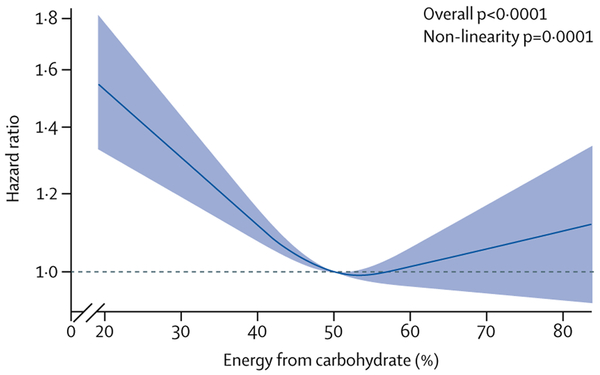
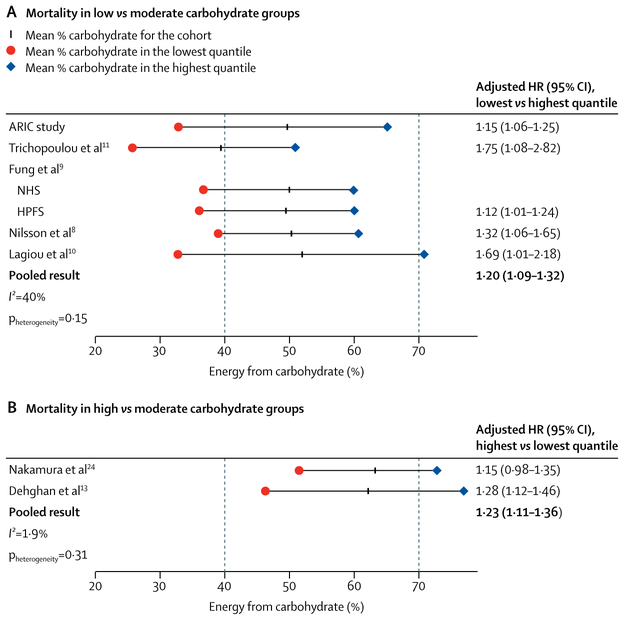
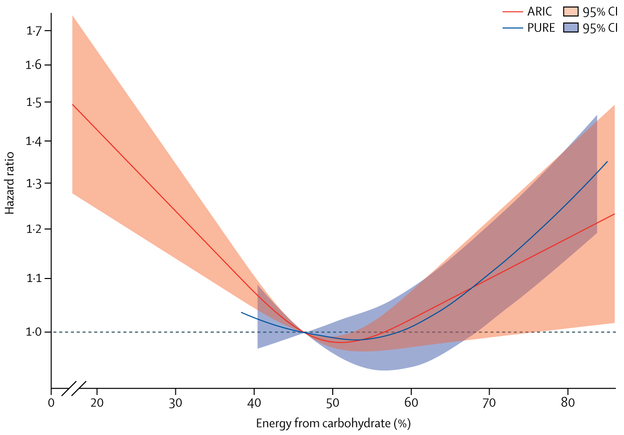
BACKGROUND: Low carbohydrate diets, which restrict carbohydrate in favour of increased protein or fat intake, or both, are a popular weight-loss strategy. However, the long-term effect of carbohydrate restriction on mortality is controversial and could depend on whether dietary carbohydrate is replaced by plant-based or animal-based fat and protein. We aimed to investigate the association between carbohydrate intake and mortality. METHODS: We studied 15 428 adults aged 45-64 years, in four US communities, who completed a dietary questionnaire at enrolment in the Atherosclerosis Risk in Communities (ARIC) study (between 1987 and 1989), and who did not report extreme caloric intake (<600 kcal or >4200 kcal per day for men and <500 kcal or >3600 kcal per day for women). The primary outcome was all-cause mortality. We investigated the association between the percentage of energy from carbohydrate intake and all-cause mortality, accounting for possible non-linear relationships in this cohort. We further examined this association, combining ARIC data with data for carbohydrate intake reported from seven multinational prospective studies in a meta-analysis. Finally, we assessed whether the substitution of animal or plant sources of fat and protein for carbohydrate affected mortality. FINDINGS: During a median follow-up of 25 years there were 6283 deaths in the ARIC cohort, and there were 40 181 deaths across all cohort studies. In the ARIC cohort, after multivariable adjustment, there was a U-shaped association between the percentage of energy consumed from carbohydrate (mean 48·9%, SD 9·4) and mortality: a percentage of 50-55% energy from carbohydrate was associated with the lowest risk of mortality. In the meta-analysis of all cohorts (432 179 participants), both low carbohydrate consumption (<40%) and high carbohydrate consumption (>70%) conferred greater mortality risk than did moderate intake, which was consistent with a U-shaped association (pooled hazard ratio 1·20, 95% CI 1·09-1·32 for low carbohydrate consumption; 1·23, 1·11-1·36 for high carbohydrate consumption). However, results varied by the source of macronutrients: mortality increased when carbohydrates were exchanged for animal-derived fat or protein (1·18, 1·08-1·29) and mortality decreased when the substitutions were plant-based (0·82, 0·78-0·87). INTERPRETATION: Both high and low percentages of carbohydrate diets were associated with increased mortality, with minimal risk observed at 50-55% carbohydrate intake. Low carbohydrate dietary patterns favouring animal-derived protein and fat sources, from sources such as lamb, beef, pork, and chicken, were associated with higher mortality, whereas those that favoured plant-derived protein and fat intake, from sources such as vegetables, nuts, peanut butter, and whole-grain breads, were associated with lower mortality, suggesting that the source of food notably modifies the association between carbohydrate intake and mortality. FUNDING: National Institutes of Health.
Overview
The claims and statistics of this paper haven’t been checked yet.
Free: it reads the open-access text and checks the first 5 claims that cite a source we can check. Create a free account to check every claim.
Integrity signals
Registry
Cites
Statistics
Figures
Verification
Claims the paper makes
The claims and statistics of this paper haven’t been checked yet.
Free: it reads the open-access text and checks the first 5 claims that cite a source we can check. Create a free account to check every claim.
Claims other papers make about this one
Each is checked against this paper’s own text: does it say what the citing paper says it does?
The cited source says what the claim attributes to it.
In the citing paper
“Considering this and a recent systematic review of cohort studies suggesting that long term LCDs are associated with increased mortality,73 clinicians might consider short term LCDs for management of type 2 diabetes, while actively monitoring and adjusting diabetes medication as needed.”
The cited source says what the claim attributes to it.
In the citing paper
“Large cohort studies suggest higher mortality at lower carbohydrate levels, but this association disappears when plant-based protein is substituted for animal-based sources of protein”
From Lifestyle Medicine for Obesity in the Era of Highly Effective Anti-Obesity Treatment (2025) · cites this paper as [188]
The check wasn’t confident either way, so it gives no verdict — never disputed.
In the citing paper
“Dietary carbohydrate has a 'neutral' effect on LDL-C, although excessive consumption is represented by untoward effects on plasma TGs and HDL-C levels [164].”
From 2019 ESC/EAS guidelines for the management of dyslipidaemias: lipid modification to reduce cardiovascular risk (2019) · cites this paper as [164]
Experimental — accuracy not yet measuredIn the citing paper
“low intakes of fats and oils increase the risk of inadequate intakes of vitamin E and of essential fatty acids, and may contribute to a reduction of HDL-C [164].”
From 2019 ESC/EAS guidelines for the management of dyslipidaemias: lipid modification to reduce cardiovascular risk (2019) · cites this paper as [164]
Self-check
Percentages, sums and reported differences re-computed from the paper’s own numbers.
The self-check needs the paper’s full text.
Citations
Cites
von Elm, E., Altman, D. G., Egger, M., Pocock, S. J., Gøtzsche, P. C., Vandenbroucke, J. P., & Initiative, F. T. S. (2007) · PLoS Medicine · doi:10.1371/journal.pmed.0040296 · Cited by 23,020
von Elm, E., Altman, D. G., Egger, M., Pocock, S. J., Gøtzsche, P. C., & Vandenbroucke, J. P. (2007) · The Lancet · doi:10.1016/s0140-6736(07)61602-x · Cited by 21,320
(2014) · Medical Entomology and Zoology · Cited by 17,633
CONSORT 2010 Statement: updated guidelines for reporting parallel group randomised trials
the CONSORT Group, Schulz, K. F., Altman, D. G., & Moher, D. (2010) · BMC Medicine · doi:10.1186/1741-7015-8-18 · Cited by 13,371
Harrell, F. E. (2001) · Springer Series in Statistics · doi:10.1007/978-1-4757-3462-1 · Cited by 9,195
Reproducibility and validity of a semiquantitative food frequency questionnaire
WILLETT, W. C., SAMPSON, L., STAMPFER, M. J., ROSNER, B., BAIN, C., WITSCHI, J., HENNEKENS, C. H., & SPEIZER, F. E. (1985) · American Journal of Epidemiology · doi:10.1093/oxfordjournals.aje.a114086 · Cited by 4,274
Self-citationA short questionnaire for the measurement of habitual physical activity in epidemiological studies
Baecke, J., Burema, J., & Frijters, J. (1982) · The American Journal of Clinical Nutrition · doi:10.1093/ajcn/36.5.936 · Cited by 3,945
CONSORT 2010 statement: updated guidelines for reporting parallel group randomized trials
Schulz, K. F., Altman, D. G., Moher, D., & for the CONSORT Group* (2010) · Annals of Internal Medicine · doi:10.7326/0003-4819-152-11-201006010-00232 · Cited by 3,824
(1989) · PubMed · Cited by 3,139
THE ATHEROSCLEROSIS RISK IN COMMUNIT (ARIC) STUDY: DESIGN AND OBJECTIVES
THE ARIC INVESTIGATORS (1989) · American Journal of Epidemiology · doi:10.1093/oxfordjournals.aje.a115184 · Cited by 2,924
Cited by
Items 301–400 of 775
Shang, X., Hill, E., Zhu, Z., Liu, J., Ge, Z., Wang, W., & He, M. (2021) · Journal of Alzheimer s Disease · doi:10.3233/jad-215042 · Cited by 12
“Notably, more recent evidence has shown a significant non-linear relationship between macronutrient intake and risks of cardiovascular disease and mortality [26, 54].”
Liu, C., Meng, Q., Zu, C., Li, R., Yang, S., He, P., Li, H., Zhang, Y. Y., Zhou, C., Liu, M., et al. (2022) · QJM · doi:10.1093/qjmed/hcac159 · Cited by 12
Dietary intervention for children and adolescents with familial hypercholesterolaemia
Capra, M. E., Biasucci, G., Crivellaro, E., Banderali, G., & Pederiva, C. (2023) · The Italian Journal of Pediatrics/Italian journal of pediatrics · doi:10.1186/s13052-023-01479-8 · Cited by 16
“A recent meta-analysis of epidemiological studies has highlighted the presence of a U-shaped relationship between carbohydrates intake and mortality, showing an increase in mortality rate when carbohydrates daily intake is lower than 40% or higher than 70% of total daily caloric intake [45].”
BackgroundEvolving evidence about diet and health
Mente, A., & Yusuf, S. (2018) · The Lancet Public Health · doi:10.1016/s2468-2667(18)30160-9 · Cited by 12
Burkitt, M. J. (2020) · Nutrition · doi:10.1016/j.nut.2020.110763 · Cited by 16
Changing dietary approaches to prevent cardiovascular disease
Nestel, P. J., Beilin, L. J., & Mori, T. A. (2020) · Current Opinion in Lipidology · doi:10.1097/mol.0000000000000709 · Cited by 11
Shin, W., Shin, S., Lee, J., Kang, D., & Lee, J. E. (2020) · Molecular Nutrition & Food Research · doi:10.1002/mnfr.202000379 · Cited by 12
Approach to the Patient With Moderate Hypertriglyceridemia
Subramanian, S. (2022) · The Journal of Clinical Endocrinology & Metabolism · doi:10.1210/clinem/dgac085 · Cited by 13
Nguyen, V. T. T., Taheri, N., Choi, E. L., Kellogg, T. A., Linden, D. R., & Hayashi, Y. (2023) · Cellular and Molecular Gastroenterology and Hepatology · doi:10.1016/j.jcmgh.2023.06.002 · Cited by 10
“In addition, a potential link between improved food intake and lifespan remains unclear because there are many discrepant reports in mice and human beings.(6,8,39) Using the transposase-accessible chromatin sequencing technique, a recent study found that IGF1 stimulation increases chromatin accessibility of middle-age…”
BackgroundGan, X., Liu, M., He, P., Ye, Z., Xiang, H., Zhou, C., Yang, S., Zhang, Y., Zhang, Y., Huang, Y., et al. (2023) · Journal of clinical lipidology · doi:10.1016/j.jacl.2023.11.013 · Cited by 11
Liu, Z., Huang, H., Xie, J., Hou, L., & Xu, C. (2023) · Nutrition Journal · doi:10.1186/s12937-023-00897-y · Cited by 12
Dietary management of dyslipidemia
Chopra, A. K. (2023) · Indian Heart Journal · doi:10.1016/j.ihj.2023.12.005 · Cited by 15
“6,7,26 Whereas carbohydrates are neutral for cardiometabolic health overall, refined and processed carbohydrates are unhealthy and are associated with obesity, diabetes, lipid abnormalities, hypertension and CVD, 6,10,27 – 30, 79 the effects”
BackgroundThe Therapeutic Potential of the Specific Intestinal Microbiome (SIM) Diet on Metabolic Diseases
Chu, N. H. S., Chow, E., & Chan, J. C. N. (2024) · Biology · doi:10.3390/biology13070498 · Cited by 13
“This result may be due to an increased mortality rate when carbohydrates were exchanged for animal-derived fat or protein, but there was decreased mortality when they were exchanged with plant-based sources [159].”
BackgroundSpecific macronutrient clusters associated with lower mortality risk: Evidence from NHANES 1999–2018
Yu, J., Chen, Y., Li, D., Zhang, L., Zhang, Y., Zhang, J., Zhu, J., Li, Z., Fu, H., Guan, D., et al. (2025) · Journal of Advanced Research · doi:10.1016/j.jare.2025.02.019 · Cited by 10
Lee, C.-L., Liu, W.-J., & Wang, J. (2020) · Clinical Nutrition · doi:10.1016/j.clnu.2020.12.019 · Cited by 11
Immunonutrition and SARS-CoV-2 Infection in Children with Obesity
D’Auria, E., Calcaterra, V., Verduci, E., Ghezzi, M., Lamberti, R., Vizzuso, S., Baldassarre, P., Pendezza, E., Perico, V., Bosetti, A., et al. (2022) · Nutrients · doi:10.3390/nu14091701 · Cited by 11
“Some authors have suggested including habitual diet foods with antioxidant function, such as vegetables, fresh fruits, soy, nuts [104], and omega-3 fatty acids (ω3) [105].”
BackgroundUpdate on Nutrition in Diabetes Management
Reynolds, A. N., & Mann, J. I. (2022) · Medical Clinics of North America · doi:10.1016/j.mcna.2022.03.003 · Cited by 17
Mondal, A. K., Brock, D. C., Rowan, S., Yang, Z., Rojulpote, K. V., Smith, K., Francisco, S. G., Bejarano, E., English, M. A., Deik, A., et al. (2024) · iScience · doi:10.1016/j.isci.2024.108979 · Cited by 12
Proportions of macronutrients, including specific dietary fats, in prospective anti-Alzheimer’s diet
Studnıckı, M., Dębski, K. J., & Stępkowski, D. (2019) · Scientific Reports · doi:10.1038/s41598-019-56687-2 · Cited by 11
Haugsgjerd, T. R., Egeland, G. M., Nygard, O. K., Igland, J., Sulo, G., Lysne, V., Vinknes, K. J., Bjornevik, K., & Tell, G. S. (2020) · Public Health Nutrition · doi:10.1017/s1368980020003043 · Cited by 11
“The current study can therefore not be compared with previous studies that have shown higher allcause and cause-specific mortality associated with much lower carbohydrate intakes than our study population(52,53).”
ResultGallo, S., & Cheskin, L. J. (2021) · Gastroenterology Clinics of North America · doi:10.1016/j.gtc.2020.10.003 · Cited by 14
The association between carbohydrate quality index and nutrient adequacy in Iranian adults
Farazi, M., Jayedi, A., Noruzi, Z., Firouzabadi, F. D., Asgari, E., Djafarian, K., & Shab‐Bidar, S. (2021) · Nutrition & Food Science · doi:10.1108/nfs-12-2020-0478 · Cited by 11
Papamichou, D., Panagiotakos, D. B., Holmes, E. C., Koutsakis, P., Katsoulotos, H., Loo, R. L., & Itsiopoulos, C. (2021) · Nutrition Metabolism and Cardiovascular Diseases · doi:10.1016/j.numecd.2021.09.031 · Cited by 14
Silveira, É. A., Noll, P. R. E. S., Mohammadifard, N., Rodrigues, A. P. D. S., Sarrafzadegan, N., & de Oliveira, C. M. (2021) · Nutrients · doi:10.3390/nu13103504 · Cited by 14
“36) were associated with an increased mortality risk [44,45].”
Empfehlungen zur Ernährung von Personen mit Typ-2-Diabetes mellitus
Skurk, T., Bosy‐Westphal, A., Grünerbel, A., Kabisch, S., Keuthage, W., Kronsbein, P., Müssig, K., Pfeiffer, A. F. H., Simon, M., Tombek, A., et al. (2021) · Diabetologie und Stoffwechsel · doi:10.1055/a-1543-1293 · Cited by 11
Current status of nutrient intake in Korea: focused on macronutrients
Oh, S. (2022) · Journal of Korean Medical Association · doi:10.5124/jkma.2022.65.12.801 · Cited by 10
Lin, I.-C., Wu, C., Tain, Y., Chen, I., Hung, C., & Wu, K. L. H. (2019) · The Journal of Nutritional Biochemistry · doi:10.1016/j.jnutbio.2019.03.014 · Cited by 10
Wu, Q., Ye, Z., Zhang, Y., Yang, S., Zhou, C., Liu, M., Zhang, Y., Zhang, Z., He, P., Li, R., et al. (2023) · Nutrition Metabolism and Cardiovascular Diseases · doi:10.1016/j.numecd.2023.03.002 · Cited by 9
Tamura, T., Wakai, K., Kato, Y., Tamada, Y., Kubo, Y., Okada, R., Nagayoshi, M., Hishida, A., Imaeda, N., Goto, C., et al. (2023) · Journal of Nutrition · doi:10.1016/j.tjnut.2023.05.027 · Cited by 10
Associations of low-carbohydrate with mortality in chronic kidney disease
Ren, Q., Zhou, Y., Luo, H., Chen, G., Han, Y., Zheng, K., Qin, Y., & Li, X. (2023) · Renal Failure · doi:10.1080/0886022x.2023.2202284 · Cited by 12
“in a large cohort study and meta-analysis [30].”
BackgroundLi, B., Xu, L., He, R., Li, Y., Li, G., Deng, Y., Wang, Z., Li, F., Li, T., & Rong, S. (2024) · Clinical Nutrition · doi:10.1016/j.clnu.2024.05.015 · Cited by 11
Hironaka, J., Hamaguchi, M., Ichikawa, T., Nakajima, H., Okamura, T., Majima, S., Senmaru, T., Okada, H., Ushigome, E., Nakanishi, N., et al. (2024) · Journal of Diabetes Investigation · doi:10.1111/jdi.14326 · Cited by 12
“Carbohydrate intake was reported to be higher in Asians than in Westerners 35 .”
InfluentialEurasian clinical practice guidelines for dietary management of cardiovascular diseases (2024)
Starodubova, A. V., Chazova, I. E., Tutelyan, V. A., Nikityuk, D. B., Pavlovskaya, E. V., Кislyak, O. A., Blinova, N. V., Brumberg, A. A. B., Bubnova, M. G., Varaeva, Y. R., et al. (2024) · Eurasian heart journal · doi:10.38109/2225-1685-2024-4-6-66 · Cited by 13
Diretriz Brasileira de Dislipidemias e Prevenção da Aterosclerose – 2025
Rached, F. H., Miname, M. H., Rocha, V. Z., Zimerman, A., Cesena, F. Y., Sposito, A. C., Santos, R. D., Behr, P. E. B., Bianco, H. T., Alves, R. J., et al. (2025) · Arquivos Brasileiros de Cardiologia · doi:10.36660/abc.20250640 · Cited by 98
A prospective study of carbohydrate intake and risk of all-cause and specific-cause mortality
Zeng, X., Li, X., Zhang, Z., Li, H., Wang, Y., Zhu, Y., Hu, A., Zhao, Q., Tang, M., Zhang, X., et al. (2022) · European Journal of Nutrition · doi:10.1007/s00394-022-02877-0 · Cited by 12
“There has been only one study to primarily investigate the association between carbohydrate intake and mortality in the United States to date [7].”
BackgroundResultInfluentialOmoto, T., Kyozuka, H., Murata, T., Imaizumi, K., Yamaguchi, A., Fukuda, T., Isogami, H., Yasuda, S., Satô, A., Ogata, Y., et al. (2022) · Journal of obstetrics and gynaecology research · doi:10.1111/jog.15501 · Cited by 9
“(50%–65%) is obtained from carbohydrates(27) based on a large prospective cohort study that examined the association between carbohydrate intake and mortality in the United States.(28) The abovementioned study suggested a U-shaped relationship between life expectancy and overall carbohydrate intake, wherein lifespan w…”
BackgroundLi, X., Shi, Y., Wei, D., Ni, W., Zhu, N., & Yan, X. (2023) · Frontiers in Endocrinology · doi:10.3389/fendo.2023.1283626 · Cited by 12
“The fi ndings from the Atherosclerosis Risk in Communities (ARIC) study underscore that the nadir of mortality risk is attained when carbohydrates contribute to 50% to 55% of the overall energy intake (7).”
BackgroundZhang, H., Zhang, X., Yang, H., Yang, H., Zhang, T., Chen, L., Zhao, Y., & Xia, Y. (2024) · International Journal of Biological Macromolecules · doi:10.1016/j.ijbiomac.2024.129824 · Cited by 10
L-shaped association between dietary zinc intake and cognitive decline in Chinese older people
Meng, Q., Liu, M., Zu, C., Su, X., Wei, Y., Gan, X., Zhang, Y., He, P., Zhou, C., Ye, Z., et al. (2024) · Age and Ageing · doi:10.1093/ageing/afae008 · Cited by 10
Metsovitis, T., Bernardi, M., Bruckert, É., Fogacci, F., Cicero, A. F. G., García-Zamora, S., Spadafora, L., Angoulvant, D., Biondi‐Zoccai, G., & Sabouret, P. F. (2024) · Archives of Medical Science · doi:10.5114/aoms/187841 · Cited by 15
“[42], both high and low percentages of carbohydrates are associated with an increase in mortality.”
Gato, S., García‐Fernández, V., Gil‐Gómez, A., Rojas, Á., Montero‐Vallejo, R., Múñoz‐Hernández, R., & Romero‐Gómez, M. (2024) · European Cardiology Review · doi:10.15420/ecr.2023.26 · Cited by 10
“–111 In the absence of an approved effective drug for the treatment of NAFLD, the current first-line treatment for NAFLD consists of lifestyle modifications, including dietary, physical activity and weight-loss interventions.”
BackgroundDonders, M.-C., van der Sleen, J. M., Kleinbergen, Y. J., Su, N., de Lange, J., & Loos, B. G. (2021) · Advances in Oral and Maxillofacial Surgery · doi:10.1016/j.adoms.2021.100223 · Cited by 12
“Carbohydrate intake is also associated with increased risk for infection and mortality rates of COVID-19 across the world [13,14].”
Pooling of cohort studies and RCTs affects GRADE certainty of evidence in nutrition research
Schwingshackl, L., Nagavci, B., Stadelmaier, J., Werner, S. S., Garcia, C. A. C., Schünemann, H. J., & Meerpohl, J. J. (2022) · Journal of Clinical Epidemiology · doi:10.1016/j.jclinepi.2022.04.013 · Cited by 9
The microvascular endothelial glycocalyx: An additional piece of the puzzle in veterinary medicine
Lawrence-Mills, S. J., Hughes, D., Hezzell, M., Butler, M. J., Neal, C., Foster, R. R., Welsh, G. I., & Finch, N. (2022) · The Veterinary Journal · doi:10.1016/j.tvjl.2022.105843 · Cited by 9
Zhang, J., Chen, J., Sui, X., Drenowatz, C. J., & Wang, Q. (2023) · Nutrients · doi:10.3390/nu15040806 · Cited by 21
Carbohydrates and Hypertension: The Quality Counts
Savoia, C. (2021) · Hypertension · doi:10.1161/hypertensionaha.121.16997 · Cited by 9
Estlin, A. F. L., Ahern, A. L., Griffin, S. J., & Strelitz, J. (2021) · Diabetic Medicine · doi:10.1111/dme.14646 · Cited by 8
Healthy and unhealthy low-carbohydrate diets and plasma markers of cardiometabolic risk
Huang, Y. P., Li, X., Zhang, T., Zeng, X., Li, M., Li, H., Yang, H., Zhang, C., Zhu, Y., Zhang, Z., et al. (2022) · British Journal Of Nutrition · doi:10.1017/s0007114522003038 · Cited by 9
“In addition, there have been limited studies on the associations between LCDs and markers of cardiometabolic risk in the US free-living population, although few observational studies (25; 26; 27) have examined the associations in East Asia, in which the average percentage of energy from carbohydrate intake was approxi…”
BackgroundSari, D. R., Ramadhan, R. N., Agustin, D., Munir, M., Izzatunnisa, N., Susanto, J., Halim, S., Pranoto, A., & Rejeki, P. S. (2023) · Retos · doi:10.47197/retos.v51.101189 · Cited by 12
“Prospective and meta-analytical studies reported that high-carbohydrate diets increased the development of T2DM, stroke, coronary heart disease (CHD), and mortality risk in Asia, Europe, and the US (Seidelmann et al, 2018; Hardy et al, 2020).”
BackgroundTian, Q., Lin, L., Shan, Z., Lu, Q., Li, R., Liu, S., Lin, X., Li, R., Chen, X., Ou, Y., et al. (2024) · Journal of Nutrition · doi:10.1016/j.tjnut.2024.03.011 · Cited by 8
Li, M., Li, X., Yin, K., Wang, T., Jiang, C., Cao, H., Zhang, Z., Sun, J., & Yang, W. (2025) · American Journal of Epidemiology · doi:10.1093/aje/kwaf087 · Cited by 8
Gorini, F., & Tonacci, A. (2025) · Nutrients · doi:10.3390/nu17142350 · Cited by 12
“[98].”
Zhang, Y., Liu, M., Yang, S., Zhang, Y., Ye, Z., Wu, Q., Li, R., Zhou, C., He, P., Liu, C., et al. (2023) · Nutrition Metabolism and Cardiovascular Diseases · doi:10.1016/j.numecd.2023.11.005 · Cited by 8
Liu, Z., Zhao, D., Dai, S., Liang, Y. J., Zhao, M., Liu, M., Zhong, Z., Liang, L., Tian, Z., & Yang, Y. (2024) · Journal of Nutrition · doi:10.1016/j.tjnut.2024.02.008 · Cited by 11
Mediterranean diet lowers risk of new-onset diabetes: a nationwide cohort study in China
Ying, Z., Fu, M., Fang, Z., Ye, X., Wang, P., & Lu, J. (2024) · Nutrition Journal · doi:10.1186/s12937-024-01036-x · Cited by 13
“Of the 13,500 participants, 213 participants with self-report diabetes at baseline and 712 with extreme dietary energy data (males: > 4200 or < 800 kcal/day; females: > 3600 or < 600 kcal/day) [29] were further excluded.”
BackgroundTsunemi, A., Sato, J., Sugimoto, S., Iwagaki, Y., Enomoto, M., Someya, Y., Kiya, M., Matsuhashi, E., Wakabayashi, Y., Funayama, T., et al. (2021) · Journal of Clinical Medicine Research · doi:10.14740/jocmr4558 · Cited by 10
“In addition, according to a study with more than two decades of follow-up that investigated mortality risk in a large cohort of adults in the USA, mid-life dietary patterns characterized both by low-carbohydrate (< 40% of energy from carbohydrates) and high-carbohydrate (> 70% of energy from carbohydrates) consumption…”
BackgroundNguyen, T. X., Agazzi, A., McGill, S., Weidt, S. K., Hanh, H. Q., Gelemanović, A., McLaughlin, M., Piñeiro, M., Savoini, G., Eckersall, P. D., et al. (2022) · Journal of Proteomics · doi:10.1016/j.jprot.2022.104562 · Cited by 8
De‐la‐O, A., Jurado‐Fasoli, L., Gracia‐Marco, L., Henriksson, P., Castillo, M. J., & Amaro‐Gahete, F. J. (2022) · The journal of nutrition health & aging · doi:10.1007/s12603-022-1763-2 · Cited by 9
Choi, J. H., Cho, Y. J., Kim, H., Ko, S., Chon, S., Kang, J., Kim, K. K., Kim, E. M., Kim, H. J., Song, K., et al. (2022) · Journal of Obesity & Metabolic Syndrome · doi:10.7570/jomes22009 · Cited by 15
Zhang, S., Wang, L., Jia, X., Zhang, J., Jiang, H., Li, W., Huang, F., Wang, H., Zhang, B., Ding, G., et al. (2022) · Nutrients · doi:10.3390/nu14132778 · Cited by 10
“90) [29], so the above-mentioned improper consumption might pose potential risks for long-term health [30].”
BackgroundTerapia Nutricional no Pré-Diabetes e no Diabetes Mellitus Tipo 2
Ramos, S., Campos, L. F., Baptista, D. R., Strufaldi, M. B., Gomes, D. L., Guimarães, D. B., Souto, D. L., Marques, M., Sousa, S. S. D. S., & de Campos, T. F. (2022) · Conectando Pessoas eBooks · doi:10.29327/557753.2022-25 · Cited by 17
Immunmodulation durch Ernährung bei kritisch kranken Patienten
Hirschberger, S., Schmid, A., & Kreth, S. (2023) · Die Anaesthesiologie · doi:10.1007/s00101-023-01258-4 · Cited by 9
“eine derartige Verteilung der Makronährstoffe, und die (limitierten) verfügbaren klinischen Daten sind bestenfalls kontrovers [47, 176].”
BackgroundArimoto, M., Yamämoto, Y., Imaoka, W., Kuroshima, T., Toragai, R., Nakamura, M., Ito, Y., & Ai, M. (2023) · Journal of Atherosclerosis and Thrombosis · doi:10.5551/jat.64024 · Cited by 12
Keto diets: good, bad or ugly?
Evans, M. L. (2018) · The Journal of Physiology · doi:10.1113/jp276703 · Cited by 8
Wang, C., Almoosawi, S., & Palla, L. (2019) · Nutrients · doi:10.3390/nu11102476 · Cited by 12
“An updated prospective cohort study has found a U-shaped relationship between all-cause mortality and CH intake, in which life span is greatest among people with around 50% energy contributed by CH [33].”
BackgroundFat, Sugar or Gut Microbiota in Reducing Cardiometabolic Risk: Does Diet Type Really Matter?
Nabrdalik, K., Krzyżak, K., Hajzler, W., Drożdż, K., Kwiendacz, H., Gumprecht, J., & Lip, G. Y. H. (2021) · Nutrients · doi:10.3390/nu13020639 · Cited by 9
“LCDs with mainly animal-derived protein and fat sources were associated with higher mortality, but LCDs consisting of plant-derived protein and fat sources were associated with lower mortality [137].”
InfluentialZhao, Y., & Araki, T. (2021) · Nutrients · doi:10.3390/nu13093044 · Cited by 10
“The changes in macronutrient composition are also linked to the burden of increase in NCDs such as diabetes and overweight [11,12].”
BackgroundZhang, S., Wang, Y., Wang, X., Leng, M., Liu, R., Li, Z., Li, J., Xiao, J., Hou, D., Gao, X., et al. (2025) · BMC Medicine · doi:10.1186/s12916-025-04072-4 · Cited by 11
“%) is even related to increased mortality [27].”
Fed, not fasted: is carbohydrate mouth rinsing still ergogenic? A three-level meta-analysis
Deng, H., Fan, X., Liu, P., Song, T., Fuaad, A. A. H. A., Nasiruddin, N. J. M., & Naharudin, M. N. (2025) · Journal of the International Society of Sports Nutrition · doi:10.1080/15502783.2025.2579027 · Cited by 12
“Mixed-effects meta-regression with REML was used for all moderator models [43], and best-fitting functional forms were selected using AICc [44].”
Influentialdo Vale, M. R. L., Buckner, L., Mitrofan, C. G., Tramontt, C. R., Kargbo, S. K., Khalid, A., Ashraf, S., Mouti, S., Dai, X., Unwin, D., et al. (2021) · Nutrition Research Reviews · doi:10.1017/s0954422421000378 · Cited by 7
“For instance, a meta-analysis of prospective studies showed that low-carbohydrate diets were associated with increased mortality when carbohydrates were exchanged for animal-derived fat or protein, and decreased when the substitutions were plant-based fats or proteins (272) .”
Zeng, B., Pan, H., Li, F., Ye, Z.-Y., Liu, Y., & Du, J. (2022) · Journal of Diabetes Investigation · doi:10.1111/jdi.13935 · Cited by 11
Eckart, A. C., Bhochhibhoya, A., Stavitz, J., Ghimire, P. S., & Mathieson, K. M. (2023) · Global Epidemiology · doi:10.1016/j.gloepi.2023.100112 · Cited by 7
Li, X., Wang, Q., Guo, L., Xue, Y., Dang, Y., Liu, W., Yin, T., Zhang, Y., & Zhao, Y. (2023) · Nutrients · doi:10.3390/nu15143084 · Cited by 7
Association Between Nutrients and Cardiovascular Diseases
Shakarami, A. (2024) · Current Cardiology Reviews · doi:10.2174/011573403x263414231101095310 · Cited by 10
“A recent cohort study and meta-analysis showed that 50–55% energy consumption from carbohydrates is associated with the lowest risk of mortality, whereas low carbohydrate intake <40% and high intake >70% is associated with a high risk of all-cause mortality [117].”
Yoo, H., Jo, U., & Park, K. (2024) · Nutrients · doi:10.3390/nu16152440 · Cited by 8
“Furthermore, future intervention studies should explore how changes in carbohydrate intake within the Korean population influence the association between the P_CARB and various health outcomes, considering broader age groups to promote comprehensive health benefits.”
BackgroundSweetened beverages and atrial fibrillation in people with prediabetes or diabetes
Gan, X., Ye, Z., Zhang, Y., He, P., Liu, M., Zhou, C., Zhang, Y., Yang, S., Huang, Y., Xiang, H., et al. (2024) · Diabetes Obesity and Metabolism · doi:10.1111/dom.15859 · Cited by 7
Effectiveness of Ketogenic Diets on the Survival of Adult Oncological Patients
Minzer, S. (2020) · Nutrition and Cancer · doi:10.1080/01635581.2020.1836243 · Cited by 7
“The distribution of macronutrients in the diet is not ideal to maintain and promote health nor to prevent chronic diseases (52).”
BackgroundKim, H., Lee, H., Kwon, S. H., Jeon, J. S., Noh, H., Han, D. C., & Kim, H. (2021) · Clinical Nutrition · doi:10.1016/j.clnu.2021.09.001 · Cited by 7
Dietary patterns and type 2 diabetes—relationship to metabolic syndrome and inflammation
Bohn, T., Samouda, H., & Alkerwi, A. (2022) · Elsevier eBooks · doi:10.1016/b978-0-12-822130-3.00014-4 · Cited by 10
Tell, M. N., Hedin, K., Nilsson, M., Golsäter, M., & Lingfors, H. (2022) · Journal of Nutritional Science · doi:10.1017/jns.2022.24 · Cited by 9
Zhou, C., Yang, S., Zhang, Y., Wu, Q., Ye, Z., Liu, M., He, P., Zhang, Y., Li, R., Liu, C., et al. (2022) · The journal of nutrition health & aging · doi:10.1007/s12603-022-1870-0 · Cited by 7
Çelik, Z. M., Sargın, M., Tamer, H. G., & Güneş, F. E. (2023) · Food Science & Nutrition · doi:10.1002/fsn3.3725 · Cited by 10
“When the follow-up results of 15,428 participants over 25 years were examined for the effect of dietary carbohydrate content on mortality, the group with the lowest risk was found to be those with diets containing 50%– 55% carbohydrates (Seidelmann et al., 2018).”
BackgroundDiet and Lipid-Lowering Nutraceuticals in Pediatric Patients with Familial Hypercholesterolemia
Capra, M. E., Biasucci, G., Banderali, G., Vania, A., & Pederiva, C. (2024) · Children · doi:10.3390/children11020250 · Cited by 10
“Specifically, simple sugars should constitute less than 10% of the total daily energy intake, not only to limit triglyceride plasma levels but also to reduce the risk of developing metabolic syndrome [32,33].”
BackgroundNatural Foods and Indian herbs of cardiovascular interest
Mohiuddin, A. K. (2019) · Pharmacy & Pharmacology International Journal · doi:10.15406/ppij.2019.07.00235 · Cited by 13
Guo, X., Xu, X., Gao, J., Wang, W., Hou, W., Wu, X., Sun, C., Li, Y., & Han, T. (2021) · Frontiers in Nutrition · doi:10.3389/fnut.2021.701188 · Cited by 7
Controversial Dietary Patterns: A High Yield Primer for Clinicians
Aggarwal, M., Ros, E., Allen, K., Sikand, G., Agarwala, A., Aspry, K. E., Kris‐Etherton, P. M., Devries, S. R., Reddy, K. R., Singh, T. K., et al. (2022) · The American Journal of Medicine · doi:10.1016/j.amjmed.2022.01.028 · Cited by 7
Xu, H.-L., Liu, F.-H., Chen, H., Xiao, Q., Sun, H., Shi, Y., Gao, S., Zhao, Y., Gong, T., & Wu, Q. (2022) · SSRN Electronic Journal · doi:10.2139/ssrn.4124049 · Cited by 7
Empfehlungen zur Ernährung von Personen mit Typ-2-Diabetes mellitus
Skurk, T., Bosy‐Westphal, A., Grünerbel, A., Kabisch, S., Keuthage, W., Kronsbein, P., Müssig, K., Nussbaumer, H., Pfeiffer, A. F. H., Simon, M., et al. (2023) · Die Diabetologie · doi:10.1007/s11428-023-01041-4 · Cited by 7
Fueling the Heart: What Are the Optimal Dietary Strategies in Heart Failure?
Ataran, A., Pompian, A., Hajirezaei, H., Lodhi, R., & Javaheri, A. (2024) · Nutrients · doi:10.3390/nu16183157 · Cited by 7
“When replaced with equivalent plant-based counterparts, Seidelmann et al. found that mortality decreased [100].”
BackgroundUnderlying mechanisms of ketotherapy in heart failure: current evidence for clinical implementations
Liu, K., Yang, Y., & Yang, J.-H. (2024) · Frontiers in Pharmacology · doi:10.3389/fphar.2024.1463381 · Cited by 7
Stadelmaier, J., Bantle, G., Gorenflo, L., Kiesswetter, E., Nikolakopoulou, A., & Schwingshackl, L. (2025) · BMC Medicine · doi:10.1186/s12916-025-03860-2 · Cited by 6
Zhu, C., Wang, Y., Yang, X., Zhao, Q., Xu, W., Wang, X., Liang, Y., Chen, Q., & Fan, S. (2025) · Communications Medicine · doi:10.1038/s43856-025-00754-5 · Cited by 10
“For instance, Seidelmann et al. 45 found that a low-carbohydrate diet posed the greatest mortality risk, closely related to epigenetic biomarkers of aging 45,46 .”
Demystifying Carbohydrate Maldigestion: A Clinical Review
Cash, B. D., Patel, D., & Scarlata, K. (2025) · The American Journal of Gastroenterology · doi:10.14309/ajg.0000000000003374 · Cited by 7
Machine learning in ovarian cancer: a bibliometric and visual analysis from 2004 to 2024
Zeng, X. L., Li, Z., Dai, L., Li, J., Liao, L., & Chen, W. (2025) · Discover Oncology · doi:10.1007/s12672-025-02416-3 · Cited by 8
“Future research needs to further test and verify the performance of these models in prospective, large-scale studies [56].”
Dietary Glycemic Load and Plasma Amyloid-β Biomarkers of Alzheimer’s Disease
Gentreau, M., Raymond, M., Samieri, C., Chuy, V., Féart, C., Berticat, C., & Artéro, S. (2022) · Nutrients · doi:10.3390/nu14122485 · Cited by 187
“Particularly, the increased consumption of plant-based proteins and fat instead of carbohydrates has been associated with a significant decrease in all-cause mortality [35].”
BackgroundBujo, S., Toko, H., Ito, K., Koyama, S., Ishizuka, M., Umei, M., Yanagisawa‐Murakami, H., Guo, J., Zhai, B., Zhao, C., et al. (2023) · Scientific Reports · doi:10.1038/s41598-023-30821-7 · Cited by 10
Yang, C., Pan, X., Zhao, Y., Wang, X., Wang, Z., & Ren, X. (2023) · Heliyon · doi:10.1016/j.heliyon.2023.e14517 · Cited by 11
Association and Pathways between Dietary Manganese Intake and Incident Venous Thromboembolism
Huang, Y., Zhang, Y., Yang, S., Xiang, H., Zhou, C., Ye, Z., Liu, M., He, P., Zhang, Y., Gan, X., et al. (2023) · Thrombosis and Haemostasis · doi:10.1055/a-2213-8939 · Cited by 6
“42,43 17 Finally, the participants in the current study were predominantly of European descent and healthier than the UK general population, 44 which maylimit the generalizabilityof the results to other populations.”
BackgroundFirst Iranian guidelines for the diagnosis, management, and treatment of hyperlipidemia in adults
Bagherikholenjani, F., Shahidi, S., Vaseghi, G., Ashoorion, V., Sarrafzadegan, N., Siavash, M., Heidarpour, M., Shahidi, S., Sadeghi, M., Mohammadifard, N., et al. (2024) · Journal of Research in Medical Sciences · doi:10.4103/jrms.jrms_318_23 · Cited by 12
“[66] There is strong evidence indicating the existence of an association between protective factors, including the consumption of vegetables, nuts, and a high‑quality “Mediterranean” diet, and reduced CVD, as well as a relationship between harmful factors, including the consumption of trans fatty…”
BackgroundDietary Carbohydrates, Genetic Susceptibility, and Gout Risk: A Prospective Cohort Study in the UK
Hua, B., Dong, Z., Yang, Y., Liu, W., Chen, S., Chen, Y., Sun, X., Ye, D., Li, J., & Mao, Y. (2024) · Nutrients · doi:10.3390/nu16172883 · Cited by 9
“Nevertheless, a meta-analysis of cohort studies including 432,179 participants found a U-shaped association between carbohydrate consumption and all-cause mortality [10].”
Background
Metadata
- Authors
- Seidelmann, S. B., Claggett, B., Cheng, S., Henglin, M., Shah, A., Steffen, L. M., Folsom, A. R., Rimm, E. B., Willett, W. C., & Solomon, S. D.
- Affiliations
- Brigham and Women's Hospital (US)
- University of Minnesota (US)
- Corresponding author
- Solomon, Scott D
- ORCID
- Venue
- The Lancet Public Health
- Publisher
- Elsevier BV
- Published
- 2018-09
- Volume
- 3
- Issue
- 9
- Pages
- e419-e428
- ISSN
- 2468-2667 (ISSN-L)
- PMC
- PMC6339822
- OpenAlex
- W2885382674
- Semantic Scholar
- ee38d52ac78aab923b1f4de7d8d9e79b60dd20df
- Cited by
- 776
- References
- 33
- Citations by year
- 2026: 44 · 2025: 87 · 2024: 100 · 2023: 103 · 2022: 122 · 2021: 121 · 2020: 96 · 2019: 73 · 2018: 29
- FWCI
- 76.04
- Type
- journal article
- Language
- en
- Open access
- gold
- doi.org
- Licence
- cc-by-nc-nd
- www.elsevier.com/tdm/userlicense/1.0/ (tdm)
- creativecommons.org/licenses/by-nc-nd/4.0/ (vor)
- Locations
- The Lancet Public Health (publishedVersion, cc-by-nc-nd)
- PubMed (publishedVersion)
- Europe PMC (PubMed Central) (acceptedVersion, cc-by)
- PubMed Central (acceptedVersion, cc-by)
- DOAJ (DOAJ: Directory of Open Access Journals) (submittedVersion, cc-by-sa)
- Funders
- National Heart, Lung, and Blood Institute contracts (HHSN268201100005C, HHSN268201100006C, HHSN268201100007C, HHSN268201100008C, HHSN26820110000 9C, HHSN268201100010C, HHSN268201100011C, HHSN26820 1100012C)
- NIH (R01-HL134168, R01-HL131532)
- Topics
- Health Sciences › Medicine › Public Health, Environmental and Occupational Health › Nutritional Studies and Diet
- Health Sciences › Medicine › Physiology (medical) › Diet and metabolism studies
- Health Sciences › Medicine › Endocrinology, Diabetes and Metabolism › Diet, Metabolism, and Disease
- Keywords
- carbohydrate intake, all-cause mortality, low-carbohydrate diet, U-shaped relationship, macronutrient substitution, vegetable fats, plant proteins, animal protein, Atherosclerosis Risk in Communities Study, weight loss diet, nonlinear dose-response relationship, long-term mortality risk
- MeSH terms
- Diet Surveys, Dietary Carbohydrates, Female, Humans, Male, Middle Aged, Mortality, Prospective Studies, United States
About these checks
Registry, retraction, Cites and statistics results are computed, not judged, with one exception: a printed reference that no index lists is read once by a model before it counts as a citation error. Claims are extracted by a model and kept only when their quote appears verbatim in the text; each cited source is then checked, with a model’s help, for whether it says what the claim relies on. Those verdicts can be wrong — read the claim’s quote and the cited source before relying on one.
Statistics and arithmetic are recomputed, not judged.
Confidence bands are shown only for fields calibrated on our annotated test set. None is calibrated yet, so no band is shown.
What counts as a claim ›How we measure confidence ›How we check this ›
Are you an author, or do you see a problem with this page? Request a review
Data sources
Bibliographic data: Semantic Scholar, OpenAlex, Crossref.
Contains information from the Semantic Scholar Academic Graph Datasets, made available under the ODC Attribution License (ODC-BY 1.0).
Semantic Scholar’s data is described in: Kinney, R., et al. (2023). The Semantic Scholar Open Data Platform. arXiv:2301.10140.
