

Dietary carbohydrate intake and mortality: a prospective cohort study and meta-analysis
Open accessThe DOI matches its Crossref record; 33 of the 33 references it cites were found in a registry or an index.
Abstract
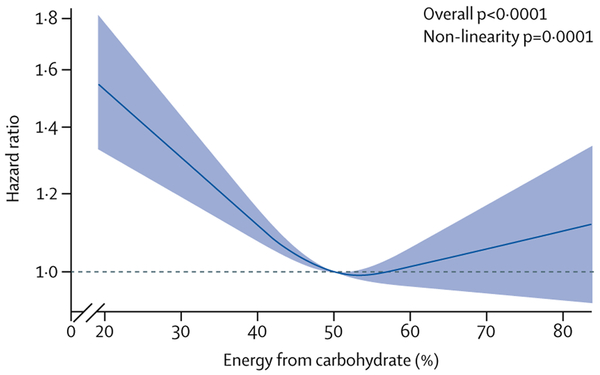
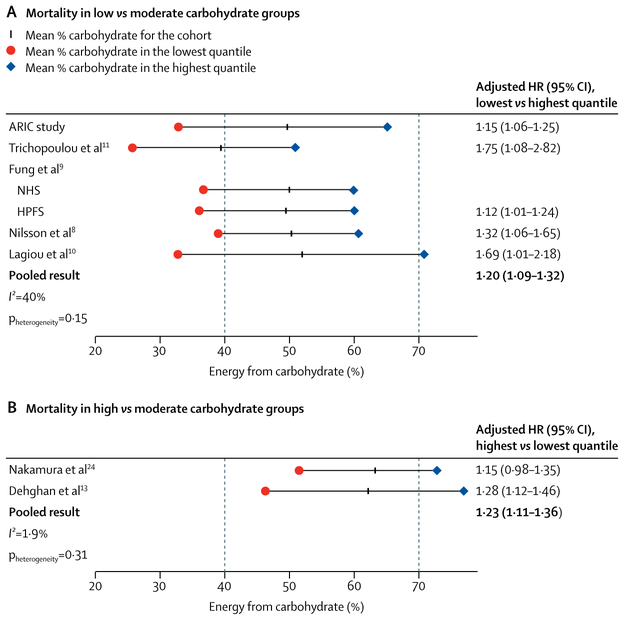
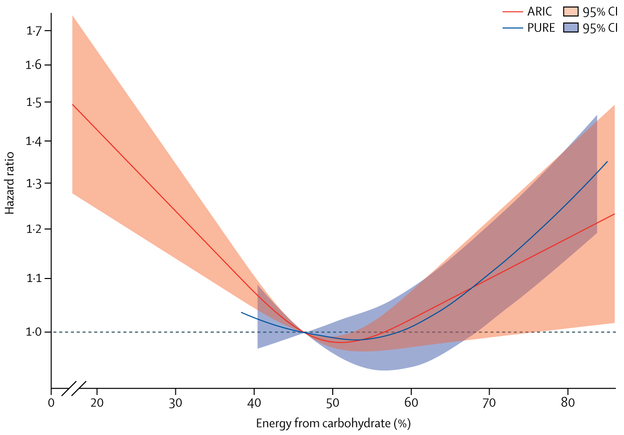
BACKGROUND: Low carbohydrate diets, which restrict carbohydrate in favour of increased protein or fat intake, or both, are a popular weight-loss strategy. However, the long-term effect of carbohydrate restriction on mortality is controversial and could depend on whether dietary carbohydrate is replaced by plant-based or animal-based fat and protein. We aimed to investigate the association between carbohydrate intake and mortality. METHODS: We studied 15 428 adults aged 45-64 years, in four US communities, who completed a dietary questionnaire at enrolment in the Atherosclerosis Risk in Communities (ARIC) study (between 1987 and 1989), and who did not report extreme caloric intake (<600 kcal or >4200 kcal per day for men and <500 kcal or >3600 kcal per day for women). The primary outcome was all-cause mortality. We investigated the association between the percentage of energy from carbohydrate intake and all-cause mortality, accounting for possible non-linear relationships in this cohort. We further examined this association, combining ARIC data with data for carbohydrate intake reported from seven multinational prospective studies in a meta-analysis. Finally, we assessed whether the substitution of animal or plant sources of fat and protein for carbohydrate affected mortality. FINDINGS: During a median follow-up of 25 years there were 6283 deaths in the ARIC cohort, and there were 40 181 deaths across all cohort studies. In the ARIC cohort, after multivariable adjustment, there was a U-shaped association between the percentage of energy consumed from carbohydrate (mean 48·9%, SD 9·4) and mortality: a percentage of 50-55% energy from carbohydrate was associated with the lowest risk of mortality. In the meta-analysis of all cohorts (432 179 participants), both low carbohydrate consumption (<40%) and high carbohydrate consumption (>70%) conferred greater mortality risk than did moderate intake, which was consistent with a U-shaped association (pooled hazard ratio 1·20, 95% CI 1·09-1·32 for low carbohydrate consumption; 1·23, 1·11-1·36 for high carbohydrate consumption). However, results varied by the source of macronutrients: mortality increased when carbohydrates were exchanged for animal-derived fat or protein (1·18, 1·08-1·29) and mortality decreased when the substitutions were plant-based (0·82, 0·78-0·87). INTERPRETATION: Both high and low percentages of carbohydrate diets were associated with increased mortality, with minimal risk observed at 50-55% carbohydrate intake. Low carbohydrate dietary patterns favouring animal-derived protein and fat sources, from sources such as lamb, beef, pork, and chicken, were associated with higher mortality, whereas those that favoured plant-derived protein and fat intake, from sources such as vegetables, nuts, peanut butter, and whole-grain breads, were associated with lower mortality, suggesting that the source of food notably modifies the association between carbohydrate intake and mortality. FUNDING: National Institutes of Health.
Overview
The claims and statistics of this paper haven’t been checked yet.
Free: it reads the open-access text and checks the first 5 claims that cite a source we can check. Create a free account to check every claim.
Integrity signals
Registry
Cites
Statistics
Figures
Verification
Claims the paper makes
The claims and statistics of this paper haven’t been checked yet.
Free: it reads the open-access text and checks the first 5 claims that cite a source we can check. Create a free account to check every claim.
Claims other papers make about this one
Each is checked against this paper’s own text: does it say what the citing paper says it does?
The cited source says what the claim attributes to it.
In the citing paper
“Considering this and a recent systematic review of cohort studies suggesting that long term LCDs are associated with increased mortality,73 clinicians might consider short term LCDs for management of type 2 diabetes, while actively monitoring and adjusting diabetes medication as needed.”
The cited source says what the claim attributes to it.
In the citing paper
“Large cohort studies suggest higher mortality at lower carbohydrate levels, but this association disappears when plant-based protein is substituted for animal-based sources of protein”
From Lifestyle Medicine for Obesity in the Era of Highly Effective Anti-Obesity Treatment (2025) · cites this paper as [188]
The check wasn’t confident either way, so it gives no verdict — never disputed.
In the citing paper
“Dietary carbohydrate has a 'neutral' effect on LDL-C, although excessive consumption is represented by untoward effects on plasma TGs and HDL-C levels [164].”
From 2019 ESC/EAS guidelines for the management of dyslipidaemias: lipid modification to reduce cardiovascular risk (2019) · cites this paper as [164]
Experimental — accuracy not yet measuredIn the citing paper
“low intakes of fats and oils increase the risk of inadequate intakes of vitamin E and of essential fatty acids, and may contribute to a reduction of HDL-C [164].”
From 2019 ESC/EAS guidelines for the management of dyslipidaemias: lipid modification to reduce cardiovascular risk (2019) · cites this paper as [164]
Self-check
Percentages, sums and reported differences re-computed from the paper’s own numbers.
The self-check needs the paper’s full text.
Citations
Cites
von Elm, E., Altman, D. G., Egger, M., Pocock, S. J., Gøtzsche, P. C., Vandenbroucke, J. P., & Initiative, F. T. S. (2007) · PLoS Medicine · doi:10.1371/journal.pmed.0040296 · Cited by 23,020
von Elm, E., Altman, D. G., Egger, M., Pocock, S. J., Gøtzsche, P. C., & Vandenbroucke, J. P. (2007) · The Lancet · doi:10.1016/s0140-6736(07)61602-x · Cited by 21,320
(2014) · Medical Entomology and Zoology · Cited by 17,633
CONSORT 2010 Statement: updated guidelines for reporting parallel group randomised trials
the CONSORT Group, Schulz, K. F., Altman, D. G., & Moher, D. (2010) · BMC Medicine · doi:10.1186/1741-7015-8-18 · Cited by 13,371
Harrell, F. E. (2001) · Springer Series in Statistics · doi:10.1007/978-1-4757-3462-1 · Cited by 9,195
Reproducibility and validity of a semiquantitative food frequency questionnaire
WILLETT, W. C., SAMPSON, L., STAMPFER, M. J., ROSNER, B., BAIN, C., WITSCHI, J., HENNEKENS, C. H., & SPEIZER, F. E. (1985) · American Journal of Epidemiology · doi:10.1093/oxfordjournals.aje.a114086 · Cited by 4,274
Self-citationA short questionnaire for the measurement of habitual physical activity in epidemiological studies
Baecke, J., Burema, J., & Frijters, J. (1982) · The American Journal of Clinical Nutrition · doi:10.1093/ajcn/36.5.936 · Cited by 3,945
CONSORT 2010 statement: updated guidelines for reporting parallel group randomized trials
Schulz, K. F., Altman, D. G., Moher, D., & for the CONSORT Group* (2010) · Annals of Internal Medicine · doi:10.7326/0003-4819-152-11-201006010-00232 · Cited by 3,824
(1989) · PubMed · Cited by 3,139
THE ATHEROSCLEROSIS RISK IN COMMUNIT (ARIC) STUDY: DESIGN AND OBJECTIVES
THE ARIC INVESTIGATORS (1989) · American Journal of Epidemiology · doi:10.1093/oxfordjournals.aje.a115184 · Cited by 2,924
Cited by
Items 701–775 of 775
Editorial: Ketone bodies: friend or foe?
Sternberg, F., Nomura, M., Xie, M., & Duszka, K. (2024) · Frontiers in Endocrinology · doi:10.3389/fendo.2024.1400206
Investigation and description of the New Brain and New Mind hypotheses
Klinedinst, B. S. (2021) · doi:10.31274/td-20240329-457
Empfehlungen zur Ernährung von Personen mit Typ-2-Diabetes mellitus
Skurk, T., Bosy‐Westphal, A., Grünerbel, A., Kabisch, S., Keuthage, W., Kronsbein, P., Müssig, K., Nussbaumer, H., Pfeiffer, A. F. H., Simon, M., et al. (2024) · Die Diabetologie · doi:10.1007/s11428-024-01174-0
“Während die Diabetesprävention durch komplexe Lebensstilintervention mit low-fat-Ansatz konsis-tent gezeigt ist [40]”
III. Nutritional Therapy for Diabetes
Fukui, M. (2023) · Nihon Naika Gakkai Zasshi · doi:10.2169/naika.112.630
Innovation, Regulation, and Excise Taxation
van Oordt, M. (2023) · World Customs Journal · doi:10.55596/001c.88823 · Cited by 3
Satoh, T. (2024) · Springer eBooks · doi:10.1007/978-3-031-54150-6_9
Satoh, T. (2024) · Springer eBooks · doi:10.1007/978-3-031-54150-6_8
Ogazie, C. A., Ochekwu, E. B., & Agbagwa, I. O. (2022) · Advanced Journal of Plant Biology · doi:10.31248/ajpb2022.022
Scientific Units and Their Multiples and Submultiples
Smil, V. (2021) · Oxford University Press eBooks · doi:10.1093/oso/9780190060664.005.0001
Smil, V. (2021) · Oxford University Press eBooks · doi:10.1093/oso/9780190060664.002.0003
Smil, V. (2021) · Oxford University Press eBooks · doi:10.1093/oso/9780190060664.002.0005
Longevity and diets: What do the Japanese and Mediterranean diets share?
Visioli, F. (2024) · Elsevier eBooks · doi:10.1016/b978-0-12-824005-2.00007-5
Macronutrients and health: A brief critical overview
Visioli, F. (2024) · Elsevier eBooks · doi:10.1016/b978-0-12-824005-2.00001-4
(2024) · Journal of Nutrition Food Science and Technology · doi:10.47485/2834-7854.1042 · Cited by 1
Chen, H., Chen, G., Li, L., Zhang, W., wang, Y., Li, K., & Lian, Y. (2024) · SSRN Electronic Journal · doi:10.2139/ssrn.4877795 · Cited by 1
Relevance of microbial fermentation for long-term health effects of high protein diets
Rajilić-Stojanović, M. D. (2024) · Arhiv za farmaciju · doi:10.5937/arhfarm74-50706
Gölz, S., & Haller, N. (2024) · Die Diabetologie · doi:10.1007/s11428-024-01217-6
Dupuis, L., & Shah, U. A. (2024) · Springer eBooks · doi:10.1007/978-3-031-63083-5_28 · Cited by 1
Diabète de type 2 : régimes hypoglucidiques et cétogènes
Lecerf, J. (2024) · Pratiques en nutrition · doi:10.1016/j.pranut.2024.08.007
Association Between Consumption of Foods Containing Vitamin D and All-Cause Mortality in Korea
Kwak, J. H., & Paik, J. K. (2024) · Journal of Medicinal Food · doi:10.1089/jmf.2024.k.0147
“There have been reports of U-shaped associations between mortality and the intake of foods, such as coffee, tea, 22 and carbohydrates, 23 indicating that healthy foods are bene fi cial to health through appropriate rather than excessive consumption.”
PhD, L. S. S., & MD, S. N. K. (2022) · Wiley eBooks · doi:10.1002/9781394323128.ch16
Components of an Unhealthy Lifestyle
PhD, L. S. S., & MD, S. N. K. (2022) · Wiley eBooks · doi:10.1002/9781394323128.ch3
Plant-based diet and cardiovascular health
Reddy, K. R., & Basu‐Ray, I. (2024) · Elsevier eBooks · doi:10.1016/b978-0-323-99645-7.00001-9
Shao, L., Zhi, A., Li, M., Zhang, Y., Jiang, S., Zhang, J., Yang, K., Yang, E., Zhu, X., Cheng, Y., et al. (2024) · Reviews in Cardiovascular Medicine · doi:10.31083/j.rcm2511410 · Cited by 1
Response to the Letter to the Editor by Athinarayanan
Almandoz, J. P., Wadden, T. A., Tewksbury, C. M., Apovian, C. M., Fitch, A., Ard, J. D., Li, Z., Richards, J. R., Butsch, W. S., Jouravskaya, I., et al. (2024) · Obesity · doi:10.1002/oby.24191
“However, when considering the potential impacts of dietary patterns on long-term health outcomes such as cardiovascular disease and mortality, there is more evidence to support a recommendation for moderate-carbohydrate dietary patterns such as the Mediterranean and healthy plant-based diets [1, 4].”
The Importance of Dietary Intervention in Obesity Management
Seo, Y. B. (2024) · Korean Journal of Family Practice · doi:10.21215/kjfp.2024.14.4.193
Lake, R., Liuzzi, J. P., & Yoo, C. (2025) · Journal of Trace Elements and Minerals · doi:10.1016/j.jtemin.2025.100233
Cellular and molecular mechanisms underlying aging-related gastric neuromuscular dysfunction
Zhang, Y., Choi, E. L., & Hayashi, Y. (2025) · Journal of Smooth Muscle Research · doi:10.1540/jsmr.61.43 · Cited by 1
“Reductions in food intake caused by gastric motor dysfunction may adversely affect the quality of life, exacerbate sarcopenia and frailty, contribute to disability, and increase the mortality risk in older adults (3, 6, 7).”
Zhong, Q., Lin, Z., Yang, Y., Huang, Y., Lan, X., Xia, C., Kong, Y., Wan, Q., Li, Y., Huang, S., et al. (2025) · Clinical Kidney Journal · doi:10.1093/ckj/sfaf124 · Cited by 2
“Another meta-analysis showed a U-shaped association between carbohydrate intake and all-cause mortality, with the U-shaped curve on the left representing North American and European countries with lower carbohydrate intake and Asian populations with higher carbohydrate intake on the right [26 ].”
Park, J. E., Jang, T. H., Kim, S. Y., & Park, J. H. (2025) · Nutrition Research and Practice · doi:10.4162/nrp.2025.19.6.967
“A high-carbohydrate diet was defined as one in which > 70% of daily energy intake was derived from carbohydrates [19,20].”
Yun, S.-Y., Choi, M., & Kim, M. (2025) · British Food Journal · doi:10.1108/bfj-08-2025-1119
Macronutrient content and quality, and risk of multimorbidity in the UK Biobank
Vázquez‐Fernández, A., Yévenes‐Briones, H., Baylín, A., Caballero, F. F., & López‐García, E. (2025) · The Journals of Gerontology Series A · doi:10.1093/gerona/glaf267 · Cited by 1
Bai, A., Si, M., Xue, P., Qu, Y., & Jiang, Y. (2024) · Figshare · doi:10.6084/m9.figshare.24965962
Chen, Y., Sun, B., Wang, C., Zhang, K., Lu, W., & Huang, G. (2024) · Figshare · doi:10.6084/m9.figshare.26566688
Bai, A., Si, M., Xue, P., Qu, Y., & Jiang, Y. (2024) · Figshare · doi:10.6084/m9.figshare.24966082
Liu, Z., Huang, H., Xie, J., Hou, L., & Xu, C. (2023) · Figshare · doi:10.6084/m9.figshare.24770264
Chen, Y., Sun, B., Wang, C., Zhang, K., Lu, W., & Huang, G. (2024) · Figshare · doi:10.6084/m9.figshare.26566685
Yuan, Q., Li, Y., Zhao, Q., Lou, L., Zhong, Q., & Cui, H. (2025) · Frontiers in Sustainable Food Systems · doi:10.3389/fsufs.2025.1714357
Karbonhidrat Korkusu: Makarnanın Diyetteki Yeri
Tüysüz, V. (2025) · International Journal of Contemporary Tourism Research · doi:10.30625/ijctr.1667283
Pui, M. C. P., & Cheah, W. L. (2025) · Malaysian Journal of Medicine and Health Sciences · doi:10.47836/mjmhs.21.2.7
Africa figl (Raphanus sativus) nutritional composition and bioactive compounds
Keyata, E. O., Tola, Y. B., Bultosa, G., & Forsido, S. F. (2026) · Elsevier eBooks · doi:10.1016/b978-0-443-33433-7.00025-3
Lifestyle Modifications in Hypertensive Patients to Reduce Risk of Stroke: A Review
Afsar, A. P., Tayal, A., & Goswami, B. (2023) · GLOBAL JOURNAL OF MEDICAL STUDENTS · doi:10.25259/gjms.2023.3.2.15
Ceylan, J. A., Andrade-Laborde, J. E., & Andrade, J. (2026) · Nutrition Research · doi:10.1016/j.nutres.2026.03.004 · Cited by 1
Grillo, G., Véga, N., Zaczek, A., Selmi, A., Chanon, S., Vieille‐Marchiset, A., Santillo, A., Balcerczyk, A., Strigini, M., & Pirola, L. (2026) · Nutrients · doi:10.3390/nu18071141
“…supplementation) underlined in both nutritional patterns a short-term significant loss of body lean mass, suggesting that diets extremely enriched in either carbohydrates or fat may, in the end, provoke deleterious effects, as also suggested by epidemiological observations in large cohorts [49,50].”
Li, J., Zhang, X., 胡予, Tang, Y., Xiao, S., & Xu, Y. (2026) · Journal of Alzheimer s Disease Reports · doi:10.1177/25424823261445034
“7 10 Empirical research has revealed that both excessively low and high carbohydrate intake may exert deleterious effects on human cognitive function, and more importantly, this association is highly dependent on the type of carbohydrates: diets rich in re fi ned or highly processed carbohydrates…”
The association between dietary macronutrient distribution and mortality in an African cohort
Linde, M., van der Merwe, C., Ricci, C., & Pieters, M. (2026) · British Journal Of Nutrition · doi:10.1017/s000711452610717x
Isaksson, S. S., Imberg, H., Ólafsdóttir, A. F., Ivarsson, S., Toft, E., Hallström, S., Rosenqvist, U., Ekström, M., & Lind, M. (2026) · BMJ Nutrition Prevention & Health · doi:10.1136/bmjnph-2025-001410
Lee, J., & Lee, Y. (2026) · Journal of Nutrition and Health · doi:10.4163/jnh.2026.59.2.115
Doo, M., Song, Y., Lim, J. H., Jeon, J. Y., & Kim, W. (2026) · Journal of Nutrition and Health · doi:10.4163/jnh.2026.59.2.148
Neves, A. C. M., Bressan, J., Teixeira, C. M., Hermsdorff, H. H. M., Pimenta, A. M., & Carraro, J. C. C. (2026) · International Journal of Food Sciences and Nutrition · doi:10.1080/09637486.2026.2673049
“Daily carbohydrate intake has led to unsubstantiated hypotheses regarding its role in the obesity epidemic (Seidelmann et al. 2018).”
Prinelli, F., & Russo, A. G. (2026) · Nutrients · doi:10.3390/nu18122035
“In humans, epidemiological studies similarly indicate that macronutrient distributions and overall energy intake predict mortality risk and long-term health outcomes [4–6].”
Román, L., Gallego-Lobillo, P., Lopez-Rodulfo, I. M., & Martínez, M. M. (2026) · Elsevier eBooks · doi:10.1016/b978-0-443-33285-2.00024-0
Najafi, F., Izadi, N., Rezaeian, S., Pasdar, Y., Shadmani, F. K., Bagheri, A., Poustchi, H., Eghtesad, S., Pourfarzi, F., Nejatizadeh, A., et al. (2026) · Food Science & Nutrition · doi:10.1002/fsn3.72060
Zhang, Y., Guan, K. L., Guo, S., Gao, J., Bai, X., Yang, Y., Wang, H., Xiaoxuan, N., & Sun, S. (2026) · QJM · doi:10.1093/qjmed/hcag166
Improving immunity in patients with cancer through diet: mechanisms and gaps
MacPherson, S., Dhaliwal, E., & Lum, J. J. (2026) · Trends Open · doi:10.1016/j.treopn.2026.05.008
Nikitara, K., Kontogianni, M. D., Haidich, A., & Bountziouka, V. (2026) · European Journal of Nutrition · doi:10.1007/s00394-026-04028-1
Protected areas affect staple-grain yield gains in Chinese villages
Cui, Z., Wang, Z., Li, J., & Chen, Z. (2026) · Cell Reports Sustainability · doi:10.1016/j.crsus.2026.100783
Nawi, M. N. M., Radzi, R., Ali, A., Lem, S. Z. C., Zulkapli, A., Lokman, E. F., Mansor, F., Saparuddin, F., Misnan, N. M., Narayanan, S. S., et al. (2026) · International Journal of Molecular Sciences · doi:10.3390/ijms27157017
“…Risk in Communities (ARIC) [11] and Prospective Urban Rural Epidemiology (PURE) [12] are suggesting both very low and very high carbohydrate intake potentially increase cardiovascular mortality, whereas moderate carbohydrate and relatively higher fat intakes are associated with lower risk [11].”
Guo, H., Wang, L., & Xiao, F. (2026) · Nutrition Metabolism and Cardiovascular Diseases · doi:10.1016/j.numecd.2026.104955
Khairan, P., Kato, Y., Kokubo, Y., Arafa, A., Nakao, Y. M., Matsumoto, C., Maruyama, K., & KUSANO, K. F. (2026) · BMJ Open · doi:10.1136/bmjopen-2025-109639
Wang, Y., Ma, J., Hu, Y., Desjardins, C., & Chen, Z. (2026) · Vessel Plus · doi:10.20517/2574-1209.2026.31
Beyond dietary restriction: Towards next-generation precision diets for healthy aging
Huang, J., Huang, D., & Wu, Z. (2026) · The Innovation Nutrition · doi:10.59717/j.xinn-nutri.2026.100034
Yao, Y., Gu, Z., Hu, J., Zhu, W., & Lin, Q. (2026) · Pharmacological Research · doi:10.1016/j.phrs.2026.108466
Nutritional strategies in kidney transplantation: optimising outcomes beyond surgery
Caldiroli, L., Molinari, P., Vettoretti, S., Regalia, A. L., Verdesca, S., Castellano, G., Gallieni, M. A., & Alfieri, C. (2026) · Transplant International · doi:10.3389/ti.2026.16322
“Reported adverse effects include fatty liver and insulin resistance [40, 89, 90].”
Song, S., Yan-Hong, Z., Lei, Z., Hang-Kun, M., Yang, Z., & Ye, H. (2026) · Scientific Reports · doi:10.1038/s41598-026-62994-2
Li, Q., Lv, X., Wang, L., Wang, Y., 郭, 燕., Yu, L., Zhai, Z., Huang, Z., & Tang, L. (2026) · BMJ Open Diabetes Research & Care · doi:10.1136/bmjdrc-2026-005941
Hu, F. B., Beleslin, B., Blaha, M. J., Kris-Etherton, P. M., Seligman, H. K., & Williams, K. A. (2026) · Journal of the American College of Cardiology · doi:10.1016/j.jacc.2026.08.025 · Cited by 4
Diet and risk of cardiovascular disease
Sultan, S., Mahdi, M., Ahmed, A., Sultan, S., Birnbaum, Y., Lavie, C. J., & Krittanawong, C. (2026) · The American Journal of Medicine · doi:10.1016/j.amjmed.2026.09.031
Roberts, C. G. P., Shanmugam, P., Athinarayanan, S. J., Wolfberg, A., Raskin, S., & López-Jiménez, F. A. (2026) · Cardiology and Therapy · doi:10.1007/s40119-026-00478-0
Jang, J., Jang, E.-J., Lee, E., & Park, S. (2026) · Nutrition Research and Practice · doi:10.4162/nrp.2026.20.5.892
“The same direction held across outcomes, with the substitution of animal sources for plant sources raising the overall mortality [30], unhealthy versus healthy LCD scores tracking weight gain rather than loss [31], and animal fat raising total and cardiovascular mortality while plant fat lowered it…”
The Carnivore Diet and Cardiovascular Disease Risk: A Narrative Review
Goldman, D., Waterfall, T., & Nagra, M. (2026) · Recent Progress in Nutrition · doi:10.21926/rpn.2604026
Macronutrient Distribution and Frailty According to Energy Sufficiency
Seo, Y. B., Shin, J. Y., & Choi, J. (2026) · Nutrients · doi:10.3390/nu18203393
“…KDRI also lowered the lower bound of the carbohydrate AMDR from 55% to 50% of total energy, partly reflecting epidemiological evidence of a U-shaped association between carbohydrate energy contribution and mortality, with the lowest mortality risk observed at approximately 50–55% of energy [12,34].”
Healthy Dietary Patterns and Incident Cardiovascular Disease in Cancer Survivors
Gao, Q.-Y., Gao, J., Liao, G.-H., Zhang, Y., Wu, X., Chen, Z.-T., Liu, P., Wang, J.-F., Zhang, H., & Chen, Y. (2026) · JACC Advances · doi:10.1016/j.jacadv.2026.103376
Metadata
- Authors
- Seidelmann, S. B., Claggett, B., Cheng, S., Henglin, M., Shah, A., Steffen, L. M., Folsom, A. R., Rimm, E. B., Willett, W. C., & Solomon, S. D.
- Affiliations
- Brigham and Women's Hospital (US)
- University of Minnesota (US)
- Corresponding author
- Solomon, Scott D
- ORCID
- Venue
- The Lancet Public Health
- Publisher
- Elsevier BV
- Published
- 2018-09
- Volume
- 3
- Issue
- 9
- Pages
- e419-e428
- ISSN
- 2468-2667 (ISSN-L)
- PMC
- PMC6339822
- OpenAlex
- W2885382674
- Semantic Scholar
- ee38d52ac78aab923b1f4de7d8d9e79b60dd20df
- Cited by
- 776
- References
- 33
- Citations by year
- 2026: 44 · 2025: 87 · 2024: 100 · 2023: 103 · 2022: 122 · 2021: 121 · 2020: 96 · 2019: 73 · 2018: 29
- FWCI
- 76.04
- Type
- journal article
- Language
- en
- Open access
- gold
- doi.org
- Licence
- cc-by-nc-nd
- www.elsevier.com/tdm/userlicense/1.0/ (tdm)
- creativecommons.org/licenses/by-nc-nd/4.0/ (vor)
- Locations
- The Lancet Public Health (publishedVersion, cc-by-nc-nd)
- PubMed (publishedVersion)
- Europe PMC (PubMed Central) (acceptedVersion, cc-by)
- PubMed Central (acceptedVersion, cc-by)
- DOAJ (DOAJ: Directory of Open Access Journals) (submittedVersion, cc-by-sa)
- Funders
- National Heart, Lung, and Blood Institute contracts (HHSN268201100005C, HHSN268201100006C, HHSN268201100007C, HHSN268201100008C, HHSN26820110000 9C, HHSN268201100010C, HHSN268201100011C, HHSN26820 1100012C)
- NIH (R01-HL134168, R01-HL131532)
- Topics
- Health Sciences › Medicine › Public Health, Environmental and Occupational Health › Nutritional Studies and Diet
- Health Sciences › Medicine › Physiology (medical) › Diet and metabolism studies
- Health Sciences › Medicine › Endocrinology, Diabetes and Metabolism › Diet, Metabolism, and Disease
- Keywords
- carbohydrate intake, all-cause mortality, low-carbohydrate diet, U-shaped relationship, macronutrient substitution, vegetable fats, plant proteins, animal protein, Atherosclerosis Risk in Communities Study, weight loss diet, nonlinear dose-response relationship, long-term mortality risk
- MeSH terms
- Diet Surveys, Dietary Carbohydrates, Female, Humans, Male, Middle Aged, Mortality, Prospective Studies, United States
About these checks
Registry, retraction, Cites and statistics results are computed, not judged, with one exception: a printed reference that no index lists is read once by a model before it counts as a citation error. Claims are extracted by a model and kept only when their quote appears verbatim in the text; each cited source is then checked, with a model’s help, for whether it says what the claim relies on. Those verdicts can be wrong — read the claim’s quote and the cited source before relying on one.
Statistics and arithmetic are recomputed, not judged.
Confidence bands are shown only for fields calibrated on our annotated test set. None is calibrated yet, so no band is shown.
What counts as a claim ›How we measure confidence ›How we check this ›
Are you an author, or do you see a problem with this page? Request a review
Data sources
Bibliographic data: Semantic Scholar, OpenAlex, Crossref.
Contains information from the Semantic Scholar Academic Graph Datasets, made available under the ODC Attribution License (ODC-BY 1.0).
Semantic Scholar’s data is described in: Kinney, R., et al. (2023). The Semantic Scholar Open Data Platform. arXiv:2301.10140.
