

Workers' health and productivity under occupational heat strain: a systematic review and meta-analysis
Open accessThe DOI matches its Crossref record; 152 of the 160 references it cites were found in a registry or an index, and 1 are not checked yet; 7 of the 26 sources its claims cite were checked for support.
Abstract
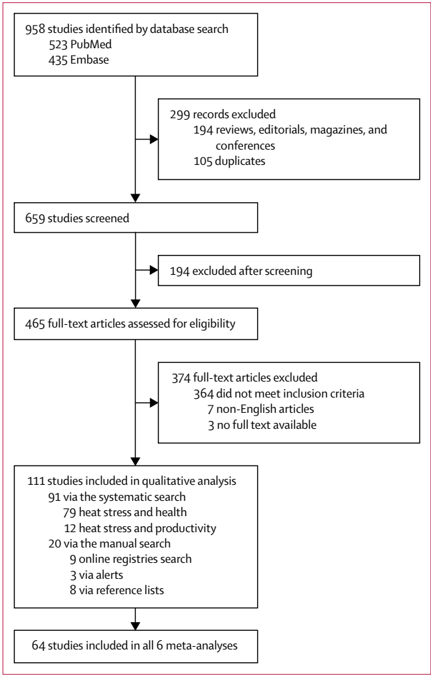
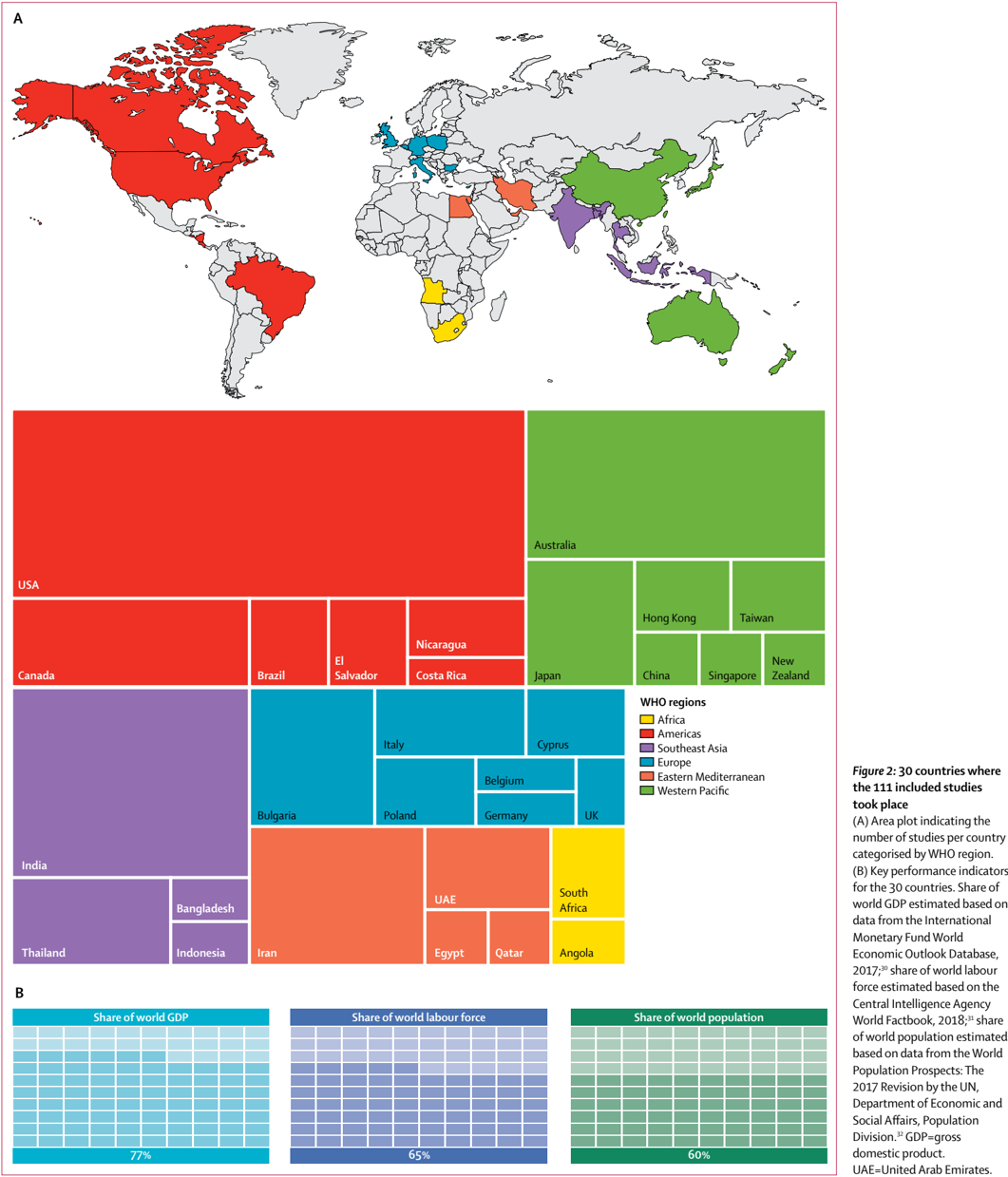
BACKGROUND: Occupational heat strain (ie, the effect of environmental heat stress on the body) directly threatens workers' ability to live healthy and productive lives. We estimated the effects of occupational heat strain on workers' health and productivity outcomes. METHODS: Following PRISMA guidelines for this systematic review and meta-analysis, we searched PubMed and Embase from database inception to Feb 5, 2018, for relevant studies in any labour environment and at any level of occupational heat strain. No restrictions on language, workers' health status, or study design were applied. Occupational heat strain was defined using international health and safety guidelines and standards. We excluded studies that calculated effects using simulations or statistical models instead of actual measurements, and any grey literature. Risk of bias, data extraction, and sensitivity analysis were performed by two independent investigators. Six random-effects meta-analyses estimated the prevalence of occupational heat strain, kidney disease or acute kidney injury, productivity loss, core temperature, change in urine specific gravity, and odds of occupational heat strain occurring during or at the end of a work shift in heat stress conditions. The review protocol is available on PROSPERO, registration number CRD42017083271. FINDINGS: Of 958 reports identified through our systematic search, 111 studies done in 30 countries, including 447 million workers from more than 40 different occupations, were eligible for analysis. Our meta-analyses showed that individuals working a single work shift under heat stress (defined as wet-bulb globe temperature beyond 22·0 or 24·8°C depending on work intensity) were 4·01 times (95% CI 2·45-6·58; nine studies with 11 582 workers) more likely to experience occupational heat strain than an individual working in thermoneutral conditions, while their core temperature was increased by 0·7°C (0·4-1·0; 17 studies with 1090 workers) and their urine specific gravity was increased by 14·5% (0·0031, 0·0014-0·0048; 14 studies with 691 workers). During or at the end of a work shift under heat stress, 35% (31-39; 33 studies with 13 088 workers) of workers experienced occupational heat strain, while 30% (21-39; 11 studies with 8076 workers) reported productivity losses. Finally, 15% (11-19; ten studies with 21 721 workers) of individuals who typically or frequently worked under heat stress (minimum of 6 h per day, 5 days per week, for 2 months of the year) experienced kidney disease or acute kidney injury. Overall, this analysis include a variety of populations, exposures, and occupations to comply with a wider adoption of evidence synthesis, but resulted in large heterogeneity in our meta-analyses. Grading of Recommendations, Assessment, Development and Evaluation analysis revealed moderate confidence for most results and very low confidence in two cases (average core temperature and change in urine specific gravity) due to studies being funded by industry. INTERPRETATION: Occupational heat strain has important health and productivity outcomes and should be recognised as a public health problem. Concerted international action is needed to mitigate its effects in light of climate change and the anticipated rise in heat stress. FUNDING: EU Horizon 2020 research and innovation programme.
Verified 2026-11-22 · 1 reference not checked yet
Overview
CoChat Summary
## TL;DR
This systematic review and meta-analysis found that occupational heat strain is associated with substantial losses in workers’ health and productivity across a very large evidence base. Across 111 studies from 30 countries, workers in heat stress conditions had higher risks of heat strain, dehydration, productivity loss, and kidney-related outcomes.
## Key findings
- The review included 111 studies from 30 countries, covering 447,108,664 workers in more than 40 occupations.
- In six random-effects meta-analyses, working a single shift under heat stress made workers 4.01 times more likely to experience occupational heat strain than thermoneutral conditions (95% CI 2.45–6.58; 9 studies, 11,582 workers).
- Single-shift heat stress increased core temperature by 0.7°C (0.4–1.0; 17 studies, 1,090 workers) and urine specific gravity by 14.5% (0.0014–0.0048; 14 studies, 691 workers).
- During or at the end of a shift in heat stress conditions, 35% of workers experienced occupational heat strain (31–39; 33 studies, 13,088 workers), 30% reported productivity losses (21–39; 11 studies, 8,076 workers), and 15% of those typically or frequently working in heat stress had kidney disease or acute kidney injury (11–19; 10 studies, 21,721 workers).
## Methods
- Systematic review and meta-analysis conducted according to PRISMA; protocol registered on PROSPERO (CRD42017083271).
- Searched PubMed and Embase from inception to Feb 5, 2018; included original quantitative studies in any language, any labor environment, and any occupational heat strain level; excluded grey literature and studies based on simulations/statistical models rather than actual human measurements.
- Two independent investigators handled study selection, risk of bias, extraction, and sensitivity analysis; six random-effects meta-analyses were run for prevalence, odds, mean differences, and related outcomes.
## Limitations
- The authors state that the included studies produced large heterogeneity in the meta-analyses; average I² was 80%.
- The review pooled studies with different populations, exposures, and occupations, which the authors say widened evidence synthesis but increased heterogeneity.
- The text makes evident that some outcomes relied on self-reported tools and that studies were often regionally confined and selected where high prevalence/effects were expected; the authors say this could bias prevalence estimates and limit generalizability to cold regions or jobs not associated with heat exposure.
Model-written summary. Check it against the paper before relying on it.
Integrity signals
Registry
Cites
Statistics
Figures
Verification
Claims the paper makes
4 Valid · 0 Not valid · 10 Not checked · 58 Own results and interpretations
The cited sources support only part of this claim — read each source’s verdict below.
In the paper
“those who are older, obese, unfit, have chronic disease, or experience acute illness or infection are at a high risk for heatinduced pathologies (eg, heat cramps, heat exhaustion, and heat stroke). 1,7,139,147”
What the sources say
- Partly supportedcites [1] 1 Mora C, Dousset B, Caldwell IR, et al. Global risk of deadly heat. Nat Clim Chang 2017; 7: 501-06. sourceExperimental — accuracy not yet measured
The discussion (p. 8) describes an aging population as highly vulnerable to heat, supporting the claim about older individuals. It does not identify obesity, poor fitness, chronic disease, acute illness, or infection as risk factors, or specifically connect those groups to heat cramps, heat exhaustion, and heat stroke. (LLM, conf=0.87)
- Partly supportedcites [7] 7 Kenny GP, Groeller H, McGinn R, Flouris AD. Age, human performance, and physical employment standards. Appl Physiol Nutr Metab 2016; 41 (6 suppl 2) : S92-107 . sourceExperimental — accuracy not yet measured
Kenny et al. (2016) supports most of the risk list: 'Factors affecting work ability in older adults' reports age-related impairments in whole-body heat loss and 60-80% greater heat storage in individuals ≥40 years (Larose et al. 2013, 2014), with those impairments modulated by fitness (low-fitness middle-aged adults losing heat like older counterparts; Stapleton et al. 2015), and 'Impact of chronic health disorders on physical function' states that cardiopulmonary impairments and type 2 diabetes are associated with higher rates of heat illness in hot environments, with the INTRODUCTION naming obesity, diabetes and hypertension as the vulnerable workers the ACGIH TLVs may not protect. However, our copy nowhere treats acute illness or infection as a heat-illness risk factor, and it does not enumerate heat-induced pathologies as heat cramps, heat exhaustion and heat stroke — its outcomes are heat storage, attenuated heat-loss capacity, 'heat illness' and reduced work output. The claim's infection/acute-illness element and the specific pathology spectrum are therefore not attributable to this source. (LLM, conf=0.72)
- Partly supportedcites [139] 139 Flouris AD, McGinn R, Poirier MP, et al. Screening criteria for increased susceptibility to heat stress during work or leisure in hot environments in healthy individuals aged 31-70 years. Temperature (Austin) 2017; 5: 86-99. 142 sourceExperimental — accuracy not yet measured
The Introduction (p.1) supports part of the list: it states that 'heat injuries were more prevalent in unfit, obese, and unacclimatised individuals' and that intrinsic factors 'known to increase an individual's susceptibility to heat stress (SHS)' include sex, age, body composition and cardiorespiratory fitness; the Discussion adds that older adults and 'patients with chronic diseases such as hypertension and type 2 diabetes' are 'more vulnerable populations' (while noting their own cohort excluded chronic disease). However, our copy nowhere mentions acute illness or infection as a risk factor, and it does not enumerate heat cramps, heat exhaustion or heat stroke as the heat-induced pathologies these individuals are at high risk of (the only such wording is in the titles of cited works, e.g. Schickele's 'fatal heat stroke' analysis, ref. 14). So the risk-factor list is only partly attributable to this source. (LLM, conf=0.72)
- Not matchedcites [147] 147 WHO. Quantitative risk assessment of the effects of climate change on selected causes of death, 2030s and 2050s. Geneva: World Health Organization, 2014.
Its entry has no title and year that we can search by.
plainstates an association- Asserted: passes — The authors put it forward as true.
- Checkable: passes — It can be checked against evidence.
- Load-bearing: unclear — It is unclear whether the paper’s conclusions depend on it.
- Based: passes — The paper gives a reason why it holds.
- Partly supported
Every source the paper cites for this claim was checked and supports it.
In the paper
“Our estimate that 35% of individuals working in heat stress conditions experience occupational heat strain is in line with the 30% (95% CI 24-36) prevalence reported for increased susceptibility to heat stress (an inability to mitigate hyperthermia) when working or exercising in hot environments, 139”
What the sources say
- Supportedcites [139] 139 Flouris AD, McGinn R, Poirier MP, et al. Screening criteria for increased susceptibility to heat stress during work or leisure in hot environments in healthy individuals aged 31-70 years. Temperature (Austin) 2017; 5: 86-99. 142 source
The Results section 'SHS in the analysis group' states verbatim: 'Overall, 30% (95% confidence interval: 24-36%) of OLDER individuals were identified as SHSC (Table 2)', and Table 2 (Discussion) gives the same overall prevalence rate of 0.30 § 0.06 for the entire sample. The paper's scope matches the claim's context — sex-specific screening criteria for susceptibility to heat stress (SHS) 'during work and leisure activities in hot environments' (Introduction), with SHSC defined as a reduced capacity to dissipate heat, i.e. elevated rectal temperature/heat storage (equivalent to 'inability to mitigate hyperthermia'). Note that the source's figure is for healthy, physically active adults aged 31-70 (Discussion cautions that the criteria require further validation in sedentary adults and patients with chronic disease), which is the population the 30% prevalence describes. (LLM, conf=0.88)
hedged- Asserted: passes — The authors put it forward as true.
- Checkable: passes — It can be checked against evidence.
- Load-bearing: unclear — It is unclear whether the paper’s conclusions depend on it.
- Based: passes — The paper gives a reason why it holds.
- Supported
A result the paper reports from its own data — it cites no other source for it, so there is none to check. The quote shows it is in the paper.
In the paper
“their urine specific gravity was increased by 14·5% (0·0031, 0·0014-0·0048; 14 studies with 691 workers)”
- Also stated in: § Results · plain
“The average increase due to working in heat stress conditions was 0·0031 (0·0014-0·0048; table; appendix), which is equal to a 14·5% (6·5-22·4) increase.”
- Also stated in: § Discussion · plain
“our analyses show that people who worked a single shift in heat stress conditions had an increase of 14·5% in urine specific gravity compared with those who worked a shift in thermoneutral conditions.”
plainstates a cause- Asserted: passes — The authors put it forward as true.
- Checkable: passes — It can be checked against evidence.
- Load-bearing: passes — The paper’s conclusions depend on it.
- Based: passes — The paper gives a reason why it holds.
- Also stated in: § Results · plain
A result the paper reports from its own data — it cites no other source for it, so there is none to check. The quote shows it is in the paper.
In the paper
“resulted in large heterogeneity with an average I ² of 80% (table)”
- Also stated in: § Summary · plain
“but resulted in large heterogeneity in our meta-analyses”
plain- Asserted: passes — The authors put it forward as true.
- Checkable: passes — It can be checked against evidence.
- Load-bearing: unclear — It is unclear whether the paper’s conclusions depend on it.
- Based: passes — The paper gives a reason why it holds.
- Also stated in: § Summary · plain
A result the paper reports from its own data — it cites no other source for it, so there is none to check. The quote shows it is in the paper.
In the paper
“These studies suggest an average 2·6% productivity decline (individual study estimates: 0·8%, 4 1·4%, 5 1·8%, 56 2·2%, 38 2·8%, 57 4·4%, 55 5·0% 6 ) for every degree increase beyond 24°C WBGT.”
- Also stated in: § Discussion · plain
“These losses increased by 2·6% for every degree increase beyond 24°C WBGT.”
plainstates a cause- Asserted: passes — The authors put it forward as true.
- Checkable: passes — It can be checked against evidence.
- Load-bearing: passes — The paper’s conclusions depend on it.
- Based: passes — The paper gives a reason why it holds.
- Also stated in: § Discussion · plain
25 more claims
Create a free account to see all 72 claims and to verify the 5 references still open.
- Probably not a substantial claim. 31
- It may state two separate claims as one. 23
Claims other papers make about this one
Each is checked against this paper’s own text: does it say what the citing paper says it does?
The source backs part of the claim, not all of it — or backs it for a different population, condition or comparison.
In the citing paper
“However, recent data confirmed that these employees perform the vast majority of their work outdoors and are directly affected by sun exposure, leading to increased heat strain and impaired capacity for manual labor [10,11,12,13].”
From The Impacts of Sun Exposure on Worker Physiology and Cognition: Multi-Country Evidence and Interventions (2021) · cites this paper as [10]
Experimental — accuracy not yet measuredIn the citing paper
“In addition, heat exposure reduces labour productivity and harms the livelihoods of workers and their dependents, particularly when affecting access to quality nutrition, health care, housing, or health-supporting services.94,95”
From The 2024 report of the Lancet Countdown on health and climate change: facing record-breaking threats from delayed action (2024) · cites this paper as [94]
Citations
Cites
Preferred Reporting Items for Systematic Reviews and Meta-Analyses: The PRISMA Statement
Moher, D., Liberati, A., Tetzlaff, J., Altman, D. G., & The PRISMA Group (2009) · PLoS Medicine · doi:10.1371/journal.pmed.1000097 · Cited by 64,042 · cited 2×
“Following PRISMA guidelines, 13 for our systematic review and meta-analysis we searched the PubMed and Embase databases from inception to Nov 30, 2017, for studies that assessed the effect of occupational heat strain on workers’ health or productivity outcomes.”
Preferred reporting items for systematic reviews and meta-analyses: the PRISMA Statement.
(2009) · PubMed Central · Cited by 44,859
Preferred reporting items for systematic reviews and meta-analyses: The PRISMA statement
Moher, D., Liberati, A., Tetzlaff, J., Altman, D. G., & the PRISMA Group* (2009) · Annals of Internal Medicine · doi:10.7326/0003-4819-151-4-200908180-00135 · Cited by 37,554
(2012) · Kidney International Supplements · doi:10.1038/kisup.2012.1 · Cited by 4,326
What is ‘quality of evidence’ and why is it important to clinicians?
Guyatt, G. H., Oxman, A. D., Kunz, R., Vist, G. E., Falck-Ytter, Y., & Schünemann, H. J. (2008) · BMJ · doi:10.1136/bmj.39490.551019.be · Cited by 3,250 · cited 2×
“28 GRADE assessed the quality of the meta-analysis results via methodological design, risk of bias, heterogeneity, indirectness, imprecision, publication bias, and effect sizes displayed in both the included studies in a meta-analysis and the meta-analysis itself.”
Clinical Methods: The History, Physical, and Laboratory Examinations
Kruse, J. A. (1990) · JAMA: The Journal of the American Medical Association · doi:10.1001/jama.1990.03450210108045 · Cited by 2,029
ACSM Position Stand: Exercise and Fluid Replacement
Convertino, V. A., Armstrong, L. E., Coyle, E. F., Mack, G. W., Sawka, M. N., Senay, L. C., & Sherman, W. M. (1996) · Medicine & Science in Sports & Exercise · doi:10.1097/00005768-199610000-00045 · Cited by 1,965
Mora, C., Dousset, B., Caldwell, I. R., Powell, F. E., Geronimo, R. C., Bielecki, C. R., Counsell, C. W. W., Dietrich, B. S., Johnston, E. T., Louis, L. V., et al. (2017) · Nature Climate Change · doi:10.1038/nclimate3322 · Cited by 1,746 · cited 1×
“1,7,139,147 We used the standard definitions of kidney disease and acute kidney injury proposed by the KDIGO clinical practice guidelines workgroup 24 and found that 15% of individuals working in heat stress have these conditions, which is markedly higher than the prevalence rates reported for…”
Climate Change and Extreme Heat Events
Luber, G., & McGeehin, M. (2008) · American Journal of Preventive Medicine · doi:10.1016/j.amepre.2008.08.021 · Cited by 1,243
Evolving importance of kidney disease: from subspecialty to global health burden
Eckardt, K.-U., Coresh, J., Devuyst, O., Johnson, R. J., Köttgen, A., Levey, A. S., & Levin, A. (2013) · The Lancet · doi:10.1016/s0140-6736(13)60439-0 · Cited by 1,159 · cited 1×
“148 and acute kidney injury in high-income (2”
Research works printed but not linked: 6
- 17 ACGIH. Heat Stress and Strain: TLV Physical Agents Documentation. Cincinatti, OH: American Conference of Governmental Industrial Hygienists, 2007 .
- 24 Acute Kidney Injury Work Group. Kidney Disease: Improving Global Outcomes (KDIGO). KDIGO clinical practice guideline for acute kidney injury. Kidney Int 2012; 2 (suppl) : 1-138.
- 78 Krishnan S, Kumar AP, Maruthy KN, Jeremiah PR, Venugopal V. Physiological implications of occupational heat stress for maintenance workers in a residential complex in Chennai-an exploratory intervention trial. Indian J Physiol Pharmacol 2017; 61: 23-29.
- 107 Armed Forces Health Surveillance Center. Update: heat injuries, active component, U.S. Armed Forces, 2011. MSMR 2012; 19: 14-16.
- 108 Armed Forces Health Surveillance Center. Update: heat injuries, active component, U.S. Armed Forces, 2012. MSMR 2013; 20: 17-20.
- 110 Armed Forces Health Surveillance Center. Update: Heat injuries, active component, U.S. Armed Forces, 2014. MSMR 2015; 22: 17-20.
Cited by
Items 101–200 of 564
Conti, A. A., Valente, M., Paganini, M., Farsoni, M., Ragazzoni, L., & Barone‐Adesi, F. (2022) · International Journal of Environmental Research and Public Health · doi:10.3390/ijerph19105887 · Cited by 44
“Morbidity for Injuries Three meta-analyses dealt with occupational injuries morbidity [37,39,40].”
BackgroundKong, X., Fu, Y., & Yuan, J. (2023) · Applied Energy · doi:10.1016/j.apenergy.2023.121556 · Cited by 38
Pacheco-Zenteno, F., Glaser, J. R., Jakobsson, K., Weiss, I., Arias-Monge, E., & Gyllensten, K. (2021) · Frontiers in Public Health · doi:10.3389/fpubh.2021.713711 · Cited by 35
Analysis of Exertion-Related Injuries and Fatalities in Laborers in the United States
Morrissey, M. C., Kerr, Z. Y., Brewer, G. J., Tishukaj, F., Casa, D. J., & Stearns, R. L. (2023) · International Journal of Environmental Research and Public Health · doi:10.3390/ijerph20032683 · Cited by 38
“Exertion-related injuries and fatalities are important to consider, as laborers, workers who engage in physical activity during their job such as farmers, construction workers, and assembly line workers, engaging in heavy physical work for prolonged hours and often in environmental extremes [7].”
BackgroundCombined Burden of Heat and Particulate Matter Air Quality in WA Agriculture
Austin, E., Kasner, E. J., Seto, E., & Spector, J. T. (2020) · Journal of Agromedicine · doi:10.1080/1059924x.2020.1795032 · Cited by 38
Cooling intervention studies among outdoor occupational groups: A review of the literature
Chicas, R. C., Xiuhtecutli, N., Dickman, N. E., Scammell, M. K., Steenland, K., Hertzberg, V., & McCauley, L. (2020) · American Journal of Industrial Medicine · doi:10.1002/ajim.23175 · Cited by 36
“34 All participants were randomized to (1) control (no cooling device); (2) cooling gel containing menthol; (3) PCM cooling vest; and (4) combination of both the cooling gel with menthol and PCM cooling vest to use during the trials.”
MethodFu, X., Yao, L., & Sun, S. (2022) · Atmosphere · doi:10.3390/atmos13050739 · Cited by 30
Bonafede, M., Levi, M., Pietrafesa, E., Binazzi, A., Marinaccio, A., Morabito, M., Pinto, I., de'Donato, F. K., Grasso, V., Costantini, T., et al. (2022) · International Journal of Environmental Research and Public Health · doi:10.3390/ijerph19138196 · Cited by 34
Elderly vulnerability to temperature-related mortality risks in China
Yao, X., Qu, Y., Mishra, A., MANN, M. E., Zhang, L., Bai, C., Li, M., Lin, J., Wei, J., Yu, Q., et al. (2025) · Science Advances · doi:10.1126/sciadv.ado5499 · Cited by 34
Su, Y., Cheng, L., Cai, W., LEE, J. K. W., Zhong, S., Chen, S., Li, T., Huang, X., & Huang, C. (2020) · Environmental Research · doi:10.1016/j.envres.2020.109532 · Cited by 33
Ferraro, S. D., Falcone, T., Morabito, M., Messeri, A., Bonafede, M., Marinaccio, A., Gao, C., & Molinaro, V. (2021) · International Journal of Industrial Ergonomics · doi:10.1016/j.ergon.2021.103230 · Cited by 35
Impact of climate change on occupational health and safety: A review of methodological approaches
Ferrari, G. N., Leal, G. C. L., de Souza, R. C. T., & Galdámez, E. V. C. (2022) · Work · doi:10.3233/wor-211303 · Cited by 43
“…latter category, all 21 studies were literature reviews, with well-defined objectives, a methodology with clear information regarding the search engines used and the selection criteria applied, as well as the information extraction process for the selected papers [23, 28, 187–196, 29, 197, 180–186].”
Sverdlik, A., Kothiwal, K., Kadungure, A., Agarwal, S., Machemedze, R., Verma, S., & Loewenson, R. H. (2024) · Social Science & Medicine · doi:10.1016/j.socscimed.2024.116750 · Cited by 45
The 2024 small island developing states report of the Lancet Countdown on health and climate change
Gordon-Strachan, G. M., Parker, S. Y., Harewood, H. C., Méndez‐Lázaro, P., Saketa, S. T., Parchment, K. F., Walawender, M., Abdulkadri, A. O., Beggs, P. J., Buss, D. F., et al. (2024) · The Lancet Global Health · doi:10.1016/s2214-109x(24)00421-2 · Cited by 52
Bach, A. J. E., Palutikof, J. P., Tonmoy, F., Smallcombe, J. W., Rutherford, S., Joarder, M. A. R., Hossain, M., & Jay, O. (2023) · Energy and Buildings · doi:10.1016/j.enbuild.2023.112954 · Cited by 35
Heat exposure and productivity loss among construction workers: a meta-analysis
Han, S., Dong, L., Weng, Y., & Xiang, J. (2024) · BMC Public Health · doi:10.1186/s12889-024-20744-x · Cited by 58
“This result was higher than Flouris’s meta-analysis [26], suggesting a more significant impact of heat exposure on construction workers compared to other occupations.”
Weitz, C. A., Mukhopadhyay, B., & Das, K. (2022) · International Journal of Biometeorology · doi:10.1007/s00484-022-02264-8 · Cited by 27
Projecting future labor losses due to heat stress in China under climate change scenarios
Cheng, L., Gu, K., Zhao, L., Wang, H., Ji, J. S., Liu, Z., Huang, J., Chen, Y., Gao, X., Xu, Y., et al. (2023) · Science Bulletin · doi:10.1016/j.scib.2023.09.044 · Cited by 29
“Climate change affects occupational health and work efficiency through increased intensity and frequency of extreme heat events, especially for workers exposed to high temperatures and humidity [1,2].”
BackgroundChallenges to Global Health Emerging from the COVID-19 Pandemic
Albreht, T. (2023) · Sustainability · doi:10.3390/su15097633 · Cited by 41
Strategies to mitigate acute kidney injury risk during physical work in the heat
Masoud, A. A., McKenna, Z. J., Li, Z., Deyhle, M. R., Mermier, C. M., Schlader, Z. J., & Amorim, F. T. (2024) · American Journal of Physiology-Renal Physiology · doi:10.1152/ajprenal.00350.2023 · Cited by 29
Bonell, A., Hirst, J. E., Vicedo‐Cabrera, A. M., Haines, A., Prentice, A. M., & Maxwell, N. (2020) · Wellcome Open Research · doi:10.12688/wellcomeopenres.15731.2 · Cited by 36
Compensation incentives and heat exposure affect farm worker effort
Pan, Q., Sumner, D. A., Mitchell, D. C., & Schenker, M. B. (2021) · PLoS ONE · doi:10.1371/journal.pone.0259459 · Cited by 32
Koch, M., Matzke, I., Huhn, S., Sié, A., Boudo, V., Compaoré, G., Maggioni, M. A., Bunker, A., Bärnighausen, T., Dambach, P., et al. (2023) · JMIR mhealth and uhealth · doi:10.2196/46980 · Cited by 30
“Daily activity has also been found to be negatively affected by heat [11,12], which can cause reduced working capacity and productivity [13] in addition to adverse long-term effects on morbidity and mortality [14-16].”
Rodrigues, P., Orssatto, L. B. R., Gagnon, D., Dahhak, A., Hecksteden, A., Stewart, I. B., & Minett, G. M. (2024) · Journal of Applied Physiology · doi:10.1152/japplphysiol.00701.2023 · Cited by 33
Hunt, A. P., Brearley, M. B., Hall, A., & Pope, R. (2023) · International Journal of Environmental Research and Public Health · doi:10.3390/ijerph20095675 · Cited by 27
“Global heating is exposing outdoor workers to increased risk of occupational heat strain and consequent adverse impacts on health and labour capacity [1,2].”
BackgroundResultPiil, J. F., Mikkelsen, C. J., Junge, N., Morris, N. B., & Nybo, L. (2019) · International Journal of Environmental Research and Public Health · doi:10.3390/ijerph16050716 · Cited by 29
“This negative impact is a major societal challenge for public health, with recent meta-analyses demonstrating that occupational heat strain has implications for both health and productivity [13,14].”
Self-citationBehavioural (mal)adaptation to extreme heat in Australia: Implications for health and wellbeing
Zander, K. K., Mathew, S., & Carter, S. (2023) · Urban Climate · doi:10.1016/j.uclim.2023.101772 · Cited by 28
Kuhn, S., Kutzner, F., & Thøgersen, J. B. (2021) · Energy Research & Social Science · doi:10.1016/j.erss.2021.102320 · Cited by 33
Wang, X., Zhang, Y., Huang, Y., & Yang, J. (2022) · Building and Environment · doi:10.1016/j.buildenv.2022.108922 · Cited by 21
Ioannou, L. G., Testa, D. J., Tsoutsoubi, L., Mantzios, K., Gkikas, G., Agaliotis, G., Nybo, L., Babar, Z. R., & Flouris, A. D. (2023) · Journal of Immigrant and Minority Health · doi:10.1007/s10903-023-01493-2 · Cited by 23
“Billions of workers are currently exposed to increased occupational heat stress on a daily basis [9, 10], and these estimates will increase in the coming years due to global warming [9].”
BackgroundSelf-citationVulnerability assessment of heat waves within a risk framework using artificial intelligence
Côté, J.-N., Germain, M., Levac, E., & Lavigne, É. (2023) · The Science of The Total Environment · doi:10.1016/j.scitotenv.2023.169355 · Cited by 27
Chicas, R. C., Wang, Y., Weil, E. J., Elon, L., Xiuhtecutli, N., Houser, M. C., Jones, D. P., Sands, J. M., Hertzberg, V., McCauley, L., et al. (2023) · Environment International · doi:10.1016/j.envint.2023.108206 · Cited by 27
“Recent investigations in the United States (U.S.) and around the globe have shown a link between heat exposure, heat-related illness (HRI), dehydration, and renal dysfunction among agricultural workers (Flouris et al., 2018; López-Gálvez et al., 2021; Mix et al., 2018; Moyce et al., 2017).”
BackgroundMarinaccio, A., Gariazzo, C., Taiano, L., Bonafede, M., Martini, D., D'Amario, S., de'Donato, F. K., Morabito, M., Ariani, F., Binazzi, A., et al. (2025) · Environmental Research · doi:10.1016/j.envres.2025.120844 · Cited by 36
Extreme heat and work injuries in Kuwait’s hot summers
Alahmad, B., Al-Hemoud, A. M., Al-Bouwarthan, M., Khraishah, H., Kamel, M. I., Akrouf, Q., Wegman, D. H., Bernstein, A. S., & Koutrakis, P. (2023) · Occupational and Environmental Medicine · doi:10.1136/oemed-2022-108697 · Cited by 30
Liu, Y., Zhang, G., & Yang, W. (2024) · Urban Climate · doi:10.1016/j.uclim.2024.101871 · Cited by 25
Extreme Heat Exposure Induced Acute Kidney Injury through NLRP3 Inflammasome Activation in Mice
Wang, J., Wang, K., Shi, X., Hu, Z., Zhao, L., Chen, K., Zhang, L., Li, R., Zhang, G., & Liu, C. (2024) · Environment & Health · doi:10.1021/envhealth.4c00007 · Cited by 23
Urban food delivery services as extreme heat adaptation
Zhang, Y., Wang, D., Liu, Y., Du, K., Lü, P., He, P., & Li, Y. (2025) · Nature Cities · doi:10.1038/s44284-024-00172-z · Cited by 31
Inequitable distribution of risks associated with occupational heat exposure driven by trade
Li, M., Meng, B., Geng, Y., Tong, F., Gao, Y., Yamano, N., Lim, S., Guilhoto, J. J. M., Uno, K., & Chen, X. (2025) · Nature Communications · doi:10.1038/s41467-024-55483-5 · Cited by 38
Urban multi-model climate projections of intense heat in Switzerland
Burgstall, A., Kotlarski, S., Casanueva, A., Hertig, E., Fischer, E. M., & Knutti, R. (2021) · Climate Services · doi:10.1016/j.cliser.2021.100228 · Cited by 25
Notley, S. R., Akerman, A. P., Friesen, B. J., Poirier, M. P., McCourt, E. R., Flouris, A. D., & Kenny, G. P. (2022) · Applied Physiology, Nutrition, and Metabolism · doi:10.1139/apnm-2022-0003 · Cited by 22
Self-citationHeat and health: a forthcoming Lancet Series
Capon, A. G., Jay, O., Ebi, K. L., & Lo, S. (2019) · The Lancet · doi:10.1016/s0140-6736(19)31759-3 · Cited by 21
Lin, X., Guo, C., Wargocki, P. L., Tanabe, S., Tham, K. W., & Lan, L. (2024) · Building and Environment · doi:10.1016/j.buildenv.2024.112488 · Cited by 31
The Physiology behind the Epidemiology of Heat-Related Health Impacts
Gagnon, D., Schlader, Z. J., & Jay, O. (2025) · Physiology · doi:10.1152/physiol.00012.2025 · Cited by 37
Hanneman, K. A., Alahmad, B., Ghosh, A., Khatana, S. A. M., Huang, M., Liu, J., Abadi, A. M., Khraishah, H., Beckie, T. M., Rajagopalan, S., et al. (2026) · Circulation · doi:10.1161/cir.0000000000001419 · Cited by 32
Genetic programming for prediction of heat stress hazard in underground coal mine environment
Roy, S., Mishra, D. P., Bhattacharjee, R. M., & Agrawal, H. (2022) · Natural Hazards · doi:10.1007/s11069-022-05478-6 · Cited by 25
Suter, M. K., Miller, K. A., Anggraeni, I., Ebi, K. L., Game, E. T., Krenz, J. E., Masuda, Y. J., Sheppard, L. A., Wolff, N. H., & Spector, J. T. (2019) · Environmental Research Letters · doi:10.1088/1748-9326/ab2b53 · Cited by 22
“A recent metaanalysis reported that individuals working a single shift under heat stress (WBGT 22.0 °C–24.8 °C) were four times more likely to experience heat strain than individuals working in thermoneutral conditions (Flouris et al 2018).”
BackgroundInfluentialThe impact of extreme temperature on labor wage: Evidence from Chinese manufacturing firms
Yu, Y., Huang, J., & Zhou, T. (2023) · Global Environmental Change · doi:10.1016/j.gloenvcha.2023.102768 · Cited by 26
Notley, S. R., Meade, R. D., Looney, D. P., Chapman, C. L., Potter, A. W., Fogarty, A. L., Howlader, T., Main, L. C., Friedl, K. E., & Kenny, G. P. (2025) · Applied Physiology, Nutrition, and Metabolism · doi:10.1139/apnm-2024-0395 · Cited by 33
Self-citationBonell, A., Hirst, J. E., Vicedo-Cabrera, A. M., Haines, A., Prentice, A. M., & Maxwell, N. (2020) · Wellcome Open Research · doi:10.12688/wellcomeopenres.15731.1 · Cited by 18
Targeting workload to ameliorate risk of heat stress in industrial sugarcane workers
Lucas, R. A. I., Skinner, B. D., Arias-Monge, E., et al. (2022) · Scandinavian Journal of Work Environment & Health · doi:10.5271/sjweh.4057 · Cited by 18
“Sequential HR measurements were also used to calculate estimated core temperature (ECTemp) (13) as an indicator of heat strain (ie, the effect of heat stress on the body) (16).”
MethodSiquier-Coll, J., Bartolomé, I., Pérez-Quintero, M., Pérez, F. J. G., Muñoz, D., & Maynar-Mariño, M. (2019) · Journal of Thermal Biology · doi:10.1016/j.jtherbio.2019.07.010 · Cited by 20
Indicators to assess physiological heat strain – Part 2: Delphi exercise
Ioannou, L. G., Dinas, P. C., Notley, S. R., Gofa, F., Gourzoulidis, G. A., Brearley, M. B., Epstein, Y., Havenith, G., Sawka, M. N., Bröde, P., et al. (2022) · Temperature · doi:10.1080/23328940.2022.2044738 · Cited by 20
Self-citationProtecting health in dry cities: considerations for policy makers
Frumkin, H., Das, M. B., Negev, M., Rogers, B., Bertollini, R., Dora, C. F. C., & Desai, S. (2020) · BMJ · doi:10.1136/bmj.m2936 · Cited by 23
Chu, B., Luo, J., Wang, K., Xing, Z.-C., & Wang, H. (2024) · Advances in Climate Change Research · doi:10.1016/j.accre.2024.06.006 · Cited by 17
The kidney under heat stress: a vulnerable state
Amorim, F. T., & Schlader, Z. J. (2024) · Current Opinion in Nephrology & Hypertension · doi:10.1097/mnh.0000000000001050 · Cited by 27
Davey, S., Downie, V., Griggs, K., & Havenith, G. (2021) · European Journal of Applied Physiology · doi:10.1007/s00421-021-04642-3 · Cited by 24
“It can also lead to a reduction in work productivity (Flouris et al. 2018; Foster et al. 2019); an issue detrimental to any industry.”
BackgroundSelf-citationCarballo-Leyenda, B., Villa, G., Delogu, G., Marroyo, J. A. R., & Molina, D. (2022) · International Journal of Environmental Research and Public Health · doi:10.3390/ijerph191912288 · Cited by 22
“These findings collectively add more evidence to current kn wledge on the relevance of heat strain in workplaces [29,32].”
BackgroundSomogyi, T., & Nagy, R. (2022) · Insights into Regional Development · doi:10.9770/ird.2022.4.4(1 · Cited by 25
Yang, W., Zhang, G., Liu, Y., & An, Z. (2024) · Sustainable cities and society · doi:10.1016/j.scs.2024.106099 · Cited by 17
Kimmich, C., Weyerstraß, K., Czypionka, T., Fauster, N. F., Kinner, M., Laa, E., Mateeva, L., Plank, K., Ulrici, L., Zenz, H., et al. (2025) · Climatic Change · doi:10.1007/s10584-025-03879-7 · Cited by 23
“In their meta-analysis, Flouris et al. ( 2018 ) defined hot working conditions for heavy labor jobs as > 22 WBGT°C (> 25 WBGT°C for most other jobs).”
Flouris, A. D., Notley, S. R., Stearns, R. L., Casa, D. J., & Kenny, G. P. (2023) · European Journal of Applied Physiology · doi:10.1007/s00421-023-05290-5 · Cited by 19
“As previously (Flouris et al. 2018b), Cohen’s Kappa statistic and the diagnostic odds ratio were used to evaluate the agreement between the immersion duration for each scenario and the individual’s true cooling status (i.e., whether T re had reached ≤ 38.6 °C).”
InfluentialSelf-citationQuantitative Comparison of Personal Cooling Garments in Performance and Design: A Review
Zhou, Y., Lou, L., & Fan, J. (2023) · Processes · doi:10.3390/pr11102976 · Cited by 19
Health risks from extreme heat in China: Evidence from health insurance
Xiang, R., Hou, X., & Li, R. (2024) · Journal of Environmental Management · doi:10.1016/j.jenvman.2024.120300 · Cited by 17
O’Connor, F. K., Meade, R. D., Notley, S. R., Ioannou, L. G., Flouris, A. D., & Kenny, G. P. (2024) · American Journal of Industrial Medicine · doi:10.1002/ajim.23580 · Cited by 22
Self-citationMcGarr, G. W., Saci, S., King, K. E., Topshee, S. M., Richards, B. J., Gemae, M. R., McCourt, E. R., & Kenny, G. P. (2020) · Temperature · doi:10.1080/23328940.2020.1801120 · Cited by 17
“7°C over the course of an entire work shift are associated with a four times greater chance of developing occupational heat strain compared to work in thermoneutral conditions [23].”
BackgroundSelf-citationAerobic fitness as a parameter of importance for labour loss in the heat
Foster, J., Smallcombe, J. W., Hodder, S., Jay, O., Flouris, A. D., Morris, N. B., Nybo, L., & Havenith, G. (2021) · Journal of science and medicine in sport · doi:10.1016/j.jsams.2021.05.002 · Cited by 16
Self-citationHuang, Y., Pei, J., Nielsen, P. V., et al. (2021) · Elsevier eBooks · doi:10.1016/b978-0-12-816673-4.00004-3 · Cited by 15
Effects of Thermal Environment on Bone Microenvironment: A Narrative Review
Yin, J., Guan, Q., Chen, M., Cao, Y., Zou, J., & Zhang, L. (2025) · International Journal of Molecular Sciences · doi:10.3390/ijms26083501 · Cited by 18
“High-temperature environments can endanger specific populations, such as the elderly, individuals with cardiovascular diseases, pregnant women, children [3], outdoor workers [4], and athletes [5].”
Effects of Heat Stress Exposure and Climate Change on Health and Safety of Outdoor Workers
Abokhashabah, T., Jamoussi, B., Summan, A., Abdelfattah, E. H., & Ahmad, I. (2021) · Current World Environment · doi:10.12944/cwe.16.3.15 · Cited by 20
Goulet, N., McCormick, J. J., King, K. E., Notley, S. R., Goldfield, G. S., Fujii, N., Amano, T., & Kenny, G. P. (2023) · Temperature · doi:10.1080/23328940.2023.2176107 · Cited by 16
“This in turn increases the risk of occupational heat-related illnesses, which are 4–7 times higher during exposure to extreme heat (i.e. heat waves) (>35.5°C) [5].”
BackgroundInfluentialSelf-citationConsiderations for occupational heat exposure: A scoping review
Cheveldayoff, P., Chowdhury, F., Shah, N., Burow, C. A., Figueiredo, M., Nguyen, N., Talbo, M. K., Jamasi, R., Katz, A., Pasquale, C., et al. (2023) · PLOS Climate · doi:10.1371/journal.pclm.0000202 · Cited by 25
“Several publications have resulted from the collaborative efforts including physical activity and exercise [61], agriculture [62–68], manufacturing [64, 69–72], construction [64, 66, 70, 73–76] and environment and climate [61–63, 65, 67, 69, 77– 80].”
BackgroundEstimating economic losses from perceived heat stress in a global south country, Bangladesh
Bardhan, M., Patwary, M. M., Imran, S. A., Billah, S. M., Hasan, M., Disha, A. S., Kabir, M. P., Saha, C., Pitol, M. N. S., & Browning, M. H. E. M. (2024) · Urban Climate · doi:10.1016/j.uclim.2024.102072 · Cited by 18
Καλτσάτου, Α., Flouris, A. D., Herry, C. L., Notley, S. R., Macartney, M. J., SEELY, A. J. E., & Kenny, G. P. (2020) · American Journal of Industrial Medicine · doi:10.1002/ajim.23156 · Cited by 16
Self-citationNunfam, V. F., Afrifa‐Yamoah, E., Adusei‐Asante, K., van Etten, E. J. B., Frimpong, K., Mensah, I. A., & Oosthuizen, J. (2021) · The Science of The Total Environment · doi:10.1016/j.scitotenv.2020.144911 · Cited by 17
Brasier, N., Niederberger, C., Zanella, M., Othman, A., Schlapbach, R., Kunz, L., Dittmann, A., Reeve, K. A., Prummer, M., & Goldhahn, J. (2025) · Communications Biology · doi:10.1038/s42003-025-08080-1 · Cited by 18
“Overall, heat stress affects health, lowersourwork performance by upto40%, and increasestheriskof work-related injuries 8,9 .”
Omitting labor responses underestimates the effects of future heat stress on agriculture
Sheng, D., Zhao, X., Edmonds, J., Morris, S. T., Patel, P., O’Neill, B. C., Tebaldi, C., & Wise, M. (2025) · Communications Earth & Environment · doi:10.1038/s43247-025-02318-w · Cited by 21
“Growing evidence of the adverse impact of heat stress on human health 1,2 , labor productivity 3,4 and labor participation 5 underscores the need to include labor response to heat stress in climate impact studies, especially in agriculture 6 .”
Pantavou, K. G., Fillon, A. A., Li, L., Maniadis, Z., & Nikolopoulos, G. K. (2025) · International Journal of Biometeorology · doi:10.1007/s00484-025-02948-x · Cited by 22
“They are widely applied in meteorology (Napoli et al. 2021), public health (Romaszko et al. 2022a), occupational safety (Flouris et al. 2018), urban planning (Tseliou et al. 2022), and tourism (Zare et al. 2018) to assess and mitigate the effects of extreme thermal conditions.”
Identifying Vulnerable Population in Urban Heat Island: A Literature Review
Ramly, N., Hod, R., Hassan, M. R., Jaáfar, M. H., Isa, Z. M., & Ismail, R. (2023) · International Journal of Public Health Research · doi:10.17576/ijphr.1302.2023.02.07 · Cited by 18
Hess, H. W., Baker, T. B., Tarr, M. L., Zoh, R. S., Johnson, B. D., Hostler, D. P., & Schlader, Z. J. (2023) · Kidney360 · doi:10.34067/kid.0000000000000288 · Cited by 13
Heat exposure effect on Ghanaian mining workers: A mediated-moderation approach
Nunfam, V. F., & Afrifa‐Yamoah, E. (2021) · The Science of The Total Environment · doi:10.1016/j.scitotenv.2021.147843 · Cited by 14
Risk assessment for heat stress during work and leisure
Ioannou, L. G., Gkikas, G., Mantzios, K., Tsoutsoubi, L., & Flouris, A. D. (2021) · Elsevier eBooks · doi:10.1016/b978-0-323-85215-9.00004-0 · Cited by 19
Self-citationFlouris, A. D., Ioannou, L. G., Notley, S. R., & Kenny, G. P. (2021) · Journal of Occupational and Environmental Hygiene · doi:10.1080/15459624.2021.2001475 · Cited by 12
“…has been also reported in previous observational studies (Brearley et al. 2015; Dehghan et al. 2015; Meade et al. 2015, 2016; Ioannou et al. 2017; Piil et al. 2018; Ioannou et al. 2021a) and reviews (Kenny et al. 2016; Flouris et al. 2018; Notley et al. 2018, 2019) covering different industries.”
ResultSelf-citationWork–rest regimens for work in hot environments: A scoping review
Deshayes, T. A., Hsouna, H., Braham, M. A. A., Arvisais, D., Pageaux, B., Ouellet, C., Jay, O., Maso, F. D., Begon, M., Saïdi, A., et al. (2024) · American Journal of Industrial Medicine · doi:10.1002/ajim.23569 · Cited by 19
Smith, D. J., Mac, V., Thompson, L. M., Plantinga, L., Kasper, L., & Hertzberg, V. (2022) · Workplace Health & Safety · doi:10.1177/21650799211060695 · Cited by 12
Tokizawa, K. (2023) · Frontiers in Physiology · doi:10.3389/fphys.2023.1122504 · Cited by 13
“Climate change and global warming cause increased human exposure to more prolonged and intense heat, which hampers labor productivity in physically demanding work (Flouris et al., 2018).”
BackgroundKadungure, A., Machemedze, R., Malaya, W., Banda, N., Loewenson, R. H., & Sverdlik, A. (2023) · Cities & Health · doi:10.1080/23748834.2023.2261755 · Cited by 15
“1 Prior reviews of climate, health, and workers’ safety have focused almost entirely on heatwaves (Flouris et al .”
BackgroundWang, L., Chen, Z., Zou, H., Huang, D., Pan, Y., Cheang, C. F., & Li, J. (2023) · Nondestructive Testing And Evaluation · doi:10.1080/10589759.2023.2274008 · Cited by 15
Giannaros, C., Economou, T., Parliari, D., Galanaki, E., Kotroni, V., Lagouvardos, K., & Matzarakis, A. (2024) · Urban Climate · doi:10.1016/j.uclim.2024.102206 · Cited by 15
Patel, G. P. T., & Banik, T. (2021) · International Journal of Current Microbiology and Applied Sciences · doi:10.20546/ijcmas.2021.1002.325 · Cited by 16
“The reduction in productivity will further lead to low income (Nilsson et al., 2010; Lundgren et al., 2012; Xiang et al., 2016; day et al., 2018; Flouris et al., 2018;Kjellstrom et al., 2009 ).”
BackgroundWang, L., Yu, M., Zhang, S., et al. (2021) · International Journal of Environmental Research and Public Health · doi:10.3390/ijerph19010024 · Cited by 12
“A systematic review and meta-analysis from 111 studies done in 30 countries, including 447 million workers from more than 40 different occupations, revealed that 15% studies of individuals who typically or frequently worked under heat stress (minimum of 6 h per day, five days per week, for two months of the year) expe…”
BackgroundThe use of sun-shade on safe heat exposure limit on a sunny summer day: a modelling study in Japan
Otani, H., & LEE, J. K. W. (2022) · International Journal of Biometeorology · doi:10.1007/s00484-021-02232-8 · Cited by 12
Fujii, N., Kataoka, Y., Lai, Y., Shirai, N., Hashimoto, H., & Nishiyasu, T. (2022) · Physiology & Behavior · doi:10.1016/j.physbeh.2022.113942 · Cited by 14
Lim, S., Park, H. J., & Kim, S. (2023) · Nursing Open · doi:10.1002/nop2.1813 · Cited by 12
Risk of kidney health among returnee Nepali migrant workers: A survey of nephrologists
Aryal, N., Sedhain, A., Regmi, P., et al. (2021) · Asian Journal of Medical Sciences · doi:10.3126/ajms.v12i12.39027 · Cited by 12
Pantavou, K. G., Kotroni, V., & Lagouvardos, K. (2023) · International Journal of Biometeorology · doi:10.1007/s00484-023-02572-7 · Cited by 14
“…work performance and productivity, occupational and public health, weather forecasting and warning systems, and research related to climate change (Fischereit and Schlünzen 2018; Flouris et al. 2018; Di Napoli et al. 2021; Katavoutas et al. 2021; Romaszko et al. 2022; Tseliou et al. 2022).”
BackgroundMorrissey, M. C., Brewer, G. J., Anderson, T., Adams, W. M., Navarro, J. S., Marcelino, M., Martin, D. G., & Casa, D. J. (2024) · Frontiers in Sports and Active Living · doi:10.3389/fspor.2023.1274141 · Cited by 14
Practical cooling interventions for preventing heat strain in indoor factory workers in Thailand
Bach, A. J. E., Thepaksorn, P., Hom, E. K., Borg, D. N., Rutherford, S., Osborne, N. J., Darssan, D., & Phung, D. T. (2024) · American Journal of Industrial Medicine · doi:10.1002/ajim.23589 · Cited by 14
Global Warming Amplifies Outdoor Extreme Moist Heat During the Indian Summer Monsoon
Ambika, A. K., Rajeev, A., & Huber, M. S. (2024) · Earth s Future · doi:10.1029/2024ef004673 · Cited by 14
Zhang, F., Yang, C., Wang, F., Li, P., & Zhang, L. (2024) · Health Data Science · doi:10.34133/hds.0188 · Cited by 13
“Moreover, exposure to hightemperature conditions subjects the human body to heat stress (socalled occupational heat strain) and further affect workers’ productivity outcomes, which would indirectly affect health effects by reducing the family income [51,52].”
BackgroundA Review of the Links Between Work and Heart Disease in the 21st Century
Makar, A., Al-Hemoud, A. M., Khraishah, H., Berry, J., & Alahmad, B. (2024) · Methodist DeBakey Cardiovascular Journal · doi:10.14797/mdcvj.1478 · Cited by 16
Metadata
- Authors
- Flouris, A. D., Dinas, P. C., Ioannou, L. G., Nybo, L., Havenith, G., Kenny, G. P., & Kjellstrom, T.
- Affiliations
- University of Thessaly (GR)
- University of Copenhagen (DK)
- Loughborough University (GB)
- University of Ottawa (CA)
- Centre for Technology Research & Innovation (Cyprus) (CY)
- Corresponding author
- Flouris, Andreas D
- ORCID
- Venue
- The Lancet Planetary Health
- Publisher
- Elsevier BV
- Published
- 2018-12
- Volume
- 2
- Issue
- 12
- Pages
- e521-e531
- ISSN
- 2542-5196 (ISSN-L)
- OpenAlex
- W2903225676
- Semantic Scholar
- 16332d72ac34b9fbd282919db94e00812b72dc46
- Cited by
- 579
- References
- 160
- Citations by year
- 2026: 128 · 2025: 113 · 2024: 84 · 2023: 75 · 2022: 58 · 2021: 65 · 2020: 35 · 2019: 19
- FWCI
- 3.91
- Type
- journal article
- Language
- en
- Open access
- gold
- doi.org
- Licence
- cc-by-nc-nd
- www.elsevier.com/tdm/userlicense/1.0/ (tdm)
- creativecommons.org/licenses/by-nc-nd/4.0/ (vor)
- Locations
- The Lancet Planetary Health (publishedVersion, cc-by-nc-nd)
- PubMed (publishedVersion)
- Research at the University of Copenhagen (University of Copenhagen) (publishedVersion, cc-by-nc-nd)
- DOAJ (DOAJ: Directory of Open Access Journals) (submittedVersion, cc-by-sa)
- Loughborough University Institutional Repository (Loughborough University) (submittedVersion, cc-by-nc-nd)
- Loughborough University Research Repository (Loughborough University) (submittedVersion, cc-by-nc-nd)
- University of Thessaly Institutional Repository (University of Thessaly) (submittedVersion, cc-by-nc-nd)
- Topics
- Health Sciences › Medicine › Physiology (medical) › Thermoregulation and physiological responses
- Health Sciences › Medicine › Public Health, Environmental and Occupational Health › Occupational Health and Safety in Workplaces
- Life Sciences › Agricultural and Biological Sciences › Animal Science and Zoology › Effects of Environmental Stressors on Livestock
- Keywords
- heat stress, employee health, productivity loss, core body temperature, urine specific gravity, acute kidney injury, kidney disease, wet bulb globe temperature, shift work, occupational health
- MeSH terms
- Efficiency, Hot Temperature, Humans, Occupational Diseases, Occupational Health, Occupational Exposure, Heat Stress Disorders
About these checks
Registry, retraction, Cites and statistics results are computed, not judged, with one exception: a printed reference that no index lists is read once by a model before it counts as a citation error. Claims are extracted by a model and kept only when their quote appears verbatim in the text; each cited source is then checked, with a model’s help, for whether it says what the claim relies on. Those verdicts can be wrong — read the claim’s quote and the cited source before relying on one.
The claim verdicts this report counts are experimental: their accuracy is not yet measured.
A language model drew the claims from the paper on 2026-10-10, under version 3 of the claim definition (model deepseek-v4.1-flash, prompt extract-v3).
A second model labelled each claim on 2026-10-10 (model jev-1.13-20260917, definition revision gold-guideline-v0.2).
Cited sources are checked with a language model’s help (gpt-6-sol and qwen3.8-omni-flash).
Statistics and arithmetic are recomputed, not judged.
Confidence bands are shown only for fields calibrated on our annotated test set. None is calibrated yet, so no band is shown.
What counts as a claim ›How we measure confidence ›How we check this ›
Are you an author, or do you see a problem with this page? Request a review
Data sources
Bibliographic data: Semantic Scholar, OpenAlex, Crossref.
Contains information from the Semantic Scholar Academic Graph Datasets, made available under the ODC Attribution License (ODC-BY 1.0).
Semantic Scholar’s data is described in: Kinney, R., et al. (2023). The Semantic Scholar Open Data Platform. arXiv:2301.10140.
