

Workers' health and productivity under occupational heat strain: a systematic review and meta-analysis
Open accessThe DOI matches its Crossref record; 152 of the 160 references it cites were found in a registry or an index, and 1 are not checked yet; 7 of the 26 sources its claims cite were checked for support.
Abstract
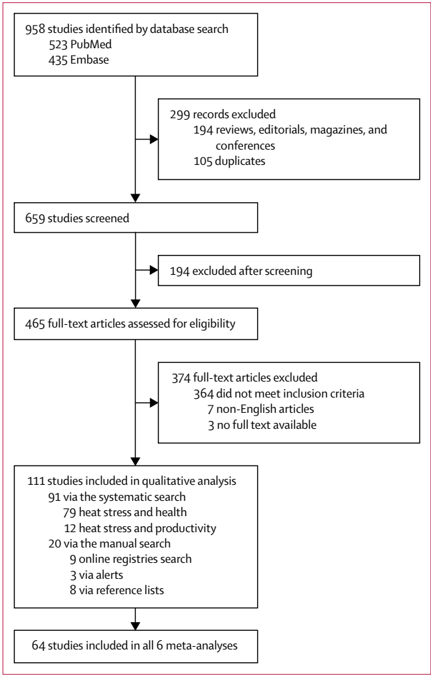
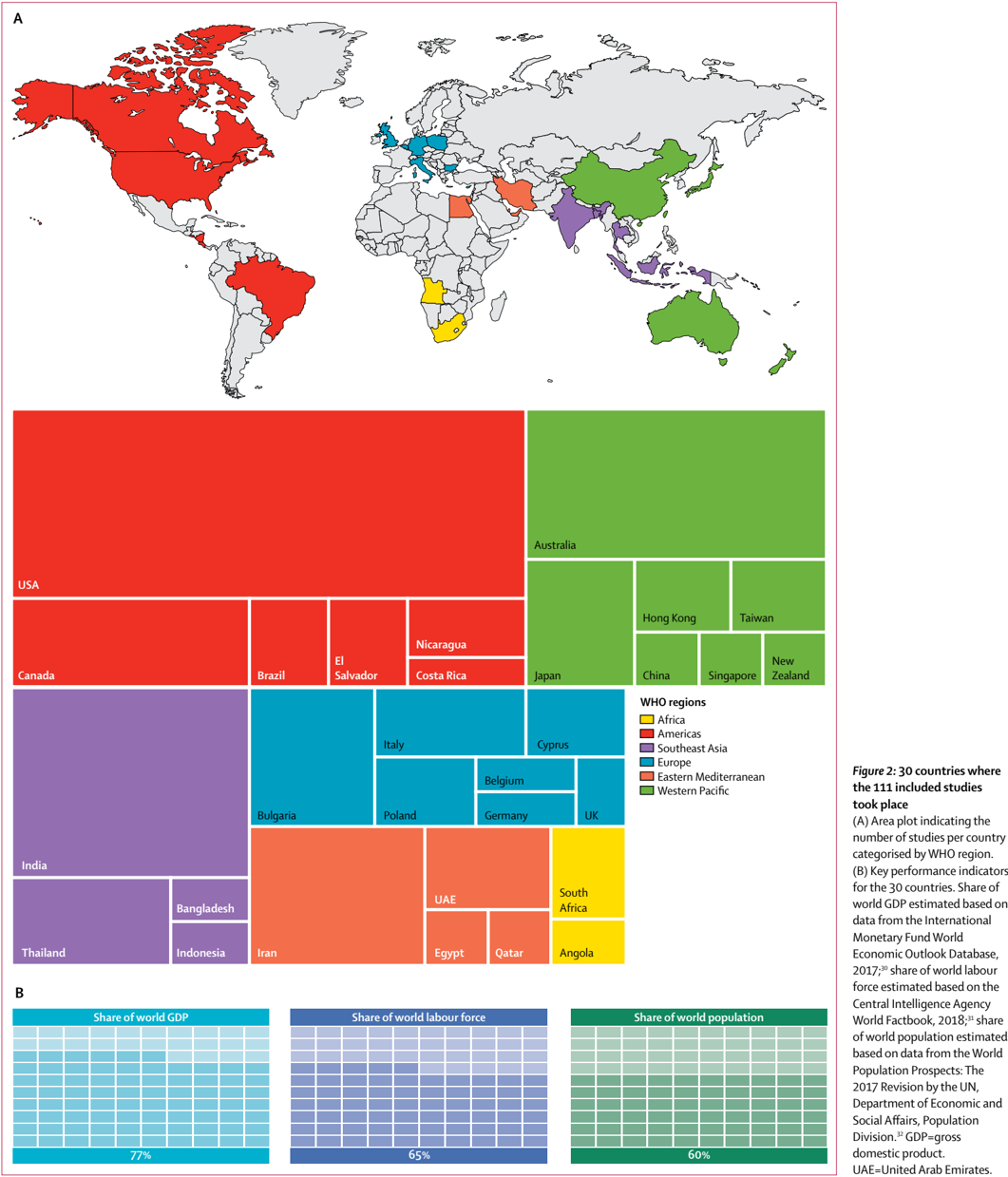
BACKGROUND: Occupational heat strain (ie, the effect of environmental heat stress on the body) directly threatens workers' ability to live healthy and productive lives. We estimated the effects of occupational heat strain on workers' health and productivity outcomes. METHODS: Following PRISMA guidelines for this systematic review and meta-analysis, we searched PubMed and Embase from database inception to Feb 5, 2018, for relevant studies in any labour environment and at any level of occupational heat strain. No restrictions on language, workers' health status, or study design were applied. Occupational heat strain was defined using international health and safety guidelines and standards. We excluded studies that calculated effects using simulations or statistical models instead of actual measurements, and any grey literature. Risk of bias, data extraction, and sensitivity analysis were performed by two independent investigators. Six random-effects meta-analyses estimated the prevalence of occupational heat strain, kidney disease or acute kidney injury, productivity loss, core temperature, change in urine specific gravity, and odds of occupational heat strain occurring during or at the end of a work shift in heat stress conditions. The review protocol is available on PROSPERO, registration number CRD42017083271. FINDINGS: Of 958 reports identified through our systematic search, 111 studies done in 30 countries, including 447 million workers from more than 40 different occupations, were eligible for analysis. Our meta-analyses showed that individuals working a single work shift under heat stress (defined as wet-bulb globe temperature beyond 22·0 or 24·8°C depending on work intensity) were 4·01 times (95% CI 2·45-6·58; nine studies with 11 582 workers) more likely to experience occupational heat strain than an individual working in thermoneutral conditions, while their core temperature was increased by 0·7°C (0·4-1·0; 17 studies with 1090 workers) and their urine specific gravity was increased by 14·5% (0·0031, 0·0014-0·0048; 14 studies with 691 workers). During or at the end of a work shift under heat stress, 35% (31-39; 33 studies with 13 088 workers) of workers experienced occupational heat strain, while 30% (21-39; 11 studies with 8076 workers) reported productivity losses. Finally, 15% (11-19; ten studies with 21 721 workers) of individuals who typically or frequently worked under heat stress (minimum of 6 h per day, 5 days per week, for 2 months of the year) experienced kidney disease or acute kidney injury. Overall, this analysis include a variety of populations, exposures, and occupations to comply with a wider adoption of evidence synthesis, but resulted in large heterogeneity in our meta-analyses. Grading of Recommendations, Assessment, Development and Evaluation analysis revealed moderate confidence for most results and very low confidence in two cases (average core temperature and change in urine specific gravity) due to studies being funded by industry. INTERPRETATION: Occupational heat strain has important health and productivity outcomes and should be recognised as a public health problem. Concerted international action is needed to mitigate its effects in light of climate change and the anticipated rise in heat stress. FUNDING: EU Horizon 2020 research and innovation programme.
Verified 2026-11-22 · 1 reference not checked yet
Overview
CoChat Summary
## TL;DR
This systematic review and meta-analysis found that occupational heat strain is associated with substantial losses in workers’ health and productivity across a very large evidence base. Across 111 studies from 30 countries, workers in heat stress conditions had higher risks of heat strain, dehydration, productivity loss, and kidney-related outcomes.
## Key findings
- The review included 111 studies from 30 countries, covering 447,108,664 workers in more than 40 occupations.
- In six random-effects meta-analyses, working a single shift under heat stress made workers 4.01 times more likely to experience occupational heat strain than thermoneutral conditions (95% CI 2.45–6.58; 9 studies, 11,582 workers).
- Single-shift heat stress increased core temperature by 0.7°C (0.4–1.0; 17 studies, 1,090 workers) and urine specific gravity by 14.5% (0.0014–0.0048; 14 studies, 691 workers).
- During or at the end of a shift in heat stress conditions, 35% of workers experienced occupational heat strain (31–39; 33 studies, 13,088 workers), 30% reported productivity losses (21–39; 11 studies, 8,076 workers), and 15% of those typically or frequently working in heat stress had kidney disease or acute kidney injury (11–19; 10 studies, 21,721 workers).
## Methods
- Systematic review and meta-analysis conducted according to PRISMA; protocol registered on PROSPERO (CRD42017083271).
- Searched PubMed and Embase from inception to Feb 5, 2018; included original quantitative studies in any language, any labor environment, and any occupational heat strain level; excluded grey literature and studies based on simulations/statistical models rather than actual human measurements.
- Two independent investigators handled study selection, risk of bias, extraction, and sensitivity analysis; six random-effects meta-analyses were run for prevalence, odds, mean differences, and related outcomes.
## Limitations
- The authors state that the included studies produced large heterogeneity in the meta-analyses; average I² was 80%.
- The review pooled studies with different populations, exposures, and occupations, which the authors say widened evidence synthesis but increased heterogeneity.
- The text makes evident that some outcomes relied on self-reported tools and that studies were often regionally confined and selected where high prevalence/effects were expected; the authors say this could bias prevalence estimates and limit generalizability to cold regions or jobs not associated with heat exposure.
Model-written summary. Check it against the paper before relying on it.
Integrity signals
Registry
Cites
Statistics
Figures
Verification
Claims the paper makes
4 Valid · 0 Not valid · 10 Not checked · 58 Own results and interpretations
The cited sources support only part of this claim — read each source’s verdict below.
In the paper
“those who are older, obese, unfit, have chronic disease, or experience acute illness or infection are at a high risk for heatinduced pathologies (eg, heat cramps, heat exhaustion, and heat stroke). 1,7,139,147”
What the sources say
- Partly supportedcites [1] 1 Mora C, Dousset B, Caldwell IR, et al. Global risk of deadly heat. Nat Clim Chang 2017; 7: 501-06. sourceExperimental — accuracy not yet measured
The discussion (p. 8) describes an aging population as highly vulnerable to heat, supporting the claim about older individuals. It does not identify obesity, poor fitness, chronic disease, acute illness, or infection as risk factors, or specifically connect those groups to heat cramps, heat exhaustion, and heat stroke. (LLM, conf=0.87)
- Partly supportedcites [7] 7 Kenny GP, Groeller H, McGinn R, Flouris AD. Age, human performance, and physical employment standards. Appl Physiol Nutr Metab 2016; 41 (6 suppl 2) : S92-107 . sourceExperimental — accuracy not yet measured
Kenny et al. (2016) supports most of the risk list: 'Factors affecting work ability in older adults' reports age-related impairments in whole-body heat loss and 60-80% greater heat storage in individuals ≥40 years (Larose et al. 2013, 2014), with those impairments modulated by fitness (low-fitness middle-aged adults losing heat like older counterparts; Stapleton et al. 2015), and 'Impact of chronic health disorders on physical function' states that cardiopulmonary impairments and type 2 diabetes are associated with higher rates of heat illness in hot environments, with the INTRODUCTION naming obesity, diabetes and hypertension as the vulnerable workers the ACGIH TLVs may not protect. However, our copy nowhere treats acute illness or infection as a heat-illness risk factor, and it does not enumerate heat-induced pathologies as heat cramps, heat exhaustion and heat stroke — its outcomes are heat storage, attenuated heat-loss capacity, 'heat illness' and reduced work output. The claim's infection/acute-illness element and the specific pathology spectrum are therefore not attributable to this source. (LLM, conf=0.72)
- Partly supportedcites [139] 139 Flouris AD, McGinn R, Poirier MP, et al. Screening criteria for increased susceptibility to heat stress during work or leisure in hot environments in healthy individuals aged 31-70 years. Temperature (Austin) 2017; 5: 86-99. 142 sourceExperimental — accuracy not yet measured
The Introduction (p.1) supports part of the list: it states that 'heat injuries were more prevalent in unfit, obese, and unacclimatised individuals' and that intrinsic factors 'known to increase an individual's susceptibility to heat stress (SHS)' include sex, age, body composition and cardiorespiratory fitness; the Discussion adds that older adults and 'patients with chronic diseases such as hypertension and type 2 diabetes' are 'more vulnerable populations' (while noting their own cohort excluded chronic disease). However, our copy nowhere mentions acute illness or infection as a risk factor, and it does not enumerate heat cramps, heat exhaustion or heat stroke as the heat-induced pathologies these individuals are at high risk of (the only such wording is in the titles of cited works, e.g. Schickele's 'fatal heat stroke' analysis, ref. 14). So the risk-factor list is only partly attributable to this source. (LLM, conf=0.72)
- Not matchedcites [147] 147 WHO. Quantitative risk assessment of the effects of climate change on selected causes of death, 2030s and 2050s. Geneva: World Health Organization, 2014.
Its entry has no title and year that we can search by.
plainstates an association- Asserted: passes — The authors put it forward as true.
- Checkable: passes — It can be checked against evidence.
- Load-bearing: unclear — It is unclear whether the paper’s conclusions depend on it.
- Based: passes — The paper gives a reason why it holds.
- Partly supported
Every source the paper cites for this claim was checked and supports it.
In the paper
“Our estimate that 35% of individuals working in heat stress conditions experience occupational heat strain is in line with the 30% (95% CI 24-36) prevalence reported for increased susceptibility to heat stress (an inability to mitigate hyperthermia) when working or exercising in hot environments, 139”
What the sources say
- Supportedcites [139] 139 Flouris AD, McGinn R, Poirier MP, et al. Screening criteria for increased susceptibility to heat stress during work or leisure in hot environments in healthy individuals aged 31-70 years. Temperature (Austin) 2017; 5: 86-99. 142 source
The Results section 'SHS in the analysis group' states verbatim: 'Overall, 30% (95% confidence interval: 24-36%) of OLDER individuals were identified as SHSC (Table 2)', and Table 2 (Discussion) gives the same overall prevalence rate of 0.30 § 0.06 for the entire sample. The paper's scope matches the claim's context — sex-specific screening criteria for susceptibility to heat stress (SHS) 'during work and leisure activities in hot environments' (Introduction), with SHSC defined as a reduced capacity to dissipate heat, i.e. elevated rectal temperature/heat storage (equivalent to 'inability to mitigate hyperthermia'). Note that the source's figure is for healthy, physically active adults aged 31-70 (Discussion cautions that the criteria require further validation in sedentary adults and patients with chronic disease), which is the population the 30% prevalence describes. (LLM, conf=0.88)
hedged- Asserted: passes — The authors put it forward as true.
- Checkable: passes — It can be checked against evidence.
- Load-bearing: unclear — It is unclear whether the paper’s conclusions depend on it.
- Based: passes — The paper gives a reason why it holds.
- Supported
A result the paper reports from its own data — it cites no other source for it, so there is none to check. The quote shows it is in the paper.
In the paper
“their urine specific gravity was increased by 14·5% (0·0031, 0·0014-0·0048; 14 studies with 691 workers)”
- Also stated in: § Results · plain
“The average increase due to working in heat stress conditions was 0·0031 (0·0014-0·0048; table; appendix), which is equal to a 14·5% (6·5-22·4) increase.”
- Also stated in: § Discussion · plain
“our analyses show that people who worked a single shift in heat stress conditions had an increase of 14·5% in urine specific gravity compared with those who worked a shift in thermoneutral conditions.”
plainstates a cause- Asserted: passes — The authors put it forward as true.
- Checkable: passes — It can be checked against evidence.
- Load-bearing: passes — The paper’s conclusions depend on it.
- Based: passes — The paper gives a reason why it holds.
- Also stated in: § Results · plain
A result the paper reports from its own data — it cites no other source for it, so there is none to check. The quote shows it is in the paper.
In the paper
“resulted in large heterogeneity with an average I ² of 80% (table)”
- Also stated in: § Summary · plain
“but resulted in large heterogeneity in our meta-analyses”
plain- Asserted: passes — The authors put it forward as true.
- Checkable: passes — It can be checked against evidence.
- Load-bearing: unclear — It is unclear whether the paper’s conclusions depend on it.
- Based: passes — The paper gives a reason why it holds.
- Also stated in: § Summary · plain
A result the paper reports from its own data — it cites no other source for it, so there is none to check. The quote shows it is in the paper.
In the paper
“These studies suggest an average 2·6% productivity decline (individual study estimates: 0·8%, 4 1·4%, 5 1·8%, 56 2·2%, 38 2·8%, 57 4·4%, 55 5·0% 6 ) for every degree increase beyond 24°C WBGT.”
- Also stated in: § Discussion · plain
“These losses increased by 2·6% for every degree increase beyond 24°C WBGT.”
plainstates a cause- Asserted: passes — The authors put it forward as true.
- Checkable: passes — It can be checked against evidence.
- Load-bearing: passes — The paper’s conclusions depend on it.
- Based: passes — The paper gives a reason why it holds.
- Also stated in: § Discussion · plain
25 more claims
Create a free account to see all 72 claims and to verify the 5 references still open.
- Probably not a substantial claim. 31
- It may state two separate claims as one. 23
Claims other papers make about this one
Each is checked against this paper’s own text: does it say what the citing paper says it does?
The source backs part of the claim, not all of it — or backs it for a different population, condition or comparison.
In the citing paper
“However, recent data confirmed that these employees perform the vast majority of their work outdoors and are directly affected by sun exposure, leading to increased heat strain and impaired capacity for manual labor [10,11,12,13].”
From The Impacts of Sun Exposure on Worker Physiology and Cognition: Multi-Country Evidence and Interventions (2021) · cites this paper as [10]
Experimental — accuracy not yet measuredIn the citing paper
“In addition, heat exposure reduces labour productivity and harms the livelihoods of workers and their dependents, particularly when affecting access to quality nutrition, health care, housing, or health-supporting services.94,95”
From The 2024 report of the Lancet Countdown on health and climate change: facing record-breaking threats from delayed action (2024) · cites this paper as [94]
Citations
Cites
Preferred Reporting Items for Systematic Reviews and Meta-Analyses: The PRISMA Statement
Moher, D., Liberati, A., Tetzlaff, J., Altman, D. G., & The PRISMA Group (2009) · PLoS Medicine · doi:10.1371/journal.pmed.1000097 · Cited by 64,042 · cited 2×
“Following PRISMA guidelines, 13 for our systematic review and meta-analysis we searched the PubMed and Embase databases from inception to Nov 30, 2017, for studies that assessed the effect of occupational heat strain on workers’ health or productivity outcomes.”
Preferred reporting items for systematic reviews and meta-analyses: the PRISMA Statement.
(2009) · PubMed Central · Cited by 44,859
Preferred reporting items for systematic reviews and meta-analyses: The PRISMA statement
Moher, D., Liberati, A., Tetzlaff, J., Altman, D. G., & the PRISMA Group* (2009) · Annals of Internal Medicine · doi:10.7326/0003-4819-151-4-200908180-00135 · Cited by 37,554
(2012) · Kidney International Supplements · doi:10.1038/kisup.2012.1 · Cited by 4,326
What is ‘quality of evidence’ and why is it important to clinicians?
Guyatt, G. H., Oxman, A. D., Kunz, R., Vist, G. E., Falck-Ytter, Y., & Schünemann, H. J. (2008) · BMJ · doi:10.1136/bmj.39490.551019.be · Cited by 3,250 · cited 2×
“28 GRADE assessed the quality of the meta-analysis results via methodological design, risk of bias, heterogeneity, indirectness, imprecision, publication bias, and effect sizes displayed in both the included studies in a meta-analysis and the meta-analysis itself.”
Clinical Methods: The History, Physical, and Laboratory Examinations
Kruse, J. A. (1990) · JAMA: The Journal of the American Medical Association · doi:10.1001/jama.1990.03450210108045 · Cited by 2,029
ACSM Position Stand: Exercise and Fluid Replacement
Convertino, V. A., Armstrong, L. E., Coyle, E. F., Mack, G. W., Sawka, M. N., Senay, L. C., & Sherman, W. M. (1996) · Medicine & Science in Sports & Exercise · doi:10.1097/00005768-199610000-00045 · Cited by 1,965
Mora, C., Dousset, B., Caldwell, I. R., Powell, F. E., Geronimo, R. C., Bielecki, C. R., Counsell, C. W. W., Dietrich, B. S., Johnston, E. T., Louis, L. V., et al. (2017) · Nature Climate Change · doi:10.1038/nclimate3322 · Cited by 1,746 · cited 1×
“1,7,139,147 We used the standard definitions of kidney disease and acute kidney injury proposed by the KDIGO clinical practice guidelines workgroup 24 and found that 15% of individuals working in heat stress have these conditions, which is markedly higher than the prevalence rates reported for…”
Climate Change and Extreme Heat Events
Luber, G., & McGeehin, M. (2008) · American Journal of Preventive Medicine · doi:10.1016/j.amepre.2008.08.021 · Cited by 1,243
Evolving importance of kidney disease: from subspecialty to global health burden
Eckardt, K.-U., Coresh, J., Devuyst, O., Johnson, R. J., Köttgen, A., Levey, A. S., & Levin, A. (2013) · The Lancet · doi:10.1016/s0140-6736(13)60439-0 · Cited by 1,159 · cited 1×
“148 and acute kidney injury in high-income (2”
Research works printed but not linked: 6
- 17 ACGIH. Heat Stress and Strain: TLV Physical Agents Documentation. Cincinatti, OH: American Conference of Governmental Industrial Hygienists, 2007 .
- 24 Acute Kidney Injury Work Group. Kidney Disease: Improving Global Outcomes (KDIGO). KDIGO clinical practice guideline for acute kidney injury. Kidney Int 2012; 2 (suppl) : 1-138.
- 78 Krishnan S, Kumar AP, Maruthy KN, Jeremiah PR, Venugopal V. Physiological implications of occupational heat stress for maintenance workers in a residential complex in Chennai-an exploratory intervention trial. Indian J Physiol Pharmacol 2017; 61: 23-29.
- 107 Armed Forces Health Surveillance Center. Update: heat injuries, active component, U.S. Armed Forces, 2011. MSMR 2012; 19: 14-16.
- 108 Armed Forces Health Surveillance Center. Update: heat injuries, active component, U.S. Armed Forces, 2012. MSMR 2013; 20: 17-20.
- 110 Armed Forces Health Surveillance Center. Update: Heat injuries, active component, U.S. Armed Forces, 2014. MSMR 2015; 22: 17-20.
Cited by
Items 401–500 of 564
Wang, Y., Peng, Z., Cheng, X., Shao, J., & Yang, B. (2026) · Building and Environment · doi:10.1016/j.buildenv.2026.114758 · Cited by 2
Riedel, N., Steghaus, S., & Wischniewski, S. (2026) · BMC Public Health · doi:10.1186/s12889-026-28055-z · Cited by 1
“Occupational heat stress imposes physiological strain, resulting in adverse outcomes such as dehydration, chronic kidney injury and an increased risk of occupational accidents, impairing work capacity and reducing productivity [7–9].”
Nutrition and Hydration Strategies for Heatwave Adaptation: A Narrative Review
D’Angelo, S. (2026) · Nutrients · doi:10.3390/nu18152502 · Cited by 3
“…cardiovascular events, renal outcomes, emergency department visits, or occupational injuries, but rarely include detailed dietary intake, hydration status, electrolyte balance, food access, food safety, or nutritional vulnerability as exposure or modifying variables [2,15,16,25,38,43,44].”
Risk Analysis of Occupational Heat-Related Illness
Lyu, P., Song, S., & Watts, P. (2022) · EPiC series in built environment · doi:10.29007/zxhz · Cited by 3
“HRI not only creates substantial health difficulties to employees but also leads to considerable productivity and financial losses (Flouris et al., 2018; Takakura et al., 2017).”
BackgroundSuarez, J. J., Elon, L., Rangel-Rodriguez, A., Xiuhtecutli, N., Houser, M. C., Hertzberg, V., McCauley, L., Sands, J. M., & Chicas, R. C. (2023) · Journal of Occupational and Environmental Medicine · doi:10.1097/jom.0000000000002880 · Cited by 1
“Copyright © 2023 American College of Occupational and Environment that included diverse populations, exposures, and occupations found a 15% incidence of AKI or kidney diseases among those whoworked in high ambient temperatures (Wet Bulb Globe Temperature >22°C [72° F] for very intense work; Wet Bulb Globe Temperature…”
BackgroundHeat exposure following encoding can interfere with subsequent recognition memory
González, J. A. C., Soto, D., & Gutiérrez, E. (2023) · Scientific Reports · doi:10.1038/s41598-023-38248-w · Cited by 1
An experimental evaluation on thermal comfort and fatigue of human wearing mascot costumes in summer
Liu, Z., Wang, R., Guo, Z., Liu, Z., Gao, Y., & Pang, F. (2023) · International Journal of Low-Carbon Technologies · doi:10.1093/ijlct/ctad104 · Cited by 1
Dehdashti, A., Fatemi, F., & Poureghtedar, N. (2024) · International Journal of Environmental Health Research · doi:10.1080/09603123.2024.2346559 · Cited by 3
“This finding is consistent with previous research that has suggested that hydration is an important factor in mitigating the effects of heat stress (Flouris et al. 2018).”
InfluentialEinfluss des Wetters auf den Schlaganfall
Treib, S., Adler, W., Gröschel, K., Binder, A., Treib, P., Morgenthaler, M., Lohmann, L., Treib, J., Fassbender, K. C., & Treib, J. (2024) · Nervenheilkunde · doi:10.1055/a-2334-3584 · Cited by 1
Medical and Surgical Emergencies in Occupational Medicine: A Comprehensive Review
Jogie, J. A., Jogie, J., Ramharacksingh, A. P., & Ali, N. C. (2025) · Cureus · doi:10.7759/cureus.76985 · Cited by 2
“Rising temperatures can expand the range of certain pathogens [42].”
Safe Work and Global Sustainable Development
Burke, M. J. (2025) · Sustainable development goals series · doi:10.1007/978-3-031-91926-8_10 · Cited by 1
Einfluss des Klimawandels auf die Schlaganfallhäufigkeit in Südwestdeutschland
Treib, J., Adler, W., Treib, S., Gröschel, K., Binder, A., Morgenthaler, M., Wößner, R., Hammen, T., Treib, P., Fassbender, K. C., et al. (2025) · Nervenheilkunde · doi:10.1055/a-2578-7174 · Cited by 1
Tetzlaff, E. J., Oddson, B. E., Janetos, K. T., Meade, R. D., & Kenny, G. P. (2025) · American Journal of Industrial Medicine · doi:10.1002/ajim.70024 · Cited by 1
“Further, heat ‐ exposed workers are also at risk for impaired work performance and cognitive function [3, 4, 8], which in turn lead to an increased risk of work ‐ related injuries [3, 4, 9, 10].”
Self-citationAssociation between extreme weather events and postoperative adverse outcomes: a systematic review
Hwang, M., Naik, H., Blake, L., Biferie, M. D., & Ke, J. X. C. (2025) · Canadian Journal of Anesthesia/Journal canadien d anesthésie · doi:10.1007/s12630-025-03051-w · Cited by 1
Phillips, W. D., Janta, B., Gehrt, D., Flemons, L., Gkousis, E., Cole, S., Smith, P., & Hafner, M. (2022) · RAND Corporation eBooks · doi:10.7249/rra1323-1 · Cited by 3
Beating the Heat: Investing in Pro-Poor Solutions for Urban Resilience
Bank, A. D. (2022) · doi:10.22617/tcs220299-2 · Cited by 7
Hall, S., Brown, S. V., Amador, J. J., López-Pilarte, D., Ramírez‐Rubio, O., Sánchez, M. R. A., Gil, S. G., Argos, M., Carvalho, L. E., Henn, B. C., et al. (2025) · SSRN Electronic Journal · doi:10.2139/ssrn.5169119 · Cited by 1
Bach, A. J. E. (2020) · Queensland University of Technology · doi:10.5204/thesis.eprints.200627 · Cited by 1
The State of Innovation in Developing East Asia
Cirera, X., Mason, A. D., de Nicola, F., Kuriakose, S., Mare, D. S., & Tran, G. T. (2021) · World Bank, Washington, DC eBooks · doi:10.1596/978-1-4648-1606-2_ch1
Gray, I., & Barral, S. (2021) · Revue Française de Socio-Économie · doi:10.3917/rfse.027.0185
DIETARY GUIDELINES FOR PROTECTION OF THE OCCUPATIONAL HEALTH OF WORKERS IN FORESTRY
Stoilova, I. Y., & Birdanova, V. A. (2021) · Journal of IMAB - Annual Proceeding (Scientific Papers) · doi:10.5272/jimab.2021274.4103
Oriente Medio. Obama se hace oír.
Zarzuela, A. (2009) · Cambio 16
Symonds, M. E. (2019) · Faculty Opinions – Post-Publication Peer Review of the Biomedical Literature · doi:10.3410/f.735896006.793560964
Nurullita, U., Sinta Dwi Surya, P., Samual, M. R., & Sumanto, D. (2022) · International journal of research and scientific innovation · doi:10.51244/ijrsi.2022.9404
Cardiovascular responses to orthostasis during a simulated 3-day heatwavePreprint
Fisher, J. T., Ciuha, U., Ioannou, L. G., et al. (2022) · Research Square · doi:10.21203/rs.3.rs-1903157/v1
Self-citationHeat exposure following encoding can interfere with subsequent recognition memoryPreprint
González, J. A. C., Soto, D., & Gutierrez, E. (2022) · doi:10.31219/osf.io/7a2vm
Occupational risk factors for health disorders in dairy production (review)
Aleshina, Y. A., Novikova, T. A., Николаевич, Л. И., et al. (2022) · Экология человека · doi:10.17816/humeco109926
Molecular choreography to acute heat exposure in a simulated extreme high temperature environmentPreprint
Wen, J., Wang, L., Cheng, J., Liu, Y., Ma, T., Wen, Q., Zhou, J., Sun, X., Li, C., Zou, Y., et al. (2023) · Research Square · doi:10.21203/rs.3.rs-3615487/v1
Analisis Heat Strain Pada Pekerja Pembangunan Kapal PT.IKI (Persero) Makassar
Nadia, N., Syam, N., & Rahman, R. (2023) · JURNAL ILMIAH KESEHATAN SANDI HUSADA · doi:10.35816/jiskh.v12i2.1079 · Cited by 1
Najihah, K., Salmira, C. S., Apriani, N., & Hasibuan, S. S. (2023) · Jurnal Perilaku Kesehatan Terpadu · doi:10.61963/jpkt.v1i2.28 · Cited by 1
“The circumstances and safety of production facilities, workers, and work practices are all included in the concept of occupational safety in the workplace (Badri et al., 2018; Tamers et al., 2019; Flouris et al., 2018).”
BackgroundMicroclimatic perception and preference among market vendors in Jakarta, Indonesia
Ufaira, R. M., Bermanda, B. S., Nastiti, A., Kusumah, S. W. D., & Amir, S. (2024) · E3S Web of Conferences · doi:10.1051/e3sconf/202448501005 · Cited by 2
Carballo, D., Carballo, S., & Martin, P. (2022) · Médecine & Hygiène eBooks · doi:10.3917/mh.senn.2022.01.0413
Estrés térmico laboral y sus efectos en la salud de los trabajadores
Ruiz-Chávez, P. J., Molina-Delgado, J. R., Rodríguez, R. C., & Noroña-Salcedo, D. R. (2023) · Revista Arbitrada Interdisciplinaria de Ciencias de la Salud Salud y Vida · doi:10.35381/s.v.v7i2.3502
Indonesia, U., Nafis, M. S., Ramdhan, D. H., & Indonesia, U. (2023) · National Journal of Occupational Health and Safety · doi:10.59230/njohs.v4i2.7643
Peran Dehidrasi Terhadap Terbentuknya Kristal Urin
Prasetyo, Y. E., Ulfah, & Naima (2024) · CoMPHI Journal Community Medicine and Public Health of Indonesia Journal · doi:10.37148/comphijournal.v4i3.176
Tsoutsoubi, L., Ioannou, L. G., Ciuha, U., Fisher, J. T., Possnig, C., Simpson, L. L., Flouris, A. D., Lawley, J. S., & Mekjavić, I. B. (2024) · Frontiers in Physiology · doi:10.3389/fphys.2024.1398816
Self-citationWagoner, R. S., López-Gálvez, N. I., Canales, R. A., Beamer, P. I., Farland, L. V., von Hippel, F. A., de Zapien, J. G., Rosales, C. B., & Furlong, M. (2024) · Journal of Agromedicine · doi:10.1080/1059924x.2026.2679282
Thermal Stress and Its Relationship with Industry: A Systematic Review of The Literature
dos Santos, A. L., Kipper, L. M., Dolci, P. C., Rohlfes, A. L. B., PEREIRA, J. S., & Lange, H. O. B. (2024) · Revista de Gestão Social e Ambiental · doi:10.24857/rgsa.v18n9-179
“…analyzed show that workers suffer harmful effects on their health when exposed to high levels of ET (Lucas et al ., 2014; Hansen et al ., 2018; Flouris et al ., 2018; Varghese et al ., 2018; Varghese et al ., 2019; Varghese et al ., 2020; Chong et al ., 2020; Fatima et al ., 2023; Ansah et al…”
BackgroundCommunity-Engaged Research with Agricultural Workers in Florida: Health and Climate Change
Chicas, R. C., Irish, J., Xiuhtecutli, N., & Mutic, A. D. (2024) · Springer eBooks · doi:10.1007/978-3-031-61160-5_21
Islam, M. Z., Ali, M. S., Roy, C. K., & Miah, M. T. (2025) · Environment Development and Sustainability · doi:10.1007/s10668-025-06018-5
Bernard, T. E., Manjunath, G., & Wesdock, J. C. (2025) · Journal of Occupational and Environmental Medicine · doi:10.1097/jom.0000000000003358
“12 In this meta-analysis, individuals working a single work period under heat stress were four times (95% CI, 2.5 – 6.6) more likely to experience occupational heat strain than individuals working in temperate conditions.”
InfluentialWang, R., & Wang, J. (2025) · Climate and Development · doi:10.1080/17565529.2025.2483363
“…research has highlighted that climate change causes severe consequences for human capital, residents’ health, and the economy in many regions (e.g. Flouris et al., 2018; Romanello et al., 2021), and different climate factors tend to have different effects on urban resilience (Liu et al., 2022).”
Hybrid Evaporative-Fan Cooling Vest: Multi-Scale Cooling Performance EvaluationPreprint
Wang, X., Yang, G., Zhang, S., et al. (2025) · SSRN Electronic Journal · doi:10.2139/ssrn.5219553
LLMs as Your Second Brain - How AI Will Affect the Way We Solve Problems
Speicher, P., & Becker, L. (2025) · Springer proceedings in business and economics · doi:10.1007/978-3-031-88052-0_37 · Cited by 1
Work and work exposures in sugarcane farming in Eswatini, Southern Africa
Msibi, S. C., Naidoo, S., Jakobsson, K., Glaser, J., Skinner, B., & Naidoo, R. (2025) · International Archives of Occupational and Environmental Health · doi:10.1007/s00420-025-02140-z · Cited by 2
“Sequential HR measurements were used to calculate estimated core temperature (ECTemp) (Buller et al. 2013) as an indicator of heat strain (i.e., the effect of heat stress on the body) (Flouris et al. 2018).”
van der Horst, L., Bouaddi, O., Williams, S. J., Jago, M., Lau, K. M., Furber, B., Hargreaves, S., Zaini, A. Z., El‐Ghitany, E. M., Loganathan, T., et al. (2025) · medRxiv · doi:10.1101/2025.06.04.25328218
Self-citationZhou, L., Yuan, B., López‐Carr, D., & Hu, F. (2025) · The urban book series · doi:10.1007/978-3-031-94499-4_1
DEDASE, C. (2025) · International Journal For Multidisciplinary Research · doi:10.36948/ijfmr.2025.v07i04.50469
Kassem, N., Boutros, P., & Barteit, S. (2025) · Progress in molecular biology and translational science · doi:10.1016/bs.pmbts.2025.06.010
A Systematic Approach to Safety Education and Training
Burke, M. J. (2025) · Sustainable development goals series · doi:10.1007/978-3-031-91926-8_2
Cognitive and athletic performances in tropical climate: The effect of time of day
Ruart, S., Hüe, O., & Robin, N. (2025) · Temperature · doi:10.1080/23328940.2025.2535046
“Several observational studies have also shown that heat stress can negatively affect productivity at work [24,25] and school results (learning and performance on cognitive tasks) [26,27].”
Efectos de la exposición a altas temperaturas durante el horneado a trabajadores de una panadería
Laaz, A. A. (2025) · Multidisciplinary Journal of Sciences Discoveries and Society · doi:10.71068/z0ftym53
Enhancing Workers’ Safety and Well-Being in Hazardous Environments: An IoT-Based Approach
Bukkawar, A., Kukrety, C., Mishra, B., et al. (2025) · Lecture notes in networks and systems · doi:10.1007/978-981-96-4741-5_15
Sharma, J., & Sidiq, M. (2025) · European Journal of Physiotherapy · doi:10.1080/21679169.2025.2553055
“increased temperature and humidity lead to fluid and electrolytic distortion that predisposes one to fatigue, cramps and injuries related to heat [3]. exposure to high temperatures over extended periods of time decreases exercise tolerance and can exacerbate sarcopenia, which is the loss of muscle…”
Gómez-García, A. R., Paz, A. L. C., & Gutiérrez-Alvarez, R. (2025) · Journal of Public Health Policy · doi:10.1057/s41271-025-00597-3
“In comparison, around 30% of workers in construction and other high‑risk sectors report reduced productivity due to heat exposure [33].”
Lü, H., Tang, J., & Song, Z. (2025) · International Journal of Financial Studies · doi:10.3390/ijfs13040185 · Cited by 1
“Furthermore, existing research has shown that extreme weather severely impairs the health of outdoor workers (Flouris et al., 2018; Parsons et al., 2021), reduces industry working hours (Somanathan et al., 2021), and increases the intensity of corporate layoffs (W. Li et al., 2025).”
Chabba, M., & Bhat, M. G. (2025) · Environmental Challenges · doi:10.1016/j.envc.2025.101343 · Cited by 1
Du, C., Guo, W., Jing, M., et al. (2025) · SSRN Electronic Journal · doi:10.2139/ssrn.5605273
Huang, M., Zhao, Z., Xu, W., Fu, M., Shen, L., Shen, S., & Aerts, J. (2025) · SSRN Electronic Journal · doi:10.2139/ssrn.5638254
Zhao, Y., Xu, Q., Wu, X., Song, Y., Yang, X., & Liu, W. (2025) · SSRN Electronic Journal · doi:10.2139/ssrn.5644196
The physiology of survival: Heat
Foster, J., Meade, R. D., & Matthews, T. K. R. (2025) · Experimental Physiology · doi:10.1113/ep093192 · Cited by 1
“However, during occupational heat stress with daily heat and dehydration, evidence for chronic kidney injury is evident in otherwise healthy individuals (Flouris et al., 2018).”
An assessment of the occupational heat stress recommendations in adults with obesity
Gabel, A. M., Cosentino, S. N., Bachraty, J. P., Chauhan, P. S., Leo, K. C., & Hess, H. W. (2025) · Temperature · doi:10.1080/23328940.2025.2583810 · Cited by 2
“This figure does not account for the additional expenses related to occupational heat-related injury/illnesses (HRI [1,6,13,14]).”
Naboni, E., Rivera-Gómez, C., Galán-Marín, C., & Santamouris, M. (2025) · Elsevier eBooks · doi:10.1016/b978-0-443-28977-4.00002-8
Keeler, J. M., Walker, C., Regester, A., Heikkinen, M., Johnson, B. D., Ju, Y. S., Jin, L., & Schlader, Z. J. (2025) · European Journal of Applied Physiology · doi:10.1007/s00421-025-06053-0
“Together, increasing hyperthermia and perceptions of warmth and thermal discomfort can diminish work productivity and quality (Flouris et al. 2018; Foster et al. 2021a).”
The Impact of Heat Stress on Cognitive Performance in Outdoor Workers: An EEG Study
Hou, H. C. (2025) · International Conference on Construction and Real Estate Management (ICCREM) · doi:10.1061/9780784486627.058
Du, C., Guo, W., Jing, M., Li, G., Li, B., & Li, Y. (2025) · Building and Environment · doi:10.1016/j.buildenv.2025.114092
Vargas, A. S., Castillo, F., Wehner, M. F., Vanos, J., & López‐Carr, D. (2025) · PLOS Climate · doi:10.1371/journal.pclm.0000770
Setko, A. G., & Rusakov, V. N. (2025) · Hygiene and Sanitation · doi:10.47470/0016-9900-2025-104-10-1334-1340
Sustainable Governance of Extreme Heat Risk in the Context of Occupational Safety and Health
Badea, D. O., Darabont, D. C., Cioca, L., Bejinariu, C., Feraru, A., & Pruteanu, A. M. (2025) · Sustainability · doi:10.3390/su172411187
A novel framework for expanding temperature intensity-duration-frequency curve utility
Tierney, G., Mallard, M. S., Spero, T. L., & Jalowska, A. M. (2025) · Natural Hazards · doi:10.1007/s11069-025-07811-1 · Cited by 1
“These effects can be compounded for outdoor laborers, who can have excessive heat strain with a host of negative health effects (Lucas et al. 2014; Flouris et al. 2018).”
Gerosa, T., Fortunato, R., Cellina, F., Ragettli, M. S., Marzorati, D., Baldassari, A., Levati, S., Karabegovic, A., & Baumann, I. (2025) · INQUIRY The Journal of Health Care Organization Provision and Financing · doi:10.1177/00469580251405766 · Cited by 1
“20-22 In addition to these direct effects of heat on health, there may also be indirect effects.”
Intensive monitoring of workers’ health outcomes in a warming world: Opportunities and challenges
Vielma, C., Ballester, J., Basagaña, X., et al. (2026) · PLOS Climate · doi:10.1371/journal.pclm.0000795
Zhang, Y., Li, J., Li, J., & Zhang, W. (2026) · Journal of the Textile Institute · doi:10.1080/00405000.2026.2622878
“This is manifested as thermoregulatory dysfunction (Ebi et al., 2021) and, in severe cases, can lead to irreversible consequences such as dehydration, heatstroke, organ damage, and death (Flouris et al., 2018).”
Gerosa, T., Fortunato, R., Cellina, F., et al. (2025) · Zürcher Hochschule für Angewandte Wissenschaften digital collection (Zurich University of Applied Sciences) · doi:10.21256/zhaw-35368
effect of self-regulated neck-cooling on physical and cognitive performance during heat stress
Bagnall, A., Giuliani, E., Tyler, C. J., & Myrene, H. (2026) · Scientific Journal of Sport and Performance · doi:10.55860/doll4539
Soleimani, N., Dehghan, A., & Dehghan, H. (2026) · Scientific Reports · doi:10.1038/s41598-026-41309-5
Khan, N., Sutanto, M. H., Khadir, F. K. B. A., Mohamad, H., Yaro, N. S. A., & Nordin, N. F. M. (2026) · Scientific Reports · doi:10.1038/s41598-026-41562-8 · Cited by 2
Extreme heat and the risk of fatal industrial accidents: nationwide evidence from China
Husile, H. (2026) · Environmental Research Communications · doi:10.1088/2515-7620/ae4cfa
Kumar, A. P., Hemamalini, A. J., Krishnan, S., Shanmugam, R., & Venugopal, V. (2026) · Archives of Environmental & Occupational Health · doi:10.1080/19338244.2026.2634015
“13,14 The antioxidant components of CFs, including vitamin C, vitamin E, flavonoids, and polyphenols, help protect cells by both neutralizing Reactive Oxygen Species (ROS) and enhancing the activity of superoxide dismutase (SOD), catalase (CAT), and glutathione peroxidase (GPx) antioxidant enzymes…”
InfluentialMcDONALD, P. J., John, K., Topham, T. H., Sawka, M. N., Clark, B., & Périard, J. D. (2026) · The Journal of Physiology · doi:10.1113/jp290089 · Cited by 3
“…exacerbates the development of thermal and cardiovascular strain during exercise and occupational tasks (Périard et al., 2021; Rowell, 1974), which leads to performance impairments and increases the risk of exertional heat illness (Flouris et al., 2018; Mantzios et al., 2022; Roberts et al., 2021).”
Yan, M., Yang, B., Li, M., Kang, W., Yang, Y., & Wang, W. (2026) · Journal of Exposure Science & Environmental Epidemiology · doi:10.1038/s41370-026-00853-y
Immurana, M., Norshie, K., Kpordorlor, G. A., Ketor, C. E., Kisseih, K. G., Tsey, I. H., Acquah, E., Iddrisu, N. I., & Dalaba, M. A. (2026) · Environmental Health Insights · doi:10.1177/11786302261428856
Das, J. K., Malik, A. A., Papageorghiou, A. T., Piryani, S., Ambareen, M., Zuberi, N. F., Islam, Z. S., Mohammed, N., Hussain, N. F., Samad, Z. Z., et al. (2026) · BMJ Open · doi:10.1136/bmjopen-2025-107773 · Cited by 2
Navigating the Intersection of Climate Change and Occupational Health and Safety
Yurtsever, Ö. (2026) · IGI Global eBooks · doi:10.4018/979-8-3373-6370-7.ch007
Zhang, F., Jin, Y. Q., Ma, R., et al. (2026) · BMC Public Health · doi:10.1186/s12889-026-27130-9
Human Work Capacity as a Dynamic Boundary Condition of Industrial Sustainability
Badea, D. O., & Cioca, M. (2026) · Sustainability · doi:10.3390/su18073520
Essays on micro-drivers of firm productivity
Kögel, C. (2023) · theses.fr (ABES) · doi:10.70675/efe7ee20z76efz4fdaz8373z425d3985093d
Les répercussions des changements climatiques sur la SST : état des lieux et pistes d'action
Serres, S. D., & Marchand, A. (2026) · PhareSST · doi:10.70010/sset9473
Adalat, S., Giannakou, K., Valderrama, B., Cárdenas-Aguilera, J. G., Sakkas, G. K., Overeem, J., Hafez, G., Kelly, D., Vulevic, J., He, G., et al. (2026) · The Lancet Planetary Health · doi:10.1016/j.lanplh.2026.101453 · Cited by 1
Pérodin, J., Lawton, B., & Smith, C. (2026) · The Journal of Law Medicine & Ethics · doi:10.1017/jme.2026.10239
Gariazzo, C., Taiano, L., Bonafede, M., & Marinaccio, A. (2026) · Environmental Research · doi:10.1016/j.envres.2026.124644
Advances in human thermophysiological modelling for hot environments: A review
Liu, D., Guo, N., Tong, X., Cao, J., Zhou, Y., & Hu, J. (2026) · International Journal of Industrial Ergonomics · doi:10.1016/j.ergon.2026.103967 · Cited by 1
Dumais, R., Suckow, E., Ainab, I., Zirille, F. M., Forbes, L. M., Lawley, J. S., & Cornwell, W. K. (2026) · International Journal of Environmental Research and Public Health · doi:10.3390/ijerph23050594 · Cited by 1
“It is well established that physical labor under heat stress not only impedes worker productivity but also places strain on the cardiovascular system through dehydration and overexertion [112–114].”
Who Pays When Temperatures Soar?
Bhatotia, K., Gow, O., Robinson, L. A., Dasgupta, S., & Balsari, S. (2026) · Health Affairs · doi:10.1377/hlthaff.2025.01671
DasGupta, M. (2026) · Rajagiri Management Journal · doi:10.1108/ramj-02-2025-0046
Ziegler, M., Seipp, H., Steffens, T., Klages, M., & Herzog‐Niescery, J. (2026) · Atmosphere · doi:10.3390/atmos17050503 · Cited by 1
“Conversely, cold-related discomfort may impair concentration and manual performance in less active staff [5].”
Chu, B., Zhu, Y. C., Luo, L., Luo, J., Liu, L., Li, D., Guo, Y., & Wang, H. (2026) · iScience · doi:10.1016/j.isci.2026.115923
Climate change and human capital
Behrer, A. P., Park, R. J., & Zhang, Y. (2026) · Elsevier eBooks · doi:10.1016/bs.hesecc.2026.03.001
Soleimani, N., & Dehghan, H. (2026) · Scientific Reports · doi:10.1038/s41598-026-54618-6
Metadata
- Authors
- Flouris, A. D., Dinas, P. C., Ioannou, L. G., Nybo, L., Havenith, G., Kenny, G. P., & Kjellstrom, T.
- Affiliations
- University of Thessaly (GR)
- University of Copenhagen (DK)
- Loughborough University (GB)
- University of Ottawa (CA)
- Centre for Technology Research & Innovation (Cyprus) (CY)
- Corresponding author
- Flouris, Andreas D
- ORCID
- Venue
- The Lancet Planetary Health
- Publisher
- Elsevier BV
- Published
- 2018-12
- Volume
- 2
- Issue
- 12
- Pages
- e521-e531
- ISSN
- 2542-5196 (ISSN-L)
- OpenAlex
- W2903225676
- Semantic Scholar
- 16332d72ac34b9fbd282919db94e00812b72dc46
- Cited by
- 579
- References
- 160
- Citations by year
- 2026: 128 · 2025: 113 · 2024: 84 · 2023: 75 · 2022: 58 · 2021: 65 · 2020: 35 · 2019: 19
- FWCI
- 3.91
- Type
- journal article
- Language
- en
- Open access
- gold
- doi.org
- Licence
- cc-by-nc-nd
- www.elsevier.com/tdm/userlicense/1.0/ (tdm)
- creativecommons.org/licenses/by-nc-nd/4.0/ (vor)
- Locations
- The Lancet Planetary Health (publishedVersion, cc-by-nc-nd)
- PubMed (publishedVersion)
- Research at the University of Copenhagen (University of Copenhagen) (publishedVersion, cc-by-nc-nd)
- DOAJ (DOAJ: Directory of Open Access Journals) (submittedVersion, cc-by-sa)
- Loughborough University Institutional Repository (Loughborough University) (submittedVersion, cc-by-nc-nd)
- Loughborough University Research Repository (Loughborough University) (submittedVersion, cc-by-nc-nd)
- University of Thessaly Institutional Repository (University of Thessaly) (submittedVersion, cc-by-nc-nd)
- Topics
- Health Sciences › Medicine › Physiology (medical) › Thermoregulation and physiological responses
- Health Sciences › Medicine › Public Health, Environmental and Occupational Health › Occupational Health and Safety in Workplaces
- Life Sciences › Agricultural and Biological Sciences › Animal Science and Zoology › Effects of Environmental Stressors on Livestock
- Keywords
- heat stress, employee health, productivity loss, core body temperature, urine specific gravity, acute kidney injury, kidney disease, wet bulb globe temperature, shift work, occupational health
- MeSH terms
- Efficiency, Hot Temperature, Humans, Occupational Diseases, Occupational Health, Occupational Exposure, Heat Stress Disorders
About these checks
Registry, retraction, Cites and statistics results are computed, not judged, with one exception: a printed reference that no index lists is read once by a model before it counts as a citation error. Claims are extracted by a model and kept only when their quote appears verbatim in the text; each cited source is then checked, with a model’s help, for whether it says what the claim relies on. Those verdicts can be wrong — read the claim’s quote and the cited source before relying on one.
The claim verdicts this report counts are experimental: their accuracy is not yet measured.
A language model drew the claims from the paper on 2026-10-10, under version 3 of the claim definition (model deepseek-v4.1-flash, prompt extract-v3).
A second model labelled each claim on 2026-10-10 (model jev-1.13-20260917, definition revision gold-guideline-v0.2).
Cited sources are checked with a language model’s help (gpt-6-sol and qwen3.8-omni-flash).
Statistics and arithmetic are recomputed, not judged.
Confidence bands are shown only for fields calibrated on our annotated test set. None is calibrated yet, so no band is shown.
What counts as a claim ›How we measure confidence ›How we check this ›
Are you an author, or do you see a problem with this page? Request a review
Data sources
Bibliographic data: Semantic Scholar, OpenAlex, Crossref.
Contains information from the Semantic Scholar Academic Graph Datasets, made available under the ODC Attribution License (ODC-BY 1.0).
Semantic Scholar’s data is described in: Kinney, R., et al. (2023). The Semantic Scholar Open Data Platform. arXiv:2301.10140.
