

Workers' health and productivity under occupational heat strain: a systematic review and meta-analysis
Open accessThe DOI matches its Crossref record; 152 of the 160 references it cites were found in a registry or an index, and 1 are not checked yet; 7 of the 26 sources its claims cite were checked for support.
Abstract
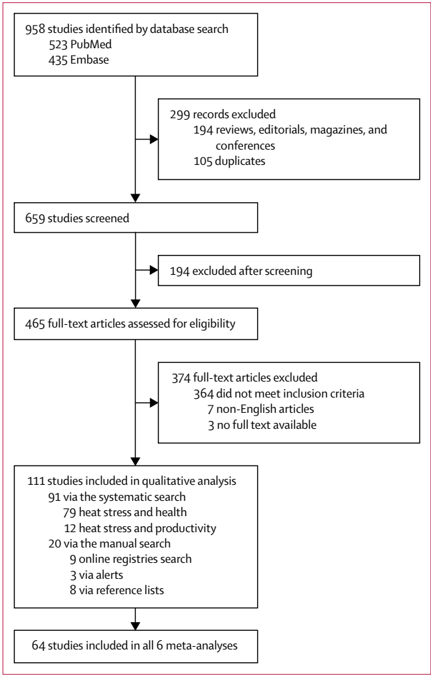
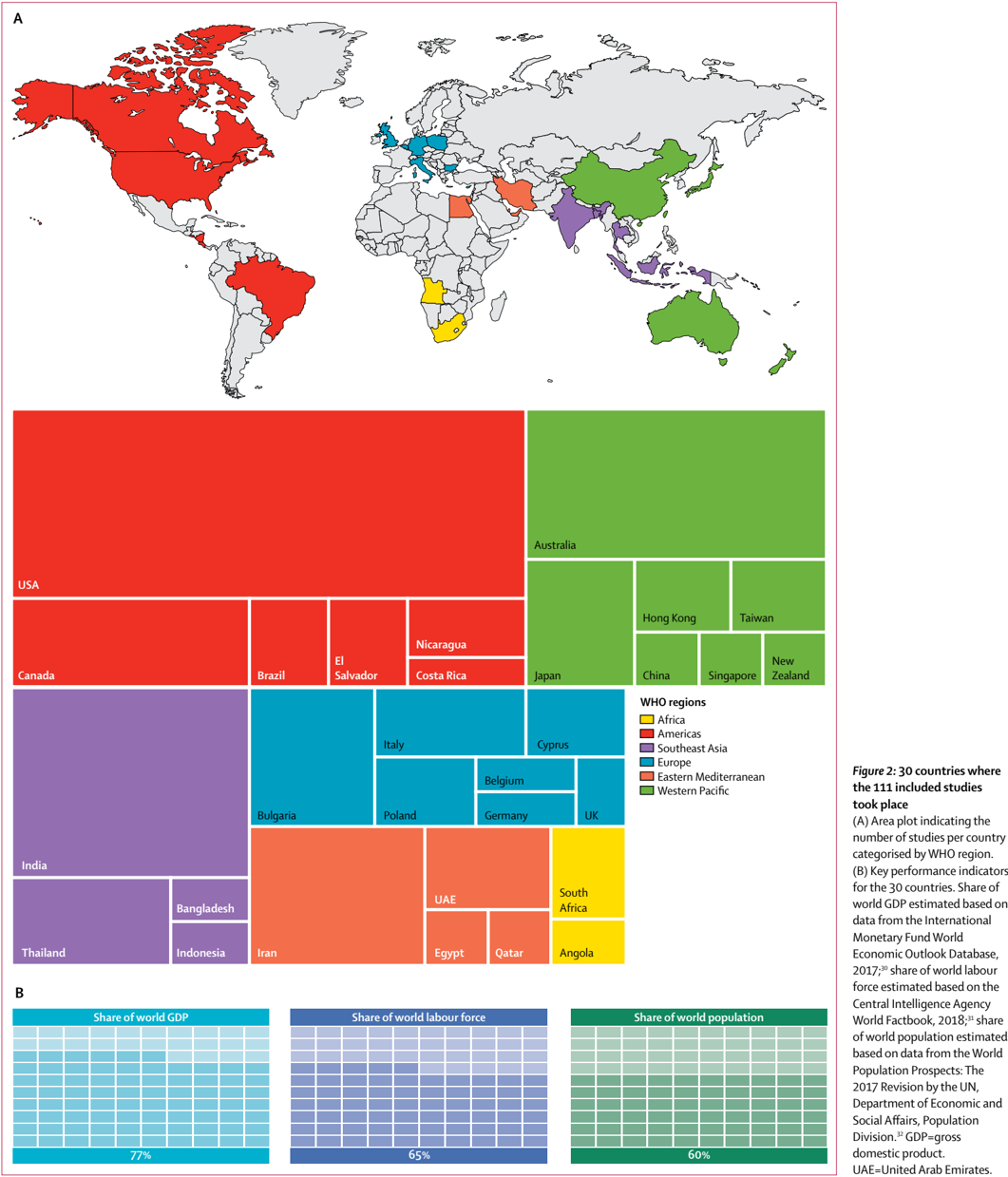
BACKGROUND: Occupational heat strain (ie, the effect of environmental heat stress on the body) directly threatens workers' ability to live healthy and productive lives. We estimated the effects of occupational heat strain on workers' health and productivity outcomes. METHODS: Following PRISMA guidelines for this systematic review and meta-analysis, we searched PubMed and Embase from database inception to Feb 5, 2018, for relevant studies in any labour environment and at any level of occupational heat strain. No restrictions on language, workers' health status, or study design were applied. Occupational heat strain was defined using international health and safety guidelines and standards. We excluded studies that calculated effects using simulations or statistical models instead of actual measurements, and any grey literature. Risk of bias, data extraction, and sensitivity analysis were performed by two independent investigators. Six random-effects meta-analyses estimated the prevalence of occupational heat strain, kidney disease or acute kidney injury, productivity loss, core temperature, change in urine specific gravity, and odds of occupational heat strain occurring during or at the end of a work shift in heat stress conditions. The review protocol is available on PROSPERO, registration number CRD42017083271. FINDINGS: Of 958 reports identified through our systematic search, 111 studies done in 30 countries, including 447 million workers from more than 40 different occupations, were eligible for analysis. Our meta-analyses showed that individuals working a single work shift under heat stress (defined as wet-bulb globe temperature beyond 22·0 or 24·8°C depending on work intensity) were 4·01 times (95% CI 2·45-6·58; nine studies with 11 582 workers) more likely to experience occupational heat strain than an individual working in thermoneutral conditions, while their core temperature was increased by 0·7°C (0·4-1·0; 17 studies with 1090 workers) and their urine specific gravity was increased by 14·5% (0·0031, 0·0014-0·0048; 14 studies with 691 workers). During or at the end of a work shift under heat stress, 35% (31-39; 33 studies with 13 088 workers) of workers experienced occupational heat strain, while 30% (21-39; 11 studies with 8076 workers) reported productivity losses. Finally, 15% (11-19; ten studies with 21 721 workers) of individuals who typically or frequently worked under heat stress (minimum of 6 h per day, 5 days per week, for 2 months of the year) experienced kidney disease or acute kidney injury. Overall, this analysis include a variety of populations, exposures, and occupations to comply with a wider adoption of evidence synthesis, but resulted in large heterogeneity in our meta-analyses. Grading of Recommendations, Assessment, Development and Evaluation analysis revealed moderate confidence for most results and very low confidence in two cases (average core temperature and change in urine specific gravity) due to studies being funded by industry. INTERPRETATION: Occupational heat strain has important health and productivity outcomes and should be recognised as a public health problem. Concerted international action is needed to mitigate its effects in light of climate change and the anticipated rise in heat stress. FUNDING: EU Horizon 2020 research and innovation programme.
Verified 2026-11-22 · 1 reference not checked yet
Overview
CoChat Summary
## TL;DR
This systematic review and meta-analysis found that occupational heat strain is associated with substantial losses in workers’ health and productivity across a very large evidence base. Across 111 studies from 30 countries, workers in heat stress conditions had higher risks of heat strain, dehydration, productivity loss, and kidney-related outcomes.
## Key findings
- The review included 111 studies from 30 countries, covering 447,108,664 workers in more than 40 occupations.
- In six random-effects meta-analyses, working a single shift under heat stress made workers 4.01 times more likely to experience occupational heat strain than thermoneutral conditions (95% CI 2.45–6.58; 9 studies, 11,582 workers).
- Single-shift heat stress increased core temperature by 0.7°C (0.4–1.0; 17 studies, 1,090 workers) and urine specific gravity by 14.5% (0.0014–0.0048; 14 studies, 691 workers).
- During or at the end of a shift in heat stress conditions, 35% of workers experienced occupational heat strain (31–39; 33 studies, 13,088 workers), 30% reported productivity losses (21–39; 11 studies, 8,076 workers), and 15% of those typically or frequently working in heat stress had kidney disease or acute kidney injury (11–19; 10 studies, 21,721 workers).
## Methods
- Systematic review and meta-analysis conducted according to PRISMA; protocol registered on PROSPERO (CRD42017083271).
- Searched PubMed and Embase from inception to Feb 5, 2018; included original quantitative studies in any language, any labor environment, and any occupational heat strain level; excluded grey literature and studies based on simulations/statistical models rather than actual human measurements.
- Two independent investigators handled study selection, risk of bias, extraction, and sensitivity analysis; six random-effects meta-analyses were run for prevalence, odds, mean differences, and related outcomes.
## Limitations
- The authors state that the included studies produced large heterogeneity in the meta-analyses; average I² was 80%.
- The review pooled studies with different populations, exposures, and occupations, which the authors say widened evidence synthesis but increased heterogeneity.
- The text makes evident that some outcomes relied on self-reported tools and that studies were often regionally confined and selected where high prevalence/effects were expected; the authors say this could bias prevalence estimates and limit generalizability to cold regions or jobs not associated with heat exposure.
Model-written summary. Check it against the paper before relying on it.
Integrity signals
Registry
Cites
Statistics
Figures
Verification
Claims the paper makes
4 Valid · 0 Not valid · 10 Not checked · 58 Own results and interpretations
The cited sources support only part of this claim — read each source’s verdict below.
In the paper
“those who are older, obese, unfit, have chronic disease, or experience acute illness or infection are at a high risk for heatinduced pathologies (eg, heat cramps, heat exhaustion, and heat stroke). 1,7,139,147”
What the sources say
- Partly supportedcites [1] 1 Mora C, Dousset B, Caldwell IR, et al. Global risk of deadly heat. Nat Clim Chang 2017; 7: 501-06. sourceExperimental — accuracy not yet measured
The discussion (p. 8) describes an aging population as highly vulnerable to heat, supporting the claim about older individuals. It does not identify obesity, poor fitness, chronic disease, acute illness, or infection as risk factors, or specifically connect those groups to heat cramps, heat exhaustion, and heat stroke. (LLM, conf=0.87)
- Partly supportedcites [7] 7 Kenny GP, Groeller H, McGinn R, Flouris AD. Age, human performance, and physical employment standards. Appl Physiol Nutr Metab 2016; 41 (6 suppl 2) : S92-107 . sourceExperimental — accuracy not yet measured
Kenny et al. (2016) supports most of the risk list: 'Factors affecting work ability in older adults' reports age-related impairments in whole-body heat loss and 60-80% greater heat storage in individuals ≥40 years (Larose et al. 2013, 2014), with those impairments modulated by fitness (low-fitness middle-aged adults losing heat like older counterparts; Stapleton et al. 2015), and 'Impact of chronic health disorders on physical function' states that cardiopulmonary impairments and type 2 diabetes are associated with higher rates of heat illness in hot environments, with the INTRODUCTION naming obesity, diabetes and hypertension as the vulnerable workers the ACGIH TLVs may not protect. However, our copy nowhere treats acute illness or infection as a heat-illness risk factor, and it does not enumerate heat-induced pathologies as heat cramps, heat exhaustion and heat stroke — its outcomes are heat storage, attenuated heat-loss capacity, 'heat illness' and reduced work output. The claim's infection/acute-illness element and the specific pathology spectrum are therefore not attributable to this source. (LLM, conf=0.72)
- Partly supportedcites [139] 139 Flouris AD, McGinn R, Poirier MP, et al. Screening criteria for increased susceptibility to heat stress during work or leisure in hot environments in healthy individuals aged 31-70 years. Temperature (Austin) 2017; 5: 86-99. 142 sourceExperimental — accuracy not yet measured
The Introduction (p.1) supports part of the list: it states that 'heat injuries were more prevalent in unfit, obese, and unacclimatised individuals' and that intrinsic factors 'known to increase an individual's susceptibility to heat stress (SHS)' include sex, age, body composition and cardiorespiratory fitness; the Discussion adds that older adults and 'patients with chronic diseases such as hypertension and type 2 diabetes' are 'more vulnerable populations' (while noting their own cohort excluded chronic disease). However, our copy nowhere mentions acute illness or infection as a risk factor, and it does not enumerate heat cramps, heat exhaustion or heat stroke as the heat-induced pathologies these individuals are at high risk of (the only such wording is in the titles of cited works, e.g. Schickele's 'fatal heat stroke' analysis, ref. 14). So the risk-factor list is only partly attributable to this source. (LLM, conf=0.72)
- Not matchedcites [147] 147 WHO. Quantitative risk assessment of the effects of climate change on selected causes of death, 2030s and 2050s. Geneva: World Health Organization, 2014.
Its entry has no title and year that we can search by.
plainstates an association- Asserted: passes — The authors put it forward as true.
- Checkable: passes — It can be checked against evidence.
- Load-bearing: unclear — It is unclear whether the paper’s conclusions depend on it.
- Based: passes — The paper gives a reason why it holds.
- Partly supported
Every source the paper cites for this claim was checked and supports it.
In the paper
“Our estimate that 35% of individuals working in heat stress conditions experience occupational heat strain is in line with the 30% (95% CI 24-36) prevalence reported for increased susceptibility to heat stress (an inability to mitigate hyperthermia) when working or exercising in hot environments, 139”
What the sources say
- Supportedcites [139] 139 Flouris AD, McGinn R, Poirier MP, et al. Screening criteria for increased susceptibility to heat stress during work or leisure in hot environments in healthy individuals aged 31-70 years. Temperature (Austin) 2017; 5: 86-99. 142 source
The Results section 'SHS in the analysis group' states verbatim: 'Overall, 30% (95% confidence interval: 24-36%) of OLDER individuals were identified as SHSC (Table 2)', and Table 2 (Discussion) gives the same overall prevalence rate of 0.30 § 0.06 for the entire sample. The paper's scope matches the claim's context — sex-specific screening criteria for susceptibility to heat stress (SHS) 'during work and leisure activities in hot environments' (Introduction), with SHSC defined as a reduced capacity to dissipate heat, i.e. elevated rectal temperature/heat storage (equivalent to 'inability to mitigate hyperthermia'). Note that the source's figure is for healthy, physically active adults aged 31-70 (Discussion cautions that the criteria require further validation in sedentary adults and patients with chronic disease), which is the population the 30% prevalence describes. (LLM, conf=0.88)
hedged- Asserted: passes — The authors put it forward as true.
- Checkable: passes — It can be checked against evidence.
- Load-bearing: unclear — It is unclear whether the paper’s conclusions depend on it.
- Based: passes — The paper gives a reason why it holds.
- Supported
A result the paper reports from its own data — it cites no other source for it, so there is none to check. The quote shows it is in the paper.
In the paper
“their urine specific gravity was increased by 14·5% (0·0031, 0·0014-0·0048; 14 studies with 691 workers)”
- Also stated in: § Results · plain
“The average increase due to working in heat stress conditions was 0·0031 (0·0014-0·0048; table; appendix), which is equal to a 14·5% (6·5-22·4) increase.”
- Also stated in: § Discussion · plain
“our analyses show that people who worked a single shift in heat stress conditions had an increase of 14·5% in urine specific gravity compared with those who worked a shift in thermoneutral conditions.”
plainstates a cause- Asserted: passes — The authors put it forward as true.
- Checkable: passes — It can be checked against evidence.
- Load-bearing: passes — The paper’s conclusions depend on it.
- Based: passes — The paper gives a reason why it holds.
- Also stated in: § Results · plain
A result the paper reports from its own data — it cites no other source for it, so there is none to check. The quote shows it is in the paper.
In the paper
“resulted in large heterogeneity with an average I ² of 80% (table)”
- Also stated in: § Summary · plain
“but resulted in large heterogeneity in our meta-analyses”
plain- Asserted: passes — The authors put it forward as true.
- Checkable: passes — It can be checked against evidence.
- Load-bearing: unclear — It is unclear whether the paper’s conclusions depend on it.
- Based: passes — The paper gives a reason why it holds.
- Also stated in: § Summary · plain
A result the paper reports from its own data — it cites no other source for it, so there is none to check. The quote shows it is in the paper.
In the paper
“These studies suggest an average 2·6% productivity decline (individual study estimates: 0·8%, 4 1·4%, 5 1·8%, 56 2·2%, 38 2·8%, 57 4·4%, 55 5·0% 6 ) for every degree increase beyond 24°C WBGT.”
- Also stated in: § Discussion · plain
“These losses increased by 2·6% for every degree increase beyond 24°C WBGT.”
plainstates a cause- Asserted: passes — The authors put it forward as true.
- Checkable: passes — It can be checked against evidence.
- Load-bearing: passes — The paper’s conclusions depend on it.
- Based: passes — The paper gives a reason why it holds.
- Also stated in: § Discussion · plain
25 more claims
Create a free account to see all 72 claims and to verify the 5 references still open.
- Probably not a substantial claim. 31
- It may state two separate claims as one. 23
Claims other papers make about this one
Each is checked against this paper’s own text: does it say what the citing paper says it does?
The source backs part of the claim, not all of it — or backs it for a different population, condition or comparison.
In the citing paper
“However, recent data confirmed that these employees perform the vast majority of their work outdoors and are directly affected by sun exposure, leading to increased heat strain and impaired capacity for manual labor [10,11,12,13].”
From The Impacts of Sun Exposure on Worker Physiology and Cognition: Multi-Country Evidence and Interventions (2021) · cites this paper as [10]
Experimental — accuracy not yet measuredIn the citing paper
“In addition, heat exposure reduces labour productivity and harms the livelihoods of workers and their dependents, particularly when affecting access to quality nutrition, health care, housing, or health-supporting services.94,95”
From The 2024 report of the Lancet Countdown on health and climate change: facing record-breaking threats from delayed action (2024) · cites this paper as [94]
Citations
Cites
Preferred Reporting Items for Systematic Reviews and Meta-Analyses: The PRISMA Statement
Moher, D., Liberati, A., Tetzlaff, J., Altman, D. G., & The PRISMA Group (2009) · PLoS Medicine · doi:10.1371/journal.pmed.1000097 · Cited by 64,042 · cited 2×
“Following PRISMA guidelines, 13 for our systematic review and meta-analysis we searched the PubMed and Embase databases from inception to Nov 30, 2017, for studies that assessed the effect of occupational heat strain on workers’ health or productivity outcomes.”
Preferred reporting items for systematic reviews and meta-analyses: the PRISMA Statement.
(2009) · PubMed Central · Cited by 44,859
Preferred reporting items for systematic reviews and meta-analyses: The PRISMA statement
Moher, D., Liberati, A., Tetzlaff, J., Altman, D. G., & the PRISMA Group* (2009) · Annals of Internal Medicine · doi:10.7326/0003-4819-151-4-200908180-00135 · Cited by 37,554
(2012) · Kidney International Supplements · doi:10.1038/kisup.2012.1 · Cited by 4,326
What is ‘quality of evidence’ and why is it important to clinicians?
Guyatt, G. H., Oxman, A. D., Kunz, R., Vist, G. E., Falck-Ytter, Y., & Schünemann, H. J. (2008) · BMJ · doi:10.1136/bmj.39490.551019.be · Cited by 3,250 · cited 2×
“28 GRADE assessed the quality of the meta-analysis results via methodological design, risk of bias, heterogeneity, indirectness, imprecision, publication bias, and effect sizes displayed in both the included studies in a meta-analysis and the meta-analysis itself.”
Clinical Methods: The History, Physical, and Laboratory Examinations
Kruse, J. A. (1990) · JAMA: The Journal of the American Medical Association · doi:10.1001/jama.1990.03450210108045 · Cited by 2,029
ACSM Position Stand: Exercise and Fluid Replacement
Convertino, V. A., Armstrong, L. E., Coyle, E. F., Mack, G. W., Sawka, M. N., Senay, L. C., & Sherman, W. M. (1996) · Medicine & Science in Sports & Exercise · doi:10.1097/00005768-199610000-00045 · Cited by 1,965
Mora, C., Dousset, B., Caldwell, I. R., Powell, F. E., Geronimo, R. C., Bielecki, C. R., Counsell, C. W. W., Dietrich, B. S., Johnston, E. T., Louis, L. V., et al. (2017) · Nature Climate Change · doi:10.1038/nclimate3322 · Cited by 1,746 · cited 1×
“1,7,139,147 We used the standard definitions of kidney disease and acute kidney injury proposed by the KDIGO clinical practice guidelines workgroup 24 and found that 15% of individuals working in heat stress have these conditions, which is markedly higher than the prevalence rates reported for…”
Climate Change and Extreme Heat Events
Luber, G., & McGeehin, M. (2008) · American Journal of Preventive Medicine · doi:10.1016/j.amepre.2008.08.021 · Cited by 1,243
Evolving importance of kidney disease: from subspecialty to global health burden
Eckardt, K.-U., Coresh, J., Devuyst, O., Johnson, R. J., Köttgen, A., Levey, A. S., & Levin, A. (2013) · The Lancet · doi:10.1016/s0140-6736(13)60439-0 · Cited by 1,159 · cited 1×
“148 and acute kidney injury in high-income (2”
Research works printed but not linked: 6
- 17 ACGIH. Heat Stress and Strain: TLV Physical Agents Documentation. Cincinatti, OH: American Conference of Governmental Industrial Hygienists, 2007 .
- 24 Acute Kidney Injury Work Group. Kidney Disease: Improving Global Outcomes (KDIGO). KDIGO clinical practice guideline for acute kidney injury. Kidney Int 2012; 2 (suppl) : 1-138.
- 78 Krishnan S, Kumar AP, Maruthy KN, Jeremiah PR, Venugopal V. Physiological implications of occupational heat stress for maintenance workers in a residential complex in Chennai-an exploratory intervention trial. Indian J Physiol Pharmacol 2017; 61: 23-29.
- 107 Armed Forces Health Surveillance Center. Update: heat injuries, active component, U.S. Armed Forces, 2011. MSMR 2012; 19: 14-16.
- 108 Armed Forces Health Surveillance Center. Update: heat injuries, active component, U.S. Armed Forces, 2012. MSMR 2013; 20: 17-20.
- 110 Armed Forces Health Surveillance Center. Update: Heat injuries, active component, U.S. Armed Forces, 2014. MSMR 2015; 22: 17-20.
Cited by
Items 501–564 of 564
Biophysical limits create a global labour productivity cliffPreprint
Cao, S.-J., Ditta, A. A., Wang, L., Che, W., Wang, J., Yang, M., Mavrogianni, A., Castaño-Rosa, R., Hu, M., & Haghighat, F. (2026) · Research Square · doi:10.21203/rs.3.rs-9579072/v1
Chronic humid heat as a labour-capacity constraint: WBGT-based stress tests for tropical economies
Borzino, N., Otto, M., & LEE, J. K. W. (2026) · Climatic Change · doi:10.1007/s10584-026-04228-y
“…often analysed as discrete shocks—chronic humid heat constitutes a continuous background condition that constrains physical and cognitive work capacity through sustained physiological strain, cumulative fatigue, and the need for work–rest adjustment (Kjellstrom et al. 2016; Flouris et al. 2018).”
InfluentialThe Impact of Climate Change on Productivity in India: Explorations with ARFIMA Model
Joshi, S., Gupta, S., & Kansil, R. (2026) · Indian Journal of Labour Economics · doi:10.1007/s41027-026-00621-4
Bühn, S., & Kantrowitsch, V. (2026) · Zeitschrift für Arbeitswissenschaft · doi:10.1007/s41449-026-00535-3
“Der Belastungsfaktor Hitze kann wie oben beschrieben di-rekt zu Beanspruchungen wie akuten kognitiven Leistungs-einbußen, erhöhter Ermüdung und Konzentrationsstörungen führen (Flouris et al. 2018).”
Occupational heat stress among female agricultural workers in the Jordan Valley, Palestine
Nemer, M., Mitwalli, S., & Basha, H. (2026) · Annals of Work Exposures and Health · doi:10.1093/annweh/wxag048 · Cited by 1
“This finding aligns with existing literature emphasizing the combined effects of environmental heat and metabolic workload in determining occupational heat strain (Flouris et al. 2018; Ioannou et al. 2022).”
KUMAR, S. M., Isaac, T. S., Vijayalakshmi, P., Krishnan, S., Panda, S., Shanmugam, R., Latha, P. K., & Venugopal, V. (2026) · Discover Public Health · doi:10.1186/s12982-026-02155-y
“Importantly, existing tools do not provide a validated, worker-level Heat Vulnerability Index that integrates both physiological strain and heat exposure [26, 27].”
van Selm, L., Williams, S., Elafef, E., Martí-Soler, H., Vecchi, S., de'Donato, F. K., Sario, M. D., & Requena‐Méndez, A. (2026) · BMC Public Health · doi:10.1186/s12889-026-28106-5 · Cited by 2
“Beyond its health effects, occupational heat stress is also related to productivity losses [10].”
Traylor, D., Anderson, E. E., McKinney, C., Trahan-Johnson, A. T., & Swington, C. (2026) · IGI Global eBooks · doi:10.4018/979-8-3373-8470-2.ch005
Chiwanga, F. S., Sambalino, F., Sambaiga, R., von Woesik, F., Chiwanga, N., Makupa, E. E., & Murage, P. (2026) · Wellcome Open Research · doi:10.12688/wellcomeopenres.26338.1
Cunego, E., & Devito, A. (2026) · International Archives of Occupational and Environmental Health · doi:10.1007/s00420-026-02223-5 · Cited by 1
“These are not hypothetical questions—they arise daily in clinical practice, and they deserve evidence-based answers and standardized protocols (Kjellstrom et al. 2016; Flouris et al. 2018; Var-ghese et al. 2018).”
InfluentialCerna-Turoff, I., Ruiz, E., & Keyes, K. M. (2026) · SSM - Qualitative Research in Health · doi:10.1016/j.ssmqr.2026.100824 · Cited by 1
Scheidl, S. T., Kaspar‐Ott, I., & Hertig, E. (2026) · BMC Public Health · doi:10.1186/s12889-026-28452-4 · Cited by 2
“Domains were selected based on evidence that subjective heat perception predicts heat strain and productivity loss [8, 12, 21], that heat exposure can cause specific symptoms [2, 8, 22], and that knowledge, training and warning influence adoption of preventive behaviors [12, 19, 23, 24].”
InfluentialLi, M., Xu, R., Zhang, Y., Du, S., Xu, R., Zu, Q., Lv, Z., Zheng, W., Ye, W., & Xiang, J. (2026) · International Archives of Occupational and Environmental Health · doi:10.1007/s00420-026-02227-1
“The convergence of climate change and industrial pollution is reshaping occupational health risks worldwide and underscores the urgency of adopting integrated prevention strategies (Flouris et al. 2018; Levi et al. 2018; Romanello et al. 2024 ).”
Torales, J. C., Barrios, I., O’Higgins, M. G., Caycho-Rodríguez, T., Ventriglio, A., & Castaldelli-Maia, J. M. (2026) · Biology · doi:10.3390/biology15141165 · Cited by 2
Akbari, R., Asghari, M., Amrolahi, M., Nataj, A. H., & Samaei, S. E. (2026) · International Journal of Biometeorology · doi:10.1007/s00484-026-03282-6
“Notably, occupational productivity may decrease by up to 30% in indoor or outdoor environments, and for every 1 °C increase in WBGT above 24 °C, a 2.6% decline in productivity has been reported (Flouris et al. 2018).”
InfluentialLi, J., & Feng, C. (2026) · Environment Development and Sustainability · doi:10.1007/s10668-026-07996-w
Delivering Health in the Gig Economy: Telemedicine as a Tool for Access, Inclusion, and Well-Being
Kalbalia, P., & Koushik, K. (2026) · IGI Global eBooks · doi:10.4018/979-8-2600-3085-1.ch003
Assessing indoor heat strain through occupant language: A framework for building thermal resilience
Babon-Ayeng, P., & Jung, W. (2026) · Building and Environment · doi:10.1016/j.buildenv.2026.115052 · Cited by 2
Heat, employment and deprivation: compound climate burden in an island tourism economy
Corral, S., Bonal, E., Herrera, A., & Armas, F. (2026) · Regional Environmental Change · doi:10.1007/s10113-026-02692-x
“The choice of temperature-based indicators over composite occupational heat-stress indices—WBGT (ISO 2017; Lemke and Kjellstrom 2012), UTCI (Bröde et al. 2012)or the Heat Index (Flouris et al. 2018)—rests on three grounds.”
Santamouris, M., Khan, A., Kousis, I., et al. (2026) · SSRN Electronic Journal · doi:10.2139/ssrn.7212090
Integrative Investigation of the Microclimate for Personal Protective Clothing
Dāboliņa, I., Lapkovska, E., Kyosev, Y. K., Siliņa, L., & Hossfeld, J. (2026) · Springer Proceedings in Materials · doi:10.1007/978-3-032-26592-0_11
van Selm, L., Ciborowski, H. M., Wagoner, R. S., Toji-Ruiz, B., Solorio, M., Toji, B., Solorio, A., Biggs, T. W., Quintana, P. J. E., Lara-Jacobo, L. R., et al. (2026) · International Journal of Hygiene and Environmental Health · doi:10.1016/j.ijheh.2026.114885
Long-term global and regional GDP implications of heat stress on crops and labor
Sheng, D., Edmonds, J., Zhao, X., Patel, P., Morris, S. T., Dorheim, K., Bertram, C., & Fawcett, A. A. (2026) · Environmental Research Letters · doi:10.1088/1748-9326/ae9627
“The HELPS package [39] uses changes in surface air temperature, relative humidity, and surface downwelling shortwave radiation to approximate the changes in wet-bulb globe temperature, which is a widely used indicator to represent human heat stress exposure [40].”
Yu, H., Yang, S., Liu, S., Jiang, L., Zhong, C., & Wang, J. (2026) · Sustainable Cities and Society · doi:10.1016/j.scs.2026.107800
El-Ghannam, M., Hassanien, M. H., Ameen, Y. A., Turky, E. A., ELattar, G. M., Abu-Taleb, H. M., Ray, A. A. E., & Eltalkawy, M. D. (2026) · Exploration of Digestive Diseases · doi:10.37349/edd.2026.1005131
Killick, J. A., Jenkins, E. J., Benson, J. A., Macciochi, J., & Corr, L. D. (2026) · International Journal of Sport Nutrition and Exercise Metabolism · doi:10.1123/ijsnem.2026-0016
SONG, X., Ma, Y., Huang, K., & Xiaotian, X. (2026) · Climate Change Economics · doi:10.1142/s2010007826400154
Noman, A. A. , Sojib, M. T. H., Rafid, A. I., Praptee, A. C., Rahman, M. H. I., Rahman, M. S., & Karim, A. (2026) · SSRN Electronic Journal · doi:10.2139/ssrn.7302404
Wei, J. (2026) · Frontiers in Public Health · doi:10.3389/fpubh.2026.1925435
Developing a Personalized Occupational Heat Exposure Index
Wiskel, T., Meade, R. D., González-Casabianca, F., Flouris, A. D., Venugopal, V., Buckee, C. O., & Balsari, S. (2026) · Environment & Health · doi:10.1021/envhealth.6c00187 · Cited by 1
Self-citationTorres, T. P. M., & Gomides, L. D. M. (2026) · Vigiles · doi:10.56914/vigiles.v9n1a5
Bourgois, G., Janetos, K. T., O’Connor, F. K., Ioannou, L. G., & Kenny, G. P. (2026) · American Journal of Industrial Medicine · doi:10.1002/ajim.70127
Self-citationA fourteen-year analysis of thermal stress in Kuwait
Al-Hemoud, A. M., Al‐Dashti, H., Al-Khayat, A., Behbehani, W., Almaraghi, B., Glaser, J., Koutrakis, P., & Alahmad, B. (2026) · International Journal of Biometeorology · doi:10.1007/s00484-026-03303-4
“Work productivity losses were shown to be associated with occupational heat strain (Flouris et al. 2018).”
Dovie, D. B. K., Antwi-Boadi, L., Koranteng, A. F. O., et al. (2026) · Discover Public Health · doi:10.1186/s12982-026-02537-2
“…slower work pace, and increased absenteeism [12–15, 19] Despite the recognition that temperature affects occupational performance [11, 13, 14, 21], empirical evidence on how heat-related discomfort influences health system functioning remains limited amidst the lack of established…”
InfluentialLi, Z., Mao, X., Song, X., & Zhang, Y. (2026) · Financial Management · doi:10.1111/fima.70061 · Cited by 2
Kenny, G. P., McCormick, K. E., Wagar, K. E., Harris‐Mostert, R. C., McCormick, J. J., Ioannou, L. G., & O’Connor, F. K. (2026) · American Journal of Industrial Medicine · doi:10.1002/ajim.70129
Self-citationLucas, T. D. P. B., Magalhães, A. S., Ferreira, D. G., Camilo, G. A., Parajára, M. D. C., de Menezes, F. C., Sales, A. D. F., & Caiaffa, W. T. (2026) · Revista Brasileira de Epidemiologia · doi:10.1590/1980-549720260048.2
Lucas, T. D. P. B., Magalhães, A. S., Ferreira, D. G., Camilo, G. A., Parajára, M. D. C., de Menezes, F. C., Sales, A. D. F., & Caiaffa, W. T. (2026) · Revista Brasileira de Epidemiologia · doi:10.1590/1980-549720260048
Leveraging wearables to safeguard workers in a hotter climate
Morrissey, M. C., LEE, J. K. W., Rollo, I., & Pitsiladis, Y. P. (2026) · Frontiers in Public Health · doi:10.3389/fpubh.2026.1867796
Climate Change as a Determinant of Mental and Physical Health: A Review
Sahay, A., Mishra, U., Sharma, A., Alam, B., Shekhar, R., & Mishra, A. K. (2026) · Journal of Psychosexual Health · doi:10.1177/26318318261479108
When Moving More Is Not Enough: App-Based Bicycle Delivery Work and the Physical Activity Paradox
de Lira, C. A. B., Silva, R. R., Santos, D. D. A. T., Andrade, M. S., & Vancini, R. L. (2026) · Journal of Physical Activity and Health · doi:10.1123/jpah.2026-0428
Lu, Y., Du, C., & Wang, Y. (2026) · Heat and Mass Transfer · doi:10.1007/s00231-026-03764-8
Santamouris, M., Khan, A., Kousis, I., Lu, S., Lv, Q., Lv, X., Mao, H., Paolini, R., Vasilakopoulou, K., Wang, J., et al. (2026) · Energy and Buildings · doi:10.1016/j.enbuild.2026.118246
Li, Z., Fong, C. S., Hamid, S. H. A., Aghamohammadi, N., Jamali, S. N., & Sulaiman, N. M. (2026) · Air Quality Atmosphere & Health · doi:10.1007/s11869-026-02091-5
“However, the message efficacy of such approaches is weakly evidenced due to the lack of behavioral validation in the process.”
Ditta, A. A., Wang, L., Zhang, R., Wang, J., Haghighat, F., & Cao, S. (2026) · Sustainable Cities and Society · doi:10.1016/j.scs.2026.107910
Heil, C. S., Sawry, S., Alce, G., Roux, J. L., Munyewende, P. O., Madondo, C., Lamola, R. R., Mkwananzi, S., Solarin, I., Watambwa, P., et al. (2026) · npj Digital Public Health · doi:10.1038/s44482-026-00036-4 · Cited by 1
“Thenon-signi fi cant fi nding islikelyduetothetimingofurinesamplingduringroutinehealthcarevisits, ratherthancollectingsamplesearlyinthemorningorafterphysicalexertion (e.g.,aworkday),wheredehydrationistypicallymeasuredandismore detectable 28 .”
InfluentialSelf-citationKenny, G. P., Bourgois, G., Taggart, S. M., King, K. E., McCormick, J. J., Ioannou, L. G., & O’Connor, F. K. (2026) · American Journal of Industrial Medicine · doi:10.1002/ajim.70138 · Cited by 2
Self-citationEpidemiology, mechanisms and clinical implications of heat-related kidney disease
McMullen, L., Gallagher, A., Gagnon, D., Schlader, Z. J., Endre, Z. H., Rogers, N. M., English, T., Anand, S., Glaser, J., Jha, V., et al. (2026) · Nature Reviews Nephrology · doi:10.1038/s41581-026-01126-5
Mousavi, S. M., Dehghan, H., & Yazdanirad, S. (2026) · Theoretical and Applied Climatology · doi:10.1007/s00704-026-06597-x
“This par - tially explains limitations of the WBGT index for evaluating radiant heat effects (Flouris et al. 2018 ).”
Communicating and Constructing Risk: Government and Public Interactions in Responding to Heat Risks
Lu, L., Jiang, W., & Xu, J. (2026) · Risk Analysis · doi:10.1111/risa.70359 · Cited by 1
Cardiometabolic Risk Behavior Modification in a Migrant Industrial Workforce
Rahim, H., Kale, S., Devan, D., Naz, M., & Mujeeb, F. (2026) · JACC Case Reports · doi:10.1016/j.jaccas.2026.109397
Akanksha, K., Aggarwal, Y., & Sinha, R. K. (2026) · Medical Hypotheses · doi:10.1016/j.mehy.2026.112170
Ajisafe, V. A., Conde, D., & Ibarra-Mejia, G. (2026) · Experimental and Molecular Pathology · doi:10.1016/j.yexmp.2026.105077
Wang, D., & Qin, Y. (2026) · Frontiers in Public Health · doi:10.3389/fpubh.2026.1938727
Jain, R., Jain, R., Pancholi, C., Rana, K. B., & Meena, M. L. (2026) · International Archives of Occupational and Environmental Health · doi:10.1007/s00420-026-02243-1
“…thermal load, influencing workers’ perceived thermal burden as reflected by TSV. Perceived thermal load may contribute to fatigue, reduced cognitive alertness, altered pacing behavior, and increased susceptibility to health issues (Flouris et al. 2018 ; Sabrin et al. 2021 ; Di Blasi et al. 2023 ).”
Energy‑Tiered Functional Materials for Personal Thermal‑Moisture Management
Shao, S., Chen, M., Jiang, X., Chu, J., Li, G., Xu, H., Duan, M., Guo, W., & Li, X. (2026) · Advanced Fiber Materials · doi:10.1007/s42765-026-00785-0
Dugul, T. T. (2026) · World Journal of Neuroscience · doi:10.4236/wjns.2026.164017
Bagher, M. S., Dehghan, S. F., Khaloo, S. S., & Pirposhteh, E. A. (2026) · Research Square · doi:10.21203/rs.3.rs-10953121/v1
Zhao, X., Butts, C. L., McKenna, Z. J., Lo, W., Wierick, S. C., Perez, R. I., & McDermott, B. P. (2026) · Annals of Work Exposures and Health · doi:10.1093/annweh/wxag085
Kashtan, Y. S., Lebel, E. D., Lucha, N., Finnegan, C. J., Huang, G., Sparks, T. L., Shankute, A., Saporito, A. F., Galarza, C., Jackson, R. B., et al. (2026) · Environmental Research Letters · doi:10.1088/1748-9326/ae9d96
“Elevated ambient temperatures compound this physiological burden, potentially accelerating dehydration and cardiovascular strain during extended shifts [39, 40].”
Kangarlou, M. B., Dehdashti, A., seddigh, S. M. H., & Golbabaei, F. (2026) · Research Square · doi:10.21203/rs.3.rs-10862601/v1
Ambiente térmico y fatiga en trabajadores de lavandería, cocina y esterilización hospitalaria
Ger-Minda, I. A., Cano, J. R. M., & Navarrete-Arboleda, E. D. (2026) · Sanitas. Revista arbitrada de ciencias de la salud. · doi:10.62574/rdf25piz
Exposición a factores de riesgo físico en trabajadores de la construcción de Santo Domingo, Ecuador
Torres, G. A. T., Molina-Delgado, J. R., & Rodríguez, R. C. (2026) · Sanitas. Revista arbitrada de ciencias de la salud. · doi:10.62574/ihohn8oq
Metadata
- Authors
- Flouris, A. D., Dinas, P. C., Ioannou, L. G., Nybo, L., Havenith, G., Kenny, G. P., & Kjellstrom, T.
- Affiliations
- University of Thessaly (GR)
- University of Copenhagen (DK)
- Loughborough University (GB)
- University of Ottawa (CA)
- Centre for Technology Research & Innovation (Cyprus) (CY)
- Corresponding author
- Flouris, Andreas D
- ORCID
- Venue
- The Lancet Planetary Health
- Publisher
- Elsevier BV
- Published
- 2018-12
- Volume
- 2
- Issue
- 12
- Pages
- e521-e531
- ISSN
- 2542-5196 (ISSN-L)
- OpenAlex
- W2903225676
- Semantic Scholar
- 16332d72ac34b9fbd282919db94e00812b72dc46
- Cited by
- 579
- References
- 160
- Citations by year
- 2026: 128 · 2025: 113 · 2024: 84 · 2023: 75 · 2022: 58 · 2021: 65 · 2020: 35 · 2019: 19
- FWCI
- 3.91
- Type
- journal article
- Language
- en
- Open access
- gold
- doi.org
- Licence
- cc-by-nc-nd
- www.elsevier.com/tdm/userlicense/1.0/ (tdm)
- creativecommons.org/licenses/by-nc-nd/4.0/ (vor)
- Locations
- The Lancet Planetary Health (publishedVersion, cc-by-nc-nd)
- PubMed (publishedVersion)
- Research at the University of Copenhagen (University of Copenhagen) (publishedVersion, cc-by-nc-nd)
- DOAJ (DOAJ: Directory of Open Access Journals) (submittedVersion, cc-by-sa)
- Loughborough University Institutional Repository (Loughborough University) (submittedVersion, cc-by-nc-nd)
- Loughborough University Research Repository (Loughborough University) (submittedVersion, cc-by-nc-nd)
- University of Thessaly Institutional Repository (University of Thessaly) (submittedVersion, cc-by-nc-nd)
- Topics
- Health Sciences › Medicine › Physiology (medical) › Thermoregulation and physiological responses
- Health Sciences › Medicine › Public Health, Environmental and Occupational Health › Occupational Health and Safety in Workplaces
- Life Sciences › Agricultural and Biological Sciences › Animal Science and Zoology › Effects of Environmental Stressors on Livestock
- Keywords
- heat stress, employee health, productivity loss, core body temperature, urine specific gravity, acute kidney injury, kidney disease, wet bulb globe temperature, shift work, occupational health
- MeSH terms
- Efficiency, Hot Temperature, Humans, Occupational Diseases, Occupational Health, Occupational Exposure, Heat Stress Disorders
About these checks
Registry, retraction, Cites and statistics results are computed, not judged, with one exception: a printed reference that no index lists is read once by a model before it counts as a citation error. Claims are extracted by a model and kept only when their quote appears verbatim in the text; each cited source is then checked, with a model’s help, for whether it says what the claim relies on. Those verdicts can be wrong — read the claim’s quote and the cited source before relying on one.
The claim verdicts this report counts are experimental: their accuracy is not yet measured.
A language model drew the claims from the paper on 2026-10-10, under version 3 of the claim definition (model deepseek-v4.1-flash, prompt extract-v3).
A second model labelled each claim on 2026-10-10 (model jev-1.13-20260917, definition revision gold-guideline-v0.2).
Cited sources are checked with a language model’s help (gpt-6-sol and qwen3.8-omni-flash).
Statistics and arithmetic are recomputed, not judged.
Confidence bands are shown only for fields calibrated on our annotated test set. None is calibrated yet, so no band is shown.
What counts as a claim ›How we measure confidence ›How we check this ›
Are you an author, or do you see a problem with this page? Request a review
Data sources
Bibliographic data: Semantic Scholar, OpenAlex, Crossref.
Contains information from the Semantic Scholar Academic Graph Datasets, made available under the ODC Attribution License (ODC-BY 1.0).
Semantic Scholar’s data is described in: Kinney, R., et al. (2023). The Semantic Scholar Open Data Platform. arXiv:2301.10140.
